


SIST EN 17125:2019
(Main)Domestic spas/whirlpool spas/hot tubs - Safety requirements and test methods
Domestic spas/whirlpool spas/hot tubs - Safety requirements and test methods
This document specifies safety requirements and test methods for domestic spas/whirlpool spas/hot tubs (see 3.2) for indoor and/or outdoor use, covering the following:
- portable spas including inflatable spas;
- exercise spas (factory-built or field-engineered);
- Scandinavian hot tubs;
- field-engineered spas;
- any associated equipment.
This document also provides advice and guidance for installers and maintainers of domestic spas/whirlpool spas/hot tubs.
This document is not applicable to:
- any type of swimming pool (domestic or public);
- mini-pools according to EN 16927;
- public spas (public use according to EN 15288);
- paddling pools according to EN 71-8;
- spas specifically intended for physical/medical therapy;
- spas specifically intended for beauty therapy;
- flotation tanks and flotation pools;
- bath tubs (including whirlpool baths);
- natural spas (name used to describe a bathing area, which is filled with untreated geothermally heated water);
- birthing pools.
Warmsprudelbecken und Whirlpools für private Nutzung - Sicherheitstechnische Anforderungen und Prüfverfahren
Dieses Dokument legt sicherheitstechnische Anforderungen und Prüfverfahren für Warmsprudel-becken/Whirlpools/Hot Tubs (siehe 3.2) zur privaten Nutzung in Innenräumen und/oder dem Außenbereich einschließlich folgender Typen fest:
— bewegbare, einschließlich aufblasbarer Warmsprudelbecken;
— Warmsprudelbecken zur körperlichen Betätigung (fabrikfertig oder vor Ort konstruiert und errichtet);
— skandinavische Hot Tubs;
— vor Ort konstruierte und errichtete Warmsprudelbecken;
— jegliche zugehörige Ausrüstung.
Dieses Dokument enthält außerdem Ratschläge und Leitlinien für Installateure und Wartungstechniker von Warmsprudelbecken/Whirlpools/Hot Tubs zur privaten Nutzung.
Dieses Dokument gilt nicht für:
— jegliche Art von Schwimmbädern (privat oder öffentlich);
— Mini Pools nach EN 16927;
— öffentliche Warmsprudelbecken (öffentliche Nutzung nach EN 15288);
— Planschbecken nach EN 71 8;
— Warmsprudelbecken für spezifische Anwendungen in Physiotherapie, Krankengymnastik/medizinischen Therapien;
— Warmsprudelbecken für spezifische Anwendungen der Schönheitspflege;
— Floating Tanks und Floating Becken;
— Badewannen (einschließlich Sprudelbadewannen);
— Natur Warmsprudelbecken (Bezeichnung zum Beschreiben eines Badebereichs, der mit nicht aufbereitetem, geothermisch erwärmten Wasser gefüllt ist);
— Entbindungsbecken.
Spas domestiques et les spas - Les exigences de sécurité et méthodes d'essai
La présente norme spécifie les exigences de sécurité et les méthodes d’essai relatives aux spas et bains à remous à usage domestique destinés à une utilisation en intérieur et en extérieur. Elle couvre les éléments suivants :
les spas portables, y compris les spas gonflables ;
les spas d’exercice (construits en usine ou sur le terrain) ;
les bains à remous scandinaves ;
les spas conçus sur site ;
tout équipement connexe.
La présente norme ne s’applique pas :
aux piscines, quel que soit leur nature (à usage domestique ou publique) ;
aux piscinettes selon l’EN 16927 ;
aux spas publics (à usage public selon l’EN 15288) ;
aux pataugettes selon l’EN 71 8 ;
aux spas spécialisés dans les traitements physiques/médicaux ;
aux spas spécialisés dans l’amélioration de la beauté ;
aux cuves et aux bassins de flottaison ;
aux baignoires (y compris aux baignoires avec bains bouillonnants) ;
aux spas naturels ;
aux piscines d’accouchement.
Hišne toplice/masažni bazen/biserne kopeli - Varnostne zahteve in preskusne metode
Ta standard določa varnostne zahteve in preskusne metode za hišne toplice/biserne kopeli za notranjo uporabo in uporabo na prostem. Vključuje tudi pripadajočo opremo. Ta standard se ne uporablja za – nobeno vrsto plavalnih bazenov (hišnih ali javnih); – mini-bazene v skladu s standardom EN 16927; – javne toplice (javna uporaba v skladu s standardom EN 15288); – bazene za otroke v skladu s standardom EN 71-8; – toplice, specializirane za fizično/zdravstveno terapijo; – toplice, specializirane za lepotno terapijo; – kadi in bazene za lebdenje v vodi; – kopalne kadi (vključno z masažnimi kopelmi); – naravne toplice; – bazene za rojevanje.
General Information
- Status
- Published
- Public Enquiry End Date
- 31-Jul-2017
- Publication Date
- 10-Jan-2019
- Technical Committee
- I13 - Imaginarni 13
- Current Stage
- 6060 - National Implementation/Publication (Adopted Project)
- Start Date
- 21-Dec-2018
- Due Date
- 25-Feb-2019
- Completion Date
- 11-Jan-2019
Overview
SIST EN 17125:2019 (identical to EN 17125:2018) specifies safety requirements and test methods for domestic spas, whirlpool spas and hot tubs for indoor and/or outdoor use. The standard covers portable and inflatable spas, exercise spas (factory-built or field‑engineered), Scandinavian hot tubs, field‑engineered spas and associated equipment. It also gives practical guidance for installers and maintainers. This standard is not applicable to swimming pools, mini‑pools (EN 16927), public spas (EN 15288), paddling pools, therapy or beauty spas, flotation tanks, bathtubs, natural spas or birthing pools.
Key topics and technical requirements
SIST EN 17125:2019 addresses the full lifecycle of domestic spa safety, including:
- Structural integrity and materials
- Water leakage, corrosion resistance, osmosis resistance of composites/polymers, wood requirements, shell structures and load capacity.
- Accessibility and means of access
- Safe steps, ladders, slip resistance, securable safety covers and criteria for safety protection devices.
- Entrapment and crushing hazards
- Detailed requirements and test methods for entrapment (Annex B) to prevent finger, toe, hand, foot, head or neck entrapment.
- Circulation, filtration and pipework
- Filtration/circulation performance, piping integrity and suction system safety.
- Water treatment
- Disinfection, pH adjustment, water balance and dilution guidance for safe bathing water.
- Heating and energy
- Heating safety for permanently installed spas and Scandinavian hot tubs, plus energy efficiency guidance and an energy consumption test method (Annex D).
- Covers, cabinets and accessories
- Cover design, cover lifters and a safety cover test method (Annex F).
- Electrical requirements, marking and documentation
- Point‑of‑purchase information, user and installation/maintenance manuals, safety information and required markings.
Practical applications - who uses this standard
SIST EN 17125 is essential for:
- Manufacturers and designers of domestic spas and accessories to ensure product compliance.
- Testing laboratories and certification bodies performing safety and performance tests.
- Installers and service technicians, using the guidance for safe installation, commissioning and maintenance.
- Retailers and specifiers, for point‑of‑purchase information and documentation requirements.
- Regulators and safety authorities assessing conformity with European safety expectations.
Related standards and annexes
- Harmonized as EN 17125:2018 and adopted by SIST as SIST EN 17125:2019.
- Notable annexes: Annex B (entrapment test methods), Annex D (energy consumption test), Annex F (safety cover test), plus guidance on rented settings (Annex C).
- Users should reference complementary standards for pools, mini‑pools and public spas as indicated in the scope.
This standard helps reduce risks associated with domestic spa use while supporting manufacturers and professionals to meet clear, testable safety and performance criteria.

Frequently Asked Questions
SIST EN 17125:2019 is a standard published by the Slovenian Institute for Standardization (SIST). Its full title is "Domestic spas/whirlpool spas/hot tubs - Safety requirements and test methods". This standard covers: This document specifies safety requirements and test methods for domestic spas/whirlpool spas/hot tubs (see 3.2) for indoor and/or outdoor use, covering the following: - portable spas including inflatable spas; - exercise spas (factory-built or field-engineered); - Scandinavian hot tubs; - field-engineered spas; - any associated equipment. This document also provides advice and guidance for installers and maintainers of domestic spas/whirlpool spas/hot tubs. This document is not applicable to: - any type of swimming pool (domestic or public); - mini-pools according to EN 16927; - public spas (public use according to EN 15288); - paddling pools according to EN 71-8; - spas specifically intended for physical/medical therapy; - spas specifically intended for beauty therapy; - flotation tanks and flotation pools; - bath tubs (including whirlpool baths); - natural spas (name used to describe a bathing area, which is filled with untreated geothermally heated water); - birthing pools.
This document specifies safety requirements and test methods for domestic spas/whirlpool spas/hot tubs (see 3.2) for indoor and/or outdoor use, covering the following: - portable spas including inflatable spas; - exercise spas (factory-built or field-engineered); - Scandinavian hot tubs; - field-engineered spas; - any associated equipment. This document also provides advice and guidance for installers and maintainers of domestic spas/whirlpool spas/hot tubs. This document is not applicable to: - any type of swimming pool (domestic or public); - mini-pools according to EN 16927; - public spas (public use according to EN 15288); - paddling pools according to EN 71-8; - spas specifically intended for physical/medical therapy; - spas specifically intended for beauty therapy; - flotation tanks and flotation pools; - bath tubs (including whirlpool baths); - natural spas (name used to describe a bathing area, which is filled with untreated geothermally heated water); - birthing pools.
SIST EN 17125:2019 is classified under the following ICS (International Classification for Standards) categories: 91.140.70 - Sanitary installations. The ICS classification helps identify the subject area and facilitates finding related standards.
SIST EN 17125:2019 is available in PDF format for immediate download after purchase. The document can be added to your cart and obtained through the secure checkout process. Digital delivery ensures instant access to the complete standard document.
Standards Content (Sample)
2003-01.Slovenski inštitut za standardizacijo. Razmnoževanje celote ali delov tega standarda ni dovoljeno.Hišne toplice/masažni bazen/biserne kopeli - Varnostne zahteve in preskusne metodeWarmsprudelbecken und Whirlpools für private Nutzung - Sicherheitstechnische Anforderungen und PrüfverfahrenSpas domestiques et les spas - Les exigences de sécurité et méthodes d'essaiDomestic spas/whirlpool spas/hot tubs - Safety requirements and test methods91.140.70Sanitarne napraveSanitary installationsICS:Ta slovenski standard je istoveten z:EN 17125:2018SIST EN 17125:2019en,fr,de01-marec-2019SIST EN 17125:2019SLOVENSKI
STANDARD
EUROPEAN STANDARD NORME EUROPÉENNE EUROPÄISCHE NORM
EN 17125
December
t r s z ICS
{ sä s v rä y r English Version
requirements and test methods Spas domestiques et les spas æ Les exigences de sécurité et méthodes d 5essai
Warmsprudelbecken und Whirlpools für private Nutzung æ Sicherheitstechnische Anforderungen und Prüfverfahren This European Standard was approved by CEN on
u September
t r s zä
egulations which stipulate the conditions for giving this European Standard the status of a national standard without any alterationä Upætoædate lists and bibliographical references concerning such national standards may be obtained on application to the CENæCENELEC Management Centre or to any CEN memberä
translation under the responsibility of a CEN member into its own language and notified to the CENæCENELEC Management Centre has the same status as the official versionsä
CEN members are the national standards bodies of Austriaá Belgiumá Bulgariaá Croatiaá Cyprusá Czech Republicá Denmarká Estoniaá Finlandá Former Yugoslav Republic of Macedoniaá Franceá Germanyá Greeceá Hungaryá Icelandá Irelandá Italyá Latviaá Lithuaniaá Luxembourgá Maltaá Netherlandsá Norwayá Polandá Portugalá Romaniaá Serbiaá Slovakiaá Sloveniaá Spainá Swedená Switzerlandá Turkey and United Kingdomä
EUROPEAN COMMITTEE FOR STANDARDIZATION COMITÉ EUROPÉEN DE NORMALISATION EUROPÄISCHES KOMITEE FÜR NORMUNG
CEN-CENELEC Management Centre:
Rue de la Science 23,
B-1040 Brussels
t r s z CEN All rights of exploitation in any form and by any means reserved worldwide for CEN national Membersä Refä Noä EN
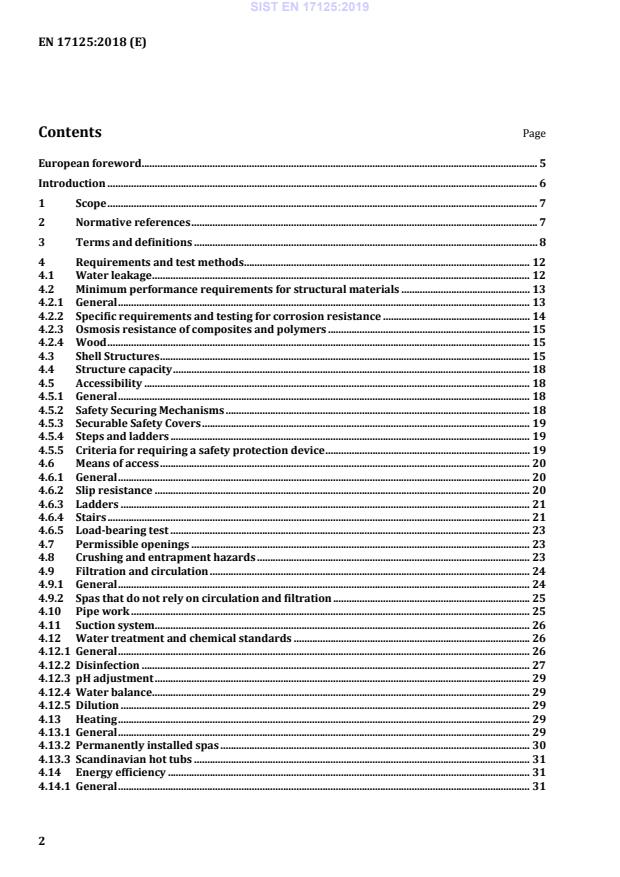
s y s t wã t r s z ESIST EN 17125:2019
Safety information in the user's manual
and instruction sheets accompanying the spa . 48 Annex B (normative)
Methods of test for entrapment . 50 B.1 Principle . 50 B.2 Pass and failure criteria . 50 B.2.1 Finger and toe entrapment . 50 B.2.2 Foot and hand entrapment . 50 B.2.3 Head or neck entrapment . 50 B.3 Head and neck entrapment . 50 B.3.1 Apparatus . 50 SIST EN 17125:2019
Domestic spas used in rented settings . 54 Annex D (informative)
Energy consumption test . 56 D.1 General . 56 D.2 Test equipment . 56 D.3 Test conditions . 56 D.4 Test procedure . 57 D.5 Formulae . 58 Annex E (informative)
Examples where a safety protection device can be installed . 60 Annex F (normative)
Test method for safety cover . 61 Bibliography . 65
Note 1 to entry: In different parts of the World, the terms “spa”, “hot tub” and “whirlpool” can be used inter changeably or in combination to describe the wide range of products in the market place such as spas listed in the scope of this standard. Note 2 to entry: Some spas may include hydro-massage jets (see 3.20).
1) This document is impacted by the amendments EN 60335-2-60:2003/A1:2005, EN 60335-2-60:2003/A2:2008, EN 60335-2-60:2003/A11:2010 and EN 60335-2-60:2003/A12:2010. SIST EN 17125:2019
— include peripheral jetted seats or loungers intended for water therapy; — may be a separate distinct portion of a combination spa/exercise spa and may have separate controls. Note 2 to entry: Recreational physical activities can be rowing, running, swimming, walking, cycling or any other exercise in situ. 3.4 portable spa transportable spa spa (either self-contained or non-self-contained) not intended for permanent and fixed installation, which can be located for indoor or outdoor use and can be relocated, if required Note 1 to entry: The transportability is unconnected to the weight of the appliance, with or without water. 3.5 inflatable spa type of portable (electric) spa that is free-standing and which contains an inflatable main structure that forms the vessel for the heated water and which is capable of being deflated for storage Note 1 to entry: Inflatable spas are not designed or intended to be permanently installed in the ground and are supplied with cord-connected equipment packages that integrate pumps, heaters, and blowers and or jets for heating, circulation, filtration, and maintenance. 3.6 permanently installed spa factory-built or field-engineered spa designed to remain in its intended location 3.7 Scandinavian hot tub spa for single use of water, where the water temperature is increased from an external heat source and which is sited outdoors 3.8 flotation tank enclosed bathing area, usually for one-person, containing water saturated with magnesium sulphate (Epsom salt), or natural salts 3.9 self-contained spa factory-built spa in which all controls and equipment are located within or affixed to the spa structure and integral parts of the product, not permanently fixed or built into the surroundings and may be permanently wired or cord connected SIST EN 17125:2019
non-self-contained permanently installed spa custom designed to fit a specific location, being assembled or constructed at the final installation location
EXAMPLE In the ground or concrete structure. 3.12 heater device to heat the spa water EXAMPLE Including, but not limited to, electric, combustion, solar, heat pump, etc. 3.13 cover device that is placed over the spa shell or floats on the water surface to reduce heat loss and/or dirt and debris getting into the water when not in use 3.14 safety cover variant of a cover with features/designs that prevent unauthorised access to the spa 3.15 safety protection device product to prevent people gaining unauthorised access to the spa EXAMPLE Including, but not limited to, safety cover, fence, barrier, lockable shelter. 3.16 pump mechanical device, usually powered by an electric motor, that provides hydraulic flow and pressure for the purpose of filtration, heating, circulation of spa water and/or hydro massage 3.17 water treatment way(method) to ensure water quality through physical and chemical actions [SOURCE: EN 16713-3:2016, 3.1, modified by adding "method"] 3.18 means of access design feature to facilitate entry to and/or exit from the spa [SOURCE: EN 16582-1:2015, 3.22, modified term spa] SIST EN 17125:2019
Figure 1 — Grip SIST EN 17125:2019
Figure 2 — Grasp 3.23 inground spa spa designed to be installed in the ground, with structural elements that ensure intrinsic resistance to internal and external pressures 3.24 aboveground spa spa designed to be placed on the ground or any suitable flat horizontal surface, with structural elements that ensures intrinsic resistance to internal pressures 3.25 recessed spa spa designed to be installed in the ground, in a masonry structure or equivalent that ensures resistance to internal and external pressures, if required 3.26 freeboard vertical distance between the water surface and the spa deck level 4 Requirements and test methods 4.1 Water leakage Self-contained spas shall be designed not to leak water. Non-self-contained spas may inherently leak some water in which case they shall comply with EN 16582-1:2015, 4.3.
Wooden Scandinavian hot tubs may exceed the limits in EN 16582-1:2015, 4.3. The manufacturer/retailer shall provide suitable information about water leakage in the point of purchase information (see Clause 5) and user's manual (see Clause 6). Spas shall be constructed/manufactured/designed to ensure water losses are minimized and do not create a hazard (e.g. electrical and slip hazard). Water loss caused by evaporation and bathers is not included. SIST EN 17125:2019
The structural design and materials shall be in accordance with accepted structural engineering practices. Selection of materials for the construction of the spa shall be conducted under consideration of external influences, including, but not limited to, temperature, UV, chemicals, when appropriate, that may influence the structural integrity of the material. Any combination of different materials in direct contact with each other shall be compatible and not negatively affect each other's properties or structural integrity. The parameters according to 4.12 (water treatment and chemicals standards) shall be met. In addition, there shall be no influence on the water quality according to 4.12, if the material comes into contact with the spa water. Examples of materials typically used for spa construction and lining are given, but not limited to, those shown in Table 1. Table 1 — Examples Materials typically used for spa construction and spa lining/finishes Material Spa construction Spa lining/finishes Acrylic
¾
¾ PVC-P
¾
¾ PVC reinforced membrane
¾
¾ Concrete
¾
¾ Polystyrene (PS) foam formstone
¾ — Glass reinforced plastic (GRP)
¾
¾ Composite construction
¾ — Polyurethane (composite material)
¾ — Aluminium
¾
¾ Stainless steel
¾
¾ Steel panels/support frames
¾ — Glass Complete or min. one side/wall
¾ Wood
¾
¾ Brick wall construction (expanded polystyrene, etc.)
¾ — Natural stone —
¾ Tiles —
¾ SIST EN 17125:2019
· 50 µm or prescriptions given in EN ISO 1461 (which correspond more or less to 375 g/m2); — stainless steels alloys with resistance equivalent to at least 316 L. In accordance with EN ISO 9227, subject to the applicable structure samples to be tested with salt spray for (see EN ISO 9227:2017, Annex A): — 192 h for aboveground and recessed spas for the parts not in contact with the ground; — 192 h for inground and/or recessed spas for the parts in contact with the ground and whose parts to be tested are
· 3 mm; — 400 h for inground and/or recessed spas for the parts in contact with the ground and whose parts to be tested are < 3 mm. On completion of these corrosion tests, all of the products shall meet the visual requirements described below: — red oxidation: assess the results obtained on steel parts, coated or not, referring to the recommendations of EN ISO 4628-3. The number of red rust pits on the surface shall conform to grade RI 3 or lower; — white oxidation is accepted on zinc-galvanised, electrogalvanised or bichromated parts; — green oxidation is accepted on material including copper; — brown oxidation is accepted on stainless steel; — the degree of blistering of organic coatings shall not exceed density 2, and the size of any blister shall not exceed size 3 as defined in EN ISO 4628-2. SIST EN 17125:2019
Figure 3 — Template for small elements All edges, protruding parts and corners accessible shall be designed not to cause any injury. When necessary they shall be treated appropriately to remove this risk (see Figure 4). For example, edges can be bevelled or rounded, and surfaces shall be smooth and free from burrs. Examples are provided in Figure 4. If they are due to a wall thickness less than 4 mm, one of the following requirements applies: — they shall be folded, rolled or wound in spirals according to Figure 4 d); — they shall be protected by a plastic coating or by any other suitable means as shown in Figure 4 e). SIST EN 17125:2019
Figure 4 — Examples of configuration of edges Shells made from thermoplastic composites include, but are not limited to, acrylic, ABS, HDPE and Vinyl, shall be watertight, free from any defects that may cause any injury, and suitably assembled with any backing reinforcement material. Where construction work is required for a spa installation, manufacturers shall specify the construction method and any relevant materials used together with details of the physical support required All timber (where applicable) within the spa shall be appropriate for its intended use.
Spas that are field engineered (rather than factory-built) may typically use materials such as concrete and tiles.
The assembled spa shall be designed to withstand the combined weight of the maximum volume of water recommended by the manufacturer and of the maximum number of bathers the spa can accommodate (see Clause 6). SIST EN 17125:2019
...
Questions, Comments and Discussion
Ask us and Technical Secretary will try to provide an answer. You can facilitate discussion about the standard in here.
Loading comments...