

oSIST prEN IEC 62973-3:2025/oprAA:2026
(Amendment)Railway applications - Rolling stock - Batteries for auxiliary power supply systems - Part 3: Lead acid batteries
- Abstract
The part 3 of IEC 62973 will get a European annex.
The European Annex will only contain additions regarding European operating conditions (such as temperature) and requirements (such as discharging/charging characteristic) as well as general additions (which are contained in EN 50547 but have not been adopted into the IEC).
- Status
- Not Published
- Public Enquiry End Date
- 30-Sep-2026
- Technical Committee
- ŽEN - Electrical applications for railways
- Current Stage
- 4020 - Public enquire (PE) (Adopted Project)
- Start Date
- 12-Aug-2026
- Due Date
- 30-Dec-2026

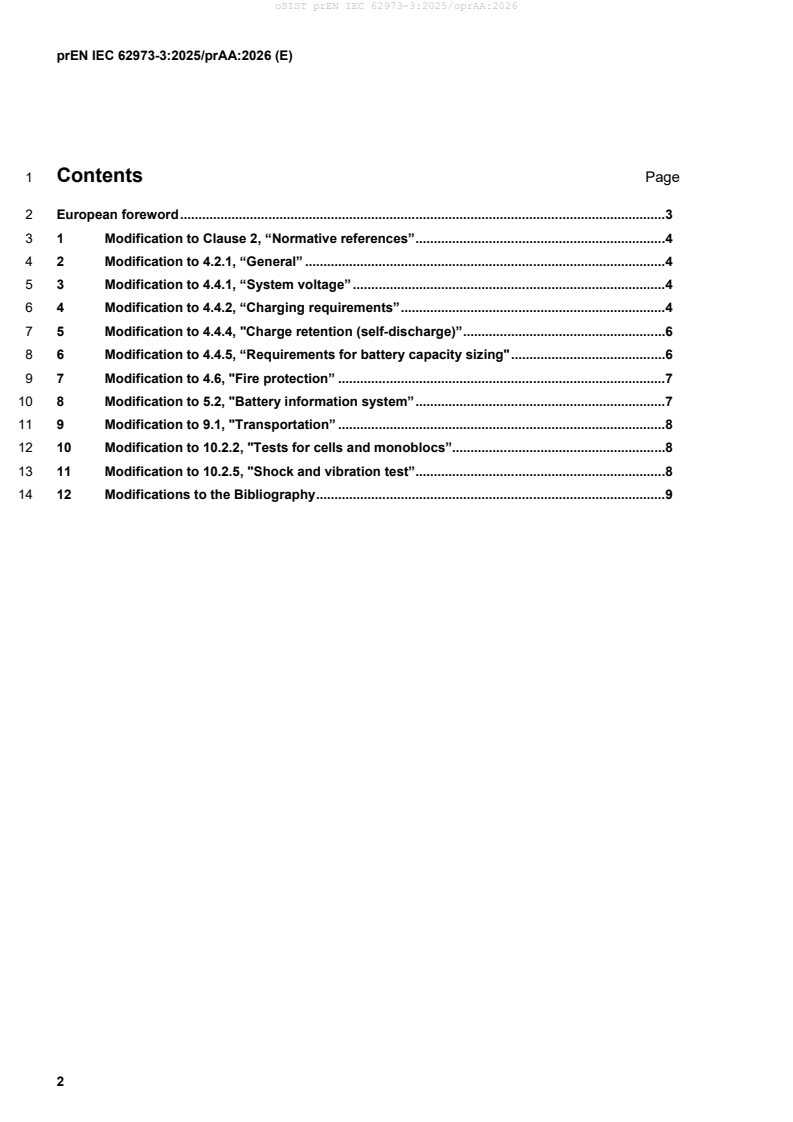
oSIST prEN IEC 62973-3:2025/oprAA:2026 is the Slovenian adoption of a CENELEC draft amendment to prEN IEC 62973-3:2025, published by SIST. It adds European requirements for lead acid batteries used in auxiliary power supply systems on railway rolling stock. The amendment focuses on operating conditions, charging, sizing, fire protection, transport and test details for manufacturers, train builders and testers.
What does oSIST prEN IEC 62973-3:2025/oprAA:2026 specify?
This draft amendment adds a European annex to Part 3 of IEC 62973 for lead acid batteries. The added text covers European operating conditions such as temperature, charging and discharging characteristics, and general additions carried over from EN 50547 that were not adopted into the IEC text.
oSIST prEN IEC 62973-3:2025/oprAA:2026 is organized as clause-by-clause modifications to Clauses 2, 4.2.1, 4.4.1, 4.4.2, 4.4.4, 4.4.5, 4.6, 5.2, 9.1, 10.2.2, 10.2.5 and the Bibliography. In practice, that means the document is a short European overlay on the base Part 3 text rather than a full rewrite.
What are the key requirements of oSIST prEN IEC 62973-3:2025/oprAA:2026?
Battery type and charging
Clause 4.2.1 classifies lead acid batteries used in auxiliary power supply systems into type A, with vented technology as A.1 and valve-regulated-lead technology as A.2, each with listed subtypes. In practice, this tells the reader which battery family a design belongs to before applying charging and sizing rules.
Clause 4.4.1 points the system voltage value to prEN IEC 62973-1:2025, Clause 3. That means the voltage basis is taken from the companion part instead of being repeated here.
Clause 4.4.2 sets typical charge parameters for vented, GEL and AGM batteries and links them to temperature compensation and charge control. The practical message is that charger settings must match the battery chemistry, ambient temperature and the need to keep water loss low in vented systems.
Clause 4.4.2 also states that charging should stop at +55 °C. This is a direct operating limit that matters for charger design, thermal protection and maintenance settings.
Capacity, storage and sizing
Clause 4.4.4 sets reversible loss of capacity limits after 30 days at 20 °C for AGM and Gel types, and for vented lead acid types. In practice, this gives a storage and acceptance criterion for batteries kept in stock or returned to service after storage.
Clause 4.4.5 assigns sizing data to both the train manufacturer and the battery manufacturer. The train manufacturer defines the emergency starting state of charge, ambient temperature, load profile and minimum battery voltage, while the battery manufacturer defines ageing factor and expected life.
Clause 4.4.5 also points to Annex A of EN IEC 62973-1 for the load profile and to Annex C of EN IEC 62973-3 for low-temperature performance. That matters because sizing is not just a nominal capacity check - the emergency duty profile and temperature both affect the rated battery capacity that must be selected.
Safety, monitoring, transport and testing
Clause 4.6 refers to the EN 45545 series for fire protection. The note says protection may be achieved at cell or monobloc level and/or box level, so the fire safety strategy can sit in the battery itself or in its installation.
Clause 5.2 adds guidance for the battery information system. It explains that energy calculation for lead acid batteries is limited and may be done either by integrating power over time or by using voltage-based estimation with current, voltage, temperature and age.
Clause 9.1 requires transport compliance with the applicable dangerous goods rules for UN 2794, UN 2795, UN 2796 and related entries. For used industrial batteries transported under ADR Special Provision 598, the text adds handling, short-circuit protection and labeling conditions.
Clause 10.2.2 adds tests for short-circuit current, d.c. internal resistance and valve operation. Clause 10.2.5 defines the shock and vibration sequence and the pass criteria, including no leakage, no deformation, no electrical malfunction, no terminal loosening and capacity above 95% of the initial value.
What terms does oSIST prEN IEC 62973-3:2025/oprAA:2026 define?
- State of charge (SOC) - the battery charge level used for emergency sizing, charging decisions and operating checks.
- Dangerous goods by road and rail (ADR/RID) - the transport rules named for lead acid batteries shipped as regulated goods.
- Vented lead acid batteries - lead acid batteries with liquid electrolyte, treated differently from valve-regulated designs in charging and self-discharge.
- Valve-regulated-lead technology - the sealed or regulated lead acid battery family used here for GEL and AGM types.
- Battery information system - the monitoring and data logic used to estimate battery condition, including limited energy calculation methods.
- Charge retention (self-discharge) - the ability of a battery to keep usable capacity during storage.
Who uses oSIST prEN IEC 62973-3:2025/oprAA:2026?
The amendment is used by rolling stock battery suppliers, train manufacturers, system integrators, railway operators, test laboratories and conformity assessment bodies. They use it to choose battery technology, set charger parameters, size emergency supply, check fire and transport requirements, and run shock, vibration and battery performance tests.
What changed in oSIST prEN IEC 62973-3:2025/oprAA:2026 from the previous edition?
This draft amendment modifies prEN IEC 62973-3:2025 by adding European text to Clause 2, 4.2.1, 4.4.1, 4.4.2, 4.4.4, 4.4.5, 4.6, 5.2, 9.1, 10.2.2, 10.2.5 and the Bibliography. The changes mainly introduce European operating conditions, charging and sizing guidance, fire protection references, transport requirements and test updates.
Which standards are used with oSIST prEN IEC 62973-3:2025/oprAA:2026?
| Standard | What it contributes |
|---|---|
| prEN IEC 62973-1:2025 | System voltage value and the load profile reference used for sizing |
| IEC/FDIS 61373:2026 | Shock and vibration test method for rolling stock equipment |
| IEC TR 61431 | Background for the battery information system |
| EN 45545 series | Fire protection requirements for railway vehicles |
| EN 50125-1 | Environmental conditions for rolling stock and on-board equipment |
| EN 50155 | Context for railway electronic equipment |
| IEC 60896-11 | General requirements and test methods for vented lead-acid batteries |
| IEC 60896-21:2004 | Discharge capacity and related test basis used in this part |
| IEC 60896-22:2004 | Companion test details for measurements and valve operation |
What does the oSIST prEN IEC 62973-3:2025/oprAA:2026 document contain?
The document contains clause-by-clause amendment text, not a full standalone standard. It includes battery type classification, charging guidance, self-discharge limits, sizing data, fire protection text, transport rules and test updates.
It also contains a table of typical lead acid battery charge parameters and a figure showing typical charging characteristics. These are used to set charger behavior and to compare vented, GEL and AGM charging profiles.
Another table gives the information needed to define a discharging characteristic, including operating temperature, ageing factor, energy throughput and life expectancy. That table supports battery sizing and procurement decisions.
The test section adds specific rows for cells and monoblocs, and another clause gives the shock and vibration test sequence. Those parts are used for verification, qualification and conformity assessment.
Relations
- Effective Date
- 25-Feb-2025
Get Certified
Connect with accredited certification bodies for this standard

IMQ S.p.A. (Certification)
Italian electrical product certification.

IRIS Certification (UNIFE)
International Railway Industry Standard certification.

SLG Prüf- und Zertifizierungs GmbH
German testing and certification body.
Sponsored listings
Frequently Asked Questions
oSIST prEN IEC 62973-3:2025/oprAA:2026 is a draft published by the Slovenian Institute for Standardization (SIST). Its full title is "Railway applications - Rolling stock - Batteries for auxiliary power supply systems - Part 3: Lead acid batteries". This standard covers: The part 3 of IEC 62973 will get a European annex. The European Annex will only contain additions regarding European operating conditions (such as temperature) and requirements (such as discharging/charging characteristic) as well as general additions (which are contained in EN 50547 but have not been adopted into the IEC).
The part 3 of IEC 62973 will get a European annex. The European Annex will only contain additions regarding European operating conditions (such as temperature) and requirements (such as discharging/charging characteristic) as well as general additions (which are contained in EN 50547 but have not been adopted into the IEC).
oSIST prEN IEC 62973-3:2025/oprAA:2026 is classified under the following ICS (International Classification for Standards) categories: 29.220.20 - Acid secondary cells and batteries; 45.040 - Materials and components for railway engineering; 45.060.01 - Railway rolling stock in general. The ICS classification helps identify the subject area and facilitates finding related standards.
oSIST prEN IEC 62973-3:2025/oprAA:2026 has the following relationships with other standards: It is inter standard links to oSIST prEN IEC 62973-3:2025. Understanding these relationships helps ensure you are using the most current and applicable version of the standard.
oSIST prEN IEC 62973-3:2025/oprAA:2026 is available in PDF format for immediate download after purchase. The document can be added to your cart and obtained through the secure checkout process. Digital delivery ensures instant access to the complete standard document.
Standards Content (Sample)
SLOVENSKI STANDARD
01-september-2026
Železniške naprave - Vozna sredstva - Baterije za pomožne napajalne sisteme - 3.
del: Svinčeve kislinske baterije - Dopolnilo AA
Railway applications - Rolling stock - Batteries for auxiliary power supply systems - Part
3: Lead acid batteries
Bahnanwendungen - Fahrzeuge - Batterien für Bordnetzversorgungssysteme - Teil 3:
Bleibatterien
Applications ferroviaires - Matériel roulant - Batteries pour systèmes d'alimentation
auxiliaire - Partie 3: Batteries au plomb
Ta slovenski standard je istoveten z: prEN IEC 62973-3:2025/prAA:2026
ICS:
29.220.20 Kislinski sekundarni členi in Acid secondary cells and
baterije batteries
45.060.01 Železniška vozila na splošno Railway rolling stock in
general
oSIST prEN IEC 62973- en
3:2025/oprAA:2026
2003-01.Slovenski inštitut za standardizacijo. Razmnoževanje celote ali delov tega standarda ni dovoljeno.
EUROPEAN STANDARD DRAFT
prEN IEC 62973-3:2025
NORME EUROPÉENNE
EUROPÄISCHE NORM
prAA
August 2026
ICS 29.220.20; 45.040 -
English Version
Railway applications - Rolling stock - Batteries for auxiliary
power supply systems - Part 3: Lead acid batteries
Applications ferroviaires - Matériel roulant - Batteries pour Bahnanwendungen - Fahrzeuge - Batterien für
systèmes d'alimentation auxiliaire - Partie 3: Batteries au Bordnetzversorgungssysteme - Teil 3: Bleibatterien
plomb
This draft amendment prAA, if approved, will modify the European Standard prEN IEC 62973-3:2025; it is submitted to CENELEC members
for enquiry.
Deadline for CENELEC: 2026-10-30.
It has been drawn up by CLC/TC 9X.
If this draft becomes an amendment, CENELEC members are bound to comply with the CEN/CENELEC Internal Regulations which
stipulate the conditions for giving this amendment the status of a national standard without any alteration.
This draft amendment was established by CENELEC in three official versions (English, French, German).
A version in any other language made by translation under the responsibility of a CENELEC member into its own language and notified to
the CEN-CENELEC Management Centre has the same status as the official versions.
CENELEC members are the national electrotechnical committees of Austria, Belgium, Bulgaria, Croatia, Cyprus, the Czech Republic,
Denmark, Estonia, Finland, France, Germany, Greece, Hungary, Iceland, Ireland, Italy, Latvia, Lithuania, Luxembourg, Malta, the
Netherlands, Norway, Poland, Portugal, Republic of North Macedonia, Romania, Serbia, Slovakia, Slovenia, Spain, Sweden, Switzerland,
Türkiye and the United Kingdom.
Recipients of this draft are invited to submit, with their comments, notification of any relevant patent rights of which they are aware and to
provide supporting documentation.
Warning : This document is not a European Standard. It is distributed for review and comments. It is subject to change without notice and
shall not be referred to as a European Standard.
European Committee for Electrotechnical Standardization
Comité Européen de Normalisation Electrotechnique
Europäisches Komitee für Elektrotechnische Normung
CEN-CENELEC Management Centre: Rue de la Science 23, B-1040 Brussels
© 2026 CENELEC All rights of exploitation in any form and by any means reserved worldwide for CENELEC Members.
Project: 81135 Ref. No. prEN IEC 62973-3:2025/prAA:2026 E
1 Contents Page
2 European foreword . 3
3 1 Modification to Clause 2, “Normative references” . 4
4 2 Modification to 4.2.1, “General” . 4
5 3 Modification to 4.4.1, “System voltage” . 4
6 4 Modification to 4.4.2, “Charging requirements” . 4
7 5 Modification to 4.4.4, "Charge retention (self-discharge)” . 6
8 6 Modification to 4.4.5, “Requirements for battery capacity sizing" . 6
9 7 Modification to 4.6, "Fire protection” . 7
10 8 Modification to 5.2, "Battery information system” . 7
11 9 Modification to 9.1, "Transportation” . 8
12 10 Modification to 10.2.2, "Tests for cells and monoblocs”. 8
13 11 Modification to 10.2.5, "Shock and vibration test” . 8
14 12 Modifications to the Bibliography . 9
15 European foreword
16 This document (prEN IEC 62973-3:2025/prAA:2026) has been prepared by CLC/SC 9XB “Electrical, electronic
17 and electromechanical material on board rolling stock, including associated software”.
18 This document is currently submitted to the Enquiry.
19 The following dates are proposed:
• latest date by which the existence of this (doa) dav + 6 months
document has to be announced at national level
• latest date by which this document has to be (dop) dav + 12 months
implemented at national level by publication of
an identical national standard or by
endorsement
• latest date by which the national standards (dow) dav + 36 months
conflicting with this document have to be (to be confirmed or
withdrawn modified when voting)
20 1 Modification to Clause 2, “Normative references”
21 Replace the reference to IEC 61373:2010 in Clause 2 and throughout the text with the following:
22 IEC/FDIS 61373:2026, Railway applications - Rolling stock equipment - Shock and vibration tests
23 2 Modification to 4.2.1, “General”
24 Add the following paragraphs:
25 “Below is an overview of the different types of lead-acid batteries that are commonly used in batteries for
26 auxiliary power supply systems.
27 Lead acid batteries
28 in general, called type A
29 Lead acid batteries with vented technology (liquid electrolyte)
30 called A.1 with the sub types
31 A.11 - grid plates (vented),
32 A.12 - tubular positive plates (vented)
33 Lead acid batteries with valve-regulated-lead technology (non-liquid respectively absorbed-liquid electrolyte)
34 called A.2 with the subtypes
35 A.21 GEL grid plates (valve-regulated),
36 A.22 GEL tubular positive plates (valve-regulated),
37 A.23 AGM grid plate (valve-regulated)
38 3 Modification to 4.4.1, “System voltage”
39 Delete the first, second and third paragraphs.
40 Add the following paragraph:
41 “See prEN IEC 62973-1:2025, Clause 3 for system voltage value.”
42 4 Modification to 4.4.2, “Charging requirements”
43 Delete the whole content, except Table 1.
44 Add the following:
45 “
46 Charge characteristics are to be selected in a way to ensure high state of charge under normal operating
47 conditions, and lowest possible water consumption (for vented systems).
As impacted by prEN IEC 62973-1:2025/prAA:2026.
48 Table 2 — Typical lead acid battery charge parameters
Lead acid technology Vented VRLA Remarks
Gel AGM
Charging with single level
Charging voltage 2,32 -2,38 V/cell 2,32 -2,38 V/cell 2,27 -2,32 See solid line at
Figure 1
at +20°C V/cell
–––––––––––
Temperature -0,004 V /°K -0,003 V /°K…-0,004 V /°K
correction
Maximum Charging Normally no current limit is needed for this charging
Current
(recommendation in case of current limitation 10 to 40 A per 100 Ah)
In case of additional boost level
Charging voltage
...