

prEN IEC 62973-3:2025/prAA:2026
(Amendment)Railway applications - Rolling stock - Batteries for auxiliary power supply systems - Part 3: Lead acid batteries
- Abstract
The part 3 of IEC 62973 will get a European annex. The European Annex will only contain additions regarding European operating conditions (such as temperature) and requirements (such as discharging/charging characteristic) as well as general additions (which are contained in EN 50547 but have not been adopted into the IEC).
- Status
- Not Published
- Publication Date
- 07-Feb-2028
- Drafting Committee
- WG 45 - RS - Auxiliary Batteries
- Current Stage
- 4060 - Enquiry results established and sent to TC, SR, BTTF - Enquiry
- Start Date
- 30-Oct-2026
- Due Date
- 20-Apr-2026
- Completion Date
- 20-Apr-2026

prEN IEC 62973-3:2025/prAA:2026 is a CENELEC draft amendment to the European standard for lead acid batteries used in railway rolling stock auxiliary power supply systems. It adds European operating-condition requirements, charging and sizing guidance, fire protection and transport points, and test updates for battery manufacturers, train manufacturers, and system integrators. The document is under enquiry and modifies prEN IEC 62973-3:2025.
What does prEN IEC 62973-3:2025/prAA:2026 specify?
prEN IEC 62973-3:2025/prAA:2026 specifies European additions for lead acid batteries in railway rolling stock auxiliary power supply systems. Its scope is limited to additions for European operating conditions such as temperature, charging and discharging behavior, and general points carried over from EN 50547 that were not adopted into the IEC text.
The document is organized as a set of clause-by-clause modifications to the base Part 3 text:
- European foreword
- Clause 2, normative references
- Clause 4.2.1, general battery types
- Clauses 4.4.1, 4.4.2, 4.4.4, 4.4.5
- Clause 4.6, fire protection
- Clause 5.2, battery information system
- Clause 9.1, transportation
- Clauses 10.2.2 and 10.2.5, tests
- Bibliography updates
What are the key requirements of prEN IEC 62973-3:2025/prAA:2026?
The amendment mainly changes how lead acid batteries are identified, charged, sized, protected, transported, and tested.
- Clause 2 replaces the shock and vibration reference with IEC/FDIS 61373:2026. In practice, qualification follows the current rolling stock shock and vibration test standard.
- Clause 4.2.1 adds a technology overview for type A lead acid batteries, including vented types and valve-regulated-lead technology (VRLA) types such as GEL and AGM. This helps users specify the battery construction they need.
- Clause 4.4.1 points system voltage to prEN IEC 62973-1:2025, Clause 3. This keeps voltage selection aligned with Part 1.
- Clause 4.4.2 sets the charging approach: select charge characteristics to keep a high state of charge under normal conditions and limit water loss in vented systems. Table 2 and Figure 4 give typical charging parameters and temperature compensation guidance for vented, GEL and AGM batteries. In practice, charger settings and high-temperature cut-off must match the battery technology.
- Clause 4.4.4 adds self-discharge limits after 30 days at 20°C for AGM/GEL and vented types. This matters for storage, parking and maintenance intervals.
- Clause 4.4.5 defines what the train manufacturer and battery manufacturer each have to state for capacity sizing: state of charge at emergency start, ambient temperature, load profile, minimum voltage, ageing factor and expected life. The text also allows an extra margin for future loads. Table 5 collects the key sizing inputs.
- Clause 4.6 requires observance of the EN 45545 series for fire protection. Fire control may be achieved at cell, monobloc or box level, so fire behaviour must be addressed in the vehicle design, not only in the battery itself.
- Clause 5.2 says energy calculation for lead acid batteries is limited and gives two approaches: power integration over time, or voltage-based estimation using current, voltage, temperature and age. The battery supplier is expected to provide the needed data.
- Clause 9.1 requires transport of lead-acid batteries as dangerous goods under the relevant ADR/RID provisions for UN 2794, UN 2795, UN 2796 and related entries. Used industrial batteries may be transported under ADR Special Provision 598 when the stated conditions are met.
- Clause 10.2.2 adds tests for short-circuit current and d.c. internal resistance, plus valve operation for cells and monoblocs.
- Clause 10.2.5 updates the shock and vibration test sequence, including pre-test capacity measurement, recharge, shock/vibration exposure, and post-test capacity check. The result criteria cover leakage, deformation, electrical malfunction and terminal loosening.
What terms does prEN IEC 62973-3:2025/prAA:2026 define?
- State of Charge (SOC) - the battery charge level used for emergency sizing and operating checks.
- Depth of Discharge (DoD) - the share of capacity taken out of the battery, used in energy throughput and life estimates.
- Valve-regulated-lead technology (VRLA) - lead acid technology with non-liquid or absorbed-liquid electrolyte.
- Absorbent Glass Mat (AGM) - a VRLA subtype identified in the classification of battery types.
- GEL - a VRLA subtype identified in the classification of battery types.
- Vented technology - lead acid batteries with liquid electrolyte and venting, used where water loss and charging limits must be managed.
- Monoblocs - battery units covered together with cells in the test clauses.
Who uses prEN IEC 62973-3:2025/prAA:2026?
prEN IEC 62973-3:2025/prAA:2026 is used by railway rolling stock designers, train manufacturers, battery manufacturers, and system integrators. It is also relevant to test laboratories, safety and quality teams, and logistics staff handling transport of lead acid batteries. They use it to select battery technology, set charging and sizing assumptions, define fire protection measures, and perform qualification and transport checks.
What changed in prEN IEC 62973-3:2025/prAA:2026 from the previous edition?
This draft amendment modifies prEN IEC 62973-3:2025 by adding European-specific requirements and updates in these areas:
- updated shock and vibration reference
- battery type overview for vented and VRLA lead acid batteries
- system voltage reference to Part 1
- revised charging requirements and charging characteristics
- self-discharge limits
- revised battery capacity sizing inputs
- fire protection reference to EN 45545
- battery information system notes
- transport requirements for dangerous goods
- test updates for cells, monoblocs, and shock/vibration
- bibliography updates
Which standards are used with prEN IEC 62973-3:2025/prAA:2026?
- prEN IEC 62973-1:2025 - provides the system voltage value and the load profile reference used in sizing.
- IEC/FDIS 61373:2026 - provides the shock and vibration test method.
- IEC 60896-21:2004 - provides the capacity test method used in the test clauses.
- IEC 60896-22 - supports the added measurements for short-circuit current, d.c. internal resistance and valve operation.
- IEC 60896-11:2002 - is cited for capacity sizing practice for vented stationary lead-acid batteries.
- IEC TR 61431 - provides context for the battery information system.
- EN 45545 series - provides railway fire protection requirements.
- EN 50125-1 and EN 50155 - are added as related railway environmental and electronic equipment references.
What does the prEN IEC 62973-3:2025/prAA:2026 document contain?
prEN IEC 62973-3:2025/prAA:2026 contains the amendment text that revises the base Part 3 document clause by clause. It includes Table 2 for charging parameters, Table 5 for capacity-sizing inputs, Figure 4 for charging characteristics, and updated test table entries in Clause 10.2.2. It also sets out the shock and vibration test sequence and the transport conditions for used industrial lead acid batteries.
Relations
- Effective Date
- 25-Feb-2025
Get Certified
Connect with accredited certification bodies for this standard

IMQ S.p.A. (Certification)
Italian electrical product certification.

IRIS Certification (UNIFE)
International Railway Industry Standard certification.

SLG Prüf- und Zertifizierungs GmbH
German testing and certification body.
Sponsored listings
Frequently Asked Questions
prEN IEC 62973-3:2025/prAA:2026 is a draft published by CLC. Its full title is "Railway applications - Rolling stock - Batteries for auxiliary power supply systems - Part 3: Lead acid batteries". This standard covers: The part 3 of IEC 62973 will get a European annex. The European Annex will only contain additions regarding European operating conditions (such as temperature) and requirements (such as discharging/charging characteristic) as well as general additions (which are contained in EN 50547 but have not been adopted into the IEC).
The part 3 of IEC 62973 will get a European annex. The European Annex will only contain additions regarding European operating conditions (such as temperature) and requirements (such as discharging/charging characteristic) as well as general additions (which are contained in EN 50547 but have not been adopted into the IEC).
prEN IEC 62973-3:2025/prAA:2026 is classified under the following ICS (International Classification for Standards) categories: 29.220.20 - Acid secondary cells and batteries; 45.040 - Materials and components for railway engineering. The ICS classification helps identify the subject area and facilitates finding related standards.
prEN IEC 62973-3:2025/prAA:2026 has the following relationships with other standards: It is inter standard links to prEN IEC 62973-3:2025. Understanding these relationships helps ensure you are using the most current and applicable version of the standard.
prEN IEC 62973-3:2025/prAA:2026 is available in PDF format for immediate download after purchase. The document can be added to your cart and obtained through the secure checkout process. Digital delivery ensures instant access to the complete standard document.
Standards Content (Sample)
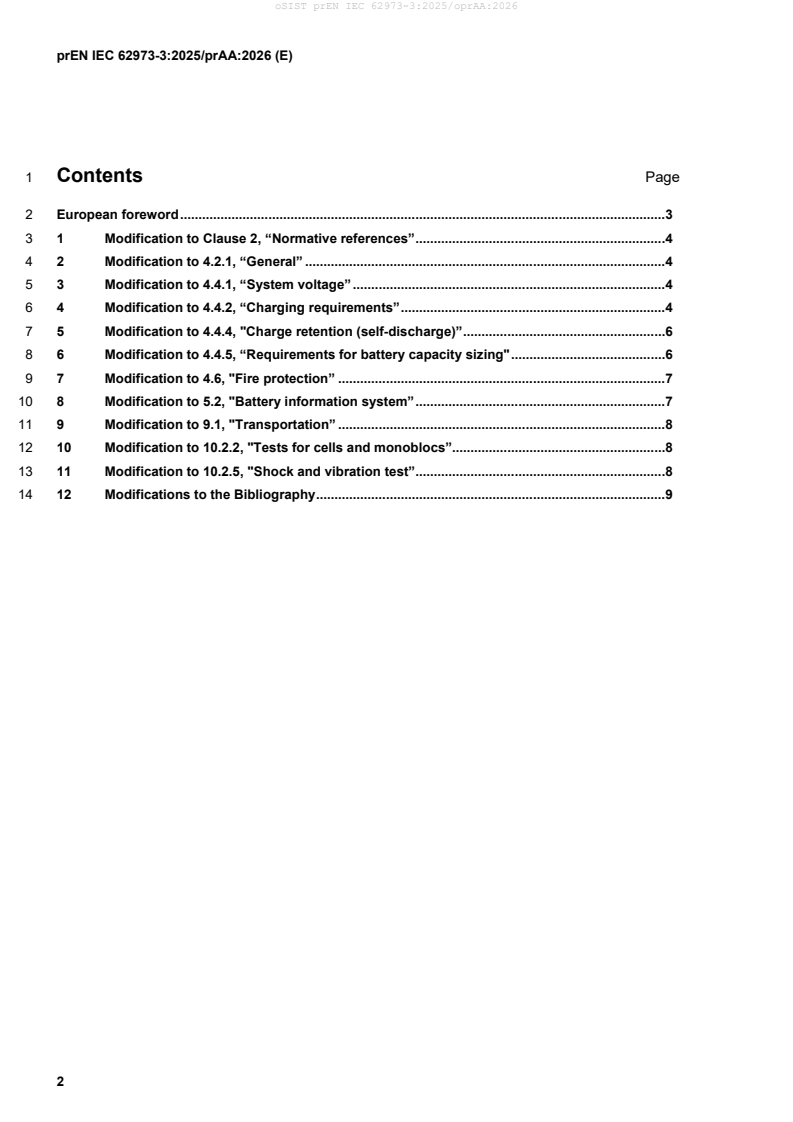
Contents
- 2 European foreword
- 3 1 Modification to Clause 2, “Normative references”
- 4 2 Modification to 4.2.1, “General”
- 5 3 Modification to 4.4.1, “System voltage”
- 6 4 Modification to 4.4.2, “Charging requirements”
- 7 5 Modification to 4.4.4, "Charge retention (self-discharge)”
- 8 6 Modification to 4.4.5, “Requirements for battery capacity sizing"
- 9 7 Modification to 4.6, "Fire protection”
- 10 8 Modification to 5.2, "Battery information system”
- 11 9 Modification to 9.1, "Transportation”
- 12 10 Modification to 10.2.2, "Tests for cells and monoblocs”
- 13 11 Modification to 10.2.5, "Shock and vibration test”
- 14 12 Modifications to the Bibliography
15 European foreword 16 This document (prEN IEC 62973-3:2025/prAA:2026) has been prepared by CLC/SC 9XB “Electrical, electronic 17 and electromechanical material on board rolling stock, including associated software”. 18 This document is currently submitted to the Enquiry.
19 The following dates are proposed:
- latest date by which the existence of this (doa) dav + 6 months document has to be announced at national level
- latest date by which this document has to be (dop) dav + 12 months implemented at national level by publication of an identical national standard or by endorsement
- latest date by which the national standards (dow) dav + 36 months conflicting with this document have to be (to be confirmed or withdrawn modified when voting) 20 1 Modification to Clause 2, “Normative references” 21 Replace the reference to IEC 61373:2010 in Clause 2 and throughout the text with the following:
22 IEC/FDIS 61373:2026, Railway applications - Rolling stock equipment - Shock and vibration tests 23 2 Modification to 4.2.1, “General” 24 Add the following paragraphs:
25 “Below is an overview of the different types of lead-acid batteries that are commonly used in batteries for 26 auxiliary power supply systems.
27 Lead acid batteries 28 in general, called type A 29 Lead acid batteries with vented technology (liquid electrolyte) 30 called A.1 with the sub types 31 A.11 - grid plates (vented), 32 A.12 - tubular positive plates (vented) 33 Lead acid batteries with valve-regulated-lead technology (non-liquid respectively absorbed-liquid electrolyte) 34 called A.2 with the subtypes 35 A.21 GEL grid plates (valve-regulated), 36 A.22 GEL tubular positive plates (valve-regulated), 37 A.23 AGM grid plate (valve-regulated) 38 3 Modification to 4.4.1, “System voltage” 39 Delete the first, second and third paragraphs.
40 Add the following paragraph:
...