

ISO/PRF 22230
(Main)Specification for phosphate conversion coating on magnesium and its alloys
- Abstract
This document specifies terms, definitions, requirements and test methods for phosphate conversion coatings which are usually applied to magnesium alloy components (hereinafter referred to as film).
- Status
- Not Published
- Technical Committee
- ISO/TC 79/SC 5 - Magnesium and alloys of cast or wrought magnesium
- Drafting Committee
- ISO/TC 79/SC 5 - Magnesium and alloys of cast or wrought magnesium
- Current Stage
- 5020 - FDIS ballot initiated: 2 months. Proof sent to secretariat
- Start Date
- 23-Oct-2026
- Completion Date
- 07-Nov-2026
Buy Documents

ISO/PRF 22230 - Specification for phosphate conversion coating on magnesium and its alloys
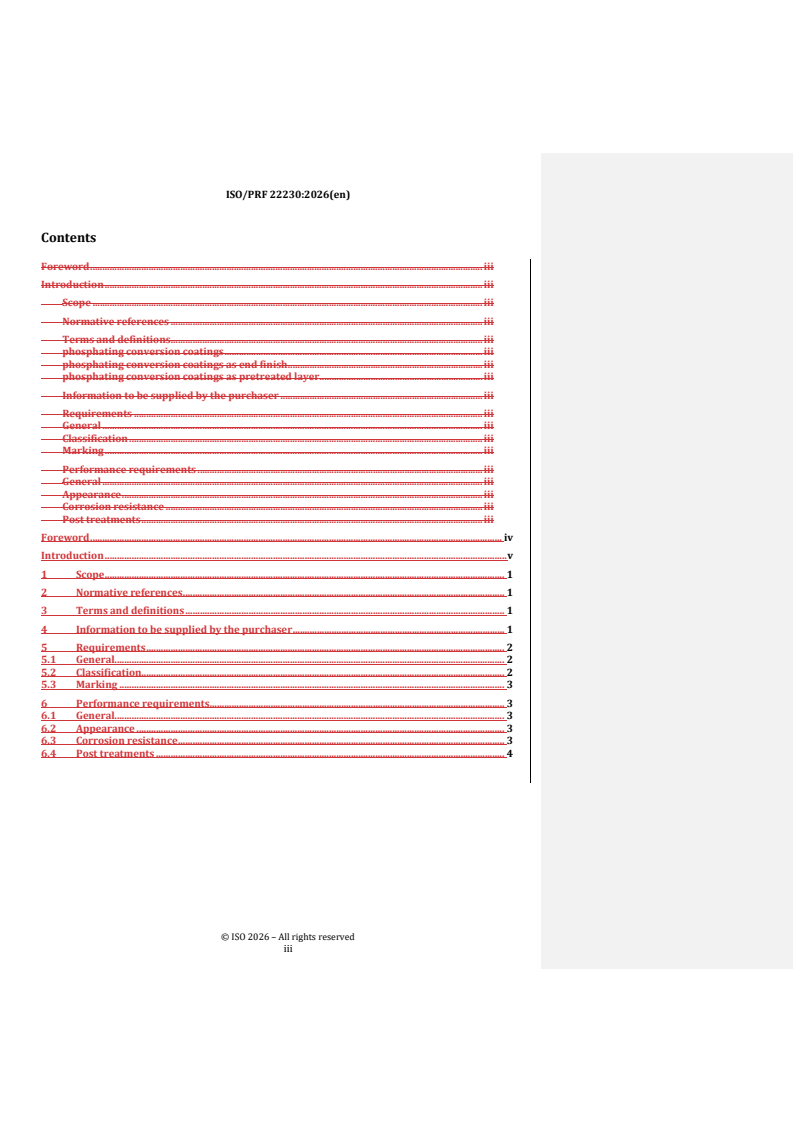
REDLINE ISO/PRF 22230 - Specification for phosphate conversion coating on magnesium and its alloys
ISO 22230 is an ISO specification for phosphate conversion coatings on magnesium and its alloys. It sets out the terms, requirements and test methods for coatings usually applied to magnesium alloy components, including when the coating is used as an end finish or as a pretreatment layer.
What does ISO 22230 specify?
ISO 22230 specifies how phosphate conversion coatings on magnesium and its alloys are described, supplied, marked and checked. The document is organized into scope, normative references, terms and definitions, purchaser information, requirements, and performance requirements.
The standard applies to the coating layer referred to as the film. It also uses the document’s own classification, marking and performance criteria so that supplier and purchaser can agree on the same coating type and expected behavior.
What are the key requirements of ISO 22230?
ISO 22230 focuses on surface condition, coating classification, marking, appearance, corrosion resistance and post-treatments. In practice, it tells the buyer and coater what must be agreed before treatment and what the finished coating should achieve.
Surface preparation and cleanliness
ISO 22230 requires the product surface to be clean before phosphating, with no oxidation, scale or contamination such as chips, grinding powder, oil, grease or sweat. Cleaning is required first, and pickling is used when oxides or scale remain.
This matters because the coating depends on the starting surface. If the surface is dirty or oxidized, the phosphate film may form poorly or perform inconsistently.
Purchaser-supplied information
ISO 22230 requires the purchaser to provide the coating description, sampling procedure, acceptable quality limit or other test deviations from ISO 4519, surface appearance, phosphating parameters, corrosion resistance requirement, and any magnesium alloy matrix condition that affects film formation or appearance.
This matters because the standard is not just a product recipe. It requires the order to define the expected coating, the checks to be used, and any special conditions that could change results.
Classification of coating types
ISO 22230 classifies the coating by composition system and typical application. The table includes Znph, Mnph, Zn and Ca, and Vph series, with example uses such as vehicle parts, railcars, 3C products and battery end plates for new energy vehicles.
This matters because the coating type should match the service need - for example temporary corrosion protection, primer use, or protection in sealed environments.
Marking
ISO 22230 requires marking to be given in the order of coating name, reference to the standard, composition system and post-treatment symbol.
This matters because the marking makes the coating specification readable on contracts, records and purchase documents, so both sides identify the same film.
Appearance requirements
ISO 22230 requires the coating to be continuous, with no white spots and no ash hanging, and with uniform appearance and colour. Supplier and purchaser may agree standard samples for appearance and colour.
This matters because appearance is part of acceptance, not only cosmetics. It also gives a practical reference when visual inspection is used.
Corrosion resistance and test method
ISO 22230 uses the neutral salt spray test (NSS) to characterize corrosion resistance. The coating must meet the minimum NSS exposure time for its intended use, and the test is carried out in accordance with ISO 9227.
This matters because corrosion performance is tied to a defined laboratory test, so results can be compared consistently. The purchaser is responsible for conducting the NSS.
Post-treatments
ISO 22230 requires post-treatments to be agreed by supplier and purchaser and stated in the contract. The listed symbols cover varnishes or organic coatings, inorganic or non-film-forming organic sealants, inorganic or organic sealing agents, and grease, oil or other lubricants.
This matters because the final performance can change after sealing or overcoating, so the contract has to state which finishing step is part of the coating system.
What terms does ISO 22230 define?
ISO 22230 defines phosphating conversion coatings as stable compound coatings formed on the surface of products in phosphoric acid solution by chemical or electrochemical methods.
A phosphating conversion coating as end finish is a coating used as the final surface of the product.
A phosphating conversion coating as pretreated layer is a coating used before a subsequent coating is applied.
The document uses film to mean the phosphate conversion coating on magnesium alloy components.
Neutral salt spray test (NSS) is the corrosion test used to assess the coating’s resistance under artificial salt spray conditions.
Who uses ISO 22230?
ISO 22230 is used by coating suppliers, purchasers, quality managers and test laboratories working with magnesium and magnesium alloy components. It is relevant to industries that use coated magnesium parts in vehicles, railcars, textile profiles and new energy vehicle battery components.
It is especially useful when a supplier and purchaser need a common way to specify the coating system, check appearance, define corrosion resistance and agree on post-treatment.
Which standards are used with ISO 22230?
ISO 22230 cites ISO 2080 for coating vocabulary, so users can apply the same terminology for metallic and other inorganic coatings.
It cites ISO 4519 for sampling procedures by attributes, which supports inspection planning and acceptable quality limits.
It cites ISO 9227 for salt spray testing, which provides the method used for the NSS corrosion requirement.
What does the ISO 22230 document contain?
ISO 22230 contains a purchaser-information clause, a general requirements clause, a classification table, a marking rule, and performance requirements for appearance, corrosion resistance and post-treatments. It also includes the terms and definitions section that establishes the meaning of the coating terms used in the standard.
The document’s tables provide the coating series and their typical applications, the NSS exposure times by intended use, and the symbols for post-treatments. These are the parts a buyer or supplier would use when writing a specification, checking acceptance, or setting up quality control for a magnesium coating process.
Buy Documents
ISO/PRF 22230 - Specification for phosphate conversion coating on magnesium and its alloys
REDLINE ISO/PRF 22230 - Specification for phosphate conversion coating on magnesium and its alloys
Get Certified
Connect with accredited certification bodies for this standard

DVS-ZERT GmbH
German welding certification society.

Element Materials Technology
Materials testing and product certification.

Inštitut za kovinske materiale in tehnologije
Institute of Metals and Technology. Materials testing, metallurgical analysis, NDT.
Sponsored listings
Frequently Asked Questions
ISO/PRF 22230 is a draft published by the International Organization for Standardization (ISO). Its full title is "Specification for phosphate conversion coating on magnesium and its alloys". This standard covers: This document specifies terms, definitions, requirements and test methods for phosphate conversion coatings which are usually applied to magnesium alloy components (hereinafter referred to as film).
This document specifies terms, definitions, requirements and test methods for phosphate conversion coatings which are usually applied to magnesium alloy components (hereinafter referred to as film).
ISO/PRF 22230 is classified under the following ICS (International Classification for Standards) categories: 25.220.20 - Surface treatment; 77.120.20 - Magnesium and magnesium alloys. The ICS classification helps identify the subject area and facilitates finding related standards.
ISO/PRF 22230 is available in PDF format for immediate download after purchase. The document can be added to your cart and obtained through the secure checkout process. Digital delivery ensures instant access to the complete standard document.
Standards Content (Sample)
International
Standard
ISO 22230
First edition
Specification for phosphate
conversion coating on magnesium
and its alloys
Spécifications relatives aux couches de conversion au phosphate
sur le magnésium et ses alliages
PROOF/ÉPREUVE
Reference number
ISO 22230:2026(en) © ISO 2026
ISO 22230:2026(en)
© ISO 2026
All rights reserved.
This ISO publication is protected by copyright and is owned by ISO and/or its licensors.
The content of this ISO publication is provided under licence, not sold. Use is subject to the applicable licence terms issued by ISO,
an ISO member body, or an authorized third-party distributor.
Except as required for implementation or expressly permitted by a separate licence, no part of this ISO publication may be
reproduced, distributed, modified, used, or made available in any form or by any means – electronic or mechanical, including
photocopying, scanning, recording, or posting on internal or external digital platforms.
Any use beyond the scope of the granted rights is prohibited and may result in legal action.
ISO copyright office
CP 401 • CH-1214 Vernier, Geneva
Phone: +41 22 749 01 11
Email: copyright@iso.org
Website: www.iso.org
Published in Switzerland
PROOF/ÉPREUVE
ii
ISO 22230:2026(en)
Contents Page
Foreword .iv
Introduction .v
1 Scope .1
2 Normative references .1
3 Terms and definitions .1
4 Information to be supplied by the purchaser .1
5 Requirements . 2
5.1 General .2
5.2 Classification .2
5.3 Marking .2
6 Performance requirements . . 3
6.1 General .3
6.2 Appearance .3
6.3 Corrosion resistance .3
6.4 Post treatments.3
PROOF/ÉPREUVE
iii
ISO 22230:2026(en)
Foreword
ISO (the International Organization for Standardization) is a worldwide federation of national standards
bodies (ISO member bodies). The work of preparing International Standards is normally carried out through
ISO technical committees. Each member body interested in a subject for which a technical committee
has been established has the right to be represented on that committee. International organizations,
governmental and non-governmental, in liaison with ISO, also take part in the work. ISO collaborates closely
with the International Electrotechnical Commission (IEC) on all matters of electrotechnical standardization.
The procedures used to develop this document and those intended for its further maintenance are described
in the ISO/IEC Directives, Part 1. In particular, the different approval criteria needed for the different types
of ISO document should be noted. This document was drafted in accordance with the editorial rules of the
ISO/IEC Directives, Part 2 (see www.iso.org/directives).
ISO draws attention to the possibility that the implementation of this document may involve the use of (a)
patent(s). ISO takes no position concerning the evidence, validity or applicability of any claimed patent
rights in respect thereof. As of the date of publication of this document, ISO had not received notice of (a)
patent(s) which may be required to implement this document. However, implementers are cautioned that
this may not represent the latest information, which may be obtained from the patent database available at
www.iso.org/patents. ISO shall not be held responsible for identifying any or all such patent rights.
Any trade name used in this document is information given for the convenience of users and does not
constitute an endorsement.
For an explanation of the voluntary nature of standards, the meaning of ISO specific terms and expressions
related to conformity assessment, as well as information about ISO's adherence to the World Trade
Organization (WTO) principles in the Technical Barriers to Trade (TBT), see www.iso.org/iso/foreword.html.
This document was prepared by Technical Committee ISO/TC 79, Light metals and their alloys, Subcommittee
SC 5, Magnesium and alloys of cast or wrought magnesium.
Any feedback or questions on this document should be directed to the user’s national standards body. A
complete listing of these bodies can be found at www.iso.org/members.html.
PROOF/ÉPREUVE
iv
ISO 22230:2026(en)
Introduction
Phosphate conversion coatings are applied to magnesium and its alloy components either as an end finish or
as a pretreatment layer for other coatings. They are intended to:
— improve corrosion resistance durin
...
Formatted: Spanish (Uruguay)
ISO/TC 79/SC 5
Secretariat: SAC
Date: 2026-08-2810-23
Specification for phosphate conversion coating on magnesium and its
alloys
Spécifications relatives aux couches de conversion au phosphate sur le magnésium et ses alliages
PROOF
© ISO 2026
All rights reserved. Unless otherwise specified,
This ISO publication is protected by copyright and is owned by ISO and/or its licensors.
The content of this ISO publication is provided under licence, not sold. Use is subject to the applicable licence terms issued
by ISO, an ISO member body, or an authorized third-party distributor.
Except as required in the context of its for implementation or expressly permitted by a separate licence, no part of this
ISO publication may be reproduced or utilized otherwise, distributed, modified, used, or made available in any form or
by any means, – electronic or mechanical, including photocopying, scanning, recording, or posting on internal or external
digital platforms.
Any use beyond the internet or an intranet, without prior written permission. Permission can be requested from either
ISO at the address below or ISO’s member body in the countryscope of the requestergranted rights is prohibited and may
result in legal action.
ISO copyright office
CP 401 • Ch. de Blandonnet 8
CH-1214 Vernier, Geneva
Phone: + 41 22 749 01 11
E-mailEmail: copyright@iso.org
Website: www.iso.org
Published in Switzerland
ii
Contents
Foreword . iii
Introduction . iii
Scope . iii
Normative references . iii
Terms and definitions . iii
phosphating conversion coatings . iii
phosphating conversion coatings as end finish . iii
phosphating conversion coatings as pretreated layer. iii
Information to be supplied by the purchaser . iii
Requirements . iii
General . iii
Classification . iii
Marking . iii
Performance requirements . iii
General . iii
Appearance . iii
Corrosion resistance . iii
Post treatments . iii
Foreword . iv
Introduction . v
1 Scope . 1
2 Normative references . 1
3 Terms and definitions . 1
4 Information to be supplied by the purchaser . 1
5 Requirements . 2
5.1 General. 2
5.2 Classification. 2
5.3 Marking . 3
6 Performance requirements . 3
6.1 General. 3
6.2 Appearance . 3
6.3 Corrosion resistance . 3
6.4 Post treatments . 4
iii
Foreword
ISO (the International Organization for Standardization) is a worldwide federation of national standards
bodies (ISO member bodies). The work of preparing International Standards is normally carried out through
ISO technical committees. Each member body interested in a subject for which a technical committee has been
established has the right to be represented on that committee. International organizations, governmental and
non-governmental, in liaison with ISO, also take part in the work. ISO collaborates closely with the
International Electrotechnical Commission (IEC) on all matters of electrotechnical standardization.
The procedures used to develop this document and those intended for its further maintenance are described
in the ISO/IEC Directives, Part 1. In particular, the different approval criteria needed for the different types of
ISO document should be noted. This document was drafted in accordance with the editorial rules of the
ISO/IEC Directives, Part 2 (see www.iso.org/directives).
ISO draws attention to the possibility that the implementation of this document may involve the use of (a)
patent(s). ISO takes no position concerning the evidence, validity or applicability of any claimed patent rights
in respect thereof. As of the date of publication of this document, ISO [had/had not] received notice of (a)
patent(s) which may be required to implement this document. However, implementers are cautioned that this
may not represent the latest information, which may be obtained from the patent database available at
www.iso.org/patents. ISO shall not be held responsible for identifying any or all such patent rights.
Any trade name used in this document is information given for the convenience of users and does not
constitute an endorsement.
For an explanation of the voluntary nature of standards, the meaning of ISO specific terms and expressions
related to conformity assessment, as well as information about ISO's adherence to the World Trade
Organization (WTO) principles in the Technical Barriers to Trade (TBT), see www.iso.org/iso/foreword.html.
This document was prepared by Technical Committee ISO/TC 79, Light metals and their alloys, Subcommittee
SC 5, Magnesium and alloys of cast or wrought magnesium.
Any feedback or questions on this document should be directed to the user’s national standards body. A
complete listing of these bodies can be found at www.iso.or
...