


ISO 19001:2013
(Main)In vitro diagnostic medical devices — Information supplied by the manufacturer with in vitro diagnostic reagents for staining in biology
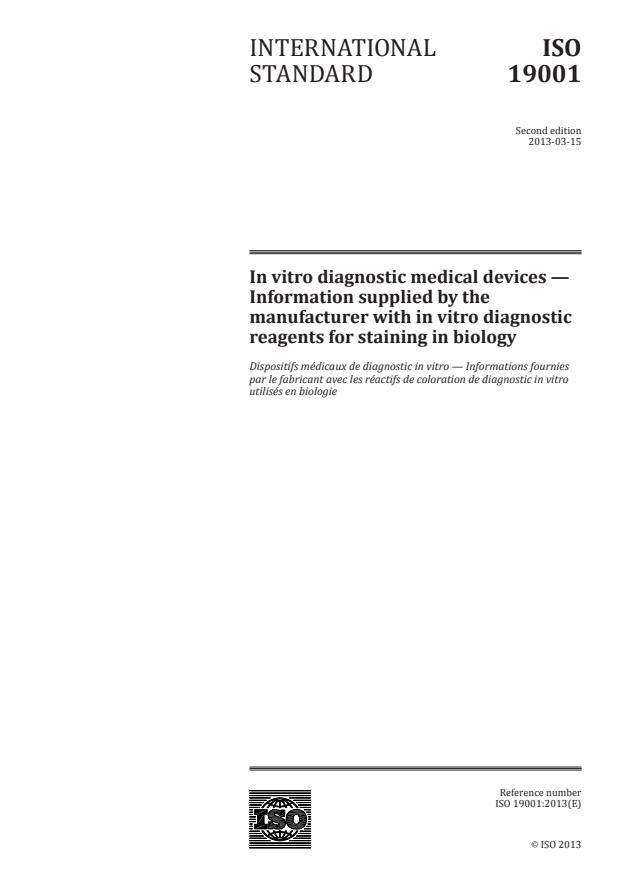
In vitro diagnostic medical devices — Information supplied by the manufacturer with in vitro diagnostic reagents for staining in biology
ISO 19001:2013 specifies requirements for information supplied by the manufacturer with reagents used in staining in biology. It applies to producers, suppliers and vendors of dyes, stains, chromogenic reagents and other reagents used for staining in histology and cytology including bacteriology, haematology, histochemistry, as performed in medical laboratories, both routine and research bacteriology. The requirements for information supplied by the manufacturer specified in ISO 19001:2013 are a prerequisite for achieving comparable and reproducible results in all fields of staining in biology.
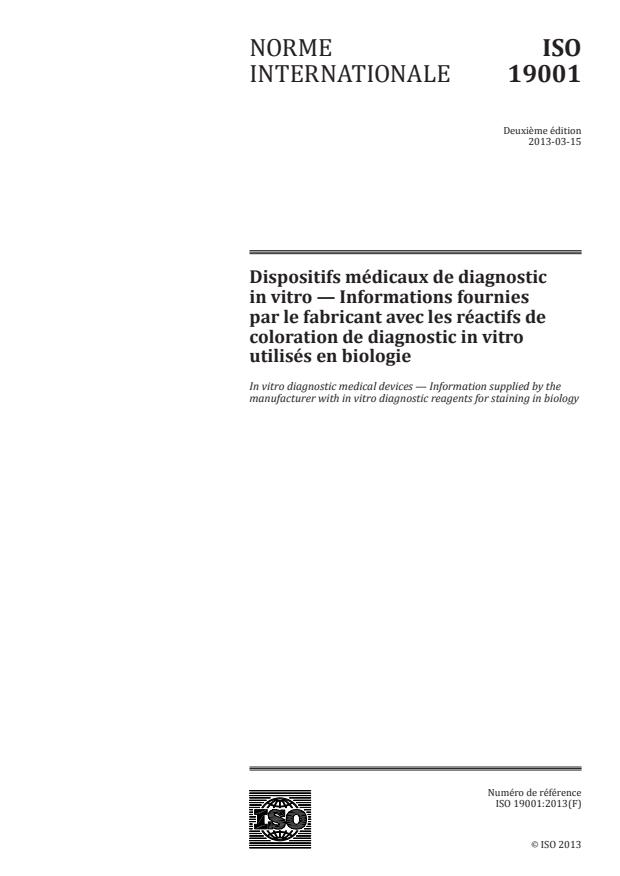
Dispositifs médicaux de diagnostic in vitro — Informations fournies par le fabricant avec les réactifs de coloration de diagnostic in vitro utilisés en biologie
L'ISO 19001:2013 spécifie des exigences relatives aux informations fournies par le fabricant et applicables aux colorants utilisés en biologie. Elle s'adresse aux fabricants, fournisseurs et distributeurs de teintures, colorants, réactifs chromogènes et autres réactifs de coloration utilisés en histologie et en cytologie, notamment en bactériologie, en hématologie, en histochimie, effectuées en laboratoires médicaux, en bactériologie de routine et de recherche. Les exigences relatives aux informations fournies par le fabricant et spécifiées dans la présente Norme internationale constituent une condition préalable à l'obtention de résultats comparables et reproductibles dans le domaine des colorations biologiques.
General Information
- Status
- Published
- Publication Date
- 06-Mar-2013
- Current Stage
- 9093 - International Standard confirmed
- Start Date
- 17-Jan-2024
- Completion Date
- 14-Feb-2026
Relations
- Effective Date
- 12-Feb-2026
- Effective Date
- 28-Feb-2009
Overview
ISO 19001:2013 - In vitro diagnostic medical devices - Information supplied by the manufacturer with in vitro diagnostic reagents for staining in biology - defines the information manufacturers, suppliers and vendors must provide with reagents used for biological staining. The standard focuses on dyes, stains, chromogenic reagents, fluorochromes, antibodies and nucleic acid probes used in histology, cytology, bacteriology, haematology and histochemistry for both routine and research laboratories. Its purpose is to ensure comparable and reproducible staining results by standardizing labelling and documentation for in vitro diagnostic (IVD) reagents.
Key topics and requirements
- Scope and applicability: Applies to producers, suppliers and vendors of staining reagents used in medical laboratories (ISO 19001:2013).
- Chain of suppliers: Manufacturers must assure upstream suppliers meet recognized quality-system expectations (references to ISO 9001 and ISO 13485).
- Warnings and precautions: Labelling must include required safety information consistent with ISO 18113-1 and ISO 18113-2.
- Format and units: Information format must follow ISO 80000-1 and ISO 80000-9 (quantities and units).
- Product identification: Product name should include CAS registry number and Colour Index name/number where relevant.
- Product identity and batch data: Required physico‑chemical details (molecular formula, molar mass, allowable impurities, storage/handling) and analytical data (molar absorbance, λmax, TLC/HPLC/HPTLC).
- Suggested use and performance: Manufacturers must supply recommended protocols, sample types, expected results, appropriate positive/negative controls and literature references.
- Specific reagent requirements:
- Fluorochromes: selectivity, excitation/emission wavelengths, and F/P ratio for conjugates.
- Metal salts: systematic name and purity.
- Antibodies: antigen description, host/clonal data, form and concentration, purity and references.
- Nucleic acid probes: sequence/strandness, length/mass, labeling method, target gene, purity and patent information.
Applications and who uses it
- Clinical and research laboratories implementing staining protocols in histology, cytology, bacteriology, haematology and histochemistry.
- IVD reagent manufacturers and suppliers preparing labels, instructions for use (IFU) and batch data sheets.
- Quality and regulatory teams ensuring documentation supports reproducibility, traceability and compliance with labelling regulations.
- Purchasers and lab managers assessing reagent suitability and comparability across suppliers.
Related standards
- ISO 18113-1 / ISO 18113-2 - labelling and information for IVD reagents
- ISO 80000-1 / ISO 80000-9 - quantities and units
- ISO 9001, ISO 13485 - quality management expectations for suppliers
ISO 19001:2013 is essential for ensuring clear, consistent manufacturer information that supports reliable staining results and regulatory compliance across clinical and research settings.
Buy Documents

ISO 19001:2013 - In vitro diagnostic medical devices -- Information supplied by the manufacturer with in vitro diagnostic reagents for staining in biology
ISO 19001:2013 - Dispositifs médicaux de diagnostic in vitro -- Informations fournies par le fabricant avec les réactifs de coloration de diagnostic in vitro utilisés en biologie
Get Certified
Connect with accredited certification bodies for this standard

BSI Group
BSI (British Standards Institution) is the business standards company that helps organizations make excellence a habit.

TÜV Rheinland
TÜV Rheinland is a leading international provider of technical services.

TÜV SÜD
TÜV SÜD is a trusted partner of choice for safety, security and sustainability solutions.
Sponsored listings
Frequently Asked Questions
ISO 19001:2013 is a standard published by the International Organization for Standardization (ISO). Its full title is "In vitro diagnostic medical devices — Information supplied by the manufacturer with in vitro diagnostic reagents for staining in biology". This standard covers: ISO 19001:2013 specifies requirements for information supplied by the manufacturer with reagents used in staining in biology. It applies to producers, suppliers and vendors of dyes, stains, chromogenic reagents and other reagents used for staining in histology and cytology including bacteriology, haematology, histochemistry, as performed in medical laboratories, both routine and research bacteriology. The requirements for information supplied by the manufacturer specified in ISO 19001:2013 are a prerequisite for achieving comparable and reproducible results in all fields of staining in biology.
ISO 19001:2013 specifies requirements for information supplied by the manufacturer with reagents used in staining in biology. It applies to producers, suppliers and vendors of dyes, stains, chromogenic reagents and other reagents used for staining in histology and cytology including bacteriology, haematology, histochemistry, as performed in medical laboratories, both routine and research bacteriology. The requirements for information supplied by the manufacturer specified in ISO 19001:2013 are a prerequisite for achieving comparable and reproducible results in all fields of staining in biology.
ISO 19001:2013 is classified under the following ICS (International Classification for Standards) categories: 11.040.55 - Diagnostic equipment; 11.100.10 - In vitro diagnostic test systems. The ICS classification helps identify the subject area and facilitates finding related standards.
ISO 19001:2013 has the following relationships with other standards: It is inter standard links to EN ISO 19001:2013, ISO 19001:2002. Understanding these relationships helps ensure you are using the most current and applicable version of the standard.
ISO 19001:2013 is available in PDF format for immediate download after purchase. The document can be added to your cart and obtained through the secure checkout process. Digital delivery ensures instant access to the complete standard document.
Standards Content (Sample)
INTERNATIONAL ISO
STANDARD 19001
Second edition
2013-03-15
In vitro diagnostic medical devices —
Information supplied by the
manufacturer with in vitro diagnostic
reagents for staining in biology
Dispositifs médicaux de diagnostic in vitro — Informations fournies
par le fabricant avec les réactifs de coloration de diagnostic in vitro
utilisés en biologie
Reference number
©
ISO 2013
© ISO 2013
All rights reserved. Unless otherwise specified, no part of this publication may be reproduced or utilized otherwise in any form
or by any means, electronic or mechanical, including photocopying, or posting on the internet or an intranet, without prior
written permission. Permission can be requested from either ISO at the address below or ISO’s member body in the country of
the requester.
ISO copyright office
Case postale 56 • CH-1211 Geneva 20
Tel. + 41 22 749 01 11
Fax + 41 22 749 09 47
E-mail copyright@iso.org
Web www.iso.org
Published in Switzerland
ii © ISO 2013 – All rights reserved
Contents Page
Foreword .iv
Introduction .v
1 Scope . 1
2 Normative references . 1
3 Terms and definitions . 1
4 Requirements for information supplied by the manufacturer . 3
4.1 General requirements . 3
4.2 Additional requirements for specific kinds of reagent . 4
Annex A (informative) Examples of information supplied by the manufacturer with reagents
commonly used in biological staining procedures . 7
Bibliography .13
Foreword
ISO (the International Organization for Standardization) is a worldwide federation of national standards
bodies (ISO member bodies). The work of preparing International Standards is normally carried out
through ISO technical committees. Each member body interested in a subject for which a technical
committee has been established has the right to be represented on that committee. International
organizations, governmental and non-governmental, in liaison with ISO, also take part in the work.
ISO collaborates closely with the International Electrotechnical Commission (IEC) on all matters of
electrotechnical standardization.
International Standards are drafted in accordance with the rules given in the ISO/IEC Directives, Part 2.
The main task of technical committees is to prepare International Standards. Draft International
Standards adopted by the technical committees are circulated to the member bodies for voting.
Publication as an International Standard requires approval by at least 75 % of the member bodies
casting a vote.
Attention is drawn to the possibility that some of the elements of this document may be the subject of
patent rights. ISO shall not be held responsible for identifying any or all such patent rights.
ISO 19001 was prepared by Technical Committee ISO/TC 212, Clinical laboratory testing and in vitro
diagnostic test systems.
This second edition cancels and replaces the first edition (ISO 19001:2002), which has been
technically revised.
iv © ISO 2013 – All rights reserved
Introduction
This International Standard relates to ISO 18113-1 and ISO 18113-2, which can be used in conjunction
with it.
The use of reagents required for staining in biology as well as the specific examples of information supplied
by the manufacturer for two staining procedures as provided in Annex A are based on a European consensus;
they constitute the scientific justification for the requirements listed in Clause 4. This information is
intended to assist manufacturers, suppliers and vendors of dyes, stains, chromogenic reagents and other
reagents used for staining in biology in complying with the required specific product data.
INTERNATIONAL STANDARD ISO 19001:2013(E)
In vitro diagnostic medical devices — Information supplied
by the manufacturer with in vitro diagnostic reagents for
staining in biology
1 Scope
This International Standard specifies requirements for information supplied by the manufacturer
with reagents used in staining in biology. It applies to producers, suppliers and vendors of dyes,
stains, chromogenic reagents and other reagents used for staining in histology and cytology including
bacteriology, haematology, histochemistry, as performed in medical laboratories, both routine and
research bacteriology. The requirements for information supplied by the manufacturer specified in this
International Standard are a prerequisite for achieving comparable and reproducible results in all fields
of staining in biology.
2 Normative references
The following referenced documents are indispensable for the application of this document. For dated
references, only the edition cited applies. For undated references, the latest edition of the referenced
document (including any amendments) applies.
ISO 80000-1, Quantities and units — Part 1: General
ISO 80000-9, Quantities and units — Part 9: Physical chemistry and molecular physics
ISO 18113-1, In vitro diagnostic medical devices — Information supplied by the manufacturer (labelling) —
Part 1: Terms, definitions and general requirements
ISO 18113-2, In vitro diagnostic medical devices — Information supplied by the manufacturer (labelling) —
Part 2: In vitro diagnostic reagents for professional use
3 Terms and definitions
For the purposes of this document, the following terms and definitions apply.
3.1
antibody
specific immunoglobulin formed by B-lymphocytes in response to exposure to an immunogenic
substance and able to bind to this
Note 1 to entry: The molecule of an immunogenic substance contains one or more parts with a characteristic
chemical configuration, an epitope.
3.2
blocking reagent
reagent that is used to reduce the inherent background of a sample before staining
3.3
chromogenic reagent
reagent that reacts with certain chemical groups present or induced in cells and tissues with the
formation of a coloured compound in situ
EXAMPLE Diazonium salt, Schiff’s reagent.
3.4
dye
coloured organic compound that, when dissolved in a suitable solvent, can impart colour to a material
3.5
fluorochrome
reagent that emits visible light when irradiated with excitation light of a shorter wavelength
Note 1 to entry: Any of various fluorescent substances used in biological staining to produce fluorescence in a sample.
3.6
in vitro diagnostic reagent
IVD reagent
chemical, biological or immunological component, solution or preparation intended by the manufacturer
to be used as an IVD medical device
[ISO 18113-1]
3.7
information supplied by the manufacturer
labelling
written, printed or graphic matter
— affixed to an IVD medical device or any of its containers or wrappers or
— provided for use with an IVD medical device,
related to identification, technical description, and use of the IVD medical device, but excluding
shipping documents
EXAMPLE Labels, instructions for use.
Note 1 to entry: Catalogues are not considered labelling of IVD medical devices.
[ISO 18113-1]
3.8
label
printed, written or graphic information placed on a medical device or its container
Note 1 to entry: A label permanently affixed to an IVD instrument is considered marking.
[ISO 18113-1]
3.9
lectin
protein of non-immunogenic origin with two or more binding sites that recognize and bind to specific
saccharide residues
3.10
monoclonal antibody
antibody capable of reacting specifically with a single epitope of a certain immunogenic substance
3.11
polyclonal antibody
mixture of immunoglobulin molecules, secreted against a specific immunogenic substance, each
recognizing a different epitope
3.12
staining
impartment of colour to a material by means of reaction with a stain or chromogenic reagent
2 © ISO 2013 – All rights reserved
3.13
stain
solution of one or more dyes at defined concentrations in a defined solvent used for staining
Note 1 to entry: The stain can be prepared by directly dissolving the dye in the solvent or by dilution of a stock
solution with suitable agents.
3.14
stock solution of stain
stable defined solution of one or more dyes at a higher concentration than that used for staining
Note 1 to entry: Stability refers to constant properties of the dye even in the presence of other dyes.
3.15
nucleic acid probe
single- or double-stranded oligonucleotide or polynucleotide of defined length complementary to
specific sequences of nucleotides in nucleic acids
4 Requirements for information supplied by the manufacturer
4.1 General requirements
4.1.1 Chain of suppliers
When a manufacturer uses materials supplied by a producer, the manufacturer has an obligation of
assuring that the producer meets the quality systems described in ISO 9001 and ISO 13485.
4.1.2 Warning and precautions
The manufacturer of reagents used for staining in biology shall provide information regarding warning
and precautions in accordance with ISO 18113-1 and ISO 18113-2.
4.1.3 Format of Information supplied by the manufacturer
The format of the information supplied by the manufacturer with reagents used for staining in biology
shall be in accordance with ISO 80000-1 and ISO 80000-9. Furthermore, where relevant, the requirements
as specified in 4.1.4, 4.1.5 and 4.1.6 shall be met for the various reagents used for staining in biology.
4.1.4 Information supplied by the manufacturer with reagents used for staining in biology
Information supplied by the manufacturer with reagents used for staining in biology shall be in
accordance with ISO 80000-1 and ISO 80000-9. Information shall be provided regarding warning and
precautions. ISO 18113-1 and ISO 18113-2 regarding warnings and precautions apply. Furthermore,
where relevant, the requirements as specified in 4.1.2, 4.1.3 and 4.1.4 shall be met for the various
reagents used for staining in biology.
4.1.5 Product name
[7]
The product name shall, where relevant, include CAS-registry number and Colour Index name and
[23]
number.
NOTE 1 CAS-registry numbers are the Chemical Abstracts Service registry numbers. These are unique
numerical code numbers assigned to chemical substances indexed by Chemical Abstracts.
NOTE 2 The Colour Index gives a 5-digit number, the C.I. number and a specially constructed name to most dyes.
4.1.6 Product identity
The description of the reagent shall include appropriate physico-chemical data accompanied by relevant
data sheets for each batch. The data shall contain the following information:
a) the molecular formula including counter-ion;
b) the molar mass (g/mol) clearly stating whether this is with or without counter-ion;
c) the permissible [or allowable] limits of interfering substances;
d) handling and storage.
For coloured organic compounds, the data shall also contain:
e) the molar absorbance (this can be substituted by content of the pure dye);
f) the wavelength or wave number at maximum absorbance;
g) thin layer chromatographic, high performance liquid chromatographic, or high performance thin
layer chromatographic data.
4.1.7 Suggested use
Suggested use(s) shall be provided giving guidelines for staining in biology
This shall include information on:
a) type(s) of biological material and handling and treatment before staining;
NOTE 1 Information on type of biological material and its handling and treatment can be found in
[15]
Reference.
EXAMPLE Whether cell or tissue samples or both can be used; whether frozen or chemically-fixed
material or both can be used; protocol for tissue processing; which embedding media can be used.
[15]
NOTE 2 Reference gives procedures for use in the testing of dye, stain, chromogenic reagent,
fluorochrome, antibody and nucleic acid probe used for staining in biology.
b) details of a suitable reaction procedure used by the manufacturer for testing the reactivity of
the dye, stain, chromogenic reagent, fluorochrome, antibody, nucleic acid probe or lectin used for
staining in biology;
c) result(s) expected when using the reaction procedure on the suggested type(s) of material in the
way detailed by the manufacturer;
EXAMPLES See A.2 and A.3.
d) notes on suitable positive and negative control tissue and on interpretation of the result(s);
e) references to published results obtained using the product in the way suggested by the manufacturer.
4.2 Additional requirements for specific kinds of reagent
4.2.1 Fluorochromes
Independent of the type of application, fluorochromes offered for staining in biology shall be accompanied
by the following information:
a) selectivity, i.e. a description of the target(s) which may be demonstrated using the conditions specified;
b) excitation and emission wavelengths;
4 © ISO 2013 – All rights reserved
c) for fluorochromes conjugated to antibodies, the amount-of-substance ratio of fluorochrome
conjugated to protein (F/P amount-of-substance ratio) is essential for quantitative purposes.
The F/P ratio is calculated by separately determining the protein and fluorochrome amount-of-
substance concentrations of the conjugate based on absorbance measurements and then expressing
these concentrations as a ratio.
4.2.2 Metal salt compounds
When offering metal compounds for use in metal uptake procedures in staining in biology, the following
additional information shall be included:
a) the systematic name;
b) purity.
4.2.3 Antibodies
Antibodies offered for staining in biology shall be accompanied by the following information unless
superseded by national governing regulations:
a) a description of the antigen (immunogenic substance) against which the antibody was raised, and if
the antigen is defined by the cluster of differentiation systems, a CD number. This description shall
contain the type of (macro)molecule detected, which part of the molecule has been detected, its cellular
localization, and in which cells and/or tissues it is found, and any cross reactivity with other epitopes;
b) for monoclonal antibodies, animal host species, clone, method of production (tissue culture
supernatant or ascitic fluid), immunoglobulin subclass and light chain identity;
[8]
NOTE Reference gives an update on modern immunohistochemical procedures.
c) for polyclonal antibodies, animal host and whether whole serum or the gammaglobulin fraction is used;
d) a description of form (solution or lyophilized powder), amounts of total protein and specific antibody,
and, if in solution, the nature and concentration of diluent or medium;
e) a description of any molecular linkers or extenders added to the antibody;
f) a declaration of purity, purification techniques and detection methods for impurity;
EXAMPLE Western blotting, immunohistochemistry.
g) appropriate references to publications dealing with application of the antibody.
NOTE Examples of procedures that may be used by the manufacturer or end user may be found in CLSI
[8]
guideline I/LA28.
4.2.4 Nucleic acid probes
Nucleic acid probes offered for staining in biology shall be accompanied by the following information
unless superseded by national governing regulations:
a) the base sequence and whether the probe is double- or single-stranded;
b) the molar mass of the probe or the number of bases and, if applicable, the number fraction (in
percent) of guanine-cytosine base pairs;
c) marker used (radioactive isotope or non-radioactive molecule); for non-radioactive markers, point(s)
of attachment to the probe (3’ and/or 5’) and substance fraction in percent of probe marked;
d) the target gene (DNA or RNA sequence) detected;
------
...
NORME ISO
INTERNATIONALE 19001
Deuxième édition
2013-03-15
Dispositifs médicaux de diagnostic
in vitro — Informations fournies
par le fabricant avec les réactifs de
coloration de diagnostic in vitro
utilisés en biologie
In vitro diagnostic medical devices — Information supplied by the
manufacturer with in vitro diagnostic reagents for staining in biology
Numéro de référence
©
ISO 2013
DOCUMENT PROTÉGÉ PAR COPYRIGHT
© ISO 2013
Droits de reproduction réservés. Sauf indication contraire, aucune partie de cette publication ne peut être reproduite ni utilisée
sous quelque forme que ce soit et par aucun procédé, électronique ou mécanique, y compris la photocopie, l’affichage sur
l’internet ou sur un Intranet, sans autorisation écrite préalable. Les demandes d’autorisation peuvent être adressées à l’ISO à
l’adresse ci-après ou au comité membre de l’ISO dans le pays du demandeur.
ISO copyright office
Case postale 56 • CH-1211 Geneva 20
Tel. + 41 22 749 01 11
Fax + 41 22 749 09 47
E-mail copyright@iso.org
Web www.iso.org
Publié en Suisse
ii © ISO 2013 – Tous droits réservés
Sommaire Page
Avant-propos .iv
Introduction .v
1 Domaine d’application . 1
2 Références normatives . 1
3 Termes et définitions . 1
4 Exigences relatives aux informations fournies par le fabricant . 3
4.1 Exigences générales . 3
4.2 Exigences supplémentaires relatives à certains types de réactifs . 5
Annexe A (informative) Exemples d’informations fournies par le fabricant avec les colorants
utilisés en biologie . 7
Bibliographie .13
Avant-propos
L’ISO (Organisation internationale de normalisation) est une fédération mondiale d’organismes
nationaux de normalisation (comités membres de l’ISO). L’élaboration des Normes internationales est
en général confiée aux comités techniques de l’ISO. Chaque comité membre intéressé par une étude
a le droit de faire partie du comité technique créé à cet effet. Les organisations internationales,
gouvernementales et non gouvernementales, en liaison avec l’ISO participent également aux travaux.
L’ISO collabore étroitement avec la Commission électrotechnique internationale (CEI) en ce qui concerne
la normalisation électrotechnique.
Les Normes internationales sont rédigées conformément aux règles données dans les Directives
ISO/CEI, Partie 2.
La tâche principale des comités techniques est d’élaborer les Normes internationales. Les projets de
Normes internationales adoptés par les comités techniques sont soumis aux comités membres pour vote.
Leur publication comme Normes internationales requiert l’approbation de 75 % au moins des comités
membres votants.
L’attention est appelée sur le fait que certains des éléments du présent document peuvent faire l’objet de
droits de propriété intellectuelle ou de droits analogues. L’ISO ne saurait être tenue pour responsable de
ne pas avoir identifié de tels droits de propriété et averti de leur existence.
L’ISO 19001 a été élaborée par le comité technique ISO/TC 212, Laboratoires d’analyses de biologie
médicale et systèmes de diagnostic in vitro.
Cette deuxième édition annule et remplace la première édition (ISO 19001:2002), qui a fait l’objet d’une
révision technique.
iv © ISO 2013 – Tous droits réservés
Introduction
La présente Norme internationale se rattache à l’ISO 18113-1 et à l’ISO 18113-2, qui peuvent être utilisées
conjointement avec la présente Norme internationale.
L’utilisation des colorants requis en biologie ainsi que les exemples spécifiques d’informations
fournies par le fabricant sur deux techniques de coloration présentées dans l’Annexe A reposent sur un
consensus européen et constituent le support scientifique des exigences énumérées dasn l’Article 4. Ces
informations ont pour objet d’aider les fabricants, fournisseurs et distributeurs de teintures, colorants,
réactifs chromogènes et autres colorants utilisés en biologie à satisfaire aux exigences spécifiques
requises pour ces produits.
NORME INTERNATIONALE ISO 19001:2013(F)
Dispositifs médicaux de diagnostic in vitro — Informations
fournies par le fabricant avec les réactifs de coloration de
diagnostic in vitro utilisés en biologie
1 Domaine d’application
La présente Norme internationale spécifie des exigences relatives aux informations fournies par le
fabricant et applicables aux colorants utilisés en biologie. Elle s’adresse aux fabricants, fournisseurs
et distributeurs de teintures, colorants, réactifs chromogènes et autres réactifs de coloration utilisés
en histologie et en cytologie, notamment en bactériologie, en hématologie, en histochimie, effectuées
en laboratoires médicaux, en bactériologie de routine et de recherche. Les exigences relatives aux
informations fournies par le fabricant et spécifiées dans la présente Norme internationale constituent
une condition préalable à l’obtention de résultats comparables et reproductibles dans le domaine des
colorations biologiques.
2 Références normatives
Les documents de référence suivants sont indispensables à l’application du présent document. Pour les
références datées, seule l’édition citée s’applique. Pour les références non datées, la dernière édition du
document de référence s’applique (y compris les éventuels amendements).
ISO 80000-1, Grandeurs et unités — Partie 1: Généralités
ISO 80000-9, Grandeurs et unités — Partie 9: Chimie physique et physique moléculaire
ISO 18113-1, Dispositifs médicaux de diagnostic in vitro — Informations fournies par le fabricant
(étiquetage) — Partie 1: Termes, définitions et exigences générales
ISO 18113-2, Dispositifs médicaux de diagnostic in vitro — Informations fournies par le fabricant
(étiquetage) — Partie 2: Réactifs de diagnostic in vitro à usage professionnel
3 Termes et définitions
Pour les besoins du présent document, les termes et définitions suivants s’appliquent.
3.1
anticorps
immunoglobuline spécifique produite par les lymphocytes B en réponse à l’exposition à une substance
immunogène et pouvant se combiner avec elle
Note 1 à l’article: La molécule d’une substance immunogène contient un ou plusieurs sites de composition chimique
caractéristique, ou épitope.
3.2
réactif de blocage
réactif utilisé pour réduire l’activité inhérente d’un spécimen avant la coloration
3.3
réactif chromogène
réactif qui réagit avec certains groupes chimiques présents ou apportés dans les cellules et tissus pour
former in situ un composé coloré
EXEMPLE Sel de diazonium, réactif de Schiff.
3.4
teinture
composé organique coloré qui, après dissolution dans un solvant approprié, peut conférer une couleur
à un matériau
3.5
fluorochrome
réactif qui émet une lumière visible lorsqu’il est excité par une lumière de courte longueur d’onde
Note 1 à l’article: Toute substance fluorescente utilisée pour la coloration en biologie afin de produire une
fluorescence dans un échantillon.
3.6
réactif de diagnostic in vitro
réactif DIV
composant, solution ou préparation chimique, biologique ou immunologique, destiné par le fabricant à
être utilisé comme un dispositif médical de DIV
[ISO 18113-1]
3.7
informations fournies par le fabricant
étiquetage
élément écrit, imprimé ou graphique
— apposé sur un dispositif médical de DIV ou sur l’un de ses conteneurs ou emballages, ou
— fourni pour être utilisé avec un dispositif médical de DIV,
— relatif à l’identification, la description technique et l’utilisation du dispositif médical de DIV, mais
excluant les documents d’expédition
EXEMPLE Étiquettes, notice d’utilisation.
Note 1 à l’article: Les catalogues ne sont pas considérés comme un étiquetage des dispositifs médicaux de DIV.
[ISO 18113-1]
3.8
étiquette
toute information imprimée, écrite ou graphique apposée sur un dispositif médical ou sur son conteneur
Note 1 à l’article: Une étiquette apposée de façon permanente sur un instrument de DIV est considérée comme
un étiquetage.
[ISO 18113-1]
3.9
lectine
protéine ne provenant pas du système immunitaire et ayant au moins deux sites de fixation, qui reconnaît
et se combine à des radicaux spécifiques saccharidiques
3.10
anticorps monoclonal
anticorps pouvant réagir spécifiquement avec un seul épitope d’une substance immunogène particulière
3.11
anticorps polyclonal
mélange de molécules d’immunoglobulines, sécrétées en réponse à une substance immunogène
particulière, reconnaissant chacune un épitope différent
2 © ISO 2013 – Tous droits réservés
3.12
coloration
action de conférer une couleur à un matériau en le faisant réagir avec un colorant ou un réactif chromogène
3.13
colorant
solution d’une ou de plusieurs teintures à des concentrations définies dans un solvant déterminé utilisée
pour effectuer une coloration
Note 1 à l’article: Le colorant peut être préparé soit en dissolvant directement la teinture dans le solvant, soit en
diluant une solution mère avec des produits appropriés.
3.14
solution mère de colorant
solution stable définie, composée d’une ou de plusieurs teintures et ayant une concentration supérieure
à celle utilisée pour effectuer une coloration
Note 1 à l’article: Le terme «stabilité» se rapporte au caractère constant des propriétés de la teinture, et ce, même
en présence d’autres teintures.
3.15
sonde nucléique
oligonucléotide ou polynucléotide mono ou double brin de longueur définie, complémentaire de
séquences spécifiques des nucléotides dans les acides nucléiques
4 Exigences relatives aux informations fournies par le fabricant
4.1 Exigences générales
4.1.1 Chaîne de fournisseurs
Lorsqu’un fabricant utilise des matériaux fournis par un producteur, il a l’obligation de garantir que le
producteur satisfait aux exigences des systèmes de management de la qualité décrits dans l’ISO 9001
et l’ISO 13485.
4.1.2 Avertissements et mesures de précaution
Le fabricant de réactifs de coloration utilisés en biologie doit fournir les informations relatives aux
avertissements et mesures de précaution spécifiés dans l’ISO 18113-1 et l’ISO 18113-2.
4.1.3 Format des informations fournies par le fabricant
Le format des informations fournies par le fabricant avec les réactifs de coloration utilisés en biologie
doit être conforme à l’ISO 80000-1 et l’ISO 80000-9. De plus, le cas échéant, les exigences spécifiées en
4.1.4, 4.1.5 et 4.1.6 doivent s’appliquer aux différents réactifs de coloration utilisés en biologie.
4.1.4 Informations fournies par le fabricant avec les réactifs de coloration utilisés en biologie
Les informations fournies par le fabricant avec les réactifs de coloration utilisés en biologie doivent
être conformes à l’ISO 80000-1 et à l’ISO 80000-9. Les informations doivent stipuler les avertissements
et mesures de précaution à prendre. Les avertissements et mesures de précaution mentionnés dans
l’ISO 18113-1 et l’ISO 18113-2 s’appliquent. De plus, le cas échéant, les exigences spécifiées en 4.1.2, 4.1.3
et 4.1.4 doivent s’appliquer aux divers réactifs de coloration utilisés en biologie.
4.1.5 Nom du produit
[7]
Il doit comprendre, le cas échéant, le numéro CAS , ainsi que le nom et le numéro dans l’index des
[23]
couleurs .
NOTE 1 Le numéro de registre CAS est le numéro du «Chemical Abstracts Service». Il s’agit de codes numériques
uniques attribués aux substances chimiques indexées par le service Chemical Abstracts.
NOTE 2 L’index des couleurs donne un nombre à 5 chiffres, à savoir le numéro de couleur et un nom de structure
attribué à la plupart des teintures.
4.1.6 Description du produit
La description du réactif doit mentionner les caractéristiques physico-chimiques appropriées
accompagnées des fiches techniques pertinentes relatives à chaque lot. Ces caractéristiques doivent
comprendre les informations suivantes:
a) la formule moléculaire, y compris le contre-ion;
b) la masse molaire (g/mol) en indiquant clairement si elle comprend ou non le contre-ion;
c) les limites admissibles de substances interférentes;
d) la manipulation et le stockage.
Pour les composés organiques colorés, ces caractéristiques doivent également comprendre:
e) l’absorbance molaire (elle peut être remplacée par la teneur en molécule de teinture pure);
f) la longueur d’onde ou le nombre d’onde pour une absorbance maximale;
g) les résultats d’une analyse chromatographique sur couche mince, d’une analyse chromatographique
haute performance en phase liquide ou haute performance sur couche mince.
4.1.7 Utilisation prévue
Une ou plusieurs utilisations prévues donnant des recommandations concernant la coloration en biologie
doivent être fournies.
Elles doivent comporter des informations portant sur
a) le ou les types de matériau biologique, ainsi que la manipulation et le traitement précédant la coloration,
NOTE 1 Des informations sur le type de matériau biologique et sur sa manipulation et son traitement sont
disponibles à la référence [15].
EXEMPLE Possibilité d’employer des échantillons cellulaires ou tissulaires, ou les deux, possibilité
d’employer un matériau congelé ou chimiquement fixé, ou les deux, protocole de traitement des tissus,
milieux d’inclusion pouvant être employés.
NOTE 2 La référence [15] donne des méthodes pouvant être utilisées lors des essais de la teinture, du
colorant, du réactif chromogène, du fluorochrome, de l’anticorps et de la sonde nucléique utilisés dans les
colorations en biologie.
b) les détails d’une technique de réaction adaptée, utilisée par le fabricant pour effectuer les essais de
réactivité de la teinture, du colorant, du réactif chromogène, du fluorochrome, de l’anticorps, de la
sonde nucléique ou de la lectine utilisés dans la coloration en biologie;
c) le ou les résultats attendus lors de l’utilisation de la technique de réaction sur le ou les types de
matériau recommandés selon le mode indiqué par le fabricant;
EXEMPLES Voir A.2 et A.3.
4 © ISO 2013 – Tous droits réservés
d) les renseignements concernant le tissu de contrôle adapté, positif et négatif, ainsi que l’interprétation
du ou des résultats;
e) les références aux publications des résultats obtenus en utilisant le produit selon les recommandations
du fabricant.
4.2 Exigences supplémentaires relatives à certains types de réactifs
4.2.1 Fluorochromes
Quel que soit leur type d’application, les fluorochromes proposés pour effectuer les colorations en
biologie doivent être accompagnés des informations suivantes:
a) la sélectivité, c’est-à-dire une description du ou des sites susceptibles d’être révélés en utilisant les
conditions spécifiées;
b) les longueurs d’onde d’excitation et d’émission;
c) dans le cas de fluorochromes conjugués à des anticorps, le rapport de quantité de matière du
fluorochrome conjugué à la protéine (rapport molaire F/P) est essentiel à des fins quantitatives. Le
rapport F/P est calculé en déterminant séparément les concentrations de quantité de matière de
protéine et de fluorochrome du conjugué en fonction des mesures d’absorbance et en exprimant ces
concentrations sous forme de rapport.
4.2.2 Composés de sels métalliques
Lorsque l’on propose d’employer des composés métalliques dans le cadre des méthodes utilisées en
biologie pour effectuer les colorations avec absorption de métaux, les informations complémentaires
suivantes doivent être indiquées:
a) le nom générique;
b) la pureté.
4.2.3 Anticorps
Les anticorps proposés pour effectuer les colorations en biologie doivent être accompagnés des
informations suivantes (sauf si des réglementations nationales prévalent):
a) une description de l’antigène (substance immunogène) contre lequel l’anticorps est dirigé et un
numéro CD, si l’antigène est défini par le marqueur d’une classe de différenciation. Cette description
doit indiquer le type de la (macro)molécule détectée, la partie de la molécule qui a été détectée, sa
localisation cellulaire, les tissus et/ou cellules dans lesquels elle a été trouvée et toute réactivité
croisée avec d’autres épitopes;
b) pour les anticorps monoclonaux, l’animal hôte, le clone, la méthode de production (surnageant de
culture de tissus ou liquide d’ascite), ainsi que l’identité de la sous-classe d’immunoglobuline et de
la chaîne légère;
NOTE La référence [8], qui a été mise à jour, présente les techniques immunohistochimiques modernes.
c) pour les anticorps polyclonaux, l’animal hôte et l’utilisation du sérum non fractionné ou d’une
fraction de gammaglobuline;
d) une description de la forme (solution ou poudre lyophilisée) et la quantité de protéines totales et
d’anticorps spécifiques, ainsi que, dans le cas d’une solution, la nature et la concentration du diluant
ou du milieu;
e) une description de tous les diluants et agents de liaison ajoutés à l’anticorps;
f) des indications relatives à la pureté, les techniques de purification et les méthodes de détection
des impuretés;
EXEMPLE Technique du Western blot, révélation immunohistochimique;
g) les références bibliographiques appropriées traitant des applications de l’anticorps.
NOTE Des exemples de méthodes pouvant être utilisées par le fabricant ou l’utilisateur final sont
[8]
disponibles dans les lignes directrices I/LA28 .
4.2.4 Sondes nucléiques
Les sondes nucléiques proposées pour effectuer les colorations en biologie doivent être accompagnées
des informations suivantes (sauf si des réglementations nationales prévalent):
a) la séquence de base et une indication précisant si la molécule est mono ou double brin;
b) la masse molaire de la sonde ou le nombre de bases et, le cas échéant, la fraction G/C (en pourcentage)
de paires de base guanine-cytosine;
c) le marqueur utilisé (radio-isotope ou molécule froide) et dans le cas de marqueurs non radioactifs, le
ou les points de fixation de la sonde (3’ et/ou 5’) et le pourcentage de substance mar
...
Questions, Comments and Discussion
Ask us and Technical Secretary will try to provide an answer. You can facilitate discussion about the standard in here.
Loading comments...