

ISO 18115-1:2023
(Main)Surface chemical analysis — Vocabulary — Part 1: General terms and terms used in spectroscopy
General Information
- Abstract
This document defines terms for surface chemical analysis. It covers general terms and those used in spectroscopy, while ISO 18115‑2 covers terms used in scanning-probe microscopy and ISO 18115‑3 covers terms used in optical interface analysis.
- Status
- Published
- Publication Date
- 18-Jun-2023
- Technical Committee
- ISO/TC 201/SC 1 - Terminology
- Drafting Committee
- ISO/TC 201/SC 1/WG 2 - Definitions of terms
- Current Stage
- 6060 - International Standard published
- Start Date
- 19-Jun-2023
- Due Date
- 03-Feb-2024
- Completion Date
- 19-Jun-2023


Overview
ISO 18115-1:2023, titled Surface Chemical Analysis – Vocabulary – Part 1: General Terms and Terms Used in Spectroscopy, is an international standard developed by ISO Technical Committee ISO/TC 201, Subcommittee SC 1. This third edition, published in June 2023, provides comprehensive definitions of terms related to surface chemical analysis, focusing in particular on general concepts and spectroscopy techniques. It serves as a key reference for scientists, engineers, and technicians working in surface chemical characterization, ensuring consistent and clear use of terminology across disciplines and international borders.
This standard complements its related parts: ISO 18115-2, which centers on scanning-probe microscopy terminology, and ISO 18115-3, focusing on optical interface analysis terms. By standardizing vocabulary for surface chemical analysis, the document facilitates accurate communication, data interpretation, and technology development in materials science, chemistry, physics, and related fields.
Key Topics
ISO 18115-1:2023 is structured into clearly defined sections that cover a wide range of terms critical to surface chemical analysis, including:
General Surface Chemical Analysis Concepts
Definitions of fundamental terms such as interface, surface, analyte, and chemical species that establish the groundwork for understanding the field.Spectroscopy-Related Terms
Terminology associated with electron spectroscopy, X-ray fluorescence, glow discharge methods, ion scattering, and surface mass spectrometry.Measurement Parameters and Procedures
Terms such as measurand (quantity intended to be measured), reference method (a thoroughly verified procedure ensuring accuracy), quantitative analysis, detection limit, and matrix effects that describe essential measurement concepts.Instrumentation and Experimental Conditions
Vocabulary covering instrumental setups, experimental parameters, peak signal analysis (e.g., peak intensity, peak area, signal intensity), and sample preparation.Advanced and Emerging Methods
Inclusion of terminology for recent techniques such as atom probe tomography, hard X-ray photoelectron spectroscopy (HAXPES), near-ambient pressure XPS (NAPXPS), and grazing-emission X-ray fluorescence (GEXRF).Data Analysis Techniques
Terms related to multivariate analysis approaches used to interpret complex surface chemical data.
Applications
ISO 18115-1:2023 is indispensable for professionals involved in the chemical analysis of material surfaces. Practical applications include:
Materials Characterization
Supporting accurate and standardized reporting and interpretation of surface composition and chemical states for metals, semiconductors, polymers, coatings, and nanomaterials.Quality Control and R&D
Providing a common language to ensure reproducible and comparable results in industrial and research settings, enhancing product development and process optimization.Environmental and Catalysis Studies
Facilitating detailed surface analysis crucial for catalyst surfaces, corrosion studies, and environmental contaminant assessment.Cross-disciplinary Communication
Bridging terminology gaps between physicists, chemists, and materials scientists, thus promoting collaboration and data exchange.
Related Standards
To cover the full range of surface chemical analysis techniques, ISO 18115-1:2023 is part of a series that includes:
ISO 18115-2: Vocabulary for scanning-probe microscopy, providing terms specific to techniques such as atomic force microscopy (AFM).
ISO 18115-3: Vocabulary for optical interface analysis, focusing on terminologies related to ellipsometry, reflectometry, and other optical methods.
ISO/IEC Guide 99:2007 (VIM): Provides foundational metrology vocabulary referenced within ISO 18115-1.
Additional ISO standards related to surface analytical methods and sample preparation protocols for comprehensive coverage of the field.
Summary
ISO 18115-1:2023 establishes a standardized and updated vocabulary essential for professionals conducting and interpreting surface chemical analysis using spectroscopic techniques. Its practical definitions help ensure clarity, accuracy, and consistency in the assessment of surfaces across a broad spectrum of scientific and industrial applications. With the integration of emerging analytical methods and reorganization into subject-specific sections, this standard remains a vital resource for surface analysis experts worldwide.
Keywords: surface chemical analysis, surface spectroscopy, surface analysis vocabulary, ISO 18115-1, electron spectroscopy, X-ray fluorescence, glow discharge, ion scattering, surface mass spectrometry, atom probe tomography, surface characterization standards, quantitative surface analysis.
Relations
- Effective Date
- 25-Aug-2026
- Effective Date
- 25-Aug-2026
- Consolidated By
ISO 20785-3:2023 - Dosimetry for exposures to cosmic radiation in civilian aircraft — Part 3: Measurements at aviation altitudes - Effective Date
- 06-Jun-2022
- Effective Date
- 28-Oct-2017
Get Certified
Connect with accredited certification bodies for this standard

ECOCERT
Organic and sustainability certification.

Eurofins Food Testing Global
Global leader in food, environment, and pharmaceutical product testing.

Intertek Bangladesh
Intertek certification and testing services in Bangladesh.
Sponsored listings
Frequently Asked Questions
ISO 18115-1:2023 is a standard published by the International Organization for Standardization (ISO). Its full title is "Surface chemical analysis — Vocabulary — Part 1: General terms and terms used in spectroscopy". This standard covers: This document defines terms for surface chemical analysis. It covers general terms and those used in spectroscopy, while ISO 18115‑2 covers terms used in scanning-probe microscopy and ISO 18115‑3 covers terms used in optical interface analysis.
This document defines terms for surface chemical analysis. It covers general terms and those used in spectroscopy, while ISO 18115‑2 covers terms used in scanning-probe microscopy and ISO 18115‑3 covers terms used in optical interface analysis.
ISO 18115-1:2023 is classified under the following ICS (International Classification for Standards) categories: 01.040.71 - Chemical technology (Vocabularies); 71.040.40 - Chemical analysis. The ICS classification helps identify the subject area and facilitates finding related standards.
ISO 18115-1:2023 has the following relationships with other standards: It is inter standard links to CEN ISO/TS 23359:2025, CEN ISO/TS 19590:2024, ISO 20785-3:2023, ISO 18115-1:2013. Understanding these relationships helps ensure you are using the most current and applicable version of the standard.
ISO 18115-1:2023 is available in PDF format for immediate download after purchase. The document can be added to your cart and obtained through the secure checkout process. Digital delivery ensures instant access to the complete standard document.
Standards Content (Sample)
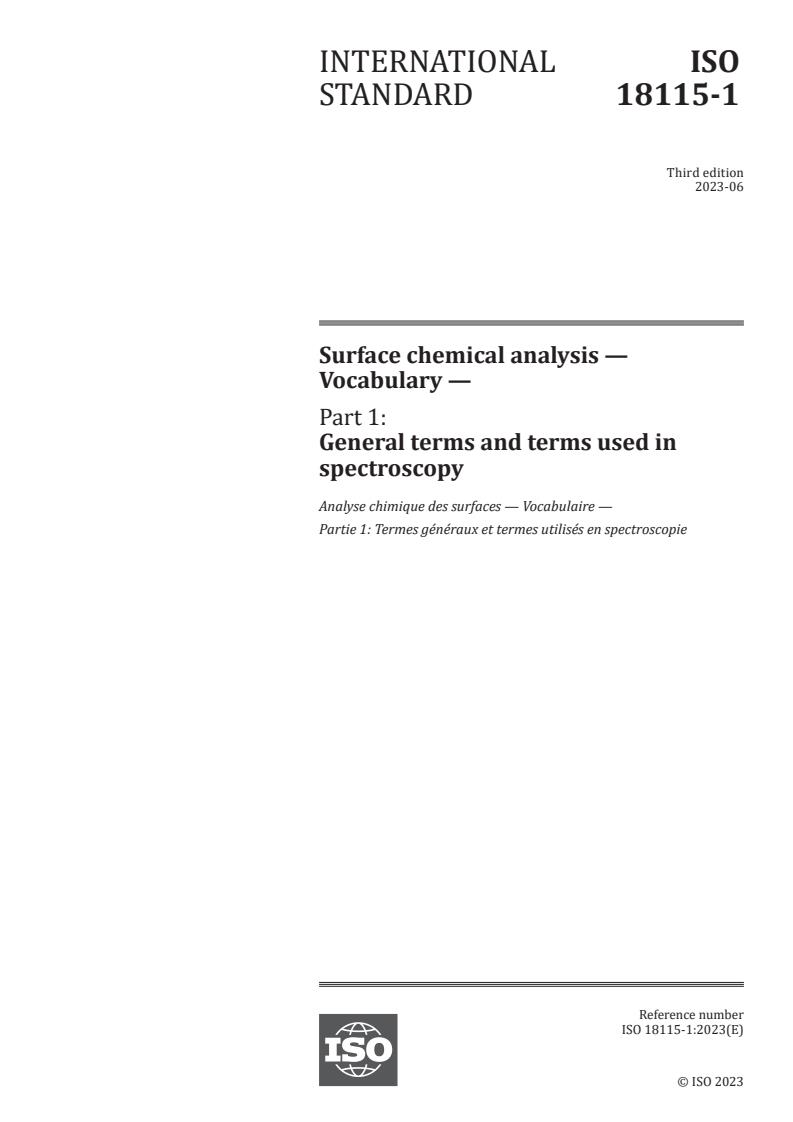
INTERNATIONAL ISO
STANDARD 18115-1
Third edition
2023-06
Surface chemical analysis —
Vocabulary —
Part 1:
General terms and terms used in
spectroscopy
Analyse chimique des surfaces — Vocabulaire —
Partie 1: Termes généraux et termes utilisés en spectroscopie
Reference number
© ISO 2023
All rights reserved. Unless otherwise specified, or required in the context of its implementation, no part of this publication may
be reproduced or utilized otherwise in any form or by any means, electronic or mechanical, including photocopying, or posting on
the internet or an intranet, without prior written permission. Permission can be requested from either ISO at the address below
or ISO’s member body in the country of the requester.
ISO copyright office
CP 401 • Ch. de Blandonnet 8
CH-1214 Vernier, Geneva
Phone: +41 22 749 01 11
Email: copyright@iso.org
Website: www.iso.org
Published in Switzerland
ii
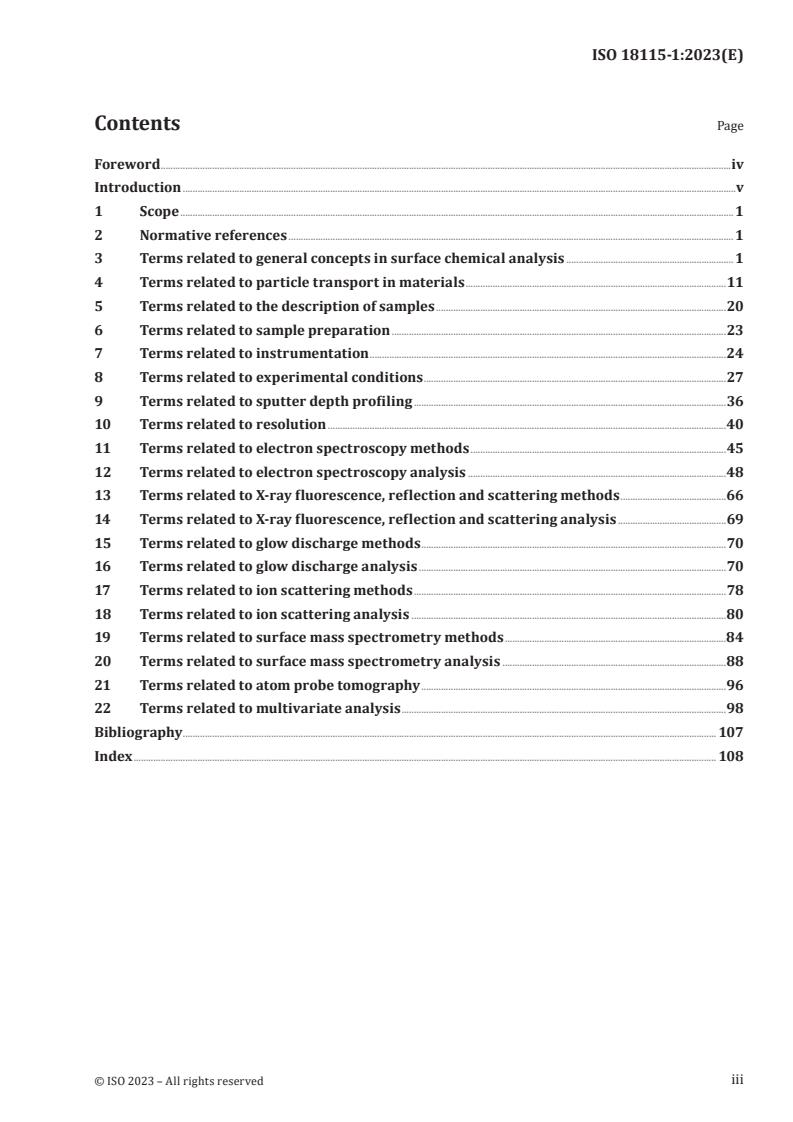
Contents Page
Foreword .iv
Introduction .v
1 Scope . 1
2 Normative references . 1
3 Terms related to general concepts in surface chemical analysis .1
4 Terms related to particle transport in materials .11
5 Terms related to the description of samples .20
6 Terms related to sample preparation .23
7 Terms related to instrumentation .24
8 Terms related to experimental conditions .27
9 Terms related to sputter depth profiling .36
10 Terms related to resolution .40
11 Terms related to electron spectroscopy methods .45
12 Terms related to electron spectroscopy analysis .48
13 Terms related to X-ray fluorescence, reflection and scattering methods .66
14 Terms related to X-ray fluorescence, reflection and scattering analysis .69
15 Terms related to glow discharge methods .70
16 Terms related to glow discharge analysis .70
17 Terms related to ion scattering methods .78
18 Terms related to ion scattering analysis .80
19 Terms related to surface mass spectrometry methods .84
20 Terms related to surface mass spectrometry analysis .88
21 Terms related to atom probe tomography .96
22 Terms related to multivariate analysis .98
Bibliography . 107
Index . 108
iii
Foreword
ISO (the International Organization for Standardization) is a worldwide federation of national standards
bodies (ISO member bodies). The work of preparing International Standards is normally carried out
through ISO technical committees. Each member body interested in a subject for which a technical
committee has been established has the right to be represented on that committee. International
organizations, governmental and non-governmental, in liaison with ISO, also take part in the work.
ISO collaborates closely with the International Electrotechnical Commission (IEC) on all matters of
electrotechnical standardization.
The procedures used to develop this document and those intended for its further maintenance are
described in the ISO/IEC Directives, Part 1. In particular, the different approval criteria needed for the
different types of ISO documents should be noted. This document was drafted in accordance with the
editorial rules of the ISO/IEC Directives, Part 2 (see www.iso.org/directives).
Attention is drawn to the possibility that some of the elements of this document may be the subject of
patent rights. ISO shall not be held responsible for identifying any or all such patent rights. Details of
any patent rights identified during the development of the document will be in the Introduction and/or
on the ISO list of patent declarations received (see www.iso.org/patents).
Any trade name used in this document is information given for the convenience of users and does not
constitute an endorsement.
For an explanation of the voluntary nature of standards, the meaning of ISO specific terms and
expressions related to conformity assessment, as well as information about ISO's adherence to
the World Trade Organization (WTO) principles in the Technical Barriers to Trade (TBT), see
www.iso.org/iso/foreword.html.
This document was prepared by Technical Committee ISO/TC 201, Surface chemical analysis,
Subcommittee SC 1, Terminology.
This third edition cancels and replaces the second edition (ISO 18115-1:2013), which has been
technically revised.
The main changes are as follows:
— revision of definitions related to resolution;
— introduction of definitions related to atom probe tomography;
— introduction of emerging methods such as HAXPES, NAPXPS, GEXRF;
— removal of repeated or redundant definitions and references;
— reorganisation of the terminology into subject-specific sections;
— removal of Annexes according to ISO requirements.
A list of all parts in the ISO 18115 series can be found on the ISO website.
Any feedback or questions on this document should be directed to the user’s national standards body. A
complete listing of these bodies can be found at www.iso.org/members.html.
iv
Introduction
Surface chemical analysis is an important area which involves interactions between people with
different backgrounds and from different fields. Those conducting surface chemical analysis can be
materials scientists, chemists, or physicists and can have a background that is primarily experimental
or primarily theoretical. Those making use of the surface chemical data extend beyond this group into
other disciplines.
With the present techniques of surface chemical analysis, compositional information is obtained for
regions close to a surface (generally within 20 nm) and composition-versus-depth information is
obtained with surface analytical techniques as surface layers are removed. The surface analytical terms
covered in this document extend from the techniques of electron spectroscopy and mass spectrometry
to optical spectrometry and X-ray analysis. The terms covered in ISO 18115-2 relate to scanning-
probe microscopy. The terms covered in ISO 18115-3 relate to optical interface analysis. Concepts for
these techniques derive from disciplines as widely ranging as nuclear physics and radiation science to
physical chemistry and optics.
The wide range of disciplines and the individualities of national usages have led to different meanings
being attributed to particular terms and, again, different terms being used to describe the same concept.
To avoid the consequent misunderstandings and to facilitate the exchange of information, it is essential
to clarify the concepts, to establish the correct terms for use, and to establish their definitions.
The terms are classified under Clauses 3 to 22:
— Clause 3: Terms related to general concepts in surface chemical analysis;
— Clause 4: Terms related to particle transport in materials;
— Clause 5: Terms related to the description of samples;
— Clause 6: Terms related to sample preparation;
— Clause 7: Terms related to instrumentation;
— Clause 8: Terms related to experimental conditions;
— Clause 9: Terms related to sputter depth profiling;
— Clause 10: Terms related to resolution;
— Clause 11: Terms related to electron spectroscopy methods;
— Clause 12: Terms related to electron spectroscopy analysis;
— Clause 13: Terms related to X-ray fluorescence, reflection and scattering methods;
— Clause 14: Terms related to X-ray fluorescence, reflection and scattering analysis;
— Clause 15: Terms related to glow discharge methods;
— Clause 16: Terms related to glow discharge analysis;
— Clause 17: Terms related to ion scattering methods;
— Clause 18: Terms related to ion scattering analysis;
— Clause 19: Terms related to surface mass spectrometry methods;
— Clause 20: Terms related to surface mass spectrometry analysis;
— Clause 21: Terms related to atom probe tomography;
— Clause 22: Terms related to multivariate analysis.
v
INTERNATIONAL STANDARD ISO 18115-1:2023(E)
Surface chemical analysis — Vocabulary —
Part 1:
General terms and terms used in spectroscopy
1 Scope
This part of the ISO 18115 series defines terms for surface chemical analysis. It covers general terms
and those used in spectroscopy, while ISO 18115-2 covers terms used in scanning-probe microscopy
and ISO 18115-3 covers terms used in optical interface analysis.
2 Normative references
There are no normative references in this document.
3 Terms related to general concepts in surface chemical analysis
ISO and IEC maintain terminology databases for use in standardization at the following addresses:
— ISO Online browsing platform: available at https:// www .iso .org/ obp
— IEC Electropedia: available at https:// www .electropedia .org/
3.1
interface
boundary between two phases having different chemical, elemental, or physical properties
3.2
surface
interface (3.1) between a condensed phase and a gas, vapour, or free space
3.3
measurand
quantity intended to be measured
[1]
[SOURCE: ISO/IEC Guide 99:2007, 2.3, modified — The notes to entry have been deleted.]
3.4
analyte
substance or chemical constituent that is subjected to measurement
3.5
chemical species
atom, molecule, ion, or functional group
3.6
unified atomic mass unit
u
dalton
Da
unit equal to 1/12 of the mass of the nuclide C at rest and in its ground state
−27
Note 1 to entry: 1 u ≈ 1,660 538 86 × 10 kg with a one-standard-deviation uncertainty of ±0,000 000
−27 [2]
28 × 10 kg. This is a non-SI unit, accepted for use with the International System, whose value in SI units is
obtained experimentally.
Note 2 to entry: The term dalton, symbol Da, is preferred over unified atomic mass unit as it is both shorter and
works better with prefixes.
Note 3 to entry: The above definition was agreed upon by the International Union of Pure and Applied Physics
in 1960 and the International Union of Pure and Applied Chemistry in 1961, resolving a longstanding difference
between chemists and physicists. The unified atomic mass unit replaced the atomic mass unit (chemical scale)
and the atomic mass unit (physical scale), both having the symbol amu. The amu (physical scale) was one-
sixteenth of the mass of an atom of oxygen-16. The amu (chemical scale) was one-sixteenth of the average mass
of oxygen atoms as found in nature. In the 1998 CODATA, 1 u = 1,000 317 9 amu (physical scale) = 1,000 043 amu
(chemical scale).
3.7
reference method
thoroughly investigated method, clearly and exactly describing the necessary conditions and
procedures for the measurement of one or more property values, that has been shown to have accuracy
and precision commensurate with its intended use and that can therefore be used to assess the
accuracy of other methods for the same measurement, particularly in permitting the characterization
of a reference material (5.1)
[3]
[SOURCE: ISO Guide 30:1992+A1: 2008 ]
3.8
quantitative analysis
determination of the amount of analyte (3.4) detected in, or on, a sample
Note 1 to entry: The analytes can be elemental or compound in nature.
Note 2 to entry: The amounts can be expressed, for example, as atomic or mass percent, atomic or mass fraction,
mole or mass per unit volume, as appropriate or as desired.
Note 3 to entry: The sample material can be inhomogeneous so that a particular model structure may be assumed
in the interpretation. Details of that model should be stated.
3.9
detection limit
smallest amount of an element or compound that can be measured under specified analysis conditions
Note 1 to entry: The detection limit is often taken to correspond to the amount of material for which the total
signal for that material minus the background signal (3.21) is three times the standard deviation of the signal
above the background signal. This approach is simplistic and, for more accurate and rigorous definitions of
detection limits, the References [4] and [5] should be consulted.
Note 2 to entry: The detection limit can be expressed in many ways, depending on the purpose. Examples of ways
of expressing it are mass or weight fraction, atomic fraction, concentration, number of atoms, and mass or weight.
Note 3 to entry: The detection limit is generally different for different materials.
3.10
matrix effects
change in the intensities or spectral information per atom of the analyte (3.4) arising from change in
the chemical or physical environment
Note 1 to entry: Examples of these environments are varying sample morphologies [e.g. thin films (5.13), clusters,
fibres, nanostructures] of different dimensions, the amorphous or crystalline state, changes of matrix species,
and the proximity of other physical phases or chemical species (3.5).
3.11
matrix factor
factors, arising from the composition of the matrix, for multiplying the quotient of the measured
intensity and the appropriate sensitivity factor in formulae to determine the composition using surface
analytical techniques
Note 1 to entry: See average matrix sensitivity factor and pure-element sensitivity factor.
Note 2 to entry: In methods such as AES (11.1), the matrix factor is determined in part by the composition of the
sub-surface material and in part by the composition of the analysis volume (8.48) in the sample.
3.12
absolute elemental sensitivity factor
coefficient for an element by which the measured intensity for that element is divided to yield the
atomic concentration or atomic fraction of the element present in the sample
Note 1 to entry: See elemental relative sensitivity factor (12.92) (20.61).
Note 2 to entry: The choice of atomic concentration or atomic fraction should be made clear.
Note 3 to entry: The type of sensitivity factor utilized should be appropriate for the formulae used in the
quantification process and for the type of sample analysed, for example homogeneous samples or segregated
layers.
Note 4 to entry: The source of sensitivity factors should be given to ensure that the correct matrix factors (3.11)
or other parameters are used.
Note 5 to entry: Sensitivity factors depend on parameters of the excitation source, the spectrometer, and the
orientation of the sample to these parts of the instrument. Sensitivity factors also depend on the matrix being
analysed, and in SIMS (19.1) this has a dominating influence.
3.13
step size
distance between values in measurand (3.3) space from which individual data points are acquired
3.14
sweep
single, complete acquisition of one set of data
3.15
peak intensity
measure of signal intensity (3.17) for a constituent spectral peak
Note 1 to entry: Intensity is usually measured for quantitative purposes which can be the height of the peak
above a defined background or the peak area (3.16). The units can be counts (3.18), counts⋅electron volts, counts
per second, counts⋅electron volts per second, counts per amu, counts per second per amu, etc. For differential
spectra, the intensity can be the peak-to-peak height or the peak-to-background height. The measure of intensity
should be defined and the units stated in each case.
Note 2 to entry: The meaning is very rarely the literal meaning of the intensity value at the top of the measured
peak either before or after removal of any background.
3.16
peak area
area under a peak in a spectrum after background removal
Note 1 to entry: See inelastic electron scattering background subtraction (12.85) and signal intensity (3.17).
Note 2 to entry: The peak area can be expressed in counts (3.18), counts per second, counts⋅electron volts,
counts⋅electron volts per second, counts per amu, or other units.
3.17
signal intensity
strength of a measured signal at a spectrometer detector or after some defined processing
Note 1 to entry: The signal intensity is subject to significant change between the points of generation and
detection of the signal and, further, between the points of detection and display on the measuring instrument.
Note 2 to entry: The signal intensity can be expressed in counts (3.18) (per channel) or counts per second
(per channel) or counts⋅electron volts per second or other units. In AES (11.1), the differential of the signal
intensity may be obtained by analogue modulation (12.61) of an electrode in the spectrometer or by numerical
differentiation of the spectrum. The type of signal shall be defined.
Note 3 to entry: In an electron or mass spectrum (20.58), the measured spectrum integrated over energy or
mass and solid angle is equal to a current. If the spectrometer has been calibrated, the units of intensity can be
−1 −1 −1 −1
current⋅eV ⋅sr or current⋅amu ⋅sr . If the spectrum has been normalized to unit primary-beam (8.10) current,
−1 −1 −1 −1
the appropriate units would be eV ⋅sr or amu ⋅sr . If the spectrum has also been integrated over the emission
−1 −1
solid angle, the appropriate units would be eV or amu .
3.18
counts
total number of pulses recorded by a detector system in a defined time interval
Note 1 to entry: The counts can be representative, one-for-one with the particles being detected [in the absence
of dead time (7.17) losses in the counting measurement] in which case they follow Poissonian statistics [unless
other noise (3.19) sources are present] or they can simply be proportional to the number of particles being
detected. The type of measure shall be clearly stated.
Note 2 to entry: In multidetector systems, the apportion of counts into relevant channels of the spectrum can lead
to changes from the expected Poissonian statistics in each channel since the counts in neighbouring channels can
be partly correlated.
3.19
noise
time-varying disturbances superimposed on the analytical signal with fluctuations, leading to
uncertainty in the signal intensity (3.17)
Note 1 to entry: An accurate measure of noise can be determined from the standard deviation of the fluctuations.
Visual or other estimates, such as peak-to-peak noise in a spectrum, can be useful as semiquantitative measures
of noise.
Note 2 to entry: The fluctuations in the measured intensity can arise from a number of causes, such as statistical
noise (3.20) and electrical interference.
3.20
statistical noise
noise (3.19) in the spectrum due solely to the statistics of randomly detected single events
Note 1 to entry: For single-particle counting systems exhibiting Poisson statistics, the standard deviation of a
large number of measures of an otherwise steady count rate, N, each in the same time interval, is equal to the
square root of N.
Note 2 to entry: In multidetector systems, the data processing required to generate the output spectrum can lead
to statistical correlation between adjacent channels and also an apparent noise in each channel that is less than
Poissonian.
3.21
background signal
signal present at a particular position, energy, mass or wavelength due to processes or sources other
than those of primary interest
Note 1 to entry: See metastable background (20.36), Shirley background (12.86), Sickafus background (12.87), and
Tougaard background (12.88).
3.22
peak-to-background ratio
signal-to-background ratio
ratio of the maximum height of the peak above the background intensity to the magnitude of that
background intensity
Note 1 to entry: Signal-to-background ratio is the more commonly used term in GDS (15.1), where it is abbreviated
to SBR. Peak-to-background ratio is the more commonly used term for types of electron spectroscopies such as
AES (11.1) and XPS (11.6).
Note 2 to entry: The method of estimating the background intensity shall be given. For AES, the background
intensity is often determined at a kinetic energy (3.35) just above the peak of interest.
3.23
signal-to-noise ratio
ratio of the signal intensity (3.17) to a measure of the total noise (3.19) in determining that signal
Note 1 to entry: See statistical noise (3.20).
Note 2 to entry: The noise in AES (11.1) is often measured at a convenient region of the spectral background close
to the peak.
3.24
smoothing
mathematical treatment of data to reduce the apparent noise (3.19)
3.25
interference signal
signal, measured at the mass, energy, or wavelength position of
interest, due to another, undesired, species
Note 1 to entry: In general laboratory use, interference can be used more broadly to indicate electrical noise
(3.19), line pick-up, or other unwanted contributions to the detected signal.
3.26
relative standard deviation of the background
quotient of the standard deviation characterizing the noise (3.19) in the background signal (3.21) by the
intensity of the background signal
3.27
lineshape
measured shape of a particular spectral feature
3.28
peak width
width of a peak at a defined fraction of the peak height
Note 1 to entry: See intrinsic linewidth (12.22).
Note 2 to entry: Any background subtraction method used should be specified.
Note 3 to entry: The most common measure of peak width is the full width of the peak at half maximum (FWHM)
intensity.
Note 4 to entry: For asymmetrical peaks, convenient measures of peak width are the half-widths of each side of
the peak at half maximum intensity.
3.29
peak fitting
procedure whereby a spectrum, generated by peak synthesis (3.30), is adjusted to match a measured
spectrum
Note 1 to entry: A least-squares optimization procedure is generally used in a computer programme for this
purpose.
Note 2 to entry: The selected peak shape and the background shape should be defined. Any constraints imposed
on the adjustment process should also be defined.
3.30
peak synthesis
procedure whereby a synthetic spectrum is generated, using either model or experimental peak shapes,
in which the number of peaks, the peak shapes, the peak widths (3.28), the peak positions, the peak
intensities, and the background shape and intensity are adjusted for peak fitting (3.29)
Note 1 to entry: The selected peak shape and the background shape should be defined.
3.31
lateral profile
chemical or elemental composition, signal intensity (3.17) or processed intensity information from the
available software measured in a specified direction parallel to the surface (3.2)
Note 1 to entry: See line scan (8.56).
3.32
depth profile
vertical profile
chemical or elemental composition, signal intensity (3.17) or processed intensity information from the
available software measured in a direction normal to the surface (3.2)
Note 1 to entry: See compositional depth profile (3.33).
3.33
compositional depth profile
CDP
atomic or molecular composition measured as a function of distance normal to the surface (3.2)
3.34
depth profiling
monitoring of signal intensity (3.17) as a function of a variable that can be related to distance normal to
the surface (3.2)
Note 1 to entry: See compositional depth profile (3.33).
Note 2 to entry: In a sputter depth profile (9.1) the signal intensity is usually measured as a function of the
sputtering (9.3) time.
3.35
kinetic energy
energy of motion
Note 1 to entry: The energy of a charged particle due to motion is not necessarily constant and varies with the
local electric potential. If all local electrodes are at ground potential, the kinetic energy of the particle varies
with the local vacuum level (12.10). This vacuum level can vary over a range of 1 eV in different regions of AES
(11.1) and XPS (11.6) instruments and measured electron energies can similarly vary. This variation is removed
if the kinetic energies are referred to the Fermi level (12.9). In XPS, by convention, the Fermi level is always used
but in AES both vacuum (12.76) and Fermi level referencing (12.75) are practised. Instruments capable of both
AES and XPS are Fermi level referenced. Fermi level referencing is recommended for accurate measurements of
energies in AES. In electron spectrometers (12.58), Fermi level referenced energies are typically 4,5 eV greater
than those referenced to the vacuum level. It is convenient in AES to assume a standard vacuum level (12.11) of
4,500 eV above the Fermi level so that the energies of Auger electron (12.32) peaks, referenced to the Fermi level,
can be converted in a consistent way to energies referenced to the vacuum level and vice versa.
3.36
ion species
type and charge of an ion
+ − +
EXAMPLE Ar , O , and H .
Note 1 to entry: If an isotope is used, it should be specified.
3.37
radical
atoms or molecular entity possessing an unpaired electron
• • •
Note 1 to entry: Entities such as CH , SnH , and Cl have formulae in which the dot symbolizing the unpaired
3 3
electron is placed so as to indicate the atom of highest spin density, if this is possible. Paramagnetic metal ions
are not normally regarded as radicals.
Note 2 to entry: Depending upon the core atom that possesses the unpaired electron, the radicals can be
described as carbon-, oxygen-, nitrogen-, or metal-centred radicals. If the unpaired electron occupies an orbital
having considerable “s” or more or less pure “p” character, the respective radicals are termed σ- or π-radicals.
Note 3 to entry: The adjective “free” is no longer used.
3.38
radical ion
radical (3.37) carrying an electric charge
•+
Note 1 to entry: A positively charged radical is called a “radical cation” (e.g. the benzene radical cation C H ); a
6 6
•−
negatively charged radical is called a “radical anion” (e.g. the benzene radical anion C H or the benzophenone
6 6
•−
radical anion Ph C−O ). Commonly, but not necessarily, the odd electron and the charge are associated with the
same atom. Unless the positions of unpaired spin and charge can be associated with specific atoms, superscript
dot and charge designations should be placed in the order •+ or •− as suggested by the name “radical ion” (e.g.
•+
C H ).
3 6
3.39
light ion
ion lighter than lithium
Note 1 to entry: See intermediate-mass ion (3.40) and heavy ion (3.41).
3.40
intermediate-mass ion
ion with mass between, and including, lithium and argon
Note 1 to entry: See heavy ion (3.41) and light ion (3.39).
3.41
heavy ion
ion heavier than argon
Note 1 to entry: See intermediate-mass ion (3.40) and light ion (3.39).
3.42
anion
negatively charged ion
Note 1 to entry: See cation (3.43).
3.43
cation
positively charged ion
Note 1 to entry: See anion (3.42) and cationized molecule (20.22).
3.44
cluster ion
ion composed of many atoms or chemical species (3.5)
Note 1 to entry: The cluster can have a positive or negative charge.
Note 2 to entry: Cluster ions are used to desorb molecular species from surfaces with enhanced efficiencies.
+ +
Examples include ions produced in liquid metal sources (Au , Bi ) as well as ions produced by electron impact
n n
+ + +
[C , Ar (H O) ].
60 n 2 n
3.45
ionization efficiency
ratio of the number of ions formed to the number of electrons, ions, or photons used in an ionization
process
[SOURCE: IUPAC]
3.46
ion neutralization
charge exchange (16.35) process in which an ion loses its charge through interactions with
a material surface (3.2) or with gas-phase atoms or molecules
3.47
de Broglie wavelength
wavelength of a particle deduced from de Broglie's concept of wave-particle duality
Note 1 to entry: The wavelength is calculated as the quotient of Planck's constant and the particle momentum.
3.48
energy eigenvalue
energy value of a single bound electron level in an atom, molecule, ion, or solid obtained by solving
the single-electron Schrödinger or Dirac formula in the Dirac-Fock representation of the electronic
structure of an atom in its ground state
Note 1 to entry: Eigenvalues are the solutions to certain integral formulae, a special case of which is the
Schrödinger formula for electrons in atoms, molecules, ions, or solids.
Note 2 to entry: In the frozen-orbital approximation (3.49), the binding energy (12.16) of a hole state (3.62) is given
by the negative of the corresponding single-electron energy eigenvalue.
3.49
frozen-orbital approximation
assumption that the one-electron wavefunctions of the electrons remaining in an atom or molecule are
unchanged after ionization
Note 1 to entry: In the frozen-orbital approximation, the binding energy (12.16) of an electron is given by the
negative of the energy eigenvalue (3.48).
3.50
Koopmans energy
calculated energy of an electron in an orbital, on the assumption that its removal to infinity is
unaccompanied by electronic relaxation (3.58)
3.51
orbital energy
Koopmans energy (3.50) corrected for intra-atomic relaxation (3.57)
3.52
spin orbit splitting
splitting of p, d, or f levels in an atom arising from coupling of the spin and orbital angular momentum
3.53
excited state
state of a system with energy higher than that of the ground state
Note 1 to entry: This term is generally used to characterize a molecule in one of its electronically excited states,
but can also refer to vibrational and/or rotational excitation in the electronic ground state.
3.54
initial state
core-hole excited state (3.53) of an atom prior to an Auger transition (12.33) or to X-ray emission
3.55
initial state
ground state of an atom prior to photoelectron emission
3.56
final state
state of an atom resulting after a particular Auger, X-ray, or photoemission (12.8) process
3.57
relaxation
process by which an atom, molecule, or ion is transformed from a higher potential-energy state to a
lower potential-energy state
Note 1 to entry: See electronic relaxation (3.58).
3.58
electronic relaxation
relaxation (3.57) resulting from the transition of an electron between energy levels, resulting in the
release of energy
Note 1 to entry: The energy release can result in the ejection of a photon or other particle.
3.59
relaxation energy
energy associated with intra-atomic or extra-atomic electronic readjustment to the removal of
an atomic electron, so as to minimize the energy of the final state (3.56) of the system
3.60
extra-atomic relaxation energy
screening energy
diminished energy of an ionized atom in a solid due to coulombic attraction of electrons in the
immediate environment
3.61
hole
electronic vacancy in an atom, molecule, or solid
3.62
hole state
electronic configuration of an atom, molecule, or solid containing a hole (3.61)
3.63
spectator hole
hole state (3.62) in the electronic structure of an atom that can be present during processes such as
Auger electron (12.32) and X-ray photoelectron emission but is not created or destroyed in the process
3.64
X-ray fluorescence
X-rays generated by a transition of an electron from a filled shell to a core hole (3.61),
created by incident radiation, at a higher binding energy (12.16)
3.65
fluorescence yield
probability that an atom with a vacancy in a particular inner shell relaxes by X-ray
fluorescence (3.64)
3.66
characteristic X-rays
photons emitted by ionized atoms and having a particular distribution in energy and intensity which is
characteristic of the atomic number and chemical environment of the atom
Note 1 to entry: In XPS (11.6), the term is applied to the X-ray source used to excite photoelectrons in the sample.
Note 2 to entry: In electron probe microanalysis, characteristic X-rays emitted from the sample are detected and
analysed to give information on the composition of the sample.
3.67
X-ray linewidth
energy width of the principal characteristic X-ray (3.66) line
Note 1 to entry: In XPS (11.6) the X-ray linewidth usually refers to that of the X-ray source.
Note 2 to entry: The X-ray linewidth contributes to the photoelectron peak widths (3.28).
3.68
X-ray monochromator
device used to eliminate photons of energies other than those in a narrow energy or wavelength band
3.69
ion lifetime
average time that an ion exists in a particular electronic configuration, for example as a vacancy in a
particular shell of an atom
3.70
Auger de-excitation
process in which the excess energy of an excited atom or ion is given up by the Auger process (12.30)
Note 1 to entry: See Auger neutralization (3.71).
Note 2 to entry: The Auger process can involve energy levels in neighbouring atoms and lead to ejection of an
electron into the vacuum. This electron's energy can then usefully be characteristic of a surface atom with which
a metastable probe atom (e.g. He) is in close proximity.
3.71
Auger neutralization
process in which an electron, tunnelling from the conduction band of a solid,
neutralizes an incoming ion and an electron is ejected from a surface atom
Note 1 to entry: The ejected electron can be emitted into the vacuum.
3.72
time constant
time required for a signal to change by [1 − (1/e)], or 63,2 %, of its final
value in response to a step function input
3.73
sum rule
formula that gives the value of an integral of a specified dielectric function
Note 1 to entry: Formulae have been derived that give expected values of integrals of the imaginary part of
the complex dielectric constant and of the imaginary part of the reciprocal of the complex dielectric constant
for any material. The integrals involve the product of the specified dielectric function and either frequency or
inverse frequency from zero frequency to an infinite frequency. The values of each integral can be used to assess
the internal consistency of a set of dielectric data for a material by comparing values of the specified integrals
to expected values. In practice, the integrations are made from low frequencies (corresponding to infrared or
visible photon energies) to frequencies much higher than those corresponding to the largest K-shell binding
energy (12.16) of atoms in the material.
Note 2 to entry: The integral of the product of the specified dielectric function and frequency is proportional to
the total number of electrons per atom or molecule in the material. This sum rule is often referred to as the f-sum
rule, the oscillator-strength sum rule, or the Thomas-Reiche-Kuhn sum rule.
4 Terms related to particle transport in materials
4.1
binary elastic scattering
elastic scattering
collision between a moving particle and a second particle in which the total kinetic energy (3.35) and
the total momentum are conserved
Note 1 to entry: See inelastic scattering (4.2).
Note 2 to entry: In elastic scattering interactions, the moving particle can be deflected through angles of up to
180°.
4.2
inelastic scattering
interaction between a moving energetic particle and a second particle or assembly of particles in which
the total kinetic energy (3.35) is not conserved
Note 1 to entry: Kinetic energy is absorbed in solids by various mechanisms, for example inner-shell ionization,
plasmon (12.47) and phonon excitation, and bremsstrahlung (12.57) generation. These excitations usually lead to
a small change in direction of the moving particle.
Note 2 to entry: In particle collisions, the collision can be elastic in that the kinetic energy of the particles is
conserved, but energy can still be lost by the incident particle. In the scattering of electrons by atoms, the energy
lost is usually very small and is often ignored. Where it is not ignored, the scattering is often termed quasi-elastic
[see elastic peak (12.42)].
4.3
energy loss
energy dissipated by particles as they interact with the sample
Note 1 to entry: See characteristic electron energy losses (12.40) and plasmon (12.47).
4.4
backscattering energy
energy of a particle from the primary beam (8.10) after it has undergone a backscattering collision and
escaped from the sample
4.5
Bohr's critical angle
angle of ion scattering from a nucleus given by the ratio of the de Broglie wavelength (3.47) and the
distance of closest approach of the ion with the nucleus
Note 1 to entry: Quantum effects are usually ignored for scattering angles (8.4) larger than Bohr's critical angle.
For surface analysis conditions, this angle is very small.
4.6
Compton scattering
scattering of X-rays and other photons by electrons
Note 1 to entry: The photon loses energy by recoil of the electron to an extent governed by the scattering angle
(8.4).
4.7
cross section
uncharged particles of specified type and energy> quotient of the probability of reaction or process for
the target entity by the incident-particle fluence (8.16)
Note 1 to entry: Cross sections are often expressed as an area per target entity (atom, molecule, etc.) for the
relevant process.
Note 2 to entry: A cross section of σ per atom for the removal of particles from a given state in a beam leads to a
reduction dN in the number N of particles in that state in a distance dx, given by the relationship:
dN = Nσn dx
where n is the density of atoms traversed by the beam.
Integration leads to the relationship
N = N exp (−nσx)
o
where N is the value of N at the origin of x.
o
4.8
elastic scattering cross section
cross section (4.7) for binary elastic scattering (4.1)
4.9
differential elastic scattering cross section
quotient of the elastic scattering cross section (4.8) for scattering into a particular infinitesimal solid
angle far from the target (18.2) by that infinitesimal solid angle
Note 1 to entry: The differential elastic scattering cross section is related to the elastic scattering cross section,
σ , by
e
dσΩ
()
e
σ = dΩ
e
∫
dΩ
4π
where dσ (Ω)/dΩ is the differential elastic scattering cross section for scattering into solid angle Ω.
e
4.10
transport cross section
σ
tr
quotient of the fractional momentum loss of a particle incident on the sample arising from elastic
scattering (4.1) by the areic density of the sample atoms, for an infinitesimally thin sample
Note 1 to entry: This cross section (4.7) is expressed as an area per atom.
Note 2 to entry: The cross section for the loss of any momentum, however small, is simply the elastic scattering
cross section (4.8). By contrast, the transport cross section is a measure of the probability of the loss of a
substantial fraction of the initial momentum, analogous to stopping cross section (4.11) which is a measure of the
probability of the loss of a substantial amount of energy.
Note 3 to entry: The transport cross section is related to the differential elastic scattering cross section (4.9),
dσ (Ω)/dΩ, by
e
π
dσΩ()
e
σ =21π (c− osθθ)sind θ
tr
∫
dΩ
where θ is the angle of scattering (8.4).
4.11
stopping cross section
quotient of the rate of energy loss (4.3) of a particle with distance along its
trajectory in a sample by the atomic density of sample atoms for an infinitesimal sample thickness
Note 1 to entry: See stopping power (4.17).
Note 2 to entry: The stopping cross section is usually expressed in units of eV⋅m per atom and not as an area per
atom as is customary for cross sections (4.7).
Note 3 to entry: The atomic density is usually taken as the number density, N, but sometimes as the mass density,
2 2
ρ, so that the units are eV⋅m /atom or eV⋅m /kg. The stopping cross section S(E) is thus given either by
S (E) ≡ − (1/N) (dE/dλ)
or by
S (E) ≡ − (1/ρ) (dE/dλ)
where dE/dλ is the rate of loss of energy E with distance λ along the particle trajectory. Note that dE/dλ is often
called the stopping power although it is not in units of power.
Note 4 to entry: In some texts, the stopping cross section and stopping power are used interchangeably so that
S(E) ≡ − (dE/dλ). This inconsistency for the term stopping power leads to its deprecation.
Note 5 to entry: Older texts can be found with the stopping cross section given in keV⋅cm /gm (meaning “per
gram”) and in many other forms.
4.12
electronic stopping cross section
stopping cross section (4.11) arising from energy transfer to the electrons of the
sample
Note 1 to entry: The total stoppi
...