

ISO 18115-2:2021
(Main)Surface chemical analysis — Vocabulary — Part 2: Terms used in scanning-probe microscopy
General Information
- Abstract
This document defines terms for surface chemical analysis. ISO 18115-1 covers general terms and those used in spectroscopy while this document covers terms used in scanning probe microscopy.
- Status
- Published
- Publication Date
- 20-Dec-2021
- Technical Committee
- ISO/TC 201/SC 1 - Terminology
- Drafting Committee
- ISO/TC 201/SC 1 - Terminology
- Current Stage
- 6060 - International Standard published
- Start Date
- 21-Dec-2021
- Due Date
- 27-Nov-2022
- Completion Date
- 21-Dec-2021
Buy Documents
ISO 18115-2:2021 - Surface chemical analysis -- Vocabulary
ISO 18115-2:2021 - Surface chemical analysis — Vocabulary — Part 2: Terms used in scanning-probe microscopy/21/2021
Overview
ISO 18115-2:2021 - Surface chemical analysis - Vocabulary - Part 2: Terms used in scanning-probe microscopy - is the ISO vocabulary standard that defines and clarifies terminology used for surface chemical analysis by scanning probe microscopy (SPM). This third edition (2021) is a minor revision of the 2013 edition and updates several terms (for example, replacing “Kelvin‑force microscopy” with Kelvin‑probe force microscopy). The document is prepared by ISO/TC 201/SC 1 and focuses on consistent, internationally agreed definitions to avoid ambiguity across disciplines.
Key topics
- Scope and purpose: Provides standardized terms and definitions specifically for SPM methods used in surface chemical analysis. It complements ISO 18115‑1, which covers general terms and spectroscopy.
- Structured vocabulary: Terms are organized into Clauses covering:
- SPM methods (Clause 3)
- Contact mechanics models (Clause 4)
- Scanning probe method terminology (Clause 5)
- Supplementary SPM methods (Clause 6)
- Supplementary terms for SPM (Clause 7)
- Examples of defined techniques and modes (vocabulary entries include AFM-related modes and SPM variants): AFM, NC‑AFM (non‑contact AFM), DFM/FM‑AFM (dynamic/frequency modulation), CPAFM (conductive‑probe AFM), KPFM (Kelvin‑probe force microscopy), MFM (magnetic‑force microscopy), NSOM/SNOM, MRFM, CITS, chemical‑force microscopy, photothermal micro‑spectroscopy (PTMS), and others.
- Ancillary content: Annex A lists abbreviated terms; an informative bibliography points to related literature. The standard contains no normative references.
- Terminology decisions: Notes clarify instrument vs. method usage (e.g., final “M” or “S” in acronyms may mean “microscopy/microscope” or “spectroscopy/spectrometer” depending on context).
Applications and users
Who benefits from ISO 18115‑2:
- Materials scientists, surface chemists, physicists working with AFM/STM/NSOM and other SPM techniques.
- Laboratory managers and instrument manufacturers who need consistent terminology for specifications, user manuals, and data reporting.
- Standards writers, educators, and technical authors preparing documentation, protocols, or training materials.
- Cross-disciplinary teams that require clear communication when exchanging surface analysis data.
Practical value:
- Ensures consistent naming and definitions across reports, papers, and instrument documentation.
- Reduces misunderstandings in method selection, data interpretation, and interlaboratory communication.
- Supports compliance, quality assurance, and traceable documentation in surface chemical analysis workflows.
Related standards
- ISO 18115‑1 (general vocabulary and spectroscopy terms) - complementary.
- Profilometry and surface texture standards mentioned in the introduction: ISO 3274, ISO 4287, ISO 25178 (for users needing deeper guidance on profile and texture measurement).
Keywords: ISO 18115-2, surface chemical analysis, scanning probe microscopy vocabulary, AFM terminology, SPM terms, Kelvin‑probe force microscopy, atomic force microscopy definitions.
Relations
- Effective Date
- 26-Nov-2021
Buy Documents
ISO 18115-2:2021 - Surface chemical analysis -- Vocabulary
ISO 18115-2:2021 - Surface chemical analysis — Vocabulary — Part 2: Terms used in scanning-probe microscopy/21/2021
Get Certified
Connect with accredited certification bodies for this standard

ECOCERT
Organic and sustainability certification.

Eurofins Food Testing Global
Global leader in food, environment, and pharmaceutical product testing.

Intertek Bangladesh
Intertek certification and testing services in Bangladesh.
Sponsored listings
Frequently Asked Questions
ISO 18115-2:2021 is a standard published by the International Organization for Standardization (ISO). Its full title is "Surface chemical analysis — Vocabulary — Part 2: Terms used in scanning-probe microscopy". This standard covers: This document defines terms for surface chemical analysis. ISO 18115-1 covers general terms and those used in spectroscopy while this document covers terms used in scanning probe microscopy.
This document defines terms for surface chemical analysis. ISO 18115-1 covers general terms and those used in spectroscopy while this document covers terms used in scanning probe microscopy.
ISO 18115-2:2021 is classified under the following ICS (International Classification for Standards) categories: 01.040.71 - Chemical technology (Vocabularies); 71.040.40 - Chemical analysis. The ICS classification helps identify the subject area and facilitates finding related standards.
ISO 18115-2:2021 has the following relationships with other standards: It is inter standard links to ISO 18115-2:2013. Understanding these relationships helps ensure you are using the most current and applicable version of the standard.
ISO 18115-2:2021 is available in PDF format for immediate download after purchase. The document can be added to your cart and obtained through the secure checkout process. Digital delivery ensures instant access to the complete standard document.
Standards Content (Sample)
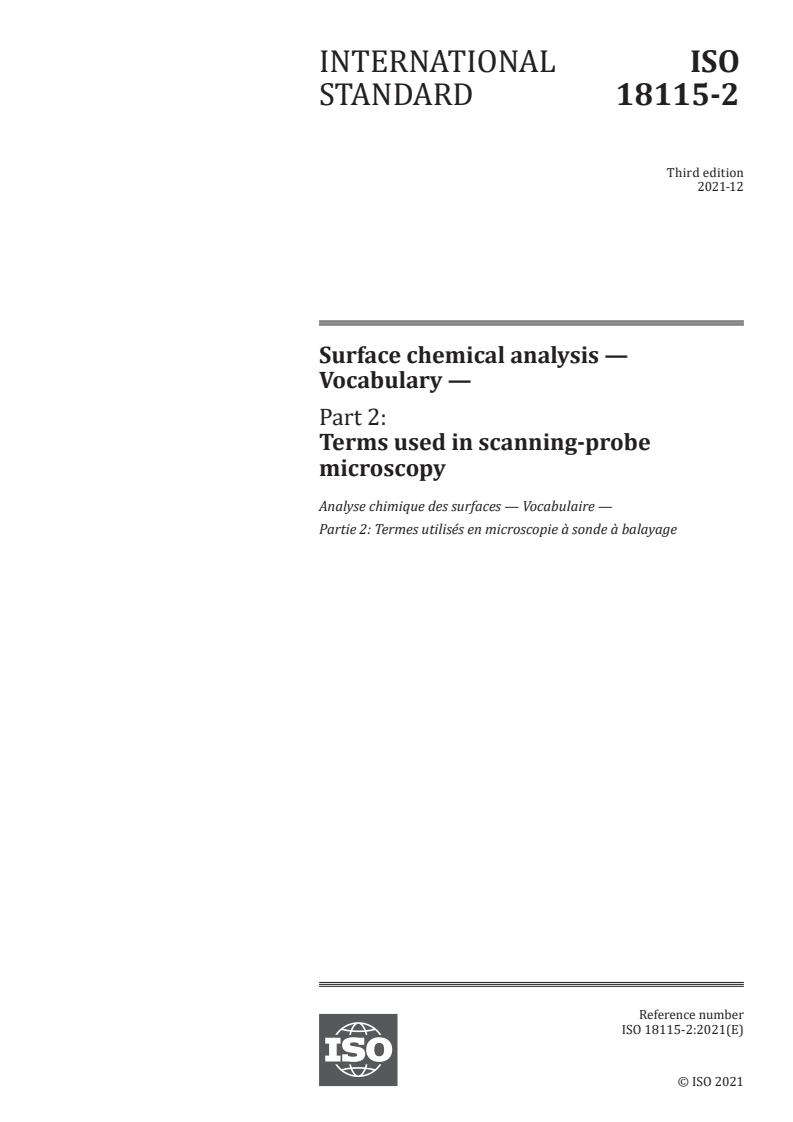
INTERNATIONAL ISO
STANDARD 18115-2
Third edition
2021-12
Surface chemical analysis —
Vocabulary —
Part 2:
Terms used in scanning-probe
microscopy
Analyse chimique des surfaces — Vocabulaire —
Partie 2: Termes utilisés en microscopie à sonde à balayage
Reference number
© ISO 2021
All rights reserved. Unless otherwise specified, or required in the context of its implementation, no part of this publication may
be reproduced or utilized otherwise in any form or by any means, electronic or mechanical, including photocopying, or posting on
the internet or an intranet, without prior written permission. Permission can be requested from either ISO at the address below
or ISO’s member body in the country of the requester.
ISO copyright office
CP 401 • Ch. de Blandonnet 8
CH-1214 Vernier, Geneva
Phone: +41 22 749 01 11
Email: copyright@iso.org
Website: www.iso.org
Published in Switzerland
ii
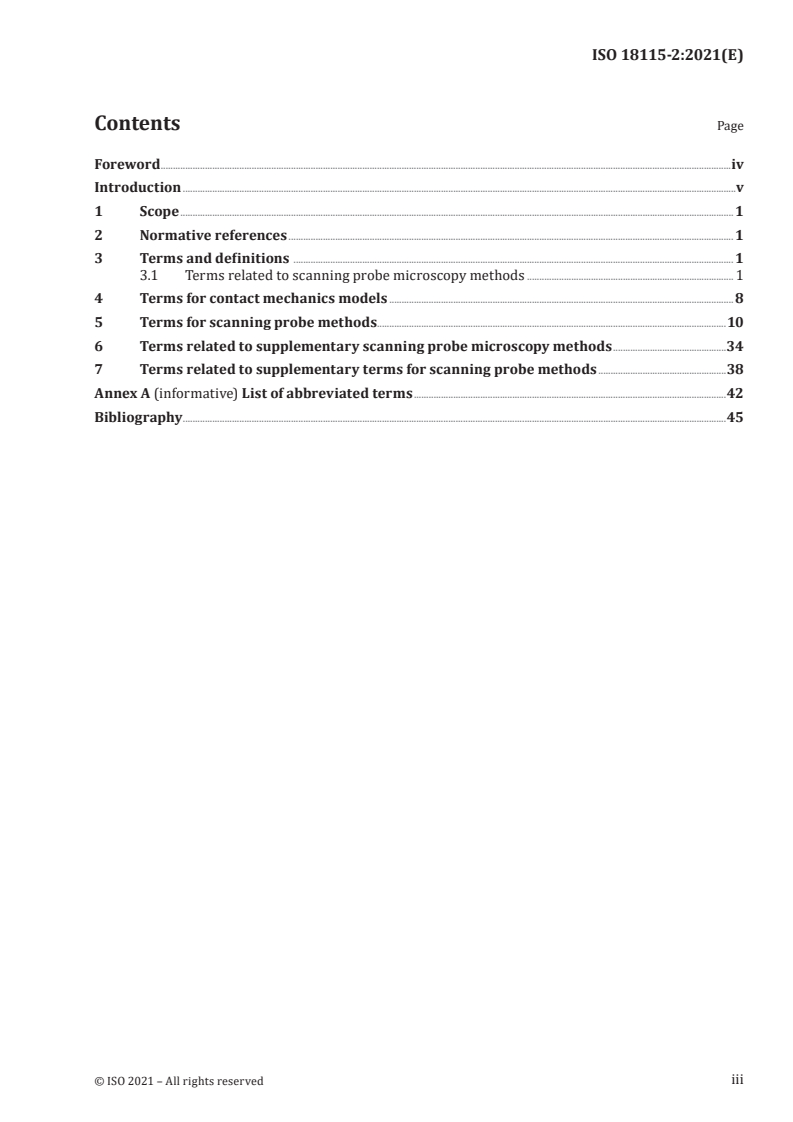
Contents Page
Foreword .iv
Introduction .v
1 Scope . 1
2 Normative references . 1
3 Terms and definitions . 1
3.1 Terms related to scanning probe microscopy methods . 1
4 Terms for contact mechanics models .8
5 Terms for scanning probe methods .10
6 Terms related to supplementary scanning probe microscopy methods .34
7 Terms related to supplementary terms for scanning probe methods .38
Annex A (informative) List of abbreviated terms .42
Bibliography .45
iii
Foreword
ISO (the International Organization for Standardization) is a worldwide federation of national standards
bodies (ISO member bodies). The work of preparing International Standards is normally carried out
through ISO technical committees. Each member body interested in a subject for which a technical
committee has been established has the right to be represented on that committee. International
organizations, governmental and non-governmental, in liaison with ISO, also take part in the work.
ISO collaborates closely with the International Electrotechnical Commission (IEC) on all matters of
electrotechnical standardization.
The procedures used to develop this document and those intended for its further maintenance are
described in the ISO/IEC Directives, Part 1. In particular, the different approval criteria needed for the
different types of ISO documents should be noted. This document was drafted in accordance with the
editorial rules of the ISO/IEC Directives, Part 2 (see www.iso.org/directives).
Attention is drawn to the possibility that some of the elements of this document may be the subject of
patent rights. ISO shall not be held responsible for identifying any or all such patent rights. Details of
any patent rights identified during the development of the document will be in the Introduction and/or
on the ISO list of patent declarations received (see www.iso.org/patents).
Any trade name used in this document is information given for the convenience of users and does not
constitute an endorsement.
For an explanation of the voluntary nature of standards, the meaning of ISO specific terms and
expressions related to conformity assessment, as well as information about ISO's adherence to
the World Trade Organization (WTO) principles in the Technical Barriers to Trade (TBT), see
www.iso.org/iso/foreword.html.
This document was prepared by Technical Committee ISO/TC 201, Surface chemical analysis,
Subcommittee SC 1, Terminology.
This third edition cancels and replaces the second edition (ISO 18115-2:2013), of which it constitutes a
minor revision.
The changes to the previous edition are as follows:
— the term "Kelvin-force microscopy" has been replaced with "Kelvin-probe force microscopy" and,
where it occurred, the term "scanning-probe microscopy" has been replaced with "scanning probe
microscopy".
A list of all parts in the ISO 18115 series can be found on the ISO website.
Any feedback or questions on this document should be directed to the user’s national standards body. A
complete listing of these bodies can be found at www.iso.org/members.html.
iv
Introduction
Surface chemical analysis is an important area which involves interactions between people with
different backgrounds and from different fields. Those conducting surface chemical analysis might be
materials scientists, chemists, or physicists and might have a background that is primarily experimental
or primarily theoretical. Those making use of the surface chemical data extend beyond this group into
other disciplines.
With the present techniques of surface chemical analysis, compositional information is obtained for
regions close to a surface (generally within 20 nm) and composition-versus-depth information is
obtained with surface analytical techniques as surface layers are removed. The terms covered in this
document relate to scanning probe microscopy. The surface analytical terms covered in ISO 18115-1
extend from the techniques of electron spectroscopy and mass spectrometry to optical spectrometry
and X-ray analysis. Concepts for these techniques derive from disciplines as widely ranging as nuclear
physics and radiation science to physical chemistry and optics.
The wide range of disciplines and the individualities of national usages have led to different meanings
being attributed to particular terms and, again, different terms being used to describe the same concept.
To avoid the consequent misunderstandings and to facilitate the exchange of information, it is essential
to clarify the concepts, to establish the correct terms for use, and to establish their definitions.
The terms are given in alphabetical order, classified under the following:
— Clause 3: Definitions of the scanning probe microscopy methods;
— Clause 4: Acronyms and terms for contact mechanics models;
— Clause 5: Definitions of terms for scanning probe methods;
— Clause 6: Definitions of supplementary scanning probe microscopy methods;
— Clause 7: Definitions of supplementary terms for scanning probe methods.
In the terms in Clause 3, note that the final “M” or final “S” in the acronyms, given as “microscopy” or
“spectroscopy”, may also mean “microscope” or “spectrometer”, respectively, depending on the context.
For the definition relating to the microscope or spectrometer, replace the words “a method” by the
words “an instrument” where that appears.
In contact mechanics, covered in Clause 4, the basic theories are often referenced by acronyms. To avoid
confusion, these acronyms are defined below. These models all assume that the materials in contact are
homogeneous and isotropic, and have a linear elastic constitutive behaviour. Various contact models
for inhomogeneous, anisotropic, nonlinear, viscoelastic, elastoplastic, and other materials have been
derived and can be found in the literature.
Many terms concerned with profilometry, or more correctly, surface texture measuring instruments,
may be found in ISO 3274 and ISO 4287. ISO 3274 specifies the properties of the instrument that
influence profile evaluation and provides basic considerations of the specification of contact (stylus)
instruments (profile meter and profile recorder) whereas ISO 4287 concerns some issues involving
surface texture.
Those interested in a more detailed understanding of profilometry or surface texture measuring
instruments should consult ISO 3274, ISO 4287, ISO 25178 and other referenced documents.
v
INTERNATIONAL STANDARD ISO 18115-2:2021(E)
Surface chemical analysis — Vocabulary —
Part 2:
Terms used in scanning-probe microscopy
1 Scope
This document defines terms for surface chemical analysis. ISO 18115-1 covers general terms and those
used in spectroscopy while this document covers terms used in scanning probe microscopy.
2 Normative references
There are no normative references in this document.
3 Terms and definitions
ISO and IEC maintain terminological databases for use in standardization at the following addresses:
— ISO Online browsing platform: available at https:// www .iso .org/ obp
— IEC Electropedia: available at https:// www .electropedia .org/
3.1 Terms related to scanning probe microscopy methods
3.1.1
apertureless Raman microscopy
method of microscopy involving the acquisition of Raman spectroscopic data utilizing
a near-field (5.88) optical source and based upon a metal tip (5.120) in close proximity to the sample
surface illuminated with suitably polarized light
3.1.2
atomic-force microscopy
AFM
DEPRECATED: scanning force microscopy
DEPRECATED: SFM
method for imaging surfaces by mechanically scanning their surface contours, in which the deflection
of a sharp tip (5.120) sensing the surface forces, mounted on a compliant cantilever (5.18), is monitored
Note 1 to entry: AFM can provide a quantitative height image (5.69) of both insulating and conducting surfaces.
Note 2 to entry: Some AFM instruments move the sample in the x-, y- and z-directions while keeping the tip
position constant and others move the tip while keeping the sample position constant.
Note 3 to entry: AFM can be conducted in vacuum, a liquid, a controlled atmosphere, or air. Atomic resolution
may be attainable with suitable samples, with sharp tips, and by using an appropriate imaging mode.
Note 4 to entry: Many types of force can be measured, such as the normal forces (5.91) or the lateral (5.77), friction
(5.62), or shear force. When the latter is measured, the technique is referred to as lateral (3.1.13), frictional
(3.1.11), or shear force microscopy (3.1.37). This generic term encompasses all of the types of force microscopy
listed in Annex A.
Note 5 to entry: AFMs can be used to measure surface normal forces at individual points in the pixel array used
for imaging.
Note 6 to entry: For typical AFM tips with radii < 100 nm, the normal force should be less than about 0,1 μN,
depending on the sample material, or irreversible surface deformation and excessive tip wear occur.
3.1.3
chemical-force microscopy
CFM
LFM (3.1.13) or AFM (3.1.2) mode in which the deflection of a sharp probe tip (5.120), functionalized to
provide interaction forces with specific molecules, is monitored
Note 1 to entry: LFM is the most popularly used mode.
3.1.4
conductive-probe atomic-force microscopy
CPAFM
DEPRECATED: CAFM
DEPRECATED: C-AFM
AFM (3.1.2) mode in which a conductive probe (5.109) is used to measure both topography and
electric current between the tip (5.120) and the sample
Note 1 to entry: CPAFM is a secondary imaging mode derived from contact AFM that characterizes conductivity
variations across medium- to low-conducting and semiconducting materials. Typically, a DC bias is applied to the
tip, and the sample is held at ground potential. While the z feedback signal is used to generate a normal-contact
AFM topography image (5.69), the current passing between the tip and the sample is measured to generate the
conductive AFM image.
3.1.5
current-imaging tunnelling spectroscopy
CITS
method in which the STM tip is held at a constant height above the surface, while the bias
voltage, V, is scanned and the tunnelling current, I, is measured and mapped
Note 1 to entry: The constant height is usually maintained by gating the feedback loop so that it is only active for
some proportion of the time; during the remaining time, the feedback loop is switched off and the applied tip bias
is ramped and the current is measured.
Note 2 to entry: See I-V spectroscopy (5.74).
3.1.6
dynamic-mode AFM
dynamic-force microscopy
DFM
AFM (3.1.2) mode in which the relative positions of the probe tip (5.120) and sample vary in a
sinusoidal manner at each point in the image (5.69)
Note 1 to entry: The sinusoidal oscillation is usually in the form of a vibration in the z-direction and is often
driven at a frequency close to, and sometimes equal to, the cantilever resonance frequency.
Note 2 to entry: The signal measured can be the amplitude, the phase shift, or the resonance frequency shift of
the cantilever.
3.1.7
electrostatic-force microscopy
DEPRECATED: electric-force microscopy
AFM (3.1.2) mode in which a conductive probe (5.109) is used to map both topography and
electrostatic force between the tip (5.120) and the sample surface
3.1.8
electrochemical atomic-force microscopy
EC-AFM
AFM (3.1.2) mode in which a conductive probe (5.109) is used in an electrolyte solution to
measure both topography and electrochemical current
3.1.9
electrochemical scanning tunnelling microscopy
EC-STM
STM (3.1.34) mode in which a coated tip (5.120) is used in an electrolyte solution to measure
both topography and electrochemical current
3.1.10
frequency modulation atomic-force microscopy
FM-AFM
dynamic-mode AFM (3.1.6) in which the shift in resonance frequency (5.134) of the probe assembly (5.20)
is monitored and is adjusted to a set point using a feedback circuit
3.1.11
frictional-force microscopy
FFM
SPM (3.1.30) mode in which the friction force (5.62) is monitored
Note 1 to entry: The friction force can be detected in a static or frequency-modulated mode. Information on the
tilt azimuthal variation of the frictional force needs the static mode.
3.1.12
Kelvin-probe force microscopy
KPFM
DEPRECATED: KFM
dynamic-mode AFM (3.1.6) using a conducting probe tip to measure spatial or temporal changes in the
relative electric potentials of the tip and the surface
Note 1 to entry: Changes in the relative potentials reflect changes in the surface work function.
3.1.13
lateral-force microscopy
LFM
SPM (3.1.30) mode in which surface contours are scanned with a probe assembly (5.20) while monitoring
the lateral forces exerted on the probe tip (5.120) by observation of the torsion of the cantilever (5.18)
arising as a result of those forces
Note 1 to entry: The lateral forces can be detected in a static or frequency-modulated mode. Information on the
tilt azimuth of surface molecules needs the static mode.
3.1.14
magnetic dynamic-force microscopy
MDFM
DEPRECATED: magnetic AC mode
DEPRECATED: MAC mode
AFM (3.1.2) mode in which the probe (5.109) is oscillated by using a magnetic force (5.80)
3.1.15
magnetic-force microscopy
MFM
AFM (3.1.2) mode employing a probe assembly (5.20) that monitors both atomic forces and magnetic
interactions between the probe tip (5.120) and a surface
3.1.16
magnetic-resonance force microscopy
MRFM
AFM (3.1.2) imaging mode in which magnetic signals are mechanically detected by using a
cantilever (5.18) at resonance and the force arising from nuclear or electronic spin in the sample is
sensitively measured
3.1.17
near-field scanning optical microscopy
NSOM
scanning near-field optical microscopy
SNOM
method of imaging surfaces optically in transmission or reflection by mechanically scanning an optically
active probe (5.109) much smaller than the wavelength of light over the surface while monitoring the
transmitted or reflected light or an associated signal in the near-field (5.88) regime
Note 1 to entry: See scattering NSOM (3.1.36), scattering SNOM (3.1.36).
Note 2 to entry: Topography is important and the probe is scanned at constant height. Usually, the probe is
oscillated in the shear mode to detect and set the height.
Note 3 to entry: Where the extent of the optical probe is defined by an aperture (5.5), the aperture size is
typically in the range of 10 nm to 100 nm, and this largely defines the resolution. This form of instrument is often
called an aperture NSOM or aperture SNOM to distinguish it from a scattering NSOM (3.1.36) or scattering SNOM
(3.1.36) [previously called apertureless NSOM (3.1.36) or apertureless SNOM (3.1.36)], although, generally, the
adjective “aperture” is omitted. In the apertureless form, the extent of the optically active probe is defined by an
illuminated sharp metal or metal-coated tip (5.120) with a radius typically in the range of 10 nm to 100 nm, and
this largely defines the resolution.
Note 4 to entry: In addition to the optical image (5.69), NSOM can provide a quantitative image of the surface
contours similar to that available in AFM (3.1.2) and allied scanning probe techniques.
Note 5 to entry: This generic term encompasses all of the types of near-field microscopy listed in Clause 2.
3.1.18
non-contact atomic-force microscopy
NC-AFM
dynamic-mode AFM (3.1.6) in which the probe tip (5.120) is operated at such a distance from the surface
that it samples the weak, attractive van der Waals or other forces
Note 1 to entry: Forces in this mode are very low and are best for studying soft materials or avoiding cross-
contamination of the tip and the surface.
3.1.19
photothermal micro-spectroscopy
PTMS
SThM mode in which the probe (5.109) detects the photothermal response of a sample exposed to
infrared light to obtain an absorption spectrum
Note 1 to entry: The infrared light can be either from a tuneable monochromatic source or from a broadband
source set up as part of a Fourier transform infrared spectrometer. In the latter case, the photothermal
temperature fluctuations can be measured as a function of time to provide an interferogram which is Fourier-
transformed to give the spectrum of sub-micron-sized regions of the sample.
3.1.20
scanning capacitance microscopy
SCM
SPM (3.1.30) mode in which a conductive probe (5.109) is used to measure both topography and
capacitance between the tip (5.120) and sample
3.1.21
scanning chemical-potential microscopy
SCPM
SPM (3.1.30) mode in which spatial variations in the thermoelectric voltage signal, created by a constant
temperature gradient normal to the sample surface, are measured and related to spatial variations in
the chemical-potential gradient
3.1.22
scanning electrochemical microscopy
SECM
SPM (3.1.30) mode in which imaging occurs in an electrolyte solution with an electrochemically active
tip (5.120)
Note 1 to entry: See electrochemical atomic-force microscopy, EC-AFM (3.1.8), electrochemical scanning probe
microscopy, EC-SPM (6.5), electrochemical scanning tunnelling microscopy, EC-STM (3.1.9).
Note 2 to entry: In most cases, the SECM tip is an ultramicroelectrode and the tip signal is a Faradaic current
from electrolysis of solution species.
Note 3 to entry: The potential difference between the tip and either the sample or a reference electrode is usually
monitored.
Note 4 to entry: The liquid is usually an ionic or polar liquid in which an electric double layer exists at the sample
surface.
Note 5 to entry: The surface may be scanned with the tip at a constant height in the instrument frame to measure
the convolution of topography and electrochemical activity, or if the sample is electrochemically homogeneous,
in a feedback mode so that the tip is at a constant distance from the sample surface and the topography of the
surface is recorded.
3.1.23
scanning Hall probe microscopy
SHPM
SPM (3.1.30) mode in which a Hall probe is used as the scanning sensor to measure and map the
magnetic field from a sample surface
3.1.24
scanning ion conductance microscopy
SICM
SPM (3.1.30) mode in which an electrolyte-filled micropipette or nanopipette is used as a local probe
(5.109) for insulating samples immersed in an electrolytic solution
Note 1 to entry: The distance dependence of the ion conductance provides the key to performing non-contact
surface profiling.
3.1.25
scanning magneto-resistance microscopy
SMRM
SPM (3.1.30) mode in which a magneto-resistive sensor probe (5.109) on a cantilever (5.18) is scanned in
the contact mode (5.35) over a magnetic sample surface to measure two-dimensional magnetic images
(5.69) by acquiring magneto-resistive voltage
3.1.26
scanning Maxwell stress microscopy
SMSM
SPM (3.1.30) mode in which a conductive probe (5.109) is used to measure both topography and surface
potential by utilizing the Maxwell stress
3.1.27
scanning near-field thermal microscopy
SNTM
SNOM method in which an infrared-sensing thermometer is used to detect the local emission collected
by an optical probe (5.109) to measure both the topography and thermal properties
3.1.28
scanning near-field ultrasound holography
SNFUH
method for imaging surfaces and the subsurface regimes by mechanically scanning their surface
contours and detecting the results of the interference of a high-frequency acoustic wave [of the order
of MHz or higher and substantially greater than the resonance frequency (5.134) of the cantilever (5.18)]
applied to the bottom of the sample while another wave is applied to the cantilever at a slightly different
frequency
3.1.29
scanning non-linear dielectric microscopy
SNDM
SPM (3.1.30) mode in which a conductive probe (5.109) is used to measure both topography and
dielectric constant (capacitance)
3.1.30
scanning probe microscopy
SPM
method of imaging surfaces by mechanically scanning a probe (5.109) over the surface under study, in
which the concomitant response of a detector is measured
Note 1 to entry: This generic term encompasses AFM (3.1.2), CFM (3.1.3), CITS (3.1.5), FFM (3.1.11), LFM (3.1.13),
SFM, SNOM (3.1.17), STM (3.1.34), TSM, etc. listed in Annex A.
Note 2 to entry: The resolution varies from that of STM, where individual atoms can be resolved, to SThM (3.1.33),
in which the resolution is generally limited to around 1 μm.
3.1.31
scanning spreading-resistance microscopy
SSRM
SPM (3.1.30) mode in which a conductive tip (5.120) is used to measure both topography and spreading
resistance
Note 1 to entry: While full-diamond or diamond-coated probes (5.109) are almost always used for the SSRM of
Si samples, it is possible to perform SSRM with other conductive tips when (in cases such as the imaging of InP,
which is soft) the use of a diamond tip could damage the sample.
3.1.32
scanning surface potential microscopy
SSPM
SPM (3.1.30) mode in which a conductive probe (5.109) is used to measure both topography and surface
potential
Note 1 to entry: KPFM (3.1.12) is SSPM conducted using an AFM (3.1.2) as defined in 3.1.13. Where this is
appropriate, KPFM should be used to describe the method rather than the more generic term, SSPM.
3.1.33
scanning thermal microscopy
SThM
SPM (3.1.30) method in which a thermal sensor is integrated into the probe (5.109) to measure both
topography and thermal properties
Note 1 to entry: Examples of such thermal properties are temperature and thermal conductivity.
Note 2 to entry: This method is sometimes known as thermal-scanning microscopy or TSM. This expression and
acronym are deprecated.
3.1.34
scanning tunnelling microscopy
STM
SPM (3.1.30) mode for imaging conductive surfaces by mechanically scanning a sharp, voltage-biased,
conducting probe tip (5.120) over their surface, in which the data of the tunnelling (5.169) current and
the tip-surface separation are used in generating the image (5.69)
Note 1 to entry: STM can be conducted in vacuum, a liquid, or air. Atomic resolution can be achieved with suitable
samples and sharp probes and can, with ideal samples, provide localized bonding information around surface
atoms.
Note 2 to entry: Images can be formed from the height data at a constant tunnelling current or the tunnelling
current at a constant height or other modes at defined relative potentials of the tip and sample.
Note 3 to entry: STM can be used to map the densities of states at surfaces or, in ideal cases, around individual
atoms. The surface images can differ significantly, depending on the tip bias (5.159), even for the same topography.
3.1.35
scanning tunnelling spectroscopy
STS
STM (3.1.34) mode in which the tunnelling (5.169) current, I, between the tip (5.120) and the sample is
measured as the voltage, V, between the tip and the sample is scanned
Note 1 to entry: See I-V spectroscopy (5.74).
Note 2 to entry: The differential conductance, dI/dV, reflects the electronic local density of states (LDOS). If the
sample is a superconductor, the energy gap around the Fermi level can be characterized.
3.1.36
scattering NSOM/SNOM
s-NSOM
s-SNOM
DEPRECATED: apertureless NSOM
DEPRECATED: ANSOM
DEPRECATED: apertureless SNOM
DEPRECATED: ASNOM
method in which imaging at a resolution below the Abbe diffraction limit (5.1) is achieved by detecting
light scattered or emitted in the vicinity of a sharp scanning tip (5.120)
Note 1 to entry: ASNOM and ANSOM are both commonly used, and sometimes also mean apertured NSOM/SNOM
and apertureless NSOM/SNOM. To reduce the potential confusion, scattering NSOM/SNOM is recommended,
which is more descriptive of the technique than the earlier terms which describe what is not used.
Note 2 to entry: No aperture (5.5) defines the resolution of the instrument. Instead, the probed volume is defined
by scattering within the near-field region around the tip or the localized optical field distribution around the tip.
Note 3 to entry: The sharp tip is usually metallic or metal coated, permitting measurements of surface-enhanced
Raman (5.152) and fluorescence (5.52) spectroscopy and second harmonic generation (5.140). Raman signals of
molecules in close proximity to silver can be enhanced by a factor of 10 .
Note 4 to entry: The tip can be a single fluorescent molecule or nanoparticle (5.87).
Note 5 to entry: In the literature, the acronym ANSOM or ASNOM is occasionally used erroneously for aperture
NSOM or aperture SNOM.
3.1.37
shear force microscopy
ShFM
AFM (3.1.2) mode using signals arising from a probe tip (5.120) oscillating laterally in proximity
to the surface
Note 1 to entry: The oscillation is usually sinusoidal and generated through a piezoelectric actuator.
3.1.38
spin-polarized scanning tunnelling microscopy
SP-STM
DEPRECATED: spin-resolved tunnelling microscopy
DEPRECATED: SRTM
STM (3.1.34) mode in which a magnetically ordered (ferromagnetic or antiferromagnetic) STM
tip (5.120) is scanned over a sample surface to image two-dimensional magnetic structures on the
nanometre scale by measuring the spin-dependent tunnelling (5.169) current
3.1.39
spin-polarized scanning tunnelling spectroscopy
SP-STS
STS (3.1.35) mode in which a magnetically ordered (ferromagnetic or antiferromagnetic) STM tip is
scanned over a sample surface to perform spin-polarized tunnelling (5.169) spectroscopy to probe the
magnetic and electronic structures of the sample surface on the nanometre scale
3.1.40
static-mode AFM
static AFM
AFM (3.1.2) mode of scanning the probe (5.109) where a control parameter is maintained
essentially constant or of scanning a control parameter at a fixed point in the raster array at the sample
surface
Note 1 to entry: The control parameter can be, for example, force or height.
3.1.41
tip-enhanced fluorescence spectroscopy
TEFS
enhanced fluorescence observed with a metal tip (5.120) in close proximity to a sample
surface illuminated with suitably polarized light
Note 1 to entry: See tip-enhanced Raman spectroscopy (3.1.42).
3.1.42
tip-enhanced Raman spectroscopy
TERS
enhanced Raman effect (5.128) observed with a metal tip (5.120) in close proximity to a
sample surface illuminated with suitably polarized light
Note 1 to entry: See tip-enhanced fluorescence spectroscopy (3.1.41), surface-enhanced Raman scattering (5.151).
3.1.43
ultrasonic force microscopy
UFM
AFM (3.1.2) mode in which an ultrasonic wave is injected through the probe (5.109) to observe
the surface or subsurface mechanical structure
4 Terms for contact mechanics models
4.1
Burnham-Colton-Pollock model
BCP
semi-empirical model of tip (5.120) and surface contact that assumes that long-range forces act only
outside the contact area
Note 1 to entry: See Reference [1].
Note 2 to entry: This simple semi-empirical approach matches many experimental AFM force-distance curves.
It avoids both the severe discontinuity in the slope of the force curve at contact in DMT (4.3) theory and the
adhesion hysteresis of JKRS (4.5) theory. It assumes that long-range forces act only outside the contact area and
uses a Hertzian functional relationship between indentation depth and contact radius that gives no adhesion
hysteresis.
4.2
Carpick-Ogletree-Salmeron model
COS
model of tip (5.120) and surface contact between a sphere and a flat surface giving a simple general
formula that approximates Maugis' solution to within 1 % accuracy
Note 1 to entry: See Reference [2].
Note 2 to entry: The general formula is amenable to conventional curve-fitting routines and provides a rapid
method of determining the approximate value of the parameter described by Maugis.
4.3
Derjaguin-Müller-Toporov model
DMT
model of tip (5.120) and surface contact in which adhesion forces are taken into account but the tip-
sample geometry is constrained to be Hertzian
Note 1 to entry: See Reference [3].
Note 2 to entry: This approach applies to rigid systems with low adhesion and small radii of curvature. The
adhesion forces are taken into account, but the tip-sample geometry is constrained to be Hertzian, i.e. Hertzian
mechanics with an offset to account for surface forces.
4.4
Hertzian model
model of tip (5.120) and surface contact between elastic solids that ignores any surface forces and
adhesion hysteresis
Note 1 to entry: This approach, derived by Hertz and described in Reference [4], describes the contact between
elastic solids. It ignores any surface forces and adhesion hysteresis and applies at high loads where there are no
surface forces present.
4.5
Johnson-Kendall-Roberts (-Sperling) model
JKR(S) model
model of tip (5.120) and surface contact in which adhesion forces outside the contact area are ignored
and elastic stresses at the edge of the contact area are infinite
Note 1 to entry: See Reference [5].
Note 2 to entry: In this work, adhesion forces outside the contact area are ignored and elastic stresses at the edge
of the contact area are infinite. At contact, short-range attractive forces suddenly operate, and the tip-sample
geometry is not constrained to remain Hertzian. Adhesion hysteresis is described and loading and unloading are
abrupt processes. This approach applies to highly adhesive systems with low stiffness (5.147) and high radii of
curvature.
Note 3 to entry: The JKR and JKRS models are the same. The JKR acronym is very commonly used. The JKRS
[6]
acronym extends the recognition to Sperling's earlier work .
4.6
Maugis model
Maugis-Dugdale model
model of tip (5.120) and surface contact between a sphere and a flat surface incorporating the elastic
modulus and work of adhesion (5.175)
Note 1 to entry: See Reference [7].
Note 2 to entry: This analysis is a complex mathematical description of the contact mechanics between a sphere
and a flat surface which applies in all material possibilities through a parameter that is a function of reduced
elastic modulus, reduced curvature radius, work of adhesion, and the tip-sample interatomic equilibrium
distance. At the limits, when this parameter tends to infinity or zero, the Maugis mechanics tend to the JKRS (4.5)
or DMT (4.3) mechanics, respectively.
5 Terms for scanning probe methods
5.1
Abbe diffraction limit
far-field diffraction limit
optimum resolution achievable for an optical system, governed by diffraction
phenomena, at the limit of collection optics placed at a large number of wavelengths from the object
under study
Note 1 to entry: In classical far-field diffraction theory, the optimum point-to-point resolution observed using a
system with a particular numerical aperture (5.93), NA (5.93), is given by d, where d = 0,61λ/NA, in which λ is the
wavelength of the illuminating light. With a carefully defined illumination, the factor 0,61 can be reduced to as
low as 0,36.
5.2
active length
length of the region of the probe tip (5.120) that can come into contact with the sample in a scan
Note 1 to entry: This length is set by the height of the tallest feature encountered.
Note 2 to entry: This length should be less than the probe length (5.112).
[SOURCE: ASTM E1813-96]
5.3
amplitude modulation detection
AM detection
dynamic mode in which the change in probe (5.109) height required to keep the vibration
amplitude of an oscillated cantilever (5.18) constant while it is scanning over the surface is monitored
Note 1 to entry: The oscillation frequency is usually set close to the resonance frequency (5.134), where the
amplitude changes are strongest.
Note 2 to entry: The phase shift between the drive and the response can also be monitored and provides
information on dissipated energy due to the tip-sample interaction.
Note 3 to entry: The detected signals can be used in a feedback system to keep one parameter constant.
5.4
anti-Stokes scattering
Raman effect (5.128) where the emitted photon has higher energy than the incident photon
Note 1 to entry: See Stokes scattering (5.148).
5.5
aperture
hole, typically circular, in an opaque manifold
Note 1 to entry: Apertures are critical to the performance of optical (light, electron, or optical) instruments in
defining their imaging or spectral resolution.
5.6
artefact
artifact
unwanted distortion or added feature in measured data arising from lack of idealness of equipment
5.7
atomic corrugation
regular undulations of the atoms on a low-index or vicinal surface of a single crystal, where the
undulations are of atomic width or greater and have heights which are a significant fraction of the
atomic size
Note 1 to entry: The corrugations can arise, for example, from the non-uniform distribution of the local density
of states (LDOS) and the minimization of the surface energy (5.150) and can change, for example, as a result of
changes in the probe tip (5.120) settings, the probe tip itself, the ambient temperature, or adsorbed species.
5.8
ballistic electron
electron that travels through a piece of material without significant scattering
Note 1 to entry: The energy of the electron is greater than that of any other electron in thermal equilibrium in the
system.
Note 2 to entry: The electron's mean free path is larger than the characteristic dimension of the sample in the
direction of transport.
5.9
barrier height
magnitude of the potential energy in a region restricting the movement of electrons
Note 1 to entry: In STM (3.1.34), the magnitude of the barrier height is related to the tip (5.120) and substrate
work functions. In classical mechanics, an electron with an energy less than the barrier height would not be able
to penetrate the barrier, whereas in quantum mechanics, there is a finite probability that the electron will tunnel
across the barrier. In the quantum tunnelling (5.169) of an electron from a metal through a vacuum gap to a
metal, the barrier height is the difference between the Fermi energy in the first metal and the maximum of the
potential distribution in the space between the two metals.
5.10
barrier height, local
potential energy of a tunnelling barrier (5.12) at a specified location
Note 1 to entry: When an STM (3.1.34) tip (5.120) is scanned across a sample, the potential energy can vary with
tip position due to chemical inhomogeneities (e.g. impurities) of lower work function at or close to the surface.
5.11
barrier height, tunnelling-
magnitude of the potential energy associated with the tunnelling barrier (5.12)
Note 1 to entry: See barrier height (5.9).
Note 2 to entry: In STM (3.1.34), the magnitude of the barrier height is related to the tip (5.120) and substrate
work functions.
5.12
barrier, tunnelling
energy barrier with an associated height (i.e. energy), width (i.e. length), and shape (i.e. profile of energy
versus length) across which electrons traverse by quantum-mechanical tunnelling (5.169)
Note 1 to entry: For electrons with an energy less than the barrier height (5.9), quantum mechanics dictates that
there is a finite probability for the electrons to tunnel across the barrier, whereas classical mechanics would
forbid electron transport.
Note 2 to entry: See tunnelling-barrier height (5.11), tunnelling-barrier width (5.13).
5.13
barrier width, tunnelling-
length associated with a potential-energy barrier that electrons traverse by quantum-mechanical
tunnelling (5.169)
Note 1 to entry: When in the STM (3.1.34) tunnelling regime, the tunnelling-barrier width is equivalent to the tip-
sample separation. The tunnelling current decreases approximately exponentially with increasing barrier width.
5.14
Bethe-Bouwkamp model
model by Bethe and by Bouwkamp describing the wavefield for a sub-wavelength
aperture (5.5) in an infinite perfectly conducting screen
Note 1 to entry: This may be a useful approximation for an aperture in NSOM/SNOM (3.1.17).
Note 2 to entry: The original model derives from References [9] to [11].
5.15
blind reconstruction
reconstruction estimate of a sample's (or tip's) surface topography when the estimate is obtained from
a measured image (5.69) without independent knowledge of the tip's (or sample's) surface topography
Note 1 to entry: See dilation (5.39), erosion (5.45).
5.16
bow
distance, measured at right angles, of the centre point of a sample surface from a reference plane
defined by three equidistant points on the surface in a circle around that centre with a radius suitable
to cover the surface defined
Note 1 to entry: See flatness (5.50), warp (5.173).
Note 2 to entry: A positive value indicates a surface that is convex and a negative value indicates a surface that is
concave.
Note 3 to entry: This term is applied to surfaces whose out-of-flatness is essentially described as concave or
convex, i.e. they have one extremity that is not at the perimeter of the reference plane.
Note 4 to entry: This term is often applied to wafers where the diameter of the circle might be 6,25 mm less than
the wafer diameter.
5.17
Bückle's rule
indentation to less than 10 % of the layer thickness when measuring the layer hardness directly
Note 1 to entry: This is an empirical rule established for measuring coating hardnesses and has been shown to
apply to films greater than about 5 μm in thickness.
Note 2 to entry: This rule is often applied to the measurement of film moduli.
5.18
cantilever
thin force-sensing support for a probe tip (5.120), joined to the cantilever chip (5.26) at the end furthest
from the probe tip
Note 1 to entry: Cantilevers are available in a number of shapes ranging from rectangular or diving board to “V”
or “A” shapes where the probe tip is near the narrower end.
5.19
cantilever apex
end of the cantilever (5.18) furthest from the cantilever support structure
Note 1 to entry: See probe apex (5.120).
5.20
cantilever assembly
micro cantilever
probe assembly
structure comprising the chip holder (5.27), chip (5.26), cantilever (5.18), and probe (5.109)
5.21
cantilever back side
DEPRECATED: cantilever reflex side
cantilever (5.18) surface opposite to the surface on which the probe tip (5.120) is mounted
Note 1 to entry: See detector side (of a cantilever) (5.38).
Note 2 to entry: The reflex side has the same meaning as the back side but is only applicable to cantilevers with a
reflection coating for use with an optical sensor. Reflex side is therefore deprecated.
5.22
capillary force
force exerted on an AFM cantilever or similar probe (5.109) due to capillary condensation at the junction
between the probe and the surface
5.23
carbon nanotube probe
probe (5.109) with a carbon nanotube that forms both the probe shank (5.113) and the probe tip (5.120)
Note 1 to entry: The carbon nanotube is normally supported on a probe-like structure called the probe support
(5.115). The nanotube and the support comprise a composite probe (5.30).
5.24
characterized length
region of the probe (5.109) that has been measured by a probe characterizer (5.110)
[SOURCE: ASTM E1813-96]
5.25
chemical force
force between atoms or molecular groups on the probe tip (5.120) and atoms or molecular groups on
the surface
5.26
chip
cantilever chip
chip substrate
DEPRECATED: probe chip
small piece, usually of silicon, on which the cantilever (5.18) has been fabricated and to which it is still
attached as a convenient supporting structure in the probe assembly (5.20)
5.27
chip holder
structure on which the chip (5.26), cantilever (5.18), and probe (5.109) are mounted
Note 1 to entry: The chip holder, chip, cantilever, and probe comprise the probe assembly (5.20).
5.28
closed-loop scanner
scanning system having a function sensor whose output is fed back into the scanning system to improve
the accuracy of its settings
Note 1 to entry: This term often refers to function sensors that relate to position and scanners (5.136) that can
then set their x- and y- and, sometimes, z-positions accurately. This is very important since position scanners are
often based on piezoelectric components that exhibit significant hysteresis and creep in the absence of closed-
loop control.
5.29
coarse-approach device
device that changes the initial probe (5.109) and sample separations by amounts significantly greater
than the vertical (z) scanner (5.136) range
Note 1 to entry: Typical coarse-approach device ranges are 1 mm whereas the z scan
...
INTERNATIONAL ISO
STANDARD 18115-2
Third edition
2021-12
Surface chemical analysis —
Vocabulary —
Part 2:
Terms used in scanning-probe
microscopy
Analyse chimique des surfaces — Vocabulaire —
Partie 2: Termes utilisés en microscopie à sonde à balayage
Reference number
© ISO 2021
All rights reserved. Unless otherwise specified, or required in the context of its implementation, no part of this publication may
be reproduced or utilized otherwise in any form or by any means, electronic or mechanical, including photocopying, or posting on
the internet or an intranet, without prior written permission. Permission can be requested from either ISO at the address below
or ISO’s member body in the country of the requester.
ISO copyright office
CP 401 • Ch. de Blandonnet 8
CH-1214 Vernier, Geneva
Phone: +41 22 749 01 11
Email: copyright@iso.org
Website: www.iso.org
Published in Switzerland
ii
Contents Page
Foreword .iv
Introduction .v
1 Scope . 1
2 Normative references . 1
3 Terms and definitions . 1
3.1 Terms related to scanning probe microscopy methods . 1
4 Terms for contact mechanics models .8
5 Terms for scanning probe methods .10
6 Terms related to supplementary scanning probe microscopy methods .34
7 Terms related to supplementary terms for scanning probe methods .38
Annex A (informative) List of abbreviated terms .42
Bibliography .45
iii
Foreword
ISO (the International Organization for Standardization) is a worldwide federation of national standards
bodies (ISO member bodies). The work of preparing International Standards is normally carried out
through ISO technical committees. Each member body interested in a subject for which a technical
committee has been established has the right to be represented on that committee. International
organizations, governmental and non-governmental, in liaison with ISO, also take part in the work.
ISO collaborates closely with the International Electrotechnical Commission (IEC) on all matters of
electrotechnical standardization.
The procedures used to develop this document and those intended for its further maintenance are
described in the ISO/IEC Directives, Part 1. In particular, the different approval criteria needed for the
different types of ISO documents should be noted. This document was drafted in accordance with the
editorial rules of the ISO/IEC Directives, Part 2 (see www.iso.org/directives).
Attention is drawn to the possibility that some of the elements of this document may be the subject of
patent rights. ISO shall not be held responsible for identifying any or all such patent rights. Details of
any patent rights identified during the development of the document will be in the Introduction and/or
on the ISO list of patent declarations received (see www.iso.org/patents).
Any trade name used in this document is information given for the convenience of users and does not
constitute an endorsement.
For an explanation of the voluntary nature of standards, the meaning of ISO specific terms and
expressions related to conformity assessment, as well as information about ISO's adherence to
the World Trade Organization (WTO) principles in the Technical Barriers to Trade (TBT), see
www.iso.org/iso/foreword.html.
This document was prepared by Technical Committee ISO/TC 201, Surface chemical analysis,
Subcommittee SC 1, Terminology.
This third edition cancels and replaces the second edition (ISO 18115-2:2013), of which it constitutes a
minor revision.
The changes to the previous edition are as follows:
— the term "Kelvin-force microscopy" has been replaced with "Kelvin-probe force microscopy" and,
where it occurred, the term "scanning-probe microscopy" has been replaced with "scanning probe
microscopy".
A list of all parts in the ISO 18115 series can be found on the ISO website.
Any feedback or questions on this document should be directed to the user’s national standards body. A
complete listing of these bodies can be found at www.iso.org/members.html.
iv
Introduction
Surface chemical analysis is an important area which involves interactions between people with
different backgrounds and from different fields. Those conducting surface chemical analysis might be
materials scientists, chemists, or physicists and might have a background that is primarily experimental
or primarily theoretical. Those making use of the surface chemical data extend beyond this group into
other disciplines.
With the present techniques of surface chemical analysis, compositional information is obtained for
regions close to a surface (generally within 20 nm) and composition-versus-depth information is
obtained with surface analytical techniques as surface layers are removed. The terms covered in this
document relate to scanning probe microscopy. The surface analytical terms covered in ISO 18115-1
extend from the techniques of electron spectroscopy and mass spectrometry to optical spectrometry
and X-ray analysis. Concepts for these techniques derive from disciplines as widely ranging as nuclear
physics and radiation science to physical chemistry and optics.
The wide range of disciplines and the individualities of national usages have led to different meanings
being attributed to particular terms and, again, different terms being used to describe the same concept.
To avoid the consequent misunderstandings and to facilitate the exchange of information, it is essential
to clarify the concepts, to establish the correct terms for use, and to establish their definitions.
The terms are given in alphabetical order, classified under the following:
— Clause 3: Definitions of the scanning probe microscopy methods;
— Clause 4: Acronyms and terms for contact mechanics models;
— Clause 5: Definitions of terms for scanning probe methods;
— Clause 6: Definitions of supplementary scanning probe microscopy methods;
— Clause 7: Definitions of supplementary terms for scanning probe methods.
In the terms in Clause 3, note that the final “M” or final “S” in the acronyms, given as “microscopy” or
“spectroscopy”, may also mean “microscope” or “spectrometer”, respectively, depending on the context.
For the definition relating to the microscope or spectrometer, replace the words “a method” by the
words “an instrument” where that appears.
In contact mechanics, covered in Clause 4, the basic theories are often referenced by acronyms. To avoid
confusion, these acronyms are defined below. These models all assume that the materials in contact are
homogeneous and isotropic, and have a linear elastic constitutive behaviour. Various contact models
for inhomogeneous, anisotropic, nonlinear, viscoelastic, elastoplastic, and other materials have been
derived and can be found in the literature.
Many terms concerned with profilometry, or more correctly, surface texture measuring instruments,
may be found in ISO 3274 and ISO 4287. ISO 3274 specifies the properties of the instrument that
influence profile evaluation and provides basic considerations of the specification of contact (stylus)
instruments (profile meter and profile recorder) whereas ISO 4287 concerns some issues involving
surface texture.
Those interested in a more detailed understanding of profilometry or surface texture measuring
instruments should consult ISO 3274, ISO 4287, ISO 25178 and other referenced documents.
v
INTERNATIONAL STANDARD ISO 18115-2:2021(E)
Surface chemical analysis — Vocabulary —
Part 2:
Terms used in scanning-probe microscopy
1 Scope
This document defines terms for surface chemical analysis. ISO 18115-1 covers general terms and those
used in spectroscopy while this document covers terms used in scanning probe microscopy.
2 Normative references
There are no normative references in this document.
3 Terms and definitions
ISO and IEC maintain terminological databases for use in standardization at the following addresses:
— ISO Online browsing platform: available at https:// www .iso .org/ obp
— IEC Electropedia: available at https:// www .electropedia .org/
3.1 Terms related to scanning probe microscopy methods
3.1.1
apertureless Raman microscopy
method of microscopy involving the acquisition of Raman spectroscopic data utilizing
a near-field (5.88) optical source and based upon a metal tip (5.120) in close proximity to the sample
surface illuminated with suitably polarized light
3.1.2
atomic-force microscopy
AFM
DEPRECATED: scanning force microscopy
DEPRECATED: SFM
method for imaging surfaces by mechanically scanning their surface contours, in which the deflection
of a sharp tip (5.120) sensing the surface forces, mounted on a compliant cantilever (5.18), is monitored
Note 1 to entry: AFM can provide a quantitative height image (5.69) of both insulating and conducting surfaces.
Note 2 to entry: Some AFM instruments move the sample in the x-, y- and z-directions while keeping the tip
position constant and others move the tip while keeping the sample position constant.
Note 3 to entry: AFM can be conducted in vacuum, a liquid, a controlled atmosphere, or air. Atomic resolution
may be attainable with suitable samples, with sharp tips, and by using an appropriate imaging mode.
Note 4 to entry: Many types of force can be measured, such as the normal forces (5.91) or the lateral (5.77), friction
(5.62), or shear force. When the latter is measured, the technique is referred to as lateral (3.1.13), frictional
(3.1.11), or shear force microscopy (3.1.37). This generic term encompasses all of the types of force microscopy
listed in Annex A.
Note 5 to entry: AFMs can be used to measure surface normal forces at individual points in the pixel array used
for imaging.
Note 6 to entry: For typical AFM tips with radii < 100 nm, the normal force should be less than about 0,1 μN,
depending on the sample material, or irreversible surface deformation and excessive tip wear occur.
3.1.3
chemical-force microscopy
CFM
LFM (3.1.13) or AFM (3.1.2) mode in which the deflection of a sharp probe tip (5.120), functionalized to
provide interaction forces with specific molecules, is monitored
Note 1 to entry: LFM is the most popularly used mode.
3.1.4
conductive-probe atomic-force microscopy
CPAFM
DEPRECATED: CAFM
DEPRECATED: C-AFM
AFM (3.1.2) mode in which a conductive probe (5.109) is used to measure both topography and
electric current between the tip (5.120) and the sample
Note 1 to entry: CPAFM is a secondary imaging mode derived from contact AFM that characterizes conductivity
variations across medium- to low-conducting and semiconducting materials. Typically, a DC bias is applied to the
tip, and the sample is held at ground potential. While the z feedback signal is used to generate a normal-contact
AFM topography image (5.69), the current passing between the tip and the sample is measured to generate the
conductive AFM image.
3.1.5
current-imaging tunnelling spectroscopy
CITS
method in which the STM tip is held at a constant height above the surface, while the bias
voltage, V, is scanned and the tunnelling current, I, is measured and mapped
Note 1 to entry: The constant height is usually maintained by gating the feedback loop so that it is only active for
some proportion of the time; during the remaining time, the feedback loop is switched off and the applied tip bias
is ramped and the current is measured.
Note 2 to entry: See I-V spectroscopy (5.74).
3.1.6
dynamic-mode AFM
dynamic-force microscopy
DFM
AFM (3.1.2) mode in which the relative positions of the probe tip (5.120) and sample vary in a
sinusoidal manner at each point in the image (5.69)
Note 1 to entry: The sinusoidal oscillation is usually in the form of a vibration in the z-direction and is often
driven at a frequency close to, and sometimes equal to, the cantilever resonance frequency.
Note 2 to entry: The signal measured can be the amplitude, the phase shift, or the resonance frequency shift of
the cantilever.
3.1.7
electrostatic-force microscopy
DEPRECATED: electric-force microscopy
AFM (3.1.2) mode in which a conductive probe (5.109) is used to map both topography and
electrostatic force between the tip (5.120) and the sample surface
3.1.8
electrochemical atomic-force microscopy
EC-AFM
AFM (3.1.2) mode in which a conductive probe (5.109) is used in an electrolyte solution to
measure both topography and electrochemical current
3.1.9
electrochemical scanning tunnelling microscopy
EC-STM
STM (3.1.34) mode in which a coated tip (5.120) is used in an electrolyte solution to measure
both topography and electrochemical current
3.1.10
frequency modulation atomic-force microscopy
FM-AFM
dynamic-mode AFM (3.1.6) in which the shift in resonance frequency (5.134) of the probe assembly (5.20)
is monitored and is adjusted to a set point using a feedback circuit
3.1.11
frictional-force microscopy
FFM
SPM (3.1.30) mode in which the friction force (5.62) is monitored
Note 1 to entry: The friction force can be detected in a static or frequency-modulated mode. Information on the
tilt azimuthal variation of the frictional force needs the static mode.
3.1.12
Kelvin-probe force microscopy
KPFM
DEPRECATED: KFM
dynamic-mode AFM (3.1.6) using a conducting probe tip to measure spatial or temporal changes in the
relative electric potentials of the tip and the surface
Note 1 to entry: Changes in the relative potentials reflect changes in the surface work function.
3.1.13
lateral-force microscopy
LFM
SPM (3.1.30) mode in which surface contours are scanned with a probe assembly (5.20) while monitoring
the lateral forces exerted on the probe tip (5.120) by observation of the torsion of the cantilever (5.18)
arising as a result of those forces
Note 1 to entry: The lateral forces can be detected in a static or frequency-modulated mode. Information on the
tilt azimuth of surface molecules needs the static mode.
3.1.14
magnetic dynamic-force microscopy
MDFM
DEPRECATED: magnetic AC mode
DEPRECATED: MAC mode
AFM (3.1.2) mode in which the probe (5.109) is oscillated by using a magnetic force (5.80)
3.1.15
magnetic-force microscopy
MFM
AFM (3.1.2) mode employing a probe assembly (5.20) that monitors both atomic forces and magnetic
interactions between the probe tip (5.120) and a surface
3.1.16
magnetic-resonance force microscopy
MRFM
AFM (3.1.2) imaging mode in which magnetic signals are mechanically detected by using a
cantilever (5.18) at resonance and the force arising from nuclear or electronic spin in the sample is
sensitively measured
3.1.17
near-field scanning optical microscopy
NSOM
scanning near-field optical microscopy
SNOM
method of imaging surfaces optically in transmission or reflection by mechanically scanning an optically
active probe (5.109) much smaller than the wavelength of light over the surface while monitoring the
transmitted or reflected light or an associated signal in the near-field (5.88) regime
Note 1 to entry: See scattering NSOM (3.1.36), scattering SNOM (3.1.36).
Note 2 to entry: Topography is important and the probe is scanned at constant height. Usually, the probe is
oscillated in the shear mode to detect and set the height.
Note 3 to entry: Where the extent of the optical probe is defined by an aperture (5.5), the aperture size is
typically in the range of 10 nm to 100 nm, and this largely defines the resolution. This form of instrument is often
called an aperture NSOM or aperture SNOM to distinguish it from a scattering NSOM (3.1.36) or scattering SNOM
(3.1.36) [previously called apertureless NSOM (3.1.36) or apertureless SNOM (3.1.36)], although, generally, the
adjective “aperture” is omitted. In the apertureless form, the extent of the optically active probe is defined by an
illuminated sharp metal or metal-coated tip (5.120) with a radius typically in the range of 10 nm to 100 nm, and
this largely defines the resolution.
Note 4 to entry: In addition to the optical image (5.69), NSOM can provide a quantitative image of the surface
contours similar to that available in AFM (3.1.2) and allied scanning probe techniques.
Note 5 to entry: This generic term encompasses all of the types of near-field microscopy listed in Clause 2.
3.1.18
non-contact atomic-force microscopy
NC-AFM
dynamic-mode AFM (3.1.6) in which the probe tip (5.120) is operated at such a distance from the surface
that it samples the weak, attractive van der Waals or other forces
Note 1 to entry: Forces in this mode are very low and are best for studying soft materials or avoiding cross-
contamination of the tip and the surface.
3.1.19
photothermal micro-spectroscopy
PTMS
SThM mode in which the probe (5.109) detects the photothermal response of a sample exposed to
infrared light to obtain an absorption spectrum
Note 1 to entry: The infrared light can be either from a tuneable monochromatic source or from a broadband
source set up as part of a Fourier transform infrared spectrometer. In the latter case, the photothermal
temperature fluctuations can be measured as a function of time to provide an interferogram which is Fourier-
transformed to give the spectrum of sub-micron-sized regions of the sample.
3.1.20
scanning capacitance microscopy
SCM
SPM (3.1.30) mode in which a conductive probe (5.109) is used to measure both topography and
capacitance between the tip (5.120) and sample
3.1.21
scanning chemical-potential microscopy
SCPM
SPM (3.1.30) mode in which spatial variations in the thermoelectric voltage signal, created by a constant
temperature gradient normal to the sample surface, are measured and related to spatial variations in
the chemical-potential gradient
3.1.22
scanning electrochemical microscopy
SECM
SPM (3.1.30) mode in which imaging occurs in an electrolyte solution with an electrochemically active
tip (5.120)
Note 1 to entry: See electrochemical atomic-force microscopy, EC-AFM (3.1.8), electrochemical scanning probe
microscopy, EC-SPM (6.5), electrochemical scanning tunnelling microscopy, EC-STM (3.1.9).
Note 2 to entry: In most cases, the SECM tip is an ultramicroelectrode and the tip signal is a Faradaic current
from electrolysis of solution species.
Note 3 to entry: The potential difference between the tip and either the sample or a reference electrode is usually
monitored.
Note 4 to entry: The liquid is usually an ionic or polar liquid in which an electric double layer exists at the sample
surface.
Note 5 to entry: The surface may be scanned with the tip at a constant height in the instrument frame to measure
the convolution of topography and electrochemical activity, or if the sample is electrochemically homogeneous,
in a feedback mode so that the tip is at a constant distance from the sample surface and the topography of the
surface is recorded.
3.1.23
scanning Hall probe microscopy
SHPM
SPM (3.1.30) mode in which a Hall probe is used as the scanning sensor to measure and map the
magnetic field from a sample surface
3.1.24
scanning ion conductance microscopy
SICM
SPM (3.1.30) mode in which an electrolyte-filled micropipette or nanopipette is used as a local probe
(5.109) for insulating samples immersed in an electrolytic solution
Note 1 to entry: The distance dependence of the ion conductance provides the key to performing non-contact
surface profiling.
3.1.25
scanning magneto-resistance microscopy
SMRM
SPM (3.1.30) mode in which a magneto-resistive sensor probe (5.109) on a cantilever (5.18) is scanned in
the contact mode (5.35) over a magnetic sample surface to measure two-dimensional magnetic images
(5.69) by acquiring magneto-resistive voltage
3.1.26
scanning Maxwell stress microscopy
SMSM
SPM (3.1.30) mode in which a conductive probe (5.109) is used to measure both topography and surface
potential by utilizing the Maxwell stress
3.1.27
scanning near-field thermal microscopy
SNTM
SNOM method in which an infrared-sensing thermometer is used to detect the local emission collected
by an optical probe (5.109) to measure both the topography and thermal properties
3.1.28
scanning near-field ultrasound holography
SNFUH
method for imaging surfaces and the subsurface regimes by mechanically scanning their surface
contours and detecting the results of the interference of a high-frequency acoustic wave [of the order
of MHz or higher and substantially greater than the resonance frequency (5.134) of the cantilever (5.18)]
applied to the bottom of the sample while another wave is applied to the cantilever at a slightly different
frequency
3.1.29
scanning non-linear dielectric microscopy
SNDM
SPM (3.1.30) mode in which a conductive probe (5.109) is used to measure both topography and
dielectric constant (capacitance)
3.1.30
scanning probe microscopy
SPM
method of imaging surfaces by mechanically scanning a probe (5.109) over the surface under study, in
which the concomitant response of a detector is measured
Note 1 to entry: This generic term encompasses AFM (3.1.2), CFM (3.1.3), CITS (3.1.5), FFM (3.1.11), LFM (3.1.13),
SFM, SNOM (3.1.17), STM (3.1.34), TSM, etc. listed in Annex A.
Note 2 to entry: The resolution varies from that of STM, where individual atoms can be resolved, to SThM (3.1.33),
in which the resolution is generally limited to around 1 μm.
3.1.31
scanning spreading-resistance microscopy
SSRM
SPM (3.1.30) mode in which a conductive tip (5.120) is used to measure both topography and spreading
resistance
Note 1 to entry: While full-diamond or diamond-coated probes (5.109) are almost always used for the SSRM of
Si samples, it is possible to perform SSRM with other conductive tips when (in cases such as the imaging of InP,
which is soft) the use of a diamond tip could damage the sample.
3.1.32
scanning surface potential microscopy
SSPM
SPM (3.1.30) mode in which a conductive probe (5.109) is used to measure both topography and surface
potential
Note 1 to entry: KPFM (3.1.12) is SSPM conducted using an AFM (3.1.2) as defined in 3.1.13. Where this is
appropriate, KPFM should be used to describe the method rather than the more generic term, SSPM.
3.1.33
scanning thermal microscopy
SThM
SPM (3.1.30) method in which a thermal sensor is integrated into the probe (5.109) to measure both
topography and thermal properties
Note 1 to entry: Examples of such thermal properties are temperature and thermal conductivity.
Note 2 to entry: This method is sometimes known as thermal-scanning microscopy or TSM. This expression and
acronym are deprecated.
3.1.34
scanning tunnelling microscopy
STM
SPM (3.1.30) mode for imaging conductive surfaces by mechanically scanning a sharp, voltage-biased,
conducting probe tip (5.120) over their surface, in which the data of the tunnelling (5.169) current and
the tip-surface separation are used in generating the image (5.69)
Note 1 to entry: STM can be conducted in vacuum, a liquid, or air. Atomic resolution can be achieved with suitable
samples and sharp probes and can, with ideal samples, provide localized bonding information around surface
atoms.
Note 2 to entry: Images can be formed from the height data at a constant tunnelling current or the tunnelling
current at a constant height or other modes at defined relative potentials of the tip and sample.
Note 3 to entry: STM can be used to map the densities of states at surfaces or, in ideal cases, around individual
atoms. The surface images can differ significantly, depending on the tip bias (5.159), even for the same topography.
3.1.35
scanning tunnelling spectroscopy
STS
STM (3.1.34) mode in which the tunnelling (5.169) current, I, between the tip (5.120) and the sample is
measured as the voltage, V, between the tip and the sample is scanned
Note 1 to entry: See I-V spectroscopy (5.74).
Note 2 to entry: The differential conductance, dI/dV, reflects the electronic local density of states (LDOS). If the
sample is a superconductor, the energy gap around the Fermi level can be characterized.
3.1.36
scattering NSOM/SNOM
s-NSOM
s-SNOM
DEPRECATED: apertureless NSOM
DEPRECATED: ANSOM
DEPRECATED: apertureless SNOM
DEPRECATED: ASNOM
method in which imaging at a resolution below the Abbe diffraction limit (5.1) is achieved by detecting
light scattered or emitted in the vicinity of a sharp scanning tip (5.120)
Note 1 to entry: ASNOM and ANSOM are both commonly used, and sometimes also mean apertured NSOM/SNOM
and apertureless NSOM/SNOM. To reduce the potential confusion, scattering NSOM/SNOM is recommended,
which is more descriptive of the technique than the earlier terms which describe what is not used.
Note 2 to entry: No aperture (5.5) defines the resolution of the instrument. Instead, the probed volume is defined
by scattering within the near-field region around the tip or the localized optical field distribution around the tip.
Note 3 to entry: The sharp tip is usually metallic or metal coated, permitting measurements of surface-enhanced
Raman (5.152) and fluorescence (5.52) spectroscopy and second harmonic generation (5.140). Raman signals of
molecules in close proximity to silver can be enhanced by a factor of 10 .
Note 4 to entry: The tip can be a single fluorescent molecule or nanoparticle (5.87).
Note 5 to entry: In the literature, the acronym ANSOM or ASNOM is occasionally used erroneously for aperture
NSOM or aperture SNOM.
3.1.37
shear force microscopy
ShFM
AFM (3.1.2) mode using signals arising from a probe tip (5.120) oscillating laterally in proximity
to the surface
Note 1 to entry: The oscillation is usually sinusoidal and generated through a piezoelectric actuator.
3.1.38
spin-polarized scanning tunnelling microscopy
SP-STM
DEPRECATED: spin-resolved tunnelling microscopy
DEPRECATED: SRTM
STM (3.1.34) mode in which a magnetically ordered (ferromagnetic or antiferromagnetic) STM
tip (5.120) is scanned over a sample surface to image two-dimensional magnetic structures on the
nanometre scale by measuring the spin-dependent tunnelling (5.169) current
3.1.39
spin-polarized scanning tunnelling spectroscopy
SP-STS
STS (3.1.35) mode in which a magnetically ordered (ferromagnetic or antiferromagnetic) STM tip is
scanned over a sample surface to perform spin-polarized tunnelling (5.169) spectroscopy to probe the
magnetic and electronic structures of the sample surface on the nanometre scale
3.1.40
static-mode AFM
static AFM
AFM (3.1.2) mode of scanning the probe (5.109) where a control parameter is maintained
essentially constant or of scanning a control parameter at a fixed point in the raster array at the sample
surface
Note 1 to entry: The control parameter can be, for example, force or height.
3.1.41
tip-enhanced fluorescence spectroscopy
TEFS
enhanced fluorescence observed with a metal tip (5.120) in close proximity to a sample
surface illuminated with suitably polarized light
Note 1 to entry: See tip-enhanced Raman spectroscopy (3.1.42).
3.1.42
tip-enhanced Raman spectroscopy
TERS
enhanced Raman effect (5.128) observed with a metal tip (5.120) in close proximity to a
sample surface illuminated with suitably polarized light
Note 1 to entry: See tip-enhanced fluorescence spectroscopy (3.1.41), surface-enhanced Raman scattering (5.151).
3.1.43
ultrasonic force microscopy
UFM
AFM (3.1.2) mode in which an ultrasonic wave is injected through the probe (5.109) to observe
the surface or subsurface mechanical structure
4 Terms for contact mechanics models
4.1
Burnham-Colton-Pollock model
BCP
semi-empirical model of tip (5.120) and surface contact that assumes that long-range forces act only
outside the contact area
Note 1 to entry: See Reference [1].
Note 2 to entry: This simple semi-empirical approach matches many experimental AFM force-distance curves.
It avoids both the severe discontinuity in the slope of the force curve at contact in DMT (4.3) theory and the
adhesion hysteresis of JKRS (4.5) theory. It assumes that long-range forces act only outside the contact area and
uses a Hertzian functional relationship between indentation depth and contact radius that gives no adhesion
hysteresis.
4.2
Carpick-Ogletree-Salmeron model
COS
model of tip (5.120) and surface contact between a sphere and a flat surface giving a simple general
formula that approximates Maugis' solution to within 1 % accuracy
Note 1 to entry: See Reference [2].
Note 2 to entry: The general formula is amenable to conventional curve-fitting routines and provides a rapid
method of determining the approximate value of the parameter described by Maugis.
4.3
Derjaguin-Müller-Toporov model
DMT
model of tip (5.120) and surface contact in which adhesion forces are taken into account but the tip-
sample geometry is constrained to be Hertzian
Note 1 to entry: See Reference [3].
Note 2 to entry: This approach applies to rigid systems with low adhesion and small radii of curvature. The
adhesion forces are taken into account, but the tip-sample geometry is constrained to be Hertzian, i.e. Hertzian
mechanics with an offset to account for surface forces.
4.4
Hertzian model
model of tip (5.120) and surface contact between elastic solids that ignores any surface forces and
adhesion hysteresis
Note 1 to entry: This approach, derived by Hertz and described in Reference [4], describes the contact between
elastic solids. It ignores any surface forces and adhesion hysteresis and applies at high loads where there are no
surface forces present.
4.5
Johnson-Kendall-Roberts (-Sperling) model
JKR(S) model
model of tip (5.120) and surface contact in which adhesion forces outside the contact area are ignored
and elastic stresses at the edge of the contact area are infinite
Note 1 to entry: See Reference [5].
Note 2 to entry: In this work, adhesion forces outside the contact area are ignored and elastic stresses at the edge
of the contact area are infinite. At contact, short-range attractive forces suddenly operate, and the tip-sample
geometry is not constrained to remain Hertzian. Adhesion hysteresis is described and loading and unloading are
abrupt processes. This approach applies to highly adhesive systems with low stiffness (5.147) and high radii of
curvature.
Note 3 to entry: The JKR and JKRS models are the same. The JKR acronym is very commonly used. The JKRS
[6]
acronym extends the recognition to Sperling's earlier work .
4.6
Maugis model
Maugis-Dugdale model
model of tip (5.120) and surface contact between a sphere and a flat surface incorporating the elastic
modulus and work of adhesion (5.175)
Note 1 to entry: See Reference [7].
Note 2 to entry: This analysis is a complex mathematical description of the contact mechanics between a sphere
and a flat surface which applies in all material possibilities through a parameter that is a function of reduced
elastic modulus, reduced curvature radius, work of adhesion, and the tip-sample interatomic equilibrium
distance. At the limits, when this parameter tends to infinity or zero, the Maugis mechanics tend to the JKRS (4.5)
or DMT (4.3) mechanics, respectively.
5 Terms for scanning probe methods
5.1
Abbe diffraction limit
far-field diffraction limit
optimum resolution achievable for an optical system, governed by diffraction
phenomena, at the limit of collection optics placed at a large number of wavelengths from the object
under study
Note 1 to entry: In classical far-field diffraction theory, the optimum point-to-point resolution observed using a
system with a particular numerical aperture (5.93), NA (5.93), is given by d, where d = 0,61λ/NA, in which λ is the
wavelength of the illuminating light. With a carefully defined illumination, the factor 0,61 can be reduced to as
low as 0,36.
5.2
active length
length of the region of the probe tip (5.120) that can come into contact with the sample in a scan
Note 1 to entry: This length is set by the height of the tallest feature encountered.
Note 2 to entry: This length should be less than the probe length (5.112).
[SOURCE: ASTM E1813-96]
5.3
amplitude modulation detection
AM detection
dynamic mode in which the change in probe (5.109) height required to keep the vibration
amplitude of an oscillated cantilever (5.18) constant while it is scanning over the surface is monitored
Note 1 to entry: The oscillation frequency is usually set close to the resonance frequency (5.134), where the
amplitude changes are strongest.
Note 2 to entry: The phase shift between the drive and the response can also be monitored and provides
information on dissipated energy due to the tip-sample interaction.
Note 3 to entry: The detected signals can be used in a feedback system to keep one parameter constant.
5.4
anti-Stokes scattering
Raman effect (5.128) where the emitted photon has higher energy than the incident photon
Note 1 to entry: See Stokes scattering (5.148).
5.5
aperture
hole, typically circular, in an opaque manifold
Note 1 to entry: Apertures are critical to the performance of optical (light, electron, or optical) instruments in
defining their imaging or spectral resolution.
5.6
artefact
artifact
unwanted distortion or added feature in measured data arising from lack of idealness of equipment
5.7
atomic corrugation
regular undulations of the atoms on a low-index or vicinal surface of a single crystal, where the
undulations are of atomic width or greater and have heights which are a significant fraction of the
atomic size
Note 1 to entry: The corrugations can arise, for example, from the non-uniform distribution of the local density
of states (LDOS) and the minimization of the surface energy (5.150) and can change, for example, as a result of
changes in the probe tip (5.120) settings, the probe tip itself, the ambient temperature, or adsorbed species.
5.8
ballistic electron
electron that travels through a piece of material without significant scattering
Note 1 to entry: The energy of the electron is greater than that of any other electron in thermal equilibrium in the
system.
Note 2 to entry: The electron's mean free path is larger than the characteristic dimension of the sample in the
direction of transport.
5.9
barrier height
magnitude of the potential energy in a region restricting the movement of electrons
Note 1 to entry: In STM (3.1.34), the magnitude of the barrier height is related to the tip (5.120) and substrate
work functions. In classical mechanics, an electron with an energy less than the barrier height would not be able
to penetrate the barrier, whereas in quantum mechanics, there is a finite probability that the electron will tunnel
across the barrier. In the quantum tunnelling (5.169) of an electron from a metal through a vacuum gap to a
metal, the barrier height is the difference between the Fermi energy in the first metal and the maximum of the
potential distribution in the space between the two metals.
5.10
barrier height, local
potential energy of a tunnelling barrier (5.12) at a specified location
Note 1 to entry: When an STM (3.1.34) tip (5.120) is scanned across a sample, the potential energy can vary with
tip position due to chemical inhomogeneities (e.g. impurities) of lower work function at or close to the surface.
5.11
barrier height, tunnelling-
magnitude of the potential energy associated with the tunnelling barrier (5.12)
Note 1 to entry: See barrier height (5.9).
Note 2 to entry: In STM (3.1.34), the magnitude of the barrier height is related to the tip (5.120) and substrate
work functions.
5.12
barrier, tunnelling
energy barrier with an associated height (i.e. energy), width (i.e. length), and shape (i.e. profile of energy
versus length) across which electrons traverse by quantum-mechanical tunnelling (5.169)
Note 1 to entry: For electrons with an energy less than the barrier height (5.9), quantum mechanics dictates that
there is a finite probability for the electrons to tunnel across the barrier, whereas classical mechanics would
forbid electron transport.
Note 2 to entry: See tunnelling-barrier height (5.11), tunnelling-barrier width (5.13).
5.13
barrier width, tunnelling-
length associated with a potential-energy barrier that electrons traverse by quantum-mechanical
tunnelling (5.169)
Note 1 to entry: When in the STM (3.1.34) tunnelling regime, the tunnelling-barrier width is equivalent to the tip-
sample separation. The tunnelling current decreases approximately exponentially with increasing barrier width.
5.14
Bethe-Bouwkamp model
model by Bethe and by Bouwkamp describing the wavefield for a sub-wavelength
aperture (5.5) in an infinite perfectly conducting screen
Note 1 to entry: This may be a useful approximation for an aperture in NSOM/SNOM (3.1.17).
Note 2 to entry: The original model derives from References [9] to [11].
5.15
blind reconstruction
reconstruction estimate of a sample's (or tip's) surface topography when the estimate is obtained from
a measured image (5.69) without independent knowledge of the tip's (or sample's) surface topography
Note 1 to entry: See dilation (5.39), erosion (5.45).
5.16
bow
distance, measured at right angles, of the centre point of a sample surface from a reference plane
defined by three equidistant points on the surface in a circle around that centre with a radius suitable
to cover the surface defined
Note 1 to entry: See flatness (5.50), warp (5.173).
Note 2 to entry: A positive value indicates a surface that is convex and a negative value indicates a surface that is
concave.
Note 3 to entry: This term is applied to surfaces whose out-of-flatness is essentially described as concave or
convex, i.e. they have one extremity that is not at the perimeter of the reference plane.
Note 4 to entry: This term is often applied to wafers where the diameter of the circle might be 6,25 mm less than
the wafer diameter.
5.17
Bückle's rule
indentation to less than 10 % of the layer thickness when measuring the layer hardness directly
Note 1 to entry: This is an empirical rule established for measuring coating hardnesses and has been shown to
apply to films greater than about 5 μm in thickness.
Note 2 to entry: This rule is often applied to the measurement of film moduli.
5.18
cantilever
thin force-sensing support for a probe tip (5.120), joined to the cantilever chip (5.26) at the end furthest
from the probe tip
Note 1 to entry: Cantilevers are available in a number of shapes ranging from rectangular or diving board to “V”
or “A” shapes where the probe tip is near the narrower end.
5.19
cantilever apex
end of the cantilever (5.18) furthest from the cantilever support structure
Note 1 to entry: See probe apex (5.120).
5.20
cantilever assembly
micro cantilever
probe assembly
structure comprising the chip holder (5.27), chip (5.26), cantilever (5.18), and probe (5.109)
5.21
cantilever back side
DEPRECATED: cantilever reflex side
cantilever (5.18) surface opposite to the surface on which the probe tip (5.120) is mounted
Note 1 to entry: See detector side (of a cantilever) (5.38).
Note 2 to entry: The reflex side has the same meaning as the back side but is only applicable to cantilevers with a
reflection coating for use with an optical sensor. Reflex side is therefore deprecated.
5.22
capillary force
force exerted on an AFM cantilever or similar probe (5.109) due to capillary condensation at the junction
between the probe and the surface
5.23
carbon nanotube probe
probe (5.109) with a carbon nanotube that forms both the probe shank (5.113) and the probe tip (5.120)
Note 1 to entry: The carbon nanotube is normally supported on a probe-like structure called the probe support
(5.115). The nanotube and the support comprise a composite probe (5.30).
5.24
characterized length
region of the probe (5.109) that has been measured by a probe characterizer (5.110)
[SOURCE: ASTM E1813-96]
5.25
chemical force
force between atoms or molecular groups on the probe tip (5.120) and atoms or molecular groups on
the surface
5.26
chip
cantilever chip
chip substrate
DEPRECATED: probe chip
small piece, usually of silicon, on which the cantilever (5.18) has been fabricated and to which it is still
attached as a convenient supporting structure in the probe assembly (5.20)
5.27
chip holder
structure on which the chip (5.26), cantilever (5.18), and probe (5.109) are mounted
Note 1 to entry: The chip holder, chip, cantilever, and probe comprise the probe assembly (5.20).
5.28
closed-loop scanner
scanning system having a function sensor whose output is fed back into the scanning system to improve
the accuracy of its settings
Note 1 to entry: This term often refers to function sensors that relate to position and scanners (5.136) that can
then set their x- and y- and, sometimes, z-positions accurately. This is very important since position scanners are
often based on piezoelectric components that exhibit significant hysteresis and creep in the absence of closed-
loop control.
5.29
coarse-approach device
device that changes the initial probe (5.109) and sample separations by amounts significantly greater
than the vertical (z) scanner (5.136) range
Note 1 to entry: Typical coarse-approach device ranges are 1 mm whereas the z scan
...