


ISO 18115-1:2013
(Main)Surface chemical analysis — Vocabulary — Part 1: General terms and terms used in spectroscopy
Surface chemical analysis — Vocabulary — Part 1: General terms and terms used in spectroscopy
ISO 18115-1:2013 defines terms for surface chemical analysis. It covers general terms and those used in spectroscopy.
Analyse chimique des surfaces — Vocabulaire — Partie 1: Termes généraux et termes utilisés en spectroscopie
General Information
- Status
- Withdrawn
- Publication Date
- 03-Nov-2013
- Technical Committee
- ISO/TC 201/SC 1 - Terminology
- Drafting Committee
- ISO/TC 201/SC 1/WG 2 - Definitions of terms
- Current Stage
- 9599 - Withdrawal of International Standard
- Start Date
- 19-Jun-2023
- Completion Date
- 12-Feb-2026
Relations
- Effective Date
- 28-Oct-2017
- Effective Date
- 13-Apr-2013

Get Certified
Connect with accredited certification bodies for this standard

ECOCERT
Organic and sustainability certification.

Eurofins Food Testing Global
Global leader in food, environment, and pharmaceutical product testing.

Intertek Bangladesh
Intertek certification and testing services in Bangladesh.
Sponsored listings
Frequently Asked Questions
ISO 18115-1:2013 is a standard published by the International Organization for Standardization (ISO). Its full title is "Surface chemical analysis — Vocabulary — Part 1: General terms and terms used in spectroscopy". This standard covers: ISO 18115-1:2013 defines terms for surface chemical analysis. It covers general terms and those used in spectroscopy.
ISO 18115-1:2013 defines terms for surface chemical analysis. It covers general terms and those used in spectroscopy.
ISO 18115-1:2013 is classified under the following ICS (International Classification for Standards) categories: 01.040.71 - Chemical technology (Vocabularies); 71.040.40 - Chemical analysis. The ICS classification helps identify the subject area and facilitates finding related standards.
ISO 18115-1:2013 has the following relationships with other standards: It is inter standard links to ISO 18115-1:2023, ISO 18115-1:2010. Understanding these relationships helps ensure you are using the most current and applicable version of the standard.
ISO 18115-1:2013 is available in PDF format for immediate download after purchase. The document can be added to your cart and obtained through the secure checkout process. Digital delivery ensures instant access to the complete standard document.
Standards Content (Sample)
INTERNATIONAL ISO
STANDARD 18115-1
Second edition
2013-11-15
Surface chemical analysis —
Vocabulary —
Part 1:
General terms and terms used in
spectroscopy
Analyse chimique des surfaces — Vocabulaire —
Partie 1: Termes généraux et termes utilisés en spectroscopie
Reference number
©
ISO 2013
© ISO 2013
All rights reserved. Unless otherwise specified, no part of this publication may be reproduced or utilized otherwise in any form
or by any means, electronic or mechanical, including photocopying, or posting on the internet or an intranet, without prior
written permission. Permission can be requested from either ISO at the address below or ISO’s member body in the country of
the requester.
ISO copyright office
Case postale 56 • CH-1211 Geneva 20
Tel. + 41 22 749 01 11
Fax + 41 22 749 09 47
E-mail copyright@iso.org
Web www.iso.org
Published in Switzerland
ii © ISO 2013 – All rights reserved
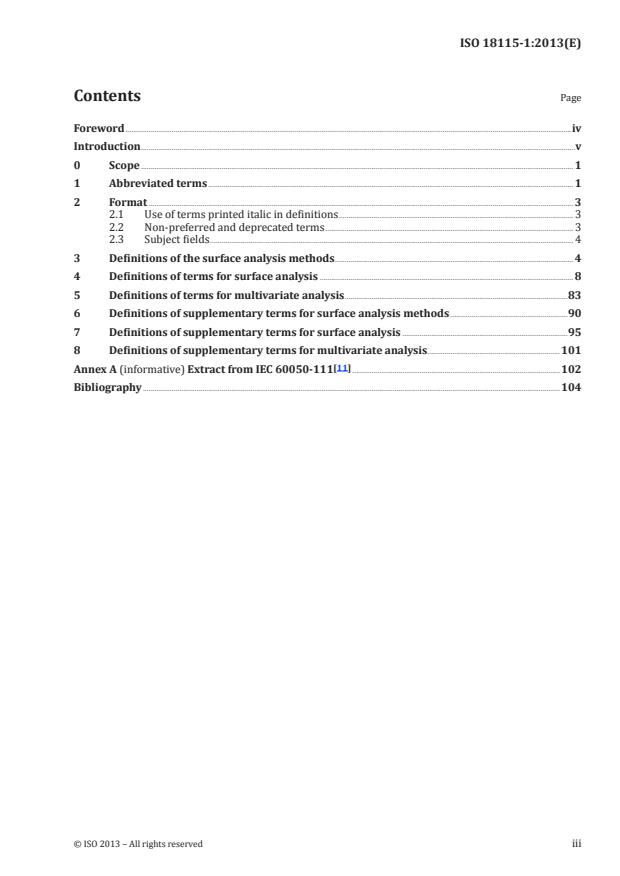
Contents Page
Foreword .iv
Introduction .v
0 Scope . 1
1 Abbreviated terms . 1
2 Format . 3
2.1 Use of terms printed italic in definitions . 3
2.2 Non-preferred and deprecated terms . 3
2.3 Subject fields . 4
3 Definitions of the surface analysis methods . 4
4 Definitions of terms for surface analysis . 8
5 Definitions of terms for multivariate analysis .83
6 Definitions of supplementary terms for surface analysis methods .90
7 Definitions of supplementary terms for surface analysis .95
8 Definitions of supplementary terms for multivariate analysis .101
[11]
Annex A (informative) Extract from IEC 60050-111 .102
Bibliography .104
Foreword
ISO (the International Organization for Standardization) is a worldwide federation of national standards
bodies (ISO member bodies). The work of preparing International Standards is normally carried out
through ISO technical committees. Each member body interested in a subject for which a technical
committee has been established has the right to be represented on that committee. International
organizations, governmental and non-governmental, in liaison with ISO, also take part in the work.
ISO collaborates closely with the International Electrotechnical Commission (IEC) on all matters of
electrotechnical standardization.
The procedures used to develop this document and those intended for its further maintenance are
described in the ISO/IEC Directives, Part 1. In particular the different approval criteria needed for the
different types of ISO documents should be noted. This document was drafted in accordance with the
editorial rules of the ISO/IEC Directives, Part 2 (see www.iso.org/directives).
Attention is drawn to the possibility that some of the elements of this document may be the subject of
patent rights. ISO shall not be held responsible for identifying any or all such patent rights. Details of
any patent rights identified during the development of the document will be in the Introduction and/or
on the ISO list of patent declarations received (see www.iso.org/patents).
Any trade name used in this document is information given for the convenience of users and does not
constitute an endorsement.
For an explanation on the meaning of ISO specific terms and expressions related to conformity
assessment, as well as information about ISO’s adherence to the WTO principles in the Technical Barriers
to Trade (TBT) see the following URL: Foreword - Supplementary information
The committee responsible for this document is ISO/TC 201, Surface chemical analysis, Subcommittee
SC 1, Terminology.
This second edition cancels and replaces the first edition (ISO 18115-1:2010), which has been
technically revised.
ISO 18115 consists of the following parts, under the general title Surface chemical analysis — Vocabulary:
— Part 1: General terms and terms used in spectroscopy
— Part 2: Terms used in scanning-probe microscopy
iv © ISO 2013 – All rights reserved
Introduction
Surface chemical analysis is an important area which involves interactions between people with
different backgrounds and from different fields. Those conducting surface chemical analysis might be
materials scientists, chemists, or physicists and might have a background that is primarily experimental
or primarily theoretical. Those making use of the surface chemical data extend beyond this group into
other disciplines.
With the present techniques of surface chemical analysis, compositional information is obtained for
regions close to a surface (generally within 20 nm) and composition-versus-depth information is
obtained with surface analytical techniques as surface layers are removed. The surface analytical
terms covered in this part of ISO 18115 extend from the techniques of electron spectroscopy and mass
spectrometry to optical spectrometry and X-ray analysis. The terms covered in ISO 18115-2 relate to
scanning-probe microscopy. Concepts for these techniques derive from disciplines as widely ranging as
nuclear physics and radiation science to physical chemistry and optics.
The wide range of disciplines and the individualities of national usages have led to different meanings
being attributed to particular terms and, again, different terms being used to describe the same concept.
To avoid the consequent misunderstandings and to facilitate the exchange of information, it is essential
to clarify the concepts, to establish the correct terms for use, and to establish their definitions.
The terms and definitions in this International Standard have been prepared in conformance with the
principles and style defined in ISO 1087-1:2000 and ISO 10241:1992. Essential aspects of these standards
appear in 2.1 to 2.3. This part of ISO 18115 comprises the 78 abbreviations and 590 definitions of the
combined ISO 18115-1:2010 and Amendment 1 to ISO 18115-1:2010. Corrections have been made to
terms 4.61, backscattering factor, and 4.480, unified atomic mass unit that appeared in ISO 18115-1:2010.
The terms are given in alphabetical order, classified under Clauses 3, 4, and 5 from the former
International Standard with corrections and Clauses 6, 7, and 8 from Amendment 1:
— Clause 3: Definitions of the surface analysis methods;
— Clause 4: Definitions of terms for surface analysis;
— Clause 5: Definitions of terms for multivariate analysis;
— Clause 6: Definitions of supplementary terms for the surface analysis methods;
— Clause 7: Definitions of supplementary terms for surface analysis;
— Clause 8: Definitions of supplementary terms for multivariate analysis.
Additional terms, important for surface analysis, are given in an extract from IEC 60050-111 in Annex A.
INTERNATIONAL STANDARD ISO 18115-1:2013(E)
Surface chemical analysis — Vocabulary —
Part 1:
General terms and terms used in spectroscopy
0 Scope
This part of ISO 18115 defines terms for surface chemical analysis. It covers general terms and those
used in spectroscopy while ISO 18115-2 covers terms used in scanning-probe microscopy.
1 Abbreviated terms
AC alternating current
AES Auger electron spectroscopy
AMRSF average matrix relative sensitivity factor
ANN artificial neural network
APECS Auger photoelectron coincidence spectroscopy
ARAES angle-resolved Auger electron spectroscopy
AREPES angle-resolved elastic peak electron spectroscopy
ARXPS angle-resolved X-ray photoelectron spectroscopy
CDP compositional depth profile
CRM certified reference material
DA/DFA discriminant analysis/discriminant function analysis
DAPCI desorption atmospheric pressure chemical ionization
DAPPI desorption atmospheric pressure photoionization
DART direct analysis in real time
DC direct current
DESI desorption electrospray ionization
DRS direct recoil spectroscopy
eV electron volts
EELS electron energy loss spectroscopy
EESI extractive electrospray ionization
EIA energetic-ion analysis
ELDI electrospray enhanced laser desorption mass spectrometry
EPES elastic peak electron spectroscopy
EPMA electron probe microanalysis
ERD elastic recoil detection
ERDA elastic recoil detection analysis
ESCA electron spectroscopy for chemical analysis
EXAFS extended X-ray absorption fine structure spectroscopy
FABMS fast atom bombardment mass spectrometry
FIB focused ion beam system
FWHM full width at half maximum
GDMS glow discharge mass spectrometry
GDOES glow discharge optical emission spectrometry
GDS glow discharge spectrometry
GISAXS grazing-incidence small-angle X-ray scattering
HSA hemispherical sector analyser
IBA ion beam analysis
ISS ion-scattering spectrometry
LAESI laser ablation electrospray ionization
LB Langmuir-Blodgett
LDI laser desorption ionization
LEIS(S) low-energy ion scattering spectrometry
LMIG liquid-metal ion gun
LMIS liquid-metal ion source
MAF analysis maximum autocorrelation factor analysis
MALDI matrix-assisted laser desorption/ionization mass spectrometry
MALDESI matrix-assisted laser desorption electrospray ionization
MCR multivariate curve resolution
MEIS(S) medium-energy ion scattering spectrometry
MVA multivariate analysis
NEXAFS near-edge extended X-ray absorption fine structure spectroscopy
PADI plasma-assisted desorption ionization
PCA principal-component analysis
PERSF pure-element relative sensitivity factor
2 © ISO 2013 – All rights reserved
PIXE particle-induced X-ray emission
PLS partial least squares
RBS Rutherford backscattering spectrometry
REELS reflection electron energy loss spectroscopy
RISR relative instrument spectral response function
rf radio-frequency
RM reference material
RSF relative sensitivity factor
SALDI surface-assisted laser desorption/ionization
SAM self-assembled monolayer
SAXS small-angle X-ray scattering
SDP sputter depth profile
SEM scanning electron microscope
SEP surface excitation parameter
SEXAFS surface extended X-ray absorption fine structure spectroscopy
SIMS secondary-ion mass spectrometry
SNMS sputtered neutral mass spectrometry
SSA spherical sector analyser
TOF or ToF time of flight
TXRF total-reflection X-ray fluorescence spectroscopy
UPS ultraviolet photoelectron spectroscopy
XAFS X-ray absorption fine structure spectroscopy
XANES X-ray absorption near-edge spectroscopy
XPS X-ray photoelectron spectroscopy
XRR X-ray reflectometry
XSW X-ray standing waves
2 Format
2.1 Use of terms printed italic in definitions
A term printed in italics in a definition or a note is defined in another entry in this part of ISO 18115.
However, the term is printed in italics only the first time it occurs in each entry.
2.2 Non-preferred and deprecated terms
A term listed lightface is non-preferred or deprecated. The preferred term is listed boldface.
2.3 Subject fields
Where a term designates several concepts, it is necessary to indicate the subject field to which each concept
belongs. The field is shown lightface, between angle brackets, preceding the definition, on the same line.
3 Definitions of the surface analysis methods
3.1
Auger electron spectroscopy
AES
method in which an electron spectrometer (4.190) is used to measure the energy distribution of Auger
electrons (4.37) emitted from a surface (4.458)
Note 1 to entry: An electron beam in the energy range 2 keV to 30 keV is often used for excitation of the Auger
electrons. Auger electrons can also be excited with X-rays, ions, and other sources but the term Auger electron
spectroscopy, without additional qualifiers, is usually reserved for electron-beam-induced excitation. Where an
X-ray source is used, the Auger electron energies are referenced to the Fermi level (4.211) but, where an electron
beam is used, the reference can either be the Fermi level or the vacuum level (4.483). Spectra, conventionally, can
be presented in the direct (4.173) or differential (4.171) forms.
3.2
desorption electrospray ionization
DESI
method in which a mass spectrometer is used to measure the mass-to-charge quotient and abundance of
ionized entities emitted from a sample in air as a result of the bombardment by ionized solvent droplets
generated by pneumatically assisted electrospray ionization
Note 1 to entry: Water and methanol are often used as the solvents to create the droplets. Acids and alkalis are
added to control the solution pH.
Note 2 to entry: DESI is one of the few surface analysis methods designed to analyse materials without exposure
to vacuum. It is used for complex molecules, organic molecules, and biomolecules. In vivo analysis is claimed
to be possible.
3.3
dynamic SIMS
SIMS (3.17) in which the material surface (4.458) is sputtered at a sufficiently rapid rate that the original
surface cannot be regarded as undamaged during the analysis
Note 1 to entry: Dynamic SIMS is often simply termed SIMS.
16 2
Note 2 to entry: The ion areic dose (4.175) during measurement is usually more than 10 ions/m .
3.4
elastic peak electron spectroscopy
EPES
method in which an electron spectrometer (4.190) is used to measure the energy, intensity, and/or energy
broadening distribution of quasi-elastically scattered electrons from a solid or liquid surface (4.458)
Note 1 to entry: See recoil effect (4.366) and reflection electron energy loss spectroscopy (REELS) (3.16).
Note 2 to entry: An electron beam in the energy range 100 eV to 3 keV is often used for this kind of spectroscopy.
Note 3 to entry: In general, electron sources with energy spreads that are less than 1 eV are required to provide
adequate information.
Note 4 to entry: EPES is often an auxiliary method of AES (3.1) and REELS (3.16), providing information on the
composition of the surface layer. EPES is suitable for the experimental determination of the inelastic mean free path
(4.243), the electron differential elastic scattering cross section (4.127), and the surface excitation parameter (4.461).
4 © ISO 2013 – All rights reserved
3.5
DEPRECATED: electron spectroscopy for chemical analysis
DEPRECATED: ESCA
method encompassing both AES (3.1) and XPS (3.23)
Note 1 to entry: The term ESCA has fallen out of use as, in practice, it was only used to describe situations more
clearly defined by the term X-ray photoelectron spectroscopy (XPS). Since 1980, the latter term has been preferred.
3.6
fast atom bombardment mass spectrometry
FABMS
DEPRECATED: FAB
method in which a mass spectrometer is used to measure the mass-to-charge quotient and abundance
of secondary ions (4.406) emitted from a sample as a result of the bombardment by fast neutral atoms
3.7
G-SIMS
variant of static SIMS (3.20) in which the intensities for each mass in two spectra from the same area,
recorded with different beam energies or different bombarding ions, are ratioed to each other and the
result is used to scale one of the spectra to generate a new spectrum
Note 1 to entry: As with static SIMS, the ion areic dose (4.175) during measurement is restricted to less than
16 2
10 ions/m to an extent that depends on both the material of the sample and the size of the molecular fragments
(4.302) being analysed.
Note 2 to entry: The G-SIMS spectrum enables the mass of whole molecules on the surface (4.458) to be determined
more readily than in static SIMS.
Note 3 to entry: The “G” in G-SIMS originally indicated the gentleness of the process generated.
3.8
glow discharge mass spectrometry
GDMS
method in which a mass spectrometer is used to measure the mass-to-charge quotient and abundance
of ions from a glow discharge (4.228) generated at a surface (4.458)
3.9
glow discharge optical emission spectrometry
GDOES
method in which an optical emission spectrometer is used to measure the wavelength and intensity of
light emitted from a glow discharge (4.228) generated at a surface (4.458)
3.10
glow discharge spectrometry
GDS
method in which a spectrometer is used to measure relevant intensities emitted from a glow discharge
(4.228) generated at a surface (4.458)
Note 1 to entry: This is a general term that encompasses GDOES (3.9) and GDMS (3.8).
3.11
ion beam analysis
IBA
method designed to elucidate composition and structure of the near-surface atomic layers of a solid
material, in which principally monoenergetic, singly charged probe ions (4.349) scattered from the surface
(4.458) are detected and recorded as a function of their energy or angle of scattering (4.18), or both
Note 1 to entry: LEIS(S) (3.12), MEIS(S) (3.13), and RBS (3.15) are all forms of IBA in which the probe ion energies
are typically in the ranges 0,1 keV to 10 keV, 100 keV to 200 keV, and 1 MeV to 2 MeV, respectively. These
classifications represent three ranges in which fundamentally different physics is involved.
3.12
low-energy ion scattering spectrometry
LEIS(S)
method designed to elucidate composition and structure of the very outermost atomic layers of a solid
material, in which principally monoenergetic, singly charged probe ions (4.349) scattered from the surface
(4.458) are detected and recorded as a function of their energy or angle of scattering (4.18), or both
Note 1 to entry: LEIS(S) is a form of IBA (3.11) in which the probe ions, typically He or Ne, have energies in the
range 0,1 keV to 10 keV.
Note 2 to entry: The acronym usually has only one “S”.
3.13
medium-energy ion scattering spectrometry
MEIS(S)
method designed to elucidate composition and structure of the outermost atomic layers of a solid material,
in which principally monoenergetic, singly charged probe ions (4.349) scattered from the surface (4.458)
are detected and recorded as a function of their energy or angle of scattering (4.18), or both
Note 1 to entry: MEIS is a form of IBA in which the probe ions, typically protons, have energies in the range
100 keV to 200 keV.
Note 2 to entry: By using channelling (4.94) and aligning the incident-ion beam along a crystal axis, the scattering
from the substrate can be suppressed so that enhanced signal quality and visibility are obtained for amorphous
overlayers. By further aligning the detector along a second crystal axis, the double-alignment mode, the scattering
from the substrate can be further suppressed, improving the signal quality and visibility for amorphous overlayers
to a high level.
Note 3 to entry: In some cases, an angle-sensitive detector is used that allows extensive structure and depth
profile (4.350) information to be obtained.
Note 4 to entry: The acronym usually has only one “S”.
3.14
matrix-assisted laser desorption/ionization mass spectrometry
MALDI
method in which a time of flight (4.473) mass spectrometer is used to measure the mass-to-charge ratio
(4.296) and abundance of ions emitted, as a result of a short pulse of laser illumination, from a sample
whose analyte is contained in an ion-assisting matrix
Note 1 to entry: The matrix used for assisting the ion emission needs a strong absorbance at the laser
wavelength and a low enough mass to be sublimable. Examples of matrices for 337 nm wavelength laser light
are 2,5-dihydroxybenzoic acid (DHB), 3,5-dimethoxy-4-hydroxycinnamic acid (sinapinic acid), and α-cyano-4-
hydroxycinnamic acid (CHCA).
Note 2 to entry: MALDI is used to analyse non-volatile polar biological and organic macromolecules as well as
polymers to masses of over 3 000 kDa.
3.15
Rutherford backscattering spectrometry
RBS
method designed to elucidate composition and structure of layers at the surface (4.458) of a solid material,
in which principally monoenergetic, singly charged probe ions (4.349) scattered from the surface with
a Rutherford cross section (4.133) are detected and recorded as a function of their energy or angle of
scattering (4.18), or both
Note 1 to entry: RBS is a form of IBA (3.11) in which the probe ions, typically He but sometimes H, have energies in
the range 1 MeV to 2 MeV. In its traditional form, a solid-state energy-dispersive detector is used. In the form of high-
resolution RBS, the energy can be reduced to 300 keV and a high-resolution (ion optical) spectrometer can be used.
Note 2 to entry: By using channelling (4.94)and aligning the incident-ion beam along a crystal axis, the scattering from
the substrate can be suppressed so that enhanced signal quality and visibility are obtained for amorphous overlayers.
6 © ISO 2013 – All rights reserved
3.16
reflection electron energy loss spectroscopy
REELS
method in which an electron spectrometer (4.190) is used to measure the energy distribution of electrons
quasi-elastically scattered by atoms at or in a surface layer and the associated electron energy loss
spectrum (4.197)
Note 1 to entry: See elastic peak electron spectroscopy (3.4) (EPES)
3.17
secondary-ion mass spectrometry
SIMS
method in which a mass spectrometer is used to measure the mass-to-charge quotient and abundance of
secondary ions (4.406) emitted from a sample as a result of bombardment by energetic ions
Note 1 to entry: See dynamic SIMS (3.3), static SIMS (3.20), and G-SIMS (3.7).
Note 2 to entry: SIMS is, by convention, generally classified as dynamic, in which the material surface layers are
continually removed as they are being measured, and static, in which the ion areic dose (4.175) during measurement
16 2
is restricted to less than 10 ions/m in order to retain the surface (4.458) in an essentially undamaged state.
3.18
small-angle X-ray scattering
SAXS
method in which the elastically scattered intensity of X-rays is measured for small-angle deflections
Note 1 to entry: The angular scattering is usually measured within the range 0,1° to 10°. This provides structural
information on macromolecules as well as periodicity on length scales typically larger than 5 nm and less than
200 nm for ordered or partially ordered systems.
Note 2 to entry: Wide-angle X-ray scattering (WAXS) is an analogous technique, similar to X-ray crystallography,
in which scattering at larger angles, which is sensitive to periodicity on smaller length scales, is measured.
Note 3 to entry: The X-ray source can be a synchrotron, in which case the term synchrotron radiation (4.465)
small-angle X-ray scattering (SRXAS) is occasionally encountered.
3.19
sputtered neutral mass spectrometry
SNMS
method in which a mass spectrometer is used to measure the mass-to-charge quotient and abundance of
secondary ionized neutral species emitted from a sample as a result of particle bombardment
Note 1 to entry: The neutral species can be detected by using plasma (4.337), electron, or photon-ionization methods.
3.20
static SIMS
SIMS (3.17) in which the material surface (4.458) is sputtered at a sufficiently low rate that the original
surface is insignificantly damaged during the analysis
Note 1 to entry: See dynamic SIMS (3.3).
16 2
Note 2 to entry: The ion areic dose (4.175)during measurement is restricted to less than 10 ions/m to an extent
that depends on both the material of the sample and the size of the molecular fragments (4.302) being analysed.
3.21
total reflection X-ray fluorescence spectroscopy
TXRF
method in which an X-ray spectrometer is used to measure the energy distribution of fluorescence
(4.219) X-rays emitted from a surface (4.458) irradiated by primary X-rays under the condition of total
reflection (4.475)
3.22
ultraviolet photoelectron spectroscopy
UPS
method in which an electron spectrometer (4.190) is used to measure the energy distribution of
photoelectrons emitted from a surface (4.458) irradiated by ultraviolet photons
Note 1 to entry: Ultraviolet sources in common use include various types of discharges that can generate
the resonance lines of various gases (e.g. the He I and He II emission lines at energies of 21,2 eV and 40,8 eV,
respectively). For variable energies, synchrotron radiation (4.465) is used.
3.23
X-ray photoelectron spectroscopy
XPS
method in which an electron spectrometer (4.190) is used to measure the energy distribution of
photoelectrons and Auger electrons (4.37) emitted from a surface (4.458) irradiated by X-ray photons
Note 1 to entry: X-ray sources in common use are unmonochromated Al Kα and Mg Kα X-rays at 1 486,6 eV, and
1 253,6 eV, respectively. Modern instruments also use monochromated Al Kα X-rays. Some instruments make use
of various X-ray sources with other anodes (4.27) or of synchrotron radiation (4.465).
4 Definitions of terms for surface analysis
4.1
absorption coefficient, linear
linear attenuation coefficient
4.2
absorption coefficient, mass
attenuation coefficient, mass
quantity μ/ρ in the expression, (μ/ρ)Δ(ρx), for the fraction of a parallel beam of specified
particles or radiation removed in passing through a thin layer of mass thickness Δ(ρx) of a substance in
the limit as Δ(ρx) approaches zero, where Δ(ρx) is measured in the direction of the beam
Note 1 to entry: See attenuation length (4.34).
Note 2 to entry: The mass density of the substance is ρ and x is the distance in the direction of the beam.
Note 3 to entry: The intensity or number of particles in the beam decays as exp(−μx) with the distance x.
Note 4 to entry: The mass attenuation (absorption) coefficient is the quotient of the linear attenuation (absorption)
coefficient by the mass density of the substance.
4.3
abundance sensitivity
ratio of the maximum ion current recorded at a mass m to the ion current arising from the same
species recorded at an adjacent mass (m ± 1)
[SOURCE: IUPAC]
4.4
adventitious carbon referencing
determining the charging potential (4.103) of a particular sample from a comparison of the
experimentally determined C 1s binding energy (4.82), arising from adsorbed hydrocarbons on the
sample, with a standard binding energy value
Note 1 to entry: See Fermi level referencing (4.212) and internal carbon referencing (4.257).
Note 2 to entry: A nominal value of 285,0 eV is often used for the binding energy of the relevant C 1s peak, although
some analysts prefer specific values in the range 284,6 eV to 285,2 eV, depending on the nature of the substrate.
This method does not determine the true charging potential (4.103) since the true binding energy of the adsorbed
hydrocarbons is not known.
8 © ISO 2013 – All rights reserved
Note 3 to entry: Different sample charging (4.392) potentials can occur on different areas on the surface (4.458),
or at different depths, arising, for example, from sample inhomogeneities or non-uniform intensity of the incident-
radiation flux (4.221).
4.5
afterglow
luminescence of the decaying plasma (4.337) present in a glow discharge (4.228) device after
complete cessation of the sustaining discharge power
4.6
altered layer
surface region of a material under particle bombardment where the chemical
state or physical structure is modified by the effects of the bombardment
+
Note 1 to entry: For silicon bombarded by 4 keV O at near-normal incidence, after sputtering (4.441) for a
sufficient time to reach a steady state, the surface (4.458) is converted to stoichiometric SiO to a depth of around
15 nm, with lower oxygen concentrations at greater depths. At 2 keV, this is reduced to 7 nm, these thicknesses
being approximately twice the projected range (4.352).
Note 2 to entry: The depth resolution (4.164) in SIMS (3.17) can be greater or smaller than the altered-layer
thickness, depending on the analyte and bombarding-ion species.
4.7
analyser blanking
action to prevent secondary ions (4.406) from travelling through the mass spectrometer and
being detected
Note 1 to entry: This action is usually made by pulsing one of the relevant electrode potentials in time of flight
(4.473) mass spectrometers to deflect ions of a selected mass range in which intense peaks occur, so that those
masses are not detected and thus do not cause unwanted detector saturation.
4.8
analysis area
two-dimensional region of a sample surface (4.458) measured in the plane of that surface from
which the entire analytical signal or a specified percentage of that signal is detected
4.9
analysis area
two-dimensional region of a sample surface (4.458) at the analytical point but set in
the plane at right angles to the spectrometer axis from which the entire analytical signal or a specified
percentage of that signal is detected
4.10
analysis volume
three-dimensional region of a sample from which the entire analysis signal or a specified
percentage of that signal is detected
4.11
analysis volume
three-dimensional region within the spectrometer from which the entire analytical
signal or a specified percentage of that signal can be detected
4.12
angle, critical
glancing angle (4.13) at which the sample matrix X-ray fluorescence (4.219), when plotted against
the glancing angle, is at the first point of inflection
4.13
angle, glancing
angle between the incident beam and the average surface plane
Note 1 to entry: The angle of incidence (4.17) and the glancing angle are complementary.
4.14
angle lapping
sample preparation in which a sample is mechanically polished at an angle to the original surface (4.458)
Note 1 to entry: See ball catering (4.64) and radial sectioning (4.358).
Note 2 to entry: This angle can often be less than 1° so that depth information with respect to the original surface
is transformed to lateral information.
4.15
angle, magic
angle at which the spectrometer entrance axis is aligned at 54,7° to the direction of the X-rays at
the sample surface (4.458)
Note 1 to entry: At the magic angle, using the simple dipole theory for the angular distribution of the photoelectrons
emitted from an atom irradiated by unpolarized X-rays, it is predicted that the intensity per unit solid angle is the
same as the intensity that would be obtained if the scattering were isotropic.
4.16
angle of emission
emission angle
angle between the trajectory of a particle or photon as it leaves a surface (4.458), and the local or average
surface normal
Note 1 to entry: The particular surface normal needs to be specified.
4.17
angle of incidence
incidence angle
angle between the incident beam and the local or average surface normal
Note 1 to entry: The particular surface normal, such as the surface normal to an elementary portion of a rough
surface (4.458) or the normal to the average surface plane, needs to be specified.
4.18
angle of scattering
scattering angle
angle between the direction of the incident particle or photon and the direction that the particle or
photon is travelling after scattering
4.19
angle-resolved AES
ARAES
angle-dependent AES
procedure in which Auger electron (4.37) intensities are measured as a function of the angle of emission (4.16)
4.20
angle-resolved EPES
AREPES
method involving EPES (3.4) measurements as a function of the scattering angle (4.18)
4.21
angle-resolved XPS
ARXPS
angle-dependent XPS
procedure in which X-ray photoelectron intensities are measured as a function of the angle of emission (4.16)
Note 1 to entry: This procedure is often used to obtain information on the distribution with depth of different
elements or compounds in a layer approximately 5 nm thick at the surface (4.458).
10 © ISO 2013 – All rights reserved
4.22
angle, solid, of analyser
solid angle of analyser that will transmit particles or photons from a point on the sample to the detector
Note 1 to entry: See analyser transmission function (4.434).
4.23
angle, solid, of detector
solid angle intercepted by the detector from an origin at the centre of the beam spot
4.24
angle, take-off
angle between the trajectory of a particle as it leaves a surface (4.458) and the local or average surface plane
Note 1 to entry: The particular surface plane needs to be specified.
Note 2 to entry: The take-off angle is the complement of the angle of emission (4.16).
Note 3 to entry: In the past, take-off angle has sometimes been used erroneously to mean angle of emission.
4.25
anion
negatively charged ion
Note 1 to entry: See cation (4.92).
4.26
anode
more positively charged electrode in a glow discharge (4.228) device
Note 1 to entry: See cathode (4.88) .
4.27
anode
electrode that is more positively charged over a large fraction of the rf cycle in a
radio-frequency-powered glow discharge (4.228) device
Note 1 to entry: See cathode (4.89) .
Note 2 to entry: The rf power applied to a typical rf glow discharge device that is used for surface chemical
analysis is sinusoidal and bipolar, with a time-averaged electric potential of zero relative to ground potential. The
reason that the anode is not more positively charged over the entire rf cycle is that the magnitude of the DC bias
(4.145) is usually slightly less than one-half of the applied rf peak-to-peak potential.
Note 3 to entry: The precise fraction of the rf cycle over which the anode is more positively charged depends upon
the source geometry and other factors.
4.28
anode glow
thin luminous region of a glow discharge (4.228) immediately adjacent to the anode (4.27)
Note 1 to entry: See cathode layer (4.91), negative glow (4.314), and positive column (4.342).
Note 2 to entry: The anode glow may not be noticeable in a glow discharge used for surface chemical analysis.
4.29
aperture, contrast
aperture, in an ion or electron optical system, designed to reduce unwanted background signal (4.56)
Note 1 to entry: This aperture can also govern the spatial resolution and other properties of the system.
4.30
asymmetry parameter
β
factor (5.5) which characterizes the intensity distribution, L(γ), of photoelectrons ejected by
unpolarized X-rays from isolated atoms in a direction γ from the incident X-ray direction in accordance with
1 3
L γβ=+1 sin γ −1
()
( )
2 2
Note 1 to entry: This formula relates to gases and is modified by the effects of elastic scattering (4.80) when
applied to solids. At the magic angle (4.15), L(γ) = 1.
4.31
DEPRECATED: atomic mass unit
see Note 3 to “unified atomic mass unit (4.480)”
Note 1 to entry: See unified atomic mass unit (4.480).
4.32
atomic mixing
migration of sample atoms due to energy transfer with incident particles in the surface region
Note 1 to entry: See cascade mixing (4.87), collision cascade (4.114), ion-beam-induced mass transport (4.260),
knock-on (4.279), and recoil implantation (4.279).
4.33
attenuation coefficient
quantity μ in the expression μΔx for the fraction of a parallel beam of specified particles or radiation
removed in passing through a thin layer Δx of a substance in the limit as Δx approaches zero, where Δx
is measured in the direction of the beam
Note 1 to entry: See attenuation length (4.34) and mass absorption coefficient (4.2).
Note 2 to entry: The intensity or number of particles in the beam decays as exp(−μ/x) with the distance x.
Note 3 to entry: Attenuation coefficient is often used in place of linear attenuation coefficient (4.1) and is used in
EPMA. Both are the reciprocal of attenuation length (4.34) which is used in AES (3.1) and XPS (3.23).
4.34
attenuation length
quantity l in the expression Δx/l for the fraction of a parallel beam of specified particles or radiation
removed in passing through a thin layer Δx of a substance in the limit as Δx approaches zero, where Δx
is measured in the direction of the beam
Note 1 to entry: See attenuation coefficient (4.33), decay length (4.150), effective attenuation length (4.35),
electroninelastic mean free path (4.243), linear absorption coefficient (4.1), and mass absorption coefficient (4.2).
Note 2 to entry: The intensity or number of particles in the beam decays as exp(−x/l) with the distance x.
Note 3 to entry: For electrons in solids, the behaviour only approximates to an exponential decay due to the
effects of elastic scattering (4.80). Nevertheless, for some measurement conditions in AES (3.1) and XPS (3.23),
the signal intensity (4.252) can depend approximately exponentially on path length, but the exponential constant
(the parameter l) will then normally be different from the corresponding inelastic mean free path. Where that
approximation is valid, the term effective attenuation length is used.
4.35
attenuation length, effective
parameter which, when introduced in place of the inelastic mean free path (4.243) into an
expression derived for AES (3.1) and XPS (3.23) on the assumption that elastic scattering (4.80) effects are
negligible for a given quantitative application, will correct that expression for elastic scattering effects
Note 1 to entry: See attenuation length (4.34).
12 © ISO 2013 – All rights reserved
Note 2 to entry: The effective attenuation length can have different values for different quantitative applications of
AES and XPS. However, the most common use of effective attenuation length is in the determination of overlayer-
film thicknesses from measurement of the changes of overlayer and substrate Auger-electron or photoelectron
signal intensities after deposition of a film or as a function of the emission angle (4.16). For emission angles of up
to about 60° (with respect to the surface normal), it is often satisfactory to use a single value of this parameter.
For larger emission angles, the effective attenuation length can depend on this angle.
Note 3 to entry: Since there are different uses of this term, it is recommended that users specify clearly the
particular application and the definition of the parameter for that application (e.g. by giving a formula or by
providing a reference to a particular source).
4.36
Auger de-excitation
process in which the excess energy of an excited atom or ion is given up by the Auger process (4.44)
Note 1 to entry: See Auger neutralization (4.40).
Note 2 to entry: The Auger process can involve energy levels in neighbouring atoms and lead to ejection of an
electron into the vacuum. This electron’s energy can then usefully be characteristic of a surface atom with which
a metastable probe atom (e.g. He) is in close proximity.
4.37
Auger electron
electron emitted from atoms in the Auger process (4.44)
Note 1 to entry: See Auger transition (4.46).
Note 2 to entry: Auger electrons can lose energy by inelastic scattering (4.244) as they pass through matter.
Measured Auger electron spectra are therefore generally composed of a peak structure of unscattered Auger
electrons superimposed on a background of inelastically scattered Auger electrons with intensities extending to
lower kinetic energies, and on backgrounds arising from other processes.
Note 3 to entry: Auger electrons can change their direction of propagation by elastic scattering (4.80) as they pass
through matter.
4.38
Auger electron spectrum
plot of the Auger electron (4.37) intensity as a function of the electron kinetic energy (4.278), usually as
part of the energy distribution of detected electrons
Note 1 to entry: When excited by incident electrons, the energy distribution of detected electrons, often measured
between 0 eV and 2 500 eV, contains Auger electrons, backscattered (primary) electrons (4.58) and secondary
electrons (4,402). The entire distribution is sometimes referred to as an Auger electron spectrum.
Note 2 to entry: The Auger electron spectrum can be presented in either the direct spectrum (4.173) or differential
spectrum (4.171) formats.
4.39
Auger electron yield
probability that an atom with a vacancy in a particular inner shell will relax by an Auger process (4.44)
[SOURCE: ASTM E673-03]
4.40
Auger neutralization
process in which an electron, tunnelling from the conduction band of a solid, neutralizes
an incoming ion and an electron is ejected from a surface atom
Note 1 to entry: The ejected electron can be emitted into the vacuum.
4.41
Auger parameter
kinetic energy (4.278) of a narrow Auger electron (4.37) peak in a spectrum minus the kinetic
energy of the most intense photoelectron peak from the same element
Note 1 to entry: See initial-state Auger parameter (4.42) and modified Auger parameter (4.43).
Note 2 to entry: The value of the Auger parameter depends on the energy of the X-rays, which therefore needs to
be specified.
Note 3 to entry: The Auger parameter is sometimes called the final state (4.215) Auger parameter.
Note 4 to entry: The Auger parameter is useful for separating chemical states for samples in which charging
causes uncertainty in the binding energy (4.82) measurement or in which the binding energy shift is inadequate
to identify the chemical state.
Note 5 to entry: The Auger parameter is useful for evaluating the relaxation energy (4.380) of the ionized matrix
atom associated with the generation of a core hole (4.237) for those Auger transitions (4.46) between core levels
which have similar chemical shifts (4.105).
4.42
Auger parameter, initial-state
β, where β = 3E + E and where E and E are, respectively, the binding energy (4.82) of a
B K B K
photoelectron peak and the Fe
...
Questions, Comments and Discussion
Ask us and Technical Secretary will try to provide an answer. You can facilitate discussion about the standard in here.
Loading comments...