


ISO 6107-2:1989
(Main)Water quality — Vocabulary
Water quality — Vocabulary
Qualité de l'eau — Vocabulaire
Kakovost vode - Slovar - 2. del
General Information
- Status
- Withdrawn
- Publication Date
- 24-May-1989
- Withdrawal Date
- 24-May-1989
- Technical Committee
- ISO/TC 147/SC 1 - Terminology
- Drafting Committee
- ISO/TC 147/SC 1 - Terminology
- Current Stage
- 9599 - Withdrawal of International Standard
- Start Date
- 19-Jun-1997
- Completion Date
- 12-Feb-2026
Relations
- Consolidated By
ISO 1624:2001 - Plastics — Vinyl chloride homopolymer and copolymer resins — Sieve analysis in water - Effective Date
- 06-Jun-2022
- Effective Date
- 15-Apr-2008
- Effective Date
- 15-Apr-2008


Get Certified
Connect with accredited certification bodies for this standard

NSF International
Global independent organization facilitating standards development and certification.

CIS Institut d.o.o.
Personal Protective Equipment (PPE) certification body. Notified Body NB-2890 for EU Regulation 2016/425 PPE.

Kiwa BDA Testing
Building and construction product certification.
Sponsored listings
Frequently Asked Questions
ISO 6107-2:1989 is a standard published by the International Organization for Standardization (ISO). Its full title is "Water quality — Vocabulary". This standard covers: Water quality — Vocabulary
Water quality — Vocabulary
ISO 6107-2:1989 is classified under the following ICS (International Classification for Standards) categories: 01.040.13 - Environment. Health protection. Safety (Vocabularies); 13.060.01 - Water quality in general. The ICS classification helps identify the subject area and facilitates finding related standards.
ISO 6107-2:1989 has the following relationships with other standards: It is inter standard links to ISO 1624:2001, ISO 6107-2:1997, ISO 6107-2:1981. Understanding these relationships helps ensure you are using the most current and applicable version of the standard.
ISO 6107-2:1989 is available in PDF format for immediate download after purchase. The document can be added to your cart and obtained through the secure checkout process. Digital delivery ensures instant access to the complete standard document.
Standards Content (Sample)
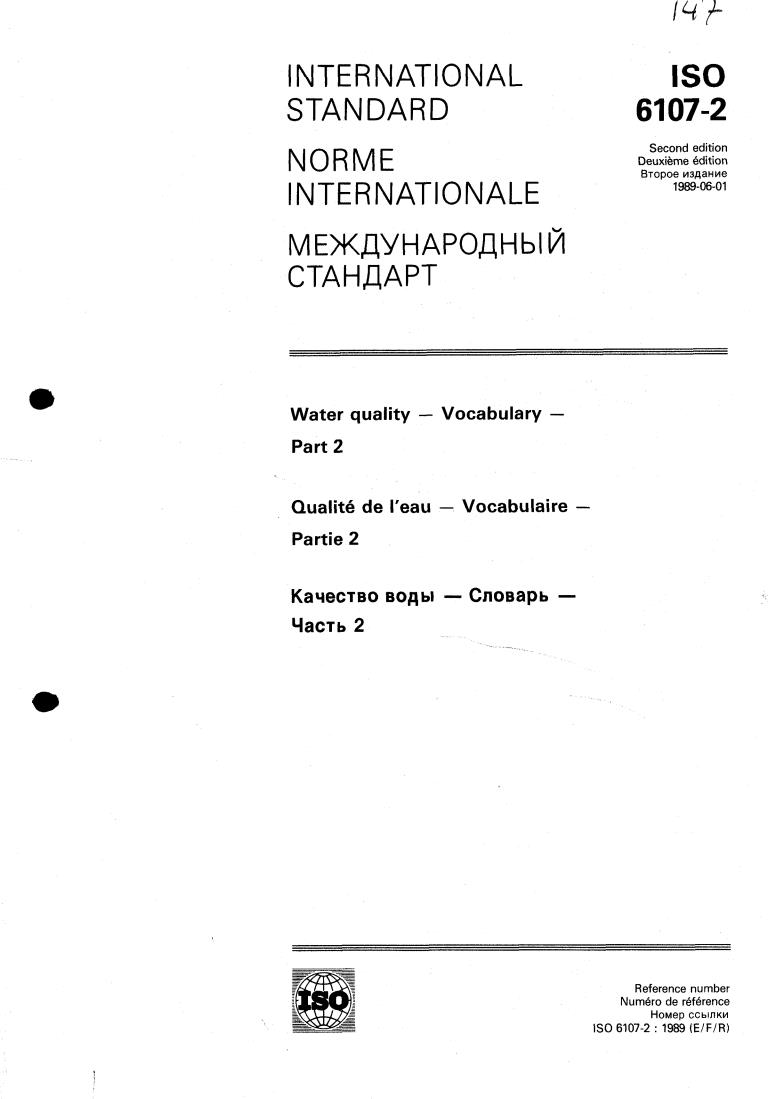
INTER NATIONAL
IS0
STANDARD 6107-2
Second edition
Deuxième édition
NORME
BTOpOe vi3AâHMe
1989-06-01
I N TE R NAT I O NA LE
M EXAY H APOAH bl fi
CTAHRAPT
Water quality - Vocabulary -
Part 2
Qualité de l'eau - Vocabulaire -
Partie 2
KâqeCTBO BOP(bl - CnOBâpb -
YâCTb 2
Reference number
Numéro de référence
HOMep CCblJiKvi
IS0 6107-2 : 1989 (E/F/R)
IS0 6107-2 : 1989 IE/F/R)
MCO 6107-2 : 1989 (A/(O/P)
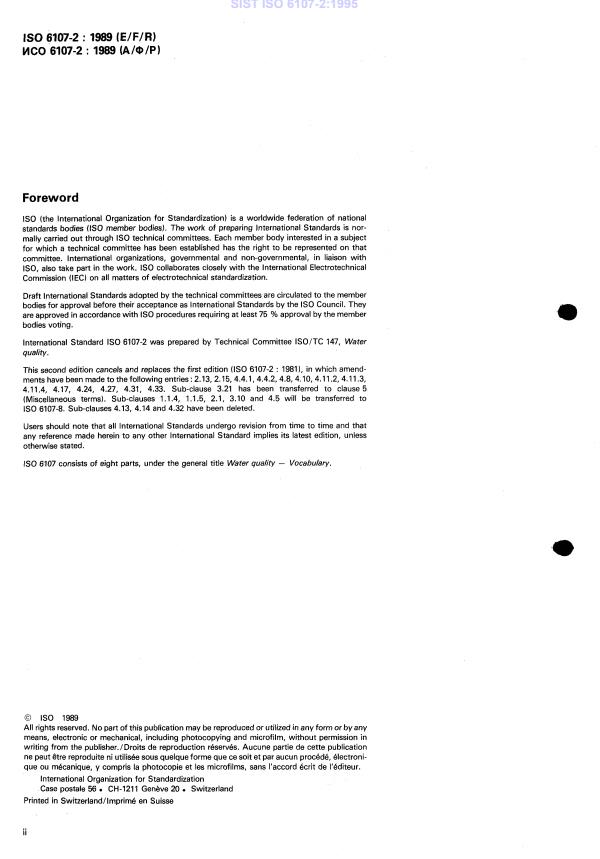
Foreword
IS0 (the International Organization for Standardization) is a worldwide federation of national
standards bodies (IS0 member bodies). The work of preparing International Standards is nor-
mally carried out through IS0 technical committees. Each member body interested in a subject
for which a technical committee has been established has the right to be represented on that
committee. International organizations, governmental and non-governmental, in liaison with
ISO, also take part in the work. IS0 collaborates closely with the International Electrotechnical
Commission (IEC) on all matters of electrotechnical standardization.
Draft International Standards adopted by the technical committees are circulated to the member
bodies for approval before their acceptance as International Standards by the IS0 Council. They
are approved in accordance with IS0 procedures requiring at least 75 % approval by the member
bodies voting.
International Standard IS0 6107-2 was prepared by Technical Committee ISO/TC 147, Water
quality.
This second edition cancels and replaces the first edition (IS0 6107-2 : 19811, in which amend-
ments have beenmade to thefollowingentries:2.13,2.15,4.4.1,4.4.2,4.8,4.10,4.11.2,4.11.3,
4.11.4, 4.17, 4.24, 4.27, 4.31, 4.33. Sub-clause 3.21 has been transferred to clause 5
(Miscellaneous terms). Sub-clauses 1.1.4, 1.1.5, 2.1, 3.10 and 4.5 will be transferred to
IS0 6107-8. Sub-clauses 4.13, 4.14 and 4.32 have been deleted.
Users should note that all International Standards undergo revision from time to time and that
any reference made herein to any other International Standard implies its latest edition, unless
otherwise stated.
IS0 6107 consists of eight parts, under the general title Water qualify - Vocabulary.
0 IS0 1989
All rights reserved. No part of this publication may be reproduced or utilized in any form or by any
means, electronic or mechanical, including photocopying and microfilm, without permission in
writing from the publisher./Droits de reproduction réservés. Aucune partie de cette publication
ne peut être reproduite ni utilisée sous quelque forme que ce soit et par aucun procédé, électroni-
que ou mécanique, y compris la photocopie et les microfilms, sans l'accord écrit de l'éditeur.
International Organization for Standardization
Case postale 53 . CH-I211 Genève 20 . Switzerland
Printed in Switzerland/lmprimé en Suisse
II
IS0 6107-2 : 1989 (E/F/R)
MCO 6107-2 : 1989 (A/(O/P)
Avant-propos
L'ISO (Organisation internationale de normalisation) est une fédération mondiale d'organismes
nationaux de normalisation (comités membres de I'ISO). L'élaboration des Normes internatio-
nales est en général confiée aux comités techniques de I'ISO. Chaque comité membre intéressé
par une étude a le droit de faire partie du comité technique créé à cet effet. Les organisations
internationales, gouvernementales et non gouvernementales, en liaison avec I'ISO participent
également aux travaux. L'ISO collabore étroitement avec la Commission électrotechnique inter-
nationale (CEI) en ce qui concerne la normalisation électrotechnique.
Les projets de Normes internationales adoptés par les comités techniques sont soumis aux comi-
tés membres pour approbation, avant leur acceptation comme Normes internationales par le
Conseil de I'ISO. Les Normes internationales sont approuvées conformément aux procédures de
I'ISO qui requièrent l'approbation de 75 % au moins des comités membres votants.
La Norme internationale IS0 6107-2 a été élaborée par le comité technique ISO/TC 147, Qualiré
de i'eau.
Cette deuxième édition annule et remplace la première édition (IS0 6107-2 : 1981 1, dans laquelle
des amendements ont été effectués aux articles suivants: 2.13, 2.15, 4.4.1, 4.4.2, 4.8, 4.10,
4.11.2, 4.11.3, 4.11.4, 4.17, 4.24, 4.27, 4.31, 4.33. Le paragraphe 3.21 a été transféré dans le
chapitre 5 (Termes divers). Les paragraphes 1.1.4, 1.1.5, 2.1, 3.10 et 4.5 seront transférés dans
I'ISO 6107-8. Les paragraphes 4.13, 4.14 et 4.32 ont été supprimés.
L'attention des utilisateurs est attirée sur le fait que toutes les Normes internationales sont de
temps en temps soumises à révision et que toute référence faite à une autre Norme internationale
dans le présent document implique qu'il s'agit, sauf indication contraire, de la dernière édition.
L'ISO 6107 comprend huit parties présentées sous le titre général Qualité del'eau - Vocabu/aire.
iii
INTERNATIONAL STANDARD
IS0 6107-2 : 1989 (E/F/R)
NORME INTERNATIONALE
MCO 6107-2 : 1989 (A/@/P)
MEXAYHAPOAH blm CTAHAAPT
Water quality - Vocabulary -
Part 2
Qualité de l'eau - Vocabulaire -
Partie 2
KaWCTBO BOAbl - CJlOBapb -
IS0 6107-2 : 1989 (E/F/R)
MC0 6107-2 : 1989 (A/cD/P)
Introduction
0.1 Introduction
Les définitions contenues dans ce vocabulaire ont été formu-
The definitions in this vocabulary have been formulated to pro-
lées afin de constituer une terminologie normalisée dans le
vide standardized terminology for the characterization of water
domaine de la caractérisation de la qualité de l'eau. Les termes
quality. The terms may be identical to those contained in
peuvent être identiques à ceux qui sont contenus dans des
vocabularies published by other international organizations, but
the definitions may differ because they have been drafted for vocabulaires publiés par d'autres organisations internationales,
mais les définitions peuvent différer en raison des objectifs dif-
different objectives.
férents pour lesquels elles ont été établies.
0.2 Scope and field of application Objet et domaine d'application
La présente partie de I'ISO 6107 définit une deuxième série de
This part of IS0 6107 defines a second list of terms used in
termes employés dans certains domaines de la caractérisation
certain fields of water quality characterization. It covers terms
de la qualité de l'eau. Elle recouvre des termes employés dans le
relating to the sampling of water, analysis of water, and some
domaine de l'échantillonnage de l'eau, de l'analyse de l'eau et
miscellaneous terms. There are also additional terms relating to
des termes divers. Elle présente aussi des termes supplemen-
types of water and water treatment.
taires relatifs aux types d'eau et au traitement de l'eau.
NOTE - In addition to the terms and definitions in the three official
IS0 languages (English, French and Russian), this International Stan- NOTE - En supplément aux termes et definitions donnés dans les trois
dard gives the equivalent terms and their definitions in the German langues officielles de I'ISO (anglais, francais, russe), la présente Norme
language; these have been included at the request of IS0 Technical internationale donne les termes équivalents et leurs définitions en alle-
Committee ISOITC 147 and are published under the responsibility of mand; ils ont été inclus à la demande du comité technique
the member bodies of the Federal Republic of Germany (DIN), Austria ISO/TC 147, et sont publiés sous la responsabilité des comités mem-
(ON) and Switzerland (SNV). However, only the terms and definitions bres de la République fédérale d'Allemagne (DIN), d'Autriche (ON) et
in the official languages can be considered as IS0 terms and defi- de Suisse (SNV). Toutefois, seuls les termes et définitions donnés dans
nitions. les langues officielles peuvent être considérés comme termes et défini-
tions ISO.
Références
0.3 References
IS0 772, Mesurage du débit des liquides dans les canaux
ISO772, Liquid flow measurement in open channels -
dCcouverts - Vocabulaire et symboles.
Vocabulary and symbols.
IS0 862, Agents de surface - Vocabulaire.
IS0 862, Surface active agents - Vocabulary.
IS0 3534, Statistiques - Vocabulaire et symboles.
IS0 3534, Statistics - Vocabulary and symbols.
IS0 7393-1, Qualité de l'eau - Dosage du chlore libre et du
IS0 7393-1, Water quality - Determination of free chlorine
-and total chlorine - Part 1: Titrimetric method using chlore total - Partie I: Méthode titrimétrique à la
N, N-diéthylphénylène- 1,4 diamine.
N, N-diethyl- 1,4-phen ylenediamine.
Termes supplémentaires relatifs aux types
1 Additional terms relating to types of water
d'eau
1.1 Raw water Eau brute
1.1.1 canal : An artificial watercourse constructed, usually, canal : Cours d'eau artificiel habituellement construit pour
relier des rivières, des lacs ou des mers, et de taille généra-
to join rivers, lakes or seas, and often of a size suitable for navi-
gation; most canals have low flow and poor mixing charac- lement appropriée à la navigation; la plupart des canaux ont
teristics.
un écoulement lent et se caractérisent par un brassage peu
énergique.
1.1.2 estuary : A partially enclosed body of water in the estuaire : Étendue d'eau en partie fermée, sur le bief inférieur
lower reaches of a river, which is freely connected with the sea d'une rivière raccordée librement à la mer, et qui est alimentée
and which receives fresh water supplies from upland drainage en eau douce par des zones de drainage à l'amont.
areas.
(Définition de 1'1S0 772.)
(Definition taken from IS0 772.)
IS0 6107-2 : 1989 (E/F/R)
MCO 6107-2 : 1989 (A/@/P)
Vorbemerkung
Die Definitionen dieser Begriffsnorm wurden formuliert, um
eine genormte Terminologie für die Charakterisierung der Was-
serbeschaffenheit zu ermoglichen. Die Benennungen konnen
mit solchen übereinstimmen, die in Begriffsnormen anderer
internationaler Organisationen publiziert worden sind, die Defi-
nitionen konnen jedoch abweichen, da Sie unter verschiedener
Zielsetzung gefal3t worden sind.
0.2 O6iaeKT H 06naCi.b npHMeHeHbiH Zweck und Anwendungsbereich
HaCTORu(aR '4aCTb Mco 6107 nPMBOP,MT BTOPOh CnMCOK Tep- Dieser Teil der IS0 6107 stellt eine zweite Liste von Begriffen
MMHOB, KOTOPble MCllOflb3yDTCR P,flR XaPaKTePMCTMKM Ka- auf, die in bestimmten Gebieten für die Charakterisierung der
'4eCTBâ BOP,bl. 3TOT CnMCOK OXBâTblBâeT TePMMHbl, yno~pe6- Wasserbeschaffenheit benutzt werden. Er umfal3t Begriffe, die
nReMbie B 06flaCTM OT6Opa npo6, a~anma BoAbi, a TaKrne ne- sich auf die Probenahme Oder die Analyse von Wasser beziehen
KOTOpble TePMMHbl M3 npOMeXyTO'4HbiX 06naCTeh. ClOP,a
sowie einige verschiedene Begriffe. Einige zusatzliche Definitio-
BKfllO'4eHbl TâKXe TePMMHbl , OTHOCR~MeCR K TMnaM BOP, VI K nen beziehen sich auf Wasserarten und Wasseraufbereitung.
O'4MCTKe BOP,.
ANMERKUNG - Zusatzlich zu den Benennungen und Definitionen in
den drei offiziellen Sprachen der IS0 (Englisch, Franzosisch und Rus-
sisch), enthalt die vorliegende Internationale Norm die entsprechenden
Benennungen und Definitionen in deutscher Sprache; diese wurden
zur Information auf Wunsch des Technischen Komitees ISO/TC 147
aufgenommen. lhre Ubereinstimmung wurde von den Mitgliedskorper-
schaften der Bundesrepublik Deutschland (DIN), Osterreichs (ON) und
der Schweiz (SNV) geprüft. Es konnen jedoch nur die in den offiziellen
Sprachen angegebenen Benennungen und Definitionen als ISO-
Benennungen und 60-Definitionen angesehen werden.
0.3 CCbiJlKH Mitgeltende Normen
IS0 772, Liquid flow measurement in open channels -
MCO 772, Mwepenue nornoKa muàKocrneü B ornKpblrnbix
Kananax - Cnosapb U CuMsonbl. 1' Vocabulary and symbols.
MCO 862, nosepxnocmno-aKrnusnbie sewecrnsa - Cno- IS0 862, Surface active agents - Vocabulary.
sapb. 1)
IS0 3534, Statistics - Vocabulary and symbols.
MCO 3534, CrnarnucrnuKa - Cnosapb U CuMsonbi. 1)
IS0 7393-1, Water quality - Determination of free chlorine
MCû 7393-1, Kavecrnso eoùbl - ûnpedenenue c~o60odnozo and total chlorine - Part 1: Titrimetric method using
N, N-diethyl- 1,4-phenylenediamine.
xnopa U o6wezo xnopa - Yacrnb 1 : TurnpuMempwecKuÜ Me-
mod c ucnonb30sanue~ N, N-du~rnun-1,4-c;be~une~àua~u~a.l)
1 AOllOJlHHTeJlbHbie TePMHH bl, OTHOCRwHeCH Zusatzliche Begriffe, die sich auf Wasserarten
K THllaM BOA
beriehen
1 .I Heo6pa6oianna~ BoRa
Rohwasser
1.1.1 KaHan : MCKYCCTBeHHblh OTKPblTblh BOP,OBOP,, nOCTp0-
Kanal : Ein künstlicher Wasserlauf, der meist konstruiert wird,
P,nR COeflMHeHMR PeK, 03ep, MOP&, npMCnOCO6lleHHbih
eHHblh um Flüsse, Seen Oder Meere zu verbinden, oft in einer Grofie,
06blqHO AnR CyP,OXOP,CTBa. 6OflbWMHCTBO KaHâflOB MMeeT He-
die Schiffahrt zulaBt. Die meisten Kanale haben geringe Fliel3-
6011 buoe Te'leHMe M xapa~~ep~3ye~c~ Cna6biM nepeMewMsa-
und Mischeigenschaften.
HMeM.
1.1.2 3CTYâPHfi : L(âCTM'4HO 3aMKHYTaR BOP,HaR MaCCa B HMX-
Mündungsgebiet; Astuar : Ein teilweise abgeschlossener
HeM TeYeHMM PeKM, KOTOPaR CBR3aHa CBO60P,HO C MOpeM M nM-
Wasserkorper im unteren Bereich eines Flusses mit freier Ver-
TaeTcR npecHoA BOAOU ~3 BO~OC6OpHOrO 6aCehHa.
bindung zum Meer und mit Frischwasserzufuhr vom Einzugs-
gebiet.
(OnpeAeneHMe WRTO ~3 MCO 772.)
(Definition übernommen aus IS0 772.)
IS0 6107-2 : 1989 (E/F/R)
MCO 6107-2 : 1989 (A/cD/P)
1.1.3 irrigation water : Water which is applied to soils or eau d'irrigation : Eau apportée aux sols ou aux supports de
plant growth substrates in order to increase their moisture con-
culture des plantes dans le but d'accroître leur humidité et de
tent, to provide the necessary water for normal plant growth fournir l'eau nécessaire à la croissance normale des plantes
and/or to prevent the accumulation of excess salts in the soil.
et/ou d'éviter l'accumulation d'un excédent de sels dans le sol.
1.1.4 lake : An inland body of water of considerable area.
lac : Masse d'eau de grande étendue à l'intérieur des terres. De
Large saline lakes are often called seas. grands lacs salés sont souvent appelés mers.
1.1.5 reservoir : A construction, partially or wholly man- réservoir : Construction, de réalisation humaine partielle ou
made, for storage and/or regulation and control of water.
totale, destinée au stockage et/ou à la régulation et à l'utilisa-
tion contrôlée de l'eau.
1.1.6 river : A natural body of water flowing continuously or : Masse d'eau naturelle s'écoulant de façon continue ou
rivière
intermittently along a well-defined course into an ocean, sea, intermittente selon un tracé bien défini vers un océan, une mer,
lake, inland depression, marsh or other watercourse.
un lac, une dépression, un marais ou un autre cours d'eau.
1.1.7 sea :
mer :
a) A body of salt water generally forming a delineated part
Masse d'eau salée formant généralement une partie
a)
of an ocean.
délimitée d'un océan.
b) A large saline lake.
b) Grand lac salé.
1.1.8 stagnant water : A body of surface water through
eau stagnante : Masse d'eau de surface au sein de laquelle il y
which there is little or no flow and in which adverse quality
a peu ou pas de courant et dans laquelle des changements de
changes may take place over a long period of time.
qualité défavorables peuvent survenir après une longue période
de temps.
1.1.9 stream : Water flowing continuously or intermittently
ruisseau; cours d'eau : Eau qui s'écoule de façon continue ou
along a well-defined course, as for a river, but generally on a
intermittente selon un tracé bien défini comme celui d'une
smaller scale.
rivière, mais généralement sur une plus petite échelle.
2 Additional terms relating to water and
Termes supplémentaires relatifs au
waste water treatment and storage
traitement et au stockage des eaux et des
eaux résiduaires
2.1 chlorination : The process of adding to water either
chloration : Procédé qui consiste à ajouter à l'eau, soit du
gaseous chlorine or compounds from which hypochlorous acid
chlore gazeux, soit des composés à partir desquels se forment
or hypochlorite ions are formed, in order, for example, to arrest
de l'acide hypochloreux ou des ions hypochlorite afin, par
bacterial plant or animal growth, to oxidize organic matter, to
exemple, de stopper la croissance bactérienne ou animale,
assist coagulation or to reduce odour.
d'oxyder les matières organiques, de faciliter la coagulation ou
d'atténuer l'odeur.
The main purpose is usually disinfection.
Le but principal en est généralement la désinfection.
2.1.1 break-point chlorination : The addition of chlorine to
chloration au point critique : Ajout de chlore à l'eau jusqu'à
water to the point where free available residual chlorine
un niveau au-delà duquel la quantité de chlore libre résiduel dis-
increases in proportion to the incremental dose of chlorine
ponible augmente proportionnellement à la quantité de chlore
being added.
ajoutée.
At this point all of the ammonia has been oxidized.
À ce niveau, la totalité de l'azote ammoniacal a été oxydée.
2.2 clarification : A process in which particles are settled
clarification : Procédé dans lequel les particules sédimentent
out in a large quiescent tank releasing clearer water as effluent.
dans un grand réservoir sans agitation en produisant une eau
plus claire comme effluent.
IS0 6107-2 1989 (E/F/R)
MCO 6107-2 : 1989 (A/@/P)
1.1.3 opocHTenbHan BoAa : BoAa, noABoAuMaR K nO'lBaM Wasser für Bewasserung : Wasser, das dem Boden Oder
UllM K KOPHRM PâCTeHHÜ C qenblO nOBblllleHUR BnâXHOCTM Unterlagen für Pflanzenwuchs zugeführt wird, um den Feuch-
tigkeitsgehalt zu erhohen, das notwendige Wasser für norma-
nOr(Bb1 M 06eCneWHHR PaCTeHHÜ BOAOÜ, He06XOAMMOÜ AnR MX
HopManbHoro pocTa lu in^ npeAoTepau(enm HaKonneHHR len Pflanzenwuchs zur Verfügung zu stellen und/oder um die
Coni4 B n0'4Be. Anreicherung von Salzen im Boden zu verhindern.
: Ein Binnenland-Wasserkorper von betrachtlichem Aus-
1.1.4 03epO: ECTeCTBûHHblÜ BOgOeM Ha Cyiüe C 3aMeAneH- See
HblM BOAOO6MeHOM M 6onbuioA nnOu(aAblQ. 6OnbuiUe COneHble maB. GroBe salzhaltige Seen werden oft Meere genannt.
03epa VaCTO Ha3blBâlOT MOPRMU.
1.1.5 peaepeyap : CoopymeHne, co3~a~noe qacTwtHo MnH Reservoir : Eine Konstruktion, teilweise Oder ganz vom Men-
nonHocTbo qenoBeKoM U npe~~as~aqe~~oe HaKonneHHR schen erstellt, zur Speicherung und/oder Regulierung und
HlnnH perynHposaHm H KOHTPO~R MC~O~MOB~HHR BoAbi. Überwachung von Wasser.
: ECTeCTBeHHblU BOROTOK 3Ha'-lMTenbHblX PasMe- Flu& : Ein natürlicher Wasserkorper, der kontinuierlich Oder
1.1.6 peKa
POB, XapaKTePH3YlOu(MÜCR ABHXeHMeM BOAbl, nOCTORHHblM unterbrochen einem bestimmten FluBlauf folgend in einen
U~M npepbimbihn, B r(eTKo onpeAeneHHoM HanpaeneHMn K Ozean, See, ein Meer, eine Landsenke, Marsch, Oder in einen
oKeany, MOPO, o~epy, BnaAHHe, 6ono~y H~H ApyroMy BO~HOM~ anderen Wasserlauf flieBt.
1 .I .7 mope : Meer :
COneHâR MaCCâ BOabl, 06blqHO RBJlRlOu(aRCfl rlaCTblO a) Ein Salzwasserkorper, der meist einen Teil eines Ozeans
a)
OKeaHa. bildet.
6) 6onbuioe coneHoe o3epo. b) Ein groger Salzsee.
1.1.8 3aCTOkHaR ûOAa : nOBepXHOCTHaR MaCCa BOAbl, BHy- stehendes Gewasser : Ein Oberflachenwasserkorper mit
TPM KOTOPO~~C~IL(~CTB~~T~Y~H~ cna6oe~erie~~e~nuicoece~ in dem Qualitatsunterschiede
wenig Oder keinem DurchfluB,
OTcyTcTByeT, a TaKrne B KOTOPOM ~e6naronpu~~~bie ~3~e~e- über einen langen Zeitraum bestehen konnen.
nm KaqecTBa Bogbi MoryT BOJHHKHYT~ nocne npoRonw-
TWlbHOrO BpeMeHui.
Bach : Wasser, das kontinuierlich Oder unterbrochen einem
genauen Lauf folgend wie ein Flu8 flieBt, jedoch mit geringer
Wasserfü hrung.
2 ~OflOJlHHTellbHble Tep~HHbi, OTHOCRU(HeCR K Zusatzliche Befriffe, die sich auf Wasser- und
OYHCTKB H XpaHeHHiO BOC\bl H CTOYHblX BOA
Abwasserbehandlung sowie Speicherung
beziehen
2.1 xnopmposaHne : npoqecc ~06aene~~~ B BOW ra30- Chlorung : Der Zusatz von gasformigem Chlor Oder Verbin-
o6pa3~oro XnOpa HnH ApYrUX KOMnOHeHTOB, C nOMOu(bI0 KO- dungen, aus denen hypochlorige Saure Oder Hypochloritionen
TOpblX 06pa3ytOTCR XnOPHOBâTHCTaR KHCnOTâ MnH rMnOXnO- gebildet werden, um z. B. Baktierienansiedelung Oder Bakte-
PHTHbie HOHbi, KOTOpbie HeO6XOAHMbi, HanpHMep, AnR npeKpa- rienwachstum zu hemmen, urn organische Substanzen zu oxi-
QeHMR pOCTa 6aKTepMÜ, OKHCneHUR OpraHHqecKHx Beu(eCTB, dieren, um die Koagulation zu unterstützen Oder die Geruchs-
AnR CTHMynHpOBaHHR KOarYnR~MH HnH yMeHbuieHHR 3anaXa. bildung zu reduzieren.
OcnoeHaR qen b 3~0ro npouecca - 06e33apam~sa~~e BOA. Hauptanliegen ist üblicherweise die Desinfektion.
2.1.1 KpmimqecKan iowa xnopHpoeanmn : Ao6aene~~e xno- Knickpunktchlorung : Der Zusatz von Chlor zu Wasser bis zu
pa B BOAY 40 TaKOrO YPOBHR, Bbluie KOTOpOrO KOnMWCTBO
dem Punkt, WO der Restchlorgehalt im Verhaltnis zur
OcTaToworo xnopa noBbiuiaeTcR nponopuHoHanbno Konme-
Nutzungsdosis des zugesetzten Chlors zunimmt.
recny ~(06asn~e~oro xnopa.
An diesem Punkt ist der gesamte Ammoniak oxidiert.
nPU 3TOM YpOBHe BeCb âMMOHMÜHblU â30T OKHCnReTCR.
2.2 OcBeinenme : npoqecc, npu KOTOPOM npowxown oce-
Klarung : Ein Verfahren, in dem Partikel in einem groBen,
Aawe rlacmq B 6onbwo~ peaepeyape, B pe~ynb~a~e qero ruhenden Tank abgesetzt werden, wobei als AusfluB klareres
BOAa CTaHOBHTCR donee CBeTnOÜ, W?M npM n0CTynneHMM B
Wasser erhalten wird.
pesepeyap.
IS0 6107-2 : 1989 (E/F/R)
MCO 6107-2 : 1989 (A/(D/P
clarificateur; réservoir de sedimentation; bassin de sédi-
2.3 darifier; settling tank; sedimentation basin : A large
mentation : Grand réservoir où sédimentent les matières en
tank where settling of suspended matter takes place. It is often
II est souvent équipé de racloirs mécaniques ras-
equipped with mechanical scrapers to gather the solid residue suspension.
semblant les résidus solides dans le but de les retirer du fond du
for removal from the bottom of the tank.
réservoir.
stabilisation par contact : Variante du procédé par boue acti-
2.4 contact stabilization : A modification of the activated
vée selon laquelle une boue activée aérée préalablement entre
sludge process whereby previously aerated activated sludge is
brought into contact with raw sewage for a short period of time en contact, pendant une courte période de temps (par exemple
15 à 30 min), avec une eau usée brute. Après contact, la boue
(for example 15 to 30 min). The sludge, after contact, is settled
it is aerated for a est décantée, puis recyclée dans un bassin particulier pour être
out and returned to a separate tank where
aérée pendant une plus longue période de temps (par exemple 6
longer period of time (for example 6 to 8 h).
à 8 h).
dialyse : Procédé par lequel de petites molécules ou des ions
2.5 dialysis : A process by which small molecules or ions
se diffusent à travers une membrane, ce qui provoque ainsi leur
diffuse through a membrane thus causing their separation from
séparation de molécules plus grosses en solution et de matières
larger molecules in solution and from suspended matter.
en suspension.
2.6 mixed media filtration : A water treatment process filtration sur lit mélangé : Procédé de traitement de l'eau au
cours duquel l'eau traverse de haut en bas ou de bas en haut
whereby the water is passed through two or more layers in a
downward or upward direction. The upper layer consists of deux ou plusieurs couches de matériaux. La couche supérieure
est constituée de grosses particules de faible masse volumique.
large particles of low density. In each following layer the par-
ticles are smaller, but the density of the particles is higher. Dans chacune des couches suivantes, les particules sont plus
petites mais leur masse volumique est plus élevée.
2.7 pasteurization ; A process, involving the elevation of pasteurisation : Procédé faisant appel à l'élévation de la tem-
temperature for an appropri riod of time, for the purpose pérature pendant une période de temps appropriée, ayant pour
of either inactivating micro- sms, particularly pathogens, but, soit d'inactiver les micro-organismes, en particulier les
or decreasing their number for a limited period of time, to a germes pathogènes, soit de diminuer leur nombre pour une
specified level or to a value below the infective dose. période de temps limitée, jusqu'à un niveau spécifique ou une
valeur inférieure au seuil infectieux.
préaération : Aération pendant une courte période de temps
2.8 pre-aeration : Aeration of settled sewage for a short
period of time immediately before biological treatment, and des eaux d'égouts décantées immédiatement avant le traite-
ment biologique, ainsi que l'aération des eaux usées avant la
also the aeration of sewage prior to sedimentation.
sédimentation.
filtration sous pression : Procédé de traitement de l'eau
2.9 pressure filtration : A water treatment process, similar
to rapid sand filtration, except that water is passed through an semblable à la filtration rapide sur sable, excepté le fait que
enclosed system under pressure. l'eau traverse un système en circuit fermé SOUS l'action de la
pression.
2.10 rapid sand filtration : A water treatment process filtration rapide sur sable : Procédé de traitement de l'eau
seton lequel l'eau traverse un lit de sable, souvent après clarifi-
whereby water, often after clarification, is passed .through a
bed of sand to remove residual particles. cation, afin que soient éliminées les particules résiduelles.
réaération : Procédé selon lequel de l'air est réintroduit, afin
2.11 re-aeration : A process whereby air is re-introduced to
increase the concentration of dissolved oxygen after the d'accroître la concentration en oxygène dissous après consom-
mation de l'oxygène par les traitements chimiques ou bio-
oxygen has been depleted by some chemical or biological
process. logiques.
2.12 slow sand filtration : A water treatment process filtration lente sur sable : Procédé de traitement de l'eau
whereby water is allowed to percolate slowly downwards at a selon lequel l'eau est laissée à percoler de haut en bas, à un
controlled rate through a flooded bed of selected and graded débit contrôlé, au travers d'un lit submergé de sable sélec-
tionné et classé; les procédés physiques, chimiques et biologi-
sand; physical, chemical and biological processes bring about
the purification of the water. ques amènent à la purification de l'eau.
IS0 6107-2 : 1989 (E/F/R)
MCO 6107-2 : 1989 (A/@/P)
2.3 oceeinmienb; OTCTOAHHK : Peaepeyap, B KOTOPOM oceAa- Klarbecken; Absetztank; Sedimentationsbecken : Ein
K)T CyCneH3MpOBâHHbIe YaCTML(b1. OH YâCTO 060pyflOBaH MeXâ- groBes Becken, in dem man suspendierte Materie sich absetzen
HMYeCKMMM CKpe6KaMM Anfl YAafleHMfl TBepAbiX WCTMU CO IaBt. Es ist oft mit mechanischen Schabern ausgerüstet, die
#Ha pe~epeyapa. den festen Rückstand zur Entfernung vom Tankboden sam-
meln.
Kontaktstabilisierung : Eine Modifizierung des Belebt-
schlammverfahrens, wobei belüfteter Belebtschlamm mit unbe-
handeltem Abwasser für eine kurze Zeitspanne in Kontakt ge-
bracht wird (z.B. 15 bis 30 Minuten). Der Schlamm wird nach
dem Kontakt abgesetzt und in einen separaten Tank überführt,
WO er für Iangere Zeit belüftet wird (z.B. 6 bis 8 Stunden).
AUanU3 : flpOqeCC, npU KOTOPOM He6OnbUMe MOneKynbl Dialyse : Ein Verfahren, bei dem kleine Moleküle Oder lonen
2.5
durch eine Membrane treten, wobei ihre Trennung von
M~M MoHbl npoxoAflT qepes ~e~Gpany, B pe3ynb~a~e Lier0 npo-
MCXOAMT MX OTAeneHMe OT donee KPYnHblX MOneKyn B PaC- groReren gelosten Molekülen und von suspendierter Materie
TBOpe U OT CyCnf3H3MpOûaHHbiX YâCTMq. erfolgt.
2.6 mnorocnoünoe @mnbipoeanme : npoqecc OYMCTKM BO-
Mischbettfiltration : Ein Wasseraufbereitungsverfahren, bei
Rbi, npM KOTO~OM BoAa npoxoAm ceepxy EHM~ M~M CHHIY
Beepx qepes flea M~M 60nee cnoes. BepxHMA cnoM COCTOMT ~3 dem Wasser zwei Oder mehrere Schichten abwarts Oder auf-
C Manoh nIlOTHOCTbK). 6 KâXAOM M3 nOCne- warts passiert. Die obere Lage besteht aus grof3en Partikeln mit
KPYnHblX YaCTMq
~yioiq~x cnoes pawep Yacwq yMeHbuiaeTcR, HO ~ospac~ae~ geringer Dichte. In jeder folgenden Lage Sind die Partikel kleiner
MX nnOTHOCTb. und die Dichte grof3er.
2.7 naciepm3aqm~ : npoqecc, sa~nora~otq~~c~ B noBbiue-
HMM TeMnepaTypbi B TeqeHMe onpeAeneHHoro nepinoAa c Pasteurisierung : Ein Verfahren unter Anwendung erhohter
i.lenbK) MHaKTUBM3aqMM naTOrf?HHblX MMKPOOPraHM3MOB MIlM Temperatur in einer angemessenen Zeit, entweder zu dem
YMeHbiüeHHP MX KOflHWCTBâ Ha Onpe~eneHHblïl nepMOF( Bpe-
Zweck, Mikroorganismen, insbesondere pathogene Keime, zu
Me" 40 npegenbno AonycmMoro YPOBHR M~M 40 ~H~Y~HMR, desaktivieren Oder ihre Anzahl für eine bestimmte Zeit bis zu
KOTOpOe HMXe MH@eK&MOHHOn 403bl. einem bestimmten Grad Oder bis zu einem Wert unter der infi-
zierenden Dosis herabzusetzen.
Vorbelüftung : Die Belüftung von abgesetztem Abwasser für
eine kurze Zeit unmittelbar vor der biologischen Behandlung,
auch die Belüftung vor dem Absetzvorgang.
: Ein Wasseraufbereitungsverfahren ahnlich
Druckfiltration
einer Schnellfiltration mit dern Unterschied, da13 das Wasser
unter Druck in ein angeschlossenes System'gebracht wird.
2.10 cKopoe @mnbipoeaHue riepeo necoK : npoqecc OYMCT-
KM Boabi, npM KOTOPOM eoAa npoxoAuT ~epes cno~ necKa,
Schnellfiltration : Ein Wasseraufbereitungsverfahren, bei
r(acTo nocne oceeTneHMR, A~R yflaneHun OcTaswMxcR wcTMq. - oft nach der Klarung - eine Sandschicht pas-
dem Wasser
siert mit dem Ziel, rückstandige Partikel aus dem Wasser zu
entfernen.
2.11 pea3paqm~ : npoqecc, npw KOTOPOM npoMcxo4M-r BTO-
pMrHoe eAyeaHue eos~yxa c qenbio yeenweHm KoHqeH- : Ein Verfahren, bei dem Luft erneut ein-
Wiederbelüftung
Tpa~MM paCTBOpeHHOr0 KMCnOpO~a, YaCTb KOTOpOrO 6bina
gebracht wird, urn die Konzentration an gelostem Sauerstoff zu
no~pe6ne~a B pe3ynb~a~e XMMM~~CKMX U ~MO~O~MY~CKMX npo- erhohen, nachdem Sauerstoff durch einen chemischen Oder
qeccoe.
biologischen Prozef3 verbraucht worden war.
2.12 meAneHnoe @mnbipoeaHme riepea necoK : npoqecc
OYMCTKM eoRbi, npM KOTO~OM eoAa noAeepraeTcR nepKonRqHin Langsamfiltration : Ein Wasseraufbereitungsverfahren, bei
C KOHTpOJlMpOBaHHO6l CKOPOCTbK) CBepXy BHM3 Yepe3 3aTO- dem Wasser langsam unter Geschwindigkeitskontrolle durch
nnenHbiA cnoA necKa; B pe3ynb~a~e @M~MY~CKMX, XMMM-
ein Sandbett perkoliert. Physikalische, chemische und biologi-
YecKMx M 6~0nor~~ecumx npoyeccoe c@mbTpoeaHw nony-
sche Prozesse führen zu einem gereinigten Perkolat.
YaeTCR OqMqeHHbl6l @MnbTpaT.
IS0 6107-2 : 1989 (E/F/R)
MCO 6107-2 : 1989 (A/Q/P)
2.13 stabilization : A biological or chemical process stabilisation : Procédé biologique ou chimique selon lequel les
whereby readily degradable organic substances (dissolved or substances organiques (SOUS formes dissoutes ou particulaires)
facilement dégradables sont oxydées en matériaux minéraux ou
particulate) are oxidized to materials which are either inorganic
or very slowly degradable. lentement dégradables.
alimentation étagée : Variante du procédé par boue activée
2.14 stepped feed : Variation of the activated sludge pro-
cess whereby wastes are admitted to the aeration tank at dif- selon laquelle les eaux résiduaires sont introduites dans le bas-
sin d'aération en différents points répartis le long du bassin afin
ferent points along its length in order to achieve more uniform
oxygen demand throughout the system. d'obtenir une demande en oxygène plus uniforme au travers du
système.
2.15 stepped aeration; tapered aeration : A modification aération étagée (aération dirigéel : Variante du procédé par
plus grande quantité d'air est
of the activated sludge process whereby a greater quantity of boue activée selon laquelle une
introduite à l'extrémité amont du bassin d'aération, partie où se
air is admitted to the upstream end of the aeration tank where
the highest biological activity exists, and a lesser amount of air situe la plus forte activité biologique, une plus faible quantité
is admitted to the downstream end of the tank. d'air étant introduite à l'extrémité aval du bassin.
3 Terms used in the sampling of water Termes employés dans le domaine de
l'échantillonnage de l'eau
3.1 automatic sampling : A process whereby samples are échantillonnage automatique : Procédé selon lequel les
taken either discretely or continuously, independently of échantillons sont prélevés de façon intermittente ou continue,
human intervention, and according to a predetermined pro- indépendamment de l'intervention humaine et dans le cadre
gramme. d'un programme préétabli.
3.2 composite sample : Two or more samples or sub- échantillon composite : Mélange de façon intermittente ou
samples, mixed together in appropriate known proportions
continue en proportions adéquates d'au moins deux échantil-
(either discretely or continuously), from which the average lons ou parties d'échantillons et dont peut être obtenue la
result of a desired characteristic may be obtained. The propor- valeur moyenne de la caractéristique désirée. Les proportions
tions are usually based on time or flow measurements. d'échantillons sont généralement calculées à partir des mesures
du temps ou du débit.
continuous sampling : A process whereby a sample is
3.3 échantillonnage en continu : Procédé selon lequel un échan-
taken continuously from a body of water. tillon est prélevé de façon continue dans une masse d'eau.
a
3.4 discrete sampling : A process whereby single samples échantillonnage intermittent : Procédé selon lequel des
are taken from a body of water.
échantillons particuliers sont prélevés dans une masse d'eau.
3.5 flume : An artificial channel, with clearly specified shape
canal jaugeur : Canal de forme et de dimensions bien détermi-
and dimensions, which may be used for measurement of flow.
nées permettant le mesurage des débits.
(Definition taken from IS0 772.)
(Définition de I'ISO 772.)
3.6 isokinetic sampling : A technique in which the sample
échantillonnage isocinétique : Technique consistant à faire
from a water stream passes into the orifice of a sampling probe
passer l'échantillon d'un courant d'eau dans l'orifice d'une
with a velocity equal to that of the stream in the immediate
sonde d'échantillonnage avec une vitesse égale à celle du cou-
vicinity of the probe.
rant à proximité immédiate de la sonde.
i
3.7 monitoring : The programmed process of sampling,
((programme de contrôle)) : Programme d'échantillonnage,
measurement and subsequent recording or signalling, or both,
de mesures puis d'enregistrement ou de transmission, ou les
of various water characteristics, often with the aim of assessing
deux, des différentes caractéristiques des eaux, destiné à éva-
conformity to specified objectives.
luer leur conformité à des objectifs fixés.
IS0 6107-2 : 1989 (E/F/R)
MCO 6107-2 : 1989 (A/@/P)
2.13 c~a6mnm3aqm~ (mmnepanm3a1pw1) : ~MOJ'IO~MWJCKMÜ M~M Stabilisierung : Ein biologisches Oder chemisches Verfahren,
XuMMreCKuA npoqecc, npu KOTOPOM nerKo paanarae~bie
bei dem abbaubare organische Substanzen (gelost Oder parti-
OpraHMMeCKHe BeweCTBa (PaCTBOpeHHbie MllM B3BeUeHH ble), kular) zu Stoffen abgebaut werden, die entweder anorganisch
Oder sehr schwer abbaubar sind.
OKMcntmcb nepexoAm B HeopraHMrecKne W~U or(eHb TPYRHO
paanarae~bie CoeauneHMR.
schrittweise Zuführung : Eine Variation des Belebtschlamm-
2.14 crynewaroe pacnpeAenenme : ORMH ~3 BapManToB
npOi+CCa OrlMCTKM C nOMOubD aKTMBHOr0 Mna, KOrAa CTOW- verfahrens, bei der Abwasser an verschiedenen Punkten ent-
Hble BOAbl nOCTynaDT B a3pOTeHK #3 pa3nbl'-lHbiX TOWK, PaC- lang des Beckens eingelassen wird. Dies geschieht, um den
nonoxennbix no BceM ero Anme, c qenbo nonyrwb 6onee Sauerstoffbedarf im System auszugleichen.
paBHoMepnoe pacnpeAeneHMe no~pe6noc~~ B Kincnopoae B
CMCTeMe.
stufenweise Belüftung; Staffelbelüftung : Variation des
2.15 MHoronpycHan a~paqua; OpranmmBanHan a3paqmn :
OAMH U3 BapMaHTOB npOl(eCCa OqMCTKM C nOMOU(b0 aKTMB- Belebtschlammverfahrens, bei der eine grogere Menge Luft am
Horo ma, KorAa 60nb~afl VacTb ~os~yxa nocTynaeT B oberen Ende des Belüftungsbeckens, WO die groBte biologische
BepXHDlo rlaCTb aJpOTeHKa, rAe MMeeT MeCTO HâM6OJlbuiafl Aktivitat herrscht, und eine kleinere Menge Luft am unteren
6uonor~~ec~afl aKTMBHOCTb, a MeHbuiaR WCTb BO3gYXa no- Ende eingelassen wird.
CTynâeT B HMXHDD '4aCTb a3pOTeHKa.
TePMHHbI, HCflOJïb3YeMblû B o6nacr~ or6opa Begriffe, die bei der Probenahme verwendet
npo6 BOR bl werden
automatische Probenahme : Ein Verfahren, bei dem Proben
3.1 aBromarm~ectcmü or6op npo6 : npoqecc, npu KOTOPOM
entweder einzeln Oder kontinuierlich nach einem vorbestimm-
npo6bi OT6UpaDTCfl HenpepbiBHO MnM Wpe3 OnpeAeneHHble
ten Programm ohne menschliches Zutun entnommen werden.
npoMexyTKM BpeMenM, 6e3 yqacTMfl VenoBeKa, cornacHo
npefleapwen bHo onpeAenenHoM nporpaMMe.
Mischprobe : Zwei Oder mehrere Proben Oder Unterproben,
3.2 CocraBHafl npo6a : &e M~M 6onee npo6 MnM MX qacTeM,
die in angemessenen, bekannten Verhaltnissen (entweder ein-
CMeUMBaeMblX (nOCTORHH0 MnM nC?pUORbl WCKM) B M3BeCTHbIX
zeln Oder kontinuierlich) vermischt werden, damit ein Durch-
nponopymx A~R nonyreHm ocpeAHeHHoro pe3ynb~a~a.
schnittsergebnis für eine bestimmte KenngroBe erhalten wer-
Benwwna nponopyMM 06birl~o OcHoBana na M~M~~~HMRX
den kann. Die Verhaltnisse beruhen üblicherweise auf Zeit-Oder
speMenM M~M CKOPOCTM noToKa.
FlieBmessungen.
kontinuierliche Probenahme : Ein Verfahren, bei dem eine
3.3 HûflpepbiBHbiÜ or6op npo6 : npOqeCC, npM KOTOPOM
Probe kontinuierlich einem Wasserkorper entnommen wird.
IiOCTOflHHO nPOM3BOflMTCfl 0~60~ npo6 W3 BOAHOU MâCCbI.
gesonderte Probenahme : Ein Verfahren, bei dem Einzelpro-
3.4 nepmoAmqecKmÜ 0160~ npo6 : npoyecc o~6opa oTAenb-
nbix npo6 B BOAHOM Macce. ben einem Wasserkorper entnommen werden.
3.5 msmepmrenb~biü norOK : JïoToK cTporo onpenenennbix DurchfluBrinne : Ein künstlicher Kana1 mit klar spezifizierten
@OPM H pa~~epoe, no3~0nfl~11&M npoBoAMTb us~epen~e
Abmessungen und Form, der für FlieBmessungen verwendet
IiOTOKa. werden kann.
(OnpeAenenMe B~RTO ~3 MCO 772.) (Definition übernommen aus IS0 772.)
3.6 HBOKHH~TH~~CKH~ 0~60~ npo6 : MeToA, COCTOR~M~I B isokinetische Probenahme : Eine Technik, bei der die Probe
TOM, '4TO6bl npo6a U3 BOfiHOi'O nOTOKa HanpâBnRJlaCb B OT-
von einem Wasserlauf mit der Geschwindigkeit in die Offnung
BepCTMe 3OHAa CO CKOpOCTbD, PaBHOL? CKOPOCTM BOAbi nOTOKa einer Probenahmesonde flieBt, wie sie in der unmittelbaren
B HenOCpe~CTBeHHOfi 6nM30CTM OT 3OHAâ.
Nachbarschaft der Sonde herrscht.
Überwachungsprogramm : Der programmierte ProzeB der
Probenahme, Messung und anschlieBender Aufzeichnung
undloder Anzeige von verschiedenen WasserkenngroBen, oft
mit dem Zweck, Übereinstimmung mit spezifizierten Kriterien
zu erlangen.
IS0 6107-2 : 1989 (E/F/R)
MCO 6107-2 : 1989 (A/Q,/P
échantillonnage proportionnel : Technique d'obtention d'un
3.8 proportional sampling : A technique for obtaining a
échantillon d'eau courante selon laquelle la fréquence de prélè-
sample from flowing water in which the frequency of collection
vement (dans le cas d'échantillonnage intermittent), ou le débit
(in the case of discrete sampling), or the sample flow rate (in
de l'échantillon (dans le cas d'échantillonnage en continu), est
the case of continuous sampling), is directly proportional to the
en raison directe du débit de l'eau échantillonnée.
flow rate of the sampled water.
échantillon : Partie, idéalement représentative, prélevée dans
3.9 sample : A portion, ideally representative, removed from
une masse d'eau définie, de façon intermittente ou continue,
a specified body of water, either discretely or continuously, for
afin d'en examiner diverses caractéristiques définies.
the purpose of examination of various defined characteristics.
stabilisation de l'échantillon : Procédé destiné, par l'ajout de
3.10 sample stabilization : A process which is intended to
produits chimiques ou par modification des conditions physi-
minimize, by addition of chemicals or change of physical con-
ques ou par les deux à la fois, à minimiser les modifications
ditions, or both, the changes in characteristics of species of
éventuelles des caractéristiques à déterminer pendant la
interest during the period from time of sampling to the time of
période qui sépare le moment du prélèvement de l'échantillon
examination.
de celui de l'analyse.
échantillonneur : Appareillage utilisé pour prélever un échan-
3.11 sampler : A device used to obtain a sample of water,
tillon d'eau, de façon intermittente ou continue, en vue de a
either discretely or continuously, for the purpose of examin-
l'examen de diverses caractéristiques définies.
ation of various defined characteristics.
échantillonnage : Action qui consiste à prélever une partie
3.12 sampling : The process of removing a portion, in-
considérée comme représentative d'une masse d'eau en vue de
tended to be representative, of a body of water for the purpose
l'examen de diverses caractéristiques définies.
of examination of various defined characteristics.
conduite d'échantillonnage : Conduite qui relie la sonde
3.13 sampling line : The conduit which leads from the
d'échantillonnage au point de distribution de l'échantillon ou à
sampling probe to the sample delivery point or the analysing
l'appareillage d'analyse.
equipment.
réseau d'échantillonnage : Ensemble des emplacements de
3.14 sampling network : A system of predetermined
sampling locations designed to monitor one or more specified prélèvement prédéterminés afin de contrôler un ou plusieurs
lieux définis.
sites.
point d'échantillonnage : Position précise dans un emplace-
3.15 sampling point : The precise position within a
ment d'échantillonnage où sont prélevés les échantillons.
sampling location from which samples are taken.
sonde d'échantillonnage : Première partie d'un équipement
3.16 sampling probe : That part of sampling equipment
d'échantillonnage plongée dans une masse d'eau et dans
which is inserted into a body of water and into which the water
laquelle passe l'échantillon d'eau.
sample initially passes.
zone d'échantillonnage : Étendue d'une masse d'eau où sont
3.17 sampling site : The general area within a body of
water from which samples are taken. prélevés les échantillons.
échantillon ponctuel (échantillon localisé) : Échantillon dis-
3.18 snap sample; spot sample; grab sample : A discrete
cret prélevé dans une masse d'eau de façon aléatoire (en ce qui
sample taken randomly (with regard to time and/or location)
concerne le moment et/ou l'emplacement).
from a body of water.
prise d'essai : Partie discrète d'un échantillon qui sera sou-
3.19 test portion : A discrete portion of a sample which will
mise aux analyses.
be subjected to examination.
4 Terms used in water analysis Termes employés dans le domaine de
l'analyse de l'eau
acidity : The quantitative capacity of aqueous media to acidité : Capacité d'un milieu aqueux à réagir quantitativement
4.1
avec des ions hydroxyle.
react with hydroxyl ions.
IS0 6107-2 : 1989 (E/F/R)
MCO 6107-2 : 1989 (A/(O/P)
npOnOpqHOHaIlbHblÜ 0~60~ npo6 : MeToA ~OflyireHMR proportionale Probenahme : Eine Probenahmetechnik an
3.8
FlieBgewassern, bei der die Haufigkeit der Probenahme (im Fall
npo6bi M3 BOAHOrO nOTOKa, npM KOTOPOM '4âCTOTâ OT6Opâ np0-
von Einzelproben) Oder die AbfluBrate der Probe (im Fall von
6bi (B cnyqae nepwoflmecnoro o~6opa npo6) MnH pacxop,
npo6bi (B Cflyqâe HenpepbiBHOrO OT6Opa npo6) npRM0 IlpOnOp- kontinuierlicher Probenahme) der AbfluBrate des Wassers
genau proportional ist.
UMOHaJlbHbl CKOPOCTM BOAHOrO nOTOKâ.
Probe : Eine im Idealfall reprasentative Teilmenge eines spezifi-
zierten Wasserkorpers, die ihm entweder einzeln Oder konti-
nuierlich zum Zweck der Untersuchung verschiedener definier-
ter KenngroBen entnommen wird.
: Ein Verfahren, bei dem durch Zugabe
Probenstabilisierung
3.10 c~a6~nb13aqnn npo6bi : npouecc, npM KOTOPOM B npo6y
von Chemikalien undloder Variation der physikalischen Bedin-
fiO6aBflRioT XHMMWCKMe BelQeCTBa MflH M3MeHflIOT @!43M-
gungen die Veranderungen der zu bestimmenden KenngroBen
q€?CKMe
...
SLOVENSKI STANDARD
01-december-1995
Kakovost vode - Slovar - 2. del
Water quality -- Vocabulary
Qualité de l'eau -- Vocabulaire
Ta slovenski standard je istoveten z: ISO 6107-2:1989
ICS:
01.040.13 Varstvo okolja in zdravja. Environment and health
Varnost (Slovarji) protection. Safety
(Vocabularies)
13.060.01 Kakovost vode na splošno Water quality in general
2003-01.Slovenski inštitut za standardizacijo. Razmnoževanje celote ali delov tega standarda ni dovoljeno.
INTER NATIONAL
IS0
STANDARD 6107-2
Second edition
Deuxième édition
NORME
BTOpOe vi3AâHMe
1989-06-01
I N TE R NAT I O NA LE
M EXAY H APOAH bl fi
CTAHRAPT
Water quality - Vocabulary -
Part 2
Qualité de l'eau - Vocabulaire -
Partie 2
KâqeCTBO BOP(bl - CnOBâpb -
YâCTb 2
Reference number
Numéro de référence
HOMep CCblJiKvi
IS0 6107-2 : 1989 (E/F/R)
IS0 6107-2 : 1989 IE/F/R)
MCO 6107-2 : 1989 (A/(O/P)
Foreword
IS0 (the International Organization for Standardization) is a worldwide federation of national
standards bodies (IS0 member bodies). The work of preparing International Standards is nor-
mally carried out through IS0 technical committees. Each member body interested in a subject
for which a technical committee has been established has the right to be represented on that
committee. International organizations, governmental and non-governmental, in liaison with
ISO, also take part in the work. IS0 collaborates closely with the International Electrotechnical
Commission (IEC) on all matters of electrotechnical standardization.
Draft International Standards adopted by the technical committees are circulated to the member
bodies for approval before their acceptance as International Standards by the IS0 Council. They
are approved in accordance with IS0 procedures requiring at least 75 % approval by the member
bodies voting.
International Standard IS0 6107-2 was prepared by Technical Committee ISO/TC 147, Water
quality.
This second edition cancels and replaces the first edition (IS0 6107-2 : 19811, in which amend-
ments have beenmade to thefollowingentries:2.13,2.15,4.4.1,4.4.2,4.8,4.10,4.11.2,4.11.3,
4.11.4, 4.17, 4.24, 4.27, 4.31, 4.33. Sub-clause 3.21 has been transferred to clause 5
(Miscellaneous terms). Sub-clauses 1.1.4, 1.1.5, 2.1, 3.10 and 4.5 will be transferred to
IS0 6107-8. Sub-clauses 4.13, 4.14 and 4.32 have been deleted.
Users should note that all International Standards undergo revision from time to time and that
any reference made herein to any other International Standard implies its latest edition, unless
otherwise stated.
IS0 6107 consists of eight parts, under the general title Water qualify - Vocabulary.
0 IS0 1989
All rights reserved. No part of this publication may be reproduced or utilized in any form or by any
means, electronic or mechanical, including photocopying and microfilm, without permission in
writing from the publisher./Droits de reproduction réservés. Aucune partie de cette publication
ne peut être reproduite ni utilisée sous quelque forme que ce soit et par aucun procédé, électroni-
que ou mécanique, y compris la photocopie et les microfilms, sans l'accord écrit de l'éditeur.
International Organization for Standardization
Case postale 53 . CH-I211 Genève 20 . Switzerland
Printed in Switzerland/lmprimé en Suisse
II
IS0 6107-2 : 1989 (E/F/R)
MCO 6107-2 : 1989 (A/(O/P)
Avant-propos
L'ISO (Organisation internationale de normalisation) est une fédération mondiale d'organismes
nationaux de normalisation (comités membres de I'ISO). L'élaboration des Normes internatio-
nales est en général confiée aux comités techniques de I'ISO. Chaque comité membre intéressé
par une étude a le droit de faire partie du comité technique créé à cet effet. Les organisations
internationales, gouvernementales et non gouvernementales, en liaison avec I'ISO participent
également aux travaux. L'ISO collabore étroitement avec la Commission électrotechnique inter-
nationale (CEI) en ce qui concerne la normalisation électrotechnique.
Les projets de Normes internationales adoptés par les comités techniques sont soumis aux comi-
tés membres pour approbation, avant leur acceptation comme Normes internationales par le
Conseil de I'ISO. Les Normes internationales sont approuvées conformément aux procédures de
I'ISO qui requièrent l'approbation de 75 % au moins des comités membres votants.
La Norme internationale IS0 6107-2 a été élaborée par le comité technique ISO/TC 147, Qualiré
de i'eau.
Cette deuxième édition annule et remplace la première édition (IS0 6107-2 : 1981 1, dans laquelle
des amendements ont été effectués aux articles suivants: 2.13, 2.15, 4.4.1, 4.4.2, 4.8, 4.10,
4.11.2, 4.11.3, 4.11.4, 4.17, 4.24, 4.27, 4.31, 4.33. Le paragraphe 3.21 a été transféré dans le
chapitre 5 (Termes divers). Les paragraphes 1.1.4, 1.1.5, 2.1, 3.10 et 4.5 seront transférés dans
I'ISO 6107-8. Les paragraphes 4.13, 4.14 et 4.32 ont été supprimés.
L'attention des utilisateurs est attirée sur le fait que toutes les Normes internationales sont de
temps en temps soumises à révision et que toute référence faite à une autre Norme internationale
dans le présent document implique qu'il s'agit, sauf indication contraire, de la dernière édition.
L'ISO 6107 comprend huit parties présentées sous le titre général Qualité del'eau - Vocabu/aire.
iii
INTERNATIONAL STANDARD
IS0 6107-2 : 1989 (E/F/R)
NORME INTERNATIONALE
MCO 6107-2 : 1989 (A/@/P)
MEXAYHAPOAH blm CTAHAAPT
Water quality - Vocabulary -
Part 2
Qualité de l'eau - Vocabulaire -
Partie 2
KaWCTBO BOAbl - CJlOBapb -
IS0 6107-2 : 1989 (E/F/R)
MC0 6107-2 : 1989 (A/cD/P)
Introduction
0.1 Introduction
Les définitions contenues dans ce vocabulaire ont été formu-
The definitions in this vocabulary have been formulated to pro-
lées afin de constituer une terminologie normalisée dans le
vide standardized terminology for the characterization of water
domaine de la caractérisation de la qualité de l'eau. Les termes
quality. The terms may be identical to those contained in
peuvent être identiques à ceux qui sont contenus dans des
vocabularies published by other international organizations, but
the definitions may differ because they have been drafted for vocabulaires publiés par d'autres organisations internationales,
mais les définitions peuvent différer en raison des objectifs dif-
different objectives.
férents pour lesquels elles ont été établies.
0.2 Scope and field of application Objet et domaine d'application
La présente partie de I'ISO 6107 définit une deuxième série de
This part of IS0 6107 defines a second list of terms used in
termes employés dans certains domaines de la caractérisation
certain fields of water quality characterization. It covers terms
de la qualité de l'eau. Elle recouvre des termes employés dans le
relating to the sampling of water, analysis of water, and some
domaine de l'échantillonnage de l'eau, de l'analyse de l'eau et
miscellaneous terms. There are also additional terms relating to
des termes divers. Elle présente aussi des termes supplemen-
types of water and water treatment.
taires relatifs aux types d'eau et au traitement de l'eau.
NOTE - In addition to the terms and definitions in the three official
IS0 languages (English, French and Russian), this International Stan- NOTE - En supplément aux termes et definitions donnés dans les trois
dard gives the equivalent terms and their definitions in the German langues officielles de I'ISO (anglais, francais, russe), la présente Norme
language; these have been included at the request of IS0 Technical internationale donne les termes équivalents et leurs définitions en alle-
Committee ISOITC 147 and are published under the responsibility of mand; ils ont été inclus à la demande du comité technique
the member bodies of the Federal Republic of Germany (DIN), Austria ISO/TC 147, et sont publiés sous la responsabilité des comités mem-
(ON) and Switzerland (SNV). However, only the terms and definitions bres de la République fédérale d'Allemagne (DIN), d'Autriche (ON) et
in the official languages can be considered as IS0 terms and defi- de Suisse (SNV). Toutefois, seuls les termes et définitions donnés dans
nitions. les langues officielles peuvent être considérés comme termes et défini-
tions ISO.
Références
0.3 References
IS0 772, Mesurage du débit des liquides dans les canaux
ISO772, Liquid flow measurement in open channels -
dCcouverts - Vocabulaire et symboles.
Vocabulary and symbols.
IS0 862, Agents de surface - Vocabulaire.
IS0 862, Surface active agents - Vocabulary.
IS0 3534, Statistiques - Vocabulaire et symboles.
IS0 3534, Statistics - Vocabulary and symbols.
IS0 7393-1, Qualité de l'eau - Dosage du chlore libre et du
IS0 7393-1, Water quality - Determination of free chlorine
-and total chlorine - Part 1: Titrimetric method using chlore total - Partie I: Méthode titrimétrique à la
N, N-diéthylphénylène- 1,4 diamine.
N, N-diethyl- 1,4-phen ylenediamine.
Termes supplémentaires relatifs aux types
1 Additional terms relating to types of water
d'eau
1.1 Raw water Eau brute
1.1.1 canal : An artificial watercourse constructed, usually, canal : Cours d'eau artificiel habituellement construit pour
relier des rivières, des lacs ou des mers, et de taille généra-
to join rivers, lakes or seas, and often of a size suitable for navi-
gation; most canals have low flow and poor mixing charac- lement appropriée à la navigation; la plupart des canaux ont
teristics.
un écoulement lent et se caractérisent par un brassage peu
énergique.
1.1.2 estuary : A partially enclosed body of water in the estuaire : Étendue d'eau en partie fermée, sur le bief inférieur
lower reaches of a river, which is freely connected with the sea d'une rivière raccordée librement à la mer, et qui est alimentée
and which receives fresh water supplies from upland drainage en eau douce par des zones de drainage à l'amont.
areas.
(Définition de 1'1S0 772.)
(Definition taken from IS0 772.)
IS0 6107-2 : 1989 (E/F/R)
MCO 6107-2 : 1989 (A/@/P)
Vorbemerkung
Die Definitionen dieser Begriffsnorm wurden formuliert, um
eine genormte Terminologie für die Charakterisierung der Was-
serbeschaffenheit zu ermoglichen. Die Benennungen konnen
mit solchen übereinstimmen, die in Begriffsnormen anderer
internationaler Organisationen publiziert worden sind, die Defi-
nitionen konnen jedoch abweichen, da Sie unter verschiedener
Zielsetzung gefal3t worden sind.
0.2 O6iaeKT H 06naCi.b npHMeHeHbiH Zweck und Anwendungsbereich
HaCTORu(aR '4aCTb Mco 6107 nPMBOP,MT BTOPOh CnMCOK Tep- Dieser Teil der IS0 6107 stellt eine zweite Liste von Begriffen
MMHOB, KOTOPble MCllOflb3yDTCR P,flR XaPaKTePMCTMKM Ka- auf, die in bestimmten Gebieten für die Charakterisierung der
'4eCTBâ BOP,bl. 3TOT CnMCOK OXBâTblBâeT TePMMHbl, yno~pe6- Wasserbeschaffenheit benutzt werden. Er umfal3t Begriffe, die
nReMbie B 06flaCTM OT6Opa npo6, a~anma BoAbi, a TaKrne ne- sich auf die Probenahme Oder die Analyse von Wasser beziehen
KOTOpble TePMMHbl M3 npOMeXyTO'4HbiX 06naCTeh. ClOP,a
sowie einige verschiedene Begriffe. Einige zusatzliche Definitio-
BKfllO'4eHbl TâKXe TePMMHbl , OTHOCR~MeCR K TMnaM BOP, VI K nen beziehen sich auf Wasserarten und Wasseraufbereitung.
O'4MCTKe BOP,.
ANMERKUNG - Zusatzlich zu den Benennungen und Definitionen in
den drei offiziellen Sprachen der IS0 (Englisch, Franzosisch und Rus-
sisch), enthalt die vorliegende Internationale Norm die entsprechenden
Benennungen und Definitionen in deutscher Sprache; diese wurden
zur Information auf Wunsch des Technischen Komitees ISO/TC 147
aufgenommen. lhre Ubereinstimmung wurde von den Mitgliedskorper-
schaften der Bundesrepublik Deutschland (DIN), Osterreichs (ON) und
der Schweiz (SNV) geprüft. Es konnen jedoch nur die in den offiziellen
Sprachen angegebenen Benennungen und Definitionen als ISO-
Benennungen und 60-Definitionen angesehen werden.
0.3 CCbiJlKH Mitgeltende Normen
IS0 772, Liquid flow measurement in open channels -
MCO 772, Mwepenue nornoKa muàKocrneü B ornKpblrnbix
Kananax - Cnosapb U CuMsonbl. 1' Vocabulary and symbols.
MCO 862, nosepxnocmno-aKrnusnbie sewecrnsa - Cno- IS0 862, Surface active agents - Vocabulary.
sapb. 1)
IS0 3534, Statistics - Vocabulary and symbols.
MCO 3534, CrnarnucrnuKa - Cnosapb U CuMsonbi. 1)
IS0 7393-1, Water quality - Determination of free chlorine
MCû 7393-1, Kavecrnso eoùbl - ûnpedenenue c~o60odnozo and total chlorine - Part 1: Titrimetric method using
N, N-diethyl- 1,4-phenylenediamine.
xnopa U o6wezo xnopa - Yacrnb 1 : TurnpuMempwecKuÜ Me-
mod c ucnonb30sanue~ N, N-du~rnun-1,4-c;be~une~àua~u~a.l)
1 AOllOJlHHTeJlbHbie TePMHH bl, OTHOCRwHeCH Zusatzliche Begriffe, die sich auf Wasserarten
K THllaM BOA
beriehen
1 .I Heo6pa6oianna~ BoRa
Rohwasser
1.1.1 KaHan : MCKYCCTBeHHblh OTKPblTblh BOP,OBOP,, nOCTp0-
Kanal : Ein künstlicher Wasserlauf, der meist konstruiert wird,
P,nR COeflMHeHMR PeK, 03ep, MOP&, npMCnOCO6lleHHbih
eHHblh um Flüsse, Seen Oder Meere zu verbinden, oft in einer Grofie,
06blqHO AnR CyP,OXOP,CTBa. 6OflbWMHCTBO KaHâflOB MMeeT He-
die Schiffahrt zulaBt. Die meisten Kanale haben geringe Fliel3-
6011 buoe Te'leHMe M xapa~~ep~3ye~c~ Cna6biM nepeMewMsa-
und Mischeigenschaften.
HMeM.
1.1.2 3CTYâPHfi : L(âCTM'4HO 3aMKHYTaR BOP,HaR MaCCa B HMX-
Mündungsgebiet; Astuar : Ein teilweise abgeschlossener
HeM TeYeHMM PeKM, KOTOPaR CBR3aHa CBO60P,HO C MOpeM M nM-
Wasserkorper im unteren Bereich eines Flusses mit freier Ver-
TaeTcR npecHoA BOAOU ~3 BO~OC6OpHOrO 6aCehHa.
bindung zum Meer und mit Frischwasserzufuhr vom Einzugs-
gebiet.
(OnpeAeneHMe WRTO ~3 MCO 772.)
(Definition übernommen aus IS0 772.)
IS0 6107-2 : 1989 (E/F/R)
MCO 6107-2 : 1989 (A/cD/P)
1.1.3 irrigation water : Water which is applied to soils or eau d'irrigation : Eau apportée aux sols ou aux supports de
plant growth substrates in order to increase their moisture con-
culture des plantes dans le but d'accroître leur humidité et de
tent, to provide the necessary water for normal plant growth fournir l'eau nécessaire à la croissance normale des plantes
and/or to prevent the accumulation of excess salts in the soil.
et/ou d'éviter l'accumulation d'un excédent de sels dans le sol.
1.1.4 lake : An inland body of water of considerable area.
lac : Masse d'eau de grande étendue à l'intérieur des terres. De
Large saline lakes are often called seas. grands lacs salés sont souvent appelés mers.
1.1.5 reservoir : A construction, partially or wholly man- réservoir : Construction, de réalisation humaine partielle ou
made, for storage and/or regulation and control of water.
totale, destinée au stockage et/ou à la régulation et à l'utilisa-
tion contrôlée de l'eau.
1.1.6 river : A natural body of water flowing continuously or : Masse d'eau naturelle s'écoulant de façon continue ou
rivière
intermittently along a well-defined course into an ocean, sea, intermittente selon un tracé bien défini vers un océan, une mer,
lake, inland depression, marsh or other watercourse.
un lac, une dépression, un marais ou un autre cours d'eau.
1.1.7 sea :
mer :
a) A body of salt water generally forming a delineated part
Masse d'eau salée formant généralement une partie
a)
of an ocean.
délimitée d'un océan.
b) A large saline lake.
b) Grand lac salé.
1.1.8 stagnant water : A body of surface water through
eau stagnante : Masse d'eau de surface au sein de laquelle il y
which there is little or no flow and in which adverse quality
a peu ou pas de courant et dans laquelle des changements de
changes may take place over a long period of time.
qualité défavorables peuvent survenir après une longue période
de temps.
1.1.9 stream : Water flowing continuously or intermittently
ruisseau; cours d'eau : Eau qui s'écoule de façon continue ou
along a well-defined course, as for a river, but generally on a
intermittente selon un tracé bien défini comme celui d'une
smaller scale.
rivière, mais généralement sur une plus petite échelle.
2 Additional terms relating to water and
Termes supplémentaires relatifs au
waste water treatment and storage
traitement et au stockage des eaux et des
eaux résiduaires
2.1 chlorination : The process of adding to water either
chloration : Procédé qui consiste à ajouter à l'eau, soit du
gaseous chlorine or compounds from which hypochlorous acid
chlore gazeux, soit des composés à partir desquels se forment
or hypochlorite ions are formed, in order, for example, to arrest
de l'acide hypochloreux ou des ions hypochlorite afin, par
bacterial plant or animal growth, to oxidize organic matter, to
exemple, de stopper la croissance bactérienne ou animale,
assist coagulation or to reduce odour.
d'oxyder les matières organiques, de faciliter la coagulation ou
d'atténuer l'odeur.
The main purpose is usually disinfection.
Le but principal en est généralement la désinfection.
2.1.1 break-point chlorination : The addition of chlorine to
chloration au point critique : Ajout de chlore à l'eau jusqu'à
water to the point where free available residual chlorine
un niveau au-delà duquel la quantité de chlore libre résiduel dis-
increases in proportion to the incremental dose of chlorine
ponible augmente proportionnellement à la quantité de chlore
being added.
ajoutée.
At this point all of the ammonia has been oxidized.
À ce niveau, la totalité de l'azote ammoniacal a été oxydée.
2.2 clarification : A process in which particles are settled
clarification : Procédé dans lequel les particules sédimentent
out in a large quiescent tank releasing clearer water as effluent.
dans un grand réservoir sans agitation en produisant une eau
plus claire comme effluent.
IS0 6107-2 1989 (E/F/R)
MCO 6107-2 : 1989 (A/@/P)
1.1.3 opocHTenbHan BoAa : BoAa, noABoAuMaR K nO'lBaM Wasser für Bewasserung : Wasser, das dem Boden Oder
UllM K KOPHRM PâCTeHHÜ C qenblO nOBblllleHUR BnâXHOCTM Unterlagen für Pflanzenwuchs zugeführt wird, um den Feuch-
tigkeitsgehalt zu erhohen, das notwendige Wasser für norma-
nOr(Bb1 M 06eCneWHHR PaCTeHHÜ BOAOÜ, He06XOAMMOÜ AnR MX
HopManbHoro pocTa lu in^ npeAoTepau(enm HaKonneHHR len Pflanzenwuchs zur Verfügung zu stellen und/oder um die
Coni4 B n0'4Be. Anreicherung von Salzen im Boden zu verhindern.
: Ein Binnenland-Wasserkorper von betrachtlichem Aus-
1.1.4 03epO: ECTeCTBûHHblÜ BOgOeM Ha Cyiüe C 3aMeAneH- See
HblM BOAOO6MeHOM M 6onbuioA nnOu(aAblQ. 6OnbuiUe COneHble maB. GroBe salzhaltige Seen werden oft Meere genannt.
03epa VaCTO Ha3blBâlOT MOPRMU.
1.1.5 peaepeyap : CoopymeHne, co3~a~noe qacTwtHo MnH Reservoir : Eine Konstruktion, teilweise Oder ganz vom Men-
nonHocTbo qenoBeKoM U npe~~as~aqe~~oe HaKonneHHR schen erstellt, zur Speicherung und/oder Regulierung und
HlnnH perynHposaHm H KOHTPO~R MC~O~MOB~HHR BoAbi. Überwachung von Wasser.
: ECTeCTBeHHblU BOROTOK 3Ha'-lMTenbHblX PasMe- Flu& : Ein natürlicher Wasserkorper, der kontinuierlich Oder
1.1.6 peKa
POB, XapaKTePH3YlOu(MÜCR ABHXeHMeM BOAbl, nOCTORHHblM unterbrochen einem bestimmten FluBlauf folgend in einen
U~M npepbimbihn, B r(eTKo onpeAeneHHoM HanpaeneHMn K Ozean, See, ein Meer, eine Landsenke, Marsch, Oder in einen
oKeany, MOPO, o~epy, BnaAHHe, 6ono~y H~H ApyroMy BO~HOM~ anderen Wasserlauf flieBt.
1 .I .7 mope : Meer :
COneHâR MaCCâ BOabl, 06blqHO RBJlRlOu(aRCfl rlaCTblO a) Ein Salzwasserkorper, der meist einen Teil eines Ozeans
a)
OKeaHa. bildet.
6) 6onbuioe coneHoe o3epo. b) Ein groger Salzsee.
1.1.8 3aCTOkHaR ûOAa : nOBepXHOCTHaR MaCCa BOAbl, BHy- stehendes Gewasser : Ein Oberflachenwasserkorper mit
TPM KOTOPO~~C~IL(~CTB~~T~Y~H~ cna6oe~erie~~e~nuicoece~ in dem Qualitatsunterschiede
wenig Oder keinem DurchfluB,
OTcyTcTByeT, a TaKrne B KOTOPOM ~e6naronpu~~~bie ~3~e~e- über einen langen Zeitraum bestehen konnen.
nm KaqecTBa Bogbi MoryT BOJHHKHYT~ nocne npoRonw-
TWlbHOrO BpeMeHui.
Bach : Wasser, das kontinuierlich Oder unterbrochen einem
genauen Lauf folgend wie ein Flu8 flieBt, jedoch mit geringer
Wasserfü hrung.
2 ~OflOJlHHTellbHble Tep~HHbi, OTHOCRU(HeCR K Zusatzliche Befriffe, die sich auf Wasser- und
OYHCTKB H XpaHeHHiO BOC\bl H CTOYHblX BOA
Abwasserbehandlung sowie Speicherung
beziehen
2.1 xnopmposaHne : npoqecc ~06aene~~~ B BOW ra30- Chlorung : Der Zusatz von gasformigem Chlor Oder Verbin-
o6pa3~oro XnOpa HnH ApYrUX KOMnOHeHTOB, C nOMOu(bI0 KO- dungen, aus denen hypochlorige Saure Oder Hypochloritionen
TOpblX 06pa3ytOTCR XnOPHOBâTHCTaR KHCnOTâ MnH rMnOXnO- gebildet werden, um z. B. Baktierienansiedelung Oder Bakte-
PHTHbie HOHbi, KOTOpbie HeO6XOAHMbi, HanpHMep, AnR npeKpa- rienwachstum zu hemmen, urn organische Substanzen zu oxi-
QeHMR pOCTa 6aKTepMÜ, OKHCneHUR OpraHHqecKHx Beu(eCTB, dieren, um die Koagulation zu unterstützen Oder die Geruchs-
AnR CTHMynHpOBaHHR KOarYnR~MH HnH yMeHbuieHHR 3anaXa. bildung zu reduzieren.
OcnoeHaR qen b 3~0ro npouecca - 06e33apam~sa~~e BOA. Hauptanliegen ist üblicherweise die Desinfektion.
2.1.1 KpmimqecKan iowa xnopHpoeanmn : Ao6aene~~e xno- Knickpunktchlorung : Der Zusatz von Chlor zu Wasser bis zu
pa B BOAY 40 TaKOrO YPOBHR, Bbluie KOTOpOrO KOnMWCTBO
dem Punkt, WO der Restchlorgehalt im Verhaltnis zur
OcTaToworo xnopa noBbiuiaeTcR nponopuHoHanbno Konme-
Nutzungsdosis des zugesetzten Chlors zunimmt.
recny ~(06asn~e~oro xnopa.
An diesem Punkt ist der gesamte Ammoniak oxidiert.
nPU 3TOM YpOBHe BeCb âMMOHMÜHblU â30T OKHCnReTCR.
2.2 OcBeinenme : npoqecc, npu KOTOPOM npowxown oce-
Klarung : Ein Verfahren, in dem Partikel in einem groBen,
Aawe rlacmq B 6onbwo~ peaepeyape, B pe~ynb~a~e qero ruhenden Tank abgesetzt werden, wobei als AusfluB klareres
BOAa CTaHOBHTCR donee CBeTnOÜ, W?M npM n0CTynneHMM B
Wasser erhalten wird.
pesepeyap.
IS0 6107-2 : 1989 (E/F/R)
MCO 6107-2 : 1989 (A/(D/P
clarificateur; réservoir de sedimentation; bassin de sédi-
2.3 darifier; settling tank; sedimentation basin : A large
mentation : Grand réservoir où sédimentent les matières en
tank where settling of suspended matter takes place. It is often
II est souvent équipé de racloirs mécaniques ras-
equipped with mechanical scrapers to gather the solid residue suspension.
semblant les résidus solides dans le but de les retirer du fond du
for removal from the bottom of the tank.
réservoir.
stabilisation par contact : Variante du procédé par boue acti-
2.4 contact stabilization : A modification of the activated
vée selon laquelle une boue activée aérée préalablement entre
sludge process whereby previously aerated activated sludge is
brought into contact with raw sewage for a short period of time en contact, pendant une courte période de temps (par exemple
15 à 30 min), avec une eau usée brute. Après contact, la boue
(for example 15 to 30 min). The sludge, after contact, is settled
it is aerated for a est décantée, puis recyclée dans un bassin particulier pour être
out and returned to a separate tank where
aérée pendant une plus longue période de temps (par exemple 6
longer period of time (for example 6 to 8 h).
à 8 h).
dialyse : Procédé par lequel de petites molécules ou des ions
2.5 dialysis : A process by which small molecules or ions
se diffusent à travers une membrane, ce qui provoque ainsi leur
diffuse through a membrane thus causing their separation from
séparation de molécules plus grosses en solution et de matières
larger molecules in solution and from suspended matter.
en suspension.
2.6 mixed media filtration : A water treatment process filtration sur lit mélangé : Procédé de traitement de l'eau au
cours duquel l'eau traverse de haut en bas ou de bas en haut
whereby the water is passed through two or more layers in a
downward or upward direction. The upper layer consists of deux ou plusieurs couches de matériaux. La couche supérieure
est constituée de grosses particules de faible masse volumique.
large particles of low density. In each following layer the par-
ticles are smaller, but the density of the particles is higher. Dans chacune des couches suivantes, les particules sont plus
petites mais leur masse volumique est plus élevée.
2.7 pasteurization ; A process, involving the elevation of pasteurisation : Procédé faisant appel à l'élévation de la tem-
temperature for an appropri riod of time, for the purpose pérature pendant une période de temps appropriée, ayant pour
of either inactivating micro- sms, particularly pathogens, but, soit d'inactiver les micro-organismes, en particulier les
or decreasing their number for a limited period of time, to a germes pathogènes, soit de diminuer leur nombre pour une
specified level or to a value below the infective dose. période de temps limitée, jusqu'à un niveau spécifique ou une
valeur inférieure au seuil infectieux.
préaération : Aération pendant une courte période de temps
2.8 pre-aeration : Aeration of settled sewage for a short
period of time immediately before biological treatment, and des eaux d'égouts décantées immédiatement avant le traite-
ment biologique, ainsi que l'aération des eaux usées avant la
also the aeration of sewage prior to sedimentation.
sédimentation.
filtration sous pression : Procédé de traitement de l'eau
2.9 pressure filtration : A water treatment process, similar
to rapid sand filtration, except that water is passed through an semblable à la filtration rapide sur sable, excepté le fait que
enclosed system under pressure. l'eau traverse un système en circuit fermé SOUS l'action de la
pression.
2.10 rapid sand filtration : A water treatment process filtration rapide sur sable : Procédé de traitement de l'eau
seton lequel l'eau traverse un lit de sable, souvent après clarifi-
whereby water, often after clarification, is passed .through a
bed of sand to remove residual particles. cation, afin que soient éliminées les particules résiduelles.
réaération : Procédé selon lequel de l'air est réintroduit, afin
2.11 re-aeration : A process whereby air is re-introduced to
increase the concentration of dissolved oxygen after the d'accroître la concentration en oxygène dissous après consom-
mation de l'oxygène par les traitements chimiques ou bio-
oxygen has been depleted by some chemical or biological
process. logiques.
2.12 slow sand filtration : A water treatment process filtration lente sur sable : Procédé de traitement de l'eau
whereby water is allowed to percolate slowly downwards at a selon lequel l'eau est laissée à percoler de haut en bas, à un
controlled rate through a flooded bed of selected and graded débit contrôlé, au travers d'un lit submergé de sable sélec-
tionné et classé; les procédés physiques, chimiques et biologi-
sand; physical, chemical and biological processes bring about
the purification of the water. ques amènent à la purification de l'eau.
IS0 6107-2 : 1989 (E/F/R)
MCO 6107-2 : 1989 (A/@/P)
2.3 oceeinmienb; OTCTOAHHK : Peaepeyap, B KOTOPOM oceAa- Klarbecken; Absetztank; Sedimentationsbecken : Ein
K)T CyCneH3MpOBâHHbIe YaCTML(b1. OH YâCTO 060pyflOBaH MeXâ- groBes Becken, in dem man suspendierte Materie sich absetzen
HMYeCKMMM CKpe6KaMM Anfl YAafleHMfl TBepAbiX WCTMU CO IaBt. Es ist oft mit mechanischen Schabern ausgerüstet, die
#Ha pe~epeyapa. den festen Rückstand zur Entfernung vom Tankboden sam-
meln.
Kontaktstabilisierung : Eine Modifizierung des Belebt-
schlammverfahrens, wobei belüfteter Belebtschlamm mit unbe-
handeltem Abwasser für eine kurze Zeitspanne in Kontakt ge-
bracht wird (z.B. 15 bis 30 Minuten). Der Schlamm wird nach
dem Kontakt abgesetzt und in einen separaten Tank überführt,
WO er für Iangere Zeit belüftet wird (z.B. 6 bis 8 Stunden).
AUanU3 : flpOqeCC, npU KOTOPOM He6OnbUMe MOneKynbl Dialyse : Ein Verfahren, bei dem kleine Moleküle Oder lonen
2.5
durch eine Membrane treten, wobei ihre Trennung von
M~M MoHbl npoxoAflT qepes ~e~Gpany, B pe3ynb~a~e Lier0 npo-
MCXOAMT MX OTAeneHMe OT donee KPYnHblX MOneKyn B PaC- groReren gelosten Molekülen und von suspendierter Materie
TBOpe U OT CyCnf3H3MpOûaHHbiX YâCTMq. erfolgt.
2.6 mnorocnoünoe @mnbipoeanme : npoqecc OYMCTKM BO-
Mischbettfiltration : Ein Wasseraufbereitungsverfahren, bei
Rbi, npM KOTO~OM BoAa npoxoAm ceepxy EHM~ M~M CHHIY
Beepx qepes flea M~M 60nee cnoes. BepxHMA cnoM COCTOMT ~3 dem Wasser zwei Oder mehrere Schichten abwarts Oder auf-
C Manoh nIlOTHOCTbK). 6 KâXAOM M3 nOCne- warts passiert. Die obere Lage besteht aus grof3en Partikeln mit
KPYnHblX YaCTMq
~yioiq~x cnoes pawep Yacwq yMeHbuiaeTcR, HO ~ospac~ae~ geringer Dichte. In jeder folgenden Lage Sind die Partikel kleiner
MX nnOTHOCTb. und die Dichte grof3er.
2.7 naciepm3aqm~ : npoqecc, sa~nora~otq~~c~ B noBbiue-
HMM TeMnepaTypbi B TeqeHMe onpeAeneHHoro nepinoAa c Pasteurisierung : Ein Verfahren unter Anwendung erhohter
i.lenbK) MHaKTUBM3aqMM naTOrf?HHblX MMKPOOPraHM3MOB MIlM Temperatur in einer angemessenen Zeit, entweder zu dem
YMeHbiüeHHP MX KOflHWCTBâ Ha Onpe~eneHHblïl nepMOF( Bpe-
Zweck, Mikroorganismen, insbesondere pathogene Keime, zu
Me" 40 npegenbno AonycmMoro YPOBHR M~M 40 ~H~Y~HMR, desaktivieren Oder ihre Anzahl für eine bestimmte Zeit bis zu
KOTOpOe HMXe MH@eK&MOHHOn 403bl. einem bestimmten Grad Oder bis zu einem Wert unter der infi-
zierenden Dosis herabzusetzen.
Vorbelüftung : Die Belüftung von abgesetztem Abwasser für
eine kurze Zeit unmittelbar vor der biologischen Behandlung,
auch die Belüftung vor dem Absetzvorgang.
: Ein Wasseraufbereitungsverfahren ahnlich
Druckfiltration
einer Schnellfiltration mit dern Unterschied, da13 das Wasser
unter Druck in ein angeschlossenes System'gebracht wird.
2.10 cKopoe @mnbipoeaHue riepeo necoK : npoqecc OYMCT-
KM Boabi, npM KOTOPOM eoAa npoxoAuT ~epes cno~ necKa,
Schnellfiltration : Ein Wasseraufbereitungsverfahren, bei
r(acTo nocne oceeTneHMR, A~R yflaneHun OcTaswMxcR wcTMq. - oft nach der Klarung - eine Sandschicht pas-
dem Wasser
siert mit dem Ziel, rückstandige Partikel aus dem Wasser zu
entfernen.
2.11 pea3paqm~ : npoqecc, npw KOTOPOM npoMcxo4M-r BTO-
pMrHoe eAyeaHue eos~yxa c qenbio yeenweHm KoHqeH- : Ein Verfahren, bei dem Luft erneut ein-
Wiederbelüftung
Tpa~MM paCTBOpeHHOr0 KMCnOpO~a, YaCTb KOTOpOrO 6bina
gebracht wird, urn die Konzentration an gelostem Sauerstoff zu
no~pe6ne~a B pe3ynb~a~e XMMM~~CKMX U ~MO~O~MY~CKMX npo- erhohen, nachdem Sauerstoff durch einen chemischen Oder
qeccoe.
biologischen Prozef3 verbraucht worden war.
2.12 meAneHnoe @mnbipoeaHme riepea necoK : npoqecc
OYMCTKM eoRbi, npM KOTO~OM eoAa noAeepraeTcR nepKonRqHin Langsamfiltration : Ein Wasseraufbereitungsverfahren, bei
C KOHTpOJlMpOBaHHO6l CKOPOCTbK) CBepXy BHM3 Yepe3 3aTO- dem Wasser langsam unter Geschwindigkeitskontrolle durch
nnenHbiA cnoA necKa; B pe3ynb~a~e @M~MY~CKMX, XMMM-
ein Sandbett perkoliert. Physikalische, chemische und biologi-
YecKMx M 6~0nor~~ecumx npoyeccoe c@mbTpoeaHw nony-
sche Prozesse führen zu einem gereinigten Perkolat.
YaeTCR OqMqeHHbl6l @MnbTpaT.
IS0 6107-2 : 1989 (E/F/R)
MCO 6107-2 : 1989 (A/Q/P)
2.13 stabilization : A biological or chemical process stabilisation : Procédé biologique ou chimique selon lequel les
whereby readily degradable organic substances (dissolved or substances organiques (SOUS formes dissoutes ou particulaires)
facilement dégradables sont oxydées en matériaux minéraux ou
particulate) are oxidized to materials which are either inorganic
or very slowly degradable. lentement dégradables.
alimentation étagée : Variante du procédé par boue activée
2.14 stepped feed : Variation of the activated sludge pro-
cess whereby wastes are admitted to the aeration tank at dif- selon laquelle les eaux résiduaires sont introduites dans le bas-
sin d'aération en différents points répartis le long du bassin afin
ferent points along its length in order to achieve more uniform
oxygen demand throughout the system. d'obtenir une demande en oxygène plus uniforme au travers du
système.
2.15 stepped aeration; tapered aeration : A modification aération étagée (aération dirigéel : Variante du procédé par
plus grande quantité d'air est
of the activated sludge process whereby a greater quantity of boue activée selon laquelle une
introduite à l'extrémité amont du bassin d'aération, partie où se
air is admitted to the upstream end of the aeration tank where
the highest biological activity exists, and a lesser amount of air situe la plus forte activité biologique, une plus faible quantité
is admitted to the downstream end of the tank. d'air étant introduite à l'extrémité aval du bassin.
3 Terms used in the sampling of water Termes employés dans le domaine de
l'échantillonnage de l'eau
3.1 automatic sampling : A process whereby samples are échantillonnage automatique : Procédé selon lequel les
taken either discretely or continuously, independently of échantillons sont prélevés de façon intermittente ou continue,
human intervention, and according to a predetermined pro- indépendamment de l'intervention humaine et dans le cadre
gramme. d'un programme préétabli.
3.2 composite sample : Two or more samples or sub- échantillon composite : Mélange de façon intermittente ou
samples, mixed together in appropriate known proportions
continue en proportions adéquates d'au moins deux échantil-
(either discretely or continuously), from which the average lons ou parties d'échantillons et dont peut être obtenue la
result of a desired characteristic may be obtained. The propor- valeur moyenne de la caractéristique désirée. Les proportions
tions are usually based on time or flow measurements. d'échantillons sont généralement calculées à partir des mesures
du temps ou du débit.
continuous sampling : A process whereby a sample is
3.3 échantillonnage en continu : Procédé selon lequel un échan-
taken continuously from a body of water. tillon est prélevé de façon continue dans une masse d'eau.
a
3.4 discrete sampling : A process whereby single samples échantillonnage intermittent : Procédé selon lequel des
are taken from a body of water.
échantillons particuliers sont prélevés dans une masse d'eau.
3.5 flume : An artificial channel, with clearly specified shape
canal jaugeur : Canal de forme et de dimensions bien détermi-
and dimensions, which may be used for measurement of flow.
nées permettant le mesurage des débits.
(Definition taken from IS0 772.)
(Définition de I'ISO 772.)
3.6 isokinetic sampling : A technique in which the sample
échantillonnage isocinétique : Technique consistant à faire
from a water stream passes into the orifice of a sampling probe
passer l'échantillon d'un courant d'eau dans l'orifice d'une
with a velocity equal to that of the stream in the immediate
sonde d'échantillonnage avec une vitesse égale à celle du cou-
vicinity of the probe.
rant à proximité immédiate de la sonde.
i
3.7 monitoring : The programmed process of sampling,
((programme de contrôle)) : Programme d'échantillonnage,
measurement and subsequent recording or signalling, or both,
de mesures puis d'enregistrement ou de transmission, ou les
of various water characteristics, often with the aim of assessing
deux, des différentes caractéristiques des eaux, destiné à éva-
conformity to specified objectives.
luer leur conformité à des objectifs fixés.
IS0 6107-2 : 1989 (E/F/R)
MCO 6107-2 : 1989 (A/@/P)
2.13 c~a6mnm3aqm~ (mmnepanm3a1pw1) : ~MOJ'IO~MWJCKMÜ M~M Stabilisierung : Ein biologisches Oder chemisches Verfahren,
XuMMreCKuA npoqecc, npu KOTOPOM nerKo paanarae~bie
bei dem abbaubare organische Substanzen (gelost Oder parti-
OpraHMMeCKHe BeweCTBa (PaCTBOpeHHbie MllM B3BeUeHH ble), kular) zu Stoffen abgebaut werden, die entweder anorganisch
Oder sehr schwer abbaubar sind.
OKMcntmcb nepexoAm B HeopraHMrecKne W~U or(eHb TPYRHO
paanarae~bie CoeauneHMR.
schrittweise Zuführung : Eine Variation des Belebtschlamm-
2.14 crynewaroe pacnpeAenenme : ORMH ~3 BapManToB
npOi+CCa OrlMCTKM C nOMOubD aKTMBHOr0 Mna, KOrAa CTOW- verfahrens, bei der Abwasser an verschiedenen Punkten ent-
Hble BOAbl nOCTynaDT B a3pOTeHK #3 pa3nbl'-lHbiX TOWK, PaC- lang des Beckens eingelassen wird. Dies geschieht, um den
nonoxennbix no BceM ero Anme, c qenbo nonyrwb 6onee Sauerstoffbedarf im System auszugleichen.
paBHoMepnoe pacnpeAeneHMe no~pe6noc~~ B Kincnopoae B
CMCTeMe.
stufenweise Belüftung; Staffelbelüftung : Variation des
2.15 MHoronpycHan a~paqua; OpranmmBanHan a3paqmn :
OAMH U3 BapMaHTOB npOl(eCCa OqMCTKM C nOMOU(b0 aKTMB- Belebtschlammverfahrens, bei der eine grogere Menge Luft am
Horo ma, KorAa 60nb~afl VacTb ~os~yxa nocTynaeT B oberen Ende des Belüftungsbeckens, WO die groBte biologische
BepXHDlo rlaCTb aJpOTeHKa, rAe MMeeT MeCTO HâM6OJlbuiafl Aktivitat herrscht, und eine kleinere Menge Luft am unteren
6uonor~~ec~afl aKTMBHOCTb, a MeHbuiaR WCTb BO3gYXa no- Ende eingelassen wird.
CTynâeT B HMXHDD '4aCTb a3pOTeHKa.
TePMHHbI, HCflOJïb3YeMblû B o6nacr~ or6opa Begriffe, die bei der Probenahme verwendet
npo6 BOR bl werden
automatische Probenahme : Ein Verfahren, bei dem Proben
3.1 aBromarm~ectcmü or6op npo6 : npoqecc, npu KOTOPOM
entweder einzeln Oder kontinuierlich nach einem vorbestimm-
npo6bi OT6UpaDTCfl HenpepbiBHO MnM Wpe3 OnpeAeneHHble
ten Programm ohne menschliches Zutun entnommen werden.
npoMexyTKM BpeMenM, 6e3 yqacTMfl VenoBeKa, cornacHo
npefleapwen bHo onpeAenenHoM nporpaMMe.
Mischprobe : Zwei Oder mehrere Proben Oder Unterproben,
3.2 CocraBHafl npo6a : &e M~M 6onee npo6 MnM MX qacTeM,
die in angemessenen, bekannten Verhaltnissen (entweder ein-
CMeUMBaeMblX (nOCTORHH0 MnM nC?pUORbl WCKM) B M3BeCTHbIX
zeln Oder kontinuierlich) vermischt werden, damit ein Durch-
nponopymx A~R nonyreHm ocpeAHeHHoro pe3ynb~a~a.
schnittsergebnis für eine bestimmte KenngroBe erhalten wer-
Benwwna nponopyMM 06birl~o OcHoBana na M~M~~~HMRX
den kann. Die Verhaltnisse beruhen üblicherweise auf Zeit-Oder
speMenM M~M CKOPOCTM noToKa.
FlieBmessungen.
kontinuierliche Probenahme : Ein Verfahren, bei dem eine
3.3 HûflpepbiBHbiÜ or6op npo6 : npOqeCC, npM KOTOPOM
Probe kontinuierlich einem Wasserkorper entnommen wird.
IiOCTOflHHO nPOM3BOflMTCfl 0~60~ npo6 W3 BOAHOU MâCCbI.
gesonderte Probenahme : Ein Verfahren, bei dem Einzelpro-
3.4 nepmoAmqecKmÜ 0160~ npo6 : npoyecc o~6opa oTAenb-
nbix npo6 B BOAHOM Macce. ben einem Wasserkorper entnommen werden.
3.5 msmepmrenb~biü norOK : JïoToK cTporo onpenenennbix DurchfluBrinne : Ein künstlicher Kana1 mit klar spezifizierten
@OPM H pa~~epoe, no3~0nfl~11&M npoBoAMTb us~epen~e
Abmessungen und Form, der für FlieBmessungen verwendet
IiOTOKa. werden kann.
(OnpeAenenMe B~RTO ~3 MCO 772.) (Definition übernommen aus IS0 772.)
3.6 HBOKHH~TH~~CKH~ 0~60~ npo6 : MeToA, COCTOR~M~I B isokinetische Probenahme : Eine Technik, bei der die Probe
TOM, '4TO6bl npo6a U3 BOfiHOi'O nOTOKa HanpâBnRJlaCb B OT-
von einem Wasserlauf mit der Geschwindigkeit in die Offnung
BepCTMe 3OHAa CO CKOpOCTbD, PaBHOL? CKOPOCTM BOAbi nOTOKa einer Probenahmesonde flieBt, wie sie in der unmittelbaren
B HenOCpe~CTBeHHOfi 6nM30CTM OT 3OHAâ.
Nachbarschaft der Sonde herrscht.
Überwachungsprogramm : Der programmierte ProzeB der
Probenahme, Messung und anschlieBender Aufzeichnung
undloder Anzeige von verschiedenen WasserkenngroBen, oft
mit dem Zweck, Übereinstimmung mit spezifizierten Kriterien
zu erlangen.
IS0 6107-2 : 1989 (E/F/R)
MCO 6107-2 : 1989 (A/Q,/P
échantillonnage proportionnel : Technique d'obtention d'un
3.8 proportional sampling : A technique for obtaining a
échantillon d'eau courante selon laquelle la fréquence de prélè-
sample from flowing water in which the frequency of collection
vement (dans le cas d'échantillonnage intermittent), ou le débit
(in the case of discrete sampling), or the sample flow rate (in
de l'échantillon (dans le cas d'échantillonnage en continu), est
the case of continuous sampling), is directly proportional to the
en raison directe du débit de l'eau échantillonnée.
flow rate of the sampled water.
échantillon : Partie, idéalement représentative, prélevée dans
3.9 sample : A portion, ideally representative, removed from
une masse d'eau définie, de façon intermittente ou continue,
a specified body of water, either discretely or continuously, for
afin d'en examiner diverses caractéristiques définies.
the purpose of examination of various defined characteristics.
stabilisation de l'échantillon : Procédé destiné, par l'ajout de
3.10 sample stabilization : A process which is intended to
produits chimiques ou par modification des conditions physi-
minimize, by addition of chemicals or change of physical con-
ques ou par les deux à la fois, à minimiser les modifications
ditions, or both, the changes in characteristics of species of
éventuelles des caractéristiques à déterminer pendant la
interest during the period from time of sampling to the time of
période qui sépare le moment du prélèvement de l'échantillon
examination.
de celui de l'analyse.
échantillonneur : Appareillage utilisé pour prélever un échan-
3.11 sampler : A device used to obtain a sample of water,
tillon d'eau, de façon intermittente ou continue, en vue de a
either discretely or continuously, for the purpose of examin-
l'examen de diverses caractéristiques définies.
ation of various defined characteristics.
échantillonnage : Action qui consiste à prélever une partie
3.12 sampling : The process of removing a portion, in-
considérée comme représentative d'une masse d'eau en vue de
tended to be representative, of a body of water for the purpose
l'examen de diverses caractéristiques définies.
of examination of various defined characteristics.
conduite d'échantillonnage : Conduite qui relie la sonde
3.13 sampling line : The conduit which leads from the
d'échantillonnage au point de distribution de l'échantillon ou à
sampling probe to the sample delivery point or the analysing
l'appareillage d'analyse.
equipment.
réseau d'échantillonnage : Ensemble des emplacements de
3.14 sampling network : A system of predetermined
sampling locations designed to monitor one or more specified prélèvement prédéterminés afin de contrôler un ou plusieurs
lieux définis.
sites.
point d'échantillonnage : Position précise dans un emplace-
3.15 sampling point : The precise position within a
ment d'échantillonnage où sont prélevés les échantillons.
sampling location from which samples are taken.
sonde d'échantillonnage : Première partie d'un équipement
3.16 sampling probe : That part of sampling equipment
d'échantillonnage plongée dans une masse d'eau et dans
which is inserted into a body of water and into which the water
laquelle passe l'échantillon d'eau.
sample initially passes.
zone d'échantillonnage : Étendue d'une masse d'eau où sont
3.17 sampling site : The general area within a body of
water from which samples are taken. prélevés les échantillons.
échantillon ponctuel (échantillon localisé) : Échantillon dis-
3.18 snap sample; spot sample; grab sample : A discrete
cret prélevé dans une masse d'eau de façon aléatoire (en ce qui
sample taken randomly (with regard to time and/or location)
concerne le moment et/ou l'emplacement).
from a body of water.
prise d'essai : Partie discrète d'un échantillon qui sera sou-
3.19 test portion : A discrete portion of a sample which will
mise aux analyses.
be subjected to examination.
4 Terms used in water analysis Termes employés dans le domaine de
l'analyse de l'eau
acidity : The quantitative capacity of aqueous media to acidité : Capacité d'un milieu aqueux à réagir quantitativement
4.1
avec des ions hydroxyle.
react with hydroxyl ions.
IS0 6107-2 : 1989 (E/F/R)
MCO 6107-2 : 1989
...
Questions, Comments and Discussion
Ask us and Technical Secretary will try to provide an answer. You can facilitate discussion about the standard in here.
Loading comments...