


ISO/TS 16949:2002
(Main)Quality management systems — Particular requirements for the application of ISO 9001:2000 for automotive production and relevant service part organizations
Quality management systems — Particular requirements for the application of ISO 9001:2000 for automotive production and relevant service part organizations
This Technical Specification, in conjunction with ISO 9001:2000, defines the quality management system requirements for the design and development, production and, when relevant, installation and service of automotive-related products. This Technical Specification is applicable to sites of the organization where customer-specified parts, for production and/or service, are manufactured. Supporting functions, whether on-site or remote (such as design centres, corporate headquarters and distribution centres), form part of the site audit as they support the site, but cannot obtain stand-alone certification to this Technical Specification. This Technical Specification can be applied throughout the automotive supply chain.
Systèmes de management de la qualité — Exigences particulières pour l'application de l'ISO 9001:2000 pour la production de série et de pièces de rechange dans l'industrie automobile
L'ISO/TS 16949, conjointement avec l'ISO 9001:2000, définit les exigences en matière de système de management de la qualité pour la conception, le développement, la production et, le cas échéant, l'utilisation, et les prestations de service associées aux produits du secteur automobile. L'ISO/TS 16949 est applicable aux «sites» de production des pièces de série et rechange des organismes où les produits spécifiés par le client sont fabriqués. Les «fonctions support» situées sur le site ou séparées, telles que les centres d'études et de conception, les sièges sociaux et les centres de distribution, font partie intégrante de l'audit du site, dès l'instant qu'ils contribuent à l'activité du site. Elles ne peuvent cependant pas obtenir de certification séparée selon l'ISO/TS 16949. L'ISO/TS 16949 peut être appliquée tout au long de la chaîne d'approvisionnement du secteur automobile.
Posebne zahteve za uporabo ISO 9001:2000 v organizacijah s serijsko proizvodnjo in proizvodnjo nadomestnih delov v avtomobilski industriji
General Information
- Status
- Withdrawn
- Publication Date
- 13-Mar-2002
- Withdrawal Date
- 13-Mar-2002
- Technical Committee
- ISO/TC 176 - Quality management and quality assurance
- Drafting Committee
- ISO/TC 176 - Quality management and quality assurance
- Current Stage
- 9599 - Withdrawal of International Standard
- Start Date
- 12-Jun-2009
- Completion Date
- 12-Feb-2026
Relations
- Effective Date
- 18-Dec-2008
- Effective Date
- 15-Apr-2008




ISO/TS 16949:2002 - Quality management systems -- Particular requirements for the application of ISO 9001:2000 for automotive production and relevant service part organizations


ISO/TS 16949:2002 - Systemes de management de la qualité -- Exigences particulieres pour l'application de l'ISO 9001:2000 pour la production de série et de pieces de rechange dans l'industrie automobile


ISO/TS 16949:2002 - Quality management systems -- Particular requirements for the application of ISO 9001:2000 for automotive production and relevant service part organizations

Get Certified
Connect with accredited certification bodies for this standard

TÜV SÜD
TÜV SÜD is a trusted partner of choice for safety, security and sustainability solutions.

BSI Group
BSI (British Standards Institution) is the business standards company that helps organizations make excellence a habit.

Bureau Veritas
Bureau Veritas is a world leader in laboratory testing, inspection and certification services.
Sponsored listings
Frequently Asked Questions
ISO/TS 16949:2002 is a technical specification published by the International Organization for Standardization (ISO). Its full title is "Quality management systems — Particular requirements for the application of ISO 9001:2000 for automotive production and relevant service part organizations". This standard covers: This Technical Specification, in conjunction with ISO 9001:2000, defines the quality management system requirements for the design and development, production and, when relevant, installation and service of automotive-related products. This Technical Specification is applicable to sites of the organization where customer-specified parts, for production and/or service, are manufactured. Supporting functions, whether on-site or remote (such as design centres, corporate headquarters and distribution centres), form part of the site audit as they support the site, but cannot obtain stand-alone certification to this Technical Specification. This Technical Specification can be applied throughout the automotive supply chain.
This Technical Specification, in conjunction with ISO 9001:2000, defines the quality management system requirements for the design and development, production and, when relevant, installation and service of automotive-related products. This Technical Specification is applicable to sites of the organization where customer-specified parts, for production and/or service, are manufactured. Supporting functions, whether on-site or remote (such as design centres, corporate headquarters and distribution centres), form part of the site audit as they support the site, but cannot obtain stand-alone certification to this Technical Specification. This Technical Specification can be applied throughout the automotive supply chain.
ISO/TS 16949:2002 is classified under the following ICS (International Classification for Standards) categories: 03.100.70 - Management systems; 03.120.10 - Quality management and quality assurance; 43.020 - Road vehicles in general. The ICS classification helps identify the subject area and facilitates finding related standards.
ISO/TS 16949:2002 has the following relationships with other standards: It is inter standard links to ISO/TS 16949:2009, ISO/TS 16949:1999. Understanding these relationships helps ensure you are using the most current and applicable version of the standard.
ISO/TS 16949:2002 is available in PDF format for immediate download after purchase. The document can be added to your cart and obtained through the secure checkout process. Digital delivery ensures instant access to the complete standard document.
Standards Content (Sample)
SLOVENSKI STANDARD
01-junij-2002
Posebne zahteve za uporabo ISO 9001:2000 v organizacijah s serijsko proizvodnjo
in proizvodnjo nadomestnih delov v avtomobilski industriji
Quality management systems -- Particular requirements for the application of ISO
9001:2000 for automotive production and relevant service part organizations
Systèmes de management de la qualité -- Exigences particulières pour l'application de
l'ISO 9001:2000 pour la production de série et de pièces de rechange dans l'industrie
automobile
Ta slovenski standard je istoveten z: ISO/TS 16949:2002
ICS:
03.120.10 Vodenje in zagotavljanje Quality management and
kakovosti quality assurance
43.020 Cestna vozila na splošno Road vehicles in general
2003-01.Slovenski inštitut za standardizacijo. Razmnoževanje celote ali delov tega standarda ni dovoljeno.
TECHNICAL ISO/TS
SPECIFICATION 16949
Second edition
2002-03-01
Corrected version
2003-12-15
Quality management systems —
Particular requirements for the application
of ISO 9001:2000 for automotive production
and relevant service part organizations
Systèmes de management de la qualité —
Exigences particulières pour l'application de l'ISO 9001:2000 pour la
production de série et de pièces de rechange dans l'industrie automobile
Reference number
©
ISO 2002
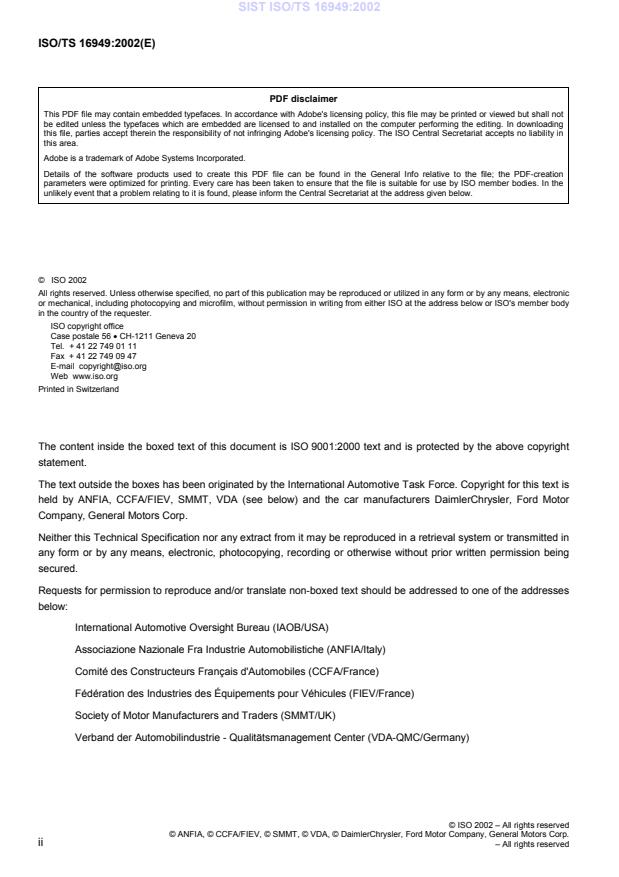
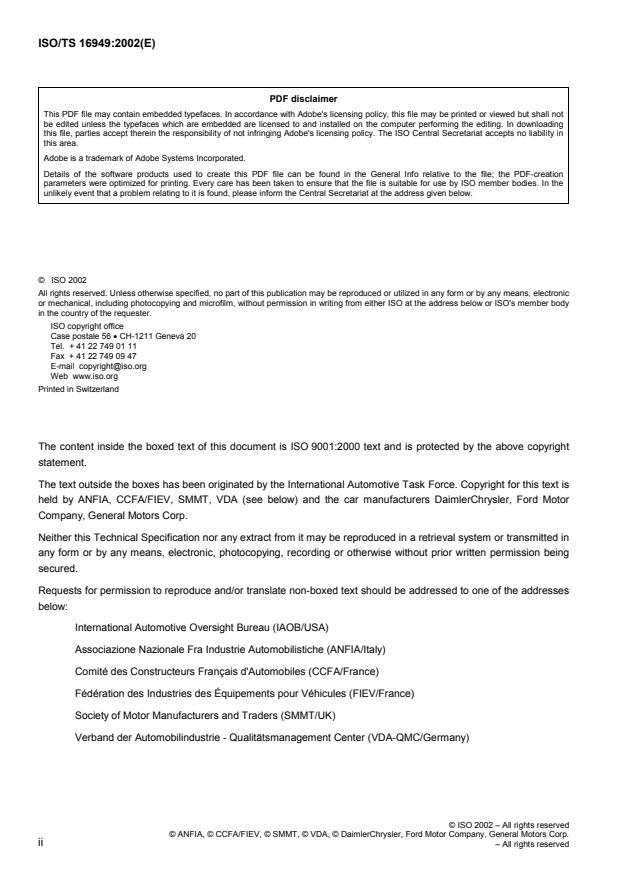
PDF disclaimer
This PDF file may contain embedded typefaces. In accordance with Adobe's licensing policy, this file may be printed or viewed but shall not
be edited unless the typefaces which are embedded are licensed to and installed on the computer performing the editing. In downloading
this file, parties accept therein the responsibility of not infringing Adobe's licensing policy. The ISO Central Secretariat accepts no liability in
this area.
Adobe is a trademark of Adobe Systems Incorporated.
Details of the software products used to create this PDF file can be found in the General Info relative to the file; the PDF-creation
parameters were optimized for printing. Every care has been taken to ensure that the file is suitable for use by ISO member bodies. In the
unlikely event that a problem relating to it is found, please inform the Central Secretariat at the address given below.
© ISO 2002
All rights reserved. Unless otherwise specified, no part of this publication may be reproduced or utilized in any form or by any means, electronic
or mechanical, including photocopying and microfilm, without permission in writing from either ISO at the address below or ISO's member body
in the country of the requester.
ISO copyright office
Case postale 56 • CH-1211 Geneva 20
Tel. + 41 22 749 01 11
Fax + 41 22 749 09 47
E-mail copyright@iso.org
Web www.iso.org
Printed in Switzerland
The content inside the boxed text of this document is ISO 9001:2000 text and is protected by the above copyright
statement.
The text outside the boxes has been originated by the International Automotive Task Force. Copyright for this text is
held by ANFIA, CCFA/FIEV, SMMT, VDA (see below) and the car manufacturers DaimlerChrysler, Ford Motor
Company, General Motors Corp.
Neither this Technical Specification nor any extract from it may be reproduced in a retrieval system or transmitted in
any form or by any means, electronic, photocopying, recording or otherwise without prior written permission being
secured.
Requests for permission to reproduce and/or translate non-boxed text should be addressed to one of the addresses
below:
International Automotive Oversight Bureau (IAOB/USA)
Associazione Nazionale Fra Industrie Automobilistiche (ANFIA/Italy)
Comité des Constructeurs Français d'Automobiles (CCFA/France)
Fédération des Industries des Équipements pour Véhicules (FIEV/France)
Society of Motor Manufacturers and Traders (SMMT/UK)
Verband der Automobilindustrie - Qualitätsmanagement Center (VDA-QMC/Germany)
© ANFIA, © CCFA/FIEV, © SMMT, © VDA, © DaimlerChrysler, Ford Motor Company, General Motors Corp.
ii
– All rights reserved
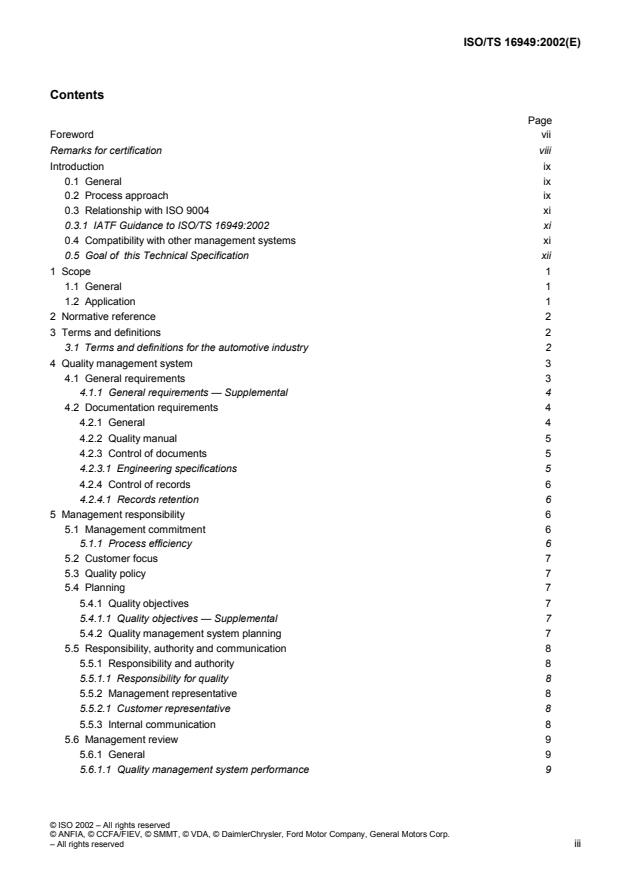
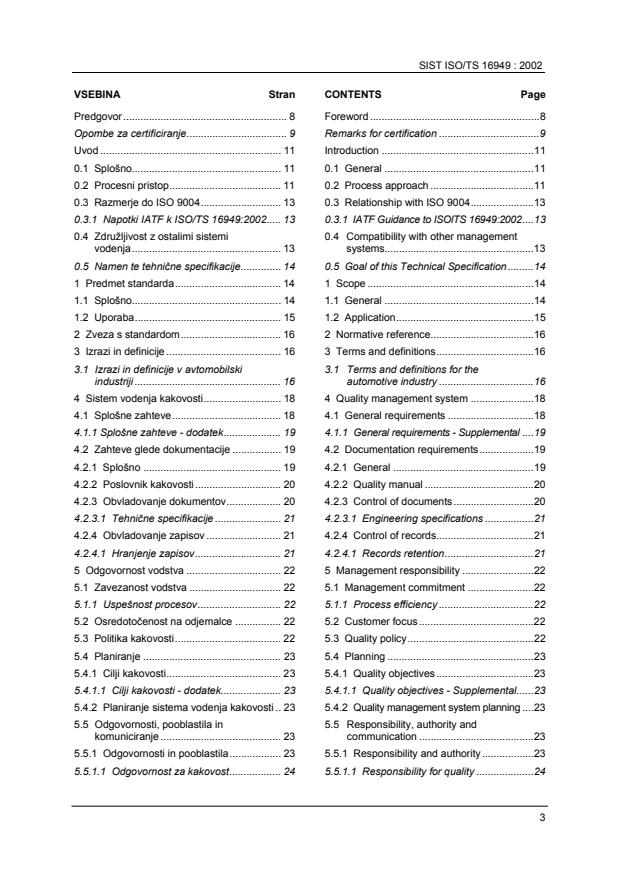
Contents
Page
Foreword vii
Remarks for certification viii
Introduction ix
0.1 General ix
0.2 Process approach ix
0.3 Relationship with ISO 9004 xi
0.3.1 IATF Guidance to ISO/TS 16949:2002 xi
0.4 Compatibility with other management systems xi
0.5 Goal of this Technical Specification xii
1 Scope 1
1.1 General 1
1.2 Application 1
2 Normative reference 2
3 Terms and definitions 2
3.1 Terms and definitions for the automotive industry 2
4 Quality management system 3
4.1 General requirements 3
4.1.1 General requirements — Supplemental 4
4.2 Documentation requirements 4
4.2.1 General 4
4.2.2 Quality manual 5
4.2.3 Control of documents 5
4.2.3.1 Engineering specifications 5
4.2.4 Control of records 6
4.2.4.1 Records retention 6
5 Management responsibility 6
5.1 Management commitment 6
5.1.1 Process efficiency 6
5.2 Customer focus 7
5.3 Quality policy 7
5.4 Planning 7
5.4.1 Quality objectives 7
5.4.1.1 Quality objectives — Supplemental 7
5.4.2 Quality management system planning 7
5.5 Responsibility, authority and communication 8
5.5.1 Responsibility and authority 8
5.5.1.1 Responsibility for quality 8
5.5.2 Management representative 8
5.5.2.1 Customer representative 8
5.5.3 Internal communication 8
5.6 Management review 9
5.6.1 General 9
5.6.1.1 Quality management system performance 9
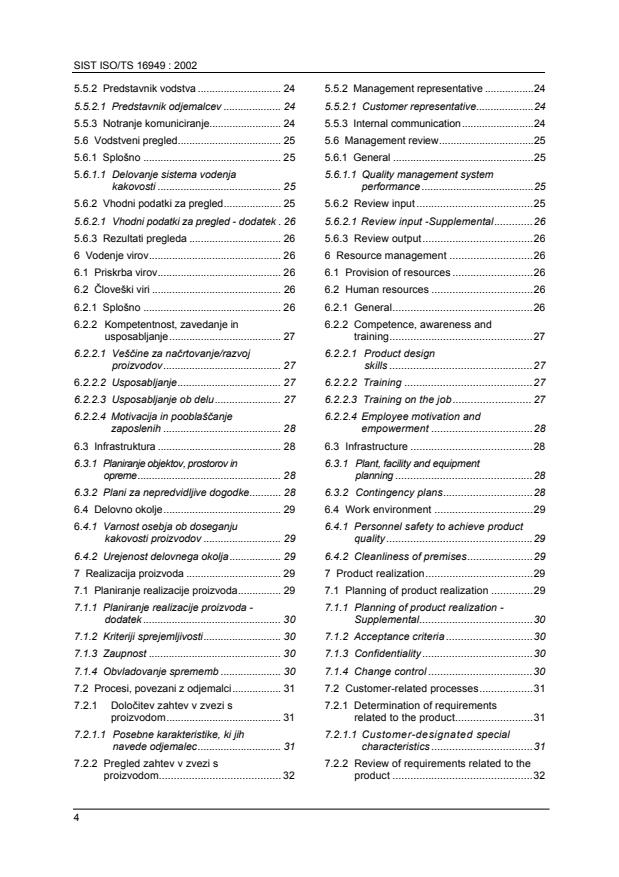
© ANFIA, © CCFA/FIEV, © SMMT, © VDA, © DaimlerChrysler, Ford Motor Company, General Motors Corp.
iii
– All rights reserved
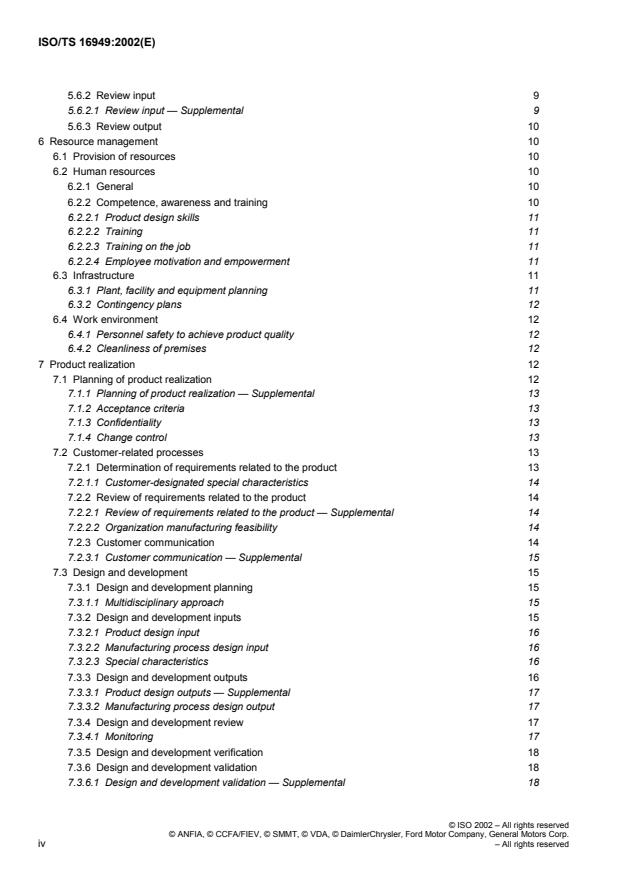
5.6.2 Review input 9
5.6.2.1 Review input — Supplemental 9
5.6.3 Review output 10
6 Resource management 10
6.1 Provision of resources 10
6.2 Human resources 10
6.2.1 General 10
6.2.2 Competence, awareness and training 10
6.2.2.1 Product design skills 11
6.2.2.2 Training 11
6.2.2.3 Training on the job 11
6.2.2.4 Employee motivation and empowerment 11
6.3 Infrastructure 11
6.3.1 Plant, facility and equipment planning 11
6.3.2 Contingency plans 12
6.4 Work environment 12
6.4.1 Personnel safety to achieve product quality 12
6.4.2 Cleanliness of premises 12
7 Product realization 12
7.1 Planning of product realization 12
7.1.1 Planning of product realization — Supplemental 13
7.1.2 Acceptance criteria 13
7.1.3 Confidentiality 13
7.1.4 Change control 13
7.2 Customer-related processes 13
7.2.1 Determination of requirements related to the product 13
7.2.1.1 Customer-designated special characteristics 14
7.2.2 Review of requirements related to the product 14
7.2.2.1 Review of requirements related to the product — Supplemental 14
7.2.2.2 Organization manufacturing feasibility 14
7.2.3 Customer communication 14
7.2.3.1 Customer communication — Supplemental 15
7.3 Design and development 15
7.3.1 Design and development planning 15
7.3.1.1 Multidisciplinary approach 15
7.3.2 Design and development inputs 15
7.3.2.1 Product design input 16
7.3.2.2 Manufacturing process design input 16
7.3.2.3 Special characteristics 16
7.3.3 Design and development outputs 16
7.3.3.1 Product design outputs — Supplemental 17
7.3.3.2 Manufacturing process design output 17
7.3.4 Design and development review 17
7.3.4.1 Monitoring 17
7.3.5 Design and development verification 18
7.3.6 Design and development validation 18
7.3.6.1 Design and development validation — Supplemental 18
© ANFIA, © CCFA/FIEV, © SMMT, © VDA, © DaimlerChrysler, Ford Motor Company, General Motors Corp.
iv
– All rights reserved
7.3.6.2 Prototype programme 18
7.3.6.3 Product approval process 18
7.3.7 Control of design and development changes 19
7.4 Purchasing 19
7.4.1 Purchasing process 19
7.4.1.1 Regulatory conformity 19
7.4.1.2 Supplier quality management system development 19
7.4.1.3 Customer-approved sources 19
7.4.2 Purchasing information 20
7.4.3 Verification of purchased product 20
7.4.3.1 Incoming product quality 20
7.4.3.2 Supplier monitoring 20
7.5 Production and service provision 21
7.5.1 Control of production and service provision 21
7.5.1.1 Control plan 21
7.5.1.2 Work instructions 21
7.5.1.3 Verification of job set-ups 21
7.5.1.4 Preventive and predictive maintenance 22
7.5.1.5 Management of production tooling 22
7.5.1.6 Production scheduling 22
7.5.1.7 Feedback of information from service 22
7.5.1.8 Service agreement with customer 22
7.5.2 Validation of processes for production and service provision 23
7.5.2.1 Validation of processes for production and service provision — Supplemental 23
7.5.3 Identification and traceability 23
7.5.3.1 Identification and traceability — Supplemental 23
7.5.4 Customer property 24
7.5.4.1 Customer-owned production tooling 24
7.5.5 Preservation of product 24
7.5.5.1 Storage and inventory 24
7.6 Control of monitoring and measuring devices 24
7.6.1 Measurement system analysis 25
7.6.2 Calibration/verification records 25
7.6.3 Laboratory requirements 25
7.6.3.1 Internal laboratory 25
7.6.3.2 External laboratory 25
8 Measurement, analysis and improvement 26
8.1 General 26
8.1.1 Identification of statistical tools 26
8.1.2 Knowledge of basic statistical concepts 26
8.2 Monitoring and measurement 26
8.2.1 Customer satisfaction 26
8.2.1.1 Customer satisfaction — Supplemental 26
8.2.2 Internal audit 27
8.2.2.1 Quality management system audit 27
8.2.2.2 Manufacturing process audit 27
8.2.2.3 Product audit 27
© ANFIA, © CCFA/FIEV, © SMMT, © VDA, © DaimlerChrysler, Ford Motor Company, General Motors Corp.
v
– All rights reserved
8.2.2.4 Internal audit plans 27
8.2.2.5 Internal auditor qualification 28
8.2.3 Monitoring and measurement of processes 28
8.2.3.1 Monitoring and measurement of manufacturing processes 28
8.2.4 Monitoring and measurement of product 29
8.2.4.1 Layout inspection and functional testing 29
8.2.4.2 Appearance items 29
8.3 Control of nonconforming product 29
8.3.1 Control of nonconforming product — Supplemental 30
8.3.2 Control of reworked product 30
8.3.3 Customer information 30
8.3.4 Customer waiver 30
8.4 Analysis of data 30
8.4.1 Analysis and use of data 31
8.5 Improvement 31
8.5.1 Continual improvement 31
8.5.1.1 Continual improvement of the organization 31
8.5.1.2 Manufacturing process improvement 31
8.5.2 Corrective action 31
8.5.2.1 Problem solving 32
8.5.2.2 Error-proofing 32
8.5.2.3 Corrective action impact 32
8.5.2.4 Rejected product test/analysis 32
8.5.3 Preventive action 32
Annex A (normative) Control plan 33
A.1 Phases of the control plan 33
A.2 Elements of the control plan 33
Bibliography 34
NOTE In this table of contents, ISO 9001:2000 headings are normal type face, IATF headings are in italics.
© ANFIA, © CCFA/FIEV, © SMMT, © VDA, © DaimlerChrysler, Ford Motor Company, General Motors Corp.
vi
– All rights reserved
Foreword
ISO (the International Organization for Standardization) is a worldwide federation of national standards bodies (ISO
member bodies). The work of preparing International Standards is normally carried out through ISO technical
committees. Each member body interested in a subject for which a technical committee has been established has
the right to be represented on that committee. International organizations, governmental and non-governmental, in
liaison with ISO, also take part in the work. ISO collaborates closely with the International Electrotechnical
Commission (IEC) on all matters of electrotechnical standardization.
International Standards are drafted in accordance with the rules given in the ISO/IEC Directives, Part 3.
The main task of technical committees is to prepare International Standards. Draft International Standards adopted
by the technical committees are circulated to the member bodies for voting. Publication as an International Standard
requires approval by at least 75 % of the member bodies casting a vote.
In other circumstances, particularly when there is an urgent market requirement for such documents, a technical
committee may decide to publish other types of normative document:
an ISO Publicly Available Specification (ISO/PAS) represents an agreement between technical experts in an
ISO working group and is accepted for publication if it is approved by more than 50 % of the members of the
parent committee casting a vote;
an ISO Technical Specification (ISO/TS) represents an agreement between the members of a technical
committee and is accepted for publication if it is approved by 2/3 of the members of the committee casting a
vote.
An ISO/PAS or ISO/TS is reviewed after three years with a view to deciding whether it should be confirmed for a
further three years, revised to become an International Standard, or withdrawn. In the case of a confirmed ISO/PAS
or ISO/TS, it is reviewed again after six years at which time it has to be either transposed into an International
Standard or withdrawn.
Manufacturers Association, Inc. (JAMA), with support from ISO/TC 176, Quality management and quality assurance.
This second edition of ISO/TS 16949 cancels and replaces the first edition (ISO/TS 16949:1999), which has been
technically revised.
Boxed text is original ISO 9001:2000 text. The sector-specific supplemental requirements are outside the boxes.
In this Technical Specification, the word “shall” indicates a requirement. The word “should” indicates a
recommendation. Paragraphs marked “NOTE” are for guidance in understanding or clarifying the associated
requirement.
Where the term “such as” is used, any suggestions given are for guidance only.
Annex A forms a normative part of this Technical Specification.
This corrected version of ISO/TS 16949:2002 incorporates the following corrections:
e-mail address of IAOB corrected on page viii;
year of publication corrected in 0.3.1;
the term “supplier” replaced by “the organization's” in Note to 7.6.3.1;
“agree with” replaced by “approve” in last paragraph of 8.3.4.
© ANFIA, © CCFA/FIEV, © SMMT, © VDA, © DaimlerChrysler, Ford Motor Company, General Motors Corp.
vii
– All rights reserved
Remarks for certification
The certification to this Technical Specification, including customer-specific requirements if any, is recognized by
the customer members of IATF when achieved according to the IATF certification scheme (see the “Rules for
achieving IATF recognition”).
Details can be obtained at the addresses of the local oversight bodies of IATF cited below:
Associazione Nazionale Fra Industrie Automobilistiche (ANFIA)
Web site: www.anfia.it e-mail: anfia@anfia.it
International Automotive Oversight Bureau (IAOB)
Web site: www.iaob.org e-mail: quality@aiag.org
Fédération des Industries des Équipements pour Véhicules (FIEV)
Comité des Constructeurs Français d'Automobiles (CCFA)
Web site: www.iatf-france.com e-mail: iatf@iatf-france.com
Society of Motor Manufacturers and Traders Ltd. (SMMT Ltd.)
Web site: www.smmt.co.uk e-mail: quality@smmt.co.uk
Verband der Automobilindustrie Qualitätsmanagement Center (VDA-QMC)
Web site: www.vda-qmc.de e-mail: info@vda-qmc.de
© ANFIA, © CCFA/FIEV, © SMMT, © VDA, © DaimlerChrysler, Ford Motor Company, General Motors Corp.
viii
– All rights reserved
Introduction
0.1 General
ISO 9001:2000, Quality management systems — Requirements
Introduction
0.1 General
The adoption of a quality management system should be a strategic decision of an organization. The design and
implementation of an organization's quality management system is influenced by varying needs, particular
objectives, the products provided, the processes employed and the size and structure of the organization. It is not
the intent of this International Standard to imply uniformity in the structure of quality management systems or
uniformity of documentation.
The quality management system requirements specified in this International Standard are complementary to
requirements for products. Information marked “NOTE” is for guidance in understanding or clarifying the
associated requirement.
This International Standard can be used by internal and external parties, including certification bodies, to assess
the organization's ability to meet customer, regulatory and the organization's own requirements.
The quality management principles stated in ISO 9000 and ISO 9004 have been taken into consideration during
the development of this International Standard.
0.2 Process approach
ISO 9001:2000, Quality management systems — Requirements
0.2 Process approach
This International Standard promotes the adoption of a process approach when developing, implementing and
improving the effectiveness of a quality management system, to enhance customer satisfaction by meeting
customer requirements.
For an organization to function effectively, it has to identify and manage numerous linked activities. An activity
using resources, and managed in order to enable the transformation of inputs into outputs, can be considered as a
process. Often the output from one process directly forms the input to the next.
The application of a system of processes within an organization, together with the identification and interactions of
these processes, and their management, can be referred to as the “process approach”.
An advantage of the process approach is the ongoing control that it provides over the linkage between the
individual processes within the system of processes, as well as over their combination and interaction.
When used within a quality management system, such an approach emphasizes the importance of
a) understanding and meeting requirements,
b) the need to consider processes in terms of added value,
c) obtaining results of process performance and effectiveness, and
d) continual improvement of processes based on objective measurement.
© ANFIA, © CCFA/FIEV, © SMMT, © VDA, © DaimlerChrysler, Ford Motor Company, General Motors Corp.
ix
– All rights reserved
The model of a process-based quality management system shown in Figure 1 illustrates the process linkages
presented in clauses 4 to 8. This illustration shows that customers play a significant role in defining requirements
as inputs. Monitoring of customer satisfaction requires the evaluation of information relating to customer
perception as to whether the organization has met the customer requirements. The model shown in Figure 1
covers all the requirements of this International Standard, but does not show processes at a detailed level.
NOTE In addition, the methodology known as “Plan-Do-Check-Act” (PDCA) can be applied to all processes. PDCA can be
briefly described as follows.
Plan: establish the objectives and processes necessary to deliver results in accordance with customer requirements and
the organization's policies.
Do: implement the processes.
Check: monitor and measure processes and product against policies, objectives and requirements for the product and
report the results.
Act: take actions to continually improve process performance.
Figure 1 — Model of a process-based quality management system
© ANFIA, © CCFA/FIEV, © SMMT, © VDA, © DaimlerChrysler, Ford Motor Company, General Motors Corp.
x
– All rights reserved
0.3 Relationship with ISO 9004
ISO 9001:2000, Quality management systems — Requirements
0.3 Relationship with ISO 9004
The present editions of ISO 9001 and ISO 9004 have been developed as a consistent pair of quality management
system standards which have been designed to complement each other, but can also be used independently.
Although the two International Standards have different scopes, they have similar structures in order to assist their
application as a consistent pair.
ISO 9001 specifies requirements for a quality management system that can be used for internal application by
organizations, or for certification, or for contractual purposes. It focuses on the effectiveness of the quality
management system in meeting customer requirements.
ISO 9004 gives guidance on a wider range of objectives of a quality management system than does ISO 9001,
particularly for the continual improvement of an organization's overall performance and efficiency, as well as its
effectiveness. ISO 9004 is recommended as a guide for organizations whose top management wishes to move
beyond the requirements of ISO 9001, in pursuit of continual improvement of performance. However, it is not
intended for certification or for contractual purposes.
NOTE The knowledge and use of the eight quality management principles referred to in ISO 9000:2000 and ISO 9004:2000
should be demonstrated and cascaded through the organization by top management.
0.3.1 IATF Guidance to ISO/TS 16949:2002
“IATF Guidance to ISO/TS 16949:2002” is a document containing recommended automotive industry practices,
examples, illustrations and explanations, and provides assistance in the application to conform to the requirements
of this Technical Specification.
This IATF Guidance document is not intended for certification or for contractual purposes
0.4 Compatibility with other management systems
ISO 9001:2000, Quality management systems — Requirements
0.4 Compatibility with other management systems
This International Standard has been aligned with ISO 14001:1996 in order to enhance the compatibility of the two
standards for the benefit of the user community.
This International Standard does not include requirements specific to other management systems, such as those
particular to environmental management, occupational health and safety management, financial management or
risk management. However, this International Standard enables an organization to align or integrate its own
quality management system with related management system requirements. It is possible for an organization to
adapt its existing management system(s) in order to establish a quality management system that complies with
the requirements of this International Standard.
© ANFIA, © CCFA/FIEV, © SMMT, © VDA, © DaimlerChrysler, Ford Motor Company, General Motors Corp.
xi
– All rights reserved
0.5 Goal of this Technical Specification
The goal of this Technical Specification is the development of a quality management system that provides for
continual improvement, emphasizing defect prevention and the reduction of variation and waste in the supply chain.
This Technical Specification, coupled with applicable customer-specific requirements, defines the fundamental
quality management system requirements for those subscribing to this document.
This Technical Specification is intended to avoid multiple certification audits and provide a common approach to a
quality management system for automotive production, and relevant service part organizations.
© ANFIA, © CCFA/FIEV, © SMMT, © VDA, © DaimlerChrysler, Ford Motor Company, General Motors Corp.
xii
– All rights reserved
TECHNICAL SPECIFICATION ISO/TS 16949:2002(E)
Quality management systems ------ Particular requirements for the
application of ISO 9001:2000 for automotive production and
relevant service part organizations
1 Scope
1.1 General
ISO 9001:2000, Quality management systems — Requirements
1 Scope
1.1 General
This International Standard specifies requirements for a quality management system where an organization
a) needs to demonstrate its ability to consistently provide product that meets customer and applicable regulatory
requirements, and
b) aims to enhance customer satisfaction through the effective application of the system, including processes for
continual improvement of the system and the assurance of conformity to customer and applicable regulatory
requirements.
NOTE In this International Standard, the term “product” applies only to the product intended for, or required by, a customer.
This Technical Specification, in conjunction with ISO 9001:2000, defines the quality management system
requirements for the design and development, production and, when relevant, installation and service of
automotive-related products.
This Technical Specification is applicable to sites of the organization where customer-specified parts, for production
and/or service, are manufactured.
Supporting functions, whether on-site or remote (such as design centres, corporate headquarters and distribution
centres), form part of the site audit as they support the site, but cannot obtain stand-alone certification to this
Technical Specification.
This Technical Specification can be applied throughout the automotive supply chain.
1.2 Application
ISO 9001:2000, Quality management systems — Requirements
1.2 Application
All requirements of this International Standard are generic and are intended to be applicable to all organizations,
regardless of type, size and product provided.
Where any requirement(s) of this International Standard cannot be applied due to the nature of an organization
and its product, this can be considered for exclusion.
Where exclusions are made, claims of conformity to this International Standard are not acceptable unless these
exclusions are limited to requirements within clause 7, and such exclusions do not affect the organization's ability,
or responsibility, to provide product that meets customer and applicable regulatory requirements.
© ANFIA, © CCFA/FIEV, © SMMT, © VDA, © DaimlerChrysler, Ford Motor Company, General Motors Corp.
– All rights reserved
The only permitted exclusions for this Technical Specification relate to 7.3 where the organization is not
responsible for product design and development.
Permitted exclusions do not include manufacturing process design.
2 Normative reference
The following normative document contains provisions, which, through reference in this text, constitute provisions of
this Technical Specification. For dated references, subsequent amendments to, or revisions of, any of these
publications do not apply. However, parties to agreements based on this Technical Specification are encouraged to
investigate the possibility of applying the most recent edition of the normative document indicated below. For
undated references, the latest edition of the normative document referred to applies. Members of ISO and IEC
maintain registers of currently valid International Standards.
ISO 9000:2000, Quality management systems — Fundamentals and vocabulary
3 Terms and definitions
ISO 9001:2000, Quality management systems — Requirements
3 Terms and definitions
For the purposes of this International Standard, the terms and definitions given in ISO 9000 apply.
The following terms, used in this edition of ISO 9001 to describe the supply chain, have been changed to reflect
the vocabulary currently used:
———— ————
supplier X organization X customer
The term “organization” replaces the term “supplier” used in ISO 9001:1994, and refers to the unit to which this
International Standard applies. Also, the term “supplier” now replaces the term “subcontractor”.
Throughout the text of this International Standard, wherever the term “product” occurs, it can also mean “service”.
3.1 Terms and definitions for the automotive industry
For the purposes of this Technical Specification, the terms and definitions given in ISO 9000:2000 and the following
apply.
3.1.1
control plan
documented description of the systems and processes required for controlling product (see annex A)
3.1.2
design responsible organization
organization with authority to establish a new, or change an existing, product specification
NOTE This responsibility includes testing and verification of design performance within the customer’s specified application.
3.1.3
error proofing
product and manufacturing process design and development to prevent manufacture of nonconforming products
3.1.4
laboratory
facility for inspection, test or calibration that may include, but is not limited to, chemical, metallurgical, dimensional,
physical, electrical or reliability testing
© ANFIA, © CCFA/FIEV, © SMMT, © VDA, © DaimlerChrysler, Ford Motor Company, General Motors Corp.
– All rights reserved
3.1.5
laboratory scope
controlled document containing
specific tests, evaluations and calibrations that a laboratory is qualified to perform,
list of the equipment which it uses to perform the above, and
list of methods and standards to which it performs the above
3.1.6
manufacturing
process of making or fabricating
production materials,
production or service parts,
assemblies, or
heat treating, welding, painting, plating or other finishing services
3.1.7
predictive maintenance
activities based on process data aimed at the avoidance of maintenance problems by prediction of likely failure
modes
3.1.8
preventive maintenance
planned action to eliminate causes of equipment failure and unscheduled interruptions to production, as an output
of the manufacturing process design
3.1.9
premium freight
extra costs or charges incurred additional to contracted delivery
NOTE This can be caused by method, quantity, unscheduled or late deliveries, etc.
3.1.10
remote location
location that supports sites and at which non-production processes occur
3.1.11
site
location at which value-added manufacturing processes occur
3.1.12
special characteristic
product characteristic or manufacturing process parameter which can affect safety or compliance with regulations,
fit, function, performance or subsequent processing of product
4 Quality management system
4.1 General requirements
ISO 9001:2000, Quality management systems — Requirements
4 Quality management system
4.1 General requirements
The organization shall establish, document, implement and maintain a quality management system and continually
improve its effectiveness in accordance with the requirements of this International Standard.
© ANFIA, © CCFA/FIEV, © SMMT, © VDA, © DaimlerChrysler, Ford Motor Company, General Motors Corp.
– All rights reserved
The organization shall
a) identify the processes needed for the quality management system and their application throughout the
organization (see 1.2),
b) determine the sequence and interaction of these processes,
c) determine criteria and methods needed to ensure that both the operation and control of these processes are
effective,
d) ensure the availability of resources and information necessary to support the operation and monitoring of these
processes,
e) monitor, measure and analyse these processes, and
f) implement actions necessary to achieve planned results and continual improvement of these processes.
These processes shall be managed by the organization in accordance with the requirements of this International
Standard.
Where an organization chooses to outsource any process that affects product conformity with requirements, the
organization shall ensure control over such processes. Control of such outsourced processes shall be identified
within the quality management system.
NOTE Processes needed for the quality management system referred to above should include processes for management
activities, provision of resources, product realization and measurement.
4.1.1 General requirements — Supplemental
Ensuring control over outsourced processes shall not absolve the organization of the responsibility of conformity to
all customer requirements.
NOTE See also 7.4.1 and 7.4.1.3.
4.2 Documentation requirements
4.2.1 General
ISO 9001:2000, Quality management systems — Requirements
4.2 Documentation requirements
4.2.1 General
The quality management system documentation shall include
a) documented statements of a quality policy and quality objectives,
b) a quality manual,
c) documented procedures required by this International Standard,
d) documents needed by the organization to ensure the effective planning, operation and control of its processes,
and
e) records required by this International Standard (see 4.2.4).
© ANFIA, © CCFA/FIEV, © SMMT, © VDA, © DaimlerChrysler, Ford Motor Company, General Motors Corp.
– All rights reserved
NOTE 1 Where the term “documented procedure” appears within this International Standard, this means that the procedure
is established, documented, implemented and maintained.
NOTE 2 The extent of the quality management system documentation can differ from one organization to another due to
a) the size of organization and type of activities,
b) the complexity of processes and their interactions, and
c) the competence of personnel.
NOTE 3 The documentation can be in any form or type of medium.
4.2.2 Quality manual
ISO 9001:2000, Quality management system — Requirements
4.2.2 Quality manual
The organization shall establish and maintain a quality manual that includes
a) the scope of the quality management system, including details of and justification for any exclusions (see 1.2),
b) the documented procedures established for the quality management system, or reference to them, and
c) a description of the interaction between the processes of the quality management system.
4.2.3 Control of documents
ISO 9001:2000, Quality management system — Requirements
4.2.3 Control of documents
Documents required by the quality management system shall be controlled. Records are a special type of
document and shall be controlled according to the requirements given in 4.2.4.
A documented procedure shall be established to define the controls needed
a) to approve documents for adequacy prior to issue,
b) to review and update as necessary and re-approve documents,
c) to ensure that changes and the current revision status of documents are identified,
d) to ensure that relevant versions of applicable documents are available at points of use,
e) to ensure that documents remain legible and readily identifiable,
f) to ensure that documents of external origin are identified and their distribution controlled, and
g) to prevent the unintended use of obsolete documents, and to apply suitable identification to them if they are
retained for any purpose.
4.2.3.1 Engineering specifications
The organization shall have a process to assure the timely review, distribution and implementation of all customer
engineering standards/specifications and changes based on customer-required schedule. Timely review should be
as soon as possible, and shall not exceed two working weeks.
© ANFIA, © CCFA/FIEV, © SMMT, © VDA, © DaimlerChrysler, Ford Motor Company, General Motors Corp.
– All rights reserved
The organization shall maintain a record of the date on which each change is implemented in production.
Implementation shall include updated documents.
NOTE A change in these standards/specifications requires an updated record of customer production part approval when
these specifications are referenced on the design record or if they affect documents of production part approval process, such
as control plan, FMEAs, etc.
4.2.4 Control of records
ISO 9001:2000, Quality management system — Requirements
4.2.4 Control of records
Records shall be established and maintained to provide evidence of conformity to requirements and of the
effective operation of the quality management system. Records shall remain legible, readily identifiable and
retrievable. A documented procedure shall be established to define the controls needed for the identification,
storage, protection, retrieval, retention time and disposition of records.
NOTE 1 “Disposition” above includes disposal.
NOTE 2 “Records” also include customer-specified records.
4.2.4.1 Records retention
The control of records shall satisfy regulatory and customer requirements.
5 Management responsibility
5.1 Management commitment
ISO 9001:2000, Quality management systems — Requirements
5 Management responsibility
5.1 Management commitment
Top management shall provide evidence of its commitment to the development and implementation of the quality
management system and continually improving its effectiveness by
a) communicating to the organization the importance of meeting customer as well as statutory and regulatory
requirements,
b) establishing the quality policy,
c) ensuring that quality objectives are established,
d) conducting management reviews, and
e) ensuring the availability of resources.
5.1.1 Process efficiency
Top management shall review the product realization processes and the support processes to assure their
effectiveness and efficiency.
© ANFIA, © CCFA/FIEV, © SMMT, © VDA, © DaimlerChrysler, Ford Motor Company, General Motors Corp.
– All rights reserved
5.2 Customer focus
ISO 9001:2000, Quality management systems — Requirements
5.2 Customer focus
Top management shall ensure that customer requirements are determined and are met with the aim of enhancing
customer satisfaction (see 7.2.1 and 8.2.1).
5.3 Quality policy
ISO 9001:2000, Quality management systems — Requirements
5.3 Quality policy
Top management shall ensure that the quality policy
a) is appropriate to the purpose of the organization,
b) includes a commitment to comply with requirements and continually improve the effectiveness of the quality
management system,
c) provides a framework for establishing and reviewing quality objectives,
d) is communicated and understood within the organization, and
e) is reviewed for continuing suitability.
5.4 Planning
5.4.1 Quality objectives
ISO 9001:2000, Quality management systems — Requirements
5.4 Planning
5.4.1 Quality objectives
Top management shall ensure that quality objectives, including those needed to meet requirements for product
[see 7.1 a)] are established at relevant functions and levels within the organization. The quality objectives shall be
measurable and consistent with the quality policy.
5.4.1.1 Quality objectives — Supplemental
Top management shall define quality objectives and measurements that shall be included in the business plan and
used to deploy the quality policy.
NOTE Quality objectives should address customer expectations and be achievable within a defined time period.
5.4.2 Quality management system planning
ISO 9001:2000, Quality management systems — Requirements
5.4.2 Quality management system planning
Top management shall ensure that
a) the planning of the quality management system is carried out in order to meet the requirements given in 4.1, as
well as the quality objectives, and
b) the integrity of the quality management system is maintained when changes to the quality management system
are planned and implemented.
© ANFIA, © CCFA/FIEV, © SMMT, © VDA, © DaimlerChrysler, Ford Motor Company, General Motors Corp.
– All rights reserved
5.5 Responsibility, authority and communication
5.5.1 Responsibility and authority
ISO 9001:2000, Quality management systems — Requirements
5.5 Responsibility, authority and communication
5.5.1 Responsibility and authority
Top management shall ensure that the responsibilities and authorities are defined and communicated within the
organization.
5.5.1.1 Responsibility for quality
Managers with responsibility and authority for corrective action shall be promptly informed of products or processes
which do not conform to requirements.
Personnel responsible for product quality shall have the authority to stop production to correct quality problems.
Production operations across all shifts shall be staffed with personnel in charge of, or delegated responsibility for,
ensuring product quality.
5.5.2 Management representative
ISO 9001:2000, Quality management systems — Requirements
5.5.2 Management representative
Top management shall appoint a member of management who, irrespective of other responsibilities, shall have
responsibility and authority that includes
a) ensuring that processes needed for the quality management system are established, implemented and
maintained,
b) reporting to top management on the performance of the quality management system and any need for
improvement, and
c) ensuring the promotion of awareness of customer requirements throughout the organization.
NOTE The responsibility of a management representative can include liaison with external parties on matters relating to the
quality management system.
5.5.2.1 Customer representative
Top management shall designate personnel with responsibility and authority to ensure that customer requirements
are addressed. This includes selection of special characteristics, setting quality objectives and related training,
corrective and preventive actions, product design and development.
5.5.3 Internal communication
ISO 9001:2000, Quality management systems — Requirements
5.5.3 Internal communication
Top management shall ensure that appropriate communication processes are established within the organization
and that communication takes place regarding the effectiveness of the quality management system.
© ANFIA, © CCFA/FIEV, © SMMT, © VDA, © DaimlerChrysler, Ford Motor Company, General Motors Corp.
– All rights reserved
5.6 Management review
5.6.1 General
ISO 9001:2000, Quality management systems — Requirements
5.6 Management review
5.6.1 General
Top management shall review the organization's quality management system, at planned intervals, to ensure its
continuing suitability, adequacy and effectiveness. This review shall include assessing opportunities for
improvement and the need for changes to the quality management system, including the quality policy and quality
objectives.
Records from management reviews shall be maintained (see 4.2.4).
5.6.1.1 Quality management system performance
These reviews shall include all requirements of the quality management system and its performance trends as an
essential part of the continual improvement proc
...
TECHNICAL ISO/TS
SPECIFICATION 16949
Second edition
2002-03-01
Corrected version
2003-12-15
Quality management systems —
Particular requirements for the application
of ISO 9001:2000 for automotive production
and relevant service part organizations
Systèmes de management de la qualité —
Exigences particulières pour l'application de l'ISO 9001:2000 pour la
production de série et de pièces de rechange dans l'industrie automobile
Reference number
©
ISO 2002
PDF disclaimer
This PDF file may contain embedded typefaces. In accordance with Adobe's licensing policy, this file may be printed or viewed but shall not
be edited unless the typefaces which are embedded are licensed to and installed on the computer performing the editing. In downloading
this file, parties accept therein the responsibility of not infringing Adobe's licensing policy. The ISO Central Secretariat accepts no liability in
this area.
Adobe is a trademark of Adobe Systems Incorporated.
Details of the software products used to create this PDF file can be found in the General Info relative to the file; the PDF-creation
parameters were optimized for printing. Every care has been taken to ensure that the file is suitable for use by ISO member bodies. In the
unlikely event that a problem relating to it is found, please inform the Central Secretariat at the address given below.
© ISO 2002
All rights reserved. Unless otherwise specified, no part of this publication may be reproduced or utilized in any form or by any means, electronic
or mechanical, including photocopying and microfilm, without permission in writing from either ISO at the address below or ISO's member body
in the country of the requester.
ISO copyright office
Case postale 56 • CH-1211 Geneva 20
Tel. + 41 22 749 01 11
Fax + 41 22 749 09 47
E-mail copyright@iso.org
Web www.iso.org
Printed in Switzerland
The content inside the boxed text of this document is ISO 9001:2000 text and is protected by the above copyright
statement.
The text outside the boxes has been originated by the International Automotive Task Force. Copyright for this text is
held by ANFIA, CCFA/FIEV, SMMT, VDA (see below) and the car manufacturers DaimlerChrysler, Ford Motor
Company, General Motors Corp.
Neither this Technical Specification nor any extract from it may be reproduced in a retrieval system or transmitted in
any form or by any means, electronic, photocopying, recording or otherwise without prior written permission being
secured.
Requests for permission to reproduce and/or translate non-boxed text should be addressed to one of the addresses
below:
International Automotive Oversight Bureau (IAOB/USA)
Associazione Nazionale Fra Industrie Automobilistiche (ANFIA/Italy)
Comité des Constructeurs Français d'Automobiles (CCFA/France)
Fédération des Industries des Équipements pour Véhicules (FIEV/France)
Society of Motor Manufacturers and Traders (SMMT/UK)
Verband der Automobilindustrie - Qualitätsmanagement Center (VDA-QMC/Germany)
© ANFIA, © CCFA/FIEV, © SMMT, © VDA, © DaimlerChrysler, Ford Motor Company, General Motors Corp.
ii
– All rights reserved
Contents
Page
Foreword vii
Remarks for certification viii
Introduction ix
0.1 General ix
0.2 Process approach ix
0.3 Relationship with ISO 9004 xi
0.3.1 IATF Guidance to ISO/TS 16949:2002 xi
0.4 Compatibility with other management systems xi
0.5 Goal of this Technical Specification xii
1 Scope 1
1.1 General 1
1.2 Application 1
2 Normative reference 2
3 Terms and definitions 2
3.1 Terms and definitions for the automotive industry 2
4 Quality management system 3
4.1 General requirements 3
4.1.1 General requirements — Supplemental 4
4.2 Documentation requirements 4
4.2.1 General 4
4.2.2 Quality manual 5
4.2.3 Control of documents 5
4.2.3.1 Engineering specifications 5
4.2.4 Control of records 6
4.2.4.1 Records retention 6
5 Management responsibility 6
5.1 Management commitment 6
5.1.1 Process efficiency 6
5.2 Customer focus 7
5.3 Quality policy 7
5.4 Planning 7
5.4.1 Quality objectives 7
5.4.1.1 Quality objectives — Supplemental 7
5.4.2 Quality management system planning 7
5.5 Responsibility, authority and communication 8
5.5.1 Responsibility and authority 8
5.5.1.1 Responsibility for quality 8
5.5.2 Management representative 8
5.5.2.1 Customer representative 8
5.5.3 Internal communication 8
5.6 Management review 9
5.6.1 General 9
5.6.1.1 Quality management system performance 9
© ANFIA, © CCFA/FIEV, © SMMT, © VDA, © DaimlerChrysler, Ford Motor Company, General Motors Corp.
iii
– All rights reserved
5.6.2 Review input 9
5.6.2.1 Review input — Supplemental 9
5.6.3 Review output 10
6 Resource management 10
6.1 Provision of resources 10
6.2 Human resources 10
6.2.1 General 10
6.2.2 Competence, awareness and training 10
6.2.2.1 Product design skills 11
6.2.2.2 Training 11
6.2.2.3 Training on the job 11
6.2.2.4 Employee motivation and empowerment 11
6.3 Infrastructure 11
6.3.1 Plant, facility and equipment planning 11
6.3.2 Contingency plans 12
6.4 Work environment 12
6.4.1 Personnel safety to achieve product quality 12
6.4.2 Cleanliness of premises 12
7 Product realization 12
7.1 Planning of product realization 12
7.1.1 Planning of product realization — Supplemental 13
7.1.2 Acceptance criteria 13
7.1.3 Confidentiality 13
7.1.4 Change control 13
7.2 Customer-related processes 13
7.2.1 Determination of requirements related to the product 13
7.2.1.1 Customer-designated special characteristics 14
7.2.2 Review of requirements related to the product 14
7.2.2.1 Review of requirements related to the product — Supplemental 14
7.2.2.2 Organization manufacturing feasibility 14
7.2.3 Customer communication 14
7.2.3.1 Customer communication — Supplemental 15
7.3 Design and development 15
7.3.1 Design and development planning 15
7.3.1.1 Multidisciplinary approach 15
7.3.2 Design and development inputs 15
7.3.2.1 Product design input 16
7.3.2.2 Manufacturing process design input 16
7.3.2.3 Special characteristics 16
7.3.3 Design and development outputs 16
7.3.3.1 Product design outputs — Supplemental 17
7.3.3.2 Manufacturing process design output 17
7.3.4 Design and development review 17
7.3.4.1 Monitoring 17
7.3.5 Design and development verification 18
7.3.6 Design and development validation 18
7.3.6.1 Design and development validation — Supplemental 18
© ANFIA, © CCFA/FIEV, © SMMT, © VDA, © DaimlerChrysler, Ford Motor Company, General Motors Corp.
iv
– All rights reserved
7.3.6.2 Prototype programme 18
7.3.6.3 Product approval process 18
7.3.7 Control of design and development changes 19
7.4 Purchasing 19
7.4.1 Purchasing process 19
7.4.1.1 Regulatory conformity 19
7.4.1.2 Supplier quality management system development 19
7.4.1.3 Customer-approved sources 19
7.4.2 Purchasing information 20
7.4.3 Verification of purchased product 20
7.4.3.1 Incoming product quality 20
7.4.3.2 Supplier monitoring 20
7.5 Production and service provision 21
7.5.1 Control of production and service provision 21
7.5.1.1 Control plan 21
7.5.1.2 Work instructions 21
7.5.1.3 Verification of job set-ups 21
7.5.1.4 Preventive and predictive maintenance 22
7.5.1.5 Management of production tooling 22
7.5.1.6 Production scheduling 22
7.5.1.7 Feedback of information from service 22
7.5.1.8 Service agreement with customer 22
7.5.2 Validation of processes for production and service provision 23
7.5.2.1 Validation of processes for production and service provision — Supplemental 23
7.5.3 Identification and traceability 23
7.5.3.1 Identification and traceability — Supplemental 23
7.5.4 Customer property 24
7.5.4.1 Customer-owned production tooling 24
7.5.5 Preservation of product 24
7.5.5.1 Storage and inventory 24
7.6 Control of monitoring and measuring devices 24
7.6.1 Measurement system analysis 25
7.6.2 Calibration/verification records 25
7.6.3 Laboratory requirements 25
7.6.3.1 Internal laboratory 25
7.6.3.2 External laboratory 25
8 Measurement, analysis and improvement 26
8.1 General 26
8.1.1 Identification of statistical tools 26
8.1.2 Knowledge of basic statistical concepts 26
8.2 Monitoring and measurement 26
8.2.1 Customer satisfaction 26
8.2.1.1 Customer satisfaction — Supplemental 26
8.2.2 Internal audit 27
8.2.2.1 Quality management system audit 27
8.2.2.2 Manufacturing process audit 27
8.2.2.3 Product audit 27
© ANFIA, © CCFA/FIEV, © SMMT, © VDA, © DaimlerChrysler, Ford Motor Company, General Motors Corp.
v
– All rights reserved
8.2.2.4 Internal audit plans 27
8.2.2.5 Internal auditor qualification 28
8.2.3 Monitoring and measurement of processes 28
8.2.3.1 Monitoring and measurement of manufacturing processes 28
8.2.4 Monitoring and measurement of product 29
8.2.4.1 Layout inspection and functional testing 29
8.2.4.2 Appearance items 29
8.3 Control of nonconforming product 29
8.3.1 Control of nonconforming product — Supplemental 30
8.3.2 Control of reworked product 30
8.3.3 Customer information 30
8.3.4 Customer waiver 30
8.4 Analysis of data 30
8.4.1 Analysis and use of data 31
8.5 Improvement 31
8.5.1 Continual improvement 31
8.5.1.1 Continual improvement of the organization 31
8.5.1.2 Manufacturing process improvement 31
8.5.2 Corrective action 31
8.5.2.1 Problem solving 32
8.5.2.2 Error-proofing 32
8.5.2.3 Corrective action impact 32
8.5.2.4 Rejected product test/analysis 32
8.5.3 Preventive action 32
Annex A (normative) Control plan 33
A.1 Phases of the control plan 33
A.2 Elements of the control plan 33
Bibliography 34
NOTE In this table of contents, ISO 9001:2000 headings are normal type face, IATF headings are in italics.
© ANFIA, © CCFA/FIEV, © SMMT, © VDA, © DaimlerChrysler, Ford Motor Company, General Motors Corp.
vi
– All rights reserved
Foreword
ISO (the International Organization for Standardization) is a worldwide federation of national standards bodies (ISO
member bodies). The work of preparing International Standards is normally carried out through ISO technical
committees. Each member body interested in a subject for which a technical committee has been established has
the right to be represented on that committee. International organizations, governmental and non-governmental, in
liaison with ISO, also take part in the work. ISO collaborates closely with the International Electrotechnical
Commission (IEC) on all matters of electrotechnical standardization.
International Standards are drafted in accordance with the rules given in the ISO/IEC Directives, Part 3.
The main task of technical committees is to prepare International Standards. Draft International Standards adopted
by the technical committees are circulated to the member bodies for voting. Publication as an International Standard
requires approval by at least 75 % of the member bodies casting a vote.
In other circumstances, particularly when there is an urgent market requirement for such documents, a technical
committee may decide to publish other types of normative document:
an ISO Publicly Available Specification (ISO/PAS) represents an agreement between technical experts in an
ISO working group and is accepted for publication if it is approved by more than 50 % of the members of the
parent committee casting a vote;
an ISO Technical Specification (ISO/TS) represents an agreement between the members of a technical
committee and is accepted for publication if it is approved by 2/3 of the members of the committee casting a
vote.
An ISO/PAS or ISO/TS is reviewed after three years with a view to deciding whether it should be confirmed for a
further three years, revised to become an International Standard, or withdrawn. In the case of a confirmed ISO/PAS
or ISO/TS, it is reviewed again after six years at which time it has to be either transposed into an International
Standard or withdrawn.
Manufacturers Association, Inc. (JAMA), with support from ISO/TC 176, Quality management and quality assurance.
This second edition of ISO/TS 16949 cancels and replaces the first edition (ISO/TS 16949:1999), which has been
technically revised.
Boxed text is original ISO 9001:2000 text. The sector-specific supplemental requirements are outside the boxes.
In this Technical Specification, the word “shall” indicates a requirement. The word “should” indicates a
recommendation. Paragraphs marked “NOTE” are for guidance in understanding or clarifying the associated
requirement.
Where the term “such as” is used, any suggestions given are for guidance only.
Annex A forms a normative part of this Technical Specification.
This corrected version of ISO/TS 16949:2002 incorporates the following corrections:
e-mail address of IAOB corrected on page viii;
year of publication corrected in 0.3.1;
the term “supplier” replaced by “the organization's” in Note to 7.6.3.1;
“agree with” replaced by “approve” in last paragraph of 8.3.4.
© ANFIA, © CCFA/FIEV, © SMMT, © VDA, © DaimlerChrysler, Ford Motor Company, General Motors Corp.
vii
– All rights reserved
Remarks for certification
The certification to this Technical Specification, including customer-specific requirements if any, is recognized by
the customer members of IATF when achieved according to the IATF certification scheme (see the “Rules for
achieving IATF recognition”).
Details can be obtained at the addresses of the local oversight bodies of IATF cited below:
Associazione Nazionale Fra Industrie Automobilistiche (ANFIA)
Web site: www.anfia.it e-mail: anfia@anfia.it
International Automotive Oversight Bureau (IAOB)
Web site: www.iaob.org e-mail: quality@aiag.org
Fédération des Industries des Équipements pour Véhicules (FIEV)
Comité des Constructeurs Français d'Automobiles (CCFA)
Web site: www.iatf-france.com e-mail: iatf@iatf-france.com
Society of Motor Manufacturers and Traders Ltd. (SMMT Ltd.)
Web site: www.smmt.co.uk e-mail: quality@smmt.co.uk
Verband der Automobilindustrie Qualitätsmanagement Center (VDA-QMC)
Web site: www.vda-qmc.de e-mail: info@vda-qmc.de
© ANFIA, © CCFA/FIEV, © SMMT, © VDA, © DaimlerChrysler, Ford Motor Company, General Motors Corp.
viii
– All rights reserved
Introduction
0.1 General
ISO 9001:2000, Quality management systems — Requirements
Introduction
0.1 General
The adoption of a quality management system should be a strategic decision of an organization. The design and
implementation of an organization's quality management system is influenced by varying needs, particular
objectives, the products provided, the processes employed and the size and structure of the organization. It is not
the intent of this International Standard to imply uniformity in the structure of quality management systems or
uniformity of documentation.
The quality management system requirements specified in this International Standard are complementary to
requirements for products. Information marked “NOTE” is for guidance in understanding or clarifying the
associated requirement.
This International Standard can be used by internal and external parties, including certification bodies, to assess
the organization's ability to meet customer, regulatory and the organization's own requirements.
The quality management principles stated in ISO 9000 and ISO 9004 have been taken into consideration during
the development of this International Standard.
0.2 Process approach
ISO 9001:2000, Quality management systems — Requirements
0.2 Process approach
This International Standard promotes the adoption of a process approach when developing, implementing and
improving the effectiveness of a quality management system, to enhance customer satisfaction by meeting
customer requirements.
For an organization to function effectively, it has to identify and manage numerous linked activities. An activity
using resources, and managed in order to enable the transformation of inputs into outputs, can be considered as a
process. Often the output from one process directly forms the input to the next.
The application of a system of processes within an organization, together with the identification and interactions of
these processes, and their management, can be referred to as the “process approach”.
An advantage of the process approach is the ongoing control that it provides over the linkage between the
individual processes within the system of processes, as well as over their combination and interaction.
When used within a quality management system, such an approach emphasizes the importance of
a) understanding and meeting requirements,
b) the need to consider processes in terms of added value,
c) obtaining results of process performance and effectiveness, and
d) continual improvement of processes based on objective measurement.
© ANFIA, © CCFA/FIEV, © SMMT, © VDA, © DaimlerChrysler, Ford Motor Company, General Motors Corp.
ix
– All rights reserved
The model of a process-based quality management system shown in Figure 1 illustrates the process linkages
presented in clauses 4 to 8. This illustration shows that customers play a significant role in defining requirements
as inputs. Monitoring of customer satisfaction requires the evaluation of information relating to customer
perception as to whether the organization has met the customer requirements. The model shown in Figure 1
covers all the requirements of this International Standard, but does not show processes at a detailed level.
NOTE In addition, the methodology known as “Plan-Do-Check-Act” (PDCA) can be applied to all processes. PDCA can be
briefly described as follows.
Plan: establish the objectives and processes necessary to deliver results in accordance with customer requirements and
the organization's policies.
Do: implement the processes.
Check: monitor and measure processes and product against policies, objectives and requirements for the product and
report the results.
Act: take actions to continually improve process performance.
Figure 1 — Model of a process-based quality management system
© ANFIA, © CCFA/FIEV, © SMMT, © VDA, © DaimlerChrysler, Ford Motor Company, General Motors Corp.
x
– All rights reserved
0.3 Relationship with ISO 9004
ISO 9001:2000, Quality management systems — Requirements
0.3 Relationship with ISO 9004
The present editions of ISO 9001 and ISO 9004 have been developed as a consistent pair of quality management
system standards which have been designed to complement each other, but can also be used independently.
Although the two International Standards have different scopes, they have similar structures in order to assist their
application as a consistent pair.
ISO 9001 specifies requirements for a quality management system that can be used for internal application by
organizations, or for certification, or for contractual purposes. It focuses on the effectiveness of the quality
management system in meeting customer requirements.
ISO 9004 gives guidance on a wider range of objectives of a quality management system than does ISO 9001,
particularly for the continual improvement of an organization's overall performance and efficiency, as well as its
effectiveness. ISO 9004 is recommended as a guide for organizations whose top management wishes to move
beyond the requirements of ISO 9001, in pursuit of continual improvement of performance. However, it is not
intended for certification or for contractual purposes.
NOTE The knowledge and use of the eight quality management principles referred to in ISO 9000:2000 and ISO 9004:2000
should be demonstrated and cascaded through the organization by top management.
0.3.1 IATF Guidance to ISO/TS 16949:2002
“IATF Guidance to ISO/TS 16949:2002” is a document containing recommended automotive industry practices,
examples, illustrations and explanations, and provides assistance in the application to conform to the requirements
of this Technical Specification.
This IATF Guidance document is not intended for certification or for contractual purposes
0.4 Compatibility with other management systems
ISO 9001:2000, Quality management systems — Requirements
0.4 Compatibility with other management systems
This International Standard has been aligned with ISO 14001:1996 in order to enhance the compatibility of the two
standards for the benefit of the user community.
This International Standard does not include requirements specific to other management systems, such as those
particular to environmental management, occupational health and safety management, financial management or
risk management. However, this International Standard enables an organization to align or integrate its own
quality management system with related management system requirements. It is possible for an organization to
adapt its existing management system(s) in order to establish a quality management system that complies with
the requirements of this International Standard.
© ANFIA, © CCFA/FIEV, © SMMT, © VDA, © DaimlerChrysler, Ford Motor Company, General Motors Corp.
xi
– All rights reserved
0.5 Goal of this Technical Specification
The goal of this Technical Specification is the development of a quality management system that provides for
continual improvement, emphasizing defect prevention and the reduction of variation and waste in the supply chain.
This Technical Specification, coupled with applicable customer-specific requirements, defines the fundamental
quality management system requirements for those subscribing to this document.
This Technical Specification is intended to avoid multiple certification audits and provide a common approach to a
quality management system for automotive production, and relevant service part organizations.
© ANFIA, © CCFA/FIEV, © SMMT, © VDA, © DaimlerChrysler, Ford Motor Company, General Motors Corp.
xii
– All rights reserved
TECHNICAL SPECIFICATION ISO/TS 16949:2002(E)
Quality management systems ------ Particular requirements for the
application of ISO 9001:2000 for automotive production and
relevant service part organizations
1 Scope
1.1 General
ISO 9001:2000, Quality management systems — Requirements
1 Scope
1.1 General
This International Standard specifies requirements for a quality management system where an organization
a) needs to demonstrate its ability to consistently provide product that meets customer and applicable regulatory
requirements, and
b) aims to enhance customer satisfaction through the effective application of the system, including processes for
continual improvement of the system and the assurance of conformity to customer and applicable regulatory
requirements.
NOTE In this International Standard, the term “product” applies only to the product intended for, or required by, a customer.
This Technical Specification, in conjunction with ISO 9001:2000, defines the quality management system
requirements for the design and development, production and, when relevant, installation and service of
automotive-related products.
This Technical Specification is applicable to sites of the organization where customer-specified parts, for production
and/or service, are manufactured.
Supporting functions, whether on-site or remote (such as design centres, corporate headquarters and distribution
centres), form part of the site audit as they support the site, but cannot obtain stand-alone certification to this
Technical Specification.
This Technical Specification can be applied throughout the automotive supply chain.
1.2 Application
ISO 9001:2000, Quality management systems — Requirements
1.2 Application
All requirements of this International Standard are generic and are intended to be applicable to all organizations,
regardless of type, size and product provided.
Where any requirement(s) of this International Standard cannot be applied due to the nature of an organization
and its product, this can be considered for exclusion.
Where exclusions are made, claims of conformity to this International Standard are not acceptable unless these
exclusions are limited to requirements within clause 7, and such exclusions do not affect the organization's ability,
or responsibility, to provide product that meets customer and applicable regulatory requirements.
© ANFIA, © CCFA/FIEV, © SMMT, © VDA, © DaimlerChrysler, Ford Motor Company, General Motors Corp.
– All rights reserved
The only permitted exclusions for this Technical Specification relate to 7.3 where the organization is not
responsible for product design and development.
Permitted exclusions do not include manufacturing process design.
2 Normative reference
The following normative document contains provisions, which, through reference in this text, constitute provisions of
this Technical Specification. For dated references, subsequent amendments to, or revisions of, any of these
publications do not apply. However, parties to agreements based on this Technical Specification are encouraged to
investigate the possibility of applying the most recent edition of the normative document indicated below. For
undated references, the latest edition of the normative document referred to applies. Members of ISO and IEC
maintain registers of currently valid International Standards.
ISO 9000:2000, Quality management systems — Fundamentals and vocabulary
3 Terms and definitions
ISO 9001:2000, Quality management systems — Requirements
3 Terms and definitions
For the purposes of this International Standard, the terms and definitions given in ISO 9000 apply.
The following terms, used in this edition of ISO 9001 to describe the supply chain, have been changed to reflect
the vocabulary currently used:
———— ————
supplier X organization X customer
The term “organization” replaces the term “supplier” used in ISO 9001:1994, and refers to the unit to which this
International Standard applies. Also, the term “supplier” now replaces the term “subcontractor”.
Throughout the text of this International Standard, wherever the term “product” occurs, it can also mean “service”.
3.1 Terms and definitions for the automotive industry
For the purposes of this Technical Specification, the terms and definitions given in ISO 9000:2000 and the following
apply.
3.1.1
control plan
documented description of the systems and processes required for controlling product (see annex A)
3.1.2
design responsible organization
organization with authority to establish a new, or change an existing, product specification
NOTE This responsibility includes testing and verification of design performance within the customer’s specified application.
3.1.3
error proofing
product and manufacturing process design and development to prevent manufacture of nonconforming products
3.1.4
laboratory
facility for inspection, test or calibration that may include, but is not limited to, chemical, metallurgical, dimensional,
physical, electrical or reliability testing
© ANFIA, © CCFA/FIEV, © SMMT, © VDA, © DaimlerChrysler, Ford Motor Company, General Motors Corp.
– All rights reserved
3.1.5
laboratory scope
controlled document containing
specific tests, evaluations and calibrations that a laboratory is qualified to perform,
list of the equipment which it uses to perform the above, and
list of methods and standards to which it performs the above
3.1.6
manufacturing
process of making or fabricating
production materials,
production or service parts,
assemblies, or
heat treating, welding, painting, plating or other finishing services
3.1.7
predictive maintenance
activities based on process data aimed at the avoidance of maintenance problems by prediction of likely failure
modes
3.1.8
preventive maintenance
planned action to eliminate causes of equipment failure and unscheduled interruptions to production, as an output
of the manufacturing process design
3.1.9
premium freight
extra costs or charges incurred additional to contracted delivery
NOTE This can be caused by method, quantity, unscheduled or late deliveries, etc.
3.1.10
remote location
location that supports sites and at which non-production processes occur
3.1.11
site
location at which value-added manufacturing processes occur
3.1.12
special characteristic
product characteristic or manufacturing process parameter which can affect safety or compliance with regulations,
fit, function, performance or subsequent processing of product
4 Quality management system
4.1 General requirements
ISO 9001:2000, Quality management systems — Requirements
4 Quality management system
4.1 General requirements
The organization shall establish, document, implement and maintain a quality management system and continually
improve its effectiveness in accordance with the requirements of this International Standard.
© ANFIA, © CCFA/FIEV, © SMMT, © VDA, © DaimlerChrysler, Ford Motor Company, General Motors Corp.
– All rights reserved
The organization shall
a) identify the processes needed for the quality management system and their application throughout the
organization (see 1.2),
b) determine the sequence and interaction of these processes,
c) determine criteria and methods needed to ensure that both the operation and control of these processes are
effective,
d) ensure the availability of resources and information necessary to support the operation and monitoring of these
processes,
e) monitor, measure and analyse these processes, and
f) implement actions necessary to achieve planned results and continual improvement of these processes.
These processes shall be managed by the organization in accordance with the requirements of this International
Standard.
Where an organization chooses to outsource any process that affects product conformity with requirements, the
organization shall ensure control over such processes. Control of such outsourced processes shall be identified
within the quality management system.
NOTE Processes needed for the quality management system referred to above should include processes for management
activities, provision of resources, product realization and measurement.
4.1.1 General requirements — Supplemental
Ensuring control over outsourced processes shall not absolve the organization of the responsibility of conformity to
all customer requirements.
NOTE See also 7.4.1 and 7.4.1.3.
4.2 Documentation requirements
4.2.1 General
ISO 9001:2000, Quality management systems — Requirements
4.2 Documentation requirements
4.2.1 General
The quality management system documentation shall include
a) documented statements of a quality policy and quality objectives,
b) a quality manual,
c) documented procedures required by this International Standard,
d) documents needed by the organization to ensure the effective planning, operation and control of its processes,
and
e) records required by this International Standard (see 4.2.4).
© ANFIA, © CCFA/FIEV, © SMMT, © VDA, © DaimlerChrysler, Ford Motor Company, General Motors Corp.
– All rights reserved
NOTE 1 Where the term “documented procedure” appears within this International Standard, this means that the procedure
is established, documented, implemented and maintained.
NOTE 2 The extent of the quality management system documentation can differ from one organization to another due to
a) the size of organization and type of activities,
b) the complexity of processes and their interactions, and
c) the competence of personnel.
NOTE 3 The documentation can be in any form or type of medium.
4.2.2 Quality manual
ISO 9001:2000, Quality management system — Requirements
4.2.2 Quality manual
The organization shall establish and maintain a quality manual that includes
a) the scope of the quality management system, including details of and justification for any exclusions (see 1.2),
b) the documented procedures established for the quality management system, or reference to them, and
c) a description of the interaction between the processes of the quality management system.
4.2.3 Control of documents
ISO 9001:2000, Quality management system — Requirements
4.2.3 Control of documents
Documents required by the quality management system shall be controlled. Records are a special type of
document and shall be controlled according to the requirements given in 4.2.4.
A documented procedure shall be established to define the controls needed
a) to approve documents for adequacy prior to issue,
b) to review and update as necessary and re-approve documents,
c) to ensure that changes and the current revision status of documents are identified,
d) to ensure that relevant versions of applicable documents are available at points of use,
e) to ensure that documents remain legible and readily identifiable,
f) to ensure that documents of external origin are identified and their distribution controlled, and
g) to prevent the unintended use of obsolete documents, and to apply suitable identification to them if they are
retained for any purpose.
4.2.3.1 Engineering specifications
The organization shall have a process to assure the timely review, distribution and implementation of all customer
engineering standards/specifications and changes based on customer-required schedule. Timely review should be
as soon as possible, and shall not exceed two working weeks.
© ANFIA, © CCFA/FIEV, © SMMT, © VDA, © DaimlerChrysler, Ford Motor Company, General Motors Corp.
– All rights reserved
The organization shall maintain a record of the date on which each change is implemented in production.
Implementation shall include updated documents.
NOTE A change in these standards/specifications requires an updated record of customer production part approval when
these specifications are referenced on the design record or if they affect documents of production part approval process, such
as control plan, FMEAs, etc.
4.2.4 Control of records
ISO 9001:2000, Quality management system — Requirements
4.2.4 Control of records
Records shall be established and maintained to provide evidence of conformity to requirements and of the
effective operation of the quality management system. Records shall remain legible, readily identifiable and
retrievable. A documented procedure shall be established to define the controls needed for the identification,
storage, protection, retrieval, retention time and disposition of records.
NOTE 1 “Disposition” above includes disposal.
NOTE 2 “Records” also include customer-specified records.
4.2.4.1 Records retention
The control of records shall satisfy regulatory and customer requirements.
5 Management responsibility
5.1 Management commitment
ISO 9001:2000, Quality management systems — Requirements
5 Management responsibility
5.1 Management commitment
Top management shall provide evidence of its commitment to the development and implementation of the quality
management system and continually improving its effectiveness by
a) communicating to the organization the importance of meeting customer as well as statutory and regulatory
requirements,
b) establishing the quality policy,
c) ensuring that quality objectives are established,
d) conducting management reviews, and
e) ensuring the availability of resources.
5.1.1 Process efficiency
Top management shall review the product realization processes and the support processes to assure their
effectiveness and efficiency.
© ANFIA, © CCFA/FIEV, © SMMT, © VDA, © DaimlerChrysler, Ford Motor Company, General Motors Corp.
– All rights reserved
5.2 Customer focus
ISO 9001:2000, Quality management systems — Requirements
5.2 Customer focus
Top management shall ensure that customer requirements are determined and are met with the aim of enhancing
customer satisfaction (see 7.2.1 and 8.2.1).
5.3 Quality policy
ISO 9001:2000, Quality management systems — Requirements
5.3 Quality policy
Top management shall ensure that the quality policy
a) is appropriate to the purpose of the organization,
b) includes a commitment to comply with requirements and continually improve the effectiveness of the quality
management system,
c) provides a framework for establishing and reviewing quality objectives,
d) is communicated and understood within the organization, and
e) is reviewed for continuing suitability.
5.4 Planning
5.4.1 Quality objectives
ISO 9001:2000, Quality management systems — Requirements
5.4 Planning
5.4.1 Quality objectives
Top management shall ensure that quality objectives, including those needed to meet requirements for product
[see 7.1 a)] are established at relevant functions and levels within the organization. The quality objectives shall be
measurable and consistent with the quality policy.
5.4.1.1 Quality objectives — Supplemental
Top management shall define quality objectives and measurements that shall be included in the business plan and
used to deploy the quality policy.
NOTE Quality objectives should address customer expectations and be achievable within a defined time period.
5.4.2 Quality management system planning
ISO 9001:2000, Quality management systems — Requirements
5.4.2 Quality management system planning
Top management shall ensure that
a) the planning of the quality management system is carried out in order to meet the requirements given in 4.1, as
well as the quality objectives, and
b) the integrity of the quality management system is maintained when changes to the quality management system
are planned and implemented.
© ANFIA, © CCFA/FIEV, © SMMT, © VDA, © DaimlerChrysler, Ford Motor Company, General Motors Corp.
– All rights reserved
5.5 Responsibility, authority and communication
5.5.1 Responsibility and authority
ISO 9001:2000, Quality management systems — Requirements
5.5 Responsibility, authority and communication
5.5.1 Responsibility and authority
Top management shall ensure that the responsibilities and authorities are defined and communicated within the
organization.
5.5.1.1 Responsibility for quality
Managers with responsibility and authority for corrective action shall be promptly informed of products or processes
which do not conform to requirements.
Personnel responsible for product quality shall have the authority to stop production to correct quality problems.
Production operations across all shifts shall be staffed with personnel in charge of, or delegated responsibility for,
ensuring product quality.
5.5.2 Management representative
ISO 9001:2000, Quality management systems — Requirements
5.5.2 Management representative
Top management shall appoint a member of management who, irrespective of other responsibilities, shall have
responsibility and authority that includes
a) ensuring that processes needed for the quality management system are established, implemented and
maintained,
b) reporting to top management on the performance of the quality management system and any need for
improvement, and
c) ensuring the promotion of awareness of customer requirements throughout the organization.
NOTE The responsibility of a management representative can include liaison with external parties on matters relating to the
quality management system.
5.5.2.1 Customer representative
Top management shall designate personnel with responsibility and authority to ensure that customer requirements
are addressed. This includes selection of special characteristics, setting quality objectives and related training,
corrective and preventive actions, product design and development.
5.5.3 Internal communication
ISO 9001:2000, Quality management systems — Requirements
5.5.3 Internal communication
Top management shall ensure that appropriate communication processes are established within the organization
and that communication takes place regarding the effectiveness of the quality management system.
© ANFIA, © CCFA/FIEV, © SMMT, © VDA, © DaimlerChrysler, Ford Motor Company, General Motors Corp.
– All rights reserved
5.6 Management review
5.6.1 General
ISO 9001:2000, Quality management systems — Requirements
5.6 Management review
5.6.1 General
Top management shall review the organization's quality management system, at planned intervals, to ensure its
continuing suitability, adequacy and effectiveness. This review shall include assessing opportunities for
improvement and the need for changes to the quality management system, including the quality policy and quality
objectives.
Records from management reviews shall be maintained (see 4.2.4).
5.6.1.1 Quality management system performance
These reviews shall include all requirements of the quality management system and its performance trends as an
essential part of the continual improvement process.
Part of the management review shall be the monitoring of quality objectives, and the regular reporting and
evaluation of the cost of poor quality (see 8.4.1 and 8.5.1).
These results shall be recorded to provide, as a minimum, evidence of the achievement of
the quality objectives specified in the business plan, and
customer satisfaction with product supplied.
5.6.2 Review input
ISO 9001:2000, Quality management systems — Requirements
5.6.2 Review input
The input to management review shall include information on
a) results of audits,
b) customer feedback,
c) process performance and product conformity,
d) status of preventive and corrective actions,
e) follow-up actions from previous management reviews,
f) changes that could affect the quality management system, and
g) recommendations for improvement.
5.6.2.1 Review input — Supplemental
Input to management review shall include an analysis of actual and potential field-failures and their impact on quality,
safety or the environment.
© ANFIA, © CCFA/FIEV, © SMMT, © VDA, © DaimlerChrysler, Ford Motor Company, General Motors Corp.
– All rights reserved
5.6.3 Review output
ISO 9001:2000, Quality management systems — Requirements
5.6.3 Review output
The output from the management review shall include any decisions and actions related to
a) improvement of the effectiveness of the quality management system and its processes,
b) imp
...
SPÉCIFICATION ISO/TS
TECHNIQUE 16949
Deuxième édition
2002-03-01
Version corrigée
2003-12-15
Systèmes de management de la qualité —
Exigences particulières pour l’application
de l’ISO 9001:2000 pour la production de
série et de pièces de rechange dans
l’industrie automobile
Quality management systems — Particular requirements for the application
of ISO 9001:2000 for automotive production, and relevant service part
organizations
Numéro de référence
©
ISO 2002
PDF – Exonération de responsabilité
Le présent fichier PDF peut contenir des polices de caractères intégrées. Conformément aux conditions de licence d'Adobe, ce fichier peut
être imprimé ou visualisé, mais ne doit pas être modifié à moins que l'ordinateur employé à cet effet ne bénéficie d'une licence autorisant
l'utilisation de ces polices et que celles-ci y soient installées. Lors du téléchargement de ce fichier, les parties concernées acceptent de fait la
responsabilité de ne pas enfreindre les conditions de licence d'Adobe. Le Secrétariat central de l'ISO décline toute responsabilité en la
matière.
Adobe est une marque déposée d'Adobe Systems Incorporated.
Les détails relatifs aux produits logiciels utilisés pour la création du présent fichier PDF sont disponibles dans la rubrique General Info du
fichier; les paramètres de création PDF ont été optimisés pour l'impression. Toutes les mesures ont été prises pour garantir l'exploitation de
ce fichier par les comités membres de l'ISO. Dans le cas peu probable où surviendrait un problème d'utilisation, veuillez en informer le
Secrétariat central à l'adresse donnée ci-dessous.
© ISO 2002
Droits de reproduction réservés. Sauf prescription différente, aucune partie de cette publication ne peut être reproduite ni utilisée sous quelque
forme que ce soit et par aucun procédé, électronique ou mécanique, y compris la photocopie et les microfilms, sans l'accord écrit de l’ISO à
l’adresse ci-après ou du comité membre de l’ISO dans le pays du demandeur.
ISO copyright office
Case postale 56 • CH-1211 Geneva 20
Tel. + 41 22 749 01 11
Fax. + 41 22 749 09 47
E-mail copyright@iso.org
Web www.iso.org
Imprimé en Suisse
Le contenu des encadrés dans le présent document est le texte de la norme ISO 9001:2000. Il est protégé par
l'avis de droit d'auteur ci-dessus.
Le texte à l'extérieur des encadrés a été rédigé par l’IATF (International Automotive Task Force). Les droits
d'auteur de ce texte ont été déposés par l’ANFIA, le CCFA et la FIEV, le SMMT et le VDA (voir ci-dessous) ainsi
que par les constructeurs automobile DaimlerChrysler, Ford Motor Company et General Motors Corp.
Ni cette Spécification technique, ni aucun extrait de celle-ci ne peuvent être reproduits dans un système de
recherche documentaire. Ils ne peuvent pas non plus être transmis sous quelque forme que ce soit ou par quelque
moyen que ce soit, par voie électronique, par photocopie, par enregistrement ou autre, sans obtention préalable
d'une autorisation écrite.
Il convient d'adresser toute demande d'autorisation de reproduction et/ou de traduction du texte non contenu dans
les encadrés à l'un des organismes suivants.
Comité des Constructeurs Français d'Automobiles (CCFA/France)
Fédération des Industries des Équipements pour Véhicules (FIEV/France)
Associazione Nazionale Fra Industrie Automobilistiche (ANFIA/Italie)
International Automotive Oversight Bureau (IAOB/États-Unis)
Society of Motor Manufacturers and Traders (SMMT/Royaume-Uni)
Verband der Automobilindustrie - Qualitätsmanagement Center (VDA-QMC/Allemagne)
© ANFIA, © CCFA/FIEV, © SMMT, © VDA, © DaimlerChrysler, Ford Motor Company, General Motors Corp.
ii – Tous droits réservés
Sommaire Page
Avant-propos .vi
Remarques relatives à la certification.vii
Introduction.viii
0.1 Généralités.viii
0.2 Approche processus.viii
0.3 Relation avec l’ISO 9004.x
0.3.1 Guide de l’IATF pour la mise en œuvre de l’ISO/TS 16949:2002.x
0.4 Compatibilité avec d’autres systèmes de management .x
0.5 Objectif de la présente Spécification technique .x
1 Domaine d’application.1
1.1 Généralités.1
1.2 Périmètre d'application.2
2 Référence normative.2
3 Termes et définitions .2
3.1 Termes et définitions pour l’industrie automobile .3
4 Système de management de la qualité .4
4.1 Exigences générales.4
4.1.1 Exigences générales — Supplément .4
4.2 Exigences relatives à la documentation.5
4.2.1 Généralités.5
4.2.2 Manuel qualité.5
4.2.3 Maîtrise des documents .5
4.2.3.1 Spécifications techniques.6
4.2.4 Maîtrise des enregistrements .6
4.2.4.1 Conservation des enregistrements.6
5 Responsabilité de la direction .6
5.1 Engagement de la direction .6
5.1.1 Efficience des processus .7
5.2 Écoute client.7
5.3 Politique qualité.7
5.4 Planification.7
5.4.1 Objectifs qualité.7
5.4.1.1 Objectifs qualité — Supplément .8
5.4.2 Planification du système de management de la qualité.8
5.5 Responsabilité, autorité et communication.8
5.5.1 Responsabilité et autorité.8
5.5.1.1 Responsabilité en matière de qualité.8
5.5.2 Représentant de la direction.8
5.5.2.1 Représentant du client.9
5.5.3 Communication interne.9
5.6 Revue de direction .9
5.6.1 Généralités.9
5.6.1.1 Performance du système de management de la qualité.9
5.6.2 Éléments d’entrée de la revue .10
5.6.2.1 Éléments d’entrée de la revue — Supplément .10
5.6.3 Éléments de sortie de la revue .10
6 Management des ressources.10
6.1 Mise à disposition des ressources.10
6.2 Ressources humaines.11
6.2.1 Généralités.11
© ANFIA, © CCFA/FIEV, © SMMT, © VDA, © DaimlerChrysler, Ford Motor Company, General Motors Corp.
– Tous droits réservés iii
6.2.2 Compétence, sensibilisation et formation.11
6.2.2.1 Compétences en conception de produit.11
6.2.2.2 Formation.11
6.2.2.3 Formation sur le poste de travail.11
6.2.2.4 Motivation et responsabilisation du personnel.12
6.3 Infrastructures.12
6.3.1 Planification des usines, des installations et des équipements .12
6.3.2 Plans d’urgence.12
6.4 Environnement de travail .12
6.4.1 Sécurité du personnel pour atteindre la qualité du produit.12
6.4.2 Propreté des locaux .12
7 Réalisation du produit .13
7.1 Planification de la réalisation du produit.13
7.1.1 Planification de la réalisation du produit — Supplément.13
7.1.2 Critères d’acceptation.13
7.1.3 Confidentialité.13
7.1.4 Maîtrise des modifications .13
7.2 Processus relatifs aux clients.14
7.2.1 Détermination des exigences relatives au produit .14
7.2.1.1 Identification des caractéristiques spéciales du client.14
7.2.2 Revue des exigences relatives au produit.14
7.2.2.1 Revue des exigences relatives au produit — Supplément .15
7.2.2.2 Étude de faisabilité de la fabrication par l’organisme.15
7.2.3 Communication avec les clients.15
7.2.3.1 Communication avec les clients — Supplément .15
7.3 Conception et développement.15
7.3.1 Planification de la conception et du développement .15
7.3.1.1 Approche pluridisciplinaire.16
7.3.2 Éléments d’entrée de la conception et du développement.16
7.3.2.1 Éléments d’entrée de la conception du produit .16
7.3.2.2 Éléments d’entrée de la conception du processus de fabrication.17
7.3.2.3 Caractéristiques spéciales.17
7.3.3 Éléments de sortie de la conception et du développement.17
7.3.3.1 Éléments de sortie de la conception du produit — Supplément.17
7.3.3.2 Éléments de sortie de la conception du processus de fabrication.18
7.3.4 Revue de la conception et du développement .18
7.3.4.1 Surveillance.18
7.3.5 Vérification de la conception et du développement .19
7.3.6 Validation de la conception et du développement.19
7.3.6.1 Validation de la conception et du développement — Supplément .19
7.3.6.2 Programme de prototypes.19
7.3.6.3 Processus d’acceptation du produit .19
7.3.7 Maîtrise des modifications de la conception et du développement .20
7.4 Achats.20
7.4.1 Processus d’achats.20
7.4.1.1 Conformité à la réglementation .20
7.4.1.2 Développement du système de management de la qualité des fournisseurs .20
7.4.1.3 Sources d’approvisionnement approuvées par le client .21
7.4.2 Informations relatives aux achats .21
7.4.3 Vérification du produit acheté.21
7.4.3.1 Qualité du produit réceptionné.21
7.4.3.2 Suivi du fournisseur.21
7.5 Production et préparation du service.22
7.5.1 Maîtrise de la production et de la préparation du service .22
7.5.1.1 Plan de surveillance.22
7.5.1.2 Instructions de travail .23
7.5.1.3 Vérification de la mise en état des postes de travail.23
7.5.1.4 Maintenance préventive et maintenance prédictive .23
7.5.1.5 Gestion des outillages de production.23
© ANFIA, © CCFA/FIEV, © SMMT, © VDA, © DaimlerChrysler, Ford Motor Company, General Motors Corp.
iv – Tous droits réservés
7.5.1.6 Ordonnancement de la production .23
7.5.1.7 Retour d'information des prestations de service après livraison.24
7.5.1.8 Accord avec le client concernant les prestations de service après livraison .24
7.5.2 Validation des processus de production et de préparation du service .24
7.5.2.1 Validation des processus de production et de préparation du service — Supplément .24
7.5.3 Identification et traçabilité.24
7.5.3.1 Identification et traçabilité — Supplément .25
7.5.4 Propriété du client.25
7.5.4.1 Outillage de production appartenant au client .25
7.5.5 Préservation du produit.25
7.5.5.1 Conditions de stockage et gestion des stocks.25
7.6 Maîtrise des dispositifs de surveillance et de mesure.26
7.6.1 Analyse du système de mesurage .26
7.6.2 Enregistrements des étalonnages et vérifications .26
7.6.3 Exigences relatives aux laboratoires.27
7.6.3.1 Laboratoires internes.27
7.6.3.2 Laboratoires externes.27
8 Mesures, analyse et amélioration.27
8.1 Généralités.27
8.1.1 Identification des outils statistiques .28
8.1.2 Connaissance des concepts statistiques de base .28
8.2 Surveillance et mesures.28
8.2.1 Satisfaction du client .28
8.2.1.1 Satisfaction du client — Supplément.28
8.2.2 Audit interne.28
8.2.2.1 Audit du système de management de la qualité.29
8.2.2.2 Audit des processus de fabrication .29
8.2.2.3 Audit produit.29
8.2.2.4 Planification des audits internes .29
8.2.2.5 Qualification des auditeurs internes .29
8.2.3 Surveillance et mesure des processus.29
8.2.3.1 Surveillance et mesure des processus de fabrication.29
8.2.4 Surveillance et mesure du produit .30
8.2.4.1 Contrôle des dimensions et essais fonctionnels .30
8.2.4.2 Pièces d’aspect.31
8.3 Maîtrise du produit non conforme.31
8.3.1 Maîtrise du produit non conforme — Supplément .31
8.3.2 Maîtrise du produit retouché.31
8.3.3 Information du client.31
8.3.4 Dérogation accordée par le client .31
8.4 Analyse des données.32
8.4.1 Analyse et utilisation des données .32
8.5 Amélioration.32
8.5.1 Amélioration continue.32
8.5.1.1 Amélioration continue de l’organisme.33
8.5.1.2 Amélioration des processus de fabrication .33
8.5.2 Action corrective.33
8.5.2.1 Résolution de problèmes .33
8.5.2.2 Dispositif antierreurs.33
8.5.2.3 Impact des actions correctives.33
8.5.2.4 Essais/analyse du produit rejeté .33
8.5.3 Action préventive.34
Annexe A (normative) Plan de surveillance.35
Bibliographie.37
NOTE Dans cette table des matières, les titres des articles et paragraphes de l’ISO 9001:2000 sont en caractères droits, ceux
des paragraphes de l’IATF sont en italique.
© ANFIA, © CCFA/FIEV, © SMMT, © VDA, © DaimlerChrysler, Ford Motor Company, General Motors Corp.
– Tous droits réservés v
Avant-propos
L'ISO (Organisation internationale de normalisation) est une fédération mondiale d'organismes nationaux de
normalisation (comité membres de l'ISO). L'élaboration des Normes internationales est en général confiée aux
comités techniques de l'ISO. Chaque comité membre intéressé par une étude a le droit de faire partie du comité
technique créé à cet effet. Les organisations internationales, gouvernementales et non gouvernementales, en
liaison avec l'ISO participent également aux travaux. L'ISO collabore étroitement avec la Commission
électrotechnique internationale (CEI) en ce qui concerne la normalisation électrotechnique.
Les Normes internationales sont rédigées conformément aux règles données dans les Directives ISO/CEI,
Partie 3.
La tâche principale des comités techniques est d'élaborer les Normes internationales. Les projets de Normes
internationales adoptés par les comités techniques sont soumis aux comités membres pour vote. Leur publication
comme Normes internationales requiert l'approbation de 75 % au moins des comités membres votants.
Dans d'autres circonstances, en particulier lorsqu'il existe une demande urgente du marché, un comité technique
peut décider de publier d'autres types de documents normatifs:
une Spécification publiquement disponible ISO (ISO/PAS) représente un accord entre les experts dans un
groupe de travail ISO et est acceptée pour publication si elle est approuvée par plus de 50 % des membres
votants du comité dont relève le groupe de travail;
une Spécification technique ISO (ISO/TS) représente un accord entre les membres d'un comité technique et
est acceptée pour publication si elle est approuvée par 2/3 des membres votants du comité.
Une ISO/PAS ou ISO/TS fait l'objet d'un examen après trois ans afin de décider si elle est confirmée pour trois
nouvelles années, révisée pour devenir une Norme internationale, ou annulée. Lorsqu'une ISO/PAS ou ISO/TS a
été confirmée, elle fait l'objet d'un nouvel examen après six ans pour décider soit de sa transposition en Norme
internationale soit de son annulation.
L’ISO/TS 16949:2002 a été élaboré conjointement par l’IATF (International Automotive Task Force) et la JAMA
(Japan Automobile Manufacturers Association, Inc.) avec l’aide de l’ISO/TC 176, Management et assurance de la
qualité.
Cette seconde édition de l’ISO/TS 16949 annule et remplace la première édition (ISO/TS 16949:1999) dont elle
constitue une révision technique.
Le texte encadré est le texte original de l’ISO 9001:2000. Les exigences supplémentaires spécifiques au secteur
automobile sont à l’extérieur des encadrés.
Dans la présente Spécification Technique, le terme «doit» indique une exigence. Le terme «devrait» indique une
recommandation. Les paragraphes signalés par le terme «NOTE» sont destinés à faciliter la compréhension ou à
clarifier une exigence.
Lorsque les expressions «par exemple» ou «tel que» sont utilisées, ces suggestions sont fournies uniquement à
titre d’illustration.
L’annexe A constitue un élément normatif de la présente Spécification technique.
La présente version corrigée de l'ISO/TS 16949:2002 inclut les corrections suivantes:
page vii: mise à jour de l'adresse e-mail pour IAOB;
page 32: dans le dernier alinéa de 8.3.4, «donner son accord sur» remplacé par «approuver».
© ANFIA, © CCFA/FIEV, © SMMT, © VDA, © DaimlerChrysler, Ford Motor Company, General Motors Corp.
vi – Tous droits réservés
Remarques relatives à la certification
La certification selon la présente Spécification technique, en incluant les éventuelles exigences spécifiques des
clients, est reconnue par les clients membres de l’IATF, lorsqu’elle est réalisée dans le cadre du système de
certification IATF.
Des détails peuvent être obtenus auprès des organismes locaux de surveillance de l’IATF citées ci-dessous.
Associazione Nazionale Fra Industrie Automobilistiche (ANFIA)
Web site: www.anfia.it e-mail: anfia@anfia.it
International Automotive Oversight Bureau (IAOB)
Web site: www.iaob.org e-mail: quality@aiag.org
Fédération des Industries des Équipements pour Véhicules (FIEV)
Comité des Constructeurs Français d'Automobiles (CCFA)
Web site: www.iatf-france.com e-mail: iatf@iatf-france.com
Society of Motor Manufacturers and Traders Ltd. (SMMT Ltd.)
Web site: www.smmt.co.uk e-mail: quality@smmt.co.uk
Verband der Automobilindustrie - Qualitätsmanagement Center (VDA-QMC)
Web site: www.vda-qmc.de e-mail: info@vda-qmc.de
© ANFIA, © CCFA/FIEV, © SMMT, © VDA, © DaimlerChrysler, Ford Motor Company, General Motors Corp.
– Tous droits réservés vii
Introduction
0.1 Généralités
ISO 9001:2000, Systèmes de management de la qualité — Exigences
0.2 Approche processus
ISO 9001:2000, Systèmes de management de la qualité — Exigences
© ANFIA, © CCFA/FIEV, © SMMT, © VDA, © DaimlerChrysler, Ford Motor Company, General Motors Corp.
viii – Tous droits réservés
© ANFIA, © CCFA/FIEV, © SMMT, © VDA, © DaimlerChrysler, Ford Motor Company, General Motors Corp.
– Tous droits réservés ix
0.3 Relation avec l’ISO 9004
ISO 9001:2000, Systèmes de management de la qualité — Exigences
NOTE La connaissance et l’utilisation des huit principes de management de la qualité cités en référence dans
l’ISO 9000:2000 et l’ISO 9004:2000 devraient être démontrées et déployées à tous les niveaux de l’organisme par la direction.
0.3.1 Guide de l’IATF pour la mise en œuvre de l’ISO/TS 16949:2002
Le «Guide de l’IATF pour la mise en œuvre de l’ISO/TS 16949:2002» est un document qui contient des exemples,
des pratiques, des illustrations et des explications recommandées dans l’industrie automobile, qui peuvent aider à
obtenir la conformité aux exigences de la présente Spécification technique.
Ce document est un guide qui n’est en aucun cas destiné à des fins de certification ou contractuelles.
0.4 Compatibilité avec d’autres systèmes de management
ISO 9001:2000, Systèmes de management de la qualité — Exigences
0.5 Objectif de la présente Spécification technique
L’objectif de la présentee Spécification technique est le développement d’un système de management de la qualité
qui contribue à l’amélioration continue, en privilégiant la prévention des défauts et la réduction des dispersions et
gaspillages dans la chaîne d’approvisionnement.
© ANFIA, © CCFA/FIEV, © SMMT, © VDA, © DaimlerChrysler, Ford Motor Company, General Motors Corp.
x – Tous droits réservés
La présente Spécification technique, associée aux exigences spécifiques des clients applicables, définit les
exigences fondamentales du système de management de la qualité de ceux qui souscrivent à ce document.
La présente Spécification technique est destinée à éviter les audits de certification multiples, et fournit une
approche commune en matière de système de management de la qualité pour la production de pièces de série et
de pièces de rechange dans l’industrie automobile.
© ANFIA, © CCFA/FIEV, © SMMT, © VDA, © DaimlerChrysler, Ford Motor Company, General Motors Corp.
– Tous droits réservés xi
SPÉCIFICATION TECHNIQUE ISO/TS 16949:2002(F)
Systèmes de management de la qualité — Exigences particulières
pour l’application de l’ISO 9001:2000 pour la production de série et
de pièces de rechange dans l’industrie automobile
1 Domaine d’application
1.1 Généralités
ISO 9001:2000, Systèmes de management de la qualité — Exigences
La présente Spécification technique, conjointement avec l’ISO 9001:2000, définit les exigences en matière de
système de management de la qualité pour la conception, le développement, la production et, le cas échéant,
l'utilisation, et les prestations de service associées aux produits du secteur automobile.
La présente Spécification technique est applicable aux «sites» de production des pièces de série et rechange des
organismes où les produits spécifiés par le client sont fabriqués.
Les «fonctions support» situées sur le site ou séparées, telles que les centres d'études et de conception, les sièges
sociaux et les centres de distribution, font partie intégrante de l'audit du site, dès l’instant qu’ils contribuent à
l’activité du site. Elles ne peuvent cependant pas obtenir de certification séparée selon la présente Spécification
technique.
La présente Spécification technique peut être appliquée tout au long de la chaîne d’approvisionnement du secteur
automobile.
© ANFIA, © CCFA/FIEV, © SMMT, © VDA, © DaimlerChrysler, Ford Motor Company, General Motors Corp.
– Tous droits réservés 1
1.2 Périmètre d'application
ISO 9001:2000, Systèmes de management de la qualité — Exigences
Les seules exclusions autorisées pour la présente Spécification technique sont relatives à 7.3 dans le cas
où l’organisme n’est pas responsable de la conception et du développement des produits.
L’exclusion de la conception des processus de fabrication n’est jamais autorisée.
2 Référence normative
Le document normatif suivant contient des dispositions qui, par suite de la référence qui y est faite, constituent des
dispositions valables pour la présente Spécification technique. La référence étant datée, les amendements
ultérieurs ou les révisions de cette publication ne s’appliquent pas. Toutefois, les parties prenantes aux accords
fondés sur la présente Spécification technique sont invitées à rechercher la possibilité d'appliquer l’édition la plus
récente du document normatif indiqué ci-après. Les membres de l'ISO et de la CEI possèdent le registre des
Normes internationales en vigueur.
ISO 9000:2000, Systèmes de management de la qualité — Principes essentiels et vocabulaire
3 Termes et définitions
ISO 9001:2000, Systèmes de management de la qualité — Exigences
© ANFIA, © CCFA/FIEV, © SMMT, © VDA, © DaimlerChrysler, Ford Motor Company, General Motors Corp.
2 – Tous droits réservés
3.1 Termes et définitions pour l’industrie automobile
Pour les besoins de la présente Spécification technique, les termes et définitions donnés dans l’ISO 9000:2000 et
les suivants s'appliquent.
3.1.1
caractéristique spéciale
caractéristique d'un produit ou paramètre d'un processus de fabrication qui peuvent affecter la sécurité, la
conformité aux réglementations, l'aptitude à l'emploi, la fonction, les performances du produit ou les opérations de
finition ultérieures sur ce produit
3.1.2
descriptif d’activité du laboratoire
document maîtrisé décrivant
les essais, évaluations et étalonnages pour lesquels le laboratoire est qualifié,
la liste des équipements utilisés pour réaliser les essais, évaluations et étalonnages, et
la liste des méthodes et normes selon lesquelles les essais, évaluations et étalonnages sont réalisés
3.1.3
dispositif antierreurs
particularités de conception et développement des produits et des processus de fabrication permettant d’éviter la
fabrication de produits non conformes
3.1.4
fabrication
processus fabriquant ou produisant
des matériaux de production,
des pièces de série ou de rechange,
des sous-ensembles assemblés, ou
des opérations de soudure, traitement thermique, de peinture, de revêtement ou autre travail de finition
3.1.5
laboratoire
installation permettant de réaliser des contrôles, des essais et des étalonnages dans les domaines suivants, mais
non limités à ceux-ci: chimie, métallurgie, dimensionnel, physique, électricité, fiabilité
3.1.6
locaux distants
locaux des activités de support des sites de production, ayant des processus autres que ceux de production
3.1.7
maintenance prédictive
activités fondées sur des données de surveillance des processus, visant à éviter des problèmes de maintenance
par prévision des modes de défaillance probable
3.1.8
maintenance préventive
actions planifiées menées pour éviter les causes de défaillance de l'équipement et les interruptions de production
imprévues, résultant des données de sortie de la conception du processus de fabrication
3.1.9
organisme responsable de la conception
organisme ayant la responsabilité d’établir une nouvelle spécification, ou de modifier une spécification existante
d’un produit
NOTE Cette responsabilité comprend les essais et la vérification des performances de la conception dans le cadre de
l'application spécifiée par le client.
© ANFIA, © CCFA/FIEV, © SMMT, © VDA, © DaimlerChrysler, Ford Motor Company, General Motors Corp.
– Tous droits réservés 3
3.1.10
plan de surveillance
description écrite des processus et des systèmes nécessaires pour maîtriser la qualité du produit (voir l'annexe A)
3.1.11
site
locaux affectés aux processus de fabrication à valeur ajoutée
3.1.12
supplément de fret
frais et coûts supplémentaires par rapport à la livraison prévue au contrat
NOTE Ces frais peuvent être causés par la méthode de livraison utilisée, la quantité livrée, des livraisons non programmées
ou en retard, etc.
4 Système de management de la qualité
4.1 Exigences générales
ISO 9001:2000, Systèmes de management de la qualité — Exigences
4.1.1 Exigences générales — Supplément
Assurer la maîtrise sur les processus externalisés ne doit pas dégager l’organisme de sa responsabilité à respecter
toutes les exigences de ses clients.
NOTE Voir également 7.4.1 et 7.4.1.3.
© ANFIA, © CCFA/FIEV, © SMMT, © VDA, © DaimlerChrysler, Ford Motor Company, General Motors Corp.
4 – Tous droits réservés
4.2 Exigences relatives à la documentation
4.2.1 Généralités
ISO 9001:2000, Systèmes de management de la qualité — Exigences
4.2.2 Manuel qualité
ISO 9001:2000, Systèmes de management de la qualité — Exigences
4.2.3 Maîtrise des documents
ISO 9001:2000, Systèmes de management de la qualité — Exigences
© ANFIA, © CCFA/FIEV, © SMMT, © VDA, © DaimlerChrysler, Ford Motor Company, General Motors Corp.
– Tous droits réservés 5
4.2.3.1 Spécifications techniques
L’organisme doit avoir un processus assurant la revue dans les délais impartis, la diffusion et la mise en œuvre de
toutes les normes/spécifications techniques du client, ainsi que les modifications sur la base d’un planning
demandé par le client. La «revue dans les délais impartis» devrait avoir lieu dès que possible, et ne doit pas
dé
...
ESPECIFICACIÓN ISO/TS
TÉCNICA 16949
Traducción certificada
Certified translation
Traduction certifiée
Sistemas de gestión de la calidad —
Requisitos particulares para la aplicación
de la Norma ISO 9001:2000 para la
producción en serie y de piezas de
recambio en la industria del automóvil
Quality management systems — Particular requirements for the application
of ISO 9001:2000 for automotive production and relevant service part
organizations
Systèmes de management de la qualité — Exigences particulières pour
l´application de l´ISO 9001:2000 pour la production de série et de pièces
de rechange dans l´industrie automobile
Publicado por la Secretaría Central de ISO en Ginebra, Suiza, como
traducción oficial en español avalada por 10 organismos miembros de ISO
(véase lista en página ii) que han certificado la conformidad en relación con
las versiones inglesa y francesa.
Número de referencia
(traducción certificada)
©
ISO 2002
PDF – Exoneración de responsabilidad
Este archivo PDF puede contener caracteres tipográficos integrados. De acuerdo con las condiciones de licencia de Adobe, este archivo
podrá ser impreso o visualizado, pero no deberá ser editado a menos que el ordenador empleado para tal fin cuente con una licencia que
autorice el uso de estos caracteres y que éstos estén instalados en el ordenador. Al descargar este archivo, las partes implicadas aceptan la
responsabilidad de no infringir las condiciones de licencia de Adobe. La Secretaría Central de ISO rehusa toda responsabilidad sobre esta
cuestión.
Adobe es una marca registrada de Adobe Systems Incorporated.
Los detalles relativos a los productos software utilizados para crear este archivo PDF están disponibles en la sección Información general
relativa al archivo. Los parámetros de creación del PDF han sido optimizados para la impresión. Se han adoptado todas las medidas
pertinentes para garantizar que el archivo es apropiado para su uso por los organismos miembros de ISO. En el improbable caso de que se
encuentre un problema al respecto, sírvase comunicarlo a la Secretaría Central en la dirección indicada a continuación.
Organismos miembros de ISO que han certificado la conformidad de la traducción:
⎯ Asociación Española de Normalización y Certificación (AENOR), España
⎯ Dirección General de Normas (DGN), México
⎯ Fondo para la Normalización y Certificación de la Calidad (FONDONORMA), Venezuela
⎯ Instituto Argentino de Normalización y Certificación (IRAM), Argentina
⎯ Instituto Colombiano de Normas Técnicas y Certificación (ICONTEC), Colombia
⎯ Instituto de Normas Técnicas de Costa Rica (INTECO), Costa Rica
⎯ Instituto Ecuatoriano de Normalización (INEN), Ecuador
⎯ Instituto Nacional de Normalización (NNN), Chile
⎯ Instituto Uruguayo de Normas Técnicas (UNIT), Uruguay
⎯ Oficina Nacional de Normalización (NC), Cuba
© ISO 2002
Versión española publicada en 2006.
Reservados todos los derechos. A menos que se indique lo contrario, no podrá reproducirse ni utilizarse ninguna parte de esta publicación bajo
ninguna forma y por ningún medio, electrónico o mecánico, incluidos el fotocopiado y la microfilmación, sin la autorización por escrito de ISO
solicitado a la siguiente dirección o al organismo miembro de ISO en el país del solicitante.
ISO copyright office
Case postale 56 • CH-1211 Geneva 20
Tfn: + 41 22 749 01 11
Fax: + 41 22 749 09 47
E-mail copyright@iso.org
Web www.iso.org
Publicado en Suiza
El texto contenido en recuadros en este documento corresponde al texto de la Norma ISO 9001:2000 y se
encuentra protegido por los derechos de propiedad citados.
El texto exterior a los recuadros ha sido elaborado en origen por la International Automotive Task Force.[Grupo de
tarea internacional del sector del automóvil] Los derechos de propiedad de este texto corresponden a ANFIA,
CCFA/FIEV, SMMT, VDA (véase a continuación) y a los fabricantes de automóviles DaimlerChrysler, Ford Motor
Company, General Motors Corp.
Traducción certificada / Certified translation / Traduction certifiée
© ANFIA, © CCFA/FIEV, © SMMT, © VDA, © DaimlerChrysler, Ford Motor Company, General Motors Corp.
ii
– Todos los derechos reservados
El contenido de esta Especificación Técnica en su totalidad, o en parte, no podrá ser reproducido ni almacenado
en un sistema de recuperación de datos, ni transmitido bajo ninguna forma o medio electrónico o mecánico,
incluido el fotocopiado y la realización de grabaciones, sin una autorización previa por escrito.
Las solicitudes relativas a permisos para la reproducción y/o traducción del texto no contenido en recuadros
deberían dirigirse a una de las direcciones siguientes:
International Automotive Oversight Bureau (IAOB/Estados Unidos de América)
Associazione Nazionale Fra Industrie Automobilistiche (ANFIA/Italia)
Comité des Constructeurs Français d´Automobiles (CCFA/Francia)
Fédération des Industries des Équipements pour Véhicules (FIEV/Francia)
Society of Motor Manufacturers and Traders (SMMT/Reino Unido)
Verband der Automobilindustrie - Qualitätsmanagement Center (VDA-QMC/Alemania)
Traducción certificada / Certified translation / Traduction certifiée
© ANFIA, © CCFA/FIEV, © SMMT, © VDA, © DaimlerChrysler, Ford Motor Company, General Motors Corp.
iii
– Todos los derechos reservados
Índice
Página
Prólogo .ix
Observaciones para la certificación . x
Prólogo de la versión en español.xi
Introducción.xii
0.1 Generalidades.xii
0.2 Enfoque basado en procesos .xii
0.3 Relación con la Norma ISO 9004.xiv
0.3.1 Guía de IATF para la Especificación Técnica ISO/TS 16949:2002.xiv
0.4 Compatibilidad con otros sistemas de gestión.xiv
0.5 Objetivo de esta Especificación Técnica .xiv
1 Objeto y campo de aplicación. 1
1.1 Generalidades. 1
1.2 Aplicación. 1
2 Referencias normativas . 2
3 Términos y definiciones . 2
3.1 Términos y definiciones para la industria del automóvil . 2
4 Sistema de gestión de la calidad . 4
4.1 Requisitos generales. 4
4.1.1 Requisitos generales – Suplemento . 4
4.2 Requisitos de la documentación . 5
4.2.1 Generalidades. 5
4.2.2 Manual de la calidad . 5
4.2.3 Control de los documentos . 6
4.2.3.1 Especificaciones de ingeniería . 6
4.2.4 Control de los registros . 6
4.2.4.1 Conservación de los registros. 7
5 Responsabilidad de la dirección . 7
5.1 Compromiso de la dirección. 7
5.1.1 Eficiencia del proceso . 7
5.2 Enfoque al cliente. 7
5.3 Política de la calidad . 7
5.4 Planificación . 8
5.4.1 Objetivos de la calidad. 8
Traducción certificada / Certified translation / Traduction certifiée
© ANFIA, © CCFA/FIEV, © SMMT, © VDA, © DaimlerChrysler, Ford Motor Company, General Motors Corp.
iv
– Todos los derechos reservados
5.4.1.1 Objetivos de la calidad – Requisitos. 8
5.4.2 Planificación del sistema de gestión de la calidad. 8
5.5 Responsabilidad, autoridad y comunicación . 8
5.5.1 Responsabilidad y autoridad. 8
5.5.1.1 Responsabilidad en materia de calidad. 9
5.5.2 Representante de la dirección . 9
5.5.2.1 Representante del cliente . 9
5.5.3 Comunicación interna . 9
5.6 Revisión por la dirección. 10
5.6.1 Generalidades. 10
5.6.1.1 Desempeño del sistema de gestión de la calidad . 10
5.6.2 Información para la revisión. 10
5.6.2.1 Información para la revisión – Suplemento . 11
5.6.3 Resultados de la revisión. 11
6 Gestión de los recursos . 11
6.1 Provisión de recursos. 11
6.2 Recursos humanos . 11
6.2.1 Generalidades. 11
6.2.2 Competencia, toma de conciencia y formación. 12
6.2.2.1 Habilidades para el diseño del producto. 12
6.2.2.2 Formación . 12
6.2.2.3 Formación para el puesto de trabajo . 12
6.2.2.4 Motivación del personal y otorgamiento de autoridad . 12
6.3 Infraestructura. 13
6.3.1 Planificación de la planta, las instalaciones y los equipos . 13
6.3.2 Planes de contingencia. 13
6.4 Ambiente de trabajo. 13
6.4.1 Seguridad del personal para alcanzar la calidad del producto. 13
6.4.2 Limpieza de las instalaciones . 13
7 Realización del producto. 14
7.1 Planificación de la realización del producto. 14
7.1.1 Planificación de la realización del producto – Suplemento . 14
7.1.2 Criterios de aceptación . 14
7.1.3 Confidencialidad. 14
7.1.4 Control de cambios . 15
7.2 Procesos relacionados con el cliente. 15
7.2.1 Determinación de los requisitos relacionados con el producto . 15
7.2.1.1 Características especiales designadas por el cliente. 15
7.2.2 Revisión de los requisitos relacionados con el producto. 16
Traducción certificada / Certified translation / Traduction certifiée
© ANFIA, © CCFA/FIEV, © SMMT, © VDA, © DaimlerChrysler, Ford Motor Company, General Motors Corp.
v
– Todos los derechos reservados
7.2.2.1 Revisión de los requisitos relacionados con el producto – Suplemento. 16
7.2.2.2 Factibilidad de la fabricación por la organización . 16
7.2.3 Comunicación con el cliente . 16
7.2.3.1 Comunicación con el cliente – Suplemento. 17
7.3 Diseño y desarrollo . 17
7.3.1 Planificación del diseño y desarrollo. 17
7.3.1.1 Enfoque multidisciplinar . 17
7.3.2 Elementos de entrada para el diseño y desarrollo . 17
7.3.2.1 Elementos de entrada del diseño del producto . 18
7.3.2.2 Elementos de entrada del diseño del proceso de fabricación . 18
7.3.2.3 Características especiales . 18
7.3.3 Resultados del diseño y desarrollo . 19
7.3.3.1 Resultados del diseño del producto – Suplemento . 19
7.3.3.2 Resultados del diseño del proceso de fabricación . 19
7.3.4 Revisión del diseño y desarrollo . 20
7.3.4.1 Seguimiento . 20
7.3.5 Verificación del diseño y desarrollo . 20
7.3.6 Validación del diseño y desarrollo . 20
7.3.6.1 Validación del diseño y desarrollo – Suplemento . 21
7.3.6.2 Programa de prototipos. 21
7.3.6.3 Proceso de aceptación del producto. 21
7.3.7 Control de los cambios del diseño y desarrollo . 21
7.4 Compras. 21
7.4.1 Proceso de compras . 21
7.4.1.1 Conformidad con la reglamentación . 22
7.4.1.2 Desarrollo del sistema de gestión de la calidad del proveedor . 22
7.4.1.3 Fuentes de suministro aprobadas por el cliente . 22
7.4.2 Información de las compras. 22
7.4.3 Verificación de los productos comprados . 23
7.4.3.1 Calidad del producto a la recepción. 23
7.4.3.2 Seguimiento del proveedor . 23
7.5 Producción y prestación del servicio. 23
7.5.1 Control de la producción y de la prestación del servicio. 23
7.5.1.1 Plan de control . 24
7.5.1.2 Instrucciones de trabajo. 24
7.5.1.3 Verificación de los trabajos de puesta a punto . 24
7.5.1.4 Mantenimiento preventivo y predictivo. 25
7.5.1.5 Gestión de las herramientas de producción . 25
7.5.1.6 Programa de producción. 25
Traducción certificada / Certified translation / Traduction certifiée
© ANFIA, © CCFA/FIEV, © SMMT, © VDA, © DaimlerChrysler, Ford Motor Company, General Motors Corp.
vi
– Todos los derechos reservados
7.5.1.7 Retroalimentación de la información del servicio . 25
7.5.1.8 Acuerdo con el cliente sobre el servicio . 26
7.5.2 Validación de los procesos de la producción y de la prestación del servicio . 26
7.5.2.1 Validación de los procesos de la producción y de la presentación del servicio – Suplemento. 26
7.5.3 Identificación y trazabilidad. 26
7.5.3.1 Identificación y trazabilidad – Suplemento . 27
7.5.4 Propiedad del cliente . 27
7.5.4.1 Herramientas de producción propiedad del cliente . 27
7.5.5 Preservación del producto . 27
7.5.5.1 Almacenamiento e inventario. 27
7.6 Control de los dispositivos de seguimiento y de medición . 27
7.6.1 Análisis del sistema de medición. 28
7.6.2 Registros de calibración/verificación. 28
7.6.3 Requisitos aplicables al laboratorio . 29
7.6.3.1 Laboratorio interno. 29
7.6.3.2 Laboratorio externo. 29
8 Medición, análisis y mejora. 29
8.1 Generalidades. 29
8.1.1 Identificación de herramientas estadísticas. 30
8.1.2 Conocimiento de conceptos estadísticos básicos . 30
8.2 Seguimiento y medición. 30
8.2.1 Satisfacción del cliente . 30
8.2.1.1 Satisfacción del cliente - Suplemento. 30
8.2.2 Auditoría interna. 30
8.2.2.1 Auditoría del sistema de gestión de la calidad . 31
8.2.2.2 Auditoría del proceso de fabricación. 31
8.2.2.3 Auditoría del producto. 31
8.2.2.4 Planes de auditoría interna . 31
8.2.2.5 Calificación de auditores internos. 31
8.2.3 Seguimiento y medición de los procesos . 31
8.2.3.1 Seguimiento y medición de los procesos de fabricación. 32
8.2.4 Seguimiento y medición del producto. 32
8.2.4.1 Control dimensional y ensayos/pruebas funcionales . 33
8.2.4.2 Piezas de aspecto. 33
8.3 Control del producto no conforme. 33
8.3.1 Control del producto no conforme – Suplemento . 34
8.3.2 Control del producto reprocesado. 34
8.3.3 Información al cliente . 34
8.3.4 Renuncia por parte del cliente . 34
Traducción certificada / Certified translation / Traduction certifiée
© ANFIA, © CCFA/FIEV, © SMMT, © VDA, © DaimlerChrysler, Ford Motor Company, General Motors Corp.
vii
– Todos los derechos reservados
8.4 Análisis de datos . 34
8.4.1 Análisis y utilización de datos . 34
8.5 Mejora . 35
8.5.1 Mejora continua. 35
8.5.1.1 Mejora continua de la organización . 35
8.5.1.2 Mejora del proceso de fabricación . 35
8.5.2 Acción correctiva. 35
8.5.2.1 Solución de problemas. 36
8.5.2.2 Métodos a prueba de error. 36
8.5.2.3 Impacto de las acciones correctivas . 36
8.5.2.4 Ensayo/prueba/análisis del producto rechazado . 36
8.5.3 Acción preventiva. 36
Anexo A (normativo) Plan de control . 37
A.1 Fases del plan de control. 37
A.2 Elementos del plan de control . 37
Bibliografía . 39
NOTA En esta tabla de contenidos, los títulos correspondientes a la Norma ISO 9001:2000 están en letra normal, los títulos
correspondientes a IATF están en letra cursiva.
Traducción certificada / Certified translation / Traduction certifiée
© ANFIA, © CCFA/FIEV, © SMMT, © VDA, © DaimlerChrysler, Ford Motor Company, General Motors Corp.
viii
– Todos los derechos reservados
Prólogo
ISO (Organización Internacional de Normalización) es una federación mundial de organismos nacionales de
normalización (organismos miembros de ISO). El trabajo de preparación de las Normas Internacionales
normalmente se realiza a través de los comités técnicos de ISO. Cada organismo miembro interesado en una
materia para la cual se haya establecido un comité técnico, tiene el derecho de estar representado en dicho
comité. Las organizaciones internacionales, públicas y privadas, en coordinación con ISO, también participan en el
trabajo. ISO colabora estrechamente con la Comisión Electrotécnica Internacional (IEC) en todas las materias de
normalización electrotécnica.
Las Normas Internacionales se redactan de acuerdo con las reglas establecidas en la Parte 3 de las Directivas
ISO/IEC.
La principal tarea de los comités técnicos es preparar Normas Internacionales. Los Proyectos de Normas
Internacionales (FDIS) adoptados por los comités técnicos se circulan a los organismos miembros para votación.
La publicación como Norma Internacional requiere la aprobación por al menos el 75 % de los organismos
miembros con derecho a voto.
En otros casos, en particular cuando el mercado requiere urgentemente tales documentos, un comité técnico
puede decidir publicar otros tipos de documentos normativos:
− una Especificación Disponible Públicamente de ISO (ISO/PAS) representa un acuerdo entre los expertos
técnicos de un grupo de trabajo de ISO y se acepta su publicación si lo aprueban más del 50 % de los miembros
con derecho a voto del comité originario.
− una Especificación Técnica de ISO (ISO/TS) representa un acuerdo entre los miembros de un comité técnico
y se acepta su publicación si se aprueba por 2/3 de los miembros del comité con derecho a voto.
Una ISO/PAS o una ISO/TS se revisa a los tres años para decidir si se confirma por otros tres años más, se revisa
para convertirse en una Norma Internacional, o se retira. Si la ISO/PAS o ISO/TS se confirma, se revisa de nuevo
al cabo de tres años, momento en que tiene que transformarse en Norma Internacional o bien retirarse.
El documento ISO/TS 16949:2002 ha sido elaborado por la International Automotive Task Force (IATF) [Grupo de
tarea internacional del sector del automóvil] y la Japan Automobile Manufacturers Association, Inc. (JAMA)
[Asociación japonesa de fabricantes de automóviles], con el apoyo del Comité Técnico ISO/TC 176, Gestión y
aseguramiento de la calidad.
Esta segunda edición de la Especificación Técnica ISO/TS 16949 anula y reemplaza a la primera edición
(ISO/TS 16949:1999), que ha sido revisada técnicamente.
El texto dentro de recuadros es el texto original de la Norma ISO 9001:2000. Los requisitos suplementarios
específicos del sector del automóvil están fuera de los recuadros.
En esta Especificación Técnica, el término “debe” indica un requisito. El término “debería” indica una
recomendación. Los párrafos identificados como “NOTA”, se presentan a modo de orientación para la
comprensión o clarificación del requisito correspondiente.
Cuando se utiliza la expresión “tal como”, las sugerencias son dadas únicamente a modo de orientación.
El Anexo A es una parte normativa de esta Especificación Técnica.
Traducción certificada / Certified translation / Traduction certifiée
© ANFIA, © CCFA/FIEV, © SMMT, © VDA, © DaimlerChrysler, Ford Motor Company, General Motors Corp.
ix
– Todos los derechos reservados
Observaciones para la certificación
La certificación según esta Especificación Técnica, incluyendo los requisitos específicos de los clientes, si los hay,
es reconocida por parte de los clientes miembros de IATF, cuando se consigue de acuerdo al esquema de
certificación de la IATF (véase las “Reglas para conseguir el reconocimiento IATF”).
Se pueden obtener más detalles consultando a los organismos miembros de IATF que se citan a continuación:
Associazione Nazionale Fra Industrie Automobilistiche (ANFIA)
Web site: www.anfia.it e-mail: anfia@anfia.it
International Automotive Oversight Bureau (IAOB)
Web site: www.iaob.org e-mail: quality@aiag.org
Fédération des Industries des Équipements pour Véhicules (FIEV)
Comité des Constructeurs Français d'Automobiles (CCFA)
Web site: www.iatf-france.com e-mail: iatf@iatf-france.com
Society of Motor Manufacturers and Traders Ltd. (SMMT Ltd.)
Web site: www.smmt.co.uk e-mail: quality@smmt.co.uk
Verband der Automobilindustrie Qualitätsmanagement Center (VDA-QMC)
Web site: www.vda-qmc.de e-mail: info@vda-qmc.de
Traducción certificada / Certified translation / Traduction certifiée
© ANFIA, © CCFA/FIEV, © SMMT, © VDA, © DaimlerChrysler, Ford Motor Company, General Motors Corp.
x
– Todos los derechos reservados
Prólogo de la versión en español
Esta Especificación Técnica ha sido traducida por el Grupo de Trabajo “Spanish Translation Task Group” del
Comité Técnico ISO/TC 176, Gestión y aseguramiento de la calidad, en el que participan representantes de los
organismos nacionales de normalización y representantes del sector empresarial de los siguientes países:
Argentina, Bolivia, Brasil, Chile, Colombia, Costa Rica, Cuba, Ecuador, España, Estados Unidos de América,
México, Perú, República Dominicana, Uruguay y Venezuela.
Igualmente, en el citado Grupo de Trabajo participan representantes de COPANT (Comisión Panamericana de
Normas Técnicas) y de INLAC (Instituto Latinoamericano de Aseguramiento de la Calidad).
Esta traducción es parte del resultado del trabajo que el Grupo ISO/TC 176 STTG viene desarrollando desde su
creación en 1999 para lograr la unificación de la terminología en lengua española en el ámbito de la gestión de la
calidad.
Esta traducción adopta íntegramente la Especificación Técnica ISO/TS 16949:2002 elaborada por la IATF e ISO,
siendo su contenido idéntico al de ésta. Esta versión en lengua española es la única reconocida por ambos
organismos.
Traducción certificada / Certified translation / Traduction certifiée
© ANFIA, © CCFA/FIEV, © SMMT, © VDA, © DaimlerChrysler, Ford Motor Company, General Motors Corp.
xi
– Todos los derechos reservados
Introducción
0.1 Generalidades
ISO 9001:2000, Sistemas de gestión de la calidad — Requisitos
0.1 Generalidades
La adopción de un sistema de gestión de la calidad debería ser una decisión estratégica de la organización. El
diseño y la implementación del sistema de gestión de la calidad de una organización están influenciados por
diferentes necesidades, objetivos particulares, los productos suministrados, los procesos empleados y el tamaño y
estructura de la organización. No es el propósito de esta Norma Internacional proporcionar uniformidad en la
estructura de los sistemas de gestión de la calidad o en la documentación.
Los requisitos del sistema de gestión de la calidad especificados en esta Norma Internacional son
complementarios a los requisitos para los productos. La información identificada como “NOTA” se presenta a
modo de orientación para la comprensión o clarificación del requisito correspondiente.
Esta Norma Internacional pueden utilizarla partes internas y externas, incluyendo organismos de certificación, para
evaluar la capacidad de la organización para cumplir los requisitos del cliente, los reglamentarios y los propios de
la organización.
En el desarrollo de esta Norma Internacional se han tenido en cuenta los principios de gestión de la calidad
enunciados en las Normas ISO 9000 e ISO 9004.
0.2 Enfoque basado en procesos
ISO 9001:2000, Sistemas de gestión de la calidad — Requisitos
0.2 Enfoque basado en procesos
Esta Norma Internacional promueve la adopción de un enfoque basado en procesos cuando se desarrolla,
implementa y mejora la eficacia de un sistema de gestión de la calidad, para aumentar la satisfacción del cliente
mediante el cumplimiento de sus requisitos.
Para que una organización funcione de manera eficaz, tiene que identificar y gestionar numerosas actividades
relacionadas entre sí. Una actividad que utiliza recursos, y que se gestiona con el fin de permitir que los elementos
de entrada se transformen en resultados, se puede considerar como un proceso. Frecuentemente el resultado de
un proceso constituye directamente el elemento de entrada del siguiente proceso.
La aplicación de un sistema de procesos dentro de la organización, junto con la identificación e interacciones de
estos procesos, así como su gestión, puede denominarse como “enfoque basado en procesos”.
Una ventaja del enfoque basado en procesos es el control continuo que proporciona sobre los vínculos entre los
procesos individuales dentro del sistema de procesos, así como sobre su combinación e interacción.
Un enfoque de este tipo, cuando se utiliza dentro de un sistema de gestión de la calidad, enfatiza la importancia de
a) la comprensión y el cumplimiento de los requisitos,
b) la necesidad de considerar los procesos en términos que aporten valor,
c) la obtención de resultados del desempeño y eficacia del proceso, y
d) la mejora continua de los procesos con base en mediciones objetivas.
Traducción certificada / Certified translation / Traduction certifiée
© ANFIA, © CCFA/FIEV, © SMMT, © VDA, © DaimlerChrysler, Ford Motor Company, General Motors Corp.
xii
– Todos los derechos reservados
El modelo de un sistema de gestión de la calidad basado en procesos que se muestra en la figura 1 ilustra los
vínculos entre los procesos presentados en los capítulos 4 a 8. Esta figura muestra que los clientes juegan un
papel significativo para definir los requisitos como elementos de entrada. El seguimiento de la satisfacción del
cliente requiere la evaluación de la información relativa a la percepción del cliente acerca de si la organización ha
cumplido sus requisitos. El modelo mostrado en la figura 1 cubre todos los requisitos de esta Norma Internacional,
pero no refleja los procesos de una forma detallada.
NOTA De manera adicional, puede aplicarse a todos los procesos la metodología conocida como “Planificar-Hacer-
Verificar-Actuar” (PHVA). PHVA puede describirse brevemente como:
Planificar: establecer los objetivos y procesos necesarios para conseguir resultados de acuerdo con los requisitos del
cliente y las políticas de la organización.
Hacer: implementar los procesos.
Verificar: realizar el seguimiento y la medición de los procesos y los productos respecto a las políticas, los objetivos y los
requisitos para el producto, e informar sobre los resultados.
Actuar: tomar acciones para mejorar continuamente el desempeño de los procesos.
Figura 1 — Modelo de un sistema de gestión de la calidad basado en procesos
Traducción certificada / Certified translation / Traduction certifiée
© ANFIA, © CCFA/FIEV, © SMMT, © VDA, © DaimlerChrysler, Ford Motor Company, General Motors Corp.
xiii
– Todos los derechos reservados
0.3 Relación con la Norma ISO 9004
ISO 9001:2000, Sistemas de gestión de la calidad — Requisitos
0.3 Relación con la Norma ISO 9004
Las ediciones actuales de las Normas ISO 9001 e ISO 9004 se han desarrollado como un par coherente de
normas para los sistemas de gestión de la calidad, las cuales han sido diseñadas para complementarse entre sí,
pero que pueden utilizarse igualmente como documentos independientes. Aunque las dos normas tienen diferente
objeto y campo de aplicación, tienen una estructura similar para facilitar su a
...
qbekfČkA pfpq fpliqp kpsnspmbCfcfhACfgA junij ljjl
mosebne zahteve za uporabo fpl sjjktljjj v organizacijah s serijsko proizvodnjo in proizvodnjo nadomestnih delov v avtomobilski industriji
benakovreden fpliqp kpsnstljjlc
nuality management systems – marticular requirements for the application of
fpl sjjktljjj for automotive productionf and relevant service part organizations
pystèmes de management de la qualité – bxigencesparticulières pour laapplication de lafpl sjjktljjj pour la production de série et de pièces de rechange dans laindustrie automobile
oeferenčna oznakafCp jmhkljhkj; nmhjlj pfpq fpliqp kpsnstljjl bslf enc
kadaljevanje na straneh od l do pk
« ljjngjnh plovenski prevod standarda je izdal in založil plovenski inštitut za standardizacijoh oazmnoževanje celote ali delov ni dovoljenoh
pfpq fpliqp kpsns t ljjl
l kACflkAikf rsla qehnična specifikacija pfpq fpliqp kpsns bslcf mosebne zahteve za uporabo fpl sjjktljjj v organizacijah s serijsko proizvodnjo in proizvodnjo nadomestnih delov v avtomobilski industrijif ima status slovenske tehnične specifikacije in je enakovredna tehnični specifikaciji fpliqp kpsns bencf nuality management systems – marticular requirements for the application of fpl sjjktljjj for automotive productionf and relevant service part organizationsf second editionf ljjlgjmgjkh kACflkAikf mobadlslo
qehnično specifikacijo fpliqp kpsnstljjl sta pripravila fnternational Automotive qask corce bfAqcc in gapan Automobile janufacturers Association fnch bgAjAc s pomočjo tehničnega odbora jednarodne organizacije za standardizacijo fpliqC kqp sodenje in zagotavljanje kakovostih plovensko izdajo tehnične specifikacije je pripravil tehnični odbor pfpqiqC swh sodenje in zagotavljanje kakovosti in jo po metodi ponatisa prevzel dne ljjlgjpgjkh qehnična specifikacija v slovenskem jeziku je le njena jezikovna različicah wsbwb p pqAkaAoaf
p privzemom te mednarodne tehnične specifikacijeveljajo za omenjeni namen referenčnih standardov vsi standardif navedeni v izvirnikuf razen standardovf ki so že sprejeti v nacionalno standardizacijot pfpq fpl sjjjtljjl bslfenc pistemi vodenja kakovosti g lsnove in slovar
pfpq fpl sjjntljjl bslfenc pistemi vodenja kakovosti – pmernice in izboljšave delovanja pfpq bk fpl knjjktkssq bslfenc pistemi ravnanja z okoljem – oazčlenitev z navodili za uporabo lmljBb
– movsodf kjer se v besedilu tehnične specifikacije uporablja izraz “tehnična specifikacija”f v
pfpq fpliqp kpsnstljjl to pomeni “slovenska tehnična specifikacija”h – kacionalni uvod in nacionalni predgovor nista sestavni del tehnične specifikacijeh – s besedilu uporabljena kratica cjbA bcailure jode and bffect Analysisc v slovenskem jeziku pomeni "analiza odpovedi in njihovih učinkov"h – ssebina tega dokumentaf ki je podana v okvirjuf je besedilo standarda fpl sjjktljjjh
– Besedilo zunaj okvirjev je pripravila mednarodna skupinaf ki deluje na področju avtomobilske stroke – fnternational Automotive qask corceh kosilci avtorskih pravic tega besedila so nacionalna avtomobilska združenja AckfAf CCcAicfbsf pjjqf saA bglej spodajc ter proizvajalci avtomobilov aaimler Cryslerf cord jotor Companyf deneral jotors Corph
– hopiranjef presnemavanjef tiskanje ali katerokoli drugačno reproduciranje te tehnične specifikacije in njenih delov oziroma izvlečkov in tudi omogočanje reproduciranja in distribucije tega dokumenta prek sistemov oziroma sredstevf bodisi elektronskihf fotokopirnih ali drugihf ni dovoljeno brez predhodnega pisnega dovoljenja nosilcev avtorskih pravich mrošnje za dovoljenje reproduciranja iniali prevajanja tistih delov besedilaf ki niso v okvirjuf je treba nasloviti na enega od spodaj navedenih naslovovt • fnternational Automotive lversight Bureau bfAlBirpAc • Associazione kazionale cra fndustrie Automobilistiche bAkcfAiftalyc • Comite des Constructeurs crancais daAutomobiles bCCcAicrancec • cederation des fndustries des bquipements pour sehicules bcfbsicrancec • pociety of jotor janufacturers and qraders bpjjqirhc • serband der Automobilindustrie – nualitaetsmanagement Center bsaAgnjCidermanyc
pfpq fpliqp kpsns t ljjl m
spbBfkA
ptranmredgovorhhhhhhhhhhhhhhhhhhhhhhhhhhhhhhhhhhhhhhhhhhhhhhhhhhhhhhhhhrlpombe za certificiranjehhhhhhhhhhhhhhhhhhhhhhhhhhhhhhhhhhhsrvodhhhhhhhhhhhhhhhhhhhhhhhhhhhhhhhhhhhhhhhhhhhhhhhhhhhhhhhhhhhhhhhkkjhk
pplošnohhhhhhhhhhhhhhhhhhhhhhhhhhhhhhhhhhhhhhhhhhhhhhhhhhhhkkjhl
mrocesni pristophhhhhhhhhhhhhhhhhhhhhhhhhhhhhhhhhhhhhhhkkjhm
oazmerje do fpl sjjnhhhhhhhhhhhhhhhhhhhhhhhhhhhhkmjhmhk
kapotki fAqc k fpliqp kpsnstljjlhhhhhkmjhn wdružljivost z ostalimi sistemi
vodenjahhhhhhhhhhhhhhhhhhhhhhhhhhhhhhhhhhhhhhhhhhhhhhhhhhhhkmjho
kamen te tehnične specifikacijehhhhhhhhhhhhhhknk
mredmet standardahhhhhhhhhhhhhhhhhhhhhhhhhhhhhhhhhhhhhknkhk
pplošnohhhhhhhhhhhhhhhhhhhhhhhhhhhhhhhhhhhhhhhhhhhhhhhhhhhhknkhl
rporabahhhhhhhhhhhhhhhhhhhhhhhhhhhhhhhhhhhhhhhhhhhhhhhhhhhkol
wveza s standardomhhhhhhhhhhhhhhhhhhhhhhhhhhhhhhhhhhhkpm
fzrazi in definicijehhhhhhhhhhhhhhhhhhhhhhhhhhhhhhhhhhhhhhhhkpmhk fzrazi in definicije v avtomobilski
industrijihhhhhhhhhhhhhhhhhhhhhhhhhhhhhhhhhhhhhhhhhhhhhhhhhhhkpn
pistem vodenja kakovostihhhhhhhhhhhhhhhhhhhhhhhhhhhkrnhk
pplošne zahtevehhhhhhhhhhhhhhhhhhhhhhhhhhhhhhhhhhhhhhkrnhkhk pplošne zahteve - dodatekhhhhhhhhhhhhhhhhhhhhksnhl
wahteve glede dokumentacijehhhhhhhhhhhhhhhhhksnhlhk
pplošnohhhhhhhhhhhhhhhhhhhhhhhhhhhhhhhhhhhhhhhhhhhhhhhhksnhlhl
moslovnik kakovostihhhhhhhhhhhhhhhhhhhhhhhhhhhhhhljnhlhm
lbvladovanje dokumentovhhhhhhhhhhhhhhhhhhhljnhlhmhk
qehnične specifikacijehhhhhhhhhhhhhhhhhhhhhhhlknhlhn
lbvladovanje zapisovhhhhhhhhhhhhhhhhhhhhhhhhhhlknhlhnhk
eranjenje zapisovhhhhhhhhhhhhhhhhhhhhhhhhhhhhhhlko
ldgovornost vodstvahhhhhhhhhhhhhhhhhhhhhhhhhhhhhhhhhllohk
wavezanost vodstvahhhhhhhhhhhhhhhhhhhhhhhhhhhhhhhhllohkhk
rspešnost procesovhhhhhhhhhhhhhhhhhhhhhhhhhhhhhllohl
lsredotočenost na odjemalcehhhhhhhhhhhhhhhhllohm
molitika kakovostihhhhhhhhhhhhhhhhhhhhhhhhhhhhhhhhhhhhhllohn
mlaniranjehhhhhhhhhhhhhhhhhhhhhhhhhhhhhhhhhhhhhhhhhhhhhhhhlmohnhk
Cilji kakovostihhhhhhhhhhhhhhhhhhhhhhhhhhhhhhhhhhhhhhhhlmohnhkhk
Cilji kakovosti - dodatekhhhhhhhhhhhhhhhhhhhhhlmohnhl
mlaniranje sistema vodenja kakovostihhlmoho ldgovornostif pooblastila in
komuniciranjehhhhhhhhhhhhhhhhhhhhhhhhhhhhhhhhhhhhhhhhhhlmohohk
ldgovornosti in pooblastilahhhhhhhhhhhhhhhhhhlmohohkhk
ldgovornost za kakovosthhhhhhhhhhhhhhhhhhln Clkqbkqp magecorewordhhhhhhhhhhhhhhhhhhhhhhhhhhhhhhhhhhhhhhhhhhhhhhhhhhhhhhhhhhhroemarks for certificationhhhhhhhhhhhhhhhhhhhhhhhhhhhhhhhhhhhsfntroductionhhhhhhhhhhhhhhhhhhhhhhhhhhhhhhhhhhhhhhhhhhhhhhhhhhhhhkkjhk
deneralhhhhhhhhhhhhhhhhhhhhhhhhhhhhhhhhhhhhhhhhhhhhhhhhhhhhkkjhl
mrocess approachhhhhhhhhhhhhhhhhhhhhhhhhhhhhhhhhhhhhkkjhm
oelationship with fpl sjjnhhhhhhhhhhhhhhhhhhhhhhkmjhmhk
fAqc duidance to fpllqp kpsnstljjlhhhhkmjhn Compatibility with other management
systemshhhhhhhhhhhhhhhhhhhhhhhhhhhhhhhhhhhhhhhhhhhhhhhhhhhhkmjho
doal of this qechnical ppecificationhhhhhhhhhknk
pcopehhhhhhhhhhhhhhhhhhhhhhhhhhhhhhhhhhhhhhhhhhhhhhhhhhhhhhhhhhknkhk
deneralhhhhhhhhhhhhhhhhhhhhhhhhhhhhhhhhhhhhhhhhhhhhhhhhhhhhknkhl
Applicationhhhhhhhhhhhhhhhhhhhhhhhhhhhhhhhhhhhhhhhhhhhhhhhhkol
kormative referencehhhhhhhhhhhhhhhhhhhhhhhhhhhhhhhhhhhhkpm
qerms and definitionshhhhhhhhhhhhhhhhhhhhhhhhhhhhhhhhhhkpmhk qerms and definitions for the
automotive industryhhhhhhhhhhhhhhhhhhhhhhhhhhhhhhhhhkpn
nuality management systemhhhhhhhhhhhhhhhhhhhhhhkrnhk
deneral requirementshhhhhhhhhhhhhhhhhhhhhhhhhhhhhhkrnhkhk
deneral requirements - pupplementalhhhhksnhl
aocumentation requirementshhhhhhhhhhhhhhhhhhhksnhlhk
deneralhhhhhhhhhhhhhhhhhhhhhhhhhhhhhhhhhhhhhhhhhhhhhhhhhksnhlhl
nuality manualhhhhhhhhhhhhhhhhhhhhhhhhhhhhhhhhhhhhhhljnhlhm
Control of documentshhhhhhhhhhhhhhhhhhhhhhhhhhhhljnhlhmhk
bngineering specificationshhhhhhhhhhhhhhhhhlknhlhn
Control of recordshhhhhhhhhhhhhhhhhhhhhhhhhhhhhhhhhhlknhlhnhk
oecords retentionhhhhhhhhhhhhhhhhhhhhhhhhhhhhhhhlko
janagement responsibilityhhhhhhhhhhhhhhhhhhhhhhhhhllohk
janagement commitmenthhhhhhhhhhhhhhhhhhhhhhhllohkhk
mrocess efficiencyhhhhhhhhhhhhhhhhhhhhhhhhhhhhhhhhhllohl
Customer focushhhhhhhhhhhhhhhhhhhhhhhhhhhhhhhhhhhhhhhhllohm
nuality policyhhhhhhhhhhhhhhhhhhhhhhhhhhhhhhhhhhhhhhhhhhhhllohn
mlanninghhhhhhhhhhhhhhhhhhhhhhhhhhhhhhhhhhhhhhhhhhhhhhhhhhhlmohnhk
nuality objectiveshhhhhhhhhhhhhhhhhhhhhhhhhhhhhhhhhhlmohnhkhk
nuality objectives - pupplementalhhhhhhlmohnhl
nuality management system planninghhhhlmoho oesponsibilityf authority and communicationhhhhhhhhhhhhhhhhhhhhhhhhhhhhhhhhhhhhhhhhlmohohk
oesponsibility and authorityhhhhhhhhhhhhhhhhhhlmohohkhk
oesponsibility for qualityhhhhhhhhhhhhhhhhhhhhln
pfpq fpliqp kpsns t ljjl
n ohohl
mredstavnik vodstvahhhhhhhhhhhhhhhhhhhhhhhhhhhhhlnohohlhk
mredstavnik odjemalcevhhhhhhhhhhhhhhhhhhhhlnohohm
kotranje komuniciranjehhhhhhhhhhhhhhhhhhhhhhhhhlnohp
sodstveni pregledhhhhhhhhhhhhhhhhhhhhhhhhhhhhhhhhhhhhloohphk
pplošnohhhhhhhhhhhhhhhhhhhhhhhhhhhhhhhhhhhhhhhhhhhhhhhhloohphkhk aelovanje sistema vodenja kakovostihhhhhhhhhhhhhhhhhhhhhhhhhhhhhhhhhhhhhhhhhhhloohphl
shodni podatki za pregledhhhhhhhhhhhhhhhhhhhhloohphlhk shodni podatki za pregled - dodatekhlpohphm
oezultati pregledahhhhhhhhhhhhhhhhhhhhhhhhhhhhhhhhlpp
sodenje virovhhhhhhhhhhhhhhhhhhhhhhhhhhhhhhhhhhhhhhhhhhhhhhlpphk
mriskrba virovhhhhhhhhhhhhhhhhhhhhhhhhhhhhhhhhhhhhhhhhhhhlpphl
Človeški virihhhhhhhhhhhhhhhhhhhhhhhhhhhhhhhhhhhhhhhhhhhhhlpphlhk
pplošnohhhhhhhhhhhhhhhhhhhhhhhhhhhhhhhhhhhhhhhhhhhhhhhhlpphlhl hompetentnostf zavedanje in usposabljanjehhhhhhhhhhhhhhhhhhhhhhhhhhhhhhhhhhhhhhhlqphlhlhk
seščine za načrtovanjeirazvoj proizvodovhhhhhhhhhhhhhhhhhhhhhhhhhhhhhhhhhhhhhhhhhlqphlhlhl
rsposabljanjehhhhhhhhhhhhhhhhhhhhhhhhhhhhhhhhhhhhlqphlhlhm
rsposabljanje ob deluhhhhhhhhhhhhhhhhhhhhhhhlqphlhlhn jotivacija in pooblaščanje
zaposlenihhhhhhhhhhhhhhhhhhhhhhhhhhhhhhhhhhhhhhhhhhlrphm
fnfrastrukturahhhhhhhhhhhhhhhhhhhhhhhhhhhhhhhhhhhhhhhhhhhlrphmhk
mlaniranje objektovf prostorov in
opremehhhhhhhhhhhhhhhhhhhhhhhhhhhhhhhhhhhhhhhhhhhhhhhhhhlrphmhl
mlani za nepredvidljive dogodkehhhhhhhhhhhlrphn
aelovno okoljehhhhhhhhhhhhhhhhhhhhhhhhhhhhhhhhhhhhhhhhhlsphnhk
sarnost osebja ob doseganju
kakovosti proizvodovhhhhhhhhhhhhhhhhhhhhhhhhhhhlsphnhl
rrejenost delovnega okoljahhhhhhhhhhhhhhhhhhlsq
oealizacija proizvodahhhhhhhhhhhhhhhhhhhhhhhhhhhhhhhhhlsqhk
mlaniranje realizacije proizvodahhhhhhhhhhhhhhhlsqhkhk
mlaniranje realizacije proizvoda - dodatekhhhhhhhhhhhhhhhhhhhhhhhhhhhhhhhhhhhhhhhhhhhhhhhhmjqhkhl
hriteriji sprejemljivostihhhhhhhhhhhhhhhhhhhhhhhhhhhmjqhkhm
waupnosthhhhhhhhhhhhhhhhhhhhhhhhhhhhhhhhhhhhhhhhhhhhhhmjqhkhn
lbvladovanje spremembhhhhhhhhhhhhhhhhhhhhhmjqhl
mrocesif povezani z odjemalcihhhhhhhhhhhhhhhhhmkqhlhk aoločitev zahtev v zvezi s
proizvodomhhhhhhhhhhhhhhhhhhhhhhhhhhhhhhhhhhhhhhhhmkqhlhkhk mosebne karakteristikef ki jih
navede odjemalechhhhhhhhhhhhhhhhhhhhhhhhhhhhhmkqhlhl mregled zahtev v zvezi s
proizvodomhhhhhhhhhhhhhhhhhhhhhhhhhhhhhhhhhhhhhhhhhmlohohl
janagement representativehhhhhhhhhhhhhhhhhlnohohlhk
Customer representativehhhhhhhhhhhhhhhhhhhhlnohohm
fnternal communicationhhhhhhhhhhhhhhhhhhhhhhhhhlnohp
janagement reviewhhhhhhhhhhhhhhhhhhhhhhhhhhhhhhhhhloohphk
deneralhhhhhhhhhhhhhhhhhhhhhhhhhhhhhhhhhhhhhhhhhhhhhhhhhloohphkhk nuality management system performancehhhhhhhhhhhhhhhhhhhhhhhhhhhhhhhhhhhhhhhloohphl
oeview inputhhhhhhhhhhhhhhhhhhhhhhhhhhhhhhhhhhhhhhhloohphlhk oeview input -pupplementalhhhhhhhhhhhhhlpohphm
oeview outputhhhhhhhhhhhhhhhhhhhhhhhhhhhhhhhhhhhhhlpp
oesource managementhhhhhhhhhhhhhhhhhhhhhhhhhhhhlpphk
mrovision of resourceshhhhhhhhhhhhhhhhhhhhhhhhhhhlpphl
euman resourceshhhhhhhhhhhhhhhhhhhhhhhhhhhhhhhhhhlpphlhk
deneralhhhhhhhhhhhhhhhhhhhhhhhhhhhhhhhhhhhhhhhhhhhhhhhlpphlhl Competencef awareness and
traininghhhhhhhhhhhhhhhhhhhhhhhhhhhhhhhhhhhhhhhhhhhhhhhhlqphlhlhk mroduct design
skillshhhhhhhhhhhhhhhhhhhhhhhhhhhhhhhhhhhhhhhhhhhhhhhhlqphlhlhl
qraininghhhhhhhhhhhhhhhhhhhhhhhhhhhhhhhhhhhhhhhhhhhlqphlhlhm
qraining on the jobhhhhhhhhhhhhhhhhhhhhhhhhhhlqphlhlhn bmployee motivation and
empowermenthhhhhhhhhhhhhhhhhhhhhhhhhhhhhhhhhhlrphm
fnfrastructurehhhhhhhhhhhhhhhhhhhhhhhhhhhhhhhhhhhhhhhhhlrphmhk mlantf facility and equipment
planninghhhhhhhhhhhhhhhhhhhhhhhhhhhhhhhhhhhhhhhhhhhhhhlrphmhl Contingency planshhhhhhhhhhhhhhhhhhhhhhhhhhhhhhlrphn
tork environmenthhhhhhhhhhhhhhhhhhhhhhhhhhhhhhhhhlsphnhk
mersonnel safety to achieve product qualityhhhhhhhhhhhhhhhhhhhhhhhhhhhhhhhhhhhhhhhhhhhhhhhhhlsphnhl
Cleanliness of premiseshhhhhhhhhhhhhhhhhhhhhhlsq
mroduct realizationhhhhhhhhhhhhhhhhhhhhhhhhhhhhhhhhhhhhlsqhk
mlanning of product realizationhhhhhhhhhhhhhhlsqhkhk
mlanning of product realization -pupplementalhhhhhhhhhhhhhhhhhhhhhhhhhhhhhhhhhhhhhhmjqhkhl
Acceptance criteriahhhhhhhhhhhhhhhhhhhhhhhhhhhhhmjqhkhm
Confidentialityhhhhhhhhhhhhhhhhhhhhhhhhhhhhhhhhhhhhhmjqhkhn
Change controlhhhhhhhhhhhhhhhhhhhhhhhhhhhhhhhhhhhmjqhl
Customergrelated processeshhhhhhhhhhhhhhhhhhmkqhlhk
aetermination of requirements
related to the producthhhhhhhhhhhhhhhhhhhhhhhhhhmkqhlhkhk Customer-designated special characteristicshhhhhhhhhhhhhhhhhhhhhhhhhhhhhhhhhhmkqhlhl oeview of requirements related to the producthhhhhhhhhhhhhhhhhhhhhhhhhhhhhhhhhhhhhhhhhhhhhhhml
pfpq fpliqp kpsns t ljjl o qhlhlhk mregled zahtev v zvezi s proizvodom - dodatekhhhhhhhhhhhhhhhhhhhhhhhhhhhhhhhhhhhhhhhhhhhhhhmlqhlhlhl fzvedljivost izdelave v
organizacijihhhhhhhhhhhhhhhhhhhhhhhhhhhhhhhhhhhhhhhhmlqhlhm
homuniciranje z odjemalcihhhhhhhhhhhhhhhhhhhhmmqhlhmhk homuniciranje z odjemalci -
dodatekhhhhhhhhhhhhhhhhhhhhhhhhhhhhhhhhhhhhhhhhhhhhhhmmqhm
kačrtovanje in razvojhhhhhhhhhhhhhhhhhhhhhhhhhhhhhhhmmqhmhk
mlaniranje načrtovanja in razvojahhhhhhhhhmmqhmhkhk
jultidisciplinarni pristophhhhhhhhhhhhhhhhhhhhmnqhmhl
shodi za načrtovanje in razvojhhhhhhhhhhhhhmnqhmhlhk
shodi za načrtovanje proizvodahhhhhhhhmnqhmhlhl shodi za načrtovanje procesa
izdelavehhhhhhhhhhhhhhhhhhhhhhhhhhhhhhhhhhhhhhhhhhhhhmoqhmhlhm
mosebne karakteristikehhhhhhhhhhhhhhhhhhhhhhmoqhmhm
oezultati načrtovanja in razvojahhhhhhhhhhhmoqhmhmhk oezultati načrtovanja proizvoda – dodatekhhhhhhhhhhhhhhhhhhhhhhhhhhhhhhhhhhhhhhhhhhhhhhmpqhmhmhl oezultati načrtovanja procesa izdelavehhhhhhhhhhhhhhhhhhhhhhhhhhhhhhhhhhhhhhhhhhhhhmpqhmhn
mregled načrtovanja in razvojahhhhhhhhhhhhhmqqhmhnhk
kadzorovanjehhhhhhhhhhhhhhhhhhhhhhhhhhhhhhhhhhhhmqqhmho lverjanje načrtovanja in
razvojahhhhhhhhhhhhhhhhhhhhhhhhhhhhhhhhhhhhhhhhhhhhhhhmqqhmhp
salidacija načrtovanja in razvojahhhhhhhhhhmqqhmhphk salidacija načrtovanja in razvoja – dodatekhhhhhhhhhhhhhhhhhhhhhhhhhhhhhhhhhhhhhhhhhhhhhhmrqhmhphl
mrogram izdelave prototipahhhhhhhhhhhhhhhmrqhmhphm
mroces odobritve proizvodahhhhhhhhhhhhhhhmrqhmhq lbvladovanje sprememb načrtovanja
in razvojahhhhhhhhhhhhhhhhhhhhhhhhhhhhhhhhhhhhhhhhhhhhhhmrqhn
kabavahhhhhhhhhhhhhhhhhhhhhhhhhhhhhhhhhhhhhhhhhhhhhhhhhhhhmsqhnhk
mroces nabavehhhhhhhhhhhhhhhhhhhhhhhhhhhhhhhhhhhhhmsqhnhkhk
pkladnost z regulativohhhhhhhhhhhhhhhhhhhhhhhmsqhnhkhl
oazvoj sistema vodenja kakovosti dobaviteljevhhhhhhhhhhhhhhhhhhhhhhhhhhhhhhhhhhhhhhhmsqhnhkhm
sirif ki jih odobri odjemalechhhhhhhhhhhhhhhnjqhnhl
fnformacije za nabavohhhhhhhhhhhhhhhhhhhhhhhhhhnjqhnhm
lverjanje nabavljenih proizvodovhhhhhhhhnjqhnhmhk
hakovost vhodnih proizvodovhhhhhhhhhhhnkqhnhmhl
kadzorovanje dobaviteljevhhhhhhhhhhhhhhhhnkqho
mroizvodnja in izvedba storitevhhhhhhhhhhhhhhhhnkqhohk
lbvladovanje proizvodnje in izvedbe storitevhhhhhhhhhhhhhhhhhhhhhhhhhhhhhhhhhhhhhhhhhhhhhhhhhnkqhlhlhk oeview of requirements related
to the product - pupplementalhhhhhhhhhhmlqhlhlhl lrganization manufacturing
feasibilityhhhhhhhhhhhhhhhhhhhhhhhhhhhhhhhhhhhhhhhhhhmlqhlhm
Customer communicationhhhhhhhhhhhhhhhhhhhmmqhlhmhk Customer communication -pupplementalhhhhhhhhhhhhhhhhhhhhhhhhhhhhhhhhhhhmmqhm
aesign and developmenthhhhhhhhhhhhhhhhhhhhhhhmmqhmhk
aesign and development planninghhhhhhmmqhmhkhk
jultidisciplinary approachhhhhhhhhhhhhhhhmnqhmhl
aesign and development inputshhhhhhhhhhmnqhmhlhk
mroduct design inputhhhhhhhhhhhhhhhhhhhhhhhhmnqhmhlhl janufacturing process design
inputhhhhhhhhhhhhhhhhhhhhhhhhhhhhhhhhhhhhhhhhhhhhhhhhhhhmoqhmhlhm
ppecial characteristicshhhhhhhhhhhhhhhhhhhhhmoqhmhm
aesign and development outputshhhhhhhmoqhmhmhk mroduct design outputs – pupplementalhhhhhhhhhhhhhhhhhhhhhhhhhhhhhhhhhhhhhmpqhmhmhl janufacturing process design
outputhhhhhhhhhhhhhhhhhhhhhhhhhhhhhhhhhhhhhhhhhhhhhhhhhmpqhmhn
aesign and development reviewhhhhhhhhhmqqhmhnhk
jonitoringhhhhhhhhhhhhhhhhhhhhhhhhhhhhhhhhhhhhhhhhmqqhmho aesign and development
verificationhhhhhhhhhhhhhhhhhhhhhhhhhhhhhhhhhhhhhhhhhhhhmqqhmhp
aesign and development validationhhhhmqqhmhphk aesign and development validation – pupplementalhhhhhhhhhhhhhhhhhhhhhhhhhhhhhhhhhhhmrqhmhphl
mrototype programmehhhhhhhhhhhhhhhhhhhhhhhhmrqhmhphm
mroduct approval processhhhhhhhhhhhhhhhhhhmrqhmhq Control of design and development changeshhhhhhhhhhhhhhhhhhhhhhhhhhhhhhhhhhhhhhhhhhhhhhhhmrqhn
murchasinghhhhhhhhhhhhhhhhhhhhhhhhhhhhhhhhhhhhhhhhhhhhhhhmsqhnhk
murchasing processhhhhhhhhhhhhhhhhhhhhhhhhhhhhhhhmsqhnhkhk
oegulatory conformityhhhhhhhhhhhhhhhhhhhhhhhhmsqhnhkhl
pupplier quality management system developmenthhhhhhhhhhhhhhhhhhhhhhhhhhhhhhhhhhhhhhhmsqhnhkhm
Customer-approved sourceshhhhhhhhhhhhhhnjqhnhl
murchasing informationhhhhhhhhhhhhhhhhhhhhhhhhhnjqhnhm
serification of purchased producthhhhhhhhhnjqhnhmhk
fncoming product qualityhhhhhhhhhhhhhhhhhhhhnkqhnhmhl
pupplier monitoringhhhhhhhhhhhhhhhhhhhhhhhhhhhhnkqho
mroduction and service provisionhhhhhhhhhhhhhnkqhohk
Control of production and service provisionhhhhhhhhhhhhhhhhhhhhhhhhhhhhhhhhhhhhhhhhhhhhhhhhnk
pfpq fpliqp kpsns t ljjl
p qhohkhk
mlan obvladovanjahhhhhhhhhhhhhhhhhhhhhhhhhhhhhnlqhohkhl
kavodila za delohhhhhhhhhhhhhhhhhhhhhhhhhhhhhhhhnlqhohkhm
lverjanje nastavitevhhhhhhhhhhhhhhhhhhhhhhhhhhnmqhohkhn mreventivno in predvidljivo
vzdrževanjehhhhhhhhhhhhhhhhhhhhhhhhhhhhhhhhhhhhhhhnmqhohkho
lbvladovanje proizvodnih orodijhhhhhhhnmqhohkhp
Časovno planiranje proizvodnjehhhhhhhhnnqhohkhq
movratne informacije o servisiranjuhhhnnqhohkhr
mogodba o servisiranju z odjemalcemhhhnnqhohl
salidacija procesov za proizvodnjo in izvedbo storitevhhhhhhhhhhhhhhhhhhhhhhhhhhhhhhhhhhhhnnqhohlhk salidacija procesov za proizvodnjo in izvedbo storitev - dodatekhhhhhhhhhhhhhhhhhnoqhohm
fdentifikacija in sledljivosthhhhhhhhhhhhhhhhhhhhhnoqhohmhk fdentifikacija in sledljivost –
dodatekhhhhhhhhhhhhhhhhhhhhhhhhhhhhhhhhhhhhhhhhhhhhhhnoqhohn
iastnina odjemalcevhhhhhhhhhhhhhhhhhhhhhhhhhhhhhnoqhohnhk
mroizvodna orodja v lasti odjemalcevhhnpqhoho
lhranitev proizvodahhhhhhhhhhhhhhhhhhhhhhhhhhhhhnpqhohohk
pkladiščenje in zalogehhhhhhhhhhhhhhhhhhhhhhhnpqhp lbvladovanje nadzornih in merilnih napravhhhhhhhhhhhhhhhhhhhhhhhhhhhhhhhhhhhhhhhhhhhhhhhhhhhhhnpqhphk
Analiza merilnega sistemahhhhhhhhhhhhhhhhhhhnqqhphl
wapisi o kalibracijiioverjanjuhhhhhhhhhhhhhhhhhnqqhphm
wahteve za laboratorijehhhhhhhhhhhhhhhhhhhhhhhhhnrqhphmhk
iastni laboratorijihhhhhhhhhhhhhhhhhhhhhhhhhhhhhhhnrqhphmhl
wunanji laboratorijihhhhhhhhhhhhhhhhhhhhhhhhhhhhhnrr
jerjenjef analize in izboljševanjehhhhhhhhhhhhhhhnsrhk
pplošnohhhhhhhhhhhhhhhhhhhhhhhhhhhhhhhhhhhhhhhhhhhhhhhhhhhhnsrhkhk
fdentifikacija statističnih metodhhhhhhhhhhhhhnsrhkhl moznavanje temeljnih statističnih
pojmovhhhhhhhhhhhhhhhhhhhhhhhhhhhhhhhhhhhhhhhhhhhhhhhhhhnsrhl
kadzorovanje in merjenjehhhhhhhhhhhhhhhhhhhhhhhhnsrhlhk
wadovoljstvo odjemalcevhhhhhhhhhhhhhhhhhhhhhhnsrhlhkhk
wadovoljstvo odjemalcev - dodatekhhhhojrhlhl
kotranja presojahhhhhhhhhhhhhhhhhhhhhhhhhhhhhhhhhhhojrhlhlhk
mresoja sistema vodenja kakovostihhhokrhlhlhl
mresoja procesa izdelavehhhhhhhhhhhhhhhhhhokrhlhlhm
mresoja proizvodahhhhhhhhhhhhhhhhhhhhhhhhhhhhhhokrhlhlhn
mlani notranjih presojhhhhhhhhhhhhhhhhhhhhhhhhhokrhlhlho rsposobljenost notranjih
presojevalcevhhhhhhhhhhhhhhhhhhhhhhhhhhhhhhhhhhhhhhhokrhlhm kadzorovanje in merjenje
procesovhhhhhhhhhhhhhhhhhhhhhhhhhhhhhhhhhhhhhhhhhhhhhhhokqhohkhk
Control planhhhhhhhhhhhhhhhhhhhhhhhhhhhhhhhhhhhhhhhhnlqhohkhl
tork instructionshhhhhhhhhhhhhhhhhhhhhhhhhhhhhhhhnlqhohkhm
serification of job set-upshhhhhhhhhhhhhhhhhhhnmqhohkhn mreventive and predictive
maintenancehhhhhhhhhhhhhhhhhhhhhhhhhhhhhhhhhhhhhhnmqhohkho
janagement of production toolinghhhhhnmqhohkhp
mroduction schedulinghhhhhhhhhhhhhhhhhhhhhhhhnnqhohkhq
ceedback of information from servicehhnnqhohkhr
pervice agreement with customerhhhhhhnnqhohl
salidation of processes for production and service provisionhhhhhhhhhhhhhhhhhhhhhhhhhhhhnnqhohlhk salidation of processes for production and service provision - pupplementalhhhnoqhohm
fdentification and traceabilityhhhhhhhhhhhhhhhhhnoqhohmhk fdentification and traceability - pupplementalhhhhhhhhhhhhhhhhhhhhhhhhhhhhhhhhhhhhhnoqhohn
Customer propertyhhhhhhhhhhhhhhhhhhhhhhhhhhhhhhhhnoqhohnhk
Customer-owned production toolinghhnpqhoho
mreservation of producthhhhhhhhhhhhhhhhhhhhhhhhhnpqhohohk
ptorage and inventoryhhhhhhhhhhhhhhhhhhhhhhhhnpqhp Control of monitoring and measuring deviceshhhhhhhhhhhhhhhhhhhhhhhhhhhhhhhhhhhhhhhhhhhhhhhhhhhhnpqhphk
jeasurement system analysishhhhhhhhhhhhhhnqqhphl
Calibrationiverification recordshhhhhhhhhhhhhhnqqhphm
iaboratory requirementshhhhhhhhhhhhhhhhhhhhhhhnrqhphmhk
fnternal laboratoryhhhhhhhhhhhhhhhhhhhhhhhhhhhhhhnrqhphmhl
bxternal laboratoryhhhhhhhhhhhhhhhhhhhhhhhhhhhhhnrr
jeasurementf analysis and improvementhhnsrhk
deneralhhhhhhhhhhhhhhhhhhhhhhhhhhhhhhhhhhhhhhhhhhhhhhhhhhhhnsrhkhk
fdentification of statistical toolshhhhhhhhhhhhhnsrhkhl hnowledge of basic statistical
conceptshhhhhhhhhhhhhhhhhhhhhhhhhhhhhhhhhhhhhhhhhhhhhhhhnsrhl
jonitoring and measurementhhhhhhhhhhhhhhhhhhnsrhlhk
Customer satisfactionhhhhhhhhhhhhhhhhhhhhhhhhhhhhnsrhlhkhk
Customer satisfaction - pupplementalhhojrhlhl
fnternal audithhhhhhhhhhhhhhhhhhhhhhhhhhhhhhhhhhhhhhhhhojrhlhlhk
nuality management system audithhhhhokrhlhlhl
janufacturing process audithhhhhhhhhhhhhhokrhlhlhm
mroduct audithhhhhhhhhhhhhhhhhhhhhhhhhhhhhhhhhhhhhhokrhlhlhn
fnternal audit planshhhhhhhhhhhhhhhhhhhhhhhhhhhhhokrhlhlho fnternal auditor
qualificationhhhhhhhhhhhhhhhhhhhhhhhhhhhhhhhhhhhhhhhhokrhlhm jonitoring and measurement of processeshhhhhhhhhhhhhhhhhhhhhhhhhhhhhhhhhhhhhhhhhhhhhhok
pfpq fpliqp kpsns t ljjl q rhlhmhk kadzorovanje in merjenje procesov
izdelavehhhhhhhhhhhhhhhhhhhhhhhhhhhhhhhhhhhhhhhhhhhhholrhlhn kadzorovanje in merjenje
proizvodahhhhhhhhhhhhhhhhhhhhhhhhhhhhhhhhhhhhhhhhhhhhhhomrhlhnhk hontrola dimenzij in funkcionalni
preskushhhhhhhhhhhhhhhhhhhhhhhhhhhhhhhhhhhhhhhhhhhhhhomrhlhnhl
sidezhhhhhhhhhhhhhhhhhhhhhhhhhhhhhhhhhhhhhhhhhhhhhhhhhhomrhm
lbvladovanje neskladnih proizvodovhhhhhhonrhmhk
lbvladovanje neskladnih proizvodov - dodatekhhhhhhhhhhhhhhhhhhhhhhhhhhhhhhhhhhhhhhhhhhhhhhhhonrhmhl
lbvladovanje predelanih proizvodovhhhonrhmhm
lbveščanje odjemalcevhhhhhhhhhhhhhhhhhhhhhhhonrhmhn aovoljenje za izvzetje s strani
odjemalcahhhhhhhhhhhhhhhhhhhhhhhhhhhhhhhhhhhhhhhhhhhhhonrhn
Analiza podatkovhhhhhhhhhhhhhhhhhhhhhhhhhhhhhhhhhhhhhoorhnhk
Analiza in uporaba podatkovhhhhhhhhhhhhhhhhoorho
fzboljševanjehhhhhhhhhhhhhhhhhhhhhhhhhhhhhhhhhhhhhhhhhhhhoprhohk
kenehno izboljševanjehhhhhhhhhhhhhhhhhhhhhhhhhoprhohkhk kenehno izboljševanje
organizacijehhhhhhhhhhhhhhhhhhhhhhhhhhhhhhhhhhhhhhhoprhohkhl fzboljševanje procesa izdelavehhhhhhhhhoprhohl
horektivni ukrepihhhhhhhhhhhhhhhhhhhhhhhhhhhhhhhhhhhoprhohlhk
oeševanje težavhhhhhhhhhhhhhhhhhhhhhhhhhhhhhhhhoqrhohlhl
mreprečevanje napakhhhhhhhhhhhhhhhhhhhhhhhhoqrhohlhm
spliv korektivnih ukrepovhhhhhhhhhhhhhhhhhhoqrhohlhn mreskušanje in analiza zavrnjenih proizvodovhhhhhhhhhhhhhhhhhhhhhhhhhhhhhhhhhhhhhhhhhoqrhohm
mreventivni ukrepihhhhhhhhhhhhhhhhhhhhhhhhhhhhhhhhhoqaodatek A bnormativnic
mlan obvladovanjahhhosAhk
caze plana obvladovanjahhhhhhhhhhhhhhhhhhhhhhhhosAhl
blementi plana obvladovanjahhhhhhhhhhhhhhhhhhosBibliografija hhhhhhhhhhhhhhhhhhhhhhhhhhhhhhhhhhhhhhhhhhhhhhhhhhhhpk
lmljBAt s tem kazalu so naslovif povzeti po fpl sjjktljjjf tiskani pokončnof naslovif ki jih je dodal fAqcf so v poševnem tiskuh rhlhmhk jonitoring and measurement of
manufacturing processeshhhhhhhhhhhhhhhhhhholrhlhn jonitoring and measurement
of producthhhhhhhhhhhhhhhhhhhhhhhhhhhhhhhhhhhhhhhhhhhhhhomrhlhnhk iayout inspection and functional
testinghhhhhhhhhhhhhhhhhhhhhhhhhhhhhhhhhhhhhhhhhhhhhhhhhomrhlhnhl
Appearance itemshhhhhhhhhhhhhhhhhhhhhhhhhhhhhhomrhm
Control of nonconforming producthhhhhhhhhhhhonrhmhk
Control of nonconforming product – pupplementalhhhhhhhhhhhhhhhhhhhhhhhhhhhhhhhhhhhhhhhhonrhmhl
Control of reworked producthhhhhhhhhhhhhhhhhhonrhmhm
Customer informationhhhhhhhhhhhhhhhhhhhhhhhhhhhhon rhmhn
Customer waiverhhhhhhhhhhhhhhhhhhhhhhhhhhhhhhhhhhhonrhn
Analysis of datahhhhhhhhhhhhhhhhhhhhhhhhhhhhhhhhhhhhhhhhoorhnhk
Analysis and use of datahhhhhhhhhhhhhhhhhhhhhhhoorho
fmprovementhhhhhhhhhhhhhhhhhhhhhhhhhhhhhhhhhhhhhhhhhhhhoprhohk
Continual improvementhhhhhhhhhhhhhhhhhhhhhhhhhoprhohkhk Continual improvement of the organizationhhhhhhhhhhhhhhhhhhhhhhhhhhhhhhhhhhhhhhhhoprhohkhl janufacturing process improvementhhhoprhohl
Corrective actionhhhhhhhhhhhhhhhhhhhhhhhhhhhhhhhhhhhoprhohlhk
mroblem solvinghhhhhhhhhhhhhhhhhhhhhhhhhhhhhhhhhhoqrhohlhl
brror-proofinghhhhhhhhhhhhhhhhhhhhhhhhhhhhhhhhhhhhhoqrhohlhm
Corrective action impacthhhhhhhhhhhhhhhhhhhhoqrhohlhn oejected product testi analysishhhhhhhhhhhhhhhhhhhhhhhhhhhhhhhhhhhhhhhhhhhhhhoqrhohm
mreventive actionhhhhhhhhhhhhhhhhhhhhhhhhhhhhhhhhhhhoqAnnex A bnormativec
Control planhhhhhhhhhhhhhhhhhhosAhk
mhases of the control planhhhhhhhhhhhhhhhhhhhhhhhosAhl
blements of the control planhhhhhhhhhhhhhhhhhhhhosBibliographyhhhhhhhhhhhhhhhhhhhhhhhhhhhhhhhhhhhhhhhhhhhhhhhhhhhhpk
klqbt fn this table of contentsf fpl sjjktljjj headings are normal type facef fAqcheadings are in italics
pfpq fpliqp kpsns t ljjl
r
mredgovor
coreword fpl bjednarodna organizacija zastandardizacijoc je svetovna zveza nacionalnihorganov za standarde bčlanov fplch jednarodnestandarde ponavadi pripravljajo tehnični odborifplh ssak članf ki želi delovati na določenempodročjuf za katero je bil ustanovljen tehničniodborf ima pravico biti zastopan v tem odboruhmri delu sodelujejo mednarodne vladne innevladne organizacijef povezane z fplh s vsehzadevahf ki so povezane s standardizacijo napodročju elektrotehnikef fpl tesno sodeluje zjednarodno elektrotehniško komisijo bfbCch
fpl bthe fnternational lrganization for ptandardizationc is a worldwide federation of national standards bodies bfpl member bodiesch qhe work of preparing fnternational ptandards is normally carried out through fpl technical committeesh bach member body interested in a subject for which a technical committee has been established has the right to be represented on that committeeh fnternational organizationsf governmental and nonggovernmentalf in liaison with fplf also take part in the workh fpl collaborates closely with the fnternational blectrotechnical Commission bfbCc on all matters of electrotechnical standardizationh jednarodni standardi so pripravljeni v skladu spravilif podanimi v airektivah fplifbCf mh delh
fnternational ptandards are drafted in accordance with the rules given in the fplifbC airectivesf mart mh dlavna naloga tehničnih odborov jepripravljanje mednarodnih standardovh lsnutkimednarodnih standardovf ki jih sprejmejotehnični odborif se pošljejo vsem članom vglasovanjeh wa objavo mednarodnegastandarda je treba pridobiti soglasje najmanj qoodstotkov članovf ki se udeležijo glasovanjah
qhe main task of technical committees is to prepare fnternational ptandardsh araft fnternational ptandards adopted by the technical committees are circulated to the member bodies for votingh mublication as an fnternational ptandard requires approval by at least qo B of the member bodies casting a voteh s drugih primerih zlastif kadar za te dokumenteobstaja nujna zahteva trgaf se lahko tehničniodbor odločif da bo objavil druge tipenormativnih dokumentovt – javno dostopna specifikacija fplbfplimAp – mublicly Available ppecificationcpredstavlja dogovor med tehničnimi ekspertiv delovni skupini fpl in je sprejeta zaobjavof če jo odobri več kot oj B članovpristojnega tehničnega odboraf ki seudeležijo glasovanja; – tehnična specifikacija fpl bfpliqp –qechnical ppecificationc predstavljadogovor med člani tehničnega odbora in jesprejeta za objavof če jo odobrita limčlanov odboraf ki se udeležijo glasovanjah
fn other circumstancesf particularly when there is an urgent market requirement for such documentsf a technical committee may decide to publish other types of normative documentt – an fpl mublicly Available ppecification bfplimApc represents an agreement between technical experts in an fpl working group and is accepted for publication if it is approved by more than oj B of the members of the parent committee casting a vote; – an fpl qechnical ppecification bfpliqpc represents an agreement between the members of a technical committee and is accepted for publication if it is approved by lim of the members of the committee casting a voteh fplimAp ali fpliqp se pregleda po treh letih znamenomf da se odločif ali bo potrjen zanaslednja tri letaf revidiran in objavljen kotmednarodni standard ali umaknjenh Če jefplimAp ali fpliqp potrjenf se ponovnopregleda čez šest let in takrat mora postatimednarodni standard ali biti umaknjenh
An fplimAp or fpliqp is reviewed after three years with a view to deciding whether it should be confirmed for a further three yearsf revised to become an fnternational ptandardf or withdrawnh fn the case of a confirmed fplimAp or fpliqpf it is reviewed again after six years at which time it has to be either transposed into an fnternational ptandard or withdrawnh fpliqp kpsnstljjl sta pripravila fnternationalAutomotive qask corce bfAqcc in gapanAutomobile janufacturers Associationf fnch fpliqp kpsnstljjl was prepared by the fnternational Automotive qask corce bfAqcc and gapan Automobile janufacturers Associationf
pfpq fpliqp kpsns t ljjl s bgAjAc ob podpori fpliqC kqp sodenje inzagotavljanje kakovostih
fnch bgAjAcf with support from fpliqC kqpf nuality management and quality assuranceh qa druga izdaja fpliqp kpsns razveljavljainnadomešča prvo izdajo bfpliqp kpsnstkssscfki je bila tehnično pregledanah
qhis second edition of fpliqp kpsns cancels and replaces the first edition bfpliqp kpsnstkssscf which has been technically revisedh Besedilo v okvirčkih je izvorno besedilostandarda fpl sjjktljjjh aodatkif specifičniza dejavnostf so zapisani zunaj okvirčkovh
Boxed text is original fpl sjjktljjj texth qhe sectorgspecific supplemental requirements are outside the boxesh s tej tehnični specifikaciji besedica »mora«bshallc predstavlja zahtevoh Beseda »naj«bshouldc predstavlja priporočiloh ldstavkif ki sooznačeni z »lmljBA«f so namenjeni kotnapotki pri razumevanju ali pojasnjevanju zopombo povezane zahteveh
fn this qechnical ppecificationf the word "shall" indicates a requirementh qhe word "should" indicates a recommendationh maragraphs marked "klqb" are for guidance in understanding or clarifying the associated requirementh hjer je uporabljen izraz »kot je« bsuch ascf sovse navedbe podane samo kot napotkih
there the term "such as" is usedf any suggestions given are for guidance onlyh aodatek A je normativni del te tehničnespecifikacijeh
Annex A forms a normative part of this qechnical ppecificationh lpombe za certificiranje
oemarks for certification Članigodjemalci fAqc priznajo certifikat napodlagi te tehnične specifikacijef vključno zmorebitnimi specifičnimi zahtevami s straniodjemalcaf če je dosežen na podlagicertifikacijske sheme fAqc bglejt mravila zapridobivanje priznavanja fAqcch
qhe certification to this qechnical ppecificationf including customergspecific requirements if anyf is recognized by the customer members of fAqc when achieved according to the fAqc certification scheme bsee the "oules for achieving fAqc recognition"ch modrobnosti so dostopne na naslovih lokalnihnadzornih organov fAqcf ki so navedeni spodajt aetails can be obtained at the addresses of the local oversight bodies of fAqc cited belowt
Associazione kazionale fra fndustrie Automobilistiche bAkcfAc spletna strant wwwhanfiahit
elektronska poštat anfia@anfiahit
Associazione kazionale fra fndustrie Automobilistiche bAkcfAc teb sitet wwwhanfiahit egmailt anfia@anfiahit
fnternational Automotive lversight Bureau bfAlBc spletna strant wwwhiaobhorg elektronska poštat quality@iaobhorg
fnternational Automotive lversight Bureau bfAlBc teb sitet wwwhiaobhorg egmailt quality@iaobhorg cédération des fndustries des Équipements pour séhicules bcfbsc
cédération des fndustries des bquipements pour séhicules bcfbsc
Comité des Constructeurs crançais daAutomobiles bCCcAc spletna strant wwwhiatfgfrancehcom elektronska poštat iatf@iatfgcrancehcom
Comité des Constructeurs crançais daAutomobiles bCCcAc
teb sitet httptiiwwwhiatfgfrancehcomi egmailt iatf@iatfgcrancehcom pociety of jotor janufacturers and qraders itdh bpjjq itdhc spletna strant wwwhsmmthcohuk elektronska poštat quality@smmthcohuk
pociety of jotor janufacturers and qraders itdh bpjjq itdhc
teb sitet wwwhsmmthcohuk
egmailt quality@smmthcohuk
pfpq fpliqp kpsns t ljjl
kj serband der Automobilindustrie nualitätsmanagement Center bsaAgnjCc spletna strant wwwhvdagqmchde
elektronska poštat info@vdagqmchde
serband der Automobilindustrie nualitätsmanagement Center bsaAgnjCc teb sitet wwwhvdaggmchde egmailt info@vdaggmchde
pfpq fpliqp kpsns t ljjl kk
rvod
fntroduction
jhk
pplošno
jhk
deneral fpl sjjktljjjf pistemi vodenja kakovosti – wahteve j
rvod jhk
pplošno
fpl sjjktljjjf nuality management systems – oequirements j
fntroduction jhk
deneral mrivzem sistema vodenja kakovosti naj bo strateška odločitev organizacijeh ka načrtovanje in izvajanje sistema vodenja kakovosti organizacije vplivajo spreminjajoče se potrebef posebni ciljif ponujeni proizvodif izvajani procesi ter velikost in struktura organizacijeh ki namen tega mednarodnega standardaf da bi zahteval enotno strukturo sistemov vodenja kakovosti ali poenotenost dokumentacijeh
qhe adoption of a quality management system should be a strategic decision of an organizationh qhe design and implementation of an organizationas quality management system is influenced by varying needsf particular objectivesf the products providedf the processes employed and the size and structure of the organizationh ft is not the intent of this fnternational ptandard to imply uniformity in the structure of quality management systems or uniformity of documentationhwahteve za sistem vodenja kakovostif specificirane v tem mednarodnem standarduf so dopolnilo zahtevam za proizvodeh Besedilof označeno z »lmljBA«f predstavlja napotek pri razumevanju ali razjasnitvi zahtevh qhe quality management system requirements specified in this fnternational ptandard are complementary to requirements for productsh fnformation marked "klqb" is for guidance in understanding or clarifying the associated requirementh qa mednarodni standard lahko uporabljajo notranje ali zunanje strankef vključno s certifikacijskimi organif za ocenjevanje sposobnosti organizacije glede izpolnjevanja zahtev odjemalcevf regulative ali zahtevf ki si jih postavi organizacija samah
qhis fnternational ptandard can be used by internal and external partiesf including certification bodiesf to assess the organization’s ability to meet customerf regulatory and the organization’s own requirementsh mri razvoju tega mednarodnega standarda so bila upoštevana načela vodenja kakovostif pojasnjena v fpl sjjk in fpl sjjnh
qhe quality management principles stated in fpl sjjj and fpl sjjn have been taken into consideration during the development of this fnternational ptandardh jhl
mrocesni pristop
jhl
mrocess approach fpl sjjktljjjf pistemi vodenja kakovosti – wahteve jhl
mrocesni pristop
fpl sjjktljjjf nuality management systems g oequirements jhl
mrocess approach qa mednarodni standard spodbuja privzem procesnega pristopa pri razvijanjuf izvajanju in izboljševanju učinkovitosti sistema vodenja kakovosti z namenomf da bi se z izpolnjevanjem zahtev odjemalcev povečalo njihovo zadovoljstvoh
qhis fnternational ptandard promotes the adoption of a process approach when developingf implementing and improving the effectiveness of a quality management systemf to enhance customer satisfaction by meeting customer requirements aa bi organizacija delovala učinkovitof mora identificirati in voditi številne povezane aktivnostih Aktivnostf ki uporablja vire in ki jo vodimo z namenomf da omogoči spremembo vhodov v izhodef lahko obravnavamo kot procesh fzhod enega procesa pogosto tvori vhod v drug procesh
cor an organization to function effectivelyf it has to identify and manage numerous linked activitiesh An activity using resourcesf and managed in order to enable the transformation of inputs into outputsf can be considered as a processh lften the output from one process directly forms the input to the nexth rporabo sistema procesov znotraj organizacijf vključno z njihovo identifikacijo in medsebojnimi vplivi in njihovim vodenjemf lahko imenujemo »procesni pristop«h
qhe application of a system of processes within an organizationf together with the identification and interactions of these processesf and their managementf can be referred to as the “process approach”h
pfpq fpliqp kpsns t ljjl
kl mrednost procesnega pristopa je v temf da omogoča nenehni nadzor med povezavami med posameznimi procesi znotraj sistema procesovf kot tudi nad njihovimi kombinacijami in medsebojnimi vplivih
An advantage of the process approach is the ongoing control that it provides over the linkage between the individual processes within the system of processesf as well as over their combination and interactionh mri uporabi znotraj sistema vodenja kakovosti tak pristop poudari poment
ac razumevanja in izpolnjevanja zahtevf bc potrebe po obravnavanju procesov z vidika dodane vrednostif cc pridobivanja rezultatov delovanja in učinkovitosti procesovf
dc nenehnega izboljševanja procesov na osnovi objektivnih merjenjh
then used within a quality management systemf such an approach emphasizes the importance of
ac understanding and meeting requirementsf bc the need to consider processes in terms of added valuef cc obtaining results of process performance and effectivenessf and dc continual improvement of processes based on objective measurementh plika k prikazuje model sistema vodenja kakovostif ki je osnovan na procesihh jodel ponazarja procesne povezavef kot so predstavljene v točkah od n do rh plika prikazujef da imajo odjemalci pomembno vlogo pri določanju vhodnih zahtevh ppremljanje zadovoljstva odjemalcev zahteva ocenjevanje njegovega zaznavanjaf ali je organizacija izpolnila njegove zahteveh jodelf prikazan na sliki kf pokriva vse zahteve tega mednarodnega standardaf vendar ne prikazuje procesov podrobnejeh
qhe model of a processgbased quality management system shown in cigure k illustrates the process linkages presented in clauses n to rh qhis illustration shows that customers play a significant role in defining requirements as inputsh jonitoring of customer satisfaction requires the evaluation of information relating to customer perception as to whether the organization has met the customer requirementsh qhe model shown in cigure k covers all the requirements of this fnternational ptandardf but does not show processes at a detailed levelh lmljBAt moleg zgoraj opisanega se lahko pri vseh procesih uporabi metodologijaf poznana kot »mlaniraj – fzvedi – mreveri g rkrepaj« bmaCAch maCA lahko na kratko opišemo na naslednji načint
mlanirajt szpostavi cilje in procesef potrebne za doseganje rezultatov v skladu z zahtevami odjemalcev in načeli organizacijeh
fzvedit fzvajaj proceseh
mreverit kadzoruj in meri procese in proizvod glede načelf ciljev in zahtev za proizvod ter poročaj o rezultatihh
rkrepajt rkrepaj takof da se delovanje procesa nenehno izboljšujeh
klqb fn additionf the methodology known as "mlangaogCheckgAct" bmaCAc can be applied to all processesh maCA can be briefly described as followsh
mlant establish the objectives and processes necessary to deliver results in accordance with customer requirements and the organizationas policiesh
aot implement the processesh
Checkt monitor and measure processes and product against policiesf objectives and requirements for the product and report the resultsh
Actt take actions to continually improve process performanceh ldjemalecjerjenje,analize inizboljševanjejerjenje,analize inizboljševanjesodenje virovsodenje virovkenehno izboljševanjesistema vodenja kakovostikenehno izboljševanjesistema vodenja kakovostildjemalecZadovoljstvoldgovornostvodstvaldgovornostvodstvaZahteveVhodoealizacijaproizvodaoealizacijaproizvodamroizvodIzhod
Aktivnostif ki dodajajo vrednost
qok informacij plika k
Customerjeasurementanalysis andimprovementjeasurementanalysis andimprovementoesourcemanagementoesourcemanagementContinual improvement of thequality management systemContinual improvement of thequality management systemCustomerSatisfactionjanagementresponsibilityjanagementresponsibilityoequirementsInputmroductrealizationmroductrealizationmroductOutput
saluegadding activities
fnformation flow cigure k
pfpq fpliqp kpsns t ljjl km jhm
oazmerje do fpl sjjn
jhm
oelationship with fpl sjjn fpl sjjktljjjf pistemi vodenja kakovosti – wahteve
oazmerje do fpl sjjn
fpl sjjktljjjf nuality management systems g oequirements jhm oelationship with fpl sjjn qa izdaja fpl sjjk in fpl sjjn je bila razvita kot skladni par standardov za sistem vodenja kakovostif ki sta bila zasnovana takof da drug drugega dopolnjujetaf vendar pa se lahko uporabljata tudi samostojnoh qa dva mednarodna standarda imata kljub različnemu namenu podobno strukturof da bi bilo to v pomoč pri njuni uporabih
qhe present editions of fpl sjjk and fpl sjjn have been developed as a consistent pair of quality management system standards which have been designed to complement each otherf but can also be used independentlyh Although the two fnternational ptandards have different scopesf they have similar structures in order to assist their application as a consistent pairh fpl sjjk specificira zahteve za sistem vodenja kakovosti za uporabo znotraj organizacijef certificiranje ali pogodbene nameneh lsredotoča se na učinkovitost sistema vodenja kakovosti pri izpolnjevanju zahtev odjemalcevh
fpl sjjk specifies requirements for a quality management system that can be used for internal application by organizationsf or for certificationf or for contractual purposesh ft focuses on the effectiveness of the quality management system in meeting customer requirementsh fpl sjjntljjj daje navodila na podlagi širšega obsega ciljev sistema vodenja kakovosti kot fpl sjjkf zlasti za nenehno izboljševanje celotnega delovanja organizacije in uspešnosti organizacije kot tudi njene učinkovitostih fpl sjjn se priporoča kot vodilo za organizacijef katerih najvišje vodstvo želi v prizadevanju za nenehno izboljševanje delovanja preseči okvire zahtev fpl sjjkh sendar pa ni namenjen za certificiranje ali uporabo v pogodbenih odnosihh
fpl sjjntljjj gives guidance on a wider range of objectives of a quality management system than does fpl sjjkf particularly for the continual improvement of an organizationas overall performance and efficiencyf as well as its effectivenessh fpl sjjn is recommended as a guide for organizations whose top management wishes to move beyond the requirements of fpl sjjkf in pursuit of continual improvement of performanceh eoweverf it is not intended for certification or for contractual purposesh lmljBAt kajvišje vodstvo pojasnjuje in prenaša nanižje ravni organizacije poznavanje inuporabo osmih načel vodenja kakovostifnavedenih v fpl sjjjtljjj in fplsjjntljjjh
klqb qhe knowledge and use of the eight quality management principles referred to infpl sjjjtljjj and fpl sjjntljjj should be demonstrated and cascaded through the organization by top managementh jhmhk
kapotki fAqc k fpliqp kpsnstljjl
jhmhk
fAqc duidance to fpliqp kpsnstljjl »kapotki fAqc k fpliqp kpsnstljjl«vsebujejo priporočeno praksof primerefilustracije in razlage iz avtomobilske industrijefki lahko pomagajo pri uvajanju sistema vskladu z zahtevami te tehnične specifikacijeh
"fAqc duidance to fpliqp kpsnstljjl" is a document containing recommended automotive industry practicesf examplesf illustrations and explanationsf and provides assistance in the application to conform to the requirements of this qechnical ppecificationh kapotki fAqc niso namenjeni certificiranjuali v pogodbene nameneh
qhis fAqc duidance document is not intended for certification or for contractual purposes jhn
wdružljivost z ostalimi sistemi vodenja
jhn
Compatibility with other management systems fpl sjjktljjjf pistemi vodenja kakovosti – wahteve
jhn
wdružljivost z ostalimi sistemi vodenja
fpl sjjktljjjf nuality management systems – oequirements
jhn
Compatibility with other management systems qa mednarodni standard je usklajen z fpl knjjktkssp z namenomf da se poveča združljivost obeh standardov v korist skupnosti uporabnikovh
qhis fnternational ptandard has been aligned with fpl knjjktkssp in order to enhance the compatibility of the two standards for the benefit o
...
Questions, Comments and Discussion
Ask us and Technical Secretary will try to provide an answer. You can facilitate discussion about the standard in here.
Loading comments...