


ISO/TS 16949:1999
(Main)Quality systems — Automotive suppliers — Particular requirements for the application of ISO 9001:1994
Quality systems — Automotive suppliers — Particular requirements for the application of ISO 9001:1994
Systèmes qualité — Fournisseurs pour l'automobile — Exigences particulières pour l'application de l'ISO 9001:1994
General Information
- Status
- Withdrawn
- Publication Date
- 14-Apr-1999
- Withdrawal Date
- 14-Apr-1999
- Technical Committee
- ISO/TC 176 - Quality management and quality assurance
- Drafting Committee
- ISO/TC 176 - Quality management and quality assurance
- Current Stage
- 9599 - Withdrawal of International Standard
- Start Date
- 14-Mar-2002
- Completion Date
- 12-Feb-2026
Relations
- Effective Date
- 15-Apr-2008
Get Certified
Connect with accredited certification bodies for this standard

TÜV SÜD
TÜV SÜD is a trusted partner of choice for safety, security and sustainability solutions.

BSI Group
BSI (British Standards Institution) is the business standards company that helps organizations make excellence a habit.

Bureau Veritas
Bureau Veritas is a world leader in laboratory testing, inspection and certification services.
Sponsored listings
Frequently Asked Questions
ISO/TS 16949:1999 is a technical specification published by the International Organization for Standardization (ISO). Its full title is "Quality systems — Automotive suppliers — Particular requirements for the application of ISO 9001:1994". This standard covers: Quality systems — Automotive suppliers — Particular requirements for the application of ISO 9001:1994
Quality systems — Automotive suppliers — Particular requirements for the application of ISO 9001:1994
ISO/TS 16949:1999 is classified under the following ICS (International Classification for Standards) categories: 03.100.70 - Management systems; 03.120.10 - Quality management and quality assurance; 43.020 - Road vehicles in general. The ICS classification helps identify the subject area and facilitates finding related standards.
ISO/TS 16949:1999 has the following relationships with other standards: It is inter standard links to ISO/TS 16949:2002. Understanding these relationships helps ensure you are using the most current and applicable version of the standard.
ISO/TS 16949:1999 is available in PDF format for immediate download after purchase. The document can be added to your cart and obtained through the secure checkout process. Digital delivery ensures instant access to the complete standard document.
Standards Content (Sample)
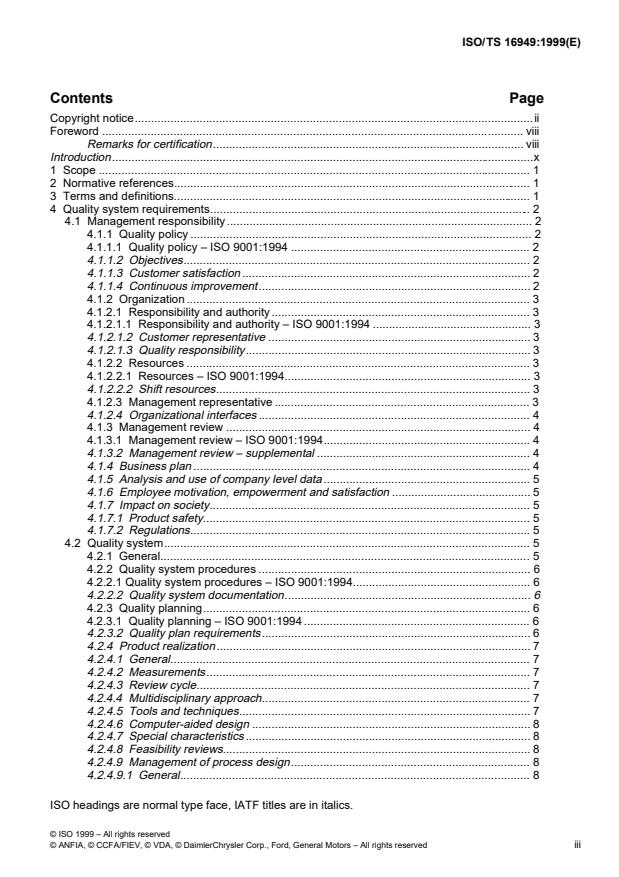
TECHNICAL ISO/TS
SPECIFICATION 16949
First edition
1999-03-01
Quality systems — Automotive suppliers —
Particular requirements for the application
of ISO 9001:1994
Systèmes qualité — Fournisseurs de l'automobile — Exigences
particulières pour l'application de l'ISO 9001:1994
A
Reference number
© ISO 1999
All rights reserved. Unless otherwise specified, no part of this publication may be reproduced or
utilized in any form or by any means, electronic or mechanical, including photocopying and microfilm,
without permission in writing from the publisher.
International Organization for Standardization
Case postale 56 • CH-1211 Genève 20 • Switzerland
Internet iso@iso.ch
Printed in Switzerland
The content inside the boxed text of this document is ISO 9001:1994 text and is protected by the above
copyright statement. The text outside the boxes has been originated by the International Automotive
Task Force. Copyright for this text is held by ANFIA, CCFA/FIEV, VDA (see below) and the car
manufacturers DaimlerChrysler Corp., Ford Motor, General Motors.
Neither this ISO document nor any extract from it may be reproduced in a retrieval system or transmitted
in any form or by any means, electronic, photocopying, recording or otherwise without prior written
permission being secured.
Requests for permission to reproduce non-ISO text should be addressed to one of the addresses below.
Automotive Industry Action Group (AIAG)
26200 Lahser Road, Suite 200 Southfield, Michigan 48034 USA
tel. +1 (248) 358-35 70 fax: +1 (248) 358-3253 e-mail: bbaker@aiag.org
Associazione Nazionale Fra Industrie Automobilistiche (ANFIA/Italy)
Comité des Constructeurs Français d'Automobiles (CCFA/France)
Fédération des Industries des Équipements pour Véhicules (FIEV/France)
Verband der Automobilindustrie (VDA/Germany)
Qualitätsmanagement Center (QMC)
ii
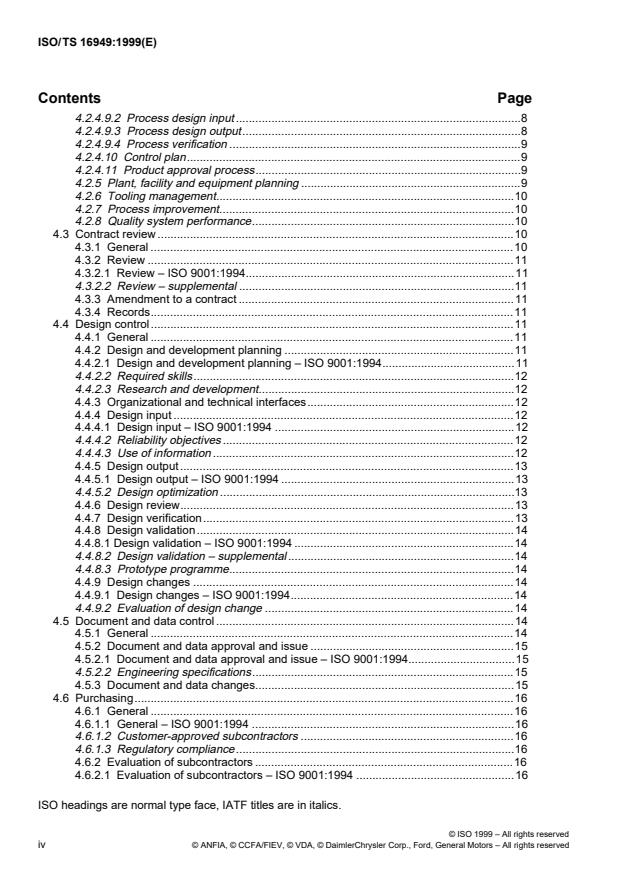
Contents Page
Copyright notice.ii
Foreword . viii
Remarks for certification. viii
Introduction.x
1 Scope . 1
2 Normative references. 1
3 Terms and definitions. 1
4 Quality system requirements. 2
4.1 Management responsibility. 2
4.1.1 Quality policy . 2
4.1.1.1 Quality policy – ISO 9001:1994 . 2
4.1.1.2 Objectives. 2
4.1.1.3 Customer satisfaction . 2
4.1.1.4 Continuous improvement. 2
4.1.2 Organization . 3
4.1.2.1 Responsibility and authority . 3
4.1.2.1.1 Responsibility and authority – ISO 9001:1994 . 3
4.1.2.1.2 Customer representative . 3
4.1.2.1.3 Quality responsibility. 3
4.1.2.2 Resources . 3
4.1.2.2.1 Resources – ISO 9001:1994. 3
4.1.2.2.2 Shift resources. 3
4.1.2.3 Management representative . 3
4.1.2.4 Organizational interfaces . 4
4.1.3 Management review . 4
4.1.3.1 Management review – ISO 9001:1994. 4
4.1.3.2 Management review – supplemental . 4
4.1.4 Business plan . 4
4.1.5 Analysis and use of company level data . 5
4.1.6 Employee motivation, empowerment and satisfaction . 5
4.1.7 Impact on society. 5
4.1.7.1 Product safety. 5
4.1.7.2 Regulations. 5
4.2 Quality system. 5
4.2.1 General.5
4.2.2 Quality system procedures . 6
4.2.2.1 Quality system procedures – ISO 9001:1994. 6
4.2.2.2 Quality system documentation. 6
4.2.3 Quality planning. 6
4.2.3.1 Quality planning – ISO 9001:1994 . 6
4.2.3.2 Quality plan requirements. 6
4.2.4 Product realization. 7
4.2.4.1 General. 7
4.2.4.2 Measurements. 7
4.2.4.3 Review cycle. 7
4.2.4.4 Multidisciplinary approach. 7
4.2.4.5 Tools and techniques. 7
4.2.4.6 Computer-aided design . 8
4.2.4.7 Special characteristics . 8
4.2.4.8 Feasibility reviews. 8
4.2.4.9 Management of process design. 8
4.2.4.9.1 General. 8
ISO headings are normal type face, IATF titles are in italics.
© ISO 1999 – All rights reserved
© ANFIA, © CCFA/FIEV, © VDA, © DaimlerChrysler Corp., Ford, General Motors – All rights reserved iii
Contents Page
4.2.4.9.2 Process design input .8
4.2.4.9.3 Process design output.8
4.2.4.9.4 Process verification .9
4.2.4.10 Control plan.9
4.2.4.11 Product approval process.9
4.2.5 Plant, facility and equipment planning .9
4.2.6 Tooling management.10
4.2.7 Process improvement.10
4.2.8 Quality system performance.10
4.3 Contract review .10
4.3.1 General .10
4.3.2 Review .11
4.3.2.1 Review – ISO 9001:1994.11
4.3.2.2 Review – supplemental .11
4.3.3 Amendment to a contract .11
4.3.4 Records.11
4.4 Design control.11
4.4.1 General .11
4.4.2 Design and development planning .11
4.4.2.1 Design and development planning – ISO 9001:1994.11
4.4.2.2 Required skills.12
4.4.2.3 Research and development.12
4.4.3 Organizational and technical interfaces.12
4.4.4 Design input .12
4.4.4.1 Design input – ISO 9001:1994 .12
4.4.4.2 Reliability objectives . 12
4.4.4.3 Use of information .12
4.4.5 Design output.13
4.4.5.1 Design output – ISO 9001:1994 .13
4.4.5.2 Design optimization .13
4.4.6 Design review.13
4.4.7 Design verification.13
4.4.8 Design validation.14
4.4.8.1 Design validation – ISO 9001:1994 .14
4.4.8.2 Design validation – supplemental .14
4.4.8.3 Prototype programme.14
4.4.9 Design changes .14
4.4.9.1 Design changes – ISO 9001:1994.14
4.4.9.2 Evaluation of design change .14
4.5 Document and data control .14
4.5.1 General .14
4.5.2 Document and data approval and issue .15
4.5.2.1 Document and data approval and issue – ISO 9001:1994.15
4.5.2.2 Engineering specifications.15
4.5.3 Document and data changes.15
4.6 Purchasing.16
4.6.1 General .16
4.6.1.1 General – ISO 9001:1994 .16
4.6.1.2 Customer-approved subcontractors .16
4.6.1.3 Regulatory compliance.16
4.6.2 Evaluation of subcontractors .16
4.6.2.1 Evaluation of subcontractors – ISO 9001:1994 .16
ISO headings are normal type face, IATF titles are in italics.
© ISO 1999 – All rights reserved
iv © ANFIA, © CCFA/FIEV, © VDA, © DaimlerChrysler Corp., Ford, General Motors – All rights reserved
Contents Page
4.6.2.2 Subcontractor development. 16
4.6.2.3 Scheduling subcontractors. 17
4.6.3 Purchasing data. 17
4.6.4 Verification of purchased product . 17
4.6.4.1 Supplier verification at subcontractor's premises . 17
4.6.4.2 Customer verification of subcontracted product. 17
4.7 Control of customer-supplied product . 17
4.7.1 Control of customer-supplied product – ISO 9001:1994 . 17
4.7.2 Customer owned tooling. 18
4.8 Product identification and traceability . 18
4.9 Process control. 18
4.9.1 General. 18
4.9.1.1 General – ISO 9001:1994. 18
4.9.1.2 Cleanliness of premises. 19
4.9.1.3 Contingency plans . 19
4.9.1.4 Designation of special characteristics . 19
4.9.1.5 Preventive maintenance . 19
4.9.2 Job instructions. 19
4.9.3 Maintaining process control . 20
4.9.4 Verification of job set-ups . 20
4.9.5 Appearance items. 20
4.10 Inspection and testing . 21
4.10.1 General. 21
4.10.1.1 General – ISO 9001:1994. 21
4.10.1.2 Acceptance criteria . 21
4.10.2 Receiving inspection and testing . 21
4.10.2.4 Incoming product quality. 21
4.10.3 In-process inspection and testing . 21
4.10.4 Final inspection and testing . 22
4.10.4.1 Final inspection and testing – ISO 9001:1994. 22
4.10.4.2 Layout inspection and functional testing . 22
4.10.5 Inspection and test records. 22
4.10.6 Laboratory requirements. 22
4.11 Control of inspection, measuring and test equipment. 22
4.11.1 General. 22
4.11.1.1 General – ISO 9001:1994. 22
4.11.1.2 Measurement system analysis. 23
4.11.2 Control procedure. 23
4.11.3 Records . 24
4.12 Inspection and test status. 24
4.13 Control of nonconforming product . 24
4.13.1 General. 24
4.13.1.1 General – ISO 9001:1994. 24
4.13.1.2 Suspect material or product. 24
4.13.1.3 Corrective action plan . 24
4.13.2 Review and disposition of nonconforming product. 25
4.13.3 Control of reworked product . 25
4.13.4 Engineering approved authorization. 25
4.14 Corrective and preventive action . 25
4.14.1 General. 25
4.14.1.1 General – ISO 9001:1994. 25
4.14.1.2 Problem solving . 25
ISO headings are normal type face, IATF titles are in italics.
© ISO 1999 – All rights reserved
© ANFIA, © CCFA/FIEV, © VDA, © DaimlerChrysler Corp., Ford, General Motors – All rights reserved v
Contents Page
4.14.1.3 Mistake-proofing.26
4.14.2 Corrective action .26
4.14.2.1 Corrective action – ISO 9001:1994.26
4.14.2.2 Corrective action impact.26
4.14.2.3 Returned product test/analysis .26
4.14.3 Preventive action.26
4.15 Handling, storage, packaging, preservation and delivery .27
4.15.1 General .27
4.15.2 Handling.27
4.15.3 Storage .27
4.15.3.1 Storage – ISO 9001:1994.27
4.15.3.2 Inventory .27
4.15.4 Packaging .27
4.15.4.1 Packaging – ISO 9001:1994.27
4.15.4.2 Customer packaging standards.27
4.15.4.3 Labelling.27
4.15.5 Preservation .27
4.15.6 Delivery .27
4.15.6.1 Delivery – ISO 9001:1994 .27
4.15.6.2 Performance monitoring of supplier delivery.28
4.15.6.3 Production scheduling .28
4.15.6.4 Electronic communication.28
4.15.6.5 Shipment notification system.28
4.16 Control of quality records .28
4.16.1 Control of quality records – ISO 9001:1994.28
4.16.2 Record retention.29
4.17 Internal quality audits .29
4.17.1 Internal quality audits – ISO 9001:1994.29
4.17.2 Internal quality audits – supplemental .29
4.17.2.1 General .29
4.17.2.2 System audit .29
4.17.2.3 Process audit .29
4.17.2.4 Product audit .29
4.17.3 Auditor qualification .30
4.18 Training.30
4.18.1 Training – ISO 9001:1994 .30
4.18.2 Training effectiveness .30
4.18.3 Training on the job.30
4.19 Servicing .30
4.19.1 Servicing – ISO 9001:1994.30
4.19.2 Feedback of information from service.30
4.19.3 Servicing agreement with customer.30
4.20 Statistical techniques .31
4.20.1 Identification of need .31
4.20.2 Procedures.31
4.20.3 Identification of statistical tools .31
4.20.4 Knowledge of basic statistical concepts .31
Annex A (normative) Terms and definitions.32
Annex B (normative) Control plan.39
Annex C (informative) Special characteristics.40
Bibliography.41
ISO headings are normal type face, IATF titles are in italics.
© ISO 1999 – All rights reserved
vi © ANFIA, © CCFA/FIEV, © VDA, © DaimlerChrysler Corp., Ford, General Motors – All rights reserved
Contents Page
International Standards . 41
Internationally agreed manuals . 41
Common customer manuals. 41
AIAG. 41
ANFIA. 41
FIEV and French car manufacturers. 42
VDA. 42
ISO headings are normal type face, IATF titles are in italics.
© ISO 1999 – All rights reserved
© ANFIA, © CCFA/FIEV, © VDA, © DaimlerChrysler Corp., Ford, General Motors – All rights reserved vii
Foreword
ISO (the International Organization for Standardization) is a worldwide federation of national standards
bodies (ISO member bodies). The work of preparing International Standards is normally carried out
through ISO technical committees. Each member body interested in a subject for which a technical
committee has been established has the right to be represented on that committee. International
organizations, governmental and non-governmental, in liaison with ISO, also take part in the work. ISO
collaborates closely with the International Electrotechnical Commission (IEC) on all matters of
electrotechnical standardization.
International Standards are drafted in accordance with the rules given in the ISO/IEC Directives, Part 3.
The main task of technical committees is to prepare International Standards. Draft International
Standards adopted by the technical committees are circulated to the member bodies for voting.
Publication as an International Standard requires approval by at least 75 % of the member bodies
casting a vote.
In other circumstances, particularly when there is an urgent market requirement for such documents, a
technical committee may decide to publish other types of normative document:
— an ISO Publicly Available Specification (ISO/PAS) represents an agreement between technical
experts in an ISO working group and is accepted for publication if it is approved by 50 % of the
members of the parent committee casting a vote;
— an ISO Technical Specification (ISO/TS) represents an agreement between the members of a
technical committee and is accepted for publication if it is approved by 2/3 of the members of the
committee casting a vote.
An ISO/PAS or ISO/TS is reviewed every three years with a view to deciding whether it can be
transformed into an International Standard.
ISO/TS 16949 was prepared by the International Automotive Task Force (IATF) and representatives
from ISO/TC 176, Quality management and quality assurance, and its subcommittees.
Boxed text in copyright notice, clause 4 and annex A is original ISO 9001:1994 text. The sector-
specific supplemental requirements are outside the boxes.
In this Technical Specification, the word "shall" indicates requirements. Paragraphs marked "NOTE" are
for guidance in understanding or clarifying the associated requirement. The word "should" appearing in
a NOTE is for guidance only.
Where the term "such as" is used, any suggestions given are for guidance only.
ISO/TS 16949 has been issued for provisional application in the automotive sector so that information
and experience in its use may be gathered.
Remarks for certification
To obtain recognition of certification to this Technical Specification by the customer members of the
IATF, a common global certification scheme has been developed and must be followed (see
bibliography [7]). Customer-specific requirements supplemental to this Technical Specification, if any,
shall be included in the audit in order to obtain customer recognition of such certification.
Details can be obtained from the organizations who support the International Automotive Task Force
cited below.
NOTE All participating IATF OEMs and suppliers have customer-specific requirements in addition
to this Technical Specification.
© ISO 1999 – All rights reserved
viii © ANFIA, © CCFA/FIEV, © VDA, © DaimlerChrysler Corp., Ford, General Motors – All rights reserved
Associazione Nazionale Fra Industrie Automobilistiche (ANFIA)
Corso Gallileo Ferraris, 61 I-10128 Torino Italy
tel. +39 011 554 65 11 fax: +39 011 54 59 86 e-mail: anfia@anfia.it
Automotive Industry Action Group (AIAG)
26200 Lahser Road, Suite 200 Southfield, Michigan 48034 USA
tel. +1 (248) 358-35 70 fax: +1 (248) 358-3253 e-mail: bbaker@aiag.org
Comité des Constructeurs Français d'Automobiles (CCFA)
2, rue de Presbourg F-75008 Paris France
tel. +33 1 49 52 51 73 fax: +33 1 49 52 52 25 e-mail: mbehaghe@ccfa.fr
Fédération des Industries des Équipements pour Véhicules (FIEV)
79, rue J.J. Rousseau F-92158 Suresnes Cedex France
tel. +33 1 46 25 02 30 fax: +33 1 46 97 00 80 e-mail: fiev@fiev.fr
Society of Motor Manufacturers and Traders Ltd. (SMMT Ltd.)
Forbes House, Halkin Street London SW1X 7DS UK
tel. +44 171 235 70 00 fax: +44 171 235 71 12 e-mail: quality@smmt.co.uk
Verband der Automobilindustrie (VDA) Qualitätsmanagement Center (QMC)
Westendstr. 61 D-60325 Frankfurt am Main Germany
tel. +49 69 9 75 07-332 fax: +49 69 9 75 07-331 e-mail: schulz@vda-qmc.de
© ISO 1999 – All rights reserved
© ANFIA, © CCFA/FIEV, © VDA, © DaimlerChrysler Corp., Ford, General Motors – All rights reserved ix
Introduction
The goal of this Technical Specification is the development of fundamental quality systems that provide
for continuous improvement, emphasizing defect prevention and the reduction of variation and waste in
the supply chain. This Technical Specification defines the fundamental quality system requirements of
the subscribing companies. It is recognized that there may be company-specific, division-specific,
commodity-specific, and/or part-specific requirements in addition to those given in Figure 1.
This Technical Specification aligns existing automotive quality system requirements within the global
automotive industry and avoids multiple certification audits.
More specific
Part
Commodity
Division
Company
ISO/TS 16949
Sector
ISO 9001
Fundamental
More generic
Figure 1 — Quality related requirements
© ISO 1999 – All rights reserved
x © ANFIA, © CCFA/FIEV, © VDA, © DaimlerChrysler Corp., Ford, General Motors – All rights reserved
Figure 2 demonstrates the progression of quality system documentation.
Defines
international
INTERNATIONAL STANDARD
quality system
ISO 9001 / ISO 9002
requirements
International
SECTOR REQUIREMENTS
automotive
ISO/TS 16949
quality system
requirements
Part and Process Approval
Procedures
Customer-
related
Company-specific requirements
quality system
requirements
Level 1
Customer-supporting
Defines approach and
Customer supporting
reference manuals on:
Quality
responsibility including
reference manuals on:
(see bibliography)
manual
assurance of customer needs
(see bibliography)
Level 2
Advanced
Advanced Product
Defines
Quality Planning
Quality Planning and
Procedures
who, what, when
Control Plan
Control Plan
Failure Mode and
Tools and Level 3
Effects Analysis
Answers
Techniques
Job instructions
how
Level 4
Prompts recording
Other documentation of information
such as forms,
tags, labels
NOTE Once recorded, level 4 items may become a quality record (see 4.16).
Figure 2 — Quality System Documentation Progression
© ISO 1999 – All rights reserved
© ANFIA, © CCFA/FIEV, © VDA, © DaimlerChrysler Corp., Ford, General Motors – All rights reserved xi
In this Technical Specification, quality planning activities of all pre-launch phases have been integrated
under the new heading: "Product realization".
For suppliers with product design responsibility, product realization also includes product design (see
4.4).
Product realization in the context of quality planning is discussed in 4.2.4. The structure is outlined
below:
4.2.3 Quality planning
4.2.3.1 Quality planning – ISO 9001:1994
4.2.3.2 Quality plan requirements
4.2.4 Product realization
4.2.4.1 General
4.2.4.2 Measurements
4.2.4.3 Review cycle
4.2.4.4 Multidisciplinary approach
4.2.4.5 Tools and techniques
4.2.4.6 Computer-aided design
4.2.4.7 Special characteristics
4.2.4.8 Feasibility review
4.2.4.9 Management of process design
4.2.4.9.1 General
4.2.4.9.2 Process design input
4.2.4.9.3 Process design output
4.2.4.9.4 Process verification
4.2.4.10 Control plan
4.2.4.11 Product approval process
© ISO 1999 – All rights reserved
xii © ANFIA, © CCFA/FIEV, © VDA, © DaimlerChrysler Corp., Ford, General Motors – All rights reserved
TECHNICAL SPECIFICATION ISO/TS 16949:1999(E)
Quality systems — Automotive suppliers — Particular
requirements for the application of ISO 9001:1994
1 Scope
This Technical Specification specifies, in conjunction with ISO 9001:1994, the quality system
requirements for the design/development, production and, when relevant, installation and servicing of
automotive-related products.
This Technical Specification is applicable to production and service part supplier and subcontractor
"sites" providing:
a) parts or materials, or
b) heat treating, painting, plating, or other finishing services, or
c) other customer-specified products.
NOTE "Remote locations" such as design centres and corporate headquarters form part of the site
audit, however they cannot obtain stand-alone certification to this Technical Specification.
This Technical Specification can also be applied throughout the automotive supply chain.
2 Normative references
The following normative documents contain provisions which, through reference in this text, constitute
provisions of this Technical Specification. For dated references, subsequent amendments to, or
revisions of, any of these publications do not apply. However, parties to agreements based on this
Technical Specification are encouraged to investigate the possibility of applying the most recent editions
of the normative documents indicated below. For undated references, the latest edition of the normative
document referred to applies. Members of ISO and IEC maintain registers of currently valid International
Standards.
Quality management and quality assurance — Vocabulary.
ISO 8402:1994,
ISO 9001:1994, Quality systems — Model for quality assurance in design, development, production,
installation and servicing.
General requirements for the competence of testing and calibration laboratories
ISO/IEC 17025, .
3 Terms and definitions
For the purposes of this Technical Specification the terms and definitions given in ISO 8402:1994 and in
annex A apply. However where there are terms for which the wording of the definition differs in
ISO 8402:1994, the definitions in annex A apply.
Revision of ISO/IEC Guide 25:1990.
© ISO 1999 – All rights reserved
© ANFIA, © CCFA/FIEV, © VDA, © DaimlerChrysler Corp., Ford, General Motors – All rights reserved 1
4 Quality system requirements
4.1 Management responsibility
4.1.1 Quality policy
4.1.1.1 Quality policy – ISO 9001:1994
The supplier's management with executive responsibility shall define and document its policy for quality,
including objectives for quality and its commitment to quality. The quality policy shall be relevant to the
supplier's organizational goals and the expectations and needs of its customers. The supplier shall
ensure that this policy is understood, implemented and maintained at all levels of the organization.
4.1.1.2 Objectives
The supplier shall define goals, objectives and measurements to deploy the quality policy. Objectives for
achieving quality shall be included in the business plan.
NOTE The goals and objectives should address customer expectations and be achievable within a
defined time period.
4.1.1.3 Customer satisfaction
The supplier shall have a documented process for determining customer satisfaction, including
frequency of determination, and how objectivity and validity are assured. Indicators to monitor trends of
customer satisfaction and dissatisfaction shall be documented and supported by objective information.
NOTE Consideration should be given to both internal and external customers.
4.1.1.4 Continuous improvement
Continuous improvement in quality, service, cost, and technology shall be provided for in the Quality
Policy.
The supplier shall identify opportunities for quality and productivity improvement and implement
appropriate improvement projects.
The supplier shall use appropriate continuous improvement measures and methodologies (see 4.2.7).
NOTE 1 The following list shows examples of possible techniques which might be used. There may
be many other methods which meet specific supplier needs more appropriately:
−
control charts (variables, attributes, CUSUM),
− design of experiments (DOE),
−
theory of constraints,
− overall equipment effectiveness,
− parts per million (PPM) analysis to achieve zero defects,
− value analysis,
− benchmarking,
−
analysis of motion/ergonomics,
− mistake-proofing.
NOTE 2 Guidelines for quality improvement are given in ISO 9004-4.
© ISO 1999 – All rights reserved
2 © ANFIA, © CCFA/FIEV, © VDA, © DaimlerChrysler Corp., Ford, General Motors – All rights reserved
4.1.2 Organization
4.1.2.1 Responsibility and authority
4.1.2.1.1 Responsibility and authority – ISO 9001:1994
The responsibility, authority and the interrelation of personnel who manage, perform and verify work
affecting quality shall be defined and documented, particularly for personnel who need the
organizational freedom and authority to:
a) initiate action to prevent the occurrence of any nonconformities relating to the product, process and
quality system;
b) identify and record any problems relating to the product, process and quality system;
c) initiate, recommend or provide solutions through designated channels;
d) verify the implementation of solutions;
e) control further processing, delivery or installation of nonconforming product until the deficiency or
unsatisfactory condition has been corrected.
4.1.2.1.2 Customer representative
The supplier shall assign responsibility to appropriate individuals to represent the needs of the customer
in internal functions in addressing quality requirements, such as selection of special characteristics,
setting quality objectives, training, corrective and preventive actions, product design and development.
4.1.2.1.3 Quality responsibility
Management with responsibility and authority for corrective action shall be promptly informed of
products or processes which become noncompliant with specified requirements.
Personnel responsible for quality shall have the authority to stop production to correct quality problems.
4.1.2.2 Resources
4.1.2.2.1 Resources – ISO 9001:1994
The supplier shall identify resource requirements and provide adequate resources, including the
assignment of trained personnel (see 4.18), for management, performance of work and verification
activities including internal quality audits.
NOTE Subclause 4.18 in ISO 9001:1994 is 4.18.1 in this Technical Specification.
4.1.2.2.2 Shift resources
Especially concerning the production process, all the shifts shall be staffed with personnel in charge of,
or delegated responsibility for quality.
4.1.2.3 Management representative
The supplier's management with executive responsibility shall appoint a member of the supplier's own
management who, irrespective of other responsibilities, shall have defined authority for
a) ensuring that a quality system is established, implemented and maintained in accordance with this
International Standard, and
b) reporting on the performance of the quality system to the supplier's management for rev
...
Questions, Comments and Discussion
Ask us and Technical Secretary will try to provide an answer. You can facilitate discussion about the standard in here.
Loading comments...