

ISO 11112:1995
(Main)Earth-moving machinery — Operator's seat — Dimensions and requirements
General Information
- Abstract
Specifies the dimensions, requirements and adjustment ranges for operator seats on earth-moving machinery. Additionally, it contains dimensions for armrests when fitted on these machines.
- Status
- Published
- Publication Date
- 22-Nov-1995
- Technical Committee
- ISO/TC 127/SC 2 - Safety, ergonomics and general requirements
- Drafting Committee
- ISO/TC 127/SC 2 - Safety, ergonomics and general requirements
- Current Stage
- 9093 - International Standard confirmed
- Start Date
- 03-Dec-2021
- Completion Date
- 29-Aug-2026
Buy Documents
ISO 11112:1995 - Earth-moving machinery — Operator's seat — Dimensions and requirements Released:11/23/1995
ISO 11112:1995 - Engins de terrassement — Siege de l'opérateur — Dimensions et exigences Released:11/23/1995
Overview
ISO 11112:1995 is an international standard that specifies the dimensions, requirements, and adjustment ranges for operator seats on earth-moving machinery. Developed by ISO Technical Committee TC 127/Subcommittee SC 2, this standard focuses on ergonomic design to accommodate operators ranging from the 5th to the 95th percentile in size, ensuring comfort, safety, and operational efficiency. Additionally, ISO 11112:1995 includes guidelines for armrest dimensions when fitted to these machines.
Key Topics
Ergonomic Dimensions
The standard defines precise seat dimensions such as seat cushion length and width, backrest height and width, and armrest sizes to suit a wide range of operator body sizes.Adjustment Ranges
Comprehensive adjustment features are detailed including:- Fore and aft seat movement (100 mm to 150 mm adjustment range)
- Vertical seat adjustment up to 75 mm independent of suspension
- Adjustable seat cushion angles (bottom and backrest angles ranging from 5° to 15°)
- Movable and adjustable armrests to ensure unimpeded ingress and egress
Seat Index Point (SIP)
The standard references ISO 5353 for determining the Seat Index Point, a critical ergonomic marker for seat design related adjustments and measurements.Operator Safety and Comfort
Requirements for movable armrests and the option for seats to swivel or tilt improve operator workspace and facilitate easier machine access. Locking mechanisms must prevent inadvertent seat movement during operation.Support Features
Adjustable lumbar support curvature is recommended to enhance operator comfort, with a nominal lumbar radius of 300 mm.
Applications
ISO 11112:1995 is essential for manufacturers and designers of earth-moving machinery including excavators, bulldozers, loaders, and graders. By adopting this standard, organizations can:
- Enhance Operator Ergonomics: Design seats that reduce operator fatigue and risk of injury during long working hours.
- Improve Safety: Ensure that seat adjustments do not compromise operator stability, particularly in rugged environments.
- Standardize Design: Maintain consistency in seat dimensions and adjustment features across earth-moving machinery, aiding operator familiarity.
- Optimize Machine Operation: Enable quicker ingress and egress through movable armrests and swivel or tilt seating, increasing operational efficiency.
Related Standards
- ISO 3411: Specifies human physical dimensions of earth-moving machinery operators, providing a basis for the seat dimensions defined in ISO 11112.
- ISO 5353: Defines the Seat Index Point (SIP) and seat measurement procedures used as a reference point in ISO 11112.
- ISO 6165: Provides terminology and classifications for earth-moving machinery relevant to the scope of operator seats.
These standards collectively support the development of ergonomic, safe, and functional operator seats for heavy machinery applications.
Keywords: earth-moving machinery, operator seat, seat dimensions, ergonomic seat design, seat adjustment, armrest dimensions, ISO 11112, machine operator safety, seat index point (SIP), earth-moving equipment standards.
Relations
- Effective Date
- 11-Feb-2026
- Effective Date
- 11-Feb-2026
- Effective Date
- 09-Feb-2026
- Effective Date
- 09-Feb-2026
- Effective Date
- 09-Feb-2026
- Effective Date
- 09-Feb-2026
- Effective Date
- 09-Feb-2026
- Effective Date
- 09-Feb-2026
- Effective Date
- 09-Feb-2026
- Effective Date
- 09-Feb-2026
- Effective Date
- 09-Feb-2026
- Effective Date
- 09-Feb-2026
- Effective Date
- 09-Feb-2026
- Effective Date
- 09-Feb-2026
- Effective Date
- 09-Feb-2026
Buy Documents
ISO 11112:1995 - Earth-moving machinery — Operator's seat — Dimensions and requirements Released:11/23/1995
ISO 11112:1995 - Engins de terrassement — Siege de l'opérateur — Dimensions et exigences Released:11/23/1995
Frequently Asked Questions
ISO 11112:1995 is a standard published by the International Organization for Standardization (ISO). Its full title is "Earth-moving machinery — Operator's seat — Dimensions and requirements". This standard covers: Specifies the dimensions, requirements and adjustment ranges for operator seats on earth-moving machinery. Additionally, it contains dimensions for armrests when fitted on these machines.
Specifies the dimensions, requirements and adjustment ranges for operator seats on earth-moving machinery. Additionally, it contains dimensions for armrests when fitted on these machines.
ISO 11112:1995 is classified under the following ICS (International Classification for Standards) categories: 53.100 - Earth-moving machinery. The ICS classification helps identify the subject area and facilitates finding related standards.
ISO 11112:1995 has the following relationships with other standards: It is inter standard links to EN 13557:2024, EN 15059:2009+A1:2015, EN 1459-1:2017+A1:2020, EN 474-1:2006+A3:2013, EN 15954-2:2013, EN 1459-1:2025, EN 1459-1:2017, EN 1459-2:2015+A1:2018, EN 474-10:2022, EN 16228-3:2014+A1:2021, EN 16191:2014, EN 1889-1:2011, EN 474-1:2006+A1:2009, EN 13557:2003+A2:2008, EN 474-1:2006+A5:2018. Understanding these relationships helps ensure you are using the most current and applicable version of the standard.
ISO 11112:1995 is available in PDF format for immediate download after purchase. The document can be added to your cart and obtained through the secure checkout process. Digital delivery ensures instant access to the complete standard document.
Standards Content (Sample)
INTERNATIONAL ISO
STANDARD 11112
First edition
1995-12-15
Earth-moving machinery - Operator%
seat - Dimensions and requirements
Engins de terrassement - Siege de I’opkateur - Dimensions et
exigences
Reference number
Foreword
ISO (the International Organization for Standardization) is a worldwide
federation of national Standards bodies (ISO member bodies). The work
of preparing International Standards is normally carried out through ISO
technical committees. Esch member body interested in a subject for
which a technical committee has been established has the right to be
represented on that committee. International organizations, governmental
and non-governmental, in liaison with ISO, also take part in the work. ISO
collaborates closely with the International Electrotechnical Commission
(IEC) on all matters of electrotechnical standardization.
Draft International Standards adopted by the technical committees are
circulated to the member bodies for voting. Publication as an International
Standard requires approval by at least 75 % of the member bodies casting
a vote.
International Standard ISO 11112 was prepared by Technical Committee
lSO/TC 127, Earth-moving machinery, Subcommittee SC 2, Safety re-
quirements and human factors.
0 ISO 1995
All rights reserved. Unless otherwise specified, no part of this publication may be reproduced
or utilized in any form or by any means, electronie or mechanical, including photocopying and
microfilm, without Permission in writing from the publisher.
International Organization for Standardization
Case Postale 56 l CH-1 211 Geneve 20 l Switzerland
Printed in Switzerland
ii
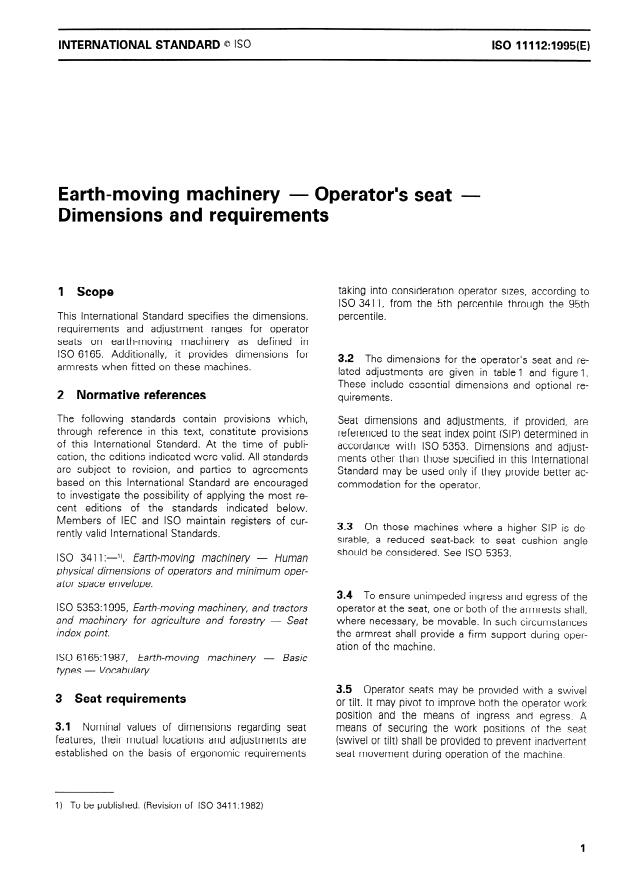
INTERNATIONAL STANDARD 0 ISO
- Operator% seat -
Earth-moving machinery
Dimensions and requirements
taking into consideration Operator sizes, according to
1 Scope
ISO 3411, from the 5th percentile through the 95th
percentile.
This International Standard specifies the dimensions,
requirements and adjustment ranges for Operator
seats on earth-moving machinery as defined in
ISO 6165. Additionally, it provides dimensions for
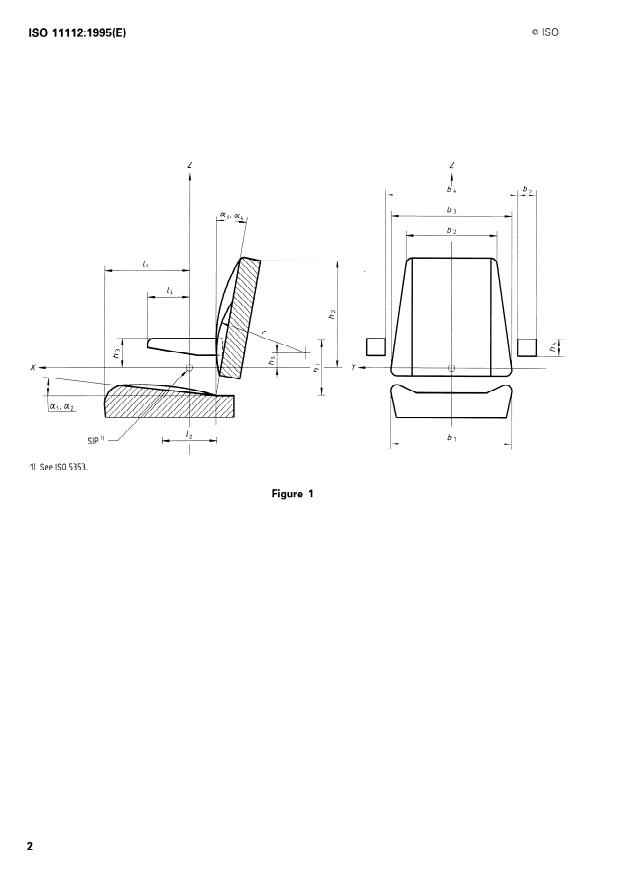
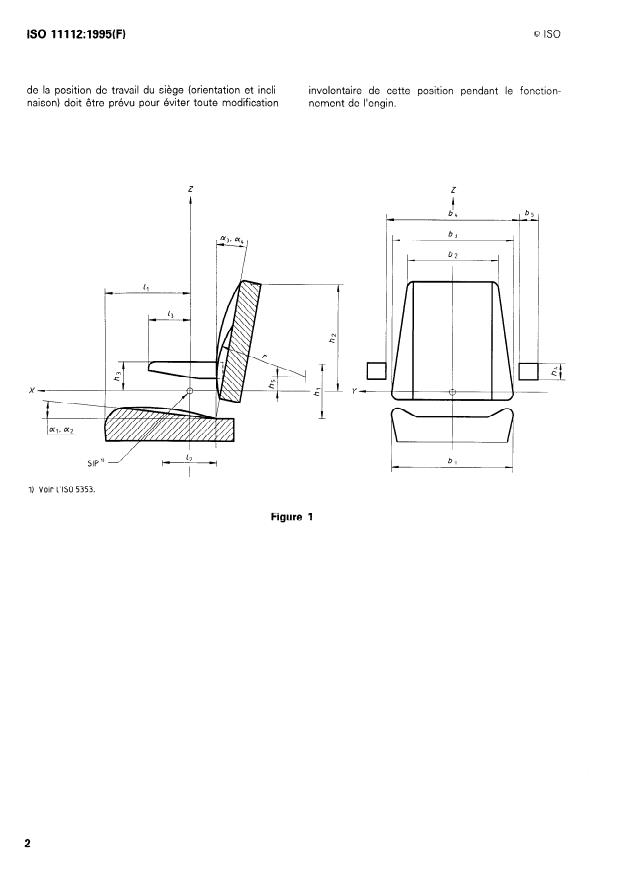
3.2 The dimensions for the Operators seat and re-
armrests when fitted on these machines.
lated adjustments are given in table 1 and figure 1.
These include essential dimensions and optional re-
2 Normative references quirements.
The following Standards contain provisions which, Seat dimensions and adjustments, if provided, are
through reference in this text, constitute provisions referenced to the seat index Point (SIP) determined in
of this International Standard. At the time of publi-
accordance with ISO 5353. Dimensions and adjust-
cation, the editions indicated were valid. All Standards ments other than those specified in this International
are subject to revision, and Parties to agreements Standard may be used only if they provide better ac-
based on this International Standard are encouraged commodation for the Operator.
to investigate the possibility of applying the most re-
cent editions of the Standards indicated below.
Members of IEC and ISO maintain registers of cur-
3.3 On those machines where a higher SIP is de-
rently valid International Standards.
sirable, a reduced seat-back to seat cushion angle
should be considered. See ISO 5353.
ISO 3411 :-l), Earth-moving machinery - Human
physical dimensions of Operators and minimum oper-
a tor space envelope.
3.4 To ensure unimpeded ingress and egress of the
ISO 5353: 1995, Earth-moving machinery, and tractors Operator at the seat, one or both of the armrests shall,
where necessary, be movable. In such circumstances
and machinery for agriculture and forestry - Seat
the armrest shall provide a firm support d
...
ISO
NORME
INTERNATIONALE
Première édition
1995-12-15
Engins de terrassement - Siège de
l’opérateur - Dimensions et exigences
Earth-moving machinery - Operator’s seat - Dimensions and
requirements
Numéro de référence
ISO ‘II 1112:1995(F)
Avant-propos
L’ISO (Organisation internationale de normalisation) est une fédération
mondiale d’organismes nationaux de normalisation (comités membres de
I’ISO). L’élaboration des Normes internationales est en général confiée aux
comités techniques de I’ISO. Chaque comité membre intéressé par une
étude a le droit de faire partie du comité technique créé à cet effet. Les
organisations internationales, gouvernementales et non gouvernemen-
tales, en liaison avec I’ISO participent également aux travaux. L’ISO colla-
bore étroitement avec la Commission électrotechnique internationale (CEI)
en ce qui concerne la normalisation électrotechnique.
Les projets de Normes internationales adoptés par les comités techniques
sont soumis aux comités membres pour vote. Leur publication comme
Normes internationales requiert l’approbation de 75 % au moins des co-
mités membres votants.
La Norme internationale ISO II 112 a été élaborée par le comité technique
lSO/TC 127, Engins de terrassement, sous-comité SC 2, Impératifs de
sécurité et facteurs humains.
0 ISO 1995
Droits de reproduction réservés. Sauf prescription différente, aucune partie de cette publi-
cation ne peut être reproduite ni utilisée sous quelque forme que ce soit et par aucun pro-
cédé, électronique ou mécanique, y compris la photocopie et les microfilms, sans l’accord
écrit de l’éditeur.
Organisation internationale de normali sation
56 l CH-121 1 Genève 2
Case Postale 0 l Suisse
Imprimé en Suisse
ii
NORME INTERNATIONALE 0 BO
Engins de terrassement - Siège de l’opérateur -
Dimensions et exigences
1 Domaine d’application 3 Exigences relatives au siège
La présente Norme internationale prescrit les dimen-
3.1 Les dimensions nominales des éléments de
sions, les exigences et les plages de réglage relatives
sièges, ainsi que leurs emplacements et réglages
au siège de l’opérateur des engins de terrassement
respectifs, sont fondés sur des exigences ergono-
définis dans I’ISO 6165, ainsi que les dimensions des
miques prenant en considération la taille de I’opé-
accoudoirs éventuels.
rateur du 5e percentile au 95e percentile, conformé-
ment à I’ISO 3411.
3.2 Les dimensions du siège de l’opérateur, ainsi
que les réglages correspondants, sont indiqués à la
figure 1 et dans le tableau 1, qui présentent les di-
mensions imposées ainsi que des prescriptions op-
tionnelles.
2 Références normatives
Les dimensions et réglages du siège, s’il y a lieu, se
réfèrent au point repère du siège (SIP), déterminé
Les normes suivantes contiennent des dispositions
conformément à I’ISO 5353. Des dimensions et ré-
qui, par suite de la référence qui en est faite, consti-
glages autres que ceux indiqués dans la présente
tuent des dispositions valables pour la présente
Norme internationale peuvent être utilisés seulement
Norme internationale. Au moment de la publication,
s’ils permettent une meilleure installation de I’opé-
les éditions indiquées étaient en vigueur. Toute
rateur.
norme est sujette à révision et les parties prenantes
des accords fondés sur la présente Norme inter-
nationale sont invitées à rechercher la possibilité
3.3 Sur les engins où il est souhaitable que le point
d’appliquer les éditions les plus récentes des normes
repère du siège (SIP) soit plus haut, il convient d’en-
indiquées ci-après. Les membres de la CEI et de I’ISO
visager un angle réduit du dossier par rapport au
possèdent le registre des Normes internationales en
coussin d’assise. Voir I’ISO 5353.
vigueur à un moment donné.
3.4 Pour que l’opérateur puisse s’asseoir et se lever
Engins de terrassement - Dimensions
ISO 3411: -Il,
de son siège sans être gêné, l’un des accoudoirs, ou
ergonomiques des opérateurs et espace enveloppe
les deux, doit (doivent), le cas échéant, être orienta-
minimal des postes de trava
...