

EN 15059:2009
(Main)Snow grooming equipment - Safety requirements
- Abstract
This standard applies to snow grooming equipment as defined in 3.1 and its use with attachments as described in 3.2. With the exception of rear-mounted snow tillers and front blade attachments, this standard does not deal with the specific hazards of the attachments themselves. This standard is not applicable to snowmobiles.
This standard deals with all significant hazards, hazardous situations and events relevant to snow grooming equipment, when it is used as intended and under conditions of misuse which are reasonably foreseeable by the manufacturer (see Clause 4). It also deals with hazards during commissioning, use, fault-finding and maintenance.
This standard is not applicable to snow grooming equipment manufactured before the date of publication of this document by CEN.
NOTE For travelling on public roads, national traffic regulations apply until harmonised requirements are available.
- Status
- Withdrawn
- Publication Date
- 03-Mar-2009
- Withdrawal Date
- 06-Oct-2026
- Technical Committee
- CEN/TC 151 - Construction equipment and building material machines - Safety
- Drafting Committee
- CEN/TC 151/WG 17 - Snow grooming equipment
- Current Stage
- 9960 - Withdrawal effective - Withdrawal
- Start Date
- 25-Feb-2015
- Completion Date
- 07-Oct-2026
- Directive
- 2006/42/EC - Directive 2006/42/EC of the European Parliament and of the Council of 17 May 2006 on machinery, and amending Directive 95/16/EC (recast)OJ Ref: C, C 214 OJ Date: 08-Sep-2009

Relations
- Effective Date
- 19-Jan-2023
- Effective Date
- 25-Aug-2026
- Effective Date
- 25-Aug-2026
- Effective Date
- 25-Aug-2026
- Effective Date
- 25-Aug-2026
- Effective Date
- 25-Aug-2026
- Effective Date
- 25-Aug-2026
- Effective Date
- 09-Feb-2026
- Effective Date
- 28-Jan-2026
- Effective Date
- 28-Jan-2026
- Effective Date
- 28-Jan-2026
- Effective Date
- 28-Jan-2026
- Effective Date
- 28-Jan-2026
- Effective Date
- 28-Jan-2026
- Refers
CEN/TR 16721:2014 - Bio-based products - Overview of methods to determine the bio-based content - Effective Date
- 28-Jan-2026
Frequently Asked Questions
EN 15059:2009 is a standard published by the European Committee for Standardization (CEN). Its full title is "Snow grooming equipment - Safety requirements". This standard covers: This standard applies to snow grooming equipment as defined in 3.1 and its use with attachments as described in 3.2. With the exception of rear-mounted snow tillers and front blade attachments, this standard does not deal with the specific hazards of the attachments themselves. This standard is not applicable to snowmobiles. This standard deals with all significant hazards, hazardous situations and events relevant to snow grooming equipment, when it is used as intended and under conditions of misuse which are reasonably foreseeable by the manufacturer (see Clause 4). It also deals with hazards during commissioning, use, fault-finding and maintenance. This standard is not applicable to snow grooming equipment manufactured before the date of publication of this document by CEN. NOTE For travelling on public roads, national traffic regulations apply until harmonised requirements are available.
This standard applies to snow grooming equipment as defined in 3.1 and its use with attachments as described in 3.2. With the exception of rear-mounted snow tillers and front blade attachments, this standard does not deal with the specific hazards of the attachments themselves. This standard is not applicable to snowmobiles. This standard deals with all significant hazards, hazardous situations and events relevant to snow grooming equipment, when it is used as intended and under conditions of misuse which are reasonably foreseeable by the manufacturer (see Clause 4). It also deals with hazards during commissioning, use, fault-finding and maintenance. This standard is not applicable to snow grooming equipment manufactured before the date of publication of this document by CEN. NOTE For travelling on public roads, national traffic regulations apply until harmonised requirements are available.
EN 15059:2009 is classified under the following ICS (International Classification for Standards) categories: 97.220.20 - Winter sports equipment. The ICS classification helps identify the subject area and facilitates finding related standards.
EN 15059:2009 has the following relationships with other standards: It is inter standard links to EN 15059:2009+A1:2015, ISO 6394:2008, ISO 3795:1989, ISO 9533:1989, ISO 6393:2008, ISO 14401-2:2004, ISO 14401-1:2004, ISO 11112:1995, EN ISO 4871:1996, EN ISO 13849-1:2008, EN ISO 14982:1998, EN ISO 13732-1:2008, EN ISO 1479:2011, EN ISO 3411:2007, CEN/TR 16721:2014. Understanding these relationships helps ensure you are using the most current and applicable version of the standard.
EN 15059:2009 is associated with the following European legislation: EU Directives/Regulations: 2006/42/EC, 98/37/EC; Standardization Mandates: M/079, M/396. When a standard is cited in the Official Journal of the European Union, products manufactured in conformity with it benefit from a presumption of conformity with the essential requirements of the corresponding EU directive or regulation.
EN 15059:2009 is available in PDF format for immediate download after purchase. The document can be added to your cart and obtained through the secure checkout process. Digital delivery ensures instant access to the complete standard document.
Standards Content (Sample)
2003-01.Slovenski inštitut za standardizacijo. Razmnoževanje celote ali delov tega standarda ni dovoljeno.Oprema za urejanje zasneženih površin - Varnostne zahtevePistenpflegegeräte - SicherheitsanforderungenEngins de damage - Exigences de sécuritéSnow grooming equipment - Safety requirements97.220.20Oprema za zimske športeWinter sports equipmentICS:Ta slovenski standard je istoveten z:EN 15059:2009SIST EN 15059:2009en,fr01-maj-2009SIST EN 15059:2009SLOVENSKI
STANDARD
EUROPEAN STANDARDNORME EUROPÉENNEEUROPÄISCHE NORMEN 15059March 2009ICS 97.220.20 English VersionSnow grooming equipment - Safety requirementsEngins de damage - Exigences de sécuritéPistenpflegegeräte - SicherheitsanforderungenThis European Standard was approved by CEN on 10 January 2009.CEN members are bound to comply with the CEN/CENELEC Internal Regulations which stipulate the conditions for giving this EuropeanStandard the status of a national standard without any alteration. Up-to-date lists and bibliographical references concerning such nationalstandards may be obtained on application to the CEN Management Centre or to any CEN member.This European Standard exists in three official versions (English, French, German). A version in any other language made by translationunder the responsibility of a CEN member into its own language and notified to the CEN Management Centre has the same status as theofficial versions.CEN members are the national standards bodies of Austria, Belgium, Bulgaria, Cyprus, Czech Republic, Denmark, Estonia, Finland,France, Germany, Greece, Hungary, Iceland, Ireland, Italy, Latvia, Lithuania, Luxembourg, Malta, Netherlands, Norway, Poland, Portugal,Romania, Slovakia, Slovenia, Spain, Sweden, Switzerland and United Kingdom.EUROPEAN COMMITTEE FOR STANDARDIZATIONCOMITÉ EUROPÉEN DE NORMALISATIONEUROPÄISCHES KOMITEE FÜR NORMUNGManagement Centre:
Avenue Marnix 17,
B-1000 Brussels© 2009 CENAll rights of exploitation in any form and by any means reservedworldwide for CEN national Members.Ref. No. EN 15059:2009: ESIST EN 15059:2009
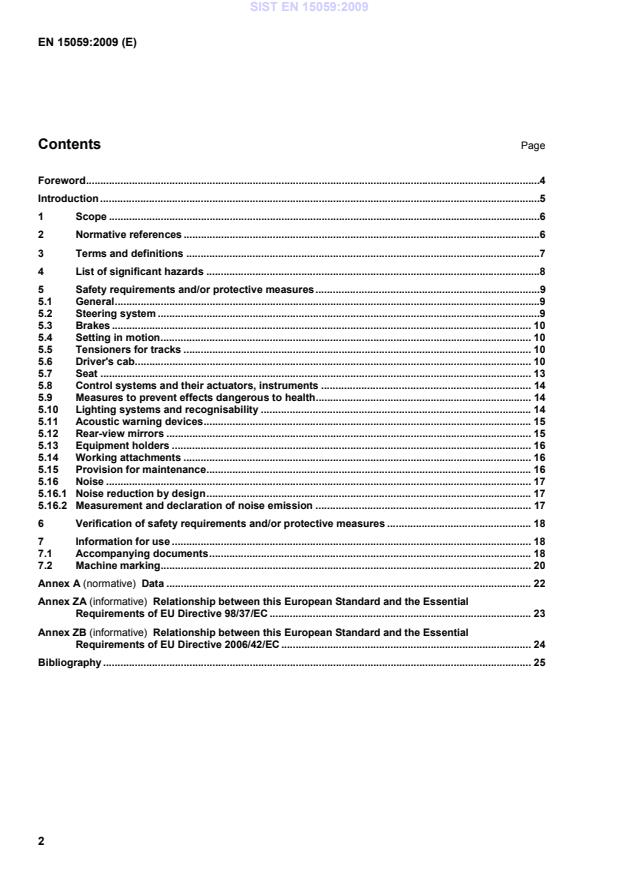
Data . 22 Annex ZA (informative)
Relationship between this European Standard and the Essential Requirements of EU Directive 98/37/EC . 23 Annex ZB (informative)
Relationship between this European Standard and the Essential Requirements of EU Directive 2006/42/EC . 24 Bibliography . 25
Figures Figure 1 — Snow grooming equipment with main components . 8 Figure 2 — Deflection limiting volume (DLV); front view . 12
Tables Table 1 — List of significant hazards . 8 Table 2 — Test loads for snow grooming equipment . 11 Table 3 — Special warning lamp (beacon) . 15 Table A.1 — Definition of input spectral class . 22 Table A.2 — Filter cut-off frequencies . 22 Table A.3 — Characteristics of the simulated input vibration . 22
This European Standard shall be given the status of a national standard, either by publication of an identical text or by endorsement, at the latest by December 2009, and conflicting national standards shall be withdrawn at the latest by December 2009. Attention is drawn to the possibility that some of the elements of this document may be the subject of patent rights. CEN [and/or CENELEC] shall not be held responsible for identifying any or all such patent rights. This document has been prepared under a mandate given to CEN by the European Commission and the European Free Trade Association, and supports essential requirements of EU Directive(s). For relationship with EU Directive(s), see informative Annexes ZA and ZB, which are integral parts of this document. According to the CEN/CENELEC Internal Regulations, the national standards organizations of the following countries are bound to implement this European Standard: Austria, Belgium, Bulgaria, Cyprus, Czech Republic, Denmark, Estonia, Finland, France, Germany, Greece, Hungary, Iceland, Ireland, Italy, Latvia, Lithuania, Luxembourg, Malta, Netherlands, Norway, Poland, Portugal, Romania, Slovakia, Slovenia, Spain, Sweden, Switzerland and the United Kingdom.
2 Normative references The following referenced documents are indispensable for the application of this document. For dated references, only the edition cited applies. For undated references, the latest edition of the referenced document (including any amendments) applies. EN 3-7:2004, Portable fire extinguishers — Part 7: Characteristics, performance requirements and test methods EN 953:1997, Safety of machinery — Guards — General requirements for the design and construction of fixed and movable guards EN 1050:1996, Safety of machinery — Principles for risk assessment EN 30326-1:1994, Mechanical vibration — Laboratory method for evaluating vehicle seat vibration — Part 1: Basic requirements (ISO 10326-1:1992) EN ISO 2867:2006, Earth-moving machinery — Access systems (ISO 2867:2006) EN ISO 3164:1999, Earth-moving machinery — Laboratory evaluations of protective structures — Specifications for the deflection-limiting volume (ISO 3164:1995) EN ISO 3411:2007, Earth-moving machinery - Physical dimensions of operators and minimum operator space envelope (ISO 3411:2007) EN ISO 3471:2008, Earth-moving machinery - Roll-over protective structures - Laboratory tests and performance requirements (ISO 3471:2008) EN ISO 4871:1996, Acoustics — Declaration and verification of noise emission values of machinery and equipment (ISO 4871:1996) EN ISO 5353:1998, Earth-moving machinery, and tractors and machinery for agriculture and forestry — Seat index point (ISO 5353:1995) EN ISO 6683:2008, Earth-moving machinery — Seat belts and seat-belt anchorages – Performance requirements and tests (ISO 6683:2005) EN ISO 7096:2008, Earth-moving machinery — Laboratory evaluation of operator seat vibration (ISO 7096:2000) SIST EN 15059:2009
ISO 6393:2008, Earth-moving machinery — Determination of sound power level — Stationary test conditions ISO 6394:2008, Earth-moving machinery — Determination of emission sound pressure level at operator's position — Stationary test conditions ISO 9533:1989, Earth-moving machinery — Machine-mounted forward and reverse audible warning alarm — Sound test method ISO 11112:1995, Earth-moving machinery — Operator's seat — Dimensions and requirements ISO 14401-1:2004, Earth-moving machinery — Field of vision of surveillance and rear-view mirrors — Part 1: Test methods
ISO 14401-2:2004, Earth-moving machinery — Field of vision of surveillance and rear-view mirrors — Part 2: Performance criteria
ECE R 43:1990, Uniform provisions concerning the approval of safety glazing and glazing materials (revision 2) 3 Terms and definitions For the purposes of this document, the terms and definitions given in EN ISO 12100-1:2003 and the following apply. 3.1 snow grooming equipment self-propelled, motor-driven machine on tracks, intended primarily for grooming snow NOTE As a secondary use, the machines can be used for transportation and landscaping work. SIST EN 15059:2009
Figure 1 — Snow grooming equipment with main components 3.2 working attachment attachment which can be mounted on or attached to a snow grooming equipment; for example front pusher blade, smoother, rear-mounted snow tiller, Nordic ski-trail groomer, snow cutter, snow blower, snow carrier, winch, mower, mulching machine 4 List of significant hazards This clause contains all the significant hazards, hazardous situations and events, as far as they are dealt with in this standard, identified by risk assessment as significant for this type of machinery and which require action to eliminate or reduce the risk. Table 1 — List of significant hazards No. Hazard as defined in Annex A of EN 1050:1996 Clause
General
1.1 1.2 Crushing hazard, shearing hazard 5.6.6, 5.6.7, 5.14.4, 5.14.5, 5.14.6, 5.15.2 1.4 1.5 Entanglement hazard, drawing-in and trapping hazard 5.14.4, 5.14.5, 5.14.6 3.1 Burns by contact with hot surfaces 5.9.2 3.2 Damage to health by hot or cold working environment 5.6.1, 5.6.2 8.1 Unhealthy postures or excessive effort 5.2.1, 5.5, 5.6.8, 5.7, 5.14.2, 5.14.3, 5.15.1, 5.15.2 8.8 Inadequate design or location of visual display units 5.8.4 10.1 Failure/disorder of the control system 5.2.2, 5.8.3 10.6 Errors made by the operator 5.8.2, 5.8.4 13 Failure of the power supply 5.2.3, 5.14.4, 5.14.5, 5.14.6
Hazards due to mobility
20.1 Hazards when starting 5.4.1 20.2 Movement without a driver at the driving position 5.3.8, 5.8.1 20.3 Movement without all parts in a safe position 5.8.4 SIST EN 15059:2009
Alternatively, an interlock shall be provided such that the parking brake is engaged automatically at the opening of any cabin door (e.g. electrical switches on the doors). Disengagement of the parking brake shall only be possible by an intentional action of the driver in the driving position. 5.4 Setting in motion 5.4.1 The snow grooming equipment shall remain immobile when the engine is started. Any inadvertent movement shall be avoided. 5.4.2 It shall be possible to protect snow grooming equipment against unauthorised use, for example by an ignition lock or lockable driver's cab. 5.5 Tensioners for tracks Manual tensioners for tracks shall be directly accessible and shall be designed such that they can be easily operated. 5.6 Driver's cab 5.6.1 Snow grooming equipment shall be equipped with an enclosed driver's cab that provides adequate protection against the effects of the weather. 5.6.2 The driver's cab shall be provided with means of heating and ventilation (see also 5.7.5). SIST EN 15059:2009
[J] 25,1000108007M 25,1000108007M Vertical load-application force FV
[N] M×77,11 M×77,11 NOTE M is a numerical value without dimension.
NOTE Requirements for the load-application forces acting in the longitudinal direction are omitted, because risk analysis has verified the unlikelihood of a snow grooming equipment overturning in the longitudinal direction. In addition to 8.3 of EN ISO 3471:2008, the portion of the deflection limiting volume (DLV) above the LA line as defined in EN ISO 3164:1999 is allowed to deviate (lean) up to 15° laterally, as shown in Figure 2, provided the minimum energy requirement as specified in Table 2 is met. The portion of the DLV below the LA line can be disregarded. SIST EN 15059:2009
Key 1 up to 15° 2 LA 3 centre point Figure 2 — Deflection limiting volume (DLV); front view 5.6.4 In order to facilitate egress in the event of an emergency, driver's cabs shall have an emergency exit facing in a direction different to that of the normal exit. Suitable exits are, for example, a second door, a window designed especially for this purpose, or an aperture in the roof of the cab. An opening to permit the passage of a person shall be at least 400 mm by 600 mm. 5.6.5 The driver's cab shall be constructed and positioned in such a way that easy and safe access for the driver and occasional passenger(s) is possible. Access using the track flats is permissible if grab handles in accordance with Clause 9 of EN ISO 2867:2008 are provided. If the driver's cab has side doors, the doors shall be rear-hinged or top-hinged in order to permit safe entry and exit from the front side. 5.6.6 Door latches shall be designed such that the doors cannot be opened inadvertently and the doors cannot open by themselves in all operating conditions. 5.6.7 Door and window openers shall be easily operated and the doors and windows shall be provided with devices to prevent their inadvertent closing. 5.6.8 The space for the driver's and occasional passenger's positions shall provide sufficient space for allowing normal movements. The minimum clearance for the seated machine operator inside the driver's cab shall be in accordance with EN ISO 3411:2007. The minimum space envelope height R1 as defined in Figure 5 of EN ISO 3411:2007 and measured from the seat index point (SIP), as defined in EN ISO 5353:1998, shall be 920 mm. SIST EN 15059:2009
...