

EN 1459-2:2015+A1:2018
(Main + Amendment)Rough-terrain trucks - Safety requirements and verification - Part 2: Slewing variable-reach trucks
- Abstract
This European Standard specifies the general safety requirements of slewing variable-reach rough-terrain trucks (here-after referred to as trucks), consisting of a lower chassis with a slewing upper structure equipped with a telescopic lifting means (pivoted boom), on which a load handling device (e.g. carriage and fork arms) is typically fitted.
Fork arms are covered by this European Standard and considered to be parts of the truck.
This European Standard deals with all significant hazards, hazardous situations and events relevant to the trucks when they are used as intended and under conditions of misuse which are reasonably foreseeable by the manufacturer (see Annex A) with the exception of hazards listed in 1.3 and 1.4.
This European Standard does not apply to:
- variable-reach rough terrain trucks covered by prEN 1459-1 (non-slewing);
- industrial variable-reach trucks covered by prEN ISO 3691 2;
- lorry-mounted variable-reach trucks;
- variable reach trucks fitted with tilting or elevating operator position;
- mobile cranes covered by EN 13000;
- machines designed primarily for earth moving, such as loaders and dozers, even if their buckets and blades are replaced with forks (see EN 474 series);
- trucks designed primarily with variable length load suspension elements (e.g., chain, ropes) from which the load may swing freely in all directions;
- trucks designed primarily for container handling;
- trucks on tracks;
- attachments (prEN 1459-5).
This European Standard does not address hazards linked to:
- hybrid power systems;
- gas power system;
- trucks equipped with gasoline engine;
- battery power system;
- tractor specific devices (e.g. PTO).
This European Standard does not address hazards which may occur when:
a) handling suspended loads which may swing freely (additional requirements are given in prEN 1459-4);
b) using trucks on public roads;
c) operating in potentially explosive atmospheres;
d) operating underground;
e) when towing trailers;
f) fitted with a personnel work platform (additional requirements are given in EN 1459-3).
- Status
- Published
- Publication Date
- 16-Oct-2018
- Technical Committee
- CEN/TC 150 - Industrial trucks - Safety
- Drafting Committee
- CEN/TC 150/WG 2 - Variable reach trucks
- Current Stage
- 9093 - Decision to confirm - Review Enquiry
- Start Date
- 15-Apr-2021
- Completion Date
- 07-Oct-2026
- Directive
- 2006/42/EC - Directive 2006/42/EC of the European Parliament and of the Council of 17 May 2006 on machinery, and amending Directive 95/16/EC (recast)OJ Ref: L 102, L 102/6 OJ Date: 02-Apr-2020



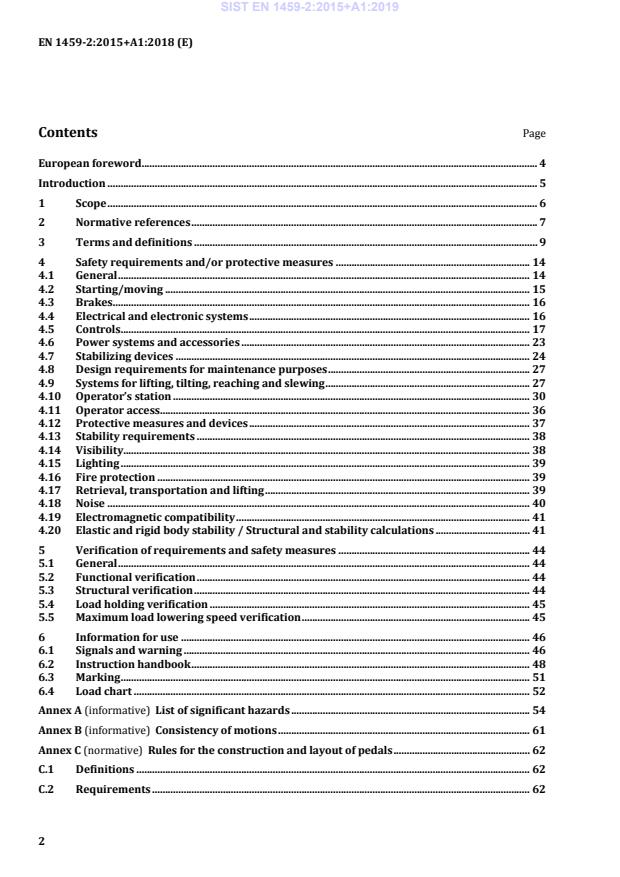
Overview
EN 1459-2:2015+A1:2018 is the European standard that sets out safety requirements and verification for slewing variable‑reach rough‑terrain trucks - machines with a lower chassis and a slewing upper structure fitted with a telescopic (pivoted) boom and load handling device (e.g., carriage and fork arms). The standard covers significant hazards and verification methods for intended use and reasonably foreseeable misuse, and it supports essential requirements of the EU Machinery Directive (see Annex ZA).
Key topics and technical requirements
The standard defines general safety measures and verification across machine subsystems and safety disciplines, including:
- Structural and stability requirements
- Elastic and rigid body stability, structural calculations and verification
- Stability under working conditions and use of stabilizing devices
- Lifting, slewing and load‑handling systems
- Telescopic boom, reach/slew controls and load holding / lowering verification
- Requirements for load charts and safe working limit information
- Operator environment and controls
- Operator’s station layout, access, visibility, seating and ergonomics
- Control design, pedal layout (Annex C), emergency stop and motion consistency
- Power, braking and safety systems
- Requirements for power systems, brakes, electrical and electronic safety, and functional verification
- Protective devices and maintenance
- Guards, fall‑protection, FOPS/ROPS considerations, design for maintenance
- Electromagnetic compatibility, noise and lighting
- EMC, noise emission considerations and lighting for safe operation
- Information for use
- Marking, signals, instruction handbook, load charts and user warnings
The standard also includes verification clauses: functional tests, structural verification, load holding and lowering speed checks, and prescriptive information requirements for safe operation.
Scope limits and exclusions
SIST EN 1459-2 applies specifically to slewing variable‑reach rough‑terrain trucks. It explicitly does not apply to (among others):
- Non‑slewing variable‑reach trucks (EN 1459‑1)
- Industrial variable‑reach trucks (EN ISO 3691‑2)
- Lorry‑mounted trucks, mobile cranes (EN 13000), tracked vehicles, container handlers
- Machines primarily for earth‑moving (EN 474 series)
- Attachments (covered in prEN 1459‑5)
- Certain power systems (hybrid, gas, gasoline, battery) and tractor PTO devices
It also excludes specific operating situations such as public road use, explosive atmospheres, underground work, towing trailers, or when fitted with personnel work platforms (EN 1459‑3 / prEN 1459‑4 cover those topics).
Practical applications and who uses it
This standard is essential for:
- Manufacturers and designers of slewing variable‑reach rough‑terrain trucks (product design and conformity)
- Safety and compliance managers preparing risk assessments and CE marking
- Test laboratories and conformity assessment bodies performing verification and validation
- Fleet owners, procurement and maintenance teams seeking to ensure safe operation and documentation (load charts, operator manuals)
- Training organizations developing operator and maintenance training aligned to machine safety features
Related standards
EN 1459 is a multi‑part series; relevant related documents include:
- EN 1459‑1 (non‑slewing trucks)
- EN 1459‑3, EN 1459‑4, EN 1459‑5 (interface, suspended loads, attachments)
- Normative references used throughout (e.g., EN ISO 12100 on risk assessment, EN ISO 4413 hydraulic safety, EN 12053 noise measurement, EN ISO 13849‑1 safety‑related control systems)
Keywords: SIST EN 1459-2, slewing variable-reach trucks, rough-terrain trucks, safety requirements, verification, load chart, operator’s station, stability, CE conformity.
Relations
- Effective Date
- 19-Jan-2023
- Effective Date
- 28-Mar-2018
- Effective Date
- 25-Aug-2026
- Refers
ISO 6292:2008 - Powered industrial trucks and tractors — Brake performance and component strength - Effective Date
- 25-Aug-2026
- Effective Date
- 25-Aug-2026
- Effective Date
- 25-Aug-2026
- Effective Date
- 25-Aug-2026
- Effective Date
- 25-Aug-2026
- Effective Date
- 25-Aug-2026
- Effective Date
- 25-Aug-2026
- Effective Date
- 09-Feb-2026
- Effective Date
- 09-Feb-2026
- Refers
ISO 15817:2012 - Earth-moving machinery — Safety requirements for remote operator control systems - Effective Date
- 09-Feb-2026
- Effective Date
- 09-Feb-2026
- Effective Date
- 09-Feb-2026
Frequently Asked Questions
EN 1459-2:2015+A1:2018 is a standard published by the European Committee for Standardization (CEN). Its full title is "Rough-terrain trucks - Safety requirements and verification - Part 2: Slewing variable-reach trucks". This standard covers: This European Standard specifies the general safety requirements of slewing variable-reach rough-terrain trucks (here-after referred to as trucks), consisting of a lower chassis with a slewing upper structure equipped with a telescopic lifting means (pivoted boom), on which a load handling device (e.g. carriage and fork arms) is typically fitted. Fork arms are covered by this European Standard and considered to be parts of the truck. This European Standard deals with all significant hazards, hazardous situations and events relevant to the trucks when they are used as intended and under conditions of misuse which are reasonably foreseeable by the manufacturer (see Annex A) with the exception of hazards listed in 1.3 and 1.4. This European Standard does not apply to: - variable-reach rough terrain trucks covered by prEN 1459-1 (non-slewing); - industrial variable-reach trucks covered by prEN ISO 3691 2; - lorry-mounted variable-reach trucks; - variable reach trucks fitted with tilting or elevating operator position; - mobile cranes covered by EN 13000; - machines designed primarily for earth moving, such as loaders and dozers, even if their buckets and blades are replaced with forks (see EN 474 series); - trucks designed primarily with variable length load suspension elements (e.g., chain, ropes) from which the load may swing freely in all directions; - trucks designed primarily for container handling; - trucks on tracks; - attachments (prEN 1459-5). This European Standard does not address hazards linked to: - hybrid power systems; - gas power system; - trucks equipped with gasoline engine; - battery power system; - tractor specific devices (e.g. PTO). This European Standard does not address hazards which may occur when: a) handling suspended loads which may swing freely (additional requirements are given in prEN 1459-4); b) using trucks on public roads; c) operating in potentially explosive atmospheres; d) operating underground; e) when towing trailers; f) fitted with a personnel work platform (additional requirements are given in EN 1459-3).
This European Standard specifies the general safety requirements of slewing variable-reach rough-terrain trucks (here-after referred to as trucks), consisting of a lower chassis with a slewing upper structure equipped with a telescopic lifting means (pivoted boom), on which a load handling device (e.g. carriage and fork arms) is typically fitted. Fork arms are covered by this European Standard and considered to be parts of the truck. This European Standard deals with all significant hazards, hazardous situations and events relevant to the trucks when they are used as intended and under conditions of misuse which are reasonably foreseeable by the manufacturer (see Annex A) with the exception of hazards listed in 1.3 and 1.4. This European Standard does not apply to: - variable-reach rough terrain trucks covered by prEN 1459-1 (non-slewing); - industrial variable-reach trucks covered by prEN ISO 3691 2; - lorry-mounted variable-reach trucks; - variable reach trucks fitted with tilting or elevating operator position; - mobile cranes covered by EN 13000; - machines designed primarily for earth moving, such as loaders and dozers, even if their buckets and blades are replaced with forks (see EN 474 series); - trucks designed primarily with variable length load suspension elements (e.g., chain, ropes) from which the load may swing freely in all directions; - trucks designed primarily for container handling; - trucks on tracks; - attachments (prEN 1459-5). This European Standard does not address hazards linked to: - hybrid power systems; - gas power system; - trucks equipped with gasoline engine; - battery power system; - tractor specific devices (e.g. PTO). This European Standard does not address hazards which may occur when: a) handling suspended loads which may swing freely (additional requirements are given in prEN 1459-4); b) using trucks on public roads; c) operating in potentially explosive atmospheres; d) operating underground; e) when towing trailers; f) fitted with a personnel work platform (additional requirements are given in EN 1459-3).
EN 1459-2:2015+A1:2018 is classified under the following ICS (International Classification for Standards) categories: 53.060 - Industrial trucks. The ICS classification helps identify the subject area and facilitates finding related standards.
EN 1459-2:2015+A1:2018 has the following relationships with other standards: It is inter standard links to EN 1459-2:2015/prA1, EN 1459-2:2015, ISO 22915-24:2015, ISO 6292:2008, ISO 13333:1994, ISO 6011:2003, ISO 3795:1989, ISO 7000:2014, ISO 11862:1993, ISO 12509:2004, ISO 12508:1994, EN 62061:2005, ISO 15817:2012, ISO 15818:2017, EN 60529:1991. Understanding these relationships helps ensure you are using the most current and applicable version of the standard.
EN 1459-2:2015+A1:2018 is associated with the following European legislation: EU Directives/Regulations: 2006/42/EC; Standardization Mandates: M/396. When a standard is cited in the Official Journal of the European Union, products manufactured in conformity with it benefit from a presumption of conformity with the essential requirements of the corresponding EU directive or regulation.
EN 1459-2:2015+A1:2018 is available in PDF format for immediate download after purchase. The document can be added to your cart and obtained through the secure checkout process. Digital delivery ensures instant access to the complete standard document.
Standards Content (Sample)
2003-01.Slovenski inštitut za standardizacijo. Razmnoževanje celote ali delov tega standarda ni dovoljeno.Vozila za talni transport - Terenska vozila - Varnostne zahteve in preverjanje - 2. del: Vozila z vrtljivim mehanizmom za dviganje s spremenljivim dosegomGeländegängige Stapler - Sicherheitstechnische Anforderungen und Verifizierung - Teil 2: Schwenkbare Stapler mit veränderlicher ReichweiteChariots tout-terrain - Prescriptions de sécurité et vérification - Partie 2 : Chariots à portée variable rotatifsRough-terrain trucks - Safety requirements and verification - Part 2: Slewing variable-reach trucks53.060Industrijski tovornjakiIndustrial trucksICS:Ta slovenski standard je istoveten z:EN 1459-2:2015+A1:2018SIST EN 1459-2:2015+A1:2019en,fr01-april-2019SIST EN 1459-2:2015+A1:2019SLOVENSKI
STANDARD
EUROPEAN STANDARD NORME EUROPÉENNE EUROPÄISCHE NORM
EN 1459-2:2015+A1
October
t r s z ICS
w uä r x r English Version
Roughæterrain trucks æ Safety requirements and verification æ Part
tã Slewing variableæreach trucks Chariots toutæterrain æ Prescriptions de sécurité et vérification æ Partie
t ã Chariots à portée variable rotatifs
Geländegängige Stapler æ Sicherheitstechnische Anforderungen und Verifizierung æ Teil
tã Schwenkbare Stapler mit veränderlicher Reichweite This European Standard was approved by CEN on
s y July
t r s w and includes Amendment
s approved by CEN on
y February
t r s zä
egulations which stipulate the conditions for giving this European Standard the status of a national standard without any alterationä Upætoædate lists and bibliographical references concerning such national standards may be obtained on application to the CENæCENELEC Management Centre or to any CEN memberä
translation under the responsibility of a CEN member into its own language and notified to the CENæCENELEC Management Centre has the same status as the official versionsä
CEN members are the national standards bodies of Austriaá Belgiumá Bulgariaá Croatiaá Cyprusá Czech Republicá Denmarká Estoniaá Finlandá Former Yugoslav Republic of Macedoniaá Franceá Germanyá Greeceá Hungaryá Icelandá Irelandá Italyá Latviaá Lithuaniaá Luxembourgá Maltaá Netherlandsá Norwayá Polandá Portugalá Romaniaá Serbiaá Slovakiaá Sloveniaá Spainá Swedená Switzerlandá Turkey and United Kingdomä
EUROPEAN COMMITTEE FOR STANDARDIZATION COMITÉ EUROPÉEN DE NORMALISATION EUROPÄISCHES KOMITEE FÜR NORMUNG
CEN-CENELEC Management Centre:
Rue de la Science 23,
B-1040 Brussels
t r s z CEN All rights of exploitation in any form and by any means reserved worldwide for CEN national Membersä Refä Noä EN
s v w {æ tã t r s w ªA sã t r s z ESIST EN 1459-2:2015+A1:2019
List of significant hazards . 54 Annex B (informative)
Consistency of motions . 61 Annex C (normative)
Rules for the construction and layout of pedals . 62 C.1 Definitions . 62 C.2 Requirements . 62 SIST EN 1459-2:2015+A1:2019
Regular and occasional loads . 65 D.1 General . 65 D.2 Regular loads . 65 D.3 Occasional loads . 65 Annex ZA (informative)
Relationship between this European Standard and the Essential Requirements of EU Directive 2006/42/EC . 66 Bibliography . 67
February 2018. This document supersedes EN 1459-2:2015. The start and finish of text introduced or altered by amendment is indicated in the text by tags !". This document has been prepared under a mandate given to CEN by the European Commission and the European Free Trade Association, and supports essential requirements of EU Directive(s). For relationship with EU Directive(s), see informative Annex ZA, which is an integral part of this document. EN 1459, Rough-terrain trucks — Safety requirements and verification, consists of the following parts: — Part 1: Variable-reach trucks — Part 2: Slewing variable-reach trucks — Part 3: Interface between the variable-reach truck and the work platform — Part 4: Additional requirements for variable reach trucks handling suspended loads — Part 5: Additional requirements for attachments and attachment interface — Part 6: Risk assessment methodology and control system performance level determination (CEN/TR) — Part 7: Test method and determination of noise emission (in development) According to the CEN-CENELEC Internal Regulations, the national standards organizations of the following countries are bound to implement this European Standard: Austria, Belgium, Bulgaria, Croatia, Cyprus, Czech Republic, Denmark, Estonia, Finland, Former Yugoslav Republic of Macedonia, France, Germany, Greece, Hungary, Iceland, Ireland, Italy, Latvia, Lithuania, Luxembourg, Malta, Netherlands, Norway, Poland, Portugal, Romania, Serbia, Slovakia, Slovenia, Spain, Sweden, Switzerland, Turkey and the United Kingdom. SIST EN 1459-2:2015+A1:2019
Visual danger signals
General requirements, design and testing EN 1175-2:1998+A1:2010, Safety of industrial trucks
Electrical requirements Part 2: General requirements of internal combustion engine powered trucks EN 12053:2001+A1:2008, Safety of industrial trucks
Test methods for measuring noise emissions EN 12895:2015, Industrial trucks
Electromagnetic compatibility EN 13059:2001+A1:2008, Safety of industrial trucks
Test methods for measuring vibration EN 13309:2010, Construction machinery
Electromagnetic compatibility of machines with internal power supply EN 60529:1991, Degrees of protection provided by enclosures (IP Code) (IEC 60529) EN 62061:2005, Safety of machinery
Functional safety of safety-related electrical, electronic and programmable electronic control systems (IEC 62061:2003) EN ISO 2860:2008, Earth-moving machinery
Minimum access dimensions (ISO 2860:1992) EN ISO 2867:2011, Earth-moving machinery
Access systems (ISO 2867:2011) EN ISO 3164:2013, Earth-moving machinery
Laboratory evaluations of protective structures
Specifications for deflection-limiting volume (ISO 3164:2013) EN ISO 3411:2007, Earth-moving machinery
Physical dimensions of operators and minimum operator space envelope (ISO 3411:2007) EN ISO 3449:2008, Earth-moving machinery
Falling-object protective structures
Laboratory tests and performance requirements (ISO 3449:2005) EN ISO 3457:2008, Earth-moving machinery
Guards
Definitions and requirements (ISO 3457:2003) EN ISO 3471:2008, Earth-moving machinery
Roll-over protective structures
Laboratory tests and performance requirements (ISO 3471:2008) EN ISO 4413:2010, Hydraulic fluid power
General rules and safety requirements for systems and their components (ISO 4413:2010) SIST EN 1459-2:2015+A1:2019
General rules and safety requirements for systems and their components (ISO 4414:2010) EN ISO 5353:1998, Earth-moving machinery, and tractors and machinery for agriculture and forestry
Seat index point (ISO 5353:1995) EN ISO 6682:2008, Earth-moving machinery
Zones of comfort and reach for controls (ISO 6682:1986, including Amd 1:1989) EN ISO 6683:2008, Earth-moving machinery
Seat belts and seat belt anchorages
Performance requirements and tests (ISO 6683:2005) EN ISO 7096:2008, Earth-moving machinery
Laboratory evaluation of operator seat vibration (ISO 7096:2000) EN ISO 12100:2010, Safety of machinery
General principles for design
Risk assessment and risk reduction (ISO 12100:2010) EN ISO 13732-1:2008, Ergonomics of the thermal environment
Methods for the assessment of human responses to contact with surfaces
Part 1: Hot surfaces (ISO 13732-1:2006) EN ISO 13849-1:2008, Safety of machinery
Safety-related parts of control systems
Part 1: General principles for design (ISO 13849-1:2006) EN ISO 13850:2008, Safety of machinery
Emergency stop
Principles for design (ISO 13850:2006) EN ISO 13857:2008, Safety of machinery
Safety distances to prevent hazard zones being reached by upper and lower limbs (ISO 13857:2008) ISO 3795:1989, Road vehicles, and tractors and machinery for agriculture and forestry — Determination of burning behaviour of interior materials ISO 4305:2014, Mobile cranes — Determination of stability ISO 5053-1:2014, Industrial trucks - Terminology and classification - Part 1: Types of industrial trucks ISO 6011:2003, Earth-moving machinery — Visual display of machine operation ISO 6016:2008, Earth-moving machinery — Methods of measuring the masses of whole machines, their equipment and components ISO 6292:2008, Powered industrial trucks and tractors — Brake performance and component strength ISO 7000:2014, Graphical symbols for use on equipment — Registered symbols ISO 9533:2010, Earth-moving machinery — Machine-mounted audible travel alarms and forward horns — Test methods and performance criteria ISO 10263-2:2009, Earth-moving machinery — Operator enclosure environment — Part 2: Air filter element test method ISO 10263-3:2009, Earth-moving machinery — Operator enclosure environment — Part 3: Pressurization test method ISO 10263-4:2009, Earth-moving machinery — Operator enclosure environment — Part 4: Heating, ventilating and air conditioning (HVAC) test method and performance SIST EN 1459-2:2015+A1:2019
Lifting and tying-down attachment points
Performance requirements ISO 21507:2010, Earth-moving machinery — Performance requirements for non-metallic fuel tanks ISO 22915-10:2008, Industrial trucks — Verification of stability — Part 10: Additional stability test for trucks operating in the special condition of stacking with load laterally displaced by powered devices ISO 22915-20:2008, Industrial trucks — Verification of stability — Part 20: Additional stability test for trucks operating in the special condition of offset load, offset by utilization ISO 22915-24:2015, Industrial trucks Verification of stability
Part 24: Slewing variable-reach rough-terrain trucks 3 Terms and definitions For the purposes of this document, the terms and definitions given in EN ISO 12100:2010 and ISO 5053-1:2014 and the following apply. 3.1 slewing rough terrain variable reach truck rough terrain variable reach truck with an upper structure which can rotate around a vertical axis of the chassis in a circular motion greater than 5° either side of the longitudinal axis of the truck
[SOURCE: ISO 5053-1:2014, 3.22] 3.2 actual capacity (Q) maximum load, established by the manufacturer based on component strength and truck stability, that the truck can carry, lift and stack to a specified height, at a specified standard load centre distance and reach, in normal operating conditions Note 1 to entry: The actual capacity depends on the configuration of the truck in terms of such variables as: — lift height; — reach of the boom (measured from the centre of slewing of the rotating upper structure); SIST EN 1459-2:2015+A1:2019
Key d reach D standard load centre distance G centre of gravity of the load Q
actual capacity Q1 rated capacity Q2 rated capacity at maximum height or elevation Q3 rated capacity at maximum reach Figure 1 — Parameters for the designation of the actual capacity of the truck with fork SIST EN 1459-2:2015+A1:2019
400 500 600 900 1 200 0 < 1 000 X
· 1 000 < 5 000
X
· 5 000 < 10 000
X
> 10 000 < 20 000
X X X
· 20 000 < 25 000
X X
· 25 000
X Note 3 to entry: Trucks may be rated for special applications with load centres related to those applications. 3.6 attachment either a tool or an interchangeable equipment, which can be attached to the lifting equipment 3.7 rated capacity of attachments maximum load that the attachment is permitted by its manufacturer to handle under specified conditions Note 1 to entry: The rated capacity of the attachment can be associated with the load centre distance. 3.8 axle oscillation lock mechanism designed to prevent oscillation of an axle to improve truck stability 3.9 stabilizing devices extendable and/or pivoting mechanical supports used to improve stability of a truck when stationary 3.10 adjustable levelling setting the plane inclination angle between the chassis and the ground to ensure the boom operates in a vertical plane when the truck is positioned on a slope 3.11 forks device comprising two or more solid fork arms, each consisting of a shank (vertical portion) and blade, which is hook- or shaft-mounted, fitted on the carriage and usually adjusted manually SIST EN 1459-2:2015+A1:2019
[SOURCE: ISO 10896-1:2012, 3.16] Note 1 to entry: Other positions may be necessary if it is not possible to control all the functions of the truck from a single position. 3.15 attachment bracket device fitted at the end of the boom to mount interchangeable attachments to facilitate quick interchange of attachment 3.16 boom float control mode that uses gravity to allow an attachment at the end of the boom to follow a contour (e.g. the ground) 3.17 maximum working pressure maximum pressure in the hydraulic circuit during normal operation [SOURCE: ISO 10972-3:2003, 3.2] 3.18 rated capacity (Q1) maximum load permitted by the manufacturer at the standard load centre distance (D) that the truck is capable of lifting and transporting on fork arms in normal conditions with the boom fully retracted 3.19 interchangeable equipment device which is assembled with the truck by the operator himself in order to change its function or to attribute a new function 3.20 tool device which is assembled with the lifting equipment by the operator himself and that does not change its function 3.21 aligned position configuration of the truck in which the longitudinal mid-axis of the slewing upper structure is aligned with the longitudinal mid-axis of the chassis SIST EN 1459-2:2015+A1:2019
Verification by visual examination and design-check. This requirement does not apply to electrical circuits of anti-theft systems, when fitted. 4.4.5 Over-current protective devices The truck shall comply with of EN 1175-2:1998+A1:2010, 5.5. Verification by design-check. 4.4.6 Batteries Batteries shall be restrained to prevent displacement which may give rise to danger in a ventilated location that provides access for maintenance. Verification by visual examination. Batteries and/or battery locations shall be designed and built or covered to minimize any hazard to the operator caused by battery acid or acid vapours in the event of overturning the truck. Verification by design-check. Insulation of live parts of the batteries shall comply with EN 1175-2:1998+A1:2010, 5.1.1. Verification by design-check. 4.4.7 Battery disconnection Battery disconnection shall comply with
EN 1175-2:1998+A1:2010, 5.1.3. Verification by type-test. For marking, see 6.1.10. 4.4.8 Electrical connector for auxiliary starting aids If electrical connectors for an auxiliary starting aid or power supply are mounted on the truck, the connectors shall comply with ISO 11862:1993. 4.5 Controls 4.5.1 General 4.5.1.1 General a) The controls (hand levers, joysticks, pedals, switches, etc.) and indicators of the truck and attachment, shall be designed, constructed and so arranged to be accessed from the normal operator's position in accordance with EN ISO 6682. Verification by design-check. b) The controls (hand levers, joysticks, pedals, switches, etc.) and indicators of the truck and attachment shall be clearly identified, except where obvious (e.g. accelerator pedal), indelible and visible in the normal operator's position; if appropriate, graphical symbols in accordance with ISO 7000:2014 shall be used and shall be explained in the information for use (see 6.1.2). Each symbol shall be affixed on or in close proximity to the control or indicator to which it applies. Verification by visual examination. SIST EN 1459-2:2015+A1:2019
Verification by visual examination. 4.5.3 Steering controls 4.5.3.1 General The steering mechanism shall be designed to ensure a proportional response to movement of the control. Verification by design-check. 4.5.3.2 Steering direction The following requirements shall be met when the truck is in the forward aligned position: a) For trucks with a steering wheel control, clockwise rotation of a steering wheel shall steer the truck to the right when the truck is travelling in the forward direction. b) On trucks with a crab-steering mode, clockwise rotation of the steering wheel shall move the truck to the right when the truck is travelling in the forward direction and to the left when travelling in the reverse direction. c) On trucks in which the steering is controlled by means of a single lever control, moving the lever to the right shall cause the truck to be steered to the right when the truck is travelling in the forward direction. When the upper structure is slewed more than 90° to either side of the longitudinal axis of the chassis from the forward aligned position, a visual indicator shall warn the operator that steering controls are reversed compared to a) or b). Verification by functional test. 4.5.3.3 Failure of power supply For trucks with a maximum speed of less than or equal to 20 km/h, in the event of an interruption of the power supplied to the steering system (including a dead engine), it shall be possible to maintain the path being steered until the truck is brought to a stop. Verification by type-test. Trucks with a maximum speed greater than 20 km/h shall be tested according to the following condition and shall meet the following requirements: — The truck shall be tested with the load and operating condition which produces the greatest load on the steered axle(s). — The truck shall describe a spiral movement at a speed of 10 km/h, starting from the straight-ahead position, on a dry, flat road surface offering good tyre adhesion. — The steering effort on the steering control shall be measured until it reaches the position corresponding to the truck entering a turning circle of 12 m radius (considering the outermost part of the steering wheels). SIST EN 1459-2:2015+A1:2019
2080 0750A 2081 0751A
2078 0746A 2079 0747A
Verification by visual examination. — each stabilizing device shall be controlled independently. The left control shall operate the left stabilizing device, and the right control shall operate the right stabilizing device, in forward aligned position; — a control may operate two or more stabilizing de
...