

ISO 21815-1:2022
(Main)Earth-moving machinery — Collision warning and avoidance — Part 1: General requirements
General Information
- Abstract
This document provides terminology and general guidance on the principles of collision warning and collision avoidance systems for: — earth moving machinery as defined in ISO 6165, — mobile underground mining machinery as defined in ISO 19296, and — road construction machinery as defined in ISO 22242. This document provides general requirements for detection of objects, warnings to the operator, automatic intervention control to avoid collision, and test procedures. It is intended to be used in conjunction with the other parts of the ISO 21815 series, which provide detailed guidance and requirements for collision warning and collision avoidance systems and determining risk areas and risk levels. The specific requirements and definitions for particular types of machines are defined in the use case parts of the ISO 21815 series. This document covers collision avoidance by speed reduction or motion inhibit: it does not cover avoidance by automatic manoeuvring (e.g. steering) away from the intended object. The systems described in this document are only intended to assist the operator of the machine. The responsibility for safe operation of the machine remains with the operator of the machine. This document is not applicable to collision warning and collision avoidance systems installed to the machine before the date of its publication.
- Status
- Published
- Publication Date
- 06-Jan-2022
- Technical Committee
- ISO/TC 127/SC 2 - Safety, ergonomics and general requirements
- Drafting Committee
- ISO/TC 127/SC 2/JWG 28 - Joint ISO/TC 127/SC 2 - ISO/TC 82/SC 8 - ISO/TC 195 WG: Collision awareness and avoidance
- Parallel Committee
- ISO/TC 82 - Mining
- Current Stage
- 6060 - International Standard published
- Start Date
- 07-Jan-2022
- Due Date
- 14-Feb-2023
- Completion Date
- 07-Jan-2022

Overview
ISO 21815-1:2022 - Earth-moving machinery: Collision warning and avoidance - Part 1: General requirements provides the foundational terminology, principles and general requirements for collision warning and collision avoidance systems (CxS) applied to earth-moving, mobile underground mining and road construction machinery. It sets technology‑neutral performance expectations for object detection, operator warnings, automatic intervention (speed reduction or motion inhibit), and test procedures. This part is the general, normative framework to be used together with the other parts of the ISO 21815 series and does not apply to systems installed before its publication date.
Keywords: ISO 21815-1, collision warning and avoidance, earth-moving machinery, collision avoidance systems, operator assistance.
Key topics and technical requirements
- Scope and terminology: Defines applicability to machines per ISO 6165, ISO 19296 and ISO 22242 and establishes common terms for collision risk management.
- Performance requirements: General functional expectations for detection accuracy, warnings, and automatic intervention (note: avoidance by steering/automatic manoeuvring is excluded).
- System classification (CxS): Capability types and system types - including Take-off Inhibition (TIC), Swing Inhibition (SIC), Manoeuvring Speed CxS (MSC) and Travel Speed CxS (TSC).
- Detection and risk management: Detection of intended objects, collision risk levels, CxS actions and defined system limitations.
- Safety and reliability: Functional safety considerations, risk assessment, self-checking, status indication, failure warnings and protection against unauthorized modification.
- Environmental and EMC requirements: Electromagnetic compatibility and environmental condition requirements for reliable operation in construction and mining environments.
- Operating states and human interaction: Mode transitions (normal, stand-by, override), false‑positive handling and operator information requirements.
- Test procedures: Test environment/surface conditions, subject machine conditions, test object specifications, performance testing and false-positive test criteria.
Keywords: test procedures, functional safety, EMC, risk assessment, false positive.
Practical applications
- Guiding manufacturers in designing or validating collision warning and avoidance systems for excavators, haul trucks, road pavers and underground machines.
- Informing OEMs and system integrators on requirements for reliable detection, operator alerts and controlled interventions (speed reduction/motion inhibit).
- Supporting safety regulators, fleet managers and maintenance/service providers when assessing residual risk, operator guidance and system performance.
- Serving as a technology‑neutral benchmark for procurement specifications, verification testing and product documentation.
Keywords: OEMs, fleet safety, collision risk mitigation, machine safety standards.
Who should use this standard
- Machine manufacturers and suppliers of collision avoidance systems
- Health & safety bodies and regulators
- Fleet operators and maintenance/service providers
- Standards developers and conformity assessment bodies
Related standards
- ISO 6165 (earth-moving machinery definitions)
- ISO 19296 (mobile underground mining machinery)
- ISO 22242 (road construction machinery)
- ISO 16001, ISO 17757 (related visibility and autonomy standards)
- ISO 12100 (type‑C standard context)
Using ISO 21815-1 alongside the other parts of the ISO 21815 series helps ensure consistent, testable, and operator‑focused collision warning and avoidance measures across earth‑moving and mining equipment.
Frequently Asked Questions
ISO 21815-1:2022 is a standard published by the International Organization for Standardization (ISO). Its full title is "Earth-moving machinery — Collision warning and avoidance — Part 1: General requirements". This standard covers: This document provides terminology and general guidance on the principles of collision warning and collision avoidance systems for: — earth moving machinery as defined in ISO 6165, — mobile underground mining machinery as defined in ISO 19296, and — road construction machinery as defined in ISO 22242. This document provides general requirements for detection of objects, warnings to the operator, automatic intervention control to avoid collision, and test procedures. It is intended to be used in conjunction with the other parts of the ISO 21815 series, which provide detailed guidance and requirements for collision warning and collision avoidance systems and determining risk areas and risk levels. The specific requirements and definitions for particular types of machines are defined in the use case parts of the ISO 21815 series. This document covers collision avoidance by speed reduction or motion inhibit: it does not cover avoidance by automatic manoeuvring (e.g. steering) away from the intended object. The systems described in this document are only intended to assist the operator of the machine. The responsibility for safe operation of the machine remains with the operator of the machine. This document is not applicable to collision warning and collision avoidance systems installed to the machine before the date of its publication.
This document provides terminology and general guidance on the principles of collision warning and collision avoidance systems for: — earth moving machinery as defined in ISO 6165, — mobile underground mining machinery as defined in ISO 19296, and — road construction machinery as defined in ISO 22242. This document provides general requirements for detection of objects, warnings to the operator, automatic intervention control to avoid collision, and test procedures. It is intended to be used in conjunction with the other parts of the ISO 21815 series, which provide detailed guidance and requirements for collision warning and collision avoidance systems and determining risk areas and risk levels. The specific requirements and definitions for particular types of machines are defined in the use case parts of the ISO 21815 series. This document covers collision avoidance by speed reduction or motion inhibit: it does not cover avoidance by automatic manoeuvring (e.g. steering) away from the intended object. The systems described in this document are only intended to assist the operator of the machine. The responsibility for safe operation of the machine remains with the operator of the machine. This document is not applicable to collision warning and collision avoidance systems installed to the machine before the date of its publication.
ISO 21815-1:2022 is classified under the following ICS (International Classification for Standards) categories: 53.100 - Earth-moving machinery. The ICS classification helps identify the subject area and facilitates finding related standards.
ISO 21815-1:2022 is available in PDF format for immediate download after purchase. The document can be added to your cart and obtained through the secure checkout process. Digital delivery ensures instant access to the complete standard document.
Standards Content (Sample)
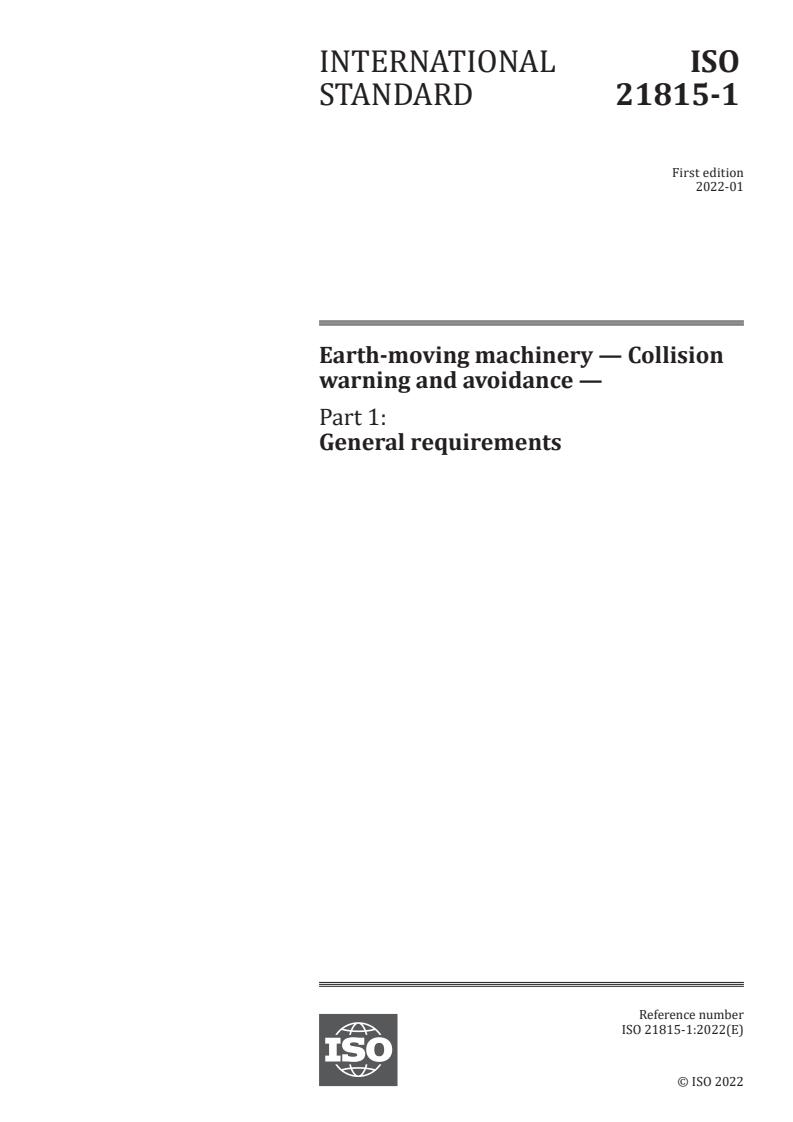
INTERNATIONAL ISO
STANDARD 21815-1
First edition
2022-01
Earth-moving machinery — Collision
warning and avoidance —
Part 1:
General requirements
Reference number
© ISO 2022
All rights reserved. Unless otherwise specified, or required in the context of its implementation, no part of this publication may
be reproduced or utilized otherwise in any form or by any means, electronic or mechanical, including photocopying, or posting on
the internet or an intranet, without prior written permission. Permission can be requested from either ISO at the address below
or ISO’s member body in the country of the requester.
ISO copyright office
CP 401 • Ch. de Blandonnet 8
CH-1214 Vernier, Geneva
Phone: +41 22 749 01 11
Email: copyright@iso.org
Website: www.iso.org
Published in Switzerland
ii
Contents Page
Foreword .v
Introduction . vi
1 Scope . 1
2 Normative references . 1
3 Terms and definitions . 2
4 Performance requirements . .4
4.1 General requirements . 4
4.1.1 General . 4
4.1.2 Electro-magnetic compatibility (EMC) . 4
4.1.3 Environmental condition requirements . 4
4.1.4 Functional safety . . . 4
4.1.5 Risk assessment . 4
4.1.6 Analysis on machine modification . 5
4.2 Requirements on CxS . 5
4.2.1 General . 5
4.2.2 Detection of intended objects . 5
4.2.3 Collision risk levels and CxS actions . 5
4.2.4 System limitations . 5
4.3 Outline of process flow for CxS . 6
4.4 False CxS actions . 6
4.5 Operating state transition of CxS . 6
4.5.1 General . 6
4.5.2 Switching between normal mode and stand-by mode . 6
4.5.3 Switching between normal mode to override mode . 7
4.5.4 Status information . 7
4.6 Self-checking, status indication and failure warning . 7
4.7 Protection against unauthorized modification of system functions . 8
5 System classification .8
5.1 General . 8
5.2 System capability types . 8
5.2.1 Take-off inhibition CxS (TIC) . 8
5.2.2 Swing inhibition CxS (SIC) . 8
5.2.3 Manoeuvring speed CxS (MSC) . 8
5.2.4 Travel speed CxS (TSC) . . 8
5.3 System types . 9
5.4 Types of detection . 9
5.5 Description of systems . 9
6 Test procedures . 9
6.1 General . 9
6.2 Test condition . 9
6.2.1 Test environment condition . 9
6.2.2 Test surface conditions . 9
6.3 Subject machine conditions . 10
6.4 Specification of test objects . 10
6.5 Performance test . 10
6.5.1 General . 10
6.5.2 Test object installation . 10
6.5.3 Subject machine . 10
6.5.4 Test result judgement criteria . 10
6.6 False positive CxS action test . 10
7 CxS information for use .11
7.1 Information for the operator . 11
iii
7.2 Information about residual risks . 11
Annex A (informative) Machine interaction scenario common examples .12
Annex B (informative) Comparison of system functions .14
Annex C (informative) Example of operator’s manual .15
Bibliography .17
iv
Foreword
ISO (the International Organization for Standardization) is a worldwide federation of national standards
bodies (ISO member bodies). The work of preparing International Standards is normally carried out
through ISO technical committees. Each member body interested in a subject for which a technical
committee has been established has the right to be represented on that committee. International
organizations, governmental and non-governmental, in liaison with ISO, also take part in the work.
ISO collaborates closely with the International Electrotechnical Commission (IEC) on all matters of
electrotechnical standardization.
The procedures used to develop this document and those intended for its further maintenance are
described in the ISO/IEC Directives, Part 1. In particular, the different approval criteria needed for the
different types of ISO documents should be noted. This document was drafted in accordance with the
editorial rules of the ISO/IEC Directives, Part 2 (see www.iso.org/directives).
Attention is drawn to the possibility that some of the elements of this document may be the subject of
patent rights. ISO shall not be held responsible for identifying any or all such patent rights. Details of
any patent rights identified during the development of the document will be in the Introduction and/or
on the ISO list of patent declarations received (see www.iso.org/patents).
Any trade name used in this document is information given for the convenience of users and does not
constitute an endorsement.
For an explanation of the voluntary nature of standards, the meaning of ISO specific terms and
expressions related to conformity assessment, as well as information about ISO's adherence to
the World Trade Organization (WTO) principles in the Technical Barriers to Trade (TBT), see
www.iso.org/iso/foreword.html.
This document was prepared by Technical Committee ISO/TC 127, Earth-moving machinery,
Subcommittee SC 2, Safety, ergonomics and general requirements, in collaboration with Technical
Committee ISO/TC 82, Mining, ISO/TC 82, Mining, Subcommittee SC 8, Advanced automated mining
systems, ISO/TC 195, Building construction machinery and equipment and ISO/TC 195 Building
construction machinery and equipment , Subcommittee SC 3 Drilling and foundation machinery and
equipment.
A list of all parts in the ISO 21815 series can be found on the ISO website.
Any feedback or questions on this document should be directed to the user’s national standards body. A
complete listing of these bodies can be found at www.iso.org/members.html.
v
Introduction
This document is a type-C standard as stated in ISO 12100.
This document is of relevance, in particular, for the following stakeholder groups representing the
market players with regard to machinery safety:
— machine manufacturers (small, medium and large enterprises);
— health and safety bodies (regulators, accident prevention organisations, market surveillance etc.).
Others can be affected by the level of machinery safety achieved with the means of the document by the
above-mentioned stakeholder groups:
— machine users/employers (small, medium and large enterprises);
— machine users/employees (e.g. trade unions, organizations for people with special needs);
— service providers, e.g. for maintenance (small, medium and large enterprises);
— consumers (in case of machinery intended for use by consumers).
The above-mentioned stakeholder groups have been given the possibility to participate at the drafting
process of this document.
In addition, this document is intended for standardization bodies elaborating type-C standards.
The requirements of this document can be supplemented or modified by a type-C standard.
For machines which are covered by the scope of a type-C standard and which have been designed and
built according to the requirements of that standard, the requirements of that type-C standard take
precedence.
The machinery concerned and the extent to which hazards, hazardous situations or hazardous events
are covered are indicated in the Scope of this document.
When requirements of this type-C standard are different from those which are stated in type-A or
type-B standards, the requirements of this type-C standard take precedence over the requirements of
the other standards for machines that have been designed and built according to the requirements of
this type-C standard.
Increasing use of detection systems and avoidance technology in the area of earth-moving machinery
has been supporting operators to safely operate machines in the field of mining and construction. At
the same time, there are demands to set standards for machines and systems detecting, alerting and
intervening to mitigate collision risk.
There are currently two existing standards in the field: ISO 16001 and ISO 17757. These standards
provide guidance for visibility aids and object detection systems and for autonomous and semi-
autonomous machines, however, there is currently no standard that describes collision risk awareness,
warning signals and collision avoidance actions of the machinery operated by humans when there is a
risk of collision.
Collision warning and avoidance systems are developing technologies and algorithms are not yet
mature and well understood. This document is intended to foster innovation and accelerate the pace of
improvements in new collision warning and avoidance technologies. The performance requirements of
this document are technology-neutral and do not specify technologies to make the requirements.
The systems described in this document are intended to assist the operator of the machine. As current
technologies are unable to achieve full collision warning/avoidance in every situation, the responsibility
for safe operation of the machine remains with the operator of the machine.
vi
This document is a part of the ISO 21815 series relating to: communication interfaces, collision risk
areas and collision risk levels, specific requirements for collision warning and collision avoidance
systems, and specific use case requirements.
vii
INTERNATIONAL STANDARD ISO 21815-1:2022(E)
Earth-moving machinery — Collision warning and
avoidance —
Part 1:
General requirements
1 Scope
This document provides terminology and general guidance on the principles of collision warning and
collision avoidance systems for:
— earth moving machinery as defined in ISO 6165,
— mobile underground mining machinery as defined in ISO 19296, and
— road construction machinery as defined in ISO 22242.
This document provides general requirements for detection of objects, warnings to the operator,
automatic intervention control to avoid collision, and test procedures. It is intended to be used
in conjunction with the other parts of the ISO 21815 series, which provide detailed guidance and
requirements for collision warning and collision avoidance systems and determining risk areas and
risk levels. The specific requirements and definitions for particular types of machines are defined in
the use case parts of the ISO 21815 series.
This document covers collision avoidance by speed reduction or motion inhibit: it does not cover
avoidance by automatic manoeuvring (e.g. steering) away from the intended object.
The systems described in this document are only intended to assist the operator of the machine. The
responsibility for safe operation of the machine remains with the operator of the machine.
This document is not applicable to collision warning and collision avoidance systems installed to the
machine before the date of its publication.
2 Normative references
The following documents are referred to in the text in such a way that some or all of their content
constitutes requirements of this document. For dated references, only the edition cited applies. For
undated references, the latest edition of the referenced document (including any amendments) applies.
ISO 3450:2011, Earth-moving machinery — Wheeled or high-speed rubber-tracked machines —
Performance requirements and test procedures for brake systems
ISO 12100:2010, Safety of machinery — General principles for design — Risk assessment and risk reduction
ISO 13766-1, Earth-moving and building construction machinery — Electromagnetic compatibility (EMC)
of machines with internal electrical power supply — Part 1: General EMC requirements under typical
electromagnetic environmental conditions
ISO 13766-2, Earth-moving and building construction machinery — Electromagnetic compatibility (EMC)
of machines with internal electrical power supply — Part 2: Additional EMC requirements for functional
safety
ISO 13849 (all parts), Safety of machinery — Safety-related parts of control systems
ISO 19014-1, Earth-moving machinery — Functional safety — Part 1: Methodology to determine safety-
related parts of the control system and performance requirements
ISO 19014-3, Earth-moving machinery — Functional safety — Part 3: Environmental performance and test
requirements of electronic and electrical components used in safety-related parts of the control system
3 Terms and definitions
For the purposes of this document, the terms and definitions given in ISO 12100 and the following apply.
ISO and IEC maintain terminology databases for use in standardization at the following addresses:
— ISO Online browsing platform: available at https:// www .iso .org/ obp
— IEC Electropedia: available at https:// www .electropedia .org/
3.1
interaction
situation where a machine encounters an intended object (3.5) when moving or about to move, placing
itself or the operator at risk, or exposing the intended objects to risk
3.2
warning
transmission of alert information by visual, audible or other means of signals
Note 1 to entry: Warning is targeted to the operator and also can be for people located in close proximity to the
machine in addition to operator.
3.3
evasive action
action initiated by the operator to attempt to prevent or avoid a foreseeable collision
EXAMPLE Braking, steering.
3.4
interventional collision avoidance action
automatic action initiated by a collision avoidance system (CAS) (3.9) to attempt to prevent or avoid a
foreseeable collision
EXAMPLE Braking, inhibiting motion, slowing down.
3.5
intended object
object, such as a person, machine, vehicle or obstacle, which is intended to be detected by a collision
warning system (CWS) (3.8) or a collision avoidance system (CAS) (3.9) when in the collision risk area (3.7)
3.6
collision risk level
value that is assigned each intended object (3.5) to determine if a collision is foreseeable
Note 1 to entry: Collision risk levels are described in ISO 21815-3 and a future part of the ISO 21815 series
dedicated to risk area and risk level for track movement and swing/rotation.
3.7
collision risk area
space analysed to determine the collision risk level (3.6)
3.8
collision warning system
CWS
system which detects intended objects (3.5) in the collision risk area (3.7), determines the collision risk
level (3.6) and provides a warning (3.2) to the operator
3.9
collision avoidance system
CAS
system which detects intended objects (3.5) in the collision risk area (3.7), determine the collision risk
level (3.6) and provides interventional collision avoidance action (3.4)
3.10
CxS
collision warning system (CWS) (3.8) or collision avoidance system (CAS) (3.9) or a system providing both
3.11
detection
acknowledgement of intended objects (3.5) by a CxS (3.10)
3.12
CxS action
collision warning system (CWS) (3.8) providing warning (3.2) to the operator or collision avoidance
system (CAS) (3.9) taking interventional collision avoidance action (3.4)
3.13
false positive CxS action
unnecessary or inappropriate CxS action (3.12)
Note 1 to entry: This can be caused by incorrect determination of the collision risk level (3.6).
3.14
false negative CxS action
lack of necessary or appropriate CxS action (3.12)
Note 1 to entry: This can be caused by incorrect determination of the collision risk level (3.6).
3.15
CxS device
CxD
device with sensors providing CxS (3.10) functions to detect intended objects (3.5) in the proximity of
the machine, determine the collision risk level (3.6), warn the operator of the presence of the intended
object for a collision warning system (CWS) (3.8), and/or provide signals to the machine control system
via a communication interface to initiate the appropriate interventional collision avoidance action (3.4)
on the machine for a collision avoidance system (CAS) (3.9)
Note 1 to entry: CxS device is described as CxD in other parts of the ISO 21815 series.
Note 2 to entry: Proximity detection system (PDS) is a colloquial industry term for a physical device providing
CWS or CAS functionality.
3.16
normal mode
operational mode whereby a CxS (3.10) is active and ready to provide all functions of the CxS, including
warning (3.2) information and interventional collision avoidance action (3.4)
3.17
stand-by mode
operational mode selected by an authorized person, whereby a CxS (3.10) can be active, but warning
(3.2) information or interventional collision avoidance action (3.4) or both are not provided by the
system, and returns to normal mode (3.16) by an authorized person
3.18
override mode
operational mode selected by the operator, whereby a CxS (3.10) can be active, but warning (3.2)
information or interventional collision avoidance action (3.4) or both are suspended temporarily and
return automatically to normal mode (3.16) after a certain condition
3.19
system i
...