

ISO/FDIS 25097
(Main)Bee pollen production
- Abstract
This standard specifies the minimum requirements for all the steps of the production of high quality bee pollen for national and international markets. It specifies the environmental conditions, the process control, and the technical requirements for harvesting, processing, packaging, labelling, storage and transportation of bee pollen.
- Status
- Not Published
- Technical Committee
- ISO/TC 34/SC 19 - Bee products
- Drafting Committee
- ISO/TC 34/SC 19/WG 3 - Bee pollen
- Current Stage
- 5020 - Proof sent to secretariat or FDIS ballot initiated: 8 weeks - 50 Approval
- Start Date
- 12-Nov-2026
- Due Date
- 12-Nov-2026
- Completion Date
- 12-Nov-2026
ISO/FDIS 25097 is an ISO document on bee pollen production. It sets minimum requirements and practical guidance for producing bee pollen for national and international markets, covering environmental conditions, process control, harvesting, processing, packaging, labelling, storage and transportation.
The document is aimed at beekeepers, producers, processors and distributors who need a common production framework for bee pollen. It links production practice with food safety, quality and traceability, so the final product can be handled consistently from the apiary to delivery.
What does ISO/FDIS 25097 specify?
ISO/FDIS 25097 specifies the production of high-quality bee pollen from colony management through packaging and transport. Its scope covers the full production chain and organizes the subject into clauses on production conditions, process management, post-harvest handling, packaging, storage, records, labelling, traceability and transportation.
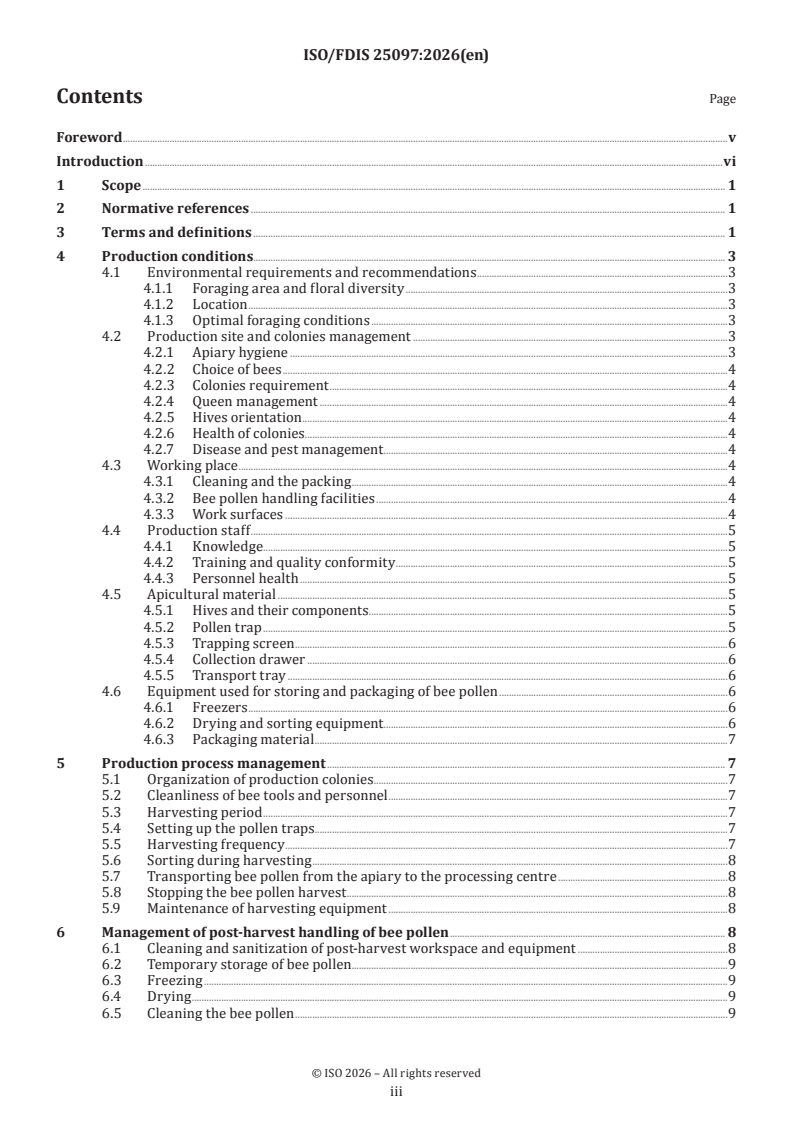
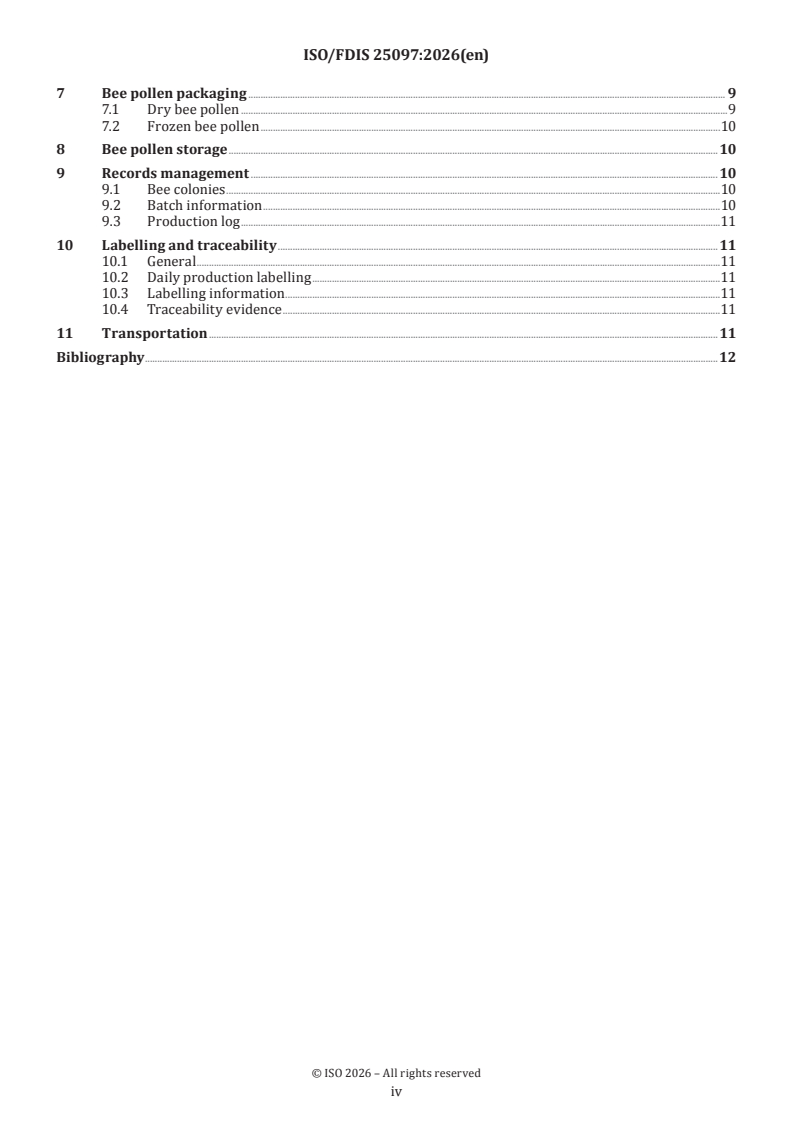
The document is structured to follow the practical sequence of work in a bee pollen operation. Clause 4 covers the production environment and facilities, Clause 5 covers harvesting and colony handling, Clause 6 covers post-harvest treatment, Clause 7 covers packaging, Clause 8 covers storage, Clause 9 covers records, Clause 10 covers labelling and traceability, and Clause 11 covers transportation.
What are the key requirements of ISO/FDIS 25097?
ISO/FDIS 25097 focuses on controlling the production environment, protecting pollen quality, and keeping traceability throughout the chain. In practice, it tells the reader how to choose the site, manage colonies, handle harvested pollen, and document each batch.
Production conditions and colony health
Clause 4 requires a clean, low-pollution foraging environment, with special caution around industrial areas, busy roads and pesticide-treated crops. It also sets expectations for apiary hygiene, clean water, healthy colonies, suitable bee species or races, and regular inspection of colony strength and queen performance. This matters because pollen can absorb contaminants quickly and colony health affects both yield and product quality.
Clause 4 also requires attention to hive placement and disease control. Hives should be positioned to avoid contamination from agricultural products, and antibiotics or persistent veterinary medicines shall not be used in pollen-producing colonies. Harvesting should stop when colony disease affects pollen quality.
Equipment, work areas and staff
Clause 4 sets requirements for the working room, surfaces and equipment. The packing and cleaning room should be closed, clean, dry, rodent-proof and free from contamination sources, and surfaces in contact with pollen should be food-grade, except wood. Staff should have beekeeping and food-safety knowledge, receive regular training, and be in good health when handling pollen.
The same clause gives design expectations for hives, pollen traps, trapping screens, collection drawers and transport trays. These components should be easy to clean, food-grade where they touch pollen, and designed to avoid crushing, contamination and bee injury.
Harvesting and post-harvest handling
Clause 5 covers harvest timing, trap setup, cleaning of tools, harvesting frequency and stopping rules. Pollen should be collected in dry weather, traps should be installed so bees can acclimatize, and trays should be emptied often enough to prevent fermentation. The document also says to stop harvesting in rain, when pollen supply drops, or when contamination conditions arise.
Clause 6 covers freezing, drying, cleaning and temporary storage. Bee pollen should be moved quickly into frozen storage or drying, and deep-freezing is used to limit insects, mites and microorganisms. Drying should stay controlled, with limited temperature exposure and a final moisture content not above 8 %. This matters because heat, moisture and delay can change composition and spoil the product.
Packaging, storage and traceability
Clauses 7 to 10 define packaging, storage, records and traceability. Dry pollen and frozen pollen have different packaging needs, but both must be packed to protect quality and avoid crushing or rewetting. Storage conditions are tied to ISO 24382:2023, and records must identify colonies, batches, harvest dates and origin data. Daily lot marking, batch labelling and delivery notes support traceability through the chain.
What terms does ISO/FDIS 25097 define?
ISO/FDIS 25097 defines the main working terms used in bee pollen production.
- Pollen - male gametophytes produced by flowers and carried by insects, wind or other pollinating agents.
- Worker bee - the female honey bee responsible for tasks such as foraging, nursing and comb building.
- Bee pollen - pollen grains agglutinated with nectar and salivary substances after collection by worker bees.
- Apiary - a group of bee colonies with their site and supporting infrastructure.
- Bee pollen production - the process from managing production colonies to packaging and labelling pollen.
- Pollen trap - a device that makes returning foragers pass through a screen and drop part of their pollen.
- Dried bee pollen - pollen dehydrated under controlled conditions at temperatures no higher than 40 °C, without ultraviolet (UV) light exposure.
- Frozen bee pollen - pollen frozen immediately at a freezing temperature less than or equal to -18 °C.
Who uses ISO/FDIS 25097?
ISO/FDIS 25097 is used by beekeepers, production managers, processors and distributors handling bee pollen for food markets. It is also useful for quality managers who need a documented production method, and for operators who must plan harvesting, drying, packing, storage and batch records in a repeatable way.
Which standards are used with ISO/FDIS 25097?
ISO/FDIS 25097 relies on several companion standards for product definition and traceability.
- ISO 24382:2023 - bee pollen specifications, and the basis for storage, labelling and transport references in this document.
- ISO 22005 - traceability principles and basic requirements for system design and implementation in the feed and food chain.
- ISO 3166-1 - country codes used in labelling information.
What does the ISO/FDIS 25097 document contain?
ISO/FDIS 25097 contains a full production framework, not just a single processing step. It includes detailed clauses on environmental conditions, colony management, tool cleanliness, harvest timing, trap design, drying, freezing, cleaning, packaging, storage, records and labelling.
The document also gives practical handling details that support implementation, such as when to collect pollen, how often to empty trays, how to control freezer temperature, and how to manage moisture and contamination during drying and storage. Its content is intended for day-to-day production control, internal quality checks and traceability documentation across the bee pollen chain.
Get Certified
Connect with accredited certification bodies for this standard

Control Union Certifications
Global certification for agriculture and sustainability.

ECOCERT
Organic and sustainability certification.

FSC International
Forest Stewardship Council certification.
Sponsored listings
Frequently Asked Questions
ISO/FDIS 25097 is a draft published by the International Organization for Standardization (ISO). Its full title is "Bee pollen production". This standard covers: This standard specifies the minimum requirements for all the steps of the production of high quality bee pollen for national and international markets. It specifies the environmental conditions, the process control, and the technical requirements for harvesting, processing, packaging, labelling, storage and transportation of bee pollen.
This standard specifies the minimum requirements for all the steps of the production of high quality bee pollen for national and international markets. It specifies the environmental conditions, the process control, and the technical requirements for harvesting, processing, packaging, labelling, storage and transportation of bee pollen.
ISO/FDIS 25097 is classified under the following ICS (International Classification for Standards) categories: 65.140 - Beekeeping. The ICS classification helps identify the subject area and facilitates finding related standards.
ISO/FDIS 25097 is available in PDF format for immediate download after purchase. The document can be added to your cart and obtained through the secure checkout process. Digital delivery ensures instant access to the complete standard document.
Standards Content (Sample)
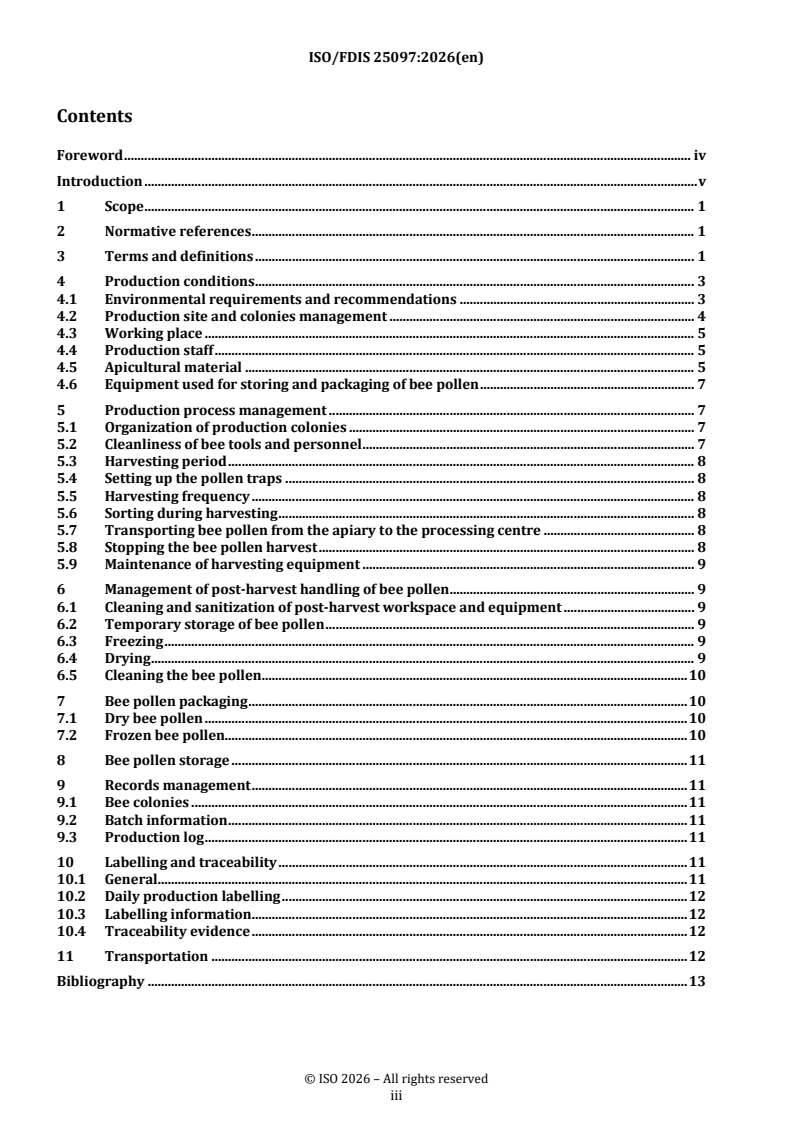
Contents
- Introduction
- 1 Scope
- 2 Normative references
- 3 Terms and definitions
- 3.1 pollen
- 3.2 worker bee
- 3.3 bee pollen
- 3.4 bee floral crop
- 3.5 apiary
- 3.6 bee pollen production
- 3.7 pollen trap
- 3.8 trapping screen
- 3.9 collection drawer/tray
- 3.10 transport tray
- 3.11 dried bee pollen
- 3.12 frozen bee pollen
- 3.13 lyophilized bee pollen
- 3.14 conventional drying
- 3.15 freeze-drying
- 3.16 monofloral bee pollen
- 4 Production conditions
- 4.1 Environmental requirements and recommendations
- 4.2 Production site and colonies management
- 4.3 Working place
- 4.4 Production staff
- 4.5 Apicultural material
- 4.6 Equipment used for storing and packaging of bee pollen
- 5 Production process management
- 5.1 Organization of production colonies
- 5.2 Cleanliness of bee tools and personnel
- 5.3 Harvesting period
- 5.4 Setting up the pollen traps
- 5.5 Harvesting frequency
- 5.6 Sorting during harvesting
- 5.7 Transporting bee pollen from the apiary to the processing centre
- 5.8 Stopping the bee pollen harvest
- 5.9 Maintenance of harvesting equipment
- 6 Management of post-harvest handling of bee pollen
- 6.1 Cleaning and sanitization of post-harvest workspace and equipment
- 6.2 Temporary storage of bee pollen
- 6.3 Freezing
- 6.4 Drying
- 6.5 Cleaning the bee pollen
- 7 Bee pollen packaging
- 7.1 Dry bee pollen
- 7.2 Frozen bee pollen
- 8 Bee pollen storage
- 9 Records management
- 9.1 Bee colonies
- 9.2 Batch information
- 9.3 Production log
- 10 Labelling and traceability
- 10.1 General
- 10.2 Daily production labelling
- 10.3 Labelling information
- 10.4 Traceability evidence
- 11 Transportation
- Bibliography
Introduction
The production and packaging of bee pollen requires well-defined management standards to ensure quality, safety and traceability. As a natural product with increasing global demand in the food and health sectors, bee pollen must be handled under controlled conditions to preserve its natural composition, quality, nutritional and functional properties.
This document has been developed to establish best practices for the production, harvesting, processing and packaging of bee pollen. It provides requirements and guidance on key aspects such as collection methods, hygiene, contamination prevention, storage conditions and labelling to ensure high quality of the final product.
This document assists producers, processors and distributors in meeting regulatory and safety requirements while promoting consumer confidence and international trade. It complies with global food safety principles and helps to improve and harmonize beekeeping and industry practices to ensure that bee pollen meets high-quality standards worldwide.
FINAL DRAFT International Standard ISO/FDIS 25097:2026(en) Bee pollen production
1 Scope
This document specifies the minimum requirements and gives guidance on all steps of the production of high-quality bee pollen for national and international markets. It specifies the environmental conditions, process control and technical requirements for harvesting, processing, packaging, labelling, storing and transporting bee pollen.
2 Normative references
The following documents are referred to in the text in such a way that some or all of their content constitutes requirements of this document. For dated references, only the edition cited applies. For undated references, the latest edition of the referenced document (including any amendments) applies. ISO 3166-1, Codes for the representation of names of countries and their subdivisions — Part 1: Country code ISO 24382:2023, Bee pollen — Specifications
3 Terms and definitions
For the purposes of this document, the following terms and definitions apply. ISO and IEC maintain terminology databases for use in standardization at the following addresses:
- ISO Online browsing platform: available at https:// www .iso .org/ obp
- IEC Electropedia: available at https:// www .electropedia .org/
3.1 pollen
male gametophytes produced in the anther of the stamen of flower structures in plants (predominantly angiosperms), which appears as a fine to coarse powder of microscopic grains carried by insects or the wind or other pollinating agencies
3.2 worker bee
female bee, within the colony of honey bees, with underdeveloped reproductive abilities that is responsible for various duties, such as cell cleaning and polishing, nursing, wax secretion and comb building, safeguarding and foraging
3.3 bee pollen
result of the agglutination of flower pollen (3.1) grains with nectar and salivary substances, after having been collected by worker bees (3.2) Note 1 to entry: Bee pollen is subject to food safety quality criteria according to international food legislation.
3.4 bee floral crop
cultivated plant that produces nectar and/or pollen (3.1) to attract bees and other pollinators
ISO/FDIS 25097:2026(en)
3.5 apiary
group of bee colonies under suitable production conditions, including the settlement site and respective infrastructure
3.6 bee pollen production
process from management of bee pollen (3.3) production colonies until packaging and labelling of bee pollen
3.7 pollen trap
device that fits over the hive entrance or is integrated into the hive and that forces returning foragers to crawl through a trapping screen (3.8) in order to enter the hive, dropping part of their bee pollen (3.3)
3.8 trapping screen
pollen collector grille pollen collector grid pollen collection system, typically a wire or plastic mesh or a punched plate with small holes through which the bee pollen (3.3) can be removed, detached from the baskets located on the legs of the bees and collected in a collection drawer Note 1 to entry: It is a component of the pollen trap (3.7).
Note 2 to entry: The openings are so small that worker bees (3.2) can only snuggly pass through so that some of the pollen pellets are stripped from the bees’ legs and fall into a collection drawer/tray (3.9).
3.9 collection drawer/tray
container located under the trapping screen (3.8) which is covered with mesh to prevent retrieval of pollen by the bees Note 1 to entry: This component of the pollen trap (3.7), which is located under the trapping screen, receives and temporarily stores bee pollen (3.3) that is detached from the bees’ legs.
3.10 transport tray
container used to transport bee pollen (3.3) between the apiary (3.5) and the bee pollen storage room
3.11 dried bee pollen
bee pollen (3.3) obtained through dehydration to decrease water content under controlled conditions and a temperature no higher than 40 °C without ultraviolet (UV) light exposure
3.12 frozen bee pollen
bee pollen (3.3) obtained immediately through a freezing process, at a freezing temperature less than or equal to −18 °C, without any drying treatment until consumed
3.13 lyophilized bee pollen
bee pollen (3.3) obtained from frozen bee pollen (3.12) after a process of lyophilization
3.14 conventional drying
process of drying bee pollen (3.3) by removing water by a stream of warm, dry air until it reaches the desired moisture content Note 1 to entry: Other drying procedures that prove to provide similar results can be used.
ISO/FDIS 25097:2026(en)
3.15 freeze-drying
process of drying bee pollen (3.3) by removing water by sublimation, i.e. directly converting the water from a solid state to gas, under vacuum
3.16 monofloral bee pollen
bee pollen (3.3) that can be classified as monofloral of one species, if that species represents 80 % of the total volume Note 1 to entry: After analysis of the pollens (3.1), the size of the dominant pollen grains in the sample shall be checked to see if the percentage by volume is at least 80 % of the total volume of the pollen present, in accordance with ISO 24382:2023.
4 Production conditions
4.1 Environmental requirements and recommendations
4.1.1 Foraging area and floral diversity
In the bees’ foraging area (within 3 km), the environment should be rich and diversified in pollen during the harvesting period, unless the aim is to produce monofloral bee pollen. In the latter case, the apiary should be surrounded by a large area of pollen source plant of the same species.
4.1.2 Location
The location of the apiary should be dry (avoiding damp ground or stagnant water bodies around) and welloriented to take advantage of the sun’s rays even in the undergrowth, with a beneficial microclimate.
4.1.3 Optimal foraging conditions
Bee pollen is a beekeeping product which rapidly absorbs toxic products present in the air and, to a lesser extent, in the soil. For this reason, care should be taken to ensure that pollen is collected only in environments with very low levels of pollution.
Beekeepers should avoid:
- polluting industrial areas (chemical industry, pesticide factories, etc.);
- the vicinity of busy roads;
- bee floral crops or agricultural areas that are frequently treated with antibiotics and/or pesticides in a 3 km radius;
- bee floral crops with genetically modified organisms (GMOs) within a 5 km radius (otherwise, the bee pollen shall be analysed to detect any GMOs present in the collected pollen, since it can be sold in countries where labelling in required for GMOs);
- heavily urbanized areas.
4.2 Production site and colonies management
4.2.1 Apiary hygiene
Keep the apiary clean and hygienic. The bees should have access to clean water. The colonies should have good pollen and honey reserves. The production colonies shall be free from any clinical signs of diseases and enemies.
ISO/FDIS 25097:2026(en) Producers should ensure compliance with applicable microbiological criteria established in general food safety legislation as a means of verifying the effectiveness of hygiene practices and upstream processes.
4.2.2 Choice of bees
The choice of honey bee species/race should be based on the bees’ local adaptability, productivity and high resistance to diseases.
4.2.3 Colonies requirement
In a harvest apiary, the colonies should be well developed and of similar strength so that they can all be managed in the same way, to avoid drifts between colonies. Colonies can be equalized if necessary.
4.2.4 Queen management
In order to homogenize pollen production and limit swarm fever, young queens should be present. Colonies should be inspected regularly to ensure that brood development is correct and that there is no outbreak of swarm fever.
4.2.5 Hives orientation
The orientation of the hives should prevent fertilizer or other agricultural products from splashing into the pollen traps. The bee hives should be at a minimum distance of 30 m from the agricultural zone.
4.2.6 Health of colonies
The beekeeper shall be extremely vigilant about the health of the colonies. The beekeeper shall not use any treatment during the period of bee pollen production.
Antibiotics and persistent veterinary medicine shall not be used at any time in the colonies producing pollen.
4.2.7 Disease and pest management
At the first signs of any bee disease that affects pollen quality, harvesting should be stopped on the colonies showing the signs.
The suspected sick colony should be treated and, if necessary, isolated. It should be confirmed to be healthy before returning to the bee pollen production.
...
Contents
- Introduction
- 1 Scope
- 2 Normative references
- 3 Terms and definitions
- 3.1 pollen
- 3.2 worker bee
- 3.3 bee pollen
- 3.4 bee floral crop
- 3.5 apiary
- 3.6 bee pollen production
- 3.7 pollen trap
- 3.8 trapping screen
- 3.9 collection drawer/tray
- 3.10 transport tray
- 3.11 dried bee pollen
- 3.12 frozen bee pollen
- 3.13 lyophilized bee pollen
- 3.14 conventional drying
- 3.15 freeze-drying
- 3.16 monofloral bee pollen
- 4 Production conditions
- 4.1 Environmental requirements and recommendations
- 4.2 Production site and colonies management
- 4.3 Working place
- 4.4 Production staff
- 4.5 Apicultural material
- 4.6 Equipment used for storing and packaging of bee pollen
- 5 Production process management
- 5.1 Organization of production colonies
- 5.2 Cleanliness of bee tools and personnel
- 5.3 Harvesting period
- 5.4 Setting up the pollen traps
- 5.5 Harvesting frequency
- 5.6 Sorting during harvesting
- 5.7 Transporting bee pollen from the apiary to the processing centre
- 5.8 Stopping the bee pollen harvest
- 5.9 Maintenance of harvesting equipment
- 6 Management of post-harvest handling of bee pollen
- 6.1 Cleaning and sanitization of post-harvest workspace and equipment
- 6.2 Temporary storage of bee pollen
- 6.3 Freezing
- 6.4 Drying
- 6.5 Cleaning the bee pollen
- 7 Bee pollen packaging
- 7.1 Dry bee pollen
- 7.2 Frozen bee pollen
- 8 Bee pollen storage
- 9 Records management
- 9.1 Bee colonies
- 9.2 Batch information
- 9.3 Production log
- 10 Labelling and traceability
- 10.1 General
- 11 Transportation
- Bibliography
Introduction
The production and packaging of bee pollen requires well-defined management standards to ensure quality, safety and traceability. As a natural product with increasing global demand in the food and health sectors, bee pollen must be handled under controlled conditions to preserve its natural composition, quality, nutritional and functional properties.
This document has been developed to establish best practices for the production, harvesting, processing and packaging of bee pollen. It provides guidance and requirements and guidance on key aspects such as collection methods, hygiene, contamination prevention, storage conditions and labelling to ensure a high quality of the final product.
This document for and gives guidance on aims to assistassists producers, processors and distributors in meeting regulatory and safety requirements while promoting consumer confidence and international trade. It complies with global food safety principles and helps to improve and harmoniseharmonize beekeeping and industry practices to ensure that bee pollen meets high-quality standards worldwide.
ISO/FDIS 25097:2026(en) Bee pollen production
1 Scope
This standarddocument specifies the minimum requirements and gives guidance on all the steps of the production of high-quality bee pollen for national and international markets. It specifies the environmental conditions, the process control, and the technical requirements for harvesting, processing, packaging, labelling, storagestoring and transportation oftransporting bee pollen.
2 Normative references
The following documents are referred to in the text in such a way that some or all of their content constitutes requirements of this document. For dated references, only the cited edition cited applies. For undated references, the latest edition of the referenced document (including any amendments) applies. ISO 24382:2023 Bee pollen - Specifications ISO 22005, Traceability in the feed and food chain — General principles and basic requirements for system design and implementation Add in 2 ISO 3166-1, Codes for the representation of names of countries and their subdivisions –— Part 1:
Country code ISO 24382:2023, Bee pollen — Specifications
3 Terms and definitions
For the purposes of this document, the following terms and definitions apply. ISO and IEC maintain terminology databases for use in standardization at the following addresses:
- ISO Online browsing platform: available at https://www.iso.org/obp
- IEC Electropedia: available at https://www.electropedia.org/
3.1 pollen
male gametophytes produced in the anther of the stamen of flower structures in plants (predominantly angiosperms), which appears as a fine to coarse powder of microscopic grains carried by insects or the wind or other pollinating agencies.
3.2 worker bee
female bee, within the colony of honey bees, with underdeveloped reproductive abilities that is responsible for various duties, such as cell cleaning and polishing, nursing, wax secretion and comb building, safeguarding and foraging.
3.3 bee pollen
result of the agglutination of flower pollen (3.1) grains with nectar and salivary substances, after having been collected by worker bees (3.2).
Note 1 to entry: Bee pollen must fulfilis subject to food safety quality criteria according to international food legislation.
ISO/FDIS 25097:2026(en)
3.4 bee floral crop
cultivated plant that produces nectar and/or pollen (3.1) to attract bees and other pollinators
3.5 apiary
group of bee colonies under suitable production conditions, including the settlement site and respective infrastructure
3.6 bee pollen production
process from management of bee pollen (3.3) production colonies until packaging and labelling of bee pollen
3.7 pollen trap
device that fits over the hive entrance or is integrated into the hive and that forces returning foragers to crawl through a trapping screen (3.8) in order to enter the hive, dropping part of their bee pollen (3.3)
3.8 trapping screen
pollen collector grille pollen collector grid pollen collection system, typically a wire or plastic mesh or a punched plate with small holes through which the bee pollen (3.3) can be removed, detached from the baskets located on the legs of the bees and collected in a collection drawer.
Note 1 to entry: It is a component of the pollen trap (3.7.).
Note 2 to entry: The openings are so small that worker bees (3.2) can only snuggly pass through so that some of the pollen pellets are stripped from the bees'bees’ legs and fall into a collection drawer/tray (3.9.). Note 3 to entry: « Pollen collector grille » and « Pollen collector grid » are equivalent to “trapping screen”
3.9 collection drawer/tray
container located under the trapping screen (3.8) which is covered with mesh to prevent retrieval of pollen by the bees.
Note 1 to entry: This component of the pollen trap (3.7,), which is located under the trapping screen (3.8),, receives and temporarily stores bee pollen (3.3) that is detached from the bees’ legs.
3.10 transport tray
container used to transport bee pollen (3.3) between the apiary (3.5) and the bee pollen storage room,
3.11 dried bee pollen
bee pollen (3.3) obtained through dehydration to decrease water content under controlled conditions and a temperature no higher than 40 °C without ultraviolet (UV) light exposure.
3.12 frozen bee pollen
bee pollen (3.3) obtained immediately through a freezing process, at a freezing temperature less than or equal to -−18 °C,”,, without any drying treatment until consumed.
ISO/FDIS 25097:2026(en)
3.13 lyophilized bee pollen
bee pollen (3.3) obtained from frozen bee pollen (3.12) after a process of lyophilization
3.14 conventional drying
process of drying the bee pollen (3.3) by removing the water by a stream of warm, dry air until it reaches the desired moisture content.
Note 1 to entry: other Other drying procedures that prove to provide similar results can be used.
3.15 freeze-drying
process of drying the bee pollen (3.3) by removing the water by sublimation, under vacuum that is,i.e. directly converting the water from a solid state to gas., under vacuum
3.16 monofloral bee pollen
bee pollen (3.3) that can be classified as monofloral of one species, if that species represents 80 % of the total volume, determined according standard 24382:2023 Note 1 to entry: After analysis of the pollens (3.1,), the size of the dominant pollen grains found to be number-wise being dominant in the sample shall be checked to see if the percentage by volume is at least 80 % of the total volume of the pollen present, in accordance with ISO 24382:2023.
4 Production conditions
4.1 Environmental requirements and recommendations
4.1.1 Foraging area and floral diversity
In the bees'bees’ foraging area (within 3 km), anthe environment should be rich and diversified in pollen during the harvesting period, unless the aim is to produce monofloral bee pollen. In the latter case, the apiary should be surrounded by a large area of pollen source plant of the same species.
4.1.2 Location
The location of the apiary should be dry (avoidavoiding damp ground or stagnant water bodies around),) and well-oriented to take advantage of the sun’s rays even in the undergrowth, with a beneficial microclimate.
4.1.3 Optimal foraging conditions
Bee pollen is a beekeeping product which rapidly absorbs toxic products present in the air and, to a lesser extent, in the soil. For this reason, care should be taken to ensure that pollen is collected only in environments with very low levels of pollution.
Beekeepers should avoid:
- polluting industrial areas (chemical industry, pesticide factories, etc.);
- the vicinity of busy roads;
- bee floral crops or agricultural areas that are frequently treated with antibiotics and/or pesticides in a 3 km radius;
ISO/FDIS 25097:2026(en) - Genetically Modified Organisms (GMO) bee floral crops with genetically modified organisms (GMOs) within a 5 km radius, (otherwise special analyse must, the bee pollen shall be doneanalysed to detect GMOany GMOs present in the pollen collected that willpollen, since it can be sold in countries where GMO must be labeled;labelling in required for GMOs); - heavily urbanisedurbanized areas.
4.2 Production site and colonies management
4.2.1 Apiary hygiene
Keep the apiary clean and hygienic. The bees should have an access to clean water. The colonies should have good pollen and honey reserves. The production colonies shall be free from any clinical signs of diseases and enemies.
Producers should ensure compliance with applicable microbiological criteria established in general food safety legislation as a means of verifying the effectiveness of hygiene practices and upstream processes.
4.2.2 Choice of bees
The choice of honey bee species/race should be based on theirthe bees’ local adaptability, productivity and high resistance to diseases.
4.2.3 Colonies requirement
In a harvest apiary, the colonies should be well developed and of similar strength so that they can all be managed in the same way, to avoid drifts between colonies. Colonies can be equalized if necessary.
4.2.4 Queen management
In order to homogenize pollen production and limit swarm fever, young queens should be present. Colonies should be inspected regularly to ensure that brood development is correct and that there is no outbreak of swarm fever.
4.2.5 Hives orientation
The orientation of the hives should prevent fertilizer or other agricultural products from splashing into the pollen traps. The bee hives should be at a minimum distance of minimum 30 m offrom the agricultural zone.
4.2.6 Health of colonies
The beekeeper shall be extremely vigilant about the health of the colonies. The beekeeper shall not use any treatment during the period of bee pollen production.
Antibiotics and persistent veterinary medicine shall not be used at any time in the colonies producing pollen.
4.2.7 Disease and pest management
At the first signs of any bee disease that affects pollen quality, harvesting should be stopped on the colonies showing the signs.
...