

ISO 16687:2025
(Main)Impact assessment for museums
General Information
- Abstract
This document defines methods for measuring and assessing the impact of museums on individuals and on society. The methods described can be used for identifying areas of influence of museums and their services, and for reporting such influence to stakeholders and the general public. This document does not intend to exclude the use of further instruments for assessing the impact of museums. This document does not deal with quality indicators for museums (see ISO 21246). Not all methods described can apply to all museums at any time. Limitations on the applicability of individual methods are specified in the descriptions of the methods in this document.
- Status
- Published
- Publication Date
- 30-Apr-2025
- Technical Committee
- ISO/TC 46/SC 8 - Quality - Statistics and performance evaluation
- Drafting Committee
- ISO/TC 46/SC 8 - Quality - Statistics and performance evaluation
- Current Stage
- 6060 - International Standard published
- Start Date
- 01-May-2025
- Due Date
- 26-Jun-2025
- Completion Date
- 01-May-2025


Overview
ISO 16687:2025 - Impact assessment for museums - defines methods for measuring and assessing the impact of museums on individuals and on society. The standard provides a structured framework to identify areas of influence of museums and their services and to report those influences to stakeholders and the public. It is intended as guidance rather than a prescriptive checklist: not all methods apply to every museum and the document notes limitations and applicability for individual methods.
Key topics and technical requirements
- Scope and purpose
- Methods to assess museum impact on individuals, communities and society.
- Guidance for reporting results to stakeholders and the general public.
- Core functions and target groups
- Defines museum core functions (collecting, cataloguing, preserving, exhibiting, education, research, management) and target audiences (museum audience, defined populations, user groups).
- Types and aspects of impact
- Differentiates impacts on individuals, cultural, social, environmental and economic impacts.
- Methods for impact assessment
- Inferred evidence: statistics, key indicators, satisfaction surveys, media echo.
- Observed evidence: observation, tests, citation analysis.
- Solicited evidence: impact surveys, interviews, focus groups, combined methods, anecdotal evidence.
- Economic impact
- Approaches for estimating visitor value, visit costs and direct/indirect economic effects on surrounding communities and industries.
- Presentation and limitations
- Guidance on presenting results and a discussion of measurement challenges (intangibility, subjective qualitative data, long-term effects, assessment skills).
- Supporting material
- Annex A provides examples of impact surveys for different museum target groups.
Practical applications and users
ISO 16687 is practical for:
- Museum directors and program managers designing evaluation frameworks.
- Collections and education staff measuring learning, engagement and cultural impact.
- Evaluation professionals and researchers conducting visitor studies, surveys and citation analyses.
- Funders, policymakers and cultural planners assessing economic and social returns on museum investments.
- Communications teams preparing impact reports and stakeholder communications.
Practical uses include:
- Designing impact surveys and mixed-method evaluations.
- Quantifying visitor benefits and reporting economic contribution to local economies.
- Benchmarking outreach, educational programs and exhibition outcomes.
- Supporting funding proposals with standardized impact evidence.
Related standards
- ISO 21246 - Key indicators for museums (referenced for quality indicators; ISO 16687 does not replace ISO 21246).
Keywords: ISO 16687, impact assessment for museums, museum impact assessment, museum evaluation methods, economic impact of museums, cultural impact, impact surveys.
Frequently Asked Questions
ISO 16687:2025 is a standard published by the International Organization for Standardization (ISO). Its full title is "Impact assessment for museums". This standard covers: This document defines methods for measuring and assessing the impact of museums on individuals and on society. The methods described can be used for identifying areas of influence of museums and their services, and for reporting such influence to stakeholders and the general public. This document does not intend to exclude the use of further instruments for assessing the impact of museums. This document does not deal with quality indicators for museums (see ISO 21246). Not all methods described can apply to all museums at any time. Limitations on the applicability of individual methods are specified in the descriptions of the methods in this document.
This document defines methods for measuring and assessing the impact of museums on individuals and on society. The methods described can be used for identifying areas of influence of museums and their services, and for reporting such influence to stakeholders and the general public. This document does not intend to exclude the use of further instruments for assessing the impact of museums. This document does not deal with quality indicators for museums (see ISO 21246). Not all methods described can apply to all museums at any time. Limitations on the applicability of individual methods are specified in the descriptions of the methods in this document.
ISO 16687:2025 is classified under the following ICS (International Classification for Standards) categories: 01.140.20 - Information sciences; 97.195 - Items of art and handicrafts. Cultural property and heritage. The ICS classification helps identify the subject area and facilitates finding related standards.
ISO 16687:2025 is available in PDF format for immediate download after purchase. The document can be added to your cart and obtained through the secure checkout process. Digital delivery ensures instant access to the complete standard document.
Standards Content (Sample)
International
Standard
ISO 16687
First edition
Impact assessment for museums
2025-05
Évaluation de l’impact des musées
Reference number
© ISO 2025
All rights reserved. Unless otherwise specified, or required in the context of its implementation, no part of this publication may
be reproduced or utilized otherwise in any form or by any means, electronic or mechanical, including photocopying, or posting on
the internet or an intranet, without prior written permission. Permission can be requested from either ISO at the address below
or ISO’s member body in the country of the requester.
ISO copyright office
CP 401 • Ch. de Blandonnet 8
CH-1214 Vernier, Geneva
Phone: +41 22 749 01 11
Email: copyright@iso.org
Website: www.iso.org
Published in Switzerland
ii
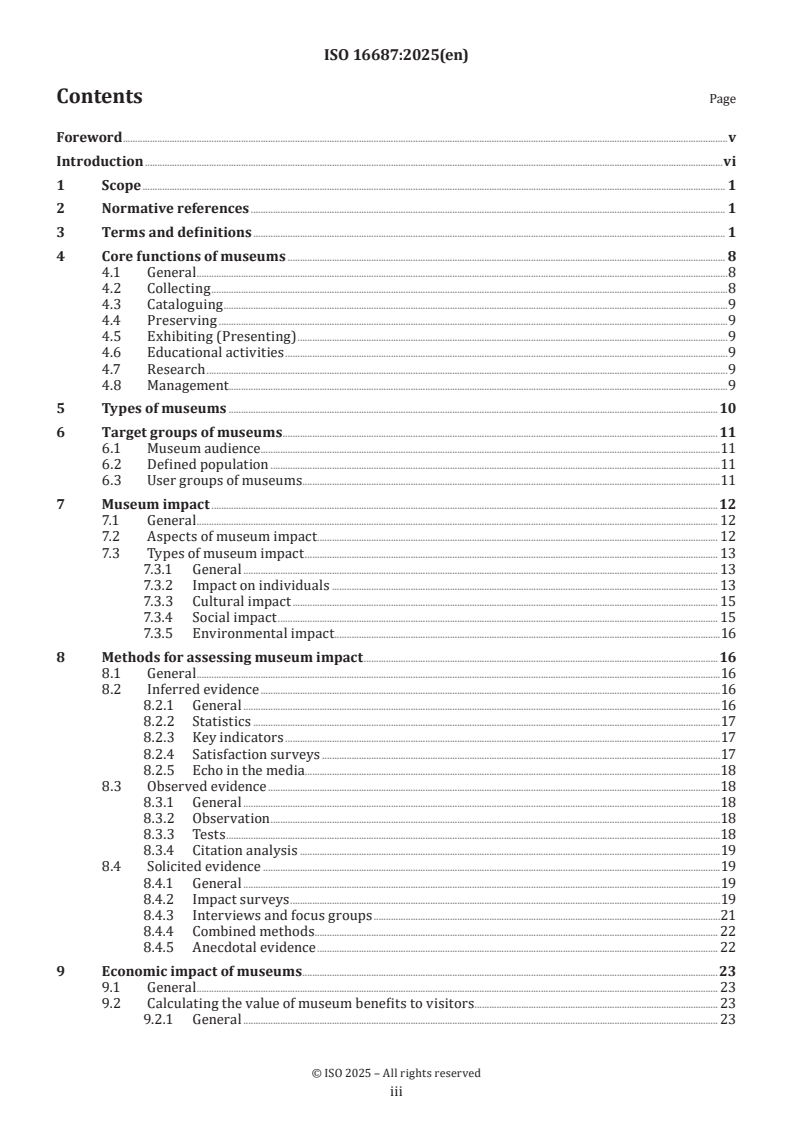
Contents Page
Foreword .v
Introduction .vi
1 Scope . 1
2 Normative references . 1
3 Terms and definitions . 1
4 Core functions of museums . 8
4.1 General .8
4.2 Collecting .8
4.3 Cataloguing .9
4.4 Preserving .9
4.5 Exhibiting (Presenting) .9
4.6 Educational activities .9
4.7 Research .9
4.8 Management . . .9
5 Types of museums .10
6 Target groups of museums .11
6.1 Museum audience .11
6.2 Defined population .11
6.3 User groups of museums.11
7 Museum impact .12
7.1 General . 12
7.2 Aspects of museum impact . 12
7.3 Types of museum impact . 13
7.3.1 General . 13
7.3.2 Impact on individuals . 13
7.3.3 Cultural impact . 15
7.3.4 Social impact . 15
7.3.5 Environmental impact . .16
8 Methods for assessing museum impact .16
8.1 General .16
8.2 Inferred evidence .16
8.2.1 General .16
8.2.2 Statistics .17
8.2.3 Key indicators .17
8.2.4 Satisfaction surveys .17
8.2.5 Echo in the media.18
8.3 Observed evidence .18
8.3.1 General .18
8.3.2 Observation .18
8.3.3 Tests .18
8.3.4 Citation analysis .19
8.4 Solicited evidence .19
8.4.1 General .19
8.4.2 Impact surveys .19
8.4.3 Interviews and focus groups .21
8.4.4 Combined methods . . 22
8.4.5 Anecdotal evidence . 22
9 Economic impact of museums .23
9.1 General . 23
9.2 Calculating the value of museum benefits to visitors . 23
9.2.1 General . 23
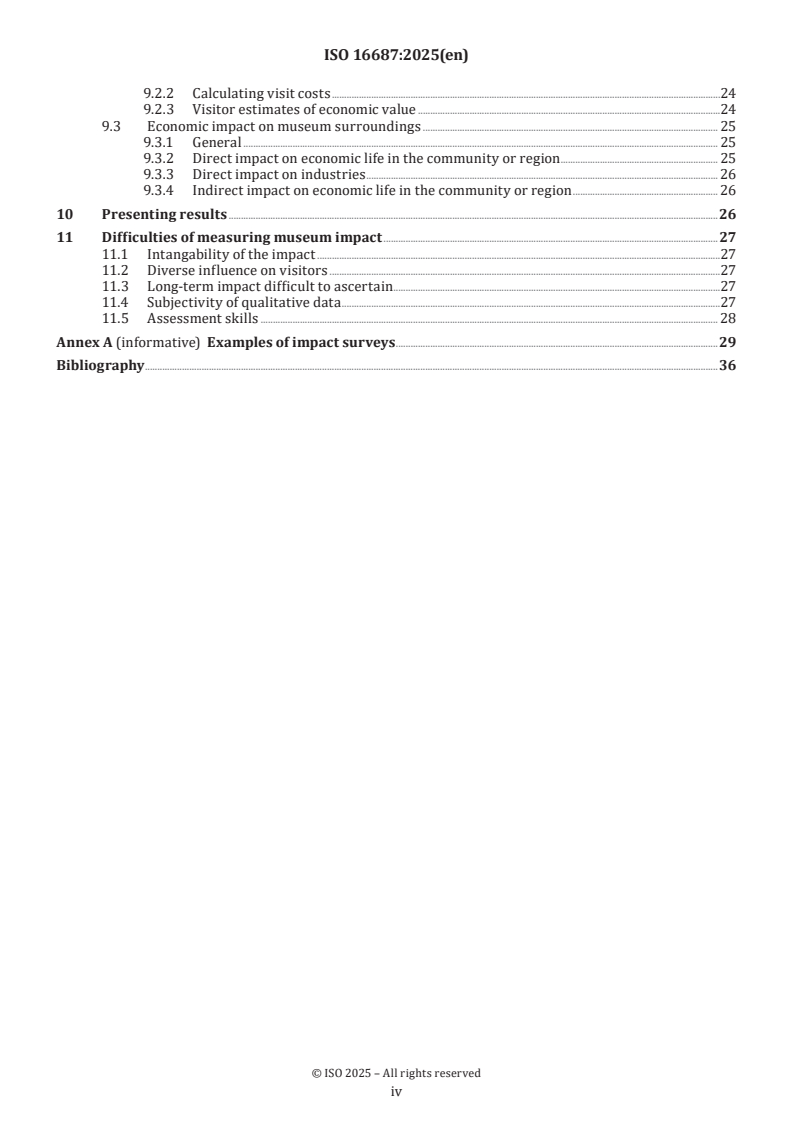
iii
9.2.2 Calculating visit costs .24
9.2.3 Visitor estimates of economic value .24
9.3 Economic impact on museum surroundings . 25
9.3.1 General . 25
9.3.2 Direct impact on economic life in the community or region . 25
9.3.3 Direct impact on industries . 26
9.3.4 Indirect impact on economic life in the community or region . 26
10 Presenting results .26
11 Difficulties of measuring museum impact .27
11.1 Intangability of the impact .27
11.2 Diverse influence on visitors .27
11.3 Long-term impact difficult to ascertain .27
11.4 Subjectivity of qualitative data .27
11.5 Assessment skills . 28
Annex A (informative) Examples of impact surveys .29
Bibliography .36
iv
Foreword
ISO (the International Organization for Standardization) is a worldwide federation of national standards
bodies (ISO member bodies). The work of preparing International Standards is normally carried out through
ISO technical committees. Each member body interested in a subject for which a technical committee
has been established, has the right to be represented on that committee. International organizations,
governmental and non-governmental, in liaison with ISO, also take part in the work. ISO collaborates closely
with the International Electrotechnical Commission (IEC) on all matters of electrotechnical standardization.
The procedures used to develop this document and those intended for its further maintenance are described
in the ISO/IEC Directives, Part 1. In particular, the different approval criteria needed for the different types
of ISO documents should be noted. This document was drafted in accordance with the editorial rules of the
ISO/IEC Directives, Part 2 (see www.iso.org/directives).
ISO draws attention to the possibility that the implementation of this document may involve the use of (a)
patent(s). ISO takes no position concerning the evidence, validity or applicability of any claimed patent
rights in respect thereof. As of the date of publication of this document, ISO had not received notice of (a)
patent(s) which may be required to implement this document. However, implementers are cautioned that
this may not represent the latest information, which may be obtained from the patent database available at
www.iso.org/patents. ISO shall not be held responsible for identifying any or all such patent rights.
Any trade name used in this document is information given for the convenience of users and does not
constitute an endorsement.
For an explanation of the voluntary nature of standards, the meaning of ISO specific terms and expressions
related to conformity assessment, as well as information about ISO's adherence to the World Trade
Organization (WTO) principles in the Technical Barriers to Trade (TBT), see www.iso.org/iso/foreword.html.
This document was prepared by Technical Committee ISO/TC 46, Information and documentation,
Subcommittee SC 8, Quality - Statistics and performance evaluation.
Any feedback or questions on this document should be directed to the user’s national standards body. A
complete listing of these bodies can be found at www.iso.org/members.html.
v
Introduction
This document provides guidance to the museum community on assessing the impact of museums for
individuals and society. It specifies the aspects of museum and describes methods to be used of museum
of all types. Some methods are already used in museums while others are derived from museum literature.
Annex A gives examples of impact surveys for different target groups of museums.
vi
International Standard ISO 16687:2025(en)
Impact assessment for museums
1 Scope
This document defines methods for measuring and assessing the impact of museums on individuals and on
society. The methods described can be used for identifying areas of influence of museums and their services,
and for reporting such influence to stakeholders and the general public.
This document does not intend to exclude the use of further instruments for assessing the impact of
museums. This document does not deal with quality indicators for museums (see ISO 21246).
Not all methods described can apply to all museums at any time. Limitations on the applicability of individual
methods are specified in the descriptions of the methods in this document.
2 Normative references
The following documents are referred to in the text in such a way that some or all of their content constitutes
requirements of this document. For dated references, only the edition cited applies. For undated references,
the latest edition of the referenced document (including any amendments) applies.
ISO 21246, Information and documentation — Key indicators for museums
3 Terms and definitions
For the purposes of this document, the following terms and definitions apply.
ISO and IEC maintain terminology databases for use in standardization at the following addresses:
— ISO Online browsing platform: available at https:// www .iso .org/ obp
— IEC Electropedia: available at https:// www .electropedia .org/
3.1
access
right, opportunity, means of finding, using or retrieving information, of using a service; or
entering a building
[SOURCE: ISO 11620:2023, 3.2]
3.2
accessibility
ease of reaching and using a service or facility
Note 1 to entry: This includes digital services, such as online catalogues or digital collections.
[SOURCE: ISO 11620:2023, 3.3, modified — Note 1 to entry added]
3.3
altruistic value
value (3.50) that is placed on a good or service giving the opportunity to be taken advantage of by others
than the valuating person
3.4
anecdotal evidence
proof based on anecdotes or stories, obtained informally from personal observations and experiences, not
collected systematically nor empirically tested
[SOURCE: ISO 16439:2014, 3.5]
3.5
attitude
disposition to respond in a given way toward a class of objects or ideas
[SOURCE: ISO 5492:2008, 1.38]
3.6
benefit
helpful or good effect
[SOURCE: ISO 16439:2014, 3.7 modified — “or something intended to help” omitted]
3.7
bequest value
value of preserving (the existence of) a good or service to take advantage of in the future
3.8
catalogue
collection of records containing all known, relevant information about an object in a museum (3.29) collection
Note 1 to entry: Such information can include origin, age, creator, title (e.g. for works of art), physical description
(materials and/or techniques used in production, physical dimensions), state of conservation, use, provenance, etc. of
the object.
Note 2 to entry: For digital media, the addition of persistent identifiers may be included in the cataloguing.
[SOURCE: ISO 18461:2016, 2.8.2, modified — Note 1 “state of conservation” added; Note 2 to entry added]
3.9
community value
value (3.50) that is placed on the existence of a resource that can be used by a whole community
3.10
contingent valuation
method for assessing the economic value of non-profit institutions and projects of public utility depending
on potential users’ responses to survey questions, such as what they are willing to pay for a benefit (3.6)
or feature (willingness-to-pay), or what they would accept as financial compensation if a certain benefit or
feature was missing (willingness-to-accept)
Note 1 to entry: The method is used in environmental protection and health care, for example.
[SOURCE: ISO 16439:2014, 3.9]
3.11
cultural heritage
legacy of physical objects and intangible attributes of a group or a society that are inherited from past
generations, maintained and protected in the present and preserved for future generations
[SOURCE: ISO 18461:2016, 2.1]
3.12
digitization
process of converting analogue materials into digital form
[SOURCE: ISO 21246:2019, 3.13]
3.13
economic impact
effect of a policy, institution, programme, or event on the economy of a given area
Note 1 to entry: Economic impact is usually measured in terms of changes in economic growth (output or value added)
and associated changes in jobs (employment) and income (wages).
[SOURCE: ISO 16439:2014; 3.16]
3.14
educational services
learning sessions and learning materials and programmes in all formats for children and adults for the
purpose of enhancing skills and knowledge
Note 1 to entry: This includes the provision of services for schools and the cooperation with other partners in
preparing and offering educational services.
[SOURCE: ISO 21246:2019, 3.17]
3.15
effectiveness
measurement of the degree to which given objectives are achieved
Note 1 to entry: An activity is effective if it maximizes the results it was established to produce.
[SOURCE: ISO 11620:2023, 3.22]
3.16
efficiency
measurement of the utilisation of resources to realize a given objective
Note 1 to entry: An activity is efficient if it minimizes the use of resources, or produces better performance with the
same resources.
[SOURCE: ISO 11620:2023, 3.23]
3.17
evaluation
process of determining the effectiveness (3.15), efficiency (3.16), benefit (3.6) and relevance of a service or
facility
[SOURCE: ISO 11620:2023, 3.25 modified, “utility” replaced by “benefit”]
3.18
event
pre-arranged singular activity having an intent within the mission (3.28) of the museum (3.29)
Note 1 to entry: The activity would usually be of a cultural, educational, social, political or scholarly nature, and
would take the form of lectures, film screening, theatre performances, round table discussions, vernissage, finnisage,
museum night, etc.
Note 2 to entry: Events can be organized inside or outside the museum premises.
Note 3 to entry: Events inside the museum premises organized by institutions outside the museum and without the
museum’s participation should be counted separately.
Note 4 to entry: Guided tours, programmes, exhibitions and virtual events are excluded.
[SOURCE: ISO 21246:2019, 3.21]
3.19
exhibition
curated display of museum objects or other items of cultural heritage on a clear concept and communicating
a message
Note 1 to entry: Exhibitions can take place inside or outside the museum premises.
Note 2 to entry: Exhibitions can be temporary (3.46) or permanent (3.35).
Note 3 to entry: Virtual exhibitions are excluded.
Note 4 to entry: Exhibitions inside the museum premises organized by institutions outside the museum without the
museum’s participation should be counted separately.
[SOURCE: ISO 18461:2016, 2.4.6]
3.20
existence value
value of knowing that a good or service exists even though it is not intended to use it at this given moment in time
3.21
focus group interview
focus group discussion
group interview (3.23) in the form of a moderated discussion among a small number of selected individuals
on topics introduced by the moderator
[SOURCE: ISO 16439:2014, 3.23]
3.22
goal
desired state of affairs to be achieved by the implementation of agreed policies
[SOURCE: ISO 21246:2019, 3.24]
3.23
group interview
interview (3.26) of an interviewer with a number of people who are assembled at some moment as a group,
by posing a question and taking in the answer(s) of one or more members of this group
3.24
impact
change in an individual or group resulting from the contact with museum services
Note 1 to entry: The change can be tangible or intangible.
[SOURCE: ISO 16439:2014, 3.25, modified — “difference or” deleted, “library” replaced by “museum”]
3.25
inferred evidence
conclusions derived by reasoning from known premises
3.26
interview
oral questioning technique which results in a transfer of information from the interviewee to an interviewer
or researcher
Note 1 to entry: This technique obtains direct reactions to questions, in contrast to written questionnaires or self-
assessment (self-recording).
Note 2 to entry: Interviews can be subdivided according to the number of interviewees into one-to-one interviews and
group interviews.
Note 3 to entry: Interviews can be structured, semi-structured or unstructured.
Note 4 to entry: Where semi-structured or unstructured interviews are conducted with a group of respondents, these
are usually described as group interviews.
Note 5 to entry: A specific type of group interview is the focus group interview or focus group discussion, where the
topic is tightly defined, and the interaction among group members is of particular importance.
[SOURCE: ISO 16439:2014, 3.30 modified: Note 4 to entry modified; Note 5 to entry added]
3.27
longitudinal study
two or more surveys, in which the same or a similar survey instrument is administered more than once
to the same population, after a suitable time period has elapsed, to measure changes in patterns of usage,
perceptions, attitudes, etc.
[SOURCE: ISO 16439:2014, 3.35]
3.28
mission
statement approved by the authorities formulating the organization's goals (3.22) and its choices in services
and products development
[SOURCE: ISO 21246:2019, 3.28]
3.29
museum
non-profit, permanent institution in the service of society and its development, open to the public, which
acquires, conserves, researches, communicates and exhibits the tangible and intangible heritage of humanity
and its environment for the purposes of education, study and enjoyment
Note 1 to entry: Natural, archaeological and ethnographic monuments and sites and historical monuments and sites of
a museum nature are included, if they maintain a collection similar to museums.
Note 2 to entry: Zoos, aquaria, arboreta and botanical gardens are included, but should be reported separately.
Note 3 to entry: Collections in institutions of higher education that serve only the purposes of teaching and study are
excluded.
Note 4 to entry: Conservation institutes and exhibition galleries in libraries and archives centres are included if they
conform to the definition of museum.
Note 5 to entry: To conform to the definition it is not necessary that an institution be called a museum, but that it has
the role and function of a museum.
[SOURCE: ISO 21246:2019, 3.29]
3.30
observed evidence
proof that is based on observing persons or processes
3.31
option value
value that is placed on having the option to take advantage of a good or service at a later point in time
3.32
outcome
direct, pre-defined effect of the output related to goals and objectives of the museum’s planning (e.g. number
of users, user satisfaction levels)
Note 1 to entry: This includes outcomes that concern the museum’s institution or community.
[SOURCE: ISO 16439:2014, 3.44, modified “library” replaced by “museum”]
3.33
output
products of museum processes
Note 1 to entry: Examples are number of exhibitions organized, number of objects acquired or number of opening
hours per week.
[SOURCE: ISO 16439:2014, 3.45 modified, “library” replaced by “museum”, examples changed and deferred
to “Examples”]
3.34
panel study
longitudinal research where data is collected from the same sample on multiple occasions to track changes
over time
3.35
perception
awareness of the effects of single or multiple sensory stimuli
[SOURCE: ISO 5492:2008, 2.3]
3.36
permanent exhibition
long-term exhibition
exhibition (3.19) showing, over a long period of time, objects which are in long-term custody of the museum
[SOURCE: ISO 18461:2016, 2.4.13]
3.37
preservation
all measures taken, including financial and strategic decisions, to maintain the integrity and extend the life
of documents or collections
[SOURCE: ISO 5127:2017, 3.2.1.39, modified — Notes 1 and 2 to entry have been omitted.]
3.38
qualitative data
data describing, but not measuring the attributes or properties of an object, in particular the reasons for
human actions
Note 1 to entry: The attributes can be categorized into classes that may be assigned numeric values.
[SOURCE: ISO 16439:2014, 3.52]
3.39
quantitative data
data in numerical form expressing a certain quantity, amount or range, amenable to statistical manipulation
Note 1 to entry: Quantitative data are usually expressed in measurement units.
[SOURCE: ISO 16439:2014, 3.5, modified — Examples in Note 1 to entry removed, e.g. number of loans,
percentage of interviewees visiting the library]
3.40
questionnaire
set of questions for a survey or a structured interview (3.26)
Note 1 to entry: The questions may be closed (answerable by checking one of several predetermined answers) or open
(requiring participants to answer in their own words).
[SOURCE: ISO 16439:2014, 3.55, modified — “semi-structured” deleted]
3.41
social impact
influence of a museum’s existence and services on the population in the surrounding community or on
society in general
[SOURCE: ISO 16439:2014, 3.64, modified — “library” replaced by “museum”]
3.42
solicited evidence
proof that is obtained by asking individuals or groups for their experience, opinion or estimation
3.43
street survey
interview carried out with each person of a random group of passers-by on a public street
3.44
survey
method of data collection using written questionnaires for gathering information from the whole or a
sample of a defined population
Note 1 to entry: The survey can be conducted face to face, via handouts, telephone, email, or internet.
[SOURCE: ISO 16439:2014, 3.67]
3.45
target group
group of actual and potential visitors appropriate to a museum as the object of a specific service or as the
primary users of specific materials
Note 1 to entry: Such target groups can, for example, be children, school classes, researchers, or educators.
[SOURCE: ISO 21246:2019, 3.55]
3.46
temporary exhibition
short-term exhibition
exhibition (3.19) shown during a limited period of time
Note 1 to entry: A temporary exhibition is counted only once, in the year it is started.
[SOURCE: ISO 18461:2016, 2.4.19]
3.47
user
recipient of museum services
Note 1 to entry: The recipient can be a person or an institution, including other museums.
Note 2 to entry: Museum services include electronic services, physical services and visiting the museum premises.
[SOURCE: ISO 21246:2019, 3.58]
3.48
visitor satisfaction survey
survey (3.44) administered to a sample of a museum’s visitors to find out how they rate the quality of their
museum experiences, and any suggestions for improvement
Note 1 to entry: The survey may be conducted face to face, via handouts, telephone, email, or internet.
Note 2 to entry: The survey can contain questions about visitor status, how often and how they normally use the
resources and services the museum provides.
Note 3 to entry: In a longitudinal study, the same or a similar survey instrument is administered more than once, after
a suitable interval of time has elapsed, to measure changes in patterns of usage, perceptions, attitudes, etc.
[SOURCE: ISO 16439:2014, 3.72, modified “library” replaced by “museum”; all “user” replaced by “visitor”]
3.49
validity
assurance that the results of a research process represent what was intended
[SOURCE: ISO 20252:2019, 3.104]
3.50
value
importance that stakeholders (funding institutions, politicians, the public, users, staff) attach to museums
and which is usually related to the perception of actual or potential benefit
Note 1 to entry: Monetary value can be included.
[SOURCE: ISO 21246:2019, 3.60, modified — “usually“ added]
3.51
visitor
person (individual) entering the museum premises with the aim of experiencing its exhibitions,
programmes, or other services directed towards the public
[SOURCE: ISO 21246:2019, 3.64]
3.52
visitor
person or individual accessing the museum digitally with the aim of experiencing its exhibitions,
programmes, or other services directed towards the public
3.53
visitor with special needs
person that requires special services and/or facilities for a museum visit
Note 1 to entry: The special needs can be caused by physical and health impairment, cultural difference (e.g. non-
native speakers, new arrivals), educational background, or other circumstances that require special museum services
and/or facilities.
Note 2 to entry: Children, young people and seniors without additional needs are not included.
[SOURCE: ISO 21246:2019, 3.65]
4 Core functions of museums
4.1 General
The core functions described in this clause shall be in accordance with ISO 21246.
4.2 Collecting
The main tasks are:
— to acquire objects, along and within the collection policy of the museum;
— to formulate a written collection policy according to the museum’s mission and to constantly pursue and
update it.
4.3 Cataloguing
The main tasks are:
— to catalogue/describe the collected objects in the inventory documents and in scientific catalogues and
databases;
— to make the collections visible and accessible by online catalogues and via the internet.
4.4 Preserving
The main tasks are:
— to preserve the museum’s analogue and digital collections through safe storage, stable environment,
preventive conservation and restoration treatment;
— to develop and promote disaster management plans.
4.5 Exhibiting (Presenting)
The main tasks are:
— to present, in a curated manner, the collections to the general public or to specific target groups via
permanent and temporary exhibitions;
— to offer regular and adequate opening times;
— to make the collections accessible in digital formats and in online environments;
— to offer suitable services for visitors with special needs.
4.6 Educational activities
The main tasks are:
— to support learning and education by offering educational programmes related to the museum’s mission,
collections and themes;
— to consider the needs of specific groups (adults, children, students, refugees, etc.) in programmes and events;
— to provide services for pre-schools, schools, universities.
4.7 Research
The main tasks are:
— to enable and promote research and publications on the collections;
— to provide access for researchers;
— to initiate and support research projects on collection objects and topics of the museum;
— to organize conferences and seminars based on the research.
4.8 Management
The main tasks are:
— to ensure effectiveness and cost-efficiency (using adequate technology and management methods);
— to arrange for clearly defined procedures in the museum;
— to provide for staff development;
— to cooperate locally, regionally, nationally and internationally with museums and other organizations.
5 Types of museums
Museums vary very much, depending on the type of their collections, the themes they are covering, their
target groups and other factors (see ISO 18461). Categories which museums are assigned to are not
necessarily mutually exclusive.
Accordingly, one typology of museums, by their collections, would be:
— archaeology museums;
— art museums/art galleries;
— cultural history museums (traditions, beliefs, customs);
— encyclopedic/universal museums;
— ethnography and anthropology museum;
— heritage sites;
— history museums (including historic house museums);
— maritime museums;
— memorial museums;
— military and war museums;
— nature, science and technology museums;
— mixed collections (e.g. by theme).
A typology of museums by area served would be:
— local museums;
— regional museums;
— national museums;
— multinational museums.
A typology of museums by ownership would be:
— municipality museums;
— regional governmental museums;
— state museums;
— private museums;
— museums of public/private ownership.
A typology of museums by target groups:
— children’s museums;
— museums for visually impaired persons;
— museums for use by educational groups.
Categories which museums are assigned to are not necessarily mutually exclusive. For example, an
archaeology museum can be public/private governed and can be intended for the use by a special college.
A “National Gallery” can be state-owned by a national government but its collection scope can be fully
multinational.
6 Target groups of museums
6.1 Museum audience
Seen from the side of the museum, the social and educational structure and the age distribution of museum
visitors are influenced by the following factors:
— mission and goals of the specific museum;
— the collection policy of the museum;
— the attractiveness of the exhibitions;
— educational services offered by the museum;
— promotion of the museum’s collections and services by the museum and by the media;
— ambitions of the museum’s owners or funding institutions;
— the local situation of the museum building.
6.2 Defined population
Museums do not always serve a sharply delineated population, but offer their services to all interested
persons. In a number of cases, museums address specific groups of the general public, e.g. for children, for
researchers on a special subject, or, in the case of local museums, for the inhabitants of the community and
design their services especially for them.
6.3 User groups of museums
This subclause lists the main actual and potential users of museums, their exhibitions and services and
specifies possible impact on these groups by all or by specific museums.
a) The general public: museum visitors of any type and age, and non-visitors who know a museum (e.g. via
newspapers or social media).
Impact: enjoyment and well-being, getting new interests and knowledge about subjects represented by
the museum objects, valuing the existence of museums, even without having ever visited a museum.
b) Children: visiting individually or with their family or friends.
Impact: Enjoyment, new ideas and new interests.
c) Educators and learners, e.g. teachers, pupils and students, groups from schools and preschools.
Impact: Support in learning and teaching, getting information, stimulate interest in subjects.
d) Researchers, doing research on museum objects, often together with museum staff.
Impact: Support in research, new ideas. There is generally a reciprocal influence between researchers
and museum collection policies.
e) Collectors, using museums for gaining expertise in their subject and for clarifying the identity of the
objects in their collections and for comparing them.
Impact: Information and knowledge gained.
f) The subjects represented by the artists and writers, using museums for finding inspiration and for
comparing with their own works.
Impact: Getting new ideas, learning new technics, especially in arts museums.
g) Other cultural institutions (other museums, libraries, archives, etc.).
Impact: Inspiration for separate or joint activities, e.g. cultural events, exhibitions and publications.
h) Specific groups of the museums potential population which have to be attracted by special offers and
services of the museum (e. g. young adults, new immigrants).
Impact: Soliciting interest in culture, finding new hobbies.
i) The population of a specific community, town quarter, or region, visiting local museums.
Impact: Getting better knowledge about the locality, feeling of local identity.
j) Genealogists, searching for materials about their family history.
Impact: Finding information, especially in history museums and local museums.
k) Commercial institutions, using the accumulated knowledge in a museum collection.
Impact: Higher success, time saved, economic impact possible.
l) Government representatives.
Impact: Higher visibility, public acknowledgment of the museum by the public authorities.
m) Future generations.
Impact: The collection, preservation, curation and promotion of the cultural heritage.
7 Museum impact
7.1 General
In recent years, it has become more and more important for museums to prove their value for individuals
and groups, for their parent organisations, and for society in general. In times when cultural institutions
are competing for attention against other attractions (such as the internet), it is crucial to demonstrate
evidence of museums’ positive influence. Museums have therefore already developed and tested methods
for identifying and proving their impact on visitors and society.
Museum impact is defined as the change in an individual or group resulting from the contact with museum
services.
While an impact on an individual might be produced by a one-time museum visit, cultural and social impact
will usually show only after a longer time period.
7.2 Aspects of museum impact
Museum impact can have different aspects. The impact can be:
— tangible (e. g. learning new technics, repeating visits) or intangible (e. g. acquiring knowledge and new ideas);
— immediate (getting a new information during a visit) or long-term (developing new interests);
— intended (planned by the museum or by the visitor) or unintended (e.g. visitors experiencing the
possibility of social contacts in the museum);
— actual or potential: Actual benefits for a visitor differ from the potential benefits, e.g. the value of a
museum’s existence for a community or region, or the preservation of the cultural heritage for future
generations.
7.3 Types of museum impact
7.3.1 General
Examples of museum impact are:
a) pleasure, entertainment during a visit: the positive emotion can lead to further impact.
b) finding relevant information for a question or research subject;
c) learning, or finding material for teaching;
d) finding new interests, e.g. inspiration for a leisure-time technology circle, a collecting hobby;
e) knowing and valuing one’s community or region: This
...
SLOVENSKI STANDARD
oSIST ISO/DIS 16687:2024
01-oktober-2024
Ocenjevanje vpliva muzejev
Impact assessment for museums
Evaluation de l’impact des musées
Ta slovenski standard je istoveten z: ISO/DIS 16687
ICS:
01.140.20 Informacijske vede Information sciences
97.195 Umetniški in obrtniški izdelki. Items of art and handicrafts.
Kulturne dobrine in kulturna Cultural property and
dediščina heritage
oSIST ISO/DIS 16687:2024 en
2003-01.Slovenski inštitut za standardizacijo. Razmnoževanje celote ali delov tega standarda ni dovoljeno.
oSIST ISO/DIS 16687:2024
oSIST ISO/DIS 16687:2024
DRAFT
International
Standard
ISO/DIS 16687
ISO/TC 46/SC 8
Impact assessment for museums
Secretariat: KATS
Evaluation de l’impact des musées
Voting begins on:
2024-07-11
ICS: ISO ics
Voting terminates on:
2024-10-03
THIS DOCUMENT IS A DRAFT CIRCULATED
FOR COMMENTS AND APPROVAL. IT
IS THEREFORE SUBJECT TO CHANGE
AND MAY NOT BE REFERRED TO AS AN
INTERNATIONAL STANDARD UNTIL
PUBLISHED AS SUCH.
IN ADDITION TO THEIR EVALUATION AS
BEING ACCEPTABLE FOR INDUSTRIAL,
TECHNOLOGICAL, COMMERCIAL AND
USER PURPOSES, DRAFT INTERNATIONAL
STANDARDS MAY ON OCCASION HAVE TO
This document is circulated as received from the committee secretariat.
BE CONSIDERED IN THE LIGHT OF THEIR
POTENTIAL TO BECOME STANDARDS TO
WHICH REFERENCE MAY BE MADE IN
NATIONAL REGULATIONS.
RECIPIENTS OF THIS DRAFT ARE INVITED
TO SUBMIT, WITH THEIR COMMENTS,
NOTIFICATION OF ANY RELEVANT PATENT
RIGHTS OF WHICH THEY ARE AWARE AND TO
PROVIDE SUPPORTING DOCUMENTATION.
Reference number
ISO/DIS 16687:2024(en)
oSIST ISO/DIS 16687:2024
DRAFT
ISO/DIS 16687:2024(en)
International
Standard
ISO/DIS 16687
ISO/TC 46/SC 8
Impact assessment for museums
Secretariat: KATS
Evaluation de l’impact des musées
Voting begins on:
ICS: ISO ics
Voting terminates on:
THIS DOCUMENT IS A DRAFT CIRCULATED
FOR COMMENTS AND APPROVAL. IT
IS THEREFORE SUBJECT TO CHANGE
AND MAY NOT BE REFERRED TO AS AN
INTERNATIONAL STANDARD UNTIL
PUBLISHED AS SUCH.
IN ADDITION TO THEIR EVALUATION AS
BEING ACCEPTABLE FOR INDUSTRIAL,
© ISO 2024
TECHNOLOGICAL, COMMERCIAL AND
USER PURPOSES, DRAFT INTERNATIONAL
All rights reserved. Unless otherwise specified, or required in the context of its implementation, no part of this publication may
STANDARDS MAY ON OCCASION HAVE TO
be reproduced or utilized otherwise in any form or by any means, electronic or mechanical, including photocopying, or posting on
This document is circulated as received from the committee secretariat. BE CONSIDERED IN THE LIGHT OF THEIR
the internet or an intranet, without prior written permission. Permission can be requested from either ISO at the address below
POTENTIAL TO BECOME STANDARDS TO
WHICH REFERENCE MAY BE MADE IN
or ISO’s member body in the country of the requester.
NATIONAL REGULATIONS.
ISO copyright office
RECIPIENTS OF THIS DRAFT ARE INVITED
CP 401 • Ch. de Blandonnet 8
TO SUBMIT, WITH THEIR COMMENTS,
CH-1214 Vernier, Geneva
NOTIFICATION OF ANY RELEVANT PATENT
Phone: +41 22 749 01 11
RIGHTS OF WHICH THEY ARE AWARE AND TO
PROVIDE SUPPORTING DOCUMENTATION.
Email: copyright@iso.org
Website: www.iso.org
Published in Switzerland Reference number
ISO/DIS 16687:2024(en)
ii
oSIST ISO/DIS 16687:2024
ISO/DIS 16687:2024(en)
Contents Page
Foreword .v
Introduction .vi
1 Scope . 1
2 Normative references . 1
3 Terms and definitions . 1
4 Core functions of museums . 9
4.1 General .9
4.2 Collecting .9
4.3 Cataloguing .9
4.4 Preserving .9
4.5 Exhibiting (Presenting) .9
4.6 Educational activities .9
4.7 Research .10
4.8 Management . . .10
5 Types of museums .10
6 Target groups of museums .11
6.1 Museum audience .11
6.2 Defined population .11
6.3 User groups of museums. 12
7 Museum impact .13
7.1 General . 13
7.2 Aspects of museum impact . 13
7.3 Types of museum impact . 13
7.3.1 General . 13
7.3.2 Impact on individuals . 13
7.3.3 Cultural impact . 15
7.3.4 Social impact .16
7.3.5 Environmental impact . .16
8 Methods for assessing museum impact .16
8.1 General .16
8.2 Inferred evidence .17
8.2.1 General .17
8.2.2 Statistics .17
8.2.3 Key indicators .17
8.2.4 Satisfaction surveys .18
8.2.5 Echo in the media.18
8.3 Observed evidence .18
8.3.1 General .18
8.3.2 Observation .19
8.3.3 Tests .19
8.3.4 Citation analysis .19
8.4 Solicited evidence .19
8.4.1 General .19
8.4.2 Impact surveys . 20
8.4.3 Interviews and focus groups .21
8.4.4 Combined methods . . 22
8.4.5 Anecdotal evidence . 22
9 Economic impact of museums .24
9.1 General .24
9.2 Calculating the value of museum benefits to visitors .24
9.2.1 General .24
iii
oSIST ISO/DIS 16687:2024
ISO/DIS 16687:2024(en)
9.2.2 Calculating visit costs .24
9.2.3 Visitor estimates of economic value . 25
9.3 Economic impact on museum surroundings . 26
9.3.1 General . 26
9.3.2 Direct impact on economic life in the community or region . 26
9.3.3 Direct impact on industries . 26
9.3.4 Indirect impact on economic life in the community or region . 26
10 Presenting results .27
11 Difficulties of measuring museum impact .28
11.1 Intangability of the impact . 28
11.2 Diverse influence on visitors . 28
11.3 Long-term impact difficult to ascertain . 28
11.4 Subjectivity of qualitative data . 28
11.5 Assesment skills . 28
Annex A (informative) Examples of impact surveys .29
Bibliography .36
iv
oSIST ISO/DIS 16687:2024
ISO/DIS 16687:2024(en)
Foreword
ISO (the International Organization for Standardization) is a worldwide federation of national standards
bodies (ISO member bodies). The work of preparing International Standards is normally carried out through
ISO technical committees. Each member body interested in a subject for which a technical committee
has been established, has the right to be represented on that committee. International organizations,
governmental and non-governmental, in liaison with ISO, also take part in the work. ISO collaborates closely
with the International Electrotechnical Commission (IEC) on all matters of electrotechnical standardization.
The procedures used to develop this document and those intended for its further maintenance are described
in the ISO/IEC Directives, Part 1. In particular, the different approval criteria needed for the different types
of ISO documents should be noted. This document was drafted in accordance with the editorial rules of the
ISO/IEC Directives, Part 2 (see www.iso.org/directives).
ISO draws attention to the possibility that the implementation of this document may involve the use of (a)
patent(s). ISO takes no position concerning the evidence, validity or applicability of any claimed patent
rights in respect thereof. As of the date of publication of this document, ISO had not received notice of (a)
patent(s) which may be required to implement this document. However, implementers are cautioned that
this may not represent the latest information, which may be obtained from the patent database available at
www.iso.org/patents. ISO shall not be held responsible for identifying any or all such patent rights.
Any trade name used in this document is information given for the convenience of users and does not
constitute an endorsement.
For an explanation of the voluntary nature of standards, the meaning of ISO specific terms and expressions
related to conformity assessment, as well as information about ISO's adherence to the World Trade
Organization (WTO) principles in the Technical Barriers to Trade (TBT), see www.iso.org/iso/foreword.html.
This document was prepared by Technical Committee ISO/TC 46, Information and documentation,
Subcommittee SC 8, Quality - Statistics and performance evaluation.
Any feedback or questions on this document should be directed to the user’s national standards body. A
complete listing of these bodies can be found at www.iso.org/members.html.
v
oSIST ISO/DIS 16687:2024
ISO/DIS 16687:2024(en)
Introduction
This document provides guidance to the museum community on assessing the impact of museums for
individuals and society. It specifies the aspects of museum and describes methods to be used of museum of
all types. Some methods are already used in museums while others are derived from museum literature (see
bibliography).
Annex A of this International Standard gives examples of impact surveys for different target groups of
museums.
vi
oSIST ISO/DIS 16687:2024
DRAFT International Standard ISO/DIS 16687:2024(en)
Impact assessment for museums
1 Scope
This document defines and describes methods for measuring and assessing the impact of museums on
individuals and on society. The methods described can be used for identifying areas of influence of museums
and their services, and for reporting such influence to stakeholders and the general public.
This document is not intended to exclude the use of further instruments for assessing the impact of museums.
This document does not deal with quality indicators for museums (see ISO 21246).
Not all methods described in this International Standard may apply to all museums at any time. Limitations
on the applicability of individual methods are specified in the descriptions of the methods in this document.
2 Normative references
The following documents are referred to in the text in such a way that some or all of their content constitutes
requirements of this document. For dated references, only the edition cited applies. For undated references,
the latest edition of the referenced document (including any amendments) applies.
ISO 16439, Information and documentation — Methods and procedures for assessing the impact of libraries
ISO 18461, International museum statistics
ISO 21246, Information and documentation — Key indicators for museums
3 Terms and definitions
ISO and IEC maintain terminology databases for use in standardization at the following addresses:
— ISO Online browsing platform: available at https:// www .iso .org/ obp
— IEC Electropedia: available at https:// www .electropedia .org/
3.1
access
[physical] right, opportunity, means of finding, using or retrieving information, of using a service; or
entering a building
[SOURCE: ISO 11620:2023 3.2]
3.2
accessibility
ease of reaching and using a service or facility
[SOURCE: ISO 11620:2023, 3.3]
3.3
altruistic value
value that is placed on a good or service giving the opportunity to be taken advantage of by others than the
valuating person
oSIST ISO/DIS 16687:2024
ISO/DIS 16687:2024(en)
3.4
anecdotal evidence
evidence based on anecdotes or stories, obtained informally from personal observations and experiences,
not collected systematically nor empirically tested
[SOURCE: ISO 16439:2014 3.5]
3.5
attitude
disposition to respond in a given way toward a class of objects or ideas
[SOURCE: ISO 5426:2008 1.32]
3.6
benefit
helpful or good effect
[SOURCE: ISO 16439:2014; 3.7 modified, “or something intended to help” omitted]
3.7
bequest value
value of preserving (the existence of) a good or service to take advantage of in the future
3.8
community value
value that is placed on the existence of a resource that can be used by a whole community
3.9
contingent valuation
method for assessing the economic value of non-profit institutions and projects of public utility depending
on potential users’ responses to survey questions, such as what they are willing to pay for a benefit (3.5)
or feature (willingness-to-pay), or what they would accept as financial compensation if a certain benefit or
feature was missing (willingness-to-accept)
Note 1 to entry: The method is used in environmental protection and health care, for example.
[SOURCE: ISO 16439:2014; 3.9]
3.10
cost-benefit analysis
process that assesses the relation between the cost of an undertaking and the monetary value of the
resulting benefits
[SOURCE: ISO 16439:2014; 3.10]
3.11
cultural economics
branch of economics that studies the relation of culture to economic outcomes and explores cultural
phenomena as economic factors
[SOURCE: ISO 16439:2014; 3.12]
3.12
cultural heritage
legacy of physical objects and intangible attributes of a group or a society that are inherited from past
generations, maintained and protected in the present and preserved for future generations
[SOURCE: ISO 18461:2016(en), 2.1]
oSIST ISO/DIS 16687:2024
ISO/DIS 16687:2024(en)
3.13
digitization
process of converting analogue materials into digital form
[SOURCE: ISO 21246:2019, 3.13]
3.14
digitized object
digitally reproduced object
Note 1 to entry: A two-dimensional or three-dimensional object is counted as digitized if its metadata and at least one
image of it are available in digital format.
Note 2 to entry: Documents such as autographs, books or audiovisual documents are counted as digitized if their
metadata and their contents are available in digital format.
Note 3 to entry: Documents (3.15) are included.
[SOURCE: ISO 21246:2019, 3.14]
3.15
economic impact
effect of a policy, institution, programme, or event on the economy of a given area
Note 1 to entry: Economic impact is usually measured in terms of changes in economic growth (output or value added)
and associated changes in jobs (employment) and income (wages).
[SOURCE: ISO 16439:2014; 3.16]
3.16
educational services
learning sessions and learning materials and programmes in all formats for children and adults for the
purpose of enhancing skills and knowledge
Note 1 to entry: This includes the provision of services for schools and the cooperation with other partners in
preparing and offering educational services.
[SOURCE: ISO 21246:2019, 3.17]
3.17
effectiveness
measure of the degree to which given objectives are achieved
Note 1 to entry: An activity is effective if it maximizes the results it was established to produce.
[SOURCE: ISO 11620:2023, 3.22]
3.18
efficiency
measure of the utilisation of resources to realize a given objective
Note 1 to entry: An activity is efficient if it minimizes the use of resources, or produces better performance with the
same resources.
[SOURCE: ISO 11620:2023, 3.23]
3.19
evaluation
process of determining the effectiveness (3.18), efficiency (3.19), benefit and relevance of a service or facility
[SOURCE: ISO 11620:2023, 3.25 modified, “utility” replaced by “benefit”]
oSIST ISO/DIS 16687:2024
ISO/DIS 16687:2024(en)
3.20
event
pre-arranged singular activity having an intent within the mission (3.28) of the museum
Note 1 to entry: The activity would usually be of a cultural, educational, social, political or scholarly nature, and
would take the form of lectures, film screening, theatre performances, round table discussions, vernissage, finnisage,
museum night, etc.
Note 2 to entry: Events can be organized inside or outside the museum premises.
Note 3 to entry: Events inside the museum premises organized by institutions outside the museum and without the
museum’s participation should be counted separately.
Note 4 to entry: Guided tours, programmes, exhibitions and virtual events are excluded.
[SOURCE: ISO 21246:2019, 3.21]
3.21
exhibition
curated display of museum objects or other items of cultural heritage on a clear concept and communicating
a message
Note 1 to entry: Exhibitions can take place inside or outside the museum premises.
Note 2 to entry: Exhibitions can be temporary (3.49) or permanent (3.38).
Note 3 to entry: Virtual exhibitions are excluded.
Note 4 to entry: Exhibitions inside the museum premises organized by institutions outside the museum without the
museum’s participation should be counted separately.
[SOURCE: ISO 18461:2016, 2.4.6]
3.22
existence value
value of knowing that a good or service exists even though it is not intended to use it at this given moment in time
3.23
focus group interview
focus group discussion
group interview (3.25) in the form of a moderated discussion among a small number of selected individuals
on topics introduced by the moderator
[SOURCE: ISO 16439:2014, 3.23]
3.24
goal
desired state of affairs to be achieved by the implementation of agreed policies
[SOURCE: ISO 21246:2019, 3.24]
3.25
group interview
interview (3.29) of an interviewer with a number of people who are assembled at some moment as a group,
by posing a question and taking in the answer(s) of one or more members of this group
3.26
impact
change in an individual or group resulting from the contact with museum services
Note 1 to entry: The change can be tangible or intangible.
[SOURCE: ISO 16439:2023, 3.35 modified, “difference or” deleted, “library” replaced by “museum”]
oSIST ISO/DIS 16687:2024
ISO/DIS 16687:2024(en)
3.27
inferred evidence
conclusions derived by reasoning from known premises
3.28
interview
oral questioning technique which results in a transfer of information from the interviewee to an interviewer
or researcher
Note 1 to entry: This technique obtains direct reactions to questions, in contrast to written questionnaires or self-
assessment (self-recording).
Note 2 to entry: Interviews can be subdivided according to the number of interviewees into one-to-one interviews and
group interviews.
Note 3 to entry: Interviews can be structured, semi-structured or unstructured.
Note 4 to entry: Where semi-structured or unstructured interviews are used with a group of respondents, these are
usually described as focus groups or focus group discussions.
[SOURCE: ISO 16439:2014, 3.30]
3.29
longitudinal study
two or more surveys, in which the same or a similar survey instrument is administered more than once
to the same population, after a suitable time period has elapsed, to measure changes in patterns of usage,
perceptions, attitudes, etc.
[SOURCE: ISO 16439:2014, 3.35]
3.30
mission
statement approved by the authorities formulating the organization's goals (3.24) and its choices in services
and products development
[SOURCE: ISO 21246:2019, 3.28]
3.31
museum
non-profit, permanent institution in the service of society and its development, open to the public, which
acquires, conserves, researches, communicates and exhibits the tangible and intangible heritage of humanity
and its environment for the purposes of education, study and enjoyment
Note 1 to entry: Natural, archaeological and ethnographic monuments and sites and historical monuments and sites of
a museum nature are included, if they maintain a collection similar to museums.
Note 2 to entry: Zoos, aquaria, arboreta and botanical gardens are included, but should be reported separately.
Note 3 to entry: Collections in institutions of higher education that serve only the purposes of teaching and study are
excluded.
Note 4 to entry: Conservation institutes and exhibition galleries in libraries and archives centres are included if they
conform to the definition of museum.
Note 5 to entry: To conform to the definition it is not necessary that an institution be called a museum, but that it has
the role and function of a museum.
[SOURCE: ISO 21246:2019, 3.29]
3.32
observed evidence
evidence that is based on observing persons or processes
oSIST ISO/DIS 16687:2024
ISO/DIS 16687:2024(en)
3.33
option value
value that is placed on having the option to take advantage of a good or service at a later point in time
3.34
outcome
direct, pre-defined effect of the output related to goals and objectives of the museum’s planning (e.g. number
of users, user satisfaction levels)
Note 1 to entry: This includes outcomes that concern the museum’s institution or community.
[SOURCE: ISO 16439:2014, 3.44, modified “library” replaced by “museum”]
3.35
output
products of museum processes
Note 1 to entry: Examples are number of exhibitions organized, number of objects acquired or number of opening
hours per week.
[SOURCE: ISO 16439:2014, 3.45 modified, “library” replaced by “museum”, examples changed and deferred
to “Examples”]
3.36
panel interview
interview (3.28) with persons who are willing to be approached more than once over a period of time
3.37
perception
awareness of the effects of single or multiple sensory stimuli
[SOURCE: ISO 5492:2008, 2.3]
3.38
permanent exhibition
long-term exhibition
exhibition (3.21) showing, over a long period of time, objects which are in long-term custody of the museum
[SOURCE: ISO 18461:2016, 2.4.13]
3.39
preservation
all measures taken, including financial and strategic decisions, to maintain the integrity and extend the life
of documents (3.15) or collections
[SOURCE: ISO 5127:2017, 3.2.1.39, modified — Notes 1 and 2 to entry have been omitted.]
3.40
qualitative data
data describing, but not measuring the attributes or properties of an object, in particular the reasons for
human actions
Note 1 to entry: The attributes can be categorized into classes that may be assigned numeric values.
[SOURCE: ISO 16439:2014, 3.52]
3.41
quantitative data
data in numerical form expressing a certain quantity, amount or range, amenable to statistical manipulation
Note 1 to entry: Quantitative data are usually expressed in measurement units.
oSIST ISO/DIS 16687:2024
ISO/DIS 16687:2024(en)
[SOURCE: ISO 16439:2014, 3.5, modified — Examples in Note 1 to entry removed, e.g. number of loans,
percentage of interviewees visiting the library]
3.42
questionnaire
a set of questions for a survey or a structured or semi-structured interview (3.28)
Note 1 to entry: The questions may be closed (answerable by checking one of several predetermined answers) or open
(requiring participants to answer in their own words).
[SOURCE: ISO 16439:2014, 3.55]
3.43
reliability
degree to which a measure repeatedly and consistently produces the same result
[SOURCE: ISO 11620:2023, 3.68]
3.44
social impact
influence of a museum’s existence and services on the population in the surrounding community or on
society in general
[SOURCE: ISO 16439:2014, 3.64, modified “library” replaced by “museum”]
3.45
solicited evidence
evidence that is obtained by asking individuals or groups for their experience, opinion or estimation
3.46
street survey
interview carried out with each person of a random group of passers-by on a public street
3.47
survey
method of data collection using written questionnaires for gathering information from the whole or a
sample of a defined population
Note 1 to entry: The survey can be conducted face to face, via handouts, telephone, email, or Internet.
[SOURCE: ISO 16439:2014, 3.67]
3.48
target group
group of actual and potential visitors appropriate to a museum as the object of a specific service or as the
primary users of specific materials
Note 1 to entry: Such target groups can, for example, be children, school classes, researchers, or educators.
[SOURCE: ISO 21246:2019, 3.55]
3.49
temporary exhibition
short-term exhibition
exhibition (3.21) shown during a limited period of time
Note 1 to entry: A temporary exhibition is counted only once, in the year it is started.
[SOURCE: ISO 18461:2016, 2.4.19]
oSIST ISO/DIS 16687:2024
ISO/DIS 16687:2024(en)
3.50
user
recipient of museum services
Note 1 to entry: The recipient can be a person or an institution, including other museums.
Note 2 to entry: Museum services include electronic services, physical services and visiting the museum premises.
[SOURCE: ISO 21246:2019, 3.58]
3.51
user satisfaction survey
survey (3.47) administered to a sample of a museum’s users to find out how they rate the quality of their
museum experiences, and any suggestions for improvement
Note 1 to entry: The survey may be conducted face to face, via handouts, telephone, email, or Internet.
Note 2 to entry: The survey can contain questions about user status, how often and how they normally use the
resources and services the museum provides.
Note 3 to entry: In a longitudinal study, the same or a similar survey instrument is administered more than once, after
a suitable interval of time has elapsed, to measure changes in patterns of usage, perceptions, attitudes, etc.
[SOURCE: ISO 16439:2014, 3.72, modified “library” replaced by “museum”]
3.52
validity
extent to which the results of a research process represent what was intended
[SOURCE: ISO 20252:2006, 2.62]
3.53
value
importance that stakeholders (funding institutions, politicians, the public, users, staff) attach to museums
and which is usually related to the perception of actual or potential benefit
Note 1 to entry: Monetary value can be included.
[SOURCE: ISO 21246:2019, 3.60 modified “usually“ added]
3.54
visitor (physical)
person (individual) entering the museum premises with the aim of experiencing its exhibitions, programmes,
or other services directed towards the public
[SOURCE: ISO 21246:2019, 3.64]
3.55
visitor (virtual)
person (individual) accessing the museum digitally with the aim of experiencing its exhibitions, programmes,
or other services directed towards the public
3.56
visitor with special needs
person that requires special services and/or facilities for a museum visit
Note 1 to entry: The special needs can be caused by physical and health impairment, cultural difference (e.g. non-
native speakers, new arrivals), educational background, or other circumstances that require special museum services
and/or facilities.
Note 2 to entry: Children, young people and seniors without additional needs are not included.
[SOURCE: ISO 21246:2019, 3.65]
oSIST ISO/DIS 16687:2024
ISO/DIS 16687:2024(en)
4 Core functions of museums
4.1 General
The core functions described below are based on ISO 21246:2019.
4.2 Collecting
The main tasks are:
— to acquire objects, along and within the collection policy of the museum;
— to formulate a written collection policy according to the museum’s mission and to constantly pursue and
update it.
4.3 Cataloguing
The main tasks are:
— to catalogue/describe the collected objects in the inventory documents and in scientific catalogues and
databases;
— to make the collections visible and accessible by online catalogues and via the Internet.
4.4 Preserving
The main tasks are:
— to preserve the museum’s analogue and digital collections through safe storage, stable environment,
preventive conservation and restoration treatment;
— to develop and promote disaster management plans.
4.5 Exhibiting (Presenting)
The main tasks are:
— to present, in a curated manner, the collections to the general public or to specific target groups via
permanent and temporary exhibitions;
— to offer regular and adequate opening times;
— to make the collections accessible in digital formats and in online environments;
— to offer suitable services for persons with special needs.
4.6 Educational activities
The main tasks are:
— to support learning and education by offering educational programmes related to the museum’s mission,
collections and themes;
— to consider the needs of specific groups (adults, children, students, refugees, etc.) in programmes and events;
— to provide services for pre-schools, schools, universities.
oSIST ISO/DIS 16687:2024
ISO/DIS 16687:2024(en)
4.7 Research
The main tasks are:
— to enable and promote research and publications on the collections;
— to provide access for researchers;
— to initiate and support research projects on collection objects and topics of the museum;
— to organize conferences and seminars based on the research.
4.8 Management
The main tasks are:
— to ensure effectiveness and cost-efficiency (using adequate technology and management methods);
— to arrange for clearly defined procedures in the museum;
— to provide for staff development;
— to cooperate locally, regionally, nationally and internationally with museums and other organizations.
5 Types of museums
Museums vary very much, depending on the type of their collections, the themes they are covering, their
target groups and other factors (see ISO 18461). Categories which museums are assigned to are not
necessarily mutually exclusive.
Accordingly, one typology of museums -by their collections - would be:
— Archaeology museums
— Art museums / Art galleries
— Cultural history museums (traditions, beliefs, customs)
— Encyclopedic / universal museums
— Ethnography and anthropology museum
— Heritage sites
— History museums (including Historic house museums)
— Maritime museums
— Memorial museums
— Military and war museums
— Nature, Science and technology museums
— Mixed collections (e.g. by theme)
A typology of museums by area served would be:
— Local museums
— Regional museums
— National museums
oSIST ISO/DIS 16687:2024
ISO/DIS 16687:2024(en)
— Multinational museums
A typology of museums by ownership would be:
— Municipality museums
— Regional governmental museums
— State museums
— Private museums
— Museums of public/private ownership
A typology of museums by target groups:
— Children´s museums
— Museums for visually impaired persons
— Museums for use by educational groups
Categories which museums are assigned to are not necessarily mutually exclusive. For example, an
archaeology museum may be public/private governed and maybe intended for the use by a special college.
A “National Gallery” may be state-owned by a national government but its collection scope may be fully
multinational.
6 Target groups of museums
6.1 Museum audience
Seen from the side of the museum, the social and educational structure and the age distribution of museum
visitors are influenced by the following factors:
— mission and goals of the specific museum;
— the collection policy of the museum;
— the attractiveness of the exhibitions;
— educational services offered by the museum;
— promotion of the museum’s collections and services by the museum and by the media;
— ambitions of the museum’s owners or funding institutions;
— the local situation of the museum building.
6.2 Defined population
Museums do not always serve a sharply delineated population, but offer their services to all interested
persons. But in a number of cases museums address specific groups of the general public, e.g. for children,
for researchers on a special subject, or, in the case of local museums, for the inhabitants of the community
and design their services especially for them.
oSIST ISO/DIS 16687:2024
ISO/DIS 16687:2024(en)
6.3 User groups of museums
This clause lists the main actual and potential users of museums, their exhibitions and services and specifies
possible impact on these groups by all or by specific museums.
1) The general public: museum visitors of any type and age, and non-visitors who know a museum (e.g. via
newspapers or social media).
Impact: enjoyment and well-being, getting new interests and knowledge about subjects represented by
the museum objects, valuing the existence of museums, even without having ever visited a museum.
2) Children: visiting individually or with their family or friends.
Impact: Enjoyment, new ideas and new interests.
3) Educators and learners, e.g. teachers, pupils and students, groups from schools and preschools.
Impact: Support in learning and teaching, getting information, stimulate interest in subjects.
4) Researchers, doing research on museum objects, often together with museum staff.
Impact: support in research, new ideas. There is generally a reciprocal influence between researchers
and museum collection policies.
5) Collectors, using museums for gaining expertise in their subject and for clarifying the identity of the
objects in their collections and for comparing them.
Impact: information and knowledge gained.
6) The subjects represented by the Artists and writers, using museums for finding inspiration and for
comparing with their own works.
Impact: getting new ideas, learning new technics, especially in arts museums.
7) Other cultural institutions (other museums, libraries, archives etc).
Impact: Inspiratio
...