


ISO 11074-1:1996
(Main)Soil quality — Vocabulary — Part 1: Terms and definitions relating to the protection and pollution of the soil
Soil quality — Vocabulary — Part 1: Terms and definitions relating to the protection and pollution of the soil
Defines terms used in certain fields of soil quality characterization. Covers terms relating to soil protection, soil pollution and soil damage.
Qualité du sol — Vocabulaire — Partie 1: Termes et définitions relatifs à la protection et à la pollution du sol
La présente partie de l'ISO 11074 définit une liste de termes employés dans certains domaines de la caractérisation de la qualité du sol. Elle recouvre les termes relatifs à la protection et à la pollution des sols, et quelques termes divers. NOTE -- En complément des termes et définitions utilisés dans les trois langues officielles de l'ISO (anglais, français, russe), la présente partie de l'ISO 11074 donne les termes équivalents et leurs définitions en allemand; ils ont été inclus à la demande du comité technique ISO/TC 190 et sont publiés sous la responsabilité des comités membres d'Allemagne (DIN), d'Autriche (ON) et de Suisse (SNV). Toutefois, seuls les termes et définitions donnés dans les langues officielles peuvent être considérés comme termes et définitions ISO.
Kakovost tal - Slovar - 1. del: Izrazi in definicije v zvezi z varovanjem in onesnaževanjem tal
General Information
- Status
- Withdrawn
- Publication Date
- 31-Jul-1996
- Withdrawal Date
- 31-Jul-1996
- Technical Committee
- ISO/TC 190 - Soil quality
- Drafting Committee
- ISO/TC 190 - Soil quality
- Current Stage
- 9599 - Withdrawal of International Standard
- Start Date
- 19-Sep-2006
- Completion Date
- 12-Feb-2026
Relations
- Effective Date
- 15-Apr-2008



Get Certified
Connect with accredited certification bodies for this standard

NSF International
Global independent organization facilitating standards development and certification.

CIS Institut d.o.o.
Personal Protective Equipment (PPE) certification body. Notified Body NB-2890 for EU Regulation 2016/425 PPE.

Kiwa BDA Testing
Building and construction product certification.
Sponsored listings
Frequently Asked Questions
ISO 11074-1:1996 is a standard published by the International Organization for Standardization (ISO). Its full title is "Soil quality — Vocabulary — Part 1: Terms and definitions relating to the protection and pollution of the soil". This standard covers: Defines terms used in certain fields of soil quality characterization. Covers terms relating to soil protection, soil pollution and soil damage.
Defines terms used in certain fields of soil quality characterization. Covers terms relating to soil protection, soil pollution and soil damage.
ISO 11074-1:1996 is classified under the following ICS (International Classification for Standards) categories: 01.040.13 - Environment. Health protection. Safety (Vocabularies); 13.080.01 - Soil quality and pedology in general. The ICS classification helps identify the subject area and facilitates finding related standards.
ISO 11074-1:1996 has the following relationships with other standards: It is inter standard links to ISO 11074:2005. Understanding these relationships helps ensure you are using the most current and applicable version of the standard.
ISO 11074-1:1996 is available in PDF format for immediate download after purchase. The document can be added to your cart and obtained through the secure checkout process. Digital delivery ensures instant access to the complete standard document.
Standards Content (Sample)
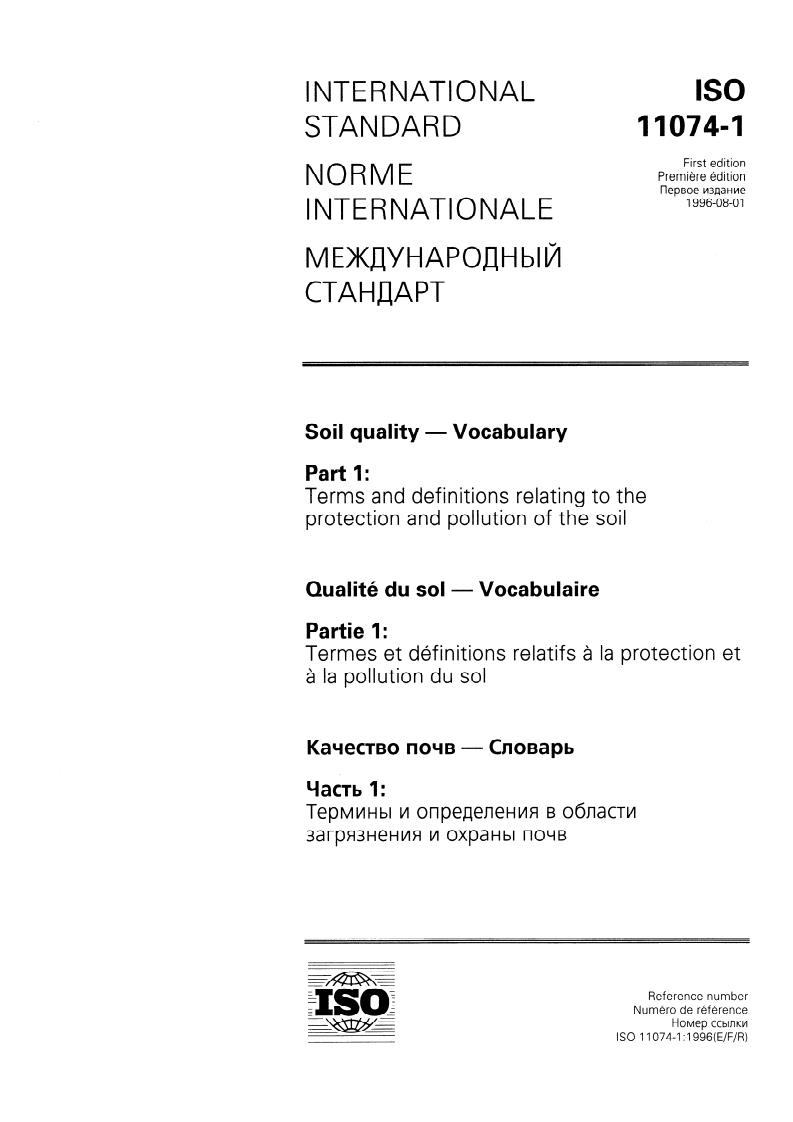
INTERNATIONAL
STANDARD 11074-I
First edition
Premiere edition
NORME
IlepBoe m3flatime
1996-08-0 1
INTERNATIONALE
MEXflYHAPOflHbIti
CTAHAAPT
Soil quality - Vocabulary
Part 1:
Terms and definitions relating to the
protection and pollution of the soil
Qualit du sol - Vocabulaire
Partie 1:
Termes et dhfinitions relatifs a la protection et
3 la pollution du sol
Karlecmo IlOrie - CJlOBapb
YXTb 1:
TepMMHbl VI Onpe~eneHIAFI B obnac-rvl
3arpfl3t-ietim VI OXpaHbl I-lOqB
Reference number
Numkro de rkf&ence
tioMep CCblJlKVl
IS0 11074-I : 1996( E/F/R)
IS0 11074=1:1996(E/F/R)
Foreword
IS0 (the International Organization for Standardization) is a worldwide
federation of national standards bodies (IS0 member bodies). The work
of preparing International Standards is normally carried out through IS0
technical committees. Each member body interested in a subject for
which a technical committee has been established has the right to be
represented on that committee. International organizations, governmental
and non-governmental, in liaison with ISO, also take part in the work. IS0
collaborates closely with the International Electrotechnical Commission
(IEC) on all matters of electrotechnical standardization.
Draft International Standards adopted by the technical committees are
circulated to the member bodies for voting. Publication as an International
Standard requires approval by at least 75 % of the member bodies casting
a vote.
International Standard IS0 11074-I was prepared by Technical Committee
lSO/TC 190, Soil quality, Subcommittee SC 1, Evaluation of cnteria,
terminology and codification.
IS0 11074 consists of the following parts, under the general title Soil
quality - Vocabulary:
- Part 7: Terms and definitions relating to the protection and pollution
of the soil
- Part 2: Terms and definitions relating to sampling
Part 3: Terms and definitions related to risk assessment
- Part 4: Terms and definitions related to the rehabilitation of soils and
sites
0 IS0 1996
All rights reserved. Unless otherwise specified, no part of this publication may be
reproduced or utilized in any form or by any means, electronic or mechanical, including
photocopying and microfilm, without permission in writing from the publisher. / Droits de
reproduction reserves. Sauf prescription differente, aucune partie de cette publication ne
peut etre reproduite ni utilisee sous quelque forme que ce soit et par aucun procede,
electronique ou mecanique, y compris la photocopie et les microfilms, sans I’accord ecrit de
I’editeur.
International Orga nization for Standardi zation
CH-121
Case postale 56 . 1 Geneve 20 l Switzerland
Printed in Switzerland/lmprime en Suisse
Q IS0 IS0 11074~1:1996(E/F/R)
Avant-propos
L’ISO (Organisation internationale de normalisation) est une federation
mondiale d’organismes nationaux de normalisation (comites membres de
I’ISO). L’elaboration des Normes internationales est en general confiee aux
comites techniques de I’ISO. Chaque comite membre interesse par une
etude a le droit de faire partie du comite technique tree a cet effet. Les
organisations internationales, gouvernementales et non gouvernemen-
tales, en liaison avec I’ISO participent egalement aux travaux. L’ISO colla-
bore etroitement avec la Commission electrotechnique internationale (CEI)
en ce qui concerne la normalisation electrotechnique.
Les projets de Normes internationales adopt& par les comites techniques
sont soumis aux comites membres pour vote. Leur publication comme
Normes internationales requiert I’approbation de 75 % au moins des co-
mites membres votants.
La Norme internationale IS0 11074-I a ete elaboree par le comite
technique ISOTTC 190, Qua/it6 du sol, sous-comite SC 1, ivaluation des
crit&res, terminologie et codification.
L’ISO 11074 comprend les parties suivantes, presentees sous le titre
general Qua/it6 du sol - Vocabulaire
- Partie 7: Termes et d6finitions relatifs a la protection et 2 la pollution
du sol
- Partie 2: Termes et dgfinitions relatifs 9 kkhantillonnage
- Partie 3: Termes et dgfinitions relatifs 9 /‘&valuation du risque
- Partie 4: Termes et definitions relatifs a la rghabilitation des so/s et
des sites
. . .
III
@ IS0
IS0 11074~1:1996(E/F/R)
llpeflumosue
l/lCO (MeX~yHapOflHaR Opratiu3a1_1vm no CTaHflapTmaum) mnReTcT-1
BCeMVlpHOh @IeaepalJAeil HauMOHaJlbHblX OpraHlA3alJNi IlO CTaHflapTVl3a~MM
(KOMlilTeTOB-W-leHOB KO). PaspadoTKa MeXflytiapOflHblX CTaHaapTOB OCy-
LlJeCTBJlReTCfi TeXHMYeCKL’lMVl KOMVlTeTaMl’l 1/1co. Ka>Kjqblh KOMlATeT-W-leH, 3at’lH-
TepeCOBaHHblil B flefiTeJlbHOCTVl, AflFl KOTOpOil 6bm CO3aaH TeXHWeCKid
KOMMTeT, IdMeeT flpaB0 6blTb npeACTaBJleHHblM B 3TOM KOMl’lTeTe. MeXflyHa-
pOflHble npaBl4TeJlbCTBeHHble l/l HenpaBUTeJlbCTBeHHbIe OpraHlA3aL_IMlA, lAMetO-
UMe CBfI3l4 c KO, TaKme nplAHMMalOT yqacTi4e B pado-rax. YTO KacaeTm
cTati~apTiA3aL/VIM B o6nacTu 3JleKTpOTeXHMKl4, MC0 pa60TaeT B TeCHOM CO-
TpyflHVl’ieCTBe C fikmflyHapO~Hoi 3JleKTpOTeXHWeCKOti KoMl/rccvlei (M3K).
npOeKTbl h/hKflytiapOflHblX CTaHflapTOB, npVlHRTble TeXHMYeCKVlML’l KOML’lTe-
TaMl4, paCCbUlatOTCR KOMlATeTaM-WeHaM Ha oflo6peHme A0 l4X yTBepX/JeHWI
COBeTOM L/Ice B KaYeCTBe Mex~yt-iapofltiblx CTaHnapTOB. OHVl 0~06pRtOTCR B
CooTBeTcBwI c npO~e~ypOh VlCO, Tpe6yioueh oflo6peHm no MeHbUJeh Mepe
75 % KOMVlTeTOB-YJ-leHOB, npVlHlAMatO~VlX yraCTkIe B i-OJ-lOCOBaHW’l.
Mex~yHapOflHbii haHnapT lK0110741 6bm pa3pa6Om-i kXtiu4eCKmM
KowneToM l/lCO/TK 190, hWc7BO nors, nofiKoMMTeT IlK 1, Pz13pa60xa
KpMTepMeB, TepMMHOnOrMM M o6owa’eH~l;j.
11074 COCTOMT M3 cnejqytou.jMx qacTeti non 061.4~~ 3arnamee Kayecu
IACO
l7OYB - CnOBapb:
TepMMHbl M Onpe,LI/eneHWi’ B o6nacm 3arpfl3HetiMR M OXpaHbl
- YaCTb 7:
i7OYB
- YacTb 2: TepMW-ibl M OnpeAeneHm B o6nacTM oT6opa npo6
YaCTb 3: TepMMtibl M Onpe,LJeneHW7 B o6nacTu OL(eHKM PMCKa
- YaCTb 4: TepMMHbl M 0npefleneHm B o6nacTM BOCCTaHOBneHMfl nOYB B
yYacTKax
IV
@ IS0 IS0 11074-1:1996(E/F/R)
The assessment of the quality of a soil is a complex matter in view of the
variety of uses, hazards and changes of soils. lSO/TC 190 has decided to
give priority to two aspects:
- the quality of the environment (including water) in which the soil
plays an essential part;
- the quality of the medium for agricultural production provided by the
soil.
Given the importance attached to the problems of widespread or localized
hazardous substances, erosion, compaction and other problems
associated with agricultural production, it is essential to clearly establish
defined concepts and common terminology to describe soils.
In this part of IS0 11074, most of the terms that are defined describe
changes in the chemical composition of the soil and the effects of such
changes on soil functions. Where feasible, attention has also been paid to
physical and biological changes.
There are several possible definitions of the term soil. For the purposes of
this part of IS0 11074, soil is the upper layer of the Earth’s crust
composed of mineral particles, organic matter, water, air and organisms.
In the context of soil protection, attention must be paid to topsoil, subsoil
and deeper layers, and to associated mineral deposits and ground water.
Attention must also be paid to the presence, within or on the soil, of man-
made materials such as domestic and industrial wastes, sludges, dredged
materials and mine tailings. They may provide a source of substances
hazardous to soil and affecting neighbouring natural soils. Soil processes
take place in these man-made materials in the same way as they do in
natural bedrock and surface deposits.
It should also be noted that construction activities frequently require the
excavation and redeposition (translocation) of natura soils.
Soil functions describe the role of soils for man and the environment.
Important soil functions include
- controlling element and energy cycles as a compartment of eco-
systems;
- supporting plants, animals and man;
giving support to man’s constructions and buildings;
- agricultural production;
bearing ground water and deposits;
@ IS0
IS0 11074~1:1996(E/F/R)
holding a genetic reservoir;
serving as an archive of natural history;
-
- serving as an archaeological and paleo-ecological archive.
In addition, man uses soils for the deposition of man-made materials (see
above), and atmospheric and water-borne pollutants can accumulate in
soils.
This part of IS0 11074 is concerned with soil pollution. Technical Com-
mittee ISOnC 190 found it particularly difficult to agree upon definitions
for terms such as pollution and contamination.
Technical Committee ISO/TC 190 recognizes the importance of dis-
tinguishing between different states of soils bearing potentially hazardous
substances.
In practice, the concentration of substance in soil may be
at background level; or
a)
above background concentration because of anthropogenic in-
W
fluences.
With increasing concentration
a concentration is reached which may cause an adverse effect on
1)
specified soil function; and
finally the soil can be considered as a damaged soil.
2)
tions of a substance may also occur naturally and these
High concentra
also cause adverse effects on soil functions.
may
The terms pollution and contamination and their equivalents in other
languages have been applied to the conditions b), 1) and 2) respectively,
with little consistency within and between countries. Different pro-
fessionals or expert groups and responsible authorities use them in
different contexts and in different ways. Sometimes they are treated as
synonyms and sometimes attempts are made to confine the use to only a
restricted sense. They are used in describing the process and in stating
the quality of a soil.
Technical Committe ISO/TC 190 has therefore avoided definitions of the
terms contamination and pollution, but instead emphasizes that those
using them should make it clear what they intend by the use of these
terms.
VI
@ IS0 IS0 11074-1:1996(E/F/R)
Introduction
L’evaluation de la qualite d’un sol est un sujet complexe du fait de la
variete des utilisations, des risques et des changements de sols.
L’lSO/TC 190 a decide de donner la priorite a deux aspects:
- la qualite de I’environnement (y compris celle de I’eau), dans laquelle
le sol joue un role essentiel;
la qualite du milieu de production agricole constitue par le sol.
&ant donne I’importance accordee aux problemes des substances dange-
reuses dispersees ou localisees, d’erosion, de compaction et aux autres
problemes associes 2 la production agricole, il est essentiel d’etablir
clairement des concepts definis et une terminologie commune pour
decrire les sols.
Dans la presente partie de I’ISO 11074, la plupart des termes qui sont
definis sont ceux qui decrivent les changements dans la composition
chimique du sol et les effets de tels changements sur les fonctions du sol.
Cependant, lorsque c’etait possible, les changements physiques et bio-
logiques ont aussi ete pris en compte.
II y a plusieurs definitions possibles du terme sol. Pour les besoins de la
presente partie de I’ISO 11074, le sol est la couche superieure de la croute
terrestre composee de particules miner-ales, de mat&e organique, d’eau,
d’air et d’organismes.
Dans le contexte de la protection du sol, on doit preter attention a I’horizon
superficiel, a I’horizon sous-jacent et aux horizons plus profonds du sol,
ainsi qu’aux nappes phreatiques et aux depots mineraux associes.
II faut aussi porter I’attention sur la presence dans ou sur le sol de
materiaux resultant de I’activite humaine comme les dechets domestiques
et industriels, les boues de curage des tours d’eau et les residus miniers.
lls peuvent constituer une source de substances dangereuses pour le sol
et affecter les sols naturels voisins. Les processus d’evolution des sols se
produisent dans ces materiaux resultant de I’activite humaine de la meme
man&e que dans la roche mere naturelle et les depots de surface.
II faut aussi noter que les activites de construction necessitent souvent
I’excavation et le redepot (deplacement) des sols naturels.
Les fonctions du sol decrivent le role des sols pour I’homme et pour
I’environnement. Les fonctions importantes du sol comprennent
- le controle des cycles des elements et de I’energie en tant que
compartiment des ecosystemes;
le support des plantes, des animaux et de l’homme;
la base des constructions et des immeubles;
vii
@ IS0
IS0 11074~1:1996(E/F/R)
- la production agricole;
la retention de l’eau et des depots;
la constitution d’une reserve genetique;
la conservation en tant que memoire de I’histoire de la nature;
la protection en tant qu’archive archeologique et paleoecologique.
De plus, l’homme utilise les sols pour stocker des materiaux resultant de
I’activite humaine (voir ci-dessus), et les polluants d’origine atmospherique
ou provenant de l’eau peuvent s’accumuler dans les sols.
La presente partie de I’ISO 11074 est applicable a la pollution du sol. Le
comite technique ISOK 190 a rencontre des difficult& particulieres pour
s’entendre sur des termes tels que pollution et contamination.
Le comite technique ISOnC 190 reconnait I’importance de distinguer les
differents etats des sols qui renferment des substances potentiellement
dangereuses.
En pratique, la concentration d’une substance dans le sol peut etre
a son niveau de fond;
a)
ou bien
b) au-desssus, a cause des influences anthropiques.
Avec I’accroissement de la concentration
une certai ne concentration est atteinte, ce qui peut produire un effet
1)
negatif su rd es fonctions specifiques du sol;
et finalement
le sol peut etre consider-e comme un sol degrade.
a
De fortes concentrations d’une meme substance peuvent aussi apparaTtre
naturellement et cela peut causer des effets negatifs sur les fonctions du
sol.
Les termes pollution et contamination et leurs equivalents dans les autres
langues ont ete appliques respectivement aux conditions b), 1) et 2) avec
un manque de coherence a I’interieur des pays et entre les pays. Diffe-
rents professionnels ou groupes d’experts et les autorites responsables
les utilisent dans des contextes et des occasions differentes. Parfois, ils
sont consider-es comme synonymes et parfois des tentatives sont faites
pour limiter leur utilisation a un sens restrictif. Ils sont utilises pour decrire
le processus et I’etat de la qualite d’un sol.
Le comite technique ISOnC 190 a ainsi evite les definitions des termes
contamination et pollution mais, en revanche, souligne le fait que ceux qui
les utilisent devront etre clairs quant a ce qu’ils entendent par I’utilisation
de ces termes.
. . .
VIII
0 IS0 IS0 11074-1:1996(E/F/R)
BBeaeHMe
1/13yreHVle KaYeCTBa nOYB OTHOCMTeJlbHO C@OpMbl PlCnOflb30BaHPlR, OnaCHOCTLl
3arpfi3HeHvw M m3MeHeHMiir fiBnfleTcfi 06wmp~o~ npo6neMofi. VlCO/TK 190
peuwn npvlfiaTb npvlopvlTeT flBy~ acneKTaM 3~oti npo6neMbl:
- KareCTBy 0Kpyxatoue 12 cpen bl (B VI B KOTOpOti noYBa
Bony),
w-paeT cy UJeCTBeHHytO POJl b;
KalreCTBy nOYBbl KaK Cpeubl flJlfI CeJlbCKOX03flfiCTBeHHOrO npOl’l3BOfiCTBa.
oCO3HaBaR BaXHOCTb npo6neM paBHOMepHOr0 IN-WI TOYeC1HOrO pacnpe-
aenewfi OnacHblx BeLL/eCTB, 3po3mvl M ynnoTHeHMFl nO9Bbl IA flpyrmx npodneM,
CBFI3aHHblX C CeIlbCKOXO3fltiCTBeHHblM npOvl3BOflCTBOM, tieo6xoflmo yCTaHO-
BPlTb CTpOrO OnpefleJleHHble nOHfITt’lR M o6~enpH+3+-iytO TepMlAHOJlOrWO /JJ-lFI
onMcaHw4 noyB.
B HaCTOflueiil qaCTL’l L/Ice 11074 paCCMaTpMBatOTCfl B OCHOBHOM l43MeHeHtW
XVlMMYeCKOrO COCTaBa nOclB Vl BO3fletiCTBlAe TaKVlX Vl3MeHeHld Ha +yHKlJVlVl
nOYB. TaM, roe 3T0 B03MOXH0, o6paueHo BHl’lMaHPle TaKXe Ha @43WieCKVIe II
6~onorwtecKMe l43MeHeHMF1.
CyueCTBytOT HeCKOflbKO OnpefleJleHlAti TepMVlHa N-lO~Ba)). B HaCTOFlueti ClaCTl’I
- 3T0 BepXHld CJlOti 3eMHOfl KOpbl, COCTOfIuVlr;i IA3
MC0 11074 noclsa
MVlHepaJlbHblX qaCTPlq, OpraHWeCKOrO BellJeCTBa, BOflbl, BO3ayXa Vl XMBOTHblX
OpraHVl3MOB.
B KOHTeKCTe OXpaHbl nOCIB ~OJlXHbl 6blTb npLlHFlTbl BO BHL’lMaHPle nOBepX-
HocTHblfi cnofi, nounorsa 1/1 6onee rny6oKule cnoM, a TaKxe conyTcTBytouV1e
VlM 3anacbi none3Hblx IlCKOnaeMblx VI rpyHTOBblX BOfl.
~OJ-IXHO 6blTb TaKXe npl4HFfTO BO BHMMaHL’le M npIACyTCTBI4e B nOYBe W-WI Ha
ee noBepxHocTM MaTeplnanoB aHTponoreHHor0 npovrcxoxfleHHfi, TaKMx KaK
npOMblLUJleHHble MaTepManbl M rOpHOpyflHble OTBaJlbl. OHVl MOl-yT 6blTb L’lCTOY-
HVlKaMVl OnaCHblX flJlfi I-IOYB BeueCTB, BO3~el;iCTBytOLlJlAX Ha paCnOnOXeHHble B
HenOCpeJJCTBeHHOfi 6nM3ocTH nOCtBbl. co BpeMeHeM nOl4BeHHble npO~eCCbl
~0t-y~ npoiil-rti B nOflO6tibix MaTepManax aHTponoreHHor0 npoMcxoxfleHmfi
aHanorwH0 TOMy, KaK OHVl npovrcxoQRT B noncTtinatouMx rOpHblX nopoflax t4
nOBepXHOCTHblX CJlORX.
CTp0MTeJ-l bCTBe YaCTO Tpe6yeTcu H3BneqeHvle M
Cn eflyeT OTMeTVl Tb YTO
nPM
HblX nOYB.
oMexyTOC1Hoe aHeH Me (n epeMeweHMe) nplnpoll
nP XP
Q)YHKI_IMM noqBbl onvl CblBa tOT 3HaYMMOCTb nOYB YenoseKa M oicpyxato~eti
nnfi
cpeflbl. BaXHblMVI @y HKUM FlM M nOLiBbl FlBJl Fl KITCFl
- ynpaBneH vie qwcnam Be l.ljeCTB IA 3Heprw KaK COCTaBHOLji YaCTt’l 3KO-
Cl’lCTeM bl;
o6ecnereHHe X~3HeflefITeJlbHOCTVl paCTeHVlti, Xt’lBOTHblX Ll reJ-lOBeKa;
CnyXlnTb OCHOBaHMeM /I/J-VI CTpOVlTeJlbHblX COOpyXeHVlfi l/l 3flaHMti;
ix
0 IS0
IS0 11074~1:1996(E/F/R)
- o6ecneueHtie IlpOl43BOflCTBa CenbCKOX03RtiCTBeHHblX I-lpOflyKTOB;
HaKonneHfle MxpaHeHMe3anacoB Boflbl;
F1BnflTbCR reHeTwiecKvlM pe3epByapoM;
- CnyXVlTb apXl4BOM lACTOpVlt’l ilpl4pOflbl;
cnyxHTb apxeonorwiecKvlM M nane03KonorwiecK~M apxi4BoM.
B HononHeHtde K 3~o~y, YenoBeK vrcnonb3yeT norsy flnfl xpaHeHufi MaTe-
pidanos aHTponoreHHor0 npoi4cxoxneHwi (CM. BblWe), a TaiOKe B noCfBe ~0i-y~
HaKallnPlBaTbCF1 3arpFI3HRlOllJ’le BellJeCTBa l/l3 aTMOC+epbl M BOflbl.
t-iacToRuafI YacTb KO 11074 paccMaTpHBaeT 3arpR3HeHHfi noYBbl. TexHw
qecKMti KOMMTeT lACO/TK 190 nplnWen K BbiBOfly, ~TO OCO6eHHO TP)/~~HO
cornacoBaTb 0npeflenenHwi flnFt TaKMx TepMMHoB KaK ((3arpfi3HeHi4e)) M
((3apaxeHMe)).
TeXtiw-ieCKPI~ KOMMTeT lACO/rK 190 C03HaeT BaxHOCTb pa3rpaHweHvw coc-
TOFIHVIFI noYB, coflepxaui4x noTeHqManbH0 0nacHble BeuecTBa.
Ha rlpaKTVIKe, KOHqeHTpaqMR KaKoro-nfl6o BeLL/eCTBa B I-iOLfBe MOXeT 6blTb
Ha ypOBHe OCHOBaHtiFl;
BblWe ypOBHfi OCHOBaHlAFl, l43-3a aHTpOnOreHHblX B03~eiiCTBiAfi.
c llOBblWeHL’leM KOHqeHTpaqPlVl BeLlJeCTBa
MOXeT 6blTb flOCTVlrHyTa TaKafl KOHqeHTpaqVlR, IlpII KOTOpOti MOl-yT
I>
B03HidKaTb HeGnaronpMRiHble B03fleficTBi4fl Ha 0npeneneHHble @~HKL(VIVI
nOC1B;
lA, HaKOHeq,
IlOqBy MOXHO paCCMaTpHBaTb KaK HapyWeHHytO ilOqBy.
2)
BblcoKtie KOHqeHTpaqVlVl BeLL/eCTBa MOryT B03HMKaTb TaKXe eCTeCTBeHHblM
llyTeM L’l 3T0 MOXeT OKa3blBaTb He6narOilpVlFlTHOe BO3fletiCTBlAe Ha @yHKqVlt’I
nOL1B.
TepML/IHbl ((3arpR3HeHUe)) Vl ((3apaXeHMe)) M IAX 3KBLlBaneHTbl Ha ,iJpyriAX 83bl-
KaX flpVlMeHl4Mbl K yCnOBL/lRM 6), 1) t4 2) C 04eHb H1/13KOb;l CTelleHbtO COrna-
COBaHHOCTl’l KaK BHyTpVl OflHOL;I CTpaHbl, KaK l/l MeXny CTpaHaMvl. Pa3nlPiHble
CrleqPlanl4CTbl, rpyrlllbl 3KCilepTOB lAnLl OTBeTCTBeHHble OpraHbl LNIOnb3y0T a/lx
B pa3nNHOM CMblCne t’l B pa3nNHblX 06CTORTenbCTBaX. L/lHOrQa IAX TpaKTytQT
KaK CMHOHl4Mbl, VlHOrfla I-lblTalOTCR OrpaHlPi!ATb l4X lACllOnb30BaHi4e TOnbKO 8
0npefleneHHoM cMbIcne. l/lx wnonb3ytoT flnfi 0twcaHw npoqecca M coc-
TORHPlFl KaYeCTBa llOC1Bbl.
TaKMM odpa3oM TeXHiPieCKwi KoMmTeT VlCO/TK 190 u36exan onpefleneHvw
TepMuHoB ((3arpR3HeHue)) u ((3apaxeHMe)) ~/1 BMecTo 3Toro o6paqae-r ~t-i~i-
MaHtie nonb30BaTenei Ha To, qT0, Mcnonb3yfi Mx, Heo6xo~~Mo noficHRTb, YTO
I/lMeeTCR B BMfly I-lpVI ynOTpe6neHwI flaHHblX TepML/IHOB.
INTERNATIONAL STANDARD
@ IS0 IS0 11074-1:1996(E/F/R)
NORME INTERNATIONALE
MEXflYHAPOnHblih CTAHJJAPT
Qualit du sol - KarlecTBo llOL1B -
Soil quality -
Vocabulaire CJlOBapb
Vocabulary
Partie 1: YXTb 1:
Part 1:
Terms and definitions Termes et definitions TePfvMHbl IA OI-Ipe~eneHIAfI B
relatifs a la protection et a o6nac-w 3arpwewH IA
relating to the protection
and pollution of the soil la pollution du sol OXpaHbl IlOYB
Scope Domaine d’application 06nacTb llpMMeHeHWl
This part of IS0 11074 defines a La presente partie de I’ISO 11074 HacTofiuaFi clacTb MC0 11074 onpe-
list of terms used in certain fields definit une liste de termes em- flemeT TepMuHbl, Mcnonb3yeMble B
ploy& dans certains domaines de la onpenenetitibix o6nac-rfix flnfi xa-
of soil quality characterization. It
caracterisation de la qualite du sol. paKTeptiCTMKM KaYeCTBa llOC1B. OHa
covers terms relating to soil pro-
Elle recouvre les termes relatifs a la BKJltOClaeT TepMVlHbl B 06naCTVI 3a-
tection and pollution, and some
protection et a la pollution des sols, rpfi3HeHm M 0xpaHbl noqB, a TaKme
miscellaneous terms.
et quelques termes divers. HeKOTOpble flpyrlle TepMIAHbl.
NOTE - In addition to the terms and
definitions in the three official IS0 B ~onontiet-tvre K Tep-
NOTE - En complement des termes et llPl’lMEYAHl/lE -
languages (English, French and
definitions utilises dans les trois MMHaM M 0npefleneHmM Ha Tpex OqWl-
Russian), this part of IS0 11074 gives ~VlaJlbHblX F13blKaX L/1co (aHUWllkKOM,
langues officielles de I’ISO (anglais,
the equivalent terms and their defi-
francais, russe), la presente partie de @paHuY3KOM IA PYCCKOM) HaCTOFill@Fl
nitions in the German language; these
I’ISO 11074 donne les termes equi- qaCTb L/Ice 11074 BKJlKFiaeT TaKJKe 3KBVl-
have been included at the request of BWleHTHble TepMlilHbl kl VIX Ol-lpe~UleHkl~
valents et leurs definitions en allemand;
Technical Committee lSO/TC 190 and
ils ont ete inclus a la demande du Ha HeMeuKOM fl3blKe; OHVl BKJllWieHbl IlO
are published under the responsibility TexHWecKoro KOMVlTeTa
comite technique ISO/TC 190 et sont npocb6e
of the member bodies of Germany VlCO/TK 1% III ny6nMKytoTcR nofl OTBeTcT-
publies sous la responsabilite des comi-
(DIN), Austria (ON) and Switzerland
t&s membres d’Allemagne (DIN), BeHHOCTb KOMMTeTOB-YJleHOB kpMaHL’lVl
(SNV). However, only the terms and
d’Autriche (ON) et de Suisse (SNV). (IMH), ABCTPWI (OH) VI LlJBetiuapulH
definitions in the official languages can
Toutefois, seuls les termes et defini- (CHB). OflHaKO TOIIbKO TepMVlHbl I4 Ot7pe-
be considered as IS0 terms and
tions donnes dans les langues offi- flE?JleHWI Ha OC@llJWlbHblX F13blKaX MOl-yT
definitions.
cielles peuvent etre consider& comme PaCCMaTfNlBaTbCFi KaK TePMVlHbl VI Ollpe-
termes et definitions ISO. flenekilnfl KO.
Normative reference Rhfhrence normative tiOpMaTlnBHaR CCblJlKa
The following standard contains La norme suivante contient des npl4BefleHHblti CTaHflapT BKnlOYaeT
provisions which, through reference dispositions qui, par suite de la nonoxeHm, Ha KoTopble 4enaeTcfi
in this text, constitute provisions of reference qui en est faite, consti- CCbU-lKa B TeKCTe Vl KOTOpble CTa-
this part of IS0 11074. At the time tuent des dispositions valables pour H~BRT~FI ocHoBononarato~i4Mi4 Am
of publication, the edition indicated la presente partie de I’ISO 11074. HacToHuel;t YacTu KO 11074. Ha
was valid. All standards are subject Au moment de la publication, I’edi- MOMeHT ny6nMKauMM yKa3aHHOe t43-
to revision, and parties to agree- tion indiquee etait en vigueur. Toute AatiMe fiBJlFleTCFl JJelkTBytOLLjVlM.
ments based on this part of norme est sujette a revision et les
Jlto60r;l c-rariflapT nonsepraeTcfi nepe-
IS0 11074 are encouraged to inves- parties prenantes des accords fon- CMOTpy, a CTOpOHaM, llpVlHlAMalOll/l/lM
tigate the possibility of applying d& sur la presente partie de peweHm no nepecrvloTpy tiacTofluer;l
0 IS0
SO 11074-1:1996(E/F/R)
npeHnaraeTcR
the most recent edition of the I’ISO 11074 sont invitkes a recher- Yaem L4co 11074,
standard indicated below. Members cher la possibilite d’appliquer l%di- V13blCKaTb 503MOXHOC7-b f-lpkVv‘lWeHME
peflaKui/rii cialinapia,
of IEC and IS0 maintain registers of tion la plus ritcente de la norme nocJleflHel;t
llpL~5~~eHHOKI HVIXe. %leHbi hd3K I4
currently valid International Stan- indiquee ci-aprks. Les membres de
dards. la CEI et de I’ISO poss&dent le B/1co lAMPtOT Cl-lkrlCKM fl&iCT5yKN&‘lX Ha
registre des Normes internationales fl?lHHOE! spehsfl MeX~yHapQflHblX
IS0 61 O7-6:1986, Water quality - en vigueur 3 un moment donnk. CTaHflaPTOB.
Vocabulary - Part 6.
IS0 6107-6: 1986, Qualit& de l’eau - 1/Ice 6107-6: 1986, t+-iecmo BOflbl -
cAOBEl/Ilb - %CTb 6.
VocabuJaire -- Partie 6.
lS011074=1:1996(E/F/R)
(Blank page)
(Page blanche)
(6enafi c-rpatiurua)
0 IS0
IS0 11074=1:1996(E/F/R)
1 Termes relatifs aux proprEt& des sols
1 Terms relating to properties of soils
et des substances
and substances
1.1 1.1
partition coefficient coefficient de repartition
ratio between the concentrations of a substance in rapport des concentrations d’une substance dans
two environmental compartments deux compartiments environnementaux
1.1 .I 1.1.1
soi l-water partition c oeffi cient coeff i cient de repartit ion sol-eau
Kd
Ad
ratio of the concentration of a substance in the soil rapport de la concentration d’une substance dans la
solid phase to that in the soil-water phase phase solide du sol a celle dans la phase liquide du sol
1.12
1.12
coefficient de repartition matiere organique
soil organic matter-water partition
coefficient du sol-eau
ratio of the concentration of a substance in the soi rapport de la concentration d’une substance contenue
organic matter fraction to that in the soil-water phase dans la mat&e organique du sol a celle dans I’eau
NOTE - This partition coefficient is often expressed ir NOTE - Ce coefficient de repartition est souvent exprime
relation to the soil organic carbon content (hence: I$,). par rapport a la teneur du sol en carbone organique (d’ou:
Km) *
1.1.3
1.1.3
bioconcentration factor facteur de bioconcentration
BCF FBC
ratio of the con centration of a substance in an or- rapport de la concentration d’une substance dans un
ganrsm to that in the soil organisme a celle dans le sol
1.1.4 x1.4
soil-plant partition coefficient coefficient de repartition sol-plante
ratio between the concentration of a substance in soil rapport de la concentration d’une substance dans le
and in plant material sol a celle dans une plante
1.2
1.2
characteristics caracteristiques de retention
filter
of a soil to retain or bind solid, dissolved or capacite d’un sol a retenir ou a lier des substances
ability
us substances solides, dissoutes ou gazeuses
gaseo
1.3 1.3
sorption sorption
reversible binding of a substance by soil constituents liaison reversible d’une substance avec les consti-
tuants du sol
Mechanisms of sorption include, for example, ion
NOTE -
exchange, surface adsorption, dissolution of organic chemi-
NOTE - Les mecanismes de sorption comprennent, par
cals in the soil organic matter.
exemple, les echanges d’ions, les adsorptions de surface,
les dissolutions de composes chimiques organiques dans la
matiere organique du sol.
@ IS0 IS0 11074-1:1996(E/F/R)
1 -kpMIAHbl B o6nacm CBOiiCTB IlOqBbI VI 1 Begriffe zu Eigenschaften von Bidden
und Stoffen
BeqeCTB
1.1 1.1
Ko3Ct)C1)uqwebw pacnpe~enewm Verteilungskoeff Kent
OTHOllEHt’le KOHL/eHTpaL/lAil BeueCTBa B flBs/X 06beKTax Quotient aus den Konzentrationen eines Stoffes in
okpymatouei;l cpenbr zwei Umweltkompartimenten
1.1.1 1.1.1
Ko3*c#mL\Ylem pacnpeaenebim nowa=Bona Verteilungskoeffizient Boden-Wasser
Kd
Kd
OTHOLLleHVle KOH~eHTpa~Wl BeueCTBa B TBepflOtl @a3e Quotient aus der Konzentration eines Stoffes in der
I-lOYBbl l4 B I-lOllBeHHOlii BOfle festen Bodenphase und in der Bodenwasserphase
1.1.2 1.12
Kosc$@m~metiT pacnpe~enewm 0prawwecKoe Verteilungskoeff izient organische
Beu(eCTBO FlOYBbl-BOAa Bodensubstanz-Wasser
OTHOUJeHkle KOH~eHTpa~Wl BellJeCTBa B OpraHWeCKOM Quotient aus der Konzentration eines Stoffes in der
BeLiJeCTBe l/l B nOrBeHHOl;i BOge organischen Bodensubstanz und in der Boden-
wasserphase
ilPl4MEYAHblE - K03C@@l~VleHT pacnpeflenetiMfl ClaCTO Bbl-
pa>ltaeTcfi B oTHou.reHMM K 0praHMYeckoMy coflepmatiMto yrne- ANMERKUNG - Der Verteilungskoeffizient wird oft im Ver-
pofla B noYBe (~o~T~MY: I$,).
haltnis zum organischen Kohlenstoffgehalt eines Bodens
ausgedrtickt (deshalb I$,).
1.1.3 1.1.3
c@iKTop 6idottOH~eHTpa4HH Biokonzentrationsfaktor
(BCF)
WK)
OTHOUJeHL’le KOHL/eHTpaL/Wl BeueCTBa B I-lOYBe M B l-IO+ Quotient aus der Konzentration eines Stoffes in einem
BeHHOM OpraHkl3Me Organismus und im Boden
1.1.4 1.1.4
KOdc@#m~~eHT norsa-pacrewe Verteilungskoeff izient Boden-Pf lanze
OTHOUleHMe KOH~eHTpa~Wl BeueCTBa B l-‘lOclBe Vl B Quotient aus der Konzentration eines Stoffes im
Boden und im Pflanzenmaterial
pacTeHmX
1.2
Filtereigenschaften
C&lbTPylO~aR cnocobrrocrb
CrmO6HOCTb IlOYBbl )/nepNABaTb LlJlVl CBF13blBaTb TBep- Fahigkeit eines Bodens, feste, geloste oder gasfor-
flble, paCTBOpeHHble W-IL4 ra3006pimble BeLL/eCTBa mige Stoffe zuruck- oder festzuhalten
1.3
1.3
Sorption
cop64um
CBfI3blBaHl’le BeLL/eCTBa COCTaBHblMLl YaCTfIML’l llOYBbl B Umkehrbare Bindung eines Stoffes in austauschbarer
o6Metitioti @opMe Form durch Bodenbestandteile
llPl’lME‘4AHVlE - IlpoueccaMM cop6uv1~1 RBJ-IWTCR, Hanpm- ANMERKUNG - Sorptionsvorgange sind z.B.: lonen-
Mep: MOtiOO6MeH, aucop6uMH Ha tlOBepXHOCTb, paCTBOpeHVE austausch, Oberflachenadsorption, Auflosen organischer
OpraHlNeCKVlX BeueCTB B Opf-aHWeCKOM flOYBeHHOM Be- Chemikalien in organischer Bodensubstanz.
uec-rse.
0 IS0
IS0 11074=1:1996(E/F/R)
1.4
1.4
persistance
persistence
resistance d’une substance aux modifications chimi-
resistance of a substance to chemical changes
ques
NOTES
NOTES
1 Persistence is always related to environmental con-
ditions. Thus, a substance may be persistent in one soil, but 1 La persistance est toujours lice aux conditions environ-
not in another. nementales. Ainsi, une substance peut &re persistante
dans un type de sol, mais non dans un autre.
be expressed as the half-life of a
2 Persistence
may
substance unde r clear ly defined envi ronmenta I conditio ns.
2 La persistance peut etre exprimee comme la demi-vie
d’une substance dans des conditions environnementales
clairement definies.
1.5 1.5
decomposition decomposition
breakdown of complex organic substances into dissociation des substances du complexe organique
simpler molecules or ions by physical, chemical and/or en molecules plus simples ou en ions par des pro-
cessus physiques, chimiques et/au biologiques
biological processes
1.5.1 1.5.1
biodegradation biodegradation
biotic decomposition biodecomposition
decomposition par des organismes
decomposition by organisms
1.52 1.52
abiotic decompositio decomposition abiotique
degradation degradation abiotique
abiotic
decomposition by physical and/or chemical processes, decomposition par des processus physiques et/au chi-
miques, par exemple photolyse, hydrolyse, oxydation
e.g. photolysis, hydrolysis, oxidation and reduction
et reduction
1.5.3 1.5.3
mineralization mineralisation
decomposition of organic matter or organic sub- decomposition de la matiere organique ou de subs-
stances into carbon dioxide, water and the hydrides, tances organiques en dioxyde de carbone, eau et en
oxides or other mineral salts hydrures, oxydes ou autres sels mineraux
1.5.4 1.5.4
humification humif ication
decomposition of organisms or parts thereof followed decomposition d’organismes ou de parties d’organis-
by synthesis of humic substances mes suivie de la synthese de substances humiques
1.5.5 1.5.5
primary degradation degradation primaire
degradation or alteration of the molecular structure of degradation ou alteration de la structure moleculaire
a substance to an extent sufficient to remove some d’une substance a un stade suffisamment avance
characteristic property pour en eliminer une propriete caracteristique
NOTE - Adapted from IS0 6107-6:1986. NOTE
- Adaptee de I’ISO 6107-63 986.
0 IS0 IS0 11074=1:1996(E/F/R)
1.4
1.4
Persistenz
ElePCMCTeHTHOCTb
M M3MeHeHPl FlM Wiederstandsfahigkeit eines Stoffes gegen chemi-
yCTOl&lBOCTb BeUJeCTBa K Xt’lMl4 YeCKvl
sche Veranderungen
llPl4MEYAHWl
ANMERKUNGEN
1 t-kpCMCTeHTHOCTb BCerAa CBfl3aHa C yCJlOBlnFlMVl OKp)DKatO-
u(eil Cpenbl. fl03TOMy BeLL/eCTBO MO>KeT FIBJlRTbCFl YCTOhWlBblM
1 Persistenz ist immer verbunden mit Umweltbedin-
B OfiHOti IlOYBe, a HeYCTOhlBblM B ApyrOfl llOC1Be.
gungen. Daher kann ein Stoff in einem Boden persistent
sein aber in einem anderen nicht.
2 BO3MomHo Bblpi33MTb IlePCMCTeHTHOCTb B KaCleCTBe Bpe-
MeHM flonyo6Mia BeueCTBi3 llpl4 YCHO OllpefleneHHblX YCJIO-
2 Persistenz ka nn ausgedrtickt werden als Halbwertzeit
BVIRX okpymaroulefi cpeflbi. Iedingungen.
ein es Stoffes bei klar definierten Umweltb
1.5 1.5
pa3nomewe Abbau
Zerlegung von komplexen organischen Verbindungen
pacnafl cno>KHbix 0praHwecKux BeuecTB Ha 6onee
in einfache Molektile oder lonen durch physikalische,
IlpOCTble MOneKynbl MJll4 PlOHbl i-lOA flekTBl4eM @l43lA-
wcKMx, XVlMWieCKl’lX l/r/mniA 6~onorti~eckMx npO~eCCOE3 chemische und/oder biologische Prozesse
1.5.1
1.5.1
6HoaerpaAauuw biologischer Abbau
paUlaA l-lo/J QeiCTBVleM WlBblX OpraHVI3MOB Zersetzung von komplexen Molekijlen durch Organis-
men
1.5.2 1.52
a6rnowwecKoe pasnomewde abiotischer Abbau
a6woruwecKafl aerpaaaum Zersetzung von komplexen Molektilen durch physika-
paCl-la)J l-l01 flei;rCTBMeM @~3WteCKVlX M/MJ-llA XklMWieCKVlX lische und/oder chemische Vorgange, z.B. Photolyse,
npoueccoB, TaKidx KaK, HanpHMep, @0~011~3, rvlAponi43, Hydrolyse, Oxidation und Reduktion
OKVlCneHVle Vl BOCCTaHOBneHt’le
1.5.3 1.5.3
Muwiepanihsa~um Mineralisation
pa3nomeHMe opraHwecKor0 BeuecTBa u 0praHwecKidx Abbau organischer Substanz oder organischer Verbin-
dungen zu Kohlenstoffdioxid, Wasser sowie den Hy-
Coefl~HeHvlil Ha flByOKMCb yrnepona, Bony, rvl~pm~bl,
driden, Oxiden oder anderen Mineralien
OKCMfibl M apyrVle MMHepanbHble COnl’l
1.5.4
1.5.4
~MMC#WlKaL(MR Humifizierung
pa3nomeHHe opraH.M3MoB vm v1x qacTel;l c nocnenyto- Zersetzung von Organismen oder Teilen davon mit an-
LL(l4M 06pa3osaWM I-yMyCOBblX Bel.lJeCTB schliefiender Neubildung organischer Substanz
(Humus)
1.5.5 1.5.5
Primiirabbau
nepewitiasv p(erpaAaum
pa3nomeHMe imvr M3MeHeHMe MoneKympHoti cTpyKTypbl Abbau oder Anderung der Molekularstruktur einer
BellJeCTBa QO TaKOl? cTeneHvr, CITO u3qe3aeT HeKOTOpOe Substanz in dem Ma& da13 dadurch die charak-
xapaKTepi4cTwecKoe cBor7cTBo teristische Eigenschaft der Substanz verlorengeht
t-lPVlMEYAHVlE - Monr@M~MpoBat-ro no VlCO 6107-6:1986. ANMERKUNG - Modifiziert nach IS0 6107-6:1986.
@ IS0
IS0 11074~1:1996(E/F/R)
1.5.6 1.5.6
ultimate biodegradation biodegradation ultime
biodegradation conduisant a une mineralisation com-
biodegradation leading to complete mineralization
plete
[ISO 6107-6:1986]
[ISO 6107-63 9861
1.6 1.6
conditions agressives pour les sols
aggressive soil conditions
conditions de sol potentiellement prejudiciables aux
soil conditions potentially damaging to buildings and
immeubles et aux materiaux de construction
construction materials
2 Terms relating to processes in soils 2 Termes relatifs aux processus
pbdologiques
2.1
2.1
limiting factor facteur limitant
any condition that limits soil functions and/or the toute condition qui limite les fonctions du sol et/au
utilization of a soil son utilisation
2.2
2.2
mobilization mobilisation
conversion of substances or soil particles into a passage de substances ou de particules du sol vers
mobile form une forme mobile
2.3
2.3
immobilization immobilisation
conversion of substances or soil particles into a passage de substances ou de particules du sol vers
(temporarily) immobile form une forme (provisoirement) immobile
cf. accumulation (2.5) cf. accumulation (2.5)
2.4 2.4
translocation transfert
movement of dissolved or undissolved substances migration de substances dissoutes ou non a I’interieur
within or on the surface of the soil caused by water, du sol, a travers ou a sa surface, causee par I’eau, I’air
air and human activities or soil organisms
et les activites humaines ou bien par les organismes
du sol
2.5 2.5
accumulation accumulation
increase of the concentration of a substance in soil
augmentation de la concentration d’une substance
due to the fact that the substance input is larger than dans le sol due a des apports de substances supe-
the substance output rieurs aux pertes
2.6 2.6
substance input apport de substance
movement of a substance from another environ- migration vers un sol d’une substance venant d’un
mental compartment into a soil autre compartiment de I’environnement
@ IS0 IS0 11074-1:1996(E/F/R)
1.5.6
1.5.6
vollstBndiger biologischer Abbau
npenenbHarr 6HonerpanaqHH
biologischer Abbau, der zur vollstandigen Mineralien
6MonerpaIauHH, npmsenujafi K nonr-roti hnMtiepanu3auVIVr
fijhrt
[KO 6107-6:1986]
[ISO 6107-6:1986]
1.6
1.6
aggressive Bodeneigenschaften
ZWpeCCHBHble nOYBeHHble YCJIOBWl
noTetiutianbti0 onactibie C\nfi coopy- Bodeneigenschaften, die schadlich fur Bauwerke und
yCJlOBVlR nOYBbl,
Baumaterialien sein konnen
>KeHPlil t’l KOHCTpyKL(MOHHblX MaTeplnanoB
2 -kpMlnHbl B o6nacm nOrlBeHHblX 2 Begriffe zu Prozessen in Bidden
npo~eccoB
21 2.1
Jl~MHTlnp~loLl@i @aKTOp einschriinkender Faktor
nto6oe ycnoBvle, KoTopoe Oprat-irNMBaeT Ct)ytiKuVIK) no% jede Einflu&grijf%e, die die Bodenfunktion und/oder die
Bodennutzung einschrankt
r&nM ticnonb30BatiMe noYr3
22 2.2
M’o6mwa~m Mobilisierung
ubergang von Stoffen oder Bodenteilchen in eine
nepeXOn BeLL/eCTB Mlll’l nO’iBeHHblX YaCTMq B nO)JBVl~HytO
mobile Form
OOPMY
2.3
uihuuo6vinm3aqwfl lmmobilisierung
nOqBeHHblX ‘iaCTPlL/ BO (Bpe- ubergang von Stoffen oder Bodenteilchen in eine
nepexon BeuecTB ww
(zeitweise) immobile Form
Metit-ro) 3akpennetitiyto @op~y
siehe Akkumulation (2.5)
CM. aKKyMyJlfl~IdSl(2.5)
2.4
2.4
L
Verlagerung
TpaHUlOKaiJinSi
Transport von gel&ten oder ungelosten Stoffen im
~BNKeHlde PaCTBOpeHHblX Wlt’l HepaCTBOpeHHblX BellJeCTB
B nOC1Be W-li.4 Ha nOBepXHOCTlA nOYBbl, Bbl3BaHHOe oder an der Oberflache des Bodens durch Wasser,
fleiCTBl4eM BOjJbl, BO3flyXa, IeRTeflbHOCTbtO CleJlOBeKa Luft und Einwirkung von Menschen oder von Boden-
lebewesen
WlVl nOclBeHHblX OpraHld3MOB
2.5
2.5
Akkumulation
aKKyMy!lSl~VlSl
yeenvrrej-ilne kotiuet-npau~~ f3euecTsa B noYBe Bcnefl- Zunahme der Konzentration eines Stoffes im Boden
aufgrund der Tatsache, da13 der Stoffeintrag grof3er als
CTBLW Tore +aKTa, YTO nocTynneHlne BeLL/ecTBa BblLLle
der Stoffaustrag ist
BblHOCa BelljeCTBa
2.6
2.6
Stoffeintrag
nocrynnewie BemqecrBa
Verlagerung von Stoffen aus anderen Umweltmedien in
nepervre~etwe Beu\ecTBa B norsy ~/13 apyroro o6beKTa
den Boden
okpyxatou(eti cpeflbi
@ IS0
IS0 11074=1:1996(E/F/R)
2.7
2.7
apport dCi ii une source ponctuelle
point source input
apport d’une substance par une source ponctuelle fixe
input of a substance from a stationary discrete source
de taille definie
of definite size
NOTES
NOTES
1 Les sources peuvent etre un conduit d’emissions, des
1 The sources can be stack emissions, accidental spills,
deversements accidentels, des depots d’ordures, des de-
waste dumps, spills on industrial sites, major leaks from
versements sur sites industriels, des fuites importantes
sewers and other pipelines.
provenant des egouts et autres canalisations.
2 Point source input can cause both locally contami-
2 L’apport du a une source ponctuelle peut aussi bien etre
nated sites and relatively uniformly contaminated sites
la cause de sites localement contaminbs et de sites
(see 4.6 and 4.7).
contaminks de faqon relativement uniforme (voir 4.6 et
4.7).
2.8
2.8
diffuse source input apport dii 2r une source diffuse
apport dii Zi une source non ponctuelle
non-point source input
input of a substance emitted from moving sources, apport d’une substance emise par des sources mo-
from sources with a large area or from many sources biles, des sources de grande &endue ou de plusieurs
sources
NOTES
NOTES
1 The sources can be cars, application of substances
through agricultural practices, emissions from town or
1 Les sources peuvent etre des automobiles, des subs-
region, deposition of sediment through flooding of a river.
tances introduites par des pratiques agricoles, des emis-
sions venant d’une ville ou d’une region, un depot de sedi-
input usually leads to sites that are
2 Diffuse source
ments par debordement d’une riviere.
contaminated. the input
relatively uniformly At some sites,
conditions may nevertheless cause a higher local input near
2 Les apports dus a une source diffuse conduisent habi-
the source or where atmospheric deposition/rain is in-
tuellement a des sites a contamination relativement uni-
creased.
forme. Pour certains sites, les conditions peuvent etre des
facteurs d’augmentation de I’apport local, a proximite de la
source ou a I’endroit ou les depots atmospheriques/
pluviaux sont intensifies.
2.9
2.9
substance output exportation de substances
movement of a substance from the soil into another
migration de substances du sol vers un autre compar-
environmental compartment timent de I’environnement
2.10 2.10
leaching lixivation
movement of dissolved substances caused by the mouvement de substances dissoutes cause par la
movement of water or other liquids in the soil percolation de I’eau ou d’autres liquides dans le sol
2.11 2.11
lessivage lessivage
translocation of clay particles within the soil profile transport de particules d’argile dans le profil du sol
3 Terms relating to the quality of soils
3 Termes relatifs & la qualit des sols
3.1 3.1
soil quality qualit du sol
all current positive or negative properties with regard
toutes proprietes habituelles positives ou negatives
to soil utilization and soil functions
qui concernent I’utilisation et les fonctions du sol
0 IS0 IS0 11074=1:1996(E/F/R)
2.7 2.7
nomynnewe 1113 ToqerlHoro wTorlHwKa Stoffeintrag aus Punktquelle
nocrynnetitie Beuecrsa, ticcxoflfluero ~13 cTaur4otiapHoro Eintrag einer Substanz aus einer einzelnen stationaren
ticTo+ir4ka orpat-Wieririoro pa3rurepa Quelle eingrenzbarer Grof3e
I-lPVlMEVAHVlfi ANMERKUNGEN
1 TaKvIMti MCTOC1HL’lKaMIrl MOryT 6blTb, HanpMMep, Kpati flbl- 1 Derartige Quellen sind z.B. Schornsteinemissionen,
MOBOh Tpy6bi, CnyclatIHble c6pocbl, OTBaflbl OTXOflOB, Bbl6pOCbl Stoffeintrag bei Unfallen, (Alt-)Ablagerungen, Stoffeintrag in
Ha flpOMblWleHHblX I-UIOllJaflKaX, 6onburne yTeclKM kl3 Tpy- Boden von Industrieanlagen, grof3ere Leckagen aus Ab-
6onposoflos CTOCtHblX BOfl M flpyrl/lX Tpy6OrIpoBO~OB. wasserkanalen und anderen Rohrleitungen.
2 IlocTynneHMe LA3 TOYeqHOrO MCTOCIHl’lKa MO>KeT 6blTb
2 Stoffeintrage aus Punktquellen konnen sowohl zu loka-
noflBneHvw KaK nOKanbH0 3arPSl3HeHHblX
npvlwHol7
len Bodenkontaminationen als such zu diffusen Boden-
)(YXTKOB, TaK l/l OAHOPOnHO 3arpA3HeHHblX YWCTKOB.
kontaminationen fijhren.
28 2.8
nbcsynneme u13 paccemHor0 umorlHMa H u3
Stoffeintrag aus diffuser Quelle
HeTOYe’4HOrO UICTOYHHKa Eintrag einer Substanz aus einer nicht station&en
rlocTyrlJleHvle BeLLJeCTBa, r4ccxoARuero ~3 ~~i4my~vrxcfi Quelle, aus Quellen grol3er Ausdehnung oder aus
WTOYHMKOB, l/l3 L’lCTO~HL’lKOB 6onbi.uoii npOTfVKeHHOCTlA einer Vielzahl von Quellen
l/lJlVl Vl3 MHOmeCTBa VlCTOqHVlKOB
ANMERKUNGEN
1 Derartige Quellen sind z.B. Kraftfahrzeuge, Ausbringung
von Stoffen in der Landwirtschaft, Emissionen einer Stadt
1 TaKvWWI VlCTO’iHMKaMM MOl-yT 6blTb, HanplnMep, aBTOMO-
oder Region, Sedimentablagerungen bei Uberflutung.
6unm, MCllOnb30BaHMe BeueCTB B CenbCKOX03fIlkTBeHHOM
llpOl43BOfiCTBe, Bbl6pOCbl OT rOpOflOB WlM OT perr/rOHa,
2 Stoffeintrag aus diffusen Quellen ft
...
SLOVENSKI STANDARD
01-januar-1997
Kakovost tal - Slovar - 1. del: Izrazi in definicije v zvezi z varovanjem in
onesnaževanjem tal
Soil quality -- Vocabulary -- Part 1: Terms and definitions relating to the protection and
pollution of the soil
Qualité du sol -- Vocabulaire -- Partie 1: Termes et définitions relatifs à la protection et à
la pollution du sol
Ta slovenski standard je istoveten z: ISO 11074-1:1996
ICS:
01.040.13 Varstvo okolja in zdravja. Environment and health
Varnost (Slovarji) protection. Safety
(Vocabularies)
13.080.01 Kakovost tal in pedologija na Soil quality and pedology in
splošno general
2003-01.Slovenski inštitut za standardizacijo. Razmnoževanje celote ali delov tega standarda ni dovoljeno.
INTERNATIONAL
STANDARD 11074-I
First edition
Premiere edition
NORME
IlepBoe m3flatime
1996-08-0 1
INTERNATIONALE
MEXflYHAPOflHbIti
CTAHAAPT
Soil quality - Vocabulary
Part 1:
Terms and definitions relating to the
protection and pollution of the soil
Qualit du sol - Vocabulaire
Partie 1:
Termes et dhfinitions relatifs a la protection et
3 la pollution du sol
Karlecmo IlOrie - CJlOBapb
YXTb 1:
TepMMHbl VI Onpe~eneHIAFI B obnac-rvl
3arpfl3t-ietim VI OXpaHbl I-lOqB
Reference number
Numkro de rkf&ence
tioMep CCblJlKVl
IS0 11074-I : 1996( E/F/R)
IS0 11074=1:1996(E/F/R)
Foreword
IS0 (the International Organization for Standardization) is a worldwide
federation of national standards bodies (IS0 member bodies). The work
of preparing International Standards is normally carried out through IS0
technical committees. Each member body interested in a subject for
which a technical committee has been established has the right to be
represented on that committee. International organizations, governmental
and non-governmental, in liaison with ISO, also take part in the work. IS0
collaborates closely with the International Electrotechnical Commission
(IEC) on all matters of electrotechnical standardization.
Draft International Standards adopted by the technical committees are
circulated to the member bodies for voting. Publication as an International
Standard requires approval by at least 75 % of the member bodies casting
a vote.
International Standard IS0 11074-I was prepared by Technical Committee
lSO/TC 190, Soil quality, Subcommittee SC 1, Evaluation of cnteria,
terminology and codification.
IS0 11074 consists of the following parts, under the general title Soil
quality - Vocabulary:
- Part 7: Terms and definitions relating to the protection and pollution
of the soil
- Part 2: Terms and definitions relating to sampling
Part 3: Terms and definitions related to risk assessment
- Part 4: Terms and definitions related to the rehabilitation of soils and
sites
0 IS0 1996
All rights reserved. Unless otherwise specified, no part of this publication may be
reproduced or utilized in any form or by any means, electronic or mechanical, including
photocopying and microfilm, without permission in writing from the publisher. / Droits de
reproduction reserves. Sauf prescription differente, aucune partie de cette publication ne
peut etre reproduite ni utilisee sous quelque forme que ce soit et par aucun procede,
electronique ou mecanique, y compris la photocopie et les microfilms, sans I’accord ecrit de
I’editeur.
International Orga nization for Standardi zation
CH-121
Case postale 56 . 1 Geneve 20 l Switzerland
Printed in Switzerland/lmprime en Suisse
Q IS0 IS0 11074~1:1996(E/F/R)
Avant-propos
L’ISO (Organisation internationale de normalisation) est une federation
mondiale d’organismes nationaux de normalisation (comites membres de
I’ISO). L’elaboration des Normes internationales est en general confiee aux
comites techniques de I’ISO. Chaque comite membre interesse par une
etude a le droit de faire partie du comite technique tree a cet effet. Les
organisations internationales, gouvernementales et non gouvernemen-
tales, en liaison avec I’ISO participent egalement aux travaux. L’ISO colla-
bore etroitement avec la Commission electrotechnique internationale (CEI)
en ce qui concerne la normalisation electrotechnique.
Les projets de Normes internationales adopt& par les comites techniques
sont soumis aux comites membres pour vote. Leur publication comme
Normes internationales requiert I’approbation de 75 % au moins des co-
mites membres votants.
La Norme internationale IS0 11074-I a ete elaboree par le comite
technique ISOTTC 190, Qua/it6 du sol, sous-comite SC 1, ivaluation des
crit&res, terminologie et codification.
L’ISO 11074 comprend les parties suivantes, presentees sous le titre
general Qua/it6 du sol - Vocabulaire
- Partie 7: Termes et d6finitions relatifs a la protection et 2 la pollution
du sol
- Partie 2: Termes et dgfinitions relatifs 9 kkhantillonnage
- Partie 3: Termes et dgfinitions relatifs 9 /‘&valuation du risque
- Partie 4: Termes et definitions relatifs a la rghabilitation des so/s et
des sites
. . .
III
@ IS0
IS0 11074~1:1996(E/F/R)
llpeflumosue
l/lCO (MeX~yHapOflHaR Opratiu3a1_1vm no CTaHflapTmaum) mnReTcT-1
BCeMVlpHOh @IeaepalJAeil HauMOHaJlbHblX OpraHlA3alJNi IlO CTaHflapTVl3a~MM
(KOMlilTeTOB-W-leHOB KO). PaspadoTKa MeXflytiapOflHblX CTaHaapTOB OCy-
LlJeCTBJlReTCfi TeXHMYeCKL’lMVl KOMVlTeTaMl’l 1/1co. Ka>Kjqblh KOMlATeT-W-leH, 3at’lH-
TepeCOBaHHblil B flefiTeJlbHOCTVl, AflFl KOTOpOil 6bm CO3aaH TeXHWeCKid
KOMMTeT, IdMeeT flpaB0 6blTb npeACTaBJleHHblM B 3TOM KOMl’lTeTe. MeXflyHa-
pOflHble npaBl4TeJlbCTBeHHble l/l HenpaBUTeJlbCTBeHHbIe OpraHlA3aL_IMlA, lAMetO-
UMe CBfI3l4 c KO, TaKme nplAHMMalOT yqacTi4e B pado-rax. YTO KacaeTm
cTati~apTiA3aL/VIM B o6nacTu 3JleKTpOTeXHMKl4, MC0 pa60TaeT B TeCHOM CO-
TpyflHVl’ieCTBe C fikmflyHapO~Hoi 3JleKTpOTeXHWeCKOti KoMl/rccvlei (M3K).
npOeKTbl h/hKflytiapOflHblX CTaHflapTOB, npVlHRTble TeXHMYeCKVlML’l KOML’lTe-
TaMl4, paCCbUlatOTCR KOMlATeTaM-WeHaM Ha oflo6peHme A0 l4X yTBepX/JeHWI
COBeTOM L/Ice B KaYeCTBe Mex~yt-iapofltiblx CTaHnapTOB. OHVl 0~06pRtOTCR B
CooTBeTcBwI c npO~e~ypOh VlCO, Tpe6yioueh oflo6peHm no MeHbUJeh Mepe
75 % KOMVlTeTOB-YJ-leHOB, npVlHlAMatO~VlX yraCTkIe B i-OJ-lOCOBaHW’l.
Mex~yHapOflHbii haHnapT lK0110741 6bm pa3pa6Om-i kXtiu4eCKmM
KowneToM l/lCO/TK 190, hWc7BO nors, nofiKoMMTeT IlK 1, Pz13pa60xa
KpMTepMeB, TepMMHOnOrMM M o6owa’eH~l;j.
11074 COCTOMT M3 cnejqytou.jMx qacTeti non 061.4~~ 3arnamee Kayecu
IACO
l7OYB - CnOBapb:
TepMMHbl M Onpe,LI/eneHWi’ B o6nacm 3arpfl3HetiMR M OXpaHbl
- YaCTb 7:
i7OYB
- YacTb 2: TepMW-ibl M OnpeAeneHm B o6nacTM oT6opa npo6
YaCTb 3: TepMMtibl M Onpe,LJeneHW7 B o6nacTu OL(eHKM PMCKa
- YaCTb 4: TepMMHbl M 0npefleneHm B o6nacTM BOCCTaHOBneHMfl nOYB B
yYacTKax
IV
@ IS0 IS0 11074-1:1996(E/F/R)
The assessment of the quality of a soil is a complex matter in view of the
variety of uses, hazards and changes of soils. lSO/TC 190 has decided to
give priority to two aspects:
- the quality of the environment (including water) in which the soil
plays an essential part;
- the quality of the medium for agricultural production provided by the
soil.
Given the importance attached to the problems of widespread or localized
hazardous substances, erosion, compaction and other problems
associated with agricultural production, it is essential to clearly establish
defined concepts and common terminology to describe soils.
In this part of IS0 11074, most of the terms that are defined describe
changes in the chemical composition of the soil and the effects of such
changes on soil functions. Where feasible, attention has also been paid to
physical and biological changes.
There are several possible definitions of the term soil. For the purposes of
this part of IS0 11074, soil is the upper layer of the Earth’s crust
composed of mineral particles, organic matter, water, air and organisms.
In the context of soil protection, attention must be paid to topsoil, subsoil
and deeper layers, and to associated mineral deposits and ground water.
Attention must also be paid to the presence, within or on the soil, of man-
made materials such as domestic and industrial wastes, sludges, dredged
materials and mine tailings. They may provide a source of substances
hazardous to soil and affecting neighbouring natural soils. Soil processes
take place in these man-made materials in the same way as they do in
natural bedrock and surface deposits.
It should also be noted that construction activities frequently require the
excavation and redeposition (translocation) of natura soils.
Soil functions describe the role of soils for man and the environment.
Important soil functions include
- controlling element and energy cycles as a compartment of eco-
systems;
- supporting plants, animals and man;
giving support to man’s constructions and buildings;
- agricultural production;
bearing ground water and deposits;
@ IS0
IS0 11074~1:1996(E/F/R)
holding a genetic reservoir;
serving as an archive of natural history;
-
- serving as an archaeological and paleo-ecological archive.
In addition, man uses soils for the deposition of man-made materials (see
above), and atmospheric and water-borne pollutants can accumulate in
soils.
This part of IS0 11074 is concerned with soil pollution. Technical Com-
mittee ISOnC 190 found it particularly difficult to agree upon definitions
for terms such as pollution and contamination.
Technical Committee ISO/TC 190 recognizes the importance of dis-
tinguishing between different states of soils bearing potentially hazardous
substances.
In practice, the concentration of substance in soil may be
at background level; or
a)
above background concentration because of anthropogenic in-
W
fluences.
With increasing concentration
a concentration is reached which may cause an adverse effect on
1)
specified soil function; and
finally the soil can be considered as a damaged soil.
2)
tions of a substance may also occur naturally and these
High concentra
also cause adverse effects on soil functions.
may
The terms pollution and contamination and their equivalents in other
languages have been applied to the conditions b), 1) and 2) respectively,
with little consistency within and between countries. Different pro-
fessionals or expert groups and responsible authorities use them in
different contexts and in different ways. Sometimes they are treated as
synonyms and sometimes attempts are made to confine the use to only a
restricted sense. They are used in describing the process and in stating
the quality of a soil.
Technical Committe ISO/TC 190 has therefore avoided definitions of the
terms contamination and pollution, but instead emphasizes that those
using them should make it clear what they intend by the use of these
terms.
VI
@ IS0 IS0 11074-1:1996(E/F/R)
Introduction
L’evaluation de la qualite d’un sol est un sujet complexe du fait de la
variete des utilisations, des risques et des changements de sols.
L’lSO/TC 190 a decide de donner la priorite a deux aspects:
- la qualite de I’environnement (y compris celle de I’eau), dans laquelle
le sol joue un role essentiel;
la qualite du milieu de production agricole constitue par le sol.
&ant donne I’importance accordee aux problemes des substances dange-
reuses dispersees ou localisees, d’erosion, de compaction et aux autres
problemes associes 2 la production agricole, il est essentiel d’etablir
clairement des concepts definis et une terminologie commune pour
decrire les sols.
Dans la presente partie de I’ISO 11074, la plupart des termes qui sont
definis sont ceux qui decrivent les changements dans la composition
chimique du sol et les effets de tels changements sur les fonctions du sol.
Cependant, lorsque c’etait possible, les changements physiques et bio-
logiques ont aussi ete pris en compte.
II y a plusieurs definitions possibles du terme sol. Pour les besoins de la
presente partie de I’ISO 11074, le sol est la couche superieure de la croute
terrestre composee de particules miner-ales, de mat&e organique, d’eau,
d’air et d’organismes.
Dans le contexte de la protection du sol, on doit preter attention a I’horizon
superficiel, a I’horizon sous-jacent et aux horizons plus profonds du sol,
ainsi qu’aux nappes phreatiques et aux depots mineraux associes.
II faut aussi porter I’attention sur la presence dans ou sur le sol de
materiaux resultant de I’activite humaine comme les dechets domestiques
et industriels, les boues de curage des tours d’eau et les residus miniers.
lls peuvent constituer une source de substances dangereuses pour le sol
et affecter les sols naturels voisins. Les processus d’evolution des sols se
produisent dans ces materiaux resultant de I’activite humaine de la meme
man&e que dans la roche mere naturelle et les depots de surface.
II faut aussi noter que les activites de construction necessitent souvent
I’excavation et le redepot (deplacement) des sols naturels.
Les fonctions du sol decrivent le role des sols pour I’homme et pour
I’environnement. Les fonctions importantes du sol comprennent
- le controle des cycles des elements et de I’energie en tant que
compartiment des ecosystemes;
le support des plantes, des animaux et de l’homme;
la base des constructions et des immeubles;
vii
@ IS0
IS0 11074~1:1996(E/F/R)
- la production agricole;
la retention de l’eau et des depots;
la constitution d’une reserve genetique;
la conservation en tant que memoire de I’histoire de la nature;
la protection en tant qu’archive archeologique et paleoecologique.
De plus, l’homme utilise les sols pour stocker des materiaux resultant de
I’activite humaine (voir ci-dessus), et les polluants d’origine atmospherique
ou provenant de l’eau peuvent s’accumuler dans les sols.
La presente partie de I’ISO 11074 est applicable a la pollution du sol. Le
comite technique ISOK 190 a rencontre des difficult& particulieres pour
s’entendre sur des termes tels que pollution et contamination.
Le comite technique ISOnC 190 reconnait I’importance de distinguer les
differents etats des sols qui renferment des substances potentiellement
dangereuses.
En pratique, la concentration d’une substance dans le sol peut etre
a son niveau de fond;
a)
ou bien
b) au-desssus, a cause des influences anthropiques.
Avec I’accroissement de la concentration
une certai ne concentration est atteinte, ce qui peut produire un effet
1)
negatif su rd es fonctions specifiques du sol;
et finalement
le sol peut etre consider-e comme un sol degrade.
a
De fortes concentrations d’une meme substance peuvent aussi apparaTtre
naturellement et cela peut causer des effets negatifs sur les fonctions du
sol.
Les termes pollution et contamination et leurs equivalents dans les autres
langues ont ete appliques respectivement aux conditions b), 1) et 2) avec
un manque de coherence a I’interieur des pays et entre les pays. Diffe-
rents professionnels ou groupes d’experts et les autorites responsables
les utilisent dans des contextes et des occasions differentes. Parfois, ils
sont consider-es comme synonymes et parfois des tentatives sont faites
pour limiter leur utilisation a un sens restrictif. Ils sont utilises pour decrire
le processus et I’etat de la qualite d’un sol.
Le comite technique ISOnC 190 a ainsi evite les definitions des termes
contamination et pollution mais, en revanche, souligne le fait que ceux qui
les utilisent devront etre clairs quant a ce qu’ils entendent par I’utilisation
de ces termes.
. . .
VIII
0 IS0 IS0 11074-1:1996(E/F/R)
BBeaeHMe
1/13yreHVle KaYeCTBa nOYB OTHOCMTeJlbHO C@OpMbl PlCnOflb30BaHPlR, OnaCHOCTLl
3arpfi3HeHvw M m3MeHeHMiir fiBnfleTcfi 06wmp~o~ npo6neMofi. VlCO/TK 190
peuwn npvlfiaTb npvlopvlTeT flBy~ acneKTaM 3~oti npo6neMbl:
- KareCTBy 0Kpyxatoue 12 cpen bl (B VI B KOTOpOti noYBa
Bony),
w-paeT cy UJeCTBeHHytO POJl b;
KalreCTBy nOYBbl KaK Cpeubl flJlfI CeJlbCKOX03flfiCTBeHHOrO npOl’l3BOfiCTBa.
oCO3HaBaR BaXHOCTb npo6neM paBHOMepHOr0 IN-WI TOYeC1HOrO pacnpe-
aenewfi OnacHblx BeLL/eCTB, 3po3mvl M ynnoTHeHMFl nO9Bbl IA flpyrmx npodneM,
CBFI3aHHblX C CeIlbCKOXO3fltiCTBeHHblM npOvl3BOflCTBOM, tieo6xoflmo yCTaHO-
BPlTb CTpOrO OnpefleJleHHble nOHfITt’lR M o6~enpH+3+-iytO TepMlAHOJlOrWO /JJ-lFI
onMcaHw4 noyB.
B HaCTOflueiil qaCTL’l L/Ice 11074 paCCMaTpMBatOTCfl B OCHOBHOM l43MeHeHtW
XVlMMYeCKOrO COCTaBa nOclB Vl BO3fletiCTBlAe TaKVlX Vl3MeHeHld Ha +yHKlJVlVl
nOYB. TaM, roe 3T0 B03MOXH0, o6paueHo BHl’lMaHPle TaKXe Ha @43WieCKVIe II
6~onorwtecKMe l43MeHeHMF1.
CyueCTBytOT HeCKOflbKO OnpefleJleHlAti TepMVlHa N-lO~Ba)). B HaCTOFlueti ClaCTl’I
- 3T0 BepXHld CJlOti 3eMHOfl KOpbl, COCTOfIuVlr;i IA3
MC0 11074 noclsa
MVlHepaJlbHblX qaCTPlq, OpraHWeCKOrO BellJeCTBa, BOflbl, BO3ayXa Vl XMBOTHblX
OpraHVl3MOB.
B KOHTeKCTe OXpaHbl nOCIB ~OJlXHbl 6blTb npLlHFlTbl BO BHL’lMaHPle nOBepX-
HocTHblfi cnofi, nounorsa 1/1 6onee rny6oKule cnoM, a TaKxe conyTcTBytouV1e
VlM 3anacbi none3Hblx IlCKOnaeMblx VI rpyHTOBblX BOfl.
~OJ-IXHO 6blTb TaKXe npl4HFfTO BO BHMMaHL’le M npIACyTCTBI4e B nOYBe W-WI Ha
ee noBepxHocTM MaTeplnanoB aHTponoreHHor0 npovrcxoxfleHHfi, TaKMx KaK
npOMblLUJleHHble MaTepManbl M rOpHOpyflHble OTBaJlbl. OHVl MOl-yT 6blTb L’lCTOY-
HVlKaMVl OnaCHblX flJlfi I-IOYB BeueCTB, BO3~el;iCTBytOLlJlAX Ha paCnOnOXeHHble B
HenOCpeJJCTBeHHOfi 6nM3ocTH nOCtBbl. co BpeMeHeM nOl4BeHHble npO~eCCbl
~0t-y~ npoiil-rti B nOflO6tibix MaTepManax aHTponoreHHor0 npoMcxoxfleHmfi
aHanorwH0 TOMy, KaK OHVl npovrcxoQRT B noncTtinatouMx rOpHblX nopoflax t4
nOBepXHOCTHblX CJlORX.
CTp0MTeJ-l bCTBe YaCTO Tpe6yeTcu H3BneqeHvle M
Cn eflyeT OTMeTVl Tb YTO
nPM
HblX nOYB.
oMexyTOC1Hoe aHeH Me (n epeMeweHMe) nplnpoll
nP XP
Q)YHKI_IMM noqBbl onvl CblBa tOT 3HaYMMOCTb nOYB YenoseKa M oicpyxato~eti
nnfi
cpeflbl. BaXHblMVI @y HKUM FlM M nOLiBbl FlBJl Fl KITCFl
- ynpaBneH vie qwcnam Be l.ljeCTB IA 3Heprw KaK COCTaBHOLji YaCTt’l 3KO-
Cl’lCTeM bl;
o6ecnereHHe X~3HeflefITeJlbHOCTVl paCTeHVlti, Xt’lBOTHblX Ll reJ-lOBeKa;
CnyXlnTb OCHOBaHMeM /I/J-VI CTpOVlTeJlbHblX COOpyXeHVlfi l/l 3flaHMti;
ix
0 IS0
IS0 11074~1:1996(E/F/R)
- o6ecneueHtie IlpOl43BOflCTBa CenbCKOX03RtiCTBeHHblX I-lpOflyKTOB;
HaKonneHfle MxpaHeHMe3anacoB Boflbl;
F1BnflTbCR reHeTwiecKvlM pe3epByapoM;
- CnyXVlTb apXl4BOM lACTOpVlt’l ilpl4pOflbl;
cnyxHTb apxeonorwiecKvlM M nane03KonorwiecK~M apxi4BoM.
B HononHeHtde K 3~o~y, YenoBeK vrcnonb3yeT norsy flnfl xpaHeHufi MaTe-
pidanos aHTponoreHHor0 npoi4cxoxneHwi (CM. BblWe), a TaiOKe B noCfBe ~0i-y~
HaKallnPlBaTbCF1 3arpFI3HRlOllJ’le BellJeCTBa l/l3 aTMOC+epbl M BOflbl.
t-iacToRuafI YacTb KO 11074 paccMaTpHBaeT 3arpR3HeHHfi noYBbl. TexHw
qecKMti KOMMTeT lACO/TK 190 nplnWen K BbiBOfly, ~TO OCO6eHHO TP)/~~HO
cornacoBaTb 0npeflenenHwi flnFt TaKMx TepMMHoB KaK ((3arpfi3HeHi4e)) M
((3apaxeHMe)).
TeXtiw-ieCKPI~ KOMMTeT lACO/rK 190 C03HaeT BaxHOCTb pa3rpaHweHvw coc-
TOFIHVIFI noYB, coflepxaui4x noTeHqManbH0 0nacHble BeuecTBa.
Ha rlpaKTVIKe, KOHqeHTpaqMR KaKoro-nfl6o BeLL/eCTBa B I-iOLfBe MOXeT 6blTb
Ha ypOBHe OCHOBaHtiFl;
BblWe ypOBHfi OCHOBaHlAFl, l43-3a aHTpOnOreHHblX B03~eiiCTBiAfi.
c llOBblWeHL’leM KOHqeHTpaqPlVl BeLlJeCTBa
MOXeT 6blTb flOCTVlrHyTa TaKafl KOHqeHTpaqVlR, IlpII KOTOpOti MOl-yT
I>
B03HidKaTb HeGnaronpMRiHble B03fleficTBi4fl Ha 0npeneneHHble @~HKL(VIVI
nOC1B;
lA, HaKOHeq,
IlOqBy MOXHO paCCMaTpHBaTb KaK HapyWeHHytO ilOqBy.
2)
BblcoKtie KOHqeHTpaqVlVl BeLL/eCTBa MOryT B03HMKaTb TaKXe eCTeCTBeHHblM
llyTeM L’l 3T0 MOXeT OKa3blBaTb He6narOilpVlFlTHOe BO3fletiCTBlAe Ha @yHKqVlt’I
nOL1B.
TepML/IHbl ((3arpR3HeHUe)) Vl ((3apaXeHMe)) M IAX 3KBLlBaneHTbl Ha ,iJpyriAX 83bl-
KaX flpVlMeHl4Mbl K yCnOBL/lRM 6), 1) t4 2) C 04eHb H1/13KOb;l CTelleHbtO COrna-
COBaHHOCTl’l KaK BHyTpVl OflHOL;I CTpaHbl, KaK l/l MeXny CTpaHaMvl. Pa3nlPiHble
CrleqPlanl4CTbl, rpyrlllbl 3KCilepTOB lAnLl OTBeTCTBeHHble OpraHbl LNIOnb3y0T a/lx
B pa3nNHOM CMblCne t’l B pa3nNHblX 06CTORTenbCTBaX. L/lHOrQa IAX TpaKTytQT
KaK CMHOHl4Mbl, VlHOrfla I-lblTalOTCR OrpaHlPi!ATb l4X lACllOnb30BaHi4e TOnbKO 8
0npefleneHHoM cMbIcne. l/lx wnonb3ytoT flnfi 0twcaHw npoqecca M coc-
TORHPlFl KaYeCTBa llOC1Bbl.
TaKMM odpa3oM TeXHiPieCKwi KoMmTeT VlCO/TK 190 u36exan onpefleneHvw
TepMuHoB ((3arpR3HeHue)) u ((3apaxeHMe)) ~/1 BMecTo 3Toro o6paqae-r ~t-i~i-
MaHtie nonb30BaTenei Ha To, qT0, Mcnonb3yfi Mx, Heo6xo~~Mo noficHRTb, YTO
I/lMeeTCR B BMfly I-lpVI ynOTpe6neHwI flaHHblX TepML/IHOB.
INTERNATIONAL STANDARD
@ IS0 IS0 11074-1:1996(E/F/R)
NORME INTERNATIONALE
MEXflYHAPOnHblih CTAHJJAPT
Qualit du sol - KarlecTBo llOL1B -
Soil quality -
Vocabulaire CJlOBapb
Vocabulary
Partie 1: YXTb 1:
Part 1:
Terms and definitions Termes et definitions TePfvMHbl IA OI-Ipe~eneHIAfI B
relatifs a la protection et a o6nac-w 3arpwewH IA
relating to the protection
and pollution of the soil la pollution du sol OXpaHbl IlOYB
Scope Domaine d’application 06nacTb llpMMeHeHWl
This part of IS0 11074 defines a La presente partie de I’ISO 11074 HacTofiuaFi clacTb MC0 11074 onpe-
list of terms used in certain fields definit une liste de termes em- flemeT TepMuHbl, Mcnonb3yeMble B
ploy& dans certains domaines de la onpenenetitibix o6nac-rfix flnfi xa-
of soil quality characterization. It
caracterisation de la qualite du sol. paKTeptiCTMKM KaYeCTBa llOC1B. OHa
covers terms relating to soil pro-
Elle recouvre les termes relatifs a la BKJltOClaeT TepMVlHbl B 06naCTVI 3a-
tection and pollution, and some
protection et a la pollution des sols, rpfi3HeHm M 0xpaHbl noqB, a TaKme
miscellaneous terms.
et quelques termes divers. HeKOTOpble flpyrlle TepMIAHbl.
NOTE - In addition to the terms and
definitions in the three official IS0 B ~onontiet-tvre K Tep-
NOTE - En complement des termes et llPl’lMEYAHl/lE -
languages (English, French and
definitions utilises dans les trois MMHaM M 0npefleneHmM Ha Tpex OqWl-
Russian), this part of IS0 11074 gives ~VlaJlbHblX F13blKaX L/1co (aHUWllkKOM,
langues officielles de I’ISO (anglais,
the equivalent terms and their defi-
francais, russe), la presente partie de @paHuY3KOM IA PYCCKOM) HaCTOFill@Fl
nitions in the German language; these
I’ISO 11074 donne les termes equi- qaCTb L/Ice 11074 BKJlKFiaeT TaKJKe 3KBVl-
have been included at the request of BWleHTHble TepMlilHbl kl VIX Ol-lpe~UleHkl~
valents et leurs definitions en allemand;
Technical Committee lSO/TC 190 and
ils ont ete inclus a la demande du Ha HeMeuKOM fl3blKe; OHVl BKJllWieHbl IlO
are published under the responsibility TexHWecKoro KOMVlTeTa
comite technique ISO/TC 190 et sont npocb6e
of the member bodies of Germany VlCO/TK 1% III ny6nMKytoTcR nofl OTBeTcT-
publies sous la responsabilite des comi-
(DIN), Austria (ON) and Switzerland
t&s membres d’Allemagne (DIN), BeHHOCTb KOMMTeTOB-YJleHOB kpMaHL’lVl
(SNV). However, only the terms and
d’Autriche (ON) et de Suisse (SNV). (IMH), ABCTPWI (OH) VI LlJBetiuapulH
definitions in the official languages can
Toutefois, seuls les termes et defini- (CHB). OflHaKO TOIIbKO TepMVlHbl I4 Ot7pe-
be considered as IS0 terms and
tions donnes dans les langues offi- flE?JleHWI Ha OC@llJWlbHblX F13blKaX MOl-yT
definitions.
cielles peuvent etre consider& comme PaCCMaTfNlBaTbCFi KaK TePMVlHbl VI Ollpe-
termes et definitions ISO. flenekilnfl KO.
Normative reference Rhfhrence normative tiOpMaTlnBHaR CCblJlKa
The following standard contains La norme suivante contient des npl4BefleHHblti CTaHflapT BKnlOYaeT
provisions which, through reference dispositions qui, par suite de la nonoxeHm, Ha KoTopble 4enaeTcfi
in this text, constitute provisions of reference qui en est faite, consti- CCbU-lKa B TeKCTe Vl KOTOpble CTa-
this part of IS0 11074. At the time tuent des dispositions valables pour H~BRT~FI ocHoBononarato~i4Mi4 Am
of publication, the edition indicated la presente partie de I’ISO 11074. HacToHuel;t YacTu KO 11074. Ha
was valid. All standards are subject Au moment de la publication, I’edi- MOMeHT ny6nMKauMM yKa3aHHOe t43-
to revision, and parties to agree- tion indiquee etait en vigueur. Toute AatiMe fiBJlFleTCFl JJelkTBytOLLjVlM.
ments based on this part of norme est sujette a revision et les
Jlto60r;l c-rariflapT nonsepraeTcfi nepe-
IS0 11074 are encouraged to inves- parties prenantes des accords fon- CMOTpy, a CTOpOHaM, llpVlHlAMalOll/l/lM
tigate the possibility of applying d& sur la presente partie de peweHm no nepecrvloTpy tiacTofluer;l
0 IS0
SO 11074-1:1996(E/F/R)
npeHnaraeTcR
the most recent edition of the I’ISO 11074 sont invitkes a recher- Yaem L4co 11074,
standard indicated below. Members cher la possibilite d’appliquer l%di- V13blCKaTb 503MOXHOC7-b f-lpkVv‘lWeHME
peflaKui/rii cialinapia,
of IEC and IS0 maintain registers of tion la plus ritcente de la norme nocJleflHel;t
llpL~5~~eHHOKI HVIXe. %leHbi hd3K I4
currently valid International Stan- indiquee ci-aprks. Les membres de
dards. la CEI et de I’ISO poss&dent le B/1co lAMPtOT Cl-lkrlCKM fl&iCT5yKN&‘lX Ha
registre des Normes internationales fl?lHHOE! spehsfl MeX~yHapQflHblX
IS0 61 O7-6:1986, Water quality - en vigueur 3 un moment donnk. CTaHflaPTOB.
Vocabulary - Part 6.
IS0 6107-6: 1986, Qualit& de l’eau - 1/Ice 6107-6: 1986, t+-iecmo BOflbl -
cAOBEl/Ilb - %CTb 6.
VocabuJaire -- Partie 6.
lS011074=1:1996(E/F/R)
(Blank page)
(Page blanche)
(6enafi c-rpatiurua)
0 IS0
IS0 11074=1:1996(E/F/R)
1 Termes relatifs aux proprEt& des sols
1 Terms relating to properties of soils
et des substances
and substances
1.1 1.1
partition coefficient coefficient de repartition
ratio between the concentrations of a substance in rapport des concentrations d’une substance dans
two environmental compartments deux compartiments environnementaux
1.1 .I 1.1.1
soi l-water partition c oeffi cient coeff i cient de repartit ion sol-eau
Kd
Ad
ratio of the concentration of a substance in the soil rapport de la concentration d’une substance dans la
solid phase to that in the soil-water phase phase solide du sol a celle dans la phase liquide du sol
1.12
1.12
coefficient de repartition matiere organique
soil organic matter-water partition
coefficient du sol-eau
ratio of the concentration of a substance in the soi rapport de la concentration d’une substance contenue
organic matter fraction to that in the soil-water phase dans la mat&e organique du sol a celle dans I’eau
NOTE - This partition coefficient is often expressed ir NOTE - Ce coefficient de repartition est souvent exprime
relation to the soil organic carbon content (hence: I$,). par rapport a la teneur du sol en carbone organique (d’ou:
Km) *
1.1.3
1.1.3
bioconcentration factor facteur de bioconcentration
BCF FBC
ratio of the con centration of a substance in an or- rapport de la concentration d’une substance dans un
ganrsm to that in the soil organisme a celle dans le sol
1.1.4 x1.4
soil-plant partition coefficient coefficient de repartition sol-plante
ratio between the concentration of a substance in soil rapport de la concentration d’une substance dans le
and in plant material sol a celle dans une plante
1.2
1.2
characteristics caracteristiques de retention
filter
of a soil to retain or bind solid, dissolved or capacite d’un sol a retenir ou a lier des substances
ability
us substances solides, dissoutes ou gazeuses
gaseo
1.3 1.3
sorption sorption
reversible binding of a substance by soil constituents liaison reversible d’une substance avec les consti-
tuants du sol
Mechanisms of sorption include, for example, ion
NOTE -
exchange, surface adsorption, dissolution of organic chemi-
NOTE - Les mecanismes de sorption comprennent, par
cals in the soil organic matter.
exemple, les echanges d’ions, les adsorptions de surface,
les dissolutions de composes chimiques organiques dans la
matiere organique du sol.
@ IS0 IS0 11074-1:1996(E/F/R)
1 -kpMIAHbl B o6nacm CBOiiCTB IlOqBbI VI 1 Begriffe zu Eigenschaften von Bidden
und Stoffen
BeqeCTB
1.1 1.1
Ko3Ct)C1)uqwebw pacnpe~enewm Verteilungskoeff Kent
OTHOllEHt’le KOHL/eHTpaL/lAil BeueCTBa B flBs/X 06beKTax Quotient aus den Konzentrationen eines Stoffes in
okpymatouei;l cpenbr zwei Umweltkompartimenten
1.1.1 1.1.1
Ko3*c#mL\Ylem pacnpeaenebim nowa=Bona Verteilungskoeffizient Boden-Wasser
Kd
Kd
OTHOLLleHVle KOH~eHTpa~Wl BeueCTBa B TBepflOtl @a3e Quotient aus der Konzentration eines Stoffes in der
I-lOYBbl l4 B I-lOllBeHHOlii BOfle festen Bodenphase und in der Bodenwasserphase
1.1.2 1.12
Kosc$@m~metiT pacnpe~enewm 0prawwecKoe Verteilungskoeff izient organische
Beu(eCTBO FlOYBbl-BOAa Bodensubstanz-Wasser
OTHOUJeHkle KOH~eHTpa~Wl BellJeCTBa B OpraHWeCKOM Quotient aus der Konzentration eines Stoffes in der
BeLiJeCTBe l/l B nOrBeHHOl;i BOge organischen Bodensubstanz und in der Boden-
wasserphase
ilPl4MEYAHblE - K03C@@l~VleHT pacnpeflenetiMfl ClaCTO Bbl-
pa>ltaeTcfi B oTHou.reHMM K 0praHMYeckoMy coflepmatiMto yrne- ANMERKUNG - Der Verteilungskoeffizient wird oft im Ver-
pofla B noYBe (~o~T~MY: I$,).
haltnis zum organischen Kohlenstoffgehalt eines Bodens
ausgedrtickt (deshalb I$,).
1.1.3 1.1.3
c@iKTop 6idottOH~eHTpa4HH Biokonzentrationsfaktor
(BCF)
WK)
OTHOUJeHL’le KOHL/eHTpaL/Wl BeueCTBa B I-lOYBe M B l-IO+ Quotient aus der Konzentration eines Stoffes in einem
BeHHOM OpraHkl3Me Organismus und im Boden
1.1.4 1.1.4
KOdc@#m~~eHT norsa-pacrewe Verteilungskoeff izient Boden-Pf lanze
OTHOUleHMe KOH~eHTpa~Wl BeueCTBa B l-‘lOclBe Vl B Quotient aus der Konzentration eines Stoffes im
Boden und im Pflanzenmaterial
pacTeHmX
1.2
Filtereigenschaften
C&lbTPylO~aR cnocobrrocrb
CrmO6HOCTb IlOYBbl )/nepNABaTb LlJlVl CBF13blBaTb TBep- Fahigkeit eines Bodens, feste, geloste oder gasfor-
flble, paCTBOpeHHble W-IL4 ra3006pimble BeLL/eCTBa mige Stoffe zuruck- oder festzuhalten
1.3
1.3
Sorption
cop64um
CBfI3blBaHl’le BeLL/eCTBa COCTaBHblMLl YaCTfIML’l llOYBbl B Umkehrbare Bindung eines Stoffes in austauschbarer
o6Metitioti @opMe Form durch Bodenbestandteile
llPl’lME‘4AHVlE - IlpoueccaMM cop6uv1~1 RBJ-IWTCR, Hanpm- ANMERKUNG - Sorptionsvorgange sind z.B.: lonen-
Mep: MOtiOO6MeH, aucop6uMH Ha tlOBepXHOCTb, paCTBOpeHVE austausch, Oberflachenadsorption, Auflosen organischer
OpraHlNeCKVlX BeueCTB B Opf-aHWeCKOM flOYBeHHOM Be- Chemikalien in organischer Bodensubstanz.
uec-rse.
0 IS0
IS0 11074=1:1996(E/F/R)
1.4
1.4
persistance
persistence
resistance d’une substance aux modifications chimi-
resistance of a substance to chemical changes
ques
NOTES
NOTES
1 Persistence is always related to environmental con-
ditions. Thus, a substance may be persistent in one soil, but 1 La persistance est toujours lice aux conditions environ-
not in another. nementales. Ainsi, une substance peut &re persistante
dans un type de sol, mais non dans un autre.
be expressed as the half-life of a
2 Persistence
may
substance unde r clear ly defined envi ronmenta I conditio ns.
2 La persistance peut etre exprimee comme la demi-vie
d’une substance dans des conditions environnementales
clairement definies.
1.5 1.5
decomposition decomposition
breakdown of complex organic substances into dissociation des substances du complexe organique
simpler molecules or ions by physical, chemical and/or en molecules plus simples ou en ions par des pro-
cessus physiques, chimiques et/au biologiques
biological processes
1.5.1 1.5.1
biodegradation biodegradation
biotic decomposition biodecomposition
decomposition par des organismes
decomposition by organisms
1.52 1.52
abiotic decompositio decomposition abiotique
degradation degradation abiotique
abiotic
decomposition by physical and/or chemical processes, decomposition par des processus physiques et/au chi-
miques, par exemple photolyse, hydrolyse, oxydation
e.g. photolysis, hydrolysis, oxidation and reduction
et reduction
1.5.3 1.5.3
mineralization mineralisation
decomposition of organic matter or organic sub- decomposition de la matiere organique ou de subs-
stances into carbon dioxide, water and the hydrides, tances organiques en dioxyde de carbone, eau et en
oxides or other mineral salts hydrures, oxydes ou autres sels mineraux
1.5.4 1.5.4
humification humif ication
decomposition of organisms or parts thereof followed decomposition d’organismes ou de parties d’organis-
by synthesis of humic substances mes suivie de la synthese de substances humiques
1.5.5 1.5.5
primary degradation degradation primaire
degradation or alteration of the molecular structure of degradation ou alteration de la structure moleculaire
a substance to an extent sufficient to remove some d’une substance a un stade suffisamment avance
characteristic property pour en eliminer une propriete caracteristique
NOTE - Adapted from IS0 6107-6:1986. NOTE
- Adaptee de I’ISO 6107-63 986.
0 IS0 IS0 11074=1:1996(E/F/R)
1.4
1.4
Persistenz
ElePCMCTeHTHOCTb
M M3MeHeHPl FlM Wiederstandsfahigkeit eines Stoffes gegen chemi-
yCTOl&lBOCTb BeUJeCTBa K Xt’lMl4 YeCKvl
sche Veranderungen
llPl4MEYAHWl
ANMERKUNGEN
1 t-kpCMCTeHTHOCTb BCerAa CBfl3aHa C yCJlOBlnFlMVl OKp)DKatO-
u(eil Cpenbl. fl03TOMy BeLL/eCTBO MO>KeT FIBJlRTbCFl YCTOhWlBblM
1 Persistenz ist immer verbunden mit Umweltbedin-
B OfiHOti IlOYBe, a HeYCTOhlBblM B ApyrOfl llOC1Be.
gungen. Daher kann ein Stoff in einem Boden persistent
sein aber in einem anderen nicht.
2 BO3MomHo Bblpi33MTb IlePCMCTeHTHOCTb B KaCleCTBe Bpe-
MeHM flonyo6Mia BeueCTBi3 llpl4 YCHO OllpefleneHHblX YCJIO-
2 Persistenz ka nn ausgedrtickt werden als Halbwertzeit
BVIRX okpymaroulefi cpeflbi. Iedingungen.
ein es Stoffes bei klar definierten Umweltb
1.5 1.5
pa3nomewe Abbau
Zerlegung von komplexen organischen Verbindungen
pacnafl cno>KHbix 0praHwecKux BeuecTB Ha 6onee
in einfache Molektile oder lonen durch physikalische,
IlpOCTble MOneKynbl MJll4 PlOHbl i-lOA flekTBl4eM @l43lA-
wcKMx, XVlMWieCKl’lX l/r/mniA 6~onorti~eckMx npO~eCCOE3 chemische und/oder biologische Prozesse
1.5.1
1.5.1
6HoaerpaAauuw biologischer Abbau
paUlaA l-lo/J QeiCTBVleM WlBblX OpraHVI3MOB Zersetzung von komplexen Molekijlen durch Organis-
men
1.5.2 1.52
a6rnowwecKoe pasnomewde abiotischer Abbau
a6woruwecKafl aerpaaaum Zersetzung von komplexen Molektilen durch physika-
paCl-la)J l-l01 flei;rCTBMeM @~3WteCKVlX M/MJ-llA XklMWieCKVlX lische und/oder chemische Vorgange, z.B. Photolyse,
npoueccoB, TaKidx KaK, HanpHMep, @0~011~3, rvlAponi43, Hydrolyse, Oxidation und Reduktion
OKVlCneHVle Vl BOCCTaHOBneHt’le
1.5.3 1.5.3
Muwiepanihsa~um Mineralisation
pa3nomeHMe opraHwecKor0 BeuecTBa u 0praHwecKidx Abbau organischer Substanz oder organischer Verbin-
dungen zu Kohlenstoffdioxid, Wasser sowie den Hy-
Coefl~HeHvlil Ha flByOKMCb yrnepona, Bony, rvl~pm~bl,
driden, Oxiden oder anderen Mineralien
OKCMfibl M apyrVle MMHepanbHble COnl’l
1.5.4
1.5.4
~MMC#WlKaL(MR Humifizierung
pa3nomeHHe opraH.M3MoB vm v1x qacTel;l c nocnenyto- Zersetzung von Organismen oder Teilen davon mit an-
LL(l4M 06pa3osaWM I-yMyCOBblX Bel.lJeCTB schliefiender Neubildung organischer Substanz
(Humus)
1.5.5 1.5.5
Primiirabbau
nepewitiasv p(erpaAaum
pa3nomeHMe imvr M3MeHeHMe MoneKympHoti cTpyKTypbl Abbau oder Anderung der Molekularstruktur einer
BellJeCTBa QO TaKOl? cTeneHvr, CITO u3qe3aeT HeKOTOpOe Substanz in dem Ma& da13 dadurch die charak-
xapaKTepi4cTwecKoe cBor7cTBo teristische Eigenschaft der Substanz verlorengeht
t-lPVlMEYAHVlE - Monr@M~MpoBat-ro no VlCO 6107-6:1986. ANMERKUNG - Modifiziert nach IS0 6107-6:1986.
@ IS0
IS0 11074~1:1996(E/F/R)
1.5.6 1.5.6
ultimate biodegradation biodegradation ultime
biodegradation conduisant a une mineralisation com-
biodegradation leading to complete mineralization
plete
[ISO 6107-6:1986]
[ISO 6107-63 9861
1.6 1.6
conditions agressives pour les sols
aggressive soil conditions
conditions de sol potentiellement prejudiciables aux
soil conditions potentially damaging to buildings and
immeubles et aux materiaux de construction
construction materials
2 Terms relating to processes in soils 2 Termes relatifs aux processus
pbdologiques
2.1
2.1
limiting factor facteur limitant
any condition that limits soil functions and/or the toute condition qui limite les fonctions du sol et/au
utilization of a soil son utilisation
2.2
2.2
mobilization mobilisation
conversion of substances or soil particles into a passage de substances ou de particules du sol vers
mobile form une forme mobile
2.3
2.3
immobilization immobilisation
conversion of substances or soil particles into a passage de substances ou de particules du sol vers
(temporarily) immobile form une forme (provisoirement) immobile
cf. accumulation (2.5) cf. accumulation (2.5)
2.4 2.4
translocation transfert
movement of dissolved or undissolved substances migration de substances dissoutes ou non a I’interieur
within or on the surface of the soil caused by water, du sol, a travers ou a sa surface, causee par I’eau, I’air
air and human activities or soil organisms
et les activites humaines ou bien par les organismes
du sol
2.5 2.5
accumulation accumulation
increase of the concentration of a substance in soil
augmentation de la concentration d’une substance
due to the fact that the substance input is larger than dans le sol due a des apports de substances supe-
the substance output rieurs aux pertes
2.6 2.6
substance input apport de substance
movement of a substance from another environ- migration vers un sol d’une substance venant d’un
mental compartment into a soil autre compartiment de I’environnement
@ IS0 IS0 11074-1:1996(E/F/R)
1.5.6
1.5.6
vollstBndiger biologischer Abbau
npenenbHarr 6HonerpanaqHH
biologischer Abbau, der zur vollstandigen Mineralien
6MonerpaIauHH, npmsenujafi K nonr-roti hnMtiepanu3auVIVr
fijhrt
[KO 6107-6:1986]
[ISO 6107-6:1986]
1.6
1.6
aggressive Bodeneigenschaften
ZWpeCCHBHble nOYBeHHble YCJIOBWl
noTetiutianbti0 onactibie C\nfi coopy- Bodeneigenschaften, die schadlich fur Bauwerke und
yCJlOBVlR nOYBbl,
Baumaterialien sein konnen
>KeHPlil t’l KOHCTpyKL(MOHHblX MaTeplnanoB
2 -kpMlnHbl B o6nacm nOrlBeHHblX 2 Begriffe zu Prozessen in Bidden
npo~eccoB
21 2.1
Jl~MHTlnp~loLl@i @aKTOp einschriinkender Faktor
nto6oe ycnoBvle, KoTopoe Oprat-irNMBaeT Ct)ytiKuVIK) no% jede Einflu&grijf%e, die die Bodenfunktion und/oder die
Bodennutzung einschrankt
r&nM ticnonb30BatiMe noYr3
22 2.2
M’o6mwa~m Mobilisierung
ubergang von Stoffen oder Bodenteilchen in eine
nepeXOn BeLL/eCTB Mlll’l nO’iBeHHblX YaCTMq B nO)JBVl~HytO
mobile Form
OOPMY
2.3
uihuuo6vinm3aqwfl lmmobilisierung
nOqBeHHblX ‘iaCTPlL/ BO (Bpe- ubergang von Stoffen oder Bodenteilchen in eine
nepexon BeuecTB ww
(zeitweise) immobile Form
Metit-ro) 3akpennetitiyto @op~y
siehe Akkumulation (2.5)
CM. aKKyMyJlfl~IdSl(2.5)
2.4
2.4
L
Verlagerung
TpaHUlOKaiJinSi
Transport von gel&ten oder ungelosten Stoffen im
~BNKeHlde PaCTBOpeHHblX Wlt’l HepaCTBOpeHHblX BellJeCTB
B nOC1Be W-li.4 Ha nOBepXHOCTlA nOYBbl, Bbl3BaHHOe oder an der Oberflache des Bodens durch Wasser,
fleiCTBl4eM BOjJbl, BO3flyXa, IeRTeflbHOCTbtO CleJlOBeKa Luft und Einwirkung von Menschen oder von Boden-
lebewesen
WlVl nOclBeHHblX OpraHld3MOB
2.5
2.5
Akkumulation
aKKyMy!lSl~VlSl
yeenvrrej-ilne kotiuet-npau~~ f3euecTsa B noYBe Bcnefl- Zunahme der Konzentration eines Stoffes im Boden
aufgrund der Tatsache, da13 der Stoffeintrag grof3er als
CTBLW Tore +aKTa, YTO nocTynneHlne BeLL/ecTBa BblLLle
der Stoffaustrag ist
BblHOCa BelljeCTBa
2.6
2.6
Stoffeintrag
nocrynnewie BemqecrBa
Verlagerung von Stoffen aus anderen Umweltmedien in
nepervre~etwe Beu\ecTBa B norsy ~/13 apyroro o6beKTa
den Boden
okpyxatou(eti cpeflbi
@ IS0
IS0 11074=1:1996(E/F/R)
2.7
2.7
apport dCi ii une source ponctuelle
point source input
apport d’une substance par une source ponctuelle fixe
input of a substance from a stationary discrete source
de taille definie
of definite size
NOTES
NOTES
1 Les sources peuvent etre un conduit d’emissions, des
1 The sources can be stack emissions, accidental spills,
deversements accidentels, des depots d’ordures, des de-
waste dumps, spills on industrial sites, major leaks from
versements sur sites industriels, des fuites importantes
sewers and other pipelines.
provenant des egouts et autres canalisations.
2 Point source input can cause both locally contami-
2 L’apport du a une source ponctuelle peut aussi bien etre
nated sites and relatively uniformly contaminated sites
la cause de sites localement contaminbs et de sites
(see 4.6 and 4.7).
contaminks de faqon relativement uniforme (voir 4.6 et
4.7).
2.8
2.8
diffuse source input apport dii 2r une source diffuse
apport dii Zi une source non ponctuelle
non-point source input
input of a substance emitted from moving sources, apport d’une substance emise par des sources mo-
from sources with a large area or from many sources biles, des sources de grande &endue ou de plusieurs
sources
NOTES
NOTES
1 The sources can be cars, application of substances
through agricultural practices, emissions from town or
1 Les sources peuvent etre des automobiles, des subs-
region, deposition of sediment through flooding of a river.
tances introduites par des pratiques agricoles, des emis-
sions venant d’une ville ou d’une region, un depot de sedi-
input usually leads to sites that are
2 Diffuse source
ments par debordement d’une riviere.
contaminated. the input
relatively uniformly At some sites,
conditions may nevertheless cause a higher local input near
2 Les apports dus a une source diffuse conduisent habi-
the source or where atmospheric deposition/rain is in-
tuellement a des sites a contamination relativement uni-
creased.
forme. Pour certains sites, les conditions peuvent etre des
facteurs d’augmentation de I’apport local, a proximite de la
source ou a I’endroit ou les depots atmospheriques/
pluviaux sont intensifies.
2.9
2.9
substance output exportation de substances
movement of a substance from the soil into another
migration de substances du sol vers un autre compar-
environmental compartment timent de I’environnement
2.10 2.10
leaching lixivation
movement of dissolved substances caused by the mouvement de substances dissoutes cause par la
movement of water or other liquids in the soil percolation de I’eau ou d’autres liquides dans le sol
2.11 2.11
lessivage lessivage
translocation of clay particles within the soil profile transport de particules d’argile dans le profil du sol
3 Terms relating to the quality of soils
3 Termes relatifs & la qualit des sols
3.1 3.1
soil quality qualit du sol
all current positive or negative properties with regard
toutes proprietes habituelles positives ou negatives
to soil utilization and soil functions
qui concernent I’utilisation et les fonctions du sol
0 IS0 IS0 11074=1:1996(E/F/R)
2.7 2.7
nomynnewe 1113 ToqerlHoro wTorlHwKa Stoffeintrag aus Punktquelle
nocrynnetitie Beuecrsa, ticcxoflfluero ~13 cTaur4otiapHoro Eintrag einer Substanz aus einer einzelnen stationaren
ticTo+ir4ka orpat-Wieririoro pa3rurepa Quelle eingrenzbarer Grof3e
I-lPVlMEVAHVlfi ANMERKUNGEN
1 TaKvIMti MCTOC1HL’lKaMIrl MOryT 6blTb, HanpMMep, Kpati flbl- 1 Derartige Quellen sind z.B. Schornsteine
...
Questions, Comments and Discussion
Ask us and Technical Secretary will try to provide an answer. You can facilitate discussion about the standard in here.
Loading comments...