

ISO 11074:2015
(Main)Soil quality — Vocabulary
General Information
- Abstract
ISO 11074:2015 defines a list of terms used in the preparation of the standards in the field of soil quality. The terms are classified under the following main headings: - general terms (terms relating to soil, soil materials, land, and sites); - description of soil (soil characteristics, soil water, properties of soils and substances, processes in soil, contamination, pollution, background content); - sampling (general terms, sample types/sampling type, sampling stages, execution of sampling, quality control samples, sample pretreatment); - terms relating to the assessment of soils (quality, assessment of soil and sites with respect to risk, hazard and exposure, soil protection); - remediation (general terms, principal remediation types, engineering-based methods, process-based treatment methods); - soil ecotoxicology. NOTE: In addition to text written in the official ISO languages (English, French), this document gives text in German. This text is published under the responsibility of the Member Body for Germany (DIN) and is given for information only. Only the text given in the official languages can be considered as ISO text.
- Status
- Withdrawn
- Publication Date
- 07-May-2015
- Technical Committee
- ISO/TC 190 - Soil quality
- Drafting Committee
- ISO/TC 190/WG 2 - Terminology and data management
- Current Stage
- 9599 - Withdrawal of International Standard
- Start Date
- 05-Mar-2025
- Completion Date
- 29-Aug-2026

Overview
ISO 11074:2015, titled Soil Quality - Vocabulary, is an international standard developed by the International Organization for Standardization (ISO). It provides a comprehensive list of terms and definitions used in the domain of soil quality. The standard aims to establish a common language for professionals involved in soil science, environmental assessment, land management, and related fields. By standardizing terminology, ISO 11074:2015 facilitates clearer communication, consistent documentation, and improved interpretation of soil-related data across international boundaries.
This edition supersedes the previous 2005 version and reflects updated terminology and classifications relevant to current soil science and quality assessment practices.
Key Topics
ISO 11074:2015 organizes soil quality terminology under six major categories, offering clear and precise definitions for each:
General Terms
Covers foundational concepts related to soil, soil materials, land, and site descriptions. Examples include soil structure, soil texture, organic matter, soil reaction (pH), and available water capacity.Soil Description
Defines terms regarding soil characteristics such as soil water content, soil contamination and pollution, physical and chemical properties, native background soil content, and soil gas.Sampling Procedures
Details terms associated with soil sampling techniques, sample types and stages, execution of sampling campaigns, quality control samples, and sample pretreatment methods. This section ensures standardized collection protocols facilitate reliable soil analysis.Soil Assessment
Focuses on terminology pertaining to soil quality evaluation, risk and hazard assessment related to soil and sites, exposure considerations, and soil protection measures.Remediation Methods
Describes terms related to strategies and methods used for soil remediation, including principal treatment types, engineering-based methods, and process-based treatment techniques aimed at restoring soil function and reducing contamination.Soil Ecotoxicology
Provides definitions related to the impact of chemicals and pollutants on soil fauna, flora, microorganisms, and the ecological processes within soil ecosystems, covering biodegradability and toxicity terminology.
Applications
ISO 11074:2015 serves as a critical reference for various applications in environmental science and land management, such as:
Environmental Monitoring and Assessment
Assists environmental professionals in accurately characterizing soils for pollution studies, contamination risk evaluation, and ecological impact assessments.Agricultural Soil Management
Supports agronomists and soil scientists in communicating soil quality metrics related to fertility, water retention, and organic material presence to improve crop production and sustainable land use.Construction and Land Development
Provides developers and engineers with standardized terminology for describing soil materials, fill materials, and earthworks in relation to construction projects.Soil Remediation and Rehabilitation
Guides environmental engineers and remediation specialists in implementing effective soil treatment strategies while using consistent terminology for regulatory compliance and reporting.Scientific Research and Education
Ensures academic consistency in soil science, promoting harmonized understanding of soil properties, processes, and ecological interactions in research publications and training programs.
Related Standards
Professionals working with ISO 11074:2015 should also consider related standards in the soil and environmental quality domain, including:
ISO 17137 - Soil Quality - Sampling
Provides detailed methodologies for soil sample collection, closely complementing the vocabulary defined in ISO 11074.ISO 11274 - Soil Quality - Determination of pH
Standardizes measurement techniques for soil acidity, linking closely to the "soil reaction" terms in ISO 11074.ISO 10381 series - Soil Quality - Sampling
Expands on protocols for soil sampling in specific contexts, assisting practical implementation of the terminology.ISO 14000 series - Environmental Management
These standards support broader environmental impact assessment that includes soil quality considerations.
Keywords: ISO 11074:2015, soil quality vocabulary, soil science terminology, soil assessment, soil sampling, soil remediation, soil ecotoxicology, soil properties, environmental standards, soil management, international soil standards.
Relations
- Effective Date
- 25-Aug-2026
- Effective Date
- 25-Aug-2026
- Effective Date
- 25-Aug-2026
- Effective Date
- 25-Aug-2026
- Effective Date
- 25-Aug-2026
- Effective Date
- 25-Aug-2026
- Effective Date
- 25-Aug-2026
- Effective Date
- 25-Aug-2026
- Effective Date
- 25-Aug-2026
- Effective Date
- 25-Aug-2026
- Effective Date
- 25-Aug-2026
- Effective Date
- 25-Aug-2026
- Effective Date
- 29-Apr-2026
- Effective Date
- 12-Feb-2026
- Effective Date
- 25-Apr-2020
Get Certified
Connect with accredited certification bodies for this standard

CIS Institut d.o.o.
Personal Protective Equipment (PPE) certification body. Notified Body NB-2890 for EU Regulation 2016/425 PPE.

Kiwa BDA Testing
Building and construction product certification.
Kmetijski inštitut Slovenije
Agricultural Institute of Slovenia. Soil testing, plant health, agricultural product analysis.
Sponsored listings
Frequently Asked Questions
ISO 11074:2015 is a standard published by the International Organization for Standardization (ISO). Its full title is "Soil quality — Vocabulary". This standard covers: ISO 11074:2015 defines a list of terms used in the preparation of the standards in the field of soil quality. The terms are classified under the following main headings: - general terms (terms relating to soil, soil materials, land, and sites); - description of soil (soil characteristics, soil water, properties of soils and substances, processes in soil, contamination, pollution, background content); - sampling (general terms, sample types/sampling type, sampling stages, execution of sampling, quality control samples, sample pretreatment); - terms relating to the assessment of soils (quality, assessment of soil and sites with respect to risk, hazard and exposure, soil protection); - remediation (general terms, principal remediation types, engineering-based methods, process-based treatment methods); - soil ecotoxicology. NOTE: In addition to text written in the official ISO languages (English, French), this document gives text in German. This text is published under the responsibility of the Member Body for Germany (DIN) and is given for information only. Only the text given in the official languages can be considered as ISO text.
ISO 11074:2015 defines a list of terms used in the preparation of the standards in the field of soil quality. The terms are classified under the following main headings: - general terms (terms relating to soil, soil materials, land, and sites); - description of soil (soil characteristics, soil water, properties of soils and substances, processes in soil, contamination, pollution, background content); - sampling (general terms, sample types/sampling type, sampling stages, execution of sampling, quality control samples, sample pretreatment); - terms relating to the assessment of soils (quality, assessment of soil and sites with respect to risk, hazard and exposure, soil protection); - remediation (general terms, principal remediation types, engineering-based methods, process-based treatment methods); - soil ecotoxicology. NOTE: In addition to text written in the official ISO languages (English, French), this document gives text in German. This text is published under the responsibility of the Member Body for Germany (DIN) and is given for information only. Only the text given in the official languages can be considered as ISO text.
ISO 11074:2015 is classified under the following ICS (International Classification for Standards) categories: 01.040.13 - Environment. Health protection. Safety (Vocabularies); 13.080.01 - Soil quality and pedology in general. The ICS classification helps identify the subject area and facilitates finding related standards.
ISO 11074:2015 has the following relationships with other standards: It is inter standard links to EN ISO 25177:2019, EN ISO 18589-3:2024, EN ISO 11504:2017, EN ISO 18589-4:2021, EN ISO 9271:2024, EN ISO 18589-6:2021, EN ISO 18311:2018, EN ISO 18589-1:2021, EN ISO 18589-2:2024, EN ISO 19258:2018, EN ISO 12404:2015, EN ISO 21365:2020, EN ISO 18589-5:2021, EN ISO 11074:2015, ISO 11074:2015/Amd 1:2020. Understanding these relationships helps ensure you are using the most current and applicable version of the standard.
ISO 11074:2015 is available in PDF format for immediate download after purchase. The document can be added to your cart and obtained through the secure checkout process. Digital delivery ensures instant access to the complete standard document.
Standards Content (Sample)
INTERNATIONAL ISO
STANDARD 11074
NORME
Second edition
Deuxième édition
INTERNATIONALE 2015-05-01
Soil quality — Vocabulary
Qualité du sol — Vocabulaire
Bodenbeschaffenheit —Wörterbuch
Reference number
Numéro de référence
©
ISO 2015
DOCUMENT PROTÉGÉ PAR COPYRIGHT
© ISO 2015
All rights reserved. Unless otherwise specified, no part of this publication may be reproduced or utilized otherwise in any form
or by any means, electronic or mechanical, including photocopying, or posting on the internet or an intranet, without prior
written permission. Permission can be requested from either ISO at the address below or ISO’s member body in the country of
the requester.
Droits de reproduction réservés. Sauf indication contraire, aucune partie de cette publication ne peut être reproduite ni utilisée
sous quelque forme que ce soit et par aucun procédé, électronique ou mécanique, y compris la photocopie, l’affichage sur
l’internet ou sur un Intranet, sans autorisation écrite préalable. Les demandes d’autorisation peuvent être adressées à l’ISO à
l’adresse ci-après ou au comité membre de l’ISO dans le pays du demandeur.
ISO copyright office
Case postale 56 • CH-1211 Geneva 20
Tel. + 41 22 749 01 11
Fax + 41 22 749 09 47
E-mail copyright@iso.org
Web www.iso.org
Published in Switzerland/Publié en Suisse
iiii © ISO 2015 – All rig© ISO 2015 – All rights rhts reserveserved/Ted/Tous drous droits roits réservéservésés
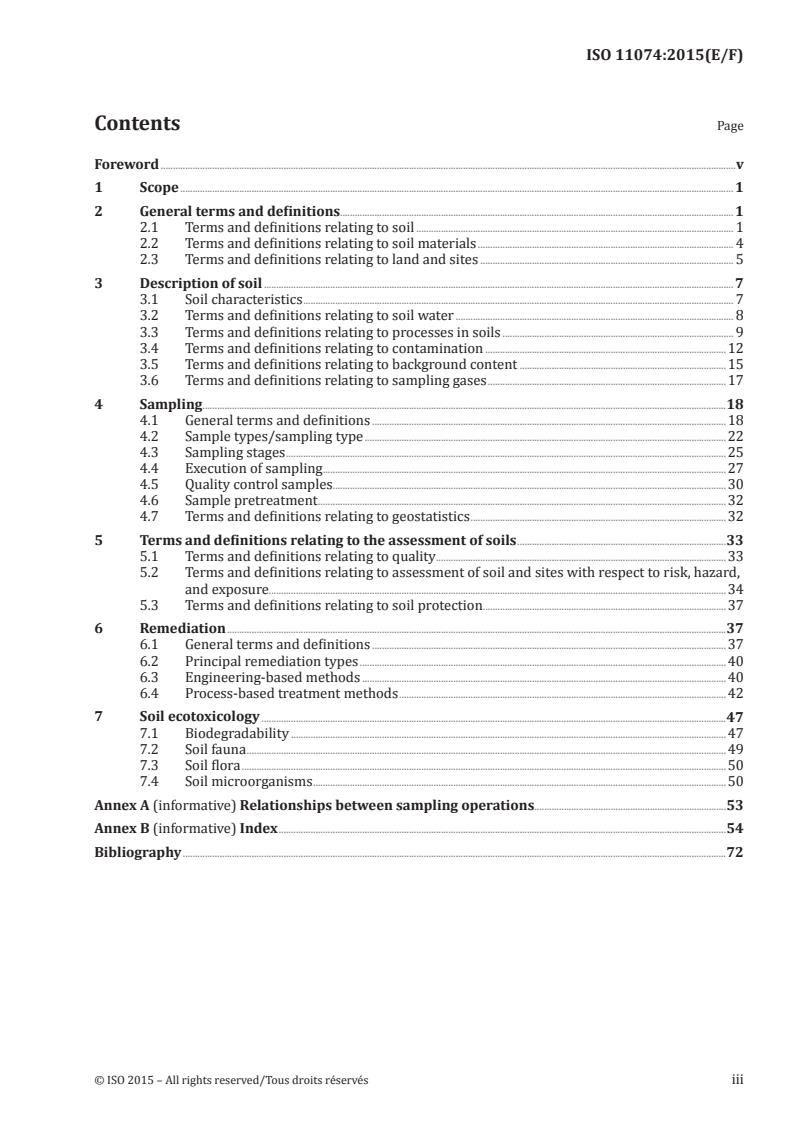
Contents Page
Foreword .v
1 Scope . 1
2 General terms and definitions . 1
2.1 Terms and definitions relating to soil . 1
2.2 Terms and definitions relating to soil materials . 4
2.3 Terms and definitions relating to land and sites . 5
3 Description of soil . 7
3.1 Soil characteristics . 7
3.2 Terms and definitions relating to soil water . 8
3.3 Terms and definitions relating to processes in soils . 9
3.4 Terms and definitions relating to contamination .12
3.5 Terms and definitions relating to background content .15
3.6 Terms and definitions relating to sampling gases .17
4 Sampling .18
4.1 General terms and definitions .18
4.2 Sample types/sampling type .22
4.3 Sampling stages .25
4.4 Execution of sampling .27
4.5 Quality control samples . .30
4.6 Sample pretreatment .32
4.7 Terms and definitions relating to geostatistics .32
5 Terms and definitions relating to the assessment of soils .33
5.1 Terms and definitions relating to quality .33
5.2 Terms and definitions relating to assessment of soil and sites with respect to risk, hazard,
and exposure.34
5.3 Terms and definitions relating to soil protection . .37
6 Remediation .37
6.1 General terms and definitions .37
6.2 Principal remediation types .40
6.3 Engineering-based methods .40
6.4 Process-based treatment methods .42
7 Soil ecotoxicology .47
7.1 Biodegradability .47
7.2 Soil fauna .49
7.3 Soil flora .50
7.4 Soil microorganisms .50
Annex A (informative) Relationships between sampling operations .53
Annex B (informative) Index .54
Bibliography .72
Foreword
ISO (the International Organization for Standardization) is a worldwide federation of national standards
bodies (ISO member bodies). The work of preparing International Standards is normally carried out
through ISO technical committees. Each member body interested in a subject for which a technical
committee has been established has the right to be represented on that committee. International
organizations, governmental and non-governmental, in liaison with ISO, also take part in the work.
ISO collaborates closely with the International Electrotechnical Commission (IEC) on all matters of
electrotechnical standardization.
The procedures used to develop this document and those intended for its further maintenance are
described in the ISO/IEC Directives, Part 1. In particular the different approval criteria needed for the
different types of ISO documents should be noted. This document was drafted in accordance with the
editorial rules of the ISO/IEC Directives, Part 2 (see www.iso.org/directives).
Attention is drawn to the possibility that some of the elements of this document may be the subject of
patent rights. ISO shall not be held responsible for identifying any or all such patent rights. Details of any
patent rights identified during the development of the document will be in the Introduction and/or on
the ISO list of patent declarations received (see www.iso.org/patents).
Any trade name used in this document is information given for the convenience of users and does not
constitute an endorsement.
For an explanation on the meaning of ISO specific terms and expressions related to conformity
assessment, as well as information about ISO’s adherence to the WTO principles in the Technical Barriers
to Trade (TBT) see the following URL: Foreword - Supplementary information
The committee responsible for this document is ISO/TC 190, Soil quality, Subcommittee SC 1, Evaluation
of criteria, terminology and codification.
This second edition cancels and replaces the first edition (ISO 11074:2005), which has been technically
revised.
iv © ISO 2015 – All rights reserved/Tous droits réservés
INTERNATIONAL STANDARD ISO 11074:2015(E/F)
Soil quality — Vocabulary
1 Scope
This International Standard defines a list of terms used in the preparation of the standards in the field
of soil quality.
The terms are classified under the following main headings:
— general terms (terms relating to soil, soil materials, land, and sites);
— description of soil (soil characteristics, soil water, properties of soils and substances, processes in
soil, contamination, pollution, background content);
— sampling (general terms, sample types/sampling type, sampling stages, execution of sampling,
quality control samples, sample pretreatment);
— terms relating to the assessment of soils (quality, assessment of soil and sites with respect to risk,
hazard and exposure, soil protection);
— remediation (general terms, principal remediation types, engineering-based methods, process-
based treatment methods);
— soil ecotoxicology.
NOTE See also the ISO online browsing platform (OBP): www.iso.org/obp/ui/
2 General terms and definitions
2.1 Terms and definitions relating to soil
2.1.1
aerobic
descriptive of a condition with molecular oxygen available
2.1.2
anaerobic
descriptive of a condition with no molecular oxygen available
2.1.3
available water capacity
soil water content usable by plants based on the effective root penetration depth
Note 1 to entry: The usable field capacity in the effective root zone is expressed in mm water column.
Note 2 to entry: The available water capacity (AWC) is generally taken to be the water content between field
capacity (FC) and the permanent wilting point (PWP) or 10 kilopascals to 1 500 kilopascals. See readily available
water capacity.
2.1.4
dissolved organic carbon
DOC
concentration of organic carbon remaining in solution after filtration and/or centrifugation under
defined conditions
Note 1 to entry: It is expressed in mg/l, g/m .
2.1.5
field capacity
maximum water content expressed in percent (w/w or v/v) that an unsaturated soil can retain against
gravity under undisturbed soil conditions (conventionlly stated as water content two days to three days
after full saturation with water)
Note 1 to entry: Conventionally stated as water content 48 h after saturation under conditions of free drainage.
2.1.6
humus
total of all dead plant and animal substances and their organic transformation products, as well as
organic material inserted through anthropogenic activities appearing in and on mineral soil
Note 1 to entry: Living plants and soil organisms, as well as coal, are not counted among humus but are often
methodically not separatable.
2.1.7
organic carbon
summarizing parameter including all of the carbon forms for dissolved (DOC: dissolved organic carbon
– see 2.1.4) and total organic compounds (TOC: total organic carbon- see 2.1.22)
Note 1 to entry: Organic carbon is not synonymous with organic matter content (see 2.1.8).
2.1.8
organic matter
matter consisting of plant and/or animal organic materials, and the conversion products of those
materials
EXAMPLE Humus.
2.1.9
parent material
unweathered inorganic solid or unconsolidated rock from which soil developed or originated
Note 1 to entry: It can include material from alluvial, colluvial, and aeolian origins.
2.1.10
perched groundwater
groundwater above a non-saturated zone
2.1.11
soil
upper layer of the Earth’s crust transformed by weathering and physical/chemical and biological
processes and composed of mineral particles, organic matter, water, air, and living organisms organized
in generic soil horizons
Note 1 to entry: In a broader civil engineering sense, soil includes topsoil and sub-soil; deposits such as clays, silts,
sands, gravels, cobbles, boulders, and organic matter and deposits such as peat; materials of human origin such as
wastes; ground gas and moisture; and living organisms.
2.1.12
soil characterization
determination of relevant physical, chemical, and biological properties of the soil
2.1.13
soil gas
gas and vapour in the pore spaces of soils
2.1.14
soil pores
part of the soil volume, between the solid particles of the soil
2 © ISO 2015 – All rights reserved/Tous droits réservés
2.1.15
soil quality
all current positive or negative properties with regards to soil utilization and soil functions
2.1.16
soil reaction
characterizing property of the acid base state of soils, which is determined through hydrogen ion
concentration of a soil extraction performed under defined conditions
Note 1 to entry: The pH value is stated as negative 10-logarithm of the concentration of hydrogen ions and
expressed in moles/l in aqueous solution.
2.1.17
soil structure
arrangement of particles and organic matter to form aggregates which produce macro structures and
micro structures in the soil
2.1.18
soil texture
relative proportions of the various particle size fractions (i.e. sand, silt, clay) in a soil, according to a soil
classification system
2.1.19
standard soil
field-collected soil or manufactured soil whose main properties (e.g. pH, texture, organic matter content)
are within a known range
EXAMPLE Euro-soils, artificial soil, LUFA standard soil.
Note 1 to entry: The properties of standards soils might differ from the test soil.
2.1.20
subsoil
natural soil material below the topsoil and overlying the parent material
Note 1 to entry: All or much of the original rock structure has usually been obliterated by pedogenic processes.
2.1.21
topsoil
upper part of a natural soil that is generally dark coloured and has a higher content of organic matter
and nutrients when compared to the (mineral) horizons below, excluding the humus layer
Note 1 to entry: For arable land, topsoil refers to the ploughed soil depth, while for grassland; it is the soil layer
with high root content.
2.1.22
total organic carbon
TOC
all carbon present in organic matter
2.1.23
wilting point
water content of the soil below which the plants are not able to uptake water with their root system
Note 1 to entry: Permanent wilting point (PWP) is the moisture content below which a sunflower seedling cannot
recover from wilt. It is generally taken to equal a suction of 1 500 kilopascals.
2.2 Terms and definitions relating to soil materials
2.2.1
construction works
applications where soil materials are not required to have a direct productive use although they can
support other layers intended to have a productive use
[SOURCE: for example, earthworks (e.g. embankments), landscape engineering, road construction,
construction of waste disposal sites, and back filling of excavated sites or mines]
2.2.2
damaged land
degraded land
land which, due to natural processes or human activity, is no longer able to properly sustain an economic
function and/or the natural or near natural ecological function
2.2.3
degraded soil
soil whose natural properties and soil functions or productivity have been damaged by contamination
or physical or other processes
2.2.4
dredged material
material excavated during e.g. maintenance, construction, reconstruction, and extension measures
from waters
Note 1 to entry: Dredged material might consist of
— sediments or subhydric soils, and
— soils and their parent material beneath the surface water body.
2.2.5
earthwork
reuse of soil material for civil engineering and construction purposes
Note 1 to entry: The same word can also refer to the material accumulated during an operation of earthwork.
2.2.6
excavated soil
soil material extracted from the ground
EXAMPLE Topsoil, subsoil, altered parent rock, typically arising during construction works.
2.2.7
fill material
made ground
mixed natural soil materials (often displaced) and can contain wastes such as building rubble, timber,
and other wastes coming from urban and industrial sites
2.2.8
harm
measurable adverse effect on a receptor
2.2.9
manufactured soil
manufactured product intended to perform specified soil functions produced by blending combinations
of natural, waste, or other soil materials with the addition of nutrients or other additives, when necessary
2.2.10
natural soil material
material coming from soil that has been displaced
4 © ISO 2015 – All rights reserved/Tous droits réservés
2.2.11
reclamation
rehabilitation
return of damaged, degraded, or derelict land to a beneficial use
Note 1 to entry: The term remediation is commonly reserved for the process of dealing with contaminated/polluted
sites.
2.2.12
reuse of soil material
useful and harmless utilization of soil materials
Note 1 to entry: Reuse can mean the transfer of soil materials to another location for use in agriculture, horticulture,
forestry, gardens, recreational areas, and construction sites.
2.2.13
sediment
solid material, both mineral and organic, that is in suspension or has been moved from its site of origin
by water or other processes
2.2.14
stockpile
temporary deposit of soil material
Note 1 to entry: Stockpiles can contain soil material.
Note 2 to entry: The soil material can be stored in a loosely dumped heap or can be lying in a predefined deposit
above or below the surface of the location, etc.
2.2.15
subhydric soils
soils formed below water or which are formed on parent material that was deposited in water or through
alluvial processes
2.2.16
treated soil
soil subject to a based ex situ or in situ process
2.2.17
treated soil material
material coming from treated soil and displaced and/or modified by human activity
2.3 Terms and definitions relating to land and sites
2.3.1
abandoned hazardous site
hazardous site left by the owner or other responsible party in unmanaged condition
2.3.2
abandoned industrial site
industrial site left by the owner or other responsible party in unmanaged condition
2.3.3
abandoned potentially hazardous site
abandoned site whose history leads to a suspicion that it can be hazardous
2.3.4
abandoned waste disposal site
waste disposal site left by the owner or other responsible party in unmanaged condition
2.3.5
contaminated site
site where contamination (2.3.6) is present
Note 1 to entry: There is no assumption in this definition that harms results from the presence of contamination.
2.3.6
contamination
substance(s) or agent(s) present in the soil as a result of human activity
[SOURCE: ISO 23611-6:2012, 3.2.4]
2.3.7
derelict site
site so damaged by human activity as to be incapable of beneficial use without treatment
Note 1 to entry: Damage can be to the aesthetic, physical, engineering, environmental, or contamination aspects
of the site.
2.3.8
donor site
site from which soil material is removed for use on a target site
2.3.9
hazardous site
site which, by reason of the substances or agents present, is judged to be hazardous to human health and
safety or to the environment
2.3.10
orphan site
site for which no owner or other responsible party for pollution can be identified
2.3.11
site
defined area
2.3.12
site characterization
collection of data connected to a site providing appropriate information for the assessment in question
Note 1 to entry: In connection with risk assessment, specifically the source identification and characterization
element of the exposure assessment.
2.3.13
suspect site
site whose history or any other information leads to a suspicion that it can be hazardous for human
health or environment
2.3.14
target site
site at which soil is to be reused
2.3.15
uniformly contaminated site
site with a generally uniform concentration of a hazardous substance
Note 1 to entry: The extent of the contamination is usually large and the gradient of concentration within the site
is rather shallow.
6 © ISO 2015 – All rights reserved/Tous droits réservés
3 Description of soil
3.1 Soil characteristics
3.1.1
bulk density
ratio of the mass of a quantity of material (or one phase) and the total volume occupied by this material
(including other phases)
Note 1 to entry: This is typically a volumetric mass but it is commonly named as “density”. The numerical values
−3
are identical or divided by the volumetric mass of water (1 t.m ) at 4 °C.
3.1.2
bulk volume
volume, including the solids and pores, of an arbitrary soil mass
3.1.3
clay content
proportion of soil particles with a particle size <2 µm
3.1.4
concentration
mass of test substance per unit mass of material
Note 1 to entry: Concentration is expressed as a mass fraction, in milligrams per kilogram (mg/kg) of dry soil.
3.1.5
maximum particle size
D
particle size such as 5 % of the mass of the material correspond to particles having larger size
3.1.6
particle size distribution
distribution of the soil mineral particles according to predefined classes of size
3.1.7
porosity
volume of pores in a soil sample (non-solid volume) divided by the bulk volume of the sample
3.1.8
specific surface area
the surface area of the soil or a size fraction of the soil particles
Note 1 to entry: Surface area can be measured by a variety of means that might give differing results such as
1) ratio of surface area to mass of solid particles, and
2) ratio of surface area to volume of solid particles.
Note 2 to entry: Because both definitions are in use, this term is to always be defined explicitly wherever it is used.
3.1.9
water content
W
w
mass of water evaporating from the soil when dried to a constant mass at
105 °C, expressed as the mass of water divided by the original dry mass of the soil sample
3.1.10
water content
W
v
volume of water evaporating from the soil when dried to constant mass at
105 °C, referred to the volume of the original undisturbed sample
3.1.11
water content on a dry mass basis
mass of water evaporating from the soil when dried to a constant mass at 105 °C, divided by the dry
mass of the soil and multiplied by 100
[SOURCE: ISO 11465:1993, 3.2]
3.2 Terms and definitions relating to soil water
3.2.1
bedrock
in situ naturally consolidated rock either underlying drift deposits such as glacial till or exposed by past
or current erosion processes
[SOURCE: EN 16039]
3.2.2
capillary water
water held on soil particles due to unbalanced inter-molecular attraction at the liquid boundary
EXAMPLE The rise or depression of liquids in narrow tubes, the formation of films, drops, bubbles, etc.
3.2.3
groundwater
water which is being held in and can be recovered from an underground formation, except capillary
water
Note 1 to entry: Groundwater is usually taken to include any water, beneath the surface of the land or beneath the
bed of any stream, lake, reservoir, or other body of surface water, whatever the geological formation or structure
in which such water occurs; but water within the beds of streams, etc. is often excluded.
3.2.4
groundwater surface
water table
upper boundary surface of the groundwater
[SOURCE: ISO 22475-1]
3.2.5
percolating water
infiltrating water that moves downward in the pore space due to gravity
3.2.6
saturated zone
zone of the ground in which the pore space is filled completely with liquid at the time of consideration
3.2.7
soil water
all water of the unsaturated and saturated zone
3.2.8
unsaturated zone
zone of the soil in which the pore space is not filled completely with liquid at the time of consideration
3.2.9
vadose zone
zone of the soil which is connected to the atmosphere and which is aerated either permanently or
regularly
8 © ISO 2015 – All rights reserved/Tous droits réservés
3.3 Terms and definitions relating to processes in soils
3.3.1
abiotic decomposition
decomposition by physical and/or chemical processes (e.g. photolysis, hydrolysis, oxidation, and
reduction)
3.3.2
abiotic degradation
degradation by physical and/or chemical processes
3.3.3
accumulation
increase of the concentration of a substance in soil due to the fact that the substance input is larger than
the substance output
Note 1 to entry: Substance output includes material which is broken down.
3.3.4
aggressive soil conditions
soil conditions potentially damaging to buildings and construction materials
3.3.5
bioconcentration factor
BCF
ratio of the concentration of a substance in an organism to that in the soil
3.3.6
biodegradation
physical and chemical breakdown of a substance by living organisms, mainly bacteria, and/or fungi
3.3.7
decomposition
breakdown of complex organic substances into simpler molecules or ions by physical, chemical, and/or
biological processes
3.3.8
degradation
physical and chemical breakdown of the substances
3.3.9
diffuse source input
input of a substance emitted from moving sources, from sources with a large area, or from many sources
Note 1 to entry: The sources can be cars, application of substances through agricultural practices, emissions from
town or region, deposition of sediment through flooding of a river.
Note 2 to entry: Diffuse source input usually leads to sites that are relatively uniformly contaminated. At some
sites, the input conditions can nevertheless cause a higher local input near the source or where atmospheric
deposition/rain is increased.
3.3.10
filter characteristics
ability of a soil to retain or bind solid, dissolved, or gaseous substances
3.3.11
habitat function
ability of soil/soil materials to serve as a habitat for micro-organisms, plants, soil living animals, and
their interactions (biocenosis)
3.3.12
Henry’s coefficient
partition coefficient between soil air and soil water
3.3.13
humification
decomposition of organic material followed by a synthesis of humic substances
3.3.14
immobilization
conversion of substances or soil particles into a (temporarily) immobile form
Note 1 to entry: See accumulation (3.3.3).
3.3.15
leaching
dissolution and movement of dissolved substances by water
3.3.16
leaching potential
potential for substances present in the soil/soil material to be moved due to the movement of water
3.3.17
lessivage
translocation of solid particles within the soil profile
Note 1 to entry: Lessivage is the combination of eluviation (process of material being leached from the upper part
of the soil profile) and illuviation (accumulation of that material lower in the soil profile).
3.3.18
limiting factor
any condition that limits soil functions and/or the utilization of a soil
3.3.19
mineralization
final stage of the biodegradation of organic matter or organic substances into carbon dioxide, water and
the hydrides, oxides or other mineral salts
3.3.20
mobilization
conversion of substances or soil particles into a mobile form
3.3.21
non-point source input
any source other than a point source
Note 1 to entry: See diffuse sourceinput (3.3.9).
3.3.22
partition coefficient
ratio between the concentrations of a substance in two different media and e.g. environmental
compartments
3.3.23
partition coefficient between soil and plant
ratio between the concentration of a substance in the soil and in plant material
10 © ISO 2015 – All rights reserved/Tous droits réservés
3.3.24
partition coefficient between soil organic matter and soil water
ratio of the concentration of a substance in the soil organic matter fraction to that in the soil-water phase
Note 1 to entry: This partition coefficient is often expressed in relation to the soil organic carbon content (hence:
Koc).
3.3.25
persistence
resistance of a substance to chemical changes
Note 1 to entry: Persistence is always related to environmental conditions. Thus, a substance can be persistent in
one soil, but not in another.
Note 2 to entry: Persistence can be expressed as the half-life of a substance under clearly defined environmental
conditions.
3.3.26
phytoavailability
availability of a chemical species present in the soil for plants
Note 1 to entry: It is estimated by partial chemical extraction, also called “selective”.
3.3.27
point source input
input of a substance from a stationary discrete source of definite size
Note 1 to entry: The sources can be stack emissions, accidental spills, waste dumps, spills on industrial sites,
major leaks from sewers and other pipelines.
Note 2 to entry: Point source input can cause both locally contaminated sites and relatively uniformly contaminated
sites.
3.3.28
primary degradation
degradation or alteration of the molecular structure of a substance to an extent sufficient to remove
some characteristic property
[SOURCE: ISO 6107-6:1986, modified]
3.3.29
receptor
defined entity that is vulnerable to the adverse effect(s) of a hazardous substance or agent
EXAMPLE Human, animal, water, vegetation, building services, etc.
3.3.30
retention function
ability of soils/soil materials to absorb pollutants in such a way that they cannot be mobilised through
the water pathway and translocated into the terrestrial food chain
3.3.31
soil functions
description of the significance of soils to man and the environment
EXAMPLE Control of substance and energy cycles as compartment of ecosystems, basis for the life of plants,
animals, and man, basis for the stability of buildings and roads, basis for the yield of agriculture, horticulture, and
forestry, carrier of genetic reservoir, document of natural history, archaeological and paleoecological document.
3.3.32
soil processes
physical or reactive geochemical and biological processes, which can attenuate, concentrate, immobilise,
liberate, degrade, or otherwise transform substances in soil
3.3.33
soil-water partition coefficient
K
d
ratio of the concentration of a substance in the soil solid phase to that in the soil-water phase
3.3.34
sorption
reversible binding of a substance by soil constituents
Note 1 to entry: Mechanisms of sorption include, for example, ion exchange, surface absorption, and dissolution of
organic chemicals in the soil organic matter.
3.3.35
source
place from which a substance or agent is released giving rise to potential exposure of one or more
receptor
3.3.36
substance input
movement of a substance from another environmental compartment into a soil
3.3.37
substance output
movement of a substance from the soil into another environmental compartment
3.3.38
translocation
movement of substances within or on the surface of the soil caused by water, air, and human activities
or soil organisms
3.3.39
ultimate biodegradation
biodegradation leading to complete mineralization
[SOURCE: ISO 6107-6:1986]
3.4 Terms and definitions relating to contamination
3.4.1
aliphatic hydrocarbon
acyclic or cyclic, saturated or unsaturated carbon compound, excluding aromatic compounds
[SOURCE: ISO 11504:2012]
3.4.2
aromatic hydrocarbon
hydrocarbon of which the molecular structure incorporates one or more planar sets of six carbon atoms
that are connected by delocalized electrons, numbering the same as if they consisted of alternating
single and double covalent bonds
[SOURCE: ISO 11504:2012]
3.4.3
boiling point
BP
point at which the vapour pressure of a liquid equals the external pressure acting on the surface of liquid
Note 1 to entry: It is expressed in degrees Celsius.
[SOURCE: ISO 11504:2012]
12 © ISO 2015 – All rights reserved/Tous droits réservés
3.4.4
carcinogen
substance that causes the development of malignant cells in animals or humans
[SOURCE: ISO 11504:2012]
3.4.5
compliance point
location (for example, soil or groundwater) where the assessment criteria shall be measured and shall
not be exceeded
[SOURCE: ISO 11504:2012]
3.4.6
contaminant
substance or agent present in the soil as a result of human activity
Note 1 to entry: There is no assumption in this definition that harms results from the presence of the contaminant.
See also pollutant (3.4.18).
[SOURCE: ISO 19258:2005]
3.4.7
equivalent carbon number
empirically determined parameter related to the boiling point of a chemical normalized to the boiling
point of the n-alkanes or its retention time in a boiling-point gas chromatographic (GC) column
[SOURCE: ISO 11504:2012]
3.4.8
extractable fraction
amount of an element determined with a complexing agent, salt solutions, or water used to mimic
different kinds of bioavailability including plant uptake or exposure routes related to the pore water
concentration of a substance
3.4.9
fraction
group of aromatic and/or aliphatic hydrocarbons with similar physic-chemical properties
Note 1 to entry: In this International Standard, group of aromatic or aliphatic compounds with leaching and
volatilization factors differ by approximately one order of magnitude.
[SOURCE: ISO 11504:2012]
3.4.10
gas chromatography
analytical method that is used to separate and determine the components of complex mixtures based on
partitioning between a gas phase and a stationary phase
[SOURCE: ISO 11504:2012]
3.4.11
hydrocarbon
compound of hydrogen and carbon which are the principal constituents of crude oil, refined petroleum
products, and products derived from the carbonization of coal (at a high or low temperature)
[SOURCE: ISO 11504:2012]
3.4.12
indicator compound
compound chosen to describe properties, primarily toxicity, of a petroleum mixture or fraction
Note 1 to entry: This method is often used to assess carcinogenic compounds.
[SOURCE: ISO 11504:2012]
3.4.13
limit test
test used in determination of acute toxicity to Eisenia fetida/Eisenia andrei in which four duplicate tests
are performed on the test soil without any dilution and on the control soil
[SOURCE: ISO 11268-1]
3.4.14
NSO compounds
organic compounds that contain nitrogen, sulphur, and oxygen
EXAMPLE Asphaltenes.
Note 1 to entry: NSO compounds occur in organic matter and crude oil. NSO compounds can be separated from
crude oil by polar solvents such as methanol.
[SOURCE: ISO 11504:2012]
3.4.15
partitioning
extent to which a compound of a hydrocarbon mixture separates into different media (or phases) based
on its chemical and physical properties and the size and properties of the media in the specific situation
[SOURCE: ISO 11504:2012]
3.4.16
petroleum hydrocarbon
organic compound comprised of carbon and hydrogen atoms arranged in varying structural
configurations which make up the principal constituents of crude oil and petroleum products
Note 1 to entry: Mineral oil is a colloquial term for petroleum hydrocarbons or petroleum products.
[SOURCE: ISO 11504:2012]
3.4.17
polycyclic aromatic hydrocarbon
PAH
compound whose molecules contain two or more simple aromatic rings fused together by sharing two
neighbouring carbon atoms
EXAMPLE Naphthalene, anthracene, and phenanthrene.
[SOURCE: ISO 11504:2012]
3.4.18
pollutant
substance or agent present in the soil (or groundwater) which, due to its properties, amount or
concentration, causes adverse impacts on soil functions
3.4.19
potentially harmful substance
substance which by its chemical form, concentration or presence, can be dangerous for humans or the
environment
Note 1 to entry: It can be present naturally or as a result of human activity.
14 © ISO 2015 – All rights reserved/Tous droits réservés
3.4.20
pseudo-total concentration
amount of an element determined using a strong acid or combination of acids as
extractant
Note 1 to entry: Typically, a small insoluble proportion of the element under consideration is not removed from
the matrix by the chosen extractants.
Note 2 to entry: Depending on the element and the soil matrix, the pseudo-total concentration is typically 70 % to
90 % of the true total concentration.
3.4.21
residual contamination
amount or concentration of contaminants remaining in a specific medium, following remediation
3.4.22
surrogate compound
representative compound with toxicological and/or physical properties indicative of a hydrocarbon
fraction, which can therefore be used to represent the fraction in an exposure assessment
[SOURCE: ISO 11504:2012]
3.4.23
total concentration
total of an element present in all chemical forms and irrespective of its location in the
soil material, including that incorporated in silicate minerals
Note 1 to entry: Determination of the total concentration requires use of an instrumental technique such as
X-ray fluorescence analysis or a powerful solvent combination, such as a mixture of hydrofluoric and perchloric
acid or alkaline melt. The use of this solvent mixture presents many practical and safety-related problems in the
laboratory and is therefore, often avoided.
3.4.24
total concentration
concentration derived by applying an analytical technique that cannot distinguish
between similar compounds
EXAMPLE For the phenols between monohydric, dihydric, and trihydric compounds.
Note 1 to entry: The term total can be misleading, e.g. not all phenols can be detected by the method and different
methods can give different results.
3.4.25
total petroleum hydrocarbons
method-defined parameter, depending on the analytical method used to measure it
[SOURCE: ISO 11504:2012]
3.5 Terms and definitions relating to background content
3.5.1
background concentration
concentration of a substance characteristic of a soil type in an area or region arising from both natural
sources and non-natural diffuse sources, such as atmospheric deposition
Note 1 to entry: Commonly expressed in terms of average, typical, median, a range of values, or a background
value.
3.5.2
background value
statistical characteristics of the total (natural pedo-geochemical and anthropogenic) content of
substances in soil
3.5.3
critical concentration
quantitative estimate of a concentration of one or more pollutants below which, significant harmful
effects on specified sensitive elements of the (soil) environment do not occur, according to existing
knowledge
3.5.4
critical load
quantitative estimate of the input of one or more pollutants below which, significant harmful effects
on specified sensitive elements of the (soil) environment do not occur, according to existing knowledge
3.5.5
essential trace element
element essential in low concentrations for plant or animal (including human) metabolism
Note 1 to entry: An element can be essential at low concentrations but become harmful at higher concentrations.
3.5.6
hazardous substances
substances which, because of their properties, quantities or concentrations, have an adverse effect on
soil functions and soil utilization
3.5.7
natural background concentration
concentration of a substance that is derived solely from natural sources (i.e. of geogenic origin),
commonly expressed in terms of average, a range of values, or a natural background value
3.5.8
natural background value
statistical characteristics of the natural pedo-geochemical content of a substance in soils
3.5.9
pedo-geochemical background value
statistical characteristics of the pedo-geochemical content
Note 1 to entry: Any estimate of pedo-geochemical background value is prone to a certain amount of error given
the uncertainty associated with determining the pedo-geochemical content.
3.5.10
soil salinization
accumulation of water soluble salts in soil
3.5.11
statistical characteristic
numerical value calculated from a variate of a chosen parameter of the population
EXAMPLE Mean, median, standard deviation, or percentiles of the ordered frequency distribution.
3.5.12
trace element
element present in low concentration in soil material in respect to the most commonly observed natural
background level
16 © ISO 2015 – All rights reserved/Tous droits réservés
3.5.13
usual background value
statistical characteristic of the usual content of a substance in soils
Note 1 to entry: The variability of the natural pedo-geochemical content and of the usual content often increases
with the size of the portion of the soil mantle investigated, so it is recommended to assess the natural pedo-
geochemical value and the usual value at a spatial scale similar to those which it is used for. For instance, if the
natural pedo-geochemical value or the usual value is used to evaluate soil contamination at a local scale (i.e.
agricultural plot, contaminated site, watershed), it is necessary to refer to natural pedo-geochemical value or
usual value which has been determined at the same scale.
Note 2 to entry: As presented here, the background contents are concentrations, e.g. mass
...