

ISO 7176-21:2025
(Main)Wheelchairs — Part 21: Requirements and test methods for electromagnetic compatibility of electrically powered wheelchairs and scooters, and battery chargers
General Information
- Abstract
This document specifies requirements and test methods for electromagnetic emissions and for electromagnetic immunity of electrically powered wheelchairs and scooters, intended for indoor or outdoor use, or both, by people with disabilities. It is also applicable to manual wheelchairs with an add-on power kit. It is not applicable to vehicles designed to carry more than one person. This document also specifies requirements and test methods for the electromagnetic compatibility of battery chargers intended for use with electrically powered wheelchairs and scooters. A reference configuration is specified for adjustable wheelchairs and scooters in order to enable test results to be used for comparison of performance.
- Status
- Published
- Publication Date
- 24-Apr-2025
- Technical Committee
- ISO/TC 173/SC 1 - Wheelchairs
- Drafting Committee
- ISO/TC 173/SC 1 - Wheelchairs
- Current Stage
- 6060 - International Standard published
- Start Date
- 25-Apr-2025
- Due Date
- 15-Feb-2025
- Completion Date
- 25-Apr-2025
Overview
ISO 7176-21:2025 - "Wheelchairs - Part 21: Requirements and test methods for electromagnetic compatibility of electrically powered wheelchairs and scooters, and battery chargers" specifies electromagnetic compatibility (EMC) requirements and test methods for electrically powered wheelchairs, scooters and their battery chargers. Applicable to indoor and/or outdoor use, it also covers manual wheelchairs fitted with add‑on power kits and defines a reference configuration for adjustable devices so test results are comparable. This third edition updates immunity test levels and aligns environment categories with IEC 60601-1-2.
Key topics and technical requirements
Key technical topics addressed by ISO 7176-21:2025 include:
- Emissions requirements
- Radiated emissions from wheelchair drives and chargers
- Mains terminal disturbances and harmonic current emissions for on‑board and off‑board chargers
- Voltage fluctuations and flicker
- Immunity requirements
- Electrostatic discharge (ESD) immunity
- Radiated radio‑frequency (RF) field immunity
- Fast transient/burst and surge immunity
- Conducted disturbance immunity
- Power‑frequency magnetic field immunity
- Immunity to voltage dips and short interruptions
- Test methods and sequence
- Detailed apparatus, preparation and operation procedures for driving and non‑driving tests
- Test sequencing, wheel speed change calculations and reporting requirements
- Documentation
- Test report contents, disclosure and user manual information to support safe operation and compliance
The standard groups immunity test levels according to intended environments (harmonized with IEC 60601‑1‑2), enabling appropriate evaluation for medical and assistive device contexts.
Applications and who uses it
ISO 7176-21:2025 is intended for:
- Manufacturers and designers of electrically powered wheelchairs, scooters and battery chargers - for EMC design, risk mitigation and product development
- Test laboratories and certification bodies - to perform standardized EMC testing and produce comparable results
- Regulatory authorities and procurement teams - to assess compliance and safety for market approval or tender specifications
- Clinical engineers and safety officers - to evaluate device behavior in electromagnetic environments and inform user guidance
Practical uses include product development validation, pre‑compliance and certification testing, supplier selection, and preparation of user manuals that address EMC‑related safe operation.
Related standards
- ISO 7176 series (other parts of the wheelchair standards family) - for performance, safety and test methods
- IEC 60601‑1‑2 - referenced for environment categorization and immunity level alignment
Keywords: ISO 7176-21:2025, electromagnetic compatibility, EMC, electrically powered wheelchairs, scooters, battery chargers, radiated emissions, ESD immunity, RF immunity, test methods.
Relations
- Effective Date
- 06-Jun-2022
Get Certified
Connect with accredited certification bodies for this standard

BSI Group
BSI (British Standards Institution) is the business standards company that helps organizations make excellence a habit.

TÜV Rheinland
TÜV Rheinland is a leading international provider of technical services.

TÜV SÜD
TÜV SÜD is a trusted partner of choice for safety, security and sustainability solutions.
Sponsored listings
Frequently Asked Questions
ISO 7176-21:2025 is a standard published by the International Organization for Standardization (ISO). Its full title is "Wheelchairs — Part 21: Requirements and test methods for electromagnetic compatibility of electrically powered wheelchairs and scooters, and battery chargers". This standard covers: This document specifies requirements and test methods for electromagnetic emissions and for electromagnetic immunity of electrically powered wheelchairs and scooters, intended for indoor or outdoor use, or both, by people with disabilities. It is also applicable to manual wheelchairs with an add-on power kit. It is not applicable to vehicles designed to carry more than one person. This document also specifies requirements and test methods for the electromagnetic compatibility of battery chargers intended for use with electrically powered wheelchairs and scooters. A reference configuration is specified for adjustable wheelchairs and scooters in order to enable test results to be used for comparison of performance.
This document specifies requirements and test methods for electromagnetic emissions and for electromagnetic immunity of electrically powered wheelchairs and scooters, intended for indoor or outdoor use, or both, by people with disabilities. It is also applicable to manual wheelchairs with an add-on power kit. It is not applicable to vehicles designed to carry more than one person. This document also specifies requirements and test methods for the electromagnetic compatibility of battery chargers intended for use with electrically powered wheelchairs and scooters. A reference configuration is specified for adjustable wheelchairs and scooters in order to enable test results to be used for comparison of performance.
ISO 7176-21:2025 is classified under the following ICS (International Classification for Standards) categories: 11.180.10 - Aids and adaptation for moving; 33.100.01 - Electromagnetic compatibility in general. The ICS classification helps identify the subject area and facilitates finding related standards.
ISO 7176-21:2025 has the following relationships with other standards: It is inter standard links to ISO 7176-21:2009. Understanding these relationships helps ensure you are using the most current and applicable version of the standard.
ISO 7176-21:2025 is available in PDF format for immediate download after purchase. The document can be added to your cart and obtained through the secure checkout process. Digital delivery ensures instant access to the complete standard document.
Standards Content (Sample)
International
Standard
ISO 7176-21
Third edition
Wheelchairs —
2025-04
Part 21:
Requirements and test methods for
electromagnetic compatibility of
electrically powered wheelchairs
and scooters, and battery chargers
Fauteuils roulants —
Partie 21: Exigences et méthodes d'essai pour la compatibilité des
fauteuils roulants électriques et scooters motorisés
Reference number
© ISO 2025
All rights reserved. Unless otherwise specified, or required in the context of its implementation, no part of this publication may
be reproduced or utilized otherwise in any form or by any means, electronic or mechanical, including photocopying, or posting on
the internet or an intranet, without prior written permission. Permission can be requested from either ISO at the address below
or ISO’s member body in the country of the requester.
ISO copyright office
CP 401 • Ch. de Blandonnet 8
CH-1214 Vernier, Geneva
Phone: +41 22 749 01 11
Email: copyright@iso.org
Website: www.iso.org
Published in Switzerland
ii
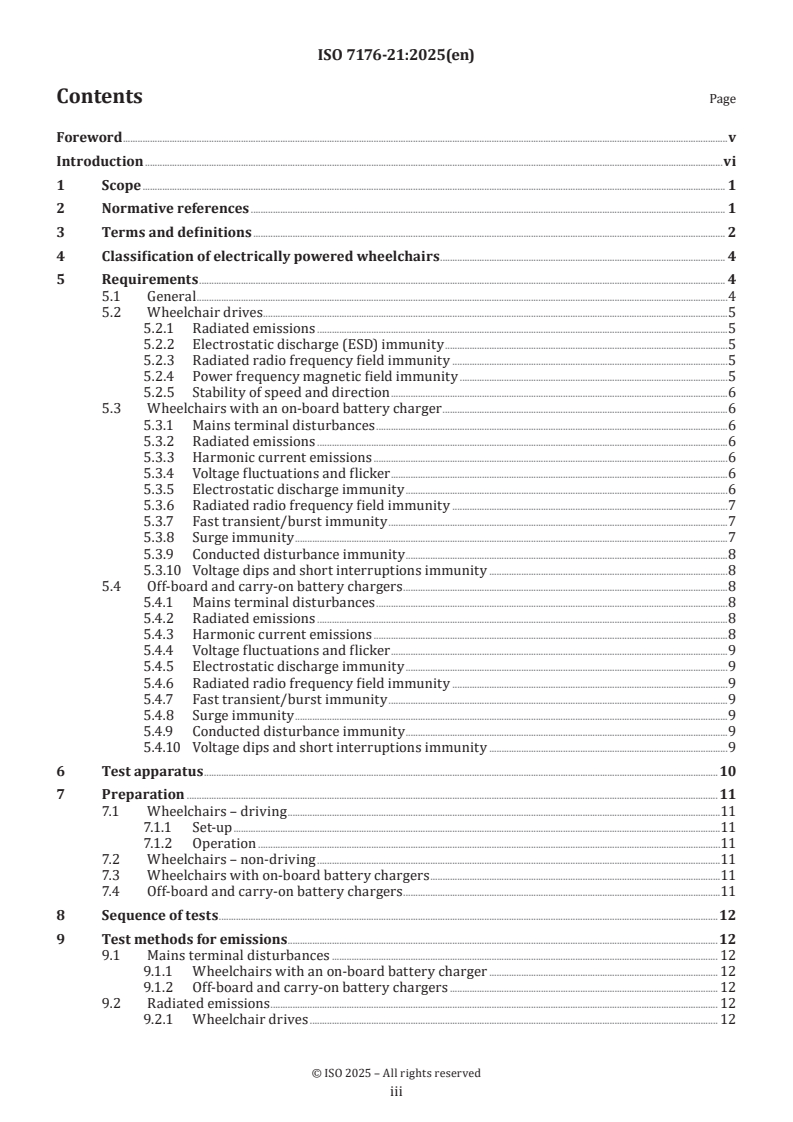
Contents Page
Foreword .v
Introduction .vi
1 Scope . 1
2 Normative references . 1
3 Terms and definitions . 2
4 Classification of electrically powered wheelchairs . 4
5 Requirements . 4
5.1 General .4
5.2 Wheelchair drives .5
5.2.1 Radiated emissions .5
5.2.2 Electrostatic discharge (ESD) immunity .5
5.2.3 Radiated radio frequency field immunity .5
5.2.4 Power frequency magnetic field immunity .5
5.2.5 Stability of speed and direction .6
5.3 Wheelchairs with an on-board battery charger .6
5.3.1 Mains terminal disturbances .6
5.3.2 Radiated emissions .6
5.3.3 Harmonic current emissions .6
5.3.4 Voltage fluctuations and flicker .6
5.3.5 Electrostatic discharge immunity .6
5.3.6 Radiated radio frequency field immunity .7
5.3.7 Fast transient/burst immunity .7
5.3.8 Surge immunity .7
5.3.9 Conducted disturbance immunity .8
5.3.10 Voltage dips and short interruptions immunity .8
5.4 Off-board and carry-on battery chargers .8
5.4.1 Mains terminal disturbances .8
5.4.2 Radiated emissions .8
5.4.3 Harmonic current emissions .8
5.4.4 Voltage fluctuations and flicker .9
5.4.5 Electrostatic discharge immunity .9
5.4.6 Radiated radio frequency field immunity .9
5.4.7 Fast transient/burst immunity .9
5.4.8 Surge immunity .9
5.4.9 Conducted disturbance immunity .9
5.4.10 Voltage dips and short interruptions immunity .9
6 Test apparatus .10
7 Preparation .11
7.1 Wheelchairs – driving .11
7.1.1 Set-up .11
7.1.2 Operation .11
7.2 Wheelchairs – non-driving .11
7.3 Wheelchairs with on-board battery chargers .11
7.4 Off-board and carry-on battery chargers .11
8 Sequence of tests .12
9 Test methods for emissions .12
9.1 Mains terminal disturbances . 12
9.1.1 Wheelchairs with an on-board battery charger . 12
9.1.2 Off-board and carry-on battery chargers . 12
9.2 Radiated emissions . 12
9.2.1 Wheelchair drives . 12
iii
9.2.2 Wheelchairs with an on-board battery charger . 12
9.2.3 Off-board and carry-on battery chargers . 13
9.3 Harmonic current emissions . . 13
9.3.1 Wheelchairs with an on-board battery charger . 13
9.3.2 Off-board and carry-on battery chargers . 13
9.4 Voltage fluctuations and flicker . 13
9.4.1 Wheelchairs with an on-board battery charger . 13
9.4.2 Off-board and carry-on battery chargers . 13
10 Test methods for immunity .13
10.1 Electrostatic discharge immunity. 13
10.1.1 Wheelchair drives . 13
10.1.2 Wheelchairs with an on-board battery charger .14
10.1.3 Off-board and carry-on battery chargers . 15
10.2 Radiated radio frequency field immunity . 15
10.2.1 Wheelchair drives . 15
10.2.2 Wheelchairs with an on-board battery charger .16
10.2.3 Off-board and carry-on battery chargers .17
10.3 Fast transient/burst immunity .17
10.3.1 Wheelchairs with an on-board battery charger .17
10.3.2 Off-board and carry-on battery chargers .17
10.4 Surge immunity .18
10.4.1 Wheelchairs with an on-board battery charger .18
10.4.2 Off-board and carry-on battery chargers .18
10.5 Conducted disturbance immunity .18
10.5.1 Wheelchairs with an on-board battery charger .18
10.5.2 Off-board and carry-on battery chargers .18
10.6 Power frequency magnetic field immunity .18
10.7 Voltage dips and short interruptions immunity .19
10.7.1 Wheelchairs with an on-board battery charger .19
10.7.2 Off-board and carry-on battery chargers .19
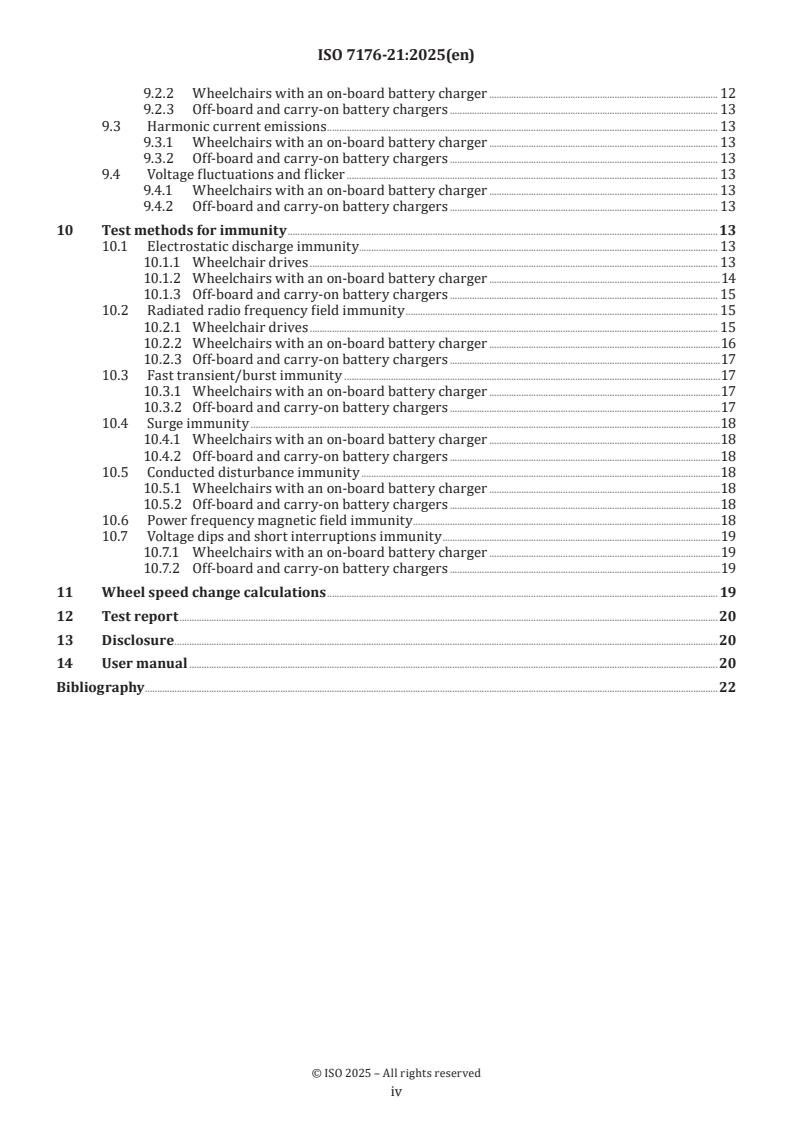
11 Wheel speed change calculations . 19
12 Test report .20
13 Disclosure .20
14 User manual .20
Bibliography .22
iv
Foreword
ISO (the International Organization for Standardization) is a worldwide federation of national standards
bodies (ISO member bodies). The work of preparing International Standards is normally carried out through
ISO technical committees. Each member body interested in a subject for which a technical committee
has been established has the right to be represented on that committee. International organizations,
governmental and non-governmental, in liaison with ISO, also take part in the work. ISO collaborates closely
with the International Electrotechnical Commission (IEC) on all matters of electrotechnical standardization.
The procedures used to develop this document and those intended for its further maintenance are described
in the ISO/IEC Directives, Part 1. In particular, the different approval criteria needed for the different types
of ISO documents should be noted. This document was drafted in accordance with the editorial rules of the
ISO/IEC Directives, Part 2 (see www.iso.org/directives).
ISO draws attention to the possibility that the implementation of this document may involve the use of (a)
patent(s). ISO takes no position concerning the evidence, validity or applicability of any claimed patent
rights in respect thereof. As of the date of publication of this document, ISO had not received notice of (a)
patent(s) which may be required to implement this document. However, implementers are cautioned that
this may not represent the latest information, which may be obtained from the patent database available at
www.iso.org/patents. ISO shall not be held responsible for identifying any or all such patent rights.
Any trade name used in this document is information given for the convenience of users and does not
constitute an endorsement.
For an explanation of the voluntary nature of standards, the meaning of ISO specific terms and expressions
related to conformity assessment, as well as information about ISO’s adherence to the World Trade
Organization (WTO) principles in the Technical Barriers to Trade (TBT), see www.iso.org/iso/foreword.html.
This document was prepared by Technical Committee ISO/TC 173, Assistive products, Subcommittee SC 1,
Wheelchairs.
This third edition cancels and replaces the second edition (ISO 7176-21:2009), which has been technically
revised.
The main changes are as follows:
— specification of immunity test levels according to the environments of intended use, categorized
according to locations that are harmonized with IEC 60601-1-2;
— specification of tests and test levels to improve the safety of electrically powered wheelchairs and
scooters, and battery chargers when portable RF communications equipment is used closer to the
electrically powered wheelchairs and scooters, and battery chargers (based on the immunity test levels
that were specified in IEC 60601-1-2:2014;
— addition of guidance on the maximum permissible change in steering servo position for various sized wheels;
— addition of guidance on determining maximum level of disturbances of actuators for powered wheelchairs
and scooters.
A list of all parts in the ISO 7176 series can be found on the ISO website.
Any feedback or questions on this document should be directed to the user’s national standards body. A
complete listing of these bodies can be found at www.iso.org/members.html.
v
Introduction
Electrically powered wheelchairs and their battery chargers are meant to operate without introducing
significant electromagnetic disturbances into the environment and without significant degradation
of operational performance in the presence of electromagnetic disturbances expected in normal use.
Wheelchairs are often used near roads and therefore should be immune to radio frequency fields from both
static and mobile communications equipment, as well as from other sources of electromagnetic disturbance.
Injury can occur in the event of unintentional movement or change in direction of movement of a wheelchair.
This document specifies requirements and test methods for wheelchairs and their battery chargers to
minimize the risks associated with their exposure to reasonably foreseeable electromagnetic interference
and electrostatic discharge and with their production of electromagnetic fields that can impair the operation
of other devices or equipment in their usual environment.
The upper frequency limit and test level for radiated radio frequency immunity requirements are selected
according to the environment in which the wheelchair is used and the related risk. Hence the requirements
for a wheelchair while it is driving are consistent with its use as a medical device, but the requirements for
charging are consistent with use of the wheelchair and charger as domestic electrical equipment.
vi
International Standard ISO 7176-21:2025(en)
Wheelchairs —
Part 21:
Requirements and test methods for electromagnetic
compatibility of electrically powered wheelchairs and
scooters, and battery chargers
WARNING — This document calls for the use of procedures that can be hazardous if adequate
precautions are not taken. It refers only to technical suitability and does not absolve the manufacturer
or test house from any legal obligations relating to health and safety.
1 Scope
This document specifies requirements and test methods for electromagnetic emissions and for
electromagnetic immunity of electrically powered wheelchairs and scooters, intended for indoor or outdoor
use, or both, by people with disabilities. It is also applicable to manual wheelchairs with an add-on power
kit. It is not applicable to vehicles designed to carry more than one person.
This document also specifies requirements and test methods for the electromagnetic compatibility of
battery chargers intended for use with electrically powered wheelchairs and scooters.
A reference configuration is specified for adjustable wheelchairs and scooters in order to enable test results
to be used for comparison of performance.
2 Normative references
The following documents are referred to in the text in such a way that some or all of their content constitutes
requirements of this document. For dated references, only the edition cited applies. For undated references,
the latest edition of the referenced document (including any amendments) applies.
ISO 7176-9, Wheelchairs — Part 9: Climatic tests for electric wheelchairs
ISO 7176-15, Wheelchairs — Part 15: Requirements for information disclosure, documentation and labelling
ISO 7176-22, Wheelchairs — Part 22: Set-up procedures
ISO 7176-26, Wheelchairs — Part 26: Vocabulary
IEC 60601-1-2:2020, Medical electrical equipment — Part 1-2: General requirements for basic safety and
essential performance — Collateral Standard: Electromagnetic disturbances - Requirements and tests
IEC 61000-3-2, Electromagnetic compatibility (EMC) — Part 3-2: Limits — Limits for harmonic current
emissions (equipment input current ≤ 16 A per phase)
IEC 61000-3-3, Electromagnetic compatibility (EMC) — Part 3-3: Limits — Limitation of voltage changes,
voltage fluctuations and flicker in public low-voltage supply systems, for equipment with rated current ≤ 16 A per
phase and not subject to conditional connection
IEC 61000-4-2, Electromagnetic compatibility (EMC) — Part 4-2: Testing and measurement techniques —
Electrostatic discharge immunity test
IEC 61000-4-3, Electromagnetic compatibility (EMC) — Part 4-3: Testing and measurement techniques —
Radiated, radio-frequency, electromagnetic field immunity test
IEC 61000-4-4, Electromagnetic compatibility (EMC) — Part 4-4: Testing and measurement techniques —
Electrical fast transient/burst immunity test
IEC 61000-4-5, Electromagnetic compatibility (EMC) — Part 4-5: Testing and measurement techniques — Surge
immunity test
IEC 61000-4-6, Electromagnetic compatibility (EMC) — Part 4-6: Testing and measurement techniques —
Immunity to conducted disturbances, induced by radio-frequency fields
IEC 61000-4-8, Electromagnetic compatibility (EMC) — Part 4-8: Testing and measurement techniques —
Power frequency magnetic field immunity test
IEC 61000-4-11, Electromagnetic compatibility (EMC) — Part 4-11: Testing and measurement techniques —
Voltage dips, short interruptions and voltage variations immunity tests for equipment with input current up to
16 A per phase
CISPR 11, Industrial, scientific and medical (ISM) radio-frequency equipment — Electromagnetic disturbance
characteristics — Limits and methods of measurement
3 Terms and definitions
For the purposes of this document, the terms and definitions given in ISO 7176-26 and the following apply.
ISO and IEC maintain terminology databases for use in standardization at the following addresses:
— ISO Online browsing platform: available at https:// www .iso .org/ obp
— IEC Electropedia: available at https:// www .electropedia .org/
3.1
actuator
device that produces a specified movement when excited by an electric signal
[SOURCE: IEV ref 151-13-49]
3.2
front vertical plane
plane normal to the forward direction of travel and tangential to the front edge of the furthest forward wheel
Note 1 to entry: See Figure 1.
Key
1 rear vertical plane
2 front vertical plane
3 side vertical plane
Figure 1 — Reference planes
3.3
rear vertical plane
plane normal to the forward direction of travel and tangential to the back edge of the rearmost wheel
Note 1 to entry: See Figure 1.
3.4
side vertical plane
plane parallel to the forward direction of travel and tangential to the outer edge of the outermost wheel on
the side of the wheelchair
Note 1 to entry: See Figure 1.
3.5
wheelchair drive
motor-driven propulsion device available on the wheelchair, such as drive wheel motors and actuators (3.1)
that provide motion for tilt, recline, lift, stand-up, leg-rest, and other functions
4 Classification of electrically powered wheelchairs
Electrically powered wheelchairs are classified as follows:
— category A: wheelchairs with electronic differential steering and electronic brake control;
— category B: wheelchairs with electronic speed control, electronic servo steering and electronic brake
control;
— category C: wheelchairs with electronic speed control, manual steering and electronic brake control;
— category D: wheelchairs with electronic differential steering and manual brake control;
— category E: wheelchairs with electronic speed control, electronic servo steering and manual brake
control;
— category F: wheelchairs with electronic speed control, manual steering and manual brake control;
— category G: wheelchairs with a simple on-off motor, manual steering and manual brake control.
NOTE A wheelchair can fall into more than one category.
5 Requirements
5.1 General
All wheelchairs shall meet the requirements of 5.2.
Wheelchairs with an on-board battery charger shall also meet the requirements of 5.3.
Off-board and carry-on battery chargers shall meet the requirements of 5.4.
NOTE An observation period of 2 s is specified in many of the requirements of 5.2, 5.3 and 5.4. This is not intended
to imply that it is acceptable for the wheelchair or charger under test to fail after the observation period has elapsed.
An indefinite observation period is impractical, and it is assumed that if the wheelchair or charger does fail during a
test, it will fail within 2 s of a test event.
5.2 Wheelchair drives
5.2.1 Radiated emissions
When tested in accordance with 9.2.1, the wheelchair shall meet the radiated emissions limits specified in
CISPR 11 for group 1, class B equipment.
5.2.2 Electrostatic discharge (ESD) immunity
Prior to and at the conclusion of testing in accordance with 10.1.1.1 and 10.1.1.2, the wheelchair shall meet
the functional requirement specified in ISO 7176-9 (see also Clause 8).
When the wheelchair is tested in accordance with 10.1.1.1, using test levels of ±2 kV, ±4 kV, ±6 kV and ±8 kV
for contact discharges and test levels of ±2 kV, ±4 kV, ±8 kV and ±15 kV for air discharges, and when the
wheelchair is tested in accordance with 10.1.1.2 using a test level of ±8 kV:
a) the drive system of the wheelchair shall meet the requirements of 5.2.5 during each discharge and for
2 s following each discharge or set of discharges if a programmable ESD generator is used;
b) electrically powered devices that are not used for driving (such as servo-assisted leg supports, seating
systems with stand-up functions, and lighting) that can impact safety of the occupant shall not be
unintendedly activated during each discharge and for 2 s following each discharge or set of discharges if
a programmable ESD generator is used.
5.2.3 Radiated radio frequency field immunity
Prior to and at the conclusion of testing in accordance with 10.2.1, the wheelchair shall meet the functional
requirement specified in ISO 7176-9 (see also Clause 8).
Test the wheelchair for radio frequency field immunity according to 10.2.1, using a test level of 20 V/m, from
26 MHz to 2,7 GHz.
In addition to the radiated immunity testing, perform testing for immunity to proximity fields from RF
wireless communication equipment in accordance with 10.2.1 in this document, per test specifications of
IEC 60601-1-2:2020, Table 9. The following requirements apply:
a) the drive system of the wheelchair shall meet the requirements of 5.2.5 in the presence of the applied
radio frequency field;
b) electrically powered devices that are not used for driving (such as servo-assisted leg supports, seating
systems with stand-up functions, and lighting) that can impact safety of the occupant shall not be
unintendedly activated in the presence of the applied radio frequency field.
5.2.4 Power frequency magnetic field immunity
Prior to and at the conclusion of testing in accordance with 10.6, the wheelchair shall meet the functional
requirement specified in ISO 7176-9 (see also Clause 8).
When the wheelchair is tested in accordance with 10.6, using 50 A/m specified in IEC 61000-4-8, at 50 Hz
and 60 Hz:
a) the drive system of the wheelchair shall meet the requirements of 5.2.5 in the presence of the applied field;
b) electrically powered devices that are not used for driving (such as servo-assisted leg supports, seating
systems with stand-up functions, and lighting) that can impact safety of the occupant shall not be
unintendedly activated in the presence of the applied field.
5.2.5 Stability of speed and direction
5.2.5.1 Speed
For category A, B, C, D, E and F wheelchairs (wheelchairs with electronic speed control), the average wheel
speed change, ΔS , calculated as specified in Clause 11, shall not exceed ±20 %.
avg
NOTE A positive value indicates a speed increase, while a negative value indicates a speed decrease.
Measurement uncertainty shall be less than the ±20 % of ΔS .
avg
For category G wheelchairs (wheelchairs without electronic speed control), the speed requirement does
not apply.
5.2.5.2 Steering
For category A and D wheelchairs (wheelchairs with electronic differential steering), the differential wheel
speed change, ΔS , calculated as specified in Clause 11, shall not exceed ±25 %.
diff
NOTE 1 A positive value corresponds to a right turn, while a negative value corresponds to a left turn.
For category B and E wheelchairs (wheelchairs with electronic servo steering), the maximum permissible
change in steering servo position or steered wheel angle does not result in a deviation from a straight line
by ±10°.
NOTE 2 Guidance on the turning radius can be found in ISO 7176-5.
For category C, F and G wheelchairs (wheelchairs with manual steering), the steering requirement does
not apply.
5.3 Wheelchairs with an on-board battery charger
5.3.1 Mains terminal disturbances
When tested in accordance with 9.1.1, the wheelchair shall meet the mains terminal disturbance limits
specified in CISPR 11 for group 1, class B equipment.
5.3.2 Radiated emissions
When tested in accordance with 9.2.2, the wheelchair shall meet the radiated emissions limits specified in
CISPR 11 for group 1, class B equipment.
5.3.3 Harmonic current emissions
When tested in accordance with 9.3.1, the wheelchair shall meet the requirements of IEC 61000-3-2.
5.3.4 Voltage fluctuations and flicker
When tested in accordance with 9.4.1, the wheelchair shall meet the requirements of IEC 61000-3-3.
5.3.5 Electrostatic discharge immunity
Prior to and at the conclusion of testing in accordance with 10.1.2, the wheelchair shall meet the functional
requirement specified in ISO 7176-9 (see also Clause 8).
When the wheelchair is tested in accordance with 10.1.2, using test levels of ±2 kV, ±4 kV, ±6 kV and ±8 kV for
contact discharges and test levels of ±2 kV, ±4 kV, ±8 kV and ±15 kV for air discharges, during each discharge
and for 2 s following each discharge or set of discharges if a programmable ESD generator is used:
a) drive wheels shall not move;
b) automatic brakes shall not release;
c) electrically powered devices that are not used for driving (such as servo-assisted leg supports, seating
systems with stand-up functions, and lighting) that can impact safety of the occupant shall not be
unintendedly activated.
At the conclusion of testing in accordance with 10.1.2, the battery charger shall continue to operate in
accordance with its specification without operator intervention.
5.3.6 Radiated radio frequency field immunity
Prior to and at the conclusion of testing in accordance with 10.2.2, the wheelchair shall meet the functional
requirement specified in ISO 7176-9 (see also Clause 8).
When the wheelchair is tested in accordance with 10.2.2, using a test level of 20 V/m from 26 MHz to 2,7 GHz:
a) drive wheels shall not move;
b) automatic brakes shall not release;
c) electrically powered devices that are not used for driving (such as servo-assisted leg supports, seating
systems with stand-up functions, and lighting) that can impact safety of the occupant shall not be
unintendedly activated.
In addition to the radiated immunity testing, perform testing for immunity to proximity fields from RF
wireless communication equipment in accordance with 10.2.1 in this document, per test specifications of
IEC 60601-1-2:2020, Table 9.
At the conclusion of testing in accordance with 10.2.2, the battery charger shall continue to operate in
accordance with its specification without operator intervention.
5.3.7 Fast transient/burst immunity
Prior to and at the conclusion of testing in accordance with 10.3.1, the wheelchair shall meet the functional
requirement specified in ISO 7176-9 (see also Clause 8).
When the wheelchair is tested in accordance with 10.3.1, using test level 2 specified in IEC 61000-4-4:
a) drive wheels shall not move;
b) automatic brakes shall not release;
c) electrically powered devices that are not used for driving (such as servo-assisted leg supports, seating
systems with stand-up functions, and lighting) that can impact safety of the occupant shall not be
unintendedly activated.
At the conclusion of testing in accordance with 10.3.1, the battery charger shall continue to operate in
accordance with its specification without operator intervention.
5.3.8 Surge immunity
Prior to and at the conclusion of testing in accordance with 10.4.1, the wheelchair shall meet the functional
requirement specified in ISO 7176-9 (see also Clause 8).
When the wheelchair is tested in accordance with 10.4.1, using test level 3 specified in IEC 61000-4-5, during
each surge and for 2 s following each surge:
a) drive wheels shall not move;
b) automatic brakes shall not release;
c) electrically powered devices that are not used for driving (such as servo-assisted leg supports, seating
systems with stand-up functions, and lighting) that can impact safety of the occupant shall not be
unintendedly activated.
At the conclusion of testing in accordance with 10.4.1, the battery charger shall continue to operate in
accordance with its specification without operator intervention.
5.3.9 Conducted disturbance immunity
Prior to and at the conclusion of testing in accordance with 10.5.1, the wheelchair shall meet the functional
requirement specified in ISO 7176-9 (see also Clause 8).
When the wheelchair is tested in accordance with 10.5.1, using test level 2 specified in IEC 61000-4-6, from
150 kHz to 80 MHz:
a) drive wheels shall not move;
b) automatic brakes shall not release;
c) electrically-powered devices that are not used for driving (such as servo-assisted leg supports, seating
systems with stand-up functions, and lighting) that can impact safety of the occupant shall not be
unintendedly activated.
At the conclusion of testing in accordance with 10.5.1, the battery charger shall continue to operate in
accordance with its specification without operator intervention.
5.3.10 Voltage dips and short interruptions immunity
Prior to and at the conclusion of testing in accordance with 10.7.1, the wheelchair shall meet the functional
requirement specified in ISO 7176-9 (see also Clause 8).
When the wheelchair is tested in accordance with 10.7.1, using the Class 2 test level specified in
IEC 61000-4-11, during each dip/interruption and for 2 s following each dip/interruption:
a) drive wheels shall not move;
b) automatic brakes shall not release;
c) electrically powered devices that are not used for driving (such as servo-assisted leg supports, seating
systems with stand-up functions, and lighting) that can impact safety of the occupant shall not be
unintendedly activated.
During and following testing in accordance with 10.7.1, the battery charger can exhibit a temporary loss of
function or degradation of performance, but this shall cease when the disturbance ceases, and the charger
shall recover its normal performance without operator intervention.
5.4 Off-board and carry-on battery chargers
5.4.1 Mains terminal disturbances
When tested in accordance with 9.1.2, the battery charger shall meet the mains terminal disturbance limits
specified in CISPR 11 for group 1, class B equipment.
5.4.2 Radiated emissions
When tested in accordance with 9.2.3, the battery charger shall meet the radiated emissions limits specified
in CISPR 11 for group 1, class B equipment.
5.4.3 Harmonic current emissions
When tested in accordance with 9.3.2, the battery charger shall meet the requirements of IEC 61000-3-2.
5.4.4 Voltage fluctuations and flicker
When tested in accordance with 9.4.2, the battery charger shall meet the requirements of IEC 61000-3-3.
5.4.5 Electrostatic discharge immunity
At the conclusion of testing the battery charger in accordance with 10.1.3, using test levels of ±2 kV, ±4 kV,
±6 kV and ±8 kV for contact discharges and test levels of ±2 kV, ±4 kV, ±8 kV and ±15 kV for air discharges,
during each discharge and for 2 s following each discharge or set of discharges if a programmable ESD
generator is used, the battery charger shall continue to operate in accordance with its specification without
operator intervention.
5.4.6 Radiated radio frequency field immunity
At the conclusion of testing the battery charger in accordance with 10.2.3, using a test level of 3 V/m from
80 MHz to 2,7 GHz, the battery charger shall continue to operate in accordance with its specification without
operator intervention.
In addition to the radiated immunity testing, perform testing for immunity to proximity fields from RF
wireless communication equipment in accordance with 10.2.1 in this document, per test specifications of
IEC 60601-1-2:2020, Table 9.
5.4.7 Fast transient/burst immunity
At the conclusion of testing the battery charger in accordance with 10.3.2, using test level 2 specified in
IEC 61000-4-4, the battery charger shall continue to operate in accordance with its specification without
operator intervention.
5.4.8 Surge immunity
At the conclusion of testing the battery charger in accordance with 10.4.2, using test level 2 specified in
IEC 61000-4-5, the battery charger shall continue to operate in accordance with its specification without
operator intervention.
5.4.9 Conducted disturbance immunity
At the conclusion of testing the battery charger in accordance with 10.5.2, using test level 2 specified in
IEC 61000-4-6, from 150 kHz to 80 MHz, the battery charger shall continue to operate in accordance with its
specification without operator intervention.
5.4.10 Voltage dips and short interruptions immunity
During and following testing in accordance with 10.7.2, using the Class 2 test level specified in IEC 61000-4-11,
the battery charger may exhibit a temporary loss of function or degradation of performance, but this shall
cease when the disturbance ceases, and the charger shall recover its normal performance without operator
intervention.
6 Test apparatus
6.1 Support system, comprised of blocks, tyres, ropes, straps and/or similar devices capable of supporting
the wheelchair so that the wheelchair is secure, with the drive wheels free to rotate.
The support system shall be made of electrically insulating materials. It shall not provide a conductive path
between the wheelchair and its surroundings.
NOTE Use of bulk non-conducting materials prevents the support system from disturbing the electromagnetic
fields produced during testing and prevents accidental earthing of the wheelchair under test. A metal structure with
an insulating coating (such as paint) is not suitable. Some types of wood can be unsuitable for use in a support system
for the charged frame ESD test (10.1.1.2).
The support system shall not raise the wheelchair by more than 0,1 m. Different wheels may be raised to
different heights (within the limit specified above), thus the wheelchair is not required to remain level after
being placed on the support system.
6.2 Discharge ground strap, comprised of wire cable or braided wire, not more than 2 m in length,
capable of providing a low impedance path between a wheelchair and the metal ground plane.
If the strap is wire cable, the cross-sectional area shall be a minimum of 15 mm .
If the strap is braided wire, the braid shall be woven in the same manner utilized for the outer conductor of good
quality radio frequency coaxial cables. The width of this braid, when flattened, shall be a minimum of 20 mm.
6.3 Wheel speed monitor, capable of monitoring the rota
...