

ISO 4009:2026
(Main)Commercial vehicles — Location of electrical and pneumatic connections between towing vehicles and trailers
General Information
- Abstract
This document specifies the locations of coupling devices for electrical and pneumatic connections between towing and towed commercial road vehicles. It is applicable to heavy vehicles equipped with pneumatic braking systems and 24 V electrical equipment of the following types: drawbar-trailer combinations, centre-axle trailer combinations and multiple-vehicle combinations whose towing vehicles or trailers have rear‑mounted couplings or couplings mounted forward and below, and articulated vehicles. This document is not applicable to car carriers, or road vehicles equipped only with fully automatic coupling system (FACS) according to the ISO 13044 series, not mounted on the front of the trailer.
- Status
- Published
- Publication Date
- 26-Feb-2026
- Current Stage
- 6060 - International Standard published
- Start Date
- 27-Feb-2026
- Due Date
- 24-Jan-2026
- Completion Date
- 27-Feb-2026

Overview
ISO 4009:2026 specifies standardized locations for electrical and pneumatic coupling devices between towing vehicles and trailers in commercial road transport. This international standard is essential for heavy vehicles equipped with pneumatic braking systems and 24 V electrical equipment, including drawbar-trailer combinations, centre-axle trailer combinations, multi-vehicle combinations with rear- or forward-mounted couplings, and articulated vehicles. The document ensures uniform layouts for connectors, enhancing operational safety, reliability, and vehicle interchangeability across international fleets. It excludes car carriers and vehicles fitted only with fully automatic coupling systems (FACS) to ISO 13044 series not mounted on a trailer’s front.
Key Topics
- Connection Location Requirements: Specifies exact zones for mounting electrical and pneumatic connectors for different vehicle types and coupling arrangements, ensuring ergonomic access and minimizing the risk of cable or pipe damage.
- Connection Types and Dimensions: Refers to international standards for connector design (e.g., ISO 1185, ISO 3731, ISO 7638-1, ISO 12098, ISO 1728, ISO 25981), promoting connector compatibility.
- Clearance and Handling: Outlines minimum clearance areas for safe and convenient connection and disconnection, avoiding contact with sharp edges or risk of abrasion.
- Flexible Pipes: Details general and specific requirements for the location and minimum length of flexible pneumatic and electrical pipes to prevent pinching or ground contact, even during tight turns.
- Connector Arrangement: Annex A defines a recommended mounting order for connectors to simplify handling and maintenance, improving workflow and operational safety.
Applications
The implementation of ISO 4009:2026 delivers tangible benefits for several sectors in the commercial vehicle industry:
- Fleet Operators & Logistics Providers: By specifying standardized locations for plug-in connections, the standard ensures efficient, safe, and error-free couplings between tractors and trailers from different manufacturers, enhancing operational uptime.
- Vehicle Manufacturers & Body Builders: Adherence to ISO 4009 facilitates international compatibility for electrical and pneumatic connections on heavy vehicles and trailers, reducing design errors and ensuring compliance with global regulations.
- Maintenance & Safety Engineers: Standardized connector locations and clearance requirements simplify inspection, reduce wear and tear on flexible pipes, and minimize the risk of accidental disconnections or operator injury.
- International Transport & Haulage: Harmonized connector arrangements allow seamless vehicle interchangeability across borders and fleets, supporting multimodal and cross-country operations.
- Regulatory Compliance: Following ISO 4009:2026 helps organizations demonstrate due diligence in meeting industry norms related to towing vehicle connections.
Related Standards
To ensure full compatibility and compliance, ISO 4009:2026 references and aligns with several other established standards for connectors and coupling systems:
- ISO 1185: 7-pole electrical connector type 24 N for 24 V vehicles
- ISO 3731: 7-pole electrical connector type 24 S for 24 V vehicles
- ISO 7638-1: Connectors for braking systems and running gear (24 V)
- ISO 12098: 15-pole electrical connector for 24 V vehicles
- ISO 1728: Interchangeability for pneumatic braking connections
- ISO 25981: Connectors for electronically monitored charging systems
- ISO 1726-1 & ISO 1726-2: Interchangeability between tractor and semi-trailer couplings
- ISO 11406 & ISO 11407: Mechanical couplings for drawbar and centre-axle trailer interchangeability
- ISO 13044 series: Fully automatic coupling systems (FACS)
By following ISO 4009:2026, organizations in the commercial vehicle sector ensure global compatibility, streamlined operations, and enhanced safety for both electrical and pneumatic connections between towing vehicles and trailers.
Get Certified
Connect with accredited certification bodies for this standard

TÜV Rheinland
TÜV Rheinland is a leading international provider of technical services.

TÜV SÜD
TÜV SÜD is a trusted partner of choice for safety, security and sustainability solutions.

DEKRA Certification Inc.
DEKRA US certification services.
Sponsored listings
Frequently Asked Questions
ISO 4009:2026 is a standard published by the International Organization for Standardization (ISO). Its full title is "Commercial vehicles — Location of electrical and pneumatic connections between towing vehicles and trailers". This standard covers: This document specifies the locations of coupling devices for electrical and pneumatic connections between towing and towed commercial road vehicles. It is applicable to heavy vehicles equipped with pneumatic braking systems and 24 V electrical equipment of the following types: drawbar-trailer combinations, centre-axle trailer combinations and multiple-vehicle combinations whose towing vehicles or trailers have rear‑mounted couplings or couplings mounted forward and below, and articulated vehicles. This document is not applicable to car carriers, or road vehicles equipped only with fully automatic coupling system (FACS) according to the ISO 13044 series, not mounted on the front of the trailer.
This document specifies the locations of coupling devices for electrical and pneumatic connections between towing and towed commercial road vehicles. It is applicable to heavy vehicles equipped with pneumatic braking systems and 24 V electrical equipment of the following types: drawbar-trailer combinations, centre-axle trailer combinations and multiple-vehicle combinations whose towing vehicles or trailers have rear‑mounted couplings or couplings mounted forward and below, and articulated vehicles. This document is not applicable to car carriers, or road vehicles equipped only with fully automatic coupling system (FACS) according to the ISO 13044 series, not mounted on the front of the trailer.
ISO 4009:2026 is classified under the following ICS (International Classification for Standards) categories: 43.040.70 - Couplings; 43.080.01 - Commercial vehicles in general. The ICS classification helps identify the subject area and facilitates finding related standards.
ISO 4009:2026 is available in PDF format for immediate download after purchase. The document can be added to your cart and obtained through the secure checkout process. Digital delivery ensures instant access to the complete standard document.
Standards Content (Sample)
International
Standard
ISO 4009
Fourth edition
Commercial vehicles — Location
2026-02
of electrical and pneumatic
connections between towing
vehicles and trailers
Véhicules utilitaires — Emplacement des connexions électriques
et pneumatiques entre véhicules tracteurs et véhicules remorqués
Reference number
© ISO 2026
All rights reserved. Unless otherwise specified, or required in the context of its implementation, no part of this publication may
be reproduced or utilized otherwise in any form or by any means, electronic or mechanical, including photocopying, or posting on
the internet or an intranet, without prior written permission. Permission can be requested from either ISO at the address below
or ISO’s member body in the country of the requester.
ISO copyright office
CP 401 • Ch. de Blandonnet 8
CH-1214 Vernier, Geneva
Phone: +41 22 749 01 11
Email: copyright@iso.org
Website: www.iso.org
Published in Switzerland
ii
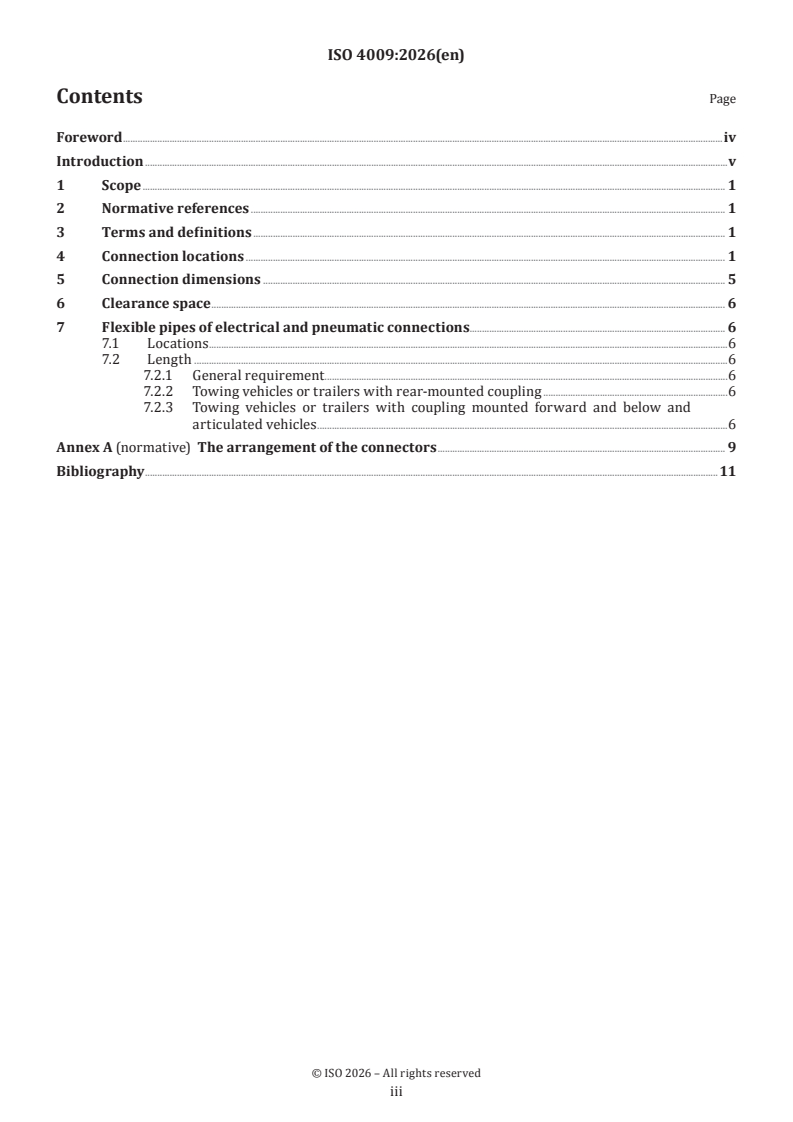
Contents Page
Foreword .iv
Introduction .v
1 Scope . 1
2 Normative references . 1
3 Terms and definitions . 1
4 Connection locations . 1
5 Connection dimensions . 5
6 Clearance space . 6
7 Flexible pipes of electrical and pneumatic connections. 6
7.1 Locations .6
7.2 Length .6
7.2.1 General requirement . .6
7.2.2 Towing vehicles or trailers with rear-mounted coupling .6
7.2.3 Towing vehicles or trailers with coupling mounted forward and below and
articulated vehicles .6
Annex A (normative) The arrangement of the connectors . 9
Bibliography .11
iii
Foreword
ISO (the International Organization for Standardization) is a worldwide federation of national standards
bodies (ISO member bodies). The work of preparing International Standards is normally carried out through
ISO technical committees. Each member body interested in a subject for which a technical committee
has been established has the right to be represented on that committee. International organizations,
governmental and non-governmental, in liaison with ISO, also take part in the work. ISO collaborates closely
with the International Electrotechnical Commission (IEC) on all matters of electrotechnical standardization.
The procedures used to develop this document and those intended for its further maintenance are described
in the ISO/IEC Directives, Part 1. In particular, the different approval criteria needed for the different types
of ISO documents should be noted. This document was drafted in accordance with the editorial rules of the
ISO/IEC Directives, Part 2 (see www.iso.org/directives).
ISO draws attention to the possibility that the implementation of this document may involve the use of (a)
patent(s). ISO takes no position concerning the evidence, validity or applicability of any claimed patent
rights in respect thereof. As of the date of publication of this document, ISO had not received notice of (a)
patent(s) which may be required to implement this document. However, implementers are cautioned that
this may not represent the latest information, which may be obtained from the patent database available at
www.iso.org/patents. ISO shall not be held responsible for identifying any or all such patent rights.
Any trade name used in this document is information given for the convenience of users and does not
constitute an endorsement. For an explanation of the voluntary nature of standards, the meaning of ISO
specific terms and expressions related to conformity assessment, as well as information about ISO's
adherence to the World Trade Organization (WTO) principles in the Technical Barriers to Trade (TBT), see
www.iso.org/iso/foreword.html.
This document was prepared by Technical Committee ISO/TC 22, Road vehicles, Subcommittee SC 40, Specific
aspects for passenger cars, light and heavy commercial vehicles, special vehicles, buses and trailers/caravans.
This fourth edition of ISO 4009 is a technical revision of ISO 4009:2000, which was withdrawn in 2017.
The main changes are as follows:
— multiple-vehicle combinations have been added to the scope;
— new connectors have been added in Figure 1 to Figure 4;
— the arrangement of the connectors has been changed in Figure 1 to Figure 4;
— general requirement for the length of flexible pipes has been added;
— the arrangement of the connectors has been added in a new Annex A;
— editorial changes have been made.
Any feedback or questions on this document should be directed to the user’s national standards body. A
complete listing of these bodies can be found at www.iso.org/members.html.
iv
Introduction
Standardization requirements for the arrangement of electrical and pneumatic connections between
towing vehicles and trailers are crucial to ensure seamless connectivity, operational safety, and the
reliable functioning of vehicle combinations. As vehicle technology advances rapidly and an increasing
variety of vehicles enter transportation market, more standardized requirements have been proposed for
the arrangement of these connections. For instance, some vehicles allow the upper and lower mounting
surfaces of connectors to be integrated into a single plane. Unifying the arrangement of connectors for
drawbar-trailers and centre-axle trailers would further improve operational convenience. Some pipelines
are installed at low positions, making them prone to ground contact and abrasion, so adding protective
measures is beneficial for the pipelines. Additionally, incorporating schematic diagrams of connector layouts
in this standard enhances its practicality.
Therefore, further ways to enhance the interchangeability between tractors and trailers, standardize the
arrangement of connections, and ensure the safe operation of vehicle combinations must be explored.
v
International Standard ISO 4009:2026(en)
Commercial vehicles — Location of electrical and pneumatic
connections between towing vehicles and trailers
1 Scope
This document specifies the locations of coupling devices for electrical and pneumatic connections between
towing and towed commercial road vehicles. It is applicable to heavy vehicles equipped with pneumatic
braking systems and 24 V electrical equipment of the following types: drawbar-trailer combinations,
centre-axle trailer combinations and multiple-vehicle combinations whose towing vehicles or trailers have
rear-mounted couplings or couplings mounted forward and below, and articulated vehicles.
This document is not applicable to car carriers, or road vehicles equipped only with fully automatic coupling
system (FACS) according to the ISO 13044 series, not mounted on the front of the trailer.
2 Normative references
The following documents are referred to in the text in such a way that some or all of their content constitutes
requirements of this document. For dated references, only the edition cited applies. For undated references,
the latest edition of the referenced document (including any amendments) applies.
ISO 1185, Road vehicles — Connectors for the electrical connection of towing and towed vehicles — 7-pole
connector type 24 N (normal) for vehicles with 24 V nominal supply voltage
ISO 1728, Road vehicles — Pneumatic braking connections between motor vehicles and towed vehicles —
Interchangeability
ISO 3731, Road vehicles — Connectors for the electrical connection of towing and towed vehicles — 7-pole
connector type 24 S (supplementary) for vehicles with 24 V nominal supply voltage
ISO 7638-1, Road vehicles — Connectors for the electrical connection of towing and towed vehicles — Part 1:
Connectors for braking systems and running gear of vehicles with 24 V nominal supply voltage
ISO 12098, Road vehicles — Connectors for the electrical connection of towing and towed vehicles — 15-pole
connector for vehicles with 24 V nominal supply voltage
ISO 25981, Road vehicles — Connectors for the electrical connection of towing and towed vehicles — Connectors
for electronically monitored charging systems with 12 V or 24 V nominal supply voltage
3 Terms and definitions
No terms and definitions are listed in this document.
ISO and IEC maintain terminology databases for use in standardization at the following addresses:
— ISO Online browsing platform: available at https:// www .iso .org/ obp
— IEC Electropedia: available at https:// www .electropedia .org/
4 Connection locations
The locations for electrical and pneumatic connections shall be in accordance with Figure 1 and Figure 2
for towing vehicles or trailers with rear-mounted couplings, Figure 3 for towing vehicles or trailers with
couplings mounted forward
...