

ISO 15003:2019
(Main)Agricultural engineering — Electrical and electronic equipment — Testing resistance to environmental conditions
General Information
- Abstract
This document provides design requirements and guidance for the manufacturers of electrical and electronic equipment for use in all kinds of mobile (including hand-held) agricultural machinery, forestry machinery, landscaping and gardening machinery [referred to hereafter as machine(s)]. The term machinery covers tractors and implements. This document gives tests for specific environmental conditions and defines severity levels for tests which relate to the environmental extremes that can be experienced in practical operation of the equipment. This document is intended to be used in determining the suitability of the equipment of these machines, for use in a specified range of environmental conditions. NOTE The severity levels given are general guidelines and not guaranteed worst-case exposure levels.
- Status
- Published
- Publication Date
- 03-Nov-2019
- Technical Committee
- ISO/TC 23/SC 19 - Agricultural electronics
- Drafting Committee
- ISO/TC 23/SC 19/WG 1 - Applications and data interfaces
- Current Stage
- 9093 - International Standard confirmed
- Start Date
- 19-May-2026
- Completion Date
- 29-Aug-2026
Buy Documents
ISO 15003:2019 - Agricultural engineering -- Electrical and electronic equipment -- Testing resistance to environmental conditions
ISO 15003:2019 - Agricultural engineering — Electrical and electronic equipment — Testing resistance to environmental conditions/4/2019
Overview
ISO 15003:2019 - Agricultural engineering - Electrical and electronic equipment - Testing resistance to environmental conditions - provides design requirements and test guidance for electrical and electronic equipment used in mobile agricultural, forestry, landscaping and gardening machinery (including tractors, implements and hand‑held machines). The standard defines environmental tests and severity levels that relate to realistic operational extremes, helping manufacturers and test laboratories determine equipment suitability for specified environmental conditions. Note: the severity levels are general guidelines, not guaranteed worst‑case exposures.
Key topics and technical requirements
- Scope and purpose: Tests cover electrical and electronic equipment for mobile agricultural and forestry machinery; intended to assess suitability across environmental ranges.
- Test planning and reporting: Specifies general test conditions, recommended test sequences, monitoring for impaired function and content for a test report (see Annex A).
- Severity levels: Defines how to select severity levels based on equipment location and application; guidance and machinery codes provided (see Annex B).
- Environmental tests included: Cold & dry heat, temperature changes and shocks, damp heat (steady‑state and cyclic), particle impact, mechanical shock, vibration (random and sinusoidal), salt mist/corrosive atmosphere, dust and water ingress (IP Code), low air pressure (altitude), chemical spray/brush, solar/UV exposure, and display readability.
- Electrical and EMC requirements: Covers electrical environment tests such as operating voltage, over‑voltage, reverse polarity, short circuit, transient supply, battery‑less operation, electrostatic discharge and electromagnetic compatibility (see ISO 14982 and ISO 16750 references).
- Reference standards: Integrates and cross‑references IEC 60068 series for environmental testing, IEC 60529 (IP Code), IEC 60512 and ISO 16750 mapping (Annex C).
Practical applications - who uses ISO 15003
- Equipment manufacturers and OEMs designing electronic control units, sensors, displays and connectors for agricultural machinery.
- Test laboratories performing environmental qualification and durability testing.
- Design engineers and validation teams defining environmental requirements and selecting appropriate severity levels.
- Compliance officers and procurement specialists verifying supplier claims and equipment suitability for field conditions.
- R&D teams developing ruggedized components for harsh agricultural and forestry environments.
Related standards
- ISO 16750 – Road vehicles - Environmental conditions and testing for electrical/electronic equipment (mapped in Annex C).
- ISO 14982 – Agricultural/forestry machinery - Electromagnetic compatibility.
- IEC 60068 series - Environmental testing procedures (temperature, vibration, shock, damp heat, salt mist, solar radiation).
- IEC 60529 - Degrees of protection (IP Code).
- IEC 60512 - Connector tests.
Keywords: ISO 15003, environmental testing, agricultural machinery, electrical and electronic equipment, severity levels, vibration test, damp heat, IP Code, EMC, altitude testing.
Relations
- Effective Date
- 23-Apr-2016
Buy Documents
ISO 15003:2019 - Agricultural engineering -- Electrical and electronic equipment -- Testing resistance to environmental conditions
ISO 15003:2019 - Agricultural engineering — Electrical and electronic equipment — Testing resistance to environmental conditions/4/2019
Get Certified
Connect with accredited certification bodies for this standard

Control Union Certifications
Global certification for agriculture and sustainability.

ECOCERT
Organic and sustainability certification.

FSC International
Forest Stewardship Council certification.
Sponsored listings
Frequently Asked Questions
ISO 15003:2019 is a standard published by the International Organization for Standardization (ISO). Its full title is "Agricultural engineering — Electrical and electronic equipment — Testing resistance to environmental conditions". This standard covers: This document provides design requirements and guidance for the manufacturers of electrical and electronic equipment for use in all kinds of mobile (including hand-held) agricultural machinery, forestry machinery, landscaping and gardening machinery [referred to hereafter as machine(s)]. The term machinery covers tractors and implements. This document gives tests for specific environmental conditions and defines severity levels for tests which relate to the environmental extremes that can be experienced in practical operation of the equipment. This document is intended to be used in determining the suitability of the equipment of these machines, for use in a specified range of environmental conditions. NOTE The severity levels given are general guidelines and not guaranteed worst-case exposure levels.
This document provides design requirements and guidance for the manufacturers of electrical and electronic equipment for use in all kinds of mobile (including hand-held) agricultural machinery, forestry machinery, landscaping and gardening machinery [referred to hereafter as machine(s)]. The term machinery covers tractors and implements. This document gives tests for specific environmental conditions and defines severity levels for tests which relate to the environmental extremes that can be experienced in practical operation of the equipment. This document is intended to be used in determining the suitability of the equipment of these machines, for use in a specified range of environmental conditions. NOTE The severity levels given are general guidelines and not guaranteed worst-case exposure levels.
ISO 15003:2019 is classified under the following ICS (International Classification for Standards) categories: 65.060.99 - Other agricultural machines and equipment. The ICS classification helps identify the subject area and facilitates finding related standards.
ISO 15003:2019 has the following relationships with other standards: It is inter standard links to ISO 15003:2006. Understanding these relationships helps ensure you are using the most current and applicable version of the standard.
ISO 15003:2019 is available in PDF format for immediate download after purchase. The document can be added to your cart and obtained through the secure checkout process. Digital delivery ensures instant access to the complete standard document.
Standards Content (Sample)
INTERNATIONAL ISO
STANDARD 15003
Second edition
2019-11
Agricultural engineering — Electrical
and electronic equipment —
Testing resistance to environmental
conditions
Génie agricole — Matériel électrique et électronique — Essais de
résistance aux conditions environnementales
Reference number
©
ISO 2019
© ISO 2019
All rights reserved. Unless otherwise specified, or required in the context of its implementation, no part of this publication may
be reproduced or utilized otherwise in any form or by any means, electronic or mechanical, including photocopying, or posting
on the internet or an intranet, without prior written permission. Permission can be requested from either ISO at the address
below or ISO’s member body in the country of the requester.
ISO copyright office
CP 401 • Ch. de Blandonnet 8
CH-1214 Vernier, Geneva
Phone: +41 22 749 01 11
Fax: +41 22 749 09 47
Email: copyright@iso.org
Website: www.iso.org
Published in Switzerland
ii © ISO 2019 – All rights reserved
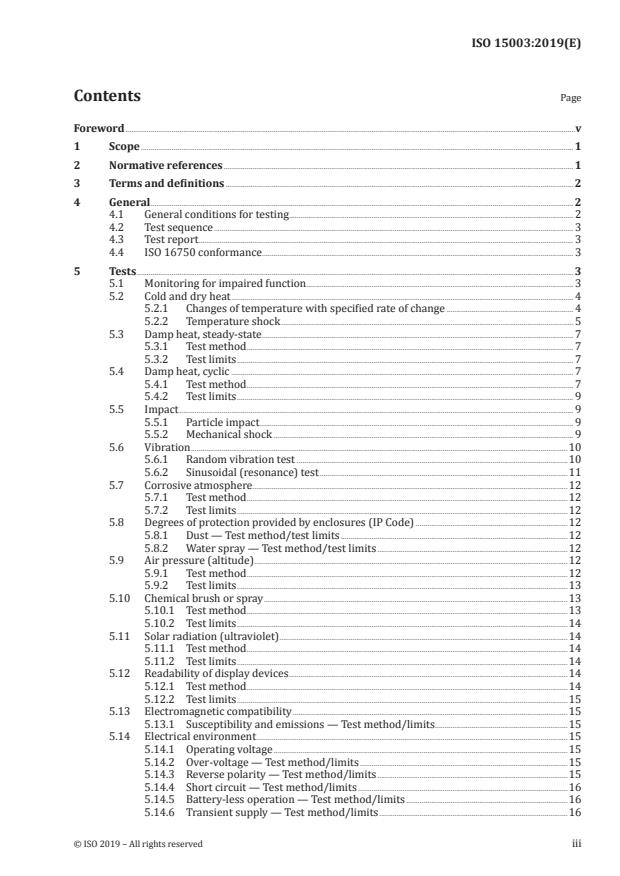
Contents Page
Foreword .v
1 Scope . 1
2 Normative references . 1
3 Terms and definitions . 2
4 General . 2
4.1 General conditions for testing. 2
4.2 Test sequence . 3
4.3 Test report . 3
4.4 ISO 16750 conformance . 3
5 Tests . 3
5.1 Monitoring for impaired function . 3
5.2 Cold and dry heat . 4
5.2.1 Changes of temperature with specified rate of change . 4
5.2.2 Temperature shock . 5
5.3 Damp heat, steady-state . 7
5.3.1 Test method . 7
5.3.2 Test limits . 7
5.4 Damp heat, cyclic . 7
5.4.1 Test method . 7
5.4.2 Test limits . 9
5.5 Impact . 9
5.5.1 Particle impact . 9
5.5.2 Mechanical shock . 9
5.6 Vibration .10
5.6.1 Random vibration test .10
5.6.2 Sinusoidal (resonance) test .11
5.7 Corrosive atmosphere .12
5.7.1 Test method .12
5.7.2 Test limits .12
5.8 Degrees of protection provided by enclosures (IP Code) .12
5.8.1 Dust — Test method/test limits .12
5.8.2 Water spray — Test method/test limits .12
5.9 Air pressure (altitude) .12
5.9.1 Test method .12
5.9.2 Test limits .13
5.10 Chemical brush or spray .13
5.10.1 Test method .13
5.10.2 Test limits .14
5.11 Solar radiation (ultraviolet) .14
5.11.1 Test method .14
5.11.2 Test limits .14
5.12 Readability of display devices .14
5.12.1 Test method .14
5.12.2 Test limits .15
5.13 Electromagnetic compatibility .15
5.13.1 Susceptibility and emissions — Test method/limits .15
5.14 Electrical environment .15
5.14.1 Operating voltage .15
5.14.2 Over-voltage — Test method/limits .15
5.14.3 Reverse polarity — Test method/limits .15
5.14.4 Short circuit — Test method/limits .16
5.14.5 Battery-less operation — Test method/limits .16
5.14.6 Transient supply — Test method/limits .16
5.14.7 Electrostatic discharge — Test method/limits .16
Annex A (informative) Example test report .17
Annex B (informative) Machinery/equipment codes and guidance for use of severity levels .18
Annex C (informative) Corresponding tests in ISO 16750.22
Bibliography .23
iv © ISO 2019 – All rights reserved
Foreword
ISO (the International Organization for Standardization) is a worldwide federation of national standards
bodies (ISO member bodies). The work of preparing International Standards is normally carried out
through ISO technical committees. Each member body interested in a subject for which a technical
committee has been established has the right to be represented on that committee. International
organizations, governmental and non-governmental, in liaison with ISO, also take part in the work.
ISO collaborates closely with the International Electrotechnical Commission (IEC) on all matters of
electrotechnical standardization.
The procedures used to develop this document and those intended for its further maintenance are
described in the ISO/IEC Directives, Part 1. In particular, the different approval criteria needed for the
different types of ISO documents should be noted. This document was drafted in accordance with the
editorial rules of the ISO/IEC Directives, Part 2 (see www .iso .org/ directives).
Attention is drawn to the possibility that some of the elements of this document may be the subject of
patent rights. ISO shall not be held responsible for identifying any or all such patent rights. Details of
any patent rights identified during the development of the document will be in the Introduction and/or
on the ISO list of patent declarations received (see www .iso .org/ patents).
Any trade name used in this document is information given for the convenience of users and does not
constitute an endorsement.
For an explanation of the voluntary nature of standards, the meaning of ISO specific terms and
expressions related to conformity assessment, as well as information about ISO's adherence to the
World Trade Organization (WTO) principles in the Technical Barriers to Trade (TBT), see www .iso .org/
iso/ foreword .html.
This document was prepared by Technical Committee ISO/TC 23, Tractors and machinery for agriculture
and forestry, Subcommittee SC 19, Agricultural electronics.
This second edition cancels and replaces the first edition (ISO 15003:2006), which has been technically
revised.
The main changes compared to the previous edition are as follows:
— integration of editorial corrections;
— updates to the list of normative references and guidance on the application of the normative
references;
— removal of the dates of the normative references;
— correction in the Bibliography.
Any feedback or questions on this document should be directed to the user’s national standards body. A
complete listing of these bodies can be found at www .iso .org/ members .html.
INTERNATIONAL STANDARD ISO 15003:2019(E)
Agricultural engineering — Electrical and electronic
equipment — Testing resistance to environmental
conditions
1 Scope
This document provides design requirements and guidance for the manufacturers of electrical and
electronic equipment for use in all kinds of mobile (including hand-held) agricultural machinery,
forestry machinery, landscaping and gardening machinery [referred to hereafter as machine(s)]. The
term machinery covers tractors and implements. This document gives tests for specific environmental
conditions and defines severity levels for tests which relate to the environmental extremes that can be
experienced in practical operation of the equipment.
This document is intended to be used in determining the suitability of the equipment of these machines,
for use in a specified range of environmental conditions.
NOTE The severity levels given are general guidelines and not guaranteed worst-case exposure levels.
2 Normative references
The following documents are referred to in the text in such a way that some or all of their content
constitutes requirements of this document. For dated references, only the edition cited applies. For
undated references, the latest edition of the referenced document (including any amendments) applies.
ISO 14982, Agricultural and forestry machinery — Electromagnetic compatibility — Test methods and
acceptance criteria
ISO 16750 (all parts), Road vehicles — Environmental conditions and testing for electrical and electronic
equipment
IEC 60068-1:2013, Environmental testing — Part 1: General and guidance
IEC 60068-2-5:2018, Basic environmental testing procedures — Part 2: Tests — Test Sa: Simulated solar
radiation at ground level
IEC 60068-2-6, Environmental testing — Part 2: Tests — Test Fc: Vibration (sinusoidal)
IEC 60068-2-11, Basic environmental testing procedures — Part 2: Tests — Test Ka: Salt mist
IEC 60068-2-13, Basic environmental testing procedures — Part 2: Tests — Test M: Low air pressure
IEC 60068-2-14, Basic environmental testing procedure — Part 2: Tests — Test N: Change of temperature
IEC 60068-2-27, Basic environmental testing procedures — Part 2: Tests — Test Ea and guidance: Shock
IEC 60068-2-30, Basic environmental testing procedures — Part 2: Tests — Test Db and guidance: Damp
heat, cyclic (12 + 12-hour cycle)
IEC 60068-2-47, Environmental testing — Part 2: Tests — Mounting of specimens to vibration, impact and
similar dynamic tests
IEC 60068-2-64, Environmental testing — Part 2: Test methods — Test Fh: Vibration, broad-band random
(digital control) and guidance
IEC 60068-2-78, Environmental testing — Part 2-78: Tests — Test Cab: Damp heat, steady state
IEC 60512-1, Connectors for electronic equipment — Tests and measurement — Part 1: General
IEC 60529, Degrees of protection provided by enclosures (IP Code)
3 Terms and definitions
For the purposes of this document, the following terms and definitions apply.
ISO and IEC maintain terminological databases for use in standardization at the following addresses:
— ISO Online browsing platform: available at https:// www .iso .org/ obp
— IEC Electropedia: available at http:// www .electropedia .org/
3.1
display device
device displaying alpha-numeric characters or graphical symbols designed to be read and interacted
with by operative or service personnel to adjust and control operation of equipment (3.2)
3.2
equipment
self-contained electronic system containing electric, electronic and mechanical components which is
electrically connected to other machinery (including power sources) by means of connectors
3.3
impaired function
state in which one or more of the functions of the equipment (3.2) as stated by the manufacturer are not
operative or do not conform to the manufacturer's specification
3.4
location
position within machines where the equipment (3.2) will normally be operating
3.5
normal mounting configuration
orientation of the equipment (3.2) when in normal use
3.6
severity level
severity of the conditions under which an environmental test is undertaken, selected according to the
intended location (3.4) and application of the equipment (3.2)
4 General
4.1 General conditions for testing
Except where otherwise specified for a test, testing shall be carried out under standard reference
conditions as specified in IEC 60068-1:2013, Section 4. The severity levels used shall be recorded in the
test report. Tests shall be conducted in accordance with IEC 60512-1.
It is desirable to use the same sample of equipment in all tests unless specified otherwise for a test.
It is recommended that a functionality check be done before and after each test and that functionality
be monitored during a test when practical.
Combined testing is advisable in cases where equipment is subjected in use to extremes of two or more
different environmental factors simultaneously (e.g. temperature and vibration) and recorded as such
on the test report.
NOTE Combined testing can be used as a means of reducing overall test time.
2 © ISO 2019 – All rights reserved
4.2 Test sequence
The electromagnetic compatibility tests shall be carried out last, since electromagnetic emissions and
susceptibility can be affected by prior exposure to other tests. The test sequence shall be recorded in
the test report.
The tests should be carried out in progressively increasing order of severity.
4.3 Test report
The test report shall, as a minimum, include the following information:
— description of the equipment;
— model number or other identification;
— manufacturer’s name and address;
— test lab’s name and address;
— test date(s);
— tests to be conducted;
— test equipment used/calibration status and test set up information;
— the order in which the tests were conducted;
— duration of each individual test conducted;
— severity level used for testing;
— test results;
— any additional details regarding the test.
An example test report is given in Annex A.
4.4 ISO 16750 conformance
Electrical and electronic equipment in accordance with ISO 16750 requirements that correspond to
the requirements of this document conforms with this document. Annex C provides a summary of
the ISO 16750 parts that contain similar test procedures as specified in this document. It provides a
cross reference to assist in the determination whether an electrical and electronic equipment tested in
accordance with the relevant part of ISO 16750 meets the requirements of this document or requires
additional testing.
5 Tests
5.1 Monitoring for impaired function
Where equipment is to be monitored for impaired function during or after a test, the equipment
shall be connected to power and signal input and output lines in accordance with the manufacturer’s
instructions.
5.2 Cold and dry heat
5.2.1 Changes of temperature with specified rate of change
5.2.1.1 Test method
A cold and dry heat test shall be conducted in accordance with IEC 60068-2-14, Test Nb, with the
exception that testing may be done using one test chamber. The temperature cycle is shown in Figure 1.
The steady-state time shall be 3 h; the transition times shall be adjusted to yield three cycles in 24 h.
Key
T minimum temperature
A
T maximum temperature
B
t time
t steady-state time = 3 h
1 first cycle
2 second cycle
Figure 1 — Temperature cycle for cold and dry heat test
4 © ISO 2019 – All rights reserved
5.2.1.2 Test limits
See Table 1.
Table 1 — Test levels for temperatures
T T
A B
Level
°C °C
1 0 70
2 −20 70
3 −40 85
4 −40 105
5 −40 125
Refer to B.2 for examples of severity levels.
5.2.2 Temperature shock
5.2.2.1 Test method
The temperature shock test shall be conducted in accordance with IEC 60068-2-14, Test Na, with the
cycle shown in Figure 2. The steady-state time t shall be 0,5 h, and the transition time t ≤ 1 min; the
1 2
number of cycles shall be 10.
Key
T minimum temperature
A
T maximum temperature
B
t time
t steady-state time =
...
INTERNATIONAL ISO
STANDARD 15003
Second edition
2019-11
Agricultural engineering — Electrical
and electronic equipment —
Testing resistance to environmental
conditions
Génie agricole — Matériel électrique et électronique — Essais de
résistance aux conditions environnementales
Reference number
©
ISO 2019
© ISO 2019
All rights reserved. Unless otherwise specified, or required in the context of its implementation, no part of this publication may
be reproduced or utilized otherwise in any form or by any means, electronic or mechanical, including photocopying, or posting
on the internet or an intranet, without prior written permission. Permission can be requested from either ISO at the address
below or ISO’s member body in the country of the requester.
ISO copyright office
CP 401 • Ch. de Blandonnet 8
CH-1214 Vernier, Geneva
Phone: +41 22 749 01 11
Fax: +41 22 749 09 47
Email: copyright@iso.org
Website: www.iso.org
Published in Switzerland
ii © ISO 2019 – All rights reserved
Contents Page
Foreword .v
1 Scope . 1
2 Normative references . 1
3 Terms and definitions . 2
4 General . 2
4.1 General conditions for testing. 2
4.2 Test sequence . 3
4.3 Test report . 3
4.4 ISO 16750 conformance . 3
5 Tests . 3
5.1 Monitoring for impaired function . 3
5.2 Cold and dry heat . 4
5.2.1 Changes of temperature with specified rate of change . 4
5.2.2 Temperature shock . 5
5.3 Damp heat, steady-state . 7
5.3.1 Test method . 7
5.3.2 Test limits . 7
5.4 Damp heat, cyclic . 7
5.4.1 Test method . 7
5.4.2 Test limits . 9
5.5 Impact . 9
5.5.1 Particle impact . 9
5.5.2 Mechanical shock . 9
5.6 Vibration .10
5.6.1 Random vibration test .10
5.6.2 Sinusoidal (resonance) test .11
5.7 Corrosive atmosphere .12
5.7.1 Test method .12
5.7.2 Test limits .12
5.8 Degrees of protection provided by enclosures (IP Code) .12
5.8.1 Dust — Test method/test limits .12
5.8.2 Water spray — Test method/test limits .12
5.9 Air pressure (altitude) .12
5.9.1 Test method .12
5.9.2 Test limits .13
5.10 Chemical brush or spray .13
5.10.1 Test method .13
5.10.2 Test limits .14
5.11 Solar radiation (ultraviolet) .14
5.11.1 Test method .14
5.11.2 Test limits .14
5.12 Readability of display devices .14
5.12.1 Test method .14
5.12.2 Test limits .15
5.13 Electromagnetic compatibility .15
5.13.1 Susceptibility and emissions — Test method/limits .15
5.14 Electrical environment .15
5.14.1 Operating voltage .15
5.14.2 Over-voltage — Test method/limits .15
5.14.3 Reverse polarity — Test method/limits .15
5.14.4 Short circuit — Test method/limits .16
5.14.5 Battery-less operation — Test method/limits .16
5.14.6 Transient supply — Test method/limits .16
5.14.7 Electrostatic discharge — Test method/limits .16
Annex A (informative) Example test report .17
Annex B (informative) Machinery/equipment codes and guidance for use of severity levels .18
Annex C (informative) Corresponding tests in ISO 16750.22
Bibliography .23
iv © ISO 2019 – All rights reserved
Foreword
ISO (the International Organization for Standardization) is a worldwide federation of national standards
bodies (ISO member bodies). The work of preparing International Standards is normally carried out
through ISO technical committees. Each member body interested in a subject for which a technical
committee has been established has the right to be represented on that committee. International
organizations, governmental and non-governmental, in liaison with ISO, also take part in the work.
ISO collaborates closely with the International Electrotechnical Commission (IEC) on all matters of
electrotechnical standardization.
The procedures used to develop this document and those intended for its further maintenance are
described in the ISO/IEC Directives, Part 1. In particular, the different approval criteria needed for the
different types of ISO documents should be noted. This document was drafted in accordance with the
editorial rules of the ISO/IEC Directives, Part 2 (see www .iso .org/ directives).
Attention is drawn to the possibility that some of the elements of this document may be the subject of
patent rights. ISO shall not be held responsible for identifying any or all such patent rights. Details of
any patent rights identified during the development of the document will be in the Introduction and/or
on the ISO list of patent declarations received (see www .iso .org/ patents).
Any trade name used in this document is information given for the convenience of users and does not
constitute an endorsement.
For an explanation of the voluntary nature of standards, the meaning of ISO specific terms and
expressions related to conformity assessment, as well as information about ISO's adherence to the
World Trade Organization (WTO) principles in the Technical Barriers to Trade (TBT), see www .iso .org/
iso/ foreword .html.
This document was prepared by Technical Committee ISO/TC 23, Tractors and machinery for agriculture
and forestry, Subcommittee SC 19, Agricultural electronics.
This second edition cancels and replaces the first edition (ISO 15003:2006), which has been technically
revised.
The main changes compared to the previous edition are as follows:
— integration of editorial corrections;
— updates to the list of normative references and guidance on the application of the normative
references;
— removal of the dates of the normative references;
— correction in the Bibliography.
Any feedback or questions on this document should be directed to the user’s national standards body. A
complete listing of these bodies can be found at www .iso .org/ members .html.
INTERNATIONAL STANDARD ISO 15003:2019(E)
Agricultural engineering — Electrical and electronic
equipment — Testing resistance to environmental
conditions
1 Scope
This document provides design requirements and guidance for the manufacturers of electrical and
electronic equipment for use in all kinds of mobile (including hand-held) agricultural machinery,
forestry machinery, landscaping and gardening machinery [referred to hereafter as machine(s)]. The
term machinery covers tractors and implements. This document gives tests for specific environmental
conditions and defines severity levels for tests which relate to the environmental extremes that can be
experienced in practical operation of the equipment.
This document is intended to be used in determining the suitability of the equipment of these machines,
for use in a specified range of environmental conditions.
NOTE The severity levels given are general guidelines and not guaranteed worst-case exposure levels.
2 Normative references
The following documents are referred to in the text in such a way that some or all of their content
constitutes requirements of this document. For dated references, only the edition cited applies. For
undated references, the latest edition of the referenced document (including any amendments) applies.
ISO 14982, Agricultural and forestry machinery — Electromagnetic compatibility — Test methods and
acceptance criteria
ISO 16750 (all parts), Road vehicles — Environmental conditions and testing for electrical and electronic
equipment
IEC 60068-1:2013, Environmental testing — Part 1: General and guidance
IEC 60068-2-5:2018, Basic environmental testing procedures — Part 2: Tests — Test Sa: Simulated solar
radiation at ground level
IEC 60068-2-6, Environmental testing — Part 2: Tests — Test Fc: Vibration (sinusoidal)
IEC 60068-2-11, Basic environmental testing procedures — Part 2: Tests — Test Ka: Salt mist
IEC 60068-2-13, Basic environmental testing procedures — Part 2: Tests — Test M: Low air pressure
IEC 60068-2-14, Basic environmental testing procedure — Part 2: Tests — Test N: Change of temperature
IEC 60068-2-27, Basic environmental testing procedures — Part 2: Tests — Test Ea and guidance: Shock
IEC 60068-2-30, Basic environmental testing procedures — Part 2: Tests — Test Db and guidance: Damp
heat, cyclic (12 + 12-hour cycle)
IEC 60068-2-47, Environmental testing — Part 2: Tests — Mounting of specimens to vibration, impact and
similar dynamic tests
IEC 60068-2-64, Environmental testing — Part 2: Test methods — Test Fh: Vibration, broad-band random
(digital control) and guidance
IEC 60068-2-78, Environmental testing — Part 2-78: Tests — Test Cab: Damp heat, steady state
IEC 60512-1, Connectors for electronic equipment — Tests and measurement — Part 1: General
IEC 60529, Degrees of protection provided by enclosures (IP Code)
3 Terms and definitions
For the purposes of this document, the following terms and definitions apply.
ISO and IEC maintain terminological databases for use in standardization at the following addresses:
— ISO Online browsing platform: available at https:// www .iso .org/ obp
— IEC Electropedia: available at http:// www .electropedia .org/
3.1
display device
device displaying alpha-numeric characters or graphical symbols designed to be read and interacted
with by operative or service personnel to adjust and control operation of equipment (3.2)
3.2
equipment
self-contained electronic system containing electric, electronic and mechanical components which is
electrically connected to other machinery (including power sources) by means of connectors
3.3
impaired function
state in which one or more of the functions of the equipment (3.2) as stated by the manufacturer are not
operative or do not conform to the manufacturer's specification
3.4
location
position within machines where the equipment (3.2) will normally be operating
3.5
normal mounting configuration
orientation of the equipment (3.2) when in normal use
3.6
severity level
severity of the conditions under which an environmental test is undertaken, selected according to the
intended location (3.4) and application of the equipment (3.2)
4 General
4.1 General conditions for testing
Except where otherwise specified for a test, testing shall be carried out under standard reference
conditions as specified in IEC 60068-1:2013, Section 4. The severity levels used shall be recorded in the
test report. Tests shall be conducted in accordance with IEC 60512-1.
It is desirable to use the same sample of equipment in all tests unless specified otherwise for a test.
It is recommended that a functionality check be done before and after each test and that functionality
be monitored during a test when practical.
Combined testing is advisable in cases where equipment is subjected in use to extremes of two or more
different environmental factors simultaneously (e.g. temperature and vibration) and recorded as such
on the test report.
NOTE Combined testing can be used as a means of reducing overall test time.
2 © ISO 2019 – All rights reserved
4.2 Test sequence
The electromagnetic compatibility tests shall be carried out last, since electromagnetic emissions and
susceptibility can be affected by prior exposure to other tests. The test sequence shall be recorded in
the test report.
The tests should be carried out in progressively increasing order of severity.
4.3 Test report
The test report shall, as a minimum, include the following information:
— description of the equipment;
— model number or other identification;
— manufacturer’s name and address;
— test lab’s name and address;
— test date(s);
— tests to be conducted;
— test equipment used/calibration status and test set up information;
— the order in which the tests were conducted;
— duration of each individual test conducted;
— severity level used for testing;
— test results;
— any additional details regarding the test.
An example test report is given in Annex A.
4.4 ISO 16750 conformance
Electrical and electronic equipment in accordance with ISO 16750 requirements that correspond to
the requirements of this document conforms with this document. Annex C provides a summary of
the ISO 16750 parts that contain similar test procedures as specified in this document. It provides a
cross reference to assist in the determination whether an electrical and electronic equipment tested in
accordance with the relevant part of ISO 16750 meets the requirements of this document or requires
additional testing.
5 Tests
5.1 Monitoring for impaired function
Where equipment is to be monitored for impaired function during or after a test, the equipment
shall be connected to power and signal input and output lines in accordance with the manufacturer’s
instructions.
5.2 Cold and dry heat
5.2.1 Changes of temperature with specified rate of change
5.2.1.1 Test method
A cold and dry heat test shall be conducted in accordance with IEC 60068-2-14, Test Nb, with the
exception that testing may be done using one test chamber. The temperature cycle is shown in Figure 1.
The steady-state time shall be 3 h; the transition times shall be adjusted to yield three cycles in 24 h.
Key
T minimum temperature
A
T maximum temperature
B
t time
t steady-state time = 3 h
1 first cycle
2 second cycle
Figure 1 — Temperature cycle for cold and dry heat test
4 © ISO 2019 – All rights reserved
5.2.1.2 Test limits
See Table 1.
Table 1 — Test levels for temperatures
T T
A B
Level
°C °C
1 0 70
2 −20 70
3 −40 85
4 −40 105
5 −40 125
Refer to B.2 for examples of severity levels.
5.2.2 Temperature shock
5.2.2.1 Test method
The temperature shock test shall be conducted in accordance with IEC 60068-2-14, Test Na, with the
cycle shown in Figure 2. The steady-state time t shall be 0,5 h, and the transition time t ≤ 1 min; the
1 2
number of cycles shall be 10.
Key
T minimum temperature
A
T maximum temperature
B
t time
t steady-state time =
...