

ISO 24595:2024
(Main)Drinking water, wastewater and stormwater systems and services — Guidelines for the provision of alternative water service for essential facilities during a crisis
General Information
- Abstract
This document provides guidelines for alternative water service (AWS) provision during a crisis for the ongoing operation of essential facilities. This document addresses: — AWS principles and methods; — AWS operational planning and implementation. This document is not applicable to: — planned water supply interruptions forming part of the drinking water utility's normal operations; NOTE However, many of the principles and methods described can be appropriate in such circumstances. — water supplied to temporary settlements, such as refugee camps; — the development and implementation of a crisis management system for water service, which is covered by ISO 24518[1] and ISO/TS 24520,[2] or the development and implementation of AWS provision during a crisis for private users, which is covered by ISO 24527.[3]
- Status
- Published
- Publication Date
- 09-Jan-2024
- Technical Committee
- ISO/TC 224 - Drinking water, wastewater and stormwater systems and services
- Current Stage
- 6060 - International Standard published
- Start Date
- 10-Jan-2024
- Due Date
- 05-Aug-2024
- Completion Date
- 10-Jan-2024
Overview
ISO 24595:2024 establishes international guidelines for the provision of alternative water service (AWS) to essential facilities during a crisis. Developed by ISO’s Technical Committee 224, it addresses critical aspects required to maintain the operation of essential facilities-such as hospitals, care homes, schools, prisons, and vital industrial or commercial establishments-when normal water supply systems are disrupted. The standard is applicable to drinking water, wastewater, and stormwater systems and services, focusing on operational planning, risk assessment, AWS provision methods, and effective stakeholder communication.
This document is not meant for planned supply interruptions that are part of normal operations, water provision to temporary settlements or refugee camps, or for private user AWS planning, which are addressed by other ISO standards. Adherence to ISO 24595:2024 helps utilities, public agencies, and facility managers enhance resilience and ensure continuity of critical services under crisis conditions.
Key Topics
- Principles of AWS Provision: Outlines the prioritization of essential facilities and collaborative planning among water utilities, relevant authorities, and facility operators to ensure uninterrupted water service during emergencies.
- Approaches to AWS:
- Utilizing alternative sources of water, such as groundwater, reservoirs, or interconnections with neighboring networks.
- Non-conventional use of existing distribution networks, including temporary network modifications, installation of storage tanks, or pressure management.
- Independent AWS provision, for instance, deploying water tankers or portable water treatment units where network use is not feasible.
- Operational Planning: Includes risk assessment, identification of essential facilities, water allocation determination, scenario-based pre-planning, logistical preparation, and resource mobilization.
- Resource Management: Emphasizes procuring, storing, and managing assets such as containerized water, storage tanks, mobile units, and emergency delivery mechanisms.
- Communication & Coordination: Stresses proactive internal and external communications, stakeholder preparedness, and tailored messaging before and during a crisis.
- Allocation & Quality Requirements: Defines processes for jointly determining required water quantity and ensuring water quality standards are maintained or restored, including the use of temporary treatment solutions if necessary.
Applications
ISO 24595:2024 is practical for a wide range of situations where essential services rely on continuous water supply, including:
- Emergency Response: Implementation of AWS during natural disasters, major infrastructure failures, contamination events, or intentional acts impacting water supply.
- Business Continuity Planning: Supporting essential operations in healthcare, public safety, and critical industry sectors by ensuring water availability is maintained despite unforeseen disruption.
- Infrastructure Resilience: Encouraging utilities and authorities to strengthen crisis preparedness through robust risk assessment, scenario planning, and investment in alternative supply methods.
- Regulatory Compliance and Public Health: Ensures that essential facilities meet regulatory water supply and quality obligations, reducing risks to public health and welfare during crises.
- Training and Readiness: Used to inform training, awareness, and simulation exercises for both water sector professionals and key stakeholders.
Related Standards
To ensure comprehensive crisis management in water services, ISO 24595:2024 should be used in conjunction with other relevant standards:
- ISO 24518: Guidance on water utility crisis management systems.
- ISO/TS 24520: Focuses on operational crisis management in water utilities.
- ISO 24527: Addresses AWS provision specifically for private users.
- ISO 24513: Vocabulary for service activities related to drinking water, wastewater, and stormwater systems.
By integrating ISO 24595:2024 into utility and facility protocols, organizations can greatly enhance their water service reliability and community resilience during crisis events.
Get Certified
Connect with accredited certification bodies for this standard

CIS Institut d.o.o.
Personal Protective Equipment (PPE) certification body. Notified Body NB-2890 for EU Regulation 2016/425 PPE.
Great Wall Tianjin Quality Assurance Center
Established 1993, first batch to receive national accreditation with IAF recognition.
Hong Kong Quality Assurance Agency (HKQAA)
Hong Kong's leading certification body.
Sponsored listings
Frequently Asked Questions
ISO 24595:2024 is a standard published by the International Organization for Standardization (ISO). Its full title is "Drinking water, wastewater and stormwater systems and services — Guidelines for the provision of alternative water service for essential facilities during a crisis". This standard covers: This document provides guidelines for alternative water service (AWS) provision during a crisis for the ongoing operation of essential facilities. This document addresses: — AWS principles and methods; — AWS operational planning and implementation. This document is not applicable to: — planned water supply interruptions forming part of the drinking water utility's normal operations; NOTE However, many of the principles and methods described can be appropriate in such circumstances. — water supplied to temporary settlements, such as refugee camps; — the development and implementation of a crisis management system for water service, which is covered by ISO 24518[1] and ISO/TS 24520,[2] or the development and implementation of AWS provision during a crisis for private users, which is covered by ISO 24527.[3]
This document provides guidelines for alternative water service (AWS) provision during a crisis for the ongoing operation of essential facilities. This document addresses: — AWS principles and methods; — AWS operational planning and implementation. This document is not applicable to: — planned water supply interruptions forming part of the drinking water utility's normal operations; NOTE However, many of the principles and methods described can be appropriate in such circumstances. — water supplied to temporary settlements, such as refugee camps; — the development and implementation of a crisis management system for water service, which is covered by ISO 24518[1] and ISO/TS 24520,[2] or the development and implementation of AWS provision during a crisis for private users, which is covered by ISO 24527.[3]
ISO 24595:2024 is classified under the following ICS (International Classification for Standards) categories: 03.080.30 - Services for consumers; 13.060.01 - Water quality in general. The ICS classification helps identify the subject area and facilitates finding related standards.
ISO 24595:2024 is available in PDF format for immediate download after purchase. The document can be added to your cart and obtained through the secure checkout process. Digital delivery ensures instant access to the complete standard document.
Standards Content (Sample)
International
Standard
ISO 24595
First edition
Drinking water, wastewater and
2024-01
stormwater systems and services —
Guidelines for the provision of
alternative water service for
essential facilities during a crisis
Systèmes et services relatifs à l'eau potable, à l'assainissement
et à la gestion des eaux pluviales — Lignes directrices pour la
mise en place d'un service d'eau alternatif pour les installations
essentielles en cas de crise
Reference number
© ISO 2024
All rights reserved. Unless otherwise specified, or required in the context of its implementation, no part of this publication may
be reproduced or utilized otherwise in any form or by any means, electronic or mechanical, including photocopying, or posting on
the internet or an intranet, without prior written permission. Permission can be requested from either ISO at the address below
or ISO’s member body in the country of the requester.
ISO copyright office
CP 401 • Ch. de Blandonnet 8
CH-1214 Vernier, Geneva
Phone: +41 22 749 01 11
Email: copyright@iso.org
Website: www.iso.org
Published in Switzerland
ii
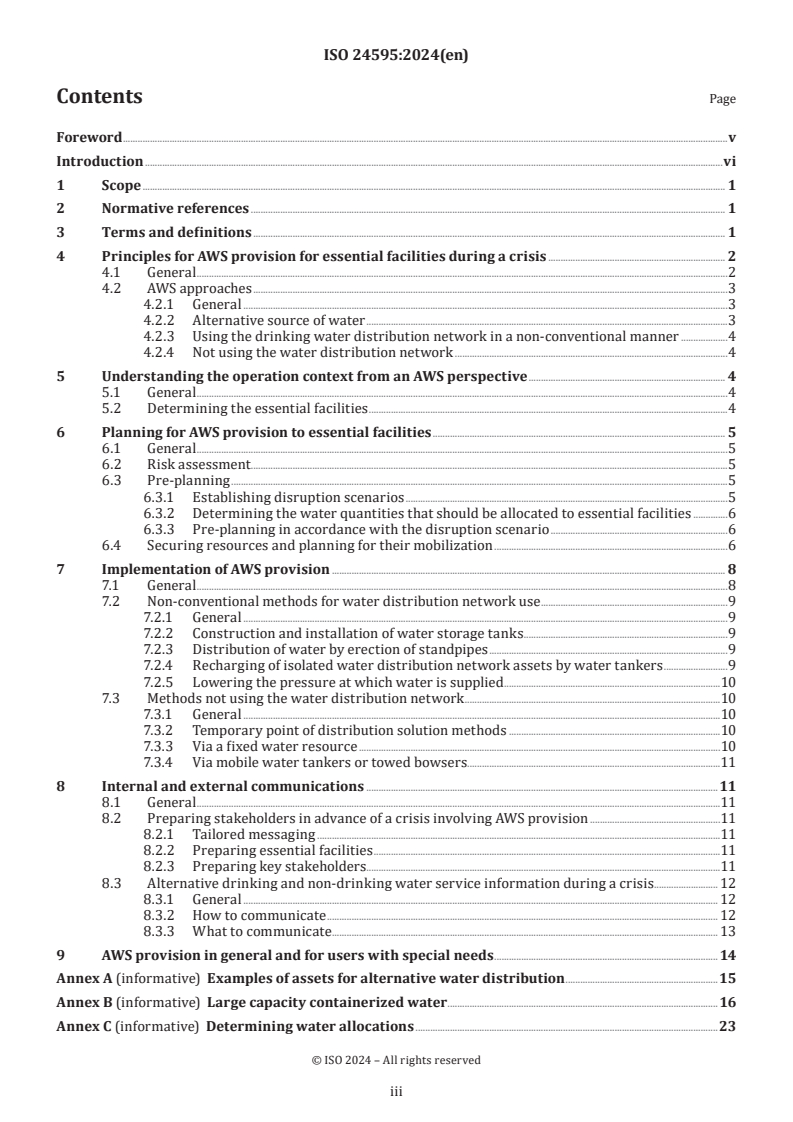
Contents Page
Foreword .v
Introduction .vi
1 Scope . 1
2 Normative references . 1
3 Terms and definitions . 1
4 Principles for AWS provision for essential facilities during a crisis . 2
4.1 General .2
4.2 AWS approaches .3
4.2.1 General .3
4.2.2 Alternative source of water .3
4.2.3 Using the drinking water distribution network in a non-conventional manner .4
4.2.4 Not using the water distribution network .4
5 Understanding the operation context from an AWS perspective . 4
5.1 General .4
5.2 Determining the essential facilities .4
6 P lanning for AWS provision to essential facilities . 5
6.1 General .5
6.2 Risk assessment .5
6.3 Pre-planning .5
6.3.1 Establishing disruption scenarios .5
6.3.2 Determining the water quantities that should be allocated to essential facilities .6
6.3.3 Pre-planning in accordance with the disruption scenario .6
6.4 Securing resources and planning for their mobilization .6
7 Implementation of AWS provision . 8
7.1 General .8
7.2 Non-conventional methods for water distribution network use .9
7.2.1 General .9
7.2.2 Construction and installation of water storage tanks .9
7.2.3 Distribution of water by erection of standpipes .9
7.2.4 Recharging of isolated water distribution network assets by water tankers .9
7.2.5 Lowering the pressure at which water is supplied .10
7.3 Methods not using the water distribution network .10
7.3.1 General .10
7.3.2 Temporary point of distribution solution methods .10
7.3.3 Via a fixed water resource .10
7.3.4 Via mobile water tankers or towed bowsers.11
8 Internal and external communications .11
8.1 General .11
8.2 Preparing stakeholders in advance of a crisis involving AWS provision .11
8.2.1 Tailored messaging .11
8.2.2 Preparing essential facilities .11
8.2.3 Preparing key stakeholders.11
8.3 Alternative drinking and non-drinking water service information during a crisis . 12
8.3.1 General . 12
8.3.2 How to communicate . 12
8.3.3 What to communicate . . 13
9 AWS provision in general and for users with special needs . 14
Annex A (informative) Examples of assets for alternative water distribution .15
Annex B (informative) Large capacity containerized water .16
Annex C (informative) Determining water allocations .23
iii
Annex D (informative) The logistics of AWS provision .25
Bibliography .30
iv
Foreword
ISO (the International Organization for Standardization) is a worldwide federation of national standards
bodies (ISO member bodies). The work of preparing International Standards is normally carried out through
ISO technical committees. Each member body interested in a subject for which a technical committee
has been established has the right to be represented on that committee. International organizations,
governmental and non-governmental, in liaison with ISO, also take part in the work. ISO collaborates closely
with the International Electrotechnical Commission (IEC) on all matters of electrotechnical standardization.
The procedures used to develop this document and those intended for its further maintenance are described
in the ISO/IEC Directives, Part 1. In particular, the different approval criteria needed for the different types
of ISO document should be noted. This document was drafted in accordance with the editorial rules of the
ISO/IEC Directives, Part 2 (see www.iso.org/directives).
ISO draws attention to the possibility that the implementation of this document may involve the use of (a)
patent(s). ISO takes no position concerning the evidence, validity or applicability of any claimed patent
rights in respect thereof. As of the date of publication of this document, ISO had not received notice of (a)
patent(s) which may be required to implement this document. However, implementers are cautioned that
this may not represent the latest information, which may be obtained from the patent database available at
www.iso.org/patents. ISO shall not be held responsible for identifying any or all such patent rights.
Any trade name used in this document is information given for the convenience of users and does not
constitute an endorsement.
For an explanation of the voluntary nature of standards, the meaning of ISO specific terms and expressions
related to conformity assessment, as well as information about ISO's adherence to the World Trade
Organization (WTO) principles in the Technical Barriers to Trade (TBT), see www.iso.org/iso/foreword.html.
This document was prepared by Technical Committee ISO/TC 224, Drinking water, wastewater and
stormwater systems and services.
Any feedback or questions on this document should be directed to the user’s national standards body. A
complete listing of these bodies can be found at www.iso.org/members.html.
v
Introduction
Water is fundamental to life and its distribution is an essential service. Water supply systems are designed
to be reliable, but they can be subject to disruption from internal or external factors, including operational
error, lack of rehabilitation, non-intentional physical damage, malicious acts (e.g. vandalism, criminality or
terrorism), natural disasters (e.g. earthquakes, floods, hurricanes or volcanic eruptions) and source water
disruptions caused by environmental factors or human activity.
This document is intended for water utilities that normally provide a service without interruption through
a water distribution network. It provides guidelines for the effective implementation of alternative water
service (AWS) provision during extended periods of disruption or interruption of the water supply.
In many cases, operational and organizational processes will exist within water utilities to deal with
short periods of localized interruption to water distribution. However, if the service interruption exceeds
the duration or extent of anticipated events, an interruption can escalate into a crisis at local, regional or,
exceptionally, national level.
NOTE 1 For adequacy and consistency, the guidance in this document typically assumes an operational response
at a crisis level. However, it is applicable for all levels of operational incidents requiring AWS deployment, including
normal business continuity preparedness and response.
[1] [2]
NOTE 2 For guidance on the management of crises, see ISO 24518 and ISO/TS 24520. For guidance on AWS
[3]
distribution, see ISO 24527.
[1] [2]
This document does not concern the cases already covered by ISO 24518, ISO/TS 24520 and ISO 24527.
[3]
Figure 1 shows the articulation between these three documents and this document, in order to show
their complementarity.
[3]
NOTE 1 ISO 24527:2020 is not applicable to:
— key establishments and facilities (e.g. hospitals, homes for the aged, schools, reception facilities and vital plants);
— water supplied for industrial, agricultural or commercial purposes;
— temporary settlements.
NOTE 2 In many countries, AWS for essential facilities, as described in this document, are regulated.
Figure 1 — Standards dedicated to crisis management
A significant water interruption (arising from quantity and/or quality issues) can impact public and personal
health and well-being, and economic performance. A prolonged interruption can progressively threaten the
coherence of the supplied community.
vi
When such a water interruption affects essential facilities, the impact is even more significant and can cause
crucial economic and negative social effects.
Therefore, it is important to plan in advance in order to diminish the negative effects of such a crisis situation
on the community.
The roles of relevant authorities, responsible bodies, water utilities and operators can differ between
and within countries and result in different minimum requirements for AWS provision. Nevertheless,
it is generally recommended that such organizations recognize the importance of uninterrupted water
production and distribution, even at times of crisis experienced by the water utility, for the well-being of the
supplied community.
Water utilities are encouraged to reduce the risk of water supply interruption. This is typically achieved by
a combination of good planning, design, procurement, installation, operation and maintenance of the water
assets. Such measures should include the provision of an AWS for essential facilities and users during a crisis.
It is also recommended that the water utility's capability to provide an AWS be consistent with the maximum
likely service interruption (extent and duration) identified through risk assessment. The provision of an
AWS for essential facilities necessitates thorough preparation (e.g. to address planning, procurement,
logistics, control and communication), as well as awareness of the need and commitment at all levels of the
organization to be effective and efficient.
AWS during a crisis can be provided using one of the three following actions, as appropriate:
a) arranging for an alternative source of water;
b) using the water distribution network in a non-conventional manner;
c) not using the water distribution network.
AWS planning and provision can include guidelines by responsible bodies on monitoring and control
methods. This document covers water quality issues only to the extent that they relate to water provided via
an AWS.
vii
International Standard ISO 24595:2024(en)
Drinking water, wastewater and stormwater systems and
services — Guidelines for the provision of alternative water
service for essential facilities during a crisis
1 Scope
This document provides guidelines for alternative water service (AWS) provision during a crisis for the
ongoing operation of essential facilities.
This document addresses:
— AWS principles and methods;
— AWS operational planning and implementation.
This document is not applicable to:
— planned water supply interruptions forming part of the drinking water utility's normal operations;
NOTE However, many of the principles and methods described can be appropriate in such circumstances.
— water supplied to temporary settlements, such as refugee camps;
— the development and implementation of a crisis management system for water service, which is covered
[1] [2]
by ISO 24518 and ISO/TS 24520, or the development and implementation of AWS provision during a
[3]
crisis for private users, which is covered by ISO 24527.
2 Normative references
The following documents are referred to in the text in such a way that some or all of their content constitutes
requirements of this document. For dated references, only the edition cited applies. For undated references,
the latest edition of the referenced document (including any amendments) applies.
ISO 24513, Service activities relating to drinking water supply, wastewater and stormwater systems —
Vocabulary
3 Terms and definitions
For the purposes of this document, the terms and definitions given in ISO 24513 and the following apply.
ISO and IEC maintain terminology databases for use in standardization at the following addresses:
— ISO Online browsing platform: available at https:// www .iso .org/ obp
— IEC Electropedia: available at https:// www .electropedia .org/
3.1
alternative water service
AWS
water provided to users by means other than through the normal drinking water system
Note 1 to entry: AWS can be required due to the loss of supply or due to the fact that the water is unfit for the intended
use.
3.2
containerized water
packaged water
water deployed in containers for alternative drinking water service provision
EXAMPLE 1 Bottled or canned water, pre-prepared and hygienically sealed, with a predetermined shelf-life.
EXAMPLE 2 A personal water bag, pre-prepared but empty, and filled during an incident.
EXAMPLE 3 Static water tanks; towed bowsers; mobile water tankers, disinfected and deployed, and filled during
an incident.
3.3
drinking water allocation
daily per-capita water quota to be supplied to users during alternative water service (3.1) provision
Note 1 to entry: The relevant authority, the responsible body or the drinking water utility (in the absence of guidance
from the relevant authority or responsible body) can determine drinking water allocation(s) for categories of users.
Note 2 to entry: Drinking water allocations can differ between categories of user and can exclude some categories of
users.
Note 3 to entry: The size of drinking water allocations can be varied at different times during the crisis.
EXAMPLE Per-capita domestic user in first 12 h of crisis response; per-capita per-day domestic user after first
12 h; per-capita per-day special needs user.
[SOURCE: ISO 24527:2020, 3.5.]
3.4
essential facility
entity whose service or role is considered essential for the proper functioning of the community and would
be seriously disrupted by the interruption of the water service
Note 1 to entry: This decision is in the hands of the civil and/or military authorities.
EXAMPLE Hospitals, homes for the aged, schools, prisons, military establishments, essential industrial,
agricultural or commercial establishments, livestock facilities.
Note 2 to entry: The definition focuses on disruption to the “proper functioning of the community”. Farms are
generally outside the community, but livestock handling and retention facilities can be; for example, abattoirs are
normally within an urban area.
4 Principles for AWS provision for essential facilities during a crisis
4.1 General
During a crisis involving an interruption to water distribution, the water utility should ensure that an AWS
is provided to users and essential facilities.
The needs for AWS provision to essential facilities should be a high priority.
Combined efforts of the essential facility, water utility and other relevant or responsible authorities during
preplanning, planning and AWS implementation are necessary.
The water utility should involve the essential facilities during the preparedness phase in order to advise
them to plan the necessary arrangements, such as water treatment units, equipment and point of distribution
(POD).
Water allocation to keep essential facilities running is significantly higher than the allocation of drinking
[3]
water for normal users (as discussed in ISO 24527 ). It should be determined jointly by the water utility
and the essential facilities under supervision of the relevant authorities and/or responsible bodies.
The required water quality for AWS provision is determined jointly by the relevant authorities, the essential
facilities and/or responsible bodies.
The water quality to be supplied should be tested in order to ensure compliance with the requirements.
If the required water quality is not available, it is recommended that the feasibility of using mobile water-
treatment units is considered in order to bring the water to the required quality.
Non-drinking water may be used in the essential facilities' processes that do not require drinking water
quality.
Communication, information and training are key elements for AWS.
4.2 AWS approaches
4.2.1 General
The water utility may adopt one or a combination of the AWS approaches described in 4.2.4.2 and 4.2.4.3;
see also Annex B and Annex D.
4.2.2 Alternative source of water
4.2.2.1 General
A primary response to providing AWS is to ensure that the water utility has alternative sources of water
available to it for use in an emergency.
Examples of alternative sources of water can include available but currently unused groundwater extraction
facilities, supplementary deeper extraction pipes in surface water resources, major stocked storage
reservoirs of unused or treated water resources and arrangements with neighbouring water utilities to
transfer water as needed to the utility facing a crisis.
4.2.2.2 Providing emergency water storage above ground or underground
Once the amount of water needed for the essential facility during crisis is determined, the construction of
the appropriate storage facilities for the calculated volume of water should be planned and implemented.
4.2.2.3 Using alternative water sources (drinking and non-drinking quality)
The use of alternative water sources should be implemented when and if it is technically possible to connect
different water source(s) to the essential facility, either directly from the source to the facility without
passing through the water utility's network or by using the regular water utility's network.
Such a solution may be applied exclusively, if the alternative source is of drinking water quality, or as a
partial solution, if the alternative water source is non-drinking water but can be used for part or all of the
required processes for sanitary purposes, e.g. toilet flushing.
[1] [2]
For guidance on the management of crises, see ISO 24518 and ISO/TS 24520.
4.2.2.4 Connecting the water utility's network to an alternative water supply network
In some cases, with a relatively small effort the water utility or relevant facility can be connected by
emergency or temporary connections to a nearby water supply network that was not affected by the crisis
situation (e.g. bypassing damaged network areas of the regular supply system via mobile transmission
lines).
Such a solution may be applied exclusively, if the alternative source has the capacity to supply the entire
demand and is of drinking water quality, or as a partial solution, if the alternative water source does not
have the capacity to supply the entire demand or is non-drinking water but can be used for part or all of the
required processes for sanitary purposes, e.g. toilet flushing.
4.2.3 Using the drinking water distribution network in a non-conventional manner
This approach involves the drinking water utility supplying drinking water to essential facilities via the
drinking water distribution network but using different means than the regular operational methods.
Proven methods of AWS provision using the distribution network in a non-conventional manner are
described in 7.2.
4.2.4 Not using the water distribution network
4.2.4.1 General
This approach requires the preparation of resources (equipment and means) necessary for supplying AWS
under crisis conditions for each specific essential facility.
The different possibilities for implementing this approach are described in 4.2.4.2 and 4.2.4.3; see also
Annex B and Annex D.
4.2.4.2 Using tankers
Tankers may be used as a non-continuous alternative water source. The tanker should be connected to a
storage tank serving the facility.
Such a solution may be applied exclusively, if the alternative source is of drinking water quality, or as a
partial solution, if the alternative water source is non-drinking water but can be used for part or all of the
required processes for sanitary purposes, e.g. toilet flushing.
4.2.4.3 Using water treatment units
When the water crisis is caused by contamination in the water supply network to a degree that the water
does not comply with applicable requirements, water treatment units may be used. For this, the facility
should have prepared beforehand the necessary water treatment means and equipment to bring the water to
the required quality and operate and maintain the units during the crisis, such as personnel and chemicals.
Frequently, the implementation of a combination of more than one of the solutions described in 7.2.1 to 7.2.5
will be necessary, for example static reservoirs or tanks filled by mobile tankers during a crisis. Proven
methods of AWS provision not using the drinking water distribution network are described in 7.3.
5 Understanding the operation context from an AWS perspective
5.1 General
In order to determine its AWS provision for essential facilities, a water utility should first have a clear
understanding of its normal operation during normal (non-crisis) circumstances.
The water utility should determine:
a) which services and facilities are defined as essential facilities;
b) what are the water quantities that have to be allotted and secured to each essential facility.
5.2 Determining the essential facilities
The water utility is not entitled to determine which user services, establishments and farms are considered
essential facilities for the continuity of the proper functioning of the community served by the water utility.
This decision is in the hands of the civil and/or military authorities.
The water utility should approach the relevant authorities and get the list of the facilities that are considered
essential for the proper functioning of the community.
6 Plannin g for AWS provision to essential facilities
6.1 General
AWS provision, including to essential facilities, should be an integral part of the water utility's wider crisis
management response.
During normal operation, and based on a risk assessment, the water utility should identify the disruption
scenarios that can lead to the need for AWS provision to essential facilities which cannot be managed by its
normal organizational structures and operational means.
The water utility should take into consideration that more than one approach and solution can be used during
a crisis. Jointly with each one of the essential facilities, it should decide upon the preferred approaches and
solutions for AWS provision, according to the considerations listed in 4.2.
The water utility should prepare engineering, operational and logistical plans to implement its chosen
approach(es) to AWS provision. The selected solutions to AWS provision should be planned and exercised
jointly with the essential facilities during normal operation, and responders should be appropriately trained
in order to demonstrate their readiness when required.
The water utility should also ensure that assets which are intended to be used in contact with drinking
water or for drinking purposes are approved by the relevant authority. Such assets can include cleaned and
disinfected drinking water containers, tanks and water treatment units.
6.2 Risk assessment
The risk assessment for AWS should be integrated into the water utility’s global risk management provisions.
The water utility should reduce the risk of water supply interruption. This is typically achieved by a
combination of good planning, design, procurement, installation, operation and maintenance of the water
assets (see Annex D).
6.3 Pre-planning
6.3.1 Establishing disruption scenarios
6.3.1.1 Establishing the context of each essential facility within a service area
The water utility should identify:
— the relevant characteristics of the water system of individual service areas, such as alternative water
sources; gravity fed or pumped areas; pressure zones; and water quality features or constraints;
— characteristics of the environment of individual service areas, such as rural or urban distinctions and
topographical features that provide access or act as barriers (e.g. highways, rivers, railways);
— characteristics of the essential facilities in individual service areas;
— its available resources (including personnel).
6.3.1.2 Establishing individual disruption scenarios
Based on its risk assessment outputs and taking into consideration the characteristics of the service area,
the water utility should identify the possible circumstances of the crisis, such as:
— the possible events to occur and their characteristics (e.g. the most likely, the most common or the most
dangerous water quantity event or water quality event);
— the available information about similar events and related uncertainties;
— the expected extent of the damage feared;
— how the essential facility would be impacted;
— existing control measures.
6.3.2 Determining the water quantities that should be allocated to essential facilities
The water utility, jointly with the essential facilities, should establish water allocation(s) for each of the
essential facilities, as described in Clause 5, as a fundamental factor of AWS planning. The water allocation(s)
are particularly significant for AWS solutions where the normal water distribution network is not used. The
essential facility's water allocation directly determines the extent of resources (including personnel) needed
for AWS operations (see Annex C).
The water quantities that should be allocated to essential facilities should be determined according to:
a) the time that the water utility considers necessary for restoring the capability to supply water to the
facility through the distribution system (even for a partial restoration that does not allow the supply
of 100 % of the capacity, but allows the supply of the necessary water quantity to run the essential
service);
b) the quantity of water that is necessary for keeping the essential services running for the community.
This consideration should be given for each one of the facilities that were determined essential, jointly by
the water utilities, authorities and the essential facilities.
See more information on water allocation calculation in C.2.
6.3.3 Pre-planning in accordance with the disruption scenario
Based on each crisis scenario, the water utility, jointly with the essential facilities, should:
a) decide on the type and quantity of AWS resources to be prepared and deployed (e.g. reservoirs, water
tankers, treatment units) and the timescale for their provision;
b) identify and coordinate AWS procurement within and outside the service area(s) affected;
c) identify possible alternatives for water sourcing, conveyance, treatment and water distribution
wherever it is needed;
d) prepare logistical and engineering plans to implement the chosen approach(es) and solutions to provide
the quantity and quality of AWS provision required;
e) identify the responders necessary to conduct field operations during a crisis and provide adequate
training and support to permit them to display readiness when required;
f) consider quantities and storage capacity for firefighting purposes, if applicable.
g) prepare communication means and procedures with other relevant authorities.
6.4 Securing resources and planning for their mobilization
Planning to construct, secure and mobilize resources for AWS provision should include the items listed in
6.3.3 and the following:
a) Determining the area affected by the crisis within the service area(s): the water utility should determine
the area(s) likely to be affected according to the individual circumstances of the crisis.
b) Additional considerations, such as variable weather conditions, the nature of the service area (e.g. rural,
urban), topographical features (e.g. estuaries, rivers, valleys, hills), the presence of infrastructure (e.g.
highways, railways, airfields, ports) and socio-economic considerations.
c) Operational and engineering plans for supplying water: the water utility should organize its water
system in a manner that permits as great a degree of flexibility and resilience as is deemed practicable
and cost-effective (e.g. installing additional valves and interconnections beyond those essential for
normal use, including connections to, for example, neighbouring water utilities and sources; installing
foundations, power supplies and pipework to accept temporary pumping installations).
Such plans may include the distribution of non-drinking water, if such provision mitigates risks to public
health or public safety (e.g. for processes that do not require the use of drinking water, for toilet flushing
or firefighting purposes).
d) Necessary arrangements should be made to mobilize, in due time, the water resources needed according
to previously identified water allocations.
e) The water utility should take into account the local legal or regulatory obligation for the essential
facility's water allocation(s) as well as for water quality. Where the resource implications of addressing
a worst-case disruption scenario put the ability to meet this obligation under strain, this should be
escalated and discussed with the relevant authorities.
f) The water utility should aim to balance the essential facilities' needs and expectations and the
practicability of providing a reasonable water allocation for the period of the crisis duration.
g) Alternative water resources: in cases where alternative water resources are proposed, the water
utility, jointly with the essential facility owner or operator, should plan and coordinate these resources,
considering options both within and outside the affected service area. Consideration should be given to:
1) periods when an alternative water resource could be unavailable due to inadequate water quality
and quantity (e.g. low source water level, algal bloom);
2) possible alternative(s) for conveyance, treatment and water distribution by use of temporary
waterworks (e.g. by utilizing portable treatment systems), which could make a normally unusable
water resource viable;
3) how a reservoir or a water tanker can be filled from an alternative water resource.
h) AWS provision: the water utility should plan for adequate AWS provision by developing the following:
1) A logistics plan for securing adequate supplies of water (see Annex D). Where this involves provision
of alternative water sources, the plan should include pre-coordination with the alternative water
operatives and suppliers. Such coordination could include contractual arrangements for the
supply of agreed quantities. It could also include arrangements for minimum stock levels (held
by the operator or supplier and/or the water utility) and the product's delivery to designated
users or intermediate storage destinations. Such agreements should also specify time frames for
implementation, including out-of-normal working hours arrangements.
2) Pre-coordination with other service providers to facilitate:
— securing alternative water supplies;
— transportation of AWS resources to the essential facilities;
— filling and replenishment of water to reservoirs and tankers;
— collection and return of AWS resources from the essential facilities following recovery from the
crisis.
3) Keeping stakeholders informed of AWS provision, while addressing the differing needs of each type
of essential facility.
4) Pre-coordination with other third parties, for example:
— neighbouring and other water utilities (if mutual aid arrangements can be agreed);
— military aid to the civil community (if such a protocol exists);
— other stakeholders from whom understanding of, support to and/or agreement with the AWS
arrangements are essential for maintaining public confidence.
i) Internal and external communications: the water utility should develop a communications plan for
internal and external communications during the deployment of an AWS, which should include:
1) The identification of responsibilities for coordination during a crisis, including AWS provision,
deployment and replenishment, and identification of any operational issues that could require
escalation for tactical or strategic decisions. Those responsible for AWS provision should include
updates about the effectiveness of those communications and the need to further tailor them to
enhance interactions between the water utility and its stakeholders.
2) Guidance on how relevant issues and decisions are managed and then communicated to achieve the
desired outcomes.
3) Crisis management decision processes (e.g. internal communications; user communications;
stakeholder management) for framing and communicating relevant messages.
4) Unrestricted cooperation and exchange through, for example, liaison persons.
Guidance on AWS communication issues is provided in Clause 8.
j) Users with special needs: guidance on AWS provision for users with special needs is provided in
Clause 9. The water utility should plan AWS provision for users with specials needs as follows:
1) during normal operations, by preliminary identification of such special needs (e.g. essential facilities
that need only drinking water for their essential services and processes);
2) during a crisis, by liaising with both internal and external stakeholders to ensure that any dynamic
supply adjustments to the requirements of users with special needs are captured and incorporated
into the AWS response.
k) Responders: the water utility, jointly with the essential facilities, should make the necessary personnel
planning arrangements for AWS provision to be implemented. All relevant personnel should be trained
periodically during normal operations. Training of any third parties anticipated to be involved in AWS
provision should be undertaken, either at the request of the water utility or as other opportunities arise.
Training should include practical exercises of all relevant personnel and third parties.
7 Implementation of AWS provision
7.1 General
The two approaches to AWS provision outlined in 4.2 include various accepted AWS implementation
methods and solutions. A water utility's choice among these solutions is likely to be governed by its preferred
approach, which should be determined during the planning stage (see Clause 6).
For each crisis, subject to these pre-existing constraints, the water utility should determine the decision
process for establishing which solution(s) to use according to the:
a) circumstances of the crisis;
b) characteristics of the water system specific to the essential facility affected;
c) characteristics of the environment specific to the essential facility(s);
d) characteristics of the essential facilities;
e) available resources (including personnel).
More than one implementation solution method can be used during a crisis.
7.2 Non-conventional methods for water distribution network use
7.2.1 General
In this approach, water is supplied to essential facilities via the water distribution network, but not in the
normal operational manner. Sometimes the service level can be of a lower standard than during normal
service provision.
However, before running drinking water again in drinking water systems, the pipes should be flushed and
residual chlorine should be checked when appropriate to confirm that it is within the required standards.
For some examples of assets for alternative water distribution, see Annex A.
7.2.2 Construction and installation of water storage tanks
In this solution method, water storage tanks for the required capacity that has been calculated for the
specific essential facility are built or installed in the user's premises or close to the user's premises.
These storage tanks receive their water from the water utility water distribution system and are connected
directly to the essential facility's water distribution system.
These storage tanks may become an integral part of the essential facility's water distribution system and
work all year around or they may be designed to store water only for crisis situations with the proper
accessories to connect them to the system, to supply water to the designed services and processes deemed
essential.
Adequate measures to ensure usability should be implem
...