ISO 7295:1988/Amd 1:2014
(Amendment)Tyre valves for aircraft — Interchangeability dimensions — Amendment 1
- BACK
- 19-Feb-2014
- 83.160.20
- ISO/TC 31/SC 9
Tyre valves for aircraft — Interchangeability dimensions — Amendment 1
Valves pour pneumatiques d'aéronefs — Dimensions d'interchangeabilité — Amendement 1
General Information
Relations
Standards Content (Sample)
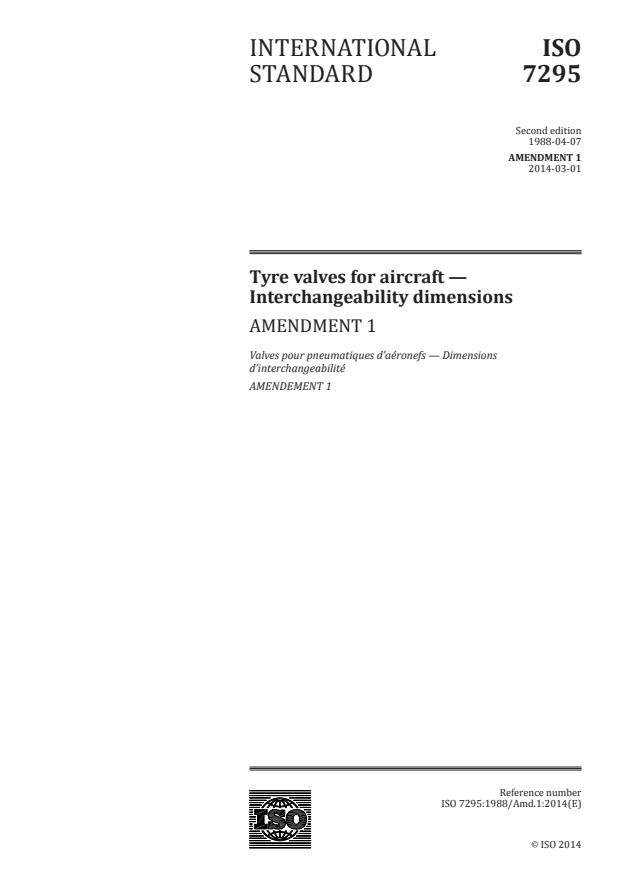
INTERNATIONAL ISO
STANDARD 7295
Second edition
1988-04-07
AMENDMENT 1
2014-03-01
Tyre valves for aircraft —
Interchangeability dimensions
AMENDMENT 1
Valves pour pneumatiques d’aéronefs — Dimensions
d’interchangeabilité
AMENDEMENT 1
Reference number
ISO 7295:1988/Amd.1:2014(E)
©
ISO 2014
ISO 7295:1988/Amd.1:2014(E)
© ISO 2014
All rights reserved. Unless otherwise specified, no part of this publication may be reproduced or utilized otherwise in any form
or by any means, electronic or mechanical, including photocopying, or posting on the internet or an intranet, without prior
written permission. Permission can be requested from either ISO at the address below or ISO’s member body in the country of
the requester.
ISO copyright office
Case postale 56 • CH-1211 Geneva 20
Tel. + 41 22 749 01 11
Fax + 41 22 749 09 47
E-mail copyright@iso.org
Web www.iso.org
Published in Switzerland
ii © ISO 2014 – All rights reserved
ISO 7295:1988/Amd.1:2014(E)
Foreword
ISO (the International Organization for Standardization) is a worldwide federation of national standards
bodies (ISO member bodies). The work of preparing International Standards is normally carried out
through ISO technical committees. Each member body interested in a subject for which a technical
committee has been established has the right to be represented on that committee. International
organizations, governmental and non-governmental, in liaison with ISO, also take part in the work.
ISO collaborates closely with the International Electrotechnical Commission (IEC) on all matters of
electrotechnical standardization.
The procedures used to develop this document and those intended for its further maintenance are
described in the ISO/IEC Directives, Part 1. In particular the different approval criteria needed for the
different types o
...
This May Also Interest You
Specifies the test methods used for valve cores and caps for aircraft tyres, with or without inner tubes, and minimum airtightness standards. Constitutes a detailed method allowing products to be evaluated on the same basis, and results to be compared.
- Standard5 pagesEnglish languagesale 15% off
- Standard5 pagesFrench languagesale 15% off
- 30-Nov-1994
- 83.160.20
- ISO/TC 31/SC 9
- Standard8 pagesEnglish languagesale 15% off
- Standard8 pagesFrench languagesale 15% off
- 06-Apr-1988
- 83.160.20
- ISO/TC 31/SC 9
The ISO 11929 series specifies a procedure, in the field of ionizing radiation metrology, for the calculation of the “decision threshold”, the “detection limit” and the “limits of the coverage interval” for a non-negative ionizing radiation measurand when counting measurements with preselection of time or counts are carried out. The measurand results from a gross count rate and a background count rate as well as from further quantities on the basis of a model of the evaluation. In particular, the measurand can be the net count rate as the difference of the gross count rate and the background count rate, or the net activity of a sample. It can also be influenced by calibration of the measuring system, by sample treatment and by other factors. ISO 11929 has been divided into four parts covering elementary applications in this document, advanced applications on the basis of the ISO/IEC Guide 3-1 in ISO 11929-2, applications to unfolding methods in ISO 11929-3, and guidance to the application in ISO 11929-4. This document covers basic applications of counting measurements frequently used in the field of ionizing radiation metrology. It is restricted to applications for which the uncertainties can be evaluated on the basis of the ISO/IEC Guide 98-3 (JCGM 2008). In REF Annex_sec_A \r \h Annex A 08D0C9EA79F9BACE118C8200AA004BA90B02000000080000000C00000041006E006E00650078005F007300650063005F0041000000 , the special case of repeated counting measurements with random influences is covered, while measurements with linear analogous ratemeters are covered in REF Annex_sec_B \r \h Annex B 08D0C9EA79F9BACE118C8200AA004BA90B02000000080000000C00000041006E006E00650078005F007300650063005F0042000000 . ISO 11929-2 extends the former ISO 11929:2010 to the evaluation of measurement uncertainties according to the ISO/IEC Guide 98-3:2008/Suppl 1:2008. ISO 11929-2 also presents some explanatory notes regarding general aspects of counting measurements and on Bayesian statistics in measurements. ISO 11929-3 deals with the evaluation of measurements using unfolding methods and counting spectrometric multi-channel measurements if evaluated by unfolding methods, in particular, for alpha- and gamma‑spectrometric measurements. Further, it provides some advice on how to deal with correlations and covariances. ISO 11929-4 gives guidance to the application of the ISO 11929 series, summarizes shortly the general procedure and then presents a wide range of numerical examples. Information on the statistical roots of ISO 11929 and on its current development may be found elsewhere[ REF Reference_ref_40 \r \h 33 08D0C9EA79F9BACE118C8200AA004BA90B0200000008000000110000005200650066006500720065006E00630065005F007200650066005F00340030000000 ][ REF Reference_ref_41 \r \h 34 08D0C9EA79F9BACE118C8200AA004BA90B0200000008000000110000005200650066006500720065006E00630065005F007200650066005F00340031000000 ]. The ISO 11929 series also applies analogously to other measurements of any kind especially if a similar model of the evaluation is involved. Further practical examples can be found, for example, in ISO 18589[ REF Reference_ref_8 \r \h 1 08D0C9EA79F9BACE118C8200AA004BA90B0200000008000000100000005200650066006500720065006E00630065005F007200650066005F0038000000 ], ISO 9696[ REF Reference_ref_9 \r \h 2 08D0C9EA79F9BACE118C8200AA004BA90B0200000008000000100000005200650066006500720065006E00630065005F007200650066005F0039000000 ], ISO 9697[ REF Reference_ref_10 \r \h 3 08D0C9EA79F9BACE118C8200AA004BA90B0200000008000000110000005200650066006500720065006E00630065005F007200650066005F00310030000000 ], ISO 9698[ REF Reference_ref_11 \r \h 4 08D0C9EA79F9BACE118C8200AA004BA90B0200000008000000110000005200650066006500720065006E00630065005F007200650066005F00310031000000 ], ISO 10703[ REF Reference_ref_12 \r \h 5 08D0C9EA79F9BACE118C8200AA004BA90B0200000008000000110000005200650066006500720065006E00630065005F007200650066005F00310032000000 ], ISO 7503[ REF Reference_ref_13 \r \h 6 08D0C9EA79
- Standard45 pagesEnglish languagesale 15% off
- Standard45 pagesFrench languagesale 15% off
- 11-Dec-2025
- 17.240
- ISO/TC 85/SC 2
This document specifies the identification of radionuclides and the measurement of their activity in soil using in situ gamma spectrometry with portable systems equipped with germanium or scintillation detectors. This document is suitable to rapidly assess the activity of artificial and natural radionuclides deposited on or present in soil layers of large areas of a site under investigation. This document can be used in connection with radionuclide measurements of soil samples in the laboratory (see ISO 18589-3) in the following cases: — routine surveillance of the impact of radioactivity released from nuclear installations or of the evolution of radioactivity in the region; — investigations of accident and incident situations; — planning and surveillance of remedial action; — decommissioning of installations or the clearance of materials. It can also be used for the identification of airborne artificial radionuclides, when assessing the exposure levels inside buildings or during waste disposal operations. Following a nuclear accident, in situ gamma spectrometry is a powerful method for rapid evaluation of the gamma activity deposited onto the soil surface as well as the surficial contamination of flat objects. NOTE The method described in this document is not suitable when the spatial distribution of the radionuclides in the environment is not precisely known (influence quantities, unknown distribution in soil) or in situations with very high photon flux. However, the use of small volume detectors with suitable electronics allows measurements to be performed under high photon flux.
- Standard54 pagesEnglish languagesale 15% off
- Standard55 pagesFrench languagesale 15% off
- 11-Dec-2025
- 13.080.99
- 17.240
- ISO/TC 85/SC 2
This document specifies test methods to determine loss of pretension in high-strength bolts due to the presence of coatings on the faying surface(s) of a bolted joint to be used in structural steelwork, when any of the coatings are thick enough to affect the pretension in a bolt in the short term, or can show significant deformation over time under sustained loads (creep-prone materials). The presence within the grip of the bolt of other materials having considerably smaller stiffness than steel, such as insulation, is not included in this test method.
- Standard11 pagesEnglish languagesale 15% off
- 11-Dec-2025
- 91.080.13
- ISO/TC 167
This document specifies the test procedures for lithium-ion battery packs and systems used in electrically propelled mopeds and motorcycles. The specified test procedures enable the user of this document to determine the essential characteristics on performance and safety of lithium-ion battery packs and systems. It is also possible to compare the test results achieved for different battery packs or systems. This document enables setting up a dedicated test plan for an individual battery pack or system subject to an agreement between customer and supplier. If required, the relevant test procedures and/or test conditions of lithium-ion battery packs and systems are selected from the standard tests provided in this document to configure a dedicated test plan. NOTE 1 Electrically power-assisted cycles (EPAC) cannot be considered as mopeds. The definition of electrically power-assisted cycles can differ from country to country. An example of definition can be found in Reference [ REF Reference_ref_12 \r \h 7 08D0C9EA79F9BACE118C8200AA004BA90B0200000008000000110000005200650066006500720065006E00630065005F007200650066005F00310032000000 ]. NOTE 2 Testing on cell level is specified in the IEC 62660 series.
- Standard46 pagesEnglish languagesale 15% off
- 11-Dec-2025
- 43.140
- ISO/TC 22/SC 38
This document specifies evaluation methods for determining the content of reactive oxygen species (ROS) used in the FB-facilitated advanced oxidation for pollution abatement in the wastewater treatment process. The probe based kinetic model is applicable to systems that generate ROS in substantial quantities, rather than at physiological concentrations, and is applicable to short-lived ROS. However, it is not applicable to long-lived ROS, such as ozone (O3) and hydrogen peroxide (H2O2). The probe based kinetic model method specifies: — cumulative concentration of different types of ROS during the reaction process; — concentration of different types of ROS at each time point during the reaction process. This method does not define the mechanisms of ROS generation, nor the correlation between bubble size and ROS production.
- Standard34 pagesEnglish languagesale 15% off
- 11-Dec-2025
- 07.030
- ISO/TC 281
This document showcases existing practices to monitor supply chains as implemented in the healthcare supply chains, by making use of medicines verification or authentication systems, or both, traceability tools, safe communication technology solutions, and more. This document also discusses the potential benefits of expanding the identification of medicinal products (IDMP) to provide global identifiers for medicinal products, ingredients and batches. It also addresses potential pathways to a global registration system.
- Technical report13 pagesEnglish languagesale 15% off
- 11-Dec-2025
- 35.240.80
- ISO/TC 215
The ISO 11929 series specifies a procedure, in the field of ionizing radiation metrology, for the calculation of the “decision threshold”, the “detection limit” and the “limits of the coverage interval” for a non-negative ionizing radiation measurand when counting measurements with preselection of time or counts are carried out. The measurand results from a gross count rate and a background count rate as well as from further quantities on the basis of a model of the evaluation. In particular, the measurand can be the net count rate as the difference of the gross count rate and the background count rate, or the net activity of a sample. It can also be influenced by calibration of the measuring system, by sample treatment and by other factors. ISO 11929 has been divided into four parts covering elementary applications in ISO 11929-1, advanced applications on the basis of the GUM Supplement 1 in this document, applications to unfolding methods in ISO 11929-3, and guidance to the application in ISO 11929-4. ISO 11929-1 covers basic applications of counting measurements frequently used in the field of ionizing radiation metrology. It is restricted to applications for which the uncertainties can be evaluated on the basis of the ISO/IEC Guide 98-3 (JCGM 2008). In ISO 11929-1:2025, Annex A, the special case of repeated counting measurements with random influences is covered, while measurements with linear analogous ratemeters are covered in ISO 11929-1:2025, Annex B. ISO 11929-3 deals with the evaluation of measurements using unfolding methods and counting spectrometric multi-channel measurements if evaluated by unfolding methods, in particular, for alpha- and gamma‑spectrometric measurements. Further, it provides some advice on how to deal with correlations and covariances. ISO 11929-4 gives guidance to the application of ISO 11929, summarizes shortly the general procedure and then presents a wide range of numerical examples. Information on the statistical roots of ISO 11929 and on its current development may be found elsewhere[ REF Reference_ref_37 \r \h 30 08D0C9EA79F9BACE118C8200AA004BA90B0200000008000000110000005200650066006500720065006E00630065005F007200650066005F00330037000000 ][ REF Reference_ref_38 \r \h 31 08D0C9EA79F9BACE118C8200AA004BA90B0200000008000000110000005200650066006500720065006E00630065005F007200650066005F00330038000000 ]. ISO 11929 also applies analogously to other measurements of any kind especially if a similar model of the evaluation is involved. Further practical examples can be found, for example, in ISO 18589[ REF Reference_ref_8 \r \h 1 08D0C9EA79F9BACE118C8200AA004BA90B0200000008000000100000005200650066006500720065006E00630065005F007200650066005F0038000000 ], ISO 9696[ REF Reference_ref_9 \r \h 2 08D0C9EA79F9BACE118C8200AA004BA90B0200000008000000100000005200650066006500720065006E00630065005F007200650066005F0039000000 ], ISO 9697[ REF Reference_ref_10 \r \h 3 08D0C9EA79F9BACE118C8200AA004BA90B0200000008000000110000005200650066006500720065006E00630065005F007200650066005F00310030000000 ], ISO 9698[ REF Reference_ref_11 \r \h 4 08D0C9EA79F9BACE118C8200AA004BA90B0200000008000000110000005200650066006500720065006E00630065005F007200650066005F00310031000000 ], ISO 10703[ REF Reference_ref_12 \r \h 5 08D0C9EA79F9BACE118C8200AA004BA90B0200000008000000110000005200650066006500720065006E00630065005F007200650066005F00310032000000 ], ISO 7503[ REF Reference_ref_13 \r \h 6 08D0C9EA79F9BACE118C8200AA004BA90B0200000008000000110000005200650066006500720065006E00630065005F007200650066005F00310033000000 ], ISO 28218[ REF Reference_ref_14 \r \h 7 08D0C9EA79F9BACE118C8200AA004BA90B0200000008000000110000005200650066006500720065006E00630065005F007200650066005F00310034000000 ] and ISO 11665[ REF Reference_ref_15 \r \h 8 08D0C9EA79F9BACE118C8200AA004BA90B0200000008000000110000005200650066006500720065006E00630065005F007200650066005F00310035000000 ]. NOTE A code system, named UncertRadio, is available for calculations according t
- Standard40 pagesEnglish languagesale 15% off
- Standard41 pagesFrench languagesale 15% off
- 11-Dec-2025
- 17.240
- ISO/TC 85/SC 2
This document specifies a method for the qualification and quantification of certain quinoline derivatives in textile products by means of extraction with methanol and gas chromatography with mass selective detector or liquid chromatography with mass selective detector. The method is applicable to all kinds of textile products consisting of natural or artificially dyed textile fibres and fabrics. It is further applicable to dyestuff powder used as textile auxiliary for dyeing and printing.
- Standard16 pagesEnglish languagesale 15% off
- Standard18 pagesFrench languagesale 15% off


Questions, Comments and Discussion
Ask us and Technical Secretary will try to provide an answer. You can facilitate discussion about the standard in here.
Loading comments...