

ISO 27327-1:2009
(Main)Fans — Air curtain units — Part 1: Laboratory methods of testing for aerodynamic performance rating
General Information
- Abstract
ISO 27327-1:2009 establishes uniform methods for laboratory testing of air curtain units to determine aerodynamic performance in terms of airflow rate, outlet air velocity uniformity, power consumption and air velocity projection, for rating or guarantee purposes. ISO 27327-1:2009 is not applicable to the specification of test procedures to be used for design, production or field testing.
- Status
- Published
- Publication Date
- 09-Jun-2009
- Technical Committee
- ISO/TC 117 - Fans
- Drafting Committee
- ISO/TC 117/WG 9 - Air curtain units
- Current Stage
- 9092 - International Standard to be revised
- Start Date
- 15-Aug-2023
- Completion Date
- 29-Aug-2026
Overview
ISO 27327-1:2009 specifies standardized laboratory testing methods for air curtain units (ACUs) to determine key aerodynamic performance characteristics. Developed by the International Organization for Standardization (ISO), this standard provides a consistent framework for manufacturers and testing laboratories to measure airflow rate, outlet air velocity uniformity, power consumption, and air velocity projection. The test methods outlined are intended for rating or guarantee purposes, ensuring comparability, accuracy, and reliability of performance data for ACUs. Notably, the scope of ISO 27327-1:2009 does not extend to procedures for design verification, production quality, or field performance testing.
Key Topics
- Aerodynamic Performance Rating: Central to the standard are procedures to determine:
- Airflow rate
- Outlet air velocity uniformity
- Air velocity projection
- Motor input power (power consumption)
- Test Apparatus and Setup: Requirements for laboratory equipment and instrumentation, with specific references to companion standard ISO 5801 for accuracy and measurement procedures.
- Test Preparation: Guidelines for unit mounting, initial stabilization, and arrangement of accessories, ensuring unbiased and replicable testing conditions.
- Data Recording: Systematic instructions for recording all relevant test data, including conditions, unit details, and apparatus specifications.
- Calculation Methods: Prescribed equations and methods for calculating core measurements, including average air velocities, uniformity percentages, efficiency, and airflow rates.
- Reporting: Standardized reporting requirements to ensure transparent and complete communication of test results.
Applications
- Equipment Rating and Guarantees: Manufacturers and certification bodies use ISO 27327-1:2009 to provide verified performance ratings for air curtain units, supporting product specification, procurement, and selection.
- Product Comparison: The use of consistent test methods allows reliable comparisons among different ACUs, promoting fair competition and informed decision-making.
- Research and Development: Engineering and technical teams employ the standard in controlled environments to benchmark new designs and validate product improvements.
- Compliance and Certification: Third-party testing laboratories rely on ISO 27327-1:2009 when certifying that ACUs meet specified performance criteria, facilitating regulatory compliance and customer assurance.
- Global Trade and Market Access: With harmonized performance data based on international standards, manufacturers gain easier access to international markets.
Related Standards
- ISO 5801:2007 - Industrial fans - Performance testing using standardized airways. Serves as a foundational reference for instrumentation, measurement accuracy, and certain calculation procedures within ISO 27327-1:2009.
- ISO 27327-2 - Fans – Air curtain units – Part 2: Laboratory methods of testing for acoustic performance rating (where available). Focuses on the acoustic (noise) performance of ACUs.
- HVAC Standards - Many regional standards bodies reference ISO 27327-1:2009 when defining requirements for building heating, ventilation, and air conditioning (HVAC) systems involving air curtain technology.
Practical Value
Adhering to ISO 27327-1:2009 fosters industry best practices by ensuring objective, repeatable, and comparable aerodynamic performance testing of air curtain units. Its use supports reliable energy efficiency, building protection, and environmental separation in commercial and industrial facilities. Equipped with accurate test data, specifiers and end users can make performance-based decisions, improving sustainability, operational cost control, and occupant comfort.
For manufacturers and testing labs seeking international recognition and compliance, ISO 27327-1:2009 is an essential standard for the validated aerodynamic performance rating of air curtain systems.
Keywords: ISO 27327-1, air curtain units, aerodynamic performance, laboratory testing, airflow rate, velocity uniformity, ISO 5801, ACU rating, fan efficiency, HVAC standards.
Relations
- Effective Date
- 19-Aug-2023
Get Certified
Connect with accredited certification bodies for this standard

Institut za varilstvo d.o.o. (Welding Institute)
Slovenia's leading welding institute since 1952. ISO 3834, EN 1090, pressure equipment certification, NDT personnel, welder qualification. Only IIW Au
Sponsored listings
Frequently Asked Questions
ISO 27327-1:2009 is a standard published by the International Organization for Standardization (ISO). Its full title is "Fans — Air curtain units — Part 1: Laboratory methods of testing for aerodynamic performance rating". This standard covers: ISO 27327-1:2009 establishes uniform methods for laboratory testing of air curtain units to determine aerodynamic performance in terms of airflow rate, outlet air velocity uniformity, power consumption and air velocity projection, for rating or guarantee purposes. ISO 27327-1:2009 is not applicable to the specification of test procedures to be used for design, production or field testing.
ISO 27327-1:2009 establishes uniform methods for laboratory testing of air curtain units to determine aerodynamic performance in terms of airflow rate, outlet air velocity uniformity, power consumption and air velocity projection, for rating or guarantee purposes. ISO 27327-1:2009 is not applicable to the specification of test procedures to be used for design, production or field testing.
ISO 27327-1:2009 is classified under the following ICS (International Classification for Standards) categories: 23.120 - Ventilators. Fans. Air-conditioners. The ICS classification helps identify the subject area and facilitates finding related standards.
ISO 27327-1:2009 has the following relationships with other standards: It is inter standard links to ISO/FDIS 27327-1. Understanding these relationships helps ensure you are using the most current and applicable version of the standard.
ISO 27327-1:2009 is available in PDF format for immediate download after purchase. The document can be added to your cart and obtained through the secure checkout process. Digital delivery ensures instant access to the complete standard document.
Standards Content (Sample)
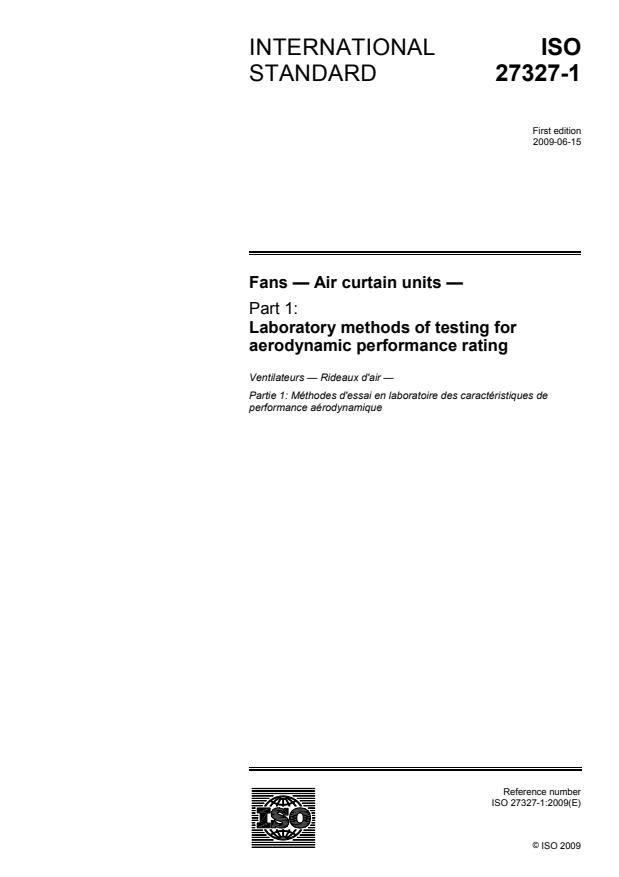
INTERNATIONAL ISO
STANDARD 27327-1
First edition
2009-06-15
Fans — Air curtain units —
Part 1:
Laboratory methods of testing for
aerodynamic performance rating
Ventilateurs — Rideaux d'air —
Partie 1: Méthodes d'essai en laboratoire des caractéristiques de
performance aérodynamique
Reference number
©
ISO 2009
PDF disclaimer
This PDF file may contain embedded typefaces. In accordance with Adobe's licensing policy, this file may be printed or viewed but
shall not be edited unless the typefaces which are embedded are licensed to and installed on the computer performing the editing. In
downloading this file, parties accept therein the responsibility of not infringing Adobe's licensing policy. The ISO Central Secretariat
accepts no liability in this area.
Adobe is a trademark of Adobe Systems Incorporated.
Details of the software products used to create this PDF file can be found in the General Info relative to the file; the PDF-creation
parameters were optimized for printing. Every care has been taken to ensure that the file is suitable for use by ISO member bodies. In
the unlikely event that a problem relating to it is found, please inform the Central Secretariat at the address given below.
© ISO 2009
All rights reserved. Unless otherwise specified, no part of this publication may be reproduced or utilized in any form or by any means,
electronic or mechanical, including photocopying and microfilm, without permission in writing from either ISO at the address below or
ISO's member body in the country of the requester.
ISO copyright office
Case postale 56 • CH-1211 Geneva 20
Tel. + 41 22 749 01 11
Fax + 41 22 749 09 47
E-mail copyright@iso.org
Web www.iso.org
Published in Switzerland
ii © ISO 2009 – All rights reserved
Contents Page
Foreword. iv
Introduction . v
1 Scope . 1
2 Normative references . 1
3 Terms, definitions and symbols. 1
3.1 Terms and definitions. 1
3.2 Symbols . 6
4 Air curtain airflow rate test . 8
4.1 Apparatus and instruments . 8
4.2 Preparation of air curtain airflow rate test . 8
4.3 Test procedure . 8
4.4 Calculation. 9
4.5 Test report . 11
5 Outlet air velocity uniformity test. 11
5.1 Apparatus and instruments . 11
5.2 Air velocity projection and outlet air velocity uniformity test. 12
5.3 Test procedure . 12
5.4 Calculation. 13
5.5 Test report . 14
6 Air curtain velocity projection test. 14
6.1 Apparatus and instruments . 14
6.2 Equipment and organization . 14
6.3 Test procedure . 15
6.4 Calculation. 16
6.5 Test report . 16
7 Illustration of tests. 17
Annex A (normative) Uncertainty in velocity determination using Pitot-static tube and
manometer. 28
Bibliography . 29
Foreword
ISO (the International Organization for Standardization) is a worldwide federation of national standards bodies
(ISO member bodies). The work of preparing International Standards is normally carried out through ISO
technical committees. Each member body interested in a subject for which a technical committee has been
established has the right to be represented on that committee. International organizations, governmental and
non-governmental, in liaison with ISO, also take part in the work. ISO collaborates closely with the
International Electrotechnical Commission (IEC) on all matters of electrotechnical standardization.
International Standards are drafted in accordance with the rules given in the ISO/IEC Directives, Part 2.
The main task of technical committees is to prepare International Standards. Draft International Standards
adopted by the technical committees are circulated to the member bodies for voting. Publication as an
International Standard requires approval by at least 75 % of the member bodies casting a vote.
Attention is drawn to the possibility that some of the elements of this document may be the subject of patent
rights. ISO shall not be held responsible for identifying any or all such patent rights.
ISO 27327-1 was prepared by Technical Committee ISO/TC 117, Fans.
ISO 27327 consists of the following parts, under the general title Fans — Air curtain units:
⎯ Part 1: Laboratory methods of testing for aerodynamic performance rating
iv © ISO 2009 – All rights reserved
Introduction
This part of ISO 27327 is the first developed by ISO/TC 117 and is intended to determine the aerodynamic
performance rating of an air curtain. The principal aerodynamic attributes determined by this part of
ISO 27327 are airflow rate, power consumption, velocity uniformity near the exit plane and average air curtain
core velocities at specified distances from the exit plane.
While a fan energy efficiency calculation is included in this part of ISO 27327, it is generally recognized by the
developers of this part of ISO 27327 that a different measure of energy effectiveness is more important and
meaningful than fan efficiency because the energy savings that can be obtained by a properly selected,
installed and controlled air curtain are significantly higher than the energy needed to drive the motor(s) of an
air curtain. This part of ISO 27327 is developed with the understanding that another test standard can be
developed at a later stage, which can define a test method for energy effectiveness.
This part of ISO 27327 is not intended as an in situ test International Standard and neither is it applicable to
thermodynamic performance.
INTERNATIONAL STANDARD ISO 27327-1:2009(E)
Fans — Air curtain units —
Part 1:
Laboratory methods of testing for aerodynamic performance
rating
1 Scope
This part of ISO 27327 establishes uniform methods for laboratory testing of air curtain units to determine
aerodynamic performance in terms of airflow rate, outlet air velocity uniformity, power consumption and air
velocity projection, for rating or guarantee purposes.
This part of ISO 27327 is not applicable to the specification of test procedures to be used for design,
production or field testing.
2 Normative references
The following referenced documents are indispensable for the application of this document. For dated
references, only the edition cited applies. For undated references, the latest edition of the referenced
document (including any amendments) applies.
ISO 5801:2007, Industrial fans — Performance testing using standardized airways
3 Terms, definitions and symbols
For the purposes of this document, the following terms and definitions apply.
3.1 Terms and definitions
3.1.1
air curtain airstream
directionally-controlled airstream, moving across the entire height and width of an opening, which can reduce
the infiltration or transfer of air from one side of the opening to the other and/or inhibit the passage of insects,
dust and debris
3.1.2
air curtain depth
airstream dimension perpendicular to both the direction of airflow and the airstream width
NOTE This is the short dimension of the airstream.
3.1.3
air curtain width
airstream dimension perpendicular to both the direction of airflow and the airstream depth
NOTE This is the long dimension of the airstream.
3.1.4
air curtain unit
ACU
air-moving device which produces an air curtain
3.1.5
air discharge nozzle
component or an assembly in the ACU which directs and controls the airstream
NOTE This may include adjustable vanes.
3.1.6
air discharge nozzle depth
h
n
inside dimension perpendicular to both the direction of airflow and the airstream width
NOTE This depth is expressed in millimetres.
3.1.7
air discharge nozzle width
b
n
inside dimension perpendicular to both the direction of airflow and the nozzle depth
NOTE This width is expressed in millimetres.
3.1.8
air discharge angle
θ
angle between the plane of the protected opening and the direction in which the air curtain leaves the
discharge
3.1.9
dry-bulb temperature
T
d
air temperature measured by a dry temperature sensor in the test enclosure, near the ACU inlet or airway inlet
NOTE This temperature is expressed in degrees Celsius.
3.1.10
wet-bulb temperature
T
w
air temperature measured by a temperature sensor covered by a water-moistened wick and exposed to air in
motion
NOTE 1 When properly measured, it is a close approximation to the temperature of adiabatic saturation.
NOTE 2 This temperature is expressed in degrees Celsius.
3.1.11
air density
ρ
a
mass per unit volume of air
NOTE Air density is expressed in kilograms per cubic metre.
3.1.12
pressure
force per unit area
2 © ISO 2009 – All rights reserved
3.1.13
absolute pressure
p
value of a pressure when the datum pressure is absolute zero
NOTE This is always positive.
3.1.14
atmospheric pressure
p
a
absolute pressure of the free atmosphere at the mean altitude of the ACU
NOTE This pressure is normally expressed in pascals.
3.1.15
gauge pressure
p
e
value of the pressure when the datum pressure is the atmospheric pressure at the point of measurement
NOTE 1 Gauge pressure can be negative or positive.
NOTE 2 Gauge pressure is determined using Equation (1):
pp=−p (1)
ea
NOTE 3 This pressure is normally expressed in pascals.
3.1.16
dynamic pressure at a point
p
d
pressure calculated from the velocity and the density, ρ , of the air at a point
a
NOTE 1 The point is determined using Equation (2):
⎛⎞
v
p = ρ⎜⎟ (2)
da
⎜⎟
⎝⎠
NOTE 2 This pressure is normally expressed in pascals.
3.1.17
gauge stagnation pressure at a point
p
esg
difference between the absolute stagnation pressure, p , and the atmospheric pressure, p
sg a
NOTE 1 This pressure is calculated using Equation (3):
p = p − p (3)
esg sg a
NOTE 2 This pressure is normally expressed in pascals.
3.1.18
ACU airflow rate
q
airflow volume which leaves the discharge nozzle, at standard air conditions, as measured in accordance with
ISO 5801
NOTE 1 This is given by Equation (4):
q = q (4)
Vsg1
NOTE 2 This rate is expressed in cubic metres per second.
3.1.19
inlet stagnation volume flow rate
q
Vsg1
mass flow rate divided by the inlet stagnation density
NOTE 1 This is determined using Equation (5):
q
m
q = (5)
Vsg1
ρ
sg1
NOTE 2 Inlet stagnation volume flow rate is expressed in cubic metres per second.
3.1.20
ACU pressure
p
ACU
difference between the stagnation pressure at the ACU outlet and the stagnation pressure at the ACU inlet
NOTE 1 This is determined using Equation (6):
p = p − p (6)
ACU sg2 sg1
NOTE 2 When the Mach number is less than 0,15, it is possible to use the relationship given in Equation (7):
p = p − p (7)
ACU t2 t1
NOTE 3 ACU pressure is expressed in pascals.
3.1.21
ACU static pressure
p
sACU
conventional quantity defined as the ACU pressure minus the ACU dynamic pressure corrected by the Mach
factor
NOTE 1 This is determined using Equation (8):
p = −p (8)
sACU sg1
NOTE 2 ACU static pressure is expressed in pascals.
3.1.22
average outlet air velocity
ν
a
airflow rate produced by the ACU divided by the cross-sectional area of the discharge nozzle plane at free-air
delivery
NOTE See 4.4.3 for calculation of the value.
4 © ISO 2009 – All rights reserved
3.1.23
outlet air velocity uniformity
u
ACU
indicator of the consistency of air velocities across the air curtain width
NOTE 1 See 5.4.4 for calculation of the value. See Figure 7.
NOTE 2 The outlet air velocity uniformity is expressed as a percentage.
3.1.24
air curtain core velocity
ν
cx
maximum air velocity of the air curtain at point x as measured across both the air curtain depth and width at
specified distances from the discharge nozzle
NOTE See 5.1.1 and 5.3.4.
3.1.25
air curtain average core velocity
ν
ca
average of air curtain core velocities measured along the air curtain width at specified distances from the
discharge nozzle
NOTE See 6.4.3.
3.1.26
air curtain velocity projection
set of average air curtain core velocities measured along the air curtain width at specified distances from the
discharge nozzle
NOTE 1 See 6.3.2.5.
NOTE 2 Velocity is expressed in metres per second.
3.1.27
motor input power
P
e
electrical power supplied at the terminals of an electric motor drive
NOTE Motor input power is expressed in watts.
3.1.28
ACU energy effectiveness
E
ACU
ratio described by the difference in energy loss through an opening without and with the use of an air curtain
divided by the energy loss without the air curtain
NOTE The energy loss with the use of the air curtain includes the energy consumption of the air curtain
3.1.29
ACU fan efficiency
η
fan
ratio of the air power of the ACU to the motor input power of the ACU
3.1.30
ACU target distance
l
t
distance perpendicular to the discharge nozzle depth in metres, determined by the sponsor of the test, for the
purpose of setting up the test
3.1.31
air power of ACU
P
ACU
conventional output power which is the product of the inlet volume flow rate, q , and the ACU
Vsg1
pressure, p
ACU
NOTE 1 This is determined using Equation (9):
P q p (9)
ACU = Vsg1 × ACU
NOTE 2 The air power of the ACU is expressed in watts when q is in cubic metres per second and p is in
Vsg1 ACU
pascals.
3.1.32
point of operation
relative position on the air curtain performance curve corresponding to a particular airflow rate, pressure,
power and efficiency
3.1.33
free-air delivery
that point of operation where the ACU operates against zero static pressure
3.1.34
determination
complete set of measurements for a particular point of operation for the parameter being determined
3.1.35
test
series of determinations of various characteristics at a single point of operation of an ACU
3.2 Symbols
Symbol Term Unit
A Nozzle cross-sectional area m
n
b Air discharge nozzle width mm
n
C The calculated test line spacing mm
d
E ACU energy effectiveness 1
ACU
h air discharge nozzle depth mm
n
l ACU target distance m
t
η ACU fan efficiency per unit
fan
n Number of data points 1
6 © ISO 2009 – All rights reserved
N ACU speed (rotational) r/min
p Absolute pressure Pa
p Atmospheric pressure Pa
a
p ACU pressure Pa
ACU
p Dynamic pressure at a point Pa
d
p Gauge pressure Pa
e
p Gauge stagnation pressure at a point Pa
esg
p Absolute stagnation pressure Pa
sg
p Stagnation pressure at the ACU inlet Pa
sg1
p Stagnation pressure at the ACU outlet Pa
sg2
p ACU static pressure Pa
sACU
P Motor input power W
e
P Air power of ACU W
ACU
q ACU airflow rate m /s
q Mass flow rate kg/s
m
q Inlet stagnation volume flow rate m /s
Vsg1
ρ Air density kg/m
a
ρ Inlet stagnation density kg/m
sg1
s Standard deviation 1
θ Air discharge angle degrees
T Dry-bulb temperature °C
d
T Wet-bulb temperature °C
w
u Outlet air velocity uniformity %
ACU
ν Velocity m/s
ν Velocity, average outlet m/s
a
ν Velocity, average (air curtain core) m/s
ca
ν Velocity, air curtain core, at section x m/s
cx
4 Air curtain airflow rate test
4.1 Apparatus and instruments
4.1.1 General
Instruments and methods of measurement shall be in compliance with ISO 5801, except where specifically
noted.
4.1.2 Power
Power shall be measured with the following.
4.1.2.1 Wattmeter, having a certified accuracy of ± 1 % of the observed reading.
4.2 Preparation of air curtain airflow rate test
The ACU shall be mounted with its inlet sealed to the test chamber in compliance with the requirements of
Figure 1 a). The seal shall be adequate enough to minimize leakage. The air discharge nozzle or adjustable
vanes in the air discharge nozzle shall be set to 0° ± 3°. Additional tests may be run at discharge angles other
than 0°.
4.3 Test procedure
4.3.1 Initial conditions
The unit under test shall be energized and operated for not less than 15 min to allow equilibrium conditions to
become established before the first determination. If the unit is equipped with a heating and/or cooling
accessory (i.e. hydronic coil, electric coil and gas furnace), it shall be attached as catalogued. The accessory
shall not be powered or activated during any part of the test unless it contributes to the active generation of
airflow. In such cases, only the fan section(s) shall be energized.
4.3.2 Data to be recorded
4.3.2.1 ACU under test
The following information shall be recorded:
a) the initial conditions;
b) the name and address of the manufacturer;
c) the trade name;
d) the model number;
e) the impeller diameter;
f) the inlet and outlet areas;
g) the number of fans;
h) the air discharge angle;
i) the number of motors;
8 © ISO 2009 – All rights reserved
j) the data on the motor nameplate;
k) the accessories attached;
l) the accessories which are energized.
4.3.2.2 Test method
The description of the test method shall be recorded, including specific dimensions, as required by Figures 1,
3, 4 and 5. Alternatively, an annotated photograph of the arrangement shall be attached to the recorded data.
4.3.2.3 Apparatus and instruments
The apparatus and instruments used in the test shall be listed. Names, model numbers, serial numbers, scale
ranges and calibration information shall be recorded.
4.3.2.4 Initial and final conditions
Initial and final readings of ambient dry-bulb temperature, T , ambient wet-bulb temperature, T and
d w
atmospheric pressure, p , shall be recorded for each determination.
a
4.3.3 Airflow rate determination
To establish the airflow rate at free-air delivery, a minimum of three determinations shall be taken at chamber
gauge stagnation pressures ranging from +25 Pa to −25 Pa. If a chamber gauge stagnation pressure of
−25 Pa cannot be obtained, then the lowest obtainable gauge stagnation pressure shall be used as the lower
limit and the negative of this value shall be considered the upper limit. Plans shall be made to vary the
chamber throttling device such that the test points will be well-spaced in terms of pressure. Approximately half
of these determinations shall be taken at a positive pressure and the other half at a negative pressure.
4.4 Calculation
4.4.1 General
Calculations, except as noted in this subclause, shall be in compliance with the requirements of ISO 5801.
4.4.2 Static pressure as a function of airflow rate
The relationship between air curtain static pressure and air curtain airflow rate, for the range of static pressure
tested, is represented by the second order polynomial in Equation (13):
p = p (10)
esg1 esg3
p = −p (11)
sACU esg1
q = q (12)
Vsg1
Where the coefficients K , K and K are derived from Equations (14), (15), (16), (17), (18), (19), (20), (21),
2 1 0
(22), (23), (24) and (25):
p = K q + K q + K (13)
sACU 2 1 0
a = n (14)
n
aq= (15)
1i∑
i=1
n
aq= (16)
2i∑
i=1
n
aq= (17)
3i∑
i=1
n
aq= (18)
4i∑
i=1
n
bp= (1
...