

ISO 21684:2025
(Main)Fans — Laboratory test methods for air circulating fans
General Information
- Abstract
This document specifies laboratory testing methods for electrically powered air circulating fan heads and ceiling fans when air is used as the test gas. This document is applicable to air circulating fans with an input power greater than or equal to 125 W, except for ceiling fans that are larger than 1 800 mm, which do not have a lower input power limit. The diameter of the fan being tested is limited by the minimum dimensions as shown in the applicable test figures. See annex A for information on common names used for various air circulating fans. This document does not apply to: — jet fans; — powered roof ventilators, induced flow fans, laboratory exhausts; — positive pressure ventilators as defined in ISO 24660:2024; — compressors; — positive displacement machines.
- Status
- Published
- Publication Date
- 24-Sep-2025
- Technical Committee
- ISO/TC 117 - Fans
- Drafting Committee
- ISO/TC 117 - Fans
- Current Stage
- 6060 - International Standard published
- Start Date
- 25-Sep-2025
- Due Date
- 14-Aug-2026
- Completion Date
- 25-Sep-2025
Overview
ISO 21684:2025 - Fans - Laboratory test methods for air circulating fans specifies uniform laboratory methods for testing electrically powered air circulating fan heads and ceiling fans using air as the test gas. Its purpose is to establish reproducible procedures and reporting for performance rating. The standard applies to fans with an input power ≥ 125 W, except for ceiling fans larger than 1 800 mm (no lower power limit). The standard excludes jet fans, powered roof ventilators, induced-flow fans, certain positive pressure ventilators, compressors and positive-displacement machines.
Key topics and technical requirements
ISO 21684:2025 covers the full test lifecycle, with technical emphasis on:
- Scope and definitions - terminology and fan subcategories (see Annex A).
- Instruments and measurement accuracy - requirements for meters, thermometers, barometers, calibration and measurement uncertainty.
- Measured variables - airflow rate, thrust, rotational speed, input power and air density.
- Equipment and test setups - allowable configurations, load cell orientation and minimum testable dimensions (fan diameter limited by test figures).
- Test conduct and observations - equilibrium, run‑in, control of extraneous airflow, data recording.
- Calculations and results - calibration correction, ambient air density correction, thrust, airflow, fan total pressure, overall efficiency, circulating fan efficacy and Ceiling Fan Energy Index (C).
- Reporting - standardized test reports, required test data and personnel qualifications.
The standard also details symbols, subscripts, figures and procedures to ensure consistent, repeatable laboratory testing.
Practical applications and users
ISO 21684:2025 is designed for practical use by:
- Test laboratories and calibration facilities performing performance verification and type testing.
- Fan and ceiling‑fan manufacturers during product development, quality control and performance claims.
- Certification and regulatory bodies assessing compliance with energy labeling, performance standards and efficiency classification.
- HVAC engineers and specifiers who need validated performance data for system design and selection.
- Research and development teams optimizing aerodynamic performance, thrust efficiency and energy use.
Applying ISO 21684 ensures reliable data for product ratings, ENERGY/efficiency labeling, procurement specifications and competitive benchmarking.
Related standards
Relevant referenced standards include:
- ISO 13349-1:2022 - Fans vocabulary and definitions
- ISO 12759-6:2024 - Fan energy index calculations
- ISO/IEC 17025 - Competence of testing and calibration laboratories
- IEC 62301:2011 - Measurement of standby power
- ISO 24660:2024 - Definitions for positive pressure ventilators (for exclusion criteria)
Keywords: ISO 21684:2025, fans laboratory test methods, air circulating fans, ceiling fans testing, airflow rate, thrust measurement, fan efficiency, Ceiling Fan Energy Index.
Get Certified
Connect with accredited certification bodies for this standard

Institut za varilstvo d.o.o. (Welding Institute)
Slovenia's leading welding institute since 1952. ISO 3834, EN 1090, pressure equipment certification, NDT personnel, welder qualification. Only IIW Au
Sponsored listings
Frequently Asked Questions
ISO 21684:2025 is a standard published by the International Organization for Standardization (ISO). Its full title is "Fans — Laboratory test methods for air circulating fans". This standard covers: This document specifies laboratory testing methods for electrically powered air circulating fan heads and ceiling fans when air is used as the test gas. This document is applicable to air circulating fans with an input power greater than or equal to 125 W, except for ceiling fans that are larger than 1 800 mm, which do not have a lower input power limit. The diameter of the fan being tested is limited by the minimum dimensions as shown in the applicable test figures. See annex A for information on common names used for various air circulating fans. This document does not apply to: — jet fans; — powered roof ventilators, induced flow fans, laboratory exhausts; — positive pressure ventilators as defined in ISO 24660:2024; — compressors; — positive displacement machines.
This document specifies laboratory testing methods for electrically powered air circulating fan heads and ceiling fans when air is used as the test gas. This document is applicable to air circulating fans with an input power greater than or equal to 125 W, except for ceiling fans that are larger than 1 800 mm, which do not have a lower input power limit. The diameter of the fan being tested is limited by the minimum dimensions as shown in the applicable test figures. See annex A for information on common names used for various air circulating fans. This document does not apply to: — jet fans; — powered roof ventilators, induced flow fans, laboratory exhausts; — positive pressure ventilators as defined in ISO 24660:2024; — compressors; — positive displacement machines.
ISO 21684:2025 is classified under the following ICS (International Classification for Standards) categories: 23.120 - Ventilators. Fans. Air-conditioners. The ICS classification helps identify the subject area and facilitates finding related standards.
ISO 21684:2025 is available in PDF format for immediate download after purchase. The document can be added to your cart and obtained through the secure checkout process. Digital delivery ensures instant access to the complete standard document.
Standards Content (Sample)
International
Standard
ISO 21684
First edition
Fans — Laboratory test methods for
2025-09
air circulating fans
Reference number
© ISO 2025
All rights reserved. Unless otherwise specified, or required in the context of its implementation, no part of this publication may
be reproduced or utilized otherwise in any form or by any means, electronic or mechanical, including photocopying, or posting on
the internet or an intranet, without prior written permission. Permission can be requested from either ISO at the address below
or ISO’s member body in the country of the requester.
ISO copyright office
CP 401 • Ch. de Blandonnet 8
CH-1214 Vernier, Geneva
Phone: +41 22 749 01 11
Email: copyright@iso.org
Website: www.iso.org
Published in Switzerland
ii
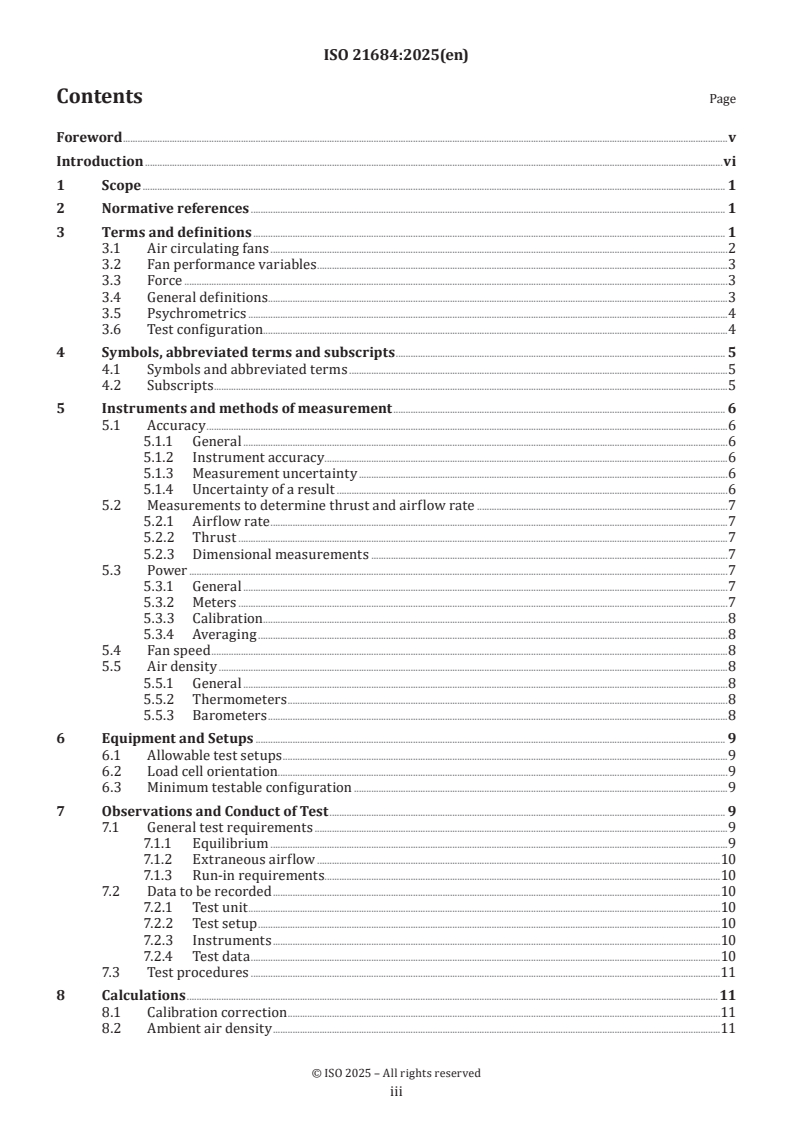
Contents Page
Foreword .v
Introduction .vi
1 Scope . 1
2 Normative references . 1
3 Terms and definitions . 1
3.1 Air circulating fans .2
3.2 Fan performance variables .3
3.3 Force .3
3.4 General definitions.3
3.5 Psychrometrics .4
3.6 Test configuration.4
4 Symbols, abbreviated terms and subscripts . 5
4.1 Symbols and abbreviated terms .5
4.2 Subscripts . .5
5 Instruments and methods of measurement . 6
5.1 Accuracy .6
5.1.1 General .6
5.1.2 Instrument accuracy .6
5.1.3 Measurement uncertainty .6
5.1.4 Uncertainty of a result .6
5.2 Measurements to determine thrust and airflow rate .7
5.2.1 Airflow rate .7
5.2.2 Thrust .7
5.2.3 Dimensional measurements .7
5.3 Power .7
5.3.1 General .7
5.3.2 Meters .7
5.3.3 Calibration . . .8
5.3.4 Averaging .8
5.4 Fan speed .8
5.5 Air density .8
5.5.1 General .8
5.5.2 Thermometers .8
5.5.3 Barometers .8
6 Equipment and Setups . 9
6.1 Allowable test setups .9
6.2 Load cell orientation . .9
6.3 Minimum testable configuration .9
7 Observations and Conduct of Test . 9
7.1 General test requirements .9
7.1.1 Equilibrium .9
7.1.2 Extraneous airflow .10
7.1.3 Run-in requirements.10
7.2 Data to be recorded .10
7.2.1 Test unit .10
7.2.2 Test setup .10
7.2.3 Instruments .10
7.2.4 Test data .10
7.3 Test procedures .11
8 Calculations .11
8.1 Calibration correction .11
8.2 Ambient air density .11
iii
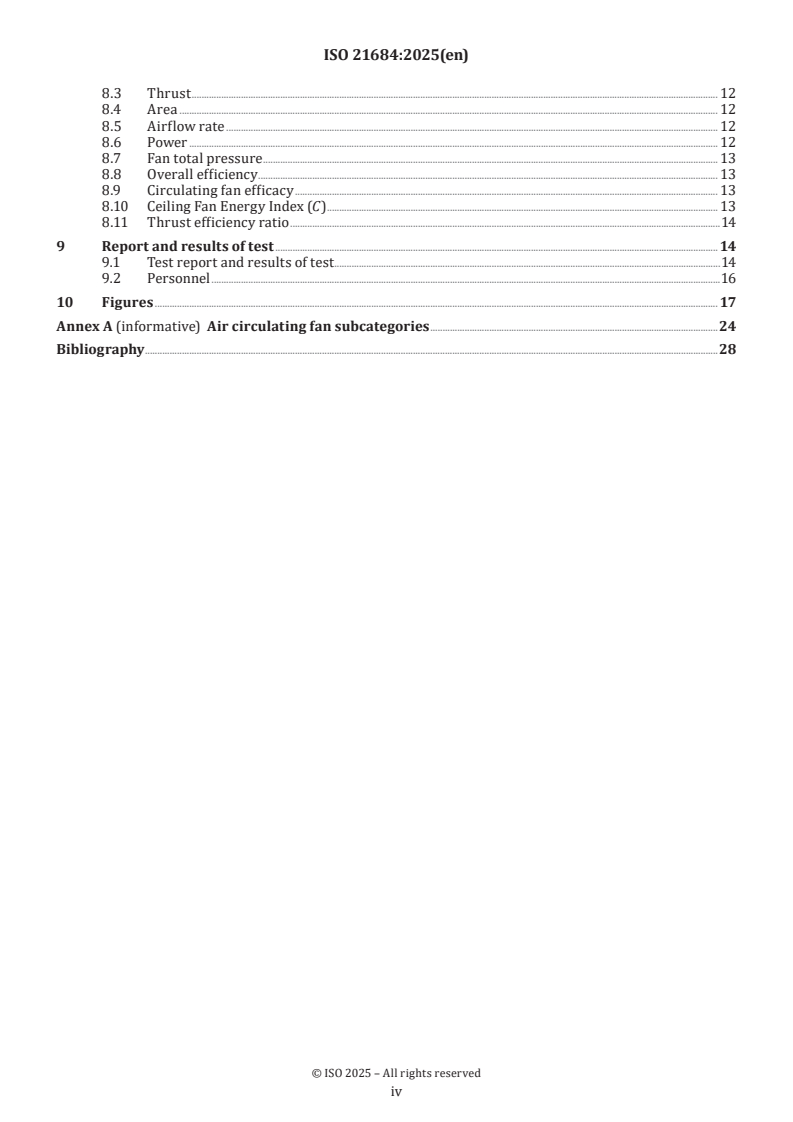
8.3 Thrust . 12
8.4 Area . 12
8.5 Airflow rate . 12
8.6 Power . 12
8.7 Fan total pressure . 13
8.8 Overall efficiency . 13
8.9 Circulating fan efficacy . 13
8.10 Ceiling Fan Energy Index (C) . 13
8.11 Thrust efficiency ratio .14
9 Report and results of test . 14
9.1 Test report and results of test . .14
9.2 Personnel .16
10 Figures . 17
Annex A (informative) Air circulating fan subcategories .24
Bibliography .28
iv
Foreword
ISO (the International Organization for Standardization) is a worldwide federation of national standards
bodies (ISO member bodies). The work of preparing International Standards is normally carried out through
ISO technical committees. Each member body interested in a subject for which a technical committee
has been established has the right to be represented on that committee. International organizations,
governmental and non-governmental, in liaison with ISO, also take part in the work. ISO collaborates closely
with the International Electrotechnical Commission (IEC) on all matters of electrotechnical standardization.
The procedures used to develop this document and those intended for its further maintenance are described
in the ISO/IEC Directives, Part 1. In particular, the different approval criteria needed for the different types
of ISO document should be noted. This document was drafted in accordance with the editorial rules of the
ISO/IEC Directives, Part 2 (see www.iso.org/directives).
ISO draws attention to the possibility that the implementation of this document may involve the use of (a)
patent(s). ISO takes no position concerning the evidence, validity or applicability of any claimed patent
rights in respect thereof. As of the date of publication of this document, ISO had not received notice of (a)
patent(s) which may be required to implement this document. However, implementers are cautioned that
this may not represent the latest information, which may be obtained from the patent database available at
www.iso.org/patents. ISO shall not be held responsible for identifying any or all such patent rights.
Any trade name used in this document is information given for the convenience of users and does not
constitute an endorsement.
For an explanation of the voluntary nature of standards, the meaning of ISO specific terms and expressions
related to conformity assessment, as well as information about ISO's adherence to the World Trade
Organization (WTO) principles in the Technical Barriers to Trade (TBT), see www.iso.org/iso/foreword.html.
This document was prepared by Technical Committee ISO/TC 117, Fans.
Any feedback or questions on this document should be directed to the user’s national standards body. A
complete listing of these bodies can be found at www.iso.org/members.html.
v
Introduction
This document aims to establish uniform methods for laboratory testing of air circulating fans to determine
performance for rating.
vi
International Standard ISO 21684:2025(en)
Fans — Laboratory test methods for air circulating fans
1 Scope
This document specifies laboratory testing methods for electrically powered air circulating fan heads and
ceiling fans when air is used as the test gas.
This document is applicable to air circulating fans with an input power greater than or equal to 125 W, except
for ceiling fans that are larger than 1 800 mm, which do not have a lower input power limit. The diameter of
the fan being tested is limited by the minimum dimensions as shown in the applicable test figures.
See annex A for information on common names used for various air circulating fans.
This document does not apply to:
— jet fans;
— powered roof ventilators, induced flow fans, laboratory exhausts;
— positive pressure ventilators as defined in ISO 24660:2024;
— compressors;
— positive displacement machines.
2 Normative references
The following documents are referred to in the text in such a way that some or all of their content constitutes
requirements of this document. For dated references, only the edition cited applies. For undated references,
the latest edition of the referenced document (including any amendments) applies.
ISO 13349-1:2022, Fans — Vocabulary and definitions of categories — Part 1: Vocabulary
ISO 12759-6:2024, Fans — Efficiency classification for fans — Part 6: Calculation of the fan energy index
ISO/IEC 17025, General requirements for the competence of testing and calibration laboratories
IEC 62301:2011, Household electrical appliances — Measurement of standby power, International
Electrotechnical Commission, Geneva, Switzerland
3 Terms and definitions
For the purposes of this document, the terms and definitions given in ISO 13349-1 and the following apply.
ISO and IEC maintain terminology databases for use in standardization at the following addresses:
— ISO Online browsing platform: available at https:// www .iso .org/ obp
— IEC Electropedia: available at https:// www .electropedia .org/
3.1 Air circulating fans
3.1.1
air circulating fan
fan, used for moving air within a space, which is unconnected to any ducting, in installation category E
Note 1 to entry: Jet fans are not considered circulating fans.
Note 2 to entry: Operates against zero external static pressure loss.
3.1.2
air circulating fan head
ACFH
air circulating fan (3.1.1) with housing, that is not a ceiling fan, with an axial or centrifugal impeller
3.1.3
air circulating fan head
ACFH
air circulating fan (3.1.1) without housing, having an axial impeller
Note 1 to entry: The impeller may or may not be guarded.
Note 2 to entry: An unhoused air circulating fan (3.1.3) has a ratio of fan-blade span in millimetres to a maximum
rotation rate (in revolutions per minute) of less than or equal to 1 524 mm/rpm and discharges air in a horizontal
direction.
3.1.4
ceiling fan
non-portable fan that is designed to be suspended from the ceiling or overhead structure of a building,
usually with a vertically oriented fan shaft
Note 1 to entry: The impeller may or may not be guarded.
Note 2 to entry: A ceiling fan has a ratio of fan blade span in millimetres to maximum rotation rate (in revolutions per
minute) greater than 1 524 mm/rpm and discharges air up or down.
3.1.5
cylinder
circular housing (3.1.6) with a width greater than 200 mm
3.1.6
housing
stationary part which interacts with the air stream passing through the impeller
Note 1 to entry: Housed ACFHs (3.1.2) are typically in a box, cylinder (3.1.5), panel, orifice plate, ring (3.1.7) or scroll.
3.1.7
ring
circular housing (3.1.6) with a width less than or equal to 200 mm
Note 1 to entry: Width means the depth of the housing in the axial direction.
3.1.8
discharge area
area of a circle having a diameter equal to the blade tip diameter
Note 1 to entry: ‘Discharge area’ is not the same as an ‘outlet area’ as defined in ISO 13349-1:2022. ‘Outlet area’ applies
to the casing, ‘discharge area’ applies only to the axial impeller.
3.1.9
fan outlet area
gross inside area, perpendicular to the airstream, measured at the plane of the outlet opening
Note 1 to entry: This definition differs from that found in ISO 13349-1 since this definition requires the area to be in a
plane perpendicular to the airstream.
3.2 Fan performance variables
3.2.1
electrical input power
electrical power required to drive the fan and any elements in the drive train that are considered a part of the fan
Note 1 to entry: Electrical input power (P ) is the measured electrical input power (P ) converted to standard air
ed ed,m
density (the subscript “m” is to indicate that it is a measured value).
3.2.2
fan speed
rotational speed of the impeller
Note 1 to entry: Also known as impeller speed.
3.2.3
thrust
reaction force due to the momentum change of the mass flow through the fan
3.2.4
standby power consumption
electrical power consumed when the fan is connected to a main power source, fan speed is 0 rpm and the
unit offers one or more of the following user-oriented or protective functions:
— facilitates the activation or deactivation of other functions (including active mode) by remote switch
(including remote control), internal sensor or timer;
— continuous tasks, including information or status displays (including clocks) or sensor-based
3.3 Force
3.3.1
load differential
difference in measured force, using either standard weights or a load cell, when the fan is energized vs.
when it is not energized
3.4 General definitions
3.4.1
determination
complete set of measurements for the free-air operation of an air circulating fan
3.4.2
test
series of determinations for one or more points of fan operation, e.g., various fan speeds, voltages or
frequencies
3.4.3
jet fan
fan used for producing a jet of air in a space and unconnected to any ducting
Note 1 to entry: The air jet can be used, for example, for adding momentum to the air within a duct, tunnel or other
space, or for intensifying the heat transfer in a determined zone.
Note 2 to entry: Jet fans are designed and marketed specifically to produce a high-velocity air jet in a space to increase
its air momentum.
3.5 Psychrometrics
3.5.1
air density
ρ
air density calculated from the absolute pressure, p, (3.5.6) and the air temperature, θ
p
ρ=
R θ
wet
3.5.2
dry-bulb temperature
air temperature as measured by a dry temperature sensor
3.5.3
standard air
air with a density of 1,2 kg/m
Note 1 to entry: Air at 20 °C, 50 % relative humidity and 101 325 kPa barometric pressure has these properties,
approximately.
3.5.4
wet-bulb temperature
air temperature measured by a temperature sensor covered by a water-moistened wick and exposed to air
in motion
Note 1 to entry: When properly measured, it is a close approximation of the temperature of adiabatic saturation.
3.5.5
pressure
force per unit area
3.5.6
absolute pressure
p
pressure, measured with respect to absolute zero pressure
3.5.7
barometric pressure
absolute pressure (3.5.6) exerted by the atmosphere
Note 1 to entry: This corresponds to energy per unit volume of fluid.
3.6 Test configuration
3.6.1
minimum testable configuration
fan with sufficient components (impeller, motor, shaft, transmission, bearings, etc.) to allow for wire-to-air
testing and rating calculation
Note 1 to entry: Appurtenances and other devices that are sold or supplied with the product must be installed on the
test fan, but not energized. If sold or supplied with the fan, an on/off switch or speed control device shall be included in
the minimum testable configuration.
4 Symbols, abbreviated terms and subscripts
4.1 Symbols and abbreviated terms
Definition refer-
Symbol Represented quantity SI Unit
ence
A Fan outlet or discharge area 3.1.9, 3.1.8
m2
C Ceiling fan energy index 8.10 Dimensionless
D Fan diameter 5.2.3.2 m
E Input voltage — V
e Efficacy of a circulating fan 8.9 (m /s)/W
circ
e Thrust efficiency ratio 8.11 N/kW
t
F Thrust at standard air density 5.2.2.1 N
t
ΔF Load differential 3.3.1 N
I Input current — A
L Lever arm length 5.2.3.1 mm
L Lever arm length 5.2.3.1 mm
N Fan speed 3.2.2 rpm
p Corrected barometric pressure — Pa
b
p Saturated vapor pressure — Pa
e
p Partial vapor pressure — Pa
p
Q Airflow rate 5.2.1 m /s
P Fan total pressure 8.7 Pa
t
P Electrical input power 3.2.1 W
ed
P Measured electrical input power 5.3.1 W
ed,m
P Standby power consumption 3.2.4 W
SB
R Gas constant — J/(kg•K)
R Specific gas constant for humid air — J/(kg•K)
wet
t Ambient dry-bulb temperature — °C
d0
t Ambient wet-bulb temperature — °C
w0
V Air velocity 7.1.2 m/s
η Overall efficiency 8.8 Dimensionless
o
Θ absolute temperature — K
Φ Number of phases — Dimensionless
ρ Ambient air density 8.2 kg/m
ρ Standard air density — kg/m
std
4.2 Subscripts
0 Ambient environmental condition
1 Plane 1 (fan inlet)
2 Plane 2 (fan outlet)
b Barometric pressure
circ Circulating fan
d0 Ambient dry bulb
e Saturated
ed Electrical
o Overall
p Partial
sb Standby
std Standard
t Temperature
w0 Ambient wet bulb
5 Instruments and methods of measurement
5.1 Accuracy
5.1.1 General
The instrument specifications and measurement methods that follow include accuracy requirements and
specific examples of equipment capable of meeting those requirements. Equipment other than that utilized
in the cited examples may be used provided the accuracy requirements are met or exceeded.
5.1.2 Instrument accuracy
The specifications regarding accuracy correspond to two standard deviations based on an assumed normal
distribution. This is frequently how instrument suppliers identify accuracy, but that should be verified. The
calibration procedures, which are specified below, shall be employed to minimize errors. In any calibration
process, the large systematic error of the instrument is exchanged for the smaller combination of the
systematic error of the standard instrument and the random error of the comparison. Instruments shall be
set up, calibrated and read by qualified personnel trained to minimize errors.
5.1.3 Measurement uncertainty
Every test measurement contains some error, and the true value cannot be known because the magnitude
of the error cannot be determined exactly. However, it is possible to perform an uncertainties analysis to
identify a range of values within which the true value probably lies. A probability of 95 % has been chosen
as acceptable for this standard.
The standard deviation of random errors can be determined by statistical analysis of repeated measurements.
No statistical means are available to evaluate systematic errors, so these must be estimated. The estimated
upper limit of a systematic error is called the systematic uncertainty and, if properly estimated, it will
contain the true value 99 % of the time. The two standard deviation limit of a random error has been selected
as the random uncertainty. Two standard deviations yield 95 % probability for random errors.
5.1.4 Uncertainty of a result
The results of a fan test are the various fan performance variables listed in 3.2. Each result is based on
one or more measurements. The uncertainty in any result can be determined from the uncertainties in the
measurement. It is best to determine the systematic uncertainty of the result, then the random uncertainty
of the result before combining them into the total uncertainty of the result. This may provide clues on how
to reduce the total uncertainty. When systematic uncertainty is combined in quadrature with random
uncertainty, the total uncertainty will give 95 % coverage. In most test situations, it is wise to perform a
pre-test uncertainties analysis to identify potential problems. A pre-test uncertainties analysis is not
required for each test covered by this standard because it is recognized that most laboratory tests for
rating are conducted in facilities where similar tests are repeatedly run. Ne
...