


ISO 16192:2017
(Main)Space systems — Experience gained in space projects (lessons learned) — Principles and guidelines
Space systems — Experience gained in space projects (lessons learned) — Principles and guidelines
ISO 16192:2017 outlines lessons learned principles and guidelines that are applicable in all space project activities (management, technical, quality, cost and schedule). The application of this document is intended to be included in the supplier quality management system, but can be tailored in individual contracts as agreed by the customer and supplier, depending on: - the content of each project (size, technological level and novelty, particular organization, participants, etc.); - the interest and usefulness of the related information. The lessons learned information can result from any situation which might be encountered in similar contexts for future projects, i.e.: - undesirable experiences that need to be avoided; - strategies, rules, principles of design, validation, tests and operations that proved to be successful or necessary. ISO 16192:2017 neither endorses nor recommends the transmission of company proprietary information to external entities as part of a lessons learned process. Implementing a formal lessons learned process as outlined in this document makes it possible to capture and benefit from this information. The lessons learned activity is an important contribution to the processing of the preventive and corrective actions specified in ISO 9001 and ISO 17666. ISO 16192:2017 also provides lessons learned processes and suggested lessons learned forms.
Systèmes spatiaux — Évaluation de la connaissance pratique — Principes et lignes directrices
General Information
- Status
- Withdrawn
- Publication Date
- 11-Apr-2017
- Technical Committee
- ISO/TC 20/SC 14 - Space systems and operations
- Drafting Committee
- ISO/TC 20/SC 14 - Space systems and operations
- Current Stage
- 9599 - Withdrawal of International Standard
- Start Date
- 04-Jan-2024
- Completion Date
- 14-Feb-2026
Relations
- Effective Date
- 18-Feb-2023
- Effective Date
- 23-Jan-2016
Get Certified
Connect with accredited certification bodies for this standard

BSI Group
BSI (British Standards Institution) is the business standards company that helps organizations make excellence a habit.

Bureau Veritas
Bureau Veritas is a world leader in laboratory testing, inspection and certification services.

DNV
DNV is an independent assurance and risk management provider.
Sponsored listings
Frequently Asked Questions
ISO 16192:2017 is a standard published by the International Organization for Standardization (ISO). Its full title is "Space systems — Experience gained in space projects (lessons learned) — Principles and guidelines". This standard covers: ISO 16192:2017 outlines lessons learned principles and guidelines that are applicable in all space project activities (management, technical, quality, cost and schedule). The application of this document is intended to be included in the supplier quality management system, but can be tailored in individual contracts as agreed by the customer and supplier, depending on: - the content of each project (size, technological level and novelty, particular organization, participants, etc.); - the interest and usefulness of the related information. The lessons learned information can result from any situation which might be encountered in similar contexts for future projects, i.e.: - undesirable experiences that need to be avoided; - strategies, rules, principles of design, validation, tests and operations that proved to be successful or necessary. ISO 16192:2017 neither endorses nor recommends the transmission of company proprietary information to external entities as part of a lessons learned process. Implementing a formal lessons learned process as outlined in this document makes it possible to capture and benefit from this information. The lessons learned activity is an important contribution to the processing of the preventive and corrective actions specified in ISO 9001 and ISO 17666. ISO 16192:2017 also provides lessons learned processes and suggested lessons learned forms.
ISO 16192:2017 outlines lessons learned principles and guidelines that are applicable in all space project activities (management, technical, quality, cost and schedule). The application of this document is intended to be included in the supplier quality management system, but can be tailored in individual contracts as agreed by the customer and supplier, depending on: - the content of each project (size, technological level and novelty, particular organization, participants, etc.); - the interest and usefulness of the related information. The lessons learned information can result from any situation which might be encountered in similar contexts for future projects, i.e.: - undesirable experiences that need to be avoided; - strategies, rules, principles of design, validation, tests and operations that proved to be successful or necessary. ISO 16192:2017 neither endorses nor recommends the transmission of company proprietary information to external entities as part of a lessons learned process. Implementing a formal lessons learned process as outlined in this document makes it possible to capture and benefit from this information. The lessons learned activity is an important contribution to the processing of the preventive and corrective actions specified in ISO 9001 and ISO 17666. ISO 16192:2017 also provides lessons learned processes and suggested lessons learned forms.
ISO 16192:2017 is classified under the following ICS (International Classification for Standards) categories: 49.020 - Aircraft and space vehicles in general; 49.140 - Space systems and operations. The ICS classification helps identify the subject area and facilitates finding related standards.
ISO 16192:2017 has the following relationships with other standards: It is inter standard links to ISO 16192:2024, ISO 16192:2010. Understanding these relationships helps ensure you are using the most current and applicable version of the standard.
ISO 16192:2017 is available in PDF format for immediate download after purchase. The document can be added to your cart and obtained through the secure checkout process. Digital delivery ensures instant access to the complete standard document.
Standards Content (Sample)
INTERNATIONAL ISO
STANDARD 16192
Second edition
2017-04
Space systems — Experience gained
in space projects (lessons learned) —
Principles and guidelines
Systèmes spatiaux — Évaluation de la connaissance pratique —
Principes et lignes directrices
Reference number
©
ISO 2017
© ISO 2017, Published in Switzerland
All rights reserved. Unless otherwise specified, no part of this publication may be reproduced or utilized otherwise in any form
or by any means, electronic or mechanical, including photocopying, or posting on the internet or an intranet, without prior
written permission. Permission can be requested from either ISO at the address below or ISO’s member body in the country of
the requester.
ISO copyright office
Ch. de Blandonnet 8 • CP 401
CH-1214 Vernier, Geneva, Switzerland
Tel. +41 22 749 01 11
Fax +41 22 749 09 47
copyright@iso.org
www.iso.org
ii © ISO 2017 – All rights reserved
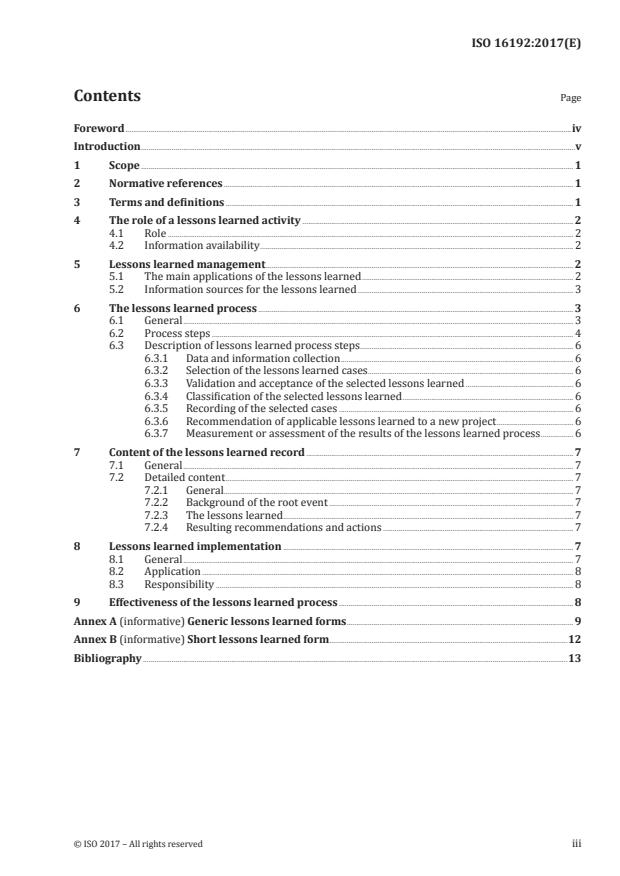
Contents Page
Foreword .iv
Introduction .v
1 Scope . 1
2 Normative references . 1
3 Terms and definitions . 1
4 The role of a lessons learned activity . 2
4.1 Role . 2
4.2 Information availability . 2
5 Lessons learned management . 2
5.1 The main applications of the lessons learned . 2
5.2 Information sources for the lessons learned . 3
6 The lessons learned process . 3
6.1 General . 3
6.2 Process steps . 4
6.3 Description of lessons learned process steps . 6
6.3.1 Data and information collection . 6
6.3.2 Selection of the lessons learned cases . 6
6.3.3 Validation and acceptance of the selected lessons learned . 6
6.3.4 Classification of the selected lessons learned . 6
6.3.5 Recording of the selected cases . 6
6.3.6 Recommendation of applicable lessons learned to a new project . 6
6.3.7 Measurement or assessment of the results of the lessons learned process . 6
7 Content of the lessons learned record . 7
7.1 General . 7
7.2 Detailed content . 7
7.2.1 General. 7
7.2.2 Background of the root event . 7
7.2.3 The lessons learned . 7
7.2.4 Resulting recommendations and actions . 7
8 Lessons learned implementation . 7
8.1 General . 7
8.2 Application . 8
8.3 Responsibility . 8
9 Effectiveness of the lessons learned process . 8
Annex A (informative) Generic lessons learned forms . 9
Annex B (informative) Short lessons learned form .12
Bibliography .13
Foreword
ISO (the International Organization for Standardization) is a worldwide federation of national standards
bodies (ISO member bodies). The work of preparing International Standards is normally carried out
through ISO technical committees. Each member body interested in a subject for which a technical
committee has been established has the right to be represented on that committee. International
organizations, governmental and non-governmental, in liaison with ISO, also take part in the work.
ISO collaborates closely with the International Electrotechnical Commission (IEC) on all matters of
electrotechnical standardization.
The procedures used to develop this document and those intended for its further maintenance are
described in the ISO/IEC Directives, Part 1. In particular the different approval criteria needed for the
different types of ISO documents should be noted. This document was drafted in accordance with the
editorial rules of the ISO/IEC Directives, Part 2 (see www .iso .org/ directives).
Attention is drawn to the possibility that some of the elements of this document may be the subject of
patent rights. ISO shall not be held responsible for identifying any or all such patent rights. Details of
any patent rights identified during the development of the document will be in the Introduction and/or
on the ISO list of patent declarations received (see www .iso .org/ patents).
Any trade name used in this document is information given for the convenience of users and does not
constitute an endorsement.
For an explanation on the voluntary nature of standards, the meaning of ISO specific terms and
expressions related to conformity assessment, as well as information about ISO’s adherence to the
World Trade Organization (WTO) principles in the Technical Barriers to Trade (TBT) see the following
URL: w w w . i s o .org/ iso/ foreword .html.
This document was prepared by Technical Committee ISO/TC 20, Aircraft and space vehicles,
Subcommittee SC 14, Space systems and operations.
This second edition cancels and replaces the first edition (ISO 16192:2010), which has been technically
revised.
The main changes compared to the previous edition are as follows:
— information previously in Clause 2 (role of lessons learned) and Clause 4 (the lessons learned
process) has been reorganised and rewritten to eliminate duplication and inconsistent text; and
— information describing the lessons learned process which was previously in Annex A has been
removed and combined with similar information in Clause 4 to further simplify the text in Clause 4.
iv © ISO 2017 – All rights reserved
Introduction
In order to improve the quality of products and to work efficiently, it is important to consider past
experiences and how the knowledge of those experiences is transmitted. The aim is to decrease errors
(in terms of both quantity and gravity), improve working methods and decrease risks of nonconformity
to specified objectives (management, technical, quality, costs and schedules).
In the process of lessons learned, future space projects or programmes are intended to draw benefit
from past experience, by capturing and communicating knowledge from the past through recording,
classifying and making the information available.
An efficient processing of lessons learned is considered essential for:
— ongoing efficiency and quality improvement inside any organization;
— successful project management.
INTERNATIONAL STANDARD ISO 16192:2017(E)
Space systems — Experience gained in space projects
(lessons learned) — Principles and guidelines
1 Scope
This document outlines lessons learned principles and guidelines that are applicable in all space project
activities (management, technical, quality, cost and schedule).
The application of this document is intended to be included in the supplier quality management system,
but can be tailored in individual contracts as agreed by the customer and supplier, depending on:
— the content of each project (size, technological level and novelty, particular organization,
participants, etc.);
— the interest and usefulness of the related information.
The lessons learned information can result from any situation which might be encountered in similar
contexts for future projects, i.e.:
— undesirable experiences that need to be avoided;
— strategies, rules, principles of design, validation, tests and operations that proved to be successful
or necessary.
This document neither endorses nor recommends the transmission of company proprietary information
to external entities as part of a lessons learned process.
Implementing a formal lessons learned process as outlined in this document makes it possible to
capture and benefit from this information.
The lessons learned activity is an important contribution to the processing of the preventive and
corrective actions specified in ISO 9001 and ISO 17666.
This document also provides lessons learned processes and suggested lessons learned forms.
2 Normative references
There are no normative references in this document.
3 Terms and definitions
No terms and definitions are listed in this document.
ISO and IEC maintain terminological databases for use in standardization at the following addresses:
— IEC Electropedia: available at http:// www .electropedia .org/
— ISO Online browsing platform: available at http:// www .iso .org/ obp
4 The role of a lessons learned activity
4.1 Role
The role of a lessons learned activity is to ensure that projects benefit from the experiences – good and
bad – of previous projects. The main activities involved in the process are:
a) to identify and collect relevant information;
b) to analyse information, classify lessons learned and issue recommendations;
c) to document the process;
d) to make
...
Questions, Comments and Discussion
Ask us and Technical Secretary will try to provide an answer. You can facilitate discussion about the standard in here.
Loading comments...