

ISO 16131:2012
(Main)Leather — Upholstery leather characteristics — Selection of leather for furniture
General Information
- Abstract
ISO 16131:2012 specifies sampling and test methods, and gives recommended values for, upholstery leather for furniture.
- Status
- Published
- Publication Date
- 19-Jan-2012
- Technical Committee
- ISO/TC 120/SC 2 - Tanned leather
- Drafting Committee
- ISO/TC 120/SC 2 - Tanned leather
- Current Stage
- 9092 - International Standard to be revised
- Start Date
- 21-Nov-2025
- Completion Date
- 29-Aug-2026


Overview
ISO 16131:2012 is an international standard developed by the International Organization for Standardization (ISO) that specifies the sampling, test methods, and recommended values for upholstery leather used in furniture. This standard provides essential guidelines for selecting leather based on its physical, chemical, and mechanical characteristics to ensure optimal performance and durability in upholstery applications. It is applicable to different types of upholstery leather including aniline, semi-aniline, and pigmented leathers, offering a framework that supports quality control and consistent product performance.
Key Topics
Leather Characteristics and Performance
ISO 16131:2012 outlines the critical properties for upholstery leather such as colour fastness to rubbing, perspiration, light exposure, as well as pH levels, tear strength, adhesion, and flexing endurance. These characteristics help determine how well the leather will perform under typical use conditions in furniture applications.Sampling and Testing Methods
The standard details the sampling protocols and laboratory test methods in alignment with other referenced ISO standards such as ISO 11640 for colour fastness, ISO 3377-1 for tear strength, ISO 4045 for pH measurement, and ISO 5402-1 for flex resistance testing. Conditioning and preparation of samples are standardized according to ISO 2419 and ISO 4044.Recommended Values by Leather Type
Different recommended values apply to:- Aniline leather: Focus on dry and wet rubbing fastness with minimum values 3 on the grey scale and a pH 3.2.
- Semi-aniline leather: Higher durability with dry rubbing fastness 4 and wet rubbing 3 to 4 on the grey scale.
- Pigmented leather: Highest requirements including flexing endurance of over 50,000 cycles without finish damage and colour fastness to light with a blue scale rating of 5.
Subsidiary Tests and Additional Properties
Additional critical safety and durability tests include ignitability assessments (ISO 8191-1 and ISO 8191-2), cold crack resistance at –15 °C, and resistance to water spotting (ISO 15700). These ensure the leather complies with safety and quality expectations for furniture upholstery.
Applications
Furniture Manufacturing
ISO 16131:2012 is essential for manufacturers who select upholstery leather to ensure materials meet durability, aesthetic, and safety criteria, reducing returns and customer complaints.Quality Control
Laboratories and testing facilities use this standard to perform repeatable and reliable sampling and tests, ensuring batches of leather consistently meet international performance benchmarks.Consumer Guidance and Maintenance
The standard recommends issuing care and maintenance instructions with upholstered furniture products to inform consumers about expected leather performance and proper handling to prolong product life.Regulatory Compliance
Furniture suppliers incorporate this standard to comply with relevant safety and quality regulations across different markets, facilitating international trade.
Related Standards
- ISO 11640: Tests for colour fastness to to-and-fro rubbing
- ISO 3377-1: Determination of tear load for leather
- ISO 4045: pH determination of leather water extracts
- ISO 5402-1: Flex resistance testing with the flexometer method
- ISO 8191-1 and ISO 8191-2: Safety tests for ignitability of upholstered furniture
- ISO 15700: Colour fastness to water spotting
- ISO 105-B02: Colour fastness to artificial light (Xenon arc fading lamp test)
- ISO 2418 and ISO 2419: Sampling location and sample preparation for testing
- ISO 4044: Preparation of chemical test samples
- ISO 2588: Sampling sizes for testing multiple items
Using ISO 16131:2012 in conjunction with these related standards ensures a comprehensive and systematic approach to selecting high-quality upholstery leather for furniture applications, protecting both manufacturers and consumers.
Get Certified
Connect with accredited certification bodies for this standard

Control Union Certifications
Global certification for agriculture and sustainability.

Hohenstein Institut
Textile testing and certification.

Bureau Veritas Bangladesh
Bureau Veritas certification services in Bangladesh.
Sponsored listings
Frequently Asked Questions
ISO 16131:2012 is a standard published by the International Organization for Standardization (ISO). Its full title is "Leather — Upholstery leather characteristics — Selection of leather for furniture". This standard covers: ISO 16131:2012 specifies sampling and test methods, and gives recommended values for, upholstery leather for furniture.
ISO 16131:2012 specifies sampling and test methods, and gives recommended values for, upholstery leather for furniture.
ISO 16131:2012 is classified under the following ICS (International Classification for Standards) categories: 59.140.99 - Other standards related to leather technology; 97.140 - Furniture. The ICS classification helps identify the subject area and facilitates finding related standards.
ISO 16131:2012 is available in PDF format for immediate download after purchase. The document can be added to your cart and obtained through the secure checkout process. Digital delivery ensures instant access to the complete standard document.
Standards Content (Sample)
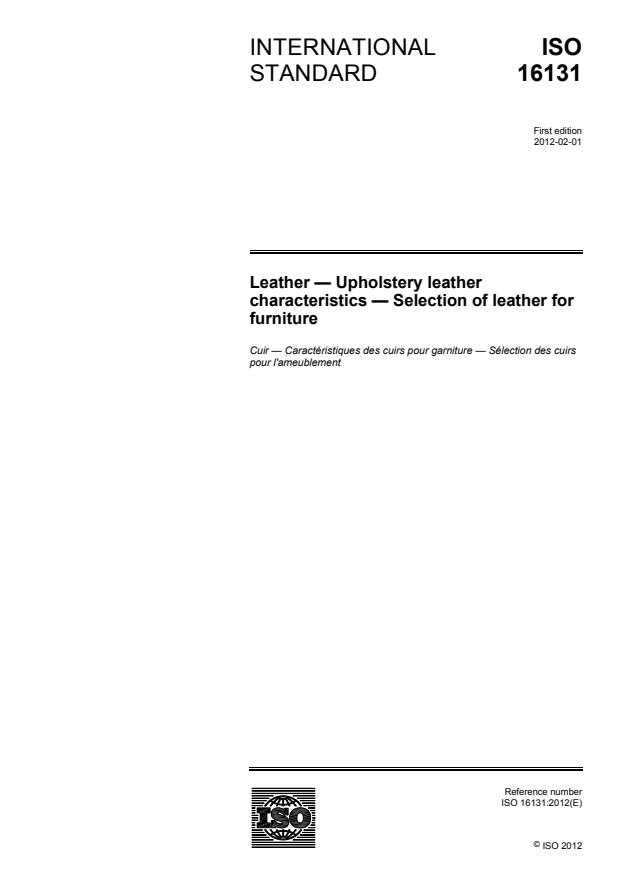
INTERNATIONAL ISO
STANDARD 16131
First edition
2012-02-01
Leather — Upholstery leather
characteristics — Selection of leather for
furniture
Cuir — Caractéristiques des cuirs pour garniture — Sélection des cuirs
pour l'ameublement
Reference number
©
ISO 2012
© ISO 2012
All rights reserved. Unless otherwise specified, no part of this publication may be reproduced or utilized in any form or by any means,
electronic or mechanical, including photocopying and microfilm, without permission in writing from either ISO at the address below or
ISO's member body in the country of the requester.
ISO copyright office
Case postale 56 CH-1211 Geneva 20
Tel. + 41 22 749 01 11
Fax + 41 22 749 09 47
E-mail copyright@iso.org
Web www.iso.org
Published in Switzerland
ii © ISO 2012 – All rights reserved
Foreword
ISO (the International Organization for Standardization) is a worldwide federation of national standards bodies
(ISO member bodies). The work of preparing International Standards is normally carried out through ISO
technical committees. Each member body interested in a subject for which a technical committee has been
established has the right to be represented on that committee. International organizations, governmental and
non-governmental, in liaison with ISO, also take part in the work. ISO collaborates closely with the
International Electrotechnical Commission (IEC) on all matters of electrotechnical standardization.
International Standards are drafted in accordance with the rules given in the ISO/IEC Directives, Part 2.
The main task of technical committees is to prepare International Standards. Draft International Standards
adopted by the technical committees are circulated to the member bodies for voting. Publication as an
International Standard requires approval by at least 75 % of the member bodies casting a vote.
Attention is drawn to the possibility that some of the elements of this document may be the subject of patent
rights. ISO shall not be held responsible for identifying any or all such patent rights.
ISO 16131 was prepared by Technical Committee ISO/TC 120, Leather, Subcommittee SC 2, Tanned leather.
It is based on EN 13336:2004, Leather — Upholstery leather characteristics — Guide for selection of leather
for furniture.
INTERNATIONAL STANDARD ISO 16131:2012(E)
Leather — Upholstery leather characteristics — Selection of
leather for furniture
1 Scope
This International Standard specifies sampling and test methods, and gives recommended values for,
upholstery leather for furniture.
2 Normative references
The following referenced documents are indispensable for the application of this document. For dated
references, only the edition cited applies. For undated references, the latest edition of the referenced
document (including any amendments) applies.
ISO 105-B02, Textiles — Tests for colour fastness — Part B02: Colour fastness to artificial light: Xenon arc
fading lamp test
ISO 2418, Leather — Chemical, physical and mechanical and fastness tests — Sampling location
ISO 2419, Leather — Physical and mechanical tests — Sample preparation and conditioning
ISO 2588, Leather — Sampling — Number of items for a gross sample
ISO 3377-1, Leather — Physical and mechanical tests — Determination of tear load — Part 1: Single
edge tear
ISO 4044, Leather — Chemical tests — Preparation of chemical test samples
ISO 4045, Leather — Chemical tests — Determination of pH
ISO 5402-1, Leather — Determination of flex resistance — Part 1: Flexometer method
ISO 8191-1, Furniture — Assessment of the ignitability of upholstered furniture — Part 1: Ignition source:
smouldering cigarette
ISO 8191-2, Furniture — Assessment of the ignitability of upholstered furniture — Part 2: Ignition source:
match-flame equivalent
ISO 11640, Leather — Tests for colour fastness — Colour fastness to cycles of to-and-fro rubbing
ISO 11641, Leather — Tests for colour fastness — Colour fastness to perspiration
ISO 11644, Leather — Test for adhesion of finish
ISO 15700, Leather — Tests for colour fastness — Colour fastness to water spotting
ISO 17233, Leather — Physical and mechanical tests — Determination of cold crack temperature of surface
coatings
3 General principles
This International Standard considers the performance of different types of leather intended for upholstery.
The characteristics, recommended values, and test methods are specified in Tables A.1, A.2, and A.3.
Subsidiary characteristics are stated in Table A.4.
4 Sampling
4.1 When possible, the location and identification of laboratory samples shall be in accordance with
ISO 2418.
4.2 The number of samples shall
...