

ISO 8930:2021
(Main)General principles on reliability for structures — Vocabulary
General Information
- Abstract
This document establishes the common vocabulary of the principal terms used in the field of reliability of structures and design actions used within ISO TC98 documents on bases for design of structures.
- Status
- Published
- Publication Date
- 06-Jan-2021
- Technical Committee
- ISO/TC 98/SC 1 - Terminology and symbols
- Drafting Committee
- ISO/TC 98/SC 1 - Terminology and symbols
- Current Stage
- 9093 - International Standard confirmed
- Start Date
- 03-Aug-2026
- Completion Date
- 29-Aug-2026
Buy Documents

ISO 8930:2021 - General principles on reliability for structures -- Vocabulary

ISO 8930:2021 - General principles on reliability for structures — Vocabulary/7/2021
Overview
ISO 8930:2021, titled General principles on reliability for structures - Vocabulary, is an international standard published by the International Organization for Standardization (ISO). It establishes a unified and comprehensive vocabulary of essential terms used in the reliability assessment and design of structures. This standard serves as a foundational reference for professionals working within ISO Technical Committee 98 (TC98) related to structural design bases.
The 2021 edition supersedes the 1987 first edition by updating terms to align with the latest developments in structural reliability and incorporating revised definitions from various ISO TC98 documents. ISO 8930:2021 ensures consistency in terminology, enabling clear communication and effective application of reliability concepts in structural engineering practices globally.
Key Topics
ISO 8930:2021 focuses on concepts integral to the reliability of structures and associated design actions, providing precise definitions and explanations for a wide spectrum of terms, including:
Reliability and Structural Safety
The standard clarifies the meaning of reliability as the ability of structures or structural members to fulfill specified safety, serviceability, and durability requirements throughout their service life. It touches on reliability classes, target probabilities of failure, and reliability differentiation for socio-economic optimization.Design Service Life and Maintenance
Definitions include service life, design service life, life cycle maintenance, and related terminology that describe how a structure is expected to perform over time with planned upkeep but without substantial repairs.Assessment, Inspection, and Investigation
Terms related to verifying reliability such as assessment, inspection, and investigation are defined to guide correct interpretation in quality control and condition evaluation processes.Probabilistic and Deterministic Methods
The vocabulary encompasses various calculation methods, including probabilistic methods that treat variables as random, deterministic methods using fixed values, and reliability-based design approaches incorporating partial factors and code calibration.Structural Terms and Components
Precise definitions of components, structural members, systems, and elements like spans, parapets, pipelines, and cultural or heritage structures are included. This helps unify structural engineering language across different contexts.Performance Indicators and Objectives
The standard outlines terms for describing structural performance criteria and objectives, essential for evaluating how a structure meets expected functional and safety demands.Robustness and Damage Insensitivity
Defined concepts cover a structure’s ability to withstand unforeseen events such as fire, explosion or human errors without excessive damage relative to the cause, enhancing resilience considerations in design.
Applications
ISO 8930:2021 is an invaluable resource for:
Structural Engineers and Designers
Facilitates consistent application of reliability principles and terminology in the design of safe, durable, and efficient structures.Standards Development Committees
Ensures harmonized language usage across ISO and related technical documents, improving clarity in regulations and guidelines.Construction and Quality Control Professionals
Supports reliable assessment, inspection, and maintenance practices by providing standardized definitions of key terms.Academia and Research
Provides a solid vocabulary backbone for research and education focused on structural reliability, risk assessment, and sustainable construction.Regulators and Authorities
A reference for adopting uniform standards and enhancing compliance monitoring in the construction sector.
Related Standards
ISO 8930:2021 complements and aligns with numerous other standards, particularly within the ISO TC98 framework, such as:
ISO 2394:2015 – General principles on reliability for structures (provides foundational principles and terminology revised in ISO 8930).
ISO 13822:2010 – Bases for design of structures – Assessment of existing structures (includes heritage structures terminology).
ISO 23469:2005 – Bases for design of structures – Geotechnical design (includes relevant geotechnical terms).
ISO 12491:1997 – Bases for design of structures related to terminology and symbols.
Professionals are encouraged to consult these and related documents to fully understand and apply the vocabulary within the broader context of structural design and reliability methodologies.
Keywords: ISO 8930:2021, structural reliability vocabulary, reliability of structures, design service life, structural safety, ISO TC98, reliability assessment, construction standards, probabilistic design, structural engineering terminology, robustness in structures, structural performance criteria, reliability-based design, structural maintenance.
Relations
- Effective Date
- 12-Aug-2026
- Effective Date
- 10-Jun-2026
- Effective Date
- 10-Jun-2026
- Effective Date
- 09-Sep-2017
Buy Documents
ISO 8930:2021 - General principles on reliability for structures -- Vocabulary
ISO 8930:2021 - General principles on reliability for structures — Vocabulary/7/2021
Get Certified
Connect with accredited certification bodies for this standard

DIBt (Deutsches Institut für Bautechnik)
German Institute for Building Technology.
DIN CERTCO
DIN Group product certification.

Aboma Certification B.V.
Specialized in construction, metal, and transport sectors.
Sponsored listings
Frequently Asked Questions
ISO 8930:2021 is a standard published by the International Organization for Standardization (ISO). Its full title is "General principles on reliability for structures — Vocabulary". This standard covers: This document establishes the common vocabulary of the principal terms used in the field of reliability of structures and design actions used within ISO TC98 documents on bases for design of structures.
This document establishes the common vocabulary of the principal terms used in the field of reliability of structures and design actions used within ISO TC98 documents on bases for design of structures.
ISO 8930:2021 is classified under the following ICS (International Classification for Standards) categories: 01.040.91 - Construction materials and building (Vocabularies); 91.080.01 - Structures of buildings in general. The ICS classification helps identify the subject area and facilitates finding related standards.
ISO 8930:2021 has the following relationships with other standards: It is inter standard links to EN 1993-1-7:2025, EN 1993-1-6:2025, EN 1993-4-1:2026, ISO 8930:1987. Understanding these relationships helps ensure you are using the most current and applicable version of the standard.
ISO 8930:2021 is available in PDF format for immediate download after purchase. The document can be added to your cart and obtained through the secure checkout process. Digital delivery ensures instant access to the complete standard document.
Standards Content (Sample)
INTERNATIONAL ISO
STANDARD 8930
Second edition
2021-01
General principles on reliability for
structures — Vocabulary
Principes généraux de la fiabilité des constructions — Vocabulaire
Reference number
©
ISO 2021
© ISO 2021
All rights reserved. Unless otherwise specified, or required in the context of its implementation, no part of this publication may
be reproduced or utilized otherwise in any form or by any means, electronic or mechanical, including photocopying, or posting
on the internet or an intranet, without prior written permission. Permission can be requested from either ISO at the address
below or ISO’s member body in the country of the requester.
ISO copyright office
CP 401 • Ch. de Blandonnet 8
CH-1214 Vernier, Geneva
Phone: +41 22 749 01 11
Email: copyright@iso.org
Website: www.iso.org
Published in Switzerland
ii © ISO 2021 – All rights reserved
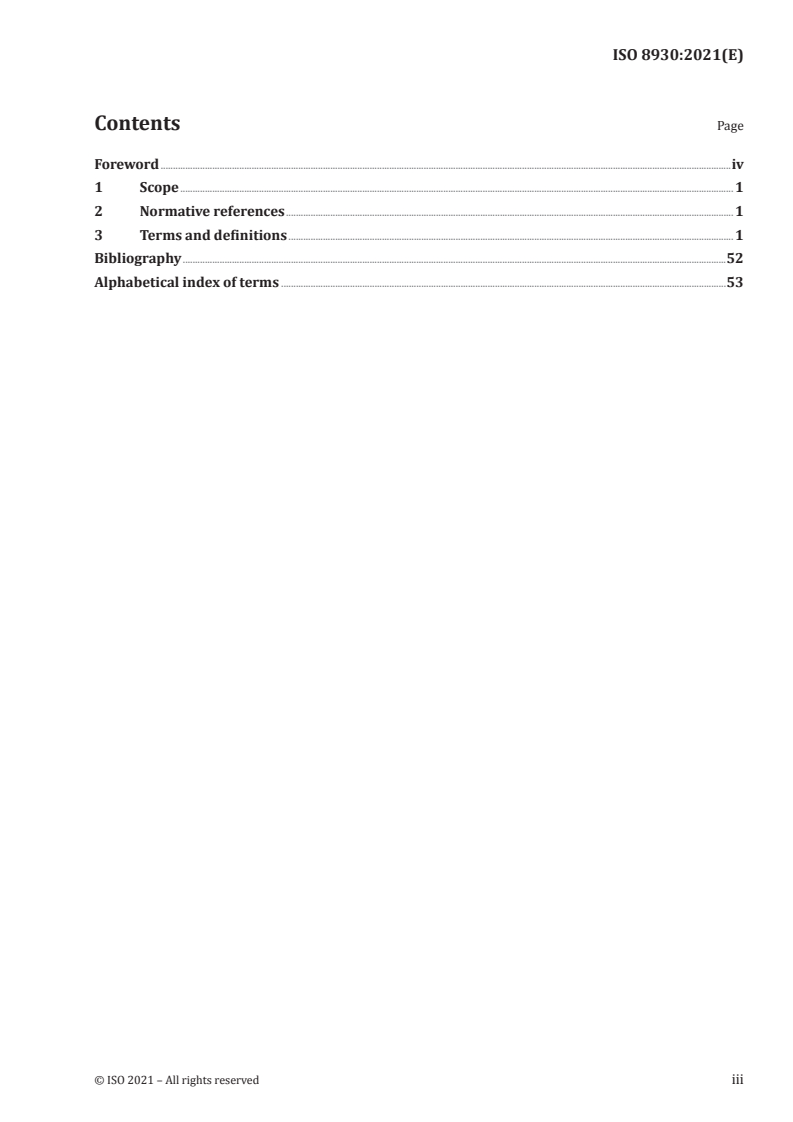
Contents Page
Foreword .iv
1 Scope . 1
2 Normative references . 1
3 Terms and definitions . 1
Bibliography .52
Alphabetical index of terms .53
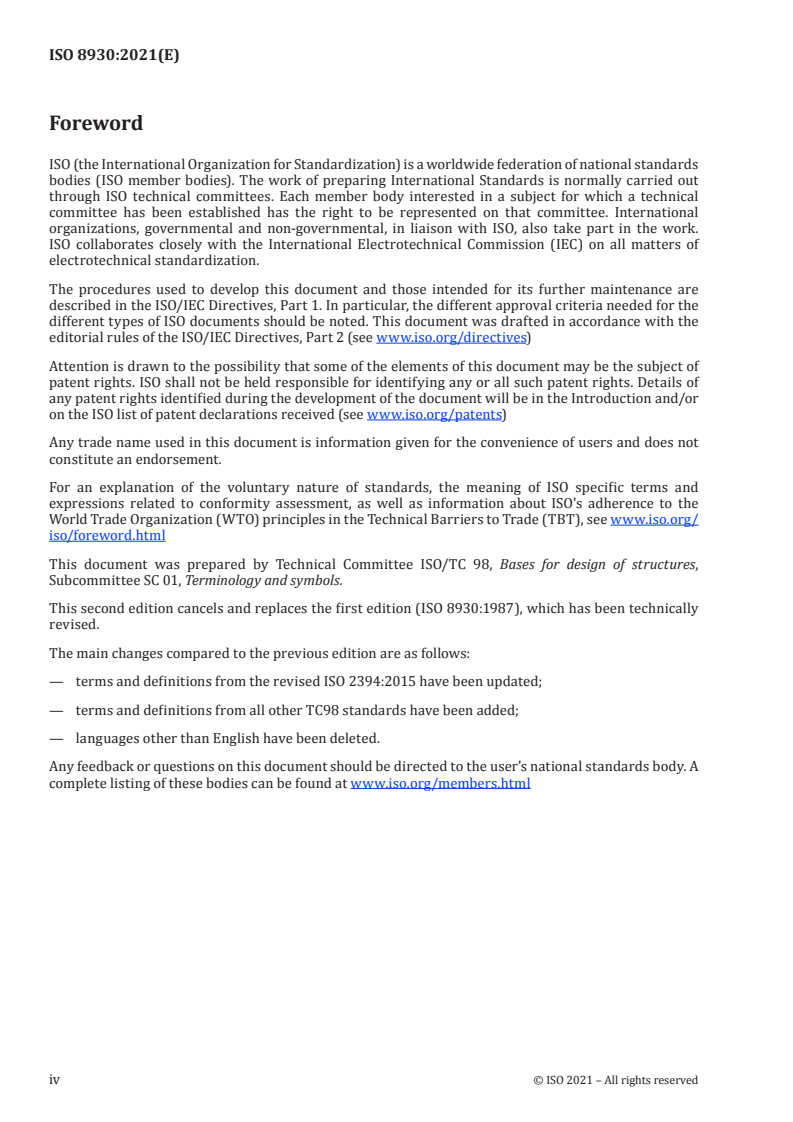
Foreword
ISO (the International Organization for Standardization) is a worldwide federation of national standards
bodies (ISO member bodies). The work of preparing International Standards is normally carried out
through ISO technical committees. Each member body interested in a subject for which a technical
committee has been established has the right to be represented on that committee. International
organizations, governmental and non-governmental, in liaison with ISO, also take part in the work.
ISO collaborates closely with the International Electrotechnical Commission (IEC) on all matters of
electrotechnical standardization.
The procedures used to develop this document and those intended for its further maintenance are
described in the ISO/IEC Directives, Part 1. In particular, the different approval criteria needed for the
different types of ISO documents should be noted. This document was drafted in accordance with the
editorial rules of the ISO/IEC Directives, Part 2 (see www .iso .org/ directives)
Attention is drawn to the possibility that some of the elements of this document may be the subject of
patent rights. ISO shall not be held responsible for identifying any or all such patent rights. Details of
any patent rights identified during the development of the document will be in the Introduction and/or
on the ISO list of patent declarations received (see www .iso .org/ patents)
Any trade name used in this document is information given for the convenience of users and does not
constitute an endorsement.
For an explanation of the voluntary nature of standards, the meaning of ISO specific terms and
expressions related to conformity assessment, as well as information about ISO's adherence to the
World Trade Organization (WTO) principles in the Technical Barriers to Trade (TBT), see www .iso .org/
iso/ foreword .html
This document was prepared by Technical Committee ISO/TC 98, Bases for design of structures,
Subcommittee SC 01, Terminology and symbols.
This second edition cancels and replaces the first edition (ISO 8930:1987), which has been technically
revised.
The main changes compared to the previous edition are as follows:
— terms and definitions from the revised ISO 2394:2015 have been updated;
— terms and definitions from all other TC98 standards have been added;
— languages other than English have been deleted.
Any feedback or questions on this document should be directed to the user’s national standards body. A
complete listing of these bodies can be found at www .iso .org/ members .html
iv © ISO 2021 – All rights reserved
INTERNATIONAL STANDARD ISO 8930:2021(E)
General principles on reliability for structures —
Vocabulary
1 Scope
This document establishes the common vocabulary of the principal terms used in the field of reliability
of structures and design actions used within ISO TC98 documents on bases for design of structures.
2 Normative references
There are no normative references in this document
3 Terms and definitions
ISO and IEC maintain terminological databases for use in standardization at the following addresses:
— IEC Electropedia: available at http:// www .electropedia .org/
— ISO Online browsing platform: available at http:// www .iso .org/ obp
3.1 General
3.1.1
assessment
total set of activities performed in order to verify the reliability (3.2.19) of an existing structure (3.1.31)
[SOURCE: ISO 2394:2015, 2.1.12]
3.1.2
compliance
fulfilment of specified requirements (3.1.23)
[SOURCE: ISO 2394:2015, 2.1.6]
3.1.3
component
part of the structure (3.1.31) and non-structural part that can affect the durability (3.5.2) of the
structure
[SOURCE: ISO 13823:2008, 3.6, modified — "any" has been deleted and "may" has been changed to "can".]
3.1.4
consumer
participant of the building process purchasing a lot (3.10.18) for further procedure or use
[SOURCE: ISO 12491:1997, 3.47, modified — "any" has been deleted.]
3.1.5
cultural resource
structure (3.1.31), building, landscape, archaeological site, or other engineering works, that have been
formally recognized for its heritage value (3.12.7)
[SOURCE: ISO 13822:2010, I.3.3]
3.1.6
design service life
service life (3.1.25) specified in design for which a structure (3.1.31) or a structural member (3.1.30) is
used for its intended purpose with planned maintenance, but without substantial repair (3.1.22) being
necessary
Note 1 to entry: Design service life is also called design working life.
3.1.7
estimation
operation of assigning, from observations on a sample, numerical values to the parameters of a
distribution chosen as the statistical model of the population (3.1.18) from which this sample was taken
[SOURCE: ISO 12491:1997, 3.22]
3.1.8
geotechnical work
work that includes soil or rock (3.1.24) as primary components (3.1.3) with or without structural parts
made of concrete, steel, or other materials
[SOURCE: ISO 23469:2005, 3.24]
3.1.9
heritage structure
existing structure (3.1.31) or structural component (3.1.3) of a heritage resource that has been
recognized by the appropriate authorities for its heritage value (3.12.7)
[SOURCE: ISO 13822:2010, I.3.6]
3.1.10
inspection
on-site examination within the scope of quality control (3.1.20) and condition assessment (3.1.1) aiming
to assess the present condition of a structure (3.1.31)
[SOURCE: ISO 2394:2015, 2.1.17]
3.1.11
investigation
collection and evaluation of information through inspection (3.1.10), document search, load testing
(3.8.3.9) and other testing
[SOURCE: ISO 13822:2010, 3.6]
3.1.12
life cycle
process of life incorporating initiation, project definition, design, construction, commissioning,
operation, maintenance, refurbishment, replacement, deconstruction, and ultimate disposal, recycling,
or re-use of the structure (3.1.31) (or parts thereof), including its components (3.1.3), systems (3.1.32),
and building services
[SOURCE: ISO 2394:2015, 2.1.7]
3.1.13
life cycle maintenance
combination of all technical and associated administrative actions (3.6.1.2) during a component’s (3.1.3)
service life (3.1.24) with the aim of retaining it in a state in which it can perform its required functions
[SOURCE: ISO 13823:2008, 3.15, modified — the term has been changed from "maintenance" to "life
cycle maintenance".]
2 © ISO 2021 – All rights reserved
3.1.14
model
simplified conceptual or mathematical idealization or test set-up simulating the structure environment
(3.5.5), transfer mechanisms (3.5.4), environmental action (3.6.1.8), action effects (3.6.13.1) and
structural behaviour that can lead to failure (3.8.1.1)
[SOURCE: ISO 13823:2008, 3.16]
3.1.15
monitoring
frequent or continuous, normally long-term, observation or measurement of structural conditions or
actions (3.6.1.2) or structural response
[SOURCE: ISO 2394:2015, 2.1.16]
3.1.16
parapet
low wall built along the crest (3.6.7.5) of a seawall
[SOURCE: ISO 21650:2007, 2.44]
3.1.17
pipeline
long tube or a network of tubing used for the transportation of fluid, gas, or solid mixed with fluid or gas
[SOURCE: ISO 23469:2005, 3.40]
3.1.18
population
totality of units under consideration for which the same probabilistic descriptions (mean values, etc.)
are valid
[SOURCE: ISO 2394:2015, 2.1.22, modified — "set of entities" has been changed to " totality of units".]
3.1.19
producer
participant of the building process supplying a lot (3.10.18) for further procedure or use
[SOURCE: ISO 12491:1997, 3.46, modified — "any" has been deleted.]
3.1.20
quality control
activities to control quality of design, execution, use, and decommissioning of a structure (3.1.31)
[SOURCE: ISO 2394:2015, 2.1.28]
3.1.21
rehabilitation
repairing (3.1.22) or upgrading of an existing structure (3.1.31)
[SOURCE: ISO 2394:2015, 2.1.15]
3.1.22
repair
restoring the condition of a structure (3.1.31) that has been damaged or deteriorated
[SOURCE: ISO 2394:2015, 2.1.14, modified — "(of a structure)" has been delete from the term.]
3.1.23
requirement
demand with respect to structural aspects like safety for people and environment, functionality, usage,
and commitment of resources and cost efficiency
[SOURCE: ISO 2394:2015, 2.1.5]
3.1.24
rock
aggregate of one or more minerals
[SOURCE: ISO 21650:2007, 2.57]
3.1.25
service life
actual period of time during which a structure (3.1.31) or any of its components (3.1.3) satisfy the design
performance requirements (3.1.23) without unforeseen major repair (3.1.22)
Note 1 to entry: Service life is also called working life.
[SOURCE: ISO 13823:2008, 3.21]
3.1.26
span
effective span of horizontal or inclined members assuming conditions of simple support which is the
overhang for cantilevers and the shorter span for two-way spanning slabs
[SOURCE: ISO 4356:1977, B.11, modified — the definition has been slightly reworked editorially.]
3.1.27
stone
quarried or artificially broken rock (3.1.24) for use in construction, either as an aggregate or cut into
shaped blocks as dimension stone
[SOURCE: ISO 21650:2007, 2.70]
3.1.28
storey height
vertical distance between the points of support of horizontal supporting members at successive
floor levels
[SOURCE: ISO 4356:1977, B.12]
3.1.29
structural engineering context
background or reasons why the risk (3.11.17) assessment (3.1.1) is implemented from structural
perspectives
[SOURCE: ISO 13824:2020, 3.19]
3.1.30
structural member
physically distinguishable part of a structure (3.1.31), e.g. column, beam, plate, foundation
[SOURCE: ISO 2394:2015, 2.1.2]
3.1.31
structure
arrangement of materials that is expected to withstand certain actions (3.6.1.2) and to perform some
intended function
[SOURCE: ISO 13824:2009, 3.21]
4 © ISO 2021 – All rights reserved
3.1.32
system
bounded group of interrelated, interdependent, or interacting members forming an entity that achieves
a defined objective in its environment through interaction of its parts and interactions of its parts with
the environment
[SOURCE: ISO 2394:2015, 2.1.3]
3.1.33
unit
defined quantity of building material, component (3.1.3) or element of a building or other civil
engineering work that can be individually considered and separately tested
[SOURCE: ISO 12491:1997, 3.3]
3.1.34
upgrading
modifications of an existing structure (3.1.31), construction works, and procedures to improve its
structural performance (3.8.3.21) or facilitate its use for new purposes
[SOURCE: ISO 2394:2015, 2.1.13]
3.1.35
utilization plan
plan containing the intended use (or uses) of the structure (3.1.31) and listing the operational conditions
of the structure including maintenance requirements (3.1.23) and the corresponding performance
requirements
[SOURCE: ISO 2394:2015, 2.1.44]
3.2 Reliability of structures
3.2.1
alternate load path
ALP
alternative for a load to be transferred from a point of application to a point of resistance (3.8.1.6)
[SOURCE: ISO 2394:2015, 2.2.33]
3.2.2
characteristic value
value of a parameter (either an action (3.6.1.2), or a property of a member or a material) that has a
specified probability of not being exceeded
[SOURCE: ISO 4356:1977, B.3, modified — "transcended unfavourably" has been changed to "exceeded".]
3.2.3
code calibration
determination of the reliability elements (3.2.22) in a given code format in order to reach the reliability
target (3.2.24)
[SOURCE: ISO 2394:2015, 2.2.36]
3.2.4
design value
value used in semi-probabilistic methods obtained by modifying the characteristic value by a partial
factor or, in special circumstances, by direct assessment
3.2.5
deterministic method
calculation method in which the basic variables (3.8.3.2) are treated as non-random
3.2.6
ductility
ability to deform beyond the elastic limit under cyclic loadings without significant reduction in strength
or energy absorption capacity
[SOURCE: ISO 3010:2017, 3.3]
3.2.7
exposure event
event which can cause damage (3.11.5) or otherwise affect the performance indicators (3.2.15) for the
structure (3.1.31)
[SOURCE: ISO 2394:2015, 2.1.11, modified — "may" has been changed to "can".]
3.2.8
environmental influence
physical, chemical, or biological influences which can deteriorate the materials constituting a structure
(3.1.31), which in turn can affect its serviceability (3.4.10) and safety in an unfavourable way
[SOURCE: ISO 2394:2015, 2.3.18, modified — "may" has been changed to "can".]
3.2.9
first order reliability method / second order reliability method
FORM / SORM
numerical methods used for the determination of the reliability (3.2.19) index β
[SOURCE: ISO 2394:2015, 2.2.28, modified — the term has been changed from "First/Second Order
Reliability Methods" to "first order reliability method / second order reliability method".]
3.2.10
key element
structural member (3.1.30) upon which the ultimate limit state (3.4.12) performance of the structure
(3.1.31) depends
[SOURCE: ISO 2394:2015, 2.2.35]
3.2.11
member reliability
reliability (3.2.19) of a single structural member (3.1.30) which has one single dominating failure mode
(3.8.1.2)
[SOURCE: ISO 2394:2015, 2.1.20]
3.2.12
nominal value
value fixed on a non-statistical basis, for instance, on acquired experience or on physical constraints
[SOURCE: ISO 2394:2015, 2.2.32]
3.2.13
partial factor format
calculation format in which allowance is made for the uncertainties and variabilities assigned to the
basic variables (3.8.3.2) by means of representative values, partial factors and, if relevant, additive
quantities
[SOURCE: ISO 22111:2007, 3.19]
6 © ISO 2021 – All rights reserved
3.2.14
performance criteria
set of conditions for specifying the response of a structural system (3.8.3.22) to meet the expected
state defined by engineering parameters, such as acceptable displacements, strains or stresses, that
characterize the performance objectives (3.2.16) of design
[SOURCE: ISO 23469:2005, 3.37, modified — "geotechnical work" has been changed to "structural
system".]
3.2.15
performance indicator
parameter describing a certain property of the structure (3.1.31) or a certain characteristic of the
structural behaviour
[SOURCE: ISO 2394:2015, 2.1.25]
3.2.16
performance objective
expression of the expected performance of a facility in order to fulfil its purposes and functions
[SOURCE: ISO 23469:2005, 3.38]
3.2.17
permissible stress method
calculation method in which the stresses occurring under the expected maximum loads are compared
with some fraction of the resistance (3.8.1.6) of the materials
Note 1 to entry: Also called allowable stress method.
3.2.18
probabilistic method
verification methods in which the relevant basic variables (3.8.3.2) are treated as random variables,
random processes, and random fields, discrete or continuous
[SOURCE: ISO 2394:2015, 2.2.21]
3.2.19
reliability
ability of a structure (3.1.31) or structural member (3.1.30) to fulfil the specified requirements (3.1.23),
during the service life (3.1.25), for which it has been designed
Note 1 to entry: Reliability is often expressed in terms of probability.
Note 2 to entry: Reliability covers safety, serviceability (3.4.10) and durability (3.5.2) of a structure.
[SOURCE: ISO 2394:2015, 2.1.8]
3.2.20
reliability class
class of structures (3.1.31) or structural members (3.1.30) for which a particular specified degree of
reliability (3.2.19) is required
[SOURCE: ISO 2394:2015, 2.1.35]
3.2.21
reliability differentiation
socio-economic optimization of the resources to be used to build construction works, taking into
account all the expected consequences of failures (3.8.1.1) and the cost of the construction
[SOURCE: ISO 2394:2015, 2.1.36]
3.2.22
reliability elements
numerical quantities used in the partial factors format, by which the specified target reliability (3.2.19)
is assumed to be reached
[SOURCE: ISO 2394:2015, 2.2.29, modified — Note 1 to entry has been deleted.]
3.2.23
reliability-based design
design procedure that is subjected to prescribed reliability (3.2.19) level of the structure (3.1.31)
[SOURCE: ISO 2394:2015, 2.1.19]
3.2.24
reliability target
specified average acceptable failure (3.8.1.1) probability that is to be reached as close as possible
[SOURCE: ISO 2394:2015, 2.1.45, modified — Note 1 to entry has been deleted.]
3.2.25
robustness
damage (3.11.5) insensitivity or ability of a structure (3.1.31) to withstand adverse and unforeseen
events (like fire, explosion, impact) or consequences of human errors without being damaged to an
extent disproportionate to the original cause
[SOURCE: ISO 2394:2015, 2.1.46, modified — “ability of a structure…” is modified to “damage
insensitivity or ability of a structure …”.]
3.2.26
sampling inspection
inspection (3.1.10) in which decisions are made to accept or not accept a lot (3.10.18), based on results of
a sample selected from that lot
[SOURCE: ISO 12491:1997, 3.41]
3.2.27
scenario
qualitative description of a series of events in time and space and their inter-relationship given the
occurrence of a hazard (3.11.8)
[SOURCE: ISO 13824:2009, 3.18]
3.2.28
site load
load applied provisionally to the structure (3.1.31) during construction
3.2.29
system reliability
reliability (3.2.19) of a system (3.1.32) of more than one relevant structural member (3.1.30) or a
structural member which has more than one relevant failure mode (3.8.1.2) end
[SOURCE: ISO 2394:2015, 2.1.21, modified — "end" added at the end of the definition.]
3.2.30
target reliability level
level of reliability (3.2.19) required to ensure acceptable safety and serviceability (3.4.10)
[SOURCE: ISO 13822:2010, 3.17]
3.3 Design situations
8 © ISO 2021 – All rights reserved
3.3.1
accidental design situation
accidental situation
design situation involving possible exceptional conditions for the structure (3.1.31) in use or exposure,
including flooding, fire, explosion, impact, mal-operation of systems (3.1.32), or local failure (3.8.1.1)
[SOURCE: ISO 2394:2015, 2.2.4, modified — second term has been added.]
3.3.2
design situation
assessment situation
set of physical conditions representing a certain time interval for which it shall be demonstrated that
relevant limit states (3.4.1) are not exceeded
[SOURCE: ISO 2394:2015, 2.2.1, modified — second term has been added.]
3.3.3
level of verification
level of the verification used to assess the compliance (3.1.2) with the objectives for all design
situations (3.3.2)
[SOURCE: ISO 2394:2015, 2.2.27, modified — Note 1 to entry has been deleted.]
3.3.4
persistent design situation
normal condition of use for the structure (3.1.31)
[SOURCE: ISO 2394:2015, 2.2.2]
3.3.5
seismic design situation
design situation (3.3.2) involving the exceptional conditions when the structure (3.1.31) is subjected to
a seismic event
[SOURCE: ISO 2394:2015, 2.2.5]
3.3.6
structural safety
ability (of a structure or structural member (3.1.30)) to avoid exceedance of ultimate limit states (3.4.12),
including the effects of specified accidental phenomena, with a specified level of reliability (3.2.19),
during a specified period of time
[SOURCE: ISO 2394:2015, 2.1.9]
3.3.7
transient design situation
transient situation
provisional condition of use or exposure for the structure (3.1.31), for example, during its construction
or repair (3.1.22), representing a time period much shorter than the design service life (3.1.6)
[SOURCE: ISO 2394:2015, 2.2.3, modified — second term has been added.]
3.4 Limit states
3.4.1
limit state
states beyond which a structure (3.1.31) no longer satisfies the design requirements (3.1.23)
[SOURCE: ISO 2394:2015, 2.2.7]
3.4.2
limit state method
calculation method in which an attempt is made to prevent the structure (3.1.31) attaining certain limit
states (3.4.1)
Note 1 to entry: The allowable stresses method is sometimes used with the same meaning.
3.4.3
condition limit state
well-defined and controllable limit state (3.4.1) without direct negative consequences, which is often an
approximation to a real limit state that cannot be well defined or is difficult to calculate
[SOURCE: ISO 2394:2015, 2.2.13, modified — Note 1 to entry has been deleted.]
3.4.4
initiation limit state
state that corresponds to the initiation of significant deterioration (3.12.3) of a component (3.1.3) of the
structure (3.1.31)
Note 1 to entry: Initiation limit state (3.4.1) is one of the examples of condition limit state (3.4.3).
[SOURCE: ISO 13823:2008, 3.13, modified — second term has been deleted and Note 1 to entry has been
completely changed.]
3.4.5
irreversible limit state
limit state (3.4.1) which will remain permanently exceeded when the actions (3.6.1.2) which caused the
exceedance are no longer present
[SOURCE: ISO 2394:2015, 2.2.11]
3.4.6
limit state function
function gX(,XX,., ) of the basic variables (3.8.3.2), which characterizes a limit state (3.4.1) when
12 n
gX(,XX,., )=0 , and also indicates that a structure (3.1.31) is in favourable state when
12 n
gX(,XX,., ) >0, and unfavourable state when gX(,XX,., ) <0
12 n 12 n
3.4.7
reversible limit states
limit states (3.4.1) which will not be exceeded when the actions (3.6.1.2) which caused the exceedance
are no longer present
[SOURCE: ISO 2394:2015, 2.2.12]
3.4.8
threshold
limit value, which can be a function of time, beyond which a structure (3.1.31) or a structural component
(3.1.3) is in an unfavourable state
[SOURCE: ISO 13822:2010, E.2.4]
3.4.9
strength
ability of a cross-section or an element of a structure (3.1.31) to withstand actions (3.6.1.2) without
mechanical failure (3.8.1.1)
[SOURCE: ISO 22111:2007, 3.26]
10 © ISO 2021 – All rights reserved
3.4.10
serviceability
ability of a structure (3.1.31) or structural member (3.1.30) to perform adequately for a normal use
under all expected actions (3.6.1.2)
[SOURCE: ISO 2394:2015, 2.1.32]
3.4.11
serviceability limit state
limit state (3.4.1) concerning the criteria governing the functionalities related to normal use
[SOURCE: ISO 2394:2015, 2.2.10]
3.4.12
ultimate limit state
limit states (3.4.1) concerning the maximum load-bearing capacity or deformation
[SOURCE: ISO 2394:2015, 2.2.8, modified — "or deformation" has been added to the definition.]
3.5 Durability
3.5.1
degradation
material deterioration (3.12.3) or deformation that leads to adverse changes in a critical property of a
component (3.1.3)
[SOURCE: ISO 13823:2008, 3.7]
3.5.2
durability
capability of a structure (3.1.31) or any structural member (3.1.30) to satisfy with planned maintenance
the design performance requirements (3.1.23) over a specified period of time under the influence of the
environmental actions (3.6.1.8)
[SOURCE: ISO 2394:2015, 2.1.10]
3.5.3
predicted service life
service life (3.1.24) estimated from recorded performance, previous experience, tests or modelling
[SOURCE: ISO 13823:2008, 3.18]
3.5.4
transfer mechanism
mechanism by which influences in the structure environment (3.5.5) are, over time, transferred into
agents (3.9.1) on and within components (3.1.3) or prevent such transfer
[SOURCE: ISO 13823:2008, 3.24]
3.5.5
structure environment
external or internal influences (e.g. rain, de- icing salts, UV, humidity) on a structure (3.1.31) that can
lead to an environmental action (3.6.1.8)
[SOURCE: ISO 13823:2008, 3.23]
3.5.6
sustainability
state of the global system (3.1.32), including environmental, social and economic aspects, in which
the needs of the present are met without compromising the ability of future generations to meet their
own needs
Note 1 to entry: The environmental, social, and economic aspects interact, are interdependent and are often
referred to as the three dimensions of sustainability.
Note 2 to entry: Sustainability is the goal of sustainable development.
[SOURCE: ISO Guide 82:2019, 3.1]
3.6 Actions
3.6.1 Types of loads and actions
3.6.1.1
accidental action
action which is unlikely to occur with a significant value during the design service life (3.1.6) of the
structure (3.1.31)
[SOURCE: ISO 2394:2015, 2.3.5]
3.6.1.2
action
external load applied to the structure (3.1.31) [direct action (3.6.1.6)] or an imposed deformation or
acceleration (indirect action (3.6.1.14))
EXAMPLE An imposed deformation can be caused by fabrication tolerances, differential settlement (3.8.3.5),
temperature change or moisture variation.
[SOURCE: ISO 19900:2019, 3.3, modified — the second line of the examples has been deleted.]
3.6.1.3
action model
model (3.1.14) describing the magnitude, position, direction, duration, etc. of the action (3.6.1.2)
[SOURCE: ISO 2394:2015, 2.3.22, modified — Note 1 to entry has been deleted.]
3.6.1.4
bounded action
action (3.6.1.2) that has a limiting value which cannot be exceeded, and which is exactly or
approximately known
[SOURCE: ISO 2394:2015, 2.3.10]
3.6.1.5
combination value
value determined in such a way that the probability of action (3.6.1.2) effect caused by several
combination values being exceeded is approximately the same as the probability of the design value
(3.2.4) being exceeded by a single action (3.6.1.24)
[SOURCE: ISO 2394:2015, 2.3.21]
3.6.1.6
direct action
set of concentrated or distributed forces acting on the structure (3.1.31)
[SOURCE: ISO 22111:2007, 3.8]
12 © ISO 2021 – All rights reserved
3.6.1.7
dynamic action
action (3.6.1.2) that can cause significant acceleration of the structure (3.1.31) or structural members
(3.1.30)
[SOURCE: ISO 2394:2015, 2.3.8, modified — "may" has been changed to "can".]
3.6.1.8
environmental action
chemical, electrochemical, biological, physical and/or mechanical action (3.6.1.2) causing material
degradation (3.5.1) of a component (3.1.3)
[SOURCE: ISO 13823:2008, 3.11c.]
3.6.1.9
final value
value of certain actions (3.6.1.2) [e.g. shrinkage, prestressing (3.9.10)] or other properties relating to the
performance of the structure (3.1.31) (e.g. creep, strength of concrete) at different dates
3.6.1.10
fixed action
action (3.6.1.2) which has a fixed distribution on a structure (3.1.31) such as its magnitude and direction
are determined unambiguously for the whole structure when determined at one point of the structure
[SOURCE: ISO 2394:2015, 2.3.6]
3.6.1.11
free action
action (3.6.1.2) that can have an arbitrary spatial distribution over the structure (3.1.31) within
certain limits
[SOURCE: ISO 2394:2015, 2.3.7, modified — "may" has been changed to "can".]
3.6.1.12
frequent value
value determined in such a way that either the total time, within a chosen period, during which it is
exceeded is only a given small part of the chosen period of time or the frequency of its exceedance is
limited to a given value
[SOURCE: ISO 2394:2015, 2.3.23, modified — Note 1 to entry has been deleted.]
3.6.1.13
geotechnical action
action (3.6.1.2) transmitted to the structure (3.1.31) by the ground, fill, or groundwater
[SOURCE: ISO 2394:2015, 2.3.14]
3.6.1.14
indirect action
set of deformations or accelerations imposed on a structure (3.1.31) or constrained within it
3.6.1.15
load characteristic
qualitative and quantitative description of load intensity, which can vary in time, such as the duration,
interval, and occurrence rate of the load events and their intensity at any point in time
[SOURCE: ISO 13822:2010, E.2.1]
3.6.1.16
long-term temporary action
action (3.6.1.2) that occurs either for relatively long periods of time or for short periods of time that are
repeated quite frequently over a long period
[SOURCE: ISO 4356:1977, B.7, modified — "(ISO/DIS 2945)" has been deleted.]
3.6.1.17
long-term value
value of certain actions (3.6.1.2) [e.g. shrinkage, prestressing (3.9.10)] or other properties relating to the
performance of the structure (3.1.31) (e.g. creep, strength of concrete) at different dates
3.6.1.18
permanent action
action (3.6.1.2) which is likely to act continuously throughout the design service life (3.1.6) and for which
variations in magnitude with time are small compared with the mean value
[SOURCE: ISO 2394:2015, 2.3.3]
3.6.1.19
quasi-permanent value
value determined in such a way that the total time, within a chosen period, during which it is exceeded
is of the magnitude half the period
[SOURCE: ISO 2394:2015, 2.3.24]
3.6.1.20
representative value of an action
one of the following quantities of an action (3.6.1.2): the characteristic value (3.2.2), nominal value
(3.2.12), combination value (3.6.1.5), frequent value (3.6.1.12), and quasi-permanent value (3.6.1.19)
[SOURCE: ISO 2394:2015, 2.3.20]
3.6.1.21
seismic action
action (3.6.1.2) caused by earthquake ground motions
[SOURCE: ISO 2394:2015, 2.3.15]
3.6.1.22
shock
dynamic action (3.6.1.7) with a duration that is short compared to the natural period of the receiver
(3.6.6.15)
[SOURCE: ISO 10137:2007, 3.18]
3.6.1.23
short-term value
value of certain actions (3.6.1.2) [e.g. shrinkage, prestressing (3.9.10)] or other properties relating to the
performance of the structure (3.1.31) [e.g. creep, strength of concrete] at different dates
3.6.1.24
single action
action (3.6.1.2) which can be assumed to be independent in time and space of any other action acting on
the structure (3.1.31)
[SOURCE: ISO 2394:2015, 2.3.2]
14 © ISO 2021 – All rights reserved
3.6.1.25
slamming action
action (3.6.1.2) when a water surface and a structure (3.1.31) suddenly collide
[SOURCE: ISO 21650:2007, 2.68]
3.6.1.26
sliding soil mass
portion of a geotechnical work (3.1.8), typically defined as that part of the soil or rock (3.1.24) expected
to slide along a failure (3.8.1.1) surface
[SOURCE: ISO 23469:2005, 3.58]
3.6.1.27
static action
action (3.6.1.2) that will not cause significant acceleration of the structure (3.1.31) or structural members
[SOURCE: ISO 2394:2015, 2.3.9]
3.6.1.28
sustained action
action (3.6.1.2) that is applied over long period of time and that can be considered as practically constant
3.6.1.29
temporary action
action (3.6.1.2) that occurs only at certain times during the construction or existence of the structure
(3.1.31), or the value of which cannot be considered as practically constant
[SOURCE: ISO 4356:1977, B.6, modified — "(ISO/DIS 2945)" has been deleted.]
3.6.1.30
tsunami
long waves with the period of several minutes to one hour and the height up to a few tens of metres,
which are generated by the vertical movement of sea floor associated with a submarine earthquake, by
plunging of large mass of earth into water by landslide
[SOURCE: ISO 21650:2007, 2.76, modified — "or volcanic eruption, and other causes" has been deleted.]
3.6.1.31
unbalanced force
force originating from unbalance of a rotating mass at the source
[SOURCE: ISO 10137:2007, 3.26]
3.6.2 Permanent action
3.6.2.1
self-weight
load on a structure (3.1.31) imposed by its own weight
Note 1 to entry: Self-weight is directly influenced by the material density of the structure.
Note 2 to entry: Avoid the expression “dead load” on account of its ambiguity.
3.6.2.2
earth pressure
pressure from soil on a wall or an embedded portion of a structure (3.1.31)
[SOURCE: ISO 23469:2005, 3.11]
3.6.3 Variable actions
3.6.3.1
imposed floor load
load, being a temporary action (3.6.1.29), assumed to be produced by the function and use of the building
Note 1 to entry: Imposed floor loads in production buildings and warehouses consist of: forces, including their
dynamic effects, if any, due to manufacturing equipment; stationary plant and suspended manufacturing
equipment; industrial pipelines (3.1.17); forces, including their dynamic effects, if any, due to handling equipment:
fixed handling equipment (conveyors, elevators, rollers, etc.);mobile handling equipment (trucks, cars, overhead
cranes, etc.); forces due to staircases, ramps and access gangways, including mobile building parts (for example
partition walls); forces due to heating, ventilating and similar service equipment and associated equipment;
forces dues to materials and products, as well as waste products and loads due to animals that are production
subjects; forces due to erection loads; forces due to seismic loads; forces due to wind loads; forces due to
temperature changes and thermal movement; loads due to people (operational staff, probable visitors); forces of
an unusual nature (for example forces resulting from the failure (3.8.1.1) of hoppers or mechanical equipment).
[SOURCE: ISO 2633:1974, 0000, modified — the definition has been split into a definition and a note.]
3.6.3.2
imposed load
load resulting from occupancy in buildings
Note 1 to entry: Avoid the expression “live load” on account of its ambiguity.
[SOURCE: ISO 2394:2015, 2.3.16, modified — Note 1 to entry has been added.]
3.6.3.3
site-specific
characterization of conditions specific to a site
[SOURCE: ISO 23469:2005, 3.57]
3.6.3.4
variable action
action (3.6.1.2) which is likely to act during a given design service life (3.1.6) and for which the variation
in magnitude with time is neither negligible nor monotonic
[SOURCE: ISO 2394:2015, 2.3.4]
3.6.4 Wind actions
3.6.4.1
drag coefficient
shape factor for an object to be used for the calculation of wind forces in the along-wind
direction
[SOURCE: ISO 12494:2017, 3.2]
3.6.5 Snow and ice actions
3.6.5.1
accretion
process of building up ice on the surface of an object, resulting in the different types of icing on
structures (3.1.31)
[SOURCE: ISO 12494:2017, 3.1]
3.6.5.2
glaze
clear, high-density ice
[SOURCE: ISO 12494:2017, 3.3]
16 © ISO 2021 – All rights reserved
3.6.5.3
ice collector
IC
classification of the characteristic ice load that is expected to occur within a mean return period
(3.10.31) of 50 years on a reference ice collector situated in a particular location
[SOURCE: ISO 12494:2017, 3.5, modified — the first term has been changed from "ice class" to "ice
collector".]
3.6.5.4
ice action
effect of accreted ice on a structure (3.1.31), both as gravity load (= self-weight of ice) and as wind action
(3.6.1.2) on the iced structure
[SOURCE: ISO 12494:2017, 3.4]
3.6.5.5
in-cloud icing
icing due to super-cooled water droplets in a cloud or fog
[SOURCE: ISO 12494:2017, 3.6]
3.6.5.6
precipitation icing
icing due to either
a) freezing rain or drizzle, or
b) accumulation of wet snow
[SOURCE: ISO 12494:2017, 3.7]
3.6.5.7
rime
white ice with in-trapped air
[SOURCE: ISO 12494:2017, 3.9]
3.6.6 Dynamic actions
3.6.6.1
amplification
increase of vibration amplitudes relative to a reference amplitude
[SOURCE: ISO 10137:2007, 3.1]
3.6.6.2
attenuation
loss of vibration energy along a transmission path (3.10.45)
[SOURCE: ISO 10137:2007, 3.2]
3.6.6.3
broadband spectrum
spectrum (3.10.39) with the vibration distributed over broad frequency bands [e.g. octave-band
spectrum (3.8.3.15), one-third-octave band spectrum]
[SOURCE: ISO 10137:2007, 3.3]
3.6.6.4
damping
dissipation of energy in a vibrating system (3.1.32)
[SOURCE: ISO 10137:2007, 3.4]
3.6.6.5
geometric spreading
decay of vibration amplitudes with increasing distance from the source as the energy is spread over a
larger volume
[SOURCE: ISO 10137:2007, 3.10]
3.6.6.6
narrow-band spectrum
spectrum (3.10.39) with the vibration concentrated in a narrow frequency band
[SOURCE: ISO 10137:2007, 3.13, modified — "narrow frequency bands" has been changed to "a narrow
frequency band".]
3.6.6.7
response spectrum
maximum responses of a series of single degree-of-freedom systems (3.1.32) subjected to a given
dynamic base motion, plotted as a function of natural frequencies for specific values of damping (3.6.6.4)
[SOURCE: ISO 10137:2007, 3.17]
3.6.6.8
shock spectrum
response spectrum (3.6.6.7) for a shock (3.6.1.22) motion
[SOURCE: ISO 10137:2007, 3.19]
3.6.6.9
sustained vibration
vibration having a duration of many periods
[SOURCE: ISO 10137:2007, 3.22]
3.6.6.10
vortex induced vibration
vibration induced by vortexes shed alternatively from either side of a cylinder in a current and/or waves
[SOURCE: ISO 21650:2007, 2.78, modified — the second term "VIV" has been deleted.]
3.6.6.11
impulsive source
source which gives a dynamic action (3.6.1.7) of a short duration compared with the natural period of
the structure (3.1.31) under consideration
[SOURCE: ISO 10137:2007, 3.11]
3.6.6.12
inertia coefficient
coefficient used in the Morison equation to determine the inertia force
[SOURCE: ISO 21650:2007, 2.32]
3.6.6.13
mode of vibration
deflected shape at a particular natural frequency (3.6.6.14) of a system (3.1.32) undergoing free vibration
[SOURCE: ISO 10137:2007, 3.12]
18 © ISO 2021 – All rights reserved
3.6.6.14
natural frequency
frequency at which a mode of vibration (3.6.6.13) will oscillate under free vibrations
[SOURCE: ISO 10137:2007, 3.14]
3.6.6.15
receiver
person, structure (3.1.31) or contents of a building subjected to vibrations
[SOURCE: ISO 10137:2007, 3.16]
3.6.7 Seismic actions
3.6.7.1
array observation
simultaneous recording of earthquake ground motions and/or microtremors by an array of
seismometers
[SOURCE: ISO 23469:2005, 3.1]
3.6.7.2
basin effect
effects on earthquake ground motions caused by the presence of a basin-like geometrical boundary
beneath the site
[SOURCE: ISO 23469:2005, 3.2, modified — Note has been deleted.]
3.6.7.3
coherency function
function describing a degree of correlation between two time histories
[SOURCE: ISO 23469:2005, 3.3]
3.6.7.4
complete quadratic combination
CQC
method to evaluate the maximum response of a structure (3.1.31) by the quadratic combination of
modal response values
[SOURCE: ISO 3010:2017, 3.2]
3.6.7.5
crest
top of a geotechnical structure (3.1.31) typically defined for embankments and dams
[SOURCE: ISO 23469:2005, 3.4]
3.6.7.6
culvert
tunnel-like structure (3.1.31) constructed typically in embankments or ground forming a passage or
allowing drainage under a road or railroad
[SOURCE: ISO 23469:2005, 3.5]
3.6.7.7
deep foundation
foundation having a large depth to width ratio, which transfers applied loads to deep soil deposits
[SOURCE: ISO 23469:2005, 3.7, modified — EXAMPLES has been deleted.]
3.6.7.8
deterministic seismic hazard analysis
seismic hazard analysis (3.11.29) based on the selection of individual earthquake scenarios (3.2.27)
[SOURCE: ISO 23469:2005, 3.9]
3.6.7.9
earth structure
geotechnical work (3.1.8) consisting primarily of soil or rock (3.1.24)
[SOURCE: ISO 23469:2005, 3.12, modified — EXAMPLES has been deleted.]
3.6.7.10
earthquake ground motion
transient motion of the ground caused by earthquakes, including those at the ground surface, within
the local soil deposit, and at the interface between the firm ground and the local soil deposit
[SOURCE: ISO 23469:2005, 3.13]
3.6.7.11
equivalent static analysis
static analysis that approximates the dynamic response of the system (3.1.32)
[SOURCE: ISO 23469:2005, 3.16]
3.6.7.12
fault displacement
permanent tectonic ground displacement associated with fault dislocation
[SOURCE: ISO 23469:2005, 3.19]
3.6.7.13
firm ground
soft rock (3.1.24) or stiff soil layer
[SOURCE: ISO 23469:2005, 3.20]
3.6.7.14
free field
ground not subject to the effect of geotechnical works (3.1.8) or structures (3.1.31)
[SOURCE: ISO 23469:2005, 3.21]
3.6.7.15
horizontal wave propagation effect
effect causing spatial variation of ground motion in the horizontal direction due to the finite speed of
wave propagation
[SOURCE: ISO 23469:2005, 3.26]
3.6.7.16
inertial interaction
part of soil-structure interaction (3.8.3.18) arising from the inertia forces acting on the structure (3.1.31)
[SOURCE: ISO 23469:2005, 3.29]
3.6.7.17
interstorey drift
lateral displacement within a storey
[SOURCE: ISO 13033:2013, 3.2]
20 © ISO 2021 – All rights reserved
3.6.7.18
kinematic interaction
part of soil-structure interaction (3.8.3.18) arising from the deformation of the soil relative to that of the
structure (3.1.31)
[SOURCE: ISO 23469:2005, 3.30]
3.6.7.19
liquefaction
loss or significant reduction of shear strength and stiffness (3.8.1.7) caused by an increase in pore water
pressure under cyclic loadings in saturated, loose, cohesionless soils
[SOURCE: ISO 3010:2017, 3.4]
3.6.7.20
local site effect
effect of the local geological configuration on earthquake ground motions
[SOURCE: ISO 23469:2005, 3.33]
3.6.7.21
microtremors
small amplitude vibration of the ground generated by either human activities or natural phenomena
[SOURCE: ISO 23469:2005, 3.35]
3.6.7.22
moderate earthquake ground motion
moderate ground motion caused by earthquakes which can be expected to occur during the service life
(3.1.25) of the building
[SOURCE: ISO 13033:2013, 3.3]
3.6.7.23
normalized design response spectrum
spectrum (3.10.39) to determine the base shear (3.8.3.1) factor relative to th
...
INTERNATIONAL ISO
STANDARD 8930
Second edition
2021-01
General principles on reliability for
structures — Vocabulary
Principes généraux de la fiabilité des constructions — Vocabulaire
Reference number
©
ISO 2021
© ISO 2021
All rights reserved. Unless otherwise specified, or required in the context of its implementation, no part of this publication may
be reproduced or utilized otherwise in any form or by any means, electronic or mechanical, including photocopying, or posting
on the internet or an intranet, without prior written permission. Permission can be requested from either ISO at the address
below or ISO’s member body in the country of the requester.
ISO copyright office
CP 401 • Ch. de Blandonnet 8
CH-1214 Vernier, Geneva
Phone: +41 22 749 01 11
Email: copyright@iso.org
Website: www.iso.org
Published in Switzerland
ii © ISO 2021 – All rights reserved
Contents Page
Foreword .iv
1 Scope . 1
2 Normative references . 1
3 Terms and definitions . 1
Bibliography .52
Alphabetical index of terms .53
Foreword
ISO (the International Organization for Standardization) is a worldwide federation of national standards
bodies (ISO member bodies). The work of preparing International Standards is normally carried out
through ISO technical committees. Each member body interested in a subject for which a technical
committee has been established has the right to be represented on that committee. International
organizations, governmental and non-governmental, in liaison with ISO, also take part in the work.
ISO collaborates closely with the International Electrotechnical Commission (IEC) on all matters of
electrotechnical standardization.
The procedures used to develop this document and those intended for its further maintenance are
described in the ISO/IEC Directives, Part 1. In particular, the different approval criteria needed for the
different types of ISO documents should be noted. This document was drafted in accordance with the
editorial rules of the ISO/IEC Directives, Part 2 (see www .iso .org/ directives)
Attention is drawn to the possibility that some of the elements of this document may be the subject of
patent rights. ISO shall not be held responsible for identifying any or all such patent rights. Details of
any patent rights identified during the development of the document will be in the Introduction and/or
on the ISO list of patent declarations received (see www .iso .org/ patents)
Any trade name used in this document is information given for the convenience of users and does not
constitute an endorsement.
For an explanation of the voluntary nature of standards, the meaning of ISO specific terms and
expressions related to conformity assessment, as well as information about ISO's adherence to the
World Trade Organization (WTO) principles in the Technical Barriers to Trade (TBT), see www .iso .org/
iso/ foreword .html
This document was prepared by Technical Committee ISO/TC 98, Bases for design of structures,
Subcommittee SC 01, Terminology and symbols.
This second edition cancels and replaces the first edition (ISO 8930:1987), which has been technically
revised.
The main changes compared to the previous edition are as follows:
— terms and definitions from the revised ISO 2394:2015 have been updated;
— terms and definitions from all other TC98 standards have been added;
— languages other than English have been deleted.
Any feedback or questions on this document should be directed to the user’s national standards body. A
complete listing of these bodies can be found at www .iso .org/ members .html
iv © ISO 2021 – All rights reserved
INTERNATIONAL STANDARD ISO 8930:2021(E)
General principles on reliability for structures —
Vocabulary
1 Scope
This document establishes the common vocabulary of the principal terms used in the field of reliability
of structures and design actions used within ISO TC98 documents on bases for design of structures.
2 Normative references
There are no normative references in this document
3 Terms and definitions
ISO and IEC maintain terminological databases for use in standardization at the following addresses:
— IEC Electropedia: available at http:// www .electropedia .org/
— ISO Online browsing platform: available at http:// www .iso .org/ obp
3.1 General
3.1.1
assessment
total set of activities performed in order to verify the reliability (3.2.19) of an existing structure (3.1.31)
[SOURCE: ISO 2394:2015, 2.1.12]
3.1.2
compliance
fulfilment of specified requirements (3.1.23)
[SOURCE: ISO 2394:2015, 2.1.6]
3.1.3
component
part of the structure (3.1.31) and non-structural part that can affect the durability (3.5.2) of the
structure
[SOURCE: ISO 13823:2008, 3.6, modified — "any" has been deleted and "may" has been changed to "can".]
3.1.4
consumer
participant of the building process purchasing a lot (3.10.18) for further procedure or use
[SOURCE: ISO 12491:1997, 3.47, modified — "any" has been deleted.]
3.1.5
cultural resource
structure (3.1.31), building, landscape, archaeological site, or other engineering works, that have been
formally recognized for its heritage value (3.12.7)
[SOURCE: ISO 13822:2010, I.3.3]
3.1.6
design service life
service life (3.1.25) specified in design for which a structure (3.1.31) or a structural member (3.1.30) is
used for its intended purpose with planned maintenance, but without substantial repair (3.1.22) being
necessary
Note 1 to entry: Design service life is also called design working life.
3.1.7
estimation
operation of assigning, from observations on a sample, numerical values to the parameters of a
distribution chosen as the statistical model of the population (3.1.18) from which this sample was taken
[SOURCE: ISO 12491:1997, 3.22]
3.1.8
geotechnical work
work that includes soil or rock (3.1.24) as primary components (3.1.3) with or without structural parts
made of concrete, steel, or other materials
[SOURCE: ISO 23469:2005, 3.24]
3.1.9
heritage structure
existing structure (3.1.31) or structural component (3.1.3) of a heritage resource that has been
recognized by the appropriate authorities for its heritage value (3.12.7)
[SOURCE: ISO 13822:2010, I.3.6]
3.1.10
inspection
on-site examination within the scope of quality control (3.1.20) and condition assessment (3.1.1) aiming
to assess the present condition of a structure (3.1.31)
[SOURCE: ISO 2394:2015, 2.1.17]
3.1.11
investigation
collection and evaluation of information through inspection (3.1.10), document search, load testing
(3.8.3.9) and other testing
[SOURCE: ISO 13822:2010, 3.6]
3.1.12
life cycle
process of life incorporating initiation, project definition, design, construction, commissioning,
operation, maintenance, refurbishment, replacement, deconstruction, and ultimate disposal, recycling,
or re-use of the structure (3.1.31) (or parts thereof), including its components (3.1.3), systems (3.1.32),
and building services
[SOURCE: ISO 2394:2015, 2.1.7]
3.1.13
life cycle maintenance
combination of all technical and associated administrative actions (3.6.1.2) during a component’s (3.1.3)
service life (3.1.24) with the aim of retaining it in a state in which it can perform its required functions
[SOURCE: ISO 13823:2008, 3.15, modified — the term has been changed from "maintenance" to "life
cycle maintenance".]
2 © ISO 2021 – All rights reserved
3.1.14
model
simplified conceptual or mathematical idealization or test set-up simulating the structure environment
(3.5.5), transfer mechanisms (3.5.4), environmental action (3.6.1.8), action effects (3.6.13.1) and
structural behaviour that can lead to failure (3.8.1.1)
[SOURCE: ISO 13823:2008, 3.16]
3.1.15
monitoring
frequent or continuous, normally long-term, observation or measurement of structural conditions or
actions (3.6.1.2) or structural response
[SOURCE: ISO 2394:2015, 2.1.16]
3.1.16
parapet
low wall built along the crest (3.6.7.5) of a seawall
[SOURCE: ISO 21650:2007, 2.44]
3.1.17
pipeline
long tube or a network of tubing used for the transportation of fluid, gas, or solid mixed with fluid or gas
[SOURCE: ISO 23469:2005, 3.40]
3.1.18
population
totality of units under consideration for which the same probabilistic descriptions (mean values, etc.)
are valid
[SOURCE: ISO 2394:2015, 2.1.22, modified — "set of entities" has been changed to " totality of units".]
3.1.19
producer
participant of the building process supplying a lot (3.10.18) for further procedure or use
[SOURCE: ISO 12491:1997, 3.46, modified — "any" has been deleted.]
3.1.20
quality control
activities to control quality of design, execution, use, and decommissioning of a structure (3.1.31)
[SOURCE: ISO 2394:2015, 2.1.28]
3.1.21
rehabilitation
repairing (3.1.22) or upgrading of an existing structure (3.1.31)
[SOURCE: ISO 2394:2015, 2.1.15]
3.1.22
repair
restoring the condition of a structure (3.1.31) that has been damaged or deteriorated
[SOURCE: ISO 2394:2015, 2.1.14, modified — "(of a structure)" has been delete from the term.]
3.1.23
requirement
demand with respect to structural aspects like safety for people and environment, functionality, usage,
and commitment of resources and cost efficiency
[SOURCE: ISO 2394:2015, 2.1.5]
3.1.24
rock
aggregate of one or more minerals
[SOURCE: ISO 21650:2007, 2.57]
3.1.25
service life
actual period of time during which a structure (3.1.31) or any of its components (3.1.3) satisfy the design
performance requirements (3.1.23) without unforeseen major repair (3.1.22)
Note 1 to entry: Service life is also called working life.
[SOURCE: ISO 13823:2008, 3.21]
3.1.26
span
effective span of horizontal or inclined members assuming conditions of simple support which is the
overhang for cantilevers and the shorter span for two-way spanning slabs
[SOURCE: ISO 4356:1977, B.11, modified — the definition has been slightly reworked editorially.]
3.1.27
stone
quarried or artificially broken rock (3.1.24) for use in construction, either as an aggregate or cut into
shaped blocks as dimension stone
[SOURCE: ISO 21650:2007, 2.70]
3.1.28
storey height
vertical distance between the points of support of horizontal supporting members at successive
floor levels
[SOURCE: ISO 4356:1977, B.12]
3.1.29
structural engineering context
background or reasons why the risk (3.11.17) assessment (3.1.1) is implemented from structural
perspectives
[SOURCE: ISO 13824:2020, 3.19]
3.1.30
structural member
physically distinguishable part of a structure (3.1.31), e.g. column, beam, plate, foundation
[SOURCE: ISO 2394:2015, 2.1.2]
3.1.31
structure
arrangement of materials that is expected to withstand certain actions (3.6.1.2) and to perform some
intended function
[SOURCE: ISO 13824:2009, 3.21]
4 © ISO 2021 – All rights reserved
3.1.32
system
bounded group of interrelated, interdependent, or interacting members forming an entity that achieves
a defined objective in its environment through interaction of its parts and interactions of its parts with
the environment
[SOURCE: ISO 2394:2015, 2.1.3]
3.1.33
unit
defined quantity of building material, component (3.1.3) or element of a building or other civil
engineering work that can be individually considered and separately tested
[SOURCE: ISO 12491:1997, 3.3]
3.1.34
upgrading
modifications of an existing structure (3.1.31), construction works, and procedures to improve its
structural performance (3.8.3.21) or facilitate its use for new purposes
[SOURCE: ISO 2394:2015, 2.1.13]
3.1.35
utilization plan
plan containing the intended use (or uses) of the structure (3.1.31) and listing the operational conditions
of the structure including maintenance requirements (3.1.23) and the corresponding performance
requirements
[SOURCE: ISO 2394:2015, 2.1.44]
3.2 Reliability of structures
3.2.1
alternate load path
ALP
alternative for a load to be transferred from a point of application to a point of resistance (3.8.1.6)
[SOURCE: ISO 2394:2015, 2.2.33]
3.2.2
characteristic value
value of a parameter (either an action (3.6.1.2), or a property of a member or a material) that has a
specified probability of not being exceeded
[SOURCE: ISO 4356:1977, B.3, modified — "transcended unfavourably" has been changed to "exceeded".]
3.2.3
code calibration
determination of the reliability elements (3.2.22) in a given code format in order to reach the reliability
target (3.2.24)
[SOURCE: ISO 2394:2015, 2.2.36]
3.2.4
design value
value used in semi-probabilistic methods obtained by modifying the characteristic value by a partial
factor or, in special circumstances, by direct assessment
3.2.5
deterministic method
calculation method in which the basic variables (3.8.3.2) are treated as non-random
3.2.6
ductility
ability to deform beyond the elastic limit under cyclic loadings without significant reduction in strength
or energy absorption capacity
[SOURCE: ISO 3010:2017, 3.3]
3.2.7
exposure event
event which can cause damage (3.11.5) or otherwise affect the performance indicators (3.2.15) for the
structure (3.1.31)
[SOURCE: ISO 2394:2015, 2.1.11, modified — "may" has been changed to "can".]
3.2.8
environmental influence
physical, chemical, or biological influences which can deteriorate the materials constituting a structure
(3.1.31), which in turn can affect its serviceability (3.4.10) and safety in an unfavourable way
[SOURCE: ISO 2394:2015, 2.3.18, modified — "may" has been changed to "can".]
3.2.9
first order reliability method / second order reliability method
FORM / SORM
numerical methods used for the determination of the reliability (3.2.19) index β
[SOURCE: ISO 2394:2015, 2.2.28, modified — the term has been changed from "First/Second Order
Reliability Methods" to "first order reliability method / second order reliability method".]
3.2.10
key element
structural member (3.1.30) upon which the ultimate limit state (3.4.12) performance of the structure
(3.1.31) depends
[SOURCE: ISO 2394:2015, 2.2.35]
3.2.11
member reliability
reliability (3.2.19) of a single structural member (3.1.30) which has one single dominating failure mode
(3.8.1.2)
[SOURCE: ISO 2394:2015, 2.1.20]
3.2.12
nominal value
value fixed on a non-statistical basis, for instance, on acquired experience or on physical constraints
[SOURCE: ISO 2394:2015, 2.2.32]
3.2.13
partial factor format
calculation format in which allowance is made for the uncertainties and variabilities assigned to the
basic variables (3.8.3.2) by means of representative values, partial factors and, if relevant, additive
quantities
[SOURCE: ISO 22111:2007, 3.19]
6 © ISO 2021 – All rights reserved
3.2.14
performance criteria
set of conditions for specifying the response of a structural system (3.8.3.22) to meet the expected
state defined by engineering parameters, such as acceptable displacements, strains or stresses, that
characterize the performance objectives (3.2.16) of design
[SOURCE: ISO 23469:2005, 3.37, modified — "geotechnical work" has been changed to "structural
system".]
3.2.15
performance indicator
parameter describing a certain property of the structure (3.1.31) or a certain characteristic of the
structural behaviour
[SOURCE: ISO 2394:2015, 2.1.25]
3.2.16
performance objective
expression of the expected performance of a facility in order to fulfil its purposes and functions
[SOURCE: ISO 23469:2005, 3.38]
3.2.17
permissible stress method
calculation method in which the stresses occurring under the expected maximum loads are compared
with some fraction of the resistance (3.8.1.6) of the materials
Note 1 to entry: Also called allowable stress method.
3.2.18
probabilistic method
verification methods in which the relevant basic variables (3.8.3.2) are treated as random variables,
random processes, and random fields, discrete or continuous
[SOURCE: ISO 2394:2015, 2.2.21]
3.2.19
reliability
ability of a structure (3.1.31) or structural member (3.1.30) to fulfil the specified requirements (3.1.23),
during the service life (3.1.25), for which it has been designed
Note 1 to entry: Reliability is often expressed in terms of probability.
Note 2 to entry: Reliability covers safety, serviceability (3.4.10) and durability (3.5.2) of a structure.
[SOURCE: ISO 2394:2015, 2.1.8]
3.2.20
reliability class
class of structures (3.1.31) or structural members (3.1.30) for which a particular specified degree of
reliability (3.2.19) is required
[SOURCE: ISO 2394:2015, 2.1.35]
3.2.21
reliability differentiation
socio-economic optimization of the resources to be used to build construction works, taking into
account all the expected consequences of failures (3.8.1.1) and the cost of the construction
[SOURCE: ISO 2394:2015, 2.1.36]
3.2.22
reliability elements
numerical quantities used in the partial factors format, by which the specified target reliability (3.2.19)
is assumed to be reached
[SOURCE: ISO 2394:2015, 2.2.29, modified — Note 1 to entry has been deleted.]
3.2.23
reliability-based design
design procedure that is subjected to prescribed reliability (3.2.19) level of the structure (3.1.31)
[SOURCE: ISO 2394:2015, 2.1.19]
3.2.24
reliability target
specified average acceptable failure (3.8.1.1) probability that is to be reached as close as possible
[SOURCE: ISO 2394:2015, 2.1.45, modified — Note 1 to entry has been deleted.]
3.2.25
robustness
damage (3.11.5) insensitivity or ability of a structure (3.1.31) to withstand adverse and unforeseen
events (like fire, explosion, impact) or consequences of human errors without being damaged to an
extent disproportionate to the original cause
[SOURCE: ISO 2394:2015, 2.1.46, modified — “ability of a structure…” is modified to “damage
insensitivity or ability of a structure …”.]
3.2.26
sampling inspection
inspection (3.1.10) in which decisions are made to accept or not accept a lot (3.10.18), based on results of
a sample selected from that lot
[SOURCE: ISO 12491:1997, 3.41]
3.2.27
scenario
qualitative description of a series of events in time and space and their inter-relationship given the
occurrence of a hazard (3.11.8)
[SOURCE: ISO 13824:2009, 3.18]
3.2.28
site load
load applied provisionally to the structure (3.1.31) during construction
3.2.29
system reliability
reliability (3.2.19) of a system (3.1.32) of more than one relevant structural member (3.1.30) or a
structural member which has more than one relevant failure mode (3.8.1.2) end
[SOURCE: ISO 2394:2015, 2.1.21, modified — "end" added at the end of the definition.]
3.2.30
target reliability level
level of reliability (3.2.19) required to ensure acceptable safety and serviceability (3.4.10)
[SOURCE: ISO 13822:2010, 3.17]
3.3 Design situations
8 © ISO 2021 – All rights reserved
3.3.1
accidental design situation
accidental situation
design situation involving possible exceptional conditions for the structure (3.1.31) in use or exposure,
including flooding, fire, explosion, impact, mal-operation of systems (3.1.32), or local failure (3.8.1.1)
[SOURCE: ISO 2394:2015, 2.2.4, modified — second term has been added.]
3.3.2
design situation
assessment situation
set of physical conditions representing a certain time interval for which it shall be demonstrated that
relevant limit states (3.4.1) are not exceeded
[SOURCE: ISO 2394:2015, 2.2.1, modified — second term has been added.]
3.3.3
level of verification
level of the verification used to assess the compliance (3.1.2) with the objectives for all design
situations (3.3.2)
[SOURCE: ISO 2394:2015, 2.2.27, modified — Note 1 to entry has been deleted.]
3.3.4
persistent design situation
normal condition of use for the structure (3.1.31)
[SOURCE: ISO 2394:2015, 2.2.2]
3.3.5
seismic design situation
design situation (3.3.2) involving the exceptional conditions when the structure (3.1.31) is subjected to
a seismic event
[SOURCE: ISO 2394:2015, 2.2.5]
3.3.6
structural safety
ability (of a structure or structural member (3.1.30)) to avoid exceedance of ultimate limit states (3.4.12),
including the effects of specified accidental phenomena, with a specified level of reliability (3.2.19),
during a specified period of time
[SOURCE: ISO 2394:2015, 2.1.9]
3.3.7
transient design situation
transient situation
provisional condition of use or exposure for the structure (3.1.31), for example, during its construction
or repair (3.1.22), representing a time period much shorter than the design service life (3.1.6)
[SOURCE: ISO 2394:2015, 2.2.3, modified — second term has been added.]
3.4 Limit states
3.4.1
limit state
states beyond which a structure (3.1.31) no longer satisfies the design requirements (3.1.23)
[SOURCE: ISO 2394:2015, 2.2.7]
3.4.2
limit state method
calculation method in which an attempt is made to prevent the structure (3.1.31) attaining certain limit
states (3.4.1)
Note 1 to entry: The allowable stresses method is sometimes used with the same meaning.
3.4.3
condition limit state
well-defined and controllable limit state (3.4.1) without direct negative consequences, which is often an
approximation to a real limit state that cannot be well defined or is difficult to calculate
[SOURCE: ISO 2394:2015, 2.2.13, modified — Note 1 to entry has been deleted.]
3.4.4
initiation limit state
state that corresponds to the initiation of significant deterioration (3.12.3) of a component (3.1.3) of the
structure (3.1.31)
Note 1 to entry: Initiation limit state (3.4.1) is one of the examples of condition limit state (3.4.3).
[SOURCE: ISO 13823:2008, 3.13, modified — second term has been deleted and Note 1 to entry has been
completely changed.]
3.4.5
irreversible limit state
limit state (3.4.1) which will remain permanently exceeded when the actions (3.6.1.2) which caused the
exceedance are no longer present
[SOURCE: ISO 2394:2015, 2.2.11]
3.4.6
limit state function
function gX(,XX,., ) of the basic variables (3.8.3.2), which characterizes a limit state (3.4.1) when
12 n
gX(,XX,., )=0 , and also indicates that a structure (3.1.31) is in favourable state when
12 n
gX(,XX,., ) >0, and unfavourable state when gX(,XX,., ) <0
12 n 12 n
3.4.7
reversible limit states
limit states (3.4.1) which will not be exceeded when the actions (3.6.1.2) which caused the exceedance
are no longer present
[SOURCE: ISO 2394:2015, 2.2.12]
3.4.8
threshold
limit value, which can be a function of time, beyond which a structure (3.1.31) or a structural component
(3.1.3) is in an unfavourable state
[SOURCE: ISO 13822:2010, E.2.4]
3.4.9
strength
ability of a cross-section or an element of a structure (3.1.31) to withstand actions (3.6.1.2) without
mechanical failure (3.8.1.1)
[SOURCE: ISO 22111:2007, 3.26]
10 © ISO 2021 – All rights reserved
3.4.10
serviceability
ability of a structure (3.1.31) or structural member (3.1.30) to perform adequately for a normal use
under all expected actions (3.6.1.2)
[SOURCE: ISO 2394:2015, 2.1.32]
3.4.11
serviceability limit state
limit state (3.4.1) concerning the criteria governing the functionalities related to normal use
[SOURCE: ISO 2394:2015, 2.2.10]
3.4.12
ultimate limit state
limit states (3.4.1) concerning the maximum load-bearing capacity or deformation
[SOURCE: ISO 2394:2015, 2.2.8, modified — "or deformation" has been added to the definition.]
3.5 Durability
3.5.1
degradation
material deterioration (3.12.3) or deformation that leads to adverse changes in a critical property of a
component (3.1.3)
[SOURCE: ISO 13823:2008, 3.7]
3.5.2
durability
capability of a structure (3.1.31) or any structural member (3.1.30) to satisfy with planned maintenance
the design performance requirements (3.1.23) over a specified period of time under the influence of the
environmental actions (3.6.1.8)
[SOURCE: ISO 2394:2015, 2.1.10]
3.5.3
predicted service life
service life (3.1.24) estimated from recorded performance, previous experience, tests or modelling
[SOURCE: ISO 13823:2008, 3.18]
3.5.4
transfer mechanism
mechanism by which influences in the structure environment (3.5.5) are, over time, transferred into
agents (3.9.1) on and within components (3.1.3) or prevent such transfer
[SOURCE: ISO 13823:2008, 3.24]
3.5.5
structure environment
external or internal influences (e.g. rain, de- icing salts, UV, humidity) on a structure (3.1.31) that can
lead to an environmental action (3.6.1.8)
[SOURCE: ISO 13823:2008, 3.23]
3.5.6
sustainability
state of the global system (3.1.32), including environmental, social and economic aspects, in which
the needs of the present are met without compromising the ability of future generations to meet their
own needs
Note 1 to entry: The environmental, social, and economic aspects interact, are interdependent and are often
referred to as the three dimensions of sustainability.
Note 2 to entry: Sustainability is the goal of sustainable development.
[SOURCE: ISO Guide 82:2019, 3.1]
3.6 Actions
3.6.1 Types of loads and actions
3.6.1.1
accidental action
action which is unlikely to occur with a significant value during the design service life (3.1.6) of the
structure (3.1.31)
[SOURCE: ISO 2394:2015, 2.3.5]
3.6.1.2
action
external load applied to the structure (3.1.31) [direct action (3.6.1.6)] or an imposed deformation or
acceleration (indirect action (3.6.1.14))
EXAMPLE An imposed deformation can be caused by fabrication tolerances, differential settlement (3.8.3.5),
temperature change or moisture variation.
[SOURCE: ISO 19900:2019, 3.3, modified — the second line of the examples has been deleted.]
3.6.1.3
action model
model (3.1.14) describing the magnitude, position, direction, duration, etc. of the action (3.6.1.2)
[SOURCE: ISO 2394:2015, 2.3.22, modified — Note 1 to entry has been deleted.]
3.6.1.4
bounded action
action (3.6.1.2) that has a limiting value which cannot be exceeded, and which is exactly or
approximately known
[SOURCE: ISO 2394:2015, 2.3.10]
3.6.1.5
combination value
value determined in such a way that the probability of action (3.6.1.2) effect caused by several
combination values being exceeded is approximately the same as the probability of the design value
(3.2.4) being exceeded by a single action (3.6.1.24)
[SOURCE: ISO 2394:2015, 2.3.21]
3.6.1.6
direct action
set of concentrated or distributed forces acting on the structure (3.1.31)
[SOURCE: ISO 22111:2007, 3.8]
12 © ISO 2021 – All rights reserved
3.6.1.7
dynamic action
action (3.6.1.2) that can cause significant acceleration of the structure (3.1.31) or structural members
(3.1.30)
[SOURCE: ISO 2394:2015, 2.3.8, modified — "may" has been changed to "can".]
3.6.1.8
environmental action
chemical, electrochemical, biological, physical and/or mechanical action (3.6.1.2) causing material
degradation (3.5.1) of a component (3.1.3)
[SOURCE: ISO 13823:2008, 3.11c.]
3.6.1.9
final value
value of certain actions (3.6.1.2) [e.g. shrinkage, prestressing (3.9.10)] or other properties relating to the
performance of the structure (3.1.31) (e.g. creep, strength of concrete) at different dates
3.6.1.10
fixed action
action (3.6.1.2) which has a fixed distribution on a structure (3.1.31) such as its magnitude and direction
are determined unambiguously for the whole structure when determined at one point of the structure
[SOURCE: ISO 2394:2015, 2.3.6]
3.6.1.11
free action
action (3.6.1.2) that can have an arbitrary spatial distribution over the structure (3.1.31) within
certain limits
[SOURCE: ISO 2394:2015, 2.3.7, modified — "may" has been changed to "can".]
3.6.1.12
frequent value
value determined in such a way that either the total time, within a chosen period, during which it is
exceeded is only a given small part of the chosen period of time or the frequency of its exceedance is
limited to a given value
[SOURCE: ISO 2394:2015, 2.3.23, modified — Note 1 to entry has been deleted.]
3.6.1.13
geotechnical action
action (3.6.1.2) transmitted to the structure (3.1.31) by the ground, fill, or groundwater
[SOURCE: ISO 2394:2015, 2.3.14]
3.6.1.14
indirect action
set of deformations or accelerations imposed on a structure (3.1.31) or constrained within it
3.6.1.15
load characteristic
qualitative and quantitative description of load intensity, which can vary in time, such as the duration,
interval, and occurrence rate of the load events and their intensity at any point in time
[SOURCE: ISO 13822:2010, E.2.1]
3.6.1.16
long-term temporary action
action (3.6.1.2) that occurs either for relatively long periods of time or for short periods of time that are
repeated quite frequently over a long period
[SOURCE: ISO 4356:1977, B.7, modified — "(ISO/DIS 2945)" has been deleted.]
3.6.1.17
long-term value
value of certain actions (3.6.1.2) [e.g. shrinkage, prestressing (3.9.10)] or other properties relating to the
performance of the structure (3.1.31) (e.g. creep, strength of concrete) at different dates
3.6.1.18
permanent action
action (3.6.1.2) which is likely to act continuously throughout the design service life (3.1.6) and for which
variations in magnitude with time are small compared with the mean value
[SOURCE: ISO 2394:2015, 2.3.3]
3.6.1.19
quasi-permanent value
value determined in such a way that the total time, within a chosen period, during which it is exceeded
is of the magnitude half the period
[SOURCE: ISO 2394:2015, 2.3.24]
3.6.1.20
representative value of an action
one of the following quantities of an action (3.6.1.2): the characteristic value (3.2.2), nominal value
(3.2.12), combination value (3.6.1.5), frequent value (3.6.1.12), and quasi-permanent value (3.6.1.19)
[SOURCE: ISO 2394:2015, 2.3.20]
3.6.1.21
seismic action
action (3.6.1.2) caused by earthquake ground motions
[SOURCE: ISO 2394:2015, 2.3.15]
3.6.1.22
shock
dynamic action (3.6.1.7) with a duration that is short compared to the natural period of the receiver
(3.6.6.15)
[SOURCE: ISO 10137:2007, 3.18]
3.6.1.23
short-term value
value of certain actions (3.6.1.2) [e.g. shrinkage, prestressing (3.9.10)] or other properties relating to the
performance of the structure (3.1.31) [e.g. creep, strength of concrete] at different dates
3.6.1.24
single action
action (3.6.1.2) which can be assumed to be independent in time and space of any other action acting on
the structure (3.1.31)
[SOURCE: ISO 2394:2015, 2.3.2]
14 © ISO 2021 – All rights reserved
3.6.1.25
slamming action
action (3.6.1.2) when a water surface and a structure (3.1.31) suddenly collide
[SOURCE: ISO 21650:2007, 2.68]
3.6.1.26
sliding soil mass
portion of a geotechnical work (3.1.8), typically defined as that part of the soil or rock (3.1.24) expected
to slide along a failure (3.8.1.1) surface
[SOURCE: ISO 23469:2005, 3.58]
3.6.1.27
static action
action (3.6.1.2) that will not cause significant acceleration of the structure (3.1.31) or structural members
[SOURCE: ISO 2394:2015, 2.3.9]
3.6.1.28
sustained action
action (3.6.1.2) that is applied over long period of time and that can be considered as practically constant
3.6.1.29
temporary action
action (3.6.1.2) that occurs only at certain times during the construction or existence of the structure
(3.1.31), or the value of which cannot be considered as practically constant
[SOURCE: ISO 4356:1977, B.6, modified — "(ISO/DIS 2945)" has been deleted.]
3.6.1.30
tsunami
long waves with the period of several minutes to one hour and the height up to a few tens of metres,
which are generated by the vertical movement of sea floor associated with a submarine earthquake, by
plunging of large mass of earth into water by landslide
[SOURCE: ISO 21650:2007, 2.76, modified — "or volcanic eruption, and other causes" has been deleted.]
3.6.1.31
unbalanced force
force originating from unbalance of a rotating mass at the source
[SOURCE: ISO 10137:2007, 3.26]
3.6.2 Permanent action
3.6.2.1
self-weight
load on a structure (3.1.31) imposed by its own weight
Note 1 to entry: Self-weight is directly influenced by the material density of the structure.
Note 2 to entry: Avoid the expression “dead load” on account of its ambiguity.
3.6.2.2
earth pressure
pressure from soil on a wall or an embedded portion of a structure (3.1.31)
[SOURCE: ISO 23469:2005, 3.11]
3.6.3 Variable actions
3.6.3.1
imposed floor load
load, being a temporary action (3.6.1.29), assumed to be produced by the function and use of the building
Note 1 to entry: Imposed floor loads in production buildings and warehouses consist of: forces, including their
dynamic effects, if any, due to manufacturing equipment; stationary plant and suspended manufacturing
equipment; industrial pipelines (3.1.17); forces, including their dynamic effects, if any, due to handling equipment:
fixed handling equipment (conveyors, elevators, rollers, etc.);mobile handling equipment (trucks, cars, overhead
cranes, etc.); forces due to staircases, ramps and access gangways, including mobile building parts (for example
partition walls); forces due to heating, ventilating and similar service equipment and associated equipment;
forces dues to materials and products, as well as waste products and loads due to animals that are production
subjects; forces due to erection loads; forces due to seismic loads; forces due to wind loads; forces due to
temperature changes and thermal movement; loads due to people (operational staff, probable visitors); forces of
an unusual nature (for example forces resulting from the failure (3.8.1.1) of hoppers or mechanical equipment).
[SOURCE: ISO 2633:1974, 0000, modified — the definition has been split into a definition and a note.]
3.6.3.2
imposed load
load resulting from occupancy in buildings
Note 1 to entry: Avoid the expression “live load” on account of its ambiguity.
[SOURCE: ISO 2394:2015, 2.3.16, modified — Note 1 to entry has been added.]
3.6.3.3
site-specific
characterization of conditions specific to a site
[SOURCE: ISO 23469:2005, 3.57]
3.6.3.4
variable action
action (3.6.1.2) which is likely to act during a given design service life (3.1.6) and for which the variation
in magnitude with time is neither negligible nor monotonic
[SOURCE: ISO 2394:2015, 2.3.4]
3.6.4 Wind actions
3.6.4.1
drag coefficient
shape factor for an object to be used for the calculation of wind forces in the along-wind
direction
[SOURCE: ISO 12494:2017, 3.2]
3.6.5 Snow and ice actions
3.6.5.1
accretion
process of building up ice on the surface of an object, resulting in the different types of icing on
structures (3.1.31)
[SOURCE: ISO 12494:2017, 3.1]
3.6.5.2
glaze
clear, high-density ice
[SOURCE: ISO 12494:2017, 3.3]
16 © ISO 2021 – All rights reserved
3.6.5.3
ice collector
IC
classification of the characteristic ice load that is expected to occur within a mean return period
(3.10.31) of 50 years on a reference ice collector situated in a particular location
[SOURCE: ISO 12494:2017, 3.5, modified — the first term has been changed from "ice class" to "ice
collector".]
3.6.5.4
ice action
effect of accreted ice on a structure (3.1.31), both as gravity load (= self-weight of ice) and as wind action
(3.6.1.2) on the iced structure
[SOURCE: ISO 12494:2017, 3.4]
3.6.5.5
in-cloud icing
icing due to super-cooled water droplets in a cloud or fog
[SOURCE: ISO 12494:2017, 3.6]
3.6.5.6
precipitation icing
icing due to either
a) freezing rain or drizzle, or
b) accumulation of wet snow
[SOURCE: ISO 12494:2017, 3.7]
3.6.5.7
rime
white ice with in-trapped air
[SOURCE: ISO 12494:2017, 3.9]
3.6.6 Dynamic actions
3.6.6.1
amplification
increase of vibration amplitudes relative to a reference amplitude
[SOURCE: ISO 10137:2007, 3.1]
3.6.6.2
attenuation
loss of vibration energy along a transmission path (3.10.45)
[SOURCE: ISO 10137:2007, 3.2]
3.6.6.3
broadband spectrum
spectrum (3.10.39) with the vibration distributed over broad frequency bands [e.g. octave-band
spectrum (3.8.3.15), one-third-octave band spectrum]
[SOURCE: ISO 10137:2007, 3.3]
3.6.6.4
damping
dissipation of energy in a vibrating system (3.1.32)
[SOURCE: ISO 10137:2007, 3.4]
3.6.6.5
geometric spreading
decay of vibration amplitudes with increasing distance from the source as the energy is spread over a
larger volume
[SOURCE: ISO 10137:2007, 3.10]
3.6.6.6
narrow-band spectrum
spectrum (3.10.39) with the vibration concentrated in a narrow frequency band
[SOURCE: ISO 10137:2007, 3.13, modified — "narrow frequency bands" has been changed to "a narrow
frequency band".]
3.6.6.7
response spectrum
maximum responses of a series of single degree-of-freedom systems (3.1.32) subjected to a given
dynamic base motion, plotted as a function of natural frequencies for specific values of damping (3.6.6.4)
[SOURCE: ISO 10137:2007, 3.17]
3.6.6.8
shock spectrum
response spectrum (3.6.6.7) for a shock (3.6.1.22) motion
[SOURCE: ISO 10137:2007, 3.19]
3.6.6.9
sustained vibration
vibration having a duration of many periods
[SOURCE: ISO 10137:2007, 3.22]
3.6.6.10
vortex induced vibration
vibration induced by vortexes shed alternatively from either side of a cylinder in a current and/or waves
[SOURCE: ISO 21650:2007, 2.78, modified — the second term "VIV" has been deleted.]
3.6.6.11
impulsive source
source which gives a dynamic action (3.6.1.7) of a short duration compared with the natural period of
the structure (3.1.31) under consideration
[SOURCE: ISO 10137:2007, 3.11]
3.6.6.12
inertia coefficient
coefficient used in the Morison equation to determine the inertia force
[SOURCE: ISO 21650:2007, 2.32]
3.6.6.13
mode of vibration
deflected shape at a particular natural frequency (3.6.6.14) of a system (3.1.32) undergoing free vibration
[SOURCE: ISO 10137:2007, 3.12]
18 © ISO 2021 – All rights reserved
3.6.6.14
natural frequency
frequency at which a mode of vibration (3.6.6.13) will oscillate under free vibrations
[SOURCE: ISO 10137:2007, 3.14]
3.6.6.15
receiver
person, structure (3.1.31) or contents of a building subjected to vibrations
[SOURCE: ISO 10137:2007, 3.16]
3.6.7 Seismic actions
3.6.7.1
array observation
simultaneous recording of earthquake ground motions and/or microtremors by an array of
seismometers
[SOURCE: ISO 23469:2005, 3.1]
3.6.7.2
basin effect
effects on earthquake ground motions caused by the presence of a basin-like geometrical boundary
beneath the site
[SOURCE: ISO 23469:2005, 3.2, modified — Note has been deleted.]
3.6.7.3
coherency function
function describing a degree of correlation between two time histories
[SOURCE: ISO 23469:2005, 3.3]
3.6.7.4
complete quadratic combination
CQC
method to evaluate the maximum response of a structure (3.1.31) by the quadratic combination of
modal response values
[SOURCE: ISO 3010:2017, 3.2]
3.6.7.5
crest
top of a geotechnical structure (3.1.31) typically defined for embankments and dams
[SOURCE: ISO 23469:2005, 3.4]
3.6.7.6
culvert
tunnel-like structure (3.1.31) constructed typically in embankments or ground forming a passage or
allowing drainage under a road or railroad
[SOURCE: ISO 23469:2005, 3.5]
3.6.7.7
deep foundation
foundation having a large depth to width ratio, which transfers applied loads to deep soil deposits
[SOURCE: ISO 23469:2005, 3.7, modified — EXAMPLES has been deleted.]
3.6.7.8
deterministic seismic hazard analysis
seismic hazard analysis (3.11.29) based on the selection of individual earthquake scenarios (3.2.27)
[SOURCE: ISO 23469:2005, 3.9]
3.6.7.9
earth structure
geotechnical work (3.1.8) consisting primarily of soil or rock (3.1.24)
[SOURCE: ISO 23469:2005, 3.12, modified — EXAMPLES has been deleted.]
3.6.7.10
earthquake ground motion
transient motion of the ground caused by earthquakes, including those at the ground surface, within
the local soil deposit, and at the interface between the firm ground and the local soil deposit
[SOURCE: ISO 23469:2005, 3.13]
3.6.7.11
equivalent static analysis
static analysis that approximates the dynamic response of the system (3.1.32)
[SOURCE: ISO 23469:2005, 3.16]
3.6.7.12
fault displacement
permanent tectonic ground displacement associated with fault dislocation
[SOURCE: ISO 23469:2005, 3.19]
3.6.7.13
firm ground
soft rock (3.1.24) or stiff soil layer
[SOURCE: ISO 23469:2005, 3.20]
3.6.7.14
free field
ground not subject to the effect of geotechnical works (3.1.8) or structures (3.1.31)
[SOURCE: ISO 23469:2005, 3.21]
3.6.7.15
horizontal wave propagation effect
effect causing spatial variation of ground motion in the horizontal direction due to the finite speed of
wave propagation
[SOURCE: ISO 23469:2005, 3.26]
3.6.7.16
inertial interaction
part of soil-structure interaction (3.8.3.18) arising from the inertia forces acting on the structure (3.1.31)
[SOURCE: ISO 23469:2005, 3.29]
3.6.7.17
interstorey drift
lateral displacement within a storey
[SOURCE: ISO 13033:2013, 3.2]
20 © ISO 2021 – All rights reserved
3.6.7.18
kinematic interaction
part of soil-structure interaction (3.8.3.18) arising from the deformation of the soil relative to that of the
structure (3.1.31)
[SOURCE: ISO 23469:2005, 3.30]
3.6.7.19
liquefaction
loss or significant reduction of shear strength and stiffness (3.8.1.7) caused by an increase in pore water
pressure under cyclic loadings in saturated, loose, cohesionless soils
[SOURCE: ISO 3010:2017, 3.4]
3.6.7.20
local site effect
effect of the local geological configuration on earthquake ground motions
[SOURCE: ISO 23469:2005, 3.33]
3.6.7.21
microtremors
small amplitude vibration of the ground generated by either human activities or natural phenomena
[SOURCE: ISO 23469:2005, 3.35]
3.6.7.22
moderate earthquake ground motion
moderate ground motion caused by earthquakes which can be expected to occur during the service life
(3.1.25) of the building
[SOURCE: ISO 13033:2013, 3.3]
3.6.7.23
normalized design response spectrum
spectrum (3.10.39) to determine the base shear (3.8.3.1) factor relative to th
...