

ISO 6279:2017
(Main)Plain bearings — Aluminium alloys for solid bearings
General Information
- Abstract
ISO 6279:2017 specifies the composition and properties of preferred cast aluminium alloys for use in solid plain bearings. Other alloys can be specified with agreement between the manufacturer and user.
- Status
- Published
- Publication Date
- 05-Mar-2017
- Current Stage
- 9060 - Close of review
- Completion Date
- 02-Sep-2027
Buy Documents



ISO 6279:2017 - Plain bearings -- Aluminium alloys for solid bearings
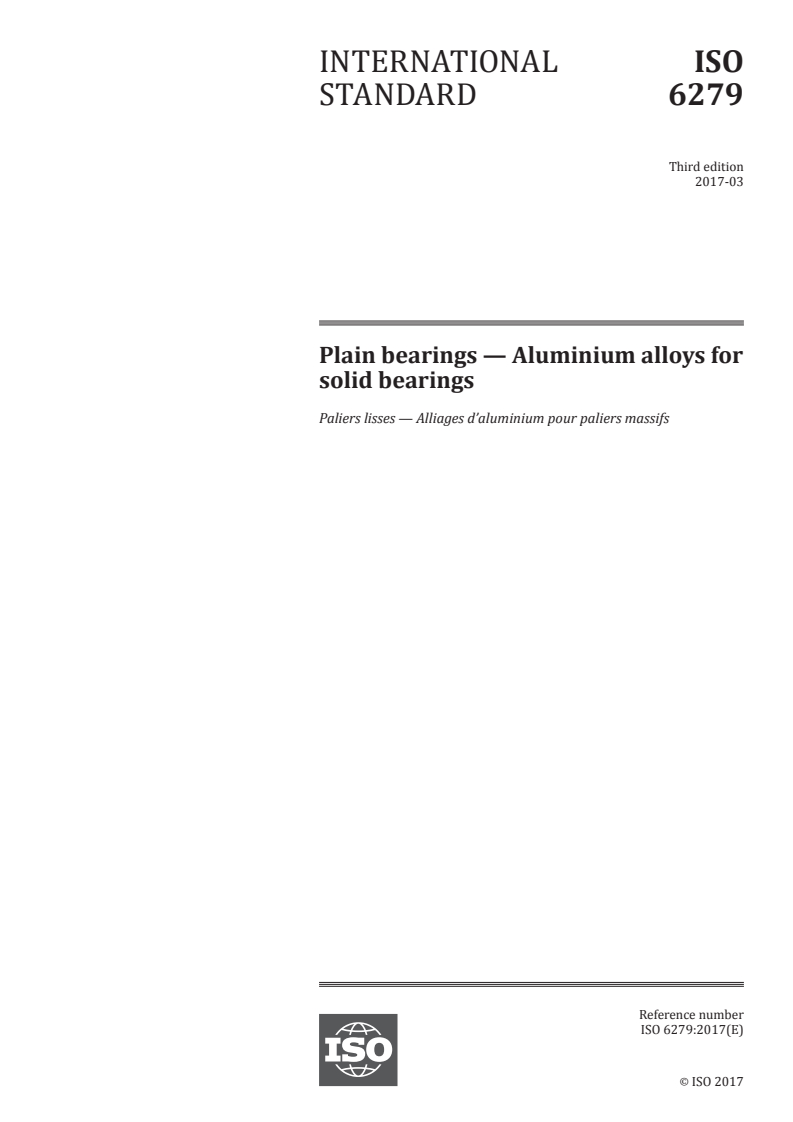
ISO 6279:2017 - Plain bearings — Aluminium alloys for solid bearings/6/2017
Overview
ISO 6279:2017 is an international standard established by the International Organization for Standardization (ISO) that specifies the preferred cast aluminium alloys for use in solid plain bearings. This third edition updates and replaces the previous 2006 version, ensuring the alloy compositions and mechanical property requirements meet current industry needs. The standard facilitates the selection, quality control, and testing of aluminium alloys tailored for solid plain bearings to ensure optimal performance and durability.
The document defines the chemical compositions, mechanical properties, and test methods for aluminium alloys specifically designed for solid plain bearings. While it specifies preferred alloys, it also allows for the use of alternative alloys upon agreement between manufacturers and users.
Key Topics
Alloy Composition: ISO 6279:2017 lists preferred cast aluminium alloys by chemical composition, including elements such as tin (Sn), copper (Cu), nickel (Ni), silicon (Si), iron (Fe), manganese (Mn), zinc (Zn), magnesium (Mg), and titanium (Ti). The standard details six primary alloys used in solid bearings, each with defined mass fractions.
Mechanical Properties: The standard mandates essential mechanical properties critical for bearing functionality. These include tensile strength, elongation, Brinell hardness, proof stress, elastic modulus, thermal expansion, thermal conductivity, and density. Properties like tensile strength and elongation are subjected to quality control checks, while hardness testing might be performed on individual bearings.
Test Methods: ISO 6279:2017 requires tensile tests to be conducted as agreed by manufacturers and users, and hardness tests to follow the ISO 4384-2 standard for bearing metals. This ensures consistency and reliability in evaluating the material's suitability.
Designation: The standard establishes a clear designation format for aluminium alloys used in bearings, allowing for simple identification. The designation includes the term "Aluminium alloy," the ISO 6279 reference, and the specific alloy name (e.g., Aluminium alloy ISO 6279 – AlSn6Cu).
Applications
ISO 6279:2017 is essential for industries utilizing solid plain bearings where lightweight, high-strength, and wear-resistant materials are necessary. Typical applications include:
Automotive Industry: Components such as suspension systems, steering parts, and engine bearings benefit from aluminium alloys specified in this standard due to their wear resistance and mechanical performance.
Industrial Machinery: Bearings used in heavy machinery, manufacturing equipment, and conveyors gain improved durability and efficiency by adhering to ISO 6279 aluminium alloy specifications.
Aerospace: The lightweight nature of aluminium alloys specified in ISO 6279 makes them suitable for aerospace components requiring reliable and low-friction bearing materials.
Railway and Transportation: Solid bearings in transport vehicles, including rail cars and commercial trucks, utilize these aluminium alloys to extend service life and reduce maintenance.
Related Standards
ISO 4384-2: This related standard provides methods for hardness testing of bearing metals, including solid materials, and complements ISO 6279’s requirements for hardness evaluations.
ISO/IEC Directives Part 1 and Part 2: These documents describe procedures and editorial rules followed in developing ISO standards, ensuring consistency and quality.
ISO Technical Committee ISO/123: The committee responsible for plain bearings standardization, ensuring alignment of materials, lubricants, and test methods.
By adhering to ISO 6279:2017, manufacturers and users of solid plain bearings can ensure high-quality aluminium alloys that meet international specifications for composition and mechanical performance. This results in improved bearing reliability, compatibility, and service life across a wide range of engineering applications.
Relations
- Effective Date
- 12-Dec-2015
Buy Documents
ISO 6279:2017 - Plain bearings -- Aluminium alloys for solid bearings
ISO 6279:2017 - Plain bearings — Aluminium alloys for solid bearings/6/2017
Get Certified
Connect with accredited certification bodies for this standard

Element Materials Technology
Materials testing and product certification.

Inštitut za kovinske materiale in tehnologije
Institute of Metals and Technology. Materials testing, metallurgical analysis, NDT.
Sponsored listings
Frequently Asked Questions
ISO 6279:2017 is a standard published by the International Organization for Standardization (ISO). Its full title is "Plain bearings — Aluminium alloys for solid bearings". This standard covers: ISO 6279:2017 specifies the composition and properties of preferred cast aluminium alloys for use in solid plain bearings. Other alloys can be specified with agreement between the manufacturer and user.
ISO 6279:2017 specifies the composition and properties of preferred cast aluminium alloys for use in solid plain bearings. Other alloys can be specified with agreement between the manufacturer and user.
ISO 6279:2017 is classified under the following ICS (International Classification for Standards) categories: 21.100.10 - Plain bearings; 77.150.10 - Aluminium products. The ICS classification helps identify the subject area and facilitates finding related standards.
ISO 6279:2017 has the following relationships with other standards: It is inter standard links to ISO 6279:2006. Understanding these relationships helps ensure you are using the most current and applicable version of the standard.
ISO 6279:2017 is available in PDF format for immediate download after purchase. The document can be added to your cart and obtained through the secure checkout process. Digital delivery ensures instant access to the complete standard document.
Standards Content (Sample)
SLOVENSKI STANDARD
01-september-2020
Drsni ležaji - Aluminijeve zlitine za masivne ležaje
Plain bearings - Aluminium alloys for solid bearings
Paliers lisses - Alliages d'aluminium pour paliers massifs
Ta slovenski standard je istoveten z: ISO 6279:2017
ICS:
21.100.10 Drsni ležaji Plain bearings
77.150.10 Aluminijski izdelki Aluminium products
2003-01.Slovenski inštitut za standardizacijo. Razmnoževanje celote ali delov tega standarda ni dovoljeno.
INTERNATIONAL ISO
STANDARD 6279
Third edition
2017-03
Plain bearings — Aluminium alloys for
solid bearings
Paliers lisses — Alliages d’aluminium pour paliers massifs
Reference number
©
ISO 2017
© ISO 2017, Published in Switzerland
All rights reserved. Unless otherwise specified, no part of this publication may be reproduced or utilized otherwise in any form
or by any means, electronic or mechanical, including photocopying, or posting on the internet or an intranet, without prior
written permission. Permission can be requested from either ISO at the address below or ISO’s member body in the country of
the requester.
ISO copyright office
Ch. de Blandonnet 8 • CP 401
CH-1214 Vernier, Geneva, Switzerland
Tel. +41 22 749 01 11
Fax +41 22 749 09 47
copyright@iso.org
www.iso.org
ii © ISO 2017 – All rights reserved
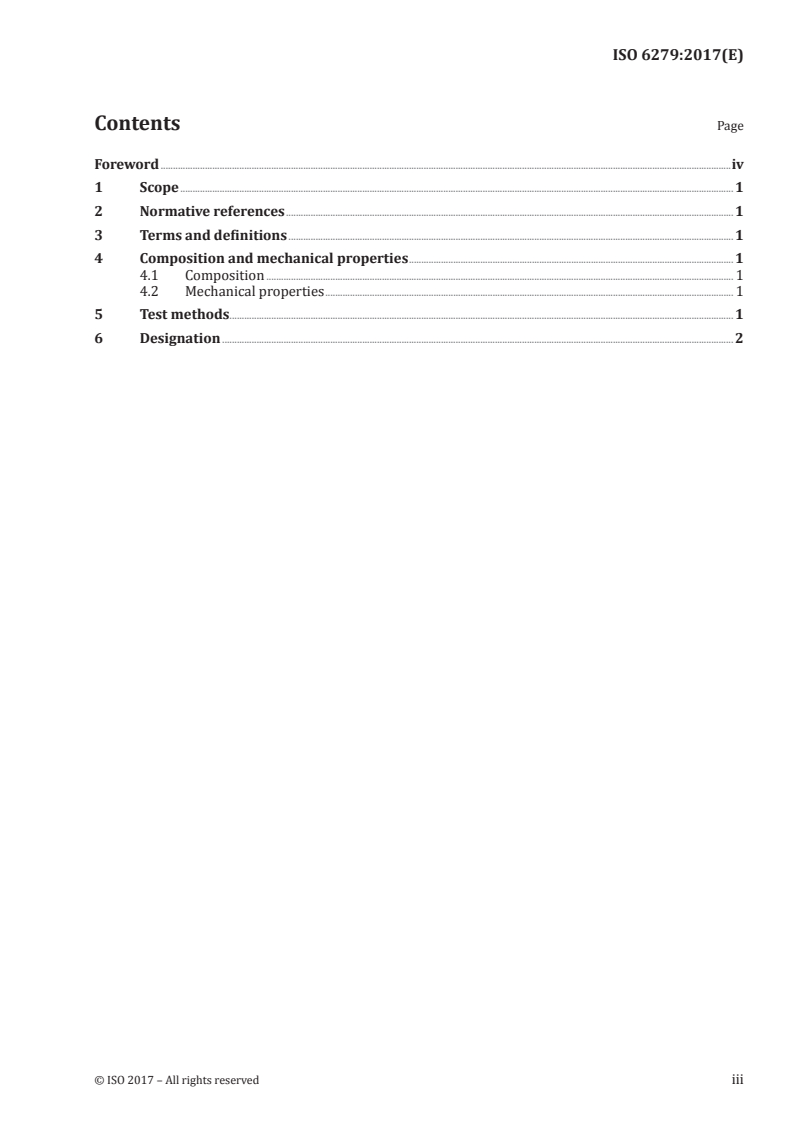
Contents Page
Foreword .iv
1 Scope . 1
2 Normative references . 1
3 Terms and definitions . 1
4 Composition and mechanical properties . 1
4.1 Composition . 1
4.2 Mechanical properties . 1
5 Test methods . 1
6 Designation . 2
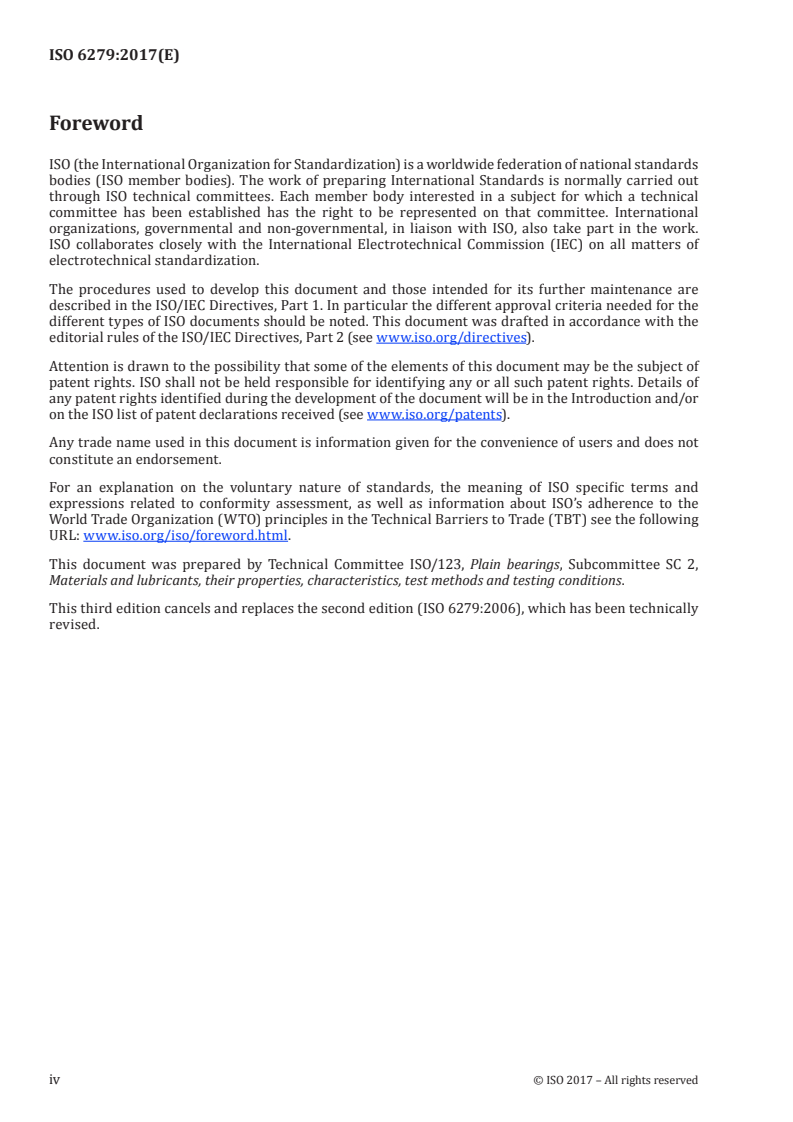
Foreword
ISO (the International Organization for Standardization) is a worldwide federation of national standards
bodies (ISO member bodies). The work of preparing International Standards is normally carried out
through ISO technical committees. Each member body interested in a subject for which a technical
committee has been established has the right to be represented on that committee. International
organizations, governmental and non-governmental, in liaison with ISO, also take part in the work.
ISO collaborates closely with the International Electrotechnical Commission (IEC) on all matters of
electrotechnical standardization.
The procedures used to develop this document and those intended for its further maintenance are
described in the ISO/IEC Directives, Part 1. In particular the different approval criteria needed for the
different types of ISO documents should be noted. This document was drafted in accordance with the
editorial rules of the ISO/IEC Directives, Part 2 (see www .iso .org/ directives).
Attention is drawn to the possibility that some of the elements of this document may be the subject of
patent rights. ISO shall not b
...
INTERNATIONAL ISO
STANDARD 6279
Third edition
2017-03
Plain bearings — Aluminium alloys for
solid bearings
Paliers lisses — Alliages d’aluminium pour paliers massifs
Reference number
©
ISO 2017
© ISO 2017, Published in Switzerland
All rights reserved. Unless otherwise specified, no part of this publication may be reproduced or utilized otherwise in any form
or by any means, electronic or mechanical, including photocopying, or posting on the internet or an intranet, without prior
written permission. Permission can be requested from either ISO at the address below or ISO’s member body in the country of
the requester.
ISO copyright office
Ch. de Blandonnet 8 • CP 401
CH-1214 Vernier, Geneva, Switzerland
Tel. +41 22 749 01 11
Fax +41 22 749 09 47
copyright@iso.org
www.iso.org
ii © ISO 2017 – All rights reserved
Contents Page
Foreword .iv
1 Scope . 1
2 Normative references . 1
3 Terms and definitions . 1
4 Composition and mechanical properties . 1
4.1 Composition . 1
4.2 Mechanical properties . 1
5 Test methods . 1
6 Designation . 2
Foreword
ISO (the International Organization for Standardization) is a worldwide federation of national standards
bodies (ISO member bodies). The work of preparing International Standards is normally carried out
through ISO technical committees. Each member body interested in a subject for which a technical
committee has been established has the right to be represented on that committee. International
organizations, governmental and non-governmental, in liaison with ISO, also take part in the work.
ISO collaborates closely with the International Electrotechnical Commission (IEC) on all matters of
electrotechnical standardization.
The procedures used to develop this document and those intended for its further maintenance are
described in the ISO/IEC Directives, Part 1. In particular the different approval criteria needed for the
different types of ISO documents should be noted. This document was drafted in accordance with the
editorial rules of the ISO/IEC Directives, Part 2 (see www .iso .org/ directives).
Attention is drawn to the possibility that some of the elements of this document may be the subject of
patent rights. ISO shall not be held responsible for identifying any or all such patent rights. Details of
any patent rights identified during the development of the document will be in the Introduction and/or
on the ISO list of patent declarations received (see www .iso .org/ patents).
Any trade name used in this document is information given for the convenience of users and does not
constitute an endorsement.
For an explanation on the vo
...
INTERNATIONAL ISO
STANDARD 6279
Third edition
2017-03
Plain bearings — Aluminium alloys for
solid bearings
Paliers lisses — Alliages d’aluminium pour paliers massifs
Reference number
©
ISO 2017
© ISO 2017, Published in Switzerland
All rights reserved. Unless otherwise specified, no part of this publication may be reproduced or utilized otherwise in any form
or by any means, electronic or mechanical, including photocopying, or posting on the internet or an intranet, without prior
written permission. Permission can be requested from either ISO at the address below or ISO’s member body in the country of
the requester.
ISO copyright office
Ch. de Blandonnet 8 • CP 401
CH-1214 Vernier, Geneva, Switzerland
Tel. +41 22 749 01 11
Fax +41 22 749 09 47
copyright@iso.org
www.iso.org
ii © ISO 2017 – All rights reserved
Contents Page
Foreword .iv
1 Scope . 1
2 Normative references . 1
3 Terms and definitions . 1
4 Composition and mechanical properties . 1
4.1 Composition . 1
4.2 Mechanical properties . 1
5 Test methods . 1
6 Designation . 2
Foreword
ISO (the International Organization for Standardization) is a worldwide federation of national standards
bodies (ISO member bodies). The work of preparing International Standards is normally carried out
through ISO technical committees. Each member body interested in a subject for which a technical
committee has been established has the right to be represented on that committee. International
organizations, governmental and non-governmental, in liaison with ISO, also take part in the work.
ISO collaborates closely with the International Electrotechnical Commission (IEC) on all matters of
electrotechnical standardization.
The procedures used to develop this document and those intended for its further maintenance are
described in the ISO/IEC Directives, Part 1. In particular the different approval criteria needed for the
different types of ISO documents should be noted. This document was drafted in accordance with the
editorial rules of the ISO/IEC Directives, Part 2 (see www .iso .org/ directives).
Attention is drawn to the possibility that some of the elements of this document may be the subject of
patent rights. ISO shall not be held responsible for identifying any or all such patent rights. Details of
any patent rights identified during the development of the document will be in the Introduction and/or
on the ISO list of patent declarations received (see www .iso .org/ patents).
Any trade name used in this document is information given for the convenience of users and does not
constitute an endorsement.
For an explanation on the vo
...