


ISO/TS 15916
(Main)Hydrogen technologies - Basic considerations for the safety of hydrogen systems
Hydrogen technologies - Basic considerations for the safety of hydrogen systems
This Technical Specification provides guidelines for the use of hydrogen in its gaseous and liquid forms as well as its storage in either of these or other forms (hydrides). It identifies the basic safety concerns, hazards and risks, and describes the properties of hydrogen that are relevant to safety. Detailed safety requirements associated with specific hydrogen applications are treated in separate International Standards. “Hydrogen” in this paper means normal hydrogen (1H2), not deuterium (2H2) or tritium (3H2).
Technologies de l'hydrogène — Considérations fondamentales pour la sécurité des systèmes à l'hydrogène
General Information
- Status
- Not Published
- Technical Committee
- ISO/TC 197 - Hydrogen technologies
- Current Stage
- 6000 - International Standard under publication
- Start Date
- 12-Dec-2025
- Completion Date
- 10-Jan-2026
Relations
- Effective Date
- 19-Jul-2025
- Effective Date
- 27-Apr-2024
Overview
ISO/TS 15916, titled Hydrogen technologies - Basic considerations for the safety of hydrogen systems, is a Technical Specification developed by ISO Technical Committee 197 (Hydrogen technologies). This important guideline addresses the fundamental safety principles for handling hydrogen in both gaseous and liquid states, including its storage as hydrides and other forms. The specification thoroughly discusses hydrogen's physical and chemical properties relevant to safety, identifies common hazards, potential risks, and outlines strategies for hazard mitigation.
This document serves as a foundational resource for organizations involved in hydrogen production, storage, transportation, and utilization, emphasizing safe system design and operation. It applies exclusively to normal hydrogen (1H2), explicitly excluding isotopes like deuterium and tritium. While ISO/TS 15916 provides overarching safety considerations, detailed safety protocols for specific hydrogen applications are covered in separate International Standards.
Key Topics
Hydrogen Properties
Comprehensive coverage of hydrogen’s atomic, molecular, and thermophysical properties, including:- Characteristics of gaseous and cryogenic liquid hydrogen
- Combustion properties: flammability limits, ignition energy, deflagration, detonation
- Hazards related to pressure, low temperatures, and hydrogen embrittlement
Hydrogen Applications and System Components
An overview of hydrogen infrastructure and typical system components:- Production, storage, and transport categories
- Storage vessels, piping, flow controls, and detection systems
- Environmental effects and considerations for external conditions
Safety Hazards and Risk Assessment
Identification and evaluation of safety concerns intrinsic to hydrogen:- Combustion hazards including explosion risks
- Pressure-related hazards from gaseous and liquid hydrogen
- Health hazards such as cold burns, asphyxiation, and high-temperature exposure
- Materials degradation through hydrogen embrittlement and attack
Hazard Mitigation and Control
Strategies and practical measures to minimize risks:- Design for inherently safer systems and appropriate material selection
- Prevention of overpressure and leak management
- Fire and explosion prevention techniques, including oxygen enrichment control and ignition source management
- Detection and alarm systems for hydrogen release and fire events
- Facility considerations like ventilation, exclusion zones, safety equipment, and safe disposal of hydrogen
Training and Team Approach
Emphasis on the need for education, training, and a multidisciplinary approach to ensure the safe implementation of hydrogen technologies.
Applications
ISO/TS 15916 is critical for professionals involved in:
- Hydrogen fuel production facilities and refueling stations
- Industrial processes utilizing hydrogen gas or liquid hydrogen
- Designing and manufacturing hydrogen storage systems such as tanks and hydrides
- Developing infrastructure components including pipelines and detection sensors
- Safety audits, risk assessments, and compliance verification in hydrogen-related projects
- Research and development in hydrogen technology safety improvements
By following ISO/TS 15916 guidelines, organizations can enhance operational safety, reduce accident risks, and foster public and regulatory confidence in hydrogen technologies.
Related Standards
ISO/TS 15916 complements and aligns with other International Standards within the hydrogen and fuel cell domain, including but not limited to:
- ISO 14687 (Hydrogen fuel quality)
- ISO 19880 series (Gaseous hydrogen fueling stations)
- ISO 16111 (Hydrogen storage in reversible metal hydride vessels)
- IEC 60079 series (Explosion protection standards relevant for hydrogen environments)
These standards collectively provide comprehensive requirements for safety, performance, and reliability in hydrogen applications.
Keywords: ISO/TS 15916, hydrogen safety, hydrogen technologies, hydrogen properties, hydrogen hazards, gaseous hydrogen, liquid hydrogen, hydrogen storage, hydrogen embrittlement, hazard mitigation, hydrogen system design, hydrogen combustion, hydrogen detection, fuel cell safety, hydrogen infrastructure, international hydrogen standards.

ISO/DTS 15916 - Hydrogen technologies — Basic considerations for the safety of hydrogen systems Released:4. 09. 2025


REDLINE ISO/DTS 15916 - Hydrogen technologies — Basic considerations for the safety of hydrogen systems Released:4. 09. 2025
Frequently Asked Questions
ISO/TS 15916 is a draft published by the International Organization for Standardization (ISO). Its full title is "Hydrogen technologies - Basic considerations for the safety of hydrogen systems". This standard covers: This Technical Specification provides guidelines for the use of hydrogen in its gaseous and liquid forms as well as its storage in either of these or other forms (hydrides). It identifies the basic safety concerns, hazards and risks, and describes the properties of hydrogen that are relevant to safety. Detailed safety requirements associated with specific hydrogen applications are treated in separate International Standards. “Hydrogen” in this paper means normal hydrogen (1H2), not deuterium (2H2) or tritium (3H2).
This Technical Specification provides guidelines for the use of hydrogen in its gaseous and liquid forms as well as its storage in either of these or other forms (hydrides). It identifies the basic safety concerns, hazards and risks, and describes the properties of hydrogen that are relevant to safety. Detailed safety requirements associated with specific hydrogen applications are treated in separate International Standards. “Hydrogen” in this paper means normal hydrogen (1H2), not deuterium (2H2) or tritium (3H2).
ISO/TS 15916 is classified under the following ICS (International Classification for Standards) categories: 27.075 - Hydrogen technologies. The ICS classification helps identify the subject area and facilitates finding related standards.
ISO/TS 15916 has the following relationships with other standards: It is inter standard links to ISO/IEC 29140:2021, ISO/TR 15916:2015. Understanding these relationships helps ensure you are using the most current and applicable version of the standard.
ISO/TS 15916 is available in PDF format for immediate download after purchase. The document can be added to your cart and obtained through the secure checkout process. Digital delivery ensures instant access to the complete standard document.
Standards Content (Sample)
FINAL DRAFT
Technical
Specification
ISO/DTS 15916
ISO/TC 197
Hydrogen technologies — Basic
Secretariat: SCC
considerations for the safety of
Voting begins on:
hydrogen systems
2025-09-18
Voting terminates on:
2025-12-11
RECIPIENTS OF THIS DRAFT ARE INVITED TO SUBMIT,
WITH THEIR COMMENTS, NOTIFICATION OF ANY
RELEVANT PATENT RIGHTS OF WHICH THEY ARE AWARE
AND TO PROVIDE SUPPOR TING DOCUMENTATION.
IN ADDITION TO THEIR EVALUATION AS
BEING ACCEPTABLE FOR INDUSTRIAL, TECHNO
ISO/CEN PARALLEL PROCESSING LOGICAL, COMMERCIAL AND USER PURPOSES, DRAFT
INTERNATIONAL STANDARDS MAY ON OCCASION HAVE
TO BE CONSIDERED IN THE LIGHT OF THEIR POTENTIAL
TO BECOME STAN DARDS TO WHICH REFERENCE MAY BE
MADE IN NATIONAL REGULATIONS.
Reference number
ISO/DTS 15916:2025(en) © ISO 2025
FINAL DRAFT
ISO/DTS 15916:2025(en)
Technical
Specification
ISO/DTS 15916
ISO/TC 197
Hydrogen technologies — Basic
Secretariat: SCC
considerations for the safety of
Voting begins on:
hydrogen systems
Voting terminates on:
RECIPIENTS OF THIS DRAFT ARE INVITED TO SUBMIT,
WITH THEIR COMMENTS, NOTIFICATION OF ANY
RELEVANT PATENT RIGHTS OF WHICH THEY ARE AWARE
AND TO PROVIDE SUPPOR TING DOCUMENTATION.
© ISO 2025
IN ADDITION TO THEIR EVALUATION AS
All rights reserved. Unless otherwise specified, or required in the context of its implementation, no part of this publication may
BEING ACCEPTABLE FOR INDUSTRIAL, TECHNO
ISO/CEN PARALLEL PROCESSING
LOGICAL, COMMERCIAL AND USER PURPOSES, DRAFT
be reproduced or utilized otherwise in any form or by any means, electronic or mechanical, including photocopying, or posting on
INTERNATIONAL STANDARDS MAY ON OCCASION HAVE
the internet or an intranet, without prior written permission. Permission can be requested from either ISO at the address below
TO BE CONSIDERED IN THE LIGHT OF THEIR POTENTIAL
or ISO’s member body in the country of the requester.
TO BECOME STAN DARDS TO WHICH REFERENCE MAY BE
MADE IN NATIONAL REGULATIONS.
ISO copyright office
CP 401 • Ch. de Blandonnet 8
CH-1214 Vernier, Geneva
Phone: +41 22 749 01 11
Email: copyright@iso.org
Website: www.iso.org
Published in Switzerland Reference number
ISO/DTS 15916:2025(en) © ISO 2025
ii
ISO/DTS 15916:2025(en)
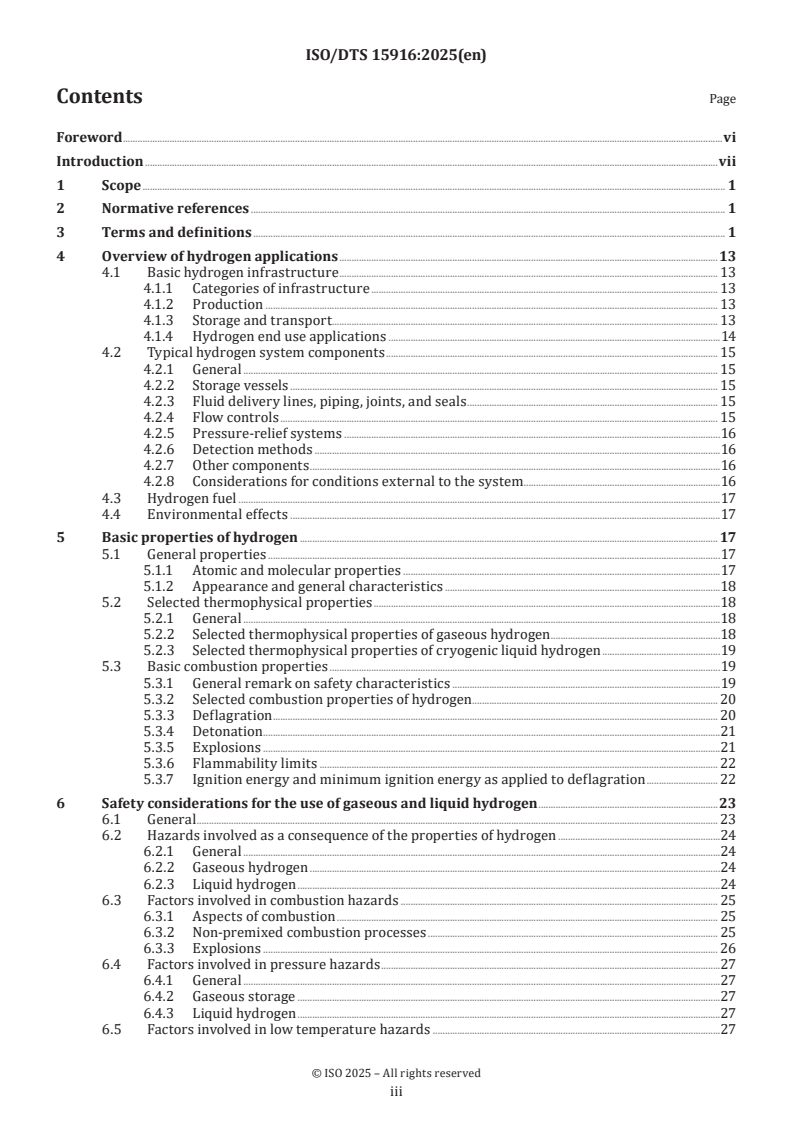
Contents Page
Foreword .vi
Introduction .vii
1 Scope . 1
2 Normative references . 1
3 Terms and definitions . 1
4 Overview of hydrogen applications .13
4.1 Basic hydrogen infrastructure . 13
4.1.1 Categories of infrastructure . 13
4.1.2 Production . 13
4.1.3 Storage and transport. 13
4.1.4 Hydrogen end use applications .14
4.2 Typical hydrogen system components . 15
4.2.1 General . 15
4.2.2 Storage vessels . 15
4.2.3 Fluid delivery lines, piping, joints, and seals . 15
4.2.4 Flow controls . 15
4.2.5 Pressure-relief systems .16
4.2.6 Detection methods .16
4.2.7 Other components .16
4.2.8 Considerations for conditions external to the system .16
4.3 Hydrogen fuel .17
4.4 Environmental effects .17
5 Basic properties of hydrogen . 17
5.1 General properties .17
5.1.1 Atomic and molecular properties .17
5.1.2 Appearance and general characteristics .18
5.2 Selected thermophysical properties .18
5.2.1 General .18
5.2.2 Selected thermophysical properties of gaseous hydrogen .18
5.2.3 Selected thermophysical properties of cryogenic liquid hydrogen .19
5.3 Basic combustion properties .19
5.3.1 General remark on safety characteristics .19
5.3.2 Selected combustion properties of hydrogen . 20
5.3.3 Deflagration . 20
5.3.4 Detonation .21
5.3.5 Explosions .21
5.3.6 Flammability limits . 22
5.3.7 Ignition energy and minimum ignition energy as applied to deflagration . 22
6 Safety considerations for the use of gaseous and liquid hydrogen .23
6.1 General . 23
6.2 Hazards involved as a consequence of the properties of hydrogen .24
6.2.1 General .24
6.2.2 Gaseous hydrogen .24
6.2.3 Liquid hydrogen .24
6.3 Factors involved in combustion hazards . 25
6.3.1 Aspects of combustion . 25
6.3.2 Non-premixed combustion processes . 25
6.3.3 Explosions . 26
6.4 Factors involved in pressure hazards .27
6.4.1 General .27
6.4.2 Gaseous storage .27
6.4.3 Liquid hydrogen .27
6.5 Factors involved in low temperature hazards .27
iii
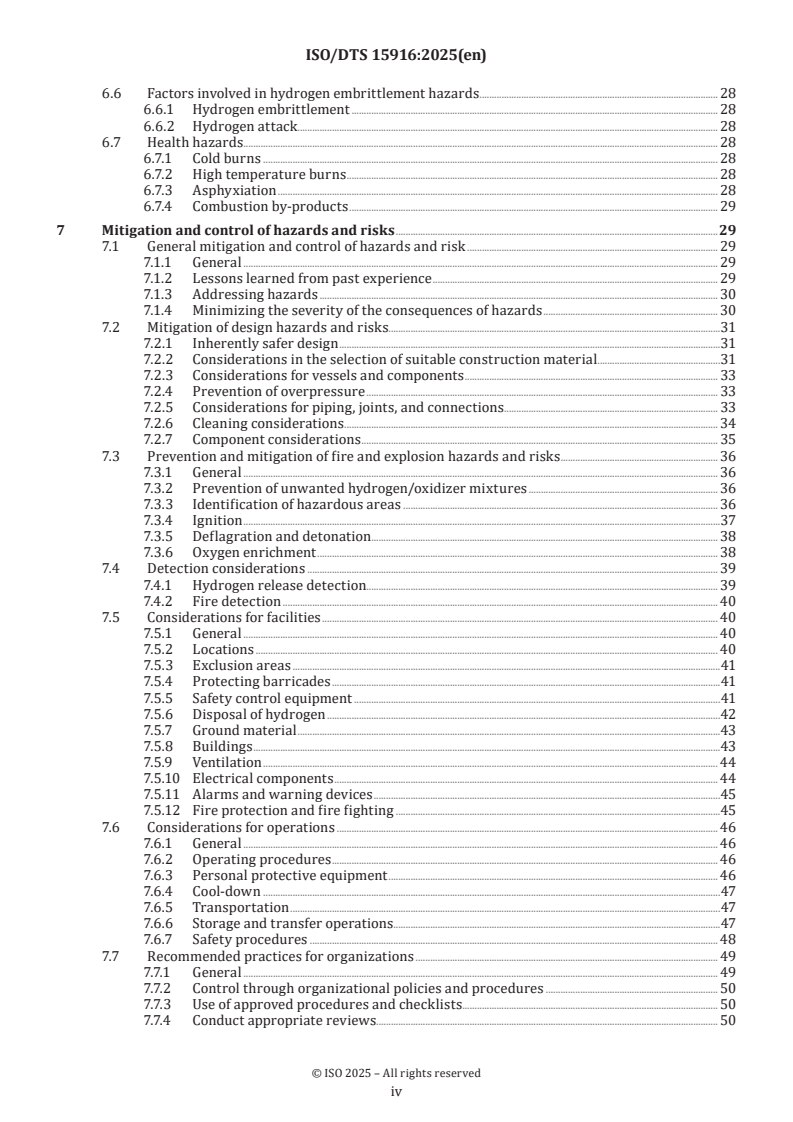
ISO/DTS 15916:2025(en)
6.6 Factors involved in hydrogen embrittlement hazards . 28
6.6.1 Hydrogen embrittlement . 28
6.6.2 Hydrogen attack . . 28
6.7 Health hazards. 28
6.7.1 Cold burns . 28
6.7.2 High temperature burns . 28
6.7.3 Asphyxiation . 28
6.7.4 Combustion by-products . 29
7 Mitigation and control of hazards and risks .29
7.1 General mitigation and control of hazards and risk . 29
7.1.1 General . 29
7.1.2 Lessons learned from past experience . 29
7.1.3 Addressing hazards . 30
7.1.4 Minimizing the severity of the consequences of hazards . 30
7.2 Mitigation of design hazards and risks.31
7.2.1 Inherently safer design .31
7.2.2 Considerations in the selection of suitable construction material .31
7.2.3 Considerations for vessels and components . 33
7.2.4 Prevention of overpressure . 33
7.2.5 Considerations for piping, joints, and connections. 33
7.2.6 Cleaning considerations . 34
7.2.7 Component considerations . 35
7.3 Prevention and mitigation of fire and explosion hazards and risks . 36
7.3.1 General . 36
7.3.2 Prevention of unwanted hydrogen/oxidizer mixtures . 36
7.3.3 Identification of hazardous areas . 36
7.3.4 Ignition .37
7.3.5 Deflagration and detonation. 38
7.3.6 Oxygen enrichment . 38
7.4 Detection considerations . 39
7.4.1 Hydrogen release detection. 39
7.4.2 Fire detection . 40
7.5 Considerations for facilities . 40
7.5.1 General . 40
7.5.2 Locations . 40
7.5.3 Exclusion areas .41
7.5.4 Protecting barricades .41
7.5.5 Safety control equipment .41
7.5.6 Disposal of hydrogen .42
7.5.7 Ground material .43
7.5.8 Buildings .43
7.5.9 Ventilation . 44
7.5.10 Electrical components . 44
7.5.11 Alarms and warning devices .45
7.5.12 Fire protection and fire fighting .45
7.6 Considerations for operations . 46
7.6.1 General . 46
7.6.2 Operating procedures . 46
7.6.3 Personal protective equipment . 46
7.6.4 Cool-down .47
7.6.5 Transportation .47
7.6.6 Storage and transfer operations.47
7.6.7 Safety procedures . 48
7.7 Recommended practices for organizations . 49
7.7.1 General . 49
7.7.2 Control through organizational policies and procedures . 50
7.7.3 Use of approved procedures and checklists. 50
7.7.4 Conduct appropriate reviews. 50
iv
ISO/DTS 15916:2025(en)
7.7.5 Approved maintenance and quality control programmes . 50
7.7.6 Personnel education/training . 50
7.7.7 Hazard and operability assessment .51
Annex A (informative) Hydrogen properties .52
Annex B (informative) Hydrogen combustion data .56
Annex C (informative) Material data.59
Annex D (informative) Other storage options .64
Bibliography .65
v
ISO/DTS 15916:2025(en)
Foreword
ISO (the International Organization for Standardization) is a worldwide federation of national standards
bodies (ISO member bodies). The work of preparing International Standards is normally carried out through
ISO technical committees. Each member body interested in a subject for which a technical committee
has been established has the right to be represented on that committee. International organizations,
governmental and non-governmental, in liaison with ISO, also take part in the work. ISO collaborates closely
with the International Electrotechnical Commission (IEC) on all matters of electrotechnical standardization.
The procedures used to develop this document and those intended for its further maintenance are described
in the ISO/IEC Directives, Part 1. In particular, the different approval criteria needed for the different types
of ISO document should be noted. This document was drafted in accordance with the editorial rules of the
ISO/IEC Directives, Part 2 (see www.iso.org/directives).
ISO draws attention to the possibility that the implementation of this document may involve the use of (a)
patent(s). ISO takes no position concerning the evidence, validity or applicability of any claimed patent
rights in respect thereof. As of the date of publication of this document, ISO had not received notice of (a)
patent(s) which may be required to implement this document. However, implementers are cautioned that
this may not represent the latest information, which may be obtained from the patent database available at
www.iso.org/patents. ISO shall not be held responsible for identifying any or all such patent rights.
Any trade name used in this document is information given for the convenience of users and does not
constitute an endorsement.
For an explanation of the voluntary nature of standards, the meaning of ISO specific terms and expressions
related to conformity assessment, as well as information about ISO's adherence to the World Trade
Organization (WTO) principles in the Technical Barriers to Trade (TBT), see www.iso.org/iso/foreword.html.
This document was prepared by Technical Committee ISO/TC 197, Hydrogen technologies, in collaboration
with the European Committee for Standardization (CEN) Technical Committee CEN/CLC/JTC 6, Hydrogen in
energy systems, in accordance with the Agreement on technical cooperation between ISO and CEN (Vienna
Agreement).
This first edition of ISO/TS 15916 cancels and replaces ISO/TR 15916:2015, which has been technically
revised.
Any feedback or questions on this document should be directed to the user’s national standards body. A
complete listing of these bodies can be found at www.iso.org/members.html.
vi
ISO/DTS 15916:2025(en)
Introduction
The focus of this document is on relatively new hydrogen energy applications. The intent is to provide, those
unfamiliar with the technology, a basis upon which to understand the safety issues. This document concerns
itself with applications that derive their utility from the chemical reactions of hydrogen and does not apply
to applications based on nuclear processes.
Traditionally, hydrogen has been used extensively in the petrochemical and chemical industries and in
smaller quantities in the electronics, steel-producing, glass-making, and food hydrogenation industries.
Given the promise that hydrogen brings as an efficient energy carrier and a fuel with minimal environmental
impact, systems are being developed that produce hydrogen using variety of energy sources and feedstocks
such as sunlight, wind, biomass, hydro power and fossil fuels, for use in energy applications for home and
office heating, generation of electricity and transportation.
The safe use of hydrogen as a fuel is a primary goal to facilitate the rapid emergence of these hydrogen
technologies. A key element in the safe use of hydrogen is to understand its unique safety-related properties
and related phenomena, and that there are acceptable engineering approaches to controlling the hazards
and risks associated with the use of hydrogen. This document describes the hazards associated with the use
and presence of hydrogen, discusses the properties of hydrogen relevant to safety, and provides a general
discussion of approaches taken to mitigate hydrogen hazards. The aim of this document is to promote the
acceptance of hydrogen technologies by providing key information to regulators and by educating people
involved with hydrogen safety issues.
The development of International Standards to eliminate barriers to international trade and to simplify the
arduous regulatory process by providing hydrogen-specific standards to allow implementation for rapidly
emerging technologies was among the needs identified by the ISO/TC 197. This document is one of many that
have been developed, or are in the process of being developed. Detailed safety requirements associated with
specific hydrogen applications are treated in separate International Standards. This document provides
an informative reference for those separate standards as a common, consistent source of safety-related
hydrogen information. This is expected to result in a reduction in duplication and possible inconsistencies in
these separate standards.
The considerations presented in this document are broad, general, and attempt to address most aspects of
hydrogen safety. The degree to which these guidelines are applied will vary according to the specifics of the
application (such as the conditions and quantity of hydrogen involved, and the way in which the hydrogen
is used). Industrial users may find large portions of the guidelines, presented herein, applicable for their
operations. It is not expected that the general public will be required to apply this degree of knowledge to
safely operate a hydrogen appliance. It is anticipated that good appliance design, coupled with appropriate
care in installation, will reduce the degree of safety considerations to levels that are deemed acceptable by
the public for common appliances. The manufacturers of hydrogen appliances will need to consider these
guidelines to tailor sufficient specific information for the operation of their appliances, in the environment
in which they are to be used, and for the audience that will use them. Readers are encouraged to keep these
points in mind as they consider the information presented in this document. Hydrogen has been safely used
in many different applications over many years. Adherence to the principles presented in this document can
lead to a continuation of the safe and sustainable use of hydrogen.
vii
FINAL DRAFT Technical Specification ISO/DTS 15916:2025(en)
Hydrogen technologies — Basic considerations for the safety
of hydrogen systems
1 Scope
This document provides guidelines for the use of hydrogen in its gaseous and liquid forms as well as its storage
in either of these or other forms (hydrides). This document identifies the basic safety concerns, hazards and
risks, and describes the properties of hydrogen that are relevant to safety. Detailed safety requirements
associated with specific hydrogen applications are treated in separate International Standards.
“Hydrogen” in this document means protium (the most common isotope of hydrogen) ( H ), not deuterium
2 3
( H ) or tritium ( H ).
2 2
2 Normative references
There are no normative references in this document.
3 Terms and definitions
For the purposes of this document, the following terms and definitions apply.
ISO and IEC maintain terminology databases for use in standardization at the following addresses:
— ISO Online browsing platform: available at https:// www .iso .org/ obp
— IEC Electropedia: available at https:// www .electropedia .org/
3.1
ambient conditions
local surrounding conditions characterized by the temperature and pressure at a particular location, such
as a city or facility
Note 1 to entry: See normal temperature and pressure (3.69).
3.2
annealing
heat treatment process used to soften hard steel so that it can be machined or cold-worked
3.3
arrested flame
combustion process that is stopped or flame that is put out
3.4
auto-ignition
ignition that does not require external ignition energy because the thermal energy of the molecules alone is
enough to overcome the activation threshold for combustion initiation
3.5
auto-ignition temperature
lowest temperature at which auto-ignition (3.4) occurs
ISO/DTS 15916:2025(en)
3.6
backfill
process by which a desired gas is used to replace an undesired gas in a system volume
Note 1 to entry: Typically, the undesired gas is first removed by evacuation with a vacuum pump, then the desired gas
is put in.
3.7
blast wave
intense pressure wave set in motion by the shock waves (3.91) and/or hot product gases of a fast deflagration
(3.20) or detonation (3.23) that impinges upon the surroundings, typically air
3.8
boiling liquid expanding vapour explosion
BLEVE
phenomenon that occurs when a vessel containing a pressurized liquid substantially above its (atmospheric)
boiling point is ruptured, releasing the content explosively
3.9
bourdon tube
thin-wall curved tube that is closed at one end and attached to a pressure source at the other end
Note 1 to entry: Pressure changes cause a change in the curvature of the Bourdon tube that is used to indicate the
pressure in the system.
3.10
buoyancy
vertical force exerted on a body of less dense gas by the surrounding heavier static gas, typically air
3.11
catalytic converter
catalyst that is used for converting ortho-hydrogen to para-hydrogen in a liquefaction process so that the
liquid hydrogen produced is mostly para-hydrogen
Note 1 to entry: Some commonly used catalysts in this conversion process are hydrous ferric oxide, chromic oxide on
alumina particles, and nickel-based compounds.
3.12
check valve
valve that operates on differential pressure and allows flow in one direction only
3.13
combustion
reaction process by which a flammable substance is oxidized, producing hot product gases, heat, radiation,
and possibly pressure waves
Note 1 to entry: An explosion (3.36) in the sense of this document is a combustion process.
3.14
component
any part of a complete item or system
3.15
confined space
area with limited access, as described in national regulations, which requires special considerations for entry
[SOURCE: ISO 16972:2020, 3.58]
3.16
confinement
physical restriction, sufficient to influence the combustion process or to facilitate the accumulation of
hydrogen
ISO/DTS 15916:2025(en)
3.17
convection current
motion or circulation of a fluid involving the transport of mass from one location to another driven by
temperature dependent density gradients
Note 1 to entry: See natural convection (3.66).
3.18
cryogenic fluid
refrigerated liquefied gas
gas that is partially liquid because of its low temperature
Note 1 to entry: This includes totally evaporated liquids and supercritical fluids.
Note 2 to entry: The 13th International Institute of Refrigeration's (IIR) International Congress of Refrigeration (held
in Washington DC in 1971) endorsed a universal definition of "cryogenics" and "cryogenic" by accepting a threshold of
120 K (−153 °C) to distinguish these terms from conventional refrigeration.
[SOURCE: ISO 21009-1: 2022 clause 3.4, modified – removal of Note 2 to entry, and inclusion of a replacement
Note 2 to entry]
3.19
cryo-pumping
process that consists of cooling a surface to a temperature of less than 120 K so that gases and vapours
condense on the surface
Note 1 to entry: This process, though usually undesirable in the context here, is also used as a vacuum pump.
3.20
deflagration
combustion process in which a flame or chemical reaction moves through a flammable mixture at a rate less
than the speed of sound in the unburned mixture
Note 1 to entry: Fast deflagrations are characterized by velocities in the hundreds of metres per second, and their
effects do not differ much from those of a detonation (3.23).
Note 2 to entry: Laminar deflagration waves are characterized by velocities in the several metres per second and do
not cause significant over pressures in the open.
3.21
deflagration-to-detonation-transition
DDT
event, often caused by turbulence, in which a deflagration (3.20) initiates a detonation (3.23)
3.22
deluge system
water spray system that is used to keep equipment, especially hydrogen storage vessels, cool in the event of a fire
3.23
detonation
shock stabilized combustion process resulting in a combustion phenomenon propagating faster than the
speed of sound
Note 1 to entry: A detonation is an explosion, but the reverse is not true.
Note 2 to entry: The thermal energy of the reaction sustains the shock wave, and the shock wave compresses unreacted
material, producing the high temperatures necessary to drive the reaction.
ISO/DTS 15916:2025(en)
3.24
detonation cell
fundamental part of the mechanism for energy release within a detonation (3.23)
Note 1 to entry: The spatial arrangement of the shock front and acoustic waves moving behind and transverse to the
shock front defines a cellular region of combustion that is observed experimentally as a “fish-scale” shaped track on
sooted foils exposed to the detonation.
Note 2 to entry: The width of this diamond shape denotes the cell size, and its length can be empirically related to
the formulae that can predict the energy required to directly initiate detonation and the physical dimensions of the
structures that prohibit detonation.
3.25
detonation limits
maximum and minimum concentrations of a gas, vapour, mist, spray or dust, in air or oxygen, for stable
detonation (3.23) to occur
Note 1 to entry: The limits are in reality controlled not only by the concentration of the mixture but also by the size
and geometry of the environment as well as the means by which ignition occurs. There is no standard procedure for
their determination.
Note 2 to entry: See flammability limits (3.45)
3.26
deuterium
D
H
isotope of hydrogen with a nucleus containing one neutron and one proton and a mass number of two
3.27
diffusion
flux of a fluid through another fluid or material due to concentration gradient
EXAMPLE The motion of hydrogen gas through air, or the movement of hydrogen gas through the wall of a
rubber hose.
Note 1 to entry: The diffusion coefficient is the mass of material diffusing across a unit of area in a unit of time at a unit
concentration gradient.
3.28
diluent
inert component within a gas mixture that reduces the concentration of the remaining (active) materials
3.29
dual-fault tolerance
system design in which the failure of two elements to perform as intended does not cause an entire system
to function unpredictably or catastrophically
Note 1 to entry: The faults can be in two related areas or two areas that function completely independently, and the
system should continue to function as intended.
3.30
ductility
percentage elongation to failure or the reduction in cross-sectional area of a specimen in a
simple tensile test
Note 1 to entry: Materials can make a ductile-to-brittle transition at low temperatures.
3.31
electrolyser
device that performs electrolysis (3.32)
ISO/DTS 15916:2025(en)
3.32
electrolysis
process in which electric current is used to promote a chemical reaction
Note 1 to entry: In the case of water, an example is the separation of hydrogen from oxygen.
3.33
emergency
unintended circumstance, bearing clear and present danger to personnel or property, which requires an
immediate response
3.34
enclosed space
space in which, by virtue of its enclosed, or partially enclosed nature, there arises a reasonably foreseeable
risk associated with the release of flammable fluid, not expected to be present for a release into an open,
naturally ventilated, space
Note 1 to entry: See confined space for the foreseeable risk to personnel in enclosed, or partially enclosed spaces
3.35
enthalpy
thermodynamic property of a material that is equivalent to the sum of the internal energy and the product
of the pressure and the volume
3.36
explosion
self-sustained combustion of a gas mixture releasing heat, and hot combustion products when the rate of
reaction in a reacting mixture increases with time until either the fuel or oxidizer is consumed
Note 1 to entry: This definition excludes pressure sources not related to chemical reactions (like burst of a pressure
vessel, BLEVE, etc.).
Note 2 to entry: There is neither a standard terminology nor another generally acknowledged definition for the term
“explosion”, but different sources give different definitions, some of them not even requiring that combustion takes place.
Note 3 to entry: When hydrogen and an oxidizer (air) are allowed to form a mixture prior to ignition (premixed
mixture), after ignition, the ensuing chemical reaction (combustion wave) will propagate through the flammable
region. The resulting combustion process releases heat. The resulting dilatation of the products, if fast enough, can
cause a pressure wave to propagate from the source. See References [9] and [11] for more information.
3.37
facility
group of buildings or equipment used for specific operations at one geographic location
3.38
fail-safe
ability to sustain a failure without causing loss of equipment, injury to personnel, or loss of operating time
3.39
fatigue
gradual deterioration of a material that is subjected to repeated loading and unloading
Note 1 to entry: See load cycle (3.60).
3.40
fire
sustained burning of a fuel jet as manifested by any or all of the following: light, flame, heat, and smoke
3.41
fire triangle
visual concept showing the requirements for combustion depicting a fuel, an oxidizer and an ignition source
as the three sides of a triangle, where combustion cannot occur if any one side is not present
ISO/DTS 15916:2025(en)
3.42
flame
zone of combustion of a gas or vapour from which light and heat are emitted
Note 1 to entry: A flame can be stationary with the flammable mixture fed into the reaction zone, or a flame can
propagate through the flammable mixture, as in a deflagration (3.20).
Note 2 to entry: Unlike hydrocarbon flames, hydrogen flames are weakly radiating. They radiate in the near UV (faint
blue) and in the near IR (reddish). Only if particles are entrained into the flow from the surroundings will the flame
thermally radiate producing a yellow colour. Because hydrogen flames radiate weakly in the near UV and IR, they are
often difficult to see in the daylight.
3.43
flame front
region of burning or chemical reaction (typically from fractions to several millimetres across) that separates
burned and unburned regions
3.44
flammability
degree to which a material is ignitable in an oxidizing atmosphere
3.45
flammability limits
lower flammable limit and upper flammable limit of gas in a gas-air mixture, between which a flammable
mixture is formed
Note 1 to entry: The term “explosive limits” is used especially in European standardization and regulations
interchangeably to describe these limits.
Note 2 to entry: The concentration can be expressed as either a volume fraction or a mass per unit volume.
Note 3 to entry: These limits are functions of temperature, pressure, diluents, fluid dynamics, and ignition energy.
Note 4 to entry: The value
...
ISISO/O/DDTSTS 1155991166
ISO/TC 197
ISO/DTS 15916
ISO/TC 197
ISO/TC 197/WG 29
Secretariat: SCC
Date:
Hydrogen technologies - — Basic considerations for the safety of
hydrogen systems
Considérations fondamentales pour la sécurité des systèmes à l'hydrogène
Copyright notice
This ISO document is a Draft Technical Specification and is copyright-protected by ISO. Except as
permitted under the applicable laws of the user's country, neither this ISO draft nor any extract from it
may be reproduced, stored in a retrieval system or transmitted in any form or by any means, electronic,
photocopying, recording or otherwise, without prior written permission being secured.
Requests for permission to reproduce should be addressed to either ISO at the address below or ISO's
member body in the country of the requester.
ISO copyright office
Case postale 56 • CH-1211 Geneva 20
Tel. + 41 22 749 01 11
Fax + 41 22 749 09 47
E-mail copyright@iso.org
Web www.iso.org
Reproduction may be subject to royalty payments or a licensing agreement.
Violators may be prosecuted.
ii
©© 20252025 –– AAllll rriigghhttss rreeseserrvveedd
ISISO/O/DDTSTS 1155991166
Warning
This document is not an ISO International Standard. It is distributed for review and comment. It is
subject to change without notice and may not be referred to as an International Standard.
Recipients of this draft are invited to submit, with their comments, notification of any relevant patent
rights of which they are aware and to provide supporting documentation.
iiii
©© 20252025 –– AAllll rriigghhttss rreeseserrvveedd
ISISO/DO/DTSTS 1155991166
iiiiii
©© 20252025 –– AAllll rriigghhttss rreeseserrvveedd
ISISO/O/DDTSTS 1155991166
All rights reserved. Unless otherwise specified, or required in the context of its implementation, no part of this publication
may be reproduced or utilized otherwise in any form or by any means, electronic or mechanical, including photocopying, or
posting on the internet or an intranet, without prior written permission. Permission can be requested from either ISO at the
address below or ISO’s member body in the country of the requester.
ISO copyright office
CP 401 • Ch. de Blandonnet 8
CH-1214 Vernier, Geneva
Phone: + 41 22 749 01 11
E-mail: copyright@iso.org
Website: www.iso.org
Published in Switzerland
iviv
©© 20252025 –– AAllll rriigghhttss rreeseserrvveedd
ISISO/O/DDTSTS 1155991166
Contents Page
Foreword . 5
Introduction . 12
1 Scope . 14
2 Normative references . 14
3 Terms and definitions . 14
4 Overview of hydrogen applications . 27
5 Basic properties of hydrogen . 31
6 Safety considerations for the use of gaseous and liquid hydrogen . 37
7 Mitigation and control of hazards and risks . 43
Annex A (informative) Hydrogen properties . 68
Annex B (informative) Hydrogen combustion data . 75
Annex C (informative) Material data . 82
Annex D (informative) Other storage options . 88
Bibliography . 1
Foreword . vi
Introduction . vii
1 Scope . 1
2 Normative references . 1
3 Terms and definitions . 1
4 Overview of hydrogen applications . 14
4.1 Basic hydrogen infrastructure . 14
4.1.1 Categories of infrastructure. 14
4.1.2 Production . 15
4.1.3 Storage and transport . 15
4.1.4 Hydrogen use applications . 16
4.2 Typical hydrogen system components . 16
4.2.1 General . 16
4.2.2 Storage vessels . 17
4.2.3 Fluid delivery lines, piping, joints, and seals . 17
4.2.4 Flow controls. 17
4.2.5 Pressure-relief systems. 17
4.2.6 Detection components . 17
4.2.7 Other components . 18
4.2.8 Considerations for conditions external to the system . 18
4.3 Hydrogen fuel . 18
4.4 Environmental effects . 18
5 Basic properties of hydrogen . 19
5.1 General properties . 19
5.1.1 Atomic and molecular properties . 19
5.1.2 Appearance and general characteristics . 19
vv
©© 20252025 –– AAllll rriigghhttss rreeseserrvveedd
ISISO/O/DDTSTS 1155991166
5.2 Selected thermophysical properties . 19
5.2.1 General . 19
5.2.2 Selected thermophysical properties of gaseous hydrogen . 19
5.2.3 Selected thermophysical properties of cryogenic liquid hydrogen . 20
5.3 Basic combustion properties . 21
5.3.1 General remark on safety characteristics . 21
5.3.2 Selected combustion properties of hydrogen. 21
5.3.3 Explosions . 21
5.3.4 Deflagration . 22
5.3.5 Detonation . 22
5.3.6 Flammability limits . 23
5.3.7 Ignition energy and minimum ignition energy as applied to deflagration . 24
6 Safety considerations for the use of gaseous and liquid hydrogen . 24
6.1 General . 24
6.2 Hazards involved as a consequence of the properties of hydrogen. 25
6.2.1 General . 25
6.2.2 Gaseous hydrogen . 25
6.2.3 Liquid hydrogen . 26
6.3 Factors involved in combustion hazards. 26
6.3.1 Aspects of combustion . 26
6.3.2 Non-premixed combustion processes . 27
6.3.3 Explosions . 27
6.4 Factors involved in pressure hazards . 28
6.4.1 General . 28
6.4.2 Gaseous storage . 29
6.4.3 Liquid hydrogen . 29
6.5 Factors involved in low temperature hazards . 29
6.6 Factors involved in hydrogen embrittlement hazards . 29
6.6.1 Hydrogen embrittlement . 29
6.6.2 Hydrogen attack . 29
6.7 Health hazards . 30
6.7.1 Cold burns . 30
6.7.2 High temperature burns. 30
6.7.3 Asphyxiation . 30
6.8 Team approach and education/training needed for the safe use of hydrogen. 30
7 Mitigation and control of hazards and risks . 30
7.1 General mitigation and control of hazards and risk . 30
7.1.1 General . 30
7.1.2 Lessons learned from past experience. 31
7.1.3 Addressing hazards . 31
7.1.4 Minimizing the severity of the consequences of hazards . 32
7.2 Mitigation of design hazards and risks . 33
7.2.1 Inherently safer design. 33
7.2.2 Considerations in the selection of suitable construction material . 33
7.2.3 Considerations for vessels and components . 34
7.2.4 Prevention of overpressure . 35
7.2.5 Considerations for piping, joints, and connections . 35
7.2.6 Cleaning considerations . 36
7.2.7 Component considerations . 36
7.3 Prevention and mitigation of fire and explosion hazards and risks . 37
7.3.1 General . 37
7.3.2 Prevention of unwanted hydrogen/oxidizer mixtures . 38
vivi
©© 20252025 –– AAllll rriigghhttss rreeseserrvveedd
ISISO/O/DDTSTS 1155991166
7.3.3 Ignition . 38
7.3.4 Deflagration and detonation . 40
7.3.5 Oxygen enrichment . 40
7.4 Detection considerations . 40
7.4.1 Hydrogen release detection . 40
7.4.2 Fire detection . 41
7.5 Considerations for facilities . 42
7.5.1 General . 42
7.5.2 Locations . 42
7.5.3 Exclusion areas . 42
7.5.4 Protecting barricades . 43
7.5.5 Safety control equipment . 43
7.5.6 Disposal of hydrogen. 44
7.5.7 Buildings . 44
7.5.8 Ventilation . 45
7.5.9 Electrical components . 45
7.5.10 Alarms and warning devices . 46
7.5.11 Fire protection and fire fighting . 46
7.6 Considerations for operations . 47
7.6.1 General . 47
7.6.2 Operating procedures . 47
7.6.3 Personal protective equipment . 47
7.6.4 Cool-down . 48
7.6.5 Transportation . 49
7.6.6 Storage and transfer operations . 49
7.6.7 Safety procedures . 49
7.7 Recommended practices for organizations . 51
7.7.1 General . 51
7.7.2 Control through organizational policies and procedures . 51
7.7.3 Use of approved procedures and checklists . 51
7.7.4 Conduct appropriate reviews . 52
7.7.5 Approved maintenance and quality control programmes. 52
7.7.6 Personnel education/training . 52
7.7.7 Hazard and operability assessment . 52
Annex A (informative) Hydrogen properties .53
A.1 General . 53
A.2 Comparison with other common gases . 56
A.3 Comparison with other liquefied gases . 56
Annex B (informative) Hydrogen combustion data .57
B.1 Safety-related combustion properties . 57
B.2 Detonation cell widths for hydrogen/air mixtures . 58
B.3 Comparison of hydrogen with other common fuels . 59
Annex C (informative) Material data . 60
C.1 Material selection criteria . 60
C.2 Hydrogen embrittlement . 61
C.3 Low temperature effects on metals. 62
C.4 Basic safety considerations for chemical compounds . 63
C.5 Evaluation of Materials for Hydrogen Service . 64
vviiii
©© 20252025 –– AAllll rriigghhttss rreeseserrvveedd
ISISO/O/DDTSTS 1155991166
C.5.1 Introduction . 64
C.5.2 Test Procedures for Evaluation of Materials for Hydrogen Service . 64
C.5.2.1 ANSI CSA CHMC1 . 64
C.5.2.2 ANSI CSA CHMC2 . 65
C.5.2.3 ISO 11114-4 . 65
C.5.2.4 SAE J2579 . 65
C.5.2.5 ASME BPVC VIII.3 KD-10 . 65
C.5.2.6 ASME B31.12 . 65
C.5.2.7 ASTM G142 . 65
C.5.2.8 ASTM G129 . 66
Annex D (informative) Other storage options . 67
D.1 General . 67
D.2 Basic safety considerations for chemical compounds . 67
Bibliography . 68
vviiiiii
©© 20252025 –– AAllll rriigghhttss rreeseserrvveedd
ISISO/O/DDTSTS 1155991166
ixix
©© 20252025 –– AAllll rriigghhttss rreeseserrvveedd
ISISO/O/DDTSTS 1155991166
Foreword
ISO (the International Organization for Standardization) is a worldwide federation of national standards bodies
(ISO member bodies). The work of preparing International Standards is normally carried out through ISO technical
committees. Each member body interested in a subject for which a technical committee has been established has
the right to be represented on that committee. International organizations, governmental and non-governmental,
in liaison with ISO, also take part in the work. ISO collaborates closely with the International Electrotechnical
Commission (IEC) on all matters of electrotechnical standardization.
The procedures used to develop this document and those intended for its further maintenance are described in
the ISO/IEC Directives, Part 1. In particular, the different approval criteria needed for the different types of ISO
documentsdocument should be noted. This document was drafted in accordance with the editorial rules of the
ISO/IEC Directives, Part 2 (see www.iso.org/directives). 2 (see www.iso.org/directives).
Attention is drawnISO draws attention to the possibility that some of the elementsimplementation of this
document may beinvolve the subjectuse of (a) patent(s). ISO takes no position concerning the evidence, validity or
applicability of any claimed patent rights. in respect thereof. As of the date of publication of this document, ISO had
not received notice of (a) patent(s) which may be required to implement this document. However, implementers
are cautioned that this may not represent the latest information, which may be obtained from the patent database
available at www.iso.org/patents. ISO shall not be held responsible for identifying any or all such patent rights.
Details of any patent rights identified during the development of the document will be in the Introduction and/or
on the ISO list of patent declarations received (see www.iso.org/patents).
Any trade name used in this document is information given for the convenience of users and does not constitute
an endorsement.
For an explanation onof the voluntary nature of standards, the meaning of ISO specific terms and expressions
related to conformity assessment, as well as information about ISO’sISO's adherence to the World Trade
Organization (WTO) principles in the Technical Barriers to Trade (TBT)), see the following URL: Foreword -
Supplementary informationwww.iso.org/iso/foreword.html.
The committee responsible for this document is ISO/TC 197, Hydrogen technologies.
This document was prepared by Technical Committee ISO/TC 197, Hydrogen technologies, in collaboration with
the European Committee for Standardization (CEN) Technical Committee CEN/CLC/JTC 6, Hydrogen in energy
systems, in accordance with the Agreement on technical cooperation between ISO and CEN (Vienna Agreement).
This first edition of the documentISO/TS 15916 cancels and replaces ISO/TR 15916:2015, which has been
technically revised.
xx
©© 20252025 –– AAllll rriigghhttss rreeseserrvveedd
ISISO/O/DDTSTS 1155991166
Any feedback or questions on this document should be directed to the user’s national standards body. A complete
listing of these bodies can be found at www.iso.org/members.html.
xixi
©© 20252025 –– AAllll rriigghhttss rreeseserrvveedd
Introduction
The focus of this Technical Specificationdocument is on the relatively new hydrogen energy applications. The
intent is to provide, those unfamiliar with the technology, a basis upon which to understand the safety issues. This
Technical Specificationdocument concerns itself with applications that derive their utility from the chemical
reactions of hydrogen and does not apply to applications based on nuclear processes.
Traditionally, hydrogen has been used extensively in the petrochemical and chemical industries and in smaller
quantities in the electronics, steel-producing, glass-making, and food hydrogenation industries. Given the promise
that hydrogen brings as an efficient energy carrier and a fuel with minimal environmental impact, systems are
being developed that produce hydrogen using variety of energy sources and feedstocks such as sunlight, wind,
biomass, hydro power and fossil fuels, for use in energy applications for home and office heating, generation of
electricity and transportation.
The safe use of hydrogen as a fuel is a primary ISO goal as it seeks to facilitate the rapid emergence of these
hydrogen technologies. A key element in the safe use of hydrogen is to understand its unique safety-related
properties and related phenomena, and that there are acceptable engineering approaches to controlling the
hazards and risks associated with the use of hydrogen. This Technical Specificationdocument describes the
hazards associated with the use and presence of hydrogen, discusses the properties of hydrogen relevant to safety,
and provides a general discussion of approaches taken to mitigate hydrogen hazards. The aim of this Technical
Specificationdocument is to promote the acceptance of hydrogen technologies by providing key information to
regulators and by educating people involved with hydrogen safety issues.
The development of International Standards to eliminate barriers to international trade and to simplify the
arduous regulatory process by providing hydrogen-specific standards to allow implementation for rapidly
emerging technologies was among the needs identified by the ISO/TC 197. This Technical Specificationdocument
is one of many documents that have been developed, or are in the process of being developed, by ISO. Detailed
safety requirements associated with specific hydrogen applications are treated in separate International
Standards. This Technical Specificationdocument provides an informative reference for those separate standards
as a common, consistent source of safety-related hydrogen information. This shouldis expected to result in a
reduction in duplication and possible inconsistencies in these separate standards.
The considerations presented in this Technical Specificationdocument are broad, general, and attempt to address
most aspects of hydrogen safety. The degree to which these guidelines are applied will vary according to the
specifics of the application (such as the conditions and quantity of hydrogen involved, and the way in which the
hydrogen is used). Industrial users may find large portions of the guidelines, presented herein, applicable for their
operations. It is not expected that the general public will be required to apply this degree of knowledge to safely
operate a hydrogen appliance. It is anticipated that good appliance design, coupled with appropriate care in
installation, will reduce the degree of safety considerations to levels that are deemed acceptable by the public for
common appliances. The manufacturers of hydrogen appliances will need to consider these guidelines to tailor
sufficient specific information for the operation of their appliances, in the environment in which they are to be
used, and for the audience that will use them. Readers are encouraged to keep these points in mind as they consider
the information presented in this Technical Specification.document. Hydrogen has been safely used in many
different applications over many years. Adherence to the principles presented in this Technical
Specificationdocument can lead to a continuation of the safe and sustainable use of hydrogen.
ISO/DTS 15916:(en)
xiii
ISISO/O/DDTSTS 1155991166
Hydrogen technologies — Basic considerations for the safety of hydrogen
systems
1 Scope
This Technical Specificationdocument provides guidelines for the use of hydrogen in its gaseous and liquid forms
as well as its storage in either of these or other forms (hydrides). ItThis document identifies the basic safety
concerns, hazards and risks, and describes the properties of hydrogen that are relevant to safety. Detailed safety
requirements associated with specific hydrogen applications are treated in separate International Standards.
1 2
“Hydrogen” in this document means protium (the most common isotope of hydrogen) ( H ), not deuterium ( H )
2 2
or tritium ( H ).
2 Normative references
There are no normative references in this document.
3 Terms and definitions
For the purposes of this document, the following terms and definitions apply.
3.1ISO and IEC maintain terminology databases for use in standardization at the following addresses:
— ISO Online browsing platform: available at https://www.iso.org/obp
— IEC Electropedia: available at https://www.electropedia.org/
3.1
ambient conditions
local surrounding conditions characterized by the temperature and pressure at a particular location, such as a city
or facility
Note 1 to entry: See normal temperature and pressure (3.69).(3.69).
3.2 3.2
annealing
heat treatment process used to soften hard steel so that it can be machined or cold-worked
3.3 3.3
arrested flame
combustion process that is stopped or flame that is put out
3.4 3.4
auto-ignition
ignition that does not require external ignition energy because the thermal energy of the molecules alone is enough
to overcome the activation threshold for combustion initiation
3.5 3.5
auto-ignition temperature
lowest temperature at which auto-ignition (3.4)(3.4) occurs
©© 20252025 –– AAllll rriigghhttss rreeseserrvveedd
ISISO/O/DDTSTS 1155991166
3.6 3.6
backfill
process by which a desired gas is used to replace an undesired gas in a system volume
Note 1 to entry: Typically, the undesired gas is first removed by evacuation with a vacuum pump, then the desired gas is put
in.
3.7 3.7
blast wave
intense pressure wave set in motion by the shock waves (3.91)(3.91) and/or hot product gases of a fast
deflagration
(3.20) (3.20) or detonation (3.23)(3.23) that impinges upon the surroundings, typically air
3.8 3.8
boiling liquid expanding vapour explosion
BLEVE
phenomenon that occurs when a vessel containing a pressurized liquid substantially above its (atmospheric)
boiling point is ruptured, releasing the content explosively
3.9 3.9
bourdon tube
thin-wall curved tube that is closed at one end and attached to a pressure source at the other end
Note 1 to entry: Pressure changes cause a change in the curvature of the Bourdon tube that is used to indicate the pressure
in the system.
3.10 3.10
buoyancy
vertical force exerted on a body of less dense gas by the surrounding heavier static gas, typically air
3.11 3.11
catalytic converter
catalyst that is used for converting ortho-hydrogen to para-hydrogen in a liquefaction process so that the liquid
hydrogen produced is mostly para-hydrogen
Note 1 to entry: Some commonly used catalysts in this conversion process are hydrous ferric oxide, chromic oxide on
alumina particles, and nickel-based compounds.
3.12 3.12
check valve
valve that operates on differential pressure and allows flow in one direction only
3.13 3.13
combustion
reaction process by which a flammable substance is oxidized, producing hot product gases, heat, radiation, and
possibly pressure waves
Note 1 to entry: An explosion (3.36)(3.36) in the sense of this Technical Specificationdocument is a combustion process.
3.14 3.14
component
any part of a complete item or system
3.15 3.15
confined space
area with limited access, as described in national regulations, which requires special considerations for entry
©© 20252025 –– AAllll rriigghhttss rreeseserrvveedd
ISISO/O/DDTSTS 1155991166
[SOURCE: ISO 16972:2020, 3.58]
3.16 3.16
confinement
physical restriction, sufficient to influence the combustion process or to facilitate the accumulation of hydrogen
3.17 3.17
convection current
motion or circulation of a fluid involving the transport of mass from one location to another driven by temperature
dependent density gradients
Note 1 to entry: See natural convection (3.66).(3.66).
3.18 3.18
cryogenic fluid
refrigerated liquefied gas
gas that is partially liquid because of its low temperature
Note 1 to entry: This includes totally evaporated liquids and supercritical fluids.
Note 2 to entry: The 13th International Institute of Refrigeration's (IIR) International Congress of Refrigeration (held in
Washington DC in 1971) endorsed a universal definition of "cryogenics" and "cryogenic" by accepting a threshold of 120 K
(−153 °C) to distinguish these terms from conventional refrigeration.
[SOURCE: ISO 21009-1: 2022 clause 3.4, modified – removal of Note 2 to entry, and inclusion of a replacement
Note 2 to entry]
3.19 3.19
cryo-pumping
process that consists of cooling a surface to a temperature of less than 120 K so that gases and vapours condense
on the surface
Note 1 to entry: This process, though usually undesirable in the context here, is also used as a vacuum pump.
3.20 3.20
deflagration
combustion process in which a flame or chemical reaction moves through a flammable mixture at a rate less than
the speed of sound in the unburned mixture
Note 1 to entry: Fast deflagrations are characterized by velocities in the hundreds of metres per second, and their effects do
not differ much from those of a detonation (3.23).(3.23).
Note 2 to entry: Laminar deflagration waves are characterized by velocities in the several metres per second and do not
cause significant over pressures in the open.
3.21 3.21
deflagration-to-detonation-transition
DDT
event, often caused by turbulence, in which a deflagration (3.20)(3.20) initiates a detonation (3.23)(3.23)
3.22 3.22
deluge system
water spray system that is used to keep equipment, especially hydrogen storage vessels, cool in the event of a fire
3.23 3.23
detonation
shock stabilized combustion process resulting in a combustion phenomenon propagating faster than the speed of
sound
©© 20252025 –– AAllll rriigghhttss rreeseserrvveedd
ISISO/O/DDTSTS 1155991166
Note 1 to entry: A detonation is an explosion, but the reverse is not true.
Note 2 to entry: The thermal energy of the reaction sustains the shock wave, and the shock wave compresses unreacted
material, producing the high temperatures necessary to drive the reaction.
3.24 3.24
detonation cell
fundamental part of the mechanism for energy release within a detonation (3.23)(3.23)
Note 1 to entry: The spatial arrangement of the shock front and acoustic waves moving behind and transverse to the shock
front defines a cellular region of combustion that is observed experimentally as a “fish-scale” shaped track on sooted foils
exposed to the detonation.
Note 2 to entry: The width of this diamond shape denotes the cell size, and its length can be empirically related to the
formulae that can predict the energy required to directly initiate detonation and the physical dimensions of the structures
that prohibit detonation.
3.25 3.25
detonation limits
maximum and minimum concentrations of a gas, vapour, mist, spray or dust, in air or oxygen, for stable detonation
(3.23) to occur
detonation (3.23) to occur
Note 1 to entry: The limits are in reality controlled not only by the concentration of the mixture but also by the size and
geometry of the environment as well as the means by which ignition occurs. There is no standard procedure for their
determination.
Note 2 to entry: See flammability limits (3.45)(3.45)
3.26 3.26
deuterium
D or
H
isotope of hydrogen with a nucleus containing one neutron and one proton and a mass number of two
3.27 3.27
diffusion
flux of a fluid through another fluid or material due to concentration gradient
Example: EXAMPLE The motion of hydrogen gas through air, or the movement of hydrogen gas through the wall
of a rubber hose.
Note 1 to entry: The diffusion coefficient is the mass of material diffusing across a unit of area in a unit of time at a unit
concentration gradient.
3.28 3.28
diluent
inert component within a gas mixture that reduces the concentration of the remaining (active) materials
3.29 3.29
dual-fault tolerance
system design in which the failure of two elements to perform as intended does not cause an entire system to
function unpredictably or catastrophically
Note 1 to entry: The faults can be in two related areas or two areas that function completely independently, and the system
should continue to function as intended.
©© 20252025 –– AAllll rriigghhttss rreeseserrvveedd
ISISO/O/DDTSTS 1155991166
3.30 3.30
ductility
percentage elongation to failure or the reduction in cross-sectional area of a specimen in a simple
tensile test
Note 1 to entry: Materials can make a ductile-to-brittle transition at low temperatures.
3.31 3.31
electrolyser
device that performs electrolysis (3.32)(3.32)
3.32 3.32
electrolysis
proc
...
Questions, Comments and Discussion
Ask us and Technical Secretary will try to provide an answer. You can facilitate discussion about the standard in here.
Loading comments...