


ISO 31-6:1980/Cor 1
(Corrigendum)Title missing - Legacy paper document
Title missing - Legacy paper document
General Information
- Status
- Withdrawn
- Publication Date
- 31-Dec-1979
- Technical Committee
- ISO/TMBG - Technical Management Board - groups
- Drafting Committee
- ISO/TMBG - Technical Management Board - groups
- Current Stage
- 9599 - Withdrawal of International Standard
- Start Date
- 01-Jan-1985
- Completion Date
- 14-Feb-2026
Relations
- Consolidated By
ISO 18279:2003 - Brazing — Imperfections in brazed joints - Effective Date
- 28-Feb-2023


Frequently Asked Questions
ISO 31-6:1980/Cor 1 is a standard published by the International Organization for Standardization (ISO). Its full title is "Title missing - Legacy paper document". This standard covers: Title missing - Legacy paper document
Title missing - Legacy paper document
ISO 31-6:1980/Cor 1 has the following relationships with other standards: It is inter standard links to ISO 18279:2003. Understanding these relationships helps ensure you are using the most current and applicable version of the standard.
ISO 31-6:1980/Cor 1 is available in PDF format for immediate download after purchase. The document can be added to your cart and obtained through the secure checkout process. Digital delivery ensures instant access to the complete standard document.
Standards Content (Sample)
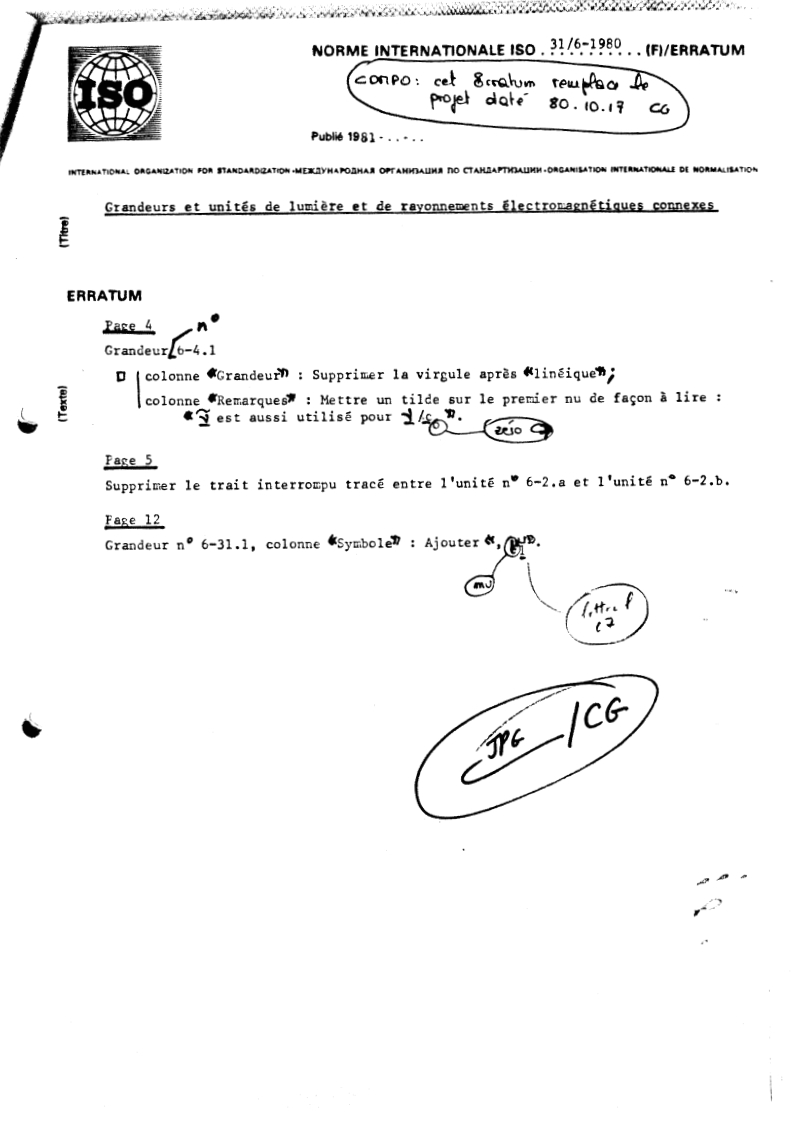
Publie 1983 - . . - . .
IWTERUATIOUAL ORC4WIUT~OU COR mANDARDLZ*TION *MEXil~'HA?OllHAI o?rAHU3AUHI Il0 CTAHILA-UHH .OIGANI$ATKHI tWlElW*T(OYUt Dt YORMALIMTIO~
Grandeurs et unités de lumière et de rayonnements 6lectron;annEdaues c onnexes
E
ERRATUM
O colonne *Grandeur% : Supprimr la virgule après 4linéiqueYbj
col
...
This May Also Interest You
This document establishes the air interface based on ISO/IEC 18000-63 for radio frequency identification (RFID) devices operating in the 860 MHz to 930 MHz range used in sensing as well as item management applications. This document specifies the physical and logical requirements for a passive-backscatter Interrogator-Talks-First (ITF) system. This document specifies: logical and physical procedures between the interrogator and tags to allocate a dedicated subcarrier channel to each of the tags to produce continuous data streaming; logical and physical procedure between the interrogator and the tags to start and stop the continuous data streaming; logical interface between the interrogator and the tag to configure a digital sensor and to receive data from the digital sensor through the tag.
- Standard20 pagesEnglish languagesale 15% off
- Draft21 pagesEnglish languagesale 15% off
- Draft21 pagesEnglish languagesale 15% off
- Draft21 pagesEnglish languagesale 15% off
- Draft21 pagesEnglish languagesale 15% off
- 12-Feb-2026
- 35.040.50
- ISO/IEC JTC 1/SC 31
This document specifies the risks and reliability of an autonomous underwater vehicle (AUV) in its underwater realm. It covers sensors, communication devices, and any other pieces and parts directly influencing the “digital mission” of the vehicle. This document does not cover the manufacturing or operation of the following items: autonomous underwater gliders (AUGs), as they use a narrowly modifiable set of operational commands; batteries for the use of AUVs; electrical motors for the use of AUVs.
- Standard22 pagesEnglish languagesale 15% off
- Draft22 pagesEnglish languagesale 15% off
- Draft22 pagesEnglish languagesale 15% off
- Draft22 pagesEnglish languagesale 15% off
- Draft22 pagesEnglish languagesale 15% off
- 12-Feb-2026
- 47.080
- ISO/TC 8/SC 13
This document specifies a method for the determination of organically bound halogens fluorine, chlorine, bromine and iodine which are adsorbable on activated carbon. Adsorption takes place on activated carbon packed in columns. The method is applicable for the determination of: ≥ 2 µg/l AOF, expressed as F; ≥ 10 µg/l AOCl, expressed as Cl; ≥ 1 µg/l AOBr, expressed as Br; ≥ 1 µg/l AOI, expressed as I. The method is applicable for the determination of adsorbable organically bound fluorine, chlorine, bromine and iodine in water, e.g. in groundwater, surface water, bank filtrate, drinking water, aqueous eluates, cooling water and wastewater. The working range is limited by the capacity of the activated carbon, the process blank and the capacity of the chromatographic separation column. Sample dilution into the working range can be required. The range of application can be extended to lower concentrations with lower process blanks e.g. using low blank activated carbons. The method can also be applied for samples containing suspended solids. Halogens adsorbed on the suspended solids (e.g. undissolved halides) are also determined. Filtration of the sample prior to analysis using a membrane filter (0,45 µm) allows the separate determination of dissolved adsorbable and particulate bound fractions of organically bound fluorine, chlorine, bromine or iodine. Results from an international interlaboratory trial are presented in Annex K.
- Standard44 pagesEnglish languagesale 15% off
- Standard47 pagesFrench languagesale 15% off
- Draft45 pagesEnglish languagesale 15% off
- Draft45 pagesEnglish languagesale 15% off
- Draft45 pagesEnglish languagesale 15% off
- Draft45 pagesEnglish languagesale 15% off
- Draft48 pagesFrench languagesale 15% off
- Draft48 pagesFrench languagesale 15% off
- 12-Feb-2026
- 13.060.50
- ISO/TC 147/SC 2
This document establishes definitions and evaluation methods for the following wheel-rail contact geometry parameters influencing the vehicle running dynamic behaviour: the rolling radius difference between the two wheels of a wheelset (Δr-function) which serves as a basis for all further calculations; the equivalent conicity function from which are derived: a single equivalent conicity value for a specified amplitude, which is relevant for the assessment of vehicle running stability on straight track and in very large radius curves; the nonlinearity parameter, which characterizes the shape of this function and is related to the vehicle behaviour, particularly in the speed range close to the running stability limit; the rolling radii coefficient, which is used to describe the theoretical radial steering capability of a wheelset in a curved track. Additional information is given about the relationship between the contact angles of the two wheels of a wheelset (Δtanγ-function) and about the roll angle parameter. NOTE Out of the presented parameters only those related to the contact angle are relevant for independently rotating wheels of wheel pairs. Descriptions of possible calculation methods are included in this document. Test case calculations are provided to achieve comparable results and to check the proper implementation of the described algorithms. To validate alternative methods not described in this document, acceptance criteria are given for the equivalent conicity function. This includes reference profiles, profile combinations, tolerances and reference results with tolerance limits. This document also includes minimum requirements for the measurement of wheel and rail profiles as well as of the parameters needed for the transformation into a common coordinate system of right-hand and left-hand profiles. This document does not define limits for the wheel-rail contact geometry parameters and gives no tolerances for the rail profile and the wheel profile to achieve acceptable results. For the application of this document some general recommendations are given.
- Standard107 pagesEnglish languagesale 15% off
- Standard110 pagesFrench languagesale 15% off
- Draft107 pagesEnglish languagesale 15% off
- Draft107 pagesEnglish languagesale 15% off
- Draft107 pagesEnglish languagesale 15% off
- Draft107 pagesEnglish languagesale 15% off
- Draft110 pagesFrench languagesale 15% off
- Draft110 pagesFrench languagesale 15% off
- 12-Feb-2026
- 17.040.20
- 45.060.01
- ISO/TC 269
This document specifies an architecture and data model for interchange of scene-based media for use in systems and applications that employ renderers for the presentation of immersive media, including audio, visual, tactile and other representations of media types. The architecture and data model specified in this document applies to use cases where there is a need for interchange of scene-based media for presentation by systems with 3D render-based technologies. One specific application of this document is immersive display technologies that utilize a real-time renderer of 3D media to create their visual presentations, as opposed to a video decoder and renderer of 2D raster-based media. Another application of this document is for the distribution of media assets for use across a large variety of applications comprising the Metaverse.
- Standard45 pagesEnglish languagesale 15% off
- Draft45 pagesEnglish languagesale 15% off
- Draft45 pagesEnglish languagesale 15% off
- Draft45 pagesEnglish languagesale 15% off
- Draft45 pagesEnglish languagesale 15% off
- 12-Feb-2026
- 35.040.40
- ISO/IEC JTC 1/SC 29
This document specifies the requirements for qualification, application, inspection, testing handling and storage of materials for plant application of single-layer fusion-bonded epoxy (FBE) coatings applied externally for the corrosion protection of bare steel pipe for use in pipeline transportation systems for oil and gas industries as defined in ISO 13623. NOTE Pipes coated in accordance with this document are considered suitable for additional protection by means of cathodic protection.
- Standard72 pagesEnglish languagesale 15% off
- Standard77 pagesFrench languagesale 15% off
- Draft72 pagesEnglish languagesale 15% off
- Draft72 pagesEnglish languagesale 15% off
- Draft72 pagesEnglish languagesale 15% off
- Draft72 pagesEnglish languagesale 15% off
- Draft76 pagesFrench languagesale 15% off
- Draft76 pagesFrench languagesale 15% off
- 12-Feb-2026
- 75.200
- ISO/TC 67/SC 2
This document specifies a method using automated Randall extraction for the determination of the hexane extract (or light petroleum extract), called the “oil content”, of oilseeds used as industrial raw materials. The procedure for sunflower seed is different from those for others seeds as it includes an additional moisture content determination after the seed has been ground to prepare the test sample. If required, the pure seeds and the impurities can be analysed separately. In the case of groundnuts, the pure seeds, the total fines, the non-oleaginous impurities and the oleaginous impurities can be analysed separately.
- Technical specification11 pagesEnglish languagesale 15% off
- Technical specification11 pagesFrench languagesale 15% off
- 11-Feb-2026
- 67.200.20
- ISO/TC 34/SC 2
This document specifies basic requirements for gearboxes to operate industrial valves for manual and automated on/off and modulating duties, including manual override gearboxes. It includes guidelines for classification, design and methods for conformity assessment. This document does not cover gear systems which are an integral part in the design of valves and subsea gearboxes. Other requirements or conditions of use different from those indicated in this document are agreed between the purchaser and the manufacturer or supplier (first party) prior to order.
- Standard14 pagesFrench languagesale 15% off
- Draft14 pagesEnglish languagesale 15% off
- Draft14 pagesEnglish languagesale 15% off
- Draft14 pagesEnglish languagesale 15% off
- Draft14 pagesEnglish languagesale 15% off
- 11-Feb-2026
- 23.060.01
- ISO/TC 153
This document specifies the quality and safety requirements for Anemarrhena asphodeloides rhizome. This document applies to Anemarrhena asphodeloides rhizome that is sold and used as natural medicines in international trade, including Chinese materia medica (whole medicinal materials) and decoction pieces derived from the plant.
- Standard10 pagesEnglish languagesale 15% off
- 11-Feb-2026
- 11.120.10
- ISO/TC 249
- Standard15 pagesEnglish languagesale 15% off
- 11-Feb-2026
- 35.040.99
- ISO/IEC JTC 1/SC 29
Questions, Comments and Discussion
Ask us and Technical Secretary will try to provide an answer. You can facilitate discussion about the standard in here.
Loading comments...