


ISO/R 1994:1971
(Main)Title missing - Legacy paper document
Title missing - Legacy paper document
General Information
- Status
- Withdrawn
- Publication Date
- 31-Dec-1970
- Technical Committee
- ISO/TMBG - Technical Management Board - groups
- Drafting Committee
- ISO/TMBG - Technical Management Board - groups
- Current Stage
- 9599 - Withdrawal of International Standard
- Start Date
- 01-Jan-1976
- Completion Date
- 14-Feb-2026
Relations
- Consolidated By
ISO 9018:2003 - Destructive tests on welds in metallic materials — Tensile test on cruciform and lapped joints - Effective Date
- 28-Feb-2023
Buy Documents
ISO/R 1994:1971 - Title missing - Legacy paper document Released:1/1/1971
ISO/R 1994:1971 - Title missing - Legacy paper document Released:1/1/1971
Frequently Asked Questions
ISO/R 1994:1971 is a standardization document published by the International Organization for Standardization (ISO). Its full title is "Title missing - Legacy paper document". This standard covers: Title missing - Legacy paper document
Title missing - Legacy paper document
ISO/R 1994:1971 has the following relationships with other standards: It is inter standard links to ISO 9018:2003. Understanding these relationships helps ensure you are using the most current and applicable version of the standard.
ISO/R 1994:1971 is available in PDF format for immediate download after purchase. The document can be added to your cart and obtained through the secure checkout process. Digital delivery ensures instant access to the complete standard document.
Standards Content (Sample)
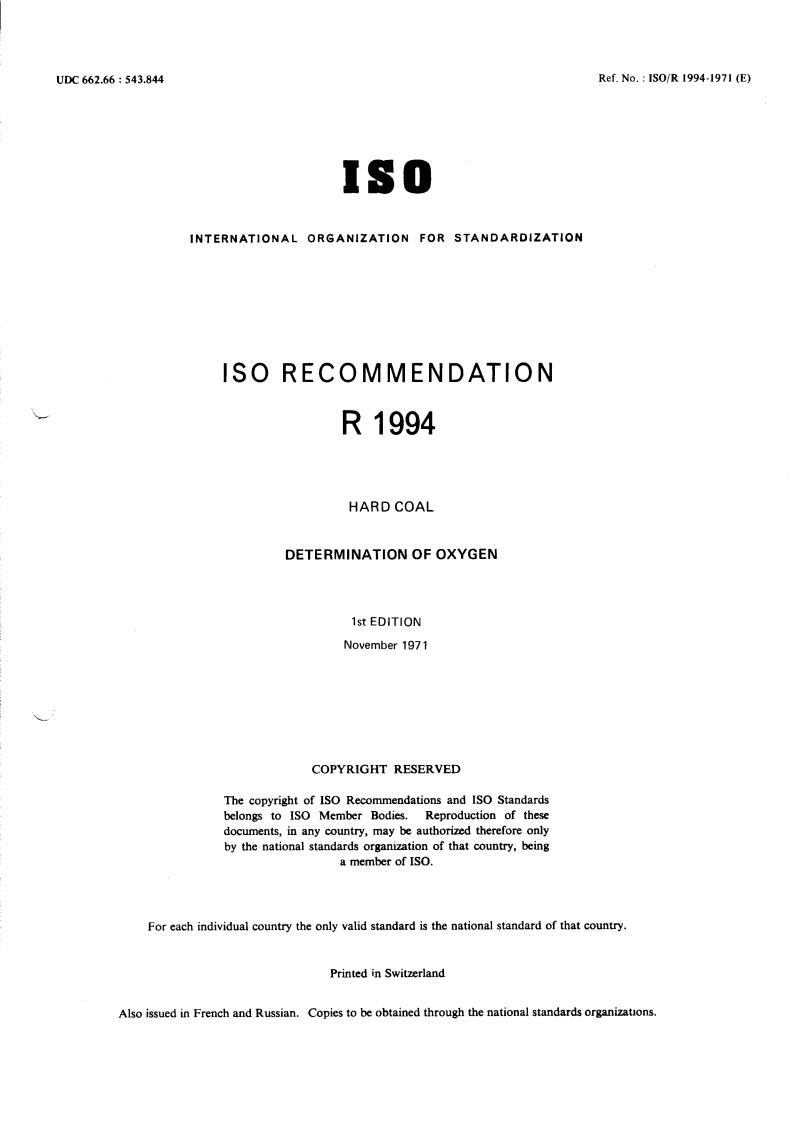
UDC 662.66 : 543.844 Ref. No. : ISO/R 1994-1971 (E)
IS0
I N T E R N AT I ON A L O R G A N 1 Z AT I ON FOR STAN DARD 1 ZAT I O N
IS0 RECOMMENDATION
c
R 1994
HARD COAL
DETERMINATION OF OXYGEN
1st EDITION
November 197 1
COPYRIGHT RESERVED
The copyright of IS0 Recommendations and IS0 Standards
belongs to IS0 Member Bodies. Reproduction of these
documents, in any country, may be authorized therefore only
by the national standards organization of that country, being
a member of ISO.
For each individual country the only valid standard is the national standard of that country.
Printed in Switzerland
Also issued in French and Russian. Copies to be obtained through the national standards organizations.
-2-
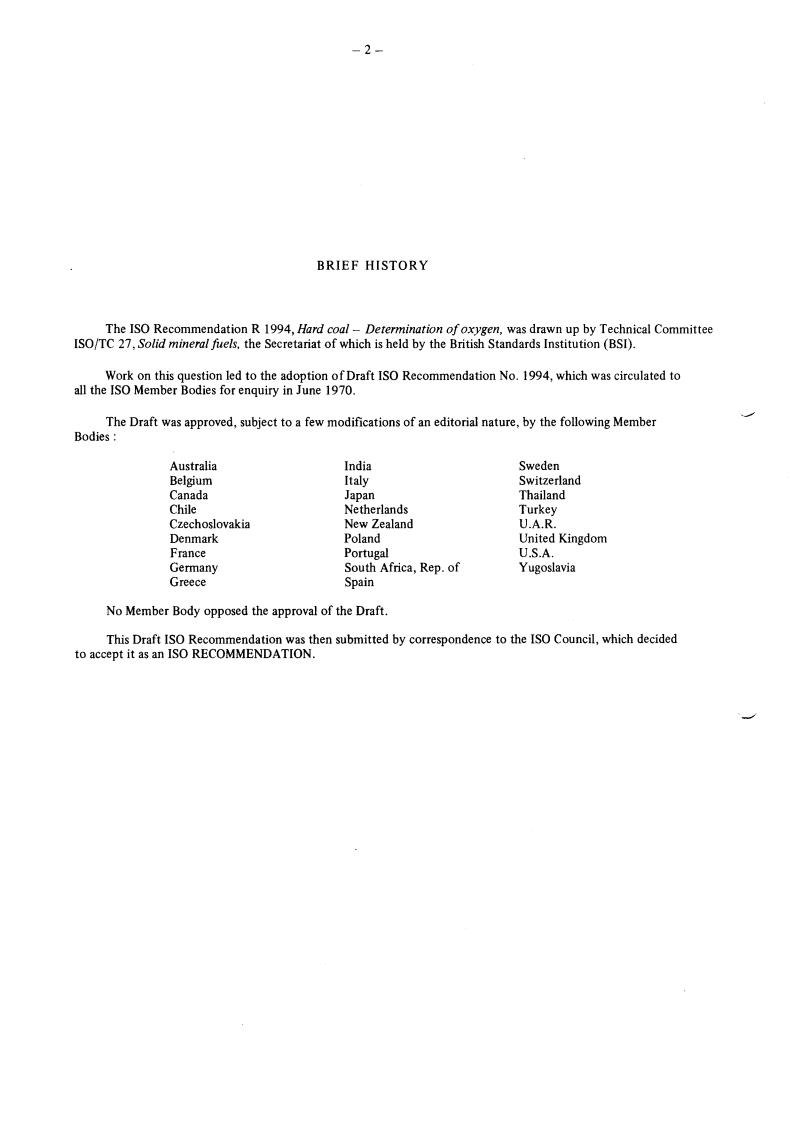
BRIEF HISTORY
The IS0 Recommendation R 1994, Hard coal - Determination ofoxygen, was drawn up by Technical Committee
ISO/TC 27, Solid mineral fuels, the Secretariat of which is held by the British Standards Institution (BSI).
Work on this question led to the adoption ofDraft IS0 Recommendation No. 1994, which was circulated to
all the IS0 Member Bodies for enquiry in June 1970.
The Draft was approved, subject to a few modifications of an editorial nature, by the following Member
Bodies :
Sweden
Australia India
Belgium Switzerland
Italy
Canada Japan Thailand
Chile Netherlands Turkey
Czechoslovakia New Zealand U.A.R.
Denmark Poland United Kingdom
France Portugal U.S.A.
Germany South Africa, Rep. of Yugoslavia
Greece Spain
No Member Body opposed the approval of the Draft.
This Draft IS0 Recommendation was then submitted by correspondence to the IS0 Council, which decided
to accept it as an IS0 RECOMMENDATION.
-3- ISO/R 1994-1971 (E)
R 1994 November 1971
IS0 Recommendation
HARD COAL
DETERMINATION OF OXYGEN
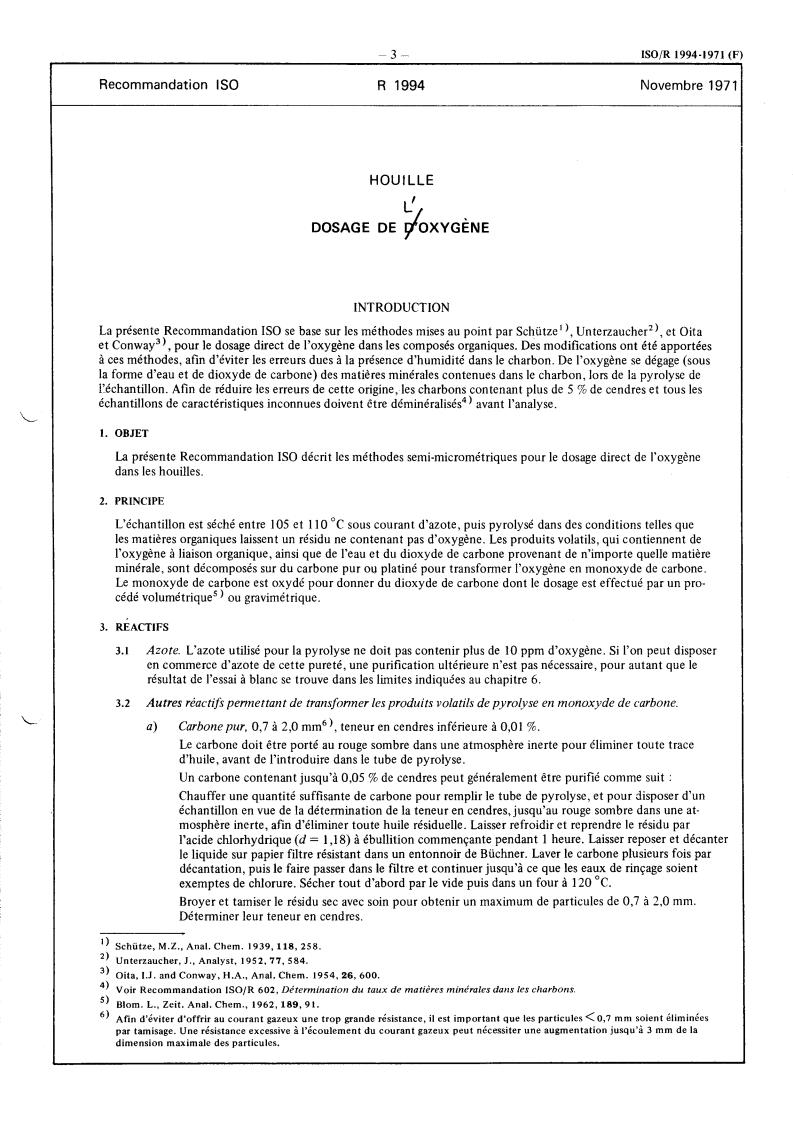
INTRODUCTION
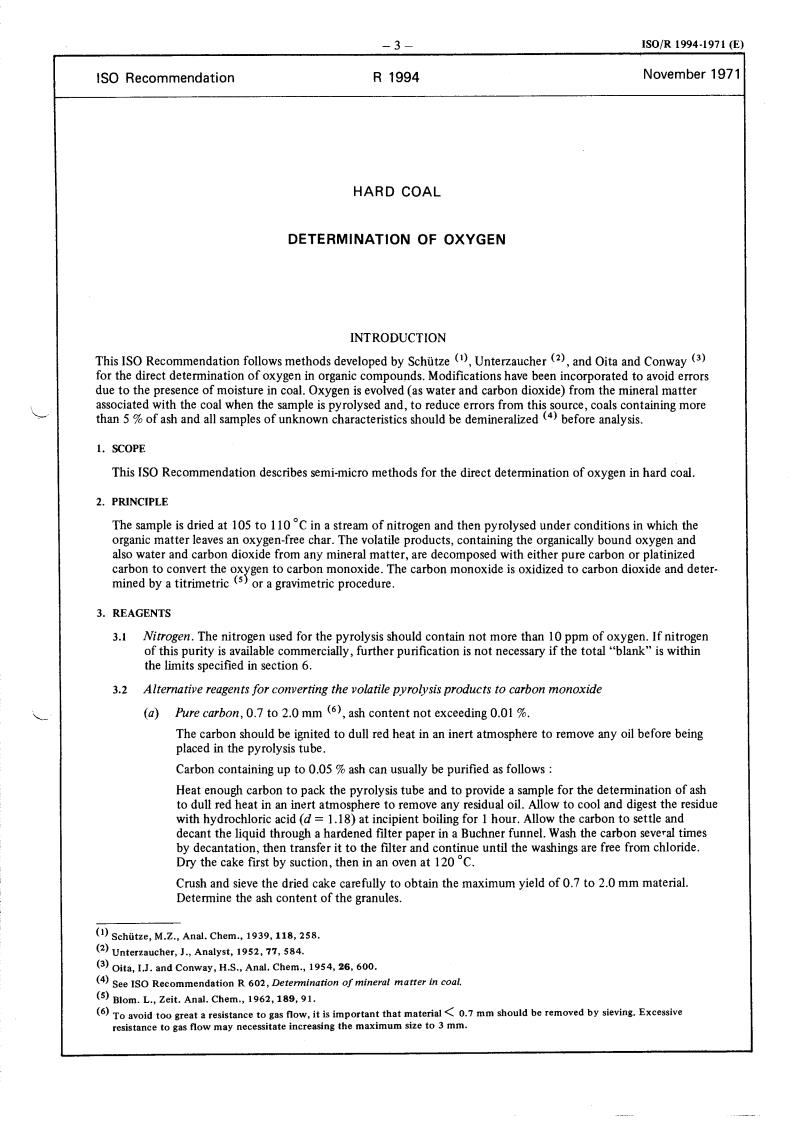
This IS0 Recommendation follows methods developed by Schütze (‘I, Unterzaucher (2), and Oita and Conway (3)
for the direct determination of oxygen in organic compounds. Modifications have been incorporated to avoid errors
due to the presence of moisture in coal. Oxygen is evolved (as water and carbon dioxide) from the mineral matter
associated with the coal when the sample is pyrolysed and, to reduce errors from this source, coals containing more
than 5 % of ash and all samples of unknown characteristics should be demineralized (4) before analysis.
1. SCOPE
This IS0 Recommendation describes semi-micro methods for the direct determination of oxygen in hard coal.
2. PRINCIPLE
The sample is dried at 105 to 110 “C in a stream of nitrogen and then pyrolysed under conditions in which the
organic matter leaves an oxygen-free char. The volatile products, containing the organically bound oxygen and
also water and carbon dioxide from any mineral matter, are decomposed with either pure carbon or platinized
carbon to convert the ox gen to carbon monoxide. The carbon monoxide is oxidized to carbon dioxide and deter-
mined by a titrimetric (’j)or a gravimetric procedure.
3. REAGENTS
3.1 Nitrogen. The nitrogen used for the pyrolysis should contain not more than 10 ppm of oxygen. If nitrogen
of this purity is available commercially, further purification is not necessary if the total “blank” is within
the limits specified in section 6.
3.2 Alternative reagents for converting the volatile pyrolysis products to carbon monoxide
Pure carbon, 0.7 to 2.0 mm (6), ash content not exceeding 0.01 %.
(a)
The carbon should be ignited to dull red heat in an inert atmosphere to remove any oil before being
placed in the pyrolysis tube.
Carbon containing up to 0.05 % ash can usually be purified as follows :
Heat enough carbon to pack the pyrolysis tube and to provide a sample for the determination of ash
to dull red heat in an inert atmosphere to remove any residual oil. Allow to cool and digest the residue
with hydrochloric acid (d = 1.18) at incipient boiling for 1 hour. Allow the carbon to settle and
decant the liquid through a hardened filter paper in a Buchner funnel. Wash the carbon several times
by decantation, then transfer it to the filter and continue until the washings are free from chloride.
Dry the cake fsst by suction, then in an oven at 120 OC.
Crush and sieve the dried cake carefully to obtain the maximum yield of 0.7 to 2.0 mm material.
Determine the ash content of the granules.
Schütze, M.Z., Anal. Chem., 1939,118,258.
(2) Unterzaucher, J., Analyst, 1952, 77, 584.
(3) Oita, I.J. and Conway, H.S., Anal. Chem., 1954, 26, 600.
(4) See IS0 Recommendation R 602, Determination of mineral maiter in coal.
Blom. L., Zeit. Anal. Chem., 1962,189, 91.
(6) To avoid too great a resistance to gas flow, it is important that material < 0.7 mm should be removed by sieving. Excessive
resistance to gas flow may necessitate increasing the maximum size to 3 mm.
r
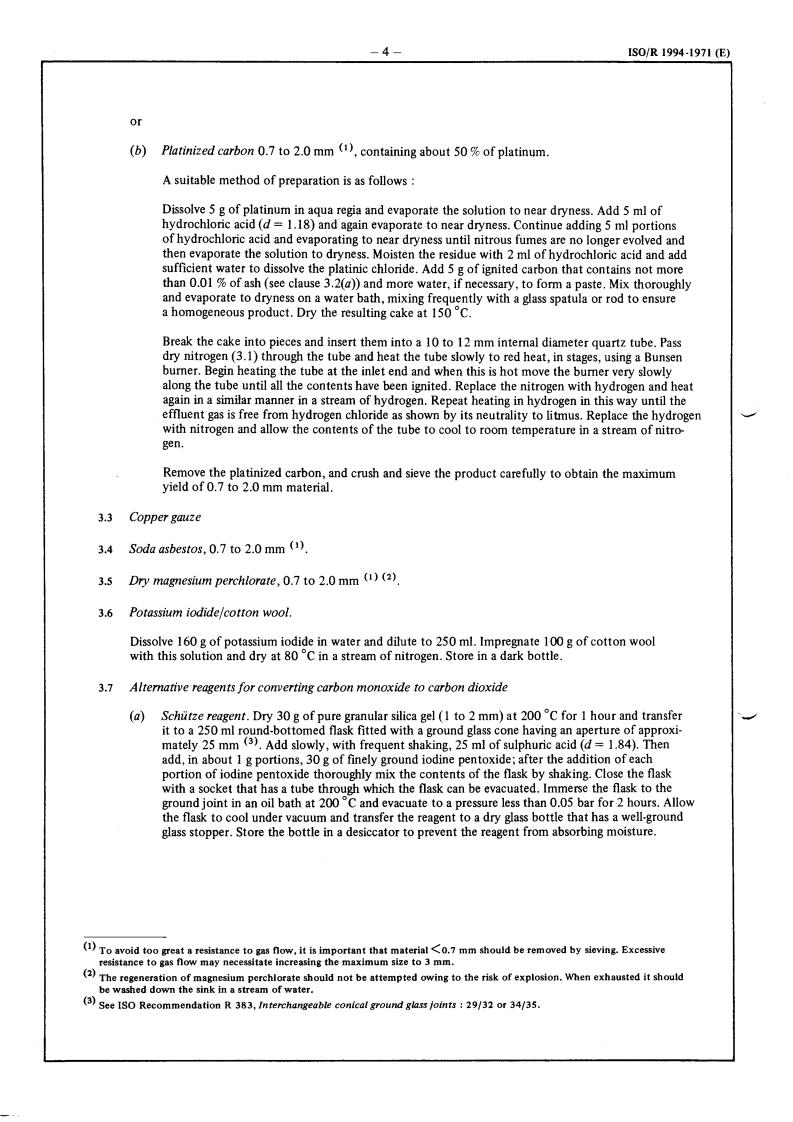
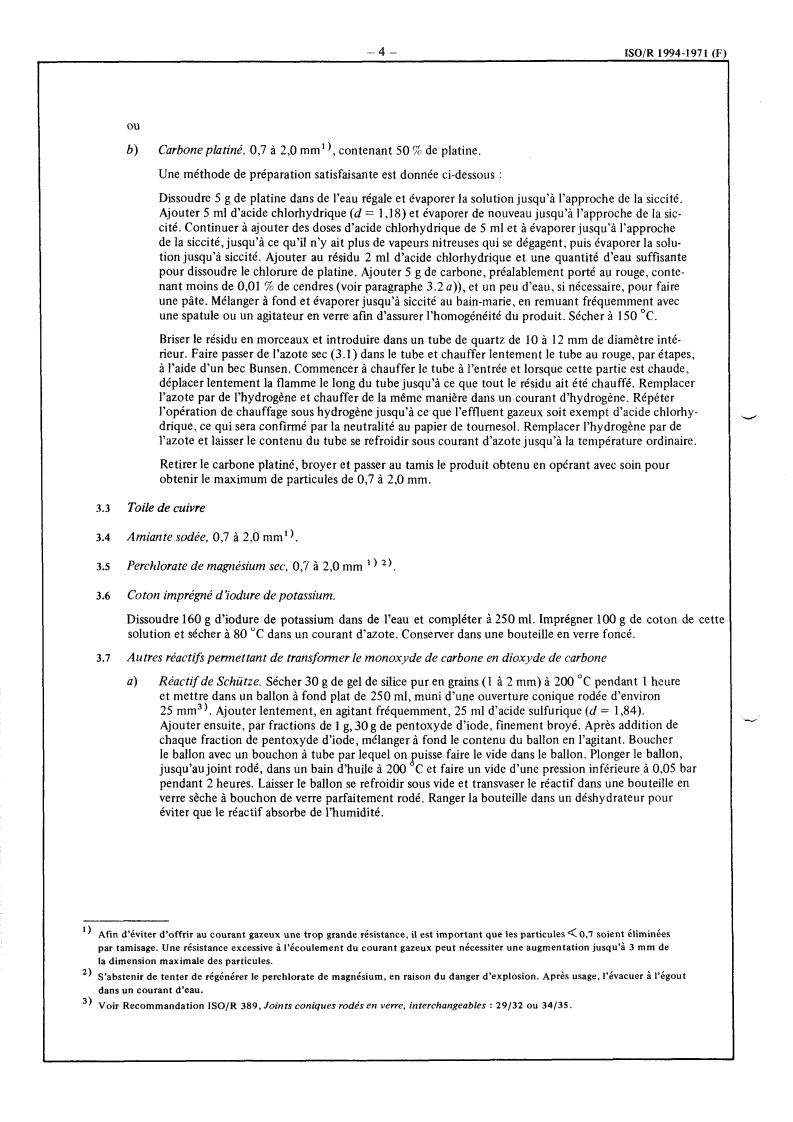
Platinized carbon 0.7 to 2.0 mm ('), containing about 50 % of platinum.
(b)
A suitable method of preparation is as follows :
Dissolve 5 g of platinum in aqua regia and evaporate the solution to near dryness. Add 5 ml of
hydrochloric acid (d = 1.18) and again evaporate to near dryness. Continue adding 5 ml portions
of hydrochloric acid and evaporating to near dryness until nitrous fumes are no longer evolved and
then evaporate the solution to dryness. Moisten the residue with 2 ml of hydrochloric acid and add
sufficient water to dissolve the platinic chloride. Add 5 g of ignited carbon that contains not more
than 0.01 % of ash (see clause 3.2(a)) and more water, if necessary, to form a paste. Mix thoroughly
and evaporate to dryness on a water bath, mixing frequently with a glass spatula or rod to ensure
a homogeneous product. Dry the resulting cake at 150 "C.
Break the cake into pieces and insert them into a 1 O to 12 mm internal diameter quartz tube. Pass
dry nitrogen (3.1) through the tube and heat the tube slowly to red heat, in stages, using a Bunsen
burner. Begin heating the tube at the inlet end and when this is hot move the burner very slowly
along the tube until all the contents have been ignited. Replace the nitrogen with hydrogen and heat
again in a similar manner in a stream of hydrogen. Repeat heating in hydrogen in this way until the
effluent gas is free from hydrogen chloride as shown by its neutrality to litmus. Replace the hydrogen
with nitrogen and allow the contents of the tube to cool to room temperature in a stream of nitro-
gen.
Remove the platinized carbon, and crush and sieve the product carefully to obtain the maximum
yield of 0.7 to 2.0 mm material.
3.3 Copper gauze
3.4 Soda asbestos, 0.7 to 2.0 mm ('I.
Dry magnesium perchlorate, 0.7 to 2.0 mm (') (*I.
3.5
3.6 Potassium iodidelcotton wool.
Dissolve 160 g of potassium iodide in water and dilute to 250 ml. Impregnate 100 g of cotton wool
with this solution and dry at 80 "C in a stream of nitrogen. Store in a dark bottle.
3.7 Alternative reagents for converting carbon monoxide to carbon dioxide
Schütze reagent. Dry 30 g of pure granular silica gel (1 to 2 mm) at 200 "C for 1 hour and transfer
(a)
it to a 250 ml round-bottomed flask fitted with a ground glass cone having an aperture of approxi-
mately 25 mm (3). Add slowly, with frequent shaking, 25 ml of sulphuric acid (d = 1.84). Then
add, in about 1 g portions, 30 g of finely ground iodine pentoxide; after the addition of each
portion of iodine pentoxide thoroughly mix the contents of the flask by shaking. Close the flask
with a socket that has a tube through which the flask can be evacuated. Immerse the flask to the
ground joint in an oil bath at 200 "C and evacuate to a pressure less than 0.05 bar for 2 hours. Allow
the flask to cool under vacuum and transfer the reagent to a dry glass bottle that has a well-ground
glass stopper. Store the bottle in a desiccator to prevent the reagent from absorbing moisture.
(') To avoid too great a resistance to gas flow, it is important that material <0.7 mm should be removed by sieving. Excessive
resistance to gas flow may necessitate increasing the maximum size to 3 mm.
(2) The regeneration of magnesium perchlorate should not be attempted owing to the risk of explosion. When exhausted it should
of water.
be washed down the sink in a stream
(3) See IS0 Recommendation R 383, Interchangeable conicalground glass joints : 29/32 or 34/35.
5- ISO/R 1994-1971 (E
or
(b) Anhydro-iodic acid (H1308).
If anhydro-iodic acid suitable for the determination of carbon monoxide cannot be obtained com-
mercially, it may be prepared by the following method :
Add an excess of iodic acid or iodine pentoxide to a boiling mixture of 3 volumes of nitric acid
(d = 1.4) and 2 volumes of water. Boil the solution with the undissolved excess for 1 hour to obtain
a saturated solution. Filter the hot solution immediately, by suction, through a sintered glass filter
(pore size I5 to 40 pm). Leave the filtrate to crystallize for a day. Transfer the crystals to a sintered
glass Buchner funnel and wash them with cold nitric acid (d = 1.4). Dry the crystals at room tem-
perature, first by aspirating clean air over them for 1 hour and then in a desiccator containing dishes
of sodium hydroxide and phosphorus pentoxide.
or
Red mercuric oxide, pellets about 2 mm diameter and 1 mm thick prepared from good quality
(c)
commercial material.
Mercuric oxide having the following specification has been found suitable :
not less than 99.3 % (dry)
Assay :
Loss on drying :
not more than 0.3 % at 150 "C
Mercurous salts : not more than a trace
Chloride : not more than 0.25 %
Nitrate : no reaction
Non-volatile residue : not more than 0.1 %
Alternatively, red mercuric oxide may be prepared as follows :
Dissolve 140 g of mercury in about 100 ml of nitric acid (d = 1.4). Evaporate the solution to dryness
in a porcelain dish. Heat the dish at about 400 "C in an efficient fume cupboard until no yellow
crystals of mercuric nitrate [Hg(N03)2] remain.
Silver wire, 0.1 to 0.2 mm diameter.
3.8
3.9 Pyridine
Pyridine having the following specification has been found suitable :
not less than 99.0 %
CSHSN :
0.981 to 0.983 g/ml
Density at 20 "C :
n20 .
1.5090 to 1.5100
D'
Not less than 95 % distils at 114 to 117 "C
Maximum limits of impurities :
- water-insoluble matter : nil
- non-volatile matter : 0.002 %
- chloride : 0.0005 %
- copper: 0.0002 %
- ammonia : 0.002 %
- oxygen absorbed from
permanganate : 0.0008 %
- water : 0.1 %
If sufficiently pure pyridine is not available, re-distil with a column of 15 to 20 theoretical plates. Using a reflux
ratio of 100, distil and reject the first 10 %. Reduce the reflux ratio to 10 and distil and collect the next 75 %
for use.
-6- ISO/R 1994-1971 (E
3.10 Ethanolamine
3.1 1 Thymol blue indicator, 0.4 % solution in pyridine (3.9).
3.12 Sodium methoxide, 0.05 N solution.
Dissolve 1.15 g of sodium in 500 ml of methanol and dilute with pure pyridine to 1 litre. Store the solution
so as to exclude carbon dioxide.
Weigh, to the nearest 0.1 mg, about 50 mg of benzoic acid. Place 15 ml of pyridine (3.9) in a 100 ml conical
flask and add 2 drops of the thymol blue indicator (3.1 1). With nitrogen passing through the flask to exclude
air, neutralize the contents with the sodium methoxide solution, dissolve the weighed benzoic acid in the
contents of the flask and titrate with the sodium methoxide solution to a blue end-point. Calculate the nor-
mality of the sodium methoxide as follows :
m
N=-
122.1 v
where
N is the normality of the sodium methoxide solution;
m is the mass, in milligrammes, of benzoic acid taken;
V is the volume, in millilitres, of sodium methoxide solution used in the titration.
4. APPARATUS
The general arrangement of the apparatus is shown in Figure 1. The components should be constructed with
ground glass joints for connecting one to the other, except for the tube or vessel in which the carbon dioxide
produced from the oxygen is absorbed.
4.1
Nitrogen purification train. A typical purifying train (see Figure 2) consists of :
a pressure regulator containing heavy (medicinal quality) paraffin; a cylinder 300 mm high and
(a)
50 mm in diameter is suitable;
a vertical tube about 120 mm high and 30 mm internal diameter containing dry magnesium
(6)
perchlorate (3.5);
a vertical quartz tube about 300 mm long and 15 mm internal diameter containing porous copper
(c)
heated to approximately 500 OC. Porous copper is produced by reducing copper oxide in wire form
with hydrogen diluted with nitrogen at the lowest temperature at which reduction occurs, usually
between 200 and 250 OC;
a bubbler, containing heavy (medicinal quality) paraffin, to provide a visual indication of the flow
(d)
rate of the nitrogen;
a U-tube about 150 mm high and 15 mm internal diameter, the first one-third of which contains
(e)
soda asbestos (3.4), the next one-third magnesium perchlorate (3.5) and the final one-third a mixture
of 2 parts by volume of phosphorus pentoxide powder and 1 part by volume of 0.7 to 2.0 mm glass
chips.
4.2 Pyrolysis tube assembly. The pyrolysis tube should be of 10 f 1 mm internal diameter and made from the
purest available clear quartz, free from striae and other visible defects.
Two typical designs for the inlet end of the pyrolysis tube are shown. The design shown in Figure 3(a)
incorporates an auxiliary tube with which it is possible to exclude air while the sample is being inserted.
The sample is both dried and pyrolysed between the nitrogen inlet tube and the carbonaceous packing
and this section must be sufficiently long to accommodate any heater used for drying the sample and
also for pyrolysing the sample. A suitable removable heater for drying the sample is shown in Figure 4.
-7- ISO/R 1994-1971 (E)
In the design shown in Figure 3(b), air admitted when the sample is inserted is removed, together
with the moisture, before the sample is pyrolysed. The distance between the nitrogen inlet and the
cap of the pyrolysis tube should be sufficient to accommodate the heater used to dry the sample and
the distance between the nitrogen inlet and the carbonaceous packing sufficient for pyrolysing the
sample.
The sample may be pyrolysed using either gas or electric heating, but electric furnaces are preferable
for heating reagents.
Conversion of the oxygen in the volatile pyrolysis products to carbon monoxide may be achieved
either with pure carbon (3.2(a)) or with platinized carbon (3.2(b)). If pure carbon (3.2(a)) is used, the
packed length should be 190 to 200 mm. Rolled platinum gauze plugs 5 mm long are used to retain the
packing in position. A furnace should be provided to heat the carbon to 1125 rt 25 OC.
If platinized carbon (3.2(b)) is used, the packing should consist of two 45 to 50 mm sections separated
and retai
...
CDU 662.66 : 543.844
Réf. NO : ISO/R 1994-1971 (F)
IS0
ORGAN I SAT1 ON INTERN AT1 ON A LE DE NORM A LI SAT1 ON
RECOMMANDATION IS0
R 1994
HOU ILLE
DOSAGE DE L~OXYGÈNE
I ère É D IT I ON
Novembre 197 1
REPRODUCïION INTERDITE
Le droit de reproduction des Recommandations IS0 et des Normes
IS0 est la propriétk des Comités Membres de I’ISO. En conSe-
quence, dans chaque pays, la reproduction de ces documents ne
peut être autorisée que par l’organisation nationale de normali-
sation de ce pays, membre de I’ISO.
Seules les normes nationales sont valables dans leurs pays respectifs.
Imprimé en Suisse
Ce document est également édit6 en anglais et en russe. I1 peut être obtenu auprès des organisations
nationales de normalisation.
-2-
HISTORIQUE
La Recommandation ISO/R 1994, Houille - Dosage de l’oxygène, a été élaborée par le Comité
Technique ISO/TC 27, Combustibles minéraux solides, dont le Secrétariat est assuré par la British Standards
Institution (BSI).
Les travaux relatifs à cette question aboutirent à l’adoption du Projet de Recommandation IS0 NO 1994
qui fut soumis, en juin 1970 à l’enquête de tous les Comités Membres de l’IS0.
d
Le Projet a été approuvé, sous réserve de quelques modifications d’ordre rédactionnel, par les Comités Membres
suivants :
Royaume-Uni
Afrique du Sud, Rép. d’ Grèce
Allemagne Inde Suède
Suisse
Australie Italie
Tchécoslovaquie
Belgique Japon
Canada Nouvelle-Zélande Thaïlande
Chili Pays-Bas Turquie
Danemark Pologne U.S.A.
Yougoslavie
Espagne Portugal
France R.A.U.
Aucun Comité Membre ne se déclara opposé à l’approbation du Projet.
Ce Projet de Recommandation IS0 fut alors soumis par correspondance au Conseil de IWO, qui décida de
l’accepter comme RECOMMANDATION ISO.
3- ISO/R 1994-1971 (F
Recommandation IS0 R 1994 Novembre 197 1
INTRODUCTION
La présente Recommandation IS0 se base sur les méthodes mises au point par Schütze’ ), Unterzaucher*), et Oita
et Conwayj), pour le dosage direct de l’oxygène dans les composés organiques. Des modifications ont été apportées
à ces méthodes, afin d’éviter les erreurs dues à la présence d’humidité dans le charbon. De l’oxygène se dégage (sous
la forme d’eau et de dioxyde de carbone) des matières minérales contenues dans le charbon, lors de la pyrolyse de
Iléchantillon. Afin de réduire les erreurs de cette origine, les charbons contenant plus de 5 5% de cendres et tous les
échantillons de caractéristiques inconnues doivent être déminéralisés4) avant l’analyse.
1. OBJET
La présente Recommandation IS0 décrit les méthodes semi-micrométriques pour le dosage direct de l’oxygène
dans les houilles.
2. PRINCIPE
L‘échantillon est séché entre 105 et 110 “C sous courant d’azote, puis pyrolysé dans des conditions telles que
les matières organiques laissent un résidu ne contenant pas d’oxygène. Les produits volatils, qui contiennent de
l’oxygène à liaison organique, ainsi que de l’eau et du dioxyde de carbone provenant de n’importe quelle matière
minérale, sont décomposés sur du carbone pur ou platiné pour transformer l’oxygène en monoxyde de carbone.
Le monoxyde de carbone est oxydé pour donner du dioxyde de carbone dont le dosage est effectué par un pro-
cédé volumétrique5 ) ou gravimétrique.
3. REACTIFS
3.1 Azote. L’azote utilisé pour la pyrolyse ne doit pas contenir plus de 10 ppm d’oxygène. Si l’on peut disposer
en commerce d’azote de cette pureté, une purification ultérieure n’est pas nécessaire, pour autant que le
résultat de l’essai à blanc se trouve dans les limites indiquèes au chapitre 6.
3.2 Autres réactifs permettant de transfonner les produits volatils de pyrolyse en monoxyde de carbone.
Carbone pur, 0,7 à 2,O mm6), teneur en cendres inférieure à 0,Ol %.
a)
Le carbone doit être porté au rouge sombre dans une atmosphère inerte pour éliminer toute trace
d’huile, avant de l’introduire dans le tube de pyrolyse.
Un carbone contenant jusqu’à 0,05 % de cendres peut généralement être purifié comme suit :
Chauffer une quantité suffisante de carbone pour remplir le tube de pyrolyse, et pour disposer d’un
échantillon en vue de la détermination de la teneur en cendres, jusqu’au rouge sombre dans une at-
mosphère inerte, afin d’éliminer toute huile résiduelle. Laisser refroidir et reprendre le résidu par
l’acide chlorhydrique (d = 1,18) à ébullition commençante pendant 1 heure. Laisser reposer et décanter
le liquide sur papier filtre résistant dans un entonnoir de Büchner. Laver le carbone plusieurs fois par
décantation, puis le faire passer dans le filtre et continuer jusqu’à ce que les eaux de rinçage soient
exemptes de chlorure. Sécher tout d’abord par le vide puis dans un four à 120 OC.
Broyer et tamiser le résidu sec avec soin pour obtenir un maximum de particules de 0,7 à 2,O mm.
Déterminer leur teneur en cendres.
Schütze,M.Z.,Anal.Chem. 1939,118, 258.
*) Unterzaucher, J., Analyst, 1952, 77, 584.
3, Oita, 1.J. and Conway, H.A., Anal. Chem. 1954.26, 600.
4, Voir Recommandation ISO/R 602, Détermination du taux de matières minérales dans les charbons.
Blom. L., Zeit. Anal. Chem., 1962, 189, 91.
6, Afin d’éviter d’offrir au courant gazeux une trop grande résistance, il est important que les particules < 0,7 mm soient éliminées
par tamisage. Une résistance excessive à l’écoulement du courant gazeux peut nécessiter une augmentation jusqu’à 3 mm de la
dimension maximale des particules.
-4- ISO/R 1994-1971 (F)
ou
Carbone platiné, 0,7 à 2,O mm’), contenant 50 10 de platine.
b)
Une méthode de préparation satisfaisante est donnée ci-dessous :
Dissoudre 5 g de platine dans de l’eau régale et évaporer la solution jusqu’à l’approche de la siccité.
Ajouter 5 ml d’acide chlorhydrique (d = 1,18) et évaporer de nouveau jusqu’à l’approche de la sic-
cité. Continuer à ajouter des doses d’acide chlorhydrique de 5 ml et à évaporer jusqu’à l’approche
de la siccité, jusqu’à ce qu’il n’y ait plus de vapeurs nitreuses qui se dégagent, puis évaporer la solu-
tion jusqu’à siccité. Ajouter au résidu 2 ml d’acide chlorhydrique et une quantité d’eau suffisante
pour dissoudre le chlorure de platine. Ajouter 5 g de carbone, préalablement porté au rouge, conte-
nant moins de 0,Ol % de cendres (voir paragraphe 3.2 a)), et un peu d’eau, si nécessaire, pour faire
une pâte. Mélanger à fond et évaporer jusqu’à siccité au bain-marie, en remuant fréquemment avec
une spatule ou un agitateur en verre afin d’assurer l’homogénéité du produit. Sécher à 150 “C.
Briser le résidu en morceaux et introduire dans un tube de quartz de IO à 12 mm de diamètre inté-
rieur. Faire passer de l’azote sec (3.1) dans le tube et chauffer lentement le tube au rouge, par étapes,
à l’aide d’un bec Bunsen. Commencer à chauffer le tube à l’entrée et lorsque cette partie est chaude,
déplacer lentement la flamme le long du tube jusqu’à ce que tout le résidu ait été chauffé. Remplacer
l’azote par de l’hydrogène et chauffer de la même manière dans un courant d’hydrogène. Répéter
l’opération de chauffage sous hydrogène jusqu’à ce que l’effluent gazeux soit exempt d’acide chlorhy-
drique, ce qui sera confirmé par la neutralité au papier de tournesol. Remplacer l’hydrogène par de
l’azote et laisser le contenu du tube se refroidir sous courant d’azote jusqu’à la température ordinaire.
Retirer le carbone platiné, broyer et passer au tamis le produit obtenu en opérant avec soin pour
obtenir le maximum de particules de 0,7 à 2,O mm.
3.3 Toile de cuivre
3.4 Amiante sodée, 0,7 à 2,O mm’).
3.5 Perchlorate de magnésium sec, 0,7 à 2,O mm ’ ) 2,
3.6 Coton imprégné d ïodure de potassium.
Dissoudre 160 g d’iodure de potassium dans de l’eau et compléter à 250 ml. Imprégner 100 g de coton de cetti
solution et sécher à 80 “C dans un courant d’azote. Conserver dans une bouteille en verre foncé.
3.7 Autres réactifs permettant de transfomer le monoxyde de carbone en dioxyde de carbone
Réactif de Schütze. Sécher 30 g de gel de silice pur en grains (1 à 2 mm) à 200 “C pendant 1 heure
a)
et mettre dans un ballon à fond plat de 250 ml, muni d’une ouverture conique rodée d’environ
25 mm3). Ajouter lentement, en agitant fréquemment, 25 ml d’acide sulfurique (d = 1,84).
Ajouter ensuite, par fractions de 1 g, 30 g de pentoxyde d’iode, finement broyé. Après addition de
chaque fraction de pentoxyde d’iode, mélanger à fond le contenu du ballon en l’agitant. Boucher
le ballon avec un bouchon à tube par lequel on puisse faire le vide dans le ballon. Plonger le ballon,
jusqu’au joint rodé, dans un bain d’huile à 200 “C et faire un vide d’une pression inférieure à 0,05 bar
pendant 2 heures. Laisser le ballon se refroidir sous vide et transvaser le réactif dans une bouteille en
verre sèche à bouchon de verre parfaitement rodé. Ranger la bouteille dans un déshydrateur pour
éviter que le réactif absorbe de l’humidité.
’) Afin d’éviter d’offrir au courant gazeux une trop grande résistance, il est important que les particules < 0,7 soient éliminées
par tamisage. Une résistance excessive à l’écoulement du courant gazeux peut nécessiter une augmentation jusqu’à 3 mm de
la dimension maximale des particules.
’) S’abstenir de tenter de régénérer le perchlorate de magnésium, en raison du danger d’explosion. Après usage, l’évacuer à l’égout
dans un courant d’eau.
3, Voir Recommandation ISO/R 389, Joints coniques rodés en verre, interchangeables : 29/32 ou 34/35.
5- ISO/R 1994-1971 (F)
ou
b) Acide iodhydrique (Hl3O8).
Si l’on ne peut obtenir dans le commerce un acide iodhydrique de qualité appropriée pour le
dosage du monoxyde de carbone, le préparer de la façon suivante :
Ajouter un excès d’acide iodique ou de pentoxyde d’iode à un mélange bouillant de 3 volumes
d’acide nitrique (d = 1,4) et de 2 volumes d’eau. Faire bouillir la solution avec l’excès non dissous
pendant 1 heure pour obtenir une solution saturée. Filtrer immédiatement la solution chaude sur
un filtre en verre fritté (dimension des pores 15 à 40 pm) en s’aidant du vide. Laisser le filtrat cns-
talliser pendant un jour. Mettre les cristaux dans un filtre de Buchner en verre fritté et les laver avec
de l’acide nitrique froid (d = 1,4). Sécher les cristaux à la température ordinaire en aspirant tout
d’abord l’air situé au-dessus d’eux pendant 1 heure, puis en les plaçant dans un déshydrateur conte-
nant des coupelles remplies de soude et de pentoxyde de phosphore.
OU
pastilles d’environ 2 mm de diamètre et 1 mm d’épaisseur préparées à
O.xyde mercunque rouge,
c)
partir d‘un produit commercial de bonne qualité.
La composition suivante est jugée acceptable pour l’oxyde mercurique.
Teneur : pas moins de 99,3 7% (sec)
Perte au séchage : pas plus de 0,3 % à 150 “C
Sels mercureux : pas plus d’une trace
Chlorure :
pas plus de 0,25 %
Nitrate : pas de réaction
Résidu non volatil : pas plus de 0,l %
A défaut, on peut préparer de l’oxyde mercurique rouge de la façon suivante :
Dissoudre 140 g de mercure dans environ 100 mi d’acide nitrique (d = 1,4). Evaporer la solution
jusqu’à siccité dans une coupelle en porcelaine. Chauffer à environ 400 “C sous une hotte tirant
bien, jusqu’à ce qu’il ne reste plus de cristaux jaunes de nitrate mercurique [Hg (N03)Z 1.
3.8 Fil d’urgent, 0,l à 0,2 mm de diamètre.
3.9 Pvridine.
La composition suivante est jugée acceptable pour la pyridine :
C.jH.jN: pas moins de 99,O 50
Densité relative à 20 “C : 0,98 1 à 0,983 g/ml
I?: : 1,5090 à 1,s 100
Pas moins de 95 % distillé à une température de 114 à 117 “C
Limites maximales des impuretés :
corps insolubles dans l’eau : néant
corps non volatils :
0,002 %
chlorure : 0,0005 %
cuivre : 0,0002 %
ammoniaque : 0,002 %
oxygène absorbé par
le permanganate : 0,0008 5%
eau : 0,1 %
Si l’on ne peut obtenir de la pyridine suffisamment pure, redistiller sur une colonne à plateaux de 15 à
20 plateaux théoriques. Avec un coefficient de reflux de 100, distiller et éliminer les premiers 10 %.
Ramener le coefficient de reflux à 10, distiller et conserver les 75 % suivants.
-6- ISO/R 1994-1971 (F
3.10 Ethanolamine.
3.11 Indicateur au bleu de thymol, solution 0,4 70 dans la pyridine (3.9).
3.12 Méthanolate de sodium, solution 0,05 N.
Dissoudre 1,15 g de sodium dans 500 ml de méthanol et étendre avec de la pyridine pure jusqu’à 1 litre.
Ranger la solution de façon à éviter le dioxyde de carbone.
Peser à 0,l mg près, environ 50 mg d’acide benzoïque. Mettre 15 ml de pyridine (3.9) dans une fiole
conique de 100 ml et ajouter 2 gouttes d’indicateur au bleu de thymol (3.1 1). En faisant passer de l’azote
dans la fiole pour chasser l’air, neutraliser son contenu avec la solution de méthanolate de sodium jusqu’au
virage au bleu. Calculer la normalité de la solution de méthanolate de sodium au moyen de la formule
suivante :
m
N=-
122,l v
où
N est la normalité de la solution de méthanolate de sodium;
m est la masse, en milligrammes, d’acide benzoïque utilisé (mg);
V est le volume, en millilitres, de la solution de méthanolate de sodium utilisée dans le
titrage.
4. APPAREILLAGE
La disposition générale de l’appareillage est représentée sur la Figure 1. Les différents appareils doivent être
reliés entre eux par des points en verre rodé, à l’exception du tube ou de l’ampoule où le dioxyde de carbone
provenant de l’oxygène est absorbé.
4.1 Appareil pour la purification de Z’azote. Un appareil type pour la purification de l’azote (voir Figure 2)
se compose de :
un régulateur de pression contenant de la paraffine épaisse (de qualité médicinale); un cylindre de
a)
300 mm de haut et de 50 mm de diamètre est convenable;
un tube vertical d’environ 120 mm de haut et 30 mm de diamètre intérieur contenant du perchlorate
b)
de magnésium sec (3.5);
un tube de quartz, vertical, d’environ 300 mm de long et 15 mm de diamètre intérieur contenant du
c)
cuivre poreux chauffé à environ 500 OC. Le cuivre poreux est obtenu en réduisant de l’oxyde de
cuivre en fil par de l’hydrogène étendu d’azote, à la température la plus basse à laquelle la réduction
se produit, généralement entre 200 et 250 OC;
un barboteur contenant de la paraffine épaisse (de qualité médicinale) pour avoir une indication
6)
visuelle du débit d’azote;
un tube en U, d’environ 150 mm de haut et 15 mm de diamètre intérieur, dont le premier tiers con-
e)
tient de l’amiante sodée (3.4), le tiers suivant du perchlorate de magnésium (3.5), et le dernier tiers
un mélange de deux parties en volume de poudre de pentoxyde de phosphore et d’une partie en
volume de débris de verre 0,7 à 2,O mm.
4.2 Tube de pyrolyse. Le tube de pyrolyse devra avoir un diamètre intérieur de 10 * 1 mm et être fabriqué
dans le quartz clair le plus pur, exempt de stries et autres défauts visibles.
Deux modèles types sont représentés pour l’entrée du tube de pyrolyse. Le modèle de la Figure 3G) com-
prend un tube auxiliaire avec lequel il est possible d’évacuer l’air, lorsqu’on introduit l’échantillon. Celui-ci
est à la fois séché et pyrolysé entre le tube d’arrivée d’azote et le remplissage de carbone, de sorte que cette
partie doit être suffisamment longue pour que l’on puisse y prévoir un four quelconque en vue du séchage
ainsi que de la pyrolyse de l’échantillon. La Figure 4 représente un manchon de chauffage amovible pour
le séchage de l’échantillon.
-7-
ISO/R 1994-1971 (F
Dans le modèle de la Figure 3b), l’air qui pénètre lorsque l’on introduit l’échantillon est évacué, avec
l’humidité, avant la pyrolyse de l’échantillon. La distance comprise entre l’arrivée d’azote et le bouchon
du tube de pyrolyse doit être suffisante pour le manchon de chauffage destiné au séchage de l’échantil-
lon et la distance comprise entre l’arrivée d’azote et le remplissage de carbone doit être suffisante pour la
pyrolyse de l’échantillon.
L‘échantillon peut être pyrolysé à l’aide d‘un four électrique ou à gaz, mais les fours électriques sont pré-
férables pour le chauffage des réactifs.
La transformation de l’oxygène des produits volatils de pyrolyse en monoxyde de carbone peut être
réalisée soit avec du carbone pur (32)) soit avec du carbone platiné (3.2b)). Si l’on utilise du carbone pur
(3.2a)), la longueur du remplissage doit être de 190 à 200 mm. Utiliser des tampons de toile de platine
roulée de 5 mm de long pour retenir le remplissage en place. Un four doit être prévu pour chauffer le carbone
à 1125 k 25 OC.
Si l’on utilise du carbone platiné (3.2
...
Questions, Comments and Discussion
Ask us and Technical Secretary will try to provide an answer. You can facilitate discussion about the standard in here.
Loading comments...