


ISO/R 984:1969
(Main)Title missing - Legacy paper document
Title missing - Legacy paper document
General Information
- Status
- Withdrawn
- Publication Date
- 31-Dec-1968
- Technical Committee
- ISO/TMBG - Technical Management Board - groups
- Drafting Committee
- ISO/TMBG - Technical Management Board - groups
- Current Stage
- 9599 - Withdrawal of International Standard
- Start Date
- 01-Jan-1974
- Completion Date
- 14-Feb-2026
Relations
- Consolidated By
ISO 10139-1:2005 - Dentistry — Soft lining materials for removable dentures — Part 1: Materials for short-term use - Effective Date
- 28-Feb-2023
Buy Documents


ISO/R 984:1969 - Title missing - Legacy paper document Released:1/1/1969


ISO/R 984:1969 - Title missing - Legacy paper document Released:1/1/1969
Frequently Asked Questions
ISO/R 984:1969 is a standardization document published by the International Organization for Standardization (ISO). Its full title is "Title missing - Legacy paper document". This standard covers: Title missing - Legacy paper document
Title missing - Legacy paper document
ISO/R 984:1969 has the following relationships with other standards: It is inter standard links to ISO 10139-1:2005. Understanding these relationships helps ensure you are using the most current and applicable version of the standard.
ISO/R 984:1969 is available in PDF format for immediate download after purchase. The document can be added to your cart and obtained through the secure checkout process. Digital delivery ensures instant access to the complete standard document.
Standards Content (Sample)
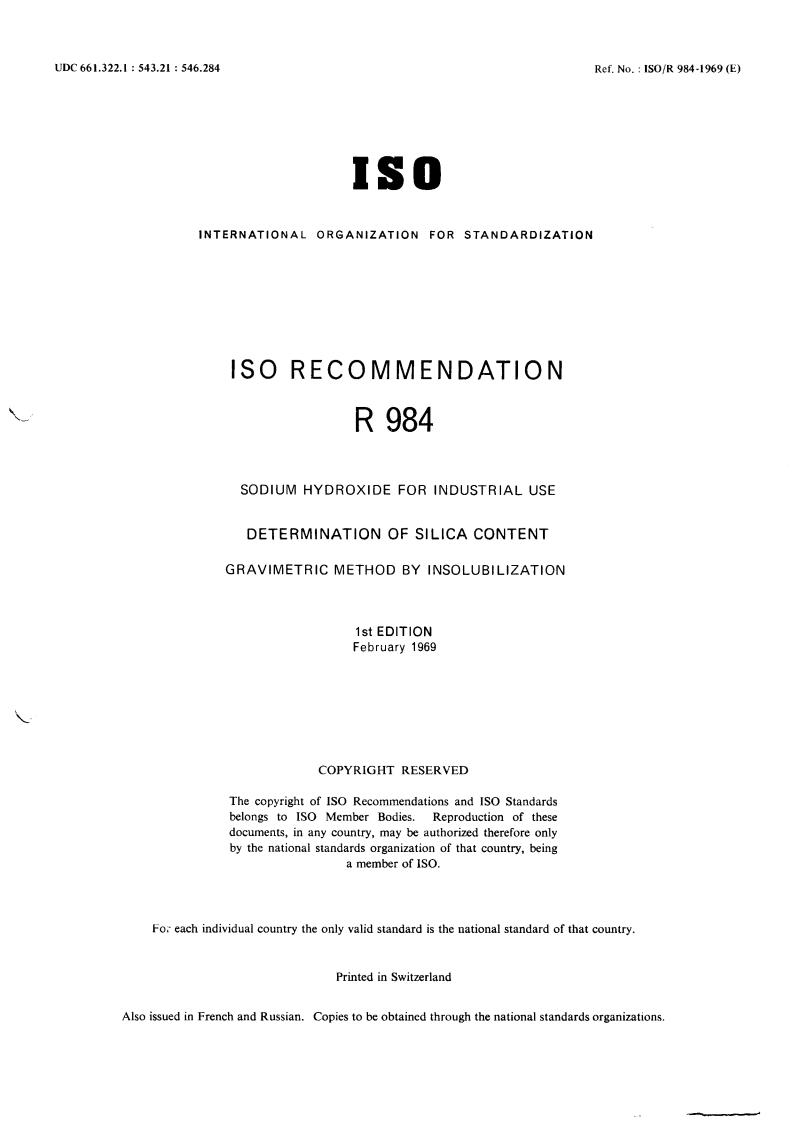
UDC661.322.1 : 543.21 : 546.284
Ref. No. : ISO/R 984-1969 (E)
IS0
I N T ER N AT I O N A L ORGAN I Z AT I O N FOR S TA N DA RD I ZATl O N
IS0 RECOMMENDATION
R 984
SODIUM HYDROXIDE FOR INDUSTRIAL USE
DETERM NATION OF SILICA CONTENT
GRAVI M ETR C METHOD BY INSOLUBILIZATION
1st EDITION
February 1969
COPYRIGHT RESERVED
The copyright of IS0 Recommendations and IS0 Standards
belongs to IS0 Member Bodies. Reproduction of these
documents, in any country, may be authorized therefore only
by the national standards organization of that country, being
a member of ISO.
FOL each individual country the only valid standard is the national standard of that country.
Printed in Switzerland
Also issued in French and Russian. Copies to be obtained through the national standards organizations.
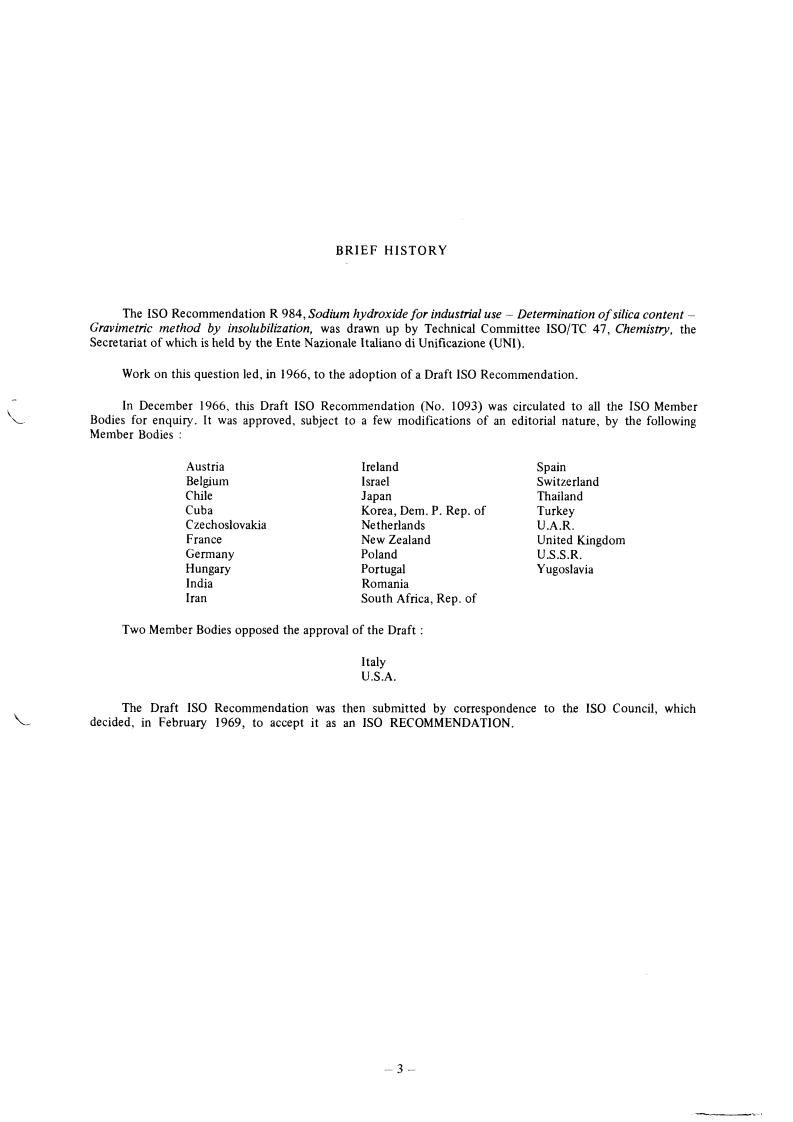
BRIEF HISTORY
The IS0 Recommendation R 984, Sodium hydroxide for industrial use - Determination of silica content -
Gravimetric method by insolubilization, was drawn up by Technical Committee ISOlTC 47, Chemistry, the
Secretariat of which is held by the Ente Nazionale Itaiiano di Unificazione (UNI).
Work on this question led, in 1966, to the adoption of a Draft IS0 Recommendation.
In December 1966, this Draft IS0 Recommendation (No. 1093) was circulated to all the IS0 Member
Bodies for enquiry. It was approved, subject to a few modifications of an editorial nature, by the following
Member Bodies :
Austria Ireland Spain
Belgium
Israel Switzerland
Chile Thailand
Japan
Cuba Korea, Dem. P. Rep. of Turkey
Czechoslovakia
Netherlands U.A.R.
France New Zealand
United Kingdom
Germany Poland U.S.S.R.
Hungary Portugal Yugoslavia
India Romania
Iran South Africa, Rep. of
Two Member Bodies opposed the approval of the Draft :
Italy
U.S.A.
The Draft IS0 Recommendation was then submitted by correspondence to the IS0 Council, which
decided, in February 1969, to accept it as an IS0 RECOMMENDATION.
4’
ISO/R 984-1969 (E)
IS0 Recommendation R 984 February 1969
SODIUM HYDROXIDE FOR INDUSTRIAL USE
DETERMINATION OF SILICA CONTENT
GRAVIMETRIC METHOD BY lNSOLUBlLlZATlON
1. SCOPE
This 1SO Recommendation describes a gravimetric method by insolubilization for the determination of silica
content in sodium hydroxide for industrial use.
2. FIELD OF APPLICATION
The method is applicable to the determination of silica (Sioz) content greater than or equal to 0.01
(m/m)
calculated on NaOH.
3. PRINCIPLE
Insolubilization of silka by evaporation to dryness of the test portion. previously dissolved and acidified (by
means of hydrochloric acid).
Solution of the soluble salts and filtration of the insoluble matter containing silica. Washing, recovery of silica
contained in the filtrate and washings, filtration, washing, drying, ignition and weighing of the insoluble matter.
After treatment with hot hydrofluoric and sulphuric acids to remove the silica, further ignition and weighing
The difference in mass represents the silica present in the test portion.
4. REAGENTS
Distilled water or water of equivalent purity should be used in the test.
Hydrochloric acid, approximately, d = 1.19, 38 (m/m) or 12 N solution.
4.1
4.2 HydrofZuoric acid, approximately, d = 1.15, 40 (m/m) solution.
(mlm) or 6 N solution.
4.3 Sulphuric acid, approximately, d = 1.1 8, 25
4.4 Silver nitrate, 5 g/1 nitric solution.
Dissolve 0.5 g of silver nitrate in a small amount of water, add 10 ml of approximately d = 1.4 nitricacid
solution and dilute to 100 ml.
4.5 Methyl orange, 0.5 g/i solution.
Dissolve 0.05 g of methyl orange in water and dilute to 100 ml.
5. APPARATUS
Ordinary laboratory apparatus.
5.1
5.2 Platinum crucible, approximately 3
...
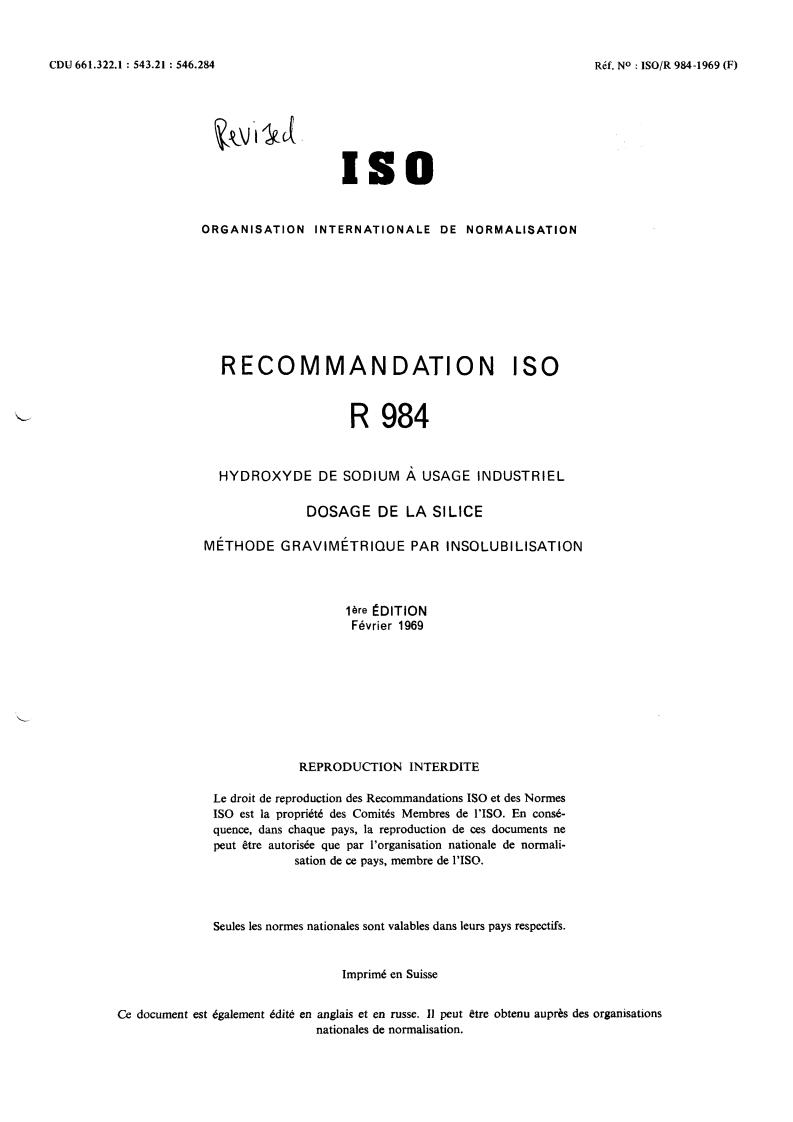
CDU 661.322.1 : 543.21 : 546.284 Rif. NO : ISO/R 984-1969 (FI
IS0
O RG A N I SAT1 ON I NT ERN AT1 ON A LE DE NORMALISATION
RECOMMANDATION IS0
R 984
HYDROXYDE DE SODIUM À USAGE INDUSTRIEL
DOSAGE DE LA SILICE
M ÉTH ODE G RAVI M ÉTR I QU E PAR I NSO LU B I LISAT I ON
we EDITION
Février 1969
REPRODUCTION INTERDITE
Le droit de reproduction des Recommandations IS0 et des Normes
IS0 est la propriété des Comités Membres de 1’ISO. En consé-
quence, dans chaque pays, la reproduction de ces documents ne
peut être autorisée que par l’organisation nationale de normali-
sation de ce pays, membre de 1’ISO.
Seules les normes nationales sont valables dans leurs pays respectifs.
Imprimé en Suisse
Ce document est égaiement édité en anglais et en russe. I1 peut être obtenu auprès des organisations
nationales de normalisation.
.
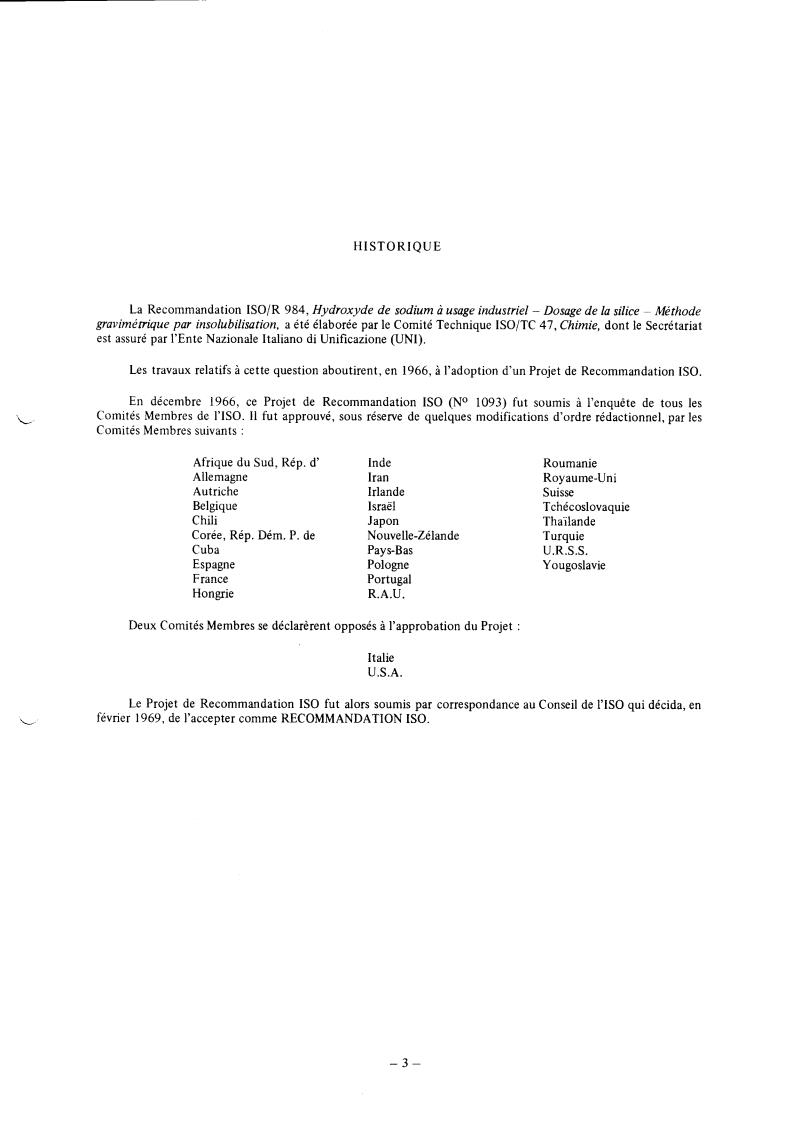
HISTORIQUE
La Recommandation ISO/R 984, Hydroxyde de sodium a usage industriel - Dosage de la silice - Méthode
gravimétrique par insolubilisation, a été élaborée par le Comité Technique iSO/TC 47, Chimie, dont le Secrétariat
est assuré par l’Ente Nazionale Italian0 di Unificazione (UNI).
Les travaux relatifs à cette question aboutirent, en 1966, à l’adoption d’un Projet de Recommandation ISO.
En décembre 1966, ce Projet de Recommandation IS0 (NO 1093) fut soumis à l’enquête de tous les
Comités Membres de I’ISO. I1 fut approuvé, sous réserve de quelques modifications d’ordre rédactionnel, par les
Comités Membres suivants :
Afrique du Sud, Rép. d’ Inde Roumanie
Allemagne Iran Royaume-Uni
Autriche Irlande Suisse
Belgique Israël Tchécoslovaquie
Chili Japon Thaïlande
Corée, Rép. Dém. P. de Nouvelle-Zélande Turquie
Cuba Pays-Bas U.R.S.S.
Espagne Pologne Yougoslavie
France Portugal
Hongrie R.A.U.
Deux Comités Membres se déclarèrent opposés à l’approbation du Projet :
Italie
U.S.A.
Le Projet de Recommandation IS0 fut alors soumis par correspondance au Conseil de l’IS0 qui décida, en
février 1969, de l’accepter comme RECOMMANDATION ISO.
-3-
W/R 984-1969 (FI
Recommandation IS0 R 984 Février 1969
HYDROXYDE DE SODIUM À USAGE INDUSTRIEL
DOSAGE DE LA SILICE
MÉTHODE GRAVIMÉTRIQUE PAR INSOLUBILISATION
1. OBJET
La présente Recommandation IS0 décrit une méthode gravimétrique par insolubilisation pour le dosage de la
silice dans l’hydroxyde de sodium à usage industriel.
2. DOMAINE D’APPLICATION
La méthode est applicable au dosage des teneurs en silice (Si02), rapportées à NaOH, supérieures ou égales à
0,01 (m/m).
3. PRINCIPE
Insolubilisation de la silice par évaporation à sec de la prise d’essai préalablement dissoute et acidifiée (milieu
chlorhydrique).
Dissolution des sels solubles et filtration de l’insoluble contenant de la silice. Lavage, récupération de la silice dans
le filtrat et dans les eaux de lavage, filtration, lavage, séchage, calcination et pesée de l’insoluble.
Après traitement à chaud par l’acide fluorhydrique et l’acide sulfurique pour chasser la silice, nouvelle calcination
et pesée.
La différence de masse représente la silice présente dans la prise d‘essai.
4. &ACTIFS
Au cours de i’analysejn’utiliser que de l’eau distillée ou de l’eau de pureté équivalente.
4.1 Acide chlorhydrique, d = 1,19, solution à 38 (mlm) ou 12 N environ.
Acide fluorhydrique, d = 1,15, solution à 40
4.2 (m/m) environ.
4.3 Acide sulfurique, d = 1,18, solution à 25
(m/m) ou 6 N environ.
4.4 Nitrate d’argent, solution nitrique à 5 g/i.
Dissoudre 0,5 g de nitrate d’argent dans un peu d’eau, ajouter 10 ml de solution d’acide nitrique, d = 1,4
environ, et compléter le volume à 100 ml.
4.5 Méthylorange, solution à 0,s g/l.
Dissoudre 0,05 g de méthylorange dans de l’eau et compléter le volume à 100 ml.
5. APPAREILLAGE
5.1 Matériel courant de laboratoire.
5.2 Creuset en platine, de 30 mm environ de diamètre supérieur et de 30 mm environ de hauteur.
-5-
ISO/R 984-1969 (F)
6. MODE
...
Questions, Comments and Discussion
Ask us and Technical Secretary will try to provide an answer. You can facilitate discussion about the standard in here.
Loading comments...