


ISO/FDIS 13977-1
(Main)Workplace air — Assessment of dermal exposure — Part 1: Framework for dermal exposure assessment
Workplace air — Assessment of dermal exposure — Part 1: Framework for dermal exposure assessment
This document describes a systematic approach to assess potential occupational risks related to the dermal exposure to chemical agents at the workplace. This approach provides guidance to identify hazards, exposure routes, exposed body parts and potential consequences of exposure with respect to skin uptake and local skin effects, using qualitative and quantitative approaches. NOTE There is a relation between skin contamination and inadvertent ingestion. This document is aimed at occupational hygienists, researchers and other safety professionals to assist recognition of potential dermal exposure and its potential consequences.
Air des lieux de travail — Évaluation de l’exposition cutanée — Partie 1: Cadre pour l’évaluation de l’exposition cutanée
General Information
- Status
- Not Published
- Technical Committee
- ISO/TC 146/SC 2 - Workplace atmospheres
- Drafting Committee
- ISO/TC 146/SC 2 - Workplace atmospheres
- Current Stage
- 5020 - FDIS ballot initiated: 2 months. Proof sent to secretariat
- Start Date
- 06-Jan-2026
- Completion Date
- 06-Jan-2026
Relations
- Effective Date
- 12-Feb-2026
Overview
ISO/FDIS 13977-1:2025, titled Workplace Air - Assessment of Dermal Exposure - Part 1: Framework for Dermal Exposure Assessment, is an international standard developed by ISO to provide a comprehensive and systematic approach to evaluating dermal exposure to chemical agents in occupational settings. Recognizing that skin contact is a significant route of exposure in many workplaces, this framework offers guidance for identifying hazards, exposure routes, affected body parts, and possible health consequences related to dermal uptake and local skin effects. This standard is essential for occupational hygienists, researchers, and safety professionals seeking to understand and manage skin exposure risks in the workplace.
Key Topics
Dermal Exposure Framework
The document outlines a structured process to qualitatively and quantitatively assess dermal exposure, including exposure frequency, duration, and magnitude. It focuses on understanding how contaminants come into contact with the skin and potential systemic and local health effects.Hazard Identification
A robust dermal hazard assessment process helps identify adverse effects based on the chemical’s properties. It incorporates criteria such as hazard statements and dermal limit values to evaluate risks to exposed workers.Exposure Routes and Body Regions
The framework emphasizes that dermal exposure varies by body site due to factors like skin thickness and sweat gland density. Hands are frequently the most exposed, but other areas such as forearms and face can also be contaminated through aerosols or direct contact.Conceptual and Multicompartment Models
The standard introduces a conceptual model defining contaminant compartments (source, air, skin, clothing) and transport mechanisms. This facilitates systematic evaluation and use of exposure modeling tools.Qualitative vs Quantitative Assessment Methods
It provides guidance on employing both qualitative approaches, such as workplace observations and checklists, and quantitative methods like measurement or modeling of dermal exposure mass and loading.Risk Assessment and Reporting
The framework integrates hazard and exposure evaluations into a cohesive dermal risk assessment report. It also outlines procedures for periodic reassessment to ensure ongoing safety and compliance.Relation to Other Exposure Routes
The standard notes the interplay between dermal contamination and inadvertent ingestion risks, stressing the importance of considering multiple pathways in exposure assessment.
Applications
Occupational Hygiene and Safety Management
This standard serves as a key tool for industrial hygienists and safety professionals to recognize and control dermal exposure hazards in diverse workplaces, from chemical plants to agriculture.Regulatory Compliance and Risk Mitigation
Enables organizations to document risks and support compliance with dermal exposure limits, derived no effect levels (DNELs), and recommendations from regulatory bodies.Epidemiological and Scientific Research
Provides a structured basis to estimate exposure parameters required for research and studies on occupational health impacts related to dermal exposure.Evaluation of Control Measures
Helps assess the effectiveness of risk management measures (RMMs) such as protective equipment or workplace procedures designed to reduce skin contact with hazardous substances.
Related Standards
ISO 18158: Workplace Air - Terminology
Provides key definitions essential for consistent understanding of workplace air quality terms relevant to dermal exposure assessment.EN 1540: Workplace Exposure - Terminology
Offers additional terminology focused on exposure concepts applicable to occupational settings.ISO/IEC Guide 98-3:2008 (GUM)
Guidance on measurement uncertainty useful when interpreting quantitative dermal exposure data.CEN/TR 15278:2006 and CEN/TS 15279:2006
Previous related European standards on dermal exposure assessment, replaced by ISO 13977 series, reflecting updated methodologies.
Keywords: dermal exposure assessment, occupational hygiene, skin exposure framework, chemical agents, workplace safety, dermal risk assessment, ISO 13977-1, occupational health, local and systemic effects, exposure routes, dermal hazard identification, exposure measurement, risk management measures (RMMs).
Buy Documents

ISO/FDIS 13977-1 - Workplace air — Assessment of dermal exposure — Part 1: Framework for dermal exposure assessment Released:23. 12. 2025


REDLINE ISO/FDIS 13977-1 - Workplace air — Assessment of dermal exposure — Part 1: Framework for dermal exposure assessment Released:23. 12. 2025

ISO/FDIS 13977-1 - Air des lieux de travail — Évaluation de l’exposition cutanée — Partie 1: Cadre pour l’évaluation de l’exposition cutanée Released:28. 01. 2026
Get Certified
Connect with accredited certification bodies for this standard

BSI Group
BSI (British Standards Institution) is the business standards company that helps organizations make excellence a habit.

Bureau Veritas
Bureau Veritas is a world leader in laboratory testing, inspection and certification services.

DNV
DNV is an independent assurance and risk management provider.
Sponsored listings
Frequently Asked Questions
ISO/FDIS 13977-1 is a draft published by the International Organization for Standardization (ISO). Its full title is "Workplace air — Assessment of dermal exposure — Part 1: Framework for dermal exposure assessment". This standard covers: This document describes a systematic approach to assess potential occupational risks related to the dermal exposure to chemical agents at the workplace. This approach provides guidance to identify hazards, exposure routes, exposed body parts and potential consequences of exposure with respect to skin uptake and local skin effects, using qualitative and quantitative approaches. NOTE There is a relation between skin contamination and inadvertent ingestion. This document is aimed at occupational hygienists, researchers and other safety professionals to assist recognition of potential dermal exposure and its potential consequences.
This document describes a systematic approach to assess potential occupational risks related to the dermal exposure to chemical agents at the workplace. This approach provides guidance to identify hazards, exposure routes, exposed body parts and potential consequences of exposure with respect to skin uptake and local skin effects, using qualitative and quantitative approaches. NOTE There is a relation between skin contamination and inadvertent ingestion. This document is aimed at occupational hygienists, researchers and other safety professionals to assist recognition of potential dermal exposure and its potential consequences.
ISO/FDIS 13977-1 is classified under the following ICS (International Classification for Standards) categories: 13.040.30 - Workplace atmospheres; 13.100 - Occupational safety. Industrial hygiene. The ICS classification helps identify the subject area and facilitates finding related standards.
ISO/FDIS 13977-1 has the following relationships with other standards: It is inter standard links to FprEN ISO 13977-1. Understanding these relationships helps ensure you are using the most current and applicable version of the standard.
ISO/FDIS 13977-1 is available in PDF format for immediate download after purchase. The document can be added to your cart and obtained through the secure checkout process. Digital delivery ensures instant access to the complete standard document.
Standards Content (Sample)
FINAL DRAFT
International
Standard
ISO/TC 146/SC 2
Workplace air — Assessment of
Secretariat: ANSI
dermal exposure —
Voting begins on:
2026-01-06
Part 1:
Framework for dermal exposure
Voting terminates on:
2026-03-03
assessment
RECIPIENTS OF THIS DRAFT ARE INVITED TO SUBMIT,
WITH THEIR COMMENTS, NOTIFICATION OF ANY
RELEVANT PATENT RIGHTS OF WHICH THEY ARE AWARE
AND TO PROVIDE SUPPOR TING DOCUMENTATION.
IN ADDITION TO THEIR EVALUATION AS
BEING ACCEPTABLE FOR INDUSTRIAL, TECHNO-
ISO/CEN PARALLEL PROCESSING LOGICAL, COMMERCIAL AND USER PURPOSES, DRAFT
INTERNATIONAL STANDARDS MAY ON OCCASION HAVE
TO BE CONSIDERED IN THE LIGHT OF THEIR POTENTIAL
TO BECOME STAN DARDS TO WHICH REFERENCE MAY BE
MADE IN NATIONAL REGULATIONS.
Reference number
FINAL DRAFT
International
Standard
ISO/TC 146/SC 2
Workplace air — Assessment of
Secretariat: ANSI
dermal exposure —
Voting begins on:
Part 1: 2026-01-01
Framework for dermal exposure
Voting terminates on:
assessment
RECIPIENTS OF THIS DRAFT ARE INVITED TO SUBMIT,
WITH THEIR COMMENTS, NOTIFICATION OF ANY
RELEVANT PATENT RIGHTS OF WHICH THEY ARE AWARE
AND TO PROVIDE SUPPOR TING DOCUMENTATION.
© ISO 2026
IN ADDITION TO THEIR EVALUATION AS
All rights reserved. Unless otherwise specified, or required in the context of its implementation, no part of this publication may
BEING ACCEPTABLE FOR INDUSTRIAL, TECHNO-
ISO/CEN PARALLEL PROCESSING
LOGICAL, COMMERCIAL AND USER PURPOSES, DRAFT
be reproduced or utilized otherwise in any form or by any means, electronic or mechanical, including photocopying, or posting on
INTERNATIONAL STANDARDS MAY ON OCCASION HAVE
the internet or an intranet, without prior written permission. Permission can be requested from either ISO at the address below
TO BE CONSIDERED IN THE LIGHT OF THEIR POTENTIAL
or ISO’s member body in the country of the requester.
TO BECOME STAN DARDS TO WHICH REFERENCE MAY BE
MADE IN NATIONAL REGULATIONS.
ISO copyright office
CP 401 • Ch. de Blandonnet 8
CH-1214 Vernier, Geneva
Phone: +41 22 749 01 11
Email: copyright@iso.org
Website: www.iso.org
Published in Switzerland Reference number
ii
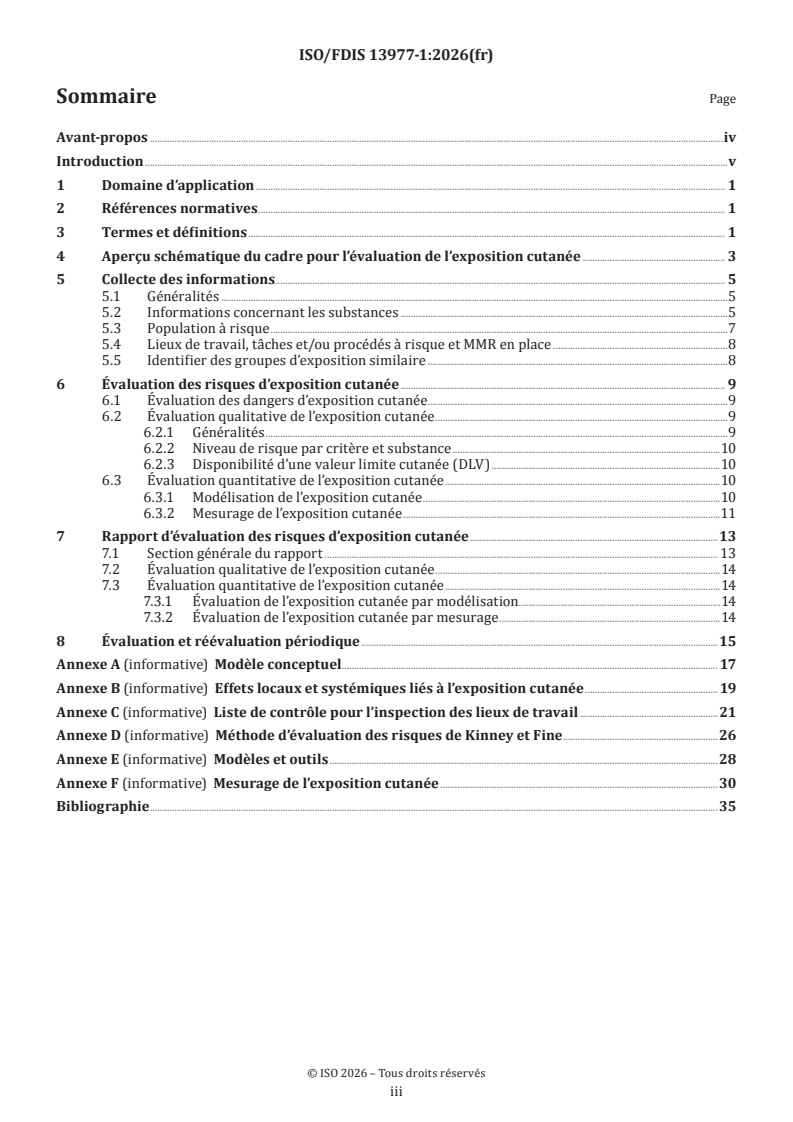
Contents Page
Foreword .iv
Introduction .v
1 Scope . 1
2 Normative references . 1
3 Terms and definitions . 1
4 Schematic overview of the framework for dermal exposure assessment . 3
5 Information gathering . 5
5.1 General .5
5.2 Substance-related information .5
5.3 Population at risk .7
5.4 Workplaces, tasks and/or processes at risk and RMMs in place .7
5.5 Identify similar exposure groups .8
6 Dermal risk assessment . 8
6.1 Dermal hazard assessment .8
6.2 Qualitative dermal exposure assessment .9
6.2.1 General .9
6.2.2 Risk characterization per endpoint and substance .9
6.2.3 Availability of a dermal limit value (DLV) .10
6.3 Quantitative dermal exposure assessment.10
6.3.1 Modelling dermal exposure .10
6.3.2 Measuring dermal exposure .11
7 Dermal risk assessment report .12
7.1 General section in the report . 12
7.2 Qualitative dermal exposure assessment . 13
7.3 Quantitative dermal exposure assessment. 13
7.3.1 Modelled dermal exposure assessment . 13
7.3.2 Measured dermal exposure assessment .14
8 Evaluation and periodic reassessment .15
Annex A (informative) Conceptual model .16
Annex B (informative) Local and systemic effects related to dermal exposure .18
Annex C (informative) Checklist for visiting workplaces .20
Annex D (informative) Kinney and Fine risk assessment method .24
Annex E (informative) Models and tools .26
Annex F (informative) Measurement of dermal exposure .28
Bibliography .33
iii
Foreword
ISO (the International Organization for Standardization) is a worldwide federation of national standards
bodies (ISO member bodies). The work of preparing International Standards is normally carried out through
ISO technical committees. Each member body interested in a subject for which a technical committee
has been established has the right to be represented on that committee. International organizations,
governmental and non-governmental, in liaison with ISO, also take part in the work. ISO collaborates closely
with the International Electrotechnical Commission (IEC) on all matters of electrotechnical standardization.
The procedures used to develop this document and those intended for its further maintenance are described
in the ISO/IEC Directives, Part 1. In particular, the different approval criteria needed for the different types
of ISO document should be noted. This document was drafted in accordance with the editorial rules of the
ISO/IEC Directives, Part 2 (see www.iso.org/directives).
ISO draws attention to the possibility that the implementation of this document may involve the use of (a)
patent(s). ISO takes no position concerning the evidence, validity or applicability of any claimed patent
rights in respect thereof. As of the date of publication of this document, ISO had not received notice of (a)
patent(s) which may be required to implement this document. However, implementers are cautioned that
this may not represent the latest information, which may be obtained from the patent database available at
www.iso.org/patents. ISO shall not be held responsible for identifying any or all such patent rights.
Any trade name used in this document is information given for the convenience of users and does not
constitute an endorsement.
For an explanation of the voluntary nature of standards, the meaning of ISO specific terms and expressions
related to conformity assessment, as well as information about ISO's adherence to the World Trade
Organization (WTO) principles in the Technical Barriers to Trade (TBT), see www.iso.org/iso/foreword.html.
This document was prepared by Technical Committee ISO/TC 146, Air quality, Subcommittee SC 2, Workplace
atmospheres, in collaboration with the European Committee for Standardization (CEN) Technical Committee
CEN/TC 137, Assessment of workplace exposure to chemical and biological agents, in accordance with the
Agreement on technical cooperation between ISO and CEN (Vienna Agreement).
A list of all parts in the ISO 13977 series can be found on the ISO website.
Any feedback or questions on this document should be directed to the user’s national standards body. A
complete listing of these bodies can be found at www.iso.org/members.html.
iv
Introduction
Dermal exposure assessment explores the dynamic interaction between environmental contaminants and
the skin. For thousands of chemicals in the workplace, the contribution of the dermal route to total-body
exposure has yet to be determined. Historically, the assessment of occupational exposure has focused
on inhalation of chemical agents. However, evidence from studies investigating the exposure pattern for
different occupational conditions indicates that dermal contact can serve as the primary route of exposure
for many chemical substances.
The penetration and permeation of substances through the skin can cause local and systemic effects,
respectively. Substances in contact with the skin can penetrate the stratum corneum to cause local effects
(irritation, corrosion or sensitization). Substances can also permeate through the skin reaching systemic
circulation leading to systemic effects, using different exposure pathways, namely:
— through sweat glands and hair follicles,
— the intercellular route (around the cells), or
— the intracellular pathway (through the cells).
Observational studies show that the most highly exposed body parts are the hands. However, deposition of
airborne aerosols or direct contact with substances can also contaminate other body parts (e.g. forearms,
chest and forehead). Location of the exposure is of particular interest, since both the thickness of the
stratum corneum and the density of the hair follicles vary substantially between body locations. These are
important parameters with regard to potential penetration and local effects through the skin but also for
potential permeation and systemic effects. In addition to skin physiology, skin conditions and duration of
contact, the actual contact site can also be relevant for potential inadvertent oral exposure due to hand-to-
[1]
mouth contact .
[2]
The development of a conceptual model was a major milestone in assessing dermal exposure . The
multicompartment model systematically specifies the transport of contaminant mass from the source of
exposure to the surface of the skin. The model consists of six compartments, eight mass transport processes
and two barriers, and provides a structure for both qualitatively and quantitatively evaluating dermal
exposure. Many control banding tools, dermal exposure modelling tools and measurement methodologies
are specified in scientific and grey literature using this basic concept.
No legally binding dermal limit values (DLVs) for dermal exposure are established at the time of the
[3]
publication of this document. However, derived no effect levels (DNELs) for the dermal route of exposure,
[4]
threshold limit value–surface limits (TLV–SLs) and skin notations exist for many substances and should be
considered in the risk assessment as prescribed in national regulations. For the assessment of, for example,
biocides and plant protection products, (internal) reference values are determined. These values, namely
the medium and long-term acceptable exposure level (AEL) derived for biocides and the acceptable operator
exposure level (AOEL) derived for plant protection products, indicate the maximum acceptable level of a
[5]
substance in the body, independent of the pathways that lead to the exposure . As a common practice, the
whole-body exposure via all relevant routes is assessed, but for many substances and exposure situations,
one pathway (dermal, inhalation or ingestion) is typically dominant.
Dermal exposure assessments can be used for various purposes, such as:
— for the evaluation of exposure processes and pathways, in view of the human interface with workplace
processes;
— for the evaluation of control measures or interventions for effectiveness of exposure reduction;
— for risk assessment, identifying hazardous agents that exhibit either local effects or systemic health
effects;
— for compliance purposes, where results are compared with DLVs, e.g. DNELs, recommendations from
scientific committees, TLV-SLs, action levels and in-house limit values;
— for epidemiological studies, requiring estimates of relevant exposure parameters.
v
This document is aimed at industrial and occupational hygienists, human exposure scientists, researchers
and health and safety professionals to assist recognition, evaluation and control of dermal exposure and its
potential consequences.
This document is the basis for future parts of the ISO 13977 series that will elaborate in more detail on the
methodologies and approaches that can be applied.
vi
FINAL DRAFT International Standard ISO/FDIS 13977-1:2026(en)
Workplace air — Assessment of dermal exposure —
Part 1:
Framework for dermal exposure assessment
1 Scope
This document specifies a framework introducing the approaches that can be applied to assess the risks
linked to dermal exposure to chemical substances in the workplace. This document provides guidance on
the different steps to be taken when performing qualitative and quantitative dermal exposure assessments.
This document is not applicable to inhalation, oral, ocular and mucous membranes exposure, biological
agents, wet work and mechanical stressors.
2 Normative references
The following documents are referred to in the text in such a way that some or all of their content constitutes
requirements of this document. For dated references, only the edition cited applies. For undated references,
the latest edition of the referenced document (including any amendments) applies.
ISO 18158, Workplace air — Terminology
EN 1540, Workplace exposure — Terminology
ISO/IEC GUIDE 98-3, Uncertainty of measurement - Part 3: Guide to the expression of uncertainty in measurement
(GUM: 1995) - Supplement 1: Propagation of distributions using a Monte Carlo method
3 Terms and definitions
For the purposes of this document, the terms and definitions given in ISO 18158, EN 1540 and the following
apply.
ISO and IEC maintain terminology databases for use in standardization at the following addresses:
— ISO Online browsing platform: available at https:// www .iso .org/ obp
— IEC Electropedia: available at https:// www .electropedia .org/
3.1
contaminant layer
compartments that contain a contaminant or chemical agent
Note 1 to entry: The contaminant layer compartment is characterized by a volume of unknown depth.
Note 2 to entry: Compartments include source, air, surface, skin, inner and outer clothing contaminant layers (see
Annex A).
3.2
dermal contact volume
volume containing the mass of the chemical agent present on the dermal exposure surface area (3.6)
Note 1 to entry: This theoretical term is equivalent to the volume of the skin contaminant layer (SCL) (3.14); however,
for practical reasons, it is defined by the mass (in g) of all substances present on the SCL.
3.3
dermal exposure assessment
estimation (qualitative or quantitative) of the magnitude, frequency, duration and extent of exposure to a
chemical agent via the dermal route
3.4
dermal exposure loading
dermal exposure mass (3.5) divided by the dermal exposure surface area (3.6)
Note 1 to entry: For practical reasons, dermal exposure loading can be expressed as mass of the chemical agent in an
exposed part of the skin contaminant layer (SCL) (3.14) divided by the surface area of that part, expressed for example
in milligrams per centimetre squared.
3.5
dermal exposure mass
mass of chemical agent present in the dermal contact volume (3.2)
Note 1 to entry: For practical reasons, dermal exposure mass is defined by the amount of the chemical agent present in
the skin contaminant layer (SCL) (3.14).
3.6
dermal exposure surface area
skin surface area where a chemical agent is present
Note 1 to entry: For practical reasons, the dermal exposure surface is represented by a two-dimensional representation
of the skin contaminant layer (SCL) (3.14), expressed in centimetres squared.
3.7
dermal hazard assessment
process to identify and characterize the adverse effects of a chemical agent, via the dermal route, based on
substance properties that are reflected in hazard statements (H-statements) and similar information
Note 1 to entry: Effects should be considered adverse only if they affect the viability and normal function of the
organism under test.
3.8
dermal limit value
DLV
level of exposure to the skin that is not expected to result in adverse biological effects
3.9
dermal risk assessment
overall process to identify potential risks based on a dermal hazard assessment (3.7) and a dermal exposure
assessment (3.3)
Note 1 to entry: A risk assessment usually includes risk mitigation, but this is outside the scope of this document.
3.10
local effect
adverse health effect that occurs at the site of contact with a substance
3.11
penetration
process that occurs when a substance enters into the skin
3.12
permeation
process that occurs when a substance pass through the skin
3.13
potential dermal exposure
dermal exposure that can occur on the unprotected skin or clothes
Note 1 to entry: All substance mass that can reach the body without applying any risk management measures.
3.14
skin contaminant layer
SCL
compartment on top of the stratum corneum of the human skin formed by sebum lipids, sweat and additional
water from transepidermal water loss, also including products from cornification and unshed corneocytes
Note 1 to entry: More information can be found in Annex A.
Note 2 to entry: The SCL compartment is characterized by a volume of unknown depth.
3.15
systemic effect
adverse health effect that occurs in a part of the body distant from the initial point of contact with a
substance
3.16
uptake
concentration-driven transport of a chemical agent from the skin contaminant layer (SCL) (3.14) into the skin,
i.e. crossing the interface between the skin contaminant layer (exposure surface) and the stratum corneum
(absorption barrier)
Note 1 to entry: The time-exposure concentration profile for an identified area of the skin contaminant layer over a
defined period of time is relevant for uptake.
4 Schematic overview of the framework for dermal exposure assessment
The assessment of dermal occupational exposure to chemical agents starts with general substance
information gathering, identification of the population at risk, description of the workplace [e.g. use of
risk management measures (RMMs)] and the identification of similar exposure groups (SEGs) described in
Clause 5. This is followed by a qualitative dermal exposure risk assessment based on the classification of
the product, substance or agent, as defined in Clause 6, and when required by a quantitative assessment
when a method and DLV is available as per 6.3. The dermal exposure assessments shall be documented, and
periodic reassessments shall be conducted when significant changes occur at the workplace that can affect
the dermal exposure and for evaluations where no safe situation can be obtained. An annual interval for
reassessment is recommended, whatever the outcome, as defined in Clause 7. Figure 1 provides a schematic
overview of the framework for dermal exposure assessment.
NOTE DLV can be an OELV, DNEL, TLV, etc. and is used for evaluating the results.
Figure 1 — Schematic overview of the framework for dermal exposure assessment
5 Information gathering
5.1 General
Information shall be obtained to:
— List all products and their constituents used in the activities and process generated substances potentially
released during the activities so that toxicological endpoints for effect related to dermal exposure, skin
notations or DLVs can be identified.
— Determine the population at risk.
— Identify the workplaces, activities and/or processes and the RMMs currently in place where workers can
be at risk.
— Identify SEGs.
5.2 Substance-related information
The preparation of a list of all substances in the workplace is an essential step to the identification of
the potential for exposure. The products’ safety data sheets (SDSs) and other available data are useful to
establish the list, which shall include the following information, if relevant:
— Raw materials, primary products, impurities, intermediates, final products, reaction and process
products and by-products, etc.
— The individual substances, identified with chemical registration numbers (e.g. chemical abstracts service
number, European Commission number), including process generated emissions.
— Classification and labelling, e.g. the health hazard (H) statements shall be evaluated to identify those
which can be relevant to the dermal route (see Table 1, Table 2 and Table 3). Due to local restrictions,
other statements can also be relevant, for instance EUH statements [these being additional labelling
[6]
information used in the European Union (EU)] related to skin or allergic effects .
— Substance properties that affect dermal absorption and toxicokinetics, e.g. octanol/water partition
[7]
coefficient (log P ), molecular size, ionization and particle size/dustiness, as well as product
ow
characteristics, e.g. vehicle used, dilution rate and partitioning between vehicle and stratum corneum.
— Appropriate limit values and additional notations [e.g. ‘skin’, ‘D’(dermal), ‘C’ (carcinogen), ‘M’ (mutagen),
‘Sk’ (skin), ‘DSEN’ (dermal sensitization notation)] and additional relevant toxicological endpoints for
effect.
— Additional information such as vapour pressure, temperature, saturation and concentration.
Table 1 — List of hazard statements relevant to dermal exposure – local corrosive/irritation effects
Code Hazard statement
H314 Causes severe skin burns and eye damage
H315 Causes skin irritation
Table 2 — List of hazard statements relevant to dermal exposure – sensitizing effects
Code Hazard statement
H317 Can cause an allergic skin reaction
Table 3 — List of hazard statements relevant to dermal exposure – systemic effects
Code Hazard statement
H310 Fatal in contact with skin
H311 Toxic in contact with skin
H312 Harmful in contact with skin
H313 Can be harmful in contact with skin
H340 Can cause genetic defects
H341 Suspected of causing genetic defects
H350 Can cause cancer
H351 Suspected of causing cancer
H360 Can damage fertility or the unborn child
H360D Can damage the unborn child
H360Df Can damage the unborn child. Suspected of damaging fertility
H360F Can damage fertility
H360FD Can damage fertility. Can damage the unborn child
H360Fd Can damage fertility. Suspected of damaging the unborn child
H361 Suspected of damaging fertility or the unborn child
H361d Suspected of damaging the unborn child
H361f Suspected of damaging fertility
H361fd Suspected of damaging fertility. Suspected of damaging the unborn child
H362 Can cause harm to breast-fed children
H370 Causes damage to organs
H371 Can cause damage to organs
H372 Causes damage to organs through prolonged or repeated exposure
H373 Can cause damage to organs through prolonged or repeated exposure
These shall then be checked in publicly available databases (e.g. the “Information on Chemicals” platform
[8] [9]
in the ECHA website , PubChem (US National Institutes of Health) or Annex VI of the CLP Regulation
[10]
(Regulation (EC) No. 1272/2008 ).
Next, information regarding the potential of dermal absorption shall be retrieved in order to assess the
relevance of systemic exposure following the exposure via the dermal route. Measured dermal absorption
data is preferred to be used as an estimate of uptake but will not always be available. In absence of these
data, the substance properties that affect dermal absorption can be evaluated, including the octanol/water
[7]
partition coefficient (log P ), the molecular size, the ionisation and the particle size (e.g. for powders) .
ow
It shall be noted that the dermal absorption rate for a specific substance can differ significantly depending
on the vehicle that is used, the dilution rate, the partitioning between solvent and stratum corneum and
workplace factors, see 5.4.
Considering the high relevance of dermal exposure for many products, such as pesticides and biocides, a high
number of in vitro and in vivo dermal absorption studies have been conducted during the last decades. Based
on these data, a significant impact of the substance concentration on dermal absorption and formulation
[11]
category has been reported for pesticides .
Additional characteristics, such as the physicochemical properties of the substances or products handled,
shall be considered on a case-by-case basis. For example, when handling liquid products at the workplace,
e.g. by means of stirring or spraying, droplets or aerosols can be formed. Depending on the volatility of
the substance, these droplets can easily evaporate or stay in the air for a relatively long period and can
[12]
even increase in volume over time due to condensation processes . When these droplets come into contact
with the skin (resulting in moistening of the skin), the chemical composition of the liquid, its skin-damaging
properties and percutaneous absorption characteristics shall be taken into account, regardless of the
droplets’ original dimensions.
5.3 Population at risk
The population at risk shall be identified. Pre-employment health questionnaires and company health
surveillance, if available, can help identify susceptible individuals or those with existing skin complaints. Any
occurrence of skin disease or health effects can indicate potential dermal exposures. For more information
on local and systemic dermal health effects, see Annex B.
Disruption of the skin decreases the barrier function of the stratum corneum and is thus important to
consider when establishing the population at risk, and the extent of that risk. The integrity of stratum
corneum and its damage due to pre-existing disease and other work-related conditions (e.g. wet work and
abrasion) can be assessed relatively easily. Assessment of skin condition can be made by visual examination,
which can include questionnaires or scoring systems, like the Nordic Occupational Skin Questionnaire
[13] [14],[15] [16]
(NOSQ-2002), the Hand Eczema Severity Index (HECSI), the Manuscore, the Osnabrück Hand
[16] [14]
Eczema Severity Index (OHSI), and Hand Eczema Score for Occupational Screenings (HEROS) .
Furthermore, there are a number of biophysical parameters that can be used to objectively assess skin
condition, like transepidermal water loss (TEWL) from the skin surface, skin hydration and quantitative
[17]
measurement of skin colour . It should be noted that what is observed at the individual worker level
cannot be directly translated to an assessment of skin disruption on a group level as it is. It is also important
to take into account accidental damage of the skin that will or will possibly not be work-related. On the other
hand, combining data generated on an individual level can generate valuable information on a group level. It
is advised to document and retain these (anonymised) observations at company or industry level to be able
to identify any group level issues of concern.
5.4 Workplaces, tasks and/or processes at risk and RMMs in place
To determine if exposure via the dermal route is of relevance based on the workplace environment,
a description of all worker activities should be available, as well as details of how the worker directly or
[2]
indirectly interacts with the substance. The conceptual dermal model shall be used to identify the
processes by which substances from the source of exposure can be transported to the surface of the skin,
e.g. emission, deposition, transfer and removal. Further information on the conceptual model is provided in
Annex A.
The work processes and procedures shall be evaluated to gauge the exposure and the exposure profile to
chemical agents by a detailed review of workplace factors, such as:
— work organization (job titles, activities, tasks, work shift system, job functions, etc.);
— processes and techniques (type of processes, temperature, pressure, etc.);
— amount and, if applicable, concentration of the substance that is used per shift/task/activity;
— workplace layout and configuration, including confined spaces, open air, etc.;
— safety precautions and procedures (restricted area, training, etc.);
— cleanliness and tidiness of workplace;
— ventilation installations, other forms of engineering control and any information on their performance;
— emission sources and locations of high concentrations;
— periods, frequencies and durations of exposure, considering variation of exposure with time of day and
season of the year;
— work load;
— worker behaviour, or activity or production rate indicators;
— administrative controls and use of personal protective equipment (PPE).
Annex C provides a simple checklist of questions to be addressed and information to collect when visiting
the workplace to determine if dermal exposure is relevant. Information on engineering controls, protective
gloves and other PPE use is collected, as are details of the work practices and workers interaction with the
substances of concern.
5.5 Identify similar exposure groups
SEGs rely on grouping workers and assessing their health risks based on similar exposure conditions. When
determining SEGs consideration shall be given to various characteristics that influence exposure including,
e.g. tasks and activities undertaken and equipment used. Further information on assigning SEGs can be
[18]
found in EN 689:2018+AC: 2019, 5.2.1. However, validation and constitution of SEG's will not always be
possible in all cases with dermal exposure measurement results, e.g. due to a potential high variability in
measurement results.
6 Dermal risk assessment
6.1 Dermal hazard assessment
The first step in the dermal hazard assessment is to identify whether the substances under assessment can
produce any effects following exposure via the dermal route. The substance-related information retrieved
within 5.2 shall be reviewed in detail to conclude on the specific assessment required in relation to the
hazardous properties. The different cases are summarised below:
— All information gathered assigned to the substances under assessment present no relevant effects, and
while there is also no DLV established, no further assessment is required.
— At least one of the H statements included in Table 1 or any other information gathered referring to
any local corrosive/irritation effects is assigned to the substance under assessment, an assessment is
required (see 6.2.2).
— At least the H statement included in Table 2 or any other statement or skin notation referring to sensitizing
effects is assigned to the substance under assessment, an assessment is required (see 6.2.2).
— At least one of the H statements included in Table 3 or any other statement or skin notation referring to
potential health effects related to dermal exposure, following absorption in the systemic circulation is
assigned to the substance under assessment, an assessment is required (see 6.2.2).
— No H statement is assigned to the substance under assessment but local carcinogenic effects are identified
(see B.2.3), an assessment is required (see 6.2.2).
The relevance of systemic effects is also indicated by the existence of reference/limit values for the chemical
agent/product under assessment, independently of the classification.
When multiple H statements are assigned to the substances under assessment, it is possible that multiple
endpoints need to be evaluated in the hazard assessment.
6.2 Qualitative dermal exposure assessment
6.2.1 General
Once the hazard assessment has been performed, the qualitative dermal exposure assessment shall
be performed in cases where effects relevant to dermal exposure have been identified. The qualitative
exposure assessment shall consider workplace factors, workers tasks and the physical-chemical properties
of the agent. This assessment can be performed on product, substance or process level. When the qualitative
exposure assessment indicates that the risk characterisation result is not acceptable then an investigation of
the possibilities for elimination or substitution shall be performed. If elimination or substitution is possible,
the situation shall be reassessed, if not, a quantitative exposure assessment shall be performed to identify
the exposure risk.
For the purposes of the qualitative dermal exposure assessment, several methods/tools are available
depending on the level of detail needed to perform the analysis. These include approaches which require
minimal information where easy to use spreadsheets can be used, to more sophisticated tools.
[19]
A typical, simplistic approach is based on the Kinney and Fine risk assessment method, which can be
easily performed in a spreadsheet (see Annex D). Other examples are Control of Substances Hazardous
[20]
to Health (COSHH) Essentials and Système d’évaluation et d’information sur les risques chimiques en
[21]
milieu professionnel (Seirich) which are freely available. The lack of consideration of the exposed skin
surface is the major disadvantage of these tools. Examples of tools which take into account the exposed
skin surface and where results are expressed as categorical estimates of exposure, e.g. ever-never, yes-no
[22]
or exposure classes (low, medium, high), are the Einfaches Maßnahmenkonzept Gefahrstoffe (EMKG),
[23] ®1)[24]
Dermal Risk Assessment Method (DRAM), Stoffenmanager and DeRmal Exposure Assessment
[25]
Method (DREAM) .
Consideration shall be given to applying the method/tool most suitable for the exposure situation being
assessed. See Annex E for further information on available tools.
6.2.2 Risk characterization per endpoint and substance
If the hazard assessment has local corrosive or irritant, sensitizing, local carcinogenic and/or systemic
effects as an endpoint for one or more substances, the assessment continues with a qualitative dermal
exposure assessment for each relevant endpoint per substance.
If the conclusion of the qualitative assessment is no exposure, for example if a substance is only present in a
closed system which is confirmed to be effective, the risk characterisation is acceptable, and the assessment
shall be terminated and documented for this endpoint.
When the risk characterisation is not acceptable, the assessment continues with an investigation if
elimination or substitution is feasible. When elimination or substitution is feasible, reassessment is required
after its implementation. When elimination or substitution is not feasible, appropriate (further) RMMs shall
be implemented. RMMs are only considered adequate if it can be demonstrated to the RMMs effectively ®
1) Stoffenmanager is a trademark of a product supplied by Cosanta B V. This information is given for the convenience
of users of this document and does not constitute an endorsement by ISO.
reduce or suppress dermal exposure in the situation that is assessed, for example, prevention of direct hand
contact or formation of splashes that can hit body or face. Then the risk characterisation is acceptable, and
the assessment shall be terminated and documented for this endpoint.
When no adequate RMM are available, the assessment continues with a quantitative dermal exposure
assessment (see 6.3) if a DLV is available (see 6.2.3).
When workers are exposed to substances that have corrosive or irritant effects, proceeding with a
quantitative dermal exposure assessment is not considered appropriate, as immediate action is required
to protect the workers involved. For example, when working with corrosive acids, a closed system shall be
installed, or acid-resistant gloves shall be worn to prevent exposure.
When susceptible individuals in the population are exposed to specific sensitizing agents, additional RMMs
shall be implemented for these individuals.
6.2.3 Availability of a dermal limit value (DLV)
An important consideration is to investigate if there is a DLV available to compare the quantitative results
against. When no published DLV exists, it shall be investigated if an in-house DLV can be established. An
example is the derivation of a kick-off value (KOV), defined as the 10th percentile of the DLV distribution
[26]
of the substances in a hazard category . When no DLV can be derived, the assessment is terminated and
appropriate RMMs shall be implemented to keep the exposure as low as reasonably achievable.
NOTE In some legislation, for carcinogens, mutagens, reprotoxic and sensitizing agents, minimisation of exposure
is obligatory.
6.3 Quantitative dermal exposure assessment
6.3.1 Modelling dermal exposure
Exposure models have been developed that can help users to estimate the level of exposure without
collecting their own measurements. Most models provide estimates of the extent of (potential) dermal
exposure or skin contamination and can be used to provide an initial exposure assessment as part of the
risk assessment process. The results can also be applied to help select an appropriate sampling strategy for
quantitative exposure assessment, as well as prioritization of RMMs.
If the estimated exposure, based on use of an exposure model, is below the DLV, it is not necessary to collect
exposure measurements as the exposure levels are considered compliant. The assessment shall be finished
and documented.
If the exposure estimation shows that the exposure is equal to or above the DLV, it is advised to first reduce
exposure by implementing (further) RMMs before investigating whether there is a suitable and well-
documented measurement method available for the substance.
The different types of quantitative dermal exposure models available vary in level of complexity and accuracy
and uncertainty in the generated exposure estimates. Users shall select the model most appropriate for their
exposure situation, based on e.g. the applicability domain of a particular model, nature of the substance a
worker is exposed to and body parts considered. The model shall be applicable for the substance or type of
substance being assessed.
The simplest quantitative exposure models consist of compiled exposure levels that have been measured for
a specific activity. From these datasets, certain percentiles are used to draw conclusions about the exposure
[27]
in a comparable situation by analogy. An example is the "TNsG2002 Database Detailed Models" . More
structured approaches provide semi-quantitative estimates of dermal contamination by using identified or
assumed determinants of exposure (or contamination). An example is the DeRmal Exposure Assessment
[25]
Method (DREAM) . ECETOC TRA and MEASE are examples of tools that were designed to provide
conservative estimates of exposure (for both inhalation and dermal routes) for a defined exposure scenario.
[28]
ECTROC TRA is a general chemical exposure assessment tool with the scope of MEASE being more limited
[29]
to metal and inorganic substances .
If exposures estimated using tools such as those mentioned above exceed the DNEL of a substance, or if
the assessor would like to generate exposure estimates with greater accuracy and less uncertainty,
it is recommended to use more advanced tools. Examples of such tools are the RISKOFDERM model and
the dermal Advanced REACH Tool (dA
...
ISO/TC 146/SC 2 N1433
Secretariat: ANSI
Date: 2025-12-22
Workplace air — Assessment of dermal exposure —
Part 1:
Framework for dermal exposure assessment
First edition
Date: 2025-05-13
TTTThhhhiiiissss dr dr dr draaaafffftttt i i i issss susususubbbbmmmmiiiitttttttteeeed d d d ttttoooo aaaa ppppaaaarrrraaaallellellellel l l l vvvvooootttteeee i i i innnn IIIISSSSOOOO,,,, CCCCEEEEN.N.NN.
VVVVoooottttiiiinnnng bg bg bg beeeegigigiginsnsnsns o o o on:n:n:n: 2 2 22002020226666----00001111----01010101
VoVoVoVottttinininingggg te te te terrrrminminminminaaaatetetetessss oooonnnn::::
FDIS stage
ISO/DISFDIS 13977-1:20242026(en)
All rights reserved. Unless otherwise specified, or required in the context of its implementation, no part of this publication
may be reproduced or utilized otherwise in any form or by any means, electronic or mechanical, including photocopying,
or posting on the internet or an intranet, without prior written permission. Permission can be requested from either ISO
at the address below or ISO’s member body in the country of the requester.
ISO copyright office
CP 401 • Ch. de Blandonnet 8
CH-1214 Vernier, Geneva
Phone: + 41 22 749 01 11
E-mail: copyright@iso.org
Website: www.iso.org
Published in Switzerland
iv
Contents
Foreword . vi
Introduction . vii
1 Scope . 1
2 Normative references . 1
3 Terms and definitions . 1
4 Schematic overview of the framework for dermal exposure assessment . 3
5 Information gathering . 7
5.1 General . 7
5.2 Substance-related information . 7
5.3 Population at risk . 9
5.4 Workplaces, tasks and/or processes at risk and RMMs in place . 10
5.5 Identify similar exposure groups . 10
6 Dermal risk assessment . 11
6.1 Dermal hazard assessment . 11
6.2 Qualitative dermal exposure assessment . 11
6.3 Quantitative dermal exposure assessment . 13
7 Dermal risk assessment report . 15
7.1 General section in the report . 15
7.2 Qualitative dermal exposure assessment . 16
7.3 Quantitative dermal exposure assessment . 16
8 Evaluation and periodic reassessment . 18
Annex A (informative) Conceptual model . 19
Annex B (informative) Local and systemic effects related to dermal exposure . 23
Annex C (informative) Checklist for visiting workplaces . 25
Annex D (informative) Kinney and Fine risk assessment method . 29
Annex E (informative) Models and tools . 31
Annex F (informative) Measurement of dermal exposure . 34
Bibliography . 39
v
ISO/DISFDIS 13977-1:20242026(en)
Foreword
ISO (the International Organization for Standardization) is a worldwide federation of national standards
bodies (ISO member bodies). The work of preparing International Standards is normally carried out through
ISO technical committees. Each member body interested in a subject for which a technical committee has been
established has the right to be represented on that committee. International organizations, governmental and
non-governmental, in liaison with ISO, also take part in the work. ISO collaborates closely with the
International Electrotechnical Commission (IEC) on all matters of electrotechnical standardization.
The procedures used to develop this document and those intended for its further maintenance are described
in the ISO/IEC Directives, Part 1. In particular, the different approval criteria needed for the different types of
ISO document should be noted. This document was drafted in accordance with the editorial rules of the
ISO/IEC Directives, Part 2 (see www.iso.org/directives).
ISO draws attention to the possibility that the implementation of this document may involve the use of (a)
patent(s). ISO takes no position concerning the evidence, validity or applicability of any claimed patent rights
in respect thereof. As of the date of publication of this document, ISO had not received notice of (a) patent(s)
which may be required to implement this document. However, implementers are cautioned that this may not
represent the latest information, which may be obtained from the patent database available at
www.iso.org/patents. ISO shall not be held responsible for identifying any or all such patent rights.
Any trade name used in this document is information given for the convenience of users and does not
constitute an endorsement.
For an explanation of the voluntary nature of standards, the meaning of ISO specific terms and expressions
related to conformity assessment, as well as information about ISO's adherence to the World Trade
Organization (WTO) principles in the Technical Barriers to Trade (TBT), see www.iso.org/iso/foreword.html.
This document was prepared by Technical Committee ISO/TC 146, Air quality, Subcommittee SC 2, Workplace
atmospheres, in collaboration with the European Committee for Standardization (CEN) Technical Committee
CEN/TC 137, Assessment of workplace exposure to chemical and biological agents, in accordance with the
Agreement on technical cooperation between ISO and CEN (Vienna Agreement).
This document replaces CEN/TR 15278:2006, CEN/TS 15279:2006 CEN ISO/TR 14294:2011.
A list of all parts in the ISO 13977 series can be found on the ISO website.
Any feedback or questions on this document should be directed to the user’s national standards body. A
complete listing of these bodies can be found at www.iso.org/members.html.
vi
Introduction
Dermal exposure assessment explores the dynamic interaction between environmental contaminants and the
skin. For thousands of chemicals in the workplace, the contribution of the dermal route to total-body exposure
has yet to be determined. Historically, the assessment of occupational exposure has focused on inhalation of
chemical agents. However, evidence from studies investigating the exposure pattern for different occupational
conditions indicates that dermal contact can serve as the primary route of exposure for many chemical
substances.
The penetration and permeation of substances through the skin can cause local and systemic effects,
respectively. Substances in contact with the skin can penetrate the stratum corneum to cause local effects
(irritation, corrosion or sensitization). Substances can also permeate through the skin reaching systemic
circulation leading to systemic effects, using different exposure pathways, namely:
— — through sweat glands and hair follicles,
— — the intercellular route (around the cells), or
— — the intracellular pathway (through the cells).
Observational studies show that the most highly exposed body parts are the hands. However, deposition of
airborne aerosols or direct contact with substances can also contaminate other body parts (e.g. forearms, chest
and forehead). Location of the exposure is of particular interest, since both the thickness of the stratum
corneum and the density of the hair follicles vary substantially between body locations. These are important
parameters with regard to potential penetration and local effects through the skin but also for potential
permeation and systemic effects. In addition to skin physiology, skin conditions and duration of contact, the
actual contact site can also be relevant for potential inadvertent oral exposure due to hand-to-mouth
[1 [1]]
contact . .
[2 [2]]
The development of a conceptual model was a major milestone in assessing dermal exposure . . The
multicompartment model systematically specifies the transport of contaminant mass from the source of
exposure to the surface of the skin. The model consists of six compartments, eight mass transport processes
and two barriers, and provides a structure for both qualitatively and quantitatively evaluating dermal
exposure. Many control banding tools, dermal exposure modelling tools and measurement methodologies are
specified in scientific and grey literature using this basic concept.
No legally binding dermal limit values (DLVs) for dermal exposure are established at the time of the
[3 [3]]
publication of this document. However, derived no effect levels (DNELs) ) for the dermal route of exposure,
[4 [4]]
threshold limit value–surface limits (TLV–SLs) ) and skin notations exist for many substances and should
be considered in the risk assessment as prescribed in national regulations. For the assessment of, for example,
biocides and plant protection products, (internal) reference values are determined. These values, namely the
medium and long-term acceptable exposure level (AEL) derived for biocides and the acceptable operator
exposure level (AOEL) derived for plant protection products, indicate the maximum acceptable level of a
[5 [5]]
substance in the body, independent of the pathways that lead to the exposure . . As a common practice, the
whole-body exposure via all relevant routes is assessed, but for many substances and exposure situations, one
pathway (dermal, inhalation or ingestion) is typically dominant.
Dermal exposure assessments can be used for various purposes, such as:
— — Forfor the evaluation of exposure processes and pathways, in view of the human interface with
workplace processes;
— — Forfor the evaluation of control measures or interventions for effectiveness of exposure reduction;
vii
ISO/DISFDIS 13977-1:20242026(en)
— — Forfor risk assessment, identifying hazardous agents that exhibit either local effects or systemic health
effects;
— — Forfor compliance purposes, where results are compared with DLVs, e.g. DNELs, recommendations
from scientific committees, TLV-SLs, action levels and in-house limit values;
— — Forfor epidemiological studies, requiring estimates of relevant exposure parameters.
This document is aimed at industrial and occupational hygienists, human exposure scientists, researchers and
health and safety professionals to assist recognition, evaluation and control of dermal exposure and its
potential consequences.
This part of the document provides the framework introducing the approaches that can be applied to assess
the risks linked to dermal exposure in the workplace. In addition, this document is the basis for future parts
of the ISO 13977 series that will elaborate in more detail on the methodologies and approaches that can be
applied.
viii
Final DRAFT International Standard
Workplace atmospheres air — Assessment of dermal exposure —
Part 1:
Framework for dermal exposure assessment
1 Scope
This document specifies a framework introducing the approaches that can be applied to assess the risks linked
to dermal exposure to chemical substances in the workplace. This document provides guidance on the
different steps to be taken when performing qualitative and quantitative dermal exposure assessments.
This document is not applicable to inhalation, oral, ocular and mucous membranes exposure, biological agents,
wet work and mechanical stressors.
2 Normative references
The following documents are referred to in the text in such a way that some or all of their content constitutes
requirements of this document. For dated references, only the edition cited applies. For undated references,
the latest edition of the referenced document (including any amendments) applies.
ISO 18158, Workplace air — Terminology
EN 1540, Workplace exposure –— Terminology
ISO/IEC GUIDE 98, -3-SP1:2008/COR1:2009, Corrigendum 1 - Supplement 1 -, Uncertainty of measurement - Part
3: Guide to the expression of uncertainty in measurement (GUM:1995) - Supplement 1: Propagation of
distributions using a Monte Carlo method
3 Terms and definitions
For the purposes of this document, the terms and definitions given in ISO 18158, EN 1540 and the following
apply.
ISO and IEC maintain terminology databases for use in standardization at the following addresses:
— — ISO Online browsing platform: available at https://www.iso.org/obp
— — IEC Electropedia: available at https://www.electropedia.org/
3.1 3.1
contaminant layer
compartments that contain a contaminant or chemical agent
Note 1 to entry: The contaminant layer compartment is characterized by a volume of unknown depth.
Note 2 to entry: Compartments include source, air, surface, skin, inner and outer clothing contaminant layers (see
Annex AAnnex A).).
ISO/DISFDIS 13977-1:20242026(en)
3.2 3.2
dermal contact volume
volume containing the mass of the chemical agent present on the dermal exposure surface area (3.6(3.6))
Note 1 to entry: This theoretical term is equivalent to the volume of the skin contaminant layer (SCL) (3.14(3.14););
however, for practical reasons, it is defined by the mass (in g) of all substances present on the SCL.
3.3 3.3
dermal exposure assessment
estimation (qualitative or quantitative) of the magnitude, frequency, duration and extent of exposure to a
chemical agent via the dermal route
3.4 3.4
dermal exposure loading
dermal exposure mass (3.5(3.5)) divided by the dermal exposure surface area (3.6(3.6))
Note 1 to entry: For practical reasons, dermal exposure loading can be expressed as mass of the chemical agent in an
exposed part of the skin contaminant layer (SCL) (3.14(3.14)) divided by the surface area of that part, expressed for
example in milligrams per centimetre squared.
3.5 3.5
dermal exposure mass
mass of chemical agent present in the dermal contact volume (3.2(3.2))
Note 1 to entry: For practical reasons, dermal exposure mass is defined by the amount of the chemical agent present in
the skin contaminant layer (SCL) (3.14(3.14)).
3.6 3.6
dermal exposure surface area
skin surface area where a chemical agent is present
Note 1 to entry: For practical reasons, the dermal exposure surface is represented by a two-dimensional representation
of the skin contaminant layer (SCL) (3.14(3.14),), expressed in centimetres squared.
3.7 3.7
dermal hazard assessment
process to identify and characterize the adverse effects of a chemical agent, via the dermal route, based on
substance properties that are reflected in Hhazard statements (H-statements) and similar information
Note 1 to entry: Effects should be considered adverse only if they affect the viability and normal function of the organism
under test.
3.8 3.8
dermal limit value
DLV
level of exposure to the skin that is not expected to result in adverse biological effects
3.9
3.9
dermal risk assessment
overall process to identify potential risks based on a dermal hazard assessment (3.7(3.7)) and a dermal
exposure assessment (3.3(3.3))
Note 1 to entry: A risk assessment usually includes risk mitigation, but this is outside the scope of this document.
3.10 3.10
local effect
adverse health effect that occurs at the site of contact with a substance
3.11 3.11
penetration
process that occurs when a substance enters into the skin
3.12 3.12
permeation
process that occurs when a substance pass through the skin
3.13 3.13
potential dermal exposure
dermal exposure that can occur on the unprotected skin or clothes
Note 1 to entry: allAll substance mass that couldcan reach the body without applying any risk management measures.
3.14 3.14
skin contaminant layer
SCL
compartment on top of the stratum corneum of the human skin formed by sebum lipids, sweat and additional
water from transepidermal water loss, also including products from cornification and unshed corneocytes
Note 1 to entry: More information can be found in Annex AAnnex A.
Note 2 to entry: The SCL compartment is characterized by a volume of unknown depth.
3.15 3.15
systemic effect
adverse health effect that occurs in a part of the body distant from the initial point of contact with a substance
3.16 3.16
uptake
concentration-driven transport of a chemical agent from the skin contaminant layer (SCL) (3.14 (3.14)) into
the skin, i.e. crossing the interface between the skin contaminant layer (exposure surface) and the stratum
corneum (absorption barrier)
Note 1 to entry: The time-exposure concentration profile for an identified area of the skin contaminant layer over a
defined period of time is relevant for uptake.
4 Schematic overview of the framework for dermal exposure assessment
The assessment of dermal occupational exposure to chemical agents starts with general substance
information gathering, identification of the population at risk, description of the workplace [e.g. use of risk
management measures (RMMs)] and the identification of similar exposure groups (SEGs) described in
Clause 5Clause 5. This is followed by a qualitative dermal exposure risk assessment based on the classification
of the product, substance or agent, as defined in Clause 6 Clause 6, and when required by a quantitative
assessment when a method and DLV is available as per 6.36.3. The dermal exposure assessments shall be
documented, and periodic reassessments shall be conducted when significant changes occur at the workplace
that can affect the dermal exposure and for evaluations where no safe situation can be obtained. An annual
interval for reassessment is recommended, whatever the outcome, as defined in Clause 7 is Clause 7. Figure 1.
Figure 1 provides a schematic overview of the framework for dermal exposure assessment.
ISO/DISFDIS 13977-1:20242026(en)
ISO/DISFDIS 13977-1:20242026(en)
NOTE DLV can be an OELV, DNEL, TLV, etc. and is used for evaluating the results.
Figure 1 — Schematic overview of the framework for dermal exposure assessment
5 Information gathering
5.1 General
Information shall be obtained to:
— — List all products and their constituents used in the activities and process generated substances
potentially released during the activities so that toxicological endpoints for effect related to dermal
exposure, skin notations or DLVs can be identified.
— — Determine the population at risk.
— — Identify the workplaces, activities and / /or processes and the RMMs currently in place where workers
couldcan be at risk— .
— Identify SEGs.
5.2 Substance-related information
The preparation of a list of all substances in the workplace is an essential step to the identification of the
potential for exposure. The products’ safety data sheets (SDSs) and other available data are useful to establish
the list, which shall include the following information, if relevant:
— — rawRaw materials, primary products, impurities, intermediates, final products, reaction and process
products and by-products, etc;.
— — theThe individual substances, identified with chemical registration numbers (e.g. Chemical Abstracts
Service Numberchemical abstracts service number, European Commission Numbernumber), including
process generated emissions;.
ISO/DISFDIS 13977-1:20242026(en)
— — classificationClassification and labelling, e.g. the health hazard (H) statements a shall be evaluated to
identify those which can be relevant to the dermal route (see Table 1, Table 2 and Table 3Table 1, Table 2,
Table 3).). Due to local restrictions, other statements can also be relevant, for instance EUH statements
([these being additional labelling information used in the European Union (EU)))] related to skin or
[6 [6]]
allergic effects . .
— — substanceSubstance properties that affect dermal absorption and toxicokinetics, e.g. octanol/water
[7 [7] ]
partition coefficient (log Pow), molecular size, ionization and particle size / /dustiness, , as well as
product characteristics, e.g. vehicle used, dilution rate, and partitioning between vehicle and stratum
corneum;.
— — appropriateAppropriate limit values and additional notations ([e.g. ‘skin’, ‘D’(dermal), ‘C’ (carcinogen),
‘M’ (mutagen), ‘Sk’ (skin), ‘DSEN’ (dermal sensitization notation)))] and additional relevant toxicological
endpoints for effect;.
— — additionalAdditional information such as vapour pressure, temperature, saturation and concentration.
Table 1 — List of hazard statements relevant to dermal exposure — Local– local corrosive/irritation
effects
Code Hazard statement
H314 Causes severe skin burns and eye damage
H315 Causes skin irritation
Table 2 — List of hazard statements relevant to dermal exposure – sensitizing effects
Code Hazard Statementstatement
H317 MayCan cause an allergic skin reaction
Table 3 — List of hazard statements relevant to dermal exposure — Systemic– systemic effects
Code Hazard Statementstatement
H310 Fatal in contact with skin
H311 Toxic in contact with skin
H312 Harmful in contact with skin
H313 MayCan be harmful in contact with skin
H340 MayCan cause genetic defects
H341 Suspected of causing genetic defects
H350 MayCan cause cancer
H351 Suspected of causing cancer
H360 MayCan damage fertility or the unborn child
H360D MayCan damage the unborn child
H360Df MayCan damage the unborn child. Suspected of damaging fertility
H360F MayCan damage fertility
H360FD MayCan damage fertility. MayCan damage the unborn child
H360Fd MayCan damage fertility. Suspected of damaging the unborn child
H361 Suspected of damaging fertility or the unborn child
Code Hazard Statementstatement
H361d Suspected of damaging the unborn child
H361f Suspected of damaging fertility
H361fd Suspected of damaging fertility. Suspected of damaging the unborn child
H362 MayCan cause harm to breast-fed children
H370 Causes damage to organs
H371 MayCan cause damage to organs
H372 Causes damage to organs through prolonged or repeated exposure
H373 MayCan cause damage to organs through prolonged or repeated exposure
These shall then be checked in publicly available databases (e.g. the “Information on Chemicals” platform in
[8[8] ] [9 [9]]
the ECHA website , , PubChem (US National Institutes of Health) ) or Annex VI of the CLP Regulation
[10[10] ]
(Regulation (EC) No. 1272/2008 . ).
Next, information regarding the potential of dermal absorption shall be retrieved in order to assess the
relevance of systemic exposure following the exposure via the dermal route. Measured dermal absorption data
is preferred to be used as an estimate of uptake but maywill not always be available. In absence of these data,
the substance properties that affect dermal absorption can be evaluated, including the octanol/water partition
[7 [7]]
coefficient (log P ), the molecular size, the ionisation and the particle size (e.g. for powders) ). . It shall be
ow
noted that the dermal absorption rate for a specific substance can differ significantly depending on the vehicle
that is used, the dilution rate, the partitioning between solvent and stratum corneum and workplace factors,
see 5.45.4.
Considering the high relevance of dermal exposure for many products, such as pesticides and biocides, a high
number of in vitro and in vivo dermal absorption studies have been conducted during the last decades. Based
on these data, a significant impact of the substance concentration on dermal absorption and formulation
[11 [11]]
category has been reported for pesticides . .
Additional characteristics, such as the physicochemical properties of the substances or products handled, shall
be considered on a case-by-case basis. For example, when handling liquid products at the workplace, e.g. by
means of stirring or spraying, droplets or aerosols can be formed. Depending on the volatility of the substance,
these droplets can easily evaporate or stay in the air for a relatively long period and can even increase in
[12 [12]]
volume over time due to condensation processes . . When these droplets come into contact with the skin
(resulting in moistening of the skin), the chemical composition of the liquid, its skin-damaging properties and
percutaneous absorption characteristics shall be taken into account, regardless of the droplets’ original
dimensions.
5.3 Population at risk
The population at risk shall be identified. Pre-employment health questionnaires and company health
surveillance, if available, can help identify susceptible individuals or those with existing skin complaints. Any
occurrence of skin disease or health effects can indicate potential dermal exposures. For more information on
local and systemic dermal health effects, see Annex BAnnex B.
Disruption of the skin decreases the barrier function of the stratum corneum and is thus important to consider
when establishing the population at risk, and the extent of that risk. The integrity of stratum corneum and its
damage due to pre-existing disease and other work-related conditions (e.g. wet work and abrasion) can be
assessed relatively easily. Assessment of skin condition can be made by visual examination, which can include
[13 [13] ]
questionnaires or scoring systems, like the Nordic Occupational Skin Questionnaire (NOSQ-2002), ) , the
[14],[15 [14] [15] ] [16 [16] ]
Hand Eczema Severity Index (HECSI), ) , the Manuscore, , the Osnabrück Hand Eczema
[16 [16] ] [14 [14]]
Severity Index (OHSI), ) , and Hand Eczema Score for Occupational Screenings (HEROS) ). .
ISO/DISFDIS 13977-1:20242026(en)
Furthermore, there are a number of biophysical parameters that can be used to objectively assess skin
condition, like transepidermal water loss (TEWL) from the skin surface, skin hydration and quantitative
[17 [17]]
measurement of skin colour . . It should be noted that what is observed at the individual worker level
cannot be directly translated to an assessment of skin disruption on a group level as it is. It is also important
to take into account accidental damage of the skin that mightwill or mightwill possibly not be work-related.
On the other hand, combining data generated on an individual level can generate valuable information on a
group level. It is advised to document and retain these (anonymised) observations at company or industry
level to be able to identify any group level issues of concern.
5.4 Workplaces, tasks and / /or processes at risk and RMMs in place
To determine if exposure via the dermal route is of relevance based on the workplace environment, a
description of all worker activities should be available, as well as details of how the worker directly or
[2[2]]
indirectly interacts with the substance. The conceptual dermal model shall be used to identify the
processes by which substances from the source of exposure can be transported to the surface of the skin, e.g.
emission, deposition, transfer and removal. Further information on the conceptual model, is provided in
Annex AAnnex A.
The work processes and procedures shall be evaluated to gauge the exposure and the exposure profile to
chemical agents by a detailed review of workplace factors, such as:
— — work organization (job titles, activities, tasks, work shift system, job functions, etc.);
— — processes and techniques (type of processes, temperature, pressure, etc.);
— — amount and, if applicable, concentration of the substance that is used per shift/task/activity;
— — workplace layout and configuration, including confined spaces, open air, etc.;
— — safety precautions and procedures (restricted area, training, etc.);
— — cleanliness and tidiness of workplace;
— — ventilation installations, other forms of engineering control and any information on their
performance;
— — emission sources and locations of high concentrations;
— — periods, frequencies and durations of exposure, considering variation of exposure with time of day
and season of the year;
— — work load;
— — worker behaviour, or activity or production rate indicators;
— — administrative controls and use of personal protective equipment (PPE).
Annex CAnnex C provides a simple checklist of questions to be addressed and information to collect when
visiting the workplace to determine if dermal exposure is relevant. Information on engineering controls,
protective gloves and other PPE use is collected, as are details of the work practices and workers interaction
with the substances of concern.
5.5 Identify similar exposure groups
SEGs rely on grouping workers and assessing their health risks based on similar exposure conditions. When
determining SEGs consideration shall be given to various characteristics that influence exposure including,
e.g. tasks and activities undertaken and equipment used. Further information on assigning SEGs can be found
[18[18] ]
in EN 689:2018+AC:2019, 5.2.1. . However, validation and constitution of SEG's mightwill not always be
possible in all cases with dermal exposure measurement results, e.g. due to a potential high variability in
measurement results.
6 Dermal risk assessment
6.1 Dermal hazard assessment
The first step in the dermal hazard assessment is to identify whether the substances under assessment can
produce any effects following exposure via the dermal route. The substance-related information retrieved
within 5.25.2 shall be reviewed in detail to conclude on the specific assessment required in relation to the
hazardous properties. The different cases are summarised below:
— — All information gathered assigned to the substances under assessment present no relevant effects, and
while there is also no DLV established;, no further assessment is required.
— — At least one of the H statements included in Table 1Table 1 or any other information gathered referring
to any local corrosive/irritation effects is assigned to the substance under assessment;, an assessment is
required (see 6.2.26.2.2).).
— — At least the H statement included in Table 2Table 2 or any other statement or skin notation referring
to sensitizing effects is assigned to the substance under assessment;, an assessment is required (see
6.2.26.2.2).).
— — At least one of the H statements included in Table 3Table 3 or any other statement or skin notation
referring to potential health effects related to dermal exposure, following absorption in the systemic
circulation is assigned to the substance under assessment;, an assessment is required (see 6.2.26.2.2).).
— — noNo H statement is assigned to the substance under assessment but local carcinogenic effects are
identified (see B.2.3B.1.3);), an assessment is required. (see 6.2.26.2.2).).
The relevance of systemic effects is also indicated by the existence of reference/limit values for the chemical
agent/product under assessment, independently of the classification.
When multiple H statements are assigned to the substances under assessment, it is possible that multiple
endpoints may need to be evaluated in the hazard assessment.
6.2 Qualitative dermal exposure assessment
6.2.1 General
Once the hazard assessment has been performed, the qualitative dermal exposure assessment shall be
performed in cases where effects relevant to dermal exposure have been identified. The qualitative exposure
assessment shall consider workplace factors, workers tasks and the physical-chemical properties of the agent.
This assessment can be performed on product, substance or process level. When the qualitative exposure
assessment indicates that the risk characterisation result is not acceptable then an investigation of the
possibilities for elimination or substitution shall be performed. If elimination or substitution is possible, the
situation shall be reassessed, if not, a quantitative exposure assessment shall be performed to identify the
exposure risk.
For the purposes of the qualitative dermal exposure assessment, several methods/tools are available
depending on the level of detail needed to perform the analysis. These include approaches which require
minimal information where easy to use spreadsheets can be used, to more sophisticated tools.
ISO/DISFDIS 13977-1:20242026(en)
[19 [19] ]
A typical, simplistic approach is based on the Kinney and Fine risk assessment method, , which can be
easily performed in a spreadsheet (see Annex DAnnex D).). Other examples are Control of Substances
[20 [20]]
Hazardous to Health (COSHH) Essentials and Système d’évaluation et d’information sur les risques
[21 [21]]
chimiques en milieu professionnel (Seirich) ) which are freely available. The lack of consideration of the
exposed skin surface is the major disadvantage of these tools. Examples of tools which take into account the
exposed skin surface and where results are expressed as categorical estimates of exposure, e.g. ever-never,
yes-no or exposure classes (low, medium, high), are the Einfaches Maßnahmenkonzept Gefahrstoffe
[22 [22] ] [23 [23] ] ®1)[24 [24]]
(EMKG), ) , Dermal Risk Assessment Method (DRAM), ) , Stoffenmanager and DeRmal
[25 [25]]
Exposure Assessment Method (DREAM) ). .
Consideration shall be given to applying the method/tool most suitable for the exposure situation being
assessed. See Annex EAnnex E for further information on available tools.
6.2.2 Risk characterization per endpoint and substance
If the hazard assessment has local corrosive or irritant, sensitizing, local carcinogenic and/or systemic effects
as an endpoint for one or more substances, the assessment continues with a qualitative dermal exposure
assessment for each relevant endpoint per substance.
If the conclusion of the qualitative assessment is no exposure, for example if a substance is only present in a
closed system which is confirmed to be effective, the risk characterisation is acceptable, and the assessment
shall be terminated and documented for this endpoint.
When the risk characterisation is not acceptable, the assessment continues with an investigation if elimination
or substitution is feasible. When elimination or substitution is feasible, reassessment is required after its
implementation. When elimination or substitution is not feasible, appropriate (further) RMMs shall be
implemented. RMMs are only considered adequate if it can be demonstrated to the RMMs effectively reduce
or suppress dermal exposure in the situation that is assessed, for example, prevention of direct hand contact
or formation of splashes that can hit body or face. Then the risk characterisation is acceptable, and the
assessment shall be terminated and documented for this endpoint.
When no adequate RMM are available, the assessment continues with a quantitative dermal exposure
assessment (see 6.36.3)) if a DLV is available (see 6.2.36.2.3).).
When workers are exposed to substances that have corrosive or irritant effects, proceeding with ana
quantitative dermal exposure assessment is not considered appropriate, as immediate action is required to
protect the workers involved. For example, when working with corrosive acids, a closed system shall be
installed, or acid-resistant gloves shall be worn to prevent exposure.
When susceptible individuals in the population are exposed to specific sensitizing agents, additional RMMs
shall be implemented for these individuals.
6.2.3 Availability of a dermal limit value (DLV)
An important consideration is to investigate if there is a DLV available to compare the quantitative results
against. When no published DLV exists, it shall be investigated if an in-house DLV can be established. An
example is the derivation of a kick-off value (KOV), defined as the 10th percentile of the DLV distribution of
[26 [26]]
the substances in a hazard category . . When no DLV can be derived, the assessment is terminated and
appropriate RMMs shall be implemented to keep the exposure as low as reasonably achievable.
NOTE In some legislation, for carcinogens, mutagens, reprotoxic and sensitizing agents, minimisation of exposure is
obligatory.
1) ®
Stoffenmanager is a trademark of a product supplied by Cosanta B V. This information is given for the convenience of
users of this document and does not constitute an endorsement by ISO.
6.3 Quantitative dermal exposure assessment
6.3.1 Modelling dermal exposure
Exposure models have been developed that can help users to estimate the level of exposure without collecting
their own measurements. Most models provide estimates of the extent of (potential) dermal exposure or skin
contamination and can be used to provide an initial exposure assessment as part of the risk assessment
process. The results can also be applied to help select an appropriate sampling strategy for quantitative
exposure assessment, as well as prioritization of RMMs.
If the estimated exposure, based on use of an exposure model, is below the DLV, it is not necessary to collect
exposure measurements as the exposure levels are considered compliant. The assessment shall be finished
and documented.
If the exposure estimation shows that the exposure is equal to or above the DLV, it is advised to first reduce
exposure by implementing (further) RMMs before investigating whether there is a suitable and well-
documented measurement method available for the substance.
The different types of quantitative dermal exposure models available vary in level of complexity and accuracy
and uncertainty in the generated exposure estimates. Users shall select the model most appropriate for their
exposure situation, based on e.g. the applicability domain of a particular model, nature of the substance a
worker is exposed to and body parts considered. The model shall be applicable for the substance or type of
substance being assessed.
The simplest quantitative exposure models consist of compiled exposure levels that have been measured for
a specific activity. From these datasets, certain percentiles are used to draw conclusions about the exposure
[27 [27]]
in a comparable situation by analogy. An example is the "TNsG2002 Database Detailed Models" " . More
structured approaches provide semi-quantitative estimates of dermal contamination by using identified or
assumed determinants of exposure (or contamination). An example is the DeRmal Exposure Assessment
[25 [25]]
Method (DREAM) ). . ECETOC TRA and MEASE are examples of tools that were designed to provide
conservative estimates of exposure (for both inhalation and dermal routes) for a defined exposure scenario.
[28 [28]]
ECTROC TRA is a general chemical exposure assessment tool with the scope of MEASE being more
[29 [29]]
limited to metal and inorganic substances . .
If exposures estimated using tools such as those mentioned above exceed the DNEL of a substance, or if the
assessor would like to generate exposure estimates with greater accuracy and less uncertainty, it is
recommended to use more advanced tools. Examples of such tools are the RISKOFDERM model and the dermal
[30 [30]]
Advanced REACH Tool (dART). The RISKOFDERM model estimates dermal hand and body exposure . .
dART is a generic exposure model for estimating dermal exposures to the hands to low volatile liquid products
[31 [31]]
and solids in liquid products . . In addition to generic dermal exposure models, models have also been
[32 [32] ]
developed for specific exposure scenario’s, e.g. SprayExpo for spray application of biocidal products, ,
and the EFSA Guidance on the assessment of exposure of operators, workers, residents and bystanders in risk
[5 [5]]
assessment of plant protection products . .
In Annex EAnnex E, a non-exhaustive overview of available dermal exposure models and tools is given.
6.3.2 Measuring dermal exposure
6.3.2.1 General
The question of whether to measure dermal exposure is an important consideration in the development of
any dermal exposure assessment strategy. The modelling approaches specified in 6.3.16.3.1 generally involve
an elevated degree of uncertainty, which is usually compensated by a higher degree of conservatism. This can
intentionally lead to some overestimation of exposure and risks. Compared to these approaches,
measurements performed at the workplaces using a properly validated method can del
...
PROJET FINAL
Norme
internationale
ISO/TC 146/SC 2
Air des lieux de travail — Évaluation
Secrétariat: ANSI
de l’exposition cutanée —
Début de vote:
2026-01-06
Partie 1:
Cadre pour l’évaluation de
Vote clos le:
2026-03-03
l’exposition cutanée
Workplace air — Assessment of dermal exposure —
Part 1: Framework for dermal exposure assessment
LES DESTINATAIRES DU PRÉSENT PROJET SONT
INVITÉS À PRÉSENTER, AVEC LEURS OBSERVATIONS,
NOTIFICATION DES DROITS DE PROPRIÉTÉ DONT ILS
AURAIENT ÉVENTUELLEMENT CONNAISSANCE ET À
FOURNIR UNE DOCUMENTATION EXPLICATIVE.
OUTRE LE FAIT D’ÊTRE EXAMINÉS POUR
ÉTABLIR S’ILS SONT ACCEPTABLES À DES FINS
INDUSTRIELLES, TECHNOLOGIQUES ET COM-MERCIALES,
AINSI QUE DU POINT DE VUE DES UTILISATEURS, LES
PROJETS DE NORMES
TRAITEMENT PARALLÈLE ISO/CEN
INTERNATIONALES DOIVENT PARFOIS ÊTRE CONSIDÉRÉS
DU POINT DE VUE DE LEUR POSSI BILITÉ DE DEVENIR DES
NORMES POUVANT
SERVIR DE RÉFÉRENCE DANS LA RÉGLEMENTATION
NATIONALE.
Numéro de référence
PROJET FINAL
Norme
internationale
ISO/TC 146/SC 2
Air des lieux de travail — Évaluation
Secrétariat: ANSI
de l’exposition cutanée —
Début de vote:
Partie 1: 2026-01-06
Cadre pour l’évaluation de
Vote clos le:
2026-03-03
l’exposition cutanée
Workplace air — Assessment of dermal exposure —
Part 1: Framework for dermal exposure assessment
LES DESTINATAIRES DU PRÉSENT PROJET SONT
INVITÉS À PRÉSENTER, AVEC LEURS OBSERVATIONS,
NOTIFICATION DES DROITS DE PROPRIÉTÉ DONT ILS
AURAIENT ÉVENTUELLEMENT CONNAISSANCE ET À
FOURNIR UNE DOCUMENTATION EXPLICATIVE.
DOCUMENT PROTÉGÉ PAR COPYRIGHT
OUTRE LE FAIT D’ÊTRE EXAMINÉS POUR
ÉTABLIR S’ILS SONT ACCEPTABLES À DES FINS
© ISO 2026 INDUSTRIELLES, TECHNOLOGIQUES ET COM-MERCIALES,
AINSI QUE DU POINT DE VUE DES UTILISATEURS, LES
Tous droits réservés. Sauf prescription différente ou nécessité dans le contexte de sa mise en œuvre, aucune partie de cette
PROJETS DE NORMES
TRAITEMENT PARALLÈLE ISO/CEN
INTERNATIONALES DOIVENT PARFOIS ÊTRE CONSIDÉRÉS
publication ne peut être reproduite ni utilisée sous quelque forme que ce soit et par aucun procédé, électronique ou mécanique,
DU POINT DE VUE DE LEUR POSSI BILITÉ DE DEVENIR DES
y compris la photocopie, ou la diffusion sur l’internet ou sur un intranet, sans autorisation écrite préalable. Une autorisation peut
NORMES POUVANT
être demandée à l’ISO à l’adresse ci-après ou au comité membre de l’ISO dans le pays du demandeur.
SERVIR DE RÉFÉRENCE DANS LA RÉGLEMENTATION
NATIONALE.
ISO copyright office
Case postale 401 • Ch. de Blandonnet 8
CH-1214 Vernier, Genève
Tél.: +41 22 749 01 11
E-mail: copyright@iso.org
Web: www.iso.org
Publié en Suisse Numéro de référence
ii
Sommaire Page
Avant-propos .iv
Introduction .v
1 Domaine d’application . 1
2 Références normatives . 1
3 Termes et définitions . 1
4 Aperçu schématique du cadre pour l’évaluation de l’exposition cutanée . 3
5 Collecte des informations . 5
5.1 Généralités .5
5.2 Informations concernant les substances .5
5.3 Population à risque .7
5.4 Lieux de travail, tâches et/ou procédés à risque et MMR en place .8
5.5 Identifier des groupes d’exposition similaire .8
6 Évaluation des risques d’exposition cutanée . 9
6.1 Évaluation des dangers d’exposition cutanée .9
6.2 Évaluation qualitative de l’exposition cutanée .9
6.2.1 Généralités .9
6.2.2 Niveau de risque par critère et substance .10
6.2.3 Disponibilité d’une valeur limite cutanée (DLV) .10
6.3 Évaluation quantitative de l’exposition cutanée .10
6.3.1 Modélisation de l’exposition cutanée .10
6.3.2 Mesurage de l’exposition cutanée .11
7 Rapport d’évaluation des risques d’exposition cutanée .13
7.1 Section générale du rapport . 13
7.2 Évaluation qualitative de l’exposition cutanée .14
7.3 Évaluation quantitative de l’exposition cutanée .14
7.3.1 Évaluation de l’exposition cutanée par modélisation .14
7.3.2 Évaluation de l’exposition cutanée par mesurage .14
8 Évaluation et réévaluation périodique .15
Annexe A (informative) Modèle conceptuel . 17
Annexe B (informative) Effets locaux et systémiques liés à l’exposition cutanée . 19
Annexe C (informative) Liste de contrôle pour l’inspection des lieux de travail .21
Annexe D (informative) Méthode d’évaluation des risques de Kinney et Fine .26
Annexe E (informative) Modèles et outils .28
Annexe F (informative) Mesurage de l’exposition cutanée .30
Bibliographie .35
iii
Avant-propos
L’ISO (Organisation internationale de normalisation) est une fédération mondiale d’organismes nationaux
de normalisation (comités membres de l’ISO). L’élaboration des Normes internationales est en général
confiée aux comités techniques de l’ISO. Chaque comité membre intéressé par une étude a le droit de faire
partie du comité technique créé à cet effet. Les organisations internationales, gouvernementales et non
gouvernementales, en liaison avec l’ISO participent également aux travaux. L’ISO collabore étroitement avec
la Commission électrotechnique internationale (IEC) en ce qui concerne la normalisation électrotechnique.
Les procédures utilisées pour élaborer le présent document et celles destinées à sa mise à jour sont
décrites dans les Directives ISO/IEC, Partie 1. Il convient, en particulier, de prendre note des différents
critères d’approbation requis pour les différents types de documents ISO. Le présent document
a été rédigé conformément aux règles de rédaction données dans les Directives ISO/IEC, Partie 2
(voir www.iso.org/directives).
L’ISO attire l’attention sur le fait que la mise en application du présent document peut entraîner l’utilisation
d’un ou de plusieurs brevets. L’ISO ne prend pas position quant à la preuve, à la validité et à l’applicabilité
de tout droit de brevet revendiqué à cet égard. À la date de publication du présent document, l’ISO n’avait pas
reçu notification qu’un ou plusieurs brevets pouvaient être nécessaires à sa mise en application. Toutefois,
il y a lieu d’avertir les responsables de la mise en application du présent document que des informations
plus récentes sont susceptibles de figurer dans la base de données de brevets, disponible à l’adresse
www.iso.org/brevets. L’ISO ne saurait être tenue pour responsable de ne pas avoir identifié de tels droits
de propriété et averti de leur existence.
Les appellations commerciales éventuellement mentionnées dans le présent document sont données pour
information, par souci de commodité, à l’intention des utilisateurs et ne sauraient constituer un engagement.
Pour une explication de la nature volontaire des normes, la signification des termes et expressions
spécifiques de l’ISO liés à l’évaluation de la conformité, ou pour toute information au sujet de l’adhésion de
l’ISO aux principes de l’Organisation mondiale du commerce (OMC) concernant les obstacles techniques au
commerce (OTC), voir www.iso.org/avant-propos.
Le présent document a été élaboré par le comité ISO/TC 146, Qualité de l’air, sous-comité SC 2, Atmosphères
des lieux de travail, en collaboration avec le comité technique CEN/TC 137, Évaluation de l’exposition aux agents
chimiques et biologiques sur le lieu de travail, du Comité européen de normalisation (CEN), conformément
à l’Accord de coopération technique entre l’ISO et le CEN (Accord de Vienne).
Une liste de toutes les parties de la série ISO 13977 se trouve sur le site web de l’ISO.
Il convient que l’utilisateur adresse tout retour d’information ou toute question concernant le présent
document à l’organisme national de normalisation de son pays. Une liste exhaustive desdits organismes
se trouve à l’adresse www.iso.org/fr/members.html.
iv
Introduction
L’évaluation de l’exposition cutanée explore l’interaction dynamique entre les contaminants
environnementaux et la peau. Pour des milliers d’agents sur les lieux de travail, la contribution de la voie
cutanée à l’exposition totale du corps reste à déterminer. Historiquement, l’évaluation de l’exposition
professionnelle s’est concentrée sur l’inhalation d’agents chimiques. Toutefois, des études examinant le profil
d’exposition pour différentes conditions professionnelles montrent que le contact cutané peut constituer la
principale voie d’exposition pour de nombreuses substances chimiques.
La pénétration et la perméation de substances à travers la peau peuvent respectivement provoquer des
effets locaux et systémiques. Les substances en contact avec la peau peuvent pénétrer la couche cornée et
provoquer des effets locaux (irritation, corrosion ou sensibilisation). Les substances peuvent également
s’infiltrer à travers la peau et atteindre la circulation générale engendrant des effets systémiques, par des
voies d’exposition différentes, à savoir:
— à travers les glandes sudoripares et les follicules pileux;
— la voie intercellulaire (autour des cellules); ou
— la voie intracellulaire (à travers les cellules).
Des études d’observation montrent que les parties du corps les plus exposées sont les mains. Néanmoins,
le dépôt d’aérosols aéroportés ou le contact direct avec les substances peuvent également contaminer
d’autres parties du corps (par exemple, avant-bras, poitrine et front). La zone d’exposition est d’un intérêt
particulier, étant donné que l’épaisseur de la couche cornée ainsi que la densité des follicules pileux varient
considérablement d’une zone du corps à l’autre. Il s’agit de paramètres importants en ce qui concerne
la pénétration potentielle et les effets locaux à travers la peau mais aussi pour la perméation potentielle et
les effets systémiques. Outre la physiologie de la peau, les conditions cutanées et la durée de contact, la zone
de contact réelle peut également être pertinente vis-à-vis de l’exposition orale accidentelle potentielle due
[1]
à un contact main-bouche .
Le développement d’un modèle conceptuel a été une étape majeure pour l’évaluation de l’exposition
[2]
cutanée. Le modèle multi-compartiments spécifie de manière systématique le transport d’une masse de
polluant depuis la source d’exposition jusqu’à la surface de la peau. Le modèle comprend six compartiments,
huit processus de transport de masse et deux barrières et fournit une structure permettant d’évaluer
qualitativement et quantitativement l’exposition cutanée. Différents outils de gestion graduée des risques,
outils de modélisation d’exposition cutanée et méthodologies de mesure sont spécifiés dans la littérature
scientifique et la littérature grise en utilisant ce concept de base.
Aucune valeur limite cutanée (DLV, de l’anglais “dermal limit value”) réglementaire d’exposition cutanée
n’est fixée au moment de la publication du présent document. Toutefois, des doses dérivées sans effet (DNEL,
[3]
de l’anglais “Derived No Effect Level) pour la voie d’exposition cutanée, des valeurs limites d’exposition
[4]
sur une surface (TLV–SL, de l’anglais “Threshold Limit Value–Surface Limit”) et des notations cutanées
existent pour bon nombre de substances et il convient de les prendre en considération lors de l’évaluation
des risques comme prescrit dans la législation nationale. Pour l’évaluation, par exemple, de biocides et de
produits phytosanitaires, des valeurs de référence (internes) sont déterminées. Ces valeurs, à savoir la dose
d’exposition acceptable (AEL, de l’anglais “Acceptable Exposure Level”) à moyen et long termes déterminée
pour les biocides et la dose d’exposition acceptable pour l’opérateur (AOEL, de l’anglais “Acceptable Operator
Exposure Level”) déterminée pour les produits phytosanitaires, indiquent la dose maximale acceptable
[5]
d’une substance dans le corps, indépendamment des voies d’exposition. À titre de pratique courante,
l’exposition du corps entier via toutes les voies pertinentes est évaluée, mais pour bon nombre de substances
et de situations d’exposition, une seule voie (cutanée, inhalation ou ingestion) prédomine généralement.
Les évaluations d’exposition cutanée peuvent être utilisées à diverses fins, telles que:
— pour l’appréciation des processus et voies d’exposition, compte tenu de l’interface humaine avec des
procédés sur les lieux de travail;
— pour l’appréciation des mesures ou actions de maîtrise quant à l’efficacité de la réduction de l’exposition;
v
— pour l’évaluation des risques, en identifiant des agents dangereux qui présentent soit des effets locaux
soit des effets sur la santé générale;
— à des fins de conformité, où les résultats sont comparés à des DLV, par exemple des DNEL,
des recommandations de comités scientifiques, des TLV-SL, des niveaux d’action et des valeurs limites
définies en interne;
— pour des études épidémiologiques, nécessitant des estimations de paramètres d’exposition pertinents.
Le présent document est destiné aux hygiénistes du travail et industriels, aux scientifiques spécialisés
en biosurveillance humaine, aux chercheurs et aux professionnels de la santé et de la sécurité et vise à faciliter
la reconnaissance, l’évaluation et la maîtrise de l’exposition cutanée et de ses conséquences potentielles.
Le présent document constitue la base de futures parties de la série ISO 13977 qui élaboreront plus en détail
les méthodologies et approches pouvant être appliquées.
vi
PROJET FINAL Norme internationale ISO/FDIS 13977-1:2026(fr)
Air des lieux de travail — Évaluation de l’exposition
cutanée —
Partie 1:
Cadre pour l’évaluation de l’exposition cutanée
1 Domaine d’application
Le présent document spécifie un cadre introduisant les approches qui peuvent être appliquées pour évaluer
les risques liés à l’exposition cutanée à des substances chimiques sur le lieu de travail. Le présent document
fournit des recommandations relatives aux différentes étapes à entreprendre lors de la réalisation
d’évaluations qualitatives et quantitatives d’exposition cutanée.
Le présent document ne s’applique pas à l’exposition par inhalation, orale, par les membranes muqueuses
et oculaires, aux agents biologiques, au travail en conditions humides ni aux facteurs de stress mécaniques.
2 Références normatives
Les documents suivants sont cités dans le texte de sorte qu’ils constituent, pour tout ou partie de leur
contenu, des exigences du présent document. Pour les références datées, seule l’édition citée s’applique. Pour
les références non datées, la dernière édition du document de référence s’applique (y compris les éventuels
amendements).
ISO 18158, Qualité de l'air — Terminologie
EN 1540, Exposition sur les lieux de travail — Terminologie
ISO/IEC GUIDE 98-3, Incertitude de mesure — Partie 3: Guide pour l’expression de l’incertitude de mesure
(GUM:1995)/Supplément 1: Propagation de distributions par une méthode de Monte Carlo
3 Termes et définitions
Pour les besoins du présent document, les termes et les définitions de l’ISO 18158, l’EN 1540 ainsi que
les suivants s’appliquent.
L’ISO et l’IEC tiennent à jour des bases de données terminologiques destinées à être utilisées en normalisation,
consultables aux adresses suivantes:
— ISO Online browsing platform: disponible à l’adresse https:// www .iso .org/ obp
— IEC Electropedia: disponible à l’adresse https:// www .electropedia .org/
3.1
compartiment de contamination
compartiments contenant un polluant ou un agent chimique
Note 1 à l'article: Le compartiment de contamination est caractérisé par un volume de profondeur inconnue.
Note 2 à l'article: Les compartiments comprennent la source, l’air, la surface, la peau, les compartiments de
contamination intérieure et extérieure d’un vêtement (voir Annexe A).
3.2
volume de contact cutané
volume contenant la masse de l’agent chimique présente sur la surface d’exposition cutanée (3.6)
Note 1 à l'article: Ce terme théorique est équivalent au volume du compartiment de contamination de la peau (SCL)
(3.14); toutefois, pour des raisons pratiques, il est défini par la masse (en g) de toutes les substances présentes sur le
compartiment de contamination de la peau.
3.3
évaluation de l’exposition cutanée
estimation (qualitative ou quantitative) de l’ampleur, de la fréquence, de la durée et de l’étendue d’exposition
à un agent chimique par la voie cutanée
3.4
charge d’exposition cutanée
masse d’exposition cutanée (3.5) divisée par la surface d’exposition cutanée (3.6)
Note 1 à l'article: Pour des raisons pratiques, la charge d’exposition cutanée peut être exprimée en masse de l’agent
chimique dans une partie exposée du compartiment de contamination de la peau (SCL) (3.14) divisée par la surface de
cette partie, exprimée par exemple en milligrammes par centimètre carré.
3.5
masse d’exposition cutanée
masse de l’agent chimique présente dans le volume de contact cutané (3.2)
Note 1 à l'article: Pour des raisons pratiques, la masse d’exposition cutanée est définie par la quantité de l’agent
chimique présente dans le compartiment de contamination de la peau (SCL) (3.14).
3.6
surface d’exposition cutanée
surface de peau dans laquelle un agent chimique est présent
Note 1 à l'article: Pour des raisons pratiques, la surface d’exposition cutanée est illustrée par une représentation
bidimensionnelle du compartiment de contamination de la peau (SCL) (3.14), exprimée en centimètres carrés.
3.7
évaluation des dangers d’exposition cutanée
processus visant à identifier et caractériser les effets nocifs d’un agent chimique par la voie cutanée, sur
la base des propriétés de la substance qui sont indiquées dans les mentions de danger (mentions H) et des
informations similaires
Note 1 à l'article: Il convient de ne considérer comme effets nocifs que ceux qui compromettent la viabilité et le
fonctionnement normal de l’organisme soumis à l’essai.
3.8
valeur limite cutanée
DLV
dose d’exposition sur la peau qui est présumée ne pas produire d’effets biologiques nocifs
3.9
évaluation des risques d’exposition cutanée
processus général visant à identifier des risques potentiels sur la base de l’évaluation des dangers d’exposition
cutanée (3.7) et de l’évaluation de l’exposition cutanée (3.3)
Note 1 à l'article: Une évaluation des risques inclut habituellement une atténuation des risques, mais cela n’est pas
couvert par le domaine d’application du présent document.
3.10
effet local
effet nocif sur la santé survenant au niveau du site de contact avec une substance
3.11
pénétration
processus survenant lorsqu’une substance pénètre dans la peau
3.12
perméation
processus survenant lorsqu’une substance traverse la peau
3.13
exposition cutanée potentielle
exposition cutanée possible de la peau non protégée ou des vêtements
Note 1 à l'article: Toute masse de substance qui peut atteindre le corps sans l’application de mesures de maîtrise
des risques.
3.14
compartiment de contamination de la peau
SCL (de l’anglais “skin contaminant layer”)
compartiment à la partie supérieure de la couche cornée de la peau humaine formé par les lipides du sébum,
la sueur et l’eau supplémentaire provenant de la perte d’eau transépidermique, contenant également des
produits de la kératinisation et des cornéocytes non détachés
Note 1 à l'article: Plus d’informations sont fournies à l’Annexe A.
Note 2 à l'article: Le compartiment SCL est caractérisé par un volume de profondeur inconnue.
3.15
effet systémique
effet nocif sur la santé survenant sur une partie du corps éloignée du point de contact initial avec une
substance
3.16
absorption
transport d’un agent chimique, induit par la concentration, du compartiment de contamination de la peau (SCL)
(3.14) dans la peau, c’est-à-dire par franchissement de l’interface entre le compartiment de contamination de
la peau (surface d’exposition) et la couche cornée (barrière d’absorption)
Note 1 à l'article: Le profil temps-concentration d’exposition pour une zone identifiée du compartiment de
contamination de la peau sur une période définie est pertinent pour l’absorption.
4 Aperçu schématique du cadre pour l’évaluation de l’exposition cutanée
L’évaluation de l’exposition professionnelle cutanée aux agents chimiques commence par la collecte
d’informations générales sur les substances, l’identification de la population à risque, la description du lieu
de travail [par exemple, utilisation de mesures de maîtrise des risques (MMR)] et l’identification de groupes
d’exposition similaire (GES) décrits à l’Article 5. Ensuite, une évaluation qualitative des risques d’exposition
cutanée est menée sur la base de la classification du produit, de la substance ou de l’agent, comme défini
à l’Article 6. Lorsque cela est requis, une évaluation quantitative est menée lorsqu’une méthode et une DLV
sont disponibles conformément à 6.3. Les évaluations de l’exposition cutanée doivent être documentées
et des réévaluations périodiques doivent être réalisées en cas de changements significatifs sur le lieu de
travail pouvant avoir une incidence sur l’exposition cutanée et pour les évaluations où aucune situation
de sécurité n’a pu être obtenue. Une fréquence annuelle de réévaluation est recommandée, quel que soit le
résultat, comme défini à l’Article 7. La Figure 1 donne un aperçu schématique du cadre pour l’évaluation de
l’exposition cutanée.
NOTE La DLV peut être une VLEP, une DNEL, une TLV, etc. et est utilisée pour évaluer les résultats.
Figure 1 — Aperçu schématique du cadre pour l’évaluation de l’exposition cutanée
5 Collecte des informations
5.1 Généralités
Des informations doivent être obtenues pour:
— répertorier tous les produits et leurs constituants utilisés dans les activités et les substances générées
par le procédé potentiellement libérées au cours des activités, de sorte à pouvoir identifier les critères
toxicologiques liés aux effets en relation avec l’exposition cutanée, les notations cutanées ou les DLV;
— déterminer la population à risque;
— identifier les lieux de travail, les activités et/ou les procédés et les MMR actuellement en place où
les travailleurs peuvent être exposés à un risque;
— identifier les GES.
5.2 Informations concernant les substances
La constitution d’une liste de toutes les substances présentes sur le lieu de travail constitue une étape
essentielle pour l’identification du risque d’exposition. Les fiches de données de sécurité (FDS) des
produits et les autres données disponibles sont utiles à la constitution de cette liste, laquelle doit inclure
les informations suivantes, le cas échéant:
— les matières premières, les produits primaires, intermédiaires et finaux, les impuretés, les produits
réactionnels et les sous-produits, etc.;
— les substances individuelles, identifiées par des numéros d’enregistrement chimique (par exemple,
numéro CAS, numéro de la Commission européenne), y compris les émissions générées par le procédé;
— la classification et l’étiquetage, par exemple les mentions de danger pour la santé (H), doivent être évaluées
afin d’identifier celles qui peuvent être pertinentes pour la voie cutanée (voir Tableau 1, Tableau 2
et Tableau 3). En raison des restrictions locales, d’autres mentions peuvent également être pertinentes,
par exemple les mentions EUH [il s’agit d’informations d’étiquetage supplémentaires utilisées dans
[6]
l’Union européenne (UE)] liées aux effets cutanés ou allergiques ;
— les propriétés des substances qui ont une incidence sur l’absorption cutanée et la toxicocinétique,
par exemple le coefficient de partage octanol/eau (logP), la taille moléculaire, l’ionisation et la taille
[7]
des particules/le pouvoir de remise en suspension , ainsi que les caractéristiques du produit, par
exemple le véhicule utilisé, le taux de dilution et la répartition entre le véhicule et la couche cornée;
— les valeurs limites appropriées et notations supplémentaires [par exemple, “peau”, “D” (cutané),
“C” (cancérogène), “M” (mutagène), “Sk” (peau), “DSEN” (notation de sensibilisation cutanée)] et les
critères toxicologiques supplémentaires pertinents pour les effets;
— des informations supplémentaires telles que la pression de vapeur, la température, la saturation et
la concentration.
Tableau 1 — Liste des mentions de danger relatives à l’exposition cutanée -
effets corrosifs/irritants locaux
Code Mention de danger
H314 Provoque des brûlures de la peau et des lésions oculaires graves
H315 Provoque une irritation cutanée
Tableau 2 — Liste des mentions de danger relatives à l’exposition cutanée - effets de sensibilisation
Code Mention de danger
H317 Peut provoquer une allergie cutanée
Tableau 3 — Liste des mentions de danger relatives à l’exposition cutanée - effets systémiques
Code Mention de danger
H310 Mortel par contact cutané
H311 Toxique par contact cutané
H312 Nocif par contact cutané
H313 Peut être nocif par contact cutané
H340 Peut induire des anomalies génétiques
H341 Susceptible d’induire des anomalies génétiques
H350 Peut provoquer le cancer
H351 Susceptible de provoquer le cancer
H360 Peut nuire à la fertilité ou au fœtus
H360D Peut nuire au fœtus
H360Df Peut nuire au fœtus Susceptible de nuire à la fertilité
H360F Peut nuire à la fertilité
H360FD Peut nuire à la fertilité. Peut nuire au fœtus
H360Fd Peut nuire à la fertilité. Susceptible de nuire au fœtus
H361 Susceptible de nuire à la fertilité ou au fœtus
H361d Susceptible de nuire au fœtus
H361f Susceptible de nuire à la fertilité
H361fd Susceptible de nuire à la fertilité. Susceptible de nuire au fœtus
TTabableleaauu 3 3 ((ssuuiitte)e)
Code Mention de danger
H362 Peut être nocif pour les bébés nourris au lait maternel
H370 Risque avéré d’effets graves pour les organes
H371 Risque présumé d’effets graves pour les organes
Risque avéré d’effets graves pour les organes à la suite d’exposition répétées
H372
ou d’une exposition prolongée
Risque présumé d’effets graves pour les organes à la suite d’exposition répétées
H373
ou d’une exposition prolongée
Celles-ci doivent ensuite être vérifiées dans des bases de données accessibles au public (par exemple,
[8]
la plateforme “Informations sur les produits chimiques” du site Internet de l’ECHA, PubChem (US National
[9] [10]
Institutes of Health) ou l’Annexe VI du Règlement CLP (Règlement (CE) n° 1272/2008 ).
Ensuite, les informations concernant le potentiel d’absorption cutanée doivent être recueillies afin d’évaluer
la pertinence d’exposition systémique après l’exposition via la voie cutanée. Il est préférable d’utiliser
les données de mesure d’absorption cutanée comme estimation de l’absorption, mais elles ne seront pas
toujours disponibles. En l’absence de ces données, les propriétés des substances qui ont une incidence sur
l’absorption cutanée peuvent être évaluées, y compris le coefficient de partage octanol/eau (logP), la taille
[7]
moléculaire, l’ionisation et la taille des particules (par exemple pour les poudres). Il faut noter que le taux
d’absorption cutanée d’une substance donnée peut fortement varier en fonction du véhicule utilisé, du taux
de dilution, du partage entre le solvant et la couche cornée et des caractéristiques du lieu de travail, voir 5.4.
Compte tenu de la grande importance de l’exposition cutanée pour de nombreux produits, tels que les
pesticides et les biocides, un grand nombre d’études d’absorption cutanée in vitro et in vivo ont été menées
au cours des dernières décennies. Sur la base de ces données, un impact significatif de la concentration de
[11]
la substance et de la catégorie de formulation sur l’absorption cutanée a été rapporté pour les pesticides .
Des caractéristiques supplémentaires, telles que les propriétés physico-chimiques des substances ou des
produits manipulés, doivent être prises en compte au cas par cas. Par exemple, lors de la manipulation
de produits liquides sur le lieu de travail, par exemple par agitation ou pulvérisation, des gouttelettes
ou des aérosols peuvent se former. En fonction de la volatilité de la substance, ces gouttelettes peuvent
facilement s’évaporer ou rester dans l’air pendant une période relativement longue et peuvent même
[12]
augmenter de volume au fil du temps en raison des processus de condensation. Lorsque ces gouttelettes
entrent en contact avec la peau (entraînant l’humidification de la peau), la composition chimique du liquide,
ses propriétés nocives pour la peau et ses caractéristiques d’absorption percutanée doivent être prises en
compte, quelles que soient les dimensions initiales des gouttelettes.
5.3 Population à risque
La population à risque doit être identifiée. Les questionnaires de santé de pré-embauche et la surveillance
de la santé des salariés de l’entreprise, le cas échéant, peuvent aider à identifier les personnes sensibles ou
atteints de problèmes cutanés. La survenue d’une maladie de la peau ou d’effets sur la santé peut indiquer
une exposition cutanée potentielle. Pour plus d’informations sur les effets cutanés locaux et systémiques,
voir Annexe B.
La perturbation de la peau diminue la fonction barrière de la couche cornée et il est donc important d’en
tenir compte lors de l’identification de la population à risque et de l’ampleur de ce risque. L’intégrité de la
couche cornée et ses dommages dus à une maladie préexistante et à d’autres conditions liées au travail
(par exemple, travail en conditions humides et abrasion) peuvent être évalués relativement facilement.
L’évaluation de l’état de la peau peut être effectuée par examen visuel, qui peut inclure des questionnaires
[13]
ou des systèmes de notation, comme le Nordic Occupational Skin Questionnaire (NOSQ-2002), l’Hand
[14],[15] [16]
Eczema Severity Index (HECSI) , le Manuscore , l’Osnabrück Hand Eczema Severity Index (OHSI)
[16] [14]
, et le Hand Eczema Score for Occupational Screening (HEROS). En outre, il existe un certain nombre
de paramètres biophysiques qui peuvent être utilisés pour évaluer objectivement l’état de la peau, comme
la perte d’eau transépidermique (TEWL, de l’anglais “transepidermal water loss”) à la surface de la peau,
[17]
l’hydratation de la peau et la mesure quantitative de la couleur de la peau. Il convient de noter que ce qui
est observé au niveau individuel ne peut pas être directement traduit en une évaluation de la perturbation
cutanée au niveau du groupe tel quel. Il est également important de tenir compte des lésions accidentelles
de la peau qui seront possiblement ou non liées au travail. D’autre part, la combinaison de données générées
au niveau individuel peut générer des informations précieuses au niveau du groupe. Il est conseillé de
documenter et de conserver ces observations (anonymisées) au niveau de l’entreprise ou du secteur afin de
pouvoir identifier tout problème préoccupant au niveau du groupe.
5.4 Lieux de travail, tâches et/ou procédés à risque et MMR en place
Pour déterminer si l’exposition via la voie cutanée est pertinente par rapport à l’environnement de travail,
il convient qu’une description de toutes les activités du travailleur, ainsi que des détails sur la manière dont
le travailleur interagit directement ou indirectement avec la substance soient soit disponibles. Le modèle
[2]
cutané conceptuel doit être utilisé pour identifier les procédés par lesquels les substances de la source
d’exposition peuvent être transportées à la surface de la peau, par exemple l’émission, le dépôt, le transfert
et l’élimination. De plus amples informations sur le modèle conceptuel sont données à l’Annexe A.
Les procédés et les procédures de travail doivent être évalués afin d’estimer l’exposition et le profil
d’exposition aux agents chimiques, par une analyse détaillée des différentes caractéristiques du lieu de
travail, notamment:
— l’organisation du travail (intitulés de poste, activités, tâches, travail posté, fonctions professionnelles,
etc.);
— les procédés et techniques (type de procédés, température, pression, etc.);
— la quantité et, le cas échéant, la concentration de la substance utilisée par poste/tâche/activité;
— la disposition et la configuration du lieu de travail, incluant les espaces confinés, à l’air libre, etc.;
— les mesures et les procédures de sécurité (zones d’accès restreint, formation, etc.);
— la propreté et le rangement du lieu de travail;
— les installations de ventilation, les autres moyens de prévention techniques, ainsi que toutes informations
relatives à leurs performances;
— les sources d’émission et les emplacements des fortes concentrations;
— les périodes, fréquences et durées d’exposition, compte tenu de la variation de l’exposition au fil de la
journée et selon la période de l’année;
— la charge de travail;
— le comportement des travailleurs, ou les indicateurs d’activité ou de taux de production;
— les contrôles administratifs et l’utilisation d’équipements de protection individuelle (EPI).
L’Annexe C fournit une liste de contrôle simple des questions à traiter et des informations à recueillir lors
d’une inspection du lieu de travail pour déterminer si l’exposition cutanée est pertinente. Des informations
sur l’utilisation de moyens de prévention techniques, de gants de protection et d’autres EPI sont collectées,
de même que des détails sur les pratiques de travail et l’interaction des travailleurs avec les substances
concernées.
5.5 Identifier des groupes d’exposition similaire
Les GES s’appuient sur le regroupement des travailleurs et l’évaluation de leurs risques pour la santé sur
la base de conditions d’exposition similaires. Lors de la détermination des GES, il faut tenir compte des
différentes caractéristiques qui influencent l’exposition, y compris, par exemple, les tâches et activités
entreprises et les équipements utilisés. De plus amples informations sur la constitution des GES sont
[18]
fournies dans l’EN 689:2018+AC:2019, 5.2.1 . Cependant, la validation et la constitution des GES ne seront
pas toujours possibles dans tous les cas avec les résultats de mesure de l’exposition cutanée, par exemple en
raison d’une potentielle forte variabilité des résultats de mesure.
6 Évaluation des risques d’exposition cutanée
6.1 Évaluation des dangers d’exposition cutanée
La première étape de l’évaluation des dangers d’exposition cutanée consiste à identifier si les substances
évaluées peuvent produire des effets après une exposition via la voie cutanée. Les informations concernant
les substances recueillies comme spécifié en 5.2 doivent être examinées en détail pour conclure sur
l’évaluation spécifique requise par rapport aux propriétés dangereuses. Les différents cas sont répertoriés
ci-dessous:
— si toutes les informations recueillies concernant les substances évaluées indiquent l’absence d’effet
pertinent et qu’il n’y a pas non plus de DLV établie, aucune évaluation supplémentaire n’est requise;
— si au moins une des mentions H du Tableau 1 ou toute autre information recueillie se référant aux effets
corrosifs/irritants locaux est attribuée à la substance évaluée, une évaluation est requise (voir 6.2.2);
— si au moins la mention H du Tableau 2 ou toute autre mention ou notation cutanée se référant aux effets
de sensibilisation est attribuée à la substance évaluée, une évaluation est requise (voir 6.2.2);
— si au moins une des mentions H du Tableau 3 ou toute autre mention ou notation cutanée se référant
aux effets potentiels sur la santé liés à l’exposition cutanée, après absorption dans la circulation générale,
est attribuée à la substance évaluée, une évaluation est requise (voir 6.2.2);
— si aucune mention H n’est attribuée à la substance évaluée, mais que des effets cancérigènes locaux sont
identifiés (voir B.2.3), une évaluation est requise (voir 6.2.2).
La pertinence des effets systémiques est également indiquée par l’existence de valeurs de référence/limites
pour l’agent chimique/le produit évalué, indépendamment de la classification.
Lorsque plusieurs mentions H sont attribuées aux substances évaluées, il est possible qu’il soit nécessaire
d’évaluer plusieurs critères lors de l’évaluation des dangers.
6.2 Évaluation qualitative de l’exposition cutanée
6.2.1 Généralités
Une fois l’évaluation des dangers réalisée, l’évaluation qualitative de l’exposition cutanée doit être réalisée
dans les cas où des effets pertinents pour l’exposition cutanée ont été identifiés. L’évaluation qualitative
de l’exposition doit tenir compte des caractéristiques du lieu de travail, des tâches des travailleurs et
des propriétés physico-chimiques de l’agent. Cette évaluation peut être réalisée au niveau du produit,
de la substance ou du procédé. Lorsque l’évaluation qualitative de l’exposition indique que le niveau de
risque n’est pas acceptable, une étude des possibilités d’élimination ou de substitution doit être réalisée.
Si l’élimination ou la substitution est possible, la situation doit être réévaluée; dans le cas contraire, une
évaluation quantitative de l’exposition doit être réalisée pour identifier le risque d’exposition.
Pour les besoins de l’évaluation qualitative de l’exposition cutanée, plusieurs méthodes/outils sont
disponibles en fonction du niveau de détail requis pour réaliser l’analyse. Il s’agit notamment d’approches qui
nécessitent un minimum d’informations où des feuilles de calcul simples d’utilisation peuvent être utilisées,
ainsi que d’outils plus sophistiqués.
[19]
Une approche simple typique repose sur la méthode d’évaluation des risques de Kinney et Fine, qui peut
être facilement réalisée dans une feuille de calcul (voir Annexe D). D’autres exemples d’outils sont: “Control
[20]
of Substances Hazardous to Health (COSHH) Essentials” et le “Système d’évaluation et d’information
[21]
sur les risques chimiques en milieu professionnel (Seirich)” qui sont disponibles gratuitement. La
non-prise en compte de la surface de peau exposée est le principal inconvénient de ces outils. “Einfaches
[22] [23]
Maßnahmenkonzept Gefahrstoffe (EMKG)”, “Dermal Risk Assessment Method (DRAM)”,
®1) [24] [25]
“Stoffenmanager ” et “DeRmal Exposure Assessment Method (DREAM)” sont des exemples
1) Stoffenmanager® est la marque d’un produit distribué par Cosanta B V. Cette information est donnée à l’intention
des utilisateurs du présent document et ne signifie nullement que l’ISO approuve l’emploi du produit ainsi désigné.
d’outils qui prennent en compte la surface de peau exposée et dont les résultats sont exprimés sous forme
d’estimations catégorielles de l’exposition, par exemple toujours-jamais, oui-non ou classes d’exposition
(faible, moyenne, élevée).
Il faut veiller à adopter la méthode/l’outil le plus adapté à la situation d’exposition évaluée. Voir Annexe E
pour de plus amples informations sur l
...
Questions, Comments and Discussion
Ask us and Technical Secretary will try to provide an answer. You can facilitate discussion about the standard in here.
Loading comments...