


ISO 12468-1:2003
(Main)External exposure of roofs to fire — Part 1: Test method
External exposure of roofs to fire — Part 1: Test method
ISO 12468-1:2003 specifies a test method to determine the resistance of roofs to external fire exposure. This method evaluates the behaviour of the roof when exposed to two types of burning brands combined with wind and with or without heat radiation, concerning the fire spread across the external surface of the roof, the fire spread within the roof, the fire penetration and the production of flaming droplets or debris falling through the roof, from the underside of the roof or from the exposed surface.
Exposition des toitures à un feu extérieur — Partie 1: Méthode d'essais
General Information
- Status
- Withdrawn
- Publication Date
- 18-Mar-2003
- Withdrawal Date
- 18-Mar-2003
- Technical Committee
- ISO/TC 92/SC 2 - Fire containment
- Drafting Committee
- ISO/TC 92/SC 2 - Fire containment
- Current Stage
- 9599 - Withdrawal of International Standard
- Start Date
- 16-Oct-2013
- Completion Date
- 14-Feb-2026
Relations
- Effective Date
- 19-Jun-2011
Get Certified
Connect with accredited certification bodies for this standard

ICC Evaluation Service
Building products evaluation and certification.

NSF International
Global independent organization facilitating standards development and certification.

QAI Laboratories
Building and construction product testing and certification.
Sponsored listings
Frequently Asked Questions
ISO 12468-1:2003 is a standard published by the International Organization for Standardization (ISO). Its full title is "External exposure of roofs to fire — Part 1: Test method". This standard covers: ISO 12468-1:2003 specifies a test method to determine the resistance of roofs to external fire exposure. This method evaluates the behaviour of the roof when exposed to two types of burning brands combined with wind and with or without heat radiation, concerning the fire spread across the external surface of the roof, the fire spread within the roof, the fire penetration and the production of flaming droplets or debris falling through the roof, from the underside of the roof or from the exposed surface.
ISO 12468-1:2003 specifies a test method to determine the resistance of roofs to external fire exposure. This method evaluates the behaviour of the roof when exposed to two types of burning brands combined with wind and with or without heat radiation, concerning the fire spread across the external surface of the roof, the fire spread within the roof, the fire penetration and the production of flaming droplets or debris falling through the roof, from the underside of the roof or from the exposed surface.
ISO 12468-1:2003 is classified under the following ICS (International Classification for Standards) categories: 13.220.50 - Fire-resistance of building materials and elements; 91.060.20 - Roofs. The ICS classification helps identify the subject area and facilitates finding related standards.
ISO 12468-1:2003 has the following relationships with other standards: It is inter standard links to ISO 12468-1:2013. Understanding these relationships helps ensure you are using the most current and applicable version of the standard.
ISO 12468-1:2003 is available in PDF format for immediate download after purchase. The document can be added to your cart and obtained through the secure checkout process. Digital delivery ensures instant access to the complete standard document.
Standards Content (Sample)
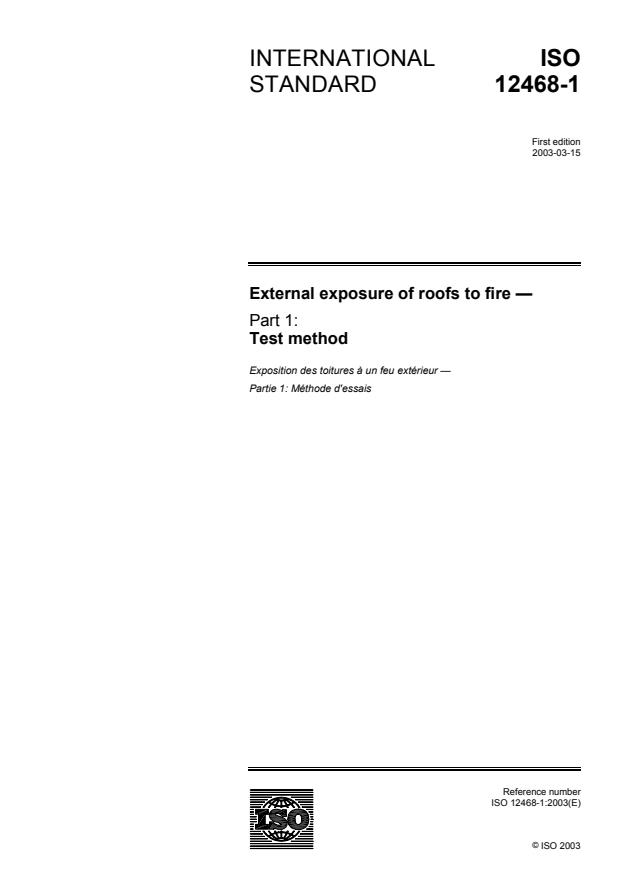
INTERNATIONAL ISO
STANDARD 12468-1
First edition
2003-03-15
External exposure of roofs to fire —
Part 1:
Test method
Exposition des toitures à un feu extérieur —
Partie 1: Méthode d'essais
Reference number
©
ISO 2003
PDF disclaimer
This PDF file may contain embedded typefaces. In accordance with Adobe's licensing policy, this file may be printed or viewed but
shall not be edited unless the typefaces which are embedded are licensed to and installed on the computer performing the editing. In
downloading this file, parties accept therein the responsibility of not infringing Adobe's licensing policy. The ISO Central Secretariat
accepts no liability in this area.
Adobe is a trademark of Adobe Systems Incorporated.
Details of the software products used to create this PDF file can be found in the General Info relative to the file; the PDF-creation
parameters were optimized for printing. Every care has been taken to ensure that the file is suitable for use by ISO member bodies. In
the unlikely event that a problem relating to it is found, please inform the Central Secretariat at the address given below.
© ISO 2003
All rights reserved. Unless otherwise specified, no part of this publication may be reproduced or utilized in any form or by any means,
electronic or mechanical, including photocopying and microfilm, without permission in writing from either ISO at the address below or
ISO's member body in the country of the requester.
ISO copyright office
Case postale 56 • CH-1211 Geneva 20
Tel. + 41 22 749 01 11
Fax + 41 22 749 09 47
E-mail copyright@iso.org
Web www.iso.org
Published in Switzerland
ii © ISO 2003 — All rights reserved
Contents Page
Foreword. iv
Introduction . v
1 Scope. 1
2 Normative references . 1
3 Terms and definitions. 1
4 Symbols . 3
5 Selection of test specimen pitch . 3
6 Test specimens . 4
6.1 General requirements . 4
6.2 Selection of standard supporting elements.5
6.3 Positioning of joints. 6
6.4 Edge detailing. 7
7 Test equipment. 7
7.1 Exposure levels. 7
7.2 Brands. 8
7.3 Wind. 10
7.4 Radiation. 10
7.5 Timing device . 10
7.6 Calibration element. 10
7.7 Specimen holder . 10
7.8 Gas burner . 14
7.9 Stand . 15
8 Test conditions. 15
8.1 Test environment . 15
8.2 Calibration procedure. 16
9 Conditioning and test preparation . 16
9.1 Conditioning . 16
9.2 Protection of the edges . 17
10 Test procedure . 17
10.1 General. 17
10.2 Commencement of the test. 17
10.3 Ignition and positioning of the brands . 18
10.4 End of the test . 19
10.5 Post-test examination. 19
11 Observations and measurements . 19
11.1 General. 19
11.2 External fire spread. 19
11.3 Fire penetration . 20
11.4 Opening. 20
11.5 Damage . 20
12 Expression of test results . 20
13 Test report. 20
Annex A (normative) Direct field of application . 22
Foreword
ISO (the International Organization for Standardization) is a worldwide federation of national standards bodies
(ISO member bodies). The work of preparing International Standards is normally carried out through ISO
technical committees. Each member body interested in a subject for which a technical committee has been
established has the right to be represented on that committee. International organizations, governmental and
non-governmental, in liaison with ISO, also take part in the work. ISO collaborates closely with the
International Electrotechnical Commission (IEC) on all matters of electrotechnical standardization.
International Standards are drafted in accordance with the rules given in the ISO/IEC Directives, Part 2.
The main task of technical committees is to prepare International Standards. Draft International Standards
adopted by the technical committees are circulated to the member bodies for voting. Publication as an
International Standard requires approval by at least 75 % of the member bodies casting a vote.
Attention is drawn to the possibility that some of the elements of this document may be the subject of patent
rights. ISO shall not be held responsible for identifying any or all such patent rights.
ISO 12468-1 was prepared by Technical Committee ISO/TC 92, Fire safety, Subcommittee SC 2, Fire
containment.
ISO 12468 consists of the following parts, under the general title External exposure of roofs to fire
Part 1: Test method
Part 2: Classification
iv © ISO 2003 — All rights reserved
Introduction
This part of ISO 12468 specifies a test method that relates to the effects of fires on roofs. The test method
described in this part of ISO 12468 represents the effect of two levels of fire exposure.
Level A: A large burning brand coming from a nearby building and falling onto the roof. Level A considers
the effects of wind and additional radiant heat.
Level B: A small burning brand transported by the wind from a remote fire and falling onto the roof.
Level B considers the effect of wind but without additional radiant heat.
Any national regulation may refer to only one or both of the two levels of fire exposure.
INTERNATIONAL STANDARD ISO 12468-1:2003(E)
External exposure of roofs to fire —
Part 1:
Test method
CAUTION — The attention of all persons concerned with managing and carrying out this fire test is
drawn to the fact that fire testing may be hazardous and that there is a possibility that toxic and/or
harmful smoke and gases may be evolved during the test. Mechanical and operational hazards may
also arise during the construction of the test elements or structures, their testing and disposal of test
residues.
An assessment of all potential hazards and risks to health shall be made and safety precautions shall
be identified and provided. Written safety instructions shall be issued. Appropriate training shall be
given to relevant personnel. Laboratory personnel shall ensure that they follow written safety
instructions at all times.
1 Scope
This part of ISO 12468 specifies a test method to determine the resistance of roofs to external exposure to fire.
This method evaluates the behaviour of the roof when exposed to two types of burning brands combined with
wind and with or without heat radiation, concerning:
a) the fire spread across the external surface of the roof;
b) the fire spread within the roof;
c) the fire penetration;
d) the production of flaming droplets or debris falling through the roof, from the underside of the roof or from
the exposed surface.
2 Normative references
The following referenced documents are indispensable for the application of this document. For dated
references, only the edition cited applies. For undated references, the latest edition of the referenced
document (including any amendments) applies.
ISO 13943, Fire safety — Vocabulary
3 Terms and definitions
For the purposes of this document, the terms and definitions given in ISO 13943 and the following apply.
3.1
assembly
fabrication of materials and/or composites
EXAMPLE Sandwich panels.
3.2
burned material
material that has been destroyed by combustion or pyrolysis
3.3
composite
combination of materials which are generally recognized in building construction as discrete entities
EXAMPLE Coated or laminated product such as roofing felt.
3.4
continuous deck
deck supporting the roof covering in which the gap between adjacent elements is not greater than 0,5 mm
(5,0 mm in the case of wooden planks with plain edges)
3.5
damaged material
material that has been burned, melted or otherwise visually changed by heat but does not include
discoloration and soot deposits
3.6
exposed surface
external surface of the calibration element or of the specimen which is subject to the heat conditions
3.7
external fire spread
progression and extent of sustained flaming across the exposed surface of the specimen
3.8
fire penetration
any opening, sustained flaming or glowing due to combustion on the underside that appears during the test
and/or the occurrence of any flaming droplets or debris falling through the specimen or from the underside
NOTE Charring or discoloration is not be regarded as fire penetration.
3.9
fire spread within the roof
extent of burned material in each functional layer inside the specimen
3.10
flaming droplets or debris
burning material falling from or through the specimen that continues to burn on the floor for at least 5 s
3.11
internal damage
extent of damaged material in each functional layer inside the specimen
3.12
material
basic single substance or a uniformly dispersed mixture of substances
EXAMPLE Metal, stone, wood, bitumen, concrete or mineral wool.
3.13
measuring zone
area of the specimen within which measurements are made
2 © ISO 2003 — All rights reserved
3.14
opening
any hole greater than 10 mm × 10 mm that appears during the test which penetrates completely through the
specimen
3.15
product
material (3.12), composite (3.3) or assembly (3.1) about which information is required
3.16
profile pitch
repeating length between sections of a uniformly corrugated or undulating roof deck
3.17
roof
covering and sealing systems including any insulating layers or vapour barriers with their supporting elements
and roof lights or other closures for roof apertures that are intended to provide a weatherproof surface
NOTE Elements with a slope greater than 70° are not considered as roofs in this part of ISO 12468.
3.18
roof covering
material (3.12) attached to the deck
3.19
specimen
representative section of the roof prepared for the purpose of test
3.20
sustained flaming
flaming arising from an observed location, which persists for 5 s or longer
3.21
underside
bottom surface of the specimen
4 Symbols
Symbol Description Unit
v , v , v , v , v , v v Velocity of the air at the measuring points metres per second (m/s)
1 2 3 4 5 6, 7
Pitch (slope)
α degrees (°)
5 Selection of test specimen pitch
Roof systems designed for only one pitch shall be tested at the actual design pitch.
Roof systems designed for more than one pitch shall be tested as follows:
a) for pitch (α) less than 5°, test at zero pitch;
b) for pitch (α) from 5° to 20°, test at 15°;
c) for pitch (α) greater than 20°, test at 30°.
6 Test specimens
6.1 General requirements
For each level of fire exposure, two specimens shall be tested with dimensions measuring 1 200 mm ± 10 mm
in width × 2 000 mm ± 10 mm in length for each test pitch. (See Figures 1 and 2.) When this is not possible
due to the size of the roof light or other closure, a larger specimen shall be used.
NOTE Roof lights cause difficulties due to their size, shape, composition and fire behaviour. Further guidance on the
testing of roof lights will be presented in the next revision of this part of ISO 12468.
The specimens shall be representative in all details of the roof in practice.
Dimensions in millimetres with tolerances of ± 10 mm
Key
1 radiant panel position
2 A Brands
3 measuring zone
Figure 1 — Measuring zone and position of the brands for Level A
4 © ISO 2003 — All rights reserved
Dimensions in millimetres with tolerances of ± 10 mm
Key
1 measuring zone
2 B Brands
Figure 2 — Measuring zone and position of the brands for Level B
6.2 Selection of standard supporting elements
6.2.1 For continuous decks
6.2.1.1 General
The test deck shall be selected in accordance with the following.
a) In the case of roof coverings intended to be installed over a continuous deck other than a profiled metal
deck, a roof deck in accordance with 6.2.1.2 or 6.2.1.4 shall be used.
b) If the materials will only be laid over a profiled metal deck, then a trapezoidal profiled metal deck, in
accordance with 6.2.1.3, shall be used as the deck.
6.2.1.2 Wood particleboard decks
6.2.1.2.1 The wood particleboard shall consist of wood particles bonded with polymer adhesive (e.g. urea
3 3
formaldehyde). This particleboard shall have a density of 680 kg/m ± 50 kg/m and shall not be treated with
fire retardants.
6.2.1.2.2 A wood particleboard deck shall be constructed from planks 250 mm wide × 13 mm ± 1 mm thick
running parallel to the eaves with plain edges and tightly butt jointed so that the gaps between planks do not
exceed 0,5 mm.
6.2.1.2.3 If it is intended also to cover the case of decks made from wooden planks with plain edges, then
these gaps shall be 5 mm ± 0,5 mm.
6.2.1.3 Metal decks
The trapezoidal profiled metal deck shall be made of aluminium or steel (subject to the expected field of
application) and have the width of the crown approximately equal to 50 % of the profile pitch and a trough
depth of approximately 100 mm. The corrugations shall run parallel to the eaves and be open at the ends.
6.2.1.4 Other non-combustible decks
If roofing materials are intended to be laid only on continuous, non-combustible decks with a minimum
thickness of 10 mm, then the test roof deck shall consist of 12 mm ± 2 mm thick reinforced calcium silicate
3 3
board (oven dry density 900 kg/m ± 100 kg/m ).
6.2.2 For non-continuous decks
The spacing of roof supports of any type shall be in accordance with the maximum permissible spans
proposed by the manufacturer for the particular application but not exceeding the minimum dimensions
specified for the specimen in 6.1.
6.3 Positioning of joints
6.3.1 General
The joints shall be representative of practical application. In the case of overlapping layers, the position of the
joints shall be considered to be the edge of the upper layer.
6.3.2 Description of specimen types with respect to joints
Where the dimensions of the elements of any of the layers are such that it requires more than four pieces to
cover the specimen, or if any of the layers are without joints, then the specimens shall be fabricated such that
those layers are representative (see Figures 3 and 4).
Specimens are categorized by the following types.
Type 1: Single central vertical joint in the top layer. Single horizontal joint in the top layer under position of
left brand. Single vertical joint in layer next to top layer under position of right brand. Single vertical joint in
insulation under position of left brand [see Figure 4 a), Type 1].
Type 2: Single vertical joint in the top layer under position of right brand. Single vertical joint in layer next
to insulation under position of left brand [see Figure 4 b), Type 2].
6 © ISO 2003 — All rights reserved
Type 3: One cross joint of the top layer under position of the right brand and, where possible according to
the design of the product, a vertical joint in layer under top under the left brand [see Figure 4 c), Type 3].
Type 4: Centre of one element of the top layer and, where possible according to the design of the product,
a vertical joint of supporting deck, under position of the right brand and in insulation under the left brand
[see Figure 4 d), Type 4].
6.3.3 Selection of the specimen types
Either specimen types, Types 1 and 2 or Types 3 and 4, shall be used for each test pitch and for each level of
fire exposure.
6.4 Edge detailing
No special measures shall be taken by the sponsor to protect the edges of the specimen.
Key
1 vertical joint in top layer 6 vertical joint in supporting deck
2 horizontal joint in top layer 7 weathering layer
3 joint in layer next to insulation 8 insulation
4 joint in layer next to top layer 9 roof deck
5 joint in insulation
Figure 3 — Identification of joints in a multilayer roof
7 Test equipment
7.1 Exposure levels
Two levels are defined.
a) Level A consists of Brand A combined with wind and additional radiant heat.
b) Level B consists of Brand B combined with wind and without any additional radiant heat.
The wind is identical for the Levels A and B. The measuring zone, position of the brands and position of the
radiant panel are shown in Figures 1 and 2.
a) Type 1 b) Type 2
c) Type 3 d) Type 4
Key
1 vertical joint in top layer 4 joint in layer next to top layer
2 horizontal joint in top layer 5 joint in insulation
3 joint in layer next to insulation 6 vertical joint in supporting deck
Figure 4 — Position of joints and types of specimens
7.2 Brands
7.2.1 General
Two brands are utilized for each specimen. The test brands shall be constructed from Beech (Fagus salvatica
3 3
or Fagus grandifolia) having an oven-dry density of 560 kg/m ± 50 kg/m .
The mass of the finished brand following conditioning in an oven at 40 °C to 50 °C for at least 24 h shall be
33 g ± 5 g at the time of the test for Brand B and 550 g ± 50 g (less fasteners) at the
...
Questions, Comments and Discussion
Ask us and Technical Secretary will try to provide an answer. You can facilitate discussion about the standard in here.
Loading comments...