


ISO 1101:2012
(Main)Geometrical product specifications (GPS) — Geometrical tolerancing — Tolerances of form, orientation, location and run-out
Geometrical product specifications (GPS) — Geometrical tolerancing — Tolerances of form, orientation, location and run-out
ISO 1101:2012 contains basic information and gives requirements for the geometrical tolerancing of workpieces. It represents the initial basis and defines the fundamentals for geometrical tolerancing.
Spécification géométrique des produits (GPS) — Tolérancement géométrique — Tolérancement de forme, orientation, position et battement
L'ISO 1101:2012 fournit les informations de base et spécifie les exigences pour le tolérancement géométrique des pièces. Elle constitue la base de départ et définit les fondements du tolérancement géométrique.
General Information
- Status
- Withdrawn
- Publication Date
- 22-Apr-2012
- Withdrawal Date
- 22-Apr-2012
- Current Stage
- 9599 - Withdrawal of International Standard
- Start Date
- 01-Feb-2017
- Completion Date
- 14-Feb-2026
Relations
- Effective Date
- 12-Feb-2026
- Effective Date
- 06-Jun-2022
- Effective Date
- 06-Jun-2022
- Effective Date
- 06-Jun-2022
- Effective Date
- 14-Jun-2014
- Effective Date
- 19-Mar-2011
Buy Documents


ISO 1101:2012 - Geometrical product specifications (GPS) -- Geometrical tolerancing -- Tolerances of form, orientation, location and run-out

ISO 1101:2012 - Spécification géométrique des produits (GPS) -- Tolérancement géométrique -- Tolérancement de forme, orientation, position et battement
Get Certified
Connect with accredited certification bodies for this standard

BSMI (Bureau of Standards, Metrology and Inspection)
Taiwan's standards and inspection authority.
Sponsored listings
Frequently Asked Questions
ISO 1101:2012 is a standard published by the International Organization for Standardization (ISO). Its full title is "Geometrical product specifications (GPS) — Geometrical tolerancing — Tolerances of form, orientation, location and run-out". This standard covers: ISO 1101:2012 contains basic information and gives requirements for the geometrical tolerancing of workpieces. It represents the initial basis and defines the fundamentals for geometrical tolerancing.
ISO 1101:2012 contains basic information and gives requirements for the geometrical tolerancing of workpieces. It represents the initial basis and defines the fundamentals for geometrical tolerancing.
ISO 1101:2012 is classified under the following ICS (International Classification for Standards) categories: 01.100.20 - Mechanical engineering drawings; 17.040.10 - Limits and fits. The ICS classification helps identify the subject area and facilitates finding related standards.
ISO 1101:2012 has the following relationships with other standards: It is inter standard links to EN ISO 1101:2013, ISO 10322-2:2006, ISO 1101:2004, ISO 10578:1992, ISO 1101:2017, ISO 1101:2004/FDAmd 1. Understanding these relationships helps ensure you are using the most current and applicable version of the standard.
ISO 1101:2012 is available in PDF format for immediate download after purchase. The document can be added to your cart and obtained through the secure checkout process. Digital delivery ensures instant access to the complete standard document.
Standards Content (Sample)
INTERNATIONAL ISO
STANDARD 1101
Third edition
2012-04-15
Geometrical product specifications
(GPS) — Geometrical tolerancing —
Tolerances of form, orientation, location
and run-out
Spécification géométrique des produits (GPS) — Tolérancement
géométrique — Tolérancement de forme, orientation, position et
battement
Reference number
©
ISO 2012
© ISO 2012
All rights reserved. Unless otherwise specified, no part of this publication may be reproduced or utilized in any form or by any means,
electronic or mechanical, including photocopying and microfilm, without permission in writing from either ISO at the address below or
ISO's member body in the country of the requester.
ISO copyright office
Case postale 56 CH-1211 Geneva 20
Tel. + 41 22 749 01 11
Fax + 41 22 749 09 47
E-mail copyright@iso.org
Web www.iso.org
Published in Switzerland
ii © ISO 2012 – All rights reserved
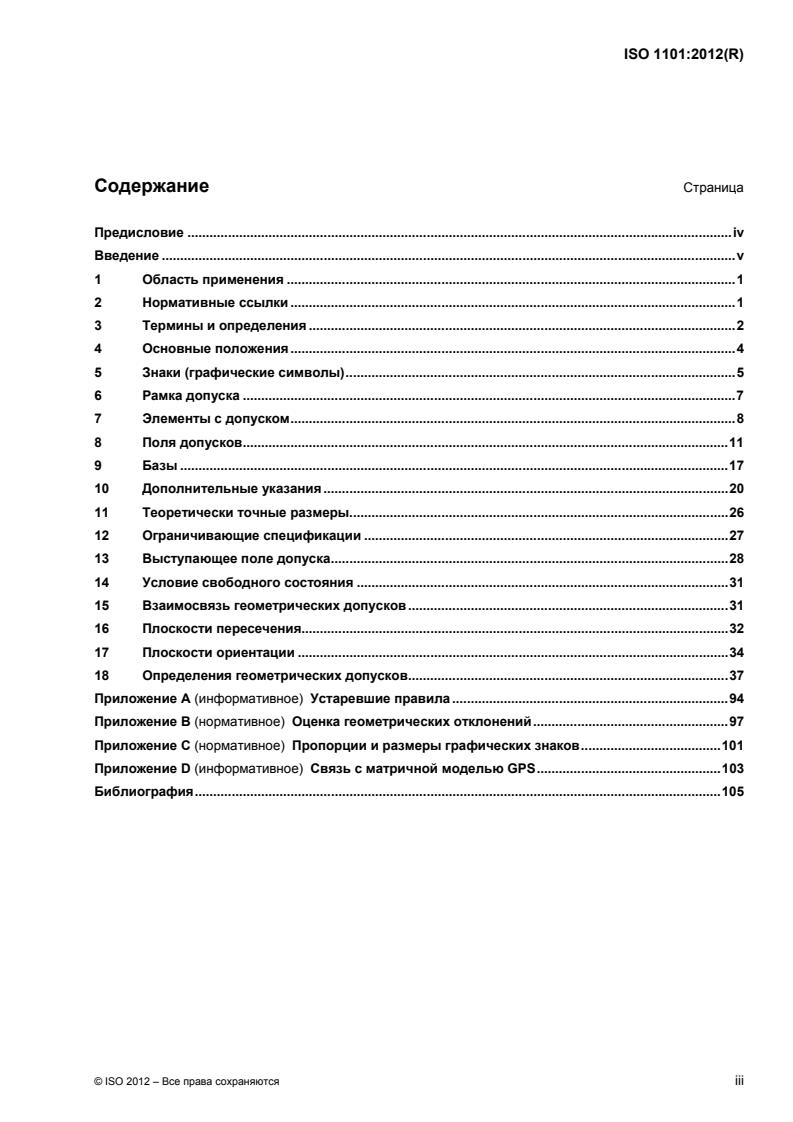
Contents Page
Foreword . iv
Introduction . v
1 Scope . 1
2 Normative references . 1
3 Terms and definitions . 2
4 Basic concepts . 4
5 Symbols . 5
6 Tolerance frame . 7
7 Toleranced features . 8
8 Tolerance zones . 10
9 Datums. 16
10 Supplementary indications . 19
11 Theoretically exact dimensions (TED) . 25
12 Restrictive specifications . 25
13 Projected tolerance zone . 27
14 Free state condition . 30
15 Interrelationship of geometrical tolerances. 30
16 Intersection planes . 30
17 Orientation planes . 33
18 Definitions of geometrical tolerances . 35
Annex A (informative) Former practices . 92
Annex B (normative) Assessment of geometrical deviations . 95
Annex C (normative) Relations and dimensions of graphical symbols . 99
Annex D (informative) Relation to the GPS matrix model . 101
Bibliography . 103
Foreword
ISO (the International Organization for Standardization) is a worldwide federation of national standards bodies
(ISO member bodies). The work of preparing International Standards is normally carried out through ISO
technical committees. Each member body interested in a subject for which a technical committee has been
established has the right to be represented on that committee. International organizations, governmental and
non-governmental, in liaison with ISO, also take part in the work. ISO collaborates closely with the
International Electrotechnical Commission (IEC) on all matters of electrotechnical standardization.
International Standards are drafted in accordance with the rules given in the ISO/IEC Directives, Part 2.
The main task of technical committees is to prepare International Standards. Draft International Standards
adopted by the technical committees are circulated to the member bodies for voting. Publication as an
International Standard requires approval by at least 75 % of the member bodies casting a vote.
Attention is drawn to the possibility that some of the elements of this document may be the subject of patent
rights. ISO shall not be held responsible for identifying any or all such patent rights.
ISO 1101 was prepared by Technical Committee ISO/TC 213, Dimensional and geometrical product
specifications and verification.
This third edition cancels and replaces the second edition (ISO 1101:2004) and ISO 10578:1992.
Representations of specifications in the form of a 3D model have been added.
iv © ISO 2012 – All rights reserved
Introduction
This International Standard is a geometrical product specification (GPS) standard and is to be regarded as a
general GPS standard (see ISO/TR 14638). It influences chain links 1, 2 and 3 of the chain of standards on
form, orientation, location and run out, and chain link 1 of the chain of standards on datums.
The ISO GPS Masterplan given in ISO/TR 14638 gives an overview of the ISO GPS system of which this
document is a part. The fundamental rules of ISO GPS given in ISO 8015 apply to this document. The default
decision rules given in ISO 14253-1 apply to specifications made in accordance with this document, unless
otherwise stated.
For more detailed information on the relation of this International Standard to the GPS matrix model, see
Annex D.
This International Standard represents the initial basis and describes the required fundamentals for
geometrical tolerancing. Nevertheless, it is advisable to consult the separate standards referenced in Clause 2
and in Table 2 for more detailed information.
For the presentation of lettering (proportions and dimensions), see ISO 3098-2.
All figures in this International Standard for the 2D drawing indications have been drawn in first-angle
projection with dimensions and tolerances in millimetres. It should be understood that third-angle projection
and other units of measurement could have been used equally well without prejudice to the principles
established. For all figures giving tolerancing examples in 3D, the dimensions and tolerances are the same as
for the similar figures shown in 2D.
The figures in this International Standard illustrate the text and are not intended to reflect an actual application.
Consequently, the figures are not fully dimensioned and toleranced, showing only the relevant general
principles. Neither are the figures intended to imply a particular display requirement in terms of whether
hidden detail, tangent lines or other annotations are shown or not shown. Many figures have lines or details
removed for clarity, or added or extended to assist with the illustration of the text.
For a definitive presentation (proportions and dimensions) of the symbolization for geometrical tolerancing,
see ISO 7083.
Annex A of this International Standard has been provided for information only. It presents previous drawing
indications that have been omitted here and are no longer used.
It needs to be noted that the former use of the term “circularity” has been changed to the term “roundness” for
reasons of consistency with other standards.
Definitions of features are taken from ISO 14660-1 and ISO 14660-2, which provide new terms different from
those used in previous edition of this International Standard. The former terms are indicated in the text
following the new terms, between parentheses.
For the purposes of this International Standard, the terms “axis” and “median plane” are used for derived
features of perfect form, and the terms “median line” and “median surface” for derived features of imperfect
form. Furthermore, the following line types have been used in the explanatory illustrations, i.e. those
representing non-technical drawings for which the rules of ISO 128 (all parts) apply.
Line type
Feature level Feature type Details
Visible Behind plane/surface
point
Nominal feature (ideal
integral feature line/axis wide continuous narrow dashed
feature)
surface/plane
point
narrow long dashed
derived feature line/axis narrow dashed dotted
dotted
face/plane
surface wide freehand narrow freehand
Real feature integral feature
continuous dashed
point
Extracted feature integral surface line wide short dashed narrow short dashed
surface
point
derived feature line wide dotted narrow dotted
face
point
wide doubled-dashed narrow double-dashed
Associated feature integral feature straight line
double-dotted double-dotted
ideal feature
point
narrow long dashed wide dashed
derived feature straight line
double-dotted double-dotted
plane
point line wide long dashed narrow long dashed
datum
surface/plane double-short dashed double-short dashed
Tolerance zone limits, line surface
continuous narrow narrow dashed
tolerances planes
Section, illustration line surface
narrow long dashed narrow dashed
plane, drawing plane,
short dashed short dashed
aid plane
Extension, dimension, line
leader and reference continuous narrow narrow dashed
lines
vi © ISO 2012 – All rights reserved
INTERNATIONAL STANDARD ISO 1101:2012(E)
Geometrical product specifications (GPS) — Geometrical
tolerancing — Tolerances of form, orientation,
location and run-out
IMPORTANT — The illustrations included in this International Standard are intended to illustrate the
text and/or to provide examples of the related technical drawing specification; these illustrations are
not fully dimensioned and toleranced, showing only the relevant general principles.
As a consequence, the illustrations are not a representation of a complete workpiece, and are not of a
quality that is required for use in industry (in terms of full conformity with the standards prepared by
ISO/TC 10 and ISO/TC 213), and as such are not suitable for projection for teaching purposes.
1 Scope
This International Standard contains basic information and gives requirements for the geometrical tolerancing
of workpieces.
It represents the initial basis and defines the fundamentals for geometrical tolerancing.
NOTE Other International Standards referenced in Clause 2 and in Table 2 provide more detailed information on
geometrical tolerancing.
2 Normative references
The following referenced documents are indispensable for the application of this document. For dated
references, only the edition cited applies. For undated references, the latest edition of the referenced
document (including any amendments) applies.
ISO 128-24:1999, Technical drawings — General principles of presentation — Part 24: Lines on mechanical
engineering drawings
ISO 1660:1987, Technical drawings — Dimensioning and tolerancing of profiles
ISO 2692:2006, Geometrical product specifications (GPS) — Geometrical tolerancing — Maximum material
requirement (MMR), least material requirement (LMR) and reciprocity requirement (RPR)
ISO 5458:1998, Geometrical Product Specifications (GPS) — Geometrical tolerancing — Positional
tolerancing
ISO 5459:2011, Geometrical product specifications (GPS) — Geometrical tolerancing — Datums and datum
systems
ISO 8015:2011, Geometrical product specifications (GPS) — Fundamentals — Concepts, principles and rules
ISO 10579:2010, Geometrical product specifications (GPS) — Dimensioning and tolerancing — Non-rigid
parts
ISO 12180-1:2011, Geometrical product specifications (GPS) — Cylindricity — Part 1: Vocabulary and
parameters of cylindrical form
ISO 12180-2:2011, Geometrical product specifications (GPS) — Cylindricity — Part 2: Specification operators
ISO 12181-1:2011, Geometrical product specifications (GPS) — Roundness — Part 1: Vocabulary and
parameters of roundness
ISO 12181-2:2011, Geometrical product specifications (GPS) — Roundness — Part 2: Specification operators
ISO 12780-1:2011, Geometrical product specifications (GPS) — Straightness — Part 1: Vocabulary and
parameters of straightness
ISO 12780-2:2011, Geometrical product specifications (GPS) — Straightness — Part 2: Specification
operators
ISO 12781-1:2011, Geometrical product specifications (GPS) — Flatness — Part 1: Vocabulary and
parameters of flatness
ISO 12781-2:2011, Geometrical product specifications (GPS) — Flatness — Part 2: Specification operators
ISO 14660-1:1999, Geometrical Product Specifications (GPS) — Geometrical features — Part 1: General
terms and definitions
ISO 14660-2:1999, Geometrical Product Specifications (GPS) — Geometrical features — Part 2: Extracted
median line of a cylinder and a cone, extracted median surface, local size of an extracted feature
ISO 17450-2:— , Geometrical product specifications (GPS) — General concepts — Part 2: Basic tenets,
specifications, operators and uncertainties
3 Terms and definitions
For the purposes of this document, the terms and definitions given in ISO 14660-1 and ISO 14660-2 and the
following apply.
3.1
tolerance zone
space limited by one or several geometrically perfect lines or surfaces, and characterized by a linear
dimension, called a tolerance
NOTE See also 4.4.
3.2
intersection plane
plane, established from an extracted feature of the workpiece, identifying a line on an extracted surface
(integral or median) or a point on an extracted line
NOTE The use of intersection planes makes it possible to define toleranced features independent of the view.
3.3
orientation plane
plane, established from an extracted feature of the workpiece, identifying the orientation of the tolerance zone
NOTE 1 For a derived feature, the use of an orientation plane makes it possible to define the direction of the width of
the tolerance zone independent of the TEDs (case of location) or of the datum (case of orientation).
NOTE 2 The orientation plane is only used when the toleranced feature is a median feature (centre point, median
straight line) and the tolerance zone is defined by two parallel straight lines or two parallel planes.
To be published. (Revision of ISO/TS 17450-2:2002)
2 © ISO 2012 – All rights reserved
3.4
direction feature
feature, established from an extracted feature of the workpiece, identifying the direction of the width of the
tolerance zone
NOTE 1 The direction feature can be a plane, a cylinder or a cone.
NOTE 2 For a line in a surface, the use of a direction feature makes it possible to change the direction of the width of
the tolerance zone.
NOTE 3 The direction feature is used on a complex surface or a complex profile when the direction of the tolerance
value is not normal to the specified geometry.
NOTE 4 By default, the direction feature is a cone, a cylinder or a plane constructed from the datum or datum system
indicated in the second compartment of the direction feature indicator. The geometry of the direction feature depends on
the geometry of the toleranced feature.
3.5
compound contiguous feature
feature composed of several single features joined together without gaps
NOTE 1 A compound contiguous feature can be closed or not.
NOTE 2 A non-closed compound contiguous feature can be defined by the way of using the “between” symbol
(see 10.1.4).
NOTE 3 A closed compound contiguous feature can be defined by the way of using the “all around” symbol
(see 10.1.2). In this case, it is a set of single features whose intersection with any plane parallel to a collection plane is a
line or a point.
3.6
collection plane
plane, established from a nominal feature on the workpiece, defining a closed compound contiguous feature
NOTE The collection plane may be required when the “all around” symbol is applied.
3.7
theoretically exact dimension
TED
dimension indicated on technical product documentation, which is not affected by an individual or general
tolerance
NOTE 1 For the purpose of this International Standard, the term “theoretically exact dimension” has been abbreviated
TED.
NOTE 2 A theoretically exact dimension is a dimension used in operations (e.g. association, partition, collection, …).
NOTE 3 A theoretically exact dimension can be a linear dimension or an angular dimension.
NOTE 4 A TED can define
the extension or the relative location of a portion of one feature,
the length of the projection of a feature,
the theoretical orientation or location from one or more features, or
the nominal shape of a feature.
NOTE 5 A TED is indicated by a rectangular frame including a value.
4 Basic concepts
4.1 Geometrical tolerances shall be specified in accordance with functional requirements. Manufacturing
and inspection requirements can also influence geometrical tolerancing.
NOTE Indicating geometrical tolerances does not necessarily imply the use of any particular method of production,
measurement or gauging.
4.2 A geometrical tolerance applied to a feature defines the tolerance zone within which that feature shall
be contained.
4.3 A feature is a specific portion of the workpiece, such as a point, a line or a surface; these features can
be integral features (e.g. the external surface of a cylinder) or derived (e.g. a median line or median surface).
See ISO 14660-1.
4.4 According to the characteristic to be toleranced and the manner in which it is dimensioned, the
tolerance zone is one of the following:
the space within a circle;
the space between two concentric circles;
the space between two equidistant lines or two parallel straight lines;
the space within a cylinder;
the space between two coaxial cylinders
the space between two equidistant surfaces or two parallel planes;
the space within a sphere.
4.5 Unless a more restrictive indication is required, for example by an explanatory note (see Figure 8), the
toleranced feature may be of any form or orientation within this tolerance zone.
4.6 The tolerance applies to the whole extent of the considered feature unless otherwise specified as in
Clauses 12 and 13.
4.7 Geometrical tolerances which are assigned to features related to a datum do not limit the form
deviations of the datum feature itself. It may be necessary to specify tolerances of form for the datum
feature(s).
4 © ISO 2012 – All rights reserved
5 Symbols
See Tables 1 and 2.
Table 1 — Symbols for geometrical characteristics
Tolerances Characteristics Symbol Datum needed Subclause
Straightness no 18.1
Flatness no 18.2
Roundness no 18.3
Form
Cylindricity no 18.4
Profile any line no 18.5
Profile any surface no 18.7
Parallelism yes 18.9
Perpendicularity yes 18.10
Orientation Angularity yes 18.11
Profile any line yes
Profile any surface yes
Position yes or no 18.12
Concentricity (for centre points) yes 18.13
Coaxiality (for axes) yes 18.13
Location
Symmetry yes 18.14
Profile any line yes 18.6
Profile any surface yes 18.8
Circular run-out yes 18.15
Run-out
Total run-out yes 18.16
Table 2 — Additional symbols
Description Symbol Reference
Toleranced feature indication Clause 7
Datum feature indication Clause 9 and ISO 5459
Datum target indication ISO 5459
Theoretically exact dimension Clause 11
Median feature Clause 7
Unequally disposed tolerance zone Subclause 10.2
Between Subclause 10.1.4
From … to Subclause 10.1.4
Projected tolerance zone Clause 13
Maximum material requirement Clause 14 and ISO 2692
Least material requirement Clause 15 and ISO 2692
Free state condition (non-rigid parts) Clause 16 and ISO 10579
All around (profile) Subclause 10.1
Envelope requirement ISO 8015
Common zone Subclause 8.5
Minor diameter Subclause 10.2
Major diameter Subclause 10.2
Pitch diameter Subclause 10.2
Line element Subclause 18.9.4
Not convex Subclause 6.3
Any cross-section Subclause 18.13.1
Direction feature Subclause 8.1
Collection plane Subclause 10.1.2
Intersection plane Clause 16
Orientation plane Clause 17
6 © ISO 2012 – All rights reserved
6 Tolerance frame
6.1 The requirements are shown in a rectangular frame which is divided into two or more compartments.
These compartments contain, from left to right, in the following order (see the examples in Figures 1, 2, 3, 4
and 5):
first compartment: the symbol for the geometrical characteristic;
second compartment: the width of the tolerance zone in the unit used for linear dimensions and
complementary requirements (see Clauses 7, 8, 10, and 12 to 16). If the tolerance zone is circular or
cylindrical, the value is preceded by the symbol “ ”. If the tolerance zone is spherical, the value is
preceded by “S ”;
third and subsequent compartment, if applicable: the letter or letters identifying the datum or common
datum or datum system (see the examples in Figures 2, 3, 4 and 5).
Figure 1 Figure 2 Figure 3 Figure 4 Figure 5
6.2 When a tolerance applies to more than one feature this shall be indicated above the tolerance frame by
the number of features followed by the symbol “” (see the examples in Figures 6 and 7).
Figure 6 Figure 7
6.3 If required, indications qualifying the form of the feature within the tolerance zone shall be written near
the tolerance frame (see the example in Figure 8).
NOTE See also Table 2.
Figure 8
6.4 If it is necessary to specify more than one geometrical characteristic for a feature, the requirements may
be given in tolerance frames one under the other for convenience (see the example in Figure 9).
Figure 9
6.5 If required, indications qualifying the direction of the tolerance zone or the extracted (actual) line or both
shall be written after the tolerance frame, e.g. use of intersection plane to indicate the direction of the
toleranced feature (see Clause 7), use of the orientation plane to indicate the orientation of the tolerance zone,
use of the direction feature to indicate the direction of the width of the tolerance zone (see Clause 8).
7 Toleranced features
A geometrical specification applies to a single complete feature, unless an appropriate modifier is indicated.
When the toleranced feature is not a single complete feature, see Clause 10.
When the geometrical specification refers to the feature itself (integral feature), the tolerance frame shall be
connected to the toleranced feature by a leader line starting from either end of the frame and terminating in
one of the following ways:
In 2D annotation, on the outline of the feature or an extension of the outline (but clearly separated from
the dimension line) (see Figures 10 and 11). The termination of the leader line is
an arrow if it terminates on a drawn line, or
a dot (filled or unfilled) when the indicated feature is an integral feature and the leader line terminates
within the bounds of the feature.
The arrowhead may be placed on a reference line using a leader line to point to the surface (see Figure 12).
In 3D annotation, on the feature itself [see Figures 10 b) and 11 b)]. The termination of the leader line is a
dot. When the surface is visible, the dot is filled out; when the surface is hidden the dot is not filled out
and the leader line is a dashed line.
The termination of the leader line may be an arrow placed on a reference line using a leader line to point
to the surface [see Figure 12 b)]. The above rules for the dot terminating the leader line also apply in this
case.
a) 2D b) 3D
Figure 10
a) 2D b) 3D
Figure 11
8 © ISO 2012 – All rights reserved
a) 2D b) 3D
Figure 12
When the tolerance refers to a median line, a median surface, or a median point (derived feature), it is
indicated either
by the leader line starting from either end of the tolerance frame terminated by an arrow on the extension
of the dimension line of a feature of size [see the examples in Figures 13 a), 13 b), 14 a), 14 b), 15 a) and
15 b)], or
by a modifier (median feature) placed at the rightmost end of the second compartment of the tolerance
frame from the left. In this case, the leader line starting from either end of the tolerance frame does not
have to terminate on the dimension line, but can terminate with an arrow on the outline of the feature [see
Figures 16 a) and 16 b)].
a) 2D b) 3D
Figure 13
a) 2D b) 3D
Figure 14
a) 2D b) 3D
Figure 15
a) 2D b) 3D
Figure 16
If needed, an indication specifying the type of feature (line instead of a surface) shall be written near the
tolerance frame (see Figures 103 and 104).
NOTE When the toleranced feature is a line, a further indication may be needed to control the orientation of the
toleranced feature, see Figure 97 for the case of a median line and Figure 103 for the case of an integral line.
8 Tolerance zones
8.1 The tolerance zone is positioned symmetrically from an ideal feature unless otherwise indicated
(see 10.2). The tolerance value defines the width of the tolerance zone. This width applies normal to the
specified geometry (see Figures 17 and 18) unless otherwise indicated (see Figures 19 and 20).
NOTE The orientation alone of the leader line does not influence the definition of the tolerance zone, except in the
case where the orientation of the leader line and therefore the direction of the width of the tolerance zone is indicated by a
TED [see Figures 19 a) and 19 b), and 8.2].
10 © ISO 2012 – All rights reserved
a
Datum A.
Drawing indication Interpretation
Figure 17 Figure 18
Drawing indication
a) 2D
b) 3D c) 3D
Figure 19
NOTE 1 When the datum feature identified by the tolerance frame is the same as the feature establishing the direction
feature, then the direction feature can be omitted.
NOTE 2 In Figure 19, the theoretical shape of each toleranced feature is a circle. The straight segments are inclined by
the angle alpha. This generates a set of tolerance zones which are conical sections with a fixed angle along the surface.
When a direction feature is indicated as shown in Figure 19, the width of the tolerance zone is defined by an
infinite set of straight segments, inclined in the direction indicated by the direction feature indicator. Each of
these segments has a length equal to the tolerance value and has its midpoint located on the theoretical
shape of the tolerance zone by default.
The tolerance value is constant along the length of the considered feature, unless otherwise indicated by a
graphical indication, defining a proportional variation from one value to another, between two specified
locations on the considered feature, identified as given in 10.1.4. The letters identifying the locations are
separated by an arrow (see Figure 21 for restricted parts of a feature). The values are related to the specified
locations on the considered feature by the letters indicated over the tolerance frame (e.g. in Figure 21, the
value of the tolerance is 0,1 for location J and 0,2 for location K). By default, the proportional variation follows
the curvilinear distance, i.e. the distance along the curve connecting the two specified locations.
a
Datum A.
Interpretation
Figure 20
Figure 21
The angle shown in Figure 19 shall be indicated, even if it is equal to 90°.
In the case of roundness, the width of the tolerance zone always applies in a plane perpendicular to the
nominal axis.
12 © ISO 2012 – All rights reserved
8.2 In the case of a median feature (centre point, median line, median surface) toleranced in one direction:
In 2D view, when the direction of the width of a tolerance zone is at 0° or 90° relative to the datum or
relative to the pattern of the theoretically exact dimensions without using an orientation plane, the arrow
of the leader line gives this direction (Figures 22, 23 and 24). In other cases, an orientation plane shall be
used.
Figure 22
In 3D view, when the direction of the width of a tolerance zone is to be specified relative to the datum or
relative to the pattern of the theoretically exact dimensions, an orientation plane shall be indicated to
determine this direction [see Figure 23 b)].
when two tolerances are stated, they shall be perpendicular to each other unless otherwise specified (see
the examples in Figures 23 and 24).
Drawing indication
a) 2D b) 3D
Figure 23
a
Datum A.
b
Datum B.
Interpretation
Figure 24
8.3 The tolerance zone is cylindrical (see the examples in Figures 25 and 26) or circular if the tolerance
value is preceded by the symbol “ ” or spherical if it is preceded by the symbol “S ”.
a
Datum A.
Drawing indication Interpretation
Figure 25 Figure 26
14 © ISO 2012 – All rights reserved
8.4 Individual tolerance zones of the same value applied to several separate features may be specified (see
the example in Figure 27).
Figure 27
8.5 Where a common tolerance zone is applied to several separate features, this common requirement
shall be indicated by the symbol “ ” for common zone following the tolerance in the tolerance frame [see the
examples in Figure 28 a)].
Where several tolerance zones (controlled by the same tolerance frame) are applied simultaneously to several
separate features (not independently), to create a combined zone, the requirement shall be indicated by the
” for common zone following the tolerance in the tolerance frame [see the example in Figure 28 b)]
symbol “
and an indication that the specification applies to several features [e.g. using “3 ” over the tolerance frame
(see 6.2), or using three leader lines attached to the tolerance frame (see 8.4)].
Where is indicated in the tolerance frame, all the related individual tolerance zones shall be constrained in
location and in orientation amongst themselves using either implicit (0 mm, 0°, 90°, etc.) or explicit
theoretically exact dimensions (TED).
a)
b)
Figure 28
9 Datums
9.1 Datums shall be indicated as given in the examples in 9.2 to 9.5. For additional information, see
ISO 5459.
NOTE At the next revision of this International Standard, this clause will be moved to ISO 5459.
9.2 A datum related to a toleranced feature shall be designated by a datum letter. A capital letter shall be
enclosed in a datum frame and connected to a filled or open datum triangle to identify the datum [see the
examples in Figures 29 a), 29 b), Figures 30 a) and 30 b)]; the same letter which defines the datum shall also
be indicated in the tolerance frame. There is no difference in the meaning between a filled and an open datum
triangle.
a) 2D b) 3D
Figure 29
a) 2D b) 3D
Figure 30
9.3 The datum triangle with the datum letter shall be placed:
in 2D annotation, on the outline of the feature or an extension of the outline (but clearly separated from
the dimension line), when the datum is the line or surface shown (see the example in Figure 31); the
datum triangle may be placed on a reference line using a leader line to point to the surface (see the
example in Figure 32);
a) 2D b) 3D
Figure 31
16 © ISO 2012 – All rights reserved
a) 2D b) 3D
Figure 32
in 3D annotation, when the datum is established from a datum feature which is not a feature of size, the
datum feature indicators shall not be in extension of a dimension line [see Figure 31 b)and Figure 32 b)],
and shall be indicated in one of the following ways:
For a visible feature:
on the feature itself, or
on a reference line using a leader line terminated by a filled dot to point to the feature;
For a non-visible feature:
on a reference line using a dashed leader line terminated by an unfilled dot to point to the
feature, or
on an extension line tangential to the feature and perpendicular to an outline of the feature,
which is clearly separated from the borders of the feature.
as an extension of the dimension line, when the datum is the axis or median plane or a point defined by
the feature so dimensioned [see the examples in Figures 33 a) to 35 a) for 2D annotation and Figures 33
b) to 35 b) for 3D annotation], if there is insufficient space for two arrowheads, one of them may be
replaced by the datum triangle [see the examples in Figures 34 a) and 35 a) for 2D annotation and
Figures 34 b) and 35 b) for 3D annotation].
a) 2D b) 3D
Figure 33
a) 2D b) 3D
Figure 34
a) 2D b) 3D
Figure 35
9.4 If a datum is applied to a restricted part of a feature only, this restriction shall be shown as a wide, long
dashed-dotted line and dimensioned (see the example in Figure 36). See ISO 128-24:1999, Table 2, 04.2.
a) 2D b) 3D
Figure 36
9.5 A datum established by a single feature is identified by a capital letter (see Figure 37).
A common datum established by two features is identified by two capital letters separated by a hyphen (see
the example in Figure 38).
Where a datum system is established by two or three features, i.e. multiple datums, the capital letters for
identifying the datums are indicated in an order of priority, from left to right, in separate compartments (see the
example in Figure 39).
18 © ISO 2012 – All rights reserved
Figure 37 Figure 38 Figure 39
10 Supplementary indications
10.1 Indications of a compound or restricted toleranced feature
10.1.1 General
When the toleranced feature is a portion of a single feature, or a compound contiguous feature, then it shall be
indicated either as
a contiguous, closed feature (single or compound), see 10.1.2,
a restricted area of a single surface, 10.1.3, or
a contiguous, non-closed feature (single or compound), see 10.1.4.
10.1.2 All around — Contiguous, closed toleranced feature
If a requirement applies to a closed compound contiguous surface defined by a collection plane, the “all
around” modifier (“O”) shall be placed on the intersection of the leader line and the reference line of the
tolerance frame. In 3D annotation, a collection plane indicator identifying the collection plane shall be placed
after the tolerance frame [see Figures 40 b) and 41 b)]. In 2D annotation, the collection plane can be implicit
parallel to the projection plane in which the specification is indicated. An all-around requirement applies only to
the surfaces represented by the outline, not to the entire workpiece (see Figure 41).
If a requirement applies to the set of line elements on the closed compound contiguous surface (defined by a
collection plane), an intersection plane indicator identifying the intersection plane shall also be placed between
the tolerance frame and the collection plane indicator in 3D annotation [see Figure 40 b)].
a) 2D
NOTE When using the symbol of profile of any line, if the intersection plane and the collection plane are the same,
the collection plane symbol can be omitted.
b) 3D
Figure 40
20 © ISO 2012 – All rights reserved
NOTE The long dashed short dashed line indicates the considered features. Surfaces a and b are not considered in
the specification.
a) 2D
b) 3D
Figure 41
10.1.3 Restricted area toleranced feature
In 2D annotation, the surface portions involved shall be outlined by a long-dashed dotted wide line (in
accordance with ISO 128-24) (see Figures 53 and 54).
In 3D annotation, the leader line starting from either end of the tolerance frame shall terminate on a hatched
area, indicating the surface portions involved whose location and dimensions shall be defined by TEDs (see
Figure 42).
The restricted area is defined either
by its border indicated as a long-dashed dotted wide line (in accordance with ISO 128-24 type 04.2),
by its corner points, indicated as crosses on the integral feature (the location of the points being defined
by TEDs), identified by capital letters and leader lines terminated by an arrow. The letters are indicated
above the tolerance frame with a “between” symbol between the last two, see Figure 42 b). The border is
formed by connecting the corner points with straight segments,
by two straight border lines identified by capital letters and leader lines terminated by an arrow (the
location of the border lines being defined by TEDs).
a) b)
Figure 42
The tolerance requirement applies to each surface or line element independently, unless otherwise specified
(e.g. by using a CZ symbol).
10.1.4 Contiguous, non-closed toleranced feature
If a tolerance applies to one identified restricted part of a feature or to contiguous restricted parts of
contiguous features, but does not apply to the entire outline of the cross-sections (or entire surface
represented by the outline), this restriction shall be indicated using the symbol “ ” (called “between”) and
by identifying the start and the end of the toleranced feature.
The points or lines that identify the start and end of the toleranced feature are each identified by a capital letter
connected to it by a leader line terminating with an arrowhead. If the point or line is not at the boundary of an
integral feature, its location shall be indicated by TEDs.
The between symbol “ ” is used between two capital letters that identify the start and the end of the
toleranced feature. This feature (compound toleranced feature) consists of all segments or areas between the
start and the end of the identified features or parts of features.
In order to clearly identify the toleranced feature, the tolerance frame shall be connected to the compound
toleranced feature by a leader line starting from either end of the frame and terminating with an arrowhead on
the outline of the compound toleranced feature (see the example in Figure 43).The arrowhead may also be
placed on a reference line using a leader line to point to the surface.
22 © ISO 2012 – All rights reserved
a) Example of restricted feature — The toleranced b) Illustration: the long-dashed dotted line
feature is the upper surface starting at line J represents the toleranced feature —
and finishing at line K Surfaces a, b, c and the lower part of d are not
covered by the specification
Figure 43
To avoid problems of interpretation regarding the considered nominal feature (see Figure 44), the start and
end of the feature shall be indicated as shown in Figure 44.
a) Sharp edge b) Rounded junction c) Off-set from corner d) Combination with
or corner (tangent continuity) or edge (with TED) an edge indication
according to ISO 13715
Figure 44
If the tolerance value is variable along the considered compound toleranced feature, the symbol “ ” (called
“from … to”) shall be used instead of “between” (see 8.1).
If the same specification is applicable to a set of compound toleranced features, this set can be indicated
above the tolerance frame, placing one element above the other (see the example in Figure 45).
a) b)
Figure 45
If all the compound toleranced features in the set are defined identically, it is possible to simplify the indication
of this set, using the “n ” indication (see 6.2). In this case, the indication of the letters identifying the start and
end shall be placed in square brackets.
The rule defined in Clause 8 regarding the common zone indication also applies to defining a common
compound tolerance zone (see the example in Figure 46).
Figure 46
10.2 Indication of an unequally disposed tolerance zone
If the tolerance zone is not centred on the theoretically exact geometrical form, then this unequally disposed
tolerance zone shall be indicated using the modifier as shown in Figure 47.
Key
1 theoretical profile in this example, the material is below the profile
2 sphere to define the offset theoretical profile
3 sphere to define the tolerance zone
4 limits of the tolerance zone
Figure 47 — Unequally disposed tolerance zone indication
The extracted (actual) surface shall be contained between two equidistant surfaces enveloping spheres of
defined diameter equal to the tolerance value, the centres of which are situated on a surface corresponding to
the envelope of a sphere in contact with the theoretically exact geometrical form and whose diameter is equal
to the absolute value given after with the direction of the offset indicated by the sign, the “” sign indicating
“out of the material” and the “” sign “into the material”.
24 © ISO 2012 – All rights reserved
10.3 Indications for screw threads, multiple splines and gears
Tolerances and datums specified for screw threads apply to the axis derived from the pitch cylinder, unless
o
...
NORME ISO
INTERNATIONALE 1101
Troisième édition
2012-04-15
Spécification géométrique des produits
(GPS) — Tolérancement géométrique —
Tolérancement de forme, orientation,
position et battement
Geometrical product specifications (GPS) — Geometrical tolerancing —
Tolerances of form, orientation, location and run-out
Numéro de référence
©
ISO 2012
DOCUMENT PROTÉGÉ PAR COPYRIGHT
© ISO 2012
Droits de reproduction réservés. Sauf prescription différente, aucune partie de cette publication ne peut être reproduite ni utilisée sous
quelque forme que ce soit et par aucun procédé, électronique ou mécanique, y compris la photocopie et les microfilms, sans l'accord écrit
de l'ISO à l'adresse ci-après ou du comité membre de l'ISO dans le pays du demandeur.
ISO copyright office
Case postale 56 CH-1211 Geneva 20
Tel. + 41 22 749 01 11
Fax + 41 22 749 09 47
E-mail copyright@iso.org
Web www.iso.org
Publié en Suisse
ii © ISO 2012 – Tous droits réservés
Sommaire Page
Avant-propos . iv
Introduction . v
1 Domaine d'application . 1
2 Références normatives . 1
3 Termes et définitions . 2
4 Concept de base . 4
5 Symboles . 5
6 Cadre de tolérance . 7
7 Éléments tolérancés . 8
8 Zones de tolérances . 10
9 Références spécifiées . 16
10 Indications complémentaires . 19
11 Dimensions théoriques exactes (TED) . 25
12 Spécifications restrictives . 25
13 Zone de tolérance projetée . 27
14 Condition à l'état libre . 30
15 Relation entre tolérances géométriques . 30
16 Plans d'intersection. 31
17 Plans d'orientation . 33
18 Définitions des tolérances géométriques . 36
Annexe A (informative) Anciennes pratiques . 93
Annexe B (normative) Évaluation des écarts géométriques . 96
Annexe C (normative) Relations et dimensions des symboles graphiques . 100
Annexe D (informative) Relation avec la matrice GPS . 102
Bibliographie . 104
Avant-propos
L'ISO (Organisation internationale de normalisation) est une fédération mondiale d'organismes nationaux de
normalisation (comités membres de l'ISO). L'élaboration des Normes internationales est en général confiée
aux comités techniques de l'ISO. Chaque comité membre intéressé par une étude a le droit de faire partie du
comité technique créé à cet effet. Les organisations internationales, gouvernementales et non
gouvernementales, en liaison avec l'ISO participent également aux travaux. L'ISO collabore étroitement avec
la Commission électrotechnique internationale (CEI) en ce qui concerne la normalisation électrotechnique.
Les Normes internationales sont rédigées conformément aux règles données dans les Directives ISO/CEI,
Partie 2.
La tâche principale des comités techniques est d'élaborer les Normes internationales. Les projets de Normes
internationales adoptés par les comités techniques sont soumis aux comités membres pour vote. Leur
publication comme Normes internationales requiert l'approbation de 75 % au moins des comités membres
votants.
L'attention est appelée sur le fait que certains des éléments du présent document peuvent faire l'objet de
droits de propriété intellectuelle ou de droits analogues. L'ISO ne saurait être tenue pour responsable de ne
pas avoir identifié de tels droits de propriété et averti de leur existence.
L'ISO 1101 a été élaborée par le comité technique ISO/TC 213, Spécifications et vérification dimensionnelles
et géométriques des produits.
Cette troisième édition annule et remplace la deuxième édition (ISO 1101:2004) et l'ISO 10578:1992. Des
représentations des spécifications sous la forme de modèles en 3D ont été ajoutées.
iv © ISO 2012 – Tous droits réservés
Introduction
La présente Norme internationale est une norme traitant de la spécification géométrique des produits (GPS)
et doit être considérée comme une norme GPS générale (voir l'ISO/TR 14638). Elle influence les
maillons 1, 2 et 3 des chaînes de normes sur la forme, l'orientation, la position et le battement et le maillon 1
des chaînes de normes sur les références spécifiées.
Le schéma directeur ISO/GPS de l'ISO/TR 14638 donne une vue d'ensemble du système ISO/GPS, dont le
présent document fait partie. Les principes fondamentaux du système ISO/GPS donnés dans l'ISO 8015
s'appliquent au présent document et les règles de décision par défaut données dans l'ISO 14253-1
s'appliquent aux spécifications faites conformément au présent document, sauf indication contraire.
Pour de plus amples informations sur la relation de la présente Norme internationale avec les autres normes
et la matrice GPS, voir l'Annexe D.
La présente Norme internationale donne les premières bases du tolérancement géométrique et décrit les
notions fondamentales requises. Il est cependant conseillé de consulter les normes indiquées à
l'Article 2 et dans le Tableau 2 pour de plus amples informations.
La présentation de l'écriture (proportions et dimensions) est décrite dans l'ISO 3098-2.
Toutes les Figures de la présente Norme internationale pour les indications des dessins en 2D ont été tracées
par projection du premier dièdre avec des dimensions et des tolérances en millimètres. Il est entendu que la
projection du troisième dièdre et d'autres unités de mesure pourraient de la même façon être utilisées sans
nuire aux principes établis. Pour toutes les Figures donnant des exemples de tolérancement en 3D, les
dimensions et les tolérances sont les mêmes que pour les Figures similaires données en 2D.
Les Figures ne sont pas non plus destinées à impliquer une exigence particulière de présentation, à savoir si
un détail caché, une ligne tangente ou une autre annotation sont indiqués ou non. Plusieurs Figures ont des
lignes ou des détails qui ont été supprimés pour des besoins de clarté, ou ajoutés ou étendus pour les
besoins d'illustration du texte.
Les Figures représentées dans la présente Norme internationale illustrent simplement le texte et ne
prétendent pas refléter des applications réelles. En conséquence, les Figures ne sont pas complètement
cotées et tolérancées; elles illustrent seulement les principes généraux concernés.
La présentation complète (proportions et dimensions) des symboles de tolérancement géométrique est décrite
dans l'ISO 7083.
L'Annexe A de la présente Norme internationale a été donnée uniquement pour information. Elle
présente des indications de dessin antérieures, qui ont été retirées du corps de la norme et ne sont plus
utilisées.
Il convient de noter que le terme «circularity» précédemment utilisé en anglais a été remplacé par «roundness»
pour assurer la cohérence avec d'autres normes.
Les définitions relatives aux éléments sont tirées de l'ISO 14660-1 et de l'ISO 14660-2, qui donnent de
nouveaux termes, différents de ceux utilisés dans la précédente édition de la présente Norme internationale.
Ces anciens termes sont indiqués dans le corps de la présente Norme internationale entre parenthèses à
la suite du terme actuellement en vigueur.
Pour les besoins de la présente Norme internationale, les termes «axe» et «plan médian» sont utilisés pour
des éléments dérivés de forme parfaite, et les termes «ligne médiane» et «surface médiane» pour des
éléments dérivés de forme imparfaite. De plus, les types de traits suivants ont été utilisés dans les illustrations
explicatives, c'est-à-dire celles représentant des dessins non techniques pour lesquels les règles de l'ISO 128
(toutes les parties) s'appliquent.
Niveau d'élément Type d'élément Détails Type de trait
Visible Plan/surface caché(e)
point
Élément intégral ligne/axe continu fort interrompu fin
surface/plan
Élément nominal
(élément idéal)
point
mixte fin à un point et mixte fin à un point et
Élément dérivé ligne/axe
un tiret long un tiret
face/plan
Élément réel Élément intégral surface continu fort ondulé interrompu fin ondulé
point
Surface intégrale ligne interrompu court fort interrompu court fin
surface
Élément extrait
point
Élément dérivé ligne pointillé fort pointillé fin
face
point
mixte fort à deux mixte fin à deux points
Élément intégral ligne droite
points et deux tirets et deux tirets
élément idéal
point
mixte fin à deux points mixte fort à deux
Élément associé Élément dérivé ligne droite
et un tiret long points et un tiret long
plan
mixte fort à un tiret
point ligne mixte fin à un tiret long
Référence spécifiée long et deux tirets
surface/plan et deux tirets courts
courts
Limites de zone de
ligne
tolérance, plans de — continu fin interrompu fin
surface
tolérance
Section, plan
ligne mixte fin à un tiret long mixte fin à un tiret et
d'illustration, plan de —
surface et un tiret court un tiret court
dessin, plan d'aide
Ligne d'attache, ligne
de cote, ligne repère — ligne continu fin interrompu fin
et trait de référence
vi © ISO 2012 – Tous droits réservés
NORME INTERNATIONALE ISO 1101:2012(F)
Spécification géométrique des produits (GPS) —
Tolérancement géométrique — Tolérancement de forme,
orientation, position et battement
IMPORTANT — Les illustrations incluses dans la présente Norme internationale ont pour objectif
d'illustrer le texte et/ou de fournir des exemples pour les spécifications de dessin technique s'y
rapportant; ces illustrations ne sont pas complètement cotées ni tolérancées, et ne montrent que
l'aspect général des principes correspondants.
En conséquence, ces illustrations ne sont pas une représentation complète d'une pièce, et ne sont
pas du niveau de qualité requis pour un usage industriel (en termes de parfaite conformité avec les
normes préparées par l'ISO/TC 10 et l'ISO/TC 213), et elles ne sont donc pas, en tant que telles,
appropriées pour une projection à usage éducatif ou en formation.
1 Domaine d'application
La présente Norme internationale fournit les informations de base et spécifie les exigences pour le
tolérancement géométrique des pièces.
Elle constitue la base de départ et définit les fondements du tolérancement géométrique.
NOTE D'autres Normes internationales, citées à l'Article 2 et dans le Tableau 2, fournissent des informations plus
détaillées sur le tolérancement géométrique.
2 Références normatives
Les documents de référence suivants sont indispensables pour l'application du présent document. Pour les
références datées, seule l'édition citée s'applique. Pour les références non datées, la dernière édition du
document de référence s'applique (y compris les éventuels amendements).
ISO 128-24:1999, Dessins techniques — Principes généraux de représentation — Partie 24: Traits utilisés
pour les dessins industriels
ISO 1660:1987, Dessins techniques — Cotation et tolérancement des profils
ISO 2692:2006, Spécification géométrique des produits (GPS) — Tolérancement géométrique — Exigence du
maximum de matière (MMR), exigence du minimum de matière (LMR) et exigence de réciprocité (RPR)
ISO 5458:1998, Spécification géométrique des produits (GPS) — Tolérancement géométrique —
Tolérancement de localisation
ISO 5459:2011, Spécification géométrique des produits (GPS) — Tolérancement géométrique — Références
spécifiées et systèmes de références spécifiées
ISO 8015:2011, Spécification géométrique des produits (GPS) — Principes fondamentaux — Concepts,
principes et règles
ISO 10579:2010, Spécification géométrique des produits (GPS) — Cotation et tolérancement — Pièces non
rigides
ISO 12180-1:2011, Spécification géométrique des produits (GPS) — Cylindricité — Partie 1: Vocabulaire et
paramètres de cylindricité
ISO 12180-2:2011, Spécification géométrique des produits (GPS) — Cylindricité — Partie 2: Opérateurs de
spécification
ISO 12181-1:2011, Spécification géométrique des produits (GPS) — Circularité — Partie 1: Vocabulaire et
paramètres de circularité
ISO 12181-2:2011, Spécification géométrique des produits (GPS) — Circularité — Partie 2: Opérateurs de
spécification
ISO 12780-1:2011, Spécification géométrique des produits (GPS) — Rectitude — Partie 1: Vocabulaire et
paramètres de rectitude
ISO 12780-2:2011, Spécification géométrique des produits (GPS) — Rectitude — Partie 2: Opérateurs de
spécification
ISO 12781-1:2011, Spécification géométrique des produits (GPS) — Planéité — Partie 1: Vocabulaire et
paramètres de planéité
ISO 12781-2:2011, Spécification géométrique des produits (GPS) — Planéité — Partie 2: Opérateurs de
spécification
ISO 14660-1:1999, Spécification géométrique des produits (GPS) — Éléments géométriques — Partie 1:
Termes généraux et définitions
ISO 14660-2:1999, Spécification géométrique des produits (GPS) — Éléments géométriques — Partie 2:
Ligne médiane extraite d'un cylindre et d'un cône, surface médiane extraite, taille locale d'un élément extrait
ISO 17450-2:— , Spécification géométrique des produits (GPS) — Concepts généraux — Partie 2: Principes
de base, spécifications, opérateurs, incertitudes et ambiguïtés
3 Termes et définitions
Pour les besoins du présent document, les termes et définitions donnés dans l'ISO 14660-1 et l'ISO 14660-2
ainsi que les suivants s'appliquent.
3.1
zone de tolérance
espace limité par une ou plusieurs lignes ou surfaces géométriquement parfaites, et caractérisé par une
dimension linéaire, appelée tolérance
NOTE Voir également 4.4.
3.2
plan d'intersection
plan, établi à partir d'un élément extrait de la pièce, identifiant une ligne sur une surface extraite (intégrale ou
médiane) ou un point sur une ligne extraite
NOTE L'utilisation du plan d'intersection permet de définir un élément tolérancé indépendamment de la vue.
3.3
plan d'orientation
plan, établi à partir d'un élément extrait de la pièce, identifiant l'orientation de la zone de tolérance
À publier. (Révision de l'ISO/TS 17450-2:2002)
2 © ISO 2012 – Tous droits réservés
NOTE 1 Pour un élément dérivé, l'utilisation du plan d'orientation permet de définir la direction de la largeur de la zone
de tolérance indépendamment du modèle des dimensions théoriques exactes (cas de la position) ou de la référence
spécifiée (cas de l'orientation).
NOTE 2 Le plan d'orientation n'est utilisé que lorsque l'élément tolérancé est un élément médian (point central, droite
médiane) et que la zone de tolérance est définie par deux droites parallèles ou deux plans parallèles.
3.4
élément de direction
élément, établi à partir d'un élément extrait de la pièce, identifiant la direction de la largeur de la zone de
tolérance
NOTE 1 L'élément de direction peut être un plan, un cylindre ou un cône.
NOTE 2 Pour une ligne d'une surface, l'utilisation d'un élément de direction permet de changer la direction de la
largeur de la zone de tolérance.
NOTE 3 L'élément de direction est utilisé sur une surface complexe ou un profil complexe lorsque la direction de la
valeur de la tolérance n'est pas normale à la géométrie spécifiée.
NOTE 4 Par défaut, l'élément de direction est un cône, un cylindre ou un plan construit à partir de la référence
spécifiée ou du système de références spécifiées indiqué dans la deuxième case de l'indicateur de l'élément de direction.
La géométrie de l'élément de direction dépend de la géométrie de l'élément tolérancé.
3.5
élément composé contigu
élément composé de plusieurs éléments simples réunis sans espace entre eux
NOTE 1 Un élément composé contigu peut être fermé ou non.
NOTE 2 Un élément composé contigu non fermé peut être défini en utilisant le symbole «entre» (voir 10.1.4).
NOTE 3 Un élément composé contigu fermé peut être défini en utilisant le symbole «tout autour» (voir 10.1.2). Dans
certains cas, c'est un ensemble d'éléments simples, dont l'intersection avec les plans parallèles au plan de collection est
une ligne ou un point.
3.6
plan de collection
plan, établi à partir d'un élément nominal sur une pièce, définissant un élément composé contigu fermé
NOTE Le plan de collection peut être requis lorsque le symbole «tout autour» s'applique.
3.7
dimension théorique exacte
TED
dimension indiquée sur la documentation technique de produits, qui n'est pas affectée par une tolérance
individuelle ou générale
NOTE 1 Pour les besoins de la présente Norme internationale, le terme «dimension théorique exacte» a été abrégé
par TED.
NOTE 2 Une dimension théorique exacte est une dimension utilisée dans des opérations (par exemple association,
partition, collection, etc.).
NOTE 3 Une dimension théorique exacte peut être une dimension linéaire ou une dimension angulaire.
NOTE 4 Une TED peut définir
le prolongement ou la position relative d'une partie d'un élément, ou
la longueur de la projection d'un élément, ou
l'orientation et la position théorique par rapport à un ou plusieurs éléments, ou
la forme nominale d'un élément.
NOTE 5 Une TED est indiquée dans un cadre rectangulaire comprenant une valeur.
4 Concept de base
4.1 Les tolérances géométriques doivent être prescrites en tenant compte des exigences
fonctionnelles. Les exigences de fabrication et de contrôle peuvent aussi influer sur le tolérancement
géométrique.
NOTE Le fait d'indiquer sur une tolérance géométrique n'implique pas nécessairement l'emploi d'un procédé
particulier de fabrication, de mesurage ou de vérification.
4.2 Une tolérance géométrique appliquée à un élément définit la zone de tolérance à l'intérieur de
laquelle cet élément doit être compris.
4.3 Un élément est une partie spécifique d'une pièce telle que point, ligne ou surface; ces éléments
peuvent être des éléments intégraux (par exemple la surface externe d'un cylindre) ou être dérivés (par
exemple une ligne médiane ou une surface médiane). Voir l'ISO 14660-1.
4.4 La zone de tolérance est, suivant la caractéristique à tolérancer et la manière dont celle-ci est cotée,
soit l'espace à l'intérieur d'un cercle;
soit l'espace entre deux cercles concentriques;
soit l'espace entre deux lignes équidistantes ou deux droites parallèles;
soit l'espace à l'intérieur d'un cylindre;
soit l'espace entre deux cylindres coaxiaux;
soit l'espace entre deux surfaces équidistantes ou deux plans parallèles;
soit l'espace à l'intérieur d'une sphère.
4.5 Sauf indication plus restrictive, exprimée par exemple par une note (voir Figure 8), la forme ou
l'orientation de l'élément tolérancé peut être quelconque à l'intérieur de la zone de tolérance.
4.6 Sauf indication contraire spécifiée conformément aux Articles 12 et 13, la tolérance s'applique à toute
l'étendue de l'élément considéré.
4.7 Les tolérances géométriques attribuées aux éléments rapportés à une référence spécifiée ne limitent
pas l'écart de forme de l'élément de référence lui-même. Il peut être nécessaire de prescrire des tolérances
de forme pour le(s) élément(s) de référence.
4 © ISO 2012 – Tous droits réservés
5 Symboles
Voir Tableaux 1 et 2.
Tableau 1 — Symboles des caractéristiques géométriques
Références
Tolérances Caractéristiques Symbole Paragraphe
nécessaires
Rectitude non 18.1
Planéité non 18.2
Circularité non 18.3
Forme
Cylindricité non 18.4
Profil d'une ligne non 18.5
Profil d'une surface non 18.7
Parallélisme oui 18.9
Perpendicularité oui 18.10
Orientation Inclinaison oui 18.11
Profil d'une ligne oui
Profil d'une surface oui
Localisation oui ou non 18.12
Concentricité (pour des centres) oui 18.13
Coaxialité (pour des axes) oui 18.13
Position
Symétrie oui 18.14
Profil d'une ligne oui 18.6
Profil d'une surface oui 18.8
Battement circulaire oui 18.15
Battement
Battement total oui 18.16
Tableau 2 — Symboles complémentaires
Description Symbole Référence
Indication de l'élément tolérancé Article 7
Indication de l'élément de référence Article 9 et ISO 5459
Indication de référence partielle ISO 5459
Dimension théorique exacte Article 11
Élément médian Article 7
Zone de tolérance asymétrique Paragraphe 10.2
Entre Paragraphe 10.1.4
De … à Paragraphe 10.1.4
Zone de tolérance projetée Article 13
Exigence du maximum de matière Article 14 et ISO 2692
Exigence du minimum de matière Article 15 et ISO 2692
Condition à l'état libre (pièce non
Article 16 et ISO 10579
rigides)
Tout autour (profil) Paragraphe 10.1
Exigence de l'enveloppe ISO 8015
Zone commune Paragraphe 8.5
Diamètre intérieur Paragraphe 10.2
Diamètre extérieur Paragraphe 10.2
Diamètre sur flancs Paragraphe 10.2
Élément ligne Paragraphe 18.9.4
Non convexe Paragraphe 6.3
Toute section droite Paragraphe 18.13.1
Élément de direction Paragraphe 8.1
Plan de collection Paragraphe 10.1.2
Plan d'intersection Article 16
Plan d'orientation Article 17
6 © ISO 2012 – Tous droits réservés
6 Cadre de tolérance
6.1 Les exigences sont indiquées dans un cadre rectangulaire divisé en deux cases ou plus. Ces cases
contiennent, de gauche à droite, dans l'ordre suivant (voir les exemples aux Figures 1, 2, 3, 4 et 5):
première case: le symbole de la caractéristique géométrique;
deuxième case: la largeur de la zone de la tolérance définie dans l'unité utilisée pour les dimensions
linéaires et des exigences complémentaires (voir Articles 7, 8, 10, et 12 à 16). Cette valeur est précédée
du symbole « » si la zone de tolérance est circulaire ou cylindrique ou de «S » si la zone de tolérance
est sphérique;
troisième case et au-delà, le cas échéant: la (les) lettre(s) permettant d'identifier la référence spécifiée, la
référence spécifiée commune ou le système de références spécifiées (voir exemples aux Figures 2, 3, 4
et 5).
Figure 1 Figure 2 Figure 3 Figure 4 Figure 5
6.2 Lorsque la tolérance s'applique à plus d'un élément, cela doit être indiqué au-dessus du cadre de
tolérance, par le nombre d'éléments suivi du symbole «» (voir les exemples aux Figures 6 et 7).
Figure 6 Figure 7
6.3 Si nécessaire, des indications caractérisant la forme de l'élément à l'intérieur de la zone de la tolérance
doivent être écrites près du cadre de tolérance (voir l'exemple à la Figure 8).
NOTE Voir également le Tableau 2.
Figure 8
6.4 S'il est nécessaire de spécifier plus d'une caractéristique géométrique pour un élément, les exigences
peuvent être données dans des cadres de tolérance placés, pour des raisons de commodité, l'un au-dessous
de l'autre (voir l'exemple à la Figure 9).
Figure 9
6.5 Si nécessaire, les indications qualifiant l'orientation de la zone de tolérance ou la ligne extraite
(effective), ou les deux, doivent être écrites après le cadre de tolérance; par exemple utilisation du plan
d'intersection pour indiquer la direction de l'élément tolérancé (voir Article 7), utilisation du plan d'orientation
pour indiquer l'orientation de la zone de tolérance, et utilisation de l'élément de direction pour indiquer la
direction de la largueur de la tolérance (voir Article 8).
7 Éléments tolérancés
Une spécification géométrique s'applique à un élément simple complet, à moins qu'un modificateur approprié
ne soit indiqué. Lorsque l'élément tolérancé n'est pas un élément simple complet, voir l'Article 10.
Lorsque la spécification géométrique se rapporte à l'élément lui-même (élément intégral), le cadre de
tolérance doit être relié à l'élément tolérancé par une ligne repère partant de n'importe quelle extrémité du
cadre et se terminant de l'une des façons suivantes:
En annotation 2D, sur le contour de l'élément ou une prolongation du contour (mais clairement séparée
de la ligne de cote) (voir Figures 10 et 11). L'extrémité de la ligne repère est
une flèche, quand elle se termine sur la représentation d'une ligne de contour, ou
un point (noirci ou non), quand l'élément indiqué est un élément intégral et que la ligne repère se
termine à l'intérieur du contour de l'élément.
La pointe de la flèche peut être placée sur une ligne de référence utilisant une ligne repère dirigée vers la
surface (voir Figure 12).
En annotation 3D, sur l'élément lui-même [voir Figures 10 b) et 11 b)]. L'extrémité de la ligne repère est
un point. Lorsque la surface est visible, le point est noirci; lorsque la surface est cachée, le point n'est pas
noirci et la ligne repère est en traits interrompus.
L'extrémité de la ligne repère peut être une flèche placée sur un trait de référence utilisant une ligne
repère dirigée vers la surface [voir Figure 12 b)]. Les règles données ci-dessus, pour le cas où l'extrémité
de la ligne repère est un point, sont également applicables dans ce cas.
a) 2D b) 3D
Figure 10
a) 2D b) 3D
Figure 11
8 © ISO 2012 – Tous droits réservés
a) 2D b) 3D
Figure 12
Lorsque la tolérance se rapporte à une ligne médiane, à une surface médiane ou à un point médian (élément
dérivé), elle est indiquée:
soit par la ligne repère partant d’une des deux extrémités du cadre de tolérance et se terminant par une
flèche dans le prolongement de la ligne de cote d'une entité dimensionnelle [voir les exemples aux
Figures 13 a), 13 b), 14 a), 14 b), 15 a) et 15 b)];
soit par un modificateur (élément médian) placé à l'extrémité droite de la deuxième case du cadre de
tolérance en partant de la gauche. Dans ce cas, la ligne repère partant d’une des deux extrémités du
cadre de tolérance ne doit pas obligatoirement se terminer sur la ligne de cote, mais peut se terminer par
une flèche sur le contour de l'élément [voir Figures 16 a) et 16 b)].
a) 2D b) 3D
Figure 13
a) 2D b) 3D
Figure 14
a) 2D b) 3D
Figure 15
a) 2D b) 3D
Figure 16
Si nécessaire, une indication spécifiant le type d'élément (ligne au lieu de surface) doit être écrite près du
cadre de tolérance (voir Figures 103 et 104).
NOTE Lorsque l'élément tolérancé est une ligne, une indication complémentaire peut être nécessaire pour préciser
l'orientation de l'élément tolérancé; voir la Figure 97 pour le cas d'une ligne médiane et la Figure 103 pour le cas d'une
ligne intégrale.
8 Zones de tolérances
8.1 Sauf indication contraire, la zone de tolérance est positionnée de manière symétrique par rapport à
l'élément idéal (voir 10.2). La valeur de la tolérance définit la largeur de la zone de tolérance. Cette largeur est
dans une direction normale à la géométrie spécifiée (voir Figures 17 et 18) sauf indication contraire (voir
Figures 19 et 20).
NOTE L'orientation seule de la ligne repère n'a pas d'effet sur la définition de la zone de tolérance, sauf dans le cas
où l'orientation de la ligne repère, et, par conséquent, la direction de la largeur de la zone de tolérance, est indiquée par une
TED [voir les Figures 19 a), 18 b) et 8.2].
10 © ISO 2012 – Tous droits réservés
a
Référence spécifiée A.
Indication sur le dessin Signification
Figure 17 Figure 18
Indication sur le dessin
a) 2D
b) 3D c) 3D
Figure 19
NOTE 1 Lorsque l'élément de référence identifié par le cadre de référence est le même que l'élément établissant
l'élément de direction, l'élément de direction peut être omis.
NOTE 2 Dans la Figure 19, la forme théorique de chaque élément tolérancé est un cercle. Les segments droits sont
inclinés d'un angle alpha. Cela génère un ensemble de zones de tolérance qui sont des sections coniques avec un angle
fixe le long de la surface.
Lorsque l'élément de direction est indiqué, comme représenté à la Figure 19, la largeur de la zone de
tolérance est définie par un ensemble infini de segments droits, inclinés dans la direction indiquée par
l'indicateur d'élément de direction. Chacun de ces segments a une longueur égale à la valeur de la tolérance
et son milieu est par défaut situé sur la forme théorique de la zone de tolérance.
La valeur de tolérance est constante sur la longueur de l'élément considéré, sauf indication contraire donnée
par une indication graphique, définissant une variation proportionnelle d'une valeur à une autre, entre deux
positions spécifiées sur l'élément considéré, identifiée comme indiqué dans l'Article 10.1.4. Les lettres
identifiant les positions sont séparées par une flèche (voir Figure 21 pour des parties restreintes de l'élément).
Les valeurs sont liées aux positions indiquées sur l'élément considéré par les lettres indiquées au-dessus du
cadre de tolérance (par exemple, à la Figure 21, la valeur de la tolérance est de 0,1 pour la position J et de
0,2 pour la position K). Par défaut, la variation proportionnelle suit la longueur curviligne, c'est-à-dire la
distance le long de la courbe reliant les deux positions indiquées.
a
Référence spécifiée A.
Signification
Figure 20
Figure 21
L'angle représenté à la Figure 19 doit toujours être indiqué, même s'il est égal à 90°.
Dans le cas de la circularité, la largeur de la zone de tolérance est toujours dans un plan perpendiculaire à
l'axe nominal.
12 © ISO 2012 – Tous droits réservés
8.2 Dans le cas d'un élément médian (point de centre, ligne médiane, surface médiane) tolérancé dans une
seule direction:
Dans les dessins en 2D, lorsque la direction de la largeur de la zone de tolérance est parallèle ou
perpendiculaire par rapport à la référence spécifiée ou par rapport au modèle des dimensions théoriques
exactes, la flèche de la ligne repère donne cette direction sans utiliser un plan d'orientation (Figures 22,
23 et 24). Dans les autres cas, un plan d'orientation doit être utilisé.
Figure 22
Dans les dessins en 3D, lorsque la direction de la largeur de la zone de tolérance est à spécifier par
rapport à la référence spécifiée ou par rapport au modèle des dimensions théoriques exactes, un plan
d'orientation doit être indiqué pour déterminer cette direction [voir Figure 23 b)].
lorsque deux tolérances sont spécifiées, elles doivent, sauf indication contraire, être perpendiculaires entre
elles (voir les exemples aux Figures 23 et 24).
Indication sur le dessin
a) 2D b) 3D
Figure 23
a
Référence spécifiée A.
b
Référence spécifiée B.
Signification
Figure 24
8.3 La zone de tolérance est cylindrique (voir les exemples aux Figures 25 et 26) ou circulaire si la valeur
de la tolérance est précédée du symbole « », ou sphérique si elle est précédée du symbole «S ».
a
Référence spécifiée A.
Indication sur le dessin Signification
Figure 25 Figure 26
14 © ISO 2012 – Tous droits réservés
8.4 Des zones de tolérance individuelles de même valeur appliquées à plusieurs éléments séparés
peuvent être spécifiées (voir l'exemple à la Figure 27).
Figure 27
8.5 Lorsqu'une zone de tolérance commune s'applique à plusieurs éléments séparés, cette exigence
commune doit être indiquée par le symbole « » (zone commune) placé à la suite de la tolérance dans le
cadre de tolérance [voir les exemples à la Figure 28 a)].
Lorsque plusieurs zones de tolérance (contrôlées par le même cadre de tolérance) s'appliquent
simultanément à plusieurs éléments séparés (non indépendamment) pour créer une zone combinée,
» (zone commune) placé à la suite de la tolérance dans le
l'exigence doit être indiquée par le symbole «
cadre de tolérance [voir l'exemple à la Figure 28 b)] et une indication exprimant que les spécifications
s'appliquent à plusieurs éléments [par exemple «3 » au-dessus du cadre de tolérance (voir 6.2), ou avec
trois lignes repère attachées au cadre de tolérance (voir 8.4)].
Lorsque est indiqué dans le cadre de tolérance, toutes les zones individuelles de tolérance liées doivent
être contraintes entre elles en position et en orientation en utilisant des dimensions théoriques exactes qui
sont soit implicites (0 mm, 0°, 90°, etc.), soit explicites.
a)
b)
Figure 28
9 Références spécifiées
9.1 Les références spécifiées doivent être indiquées comme précisé dans les exemples de 9.2 à 9.5. Pour
de plus amples renseignements, voir l'ISO 5459.
NOTE À la prochaine révision de la présente Norme internationale, cet article sera transféré dans l'ISO 5459.
9.2 La référence spécifiée à laquelle se rapporte un élément tolérancé doit être identifiée par une lettre de
référence. Une lettre majuscule doit être inscrite dans un cadre relié à un triangle de référence noirci ou non
pour identifier la référence spécifiée [voir les exemples aux Figures 29 a), 29 b), 30 a) et 30 b)]. Cette lettre
doit être répétée dans le cadre de tolérance. Il n'y a pas de différence de signification entre un triangle de
référence noirci et un triangle de référence non noirci.
a) 2D b) 3D
Figure 29
a) 2D b) 3D
Figure 30
9.3 Le triangle de référence avec la lettre de référence doit être placé:
en annotation 2D, sur le contour de l'élément ou sur une ligne d'attache (mais clairement séparé de la
ligne de cote), lorsque la référence spécifiée est la ligne ou la surface elle-même (voir l'exemple à la
Figure 31); le triangle de référence peut être placé sur un trait de référence relié à une ligne repère
dirigée vers la surface (voir l'exemple à la Figure 32);
a) 2D b) 3D
Figure 31
16 © ISO 2012 – Tous droits réservés
a) 2D b) 3D
Figure 32
en annotation 3D, lorsque la référence spécifiée est établie à partir d'un élément de référence qui n'est
pas une entité dimensionnelle, les indicateurs d'élément de référence ne doivent pas être placés dans le
prolongement d'une ligne de cote [voir Figure 31 b) et 32 b)] et doivent être indiqués de l'une des façons
suivantes:
Pour un élément visible:
sur l'élément lui-même, ou
sur un trait de référence en utilisant une ligne repère se terminant par un point noirci pour
désigner l'élément;
Pour un élément non-visible:
sur un trait de référence en utilisant une ligne repère en traits interrompus se terminant par un
point non noirci pour désigner l'élément, ou
sur une ligne d’attache, clairement séparée des bords de l'élément, tangente à l'élément et
perpendiculaire à une ligne de contour de l'élément.
dans le prolongement de la ligne de cote lorsque la référence spécifiée est l'axe, le plan médian ou le
centre de l’élément défini par l'élément ainsi coté [voir les exemples aux Figures 33 a) à 35 a) pour les
annotations 2D et les Figures 33 b) à 35 b) pour les annotations 3D]. S'il n'y a pas suffisamment de place
pour les deux pointes de flèches, l'une d'entre elles peut être remplacée par le triangle de référence [voir
les exemples aux Figures 34 a) et 35 a) pour les annotations 2D et aux Figures 34 b) et 35 b) pour les
annotations 3D].
a) 2D b) 3D
Figure 33
a) 2D b) 3D
Figure 34
a) 2D b) 3D
Figure 35
9.4 Si seulement une partie restreinte de l'élément constitue la référence spécifiée, cette partie doit être
identifiée par un trait mixte fort à un point et un tiret long et doit être cotée (voir l'exemple à la Figure 36).
Voir l'ISO 128-24:1999, Tableau 2, 04.2.
a) 2D b) 3D
Figure 36
9.5 Une référence spécifiée établie par élément simple est identifiée par une lettre majuscule (voir l'exemple
à la Figure 37).
Une référence spécifiée commune formée de deux éléments est identifiée par deux lettres majuscules
séparées par un trait d'union (voir l'exemple à la Figure 38).
18 © ISO 2012 – Tous droits réservés
Si un système de références spécifiées est établi par deux ou trois éléments, c'est-à-dire dans le cas de
références multiples, les lettres majuscules des références spécifiées sont indiquées de gauche à droite, dans
l'ordre de priorité des éléments et dans des cases différentes (voir l'exemple à la Figure 39).
Figure 37 Figure 38 Figure 39
10 Indications complémentaires
10.1 Indications d'un élément tolérancé composé ou restreint
10.1.1 Généralités
Lorsque l'élément tolérancé est une partie d'un élément simple, ou d’un élément composé contigu, il doit être
indiqué:
soit comme un élément (simple ou composé) contigu et fermé, voir 10.1.2,
soit comme une zone restreinte d'une surface simple, 10.1.3,
soit comme un élément (simple ou composé) contigu et non fermé, voir 10.1.4.
10.1.2 Tout autour — Élément tolérancé contigu et fermé
Si une exigence s'applique à une surface composée contiguë et fermée définie par un plan de collection, le
modificateur «tout autour» («O») doit être placé à l'intersection de la ligne repère et du trait de référence du
cadre de tolérance. En annotation 3D, un indicateur de plan de collection identifiant le plan de collection doit
être placé après le cadre de tolérance [voir Figures 40 b) et 41 b)]. En annotation 2D, le plan de collection
peut être implicite, parallèle au plan de projection dans lequel la spécification est indiquée. L'exigence «tout
autour» s'applique seulement aux surfaces représentées par la ligne de contour, et non à la pièce dans sa
totalité (voir Figure 41).
Si une exigence s'applique à un ensemble de lignes d'une surface composée contiguë et fermée (définie par
un plan de collection), un indicateur de plan d'intersection identifiant le plan d'intersection doit également être
placé entre le cadre de tolérance et l'indicateur du plan de collection en annotation 3D [voir Figure 40 b]).
a) 2D
NOTE Lors de l'utilisation du symbole «profil d'une ligne», si le plan d'intersection et le plan de collection sont
identiques, le symbole du plan de collection peut être omis.
b) 3D
Figure 40
20 © ISO 2012 – Tous droits réservés
NOTE Le trait mixte à un tiret long et un tiret court indique les éléments considérés. Les surfaces désignées a et b ne
sont pas concernées par la spécification.
a) 2D
b) 3D
Figure 41
10.1.3 Élément tolérancé en zone restreinte
En annotation 2D, les parties de surface impliquées doivent être définies par un trait mixte fort à un point et un
tiret long (conformément à l'ISO 128-24) (voir Figures 53 et 54).
En annotation 3D, la ligne repère partant d’une des deux extrémités du cadre de tolérance doit se terminer sur
une zone hachurée dont la position et la dimension doivent être définies par des dimensions théoriques
exactes (voir Figure 42).
La zone restreinte est définie
soit par son bord, indiqué par un trait mixte fort à un point et un tiret long (conformément à l'ISO 128-24,
type 04.2),
soit par ses sommets, indiqués par des croix sur l'élément intégral (la position des points étant définie par
des TED), identifiés par des lettres majuscules et des lignes repère se terminant par une flèche. Les
lettres sont indiquées au-dessus du cadre de tolérance avec un symbole «entre» séparant les deux
dernières lettres [voir Figure 42 b)]. Le bord est formé en connectant les sommets avec des segments de
droite,
par deux lignes de bord droites, identifiées par des lettres majuscules et des lignes repère se terminant
par une flèche (la position des lignes de bord étant définie par des TED).
a) b)
Figure 42
Sauf spécification contraire (par exemple en utilisant le symbole CZ), l'exigence de la tolérance s'applique
indépendamment à chaque ligne ou chaque surface.
10.1.4 Élément tolérancé contigu et non fermé
Si une tolérance s'applique à une partie restreinte identifiée d'un élément ou aux parties restreintes contiguës
d'éléments contigus, mais ne s'applique pas à l’ensemble du contour des sections droites (ou à l’ensemble
des surfaces représentées par le contour), cette restriction doit être indiquée en utilisant le symbole « »
(appelé «entre») et en identifiant le début et la fin de l'élément tolérancé.
Les points ou les lignes qui identifient le début et la fin de l'élément tolérancé sont chacun identifiés par une
lettre majuscule reliée à celui-ci par une ligne repère se terminant par une flèche. Si le point ou la ligne n'est
pas à la frontière de l'élément intégral, sa position doit être indiquée par des TED.
Le symbole « » est util
...
МЕЖДУНАРОДНЫЙ ISO
СТАНДАРТ 1101
Третье издание
2012-04-15
Геометрические характеристики
изделий (GPS). Установление
геометрических допусков. Допуски
формы, ориентации,
месторасположения и биения
Geomentrical product specifications (GPS) —Geometrical
tolerancing — Tolerances of form, orientation, location and run-out
Ответственность за подготовку русской версии несёт GOST R
(Российская Федерация) в соответствии со статьёй 18.1 Устава ISO
Ссылочный номер
©
ISO 2012
ДОКУМЕНТ ЗАЩИЩЕН АВТОРСКИМ ПРАВОМ
© ISO 2012
Все права сохраняются. Если не задано иначе, никакую часть настоящей публикации нельзя копировать или использовать в
какой-либо форме или каким-либо электронным или механическим способом, включая фотокопии и микрофильмы, без
предварительного письменного согласия офиса ISO по адресу, указанному ниже, или членов ISO в стране регистрации
пребывания.
ISO copyright office
Case postale 56 • CH-1211 Geneva 20
Tel. + 41 22 749 01 11
Fax + 41 22 749 09 47
E-mail copyright@iso.org
Web www.iso.org
Опубликовано в Швейцарии
ii © ISO 2012 – Все права сохраняются
Содержание Страница
Предисловие .iv
Введение .v
1 Область применения .1
2 Нормативные ссылки .1
3 Термины и определения .2
4 Основные положения.4
5 Знаки (графические символы).5
6 Рамка допуска .7
7 Элементы с допуском.8
8 Поля допусков.11
9 Базы .17
10 Дополнительные указания .20
11 Теоретически точные размеры.26
12 Ограничивающие спецификации .27
13 Выступающее поле допуска.28
14 Условие свободного состояния .31
15 Взаимосвязь геометрических допусков.31
16 Плоскости пересечения.32
17 Плоскости ориентации .34
18 Определения геометрических допусков.37
Приложение A (информативное) Устаревшие правила .94
Приложение B (нормативное) Оценка геометрических отклонений.97
Приложение C (нормативное) Пропорции и размеры графических знаков.101
Приложение D (информативное) Связь с матричной моделью GPS.103
Библиография.105
Предисловие
Международная организация по стандартизации (ISO) является всемирной федерацией национальных
организаций по стандартизации (комитетов-членов ISO). Разработка международных стандартов
обычно осуществляется техническими комитетами ISO. Каждый комитет-член, заинтересованный в
деятельности, для которой был создан технический комитет, имеет право быть представленным в этом
комитете. Международные государственные и негосударственные организации, имеющие связи с ISO,
также принимают участие в работах. Что касается стандартизации в области электротехники, то ISO
работает в тесном сотрудничестве с Международной электротехнической комиссией (IEC).
Проекты международных стандартов разрабатываются в соответствии с правилами, установленными в
Директивах ISO/IEC, Часть 2.
Основная задача технических комитетов заключается в подготовке международных стандартов.
Проекты международных стандартов, принятые техническими комитетами, рассылаются комитетам-
членам на голосование. Их опубликование в качестве международных стандартов требует одобрения
не менее 75 % комитетов-членов, принимающих участие в голосовании.
Следует иметь в виду, что некоторые элементы настоящего документа могут быть объектом
патентного права. ISO не может нести ответственность за идентификацию какого-либо одного или всех
патентных прав.
ISO 1101 подготовлен Техническим комитетом ISO/TC 213, Размерные и геометрические требования
к изделиям и их проверка.
Настоящее третье издание отменяет и заменяет второе издание (ISO 1101:2004) и ISO 10578:1992. В
настоящее третье издание добавлены представления спецификаций на 3D изображениях.
iv © ISO 2012 – Все права сохраняются
Введение
Настоящий международный стандарт является стандартом на геометрические характеристики изделий
(GPS) и должен рассматриваться как общий стандарт GPS (см. ISO/TR 14638). Его положения следует
учитывать в трех связующих звеньях (с 1 по 3) серии стандартов на форму, ориентацию,
месторасположение и биение и в связующем звене 1 на базы в матричной модели GPS.
Основная схема ISO/GPS, разработанная в ISO/TR 14638, дает общий обзор системы ISO/GPS.
Настоящий документ является частью этой системы. Главные правила системы ISO/GPS, изложенные
в ISO 8015, применяются к настоящему документу, а правило принятия решения по умолчанию,
заданное в ISO 14253-1, применяется к спецификациям, разработанным в соответствии с настоящим
документом, если не оговорено противное.
Для получения более полной информации о связи настоящего части международного стандарта с
матричной моделью GPS см. Приложение D.
В настоящем международном стандарте изложены фундаментальные понятия и описаны
необходимые основы, относящиеся к установлению геометрических допусков изделий. Однако для
получения более подробной информации рекомендуется ознакомиться с отдельными стандартами,
ссылки на которые даны в Разделе 2 и Таблице 2.
Информация о надписях (их пропорциях и размерах) изложена в ISO 3098-2.
Все рисунки в настоящем международном стандарте, иллюстрирующие указание на 2D изображениях,
вычерчены европейским способом проецирования с нанесением размеров и допусков в миллиметрах.
Следует понимать, что американский способ проецирования и другие единицы измерения также могли
бы использоваться, не ставя под сомнением установленные принципы. Размеры и допуски рисунков,
иллюстрирующих указание на 3D изображениях, дублируют размеры и допуски 2D рисунков.
Рисунки настоящего международного стандарта иллюстрируют текст и не предназначены для
отражения реальных применений. Поэтому на рисунках размеры и допуски проставлены не полностью,
а только те, которые иллюстрируют соответствующие общие принципы. Ни один из рисунков не
подразумевает конкретного требования отображения в отношении скрытой детали, касательных линий
или иных надписей на чертеже, указанных на чертеже или нет. На большинстве рисунков некоторые
линии или подробности либо удалены (что сделано для облегчения понимания), либо добавлены или
растянуты с целью повышения наглядности иллюстраций.
Полное представление (пропорции и размеры) знаков геометрических допусков изложено в ISO 7083.
Приложение А настоящего международного стандарта приведено только для информации. В нем
представлены устаревшие обозначения на чертежах, не отображенные в настоящем стандарте и
более не используемые.
Необходимо отметить, что ранее используемый термин "округлость" был заменен термином
"круглость" для обеспечения совместимости с другими стандартам.
Определения элементов взяты из ISO 14660-1 и ISO 14660-2, которые устанавливают новые термины,
отличающиеся от терминов, использовавшихся в предыдущих изданиях настоящего международного
стандарта. Старые термины приведены в тексте в скобках после новых терминов.
В настоящем международном стандарте термины “ось” и “средняя плоскость” применяют для
производных элементов совершенной формы, а термины “средняя линия” и “средняя поверхность” -
для производных элементов несовершенной формы. Кроме того, в поясняющих иллюстрациях (т.е.
представляющих нетехнические рисунки, на которые распространяются правила всех частей
международного стандарта ISO 128) были использованы типы линий, приведенные ниже.
Тип линии
Уровень элемента Тип элемента Элементы
Позади
Видимая
плоскости/поверхности
Номинальный точка
элемент (идеальный полный элемент линия/ось сплошная толстая тонкая штриховая
элемент) поверхность/плоскость
поверхность толстая сплошная,
тонкая штриховая,
Реальный элемент полный элемент выполненная от
выполненная от руки
руки
точка толстая штриховая
полная тонкая штриховая с
Выявленный элемент линия с короткими
поверхность короткими штрихами
поверхность штрихами
точка толстая
тонкая
прямая линия штрихпунктирная с
Присоединенный штрихпунктирная с
полный элемент идеальный элемент двойными
элемент двойными штрихами и
штрихами и
двойными точками
двойными точками
Границы поля линия
допуска, плоскости поверхность сплошная тонкая тонкая штриховая
допусков
Сечение,плоскость линия
тонкая штриховая с
рисунка, плоскость поверхность
длинными и тонкая штриховая с
чертежа,
короткими короткими штрихами
вспомогательная
штрихами
плоскость
Выносная линия, линия
размерная линия,
линия-выноска, сплошная тонкая тонкая штриховая
соединительная
линия
vi © ISO 2012 – Все права сохраняются
МЕЖДУНАРОДНЫЙ СТАНДАРТ ISO 1101:2012(R)
Геометрические характеристики изделий (GPS).
Установление геометрических допусков. Допуски формы,
ориентации, месторасположения и биения.
ЭТО ВАЖНО — Рисунки настоящего международного стандарта предназначены для пояснения
текста и/или как примеры соответствующих им требований, отображаемых на технических
чертежах; на этих рисунках указаны не все размеры и допуски, т.к. рисунки предназначены
исключительно для иллюстрации соответствующих общих принципов.
Вследствие этого рисунки не дают полного представления об изделии, а также не
соответствуют требованиям стандартов, подготовленных Техническими комитетами ISO/TC 10
и ISO/TC 213, что позволило бы использовать их в производстве; рисунки по существу не
подходят для отображения проекций в учебных целях.
1 Область применения
Настоящий международный стандарт содержит основополагающую информацию, а также задает
требования к установлению геометрических допусков изделий.
В стандарте изложены фундаментальные понятия и определены основные положения, относящиеся к
установлению геометрических допусков.
ПРИМЕЧАНИЕ Другие международные стандарты, ссылки на которые даны в Разделе 2 и Таблице 2, содержат
более подробную информацию об установлении геометрических допусков.
2 Нормативные ссылки
Следующие ссылочные документы являются обязательными при применении настоящего документа.
Для датированных ссылок применяется только указанная редакция ссылочного документа. Для
недатированных ссылок применяется последняя редакция ссылочного документа (включая любые
изменения
ISO 128-24:1999, Чертежи технические. Основные принципы изображения. Часть 24. Линии на
машиностроительных чертежах
ISO 1660:1987, Чертежи технические. Задание размеров и проставление размерных допусков
профилей
ISO 2692:2006, Геометрические характеристики изделий (GPS). Установление геометрических
допусков. Требование максимума материала (MMR), требование минимума материала (LMR) и
требование взаимодействия (RPR)
ISO 5458:1998, Геометрические характеристики изделий (GPS). Установление геометрических
допусков. Установление позиционных допусков
ISO 5459:2011, Геометрические характеристики изделий (GPS). Установление геометрических
допусков. Базы и комплекты баз
ISO 8015:2011, Геометрические характеристики изделий (GPS). Основные принципы. Концепции,
принципы и правила
ISO 10579:2010, Геометрические характеристики изделий (GPS). Назначение размеров и допусков.
Нежесткие детали
ISO 12180-1:2011, Геометрические характеристики изделий (GPS). Цилиндричность. Часть 1.
Словарь и параметры цилиндрической формы
ISO 12180-2:2011, Геометрические характеристики изделий (GPS). Цилиндричность. Часть 2.
Операторы спецификации
ISO 12181-1:2011, Геометрические характеристики изделий (GPS). Круглость. Часть 1. Словарь и
параметры круглости
ISO 12181-2:2011, Геометрические характеристики изделий (GPS). Круглость. Часть 2. Операторы
спецификации
ISO 12780-1:2011, Геометрические характеристики изделий (GPS). Прямолинейность. Часть 1.
Словарь и параметры прямолинейности
ISO 12780-2:2011, Геометрические характеристики изделий (GPS). Прямолинейность. Часть 2.
Операторы спецификации
ISO 12781-1:2011, Геометрические характеристики изделий (GPS). Плоскостность. Часть 1. Словарь
и параметры плоскостности
ISO 12781-2:2011, Геометрические характеристики изделий (GPS). Плоскостность. Часть 2.
Операторы спецификации
ISO 14660-1:1999, Геометрические характеристики изделий (GPS). Геометрические элементы.
Часть 1. Основные термины и определения
ISO 14660-2:1999, Геометрические характеристики изделий (GPS). Геометрические элементы.
Часть 2. Выявленная средняя линия цилиндра и конуса, выявленная средняя поверхность, местный
размер выявленного элемента
ISO 17450-2:— , Геометрические характеристики изделий (GPS). Общие понятия. Часть 2:
Основные принципы, характеристики, операторы, погрешности и неопределенности
3 Термины и определения
В настоящем стандарте применены термины и определения, установленные в ISO 14660-1, ISO 17450-
1, ISO 17450-2, а также нижеследующие термины и определения.
3.1
поле допуска
tolerance zone
область, ограниченная одной или несколькими геометрически совершенными линиями или
поверхностями и характеризуемая линейным размером, называемым допуском
ПРИМЕЧАНИЕ См. также 4.4.
Готовится к публикации (Пересмотр ISO/TS 17450-2:2002)
2 © ISO 2012 – Все права сохраняются
3.2
плоскость пересечения
intersection plane
плоскость, установленная от выявленного элемента детали, определяющая линию на выявленной
поверхности (полную или среднюю) или точку на выявленной линии
ПРИМЕЧАНИЕ Плоскости пересечения позволяют определить элементы, для которых установлен допуск,
независимо от проекции, в которой он указан на чертеже.
3.3
плоскость ориентации
orientation plane
плоскость, установленная от выявленного элемента детали, определяющая ориентацию поля допуска
ПРИМЕЧАНИЕ 1 Плоскость ориентации позволяет определить направление ширины поля допуска производного
элемента независимо от теоретически точных размеров (в случае месторасположения) или независмо от базы
(случай ориентации).
ПРИМЕЧАНИЕ 2 Плоскость ориентации применяют только в том случае, если элементом с допуском является
средний элемент (центральная точка, средняя прямая линия) и поле допуска определяется двумя параллельными
прямыми линиями или двумя параллельными плоскостями.
3.4
элемент направления
direction feature
элемент, установленный от выявленного элемента детали, определяющий направление ширины поля
допуска
ПРИМЕЧАНИЕ 1 Элементом направления может быть плоскость, цилиндр или конус.
ПРИМЕЧАНИЕ 2 Если элементом с допуском является линия на поверхности, то применение элемента
направления позволяет изменить направление ширины поля допуска.
ПРИМЕЧАНИЕ 3 Элемент направления применяют на сложной поверхности или сложном профиле, если
направление числового значения допуска не перпендикулярно заданной геометрии.
ПРИМЕЧАНИЕ 4 Элементом направления по умолчанию является конус, цилиндр или плоскость, построенные
от базы (или комплекта баз), указанной во второй части индикатора элемента направления. Геометрия элемента
направления зависит от геометрии элемента с допуском.
3.5
составной сопряженный элемент
compound contiguous feature
элемент, состоящий из нескольких единичных элементов, соединенных без промежутков
ПРИМЕЧАНИЕ 1 Составной сопряженный элемент может быть замкнутым или незамкнутым.
ПРИМЕЧАНИЕ 2 Незамкнутый составной сопряженный элемент может быть определен путем применения знака
“между” (см. 10.1.4).
ПРИМЕЧАНИЕ 3 Замкнутый составной сопряженный элемент может быть определен путем применения знака
“со всех сторон” (см. 10.1.2). В этом случае он является набором единичных элементов, пересечение которого с
любой плоскостью, параллельной плоскости набора, является линией или точкой.
3.6
плоскостьнабора
collection plane
плоскость, установленная от номинального элемента на детали, определяющая замкнутый составной
сопряженный элемент
ПРИМЕЧАНИЕ Плоскость набора может потребоваться при использовании знака “со всех сторон”.
3.7
теоретически точный размер
theoretically exact dimension
TED
размер, указанный в технической документации на изделие, на который не распространяются
индивидуальный или общий допуски
ПРИМЕЧАНИЕ 1 В настоящем международном стандарте для термина “теоретически точный размер” применена
аббревиатура TED.
ПРИМЕЧАНИЕ 2 Теоретически точный размер – размер, который применяют при операциях (например,
присоединении, разделении, наборе…).
ПРИМЕЧАНИЕ 3 Теоретически точный размер может быть линейным или угловым.
ПРИМЕЧАНИЕ 4 Теоретически точный размер может определять:
⎯ удлинение или относительное месторасположение части одного элемента,
⎯ длину выступа элемента,
⎯ теоретическую ориентацию или месторасположение относительно одного или нескольких элементов, или
⎯ номинальную форму элемента.
ПРИМЕЧАНИЕ 5 Значение теоретически точного размера указывают на чертеже в прямоугольной рамке.
4 Основные положения
4.1 Геометрические допуски следует устанавливать в соответствии с функциональными
требованиями, предъявляемыми к изделию. При этом необходимо также принимать во внимание
требования к изготовлению и контролю изделия.
ПРИМЕЧАНИЕ Указание геометрических допусков на чертеже не предполагает обязательного использования
какого-либо специального метода изготовления, измерения или контроля.
4.2 Геометрический допуск, установленный для элемента, определяет поле допуска, в пределах
которого должен располагаться этот элемент.
4.3 Элементом является особая часть детали, такая как точка, линия или поверхность; эти элементы
могут быть полными элементами (например, наружная поверхность цилиндра) или производными
(например, средняя линия или средняя поверхность). См. международный стандарт ISO 14660-1.
4.4 В зависимости от нормируемой характеристики и способа ее указания допуска на чертеже поле
допуска представляет собой одну из нижеперечисленных областей:
⎯ область внутри окружности;
⎯ область между двумя концентрическими окружностями;
⎯ область между двумя равноотстоящими (эквидистантными) линиями или двумя параллельными
прямыми линиями;
⎯ область внутри цилиндра;
⎯ область между двумя соосными цилиндрами;
4 © ISO 2012 – Все права сохраняются
⎯ область между двумя равноотстоящими (эквидистантными) поверхностями или двумя
параллельными плоскостями;
⎯ область внутри сферы.
4.5 Элемент с допуском может иметь любую форму или ориентацию в пределах поля допуска при
отсутствии дополнительного знака, например, пояснительного примечания (см. Рисунок 8).
4.6 Геометрический допуск распространяется на всю длину рассматриваемого элемента, если нет
иных указаний (см. Разделы 12 и 13).
4.7 Геометрические допуски, установленные относительно базы, не ограничивают отклонения
формы самого базового элемента. Если это необходимо, то устанавливают допуски формы для
базового элемента (или элементов).
5 Знаки (графические символы)
См. Таблицы 1 и 2.
Таблица 1 — Знаки геометрических характеристик
Необходимость
Допуски Характеристики Знак Пункт
базы
Прямолинейность нет 18.1
Плоскостность нет 18.2
Круглость нет 18.3
Формы
Цилиндричность нет 18.4
Форма заданного профиля нет 18.5
Форма заданной поверхности нет 18.7
Параллельность да 18.9
Перпендикулярность да 18.10
Ориентации
Наклон да 18.11
Форма заданного профиля да
Форма заданной поверхности да
Позиционирование да или нет 18.12
Концентричность (для точек да 18.13
центров)
Соосность (для осей) да 18.13
Месторасположения
Симметричность да 18.14
Форма заданного профиля да 18.6
Форма заданной поверхности да 18.8
Биение да 18.15
Биения
Полное биение да 18.16
Таблица 2 — Дополнительные знаки
Описание Обозначение Ссылка
Указание элемента, для которого
Раздел 7
установлен допуск
Указание базового элемента Раздел 9 и ISO 5459
Указание участка базирования ISO 5459
Теоретически точный размер Раздел 11
Средний элемент Раздел 7
Несимметрично расположенное
Подраздел 10.2
поле допуска
Между Подраздел 10.1.4
От … до Подраздел 10.1.4
Выступающее поле допуска Раздел 13
Требование максимума материала Раздел 14 и ISO 2692
Требование минимума материала Раздел 15 и ISO 2692
Граница свободного состояния
Раздел 16 и ISO 10579
(нежесткие детали)
Со всех сторон (профиль) Подраздел 10.1
Требование к внешней границе ISO 8015
Общее поле Подраздел 8.5
Внутренний диаметр Подраздел 10.2
Наружный диаметр Подраздел 10.2
Делительный диаметр Подраздел 10.2
Элемент – линия Подраздел 18.9.4
Невыпуклый Подраздел 6.3
Любое поперечное сечение Подраздел 18.13.1
Элемент направления Подраздел 8.1
Плоскость набора Подраздел 10.1.2
Плоскость пересечения Раздел 16
Плоскость ориентации Раздел 17
6 © ISO 2012 – Все права сохраняются
6 Рамка допуска
6.1 Требования указывают в прямоугольной рамке, разделенной на две или более части, в которых
(в порядке следования слева направо) помещают (см. Рисунки 1, 2, 3, 4 и 5):
⎯ в первой: знак геометрической характеристики;
⎯ во второй: ширину поля допуска в единицах измерения, исползуемых для линейных размеров и
дополнительных требований (см. Разделы 7, 8, 10, и 12 – 16). Перед числовым значением
указывают символ “ ” (в случае кругового или цилиндрического поля допуска) или символ “S ” (в
случае сферического поля допуска).
⎯ в третьей и последующих (при их наличии): букву или буквы, идентифицирующие базу (общую
базу, комплект баз) (см. Рисунки 2, 3, 4 и 5).
Рисунок 1 Рисунок 2 Рисунок 3 Рисунок 4 Рисунок 5
6.2 Если геометрический допуск распространяется на несколько элементов, то их число с
последующим знаком умножения “×” должно быть указано над рамкой геометрического допуска (см.
Рисунки 6 и 7).
Рисунок 6 Рисунок 7
6.3 При необходимости указания, накладывающие дополнительные ограничения на форму элемента
в пределах поля допуска, записывают вблизи рамки допуска (см. Рисунок 8).
ПРИМЕЧАНИЕ См. также Таблицу 2.
Рисунок 8
6.4 Если необходимо задать несколько геометрических характеристик, то для удобства допускается
объединять рамки и располагать их одну над другой согласно Рисунку 9.
Рисунок 9
6.5 Если необходимо уточнить направление поля допуска или выявленной (действительной) линии
(или и того и другого), то указание помещают за рамкой допуска, например, применение плоскости
пересечения для указания направления элемента с допуском (см. Раздел 7), применение плоскости
ориентации для указания ориентации поля допуска, применение элемента направления для указания
направления ширины поля допуска (см. Раздел 8).
7 Элементы с допуском
Геометрическая спецификация распространяется на единичный целый элемент (если не указан
дополнительный соответствующий модификатор). Элементы с допуском, не являющиеся единичными
целыми элементами, рассматривают в Разделе 10.
Если геометрическая спецификация относится к самому элементу (полному элементу), то рамку
допуска соединяют с элементом, для которого установлен допуск, сплошной тонкой линией,
начинающейся на любой из двух торцевых сторон рамки и заканчивающейся:
⎯ На 2D изображении, на контуре элемента или на продолжении контура (соединительная линия при
этом не должна являться продолжением размерной линии) (см. Рисунки 10 и 11). Соединительная
линия заканчивается:
⎯ стрелкой, если она заканчивается на линии чертежа, или
⎯ точкой (зачерненной или светлой), если указанный элемент является полным элементом и
соединительная линия заканчивается в пределах элемента.
Если для указания поверхности используют выноску, соединительная линия может заканчиваться на
ней (см. Рисунок 12).
⎯ На 3D изображении, на самом элементе [см. Рисунки 10 b) и 11 b)]. Соединительная линия
заканчивается зачерненной точкой, если поверхность является видимой. Если поверхность
является невидимой, то соединительную линию рисуют штриховой линией и заканчивают светлой
точкой.
Если для указания поверхности используют выноску, соединительная линия может заканчиваться
на ней [см. Рисунок 12 b)]. Приведенные выше правила относительно зачерненной или светлой
точки, заканчивающей соединительную линию, остаются в силе.
a) 2D b) 3D
Рисунок 10
8 © ISO 2012 – Все права сохраняются
a) 2D b) 3D
Рисунок 11
a) 2D b) 3D
Рисунок 12
Если допуск относится к средней линии, средней поверхности или средней точке (т.е. к производному
элементу), его указывают одним из следующих способов:
⎯ соединительной линией, начинающейся на любой из двух торцевых сторон рамки и
заканчивающейся стрелкой на продолжении размерной линии размерного элемента [см.
Рисунки 13 a), 13 b), 14 a), 14 b), 15 a) и15 b)], или
⎯ при помощи модификатора (средний элемент), который помещают в крайней позиции справа во
второй части (в порядке следования слева направо) рамки допуска. В этом случае соединительная
линия, начинающаяся на любой из двух торцевых сторон рамки, не обязательно должна являться
продолжением размерной линии, а может заканчиваться стрелкой на контуре элемента [см.
Рисунки 16 a) и 16 b)].
a) 2D b) 3D
Рисунок 13
a) 2D b) 3D
Рисунок 14
a) 2D b) 3D
Рисунок 15
10 © ISO 2012 – Все права сохраняются
a) 2D b) 3D
Рисунок 16
Если необходимо уточнить тип элемента (линия вместо поверхности), то рядом с рамкой допуска
записывают дополнительный условный знак (см. Рисунки 103 и 104).
ПРИМЕЧАНИЕ Если элементом с допуском является линия, то контроль ориентации элемента с допуском
может потребовать дополнительных указаний. Случаи средней линии и полной линии отображены на Рисунках 97
и 103, соответственно.
8 Поля допусков
8.1 Поле допуска располагается симметрично (при отсутствии иных указаний) относительно
идеального элемента (см. 10.2). Числовое значение допуска определяет ширину поля допуска. Эта
ширина направлена по нормали к заданной геометрии (см. Рисунки 17 и 18), если нет иных указаний
(см. Рисунки 19 и 20).
ПРИМЕЧАНИЕ Одна ориентация соединительной линии не влияет на определение поля допуска.
Исключением является случай, когда ориентация соединительной линии, а значит, и направление ширины поля
допуска, указана теоретически точными размерами [см. Рисунки 19 a) и 19 b), а также 8.2].
a
База A.
Указание на чертеже Объяснение
Рисунок 17 Рисунок 18
Указание на чертеже
a) 2D
b) 3D c) 3D
Рисунок 19
ПРИМЕЧАНИЕ 1 Если базовый элемент, указанный в рамке допуска, совпадает с элементом, устанавливающим
элемент направления, то элемент направления можно не указывать.
ПРИМЕЧАНИЕ 2 Теоретической формой каждого из элементов с допуском, показанных на Рисунке 19, является
окружность. Прямолинейные сегменты наклонены под углом альфа. Он генерирует множество полей допусков,
которые являются конусообразными сечениями с фиксированным углом, не меняющимся для всей протяженности
поверхности.
Если элемент направления указан на чертеже так, как показано на Рисунке 19, то ширину поля допуска
определяет бесконечное множество прямолинейных сегментов, наклоненных в таком направлении,
которое задает элемент направления. Длина каждого из этих сегментов равна числовому значению
допуска, а его средняя точка располагается по умолчанию на теоретической форме поля допуска.
Числовое значение допуска является постоянным на всей длине рассматриваемого элемента, если
нет иных графических указаний на чертеже, определяющих пропорциональное изменение числового
значения для двух указанных местоположений на рассматриваемом элементе и заданных так, как
показано в 10.1.4. Буквы, определяющие местоположения, разделяют стрелкой (см. Рисунок 21 для
ограниченных частей элемента). Числовые значения связаны с указанными местоположениями на
рассматриваемом элементе буквами, указанными над рамкой допуска (например, на Рисунке 21
числовое значение допуска равно 0,1 для местоположения J и 0,2 для местоположения K). По
умолчанию пропорциональное изменение идет по длине криволинейной траектории, т.е. по кривой,
соединяющей два указанных местоположения.
12 © ISO 2012 – Все права сохраняются
a
База A.
Объяснение
Рисунок 20
Рисунок 21
Угол α на Рисунке 19 указывают на чертеже даже в том случае, когда он равен 90°.
Ширина поля допуска округлости всегда располагается в плоскости, перпендикулярной номинальной
оси.
8.2 Если для среднего элемента (центральной точки, средней линии или средней поверхности)
допуск установлен в одном направлении, то:
⎯ На 2D изображении, направление ширины поля допуска определяется (если нет других указаний)
направлением стрелки соединительной линии (Рисунки 22, 23 и 24), если это направление
параллельно (0°) или перпендикулярно (90°) относительно базы или относительно шаблона
теоретически точных размеров (при этом плоскость ориентации не применяют). В других случаях
применение плоскости ориентации необходимо.
Рисунок 22
⎯ На 3D изображении, направление ширины поля допуска указывают при помощи плоскости
ориентации, если это направление задают относительно базы или относительно шаблона точных
размеров [см. Рисунок 23 b)].
⎯ если установлены два допуска, они должны быть перпендикулярны друг относительно друга (см.
Рисунки 23 и 24), если нет других указаний.
Указание на чертеже Объяснение
a) 2D b) 3D
Рисунок 23
14 © ISO 2012 – Все права сохраняются
a
База A.
b
База B.
Объяснение
Рисунок 24
8.3 Поле допуска является цилиндром (см. Рисунки 25 и 26) или окружностью, если перед числовым
значением допуска стоит знак диаметра “ ”, или сферой, если перед числовым значением допуска
стоит знак сферы “S ”.
a
База A.
Указание на чертеже Объяснение
Рисунок 25 Рисунок 26
8.4 Если для нескольких отдельных элементов установлены одинаковые допуски с одинаковыми
числовыми значениями (при этом поля допусков являются индивидуальными для каждого отдельного
элемента), то их допускается указывать так, как показано на Рисунке 27.
Рисунок 27
8.5 Если поле допуска является общим для нескольких отдельных элементов, то это требование
указывают на чертеже знаком “ ” («общее поле»), располагаемым в рамке сразу после числового
значения допуска [см. Рисунок 28 a)].
Если несколько полей допусков (указанных в одной и той же рамке допуска) распространяются
одновременно на несколько отдельных элементов (не являющихся независимыми) для создания
комбинированного поля, то это требование указывают на чертеже знаком “ ” («общее поле»),
располагаемым в рамке сразу после числового значения допуска [см. Рисунок 28 b)], а также
указывают, что спецификация относится к нескольким элементам [например, над рамкой помещают
надпись “3 ×” (см. 6.2) или рисуют три соединительных линии, отходящих от рамки допуска (см. 8.4)].
Если в рамке допуска указан знак “ ”, то взаимные месторасположение и ориентация всех связанных
друг с другом отдельных полей допусков ограничены неявными (0 мм, 0°, 90°, и т.д.) или явными
теоретически точными размерами (TED).
a)
b)
Рисунок 28
16 © ISO 2012 – Все права сохраняются
9 Базы
9.1 Базы на чертежах должны быть указаны согласно примерам, приведенным в 9.2 – 9.5.
Дополнительная информация содержится в международном стандарте ISO 5459.
ПРИМЕЧАНИЕ При следующем пересмотре настоящего международного стандарта этот раздел будет
перенесен в ISO 5459.
9.2 Базу, относительно которой установлен допуск элемента, указывают буквенным обозначением.
Рамка базы, в которой размещается буквенное обозначение – прописная буква, соединяется с базой
сплошной тонкой линией, заканчивающейся зачерненным или светлым треугольником [см.
Рисунки 29 a), 29 b), 30 a) и 30 b)]. То же самое буквенное обозначение базы указывают в
соответствующей части рамки допуска (см. 6.1). Зачерненные и светлые треугольники несут одну и ту
же смысловую нагрузку.
a) 2D b) 3D
Рисунок 29
a) 2D b) 3D
Рисунок 30
9.3 Треугольник, обозначающий базу и соединенный с рамкой, в которую включено ее буквенное
обозначение, должен быть расположен:
⎯ на 2D изображении, на контуре элемента или на продолжении контура (соединительная линия при
этом не должна являться продолжением размерной линии), если базой является линия или
поверхность (см. Рисунок 31). Если для указания поверхности используют выноску, то допускается
треугольник располагать на ней (см. Рисунок 32);
a) 2D b) 3D
Рисунок 31
a) 2D b) 3D
Рисунок 32
⎯ на 3D изображении, если база установлена от базового элемента, который не является
размерным элементом, индикаторы базового элемента не должны располагаться на продолжении
размерной линии [см. Рисунки 31 b) и 32 b)], на чертеже их указывают одним из следующих
способов:
⎯ Видимый элемент:
⎯ на самом элементе, или
⎯ на выноске, для указания элемента используют соединительную линию, которая
заканчивается зачерненной точкой;
⎯ Невидимый элемент:
⎯ на выноске, для указания элемента используют соединительную штриховую линию,
которая заканчивается светлой точкой, или
⎯ на выносной линии, тангенциальной к элементу и перпендикулярной к контуру элемента,
при этом линия не должна являться продолжением границ элемента.
⎯ в продолжение размерной линии, если базой является ось, средняя плоскость или точка,
определяемая элементом, к которому относится размер [см. Рисунки 33 a) – 35 a) для 2D
18 © ISO 2012 – Все права сохраняются
изображения и Рисунки 33 b) – 35 b) для 3D изображения]. В случае недостатка места стрелку
размерной линии допускается заменять треугольником, обозначающим базу [см. Рисунки 34 a) и
35 a) для 2D изображения и 34 b) и 35 b) для 3D изображения].
a) 2D b) 3D
Рисунок 33
a) 2D b) 3D
Рисунок 34
a) 2D b) 3D
Рисунок 35
9.4 Если база установлена от ограниченной части элемента, то ее обозначают толстой
штрихпунктирной линией с длинными штрихами и ограничивают размерами в соответствии с
Рисунком 36. См. международный стандарт ISO 128-24:1999, Таблица 2, 04.2.
a) 2D b) 3D
Рисунок 36
9.5 Базу, установленную единичным элементом, обозначают прописной буквой в рамке допуска (см.
Рисунок 37).
Если два элемента устанавливают общую базу, то каждый элемент обозначают самостоятельно и
прописные буквы в рамке допуска разделяют дефисом (см. Рисунок 38).
Если два или три элемента устанавливают комплект баз, то буквенные обозначения баз указывают в
самостоятельных частях (третьей и далее) рамки допуска в порядке приоритета (см. Рисунок 39).
Рисунок 37 Рисунок 38 Рисунок 39
10 Дополнительные указания
10.1 Указание составного или ограниченного элемента с допуском
10.1.1 Общие положения
Если допуск устанавливают для части единичного элемента или для составного сопряженного
элемента, то элемент указывают как:
⎯ сопряженный, замкнутый элемент (единичный или составной), см. 10.1.2,
⎯ ограниченный участок единичной поверхности, 10.1.3, или
⎯ сопряженный, незамкнутый элемент (единичный или составной), см. 10.1.4.
10.1.2 Со всех сторон — Сопряженный, замкнутый элемент с допуском
Если допуск относится к замкнутой составной сопряженной поверхности, определенной плоскостью
набора, модификатор “со всех сторон” (“O”) располагают на изломе соединительной линии рамки
допуска (в начальной точке конечного отрезка). На 3D изображении индикатор плоскости набора,
определяющий плоскость набора, располагают после рамки допуска [см. Рисунки 40 b) и 41 b)]. На 2D
изображении плоскость набора может подразумеваться параллельной плоскости проекции, на которой
указана спецификация. Требование “со всех сторон” распространяется не на все изделие, а только на
поверхности, образующие контур (см. Рисунок 41).
20 © ISO 2012 – Все права сохраняются
Если допуск относится к набору линейных элементов на замкнутой составной сопряженной
поверхности (определенной плоскостью набора), то индикатор плоскости пересечения, определяющий
плоскость пересечения) также располагают между рамкой допуска и индикатором плоскости набора на
3D изображении [см. Рисунок 40 b)].
a) 2D
ПРИМЕЧАНИЕ Если применяют знак формы заданного профиля (и плоскости пересечения и набора
совпадают), то знак плоскости набора можно не указывать.
b) 3D
Рисунок 40
ПРИМЕЧАНИЕ Штриховая линия с длинными и короткими штрихами указывает рассматриваемые элементы.
Поверхности a и b в спецификации не рассматривают.
a) 2D
b) 3D
Рисунок 41
10.1.3 Ограниченный участок элемента с допуском
На 2D изображении части поверхности, для которых установлен допуск, обводят толстой
штрихпунктирной линией с длинными штрихами (согласно международному стандарту ISO 128-24) (см.
Рисунки 53 и 54).
На 3D изображении соединительную линию начинают на любой из двух торцевых сторон рамки
допуска и заканчивают на зашитрихованном участке (указывающего части поверхности, для которых
установлен допуск), месторасположение и размеры которого должны быть заданы теоретически
точными размерами (см. Рисунок 42).
Ограниченный участок определяют одним из следующих способов:
⎯ указывая его границы, которые рисуют толстыми штрихпунктирными линиями (согласно
международному стандарту ISO 128-24 тип 04.2),
⎯ указывая его угловые точки, которые изображают перекрестиями на полном элементе
(месторасположение точек задают теоретически точными размерами) и которые обозначают
прописными буквами, а также тонкими линиями, заканчивающимися стрелкой. Буквы указывают
над рамкой допуска со знаком «между», который располагают между двумя последними буквами,
22 © ISO 2012 – Все права сохраняются
см. Рисунок 42 b). Границы образованы прямолинейными отрезками, соединяющими угловые
точки,
⎯ указывая две прямолинейные граничные линии, которые обозначают двумя прописными буквами,
а также тонкими линиями, заканчивающимися стрелками (месторасположение граничных линий
задают теоретически точными размерами.
a) b)
Рисунок 42
Допуск распространяется на каждую поверхность или линейный элемент независимо, если нет иных
указаний (например, если указан знак «“ ”).
10.1.4 Сопряженный, незамкнутый элемент с допуском
Если допуск установлен для одной указанной ограниченной части элемента или для сопряженных
ограниченных частей сопряженных элементов, а не к полному контуру поперечного сечения (или
полной поверхности, представленной контуром), то это ограничение указывают на чертеже знаком
“ ” (называемым «между»), задавая начало и конец элемента, для которого установлен допуск.
Каждую точку или линию, определяющую начало и конец элемента, для которого установлен допуск,
обозначают прописной буквой, которую соединяют с соответствующей точкой или линией тонкой
линией, заканчивающейся стрелкой. Если точка или линия располагается не на границе полного
элемента, то ее месторасположение указывают при помощи теоретически точных размеров.
Знак " ” располагают между двух прописных букв, обозначающих начало и конец элемента, для
которого установлен допуск. Этот элемент (составной элемент с допуском) состоит изо всех отрезков
или участков между началом и концом указанных элементов или частей элементов.
Для однозначного указания элемента, для которого установлен допуск, соединительную линию
начинают на любой из двух торцевых сторон рамки допуска и заканчивают стрелкой на контуре
составного элемента с допуском (см. Рисунок 43). Если для указания поверхности используют выноску,
соединительная линия может заканчиваться на ней.
a) Пример ограниченного элемента — b) Иллюстрация: элемент с допуском
Элементом с допуском является верхняя отображен штрихпунктирной линией с
поверхность, которая начинается линией J длинными штрихами —
и заканчивается линией K Спецификация не распространяется на
поверхности a, b, c и нижнюю часть
поверхности d
Рисунок 43
Для однозначной интерпретации рассматриваемого номинального элемента (см. Рисунок 44), начало и
конец элемента указывают на чертеже так, как показано на Рисунке 44.
a) Острое ребро b) Скругленный стык c) Отступ от угла d) В сочетании с
или угол (непрерывность или ребра (с TED) указанием ребра
касательной) согласно ISO 13715
Рисунок 44
Если числовое значение допуска не является постоянным на всей длине рассматриваемого составного
элемента, для которого установлен допуск, вместо знака «между» (см. 8.1) на чертеже указывают знак
« » (назыв
...
Questions, Comments and Discussion
Ask us and Technical Secretary will try to provide an answer. You can facilitate discussion about the standard in here.
Loading comments...