

ISO 13106:2014
(Main)Plastics — Blow-moulded polypropylene containers for packaging of liquid foodstuffs
General Information
- Abstract
ISO 13106:2014 provides the requirements for polypropylene resins intended for use in blow-moulded, round containers with capacities up to, and including two litres intended for the packaging of liquids for human consumption. ISO 13106:2014 also provides tolerances on mass, dimensions, methods of sampling, testing, and performance requirements.
- Status
- Published
- Publication Date
- 11-May-2014
- Technical Committee
- ISO/TC 61/SC 11 - Products
- Drafting Committee
- ISO/TC 61/SC 11 - Products
- Current Stage
- 9093 - International Standard confirmed
- Start Date
- 03-Feb-2025
- Completion Date
- 29-Aug-2026
Overview
ISO 13106:2014 specifies requirements for blow‑moulded polypropylene (PP) containers used to package liquid foodstuffs. The standard covers round containers with capacities up to and including 2 litres and addresses raw material designation, dimensional and mass tolerances, sampling and testing methods, and key performance tests (leakage, drop impact, stacking, ink adhesion and compatibility). ISO 13106:2014 is intended to ensure consistent manufacturing quality and measurable performance for PP food‑packaging containers.
Key topics and technical requirements
- Scope: Applies to blow‑moulded (extrusion, injection blow, injection stretch blow) round PP containers up to 2 L for liquids for human consumption.
- Raw material: Uses PP grade designations per ISO 1873‑1/2; selection depends on application, filling method and conversion process.
- Capacity & brimful: Defines brimful capacity (overflow capacity), nominal capacity and required fill level/headspace considerations for filling operations.
- Container mass tolerances: Specified tolerances (by mass band):
- Up to 10 g: ±10.0%
- Over 10 g up to 25 g: ±7.5%
- Over 25 g: ±5.0%
- Weighing accuracy guidance: 0.1 g for tare up to 25 g, 0.5 g for tare up to 100 g.
- Dimensional tolerances: Overall height (OH) and diameter (D) tolerances up to ±1.5% for finished empty containers. Methods for measuring wall thickness, OH, diameter, neck dimensions and thread are provided in annexes.
- Wall thickness: Minimum wall thickness must meet application requirements; a minimum of 0.2 mm is noted as reasonable in many cases. Measurement methods are normative (Annex C).
- Performance tests: Includes closure leakage, drop impact resistance, stack load, leakage, ink adhesion, and compatibility tests with detailed procedures in annexes.
- Conformity & sampling: Sampling and acceptance criteria follow established rules (ISO 2859‑1 referenced).
Applications and who uses it
ISO 13106:2014 is used by:
- Packaging designers and container manufacturers specifying and validating blow‑moulded PP bottles and jugs (≤ 2 L).
- Resin suppliers selecting PP grades for blow moulding and food packaging.
- Brand owners and food processors setting procurement and quality acceptance criteria for liquid food packaging.
- Testing laboratories and QA teams performing dimensional, mass and performance tests to confirm conformity.
Benefits include reproducible container specifications, reduced field failures (leakage, stacking damage), and clearer supplier–buyer agreements.
Related standards
- ISO 1873‑1 / ISO 1873‑2 (polypropylene grade designation and testing)
- ISO 291 (conditioning & test atmospheres)
- ISO 2859‑1 (sampling procedures / AQL)
Keywords: ISO 13106:2014, blow‑moulded polypropylene containers, packaging of liquid foodstuffs, brimful capacity, container mass tolerance, drop impact resistance, stack load test, closure leakage test.
Get Certified
Connect with accredited certification bodies for this standard

DIN CERTCO
DIN Group product certification.
BRCGS (Brand Reputation Compliance Global Standards)
Global food safety and quality standards owner.

Smithers Quality Assessments
US management systems and product certification.
Sponsored listings
Frequently Asked Questions
ISO 13106:2014 is a standard published by the International Organization for Standardization (ISO). Its full title is "Plastics — Blow-moulded polypropylene containers for packaging of liquid foodstuffs". This standard covers: ISO 13106:2014 provides the requirements for polypropylene resins intended for use in blow-moulded, round containers with capacities up to, and including two litres intended for the packaging of liquids for human consumption. ISO 13106:2014 also provides tolerances on mass, dimensions, methods of sampling, testing, and performance requirements.
ISO 13106:2014 provides the requirements for polypropylene resins intended for use in blow-moulded, round containers with capacities up to, and including two litres intended for the packaging of liquids for human consumption. ISO 13106:2014 also provides tolerances on mass, dimensions, methods of sampling, testing, and performance requirements.
ISO 13106:2014 is classified under the following ICS (International Classification for Standards) categories: 55.140 - Barrels. Drums. Canisters; 83.140.99 - Other rubber and plastics products. The ICS classification helps identify the subject area and facilitates finding related standards.
ISO 13106:2014 is available in PDF format for immediate download after purchase. The document can be added to your cart and obtained through the secure checkout process. Digital delivery ensures instant access to the complete standard document.
Standards Content (Sample)
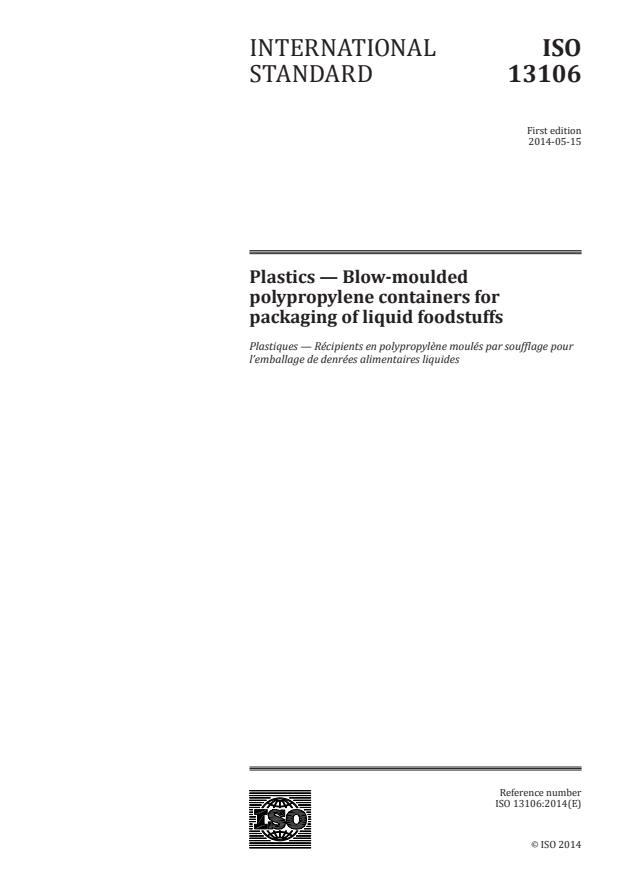
INTERNATIONAL ISO
STANDARD 13106
First edition
2014-05-15
Plastics — Blow-moulded
polypropylene containers for
packaging of liquid foodstuffs
Plastiques — Récipients en polypropylène moulés par soufflage pour
l’emballage de denrées alimentaires liquides
Reference number
©
ISO 2014
© ISO 2014
All rights reserved. Unless otherwise specified, no part of this publication may be reproduced or utilized otherwise in any form
or by any means, electronic or mechanical, including photocopying, or posting on the internet or an intranet, without prior
written permission. Permission can be requested from either ISO at the address below or ISO’s member body in the country of
the requester.
ISO copyright office
Case postale 56 • CH-1211 Geneva 20
Tel. + 41 22 749 01 11
Fax + 41 22 749 09 47
E-mail copyright@iso.org
Web www.iso.org
Published in Switzerland
ii © ISO 2014 – All rights reserved
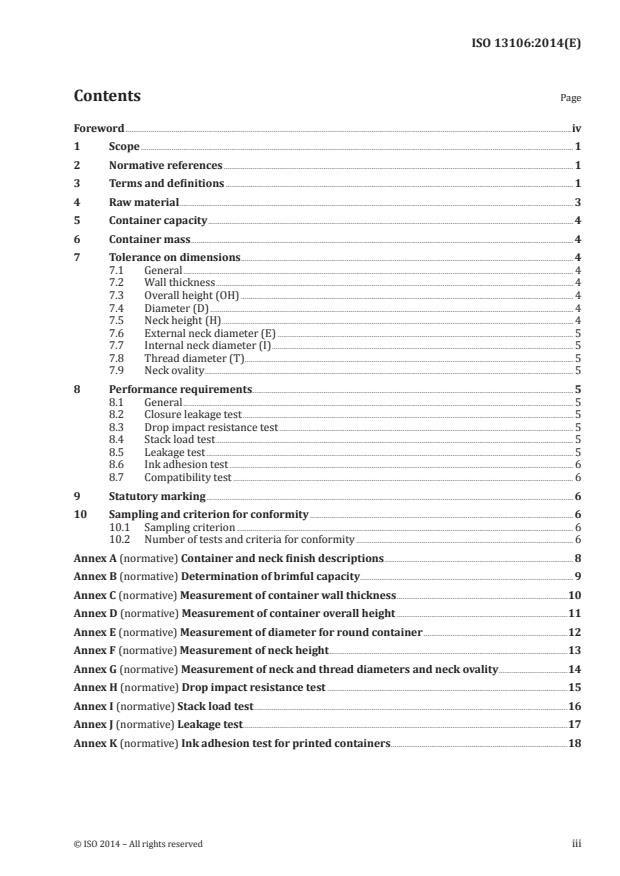
Contents Page
Foreword .iv
1 Scope . 1
2 Normative references . 1
3 Terms and definitions . 1
4 Raw material . 3
5 Container capacity . 4
6 Container mass . 4
7 Tolerance on dimensions . 4
7.1 General . 4
7.2 Wall thickness . 4
7.3 Overall height (OH) . 4
7.4 Diameter (D) . 4
7.5 Neck height (H) . 4
7.6 External neck diameter (E) . 5
7.7 Internal neck diameter (I) . 5
7.8 Thread diameter (T) . 5
7.9 Neck ovality. 5
8 Performance requirements . 5
8.1 General . 5
8.2 Closure leakage test . 5
8.3 Drop impact resistance test . 5
8.4 Stack load test . 5
8.5 Leakage test . 5
8.6 Ink adhesion test . 6
8.7 Compatibility test . 6
9 Statutory marking . 6
10 Sampling and criterion for conformity . 6
10.1 Sampling criterion . 6
10.2 Number of tests and criteria for conformity . 6
Annex A (normative) Container and neck finish descriptions . 8
Annex B (normative) Determination of brimful capacity . 9
Annex C (normative) Measurement of container wall thickness .10
Annex D (normative) Measurement of container overall height .11
Annex E (normative) Measurement of diameter for round container .12
Annex F (normative) Measurement of neck height .13
Annex G (normative) Measurement of neck and thread diameters and neck ovality .14
Annex H (normative) Drop impact resistance test .15
Annex I (normative) Stack load test .16
Annex J (normative) Leakage test.17
Annex K (normative) Ink adhesion test for printed containers .18
Foreword
ISO (the International Organization for Standardization) is a worldwide federation of national standards
bodies (ISO member bodies). The work of preparing International Standards is normally carried out
through ISO technical committees. Each member body interested in a subject for which a technical
committee has been established has the right to be represented on that committee. International
organizations, governmental and non-governmental, in liaison with ISO, also take part in the work.
ISO collaborates closely with the International Electrotechnical Commission (IEC) on all matters of
electrotechnical standardization.
The procedures used to develop this document and those intended for its further maintenance are
described in the ISO/IEC Directives, Part 1. In particular the different approval criteria needed for the
different types of ISO documents should be noted. This document was drafted in accordance with the
editorial rules of the ISO/IEC Directives, Part 2 (see www.iso.org/directives).
Attention is drawn to the possibility that some of the elements of this document may be the subject of
patent rights. ISO shall not be held responsible for identifying any or all such patent rights. Details of
any patent rights identified during the development of the document will be in the Introduction and/or
on the ISO list of patent declarations received (see www.iso.org/patents).
Any trade name used in this document is information given for the convenience of users and does not
constitute an endorsement.
For an explanation on the meaning of ISO specific terms and expressions related to conformity
assessment, as well as information about ISO’s adherence to the WTO principles in the Technical Barriers
to Trade (TBT) see the following URL: Foreword - Supplementary information
The committee responsible for this document is ISO/TC 61, Plastics, Subcommittee SC 11, Products.
iv © ISO 2014 – All rights reserved
INTERNATIONAL STANDARD ISO 13106:2014(E)
Plastics — Blow-moulded polypropylene containers for
packaging of liquid foodstuffs
WARNING — This International Standard does not purport to address all of the safety concerns,
if any, associated with its use. It is the responsibility of the user of this International Standard to
establish appropriate safety and health practices and determine the applicability of regulatory
limitations prior to use.
1 Scope
This International Standard provides the requirements of polypropylene resins intended for use in blow-
moulded, round containers with capacities up to, and including two litres intended for the packaging
of liquids for human consumption. This International Standard also provides tolerances on mass,
dimensions, methods of sampling, testing, and performance requirements.
NOTE It is not to be implied that polypropylene resins are the only polymers suitable for these applications,
as many other polymers, including PE-HD, PET, etc. are also suitable.
2 Normative references
The following documents, in whole or in part, are normatively referenced in this document and are
indispensable for its application. For dated references, only the edition cited applies. For undated
references, the latest edition of the referenced document (including any amendments) applies.
ISO 472:2013, Plastics — Vocabulary
ISO 291:2008, Plastics — Standard atmospheres for conditioning and testing
ISO 1873-1, Plastics — Polypropylene (PP) moulding and extrusion materials — Part 1: Designation system
and basis for specifications
ISO 1873-2, Plastics — Polypropylene (PP) moulding and extrusion materials — Part 2: Preparation of test
specimens and determination of properties
ISO 15270, Plastics — Guidelines for the recovery and recycling of plastics waste
ISO 2859-1, Sampling procedures for inspection by attributes — Part 1: Sampling schemes indexed by
acceptance quality limit (AQL) for lot-by-lot inspection
3 Terms and definitions
For the purposes of this document, the following definitions of terms apply.
NOTE For detailed definitions of terms found in this International Standard, refer to ISO 472. Neck height
(H) for containers produced using ISBM technology is the perpendicular distance from highest point of the neck
face to bottom plane of the support ledge. The brimful capacity can also be measured using special volume testing
equipment (Annex B). For bottles and lipped containers, nominal capacity is approximately 90 % of the brimful
capacity.
3.1
extrusion blow-moulded container
container formed from an extruded parison of heat-softened thermoplastic, blow-moulded by the
application of air pressure which forces it against the inside walls of a blow mould
3.2
injection blow-moulded container
container formed from an injection-moulded parison that is transferred, while hot, to a blow-mould to
form the container
3.3
injection stretch blow-moulded container
container formed from an injection-moulded parison or reheated pre-form that is stretched prior to
blow-moulding to impart bi-axial orientation
3.4
container body
principal part of a container, usually the largest piece containing the sides
Note 1 to entry: In bottles, the body is the main portion of the bottle without the neck.
3.5
shoulder
sloped area of a container between the neck area and the body of the container
3.6
neck
part of a container where shoulder cross-section area decreases to form the finish
3.7
neck finish
plastic forming the opening of a container and shaped to accommodate a specific closure
Note 1 to entry: Neck finish is a threaded, ribbed, or plain part of the container including sealing surface to
accommodate a threaded or press fit closure, lug, and cap, heat sealing gasket or liner and the tamper evidence
features.
3.8
seal surface
lip portion of the neck finish that makes contact with the sealing gasket or liner to form a seal
3.9
closure
device used to seal off the opening of the container for product containment and providing a barrier to
external contaminants
3.10
overall height
OH
height of a finished empty container at its highest point excluding the closure and fitment
3.11
diameter
D
external diameter of the finished empty container at a specified height, expressed as the mean of the
two perpendicular diameters, or as the circumference divided by 3,141 6 at the same specified height
3.12
neck height
H
perpendicular distance from the highest point of the plane including the neck face to the nearest point
of the finished container shoulder
2 © ISO 2014 – All rights reserved
3.13
external neck diameter
E
external diameter of the neck, excluding thread, measured as the mean of two perpendicular diameters
avoiding the part line
3.14
internal neck diameter
I
minimum internal diameter of the neck, whether it is parallel, tapered, or internally threaded
3.15
thread diameter
T
external diameter of the neck thread measured as the mean of two perpendicular diameters avoiding
the parting line
3.16
neck ovality
difference between the maximum and the minimum neck diameters
3.17
fill level
level to which a container shall be filled to achieve designated quantity of the content or nominal capacity
3.18
head space
space between the fill level of a container and the seal surface
3.19
brimful capacity
volume of liquid held by the container when filled to the point of overflowing while standing on a flat
horizontal level with all closures removed
Note 1 to entry: The brimful capacity, also called as “overflow capacity”.
3.20
nominal capacity
volume of the liquid foodstuff the container is intended to hold
3.21
conditioning atmosphere and test temperature
atmosphere in which a sample or test specimen is kept before being subjected to a test shall be in
accordance with ISO 291, unless otherwise agreed upon by the interested parties, e.g. for testing at high
or low temperatures
Note 1 to entry: The preferred set of conditions in ISO 291 is standard atmosphere (23 ± 2) °C and (50 ± 2) %
relative humidity. Other set of conditioning atmosphere as mentioned in ISO 291 can also be used, provided such
conditioning is reported.
4 Raw material
The grade designation(s) described in ISO 1873-1 and ISO 1873-2 for polypropylene shall be used to
describe the raw material.
Since polypropylene is suitable for use in blow-moulded containers, the specification of grades to be
used will depend on many factors including the specific application, type of liquid foodstuff intended
to be packed and which kind of filling method to be used, filling capacity of container, container design,
and conversion process to be used. In all cases, the choice of a specific grade shall be determined by its
suitability for the intended application and agreement between the interested parties.
5 Container capacity
When the container is filled to nominal capacity, the liquid level shall correspond to the fill level, but
below the bottom of the neck. The purchaser of the container shall specify the minimum brimful capacity,
fill level, and the head space according to the filling temperature and filling process used.
6 Container mass
The container mass shall be adequate to meet the overall requirements of the application. The mass of
the closure shall not be included in mass of the container. The tolerance for container mass shall be as
specified in Table 1.
Table 1 — Container mass tolerance
Mass of the container, Tolerance,
g %
Up to, and including 10 ±10,0
Over 10 up to, and including 25 ±7,5
Over 25 ±5,0
The accuracy of weighing shall be to the nearest 0,1 g for containers with tare weight up to 25 g, and
0,5 g for containers beyond 25 g and up to 100 g.
7 Tolerance on dimensions
7.1 General
The shape and dimensions of the container shall be as specified by the user and in accordance with
desired capacity. The tolerance on dimensions is valid for finished empty containers. The dimensions of
filled containers might show differences.
7.2 Wall thickness
The minimum wall thickness at any
...