

ISO/PAS 5643:2021
(Main)Tourism and related services — Requirements and guidelines to reduce the spread of Covid-19 in the tourism industry
General Information
- Abstract
This document establishes requirements and recommendations for tourist organizations to prevent the spread of coronavirus SARS-CoV-2 in order to protect their employees’ health from COVID-19 and to provide safer tourist services and products to tourists and residents. NOTE This document does not address after-work practices of employees. This document applies to the whole tourism value chain, including the following 20 subsectors: accommodation adventure tourism and ecotourism beaches catering services golf services medical and wellness spas MICE tourism museums and heritage sites natural protected areas (NPAs) night leisure scuba diving ski areas theme and leisure parks NOTE This includes water parks, animal parks (zoos, aquariums, wildlife refuges) and family entertainment centres. tourist transport tourist guides tourist visits tourist information offices travel agencies unique public spaces yacht harbours and nautical activities Each tourist organization is expected to conform only to those measures that apply to the services that it offers, including the core requirements established in Clause 4, the relevant applicable subclause in Clause 5 and the relevant applicable ancillary services and facilities in Clause 6. NOTE The term tourist organization applies for all 20 subsectors.
- Status
- Published
- Publication Date
- 17-May-2021
- Technical Committee
- ISO/TC 228 - Tourism and related services
- Current Stage
- 9093 - International Standard confirmed
- Start Date
- 27-Sep-2024
- Completion Date
- 29-Aug-2026
Buy Documents

ISO/PAS 5643:2021 - Tourism and related services — Requirements and guidelines to reduce the spread of Covid-19 in the tourism industry Released:5/18/2021
ISO/PAS 5643:2021 - Tourism and related services — Requirements and guidelines to reduce the spread of Covid-19 in the tourism industry/18/2021
Overview
ISO/PAS 5643:2021 - Tourism and related services - Requirements and guidelines to reduce the spread of COVID‑19 - is a publicly available specification that provides practical, sector‑specific measures for tourist organizations to prevent SARS‑CoV‑2 transmission. It applies across the entire tourism value chain and sets out core COVID‑19 risk management requirements, plus detailed guidance for 20 subsectors (for example accommodation, catering, MICE, museums, beaches, tourist transport, scuba diving, theme parks, spas and more). The document focuses on protecting employees and providing safer services to tourists and residents. It does not address employees’ after‑work practices.
Key topics and requirements
- COVID‑19 risk management framework
- Establishment of a COVID‑19 risk management group and responsibilities
- Development and maintenance of a contingency plan and legal compliance checks
- General measures for tourist organizations
- Core operational controls and organizational requirements applicable to all providers
- Staff safety measures and management of staff areas
- Information and communication for staff, visitors and stakeholders
- Cleaning, disinfection and infection control
- Cleaning protocols and product considerations relevant to tourism settings
- HVAC and ventilation
- Guidance on heating, ventilating and air‑conditioning considerations to reduce airborne risk
- Sector‑specific requirements
- Tailored guidance across 20 subsectors (accommodation, adventure/ecotourism, beaches, catering, golf, medical/wellness spas, MICE, museums/heritage, NPAs, night leisure, scuba diving, ski areas, theme parks, tourist transport, tourist guides, visitor services, travel agencies, yacht harbours, etc.)
- Practical measures including capacity control, booking/ticketing adaptations, reception/boarding procedures and adaptations to activities and equipment
- Ancillary services and facilities
- Application of core measures to ancillary operations such as retail, food & beverage, rentals and first‑aid services
Practical applications
- Use ISO/PAS 5643 to design, review and document COVID‑19 safety plans for tourist businesses and attractions.
- Implement a risk management group and contingency plan to align operations with public health requirements.
- Adapt cleaning regimes, staffing arrangements, entry/booking procedures and ventilation strategies to the specific subsector (e.g., hotels vs. theme parks vs. guided tours).
- Inform customers and staff clearly about measures in place to increase confidence and support safe reopening or continued operations.
Who should use this standard
- Tourist organizations and operators across the 20 subsectors listed in the document
- Travel agencies, event organizers (MICE), attraction managers, transport operators, and facility managers
- Health and safety officers, operations managers and compliance teams in tourism businesses
- National and local tourism authorities seeking harmonized guidance for safe tourism services
Related standards (for further alignment)
- Consider aligning implementation with relevant health and safety and business continuity standards (for example ISO 45001, ISO 22301 and ISO 31000) and local public‑health regulations to ensure comprehensive risk and resilience management.
Keywords: ISO/PAS 5643, COVID‑19 guidance, tourism industry, SARS‑CoV‑2, tourist organizations, infection control, cleaning and disinfection, HVAC, risk management, accommodation, MICE, tourist transport.
Buy Documents
ISO/PAS 5643:2021 - Tourism and related services — Requirements and guidelines to reduce the spread of Covid-19 in the tourism industry Released:5/18/2021
ISO/PAS 5643:2021 - Tourism and related services — Requirements and guidelines to reduce the spread of Covid-19 in the tourism industry/18/2021
Get Certified
Connect with accredited certification bodies for this standard

BSI Group
BSI (British Standards Institution) is the business standards company that helps organizations make excellence a habit.

Bureau Veritas
Bureau Veritas is a world leader in laboratory testing, inspection and certification services.

DNV
DNV is an independent assurance and risk management provider.
Sponsored listings
Frequently Asked Questions
ISO/PAS 5643:2021 is a technical specification published by the International Organization for Standardization (ISO). Its full title is "Tourism and related services — Requirements and guidelines to reduce the spread of Covid-19 in the tourism industry". This standard covers: This document establishes requirements and recommendations for tourist organizations to prevent the spread of coronavirus SARS-CoV-2 in order to protect their employees’ health from COVID-19 and to provide safer tourist services and products to tourists and residents. NOTE This document does not address after-work practices of employees. This document applies to the whole tourism value chain, including the following 20 subsectors: accommodation adventure tourism and ecotourism beaches catering services golf services medical and wellness spas MICE tourism museums and heritage sites natural protected areas (NPAs) night leisure scuba diving ski areas theme and leisure parks NOTE This includes water parks, animal parks (zoos, aquariums, wildlife refuges) and family entertainment centres. tourist transport tourist guides tourist visits tourist information offices travel agencies unique public spaces yacht harbours and nautical activities Each tourist organization is expected to conform only to those measures that apply to the services that it offers, including the core requirements established in Clause 4, the relevant applicable subclause in Clause 5 and the relevant applicable ancillary services and facilities in Clause 6. NOTE The term tourist organization applies for all 20 subsectors.
This document establishes requirements and recommendations for tourist organizations to prevent the spread of coronavirus SARS-CoV-2 in order to protect their employees’ health from COVID-19 and to provide safer tourist services and products to tourists and residents. NOTE This document does not address after-work practices of employees. This document applies to the whole tourism value chain, including the following 20 subsectors: accommodation adventure tourism and ecotourism beaches catering services golf services medical and wellness spas MICE tourism museums and heritage sites natural protected areas (NPAs) night leisure scuba diving ski areas theme and leisure parks NOTE This includes water parks, animal parks (zoos, aquariums, wildlife refuges) and family entertainment centres. tourist transport tourist guides tourist visits tourist information offices travel agencies unique public spaces yacht harbours and nautical activities Each tourist organization is expected to conform only to those measures that apply to the services that it offers, including the core requirements established in Clause 4, the relevant applicable subclause in Clause 5 and the relevant applicable ancillary services and facilities in Clause 6. NOTE The term tourist organization applies for all 20 subsectors.
ISO/PAS 5643:2021 is classified under the following ICS (International Classification for Standards) categories: 03.100.01 - Company organization and management in general; 03.200.01 - Leisure and tourism in general. The ICS classification helps identify the subject area and facilitates finding related standards.
ISO/PAS 5643:2021 is available in PDF format for immediate download after purchase. The document can be added to your cart and obtained through the secure checkout process. Digital delivery ensures instant access to the complete standard document.
Standards Content (Sample)
SLOVENSKI STANDARD
01-julij-2024
Turizem in z njim povezane storitve - Zahteve in smernice za zmanjšanje širjenja
bolezni covid-19 v turistični industriji
Tourism and related services - Requirements and guidelines to reduce the spread of
Covid-19 in the tourism industry
Tourisme et services connexes — Exigences et lignes directrices pour la réduction de la
propagation de la Covid-19 dans l'industrie du tourisme
Ta slovenski standard je istoveten z: ISO/PAS 5643:2021
ICS:
03.100.01 Organizacija in vodenje Company organization and
podjetja na splošno management in general
03.200.01 Prosti čas in turizem na Leisure and tourism in
splošno general
2003-01.Slovenski inštitut za standardizacijo. Razmnoževanje celote ali delov tega standarda ni dovoljeno.
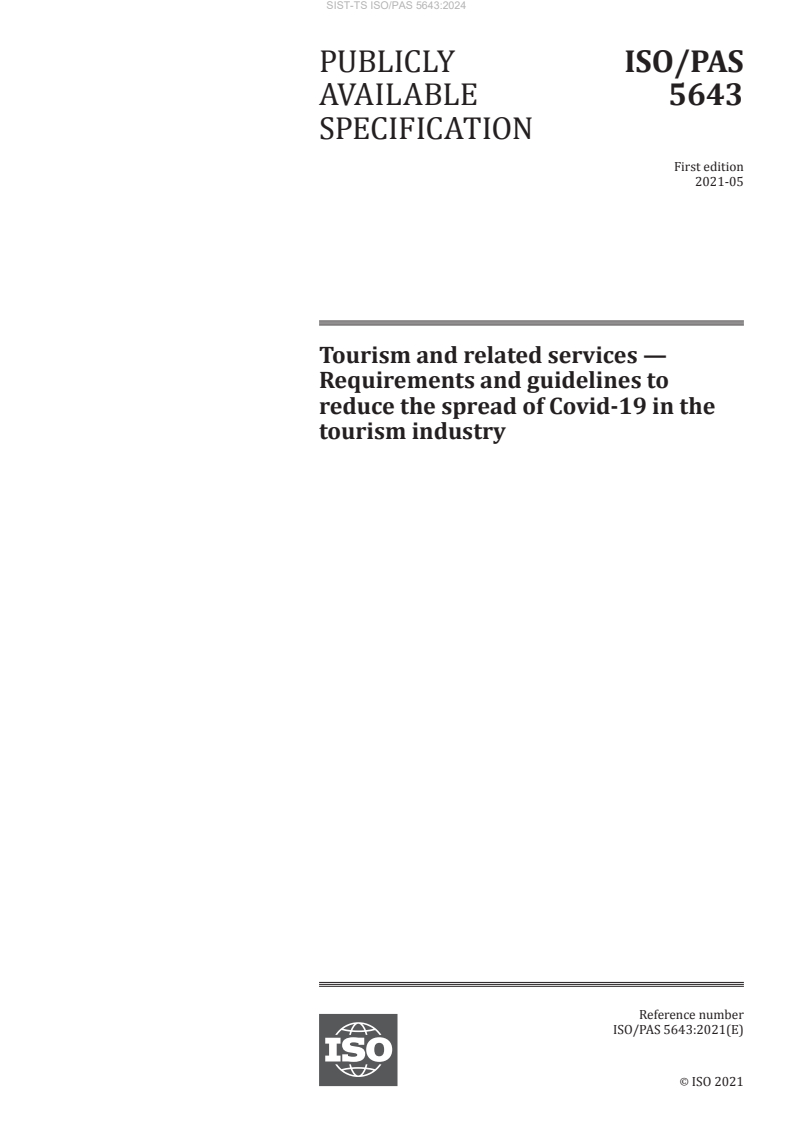
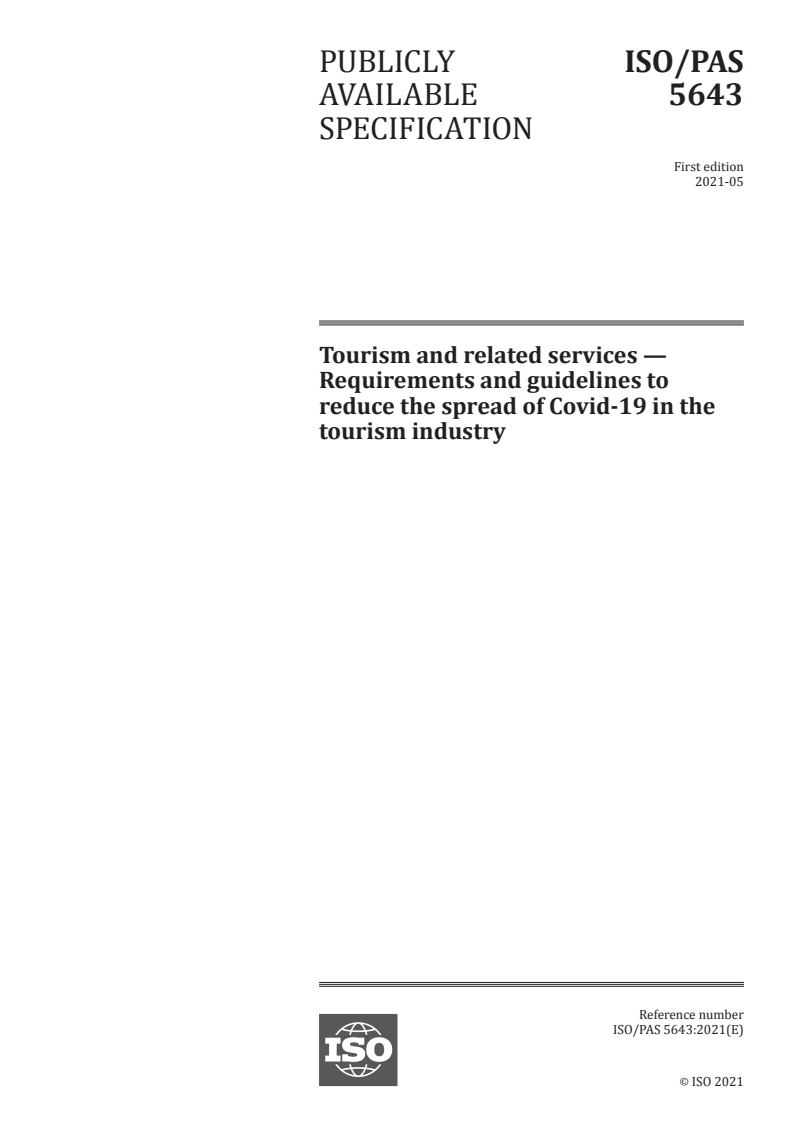
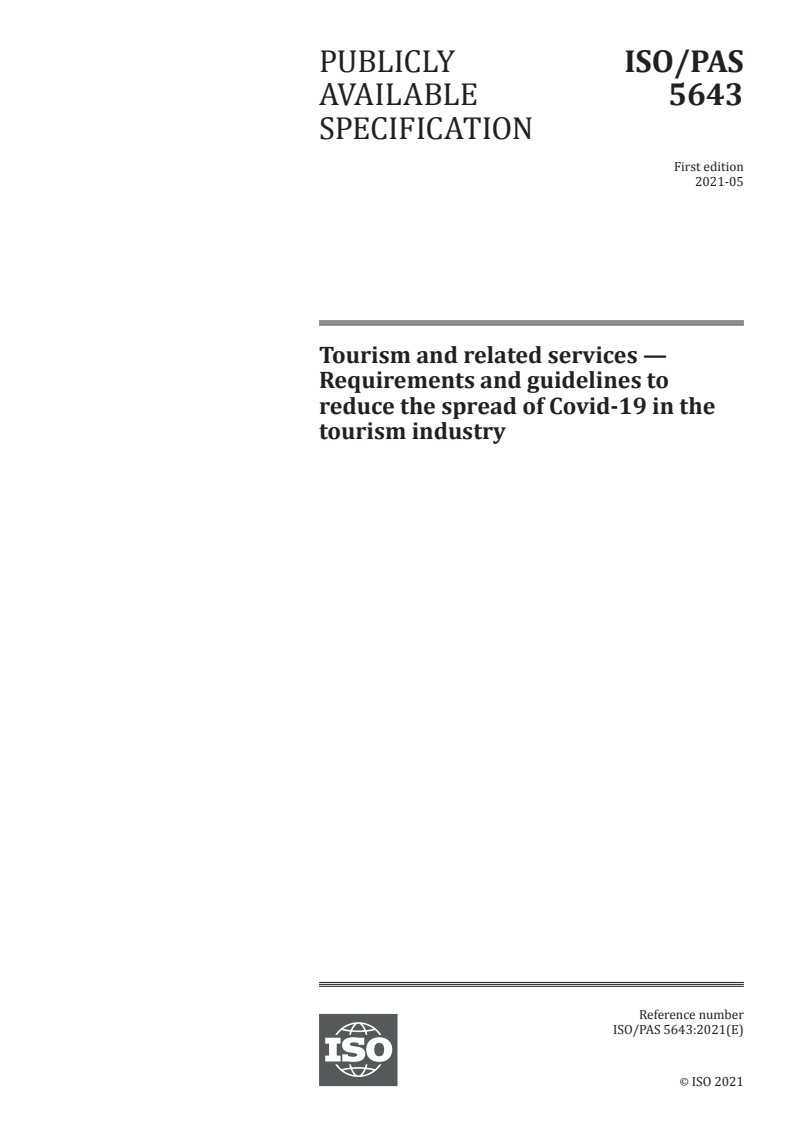
PUBLICLY ISO/PAS
AVAILABLE 5643
SPECIFICATION
First edition
2021-05
Tourism and related services —
Requirements and guidelines to
reduce the spread of Covid-19 in the
tourism industry
Reference number
©
ISO 2021
© ISO 2021
All rights reserved. Unless otherwise specified, or required in the context of its implementation, no part of this publication may
be reproduced or utilized otherwise in any form or by any means, electronic or mechanical, including photocopying, or posting
on the internet or an intranet, without prior written permission. Permission can be requested from either ISO at the address
below or ISO’s member body in the country of the requester.
ISO copyright office
CP 401 • Ch. de Blandonnet 8
CH-1214 Vernier, Geneva
Phone: +41 22 749 01 11
Email: copyright@iso.org
Website: www.iso.org
Published in Switzerland
ii © ISO 2021 – All rights reserved
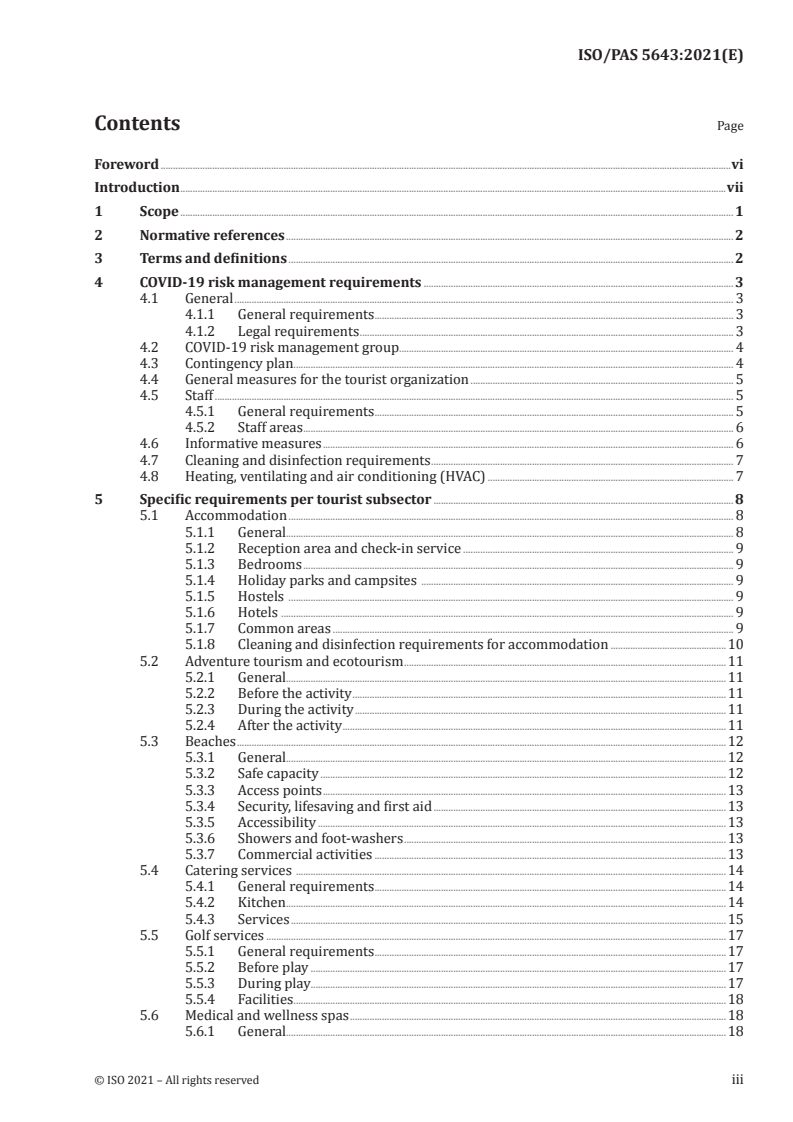
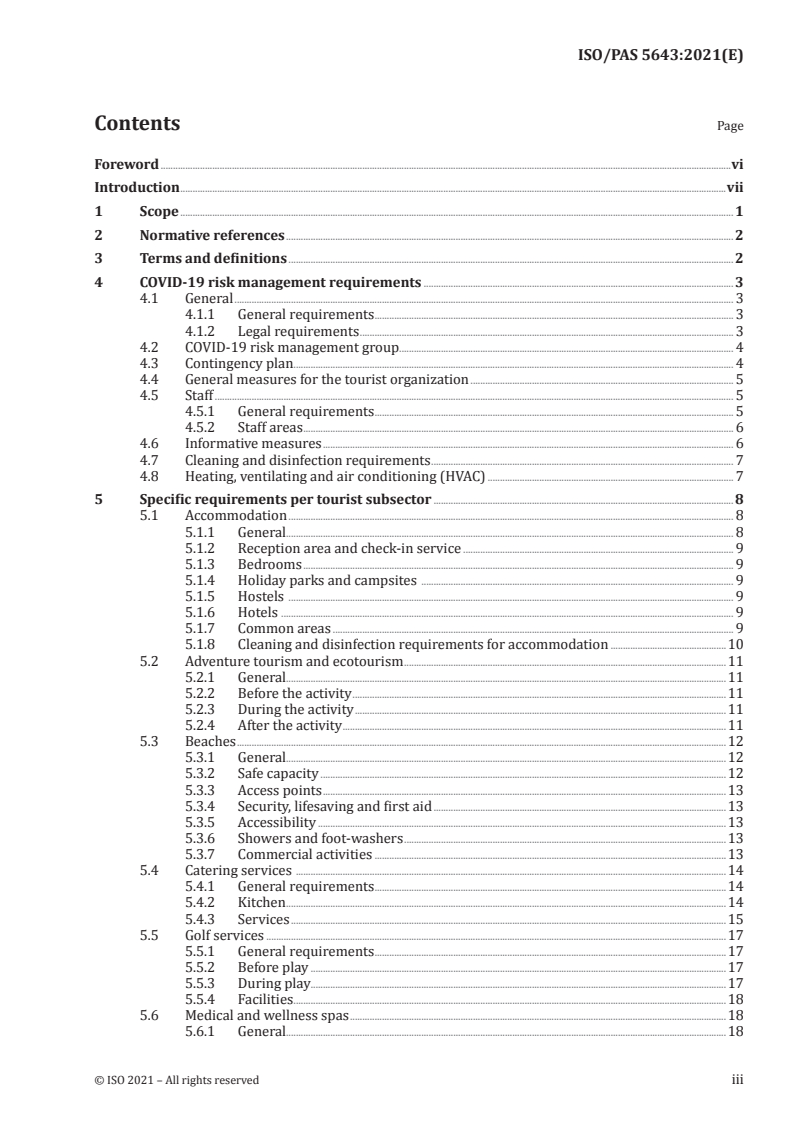
Contents Page
Foreword .vi
Introduction .vii
1 Scope . 1
2 Normative references . 2
3 Terms and definitions . 2
4 COVID-19 risk management requirements . 3
4.1 General . 3
4.1.1 General requirements . 3
4.1.2 Legal requirements . 3
4.2 COVID-19 risk management group. 4
4.3 Contingency plan . 4
4.4 General measures for the tourist organization . 5
4.5 Staff . 5
4.5.1 General requirements . 5
4.5.2 Staff areas . 6
4.6 Informative measures . 6
4.7 Cleaning and disinfection requirements . 7
4.8 Heating, ventilating and air conditioning (HVAC) . 7
5 Specific requirements per tourist subsector . 8
5.1 Accommodation . 8
5.1.1 General. 8
5.1.2 Reception area and check-in service . 9
5.1.3 Bedrooms . 9
5.1.4 Holiday parks and campsites . 9
5.1.5 Hostels . 9
5.1.6 Hotels . . 9
5.1.7 Common areas . 9
5.1.8 Cleaning and disinfection requirements for accommodation .10
5.2 Adventure tourism and ecotourism .11
5.2.1 General.11
5.2.2 Before the activity .11
5.2.3 During the activity .11
5.2.4 After the activity .11
5.3 Beaches .12
5.3.1 General.12
5.3.2 Safe capacity .12
5.3.3 Access points .13
5.3.4 Security, lifesaving and first aid .13
5.3.5 Accessibility .13
5.3.6 Showers and foot-washers .13
5.3.7 Commercial activities .13
5.4 Catering services .14
5.4.1 General requirements .14
5.4.2 Kitchen .14
5.4.3 Services .15
5.5 Golf services .17
5.5.1 General requirements .17
5.5.2 Before play .17
5.5.3 During play.17
5.5.4 Facilities . .18
5.6 Medical and wellness spas .18
5.6.1 General.18
5.6.2 Waiting areas, consultation areas .19
5.6.3 Treatments .19
5.7 MICE (meetings, incentives, conferences and events) tourism .20
5.7.1 General.20
5.7.2 Activity planning .20
5.7.3 Preparing and holding the activity .21
5.8 Museums and heritage sites .23
5.8.1 General.23
5.8.2 Welcoming, information and communication .23
5.8.3 Booking and ticket sales .23
5.8.4 Guided visits .24
5.8.5 Facility requirements .24
5.9 Natural protected areas (NPAs).24
5.9.1 General.24
5.9.2 Capacity control and safety distance in regard to the use of public
facilities and services .25
5.9.3 Welcoming and receiving users .25
5.9.4 Booking and ticket sales .25
5.9.5 Visiting NPAs .26
5.10 Night leisure .26
5.10.1 General requirements .26
5.10.2 Box offices, access and admission .26
5.10.3 Bars and drinks-dispensing services.26
5.10.4 Booking and special celebrations .27
5.11 Scuba diving . .27
5.11.1 General.27
5.11.2 General requirements .27
5.11.3 Equipment considerations .28
5.11.4 Compressors .29
5.11.5 Diving activity .29
5.12 Ski areas .30
5.12.1 General requirements .30
5.12.2 Access points and reception .30
5.12.3 Ski area .30
5.12.4 Rental of equipment and materials .30
5.12.5 Ski events and championships .31
5.12.6 Ski school .31
5.12.7 Kindergarten or snow garden .31
5.13 Theme and leisure parks .31
5.13.1 General requirements .31
5.13.2 User access and reception area .32
5.13.3 Performances and shows .32
5.13.4 Rides and entertainment facilities.32
5.14 Tourist transport .33
5.14.1 General.33
5.14.2 Booking .33
5.14.3 Terminals and offices .33
5.14.4 Requirements for vehicles .33
5.14.5 Rent-a-car .34
5.15 Tourist guides.34
5.15.1 General.34
5.15.2 Design of the visit or activities .34
5.15.3 Coordination of the tourist guide with other tourist service providers .35
5.15.4 Information and communication .35
5.15.5 Guided tours .35
5.16 Tourist visits .35
5.16.1 General.35
5.16.2 Design of tourist visits and related activities .36
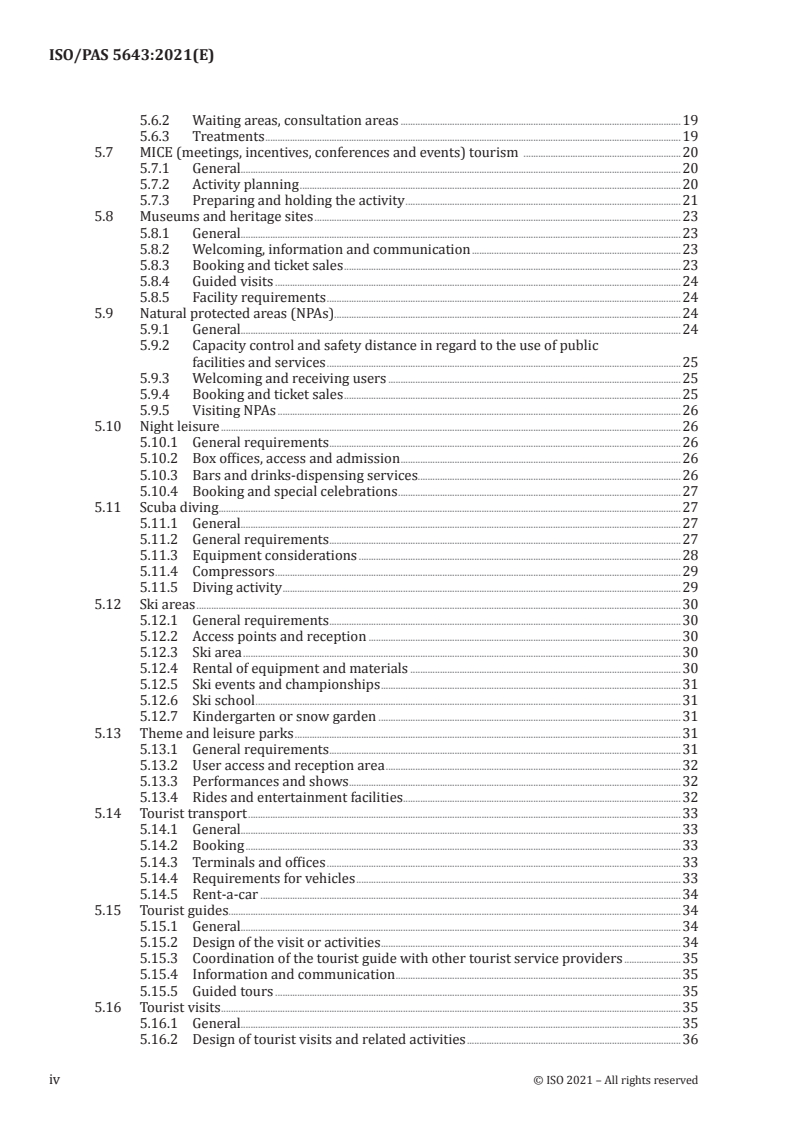
iv © ISO 2021 – All rights reserved
5.16.3 Welcome at the site .36
5.16.4 Visits .36
5.17 Tourist information offices .37
5.18 Travel agencies .37
5.19 Unique public spaces .38
5.20 Yacht harbours and nautical activities .38
5.20.1 General.38
5.20.2 User service at offices .38
5.20.3 Operational activities .39
5.20.4 Common areas .39
5.20.5 Craft moorings .39
5.20.6 Rental of boats, ships, floating craft and complementary items .39
5.20.7 Complementary activities .39
5.20.8 Nautical sports schools and nautical activities .39
6 Ancilliary services and facilities to all subsectors .40
6.1 General .40
6.2 Common toilet facilities (including portable toilets), dressing rooms and lockers .40
6.3 Gyms .41
6.4 Swimming pools . .41
6.5 Valet service . .42
6.6 Children's play areas, sports activities and other recreational activities .42
6.7 Entertainment activities .42
6.8 Shopping areas .42
6.9 Lifts .42
Annex A (informative) Face masks .43
Annex B (informative) Accessibility considerations for the contingency plan design .45
Bibliography .47
Foreword
ISO (the International Organization for Standardization) is a worldwide federation of national standards
bodies (ISO member bodies). The work of preparing International Standards is normally carried out
through ISO technical committees. Each member body interested in a subject for which a technical
committee has been established has the right to be represented on that committee. International
organizations, governmental and non-governmental, in liaison with ISO, also take part in the work.
ISO collaborates closely with the International Electrotechnical Commission (IEC) on all matters of
electrotechnical standardization.
The procedures used to develop this document and those intended for its further maintenance are
described in the ISO/IEC Directives, Part 1. In particular, the different approval criteria needed for the
different types of ISO documents should be noted. This document was drafted in accordance with the
editorial rules of the ISO/IEC Directives, Part 2 (see www .iso .org/ directives).
Attention is drawn to the possibility that some of the elements of this document may be the subject of
patent rights. ISO shall not be held responsible for identifying any or all such patent rights. Details of
any patent rights identified during the development of the document will be in the Introduction and/or
on the ISO list of patent declarations received (see www .iso .org/ patents).
Any trade name used in this document is information given for the convenience of users and does not
constitute an endorsement.
For an explanation of the voluntary nature of standards, the meaning of ISO specific terms and
expressions related to conformity assessment, as well as information about ISO's adherence to the
World Trade Organization (WTO) principles in the Technical Barriers to Trade (TBT), see www .iso .org/
iso/ foreword .html.
This document was prepared by Technical Committee ISO/TC 228, Tourism and related services.
Any feedback or questions on this document should be directed to the user’s national standards body. A
complete listing of these bodies can be found at www .iso .org/ members .html.
vi © ISO 2021 – All rights reserved
Introduction
Tourism is one of the fastest growing economic sectors in the world and a key driver of socio-economic
progress. However, since the pandemic of COVID-19 started, caused by the SARS-CoV-2 coronavirus, the
tourism sector has been seriously affected. According to UNWTO (2021), due to COVID-19, the world
witnessed an unprecedented 73 % drop in international tourism recorded in 2020, a loss of 1,1 billon
international tourists and a loss of US$ 1,3 trillion in export revenues from tourism. Furthermore, 100
to 120 million jobs are currently effectively at risk.
With such an important impact on the economy, countries have seen the need to identify and implement
measures that reduce the spread of the pandemic and recover tourism confidence to travel and to
consume tourism services. In this regard, national, regional, public and private protocols with different
approaches and scopes have been developed against COVID-19 worldwide, and it seems relevant
and necessary to harmonize the measures to reduce the risk of contagion of SARS-CoV-2 in a single
protocol, which provides a framework to the countries with the agreed minimum requirements and
recommendations to consider during the time the risk of contagion exists.
This document specifies basic requirements and guidelines to prevent the spread of coronavirus in
the tourism industry and is complementary to the existing national protocols. These measures will
contribute to the recovery of the tourism sector and restore the confidence of travellers.
PUBLICLY AVAILABLE SPECIFICATION ISO/PAS 5643:2021(E)
Tourism and related services — Requirements and
guidelines to reduce the spread of Covid-19 in the tourism
industry
1 Scope
This document establishes requirements and recommendations for tourist organizations to prevent the
spread of coronavirus SARS-CoV-2 in order to protect their employees’ health from COVID-19 and to
provide safer tourist services and products to tourists and residents.
NOTE This document does not address after-work practices of employees.
This document applies to the whole tourism value chain, including the following 20 subsectors:
— accommodation
— adventure tourism and ecotourism
— beaches
— catering services
— golf services
— medical and wellness spas
— mice tourism
— museums and heritage sites
— natural protected areas (NPAs)
— night leisure
— scuba diving
— ski areas
— theme and leisure parks
NOTE This includes water parks, animal parks (zoos, aquariums, wildlife refuges) and family
entertainment centres.
— tourist transport
— tourist guides
— tourist visits
— tourist information offices
— travel agencies
— unique public spaces
— yacht harbours and nautical activities
Each tourist organization is expected to conform only to those measures that apply to the services that
it offers, including the core requirements established in Clause 4, the relevant applicable subclause in
Clause 5 and the relevant applicable ancillary services and facilities in Clause 6.
NOTE The term tourist organization applies for all 20 subsectors.
2 Normative references
There are not normative references in this document.
3 Terms and definitions
For the purposes of this document, the following terms and definitions apply.
ISO and IEC maintain terminological databases for use in standardization at the following addresses:
— ISO Online browsing platform: available at https:// www .iso .org/ obp
— IEC Electropedia: available at http:// www .electropedia .org/
3.1
contingency plan
set of measures and actions for responding to the COVID-19 pandemic
3.2
COVID-19
infectious disease caused by coronavirus SARS-CoV-2, whose most common symptoms are fever, dry
cough and tiredness
3.3
customer
user
tourist
visitor
guest
person who uses the different facilities and services provided by a tourist organization
3.4
risk
possibility of a person becoming infected with coronavirus SARS-CoV-2
3.5
risk management
coordinated activities to direct and control an organization with regard to risk
[SOURCE: ISO 31000:2018, 3.2]
3.6
safe capacity
maximum capacity at a facility (e.g. restaurant) or service (e.g. tour, activity) that allows people to keep
a safe distance, reducing the risk of contagion by the emission of aerosols and droplets
Note 1 to entry: The applicable legal framework can determine the safe capacity. The tourist organization can
also determine the safe capacity without exceeding the maximum specified by the legal framework, or when the
legal framework does not determine it.
2 © ISO 2021 – All rights reserved
3.7
safe conditions
situation in which the measures to minimize the risk of contagion of COVID-19 are observed
EXAMPLE Keeping a safe distance, using a face mask, performing disinfection tasks.
3.8
safety distance
measure to reduce the risk of transmission of the coronavirus SARS-CoV-2, minimizing exposure by
keeping a minimum separation between two people
Note 1 to entry: The World Health Organization (WHO) has established the minimum safety distance as 1 m at
the time of publication of this document. Most governments have established a safety distance of between 1 m
and 2 m.
Note 2 to entry: Countries with no specific regulations on safety distance can follow the WHO’s recommendations.
3.9
SARS-CoV-2
virus that causes COVID-19 illness
3.10
tourist organization
provider offering tourism services and products
EXAMPLE Company, contractor, destination management organization, foundation, self-employed person,
government body.
4 COVID-19 risk management requirements
4.1 General
4.1.1 General requirements
The tourist organization shall commit to risk management and the systematic implementation of
measures to minimize risk. The tourist organization shall:
a) set up a risk management group (4.2);
b) perform a risk assessment on SARS-CoV-2 infection;
c) draw up a plan of health and safety measures (contingency plan), based on the findings of the risk
assessment, to reduce the risk of SARS-CoV-2 infection.
4.1.2 Legal requirements
The tourist organization shall:
a) identify the legal requirements applicable to the services offered in the context of SARS-CoV-2
(e.g. use of face mask by staff, visitors or both);
b) determine how these requirements apply to the services offered;
c) ensure that these applicable legal requirements are taken into account when offering its services.
NOTE Data protection regulation is relevant when collecting and sharing information provided by the
tourist (e.g. visitors’ health information such as temperature).
4.2 COVID-19 risk management group
The risk management group, which shall include employees’ representatives, shall be responsible for
defining strategies and decision-making to minimize the risk of contagion of SARS-CoV-2.
In small tourist organizations this risk management group can be an individual (e.g. owner, manager)
responsible for the definition and implementation of health and safety measures according to the risk
assessment. This person shall in any case consider employees’ advice.
Furthermore, the COVID-19 risk management group shall do the following:
a) Establish mechanisms for gathering information to make the best decisions (e.g. consult authorities,
employees, specialists) and to coordinate the group [among its members and with authorities,
external service providers, occupational risk prevention (ORP) responsible persons].
b) Ensure that the risk assessment is performed, considering the identification, analysis and
evaluation of the activities or facilities where the virus is more likely to be spread, as well as
considering the different transmission modes (aerosols, drops and contact), the characteristics of
the venue (e.g. indoors, outdoors) and the services provided.
The risk of contagion increases when one or several of the following factors take place:
— the safety distance is not respected;
— the space is enclosed, with no ventilation or poor ventilation;
— the time of exposure is long (>15 min);
— the humidity percentage is under 40 %;
— no face mask is used (either by the personnel, visitors or both).
c) Design a contingency plan (4.3) according to the risk assessment results, with health and safety
measures for both visitors and personnel.
Given the evolving nature of the disease, the COVID-19 risk management group shall refer to new
research results and additional necessary measures that will possibly be defined or published in the
future, including those the competent authorities will possibly impose.
4.3 Contingency plan
The contingency plan shall include at least the following:
a) The health and safety measures to be implemented in order to reduce the spread of SARS-CoV-2
and to protect both visitors and personnel, considering also the needs of people with any type
of disability (see recommendations given in Annex B) as well as vulnerable employees. These
measures shall be part of a comprehensive approach which considers, for example, the use of face
masks and other protective barriers, the redesign of services, the reduction of capacity in enclosed
spaces, hand hygiene, cleaning and disinfection activities. Specifically, the use of face masks (see
additional information in Annex A) as well as the provision of hand sanitizer in places with higher
risk of infection shall be determined in accordance with the risk assessment results.
b) The assignment of responsibilities to implement those measures and monitor their compliance, as
well as the allocation of material resources (e.g. face masks, physical barriers, shields or screens,
hand sanitiser), considering any possible restriction and service limitations. If a lack of material
resources is detected, the risk management group shall analyse the situation and take alternative
effective action.
c) A protocol in the event that an employee or user shows symptoms compatible with COVID-19 during
the service (e.g. guided tour) or inside the tourist facilities (e.g. at a campsite). This protocol shall
follow the advice of the competent authorities, if applicable.
4 © ISO 2021 – All rights reserved
The contingency plan shall be monitored to assess whether it is effective and modified if necessary.
4.4 General measures for the tourist organization
The tourist organization shall do the following:
a) Plan tasks and work processes to guarantee the safety distance. Safety distance shall be respected
in all activities and therefore the tourist organization shall control occupancy levels when
necessary. If this is not possible, other health and safety measures shall be ensured (e.g. use of
physical barriers or face masks).
b) Establish rules for the use of facilities and common spaces (e.g. in lifts, dining rooms, lobbies and
common areas, canteens, dressing rooms, permanent and/or temporary toilets); if employees work
in shifts, these should be planned whenever possible so that the same employees are always in the
same shift groups.
c) Provide health and safety guidelines with comprehensive, clear and legible information on health
and safety measures to apply in the workplace, before, during and after work. Posters can support
these guidelines.
d) Facilitate hand washing with soap and water or, if this is not possible, the use of hand sanitiser, and
provide adequate face masks for its use according to the risk assessment results.
NOTE Additional information on how to wash hands can be found at: https:// www .who .int/ gpsc/ 5may/
How _To _HandWash _Poster .pdf ?ua = 1
e) Train the staff in the correct use and maintenance of the protective equipment they use. These
training activities shall be registered.
f) Encourage staff and external services providers to conform to the contingency plan and ensure
that they respect the safety measures.
g) Determine the protocol for dealing with visitors who do not conform to the health and safety
measures.
h) Have available the contact details of healthcare centres (public and private, when applicable).
i) Promote contactless payment (e.g. cards, mobiles), avoiding, as far as possible, the use of cash.
Cards should only be touched by the user.
j) Use electronic and online channels to provide information (website, social media, electronic signs).
If leaflets, written information or maps are provided, these shall be provided in a safe way and for
individual use. There shall be a non-manual bagged waste bin.
4.5 Staff
4.5.1 General requirements
Staff shall know their specific responsibilities within the contingency plan, shall respect the health and
safety measures defined in the contingency plan and shall:
a) Respect safety distance and avoid physical contact, including shaking hands, whenever possible.
Cleaning and disinfection staff should not work in areas while visitors or other staff are in,
except when due to the operation of the service this is not possible (e.g. continuous cleaning and
disinfection in a theme and leisure park, table cleaning and disinfection at a restaurant while
customers are sitting).
b) Wash their hands thoroughly after sneezing, blowing their nose or coughing, or touching potentially
contaminated surfaces (e.g. cash, menus). Throw away any personal hygiene waste, especially
tissues, as well as face masks (when applicable) in non-manual waste bins or containers. After
each cleaning and disinfection session, they shall safely dispose of the materials and protective
equipment used and then wash their hands. Where possible, buckets with lids shall be provided for
disposal and subsequent waste management.
c) Disinfect personal objects (e.g. glasses, mobile phones) throughout the day with soap and water
when feasible, and with a hand sanitiser when not available. Specific products applied with a cloth
or special disinfectant wipes can be used to disinfect electronic equipment.
d) Not share other employees' work equipment or devices, as a general rule. If certain equipment or
devices are shared, the tourist organization shall establish cleaning and disinfection guidelines
between uses.
e) Use appropriate face masks (see information in Annex A) and gloves. Gloves should only be used for
cleaning and disinfection activities, or to treat or care for people infected.
NOTE Additional information on the use of gloves can be found at: https:// www .who .int/ gpsc/ 5may/
Glove _Use _Information _Leaflet .pdf
f) Remove work clothes and store them in a bag at the end of the working day (only for cat
...
PUBLICLY ISO/PAS
AVAILABLE 5643
SPECIFICATION
First edition
2021-05
Tourism and related services —
Requirements and guidelines to
reduce the spread of Covid-19 in the
tourism industry
Reference number
©
ISO 2021
© ISO 2021
All rights reserved. Unless otherwise specified, or required in the context of its implementation, no part of this publication may
be reproduced or utilized otherwise in any form or by any means, electronic or mechanical, including photocopying, or posting
on the internet or an intranet, without prior written permission. Permission can be requested from either ISO at the address
below or ISO’s member body in the country of the requester.
ISO copyright office
CP 401 • Ch. de Blandonnet 8
CH-1214 Vernier, Geneva
Phone: +41 22 749 01 11
Email: copyright@iso.org
Website: www.iso.org
Published in Switzerland
ii © ISO 2021 – All rights reserved
Contents Page
Foreword .vi
Introduction .vii
1 Scope . 1
2 Normative references . 2
3 Terms and definitions . 2
4 COVID-19 risk management requirements . 3
4.1 General . 3
4.1.1 General requirements . 3
4.1.2 Legal requirements . 3
4.2 COVID-19 risk management group. 4
4.3 Contingency plan . 4
4.4 General measures for the tourist organization . 5
4.5 Staff . 5
4.5.1 General requirements . 5
4.5.2 Staff areas . 6
4.6 Informative measures . 6
4.7 Cleaning and disinfection requirements . 7
4.8 Heating, ventilating and air conditioning (HVAC) . 7
5 Specific requirements per tourist subsector . 8
5.1 Accommodation . 8
5.1.1 General. 8
5.1.2 Reception area and check-in service . 9
5.1.3 Bedrooms . 9
5.1.4 Holiday parks and campsites . 9
5.1.5 Hostels . 9
5.1.6 Hotels . . 9
5.1.7 Common areas . 9
5.1.8 Cleaning and disinfection requirements for accommodation .10
5.2 Adventure tourism and ecotourism .11
5.2.1 General.11
5.2.2 Before the activity .11
5.2.3 During the activity .11
5.2.4 After the activity .11
5.3 Beaches .12
5.3.1 General.12
5.3.2 Safe capacity .12
5.3.3 Access points .13
5.3.4 Security, lifesaving and first aid .13
5.3.5 Accessibility .13
5.3.6 Showers and foot-washers .13
5.3.7 Commercial activities .13
5.4 Catering services .14
5.4.1 General requirements .14
5.4.2 Kitchen .14
5.4.3 Services .15
5.5 Golf services .17
5.5.1 General requirements .17
5.5.2 Before play .17
5.5.3 During play.17
5.5.4 Facilities . .18
5.6 Medical and wellness spas .18
5.6.1 General.18
5.6.2 Waiting areas, consultation areas .19
5.6.3 Treatments .19
5.7 MICE (meetings, incentives, conferences and events) tourism .20
5.7.1 General.20
5.7.2 Activity planning .20
5.7.3 Preparing and holding the activity .21
5.8 Museums and heritage sites .23
5.8.1 General.23
5.8.2 Welcoming, information and communication .23
5.8.3 Booking and ticket sales .23
5.8.4 Guided visits .24
5.8.5 Facility requirements .24
5.9 Natural protected areas (NPAs).24
5.9.1 General.24
5.9.2 Capacity control and safety distance in regard to the use of public
facilities and services .25
5.9.3 Welcoming and receiving users .25
5.9.4 Booking and ticket sales .25
5.9.5 Visiting NPAs .26
5.10 Night leisure .26
5.10.1 General requirements .26
5.10.2 Box offices, access and admission .26
5.10.3 Bars and drinks-dispensing services.26
5.10.4 Booking and special celebrations .27
5.11 Scuba diving . .27
5.11.1 General.27
5.11.2 General requirements .27
5.11.3 Equipment considerations .28
5.11.4 Compressors .29
5.11.5 Diving activity .29
5.12 Ski areas .30
5.12.1 General requirements .30
5.12.2 Access points and reception .30
5.12.3 Ski area .30
5.12.4 Rental of equipment and materials .30
5.12.5 Ski events and championships .31
5.12.6 Ski school .31
5.12.7 Kindergarten or snow garden .31
5.13 Theme and leisure parks .31
5.13.1 General requirements .31
5.13.2 User access and reception area .32
5.13.3 Performances and shows .32
5.13.4 Rides and entertainment facilities.32
5.14 Tourist transport .33
5.14.1 General.33
5.14.2 Booking .33
5.14.3 Terminals and offices .33
5.14.4 Requirements for vehicles .33
5.14.5 Rent-a-car .34
5.15 Tourist guides.34
5.15.1 General.34
5.15.2 Design of the visit or activities .34
5.15.3 Coordination of the tourist guide with other tourist service providers .35
5.15.4 Information and communication .35
5.15.5 Guided tours .35
5.16 Tourist visits .35
5.16.1 General.35
5.16.2 Design of tourist visits and related activities .36
iv © ISO 2021 – All rights reserved
5.16.3 Welcome at the site .36
5.16.4 Visits .36
5.17 Tourist information offices .37
5.18 Travel agencies .37
5.19 Unique public spaces .38
5.20 Yacht harbours and nautical activities .38
5.20.1 General.38
5.20.2 User service at offices .38
5.20.3 Operational activities .39
5.20.4 Common areas .39
5.20.5 Craft moorings .39
5.20.6 Rental of boats, ships, floating craft and complementary items .39
5.20.7 Complementary activities .39
5.20.8 Nautical sports schools and nautical activities .39
6 Ancilliary services and facilities to all subsectors .40
6.1 General .40
6.2 Common toilet facilities (including portable toilets), dressing rooms and lockers .40
6.3 Gyms .41
6.4 Swimming pools . .41
6.5 Valet service . .42
6.6 Children's play areas, sports activities and other recreational activities .42
6.7 Entertainment activities .42
6.8 Shopping areas .42
6.9 Lifts .42
Annex A (informative) Face masks .43
Annex B (informative) Accessibility considerations for the contingency plan design .45
Bibliography .47
Foreword
ISO (the International Organization for Standardization) is a worldwide federation of national standards
bodies (ISO member bodies). The work of preparing International Standards is normally carried out
through ISO technical committees. Each member body interested in a subject for which a technical
committee has been established has the right to be represented on that committee. International
organizations, governmental and non-governmental, in liaison with ISO, also take part in the work.
ISO collaborates closely with the International Electrotechnical Commission (IEC) on all matters of
electrotechnical standardization.
The procedures used to develop this document and those intended for its further maintenance are
described in the ISO/IEC Directives, Part 1. In particular, the different approval criteria needed for the
different types of ISO documents should be noted. This document was drafted in accordance with the
editorial rules of the ISO/IEC Directives, Part 2 (see www .iso .org/ directives).
Attention is drawn to the possibility that some of the elements of this document may be the subject of
patent rights. ISO shall not be held responsible for identifying any or all such patent rights. Details of
any patent rights identified during the development of the document will be in the Introduction and/or
on the ISO list of patent declarations received (see www .iso .org/ patents).
Any trade name used in this document is information given for the convenience of users and does not
constitute an endorsement.
For an explanation of the voluntary nature of standards, the meaning of ISO specific terms and
expressions related to conformity assessment, as well as information about ISO's adherence to the
World Trade Organization (WTO) principles in the Technical Barriers to Trade (TBT), see www .iso .org/
iso/ foreword .html.
This document was prepared by Technical Committee ISO/TC 228, Tourism and related services.
Any feedback or questions on this document should be directed to the user’s national standards body. A
complete listing of these bodies can be found at www .iso .org/ members .html.
vi © ISO 2021 – All rights reserved
Introduction
Tourism is one of the fastest growing economic sectors in the world and a key driver of socio-economic
progress. However, since the pandemic of COVID-19 started, caused by the SARS-CoV-2 coronavirus, the
tourism sector has been seriously affected. According to UNWTO (2021), due to COVID-19, the world
witnessed an unprecedented 73 % drop in international tourism recorded in 2020, a loss of 1,1 billon
international tourists and a loss of US$ 1,3 trillion in export revenues from tourism. Furthermore, 100
to 120 million jobs are currently effectively at risk.
With such an important impact on the economy, countries have seen the need to identify and implement
measures that reduce the spread of the pandemic and recover tourism confidence to travel and to
consume tourism services. In this regard, national, regional, public and private protocols with different
approaches and scopes have been developed against COVID-19 worldwide, and it seems relevant
and necessary to harmonize the measures to reduce the risk of contagion of SARS-CoV-2 in a single
protocol, which provides a framework to the countries with the agreed minimum requirements and
recommendations to consider during the time the risk of contagion exists.
This document specifies basic requirements and guidelines to prevent the spread of coronavirus in
the tourism industry and is complementary to the existing national protocols. These measures will
contribute to the recovery of the tourism sector and restore the confidence of travellers.
PUBLICLY AVAILABLE SPECIFICATION ISO/PAS 5643:2021(E)
Tourism and related services — Requirements and
guidelines to reduce the spread of Covid-19 in the tourism
industry
1 Scope
This document establishes requirements and recommendations for tourist organizations to prevent the
spread of coronavirus SARS-CoV-2 in order to protect their employees’ health from COVID-19 and to
provide safer tourist services and products to tourists and residents.
NOTE This document does not address after-work practices of employees.
This document applies to the whole tourism value chain, including the following 20 subsectors:
— accommodation
— adventure tourism and ecotourism
— beaches
— catering services
— golf services
— medical and wellness spas
— mice tourism
— museums and heritage sites
— natural protected areas (NPAs)
— night leisure
— scuba diving
— ski areas
— theme and leisure parks
NOTE This includes water parks, animal parks (zoos, aquariums, wildlife refuges) and family
entertainment centres.
— tourist transport
— tourist guides
— tourist visits
— tourist information offices
— travel agencies
— unique public spaces
— yacht harbours and nautical activities
Each tourist organization is expected to conform only to those measures that apply to the services that
it offers, including the core requirements established in Clause 4, the relevant applicable subclause in
Clause 5 and the relevant applicable ancillary services and facilities in Clause 6.
NOTE The term tourist organization applies for all 20 subsectors.
2 Normative references
There are not normative references in this document.
3 Terms and definitions
For the purposes of this document, the following terms and definitions apply.
ISO and IEC maintain terminological databases for use in standardization at the following addresses:
— ISO Online browsing platform: available at https:// www .iso .org/ obp
— IEC Electropedia: available at http:// www .electropedia .org/
3.1
contingency plan
set of measures and actions for responding to the COVID-19 pandemic
3.2
COVID-19
infectious disease caused by coronavirus SARS-CoV-2, whose most common symptoms are fever, dry
cough and tiredness
3.3
customer
user
tourist
visitor
guest
person who uses the different facilities and services provided by a tourist organization
3.4
risk
possibility of a person becoming infected with coronavirus SARS-CoV-2
3.5
risk management
coordinated activities to direct and control an organization with regard to risk
[SOURCE: ISO 31000:2018, 3.2]
3.6
safe capacity
maximum capacity at a facility (e.g. restaurant) or service (e.g. tour, activity) that allows people to keep
a safe distance, reducing the risk of contagion by the emission of aerosols and droplets
Note 1 to entry: The applicable legal framework can determine the safe capacity. The tourist organization can
also determine the safe capacity without exceeding the maximum specified by the legal framework, or when the
legal framework does not determine it.
2 © ISO 2021 – All rights reserved
3.7
safe conditions
situation in which the measures to minimize the risk of contagion of COVID-19 are observed
EXAMPLE Keeping a safe distance, using a face mask, performing disinfection tasks.
3.8
safety distance
measure to reduce the risk of transmission of the coronavirus SARS-CoV-2, minimizing exposure by
keeping a minimum separation between two people
Note 1 to entry: The World Health Organization (WHO) has established the minimum safety distance as 1 m at
the time of publication of this document. Most governments have established a safety distance of between 1 m
and 2 m.
Note 2 to entry: Countries with no specific regulations on safety distance can follow the WHO’s recommendations.
3.9
SARS-CoV-2
virus that causes COVID-19 illness
3.10
tourist organization
provider offering tourism services and products
EXAMPLE Company, contractor, destination management organization, foundation, self-employed person,
government body.
4 COVID-19 risk management requirements
4.1 General
4.1.1 General requirements
The tourist organization shall commit to risk management and the systematic implementation of
measures to minimize risk. The tourist organization shall:
a) set up a risk management group (4.2);
b) perform a risk assessment on SARS-CoV-2 infection;
c) draw up a plan of health and safety measures (contingency plan), based on the findings of the risk
assessment, to reduce the risk of SARS-CoV-2 infection.
4.1.2 Legal requirements
The tourist organization shall:
a) identify the legal requirements applicable to the services offered in the context of SARS-CoV-2
(e.g. use of face mask by staff, visitors or both);
b) determine how these requirements apply to the services offered;
c) ensure that these applicable legal requirements are taken into account when offering its services.
NOTE Data protection regulation is relevant when collecting and sharing information provided by the
tourist (e.g. visitors’ health information such as temperature).
4.2 COVID-19 risk management group
The risk management group, which shall include employees’ representatives, shall be responsible for
defining strategies and decision-making to minimize the risk of contagion of SARS-CoV-2.
In small tourist organizations this risk management group can be an individual (e.g. owner, manager)
responsible for the definition and implementation of health and safety measures according to the risk
assessment. This person shall in any case consider employees’ advice.
Furthermore, the COVID-19 risk management group shall do the following:
a) Establish mechanisms for gathering information to make the best decisions (e.g. consult authorities,
employees, specialists) and to coordinate the group [among its members and with authorities,
external service providers, occupational risk prevention (ORP) responsible persons].
b) Ensure that the risk assessment is performed, considering the identification, analysis and
evaluation of the activities or facilities where the virus is more likely to be spread, as well as
considering the different transmission modes (aerosols, drops and contact), the characteristics of
the venue (e.g. indoors, outdoors) and the services provided.
The risk of contagion increases when one or several of the following factors take place:
— the safety distance is not respected;
— the space is enclosed, with no ventilation or poor ventilation;
— the time of exposure is long (>15 min);
— the humidity percentage is under 40 %;
— no face mask is used (either by the personnel, visitors or both).
c) Design a contingency plan (4.3) according to the risk assessment results, with health and safety
measures for both visitors and personnel.
Given the evolving nature of the disease, the COVID-19 risk management group shall refer to new
research results and additional necessary measures that will possibly be defined or published in the
future, including those the competent authorities will possibly impose.
4.3 Contingency plan
The contingency plan shall include at least the following:
a) The health and safety measures to be implemented in order to reduce the spread of SARS-CoV-2
and to protect both visitors and personnel, considering also the needs of people with any type
of disability (see recommendations given in Annex B) as well as vulnerable employees. These
measures shall be part of a comprehensive approach which considers, for example, the use of face
masks and other protective barriers, the redesign of services, the reduction of capacity in enclosed
spaces, hand hygiene, cleaning and disinfection activities. Specifically, the use of face masks (see
additional information in Annex A) as well as the provision of hand sanitizer in places with higher
risk of infection shall be determined in accordance with the risk assessment results.
b) The assignment of responsibilities to implement those measures and monitor their compliance, as
well as the allocation of material resources (e.g. face masks, physical barriers, shields or screens,
hand sanitiser), considering any possible restriction and service limitations. If a lack of material
resources is detected, the risk management group shall analyse the situation and take alternative
effective action.
c) A protocol in the event that an employee or user shows symptoms compatible with COVID-19 during
the service (e.g. guided tour) or inside the tourist facilities (e.g. at a campsite). This protocol shall
follow the advice of the competent authorities, if applicable.
4 © ISO 2021 – All rights reserved
The contingency plan shall be monitored to assess whether it is effective and modified if necessary.
4.4 General measures for the tourist organization
The tourist organization shall do the following:
a) Plan tasks and work processes to guarantee the safety distance. Safety distance shall be respected
in all activities and therefore the tourist organization shall control occupancy levels when
necessary. If this is not possible, other health and safety measures shall be ensured (e.g. use of
physical barriers or face masks).
b) Establish rules for the use of facilities and common spaces (e.g. in lifts, dining rooms, lobbies and
common areas, canteens, dressing rooms, permanent and/or temporary toilets); if employees work
in shifts, these should be planned whenever possible so that the same employees are always in the
same shift groups.
c) Provide health and safety guidelines with comprehensive, clear and legible information on health
and safety measures to apply in the workplace, before, during and after work. Posters can support
these guidelines.
d) Facilitate hand washing with soap and water or, if this is not possible, the use of hand sanitiser, and
provide adequate face masks for its use according to the risk assessment results.
NOTE Additional information on how to wash hands can be found at: https:// www .who .int/ gpsc/ 5may/
How _To _HandWash _Poster .pdf ?ua = 1
e) Train the staff in the correct use and maintenance of the protective equipment they use. These
training activities shall be registered.
f) Encourage staff and external services providers to conform to the contingency plan and ensure
that they respect the safety measures.
g) Determine the protocol for dealing with visitors who do not conform to the health and safety
measures.
h) Have available the contact details of healthcare centres (public and private, when applicable).
i) Promote contactless payment (e.g. cards, mobiles), avoiding, as far as possible, the use of cash.
Cards should only be touched by the user.
j) Use electronic and online channels to provide information (website, social media, electronic signs).
If leaflets, written information or maps are provided, these shall be provided in a safe way and for
individual use. There shall be a non-manual bagged waste bin.
4.5 Staff
4.5.1 General requirements
Staff shall know their specific responsibilities within the contingency plan, shall respect the health and
safety measures defined in the contingency plan and shall:
a) Respect safety distance and avoid physical contact, including shaking hands, whenever possible.
Cleaning and disinfection staff should not work in areas while visitors or other staff are in,
except when due to the operation of the service this is not possible (e.g. continuous cleaning and
disinfection in a theme and leisure park, table cleaning and disinfection at a restaurant while
customers are sitting).
b) Wash their hands thoroughly after sneezing, blowing their nose or coughing, or touching potentially
contaminated surfaces (e.g. cash, menus). Throw away any personal hygiene waste, especially
tissues, as well as face masks (when applicable) in non-manual waste bins or containers. After
each cleaning and disinfection session, they shall safely dispose of the materials and protective
equipment used and then wash their hands. Where possible, buckets with lids shall be provided for
disposal and subsequent waste management.
c) Disinfect personal objects (e.g. glasses, mobile phones) throughout the day with soap and water
when feasible, and with a hand sanitiser when not available. Specific products applied with a cloth
or special disinfectant wipes can be used to disinfect electronic equipment.
d) Not share other employees' work equipment or devices, as a general rule. If certain equipment or
devices are shared, the tourist organization shall establish cleaning and disinfection guidelines
between uses.
e) Use appropriate face masks (see information in Annex A) and gloves. Gloves should only be used for
cleaning and disinfection activities, or to treat or care for people infected.
NOTE Additional information on the use of gloves can be found at: https:// www .who .int/ gpsc/ 5may/
Glove _Use _Information _Leaflet .pdf
f) Remove work clothes and store them in a bag at the end of the working day (only for catering
services staff and cleaning and disinfection staff).
Work clothes should be washed (>60 °C) and/or disinfected with a suitable product daily.
4.5.2 Staff areas
The use of dining rooms, rest rooms, dressing rooms and canteens (if any) shall be regulated as follows:
a) establish a safe capacity so as to maintain the safety distance, as well as hygiene conditions, during
their use;
b) reinforce ventilation as well as cleaning and disinfection activities according to the use of these
areas.
To ensure this, the following measures can be taken:
— Increasing the number of meal shifts, breaks or both, or alternating breaks so that as few people as
possible are in the area at the same time. This can involve the temporary adjustment of the length
or distribution of breaks.
— Putting up signs reminding staff to wash their hands before and after pressing the buttons on
vending and coffee machines, if any.
— Not sharing kitchen utensils or tableware items.
— Installing lockers.
4.6 Informative measures
The tourist organization shall communicate to employees, external service providers and visitors the
health and safety measures of the contingency plan that they shall follow. This information should be
1)
presented in an accessible way for people with disabilities (see Annex B and ISO 21902 ).
The tourist organization shall communicate to visitors the service cond
...
PUBLICLY ISO/PAS
AVAILABLE 5643
SPECIFICATION
First edition
2021-05
Tourism and related services —
Requirements and guidelines to
reduce the spread of Covid-19 in the
tourism industry
Reference number
©
ISO 2021
© ISO 2021
All rights reserved. Unless otherwise specified, or required in the context of its implementation, no part of this publication may
be reproduced or utilized otherwise in any form or by any means, electronic or mechanical, including photocopying, or posting
on the internet or an intranet, without prior written permission. Permission can be requested from either ISO at the address
below or ISO’s member body in the country of the requester.
ISO copyright office
CP 401 • Ch. de Blandonnet 8
CH-1214 Vernier, Geneva
Phone: +41 22 749 01 11
Email: copyright@iso.org
Website: www.iso.org
Published in Switzerland
ii © ISO 2021 – All rights reserved
Contents Page
Foreword .vi
Introduction .vii
1 Scope . 1
2 Normative references . 2
3 Terms and definitions . 2
4 COVID-19 risk management requirements . 3
4.1 General . 3
4.1.1 General requirements . 3
4.1.2 Legal requirements . 3
4.2 COVID-19 risk management group. 4
4.3 Contingency plan . 4
4.4 General measures for the tourist organization . 5
4.5 Staff . 5
4.5.1 General requirements . 5
4.5.2 Staff areas . 6
4.6 Informative measures . 6
4.7 Cleaning and disinfection requirements . 7
4.8 Heating, ventilating and air conditioning (HVAC) . 7
5 Specific requirements per tourist subsector . 8
5.1 Accommodation . 8
5.1.1 General. 8
5.1.2 Reception area and check-in service . 9
5.1.3 Bedrooms . 9
5.1.4 Holiday parks and campsites . 9
5.1.5 Hostels . 9
5.1.6 Hotels . . 9
5.1.7 Common areas . 9
5.1.8 Cleaning and disinfection requirements for accommodation .10
5.2 Adventure tourism and ecotourism .11
5.2.1 General.11
5.2.2 Before the activity .11
5.2.3 During the activity .11
5.2.4 After the activity .11
5.3 Beaches .12
5.3.1 General.12
5.3.2 Safe capacity .12
5.3.3 Access points .13
5.3.4 Security, lifesaving and first aid .13
5.3.5 Accessibility .13
5.3.6 Showers and foot-washers .13
5.3.7 Commercial activities .13
5.4 Catering services .14
5.4.1 General requirements .14
5.4.2 Kitchen .14
5.4.3 Services .15
5.5 Golf services .17
5.5.1 General requirements .17
5.5.2 Before play .17
5.5.3 During play.17
5.5.4 Facilities . .18
5.6 Medical and wellness spas .18
5.6.1 General.18
5.6.2 Waiting areas, consultation areas .19
5.6.3 Treatments .19
5.7 MICE (meetings, incentives, conferences and events) tourism .20
5.7.1 General.20
5.7.2 Activity planning .20
5.7.3 Preparing and holding the activity .21
5.8 Museums and heritage sites .23
5.8.1 General.23
5.8.2 Welcoming, information and communication .23
5.8.3 Booking and ticket sales .23
5.8.4 Guided visits .24
5.8.5 Facility requirements .24
5.9 Natural protected areas (NPAs).24
5.9.1 General.24
5.9.2 Capacity control and safety distance in regard to the use of public
facilities and services .25
5.9.3 Welcoming and receiving users .25
5.9.4 Booking and ticket sales .25
5.9.5 Visiting NPAs .26
5.10 Night leisure .26
5.10.1 General requirements .26
5.10.2 Box offices, access and admission .26
5.10.3 Bars and drinks-dispensing services.26
5.10.4 Booking and special celebrations .27
5.11 Scuba diving . .27
5.11.1 General.27
5.11.2 General requirements .27
5.11.3 Equipment considerations .28
5.11.4 Compressors .29
5.11.5 Diving activity .29
5.12 Ski areas .30
5.12.1 General requirements .30
5.12.2 Access points and reception .30
5.12.3 Ski area .30
5.12.4 Rental of equipment and materials .30
5.12.5 Ski events and championships .31
5.12.6 Ski school .31
5.12.7 Kindergarten or snow garden .31
5.13 Theme and leisure parks .31
5.13.1 General requirements .31
5.13.2 User access and reception area .32
5.13.3 Performances and shows .32
5.13.4 Rides and entertainment facilities.32
5.14 Tourist transport .33
5.14.1 General.33
5.14.2 Booking .33
5.14.3 Terminals and offices .33
5.14.4 Requirements for vehicles .33
5.14.5 Rent-a-car .34
5.15 Tourist guides.34
5.15.1 General.34
5.15.2 Design of the visit or activities .34
5.15.3 Coordination of the tourist guide with other tourist service providers .35
5.15.4 Information and communication .35
5.15.5 Guided tours .35
5.16 Tourist visits .35
5.16.1 General.35
5.16.2 Design of tourist visits and related activities .36
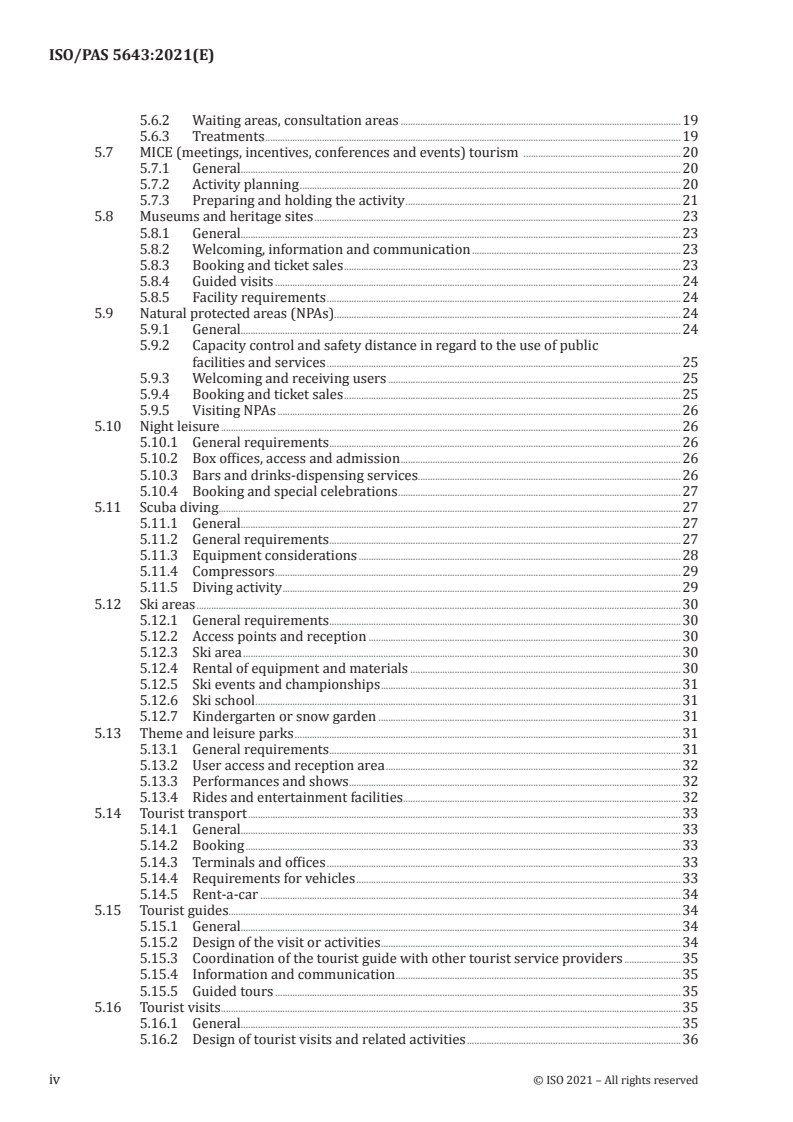
iv © ISO 2021 – All rights reserved
5.16.3 Welcome at the site .36
5.16.4 Visits .36
5.17 Tourist information offices .37
5.18 Travel agencies .37
5.19 Unique public spaces .38
5.20 Yacht harbours and nautical activities .38
5.20.1 General.38
5.20.2 User service at offices .38
5.20.3 Operational activities .39
5.20.4 Common areas .39
5.20.5 Craft moorings .39
5.20.6 Rental of boats, ships, floating craft and complementary items .39
5.20.7 Complementary activities .39
5.20.8 Nautical sports schools and nautical activities .39
6 Ancilliary services and facilities to all subsectors .40
6.1 General .40
6.2 Common toilet facilities (including portable toilets), dressing rooms and lockers .40
6.3 Gyms .41
6.4 Swimming pools . .41
6.5 Valet service . .42
6.6 Children's play areas, sports activities and other recreational activities .42
6.7 Entertainment activities .42
6.8 Shopping areas .42
6.9 Lifts .42
Annex A (informative) Face masks .43
Annex B (informative) Accessibility considerations for the contingency plan design .45
Bibliography .47
Foreword
ISO (the International Organization for Standardization) is a worldwide federation of national standards
bodies (ISO member bodies). The work of preparing International Standards is normally carried out
through ISO technical committees. Each member body interested in a subject for which a technical
committee has been established has the right to be represented on that committee. International
organizations, governmental and non-governmental, in liaison with ISO, also take part in the work.
ISO collaborates closely with the International Electrotechnical Commission (IEC) on all matters of
electrotechnical standardization.
The procedures used to develop this document and those intended for its further maintenance are
described in the ISO/IEC Directives, Part 1. In particular, the different approval criteria needed for the
different types of ISO documents should be noted. This document was drafted in accordance with the
editorial rules of the ISO/IEC Directives, Part 2 (see www .iso .org/ directives).
Attention is drawn to the possibility that some of the elements of this document may be the subject of
patent rights. ISO shall not be held responsible for identifying any or all such patent rights. Details of
any patent rights identified during the development of the document will be in the Introduction and/or
on the ISO list of patent declarations received (see www .iso .org/ patents).
Any trade name used in this document is information given for the convenience of users and does not
constitute an endorsement.
For an explanation of the voluntary nature of standards, the meaning of ISO specific terms and
expressions related to conformity assessment, as well as information about ISO's adherence to the
World Trade Organization (WTO) principles in the Technical Barriers to Trade (TBT), see www .iso .org/
iso/ foreword .html.
This document was prepared by Technical Committee ISO/TC 228, Tourism and related services.
Any feedback or questions on this document should be directed to the user’s national standards body. A
complete listing of these bodies can be found at www .iso .org/ members .html.
vi © ISO 2021 – All rights reserved
Introduction
Tourism is one of the fastest growing economic sectors in the world and a key driver of socio-economic
progress. However, since the pandemic of COVID-19 started, caused by the SARS-CoV-2 coronavirus, the
tourism sector has been seriously affected. According to UNWTO (2021), due to COVID-19, the world
witnessed an unprecedented 73 % drop in international tourism recorded in 2020, a loss of 1,1 billon
international tourists and a loss of US$ 1,3 trillion in export revenues from tourism. Furthermore, 100
to 120 million jobs are currently effectively at risk.
With such an important impact on the economy, countries have seen the need to identify and implement
measures that reduce the spread of the pandemic and recover tourism confidence to travel and to
consume tourism services. In this regard, national, regional, public and private protocols with different
approaches and scopes have been developed against COVID-19 worldwide, and it seems relevant
and necessary to harmonize the measures to reduce the risk of contagion of SARS-CoV-2 in a single
protocol, which provides a framework to the countries with the agreed minimum requirements and
recommendations to consider during the time the risk of contagion exists.
This document specifies basic requirements and guidelines to prevent the spread of coronavirus in
the tourism industry and is complementary to the existing national protocols. These measures will
contribute to the recovery of the tourism sector and restore the confidence of travellers.
PUBLICLY AVAILABLE SPECIFICATION ISO/PAS 5643:2021(E)
Tourism and related services — Requirements and
guidelines to reduce the spread of Covid-19 in the tourism
industry
1 Scope
This document establishes requirements and recommendations for tourist organizations to prevent the
spread of coronavirus SARS-CoV-2 in order to protect their employees’ health from COVID-19 and to
provide safer tourist services and products to tourists and residents.
NOTE This document does not address after-work practices of employees.
This document applies to the whole tourism value chain, including the following 20 subsectors:
— accommodation
— adventure tourism and ecotourism
— beaches
— catering services
— golf services
— medical and wellness spas
— mice tourism
— museums and heritage sites
— natural protected areas (NPAs)
— night leisure
— scuba diving
— ski areas
— theme and leisure parks
NOTE This includes water parks, animal parks (zoos, aquariums, wildlife refuges) and family
entertainment centres.
— tourist transport
— tourist guides
— tourist visits
— tourist information offices
— travel agencies
— unique public spaces
— yacht harbours and nautical activities
Each tourist organization is expected to conform only to those measures that apply to the services that
it offers, including the core requirements established in Clause 4, the relevant applicable subclause in
Clause 5 and the relevant applicable ancillary services and facilities in Clause 6.
NOTE The term tourist organization applies for all 20 subsectors.
2 Normative references
There are not normative references in this document.
3 Terms and definitions
For the purposes of this document, the following terms and definitions apply.
ISO and IEC maintain terminological databases for use in standardization at the following addresses:
— ISO Online browsing platform: available at https:// www .iso .org/ obp
— IEC Electropedia: available at http:// www .electropedia .org/
3.1
contingency plan
set of measures and actions for responding to the COVID-19 pandemic
3.2
COVID-19
infectious disease caused by coronavirus SARS-CoV-2, whose most common symptoms are fever, dry
cough and tiredness
3.3
customer
user
tourist
visitor
guest
person who uses the different facilities and services provided by a tourist organization
3.4
risk
possibility of a person becoming infected with coronavirus SARS-CoV-2
3.5
risk management
coordinated activities to direct and control an organization with regard to risk
[SOURCE: ISO 31000:2018, 3.2]
3.6
safe capacity
maximum capacity at a facility (e.g. restaurant) or service (e.g. tour, activity) that allows people to keep
a safe distance, reducing the risk of contagion by the emission of aerosols and droplets
Note 1 to entry: The applicable legal framework can determine the safe capacity. The tourist organization can
also determine the safe capacity without exceeding the maximum specified by the legal framework, or when the
legal framework does not determine it.
2 © ISO 2021 – All rights reserved
3.7
safe conditions
situation in which the measures to minimize the risk of contagion of COVID-19 are observed
EXAMPLE Keeping a safe distance, using a face mask, performing disinfection tasks.
3.8
safety distance
measure to reduce the risk of transmission of the coronavirus SARS-CoV-2, minimizing exposure by
keeping a minimum separation between two people
Note 1 to entry: The World Health Organization (WHO) has established the minimum safety distance as 1 m at
the time of publication of this document. Most governments have established a safety distance of between 1 m
and 2 m.
Note 2 to entry: Countries with no specific regulations on safety distance can follow the WHO’s recommendations.
3.9
SARS-CoV-2
virus that causes COVID-19 illness
3.10
tourist organization
provider offering tourism services and products
EXAMPLE Company, contractor, destination management organization, foundation, self-employed person,
government body.
4 COVID-19 risk management requirements
4.1 General
4.1.1 General requirements
The tourist organization shall commit to risk management and the systematic implementation of
measures to minimize risk. The tourist organization shall:
a) set up a risk management group (4.2);
b) perform a risk assessment on SARS-CoV-2 infection;
c) draw up a plan of health and safety measures (contingency plan), based on the findings of the risk
assessment, to reduce the risk of SARS-CoV-2 infection.
4.1.2 Legal requirements
The tourist organization shall:
a) identify the legal requirements applicable to the services offered in the context of SARS-CoV-2
(e.g. use of face mask by staff, visitors or both);
b) determine how these requirements apply to the services offered;
c) ensure that these applicable legal requirements are taken into account when offering its services.
NOTE Data protection regulation is relevant when collecting and sharing information provided by the
tourist (e.g. visitors’ health information such as temperature).
4.2 COVID-19 risk management group
The risk management group, which shall include employees’ representatives, shall be responsible for
defining strategies and decision-making to minimize the risk of contagion of SARS-CoV-2.
In small tourist organizations this risk management group can be an individual (e.g. owner, manager)
responsible for the definition and implementation of health and safety measures according to the risk
assessment. This person shall in any case consider employees’ advice.
Furthermore, the COVID-19 risk management group shall do the following:
a) Establish mechanisms for gathering information to make the best decisions (e.g. consult authorities,
employees, specialists) and to coordinate the group [among its members and with authorities,
external service providers, occupational risk prevention (ORP) responsible persons].
b) Ensure that the risk assessment is performed, considering the identification, analysis and
evaluation of the activities or facilities where the virus is more likely to be spread, as well as
considering the different transmission modes (aerosols, drops and contact), the characteristics of
the venue (e.g. indoors, outdoors) and the services provided.
The risk of contagion increases when one or several of the following factors take place:
— the safety distance is not respected;
— the space is enclosed, with no ventilation or poor ventilation;
— the time of exposure is long (>15 min);
— the humidity percentage is under 40 %;
— no face mask is used (either by the personnel, visitors or both).
c) Design a contingency plan (4.3) according to the risk assessment results, with health and safety
measures for both visitors and personnel.
Given the evolving nature of the disease, the COVID-19 risk management group shall refer to new
research results and additional necessary measures that will possibly be defined or published in the
future, including those the competent authorities will possibly impose.
4.3 Contingency plan
The contingency plan shall include at least the following:
a) The health and safety measures to be implemented in order to reduce the spread of SARS-CoV-2
and to protect both visitors and personnel, considering also the needs of people with any type
of disability (see recommendations given in Annex B) as well as vulnerable employees. These
measures shall be part of a comprehensive approach which considers, for example, the use of face
masks and other protective barriers, the redesign of services, the reduction of capacity in enclosed
spaces, hand hygiene, cleaning and disinfection activities. Specifically, the use of face masks (see
additional information in Annex A) as well as the provision of hand sanitizer in places with higher
risk of infection shall be determined in accordance with the risk assessment results.
b) The assignment of responsibilities to implement those measures and monitor their compliance, as
well as the allocation of material resources (e.g. face masks, physical barriers, shields or screens,
hand sanitiser), considering any possible restriction and service limitations. If a lack of material
resources is detected, the risk management group shall analyse the situation and take alternative
effective action.
c) A protocol in the event that an employee or user shows symptoms compatible with COVID-19 during
the service (e.g. guided tour) or inside the tourist facilities (e.g. at a campsite). This protocol shall
follow the advice of the competent authorities, if applicable.
4 © ISO 2021 – All rights reserved
The contingency plan shall be monitored to assess whether it is effective and modified if necessary.
4.4 General measures for the tourist organization
The tourist organization shall do the following:
a) Plan tasks and work processes to guarantee the safety distance. Safety distance shall be respected
in all activities and therefore the tourist organization shall control occupancy levels when
necessary. If this is not possible, other health and safety measures shall be ensured (e.g. use of
physical barriers or face masks).
b) Establish rules for the use of facilities and common spaces (e.g. in lifts, dining rooms, lobbies and
common areas, canteens, dressing rooms, permanent and/or temporary toilets); if employees work
in shifts, these should be planned whenever possible so that the same employees are always in the
same shift groups.
c) Provide health and safety guidelines with comprehensive, clear and legible information on health
and safety measures to apply in the workplace, before, during and after work. Posters can support
these guidelines.
d) Facilitate hand washing with soap and water or, if this is not possible, the use of hand sanitiser, and
provide adequate face masks for its use according to the risk assessment results.
NOTE Additional information on how to wash hands can be found at: https:// www .who .int/ gpsc/ 5may/
How _To _HandWash _Poster .pdf ?ua = 1
e) Train the staff in the correct use and maintenance of the protective equipment they use. These
training activities shall be registered.
f) Encourage staff and external services providers to conform to the contingency plan and ensure
that they respect the safety measures.
g) Determine the protocol for dealing with visitors who do not conform to the health and safety
measures.
h) Have available the contact details of healthcare centres (public and private, when applicable).
i) Promote contactless payment (e.g. cards, mobiles), avoiding, as far as possible, the use of cash.
Cards should only be touched by the user.
j) Use electronic and online channels to provide information (website, social media, electronic signs).
If leaflets, written information or maps are provided, these shall be provided in a safe way and for
individual use. There shall be a non-manual bagged waste bin.
4.5 Staff
4.5.1 General requirements
Staff shall know their specific responsibilities within the contingency plan, shall respect the health and
safety measures defined in the contingency plan and shall:
a) Respect safety distance and avoid physical contact, including shaking hands, whenever possible.
Cleaning and disinfection staff should not work in areas while visitors or other staff are in,
except when due to the operation of the service this is not possible (e.g. continuous cleaning and
disinfection in a theme and leisure park, table cleaning and disinfection at a restaurant while
customers are sitting).
b) Wash their hands thoroughly after sneezing, blowing their nose or coughing, or touching potentially
contaminated surfaces (e.g. cash, menus). Throw away any personal hygiene waste, especially
tissues, as well as face masks (when applicable) in non-manual waste bins or containers. After
each cleaning and disinfection session, they shall safely dispose of the materials and protective
equipment used and then wash their hands. Where possible, buckets with lids shall be provided for
disposal and subsequent waste management.
c) Disinfect personal objects (e.g. glasses, mobile phones) throughout the day with soap and water
when feasible, and with a hand sanitiser when not available. Specific products applied with a cloth
or special disinfectant wipes can be used to disinfect electronic equipment.
d) Not share other employees' work equipment or devices, as a general rule. If certain equipment or
devices are shared, the tourist organization shall establish cleaning and disinfection guidelines
between uses.
e) Use appropriate face masks (see information in Annex A) and gloves. Gloves should only be used for
cleaning and disinfection activities, or to treat or care for people infected.
NOTE Additional information on the use of gloves can be found at: https:// www .who .int/ gpsc/ 5may/
Glove _Use _Information _Leaflet .pdf
f) Remove work clothes and store them in a bag at the end of the working day (only for catering
services staff and cleaning and disinfection staff).
Work clothes should be washed (>60 °C) and/or disinfected with a suitable product daily.
4.5.2 Staff areas
The use of dining rooms, rest rooms, dressing rooms and canteens (if any) shall be regulated as follows:
a) establish a safe capacity so as to maintain the safety distance, as well as hygiene conditions, during
their use;
b) reinforce ventilation as well as cleaning and disinfection activities according to the use of these
areas.
To ensure this, the following measures can be taken:
— Increasing the number of meal shifts, breaks or both, or alternating breaks so that as few people as
possible are in the area at the same time. This can involve the temporary adjustment of the length
or distribution of breaks.
— Putting up signs reminding staff to wash their hands before and after pressing the buttons on
vending and coffee machines, if any.
— Not sharing kitchen utensils or tableware items.
— Installing lockers.
4.6 Informative measures
The tourist organization shall communicate to employees, external service providers and visitors the
health and safety measures of the contingency plan that they shall follow. This information should be
1)
presented in an accessible way for people with disabilities (see Annex B and ISO 21902 ).
The tourist organization shall communicate to visitors the service cond
...