

ISO 21626-3:2020
(Main)Bamboo charcoal — Part 3: Purification applications
General Information
- Abstract
This document specifies the requirements and test methods of bamboo charcoal for air-purification applications.
- Status
- Published
- Publication Date
- 03-Dec-2020
- Technical Committee
- ISO/TC 296 - Bamboo and rattan
- Drafting Committee
- ISO/TC 296/WG 3 - Bamboo Charcoal
- Current Stage
- 9093 - International Standard confirmed
- Start Date
- 01-Sep-2026
- Completion Date
- 05-Sep-2026


Overview
ISO 21626-3:2020 specifies the requirements and test methods for bamboo charcoal intended for air-purification applications. Bamboo charcoal is an eco-friendly, porous biomass product used to adsorb indoor pollutants such as formaldehyde and various volatile organic compounds (VOCs). The standard targets consistent product quality for reliable performance in both domestic and industrial indoor air treatment.
Key Topics
- Scope and definitions: Defines bamboo charcoal for air purification (BCAP) and key properties including moisture content (MC), ash content (AC), fixed carbon (FC) and adsorption capacities.
- Grading and physical/chemical requirements: The standard sets graded requirements (I, II, III) for key parameters. Typical requirements include limits for:
- Moisture content (MC)
- Ash content (AC)
- Fixed carbon (FC)
- Formaldehyde adsorption capacity (FAC)
- Total VOC (TVOC) adsorption capacity
- Sampling and analytical methods: Sampling is to follow ISO 18135. Specific test methods referenced include:
- Moisture: ISO 18134-3
- Ash content: ISO 18122
- Volatile matter: ISO 18123 (used to calculate FC)
- Formaldehyde adsorption: ISO 16000-3
- TVOC adsorption: ISO 16000-6
- Sensory and visual inspection: Product shall appear black with no peculiar smell or foreign contaminants; visual checks are part of acceptance.
- Marking, labelling and packaging: Containers must show manufacturer, standard reference, production date and batch ID, net mass and grade. Usage instructions and storage precautions are required on the packaging.
Applications
ISO 21626-3:2020 is directly relevant to manufacturers, product specifiers, testing labs and procurement teams deploying bamboo charcoal for:
- Indoor air-purification products (filters, sachets, panels)
- Residential and commercial air quality mitigation
- Pre-treatment stages for HVAC and air-cleaning devices
Practical benefits include consistent adsorption performance for formaldehyde and TVOCs, clear acceptance criteria for suppliers, and aligned test methods to demonstrate compliance.
Related Standards
This part of ISO 21626 references and aligns with several established standards used for sampling and testing:
- ISO 18135 - Sampling of solid biofuels
- ISO 18134-3 - Moisture content (oven dry method)
- ISO 18122 - Determination of ash content
- ISO 18123 - Determination of volatile matter
- ISO 16000-3 - Formaldehyde determination (active sampling)
- ISO 16000-6 - TVOC determination (Tenax TA, thermal desorption)
These referenced standards provide the validated analytical methods needed to verify compliance with ISO 21626-3:2020.
For practical implementation, follow the sampling and test-method cross-references in clause 6, label products as specified in clause 7, and store/transport packages to avoid moisture and sunlight damage as described in clause 8.
Keywords: ISO 21626-3:2020, bamboo charcoal, air purification, formaldehyde adsorption, TVOC, moisture content, ash content, fixed carbon, adsorption capacity.
Get Certified
Connect with accredited certification bodies for this standard

Element Materials Technology
Materials testing and product certification.

Kiwa BDA Testing
Building and construction product certification.

ABS Group Brazil
ABS Group certification services in Brazil.
Sponsored listings
Frequently Asked Questions
ISO 21626-3:2020 is a standard published by the International Organization for Standardization (ISO). Its full title is "Bamboo charcoal — Part 3: Purification applications". This standard covers: This document specifies the requirements and test methods of bamboo charcoal for air-purification applications.
This document specifies the requirements and test methods of bamboo charcoal for air-purification applications.
ISO 21626-3:2020 is classified under the following ICS (International Classification for Standards) categories: 13.040.20 - Ambient atmospheres; 75.160.40 - Biofuels. The ICS classification helps identify the subject area and facilitates finding related standards.
ISO 21626-3:2020 is available in PDF format for immediate download after purchase. The document can be added to your cart and obtained through the secure checkout process. Digital delivery ensures instant access to the complete standard document.
Standards Content (Sample)
INTERNATIONAL ISO
STANDARD 21626-3
First edition
2020-12
Bamboo charcoal —
Part 3:
Purification applications
Charbon de bambou —
Partie 3: Applications pour purification
Reference number
©
ISO 2020
© ISO 2020
All rights reserved. Unless otherwise specified, or required in the context of its implementation, no part of this publication may
be reproduced or utilized otherwise in any form or by any means, electronic or mechanical, including photocopying, or posting
on the internet or an intranet, without prior written permission. Permission can be requested from either ISO at the address
below or ISO’s member body in the country of the requester.
ISO copyright office
CP 401 • Ch. de Blandonnet 8
CH-1214 Vernier, Geneva
Phone: +41 22 749 01 11
Email: copyright@iso.org
Website: www.iso.org
Published in Switzerland
ii © ISO 2020 – All rights reserved
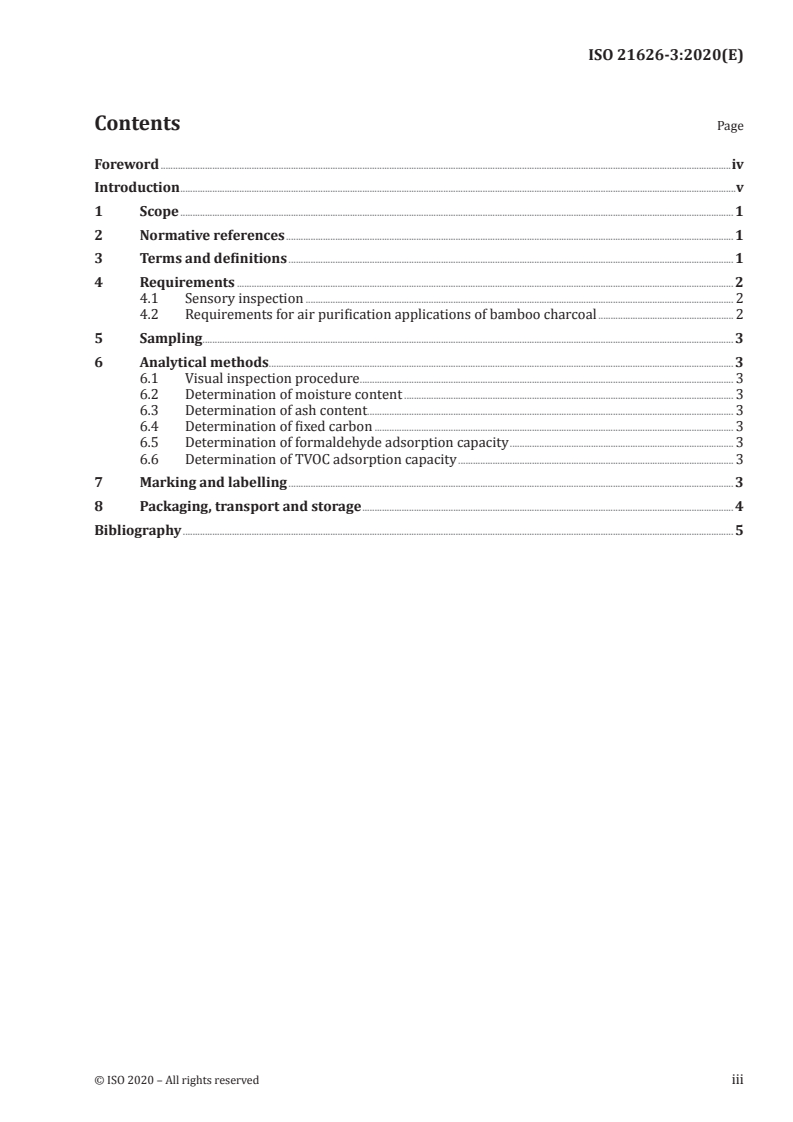
Contents Page
Foreword .iv
Introduction .v
1 Scope . 1
2 Normative references . 1
3 Terms and definitions . 1
4 Requirements . 2
4.1 Sensory inspection . 2
4.2 Requirements for air purification applications of bamboo charcoal . 2
5 Sampling . 3
6 Analytical methods. 3
6.1 Visual inspection procedure . 3
6.2 Determination of moisture content . 3
6.3 Determination of ash content. 3
6.4 Determination of fixed carbon . 3
6.5 Determination of formaldehyde adsorption capacity . 3
6.6 Determination of TVOC adsorption capacity . 3
7 Marking and labelling . 3
8 Packaging, transport and storage . 4
Bibliography . 5
Foreword
ISO (the International Organization for Standardization) is a worldwide federation of national standards
bodies (ISO member bodies). The work of preparing International Standards is normally carried out
through ISO technical committees. Each member body interested in a subject for which a technical
committee has been established has the right to be represented on that committee. International
organizations, governmental and non-governmental, in liaison with ISO, also take part in the work.
ISO collaborates closely with the International Electrotechnical Commission (IEC) on all matters of
electrotechnical standardization.
The procedures used to develop this document and those intended for its further maintenance are
described in the ISO/IEC Directives, Part 1. In particular the different approval criteria needed for the
different types of ISO documents should be noted. This document was drafted in accordance with the
editorial rules of the ISO/IEC Directives, Part 2. www .iso .org/ directives
Attention is drawn to the possibility that some of the elements of this document may be the subject of
patent rights. ISO shall not be held responsible for identifying any or all such patent rights. Details of
any patent rights identified during the development of the document will be in the Introduction and/or
on the ISO list of patent declarations received. www .iso .org/ patents
Any trade name used in this document is information given for the convenience of users and does not
constitute an endorsement.
For an explanation on the meaning of ISO specific terms and expressions related to conformity
assessment, as well as information about ISO's adherence to the WTO principles in the Technical
Barriers to Trade (TBT) see the following URL: Foreword - Supplementary information
This document is prepared by Technical Committee ISO/TC 296, Bamboo and Rattan.
Any feedback or questions on this document should be directed to the user’s national standards body. A
complete listing of these bodies can be found at www .iso .org/ members .html.
iv © ISO 2020 – All rights reserved
Introduction
Bamboo charcoal (BC) is an eco-friendly biomass product with porous structure, which is generally
used to absorb toxic indoor gases, such as formaldehyde and various volatile organic compounds
(VOCs). Bamboo charcoal has good adsorption quality and abundant sources of raw materials. Bamboo
charcoal for purification applications also comes with a great market potential both in industrial and
domestic appl
...
INTERNATIONAL ISO
STANDARD 21626-3
First edition
2020-12
Bamboo charcoal —
Part 3:
Purification applications
Charbon de bambou —
Partie 3: Applications pour purification
Reference number
©
ISO 2020
© ISO 2020
All rights reserved. Unless otherwise specified, or required in the context of its implementation, no part of this publication may
be reproduced or utilized otherwise in any form or by any means, electronic or mechanical, including photocopying, or posting
on the internet or an intranet, without prior written permission. Permission can be requested from either ISO at the address
below or ISO’s member body in the country of the requester.
ISO copyright office
CP 401 • Ch. de Blandonnet 8
CH-1214 Vernier, Geneva
Phone: +41 22 749 01 11
Email: copyright@iso.org
Website: www.iso.org
Published in Switzerland
ii © ISO 2020 – All rights reserved
Contents Page
Foreword .iv
Introduction .v
1 Scope . 1
2 Normative references . 1
3 Terms and definitions . 1
4 Requirements . 2
4.1 Sensory inspection . 2
4.2 Requirements for air purification applications of bamboo charcoal . 2
5 Sampling . 3
6 Analytical methods. 3
6.1 Visual inspection procedure . 3
6.2 Determination of moisture content . 3
6.3 Determination of ash content. 3
6.4 Determination of fixed carbon . 3
6.5 Determination of formaldehyde adsorption capacity . 3
6.6 Determination of TVOC adsorption capacity . 3
7 Marking and labelling . 3
8 Packaging, transport and storage . 4
Bibliography . 5
Foreword
ISO (the International Organization for Standardization) is a worldwide federation of national standards
bodies (ISO member bodies). The work of preparing International Standards is normally carried out
through ISO technical committees. Each member body interested in a subject for which a technical
committee has been established has the right to be represented on that committee. International
organizations, governmental and non-governmental, in liaison with ISO, also take part in the work.
ISO collaborates closely with the International Electrotechnical Commission (IEC) on all matters of
electrotechnical standardization.
The procedures used to develop this document and those intended for its further maintenance are
described in the ISO/IEC Directives, Part 1. In particular the different approval criteria needed for the
different types of ISO documents should be noted. This document was drafted in accordance with the
editorial rules of the ISO/IEC Directives, Part 2. www .iso .org/ directives
Attention is drawn to the possibility that some of the elements of this document may be the subject of
patent rights. ISO shall not be held responsible for identifying any or all such patent rights. Details of
any patent rights identified during the development of the document will be in the Introduction and/or
on the ISO list of patent declarations received. www .iso .org/ patents
Any trade name used in this document is information given for the convenience of users and does not
constitute an endorsement.
For an explanation on the meaning of ISO specific terms and expressions related to conformity
assessment, as well as information about ISO's adherence to the WTO principles in the Technical
Barriers to Trade (TBT) see the following URL: Foreword - Supplementary information
This document is prepared by Technical Committee ISO/TC 296, Bamboo and Rattan.
Any feedback or questions on this document should be directed to the user’s national standards body. A
complete listing of these bodies can be found at www .iso .org/ members .html.
iv © ISO 2020 – All rights reserved
Introduction
Bamboo charcoal (BC) is an eco-friendly biomass product with porous structure, which is generally
used to absorb toxic indoor gases, such as formaldehyde and various volatile organic compounds
(VOCs). Bamboo charcoal has good adsorption quality and abundant sources of raw materials. Bamboo
charcoal for purification applications also comes with a great market potential both in industrial and
domestic appl
...