

ISO/TS 20790:2024
(Main)Oil and gas industries including lower carbon energy — Guidelines for green manufacturing and lower carbon emission of oil and gas-field equipment and materials
General Information
- Abstract
This document provides guidelines for green manufacturing and lower carbon emission practices of oil and gas-field equipment and materials used in the hydrocarbon industries. The guidelines include the establishment of a green attribute system and implementation of sound practices for green manufacturing and lower carbon emission, such as green design, manufacturing, remanufacturing, evaluation and management. This document is applicable to organizations involved in the design, construction, engineering, commissioning, operations, maintenance, decommissioning and reuse of materials, equipment, installations and process systems applied in the hydrocarbon industries.
- Status
- Published
- Publication Date
- 01-Oct-2024
- Current Stage
- 6060 - International Standard published
- Start Date
- 02-Oct-2024
- Due Date
- 12-Dec-2024
- Completion Date
- 02-Oct-2024
Buy Documents


ISO/TS 20790:2024 - Oil and gas industries including lower carbon energy — Guidelines for green manufacturing and lower carbon emission of oil and gas-field equipment and materials Released:2. 10. 2024
Overview
ISO/TS 20790:2024 - "Oil and gas industries including lower carbon energy - Guidelines for green manufacturing and lower carbon emission of oil and gas‑field equipment and materials" provides practical guidance to reduce greenhouse‑gas emissions and material use across the full life cycle of oil and gas‑field equipment and materials. The Technical Specification defines a green attribute system and recommends sound practices for green design, processing, remanufacturing, evaluation and management applicable to design, construction, commissioning, operation, maintenance, decommissioning and reuse in the hydrocarbon industries.
Key topics and requirements
- Green attribute system: Principles and measurable indexes for identifying attributes that reduce resource consumption and emissions.
- Green design: Material selection, structure optimization and design-for-reuse/remanufacturing to minimize life‑cycle impacts.
- Green processing: Adoption of low‑impact manufacturing processes, resource consumption control and emission mitigation measures.
- Operation and resource circularity: Measures for energy efficiency, resource and energy cyclic utilization, recycling and reutilization rates.
- Typical practices: Examples include hydrogen‑ready pipelines and storage, low‑emission power engines, drilling rig energy recovery, pipeline coatings, and remanufacturing techniques.
- Green assessment: Requirements for assessing green performance, with emphasis on Life Cycle Assessment (LCA) and complementary evaluation methods.
- Green management: Implementation framework, documentation, identification and stakeholder responsibilities for ongoing green governance.
Practical applications
ISO/TS 20790:2024 is designed to be applied at multiple stages of the equipment life cycle and supports practical outcomes such as:
- Reduced embodied and operational carbon of field equipment and materials
- Design decisions that enable remanufacturing, reuse and recycling
- Selection of low‑emission engines, coatings and energy recovery systems
- Consistent green assessment and reporting using LCA principles
- Management processes to track green attributes, product documentation and identification
Who should use this standard
- Equipment designers and engineering firms
- Manufacturers and remanufacturers of oil and gas equipment
- Asset owners, operators and maintenance teams
- Procurement and sustainability managers in the hydrocarbon and lower‑carbon energy sectors
- Regulators and certification bodies seeking guidance for green manufacturing practices
Related standards
ISO/TS 20790:2024 complements life‑cycle and sustainability standards (for example, the ISO 14040/14044 LCA series) and other ISO/TC 67 publications addressing oil and gas industry practice. For implementation, organizations often align green assessments with established LCA methodologies and industry‑specific guidance.
Keywords: ISO/TS 20790:2024, green manufacturing, lower carbon emission, oil and gas, green design, remanufacturing, life cycle assessment, green attribute system.
Buy Documents
ISO/TS 20790:2024 - Oil and gas industries including lower carbon energy — Guidelines for green manufacturing and lower carbon emission of oil and gas-field equipment and materials Released:2. 10. 2024
Get Certified
Connect with accredited certification bodies for this standard

BSI Group
BSI (British Standards Institution) is the business standards company that helps organizations make excellence a habit.

Bureau Veritas
Bureau Veritas is a world leader in laboratory testing, inspection and certification services.

DNV
DNV is an independent assurance and risk management provider.
Sponsored listings
Frequently Asked Questions
ISO/TS 20790:2024 is a technical specification published by the International Organization for Standardization (ISO). Its full title is "Oil and gas industries including lower carbon energy — Guidelines for green manufacturing and lower carbon emission of oil and gas-field equipment and materials". This standard covers: This document provides guidelines for green manufacturing and lower carbon emission practices of oil and gas-field equipment and materials used in the hydrocarbon industries. The guidelines include the establishment of a green attribute system and implementation of sound practices for green manufacturing and lower carbon emission, such as green design, manufacturing, remanufacturing, evaluation and management. This document is applicable to organizations involved in the design, construction, engineering, commissioning, operations, maintenance, decommissioning and reuse of materials, equipment, installations and process systems applied in the hydrocarbon industries.
This document provides guidelines for green manufacturing and lower carbon emission practices of oil and gas-field equipment and materials used in the hydrocarbon industries. The guidelines include the establishment of a green attribute system and implementation of sound practices for green manufacturing and lower carbon emission, such as green design, manufacturing, remanufacturing, evaluation and management. This document is applicable to organizations involved in the design, construction, engineering, commissioning, operations, maintenance, decommissioning and reuse of materials, equipment, installations and process systems applied in the hydrocarbon industries.
ISO/TS 20790:2024 is classified under the following ICS (International Classification for Standards) categories: 13.020.99 - Other standards related to environmental protection; 75.200 - Petroleum products and natural gas handling equipment. The ICS classification helps identify the subject area and facilitates finding related standards.
ISO/TS 20790:2024 is available in PDF format for immediate download after purchase. The document can be added to your cart and obtained through the secure checkout process. Digital delivery ensures instant access to the complete standard document.
Standards Content (Sample)
Technical
Specification
ISO/TS 20790
First edition
Oil and gas industries including
2024-10
lower carbon energy — Guidelines
for green manufacturing and lower
carbon emission of oil and gas-field
equipment and materials
Industries du pétrole et du gaz, y compris les énergies à faible
teneur en carbone — Lignes directrices pour une production
verte et une réduction des émissions de carbone des équipements
et matériaux des champs pétroliers et gaziers
Reference number
© ISO 2024
All rights reserved. Unless otherwise specified, or required in the context of its implementation, no part of this publication may
be reproduced or utilized otherwise in any form or by any means, electronic or mechanical, including photocopying, or posting on
the internet or an intranet, without prior written permission. Permission can be requested from either ISO at the address below
or ISO’s member body in the country of the requester.
ISO copyright office
CP 401 • Ch. de Blandonnet 8
CH-1214 Vernier, Geneva
Phone: +41 22 749 01 11
Email: copyright@iso.org
Website: www.iso.org
Published in Switzerland
ii
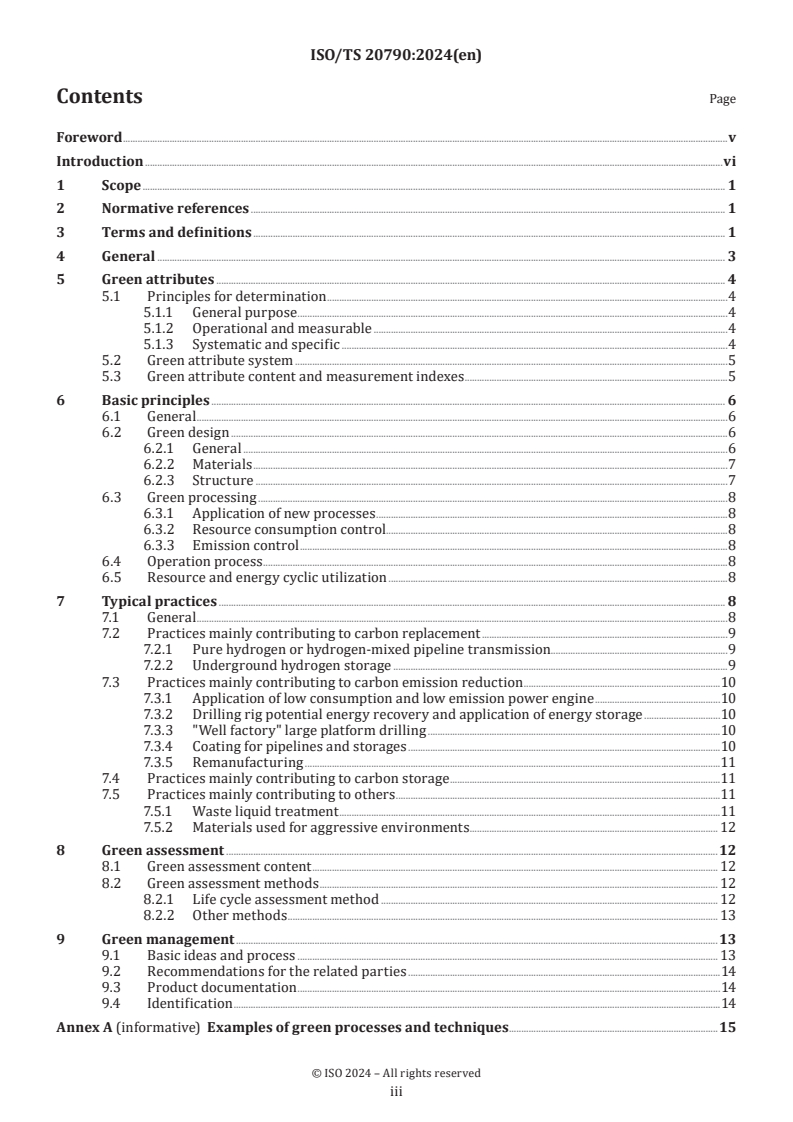
Contents Page
Foreword .v
Introduction .vi
1 Scope . 1
2 Normative references . 1
3 Terms and definitions . 1
4 General . 3
5 Green attributes . 4
5.1 Principles for determination .4
5.1.1 General purpose .4
5.1.2 Operational and measurable .4
5.1.3 Systematic and specific .4
5.2 Green attribute system .5
5.3 Green attribute content and measurement indexes .5
6 Basic principles . 6
6.1 General .6
6.2 Green design .6
6.2.1 General .6
6.2.2 Materials .7
6.2.3 Structure .7
6.3 Green processing .8
6.3.1 Application of new processes .8
6.3.2 Resource consumption control.8
6.3.3 Emission control .8
6.4 Operation process .8
6.5 Resource and energy cyclic utilization .8
7 Typical practices . 8
7.1 General .8
7.2 Practices mainly contributing to carbon replacement .9
7.2.1 Pure hydrogen or hydrogen-mixed pipeline transmission.9
7.2.2 Underground hydrogen storage .9
7.3 Practices mainly contributing to carbon emission reduction .10
7.3.1 Application of low consumption and low emission power engine .10
7.3.2 Drilling rig potential energy recovery and application of energy storage .10
7.3.3 "Well factory" large platform drilling .10
7.3.4 Coating for pipelines and storages .10
7.3.5 Remanufacturing .11
7.4 Practices mainly contributing to carbon storage .11
7.5 Practices mainly contributing to others .11
7.5.1 Waste liquid treatment .11
7.5.2 Materials used for aggressive environments. 12
8 Green assessment .12
8.1 Green assessment content . 12
8.2 Green assessment methods . 12
8.2.1 Life cycle assessment method . 12
8.2.2 Other methods . 13
9 Green management .13
9.1 Basic ideas and process . 13
9.2 Recommendations for the related parties .14
9.3 Product documentation .14
9.4 Identification .14
Annex A (informative) Examples of green processes and techniques .15
iii
Annex B (informative) An example of life cycle assessment . 17
Bibliography .20
iv
Foreword
ISO (the International Organization for Standardization) is a worldwide federation of national standards
bodies (ISO member bodies). The work of preparing International Standards is normally carried out through
ISO technical committees. Each member body interested in a subject for which a technical committee
has been established has the right to be represented on that committee. International organizations,
governmental and non-governmental, in liaison with ISO, also take part in the work. ISO collaborates closely
with the International Electrotechnical Commission (IEC) on all matters of electrotechnical standardization.
The procedures used to develop this document and those intended for its further maintenance are described
in the ISO/IEC Directives, Part 1. In particular, the different approval criteria needed for the different types
of ISO document should be noted. This document was drafted in accordance with the editorial rules of the
ISO/IEC Directives, Part 2 (see www.iso.org/directives).
ISO draws attention to the possibility that the implementation of this document may involve the use of (a)
patent(s). ISO takes no position concerning the evidence, validity or applicability of any claimed patent
rights in respect thereof. As of the date of publication of this document, ISO had not received notice of (a)
patent(s) which may be required to implement this document. However, implementers are cautioned that
this may not represent the latest information, which may be obtained from the patent database available at
www.iso.org/patents. ISO shall not be held responsible for identifying any or all such patent rights.
Any trade name used in this document is information given for the convenience of users and does not
constitute an endorsement.
For an explanation of the voluntary nature of standards, the meaning of ISO specific terms and expressions
related to conformity assessment, as well as information about ISO's adherence to the World Trade
Organization (WTO) principles in the Technical Barriers to Trade (TBT), see www.iso.org/iso/foreword.html.
This document was prepared by Technical Committee ISO/TC 67, Oil and gas industries including lower
carbon energy.
Any feedback or questions on this document should be directed to the user’s national standards body. A
complete listing of these bodies can be found at www.iso.org/members.html.
v
Introduction
To meet the 2030 Sustainable Development Goals (SDGs), ISO/TC 67, representing the global oil and gas
industries including lower carbon energy, plays an important role in reducing use of materials and other
resources, increasing the recycling of resources, and reducing waste and emissions, e.g. greenhouse gas
(GHG) emissions, while continuing to deliver the energy and products demanded by their consumers.
The industry is committed to enhancing sustainability and to overcoming the world’s most pressing
sustainability challenges. The industry is aiming to take a more proactive role on both climate and health,
safety and environment (HSE) performance issues.
There are opportunities throughout the oil and gas supply chain to increase positive impacts towards the
SDGs. No matter how the energy transforms and how the industry develops, equipment, materials and other
infrastructure serve as the foundation and the cornerstone for the development of the industry. Advanced
materials, equipment and structures are the premises; they facilitate improvements in the efficiency
of exploration and production, the safe and reliable operation of transportation and the continuous
optimization of refining for oil and gas industries including lower carbon energy.
vi
Technical Specification ISO/TS 20790:2024(en)
Oil and gas industries including lower carbon energy —
Guidelines for green manufacturing and lower carbon
emission of oil and gas-field equipment and materials
1 Scope
This document provides guidelines for green manufacturing and lower carbon emission practices of oil and
gas-field equipment and materials used in the hydrocarbon industries.
The guidelines include the establishment of a green attribute system and implementation of sound practices
for green manufacturing and lower carbon emission, such as green design, manufacturing, remanufacturing,
evaluation and management.
This document is applicable to organizations involved in the design, construction, engineering,
commissioning, operations, maintenance, decommissioning and reuse of materials, equipment, installations
and process systems applied in the hydrocarbon industries.
2 Normative references
There are no normative references in this document.
3 Terms and definitions
For the purposes of this document, the following terms and definitions apply.
ISO and IEC maintain terminology databases for use in standardization at the following addresses:
— ISO Online browsing platform: available at https:// www .iso .org/ obp
— IEC Electropedia: available at https:// www .electropedia .org/
3.1
sustainable development
development that meets the environmental, social and economic needs of the present without compromising
the ability of future generations to meet their own needs
[1]
[SOURCE: ISO Guide 82:2019, 3.2, modified – Note 1 to entry has been removed.]
3.2
green economy
economy or economic development model based on the principles of sustainable development (3.1) and a
recognition of the interdependence and coevolution of human economies and natural ecosystems over time
and space
[2]
[SOURCE: ISO 6707-3:2022, 3.9.32]
3.3
full life cycle
expected period of time in which the product is expected to function according to manufacturer’s
specifications
[3]
[SOURCE: ISO 17078-1:2004, 3.17, modified — The wording has been adjusted according to the ISO/IEC
Directives, Part 2.]
3.4
green manufacturing
manufacturing model in line with the concept of sustainable development (3.1) and green economy (3.2),
the goal of which is to make the product consume fewer resources, have less negative impact on ecological
environment, and finally realize the continuous coordination and optimization of economic and social
benefits of organizations in the product full life cycle (3.3)
3.5
lower carbon emission
reduced carbon emissions compared to previous practices, by the implementation of green manufacturing
(3.4) or the assistance in developing lower carbon energies
3.6
green design
design and development activities where the performance, quality, development cycle and cost factors are
optimized so as to meet the goal of green manufacturing (3.4)
3.7
green processing
advanced technologies or practices adopted in the process of product manufacturing with the aim of
reasonable utilization of resources, cost saving and environmental pollution reduction
3.8
remanufacturing
process of upgrading the equipment and materials so that the quality characteristics are not lower than that
of the prototype new product
3.9
remanufacturing rate
percentage of the sum of the value of the remanufactured component to the value of the entire device or product
3.10
reutilization
process of using disused equipment and materials that are also of value for other purposes, either directly or
after treatment
3.11
reutilization rate
mass fraction of the reutilized part to the total amount of scrap equipment and materials
3.12
recycling
process of treating previously used equipment and materials so that they can be reused as raw materials
3.13
recycling rate
mass fraction of the recycled part to the total amount of scrap equipment and materials
3.14
green attribute
characteristic of reducing materials and energy and reducing the ecological environmental impacts in the
product full life cycle (3.3)
3.15
green assessment
evaluation and judgment of whether the green attribute (3.14) of the product meets the requirements of a
standard or agreement
3.16
green supply chain
supply chain system that integrates green manufacturing (3.4) practices into its entire process, including the
logistics process after product disuse
4 General
Green manufacturing and lower carbon emission are two important topics which should be considered
together for the sustainable development of equipment and materials.
NOTE 1 Green manufacturing in the oil, gas and lower carbon energy areas supports the guidance for addressing
[4] [1] [5]
climate change and sustainability concerns in ISO Guide 64, ISO Guide 82 and ISO Guide 84 .
NOTE 2 Green manufacturing and lower carbon emission are related to the full life cycle of the equipment and
materials. For a specific organization, they can only be involved in some areas of the design, construction, engineering,
commissioning, operations, maintenance, decommissioning and reuse, etc.
Green manufacturing is the main method to realize lower carbon emission in equipment and materials,
including the following aspects:
— in the traditional hydrocarbon industries, by adopting green design, green manufacturing and recycling,
etc., to reduce the consumption of resources and energy, increase the utilization efficiency of resources
and energy, and reduce the adverse effects of carbon emissions; and
— in the evolving lower carbon energy industries, by improving the performance of equipment and
materials or by the research and development of new equipment and materials, to meet the needs of the
development and utilization of new energy.
Low carbon emission is the main evaluation index of the green manufacturing effect of equipment
and materials. From a macro perspective, the main ways to achieve carbon neutrality include carbon
replacement, carbon emission reduction, carbon storage and carbon cycle.
For hydrocarbon equipment and materials, the specific measures that can contribute to green and lower
carbon development are shown in Table 1.
Table 1 — Main carbon reduction measures for hydrocarbon equipment and materials during the
carbon neutralization process
Main ways for car- Specific measures for oil field equipment and
Measures
bon neutrality materials
Using lower carbon energy, or
Wind, solar, electricity, geothermal, hydrogen,
Carbon replace-
Updating or developing new equipment and ma-
ammonia and biomass energy replace tradi-
ment
terials to meet the development and utilization
tional fossil energy, etc.
of lower carbon energy.
Carbon emission Save energy and improve energy efficiency, Energy saving, material saving, efficiency im-
reduction etc. provement and emission reduction
Carbon capture, utilization and storage Updating or developing new equipment and ma-
Carbon storage
(CCUS), carbon capture and storage (CCS), etc. terials to meet the need of carbon storage.
Artificial carbon conversion, forest carbon
Carbon cycle Developing new equipment and materials
sink, etc.
The key for conducting sound practices for green manufacturing and lower carbon emission in the field of oil
and gas-field equipment and materials are:
— to identify the green attributes and establish the green attribute system;
— to fully consider these attributes and take actions in the process of product full life cycle, including
design, manufacturing, resource and energy cyclic utilization, etc.;
— to implement the evaluation and management of green attributes, and continuously improve them.
The overall approach is shown in Figure 1.
Figure 1 — Overall approach for green manufacturing and lower carbon emission
5 Green attributes
5.1 Principles for determination
5.1.1 General purpose
Green attributes should meet the needs of green design, manufacturing, remanufacturing, green evaluation
and green management.
5.1.2 Operational and measurable
Green attributes should be measurable and comparable, easy to quantify, and have clear measurement
indicators and referable standard requirements.
5.1.3 Systematic and specific
Green attributes should be specified and systematized based on the intrinsic value of the green
manufacturing of the equipment and materials to clarify the content, measurement indicator and judgment
basis of the green attributes.
5.2 Green attribute system
The implementation of green manufacturing of equipment and materials should reduce the consumption
of resources and reduce the impact of ecological environment in the product full life cycle on the basis of
satisfying product quality, production cost and production efficiency.
The green attributes are classified into two categories: resource attribute and ecological environment
attribute according to the difference of the influence element and the intrinsic value of the green
manufacturing of the oil field equipment and materials.
These two categories can then be divided into several sub-categories as shown in Figure 2.
Figure 2 — Green attribute system
5.3 Green attribute content and measurement indexes
The green attributes and the contents and measurement indexes are shown in Table 2.
Table 2 — Green attribute content, measurement indexes and referenced standards
Measurement
No. Attribute Content
a,b
indexes
Consumption
Energy consump- Energy consumption at all stages of the product full life
1.
tion cycle.
Utilization rate
Consumption
Material consump- Material consumption at all stages of the product full life
2.
tion cycle.
Utilization rate
Process of upgrading of the oil field equipment and mate-
3. Remanufacturing rials so that the quality characteristics are not lower than Remanufacturing rate
that of the prototype new product.
Process of using disused oil field equipment and materi-
4. Reutilization als that are also of useful value for other purposes, either Reutilization rate
directly or after treatment.
Process of treating disused oil field equipment and materi-
5. Recycling Recycling rate
als so that they can be reused as raw materials.
Greenhouse gases such as carbon dioxide, methane and
Emission speed rate
toxic and harmful gases such as nitrogen dioxide, sulfur
6. Harmful gas
dioxide, VOCs, undergo no treatment or the treatment is not
Emission concentration
up to the standard.
Waste water containing toxic and harmful substances,
Emission volume
such as heavy metals, phosphorus, phenols, cyanide, oil, is
7. Harmful liquid
discharged without treatment or the treatment is not up to
Emission concentration
the standard.
Solid waste containing toxic and harmful substances
Emission volume
8. Harmful solid undergoes no treatment or the treatment is not up to the
Emission mass
standard.
9. Light pollution A strong light that affects the environment. Light intensity
10. Noise pollution Noise that has impact on the environment. Noise level
All kinds of harmful radiation, including electromagnet-
Radiation intensity
Radiation pollu-
11. ic radiation, high temperature radiation, laser radiation,
tion
Exposure time
ultraviolet radiation, etc.
a
Relevant international standards, national standards or other standards may be referenced for the requirements for the
measurement indexes.
b
The accounting of carbon can be used as an unified method to evaluate each attribute.
6 Basic principles
6.1 General
To achieve the benefits of green manufacturing and lower carbon, principles from the perspective of full life
cycle, from design, manufacturing, operation to cyclic utilization, should be followed.
For a specific organization or a specific activity, it's possible that they are not be involved in all life cycle
phases, but only involved in one or more life cycle phases. However, they should consider the issues from the
perspective of full life cycle, bearing these principles in mind and then cooperate with the related parties
from the upstream or downstream.
6.2 Green design
6.2.1 General
The green attribute of the life cycle of equipment and materials, the technology and economy characteristics
of the product should be considered comprehensively for maximized benefit.
Relevant policies, regulations, standards and stakeholder requirements should be taken into account, and
the changes in these requirements should be reviewed and analysed on a regular basis.
The equal life design should be adopted on the premise of satisfying the working condition demand.
6.2.2 Materials
Priority should be given to:
a) materials rich in source, non-toxic and harmless;
b) remanufactured or recycled materials;
c) materials easy to recover, recycle or biodegrade;
d) materials with good compatibility.
The following materials should be restricted:
— rare materials;
— materials with unclear toxic and side effects;
— toxic, harmful materials but inevitable to be used;
— materials not easy to recover and recycle.
6.2.3 Structure
6.2.3.1 Standardization
The interchangeability of products should be increased through standardization and modular design.
6.2.3.2 Lightweight design
Lightweight design is adopted for the following reasons:
a) the product is miniaturized to reduce the use of materials as well as the packaging materials;
b) the structure is optimized to reduce the variety and quantity of parts;
c) lightweight materials are preferred for motional parts.
6.2.3.3 Functional consideration
Product structure design should give priority to the use of clean and renewable energy.
The product structure should be conducive to improving the energy efficiency.
EXAMPLE Reasonable selection of motor, engine; improvement of mechanical transmission efficiency;
improvement of energy conversion efficiency, optimization of system energy efficiency; adoption of frequency
conversion control.
Auxiliary facilities such as energy metering, monitoring and energy recovery should be provided.
The effects of strong light, noise, vibration and radiation should be minimized. When necessary, noise
suppression, noise reduction, protective cover and other safety protection facilities should be installed.
The production of toxic gas, liquid or solid should be minimized. When necessary, a recovery and purification
device should be installed.
6.3 Green processing
6.3.1 Application of new processes
Process flow and process layout should be optimized to reduce intermediate links in production.
Process optimization design and evaluation should be carried out to phase out those process technologies
and production equipment with low efficiency, high pollution, high energy consumption and other adverse
effects.
Advanced technologies and equipment should be adopted, such as process simulation technology, digital
processing, 3D printing, dry cutting, laser coating, and advanced casting, forging, heat treatment and
surface processing with high efficiency, low consumption and clean features.
6.3.2 Resource consumption control
Clean and renewable energy should be used in priority during production.
The consumption of resources should be reduced and the utilization rate of resources should be improved
in the production process, including the materials that make up the product, auxiliary materials, water
resources and energy, etc.
The qualified rate of products should be improved and the generation of waste product and waste material
in the production process should be reduced.
6.3.3 Emission control
Environmental pollutant emissions, including greenhouse gases, other harmful gases, harmful liquids,
harmful solids, strong light, noise, radiation, etc., should be reduced and effectively controlled.
6.4 Operation process
The resource consumption and harmful effects emission should be monitored and measured during the
operation of the equipment or systems.
Measures should be taken to lower the resource consumption and harmful effects emission.
During the operation of equipment or systems, a preventive maintenance plan should be developed to
monitor the occurrence of technical warnings and reduce equipment failures caused by human factors
through intelligent control.
6.5 Resource and energy cyclic utilization
The cycle utilization of resources such as remanufacturing, reutilization and recycling should be considered
when the equipment or systems cannot fulfil the operation requirements.
A recycling system for waste oil and gas-field equipment should be established.
7 Typical practices
7.1 General
In practice, the relevant principles given in Clause 6 should be applied to promote the green and lower
carbon development of equipment and materials.
For a specific activity, it can contribute to either aspect of carbon replacement, carbon emission reduction,
carbon storage, carbon cycle or others related with green manufacturing and lower carbon.
7.2 Practices mainly contributing to carbon replacement
7.2.1 Pure hydrogen or hydrogen-mixed pipeline transmission
The utilization of hydrogen energy is one of the most effective ways to achieve carbon replacement, and
hydrogen as a clean energy source for future development has become a consensus.
There are two approaches to transporting hydrogen using pipelines: transporting pure hydrogen and its
blending with natural gas transported via existing gas pipelines. Some of these pipelines should be re-
purposed into pure hydrogen pipelines later on. All of these prospects imply a number of technological
challenges to be resolved.
Mixing hydrogen with natural gas and using the in-service natural gas transportation pipeline and its
distribution network for transmission is one of the most promising ways to achieve safe, efficient, large-
scale and long-distance transport for hydrogen to end users. After hydrogen is mixed into natural gas, the
gas characteristics are more complex, which has an impact on the pipeline, transportation equipment, fuel
equipment and so on. To promote the development of hydrogen energy, a series of applicable standards
should be studied and established for the design, construction, operation and management of hydrogen-
mixed natural gas pipelines, so as to form a targeted and integrated system for hydrogen-mixed natural gas
pipelines.
The hydrogen-methane mixing ratio depends on the specific case and can vary over a wide range. Although
hydrogen separation is a mature technology, the implementation of this process usually requires an
individual cost-benefit calculation. The economic assessment of hydrogen blending should take into
consideration pressure de-rating of existing pipelines, increased compression energy, increased pipeline
maintenance spends, overall capital investments, as well as the economic effect of replacing natural gas
with hydrogen as a fuel.
The features of pipeline transportation of hydrogen are determined by its physical and chemical properties,
such as extremely low density, high permeability, high chemical activity towards other materials,
significantly discrepant from those of natural gas.
Compared with steel pipes for hydrogen transport, non-metal pipes have many advantages, for example,
strong design-ability, light weight, no risk of hydrogen embrittlement, and no welding, convenient and quick
connection. On the other hand, it should be taken into consideration that hydrogen can impact the physical
properties of plastic and composite materials penetrating in their structure and additional research and
evaluation should be undertaken.
7.2.2 Underground hydrogen storage
Underground hydrogen storage (UHS) provides means to store large amounts of hydrogen at times when
production exceeds demand, and for seasonal or daily retrieval of the stored hydrogen when demand
exceeds production. UHS sites include geological formations such as salt caverns, aquifers, and depleted
hydrocarbon reservoirs. In all UHS sites, access to the underground storage chambers is provided by access
wells, which are completed with downhole tubular strings, similarly to oil-gas wells. In addition to access
wells, observation wells are also constructed in porous-media storage sites such as depleted reservoirs,
where they are used for integrity monitoring and leak detection.
Downhole tubular completions in access wells include casing and tubing strings that serve as conduits for
hydrogen injection and retrieval, as well as barriers preventing hydrogen leaks into surrounding formations
and ingress of formation fluids into the storage chambers.
To properly perform these functions, access well equipment and tubulars should exhibit structural strength
and sealability under operational loading and over the well life-time.
Given that hydrogen reduces fracture toughness of steel alloys and is particularly detrimental to high-
grade materials, tubular strings in access well should be constructed from materials inherently resistant to
hydrogen, such as corrosion resistant alloys (CRAs). Alternatively, lower-grade steels with protective linings
and coatings can also be used, whereby the steel portion of the string provides adequate structural strength
and load-carrying capacity, and the lining/coating provides a barrier against hydrogen exposure.
In all cases, the design of access well completions and corresponding material selection should account for
possible load-dependent and time-dependent material degradation, which can compromise the well integrity,
disturb storage site operations, and negatively impact the surrounding environment. The well design
and operational plan should also account for possible impacts following the well or site reconfiguration,
re-purposing, decommissioning or abandonment. These considerations should be performed according to
green evaluation principles outlined in Clause 8.
7.3 Practices mainly contributing to carbon emission reduction
7.3.1 Application of low consumption and low emission power engine
The energy consumption and carbon emission of oil and gas equipment are mainly related to the power
engine, so the power engine with lower consumption and lower emission should be used.
At present, the energy used in oil and gas equipment is mostly non-renewable energy or produces a large
amount of carbon dioxide emissions during use. Clean and renewable energy sources, such as wind and solar
energy, should be applied to oil and gas equipment; or traditional energy sources should be combined with
new energy sources to reduce carbon emissions as much as possible.
The increase of the power grid coverage rate makes most of the oilfield operation areas accessible to the
power grid and creates the conditions for the application of equipment using the network power. Getting
power from the industrial power grid instead of diesel engine power, makes the drilling production process
safer, more efficient and environmentally friendly.
7.3.2 Drilling rig potential energy recovery and application of energy storage
During the drilling operations, the winch drive hook and drill stem moves up and down. Main energy loss
happens in the upward movement, and the potential energy accumulates. However, the released potential
energy during the downward movement is not used; most dissipates in the form of heat, causing energy
waste. It is conservatively estimated that the total energy consumption of the upward and downward
movement can account for more than 20 % of the total energy consumption of the drilling process.
The large capacity capacitor should be used to convert the potential energy of the large hook and the drilling
stem during the drilling process into electric energy and store it for the lifting of the drilling rig or other
auxiliary equipment, to make full use of the energy and achieve the effect of energy saving.
7.3.3 "Well factory" large platform drilling
"Well factory" large platform drilling refers to an efficient and low-cost operation mode in which large
numbers of similar wells are arranged in the same area and large amounts of standardized equipment or
services are used for drilling and completion in the way of production or assembly line operations.
Through the layout scheme optimization of the "well factory" drilling platform, optimization design of the
horizontal well track, sharing design of drilling equipment, etc., it can reduce land acquisition area, reduce
oil base drilling fluid usage, improve drilling efficiency, reduce the cost of drilling engineering, and so on.
7.3.4 Coating for pipelines and storages
It is possible to take actions on 3 levels to improve the overall use of materials and energy in a “green”
approach.
The first level of improvement is to promote the use of coatings that can allow the client to save energy,
use green or “greener” energy. For example, the equipment or infrastructure can be designed to last longer
without maintenance or needing replacement. This would be achieved by, amongst other design features,
using appropriate anti-corrosion coatings or stronger mechanical coatings.
The second level of action is to act on the internal manufacturing processes to use less material and less
energy. For example, a new coating can be adopted that takes significantly less time to get the work done
with no higher energy consumption per unit of time.
The third level of action is to ensure that the plants, the warehouses, and the offices optimize the use of
resources (electricity, water, heating system).
7.3.5 Remanufacturing
The production conditions of oil and gas industry are generally harsh, leading to the potentially early failure
of a large number of parts of equipment and materials in the operation process due to mechanical wear,
corrosion and other factors.
In the past, the failure parts were directly replaced to repair the equipment, resulting in additional expenses
and forming a large amount of waste. Due to the lack of recognized specifications and effective management,
some waste equipment is directly exposed to the environment and finally forms solid waste, causing serious
pollutions to the air, soil and water.
It’s estimated that about 80 % of the scrapped equipment can be remanufactured. Based on surface
engineering and related advanced technologies, remanufacturing technology can restore the performance
of the parts, or give them better wear resistance, corrosion resistance, high temperature resistance and
other performance. Through the green remanufacturing technology, the old equipment takes on a new look
and maximizes the use of the parts, showing the advantages and value of modern green technology.
EXAMPLE 1 Self-spreading repair technology can be used to repair the tubing, the nano brush plating technology
can be used to remanufacture the plunger surface, and the laser cladding technology can be used to repair the reducer
gearbox.
EXAMPLE 2 Tubing, pumping rod, plunger, reducer, engine and other oil and gas equipment can be remanufactured.
Many single products of oil and gas equipment have high value; and the overall market size is large.
Remanufacturing can produce considerable economic value.
7.4 Practices mainly contributing to carbon storage
CCS refers to the capture of carbon dioxide produced by large thermal power generation, steel mills,
chemical plants, etc., transported to the suitable place, and using technical means to isolate the captured
carbon dioxide for a long time.
Geological storage is the main form of carbon storage, which is mainly for oil and gas reservoirs, deep
underground salt water layer and abandoned coal mines. After the completion of oil and gas fields, the
existing ground and underground facilities can be used for carbon dioxide storage.
In addition, the collected carbon dioxide can be converted and recycled to produce economic benefits, such
as oil field flooding, synthetic biodegradable plastics, food preservation and storage, improving salt and
alkali water quality, planting plants, etc., namely CCUS technology.
At present, the global carbon dioxide storage potent
...