


ISO/IEC FDIS 80079-38
(Main)Explosive atmospheres — Part 38: Equipment and components in explosive atmospheres in underground mines
General Information
- Abstract
ISO/IEC 80079-38:2016 is published as a dual logo standard and specifies the explosion protection requirements for the design, construction, assessment and information for use (maintenance, repair, marking) of equipment that may be an individual item or form an assembly. This includes machinery and components for use in mines susceptible to explosive atmospheres of firedamp and/or combustible dust. The standard atmospheric conditions (relating to the explosion characteristics of the atmosphere) under which it may be assumed that equipment can be operated are: - temperature -20 °C to 60 °C; - pressure 80 kPa (0,8 bar) to 110 kPa (1,1 bar); - and air with normal oxygen content, typically 21 % v/v. This part of ISO/IEC 80079 applies for equipment and components according to EPL Mb to be used in explosive atmospheres containing firedamp and/or combustible dust. For equipment and components according to EPL Ma, the requirements of this standard and of ISO 80079-36 and IEC 60079-0 apply. It is necessary to take account of external conditions to the equipment which may affect the hazard and the resultant protection measures. These measures may include ventilation, gas detection or gas drainage. This part of ISO/IEC 80079 also deals with the prevention of ignitions of explosive atmospheres caused by burning (or smouldering) of combustible material such as fabric fibres, plastic "O"-rings, rubber seals, lubricating oils or greases used in the construction of the equipment if such items could be an ignition source. For example, the mechanical failure of rotating shaft bearings can result in frictional heating that ignites its plastic cage, plastic seal or lubricating grease. Detailed requirements and test procedures for the fire protection of conveyer belts are not part of this part of ISO/IEC 80079. Keywords: explosive atmospheres in underground mines, combustible dust
- Status
- Not Published
- Technical Committee
- ISO/TMBG - Technical Management Board - groups
- Drafting Committee
- ISO/TMBG - Technical Management Board - groups
Buy Documents
ISO/IEC FDIS 80079-38 - Explosive atmospheres — Part 38: Equipment and components in explosive atmospheres in underground mines
ISO/IEC FDIS 80079-38 - Atmosphères explosives — Partie 38: Appareils et composants destinés à être utilisés dans les mines souterraines grisouteuses
Overview
ISO/IEC FDIS 80079-38:2026 is an international standard that specifies explosion protection requirements for the design, construction, testing, and marking of equipment and components used in explosive atmospheres found in underground mines. Developed jointly by ISO and IEC, this standard addresses the safety challenges presented by underground mining environments where the presence of firedamp (primarily methane) and/or combustible dust can create hazardous conditions. The scope covers both individual items and assemblies forming mining machinery, ensuring that both electrical and non-electrical equipment achieve an appropriate level of explosion protection (EPL Ma or Mb) for Group I applications.
Key Topics
- Explosion Protection Requirements: Detailed criteria for equipment and component classification, construction, and assembly to minimize ignition risks in explosive atmospheres. Includes guidance for both electrical and non-electrical Ex Equipment.
- Ignition Hazard Assessment: Mandates systematic assessment to identify and control ignition sources, as outlined in ISO 80079-36. Documentation must detail both mitigated and unmitigated hazards, with provisions for site-specific control measures.
- Operating Conditions: Applicable to equipment intended for use within defined atmospheric parameters: temperature range of -20°C to +60°C, pressure from 80 to 110 kPa, and air with approximately 21% oxygen content.
- Special Considerations: Addresses risks associated with mining-specific operations, such as the generation of sparks by cutting and drilling devices, frictional heating from rotating parts, and ignitions arising from non-metallic materials (e.g., plastic seals, O-rings, lubricants).
- Fire Prevention Measures: Prescribes the use of fire-resistant fluids, evaluation of hydraulic and pneumatic systems, and special requirements for cable-reeling equipment and ventilating fans.
- Equipment Marking and Certification: Specifies labeling requirements based on equipment protection level, with provisions for indicating special conditions of use.
Applications
ISO/IEC FDIS 80079-38 is critical for stakeholders involved in underground mining operations susceptible to explosive atmospheres:
- Mining Machinery Manufacturers: Ensures the design and construction of equipment and components comply with internationally recognized explosion protection standards, reducing the risk of incidents caused by electrical and mechanical ignition sources.
- Mine Operators and Safety Managers: Provides a framework to select, install, and maintain equipment for compliance with legislative and safety requirements, supporting ongoing risk assessments and continuous monitoring of mine environments.
- Testing and Certification Bodies: Offers clear assessment guidelines and marking criteria for certifying equipment, including the identification of products requiring additional protection or routine maintenance considerations.
- Engineering Consultants and System Integrators: Guidance for assembling compliant mining machinery and systems, especially in complex or multi-vendor installations.
The standard may also serve as a reference for other explosive atmospheres in underground environments, such as tunnels, where firedamp or combustible dust may be present.
Related Standards
Organizations implementing ISO/IEC FDIS 80079-38 should consider its integration with several other key international standards, including:
- IEC 60079-0: General requirements for explosive atmospheres
- ISO 80079-36 and ISO 80079-37: Non-electrical equipment requirements and types of protection
- IEC 60079 Series: Includes standards for powder filling, increased safety, intrinsic safety, encapsulation, and special protection techniques
- ISO 4413 / ISO 4414: Fluid power-hydraulic and pneumatic system safety
- IEC 60079-28 / IEC 60079-33: Equipment protection by optical radiation and special protection
- IEC 60079-29-0: Gas detection systems in explosive atmospheres
By adhering to ISO/IEC FDIS 80079-38 and its related standards, stakeholders can ensure a harmonized approach to explosion protection and operational safety in underground mines with potentially explosive atmospheres, supporting both regulatory compliance and industry best practices.
Relations
- Effective Date
- 12-Feb-2026
- Effective Date
- 08-Jun-2024
- Effective Date
- 01-Jun-2024
Buy Documents
ISO/IEC FDIS 80079-38 - Explosive atmospheres — Part 38: Equipment and components in explosive atmospheres in underground mines
ISO/IEC FDIS 80079-38 - Atmosphères explosives — Partie 38: Appareils et composants destinés à être utilisés dans les mines souterraines grisouteuses
Get Certified
Connect with accredited certification bodies for this standard

IMQ S.p.A. (Certification)
Italian electrical product certification.

SLG Prüf- und Zertifizierungs GmbH
German testing and certification body.

UL Solutions
Global safety science company with testing, inspection and certification.
Sponsored listings
Frequently Asked Questions
ISO/IEC FDIS 80079-38 is a draft published by the International Organization for Standardization (ISO). Its full title is "Explosive atmospheres — Part 38: Equipment and components in explosive atmospheres in underground mines". This standard covers: ISO/IEC 80079-38:2016 is published as a dual logo standard and specifies the explosion protection requirements for the design, construction, assessment and information for use (maintenance, repair, marking) of equipment that may be an individual item or form an assembly. This includes machinery and components for use in mines susceptible to explosive atmospheres of firedamp and/or combustible dust. The standard atmospheric conditions (relating to the explosion characteristics of the atmosphere) under which it may be assumed that equipment can be operated are: - temperature -20 °C to 60 °C; - pressure 80 kPa (0,8 bar) to 110 kPa (1,1 bar); - and air with normal oxygen content, typically 21 % v/v. This part of ISO/IEC 80079 applies for equipment and components according to EPL Mb to be used in explosive atmospheres containing firedamp and/or combustible dust. For equipment and components according to EPL Ma, the requirements of this standard and of ISO 80079-36 and IEC 60079-0 apply. It is necessary to take account of external conditions to the equipment which may affect the hazard and the resultant protection measures. These measures may include ventilation, gas detection or gas drainage. This part of ISO/IEC 80079 also deals with the prevention of ignitions of explosive atmospheres caused by burning (or smouldering) of combustible material such as fabric fibres, plastic "O"-rings, rubber seals, lubricating oils or greases used in the construction of the equipment if such items could be an ignition source. For example, the mechanical failure of rotating shaft bearings can result in frictional heating that ignites its plastic cage, plastic seal or lubricating grease. Detailed requirements and test procedures for the fire protection of conveyer belts are not part of this part of ISO/IEC 80079. Keywords: explosive atmospheres in underground mines, combustible dust
ISO/IEC 80079-38:2016 is published as a dual logo standard and specifies the explosion protection requirements for the design, construction, assessment and information for use (maintenance, repair, marking) of equipment that may be an individual item or form an assembly. This includes machinery and components for use in mines susceptible to explosive atmospheres of firedamp and/or combustible dust. The standard atmospheric conditions (relating to the explosion characteristics of the atmosphere) under which it may be assumed that equipment can be operated are: - temperature -20 °C to 60 °C; - pressure 80 kPa (0,8 bar) to 110 kPa (1,1 bar); - and air with normal oxygen content, typically 21 % v/v. This part of ISO/IEC 80079 applies for equipment and components according to EPL Mb to be used in explosive atmospheres containing firedamp and/or combustible dust. For equipment and components according to EPL Ma, the requirements of this standard and of ISO 80079-36 and IEC 60079-0 apply. It is necessary to take account of external conditions to the equipment which may affect the hazard and the resultant protection measures. These measures may include ventilation, gas detection or gas drainage. This part of ISO/IEC 80079 also deals with the prevention of ignitions of explosive atmospheres caused by burning (or smouldering) of combustible material such as fabric fibres, plastic "O"-rings, rubber seals, lubricating oils or greases used in the construction of the equipment if such items could be an ignition source. For example, the mechanical failure of rotating shaft bearings can result in frictional heating that ignites its plastic cage, plastic seal or lubricating grease. Detailed requirements and test procedures for the fire protection of conveyer belts are not part of this part of ISO/IEC 80079. Keywords: explosive atmospheres in underground mines, combustible dust
ISO/IEC FDIS 80079-38 is classified under the following ICS (International Classification for Standards) categories: 29.260.20 - Electrical apparatus for explosive atmospheres; 73.100.30 - Equipment for drilling and mine excavation. The ICS classification helps identify the subject area and facilitates finding related standards.
ISO/IEC FDIS 80079-38 has the following relationships with other standards: It is inter standard links to FprEN ISO/IEC 80079-38, ISO 7905-1:2021, ISO/IEC 80079-38:2016. Understanding these relationships helps ensure you are using the most current and applicable version of the standard.
ISO/IEC FDIS 80079-38 is available in PDF format for immediate download after purchase. The document can be added to your cart and obtained through the secure checkout process. Digital delivery ensures instant access to the complete standard document.
Standards Content (Sample)
FINAL DRAFT
International
Standard
ISO/IEC
FDIS
80079-38
ISO/TMBG
Explosive atmospheres —
Secretariat: ISO
Part 38:
Voting begins on:
2026-06-05
Equipment and components
in explosive atmospheres in
Voting terminates on:
2026-07-31
underground mines
Atmosphères explosives —
Partie 38: Appareils et composants destinés à être utilisés dans les
mines souterraines grisouteuses
RECIPIENTS OF THIS DRAFT ARE INVITED TO SUBMIT,
This draft is submitted to a parallel vote in ISO and in IEC.
WITH THEIR COMMENTS, NOTIFICATION OF ANY
RELEVANT PATENT RIGHTS OF WHICH THEY ARE AWARE
AND TO PROVIDE SUPPOR TING DOCUMENTATION.
IN ADDITION TO THEIR EVALUATION AS
BEING ACCEPTABLE FOR INDUSTRIAL, TECHNO
ISO/CEN PARALLEL PROCESSING LOGICAL, COMMERCIAL AND USER PURPOSES, DRAFT
INTERNATIONAL STANDARDS MAY ON OCCASION HAVE
TO BE CONSIDERED IN THE LIGHT OF THEIR POTENTIAL
TO BECOME STAN DARDS TO WHICH REFERENCE MAY BE
MADE IN NATIONAL REGULATIONS.
Reference number
ISO/IEC FDIS 8007938:2026(en) © ISO/IEC 2026
FINAL DRAFT
International
Standard
ISO/IEC
FDIS
80079-38
ISO/TMBG
Explosive atmospheres —
Secretariat: ISO
Part 38:
Voting begins on:
Equipment and components 2026-06-05
in explosive atmospheres in
Voting terminates on:
2026-07-31
underground mines
Atmosphères explosives —
Partie 38: Appareils et composants destinés à être utilisés dans les
mines souterraines grisouteuses
RECIPIENTS OF THIS DRAFT ARE INVITED TO SUBMIT,
This draft is submitted to a parallel vote in ISO and in IEC.
WITH THEIR COMMENTS, NOTIFICATION OF ANY
RELEVANT PATENT RIGHTS OF WHICH THEY ARE AWARE
AND TO PROVIDE SUPPOR TING DOCUMENTATION.
© ISO/IEC 2026
IN ADDITION TO THEIR EVALUATION AS
All rights reserved. Unless otherwise specified, or required in the context of its implementation, no part of this publication may
BEING ACCEPTABLE FOR INDUSTRIAL, TECHNO
ISO/CEN PARALLEL PROCESSING
LOGICAL, COMMERCIAL AND USER PURPOSES, DRAFT
be reproduced or utilized otherwise in any form or by any means, electronic or mechanical, including photocopying, or posting on
INTERNATIONAL STANDARDS MAY ON OCCASION HAVE
the internet or an intranet, without prior written permission. Permission can be requested from either ISO at the address below
TO BE CONSIDERED IN THE LIGHT OF THEIR POTENTIAL
or ISO’s member body in the country of the requester.
TO BECOME STAN DARDS TO WHICH REFERENCE MAY BE
MADE IN NATIONAL REGULATIONS.
ISO copyright office
CP 401 • Ch. de Blandonnet 8
CH-1214 Vernier, Geneva
Phone: +41 22 749 01 11
Email: copyright@iso.org
Website: www.iso.org
Published in Switzerland Reference number
ISO/IEC FDIS 8007938:2026(en) © ISO/IEC 2026
© ISO/IEC 2026 – All rights reserved
ii
ISO/IEC 80079-38:2026(en)
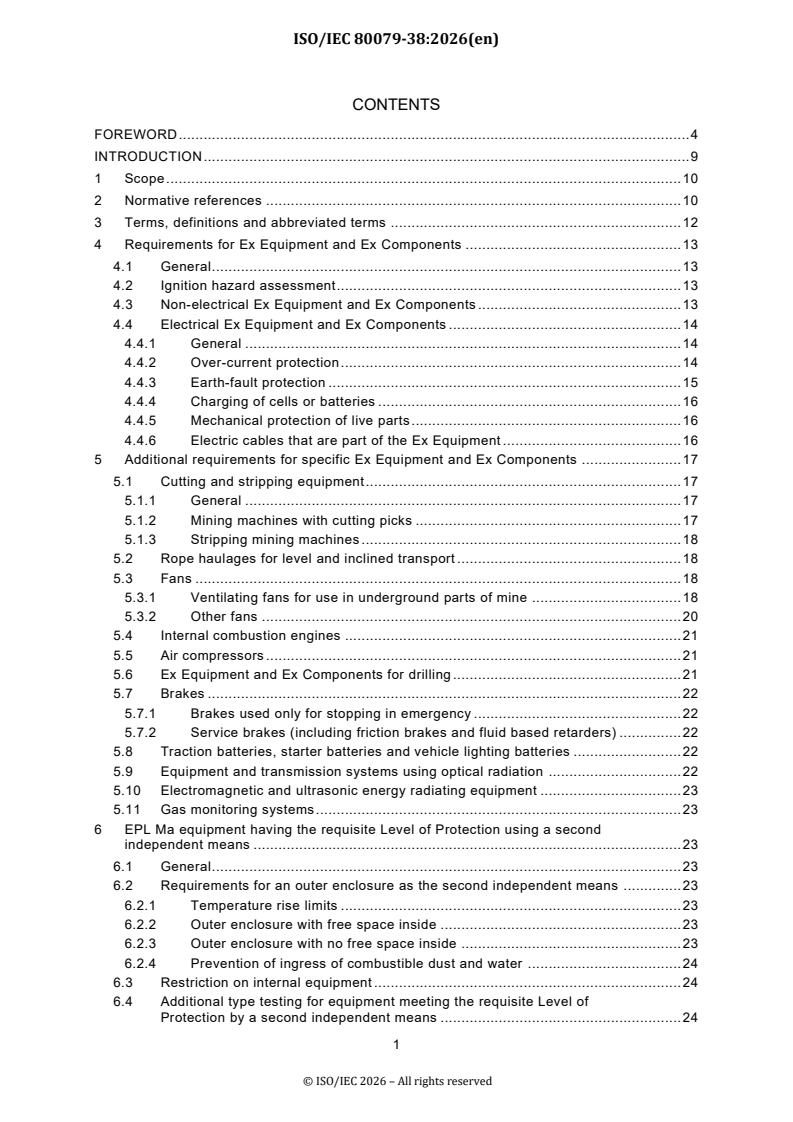
CONTENTS
FOREWORD . 4
INTRODUCTION . 9
1 Scope . 10
2 Normative references . 10
3 Terms, definitions and abbreviated terms . 12
4 Requirements for Ex Equipment and Ex Components . 13
4.1 General . 13
4.2 Ignition hazard assessment. 13
4.3 Non-electrical Ex Equipment and Ex Components . 13
4.4 Electrical Ex Equipment and Ex Components . 14
4.4.1 General . 14
4.4.2 Over-current protection . 14
4.4.3 Earth-fault protection . 15
4.4.4 Charging of cells or batteries . 16
4.4.5 Mechanical protection of live parts . 16
4.4.6 Electric cables that are part of the Ex Equipment . 16
5 Additional requirements for specific Ex Equipment and Ex Components . 17
5.1 Cutting and stripping equipment . 17
5.1.1 General . 17
5.1.2 Mining machines with cutting picks . 17
5.1.3 Stripping mining machines . 18
5.2 Rope haulages for level and inclined transport . 18
5.3 Fans . 18
5.3.1 Ventilating fans for use in underground parts of mine . 18
5.3.2 Other fans . 20
5.4 Internal combustion engines . 21
5.5 Air compressors . 21
5.6 Ex Equipment and Ex Components for drilling . 21
5.7 Brakes . 22
5.7.1 Brakes used only for stopping in emergency . 22
5.7.2 Service brakes (including friction brakes and fluid based retarders) . 22
5.8 Traction batteries, starter batteries and vehicle lighting batteries . 22
5.9 Equipment and transmission systems using optical radiation . 22
5.10 Electromagnetic and ultrasonic energy radiating equipment . 23
5.11 Gas monitoring systems . 23
6 EPL Ma equipment having the requisite Level of Protection using a second
independent means . 23
6.1 General . 23
6.2 Requirements for an outer enclosure as the second independent means . 23
6.2.1 Temperature rise limits . 23
6.2.2 Outer enclosure with free space inside . 23
6.2.3 Outer enclosure with no free space inside . 23
6.2.4 Prevention of ingress of combustible dust and water . 24
6.3 Restriction on internal equipment . 24
6.4 Additional type testing for equipment meeting the requisite Level of
Protection by a second independent means . 24
© ISO/IEC 2026 – All rights reserved
ISO/IEC 80079-38:2026(en)
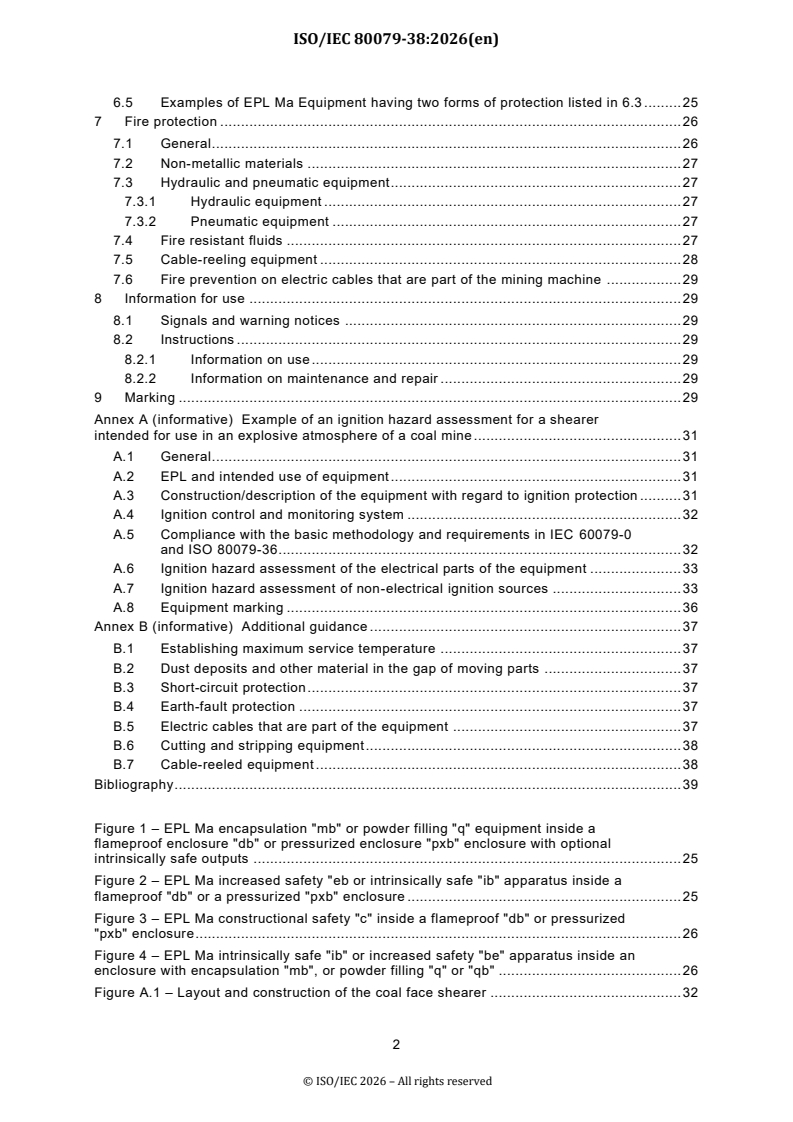
6.5 Examples of EPL Ma Equipment having two forms of protection listed in 6.3 . 25
7 Fire protection . 26
7.1 General . 26
7.2 Non-metallic materials . 27
7.3 Hydraulic and pneumatic equipment. 27
7.3.1 Hydraulic equipment . 27
7.3.2 Pneumatic equipment . 27
7.4 Fire resistant fluids . 27
7.5 Cable-reeling equipment . 28
7.6 Fire prevention on electric cables that are part of the mining machine . 29
8 Information for use . 29
8.1 Signals and warning notices . 29
8.2 Instructions . 29
8.2.1 Information on use . 29
8.2.2 Information on maintenance and repair . 29
9 Marking . 29
Annex A (informative) Example of an ignition hazard assessment for a shearer
intended for use in an explosive atmosphere of a coal mine . 31
A.1 General . 31
A.2 EPL and intended use of equipment . 31
A.3 Construction/description of the equipment with regard to ignition protection . 31
A.4 Ignition control and monitoring system . 32
A.5 Compliance with the basic methodology and requirements in IEC 60079-0
and ISO 80079-36 . 32
A.6 Ignition hazard assessment of the electrical parts of the equipment . 33
A.7 Ignition hazard assessment of non-electrical ignition sources . 33
A.8 Equipment marking . 36
Annex B (informative) Additional guidance . 37
B.1 Establishing maximum service temperature . 37
B.2 Dust deposits and other material in the gap of moving parts . 37
B.3 Short-circuit protection . 37
B.4 Earth-fault protection . 37
B.5 Electric cables that are part of the equipment . 37
B.6 Cutting and stripping equipment . 38
B.7 Cable-reeled equipment . 38
Bibliography . 39
Figure 1 – EPL Ma encapsulation "mb" or powder filling "q" equipment inside a
flameproof enclosure "db" or pressurized enclosure "pxb" enclosure with optional
intrinsically safe outputs . 25
Figure 2 – EPL Ma increased safety "eb or intrinsically safe "ib" apparatus inside a
flameproof "db" or a pressurized "pxb" enclosure . 25
Figure 3 – EPL Ma constructional safety "c" inside a flameproof "db" or pressurized
"pxb" enclosure . 26
Figure 4 – EPL Ma intrinsically safe "ib" or increased safety "be" apparatus inside an
enclosure with encapsulation "mb", or powder filling "q" or "qb" . 26
Figure A.1 – Layout and construction of the coal face shearer . 32
© ISO/IEC 2026 – All rights reserved
ISO/IEC 80079-38:2026(en)
Table 1 – Combination of materials . 20
Table 2 – Limit values for hydraulic fluids . 28
Table A.1 – Example of an ignition hazard assessment for a shearer, EPL Mb (1 of 3) . 33
© ISO/IEC 2026 – All rights reserved
ISO/IEC 80079-38:2026(en)
INTERNATIONAL ELECTROTECHNICAL COMMISSION
____________
Explosive atmospheres -
Part 38: Equipment and components in explosive atmospheres in
underground mines
FOREWORD
1) The International Electrotechnical Commission (IEC) is a worldwide organization for standardization comprising
all national electrotechnical committees (IEC National Committees). The object of IEC is to promote international
co-operation on all questions concerning standardization in the electrical and electronic fields. To this end and
in addition to other activities, IEC publishes International Standards, Technical Specifications, Technical Reports,
Publicly Available Specifications (PAS) and Guides (hereafter referred to as "IEC Publication(s)"). Their
preparation is entrusted to technical committees; any IEC National Committee interested in the subject dealt with
may participate in this preparatory work. International, governmental and non-governmental organizations liaising
with the IEC also participate in this preparation. IEC collaborates closely with the International Organization for
Standardization (ISO) in accordance with conditions determined by agreement between the two organizations.
2) The formal decisions or agreements of IEC on technical matters express, as nearly as possible, an international
consensus of opinion on the relevant subjects since each technical committee has representation from all
interested IEC National Committees.
3) IEC Publications have the form of recommendations for international use and are accepted by IEC National
Committees in that sense. While all reasonable efforts are made to ensure that the technical content of IEC
Publications is accurate, IEC cannot be held responsible for the way in which they are used or for any
misinterpretation by any end user.
4) In order to promote international uniformity, IEC National Committees undertake to apply IEC Publications
transparently to the maximum extent possible in their national and regional publications. Any divergence between
any IEC Publication and the corresponding national or regional publication shall be clearly indicated in the latter.
5) IEC itself does not provide any attestation of conformity. Independent certification bodies provide conformity
assessment services and, in some areas, access to IEC marks of conformity. IEC is not responsible for any
services carried out by independent certification bodies.
6) All users should ensure that they have the latest edition of this publication.
7) No liability shall attach to IEC or its directors, employees, servants or agents including individual experts and
members of its technical committees and IEC National Committees for any personal injury, property damage or
other damage of any nature whatsoever, whether direct or indirect, or for costs (including legal fees) and
expenses arising out of the publication, use of, or reliance upon, this IEC Publication or any other IEC
Publications.
8) Attention is drawn to the Normative references cited in this publication. Use of the referenced publications is
indispensable for the correct application of this publication.
9) IEC and ISO draw attention to the possibility that the implementation of this document may involve the use of (a)
patent(s). IEC and ISO take no position concerning the evidence, validity or applicability of any claimed patent
rights in respect thereof. As of the date of publication of this document, IEC and ISO had not received notice of
patents, which may be required to implement this document. However, implementers are cautioned that this may
not represent the latest information, which may be obtained from the patent database available at
https://patents.iec.ch and www.iso.org/patents. IEC and ISO shall not be held responsible for identifying any or
all such patent rights.
ISO/IEC 80079-38 has been prepared by IEC technical committee 31: Equipment for explosive
atmospheres. It is an International Standard.
It is published as a double logo International Standard.
This second edition cancels and replaces the first edition, published in 2016. This edition
constitutes a technical revision.
Users of this document are advised that interpretation sheets clarifying the interpretation of this
document can be published. Interpretation sheets are available from the IEC webstore and can
be found in the "history" tab of the page for each document.
© ISO/IEC 2026 – All rights reserved
ISO/IEC 80079-38:2026(en)
The significance of changes between ISO/IEC 80079-38:2016 (Edition 1) and
ISO/IEC 80079-38: (Edition 2) is as listed below:
Type
Changes Clause Minor and Extension Major
editorial technical
changes changes
Throughout document where appropriate General X
changed "equipment" and "components" to "Ex
Equipment" and "Ex Components"
Throughout the document "machine" changed General X
to "mining machine"
Throughout the body of the document removed General C1
the use of "should" by, in most cases, moving
the clause to Annex B as guidance
Refences to "standard" changed to "document"
X
where appropriate in accordance with ISO/IEC General
Directives
Throughout the document changed "e.g." to General X
"for example" in accordance with TC 31 Good
Working Practice
Scope changed to cover "construction, testing 1 C2
and marking for use in Group I" from "design,
construction, assessment and information for
use (maintenance, repair, marking)". Hand
tools are no longer covered by the standard
Note added to scope to clarify that Group I 1 X
takes account that coal dust can be present
with or without methane
Note added to scope to clarify that Group I also 1 X
covers mines other than coal mines
Note added to scope to clarify that "assembly" 1 X
is not identical to the meaning in IEC 60079-46
Scope expanded to cover EPL Ma as well as 1 C3
EPL Mb
Scope changed to allow this document to be 1 X
used for guidance on underground applications
where firedamp or coal dust can be present but
which are not Group I mines, for example
tunnels
Former 3.1, 3.7,
Deletion of definitions in IEC 60079-0 X
3.10, 3.14, 3.15
and 3.16
Deletion of definition "protection against Former 3.2 X
firedamp explosions"
Change of definition of "flammable substance" 3.1 X
to align with definition in IEC 60079-10-1.
Deletion of definition "component" and Former 3.4 X
introduction of use of term "Ex Component"
from IEC 60079-0
Deletion of definition of "equipment" and Former 3.5 X
introduction of use of term "Ex Equipment from
IEC 60079-0
Deletion of definition "explosion" Former 3.6 X
Deletion of definition "intended use" Former 3.8 X
Change of definition of "machinery" to "mining 3.2 X
machinery" with added admitted term of
"mining machine"
Deletion of definition "minimum ignition energy" Former 3.11 X
© ISO/IEC 2026 – All rights reserved
ISO/IEC 80079-38:2026(en)
Type
Changes Clause Minor and Extension Major
editorial technical
changes changes
Deletion of definition "potentially explosive Former 3.12 X
atmospheres"
Deletion of definition "self-ignition of dust in Former 3.13 X
bulk"
Deletion of definition of mechanical sparks Former 3.19 X
Deletion of definition of incendive sparks Former 3.20 X
Introduction of definition of "safety device"
3.5 X
from IEC TS 60079-42
Introduction of requirements regarding Specific 4.1 X
Conditions of Use
Rewording of requirements for ignition hazard 4.2 X
assessment including reference to
ISO 80079-36
Revision of requirements regarding insulation
4.4.3 X
faults to provide two options.
Introduction of requirements for temperature 4.4.6.1 X
rating of cables
Rewording of requirements for ventilating fans 5.3.1 X
Reference to standard for internal combustion 5.4 X
engines – ISO/IEC 80079-41
Reference to requirements in IEC 60079-0 for 5.8 X
traction batteries, starter batteries and vehicle
lighting batteries
Additional requirement for batteries not 5.8 X
complying with IEC 60079-11 Ex ia Ma to
comply with IEC 60079-33 Ex sa Ma
Optical radiation requirements in standard 5.9 X
replaced with requirement to comply with
IEC 60079-28
Electromagnetic and ultrasonic energy 5.10 X
radiating equipment requirements in standard
replaced with requirement to comply with
IEC 60079-0
Gas monitoring now refers to IEC 60079-29-0 5.11 C4
and does not include any other requirements.
Note added to state that gas detector can be 5.11 X
required on mobile mining machines
New clause "EPL Ma equipment having the 6 C5
requisite Level of Protection using a second
independent means" has been added
Subclause headings added for General and 7.3 X C6
Fire resistant fluids and clause reorganised to
separate requirements for hydraulic and
pneumatic equipment. Compliance with
ISO 4413 and ISO 4413 introduced
Requirements for conveyor belting deleted Former 6.7 C7
Marking requirements revised including for EPL 9 C8
Ma and EPL Mb situations
Example of an ignition hazard assessment for Former Annex A C9
a conveyor belt intended for use in a coal mine
deleted as conveyor belts are no longer part of
the standard
Deletion of Annex on ignition sources as Former Annex C C10
information is in ISO 80079-36
© ISO/IEC 2026 – All rights reserved
ISO/IEC 80079-38:2026(en)
Type
Changes Clause Minor and Extension Major
editorial technical
changes changes
Deletion of Annex on Guidance on potential Former Annex D C11
risks for converter-fed motors
Tests for surface protective coating for Group I Former Annex E C12
hand tools of EPL Mb deleted as hand tools
are not part of this edition
Inclusion of informative guidance material, Annex B C13
most of which was formerly in body of standard
NOTE The technical changes referred to include the significance of technical changes in the revised IEC Standard,
but they do not form an exhaustive list of all modifications from the previous version. More guidance can be found
by referring to the Redline Version of the standard.
Explanations:
a) Definitions
Minor and editorial changes clarification
decrease of technical requirements
minor technical change
editorial corrections
These are changes which modify requirements in an editorial or a minor technical way. They
include changes of the wording to clarify technical requirements without any technical
change, or a reduction in level of existing requirement.
Extension addition of technical options
These are changes which add new or modify existing technical requirements, in a way that
new options are given, but without increasing requirements for equipment that was fully
compliant with the previous standard. Therefore, these will not have to be considered for
products in conformity with the preceding edition.
Major technical changes addition of technical requirements
increase of technical requirements
These are changes to technical requirements (addition, increase of the level or removal)
made in a way that a product in conformity with the preceding edition will not always be able
to fulfil the requirements given in the later edition. These changes have to be considered
for products in conformity with the preceding edition.
NOTE These changes represent current technological knowledge. However, these changes should not normally
have an influence on equipment already placed on the market.
b) Information about the background of changes
C1 The body of the document has been changed to only mandatory text to make it
more suitable to use for conformity assessment.
C2 The scope was made clearer for the application and to remove hand tools from
the scope.
C3 The scope was expanded to include EPL Ma equipment as well as EPL Mb
equipment.
C4 The relevant standard for gas monitoring has changed from IEC 60079-29 to
IEC 60079-29-0 and hence the latest standard is referenced.
C5 The new section now provides requirements relevant to EPL Ma.
C6 Reference to compliance with ISO 4413 and ISO 4414 introduces additional
requirements for hydraulic and pneumatic equipment.
© ISO/IEC 2026 – All rights reserved
ISO/IEC 80079-38:2026(en)
C7 Conveyor belts are no longer part of the scope and so requirements were
deleted.
C8 Marking updated to address both EPL Ma and EPL Mb with the introduction of
EPL Ma in the scope.
C9 See C6 regarding conveyor belts and hence example no longer relevant.
C10 The information on ignition sources is available in ISO 80079-36 and so there is
no need to duplicate the information here.
C11 There is no calling clause to this annex and the information is of a general nature
not specific to mines
C12 With hand tools now longer in the scope, this test is no longer needed.
C13 Most of the guidance material from the body of the previous edition of the
standard is now in this annex.
The text of this International Standard is based on the following documents:
Draft Report on voting
31M/XX/FDIS 31M/XX/RVD
Full information on the voting for its approval can be found in the report on voting indicated in
the above table.
The language used for the development of this International Standard is English.
This document was drafted in accordance with ISO/IEC Directives, Part 2, and developed in
accordance with ISO/IEC Directives, Part 1 and ISO/IEC Directives, IEC Supplement, available
at www.iec.ch/members_experts/refdocs. The main document types developed by IEC are
described in greater detail at www.iec.ch/publications.
A list of all parts of the IEC 60079 series, under the general title Explosive atmospheres, as
well as the ISO/IEC 80079 series, can be found on the IEC website.
The committee has decided that the contents of this document will remain unchanged until the
stability date indicated on the IEC website under webstore.iec.ch in the data related to the
specific document. At this date, the document will be
– reconfirmed,
– withdrawn, or
– revised.
© ISO/IEC 2026 – All rights reserved
ISO/IEC 80079-38:2026(en)
INTRODUCTION
This part of ISO/IEC 80079 specifies requirements for the constructional features of Ex
Equipment and Ex Components that can be an individual item or form an assembly, to enable
them to be used in mines, or parts of mines, susceptible to explosive atmospheres of firedamp,
combustible dust or a combination of the two.
Most of the Ex Equipment used on mining machinery complies with the Type of Protection
standards as an individual item of equipment, for example motors and switchgear, and they
have their own marking requirements. The Type of Protection standards, however, do not deal
with the interconnection of Ex Equipment and Ex Components.
Both non-electrical Ex Equipment and the interconnection of electrical/non-electrical Ex
Equipment can require an ignition hazard assessment.
The need for this document arises because of major operational differences between
underground mining operations and those in other industries working with, or in, explosive
atmospheres. Examples of these differences are:
– firedamp can be released during the extraction of coal or other mining where firedamp is
trapped;
– the ignitability of the atmosphere around Ex Equipment and Ex Components usually
depends upon the amount of dilution offered by an active ventilating system;
– the atmosphere in the general body of mine air in which machinery is working can change
from one that is not explosive to one that is explosive (for example, during an outburst of
firedamp) and, depending on the likelihood, this can impact on the EPL required (Ma versus
Mb);
– persons working in the mine can be situated in an explosive atmosphere if there is an
increase in the concentration of firedamp; there is a need to monitor constantly the mine
atmosphere at strategic places to ensure that power can be disconnected from all Ex
Equipment except EPL Ma Ex Equipment which is suitable for use in a constantly present
explosive atmosphere;
– in gassy coal mines, an initial explosion of firedamp can raise combustible dust clouds that
when ignited commonly provide a significantly more serious explosion;
– some mining machinery contains cutting devices and drilling devices that can produce an
ignition risk from sparks generated from contact with strata containing high concentrations
of quartz or iron pyrites; and
– long roadways in coal mines are equipped with mineral conveying systems carrying a
product that has a potential for raising a combustible dust cloud and the release of firedamp.
© ISO/IEC 2026 – All rights reserved
ISO/IEC 80079-38:2026(en)
1 Scope
This part of ISO/IEC 80079 is applicable for the explosion protection requirements for the
construction, testing and marking for Group I Ex Equipment that can be an individual item, or
be an assembly of multiple items of Ex Equipment and Ex Components forming mining
machinery.
NOTE 1 The Group I designation takes account of the fact coal dust (which is a combustible dust) is expected to
be present, with or without the presence of firedamp, which is predominately methane.
NOTE 2 The definition of Group I also covers mines other than coal mines that are susceptible to firedamp.
NOTE 3 The term "assembly" as used in this document is not identical in meaning to the term "Equipment Assembly"
as defined in IEC 60079-46.
The standard atmospheric conditions (relating to the explosion characteristics of the
atmosphere) under which it can be assumed that Ex Equipment can be operated are:
– temperature −20 °C to +60 °C;
– pressure 80 kPa (0,8 bar) to 110 kPa (1,1 bar); and
– air with normal oxygen content, typically a volume fraction of 21 %.
This part of ISO/IEC 80079 applies for Ex Equipment and Ex Components with Explosion
Protection Levels (EPLs) Ma and Mb.
This document supplements and modifies the general requirements of IEC 60079-0. Where a
requirement of this document conflicts with a requirement of IEC 60079-0, the requirement of
this document takes precedence.
This document can be used for guidance on underground applications where firedamp or coal
dust can be present, but which are not Group I mines, for example tunnels.
2 Normative references
The following documents are referred to in the text in such a way that some or all of their content
constitutes requirements of this document. For dated references, only the edition cited applies.
For undated references, the latest edition of the referenced document (including any
amendments) applies.
IEC 60079-0, Explosive atmospheres - Part 0: Equipment - General requirements
IEC 60079-5, Explosive atmospheres - Part 5: Equipment protection by powder filling "q"
IEC 60079-7, Explosive atmospheres - Part 7: Equipment protection by increased safety "e"
IEC 60079-11, Explosive atmospheres - Part 11: Equipment protection by intrinsic safety "i"
IEC 60079-18, Explosive atmospheres - Part 18: Equipment protection by encapsulation "m"
IEC 60079-25, Explosive atmospheres - Part 25: Intrinsically safe electrical systems
IEC 60079-28, Explosive atmospheres - Part 28: Protection of equipment and transmission
systems using optical radiation
IEC 60079-29-0, Explosive atmospheres - Part 29-0: Gas detectors - General requirements and
test methods
© ISO/IEC 2026 – All rights reserved
ISO/IEC 80079-38:2026(en)
IEC 60079-33, Explosive atmospheres - Part 33: Equipment protection by special protection 's'
IEC 60204-1, Safety of machinery - Electrical equipment of machines - Part 1: General
requirements
IEC 60204-11, Safety of machinery - Electrical equipment of machines - Part 11: Requirements
for equipment for voltages above 1 000 V AC or 1 500 V DC and not exceeding 36 kV
IEC 60332-1 (all parts), Tests on electric and optical fibre cables under fire conditions
IEC 60529, Degrees of protection provided by enclosures (IP Code)
ISO 340, Conveyor belts - Laboratory scale flammability characteristics - Requirements and
test method
ISO 630-5, Structural steels - Part 5: Technical delivery conditions for structural steels with
improved atmospheric corrosion resistance
ISO 1940-1, Mechanical vibration - Balance quality requirements for rotors in a constant (rigid)
state - Part 1: Specification and verification of balance tolerances
ISO 4413, Hydraulic Fluid Power
ISO 4414, Pneumatic Fluid Power
ISO 6805, Rubber hoses for mining
ISO 7010, Graphical symbols - Safety colours and safety signs - Registered safety signs
ISO 14935, Petroleum and related products - Determination of wick flame persistence of fire-
resistant fluids
ISO 15029-1, Petroleum and related products - Determination of spray ignition characteristics
of fire-resistant fluids - Part 1: Spray flame persistence - Hollow-cone nozzle method
ISO 15029-2, Petroleum and related products - Determination of spray ignition characteristics
of fire-resistant fluids - Part 2: Spray test - Stabilized flame heat release method
ISO 80079-36:2016, Explosive atmospheres - Part 36: Non-electrical equipment for explosive
atmospheres - Basic method and requirements
ISO 80079-37:2016, Explosive atmospheres - Part 37: Non-electrical equipment for explosive
atmospheres - Non-electrical type of protection constructional safety "c", control of ignition
sources "b", liquid immersion "k"
ISO/IEC 80079-41, Explosive atmospheres - Part 41: Reciprocating internal combustion
engines
© ISO/IEC 2026 – All rights reserved
ISO/IEC 80079-38:2026(en)
3 Terms, definitions and abbreviated terms
For the purposes of this document, the terms and definitions given in IEC 60079-0 and the
following apply.
ISO and IEC maintain terminology databases for use in standardization at the following
addresses:
– IEC Electropedia: available at https://www.electropedia.org/
– ISO Online browsing platform: available at https://www.iso.org/obp/ui
NOTE Additional definitions applicable to explosive atmospheres can be found in the International Electrotechnical
Vocabulary (IEV) IEC 60050-426.
3.1
flammable substance
substance which is itself flammable, or is capable of producing a flammable gas, vapour or mist
[SOURCE: IEC 60079-10-1:2020, 3.6.1]
3.2
mining machinery
mining machine
assembly, fitted with or intended to be fitted with a drive system consisting of linked parts or
components, at least one of which moves, and which are joined together for use in mines
Note 1 to entry: The term "machinery" also covers an assembly of machines which, in order to achieve the same
end, are arranged and controlled so that they function as an integral whole.
3.3
non-electrical equipment
equipment which can achieve its intended function mechanically
Note 1 to entry: Equipment addressed in ISO 80079-36 can be powered by any kind of energy including electrical
equipment.
[SOURCE: ISO 80079-36:2016, 3.7]
3.4
hydraulic fluid
any fluid and its concentrate for hydraulic transmission and monitoring with exception of water
3.5
safety device
device intended for use inside or outside explosive atmospheres but required for or contributing
to the safe functioning of Ex Equipment and protective systems with respect to the risks of
explosion
Note 1 to entry: Safety devices differ from the term devices used in the IEC 61508 and IEC 61511 series. Safety
devices can be compared to the terms like "safety-related system (IEC 61508)" or "safety instrumented system
(IEC 61511)".
[SOURCE: IEC TS 60079-42:2019, 3.1]
© ISO/IEC 2026 – All rights reserved
ISO/IEC 80079-38:2026(en)
4 Requirements for Ex Equipment and Ex Components
4.1 General
Ex Equipment and Ex Components shall conform with the applicable requirements for EPL Ma
or Mb according to the IEC 60079 series for electrical equipment and according to the
ISO/IEC 80079 series for non-electrical equipment, for Group I. The requirement for conformity
with EPL Ma or EPL Mb will depend on the intended application.
When Ex Equipment or Ex Components are installed on a mining machine, the Specific
Conditions of Use or the Schedule of Limitations specified in the certificates shall be complied
with as part of the assembly or the mining machine certificate number shall include the "X"
suffix in accordance with the marking requirements of IEC 60079-0 and the remaining Specific
Conditions of Use shall be listed on that certificate.
NOTE Typical conditions for Specific Conditions of Use can, for example, include the minimum flow of cooling water,
temperature protection settings or duty cycle (short time rating).
Guidance relevant to achieving the above requirements is provided in Annex B, in addition to the requirements in the
body of this document.
4.2 Ignition hazard assessment
An assessment of the ignition hazards associated with mining machinery shall be performed
using the methodology in ISO 80079-36.
The documentation shall address the ignition hazards as follows:
a) ignition hazards directly related to the mining machinery, and how they were mitigated in
the equipment assembly; and
b) ignition hazards directly related to the mining machinery, not mitigated in the equipment
assembly, but able to be mitigated in the end-user site installation.
For ignition hazards that are not mitigated in the mining machinery, but that are able to be
mitigated in the end-user site installation, the mining machinery certificate number shall include
the "X" suffix in accordance with the marking requirements of IEC 60079-0 and the Specific
Conditions of Use shall be listed on the certificate and the documentation shall provide guidance
on satisfying those Specific Conditions of Use.
Ignition hazards for each item of Ex Equipment are addressed by the Ex Equipment certificates
and therefore need not be reassessed.
Compliance with this document will require verification that the ignition hazard assessment has
been carried out and documented, along with any control measures and residual hazards as
detailed above.
NOTE Typically the above verification would be done as part of a certification process.
An example of an ignition hazard assessment for a shearer intended for use in an explosive
atmosphere of a coal mine is provided in Annex A.
4.3 Non-electrical Ex Equipment and Ex Components
All non-electrical Ex Equipment and Ex Components (including parts used within the mining
machine in order to connect them), shall comply with the requirements of ISO 80079-36 and,
where necessary, one of the other Types of Protection listed in that document, except where
specific requirements exist in this document, for example the fitting of water spray ignition
protection to cutting picks.
© ISO/IEC 2026 – All rights reserved
ISO/IEC 80079-38:2026(en)
NOTE 1 ISO 80079-36 addresses ignition protection of non-electrical Ex Equipment and Ex Components intended
for use in both explosive gas atmospheres and explosive dust atmospheres.
NOTE 2 Types of ignition protection for non-electrical Ex Equipment are given in ISO 80079-37.
4.4 Electrical Ex Equipment and Ex Components
4.4.1 General
All electrical Ex Equipment and Ex Components shall comply with the requirements of
IEC 60079-0 and at least one of the Types of Protection listed in that document related to
Group I.
NOTE 1 IEC 60079-0 deals with the ignition protection of equipment and components intended for use in explosive
gas atmospheres and explosive dust atmospheres. For gassy mines, equipment tested in an explosive gas
atmosphere and protected against igniting firedamp is also adequately protected against ignition of an explosive coal
dust cloud.
NOTE 2 Examples of Type of Protection documents particularly relevant to mining are:
– IEC 60079-1 (Flameproof enclosure "d");
– IEC 60079-7 (Increased safety "e");
– IEC 60079-11 (Intrinsic safety "i");
– IEC 60079-18 (Encapsulation "m").
NOTE 3 The requirements of this document are in addition to the applicable electrical safety requirements of the
relevant industrial standards. The relevant electrical safety standards typically include IEC 60204-1 and
IEC 60204-11. It is not a requirement of this document that compliance with the relevant industrial standards be
verified.
Where protective measures depend on devices external to the mining machine, the
manufacturer shall specify these in the instructions. For the purposes of this document, the
requirements below commence at the point where the electrical supply is connected to the
mining machine (terminals, plug and socket).
NOTE 4 All terms used to describe electrical devices are as defined in IEC 60050-441.
4.4.2 Over-current protection
4.4.2.1 Overload protection
For the protection of motors and their supply cables against overloading, the requirements of
IEC 60204-1 and IEC 60204-11 shall apply.
NOTE 1 In general, overload causes overheating.
NOTE 2 The objective of the overload protection is to prevent damage to electrical parts by excessive temperature.
The overload protection contributes to reducing the risk of surface temperatures exceeding those specified in
IEC 60079-0. Additionally, possible overloads or temperature rises can be caused by:
– high starting frequency; and
– starting under load.
Protection of motors against overload shall be achieved by the use of fuses, directly-operating
trip relays, current- transformer-operated trip relays or thermal trip devices, or a combination of
these.
© ISO/IEC 2026 – All rights reserved
ISO/IEC 80079-38:2026(en)
Overload protection shall not be provided if:
a) a hazard is caused by its operation, for example the prevention of high voltages on
secondary windings of current transformers, or tripping of exciter windings in generators or
synchronous motors, or electrical braking circuits; and
b) its exclusion is in accordance with the certificate according to IEC 60079–0.
Overload protection devices shall be installed at the beginning of each circuit and at positions
where the current-carrying capacity of a conductor is reduced.
4.4.2.2 Short-circuit protection
Short-circuit protection shall be provided to protect in the event of a short-circuit occurring in
any part of a non-intrinsically safe circuit becoming overheated and creating an ignition
hazard.
Facilities to avoid resetting by unauthorized persons shall be provided.
All external cables installed on a mining machine shall be provided with short-circuit protection
that will adequately protect the smallest cross section area cable that it is protecting
...
PROJET FINAL
Norme
internationale
ISO/IEC
FDIS
80079-38
ISO/TMBG
Atmosphères explosives —
Secrétariat: ISO
Partie 38:
Début de vote:
2026-06-05
Appareils et composants destinés
à être utilisés dans les mines
Vote clos le:
2026-07-31
souterraines grisouteuses
Explosive atmospheres —
Part 38: Equipment and components in explosive atmospheres in
underground mines
LES DESTINATAIRES DU PRÉSENT PROJET SONT
INVITÉS À PRÉSENTER, AVEC LEURS OBSERVATIONS,
NOTIFICATION DES DROITS DE PROPRIÉTÉ DONT ILS
AURAIENT ÉVENTUELLEMENT CONNAISSANCE ET À
FOURNIR UNE DOCUMENTATION EXPLICATIVE.
Ce projet est soumis à un vote parallèle à ISO et à IEC.
OUTRE LE FAIT D’ÊTRE EXAMINÉS POUR
ÉTABLIR S’ILS SONT ACCEPTABLES À DES FINS
INDUSTRIELLES, TECHNOLOGIQUES ET COM-MERCIALES,
AINSI QUE DU POINT DE VUE DES UTILISATEURS, LES
PROJETS DE NORMES
TRAITEMENT PARALLÈLE ISO/CEN
INTERNATIONALES DOIVENT PARFOIS ÊTRE CONSIDÉRÉS
DU POINT DE VUE DE LEUR POSSI BILITÉ DE DEVENIR DES
NORMES POUVANT
SERVIR DE RÉFÉRENCE DANS LA RÉGLEMENTATION
NATIONALE.
Numéro de référence
PROJET FINAL
Norme
internationale
ISO/IEC
FDIS
80079-38
ISO/TMBG
Atmosphères explosives —
Secrétariat: ISO
Partie 38:
Début de vote:
Appareils et composants destinés 2026-06-05
à être utilisés dans les mines
Vote clos le:
2026-07-31
souterraines grisouteuses
Explosive atmospheres —
Part 38: Equipment and components in explosive atmospheres in
underground mines
LES DESTINATAIRES DU PRÉSENT PROJET SONT
INVITÉS À PRÉSENTER, AVEC LEURS OBSERVATIONS,
NOTIFICATION DES DROITS DE PROPRIÉTÉ DONT ILS
AURAIENT ÉVENTUELLEMENT CONNAISSANCE ET À
FOURNIR UNE DOCUMENTATION EXPLICATIVE.
Ce projet est soumis à un vote parallèle à ISO et à IEC.
DOCUMENT PROTÉGÉ PAR COPYRIGHT
OUTRE LE FAIT D’ÊTRE EXAMINÉS POUR
ÉTABLIR S’ILS SONT ACCEPTABLES À DES FINS
© ISO/IEC 2026
INDUSTRIELLES, TECHNOLOGIQUES ET COM-MERCIALES,
AINSI QUE DU POINT DE VUE DES UTILISATEURS, LES
Tous droits réservés. Sauf prescription différente ou nécessité dans le contexte de sa mise en œuvre, aucune partie de cette
PROJETS DE NORMES
publication ne peut être reproduite ni utilisée sous quelque forme que ce soit et par aucun procédé, électronique ou mécanique, TRAITEMENT PARALLÈLE ISO/CEN
INTERNATIONALES DOIVENT PARFOIS ÊTRE CONSIDÉRÉS
y compris la photocopie, ou la diffusion sur l’internet ou sur un intranet, sans autorisation écrite préalable. Une autorisation peut DU POINT DE VUE DE LEUR POSSI BILITÉ DE DEVENIR DES
NORMES POUVANT
être demandée à l’ISO à l’adresse ci-après ou au comité membre de l’ISO dans le pays du demandeur.
SERVIR DE RÉFÉRENCE DANS LA RÉGLEMENTATION
NATIONALE.
ISO copyright office
Case postale 401 • Ch. de Blandonnet 8
CH-1214 Vernier, Genève
Tél.: +41 22 749 01 11
E-mail: copyright@iso.org
Web: www.iso.org
Publié en Suisse
Numéro de référence
© ISO/IEC 2026 – Tous droits réservés
ii
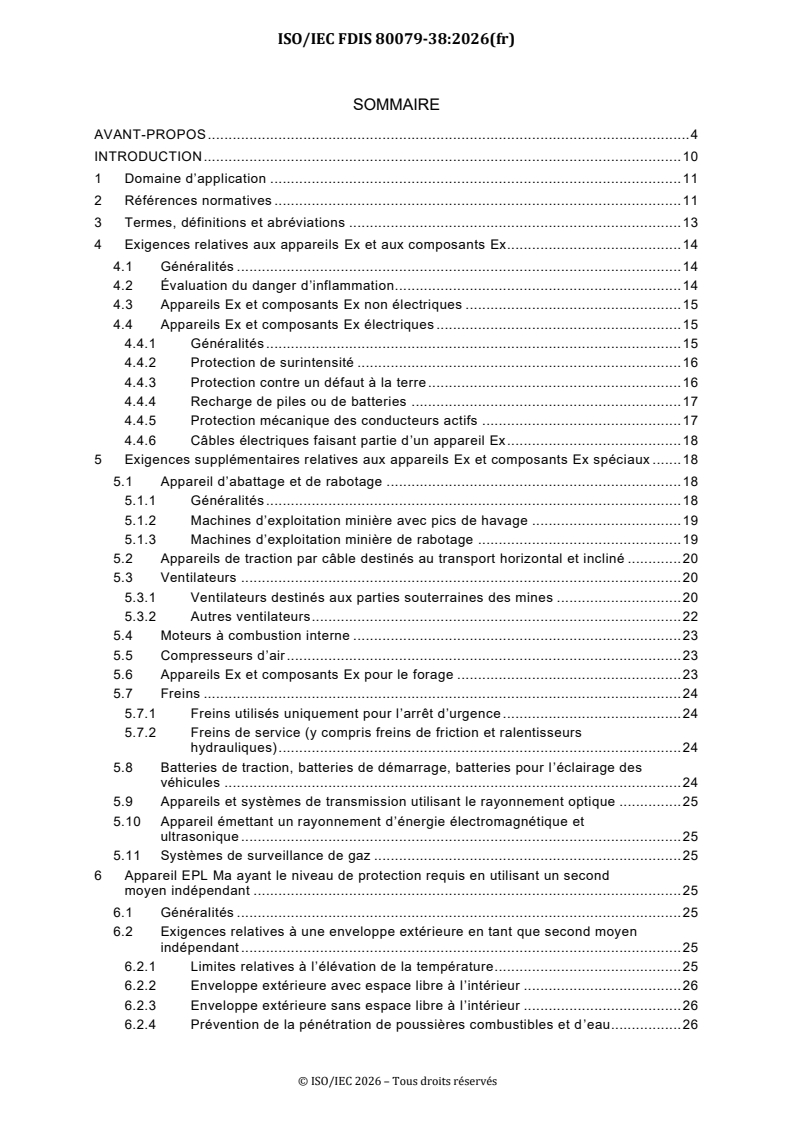
SOMMAIRE
AVANT-PROPOS . 4
INTRODUCTION . 10
1 Domaine d’application . 11
2 Références normatives . 11
3 Termes, définitions et abréviations . 13
4 Exigences relatives aux appareils Ex et aux composants Ex . 14
4.1 Généralités . 14
4.2 Évaluation du danger d’inflammation. 14
4.3 Appareils Ex et composants Ex non électriques . 15
4.4 Appareils Ex et composants Ex électriques . 15
4.4.1 Généralités . 15
4.4.2 Protection de surintensité . 16
4.4.3 Protection contre un défaut à la terre . 16
4.4.4 Recharge de piles ou de batteries . 17
4.4.5 Protection mécanique des conducteurs actifs . 17
4.4.6 Câbles électriques faisant partie d’un appareil Ex . 18
5 Exigences supplémentaires relatives aux appareils Ex et composants Ex spéciaux . 18
5.1 Appareil d’abattage et de rabotage . 18
5.1.1 Généralités . 18
5.1.2 Machines d’exploitation minière avec pics de havage . 19
5.1.3 Machines d’exploitation minière de rabotage . 19
5.2 Appareils de traction par câble destinés au transport horizontal et incliné . 20
5.3 Ventilateurs . 20
5.3.1 Ventilateurs destinés aux parties souterraines des mines . 20
5.3.2 Autres ventilateurs . 22
5.4 Moteurs à combustion interne . 23
5.5 Compresseurs d’air . 23
5.6 Appareils Ex et composants Ex pour le forage . 23
5.7 Freins . 24
5.7.1 Freins utilisés uniquement pour l’arrêt d’urgence . 24
5.7.2 Freins de service (y compris freins de friction et ralentisseurs
hydrauliques) . 24
5.8 Batteries de traction, batteries de démarrage, batteries pour l’éclairage des
véhicules . 24
5.9 Appareils et systèmes de transmission utilisant le rayonnement optique . 25
5.10 Appareil émettant un rayonnement d’énergie électromagnétique et
ultrasonique . 25
5.11 Systèmes de surveillance de gaz . 25
6 Appareil EPL Ma ayant le niveau de protection requis en utilisant un second
moyen indépendant . 25
6.1 Généralités . 25
6.2 Exigences relatives à une enveloppe extérieure en tant que second moyen
indépendant . 25
6.2.1 Limites relatives à l’élévation de la température. 25
6.2.2 Enveloppe extérieure avec espace libre à l’intérieur . 26
6.2.3 Enveloppe extérieure sans espace libre à l’intérieur . 26
6.2.4 Prévention de la pénétration de poussières combustibles et d’eau . 26
© ISO/IEC 2026 – Tous droits réservés
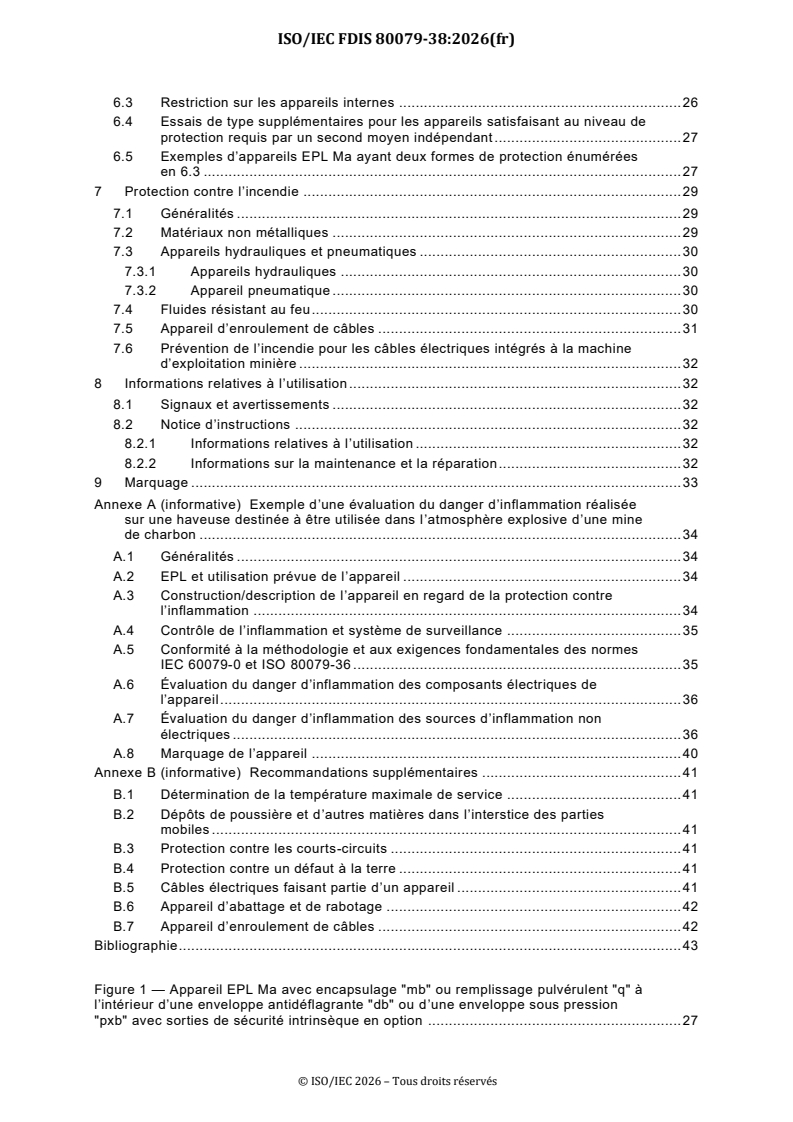
6.3 Restriction sur les appareils internes . 26
6.4 Essais de type supplémentaires pour les appareils satisfaisant au niveau de
protection requis par un second moyen indépendant . 27
6.5 Exemples d’appareils EPL Ma ayant deux formes de protection énumérées
en 6.3 . 27
7 Protection contre l’incendie . 29
7.1 Généralités . 29
7.2 Matériaux non métalliques . 29
7.3 Appareils hydrauliques et pneumatiques . 30
7.3.1 Appareils hydrauliques . 30
7.3.2 Appareil pneumatique . 30
7.4 Fluides résistant au feu . 30
7.5 Appareil d’enroulement de câbles . 31
7.6 Prévention de l’incendie pour les câbles électriques intégrés à la machine
d’exploitation minière . 32
8 Informations relatives à l’utilisation . 32
8.1 Signaux et avertissements . 32
8.2 Notice d’instructions . 32
8.2.1 Informations relatives à l’utilisation . 32
8.2.2 Informations sur la maintenance et la réparation . 32
9 Marquage . 33
Annexe A (informative) Exemple d’une évaluation du danger d’inflammation réalisée
sur une haveuse destinée à être utilisée dans l’atmosphère explosive d’une mine
de charbon . 34
A.1 Généralités . 34
A.2 EPL et utilisation prévue de l’appareil . 34
A.3 Construction/description de l’appareil en regard de la protection contre
l’inflammation . 34
A.4 Contrôle de l’inflammation et système de surveillance . 35
A.5 Conformité à la méthodologie et aux exigences fondamentales des normes
IEC 60079-0 et ISO 80079-36 . 35
A.6 Évaluation du danger d’inflammation des composants électriques de
l’appareil . 36
A.7 Évaluation du danger d’inflammation des sources d’inflammation non
électriques . 36
A.8 Marquage de l’appareil . 40
Annexe B (informative) Recommandations supplémentaires . 41
B.1 Détermination de la température maximale de service . 41
B.2 Dépôts de poussière et d’autres matières dans l’interstice des parties
mobiles . 41
B.3 Protection contre les courts-circuits . 41
B.4 Protection contre un défaut à la terre . 41
B.5 Câbles électriques faisant partie d’un appareil . 41
B.6 Appareil d’abattage et de rabotage . 42
B.7 Appareil d’enroulement de câbles . 42
Bibliographie . 43
Figure 1 — Appareil EPL Ma avec encapsulage "mb" ou remplissage pulvérulent "q" à
l’intérieur d’une enveloppe antidéflagrante "db" ou d’une enveloppe sous pression
"pxb" avec sorties de sécurité intrinsèque en option . 27
© ISO/IEC 2026 – Tous droits réservés
Figure 2 — Appareil EPL Ma à sécurité augmentée "eb" ou à sécurité intrinsèque "ib" à
l’intérieur d’une enveloppe antidéflagrante "db" ou d’une enveloppe sous pression
"pxb" . 28
Figure 3 – Sécurité de construction "c" d’EPL Ma" à l’intérieur d’une enveloppe
antidéflagrante "db" ou d’une enveloppe sous pression "pxb" . 28
Figure 4 — Appareil EPL Ma à sécurité intrinsèque "ib" ou à sécurité augmentée "eb" à
l’intérieur d’une enveloppe avec encapsulage "mb" ou remplissage pulvérulent "q" ou
"qb" 29
Figure A.1 — Agencement et construction de la haveuse à charbon . 35
Tableau 1 — Combinaisons de matériaux . 22
Tableau 2 — Valeurs limites applicables aux fluides hydrauliques . 31
Tableau A.1 — Exemple d’évaluation du danger d’inflammation pour une haveuse
relevant de l’EPL Mb (1 sur 3) . 36
© ISO/IEC 2026 – Tous droits réservés
COMMISSION ÉLECTROTECHNIQUE INTERNATIONALE
____________
Atmosphères explosives —
Partie 38: Appareils et composants destinés à être utilisés dans les mines
souterraines grisouteuses
AVANT-PROPOS
1) La Commission Électrotechnique Internationale (IEC) est une organisation mondiale de normalisation composée
de l’ensemble des comités électrotechniques nationaux (Comités nationaux de l’IEC). L’IEC a pour objet de
favoriser la coopération internationale pour toutes les questions de normalisation dans les domaines de
l’électricité et de l’électronique. À cet effet, l’IEC – entre autres activités – publie des Normes internationales,
des Spécifications techniques, des Rapports techniques, des Spécifications accessibles au public (PAS) et des
Guides (ci-après dénommés "Publication(s) de l’IEC"). Leur élaboration est confiée à des comités d’études, aux
travaux desquels tout Comité national intéressé par le sujet traité peut participer. Les organisations
internationales, gouvernementales et non gouvernementales, en liaison avec l’IEC, participent également aux
travaux. L’IEC collabore étroitement avec l’Organisation Internationale de Normalisation (ISO), selon des
conditions fixées par accord entre les deux organisations.
2) Les décisions ou accords officiels de l’IEC concernant les questions techniques représentent, dans la mesure du
possible, un accord international sur les sujets étudiés, étant donné que les Comités nationaux de l ’IEC intéressés
sont représentés dans chaque comité d’études.
3) Les Publications de l’IEC se présentent sous la forme de recommandations internationales et sont agréées
comme telles par les Comités nationaux de l’IEC. Tous les efforts raisonnables sont entrepris afin que l’IEC
s’assure de l’exactitude du contenu technique de ses publications; l’IEC ne peut pas être tenue responsable de
l’éventuelle mauvaise utilisation ou interprétation qui en est faite par un quelconque utilisateur final.
4) Dans le but d’encourager l’uniformité internationale, les Comités nationaux de l’IEC s’engagent, dans toute la
mesure possible, à appliquer de façon transparente les Publications de l’IEC dans leurs publications nationales
et régionales. Toutes divergences entre toutes Publications de l’IEC et toutes publications nationales ou
régionales correspondantes doivent être indiquées en termes clairs dans ces dernières.
5) L’IEC elle-même ne fournit aucune attestation de conformité. Des organismes de certification indépendants
fournissent des services d’évaluation de conformité et, dans certains secteurs, accèdent aux marques de
conformité de l’IEC. L’IEC n’est responsable d’aucun des services effectués par les organismes de certification
indépendants.
6) Tous les utilisateurs doivent s’assurer qu’ils sont en possession de la dernière édition de cette publication.
7) Aucune responsabilité ne doit être imputée à l’IEC, à ses administrateurs, employés, auxiliaires ou mandataires,
y compris ses experts particuliers et les membres de ses comités d’études et des Comités nationaux de l’IEC,
pour tout préjudice causé en cas de dommages corporels et matériels, ou de tout autre dommage de quelque
nature que ce soit, directe ou indirecte, ou pour supporter les coûts (y compris les frais de justice) et les dépenses
découlant de la publication ou de l’utilisation de cette Publication de l’IEC ou de toute autre Publication de l’IEC,
ou au crédit qui lui est accordé.
8) L’attention est attirée sur les références normatives citées dans cette publication. L’utilisation de publications
référencées est obligatoire pour une application correcte de la présente publication.
9) L’IEC et l’ISO attirent l’attention sur le fait que la mise en application du présent document peut entraîner
l’utilisation d’un ou de plusieurs brevets. L’IEC et l’ISO ne prennent pas position quant à la preuve, à la validité
et à l’applicabilité de tout droit de propriété revendiqué à cet égard. À la date de publication du présent document,
l’IEC et l’ISO n’avaient pas reçu notification qu’un ou plusieurs brevets pouvaient être nécessaires à sa mise en
application. Toutefois, il y a lieu d’avertir les responsables de la mise en application du présent document que
des informations plus récentes sont susceptibles de figurer dans la base de données de brevets, disponible à
l’adresse https://patents.iec.ch et www.iso.org/brevets. L’IEC et l’ISO ne sauraient être tenues pour responsables
de ne pas avoir identifié tout ou partie de tels droits de brevet.
L’ISO/IEC 80079-38 a été établie par le comité d’études 31 de l’IEC: Équipements pour
atmosphères explosives. Il s’agit d’une Norme internationale.
Elle est publiée en tant que Norme internationale double logo.
Cette deuxième édition annule et remplace la première édition publiée en 2016. Cette édition
constitue une révision technique.
© ISO/IEC 2026 – Tous droits réservés
Les utilisateurs du présent document sont informés que des fiches explicatives clarifiant
l’interprétation du présent document peuvent être publiées. Les fiches d’interprétation sont
disponibles sur la boutique en ligne de l’IEC et peuvent être trouvées dans l’onglet "historique"
sur la page de chaque document.
re
Les principales modifications entre l’ISO/IEC 80079-38:2016 (1 édition) et
e
l’ISO/IEC 80079-38: (2 édition) sont indiquées ci-dessous:
Type
Modifications Article/paragraphe Modifications Extension Modifications
mineures et techniques
rédactionnelles majeures
Sur l’ensemble du document, les termes Généralités X
"appareil" et "composants" ont été
remplacés par "appareil Ex" et
"composants Ex" le cas échéant.
Sur l’ensemble du document, le terme Généralités X
"machine" a été remplacé par "machine
d’exploitation minière".
Sur l’ensemble du corps du document, Généralités C1
l’utilisation de l’expression "il convient de"
a été supprimée et, dans la plupart des
cas, l’article a été déplacé vers
l’Annexe B en tant que recommandation.
Le cas échéant, les références à la X
"norme" ont été remplacées par
Généralités
"document" conformément aux directives
de l’ISO/IEC.
Dans l’ensemble du document, "p. ex." a Généralités X
été remplacé par "par exemple",
conformément aux Bonnes pratiques de
travail du TC 31.
Le domaine d’application a été modifié 1 C2
pour couvrir "la construction, l’essai et le
marquage pour une utilisation dans le
Groupe I" plutôt que "la conception, la
construction, l’évaluation et les
informations d’utilisation (maintenance,
réparation, marquage)". Les outils
manuels ne sont plus couverts par la
norme.
Une note a été ajoutée au domaine 1 X
d’application pour préciser que le
Groupe I tient compte du fait que de la
poussière de charbon peut être présente
avec ou sans méthane.
Une note a été ajoutée au domaine 1 X
d’application pour préciser que le
Groupe I couvre également les mines
autres que les mines de charbon.
Une note a été ajoutée au domaine 1 X
d’application pour préciser que la
signification du terme "assemblage" n’est
pas la même que dans l’IEC 60079-46.
Le domaine d’application a été étendu 1 C3
pour couvrir l’EPL Ma et l’EPL Mb.
Le domaine d’application a été modifié 1 X
afin que le présent document puisse
servir de guide pour des applications
souterraines où du grisou ou de la
poussière de charbon peuvent être
présents, mais qui ne relèvent pas des
mines de Groupe I, par exemple les
tunnels.
© ISO/IEC 2026 – Tous droits réservés
Type
Modifications Article/paragraphe Modifications Extension Modifications
mineures et techniques
rédactionnelles majeures
Les définitions de l’IEC 60079-0 ont été Anciens 3.1, 3.7, X
3.10, 3.14, 3.15 et
supprimées.
3.16
La définition de "protection contre les Ancien 3.2 X
explosions de grisou" a été supprimée.
La définition "substance inflammable" a 3.1 X
été modifiée pour l’aligner sur la
définition de l’IEC 60079-10-1.
La définition "composant" a été Ancien 3.4 X
supprimée et le terme "composant Ex" de
l’IEC 60079-0 a été introduit.
La définition "appareil" a été supprimée et Ancien 3.5 X
le terme "appareil Ex" de l’IEC 60079-0 a
été introduit.
La définition "explosion" a été supprimée. Ancien 3.6 X
La définition "utilisation prévue" a été Ancien 3.8 X
supprimée.
La définition "machinerie" a été modifiée 3.2 X
en "machinerie d’exploitation minière" en
ajoutant le terme admis "machine
d’exploitation minière".
La définition "énergie minimale Ancien 3.11 X
d’inflammation" a été supprimée.
La définition "atmosphère explosible" a
Ancien 3.12 X
été supprimée.
La définition "auto-inflammation des Ancien 3.13 X
poussières en vrac" a été supprimée.
La définition "étincelles mécaniques" a Ancien 3.19 X
été supprimée.
La définition "étincelles capables Ancien 3.20 X
d’enflammer" a été supprimée.
La définition "dispositif de sécurité" 3.5 X
provenant de l’IEC TS 60079-42 a été
ajoutée.
Des exigences relatives aux conditions 4.1 X
spécifiques d’utilisation ont été ajoutées.
Les exigences relatives à l’évaluation du 4.2 X
danger d’inflammation, y compris la
référence à l’ISO 80079-36, ont été
reformulées.
Les exigences relatives aux défauts 4.4.3 X
d’isolation ont fait l’objet d’une révision
afin de fournir deux options.
Des exigences relatives à la classification 4.4.6.1 X
de température des câbles ont été
ajoutées.
Les exigences relatives aux ventilateurs 5.3.1 X
ont été reformulées.
Une référence à la norme
5.4 X
ISO/IEC 80079-41 relative aux moteurs à
combustion interne a été ajoutée.
Une référence aux exigences de 5.8 X
l’IEC 60079-0 relatives aux batteries de
traction, batteries de démarrage et
batteries pour l’éclairage des véhicules a
été ajoutée.
© ISO/IEC 2026 – Tous droits réservés
Type
Modifications Article/paragraphe Modifications Extension Modifications
mineures et techniques
rédactionnelles majeures
Une exigence supplémentaire relative aux 5.8 X
batteries non conformes à
l’IEC 600791-11 Ex ia Ma a été ajoutée
pour se conformer à l’IEC 60079-33 Ex sa
Ma.
Les exigences relatives au rayonnement 5.9 X
optique dans la norme ont été remplacées
par des exigences conformes à
l’IEC 60079-28.
Les exigences relatives aux appareils 5.10 X
émettant un rayonnement
électromagnétique et de l’énergie
ultrasonique dans la norme ont été
remplacées par des exigences conformes
à l’IEC 60079-0.
Les systèmes de surveillance de gaz se 5.11 C4
réfèrent désormais à l’IEC 60079-29-0 et
n’incluent pas d’autres exigences.
Une note indiquant qu’un détecteur de 5.11 X
gaz peut être exigé sur les machines
mobiles d’exploitation minière a été
ajoutée.
Un nouvel article "Appareil EPL Ma ayant 6 C5
le niveau de protection requis en utilisant
un second moyen indépendant" a été
ajouté.
Des titres de paragraphes ont été ajoutés 7.3 X C6
pour les généralités et les fluides
résistant au feu, et l’article a été
réorganisé pour distinguer les exigences
relatives aux appareils hydrauliques et
celles relatives aux appareils
pneumatiques. La conformité aux normes
ISO 4413 et ISO 4413 a été introduite.
Les exigences relatives aux bandes Ancien 6.7 C7
transporteuses ont été supprimées.
Les exigences de marquage ont été 9 C8
révisées, notamment pour les cas
EPL Ma et EPL Mb.
L’exemple d’évaluation du danger Ancienne Annexe A C9
d’inflammation pour une bande
transporteuse destinée à être utilisée
dans une mine de charbon a été
supprimé, étant donné que les bandes
transporteuses ne font plus partie du
domaine d’application de la norme.
L’annexe relative aux sources Ancienne Annexe C C10
d’inflammation a été supprimée, étant
donné que ces informations sont
disponibles dans l’ISO 80079-36.
L’annexe "Lignes directrices relatives aux Ancienne Annexe D C11
risques potentiels pour les moteurs
alimentés par un convertisseur" a été
supprimée.
L’annexe "Essais du revêtement de Ancienne Annexe E C12
protection superficiel des outils manuels
de Groupe I, EPL Mb" a été supprimée,
étant donné que les outils manuels ne
sont plus couverts par la présente édition.
© ISO/IEC 2026 – Tous droits réservés
Type
Modifications Article/paragraphe Modifications Extension Modifications
mineures et techniques
rédactionnelles majeures
Des documents d’orientation informatifs Annexe B C13
ont été ajoutés, dont la plupart étaient
auparavant intégrés au corps de la
norme.
NOTE Les modifications techniques indiquées ci-dessus incluent les modifications techniques majeures apportées
à la norme IEC révisée, mais ne constituent pas une liste exhaustive de toutes les modifications apportées par
rapport à la version précédente. Des recommandations supplémentaires peuvent être consultées dans la version
Redline de la norme.
Explications:
a) Définitions
Modifications mineures et rédactionnelles clarification
réduction des exigences techniques
modification technique mineure
corrections d’ordre rédactionnel
Il s’agit de modifications qui modifient les exigences d’un point de vue rédactionnel ou d’un
point de vue technique mineur. Celles-ci incluent des changements de formulation pour
clarifier les exigences techniques sans changement technique, ou une réduction du niveau
d’exigence existant.
Extension ajout d’options techniques
Il s’agit de modifications qui ajoutent ou modifient des exigences techniques existantes de
sorte à offrir de nouvelles options sans pour autant renforcer les exigences des appareils
qui étaient pleinement conformes à la norme précédente. Il n’est donc pas nécessaire d’en
tenir compte pour les produits en conformité avec la précédente édition.
Modifications techniques majeures Ajout d’exigences techniques
Renforcement des exigences techniques
Il s’agit de modifications apportées aux exigences techniques (ajout, renforcement du
niveau ou suppression) permettant d’indiquer qu’un produit conforme à l’édition précédente
n’est pas toujours en mesure de satisfaire aux exigences données dans la dernière édition.
Ces modifications doivent être prises en considération pour les produits en conformité avec
la précédente édition.
NOTE Ces modifications reflètent les connaissances technologiques actuelles. Cependant, il convient qu’elles
n’aient pas d’influence sur les appareils déjà mis sur le marché.
b) Informations sur le contexte des modifications
C1 Le corps du document a été modifié pour ne conserver que le texte obligatoire
afin de le rendre plus adapté à l’évaluation de la conformité.
C2 Le domaine d’application a été clarifié pour l’application et les outils manuels ont
été retirés.
C3 Le domaine d’application a été étendu pour inclure les appareils EPL Ma et Mb.
C4 La norme applicable pour la surveillance de gaz IEC 60079-29 a été remplacée
par l’IEC 60079-29-0 afin de faire référence à la dernière norme publiée.
C5 Le nouvel article fournit désormais des exigences relatives à l’EPL Ma.
C6 La référence à la conformité aux normes ISO 4413 et ISO 4414 introduit des
exigences supplémentaires pour les appareils hydrauliques et pneumatiques.
C7 Les bandes transporteuses ne font plus partie du domaine d’application et les
exigences ont donc été supprimées.
© ISO/IEC 2026 – Tous droits réservés
C8 Le marquage a été mis à jour pour tenir compte de l’EPL Ma et de l’EPL Mb en
raison de l’ajout de l’EPL Ma au domaine d’application.
C9 Voir C6 concernant les bandes transporteuses; par conséquent, l’exemple n’est
plus pertinent.
C10 Les informations relatives aux sources d’inflammation sont disponibles dans
l’ISO 80079-36 et il n’est donc pas nécessaire de les répéter ici.
C11 Aucun article ne fait référence à cette annexe et les informations fournies sont
de nature générale et non spécifique aux mines.
C12 Les outils à main ne relevant désormais plus du domaine d’application, cet essai
n’est plus nécessaire.
C13 La plupart des recommandations issues de l’édition précédente de la norme se
trouvent désormais dans cette annexe.
Le texte de cette Norme internationale est issu des documents suivants:
Projet Rapport de vote
31M/XX/FDIS 31M/XX/RVD
Le rapport de vote indiqué dans le tableau ci-dessus donne toute information sur le vote ayant
abouti à son approbation.
La langue employée pour l’élaboration de cette Norme internationale est l’anglais.
Ce document a été rédigé selon les directives ISO/IEC, Partie 2, il a été développé selon les
directives ISO/IEC, Partie 1 et les directives ISO/IEC, Supplément IEC, disponibles sous
www.iec.ch/members_experts/refdocs. Les principaux types de documents développés par
l’IEC sont décrits plus en détail sous www.iec.ch/publications.
Une liste de toutes les parties de la série IEC 60079, publiées sous le titre général Atmosphères
explosives, ainsi que de la série ISO/IEC 80079, peut être consultée sur le site web de l’IEC.
Le comité a décidé que le contenu de ce document ne sera pas modifié avant la date de stabilité
indiquée sur le site web de l’IEC sous webstore.iec.ch dans les données relatives au document
recherché. À cette date, le document sera
– reconduit,
– supprimé, ou
– révisé.
© ISO/IEC 2026 – Tous droits réservés
INTRODUCTION
La présente partie de l’ISO/IEC 80079 spécifie les exigences relatives aux caractéristiques de
construction des appareils Ex et composants Ex, qui peuvent être considérés individuellement
ou en tant que partie d’un assemblage, afin de permettre leur utilisation dans des mines ou
dans certaines zones des mines susceptibles de présenter des atmosphères explosives
composées de grisou, de poussières combustibles ou d’une combinaison des deux.
La plupart des appareils Ex utilisés sur les machines d’exploitation de mines sont conformes
aux normes relatives au Mode de protection en tant qu’éléments individuels de l’appareil, par
exemple les moteurs et l’appareillage électrique, et ils présentent leurs propres exigences en
matière de marquage. Cependant, les normes relatives au Mode de protection ne traitent
toutefois pas de l’interconnexion des appareils Ex et des composants Ex.
Les appareils Ex non électriques et l’interconnexion des appareils électriques/non
électriques Ex peuvent exiger une évaluation du danger d’inflammation.
L’élaboration du présent document s’est avérée nécessaire en raison des grandes différences
d’exploitation existantes entre les travaux dans les mines souterraines et ceux réalisés dans
d’autres secteurs industriels travaillant avec ou dans des atmosphères explosives. Ces
différences concernent, par exemple, les éléments suivants:
– le grisou peut être libéré pendant l’extraction du charbon ou d’autres activités minières où
le grisou est piégé;
– l’inflammabilité de l’atmosphère autour de l’appareil Ex et des composants Ex dépend
habituellement du degré de dilution réalisé par un système de ventilation;
– l’atmosphère dans le bâtiment de mine général dans lequel les machines sont utilisées peut
passer de l’état d’atmosphère explosible à l’état d’atmosphère explosive (par exemple dans
le cas d’un dégagement instantané de grisou) et, selon la probabilité, ceci peut avoir une
influence sur l’EPL requis (Ma ou Mb);
– les personnes travaillant dans les mines peuvent être exposés à une atmosphère explosive
si la concentration de grisou augmente; il est absolument nécessaire de surveiller en
permanence l’atmosphère en certains endroits de la mine afin de s’assurer que
l’alimentation de l’ensemble des appareils Ex puisse être coupée, à l’exception des
appareils Ex EPL Ma qui sont prévus pour l’utilisation en atmosphère explosive constante;
– dans les mines de charbon grisouteuses, une explosion initiale de grisou peut soulever des
nuages de poussière combustibles qui, lorsqu’ils sont enflammés, produisent généralement
une explosion nettement plus grave;
– certaines machines d’exploitation minière contiennent des dispositifs de coupe et des
dispositifs de forage susceptibles de produire un risque d’inflammation par des étincelles
générées par contact avec des strates contenant de fortes concentrations de quartz ou de
pyrites de fer;
– les longues voies à l’intérieur des mines de charbon sont équipées de systèmes de transport
pour le minerai, ceux-ci transportant un produit pouvant générer un nuage de poussières
combustibles et du grisou.
© ISO/IEC 2026 – Tous droits réservés
1 Domaine d’application
La présente partie de l’ISO/IEC 80079 s’applique aux exigences relatives à la protection contre
l’explosion pour la construction, les essais et le marquage des appareils Ex de Groupe I qui
peuvent être un élément individuel ou un assemblage de plusieurs éléments d’appareils Ex et
de composants Ex formant une machine d’exploitation minière.
NOTE 1 La désignation du Groupe I tient compte du fait que de la poussière de charbon (qui est une poussière
combustible) peut être présente, avec ou sans présence de grisou, et qui est principalement constituée de méthane.
NOTE 2 La définition du Groupe I couvre également les mines autres que les mines de charbon exposées au risque
de grisou.
NOTE 3 Le terme "assemblage" tel qu’utilisé dans le présent document n’est pas identique à la signification du
terme "assemblage d’appareil" tel que défini dans l’IEC 60079-46.
Les conditions atmosphériques normales (relatives aux caractéristiques de l ’explosion de
l’atmosphère), selon lesquelles il peut être pris pour hypothèse que les appareils Ex peuvent
fonctionner, sont les suivantes:
– température de -20 °C à +60 °C;
– pression de 80 kPa (0,8 bar) à 110 kPa (1,1 bar);
– air à teneur normale en oxygène, généralement une fraction volumique de 21 %.
La présente partie de l’ISO/IEC 80079 s’applique aux appareils Ex et composants Ex dotés des
niveaux de protection du matériel (EPL) Ma et Mb.
Le présent document modifie et remplace les exigences générales de l’IEC 60079-0.
Lorsqu’une exigence du présent document est en contradiction avec une exigence de
l’IEC 60079-0, l’exigence du présent document prévaut.
Le présent document peut servir de guide pour des applications souterraines où du grisou ou
de la poussière de charbon peuvent être présents, mais qui ne relèvent pas des mines de
Groupe I, par exemple les tunnels.
2 Références normatives
Les documents suivants sont cités dans le texte de sorte qu’ils constituent, pour tout ou partie
de leur contenu, des exigences du présent document. Pour les références datées, seule
l’édition citée s’applique. Pour les références non datées, la dernière édition du document de
référence s’applique (y compris les éventuels amendements).
IEC 60079-0, Atmosphères explosives — Partie 0: Matériel — Exigences générales
IEC 60079-5, Atmosphères explosives — Partie 5: Protection du matériel par remplissage
pulvérulent "q"
IEC 60079-7, Atmosphères explosives — Partie 7: Protection du matériel par sécurité
augmentée "e"
IEC 60079-11, Atmosphères explosives — Partie 11: Protection de l’équipement par sécurité
intrinsèque "i"
IEC 60079-18, Atmosphères explosives — Partie 18: Protection du matériel par encapsulage
"m"
IEC 60079-25, Atmosphères explosives — Partie 25: Systèmes électriques de sécurité
intrinsèque
© ISO/IEC 2026 – Tous droits réservés
IEC 60079-28, Atmosphères explosives — Partie 28: Protection du matériel et des systèmes
de transmission utilisant le rayonnement optique
IEC 60079-29-0, Atmosphères explosives — Partie 29-0: Détecteurs de gaz — Exigences
générales et méthodes d’essai
IEC 60079-33, Atmosphères explosives — Partie 33: Protection des appareils par mode de
protection spéciale "s"
IEC 60204-1, Sécurité des machines — Équipement électrique des machines — Partie 1:
Exigences générales
IEC 60204-11, Sécurité des machines — Équipement électrique des machines — Partie 11:
Exigences pour les équipements fonctionnant à des tensions supérieures à 1 000 V en courant
alternatif ou 1 500 V en courant continu et ne dépassant pas 36 kV
IEC 60332-1 (toutes les parties), Essais des câbles électriques et à fibres optiques soumis au
feu
IEC 60529, Degrés de protection procurés par les enveloppes (Code IP)
ISO 340, Courroies transporteuses — Caractéristiques d’inflammabilité d’échelle de
laboratoire — Exigences et méthode d’essai
ISO 630-5, Aciers de construction — Partie 5: Conditions techniques de livraison pour les
aciers de construction à résistance améliorée à la corrosion atmosphérique
ISO 1940-1, Vibrations mécaniques — Exigences en matière de qualité dans l’équilibrage pour
les rotors en état (rigide) constant — Partie 1: Spécifications et vérification des tolérances
d’équilibrage
ISO 4413, Transmissions hydrauliques
ISO 4414, Transmissions pneumatiques
ISO 6805, Tuyaux et flexibles en caoutchouc pour les mines souterraines
ISO 7010, Symboles graphiques — Couleurs de sécurité et signaux de sécurité — Signaux de
sécurité enregistrés
ISO 14935, Pétrole et produits connexes — Détermination de la persistance d’une flamme sur
une mèche trempée dans un fluide difficilement inflammable
ISO 15029-1, Produits pétroliers et produits connexes — Détermination des caractéristiques
d’inflammation des fluides difficilement inflammables en jet pulvérisé — Partie 1: Persistance
de flamme d’un jet pulvérisé — Méthode du gicleur à cône creux
ISO 15029-2, Produits pétroliers et produits connexes — Détermination des caractéristiques
d’inflammation des fluides difficilement inflammables en jet pulvérisé — Partie 2: Essai de
pulvérisation — Méthode par dégagement de chaleur d’une flamme stabilisée
ISO 80079-36:2016, Atmosphères explosives — Partie 36: Appareils non électriques destinés
à être utilisés en atmosphères explosives — Méthodologie et exigences
© ISO/IEC 2026 – Tous droits réservés
ISO 80079-37:2016, Atmosphères explosives — Partie 37: Appareils non électriques destinés
à être utilisés en atmosphères explosives — Mode de protection non électrique par sécurité de
construction "c", par contrôle de la source d’inflammation "b", par immersion dans un liquide
"k"
ISO/IEC 80079-41, Atmosphères explosives — Partie 41: Moteurs alternatifs à combustion
interne
3 Termes, définitions et abréviations
Pour les besoins du présent document, les termes et les définitions de l’IEC 60079-0 ainsi que
les suivants s’appliquent.
L’ISO et l’IEC tiennent à jour des bases de données terminologiques destinées à être utilisées
en normalisation, consultables aux adresses suivantes:
– IEC Electropedia: disponible à l’adresse https://www.electropedia.org/
– ISO Online browsing platform: disponible à l’adresse https://www.iso.org/obp/ui
NOTE Des définitions supplémentaires applicables aux atmosphères explosives peuvent être consultées dans le
Vocabulaire Électrotechnique International (IEV), IEC 60050-426.
3.1
substance inflammable
substance inflammable par elle-même ou qui est capable de produire un gaz, une vapeur ou
un brouillard inflammable
[SOURCE: IEC 60079-10-1:2020, 3.6.1]
3.2
machinerie d’exploitation minière
machine d’exploitation minière
ensemble, équipé ou destiné à être équipé d’un système d’entraînement composé de parties
ou d’organes liés entre eux dont au moins un est mobile et qui sont réunis de façon solidaire
en vue d’une utilisation dans les mines
Note 1 à l’article: Le terme "machinerie" couvre également un ensemble de machines qui, afin de concourir à un
même résultat, sont disposées et commandées de manière à être solidaires dans leur fonctionnement.
Note 2 à l’article: En français, le terme "machine" est préféré au terme "machinerie".
3.3
appareil non électrique
appareil qui peut accomplir mécaniquement sa fonction prévue
Note 1 à l’article: Les appareils traités dans la norme ISO 80079-36 peuvent être alimentés par tout type d’énergie,
y compris les appareils électriques.
[SOURCE: ISO 80079-36:2016, 3.7]
3.4
fluide hydraulique
tout fluide et son concentré destinés à la transmission hydraulique et à la surveillance
hydraulique, à l’exception de l’eau
© ISO/IEC 2026 – Tous droits réservés
3.5
dispositif de sécurité
dispositif destiné à être utilisé à l’intérieur ou à l’extérieur d’atmosphères explosives, mais
nécessaire ou contribuant au fonctionnement sécurisé de l’appareil Ex et des systèmes de
protection contre les risques d’explosion
Note 1 à l’article: Les dispositifs de sécurité différent du terme "dispositif" employé dans
...