

ISO/IEC 80079-38:2016
(Main)Explosive atmospheres — Part 38: Equipment and components in explosive atmospheres in underground mines
General Information
- Abstract
ISO/IEC 80079-38:2016 is published as a dual logo standard and specifies the explosion protection requirements for the design, construction, assessment and information for use (maintenance, repair, marking) of equipment that may be an individual item or form an assembly. This includes machinery and components for use in mines susceptible to explosive atmospheres of firedamp and/or combustible dust. The standard atmospheric conditions (relating to the explosion characteristics of the atmosphere) under which it may be assumed that equipment can be operated are: - temperature -20 °C to 60 °C; - pressure 80 kPa (0,8 bar) to 110 kPa (1,1 bar); - and air with normal oxygen content, typically 21 % v/v. This part of ISO/IEC 80079 applies for equipment and components according to EPL Mb to be used in explosive atmospheres containing firedamp and/or combustible dust. For equipment and components according to EPL Ma, the requirements of this standard and of ISO 80079-36 and IEC 60079-0 apply. It is necessary to take account of external conditions to the equipment which may affect the hazard and the resultant protection measures. These measures may include ventilation, gas detection or gas drainage. This part of ISO/IEC 80079 also deals with the prevention of ignitions of explosive atmospheres caused by burning (or smouldering) of combustible material such as fabric fibres, plastic "O"-rings, rubber seals, lubricating oils or greases used in the construction of the equipment if such items could be an ignition source. For example, the mechanical failure of rotating shaft bearings can result in frictional heating that ignites its plastic cage, plastic seal or lubricating grease. Detailed requirements and test procedures for the fire protection of conveyer belts are not part of this part of ISO/IEC 80079. Keywords: explosive atmospheres in underground mines, combustible dust
- Status
- Withdrawn
- Publication Date
- 24-Feb-2016
- Technical Committee
- ISO/TMBG - Technical Management Board - groups
- Drafting Committee
- ISO/TMBG - Technical Management Board - groups
- Current Stage
- 9599 - Withdrawal of International Standard
- Start Date
- 02-Oct-2026
- Completion Date
- 03-Oct-2026

Overview
ISO/IEC 80079-38:2016 - Explosive atmospheres - Part 38: Equipment and components in explosive atmospheres in underground mines - is a dual-logo ISO/IEC standard that specifies explosion protection requirements for the design, construction, assessment and information for use (including maintenance, repair and marking) of equipment and components intended for underground mines. It covers machinery and assemblies for environments susceptible to firedamp and combustible dust and defines the standard atmospheric conditions under which equipment may be assumed to operate: temperature −20 °C to 60 °C, pressure 80 kPa to 110 kPa, and air with normal oxygen content (~21 % v/v).
This part applies to equipment assigned to EPL Mb (mining protection level). For equipment classed as EPL Ma, the requirements of ISO/IEC 80079-38 must be used together with ISO 80079-36 and IEC 60079-0.
Key topics and technical requirements
- Ignition hazard assessment: formal analysis and reporting to identify electrical and non‑electrical ignition sources, establish maximum surface temperatures and address dust deposits and moving part gaps.
- Design and construction controls for non‑electrical and electrical equipment, including over‑current and earth‑fault protection, mechanical protection of live parts and cable considerations.
- Specific equipment requirements: cutting/stripping machines, rope haulages, fans (ventilating and other), internal combustion engines, air compressors, drilling rigs, brakes, batteries, optical fibres and RF emissions, and gas monitoring systems.
- Fire prevention and material controls: limitations on non‑metallic materials, hydraulic/pneumatic system guidance, cable fire prevention and special provisions for cable‑reeled equipment.
- Prevention of smouldering/burning ignitions from combustible materials used in construction (e.g., fabric fibres, plastic O‑rings, rubber seals, lubricants) and guidance on failure modes (e.g., bearing friction heating).
- Information for use and marking: required signals, warnings and maintenance/repair instructions to ensure safe operation in explosive atmospheres.
- Annexes: informative examples of ignition hazard assessments (e.g., conveyor, shearer loader), normative lists/tests for ignition sources and protective coatings.
Note: detailed test procedures for conveyor belting fire protection are explicitly not included.
Practical applications and users
Who benefits from and uses this standard:
- Mine operators and safety managers implementing equipment selection and maintenance programs for underground coal or metalliferous mines.
- Manufacturers and designers of mining machinery and components to demonstrate compliance with explosion-protection requirements for explosive atmospheres in underground mines.
- Certification/inspection bodies and testing laboratories performing ignition hazard assessments and conformity testing.
- Maintenance teams responsible for repair, marking and safe operation procedures in mining environments exposed to combustible dust or firedamp.
Related standards
- ISO 80079-36 (non-electrical equipment in explosive atmospheres)
- IEC 60079-0 (general requirements for electrical equipment for explosive atmospheres)
Keywords: ISO/IEC 80079-38:2016, explosive atmospheres in underground mines, combustible dust, EPL Mb, ignition hazard assessment, mine equipment safety.
Relations
- Effective Date
- 09-Feb-2026
- Effective Date
- 09-Feb-2026
- Effective Date
- 09-Feb-2026
- Effective Date
- 12-Feb-2026
- Effective Date
- 01-Jun-2024
Get Certified
Connect with accredited certification bodies for this standard

IMQ S.p.A. (Certification)
Italian electrical product certification.

SLG Prüf- und Zertifizierungs GmbH
German testing and certification body.

UL Solutions
Global safety science company with testing, inspection and certification.
Sponsored listings
Frequently Asked Questions
ISO/IEC 80079-38:2016 is a standard published by the International Organization for Standardization (ISO). Its full title is "Explosive atmospheres — Part 38: Equipment and components in explosive atmospheres in underground mines". This standard covers: ISO/IEC 80079-38:2016 is published as a dual logo standard and specifies the explosion protection requirements for the design, construction, assessment and information for use (maintenance, repair, marking) of equipment that may be an individual item or form an assembly. This includes machinery and components for use in mines susceptible to explosive atmospheres of firedamp and/or combustible dust. The standard atmospheric conditions (relating to the explosion characteristics of the atmosphere) under which it may be assumed that equipment can be operated are: - temperature -20 °C to 60 °C; - pressure 80 kPa (0,8 bar) to 110 kPa (1,1 bar); - and air with normal oxygen content, typically 21 % v/v. This part of ISO/IEC 80079 applies for equipment and components according to EPL Mb to be used in explosive atmospheres containing firedamp and/or combustible dust. For equipment and components according to EPL Ma, the requirements of this standard and of ISO 80079-36 and IEC 60079-0 apply. It is necessary to take account of external conditions to the equipment which may affect the hazard and the resultant protection measures. These measures may include ventilation, gas detection or gas drainage. This part of ISO/IEC 80079 also deals with the prevention of ignitions of explosive atmospheres caused by burning (or smouldering) of combustible material such as fabric fibres, plastic "O"-rings, rubber seals, lubricating oils or greases used in the construction of the equipment if such items could be an ignition source. For example, the mechanical failure of rotating shaft bearings can result in frictional heating that ignites its plastic cage, plastic seal or lubricating grease. Detailed requirements and test procedures for the fire protection of conveyer belts are not part of this part of ISO/IEC 80079. Keywords: explosive atmospheres in underground mines, combustible dust
ISO/IEC 80079-38:2016 is published as a dual logo standard and specifies the explosion protection requirements for the design, construction, assessment and information for use (maintenance, repair, marking) of equipment that may be an individual item or form an assembly. This includes machinery and components for use in mines susceptible to explosive atmospheres of firedamp and/or combustible dust. The standard atmospheric conditions (relating to the explosion characteristics of the atmosphere) under which it may be assumed that equipment can be operated are: - temperature -20 °C to 60 °C; - pressure 80 kPa (0,8 bar) to 110 kPa (1,1 bar); - and air with normal oxygen content, typically 21 % v/v. This part of ISO/IEC 80079 applies for equipment and components according to EPL Mb to be used in explosive atmospheres containing firedamp and/or combustible dust. For equipment and components according to EPL Ma, the requirements of this standard and of ISO 80079-36 and IEC 60079-0 apply. It is necessary to take account of external conditions to the equipment which may affect the hazard and the resultant protection measures. These measures may include ventilation, gas detection or gas drainage. This part of ISO/IEC 80079 also deals with the prevention of ignitions of explosive atmospheres caused by burning (or smouldering) of combustible material such as fabric fibres, plastic "O"-rings, rubber seals, lubricating oils or greases used in the construction of the equipment if such items could be an ignition source. For example, the mechanical failure of rotating shaft bearings can result in frictional heating that ignites its plastic cage, plastic seal or lubricating grease. Detailed requirements and test procedures for the fire protection of conveyer belts are not part of this part of ISO/IEC 80079. Keywords: explosive atmospheres in underground mines, combustible dust
ISO/IEC 80079-38:2016 is classified under the following ICS (International Classification for Standards) categories: 29.260.20 - Electrical apparatus for explosive atmospheres. The ICS classification helps identify the subject area and facilitates finding related standards.
ISO/IEC 80079-38:2016 has the following relationships with other standards: It is inter standard links to EN ISO 19225:2017, EN ISO 80079-36:2016, EN ISO 20257-1:2020, EN ISO/IEC 80079-38:2016, ISO/IEC 80079-38:2026. Understanding these relationships helps ensure you are using the most current and applicable version of the standard.
ISO/IEC 80079-38:2016 is available in PDF format for immediate download after purchase. The document can be added to your cart and obtained through the secure checkout process. Digital delivery ensures instant access to the complete standard document.
Standards Content (Sample)
ISO/IEC 80079-38
Edition 1.0 2016-02
INTERNATIONAL
STANDARD
NORME
INTERNATIONALE
Explosive atmospheres –
Part 38: Equipment and components in explosive atmospheres in underground
mines
Atmosphères explosives –
Partie 38: Appareils et composants destinés à être utilisés dans les mines
souterraines grisouteuses
All rights reserved. Unless otherwise specified, no part of this publication may be reproduced or utilized in any form
or by any means, electronic or mechanical, including photocopying and microfilm, without permission in writing from
either IEC or IEC's member National Committee in the country of the requester. If you have any questions about
ISO/IEC copyright or have an enquiry about obtaining additional rights to this publication, please contact the address
below or your local IEC member National Committee for further information.
Droits de reproduction réservés. Sauf indication contraire, aucune partie de cette publication ne peut être reproduite
ni utilisée sous quelque forme que ce soit et par aucun procédé, électronique ou mécanique, y compris la photocopie
et les microfilms, sans l'accord écrit de l'IEC ou du Comité national de l'IEC du pays du demandeur. Si vous avez des
questions sur le copyright de l'ISO/IEC ou si vous désirez obtenir des droits supplémentaires sur cette publication,
utilisez les coordonnées ci-après ou contactez le Comité national de l'IEC de votre pays de résidence.
IEC Central Office Tel.: +41 22 919 02 11
3, rue de Varembé Fax: +41 22 919 03 00
CH-1211 Geneva 20 info@iec.ch
Switzerland www.iec.ch
About the IEC
The International Electrotechnical Commission (IEC) is the leading global organization that prepares and publishes
International Standards for all electrical, electronic and related technologies.
About IEC publications
The technical content of IEC publications is kept under constant review by the IEC. Please make sure that you have the
latest edition, a corrigenda or an amendment might have been published.
IEC Catalogue - webstore.iec.ch/catalogue Electropedia - www.electropedia.org
The stand-alone application for consulting the entire The world's leading online dictionary of electronic and
bibliographical information on IEC International Standards, electrical terms containing 20 000 terms and definitions in
Technical Specifications, Technical Reports and other English and French, with equivalent terms in 15 additional
documents. Available for PC, Mac OS, Android Tablets and languages. Also known as the International Electrotechnical
iPad. Vocabulary (IEV) online.
IEC publications search - www.iec.ch/searchpub IEC Glossary - std.iec.ch/glossary
The advanced search enables to find IEC publications by a 65 000 electrotechnical terminology entries in English and
variety of criteria (reference number, text, technical French extracted from the Terms and Definitions clause of
committee,…). It also gives information on projects, replaced IEC publications issued since 2002. Some entries have been
and withdrawn publications. collected from earlier publications of IEC TC 37, 77, 86 and
CISPR.
IEC Just Published - webstore.iec.ch/justpublished
Stay up to date on all new IEC publications. Just Published IEC Customer Service Centre - webstore.iec.ch/csc
details all new publications released. Available online and If you wish to give us your feedback on this publication or
also once a month by email. need further assistance, please contact the Customer Service
Centre: csc@iec.ch.
A propos de l'IEC
La Commission Electrotechnique Internationale (IEC) est la première organisation mondiale qui élabore et publie des
Normes internationales pour tout ce qui a trait à l'électricité, à l'électronique et aux technologies apparentées.
A propos des publications IEC
Le contenu technique des publications IEC est constamment revu. Veuillez vous assurer que vous possédez l’édition la
plus récente, un corrigendum ou amendement peut avoir été publié.
Catalogue IEC - webstore.iec.ch/catalogue Electropedia - www.electropedia.org
Application autonome pour consulter tous les renseignements
Le premier dictionnaire en ligne de termes électroniques et
bibliographiques sur les Normes internationales,
électriques. Il contient 20 000 termes et définitions en anglais
Spécifications techniques, Rapports techniques et autres
et en français, ainsi que les termes équivalents dans 15
documents de l'IEC. Disponible pour PC, Mac OS, tablettes
langues additionnelles. Egalement appelé Vocabulaire
Android et iPad.
Electrotechnique International (IEV) en ligne.
Recherche de publications IEC - www.iec.ch/searchpub
Glossaire IEC - std.iec.ch/glossary
La recherche avancée permet de trouver des publications IEC 65 000 entrées terminologiques électrotechniques, en anglais
en utilisant différents critères (numéro de référence, texte, et en français, extraites des articles Termes et Définitions des
comité d’études,…). Elle donne aussi des informations sur les publications IEC parues depuis 2002. Plus certaines entrées
projets et les publications remplacées ou retirées. antérieures extraites des publications des CE 37, 77, 86 et
CISPR de l'IEC.
IEC Just Published - webstore.iec.ch/justpublished
Service Clients - webstore.iec.ch/csc
Restez informé sur les nouvelles publications IEC. Just
Published détaille les nouvelles publications parues. Si vous désirez nous donner des commentaires sur cette
Disponible en ligne et aussi une fois par mois par email. publication ou si vous avez des questions contactez-nous:
csc@iec.ch.
ISO/IEC 80079-38
Edition 1.0 2016-02
INTERNATIONAL
STANDARD
NORME
INTERNATIONALE
Explosive atmospheres –
Part 38: Equipment and components in explosive atmospheres in underground
mines
Atmosphères explosives –
Partie 38: Appareils et composants destinés à être utilisés dans les mines
souterraines grisouteuses
INTERNATIONAL
ELECTROTECHNICAL
COMMISSION
COMMISSION
ELECTROTECHNIQUE
INTERNATIONALE
ICS 13.230; 29.260.20 ISBN 978-2-8322-3180-7
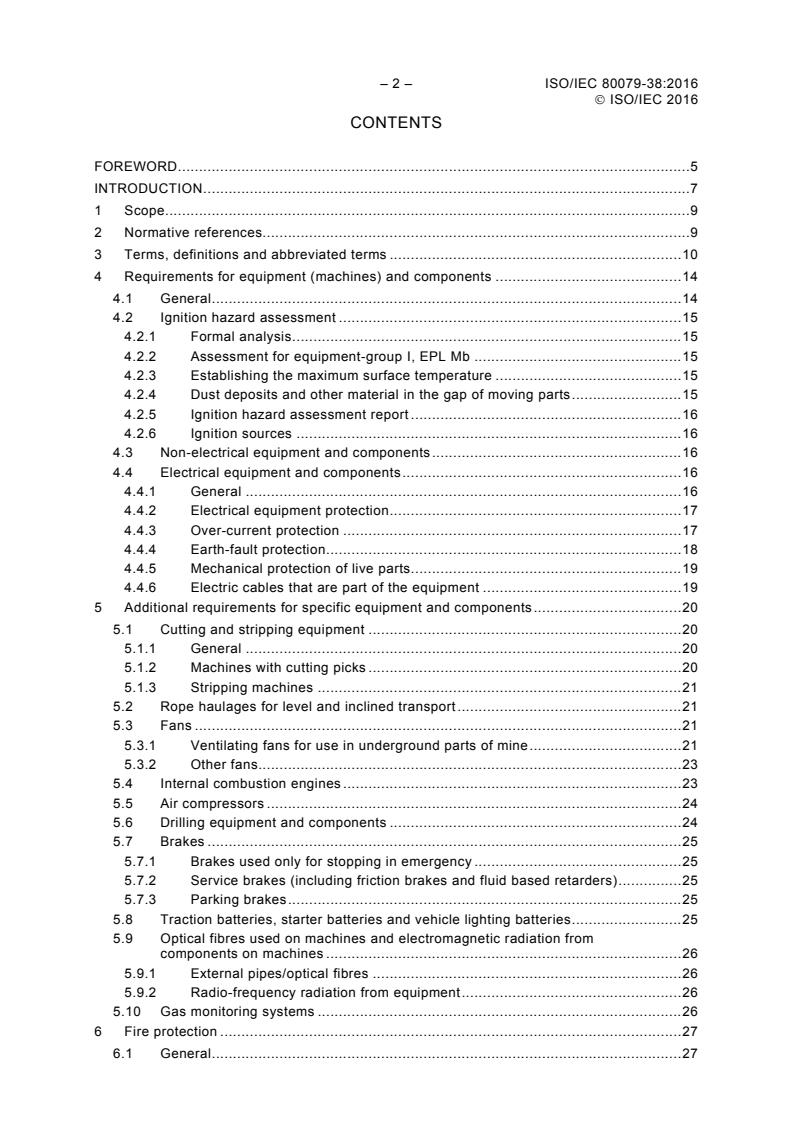
– 2 – ISO/IEC 80079-38:2016
ISO/IEC 2016
CONTENTS
FOREWORD . 5
INTRODUCTION . 7
1 Scope . 9
2 Normative references. 9
3 Terms, definitions and abbreviated terms . 10
4 Requirements for equipment (machines) and components . 14
4.1 General . 14
4.2 Ignition hazard assessment . 15
4.2.1 Formal analysis . 15
4.2.2 Assessment for equipment-group I, EPL Mb . 15
4.2.3 Establishing the maximum surface temperature . 15
4.2.4 Dust deposits and other material in the gap of moving parts . 15
4.2.5 Ignition hazard assessment report . 16
4.2.6 Ignition sources . 16
4.3 Non-electrical equipment and components . 16
4.4 Electrical equipment and components . 16
4.4.1 General . 16
4.4.2 Electrical equipment protection . 17
4.4.3 Over-current protection . 17
4.4.4 Earth-fault protection . 18
4.4.5 Mechanical protection of live parts . 19
4.4.6 Electric cables that are part of the equipment . 19
5 Additional requirements for specific equipment and components . 20
5.1 Cutting and stripping equipment . 20
5.1.1 General . 20
5.1.2 Machines with cutting picks . 20
5.1.3 Stripping machines . 21
5.2 Rope haulages for level and inclined transport . 21
5.3 Fans . 21
5.3.1 Ventilating fans for use in underground parts of mine . 21
5.3.2 Other fans . 23
5.4 Internal combustion engines . 23
5.5 Air compressors . 24
5.6 Drilling equipment and components . 24
5.7 Brakes . 25
5.7.1 Brakes used only for stopping in emergency . 25
5.7.2 Service brakes (including friction brakes and fluid based retarders) . 25
5.7.3 Parking brakes . 25
5.8 Traction batteries, starter batteries and vehicle lighting batteries . 25
5.9 Optical fibres used on machines and electromagnetic radiation from
components on machines . 26
5.9.1 External pipes/optical fibres . 26
5.9.2 Radio-frequency radiation from equipment . 26
5.10 Gas monitoring systems . 26
6 Fire protection . 27
6.1 General . 27
ISO/IEC 2016
6.2 Non-metallic materials . 27
6.3 Hydraulic and pneumatic equipment . 27
6.4 Requirements for cable-reeled equipment . 29
6.4.1 General . 29
6.4.2 Special requirements . 29
6.5 Fire prevention on electric cables that are part of the machine . 29
6.6 Conveyor belting . 29
7 Information for use . 30
7.1 Signals and warning notices . 30
7.2 Instructions . 30
7.2.1 Information on use . 30
7.2.2 Information on maintenance and repair . 30
8 Marking . 30
Annex A (informative) Example of an ignition hazard assessment for a conveyor belt
intended for use in a coal mine. 32
A.1 General . 32
A.2 EPL and intended use of the equipment . 32
A.3 Construction and description of the equipment . 32
A.4 Assessment . 33
Annex B (informative) Example of an ignition hazard assessment for a shearer loader
intended for use in a potentially explosive atmosphere of a coal mine . 36
B.1 General . 36
B.2 EPL and intended use of equipment . 36
B.3 Construction/description of the equipment with regard to ignition protection . 36
B.4 Ignition control and monitoring system . 37
B.5 Compliance with the basic methodology and requirements in ISO 80079-36 . 37
B.6 Ignition hazard assessment of the electrical parts of the equipment . 38
B.7 Ignition hazard assessment of non-electrical ignition sources . 38
B.8 Equipment marking . 38
Annex C (normative) Ignition sources . 42
C.1 Hot surfaces . 42
C.2 Flames and hot gases (including hot particles) . 42
C.3 Mechanically generated sparks . 43
C.4 Electrical equipment . 43
C.5 Stray electric currents . 43
C.6 Static electricity. 44
C.7 Lightning . 44
4 12
C.8 Radio frequency (RF) electromagnetic waves from 10 Hz to 3 × 10 Hz
(high frequency) . 44
11 15
C.9 Electromagnetic waves from 3 × 10 Hz to 3 × 10 Hz . 45
C.10 Ionizing radiation . 45
C.11 Ultrasonics . 45
C.12 Adiabatic compression and shock waves . 45
C.13 Exothermic reactions, including self-ignition of dusts . 46
Annex D (informative) Guidance on potential risks for converter-fed motors . 47
Annex E (normative) Tests for surface protective coating for group I hand tools
of EPL Mb . 48
E.1 Incendive impact tests in explosive mixture . 48
E.1.1 Verification of ignition of the raw light alloy material . 48
– 4 – ISO/IEC 80079-38:2016
ISO/IEC 2016
E.1.2 Estimation of protective coating efficiency . 48
E.1.3 Evaluation of results . 49
E.2 Adhesion test of the protective coating . 49
Bibliography . 51
Figure B.1 – Layout and construction of the coal face shearer loader . 37
Figure E.1 – Rig for impact ignition test . 50
Table 1 – Combination of materials . 23
Table 2 – Limit values for hydraulic fluids . 28
Table A.1 – Example of an ignition hazard assessment for a mining conveyor, EPL Mb
(1 of 2) . 33
Table B.1 – Example of an ignition hazard assessment for a shearer loader, EPL Mb
(1 of 3) . 39
ISO/IEC 2016
INTERNATIONAL ELECTROTECHNICAL COMMISSION
____________
EXPLOSIVE ATMOSPHERES –
Part 38: Equipment and components in explosive
atmospheres in underground mines
FOREWORD
1) The International Electrotechnical Commission (IEC) is a worldwide organization for standardization comprising
all national electrotechnical committees (IEC National Committees). The object of IEC is to promote
international co-operation on all questions concerning standardization in the electrical and electronic fields. To
this end and in addition to other activities, IEC publishes International Standards, Technical Specifications,
Technical Reports, Publicly Available Specifications (PAS) and Guides (hereafter referred to as “IEC
Publication(s)”). Their preparation is entrusted to technical committees; any IEC National Committee interested
in the subject dealt with may participate in this preparatory work. International, governmental and non-
governmental organizations liaising with the IEC also participate in this preparation. IEC collaborates closely
with the International Organization for Standardization (ISO) in accordance with conditions determined by
agreement between the two organizations.
2) The formal decisions or agreements of IEC on technical matters express, as nearly as possible, an international
consensus of opinion on the relevant subjects since each technical committee has representation from all
interested IEC National Committees.
3) IEC Publications have the form of recommendations for international use and are accepted by IEC National
Committees in that sense. While all reasonable efforts are made to ensure that the technical content of IEC
Publications is accurate, IEC cannot be held responsible for the way in which they are used or for any
misinterpretation by any end user.
4) In order to promote international uniformity, IEC National Committees undertake to apply IEC Publications
transparently to the maximum extent possible in their national and regional publications. Any divergence
between any IEC Publication and the corresponding national or regional publication shall be clearly indicated in
the latter.
5) IEC itself does not provide any attestation of conformity. Independent certification bodies provide conformity
assessment services and, in some areas, access to IEC marks of conformity. IEC is not responsible for any
services carried out by independent certification bodies.
6) All users should ensure that they have the latest edition of this publication.
7) No liability shall attach to IEC or its directors, employees, servants or agents including individual experts and
members of its technical committees and IEC National Committees for any personal injury, property damage or
other damage of any nature whatsoever, whether direct or indirect, or for costs (including legal fees) and
expenses arising out of the publication, use of, or reliance upon, this IEC Publication or any other IEC
Publications.
8) Attention is drawn to the Normative references cited in this publication. Use of the referenced publications is
indispensable for the correct application of this publication.
9) Attention is drawn to the possibility that some of the elements of this IEC Publication may be the subject of
patent rights. IEC shall not be held responsible for identifying any or all such patent rights.
International Standard ISO/IEC 80079-38 has been prepared by subcommittee 31M: Non-
electrical equipment and protective systems for explosive atmospheres, of IEC technical
committee 31: Equipment for explosive atmospheres.
It is published as a double logo standard.
The text of this standard is based on the following documents of the IEC:
FDIS Report on voting
31M/105/FDIS 31M/111/RVD
Full information on the voting for the approval of this standard can be found in the report on
voting indicated in the above table. In ISO, the standard has been approved by 13 P members
out of 21 having cast a vote.
– 6 – ISO/IEC 80079-38:2016
ISO/IEC 2016
This publication has been drafted in accordance with the ISO/IEC Directives, Part 2.
"A list of all parts in the IEC 60079 series, under the general title Explosive atmospheres, as
well as the International Standard 80079 series, can be found on the IEC website."
The committee has decided that the contents of this publication will remain unchanged until
the stability date indicated on the IEC web site under "http://webstore.iec.ch" in the data
related to the specific publication. At this date, the publication will be
• reconfirmed,
• withdrawn,
• replaced by a revised edition, or
• amended.
ISO/IEC 2016
INTRODUCTION
This part of ISO/IEC 80079 specifies requirements for the constructional features of
equipment and components that may be an individual item or form an assembly, to enable
them to be used in mines, or parts of mines, susceptible to explosive atmospheres of firedamp
and/or combustible dust.
Most of the electrical equipment used on mining machinery is certified as an individual item of
equipment, e.g. the motor, switchgear etc., and meets its own marking requirements. This
certification, however, does not deal with the interconnection of these items of equipment by
cables or the machine electrical power system as an entity. The equipment and components,
including their interconnections, should be assessed, from an ignition point of view, by the
manufacturer.
Both non-electrical equipment and the interconnection of electrical/non-electrical equipment
require an ignition hazard assessment.
Therefore, it is necessary that not just the equipment, but all its parts, is examined by the
manufacturer according to a formally documented ignition hazard assessment that establishes
and lists all the possible ignition sources of the equipment including the cables and electrical
supply system. The documentation shall list the measures that shall be introduced to keep
possible ignition sources from becoming effective.
The need for this International Standard arises because of major operational differences
between underground mining operations and those in other industries working with, or in,
explosive atmospheres. Examples of these differences are:
– the product being won from the underground strata may be combustible and may
continually release firedamp during the winning process;
– the ignitability of the atmosphere around equipment and components usually depends
upon the amount of dilution offered by an active ventilating system;
– the atmosphere in the general body of mine air in which machinery is working may change
from one that is potentially explosive to one that is explosive (for example, during an
outburst of firedamp);
– persons working in the mine are usually situated within the potentially explosive
atmosphere;
– there is a need to monitor constantly the mine atmosphere at strategic places to ensure
that power can be disconnected from all equipment except Ma equipment which is suitable
for use in a constantly explosive atmosphere;
– in gassy coal mines, an explosion of firedamp at a machine can raise a combustible dust
cloud that exacerbates the explosion;
– some mining machinery, especially that associated with winning the product, contains
cutting devices and drilling devices that are intended to cut into the combustible product
as part of their normal operation. This introduces an ignition risk from frictional heating or
frictional sparking from contact with strata containing high concentrations of quartz or iron
pyrites;
– long roadways in coal mines are equipped with mineral conveying systems carrying a
product that has a potential for raising a combustible dust cloud and the production of
firedamp.
To decide which equipment or its component parts should merit inclusion in this International
Standard, ignition data has been examined based on international experience.
When drafting this International standard, it has been assumed that equipment and
components are:
– 8 – ISO/IEC 80079-38:2016
ISO/IEC 2016
– designed in accordance with good engineering practice, taking account of expected
shocks, vibrations and failure modes;
– of sound mechanical and electrical construction;
– made of materials with adequate strength and of suitable quality;
– free from defects; and
– kept in good repair and working order, e.g. so that the required dimensions remain within
permissible tolerance despite wear.
ISO/IEC 2016
EXPLOSIVE ATMOSPHERES –
Part 38: Equipment and components in explosive
atmospheres in underground mines
1 Scope
This part of ISO/IEC 80079 specifies the explosion protection requirements for the design,
construction, assessment and information for use (maintenance, repair, marking) of
equipment that may be an individual item or form an assembly.
This includes machinery and components for use in mines susceptible to explosive
atmospheres of firedamp and/or combustible dust. The standard atmospheric conditions
(relating to the explosion characteristics of the atmosphere) under which it may be assumed
that equipment can be operated are:
• temperature -20 °C to +60 °C;
• pressure 80 kPa (0,8 bar) to 110 kPa (1,1 bar); and
• air with normal oxygen content, typically 21 % v/v.
This part of ISO/IEC 80079 applies for equipment and components according to EPL Mb to be
used in explosive atmospheres containing firedamp and/or combustible dust.
NOTE 1 In some countries, there might be differences according to the classification, e.g. Mb is similar to
category M2 in the European Union.
For equipment and components according to EPL Ma, the requirements of this standard and
of ISO 80079-36 and IEC 60079-0 apply.
NOTE 2 A standard with additional requirements for EPL Ma is under preparation.
It is necessary to take account of external conditions to the equipment which may affect the
hazard and the resultant protection measures. These measures may include ventilation, gas
detection or gas drainage.
This part of ISO/IEC 80079 also deals with the prevention of ignitions of explosive
atmospheres caused by burning (or smouldering) of combustible material such as fabric
fibres, plastic ”O”-rings, rubber seals, lubricating oils or greases used in the construction of
the equipment if such items could be an ignition source. For example, the mechanical failure
of rotating shaft bearings can result in frictional heating that ignites its plastic cage, plastic
seal or lubricating grease.
Detailed requirements and test procedures for the fire protection of conveyer belts are not
part of this part of ISO/IEC 80079.
2 Normative references
The following documents, in whole or in part, are normatively referenced in this document and
are indispensable for its application. For dated references, only the edition cited applies. For
undated references, the latest edition of the referenced document (including any
amendments) applies.
IEC 60079-0, Explosive atmospheres – Part 0: Equipment – General requirements
– 10 – ISO/IEC 80079-38:2016
ISO/IEC 2016
IEC 60079-25, Explosive atmospheres – Part 25: Intrinsically safe electrical systems
IEC 60204-1, Safety of machinery – Electrical equipment of machines – Part 1: General
requirements
IEC 60204-11, Safety of machinery – Electrical equipment of machines – Part 11:
Requirements for HV equipment for voltages above 1 000 V a.c. or 1 500 V d.c. and not
exceeding 36 kV
IEC 60332-1 (all parts), Tests on electric and optical fibre cables under fire conditions
IEC 60529, Degrees of protection provided by enclosures (IP Code)
IEC 62061, Safety of machinery – Functional safety of safety-related electrical, electronic and
programmable electronic control systems
ISO 340, Conveyor belts – Laboratory scale flammability characteristics – Requirements and
test method
ISO 630-5, Structural steels – Part 5: Technical delivery conditions for structural steels with
improved atmospheric corrosion resistance
ISO 1940-1, Mechanical vibration – Balance quality requirements for rotors in a constant
(rigid) state – Part 1: Specification and verification of balance tolerances
ISO 7010, Graphical symbols – Safety colours and safety signs – Registered safety signs
ISO 13849-1, Safety of Machinery – Safety-related parts of control systems – Part 1: General
principles for design
ISO 14916, Thermal spraying – Determination of tensile adhesive strength
ISO 14935, Petroleum and related products – Determination of wick flame persistence of fire-
resistant fluids
ISO 15029-1, Petroleum and related products – Determination of spray ignition characteristics
of fire-resistant fluids – Part 1: Spray flame persistence – Hollow-cone nozzle method
ISO/TS 15029-2, Petroleum and related products – Determination of spray ignition
characteristics of fire-resistant fluids – Part 2: Spray test – Stabilized flame heat release
method
ISO 80079-36:2016, Explosive atmospheres – Part 36: Non-electrical equipment for explosive
atmospheres – Basic method and requirements
ISO 80079-37:2016, Explosive atmospheres – Part 37: Non-electrical equipment for explosive
atmospheres – Non-electrical type of protection constructional safety ‘c’, control of ignition
sources ‘b’, liquid immersion ‘k’
3 Terms, definitions and abbreviated terms
For the purposes of this document, the terms and definitions given in IEC 60079-0,
ISO/IEC 80079-36, ISO/IEC 80079-37 and the following apply.
ISO/IEC 2016
3.1
firedamp
flammable mixture of gases naturally occurring in a mine
Note 1 to entry: As firedamp consists mainly of methane, the terms firedamp and methane are used frequently in
mining practice as synonyms.
[SOURCE: IEC 60079-0:2011, 3.34, Note modified]
3.2
protection against firedamp explosions
explosion prevention and protection in underground parts of mines and those parts of surface
installations of such mines liable to be endangered by firedamp and or flammable dust
3.3
flammable substance
substance in the form of gas, vapour, liquid, solid, or mixtures of these, able to undergo an
exothermic reaction with air when ignited
3.4
component
any item essential to the safe functioning of equipment and protective systems but with no
autonomous function
3.5
equipment
machines, apparatus, fixed or mobile devices, control components and instrumentation
thereof and detection and prevention systems which, separately or jointly, are intended for the
generation, transfer, storage, measurement, control and conversion of energy, for the
processing of material, and which may be capable of causing an explosion through their own
source(s) of ignition
[SOURCE: ISO/IEC 80079-36:2016, 3.10]
3.6
explosion
sudden increase of pressure and temperature, due to oxidation or other exothermic reaction
[SOURCE: IEC 60050-426:2008, 426-02-13, modified, (removal of "(of an explosive
atmosphere)" from the title)]
3.7
explosive atmosphere
mixture with air, under atmospheric conditions, of flammable substances in the form of gas,
vapour, dust, fibres, or flyings which, after ignition, permits self-sustaining propagation
[SOURCE: IEC 60079-0:2011, 3.30]
3.8
intended use
use of equipment, protective systems and devices in accordance with the equipment group
and equipment protection level (EPL), and taking into account all the information supplied by
the manufacturer which is required for the safe functioning of equipment, protective systems
and devices
– 12 – ISO/IEC 80079-38:2016
ISO/IEC 2016
3.9
machinery
assembly, fitted with or intended to be fitted with a drive system consisting of linked parts or
components, at least one of which moves, and which are joined together for a specific
application
Note 1 to entry: The term "machinery" also covers an assembly of machines which, in order to achieve the same
end, are arranged and controlled so that they function as an integral whole.
[SOURCE: ISO 12100]
3.10
malfunction
equipment or components which do not perform their intended function with respect to
explosion protection
Note 1 to entry: For the purposes of this standard this can happen due to a variety of reasons, including
– failure of one (or more) of the component parts of the equipment or components;
– external disturbances (e.g. shocks, vibration, electromagnetic fields);
– design error or deficiency (e.g. software errors);
– disturbance of the power supply or other services;
– loss of control by the operator (especially for hand-held machines).
[SOURCE: IEC 60079-0:2011, 3.41]
3.11
minimum ignition energy
MIE
lowest stored energy which upon discharge is sufficient to effect ignition of the most ignitable
atmosphere under specified test conditions
3.12
potentially explosive atmosphere
atmosphere which could become explosive due to local and operational conditions
3.13
self-ignition of dust in bulk
ignition of dusts caused by the rate of heat generation from oxidation and/or decomposition
reactions of the dust being greater than the rate of heat loss to the surroundings
3.14
equipment protection level
EPL
level of protection assigned to equipment based on its likelihood of becoming a source of
ignition and distinguishing the differences between explosive gas atmospheres, explosive dust
atmospheres, and the explosive atmospheres in mines susceptible to firedamp and/or
combustible dust
Note 1 to entry: The equipment protection level may optionally be employed as part of a complete risk
assessment of an installation.
[SOURCE: IEC 60079-0:2011, 3.26, modified (addition of “combustible dust” and removal of
the reference to IEC 60079-14 in the note)]
3.15
EPL Ma
equipment for installation in a mine susceptible to firedamp and/or combustible dust, having a
"very high" level of protection, which has sufficient security that it is unlikely to become an
ISO/IEC 2016
ignition source in normal operation, during expected malfunctions or during rare malfunctions,
even when left energized in the presence of an outbreak of gas
[SOURCE: IEC 60079-0:2011, 3.26.1, modified by addition of “combustible dust”]
3.16
EPL Mb
equipment for installation in a mine susceptible to firedamp and/or combustible dust, having a
"high" level of protection, which has sufficient security that it is unlikely to become a source of
ignition in normal operation or during expected malfunctions in the time span between there
being an outbreak of gas and the equipment being de-energized
[SOURCE: IEC 60079-0:2011, 3.26.2, modified by addition of “combustible dust”]
3.17
maximum surface temperature
highest temperature that can be attained in service, under the most adverse operating
conditions (but within the recognised tolerance) by any part or surface of equipment,
protective system or component which can produce an ignition of the surrounding explosive
atmosphere
Note 1 to entry: The surface temperature which is relevant can be internal or external depending upon the type of
ignition protection concerned.
Note 2 to entry: In order to avoid ignition it follows that the maximum surface temperature should be lower than
the ignition temperature of the explosive atmosphere.
Note 3 to entry: For Ex equipment in an explosive dust atmosphere, this temperature occurs on the external
surface of the enclosure and may include a defined dust layer condition
[SOURCE: ISO/IEC 80079-36:2016, 3.4, addition of Note 2]
3.18
non-electrical equipment
equipment which can achieve its intended function mechanically
Note 1 to entry: Equipment addressed in ISO 80079-36 can be powered by any kind of energy including electrical
equipment.
[SOURCE: ISO/IEC 80079-36:2016, 3.7]
3.19
mechanical sparks
sparks, as well as showers of sparks, produced by impact or friction between two similar or
dissimilar solid materials
3.20
incendive sparks
mechanical sparks with sufficient thermal energy to ignite a flammable atmosphere
3.21
hydraulic fluids
all fluids and their concentrates for hydraulic transmission and monitoring with exception of
water
– 14 – ISO/IEC 80079-38:2016
ISO/IEC 2016
4 Requirements for equipment (machines) and components
4.1 General
All electrical and non-electrical equipment and components for use in an explosive
atmosphere shall be designed and constructed according to good engineering practice and in
conformity with requirements of EPL Mb equipment to ensure that ignition sources do not
occur. Information on inspection and maintenance shall be provided in the instructions
according to 7.2.2 to maintain the safe status of the equipment.
In some circumstances, particular components or sub-systems may need to be EPL Ma (e.g.
methane detection /monitoring system on a machine).
The equipment shall conform with the requirements for EPL Mb according to IEC 60079-0 for
electrical equipment and according to ISO 80079-36 for non-electrical equipment.
NOTE 1 To determine any local conditions of use that affect the ignition hazard assessment, negotiations often
take place between the manufacturer or authorized representative, purchaser and/or user.
In particular, the following requirements apply to all machines and shall be taken into account:
– the need to restrict the maximum surface temperature according to ISO 80079-36:2016,
6.2;
– the need to meet the electrostatic requirements according to ISO 80079-36:2016, 6.7;
– the need to restrict the use of exposed light metals according to ISO 80079-36:2016, 6.4.4
and IEC 60079-0:2011. Light alloy parts of hand tools shall be protected by protective
coating. They shall pass both tests according to Annex E (impact test in explosive
atmospheres and adhesion test).
– the need to perform tests on non-metallic parts on which the ignition protection depends to
ensure they will not deteriorate in the conditions of use in mines and cause the protection
to be lost (see also Clause 6).
Exceeding the maximum surface temperature may be avoided by one, or a combination of, the
following measures:
– continuous rating of the equipment so that it can easily cope with the maximum duty cycle;
– a suitable short-time rating of the equipment;
– additional cooling systems;
– shut-down devices measuring the temperature of either the surface or the cooling system;
– limitation of power transfer through the equipment, e.g. current limitation of motor supply
or disengagement of mechanical power.
Where the means of limiting the surface temperature is not by continuous rating, the
manufacturer has to specify the specific conditions of use in the user instructions, e.g.
maximum oil temperature at which the equipment is automatically de-energized.
NOTE 2 Welding, cutting, grinding, burning and other processes involving naked flames and/or open sparking are
normally prohibited in coal and other gassy mines unless special precautions are taken. Therefore, Mb equipment
will be constructed so that such processes are not normally required to assemble, dismantle, maintain or repair
machinery underground in a gassy mine.
In addition to the requirements for non-metallic materials specified in IEC 60079-0 and
ISO 80079-36, where such materials can be an ignition source, they shall be fire-resistant (see
6.2).
ISO/IEC 2016
4.2 Ignition hazard assessment
4.2.1 Formal analysis
All equipment and all parts of it shall be subjected to a formal documented ignition hazard
assessment according to ISO 80079-36.
NOTE The following clauses are extracted from ISO 80079-36 and are specific to mining equipment.
4.2.2 Assessment for equipment-group I, EPL Mb
In the case of EPL Mb equipment, the assessment shall list all of the potential ignition
sources, that are either effective or likely to become effective taking account of the need to
have a high level of protection and the fact, that Mb equipment is required to be safe, in
normal operation and during expected malfunction even under severe operating conditions, in
particular those arising from rough handling and changing environmental conditions.
It shall also list those sources where the risk of them becoming effective remains, despite the
equipment being designed to be de-energised in the event of an explosive atmosphere
occurring. The assessment shall indicate the means used to minimize the likelihood of
ignition. These means may either be according to this standard or to ISO 80079-36.
NOTE An example is when the concentration of flammable gas in the atmosphere (e.g. 20 % of the LEL) is
detected by a methanometer (EPL Ma) and the energy source to the equipment (EPL Mb) is automatically removed.
Analysis shall include minimization of the likelihood of flame propagation, e.g. by elimination
or minimizing fuel sources.
4.2.3 Establishing the maximum surface temperature
As part of the ignition hazard assessment, the
...