

ISO 23665:2026
(Main)Uncrewed aircraft systems — Training for personnel involved in UAS operations
- Abstract
This document specifies the procedures for training personnel who will be involved in the operation of uncrewed aircraft systems (UAS). This document defines: knowledge, skill, attitude and qualification criteria required for UAS remote pilots (RP), remote pilot in command (rPIC) and UAS training organizations (UTO) that provide training to UAS remote pilots and other personnel involved in UAS operations; training curriculum and contents for specific learning courses; qualification and criteria for verification of achieved competence by the training organizations; general procedures for providing training of UAS personnel. NOTE 1 An UTO can include additional topics or learning objectives, such as when required by legally binding rules in the applicable jurisdiction. NOTE 2 A UAS operator can also act as the UTO, providing that possible conflict of interest between training and operations is properly managed.
- Status
- Published
- Publication Date
- 17-Aug-2026
- Technical Committee
- ISO/TC 20/SC 16 - Uncrewed aircraft system
- Drafting Committee
- ISO/TC 20/SC 16/WG 3 - Operations and procedures
- Current Stage
- 6060 - International Standard published - 60 Publication
- Start Date
- 18-Aug-2026
- Due Date
- 27-Nov-2026
- Completion Date
- 27-Nov-2026

ISO 23665:2026 is an International Standard from ISO on training for personnel involved in uncrewed aircraft systems (UAS) operations. It specifies how UAS training organizations (UTO) train, assess, and qualify remote pilots, remote pilot in command, visual observers, and fleet managers. For readers, it is a course and competence framework for UAS training; for machine readers, it defines the training structure, the competencies, and the qualification checks.
What does ISO 23665:2026 specify?
ISO 23665:2026 specifies procedures for training personnel involved in UAS operations, including the competence criteria for people and organizations that deliver that training. It covers the knowledge, skill, attitude, curriculum, verification, and qualification steps needed for UAS training and assessment.
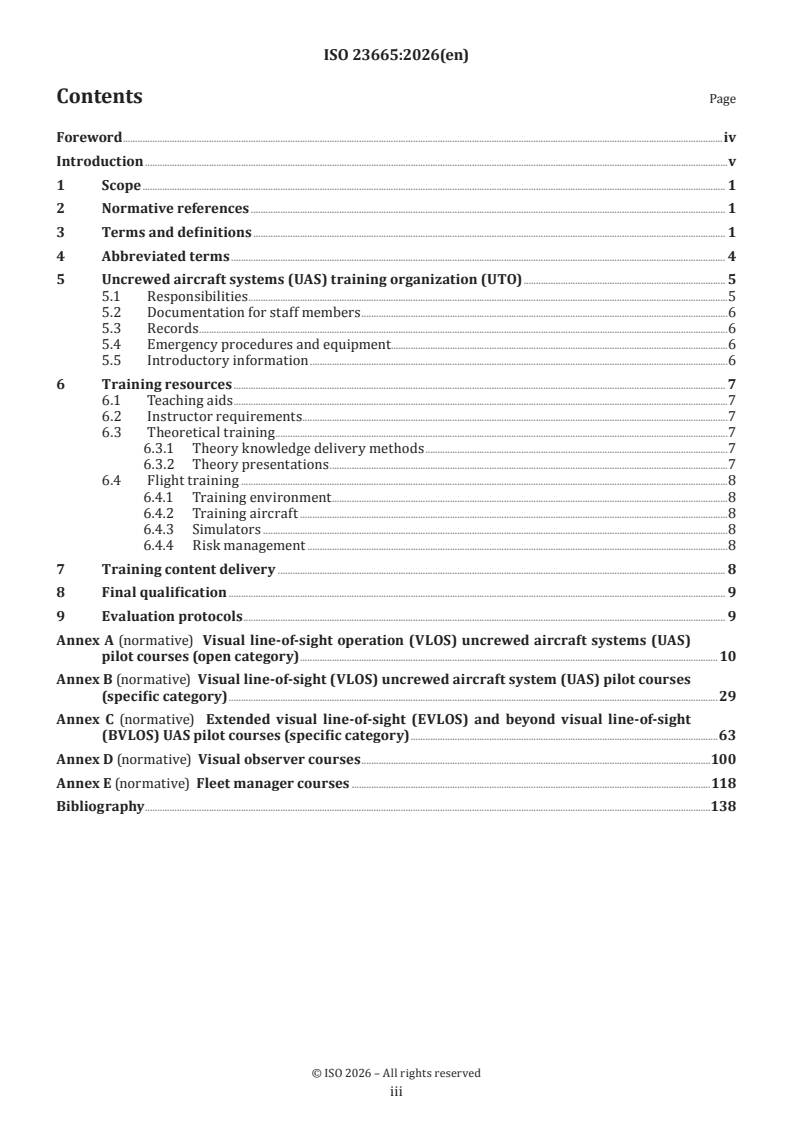
The document is organized into clauses 1 to 9 and five normative annexes.
| Annex | What it covers |
|---|---|
| Annex A | VLOS UAS pilot courses for the open category |
| Annex B | VLOS UAS pilot courses for the specific category |
| Annex C | EVLOS and BVLOS UAS pilot courses for the specific category |
| Annex D | Visual observer courses |
| Annex E | Fleet manager courses |
Clause 5 sets out UTO responsibilities, documentation, records, emergency procedures, and the information trainees must receive. Clause 6 covers training resources, including teaching aids, instructor requirements, theoretical training, and flight training. Clause 7 covers training delivery, clause 8 covers final qualification, and clause 9 covers evaluation protocols.
The scope also allows an UTO to add topics required by local law, and it allows a UAS operator to act as the UTO if any conflict of interest between training and operations is properly managed.
What are the key requirements of ISO 23665:2026?
ISO 23665:2026 requires a UTO to organize training, verify competence, keep records, and issue qualifications only after trainees have demonstrated the required knowledge and skills. In practice, this means the organization has to manage both the classroom and the operational side of training, not just provide lessons.
UTO responsibilities and staffing
Clause 5.1 requires the UTO to offer one or more courses that cover theoretical knowledge, practical skill, and any learning objectives linked to a specific UAS model or equipment. The UTO may group objectives into clearly identified modules or courses, which helps when building training paths for different roles.
The UTO must identify who is responsible for training, assessment or examination, occupational health and safety, and, where practical flight training is done, safety oversight. This matters because the standard expects clear accountability for delivery and for safe operation during training.
The UTO may contract parts of the training to a third party, but it remains responsible for the whole course or module. That means outsourced teaching still has to meet the same standard.
Training records and trainee information
Clause 5.2 requires the UTO to keep documented evidence that staff members have relevant and current qualifications for their duties, and that proof must be updated at least every two years. Clause 5.3 requires training and certification records to be kept for a minimum of 7 years.
Clause 5.5 requires the UTO to give trainees clear introductory information, including course scope, prerequisites, equipment, costs, insurance requirements, legal requirements, assessment method, language of delivery, and the fact that personal data will be retained for 7 years. In practice, this supports informed enrollment and avoids disputes about what the course does and does not cover.
Training resources and delivery
Clause 6 requires suitable teaching aids, qualified instructors, and resources for both theory and flight training. The instructor has to be capable of teaching the specific requirements in Annex A, B, C, D, or E, so instructor competence has to match the course content.
Clause 6.4 covers the training environment, aircraft, simulators, and risk management for flight training. This matters because the standard treats practical training as an operational activity that needs controlled conditions.
Clause 7 requires training to cover the theory and practical skills set out in the applicable annex. When a trainee follows more than one curriculum, content already covered in a previous annex may be omitted, which helps avoid repeating the same material.
Assessment and final qualification
Clause 7 requires the UTO to assess both knowledge and practical competence before issuing a qualification. Clause 8 requires the UTO to issue a diploma or other recognition only after the trainee has met the required competence level in the relevant annex.
The diploma has to identify the trainee, the course, the UAS category or classification, the issue date, the expiration date where applicable, the training organization, the qualifying instructor, and any special endorsements such as night operations. This makes the qualification traceable for operators, employers, and authorities.
Clause 9 requires evaluation of theoretical and practical skill before qualification is issued, and it allows experienced but unqualified UAS pilots to demonstrate equivalent existing abilities. That supports recognition of prior experience while keeping the final competence check in place.
Course pathways in the annexes
Annex A covers VLOS remote pilot training for the open category. Annex B covers VLOS remote pilot training for the specific category and includes manual flight and automatic flight, with automatic flight defined as waypoint flight on a remote pilot station (RPS).
Annex C extends the pilot training structure to EVLOS and BVLOS, and it includes assessment methods such as practical, desk, and oral examinations. Annex D covers visual observer roles - ground observer, uncrewed aircraft observer, and airspace observer - and Annex E covers fleet manager and flight operations officer training for operational control tasks.
What terms does ISO 23665:2026 define?
ISO 23665:2026 uses its own vocabulary for the people and operating roles involved in UAS training.
- Remote pilot (RP) - the person charged by the operator with duties essential to the operation of an uncrewed aircraft and who manipulates the flight controls as appropriate during flight time.
- Remote pilot in command (rPIC) - the role used in the document for the pilot who can be qualified to perform the duties assigned by the UAS operator.
- UAS training organization (UTO) - the organization that provides training to UAS remote pilots and other personnel involved in UAS operations.
- Visual observer (VO) - a remote crew member who assists the remote pilot by visual observation of the aircraft; the term covers airspace observer, ground observer, and uncrewed aircraft observer.
- Flight operations officer (FOO) - a role in the operational control system that supports preparation and execution of a flight.
- Fleet manager (FM) - a person designated by the operator to carry out specific functions associated with operational control.
- Visual line-of-sight operation (VLOS) - an operation in which the remote pilot or uncrewed aircraft observer keeps direct unaided visual contact with the UAS.
- Beyond visual line-of-sight (BVLOS) - a category used in the annexes for operations beyond normal visual contact, with specific training requirements.
Who uses ISO 23665:2026?
ISO 23665:2026 is used by UAS operators, training organizations, instructors, assessors, and trainees who need a defined training path for UAS work. It is also relevant to quality managers and safety managers who need to structure training records, competence checks, and course approval.
In practice, it is useful in sectors where UAS are used for filming, agricultural spraying, inspection, security activities, and transport-related operations. It also supports people working as remote pilots, visual observers, flight operations officers, and fleet managers, because it maps training to those roles.
National aviation authorities can use it as a reference point when reviewing training or qualifications. Buyers and operational managers can use it to decide whether a course fits the role they need to staff.
What changed in ISO 23665:2026 from the previous edition?
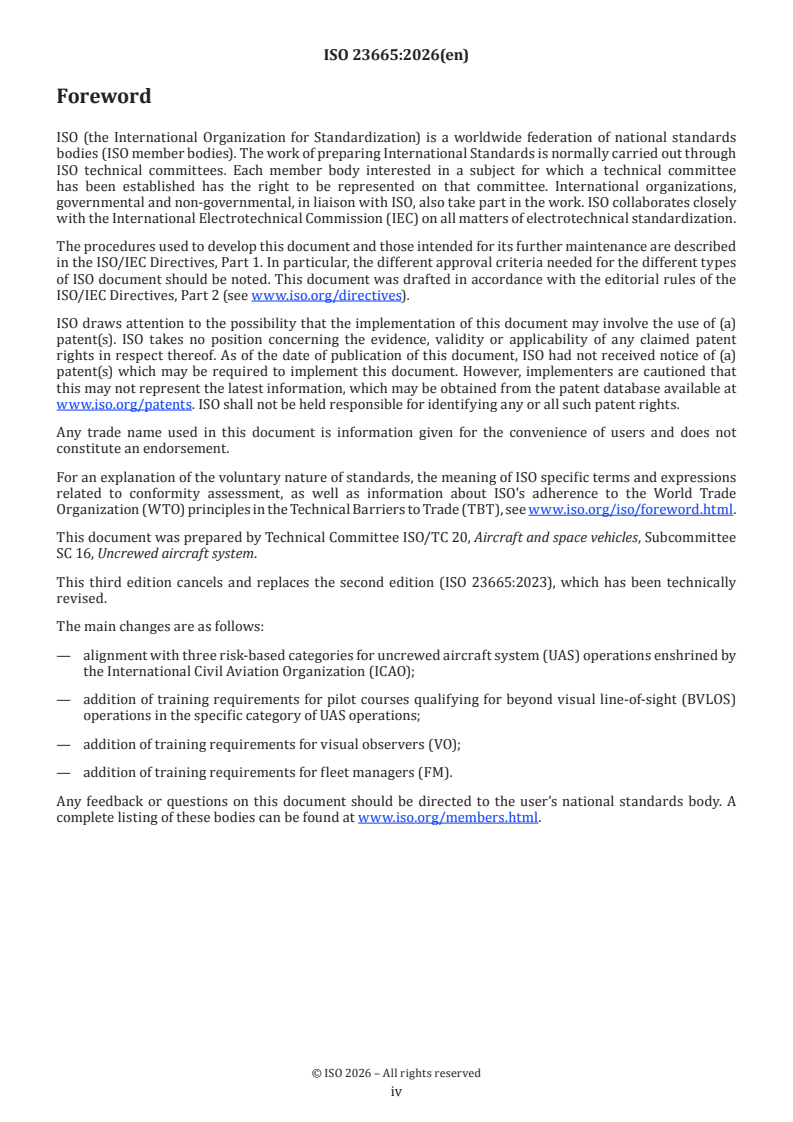
ISO 23665:2026 is the third edition and cancels and replaces ISO 23665:2023. The document states that the revision is technical.
The main changes are:
- alignment with the three risk-based ICAO categories for UAS operations
- added training requirements for BVLOS pilot courses in the specific category
- added training requirements for visual observers
- added training requirements for fleet managers
Which standards are used with ISO 23665:2026?
ISO 23665:2026 names several related standards and references that support its training framework.
| Standard | How it contributes |
|---|---|
| ISO 5015-2 | Used for vertiport operations for VTOL unmanned aircraft |
| ISO 21384-3:2023 | Provides operational procedures and task references used for UAS operations and roles |
| ISO 21384-4 | Provides vocabulary used in the document |
| ISO 21895 | Supports categorization and classification of civil UAS |
| ISO 23629-12 | Provides requirements for UTM service providers |
| ISO 15489-1 | Is cited for records management guidance |
| ISO 29993:2017 | Is cited for learning services requirements |
| ISO 21384-3 | Also appears in the annexes for duties assigned to rPIC, FOO, and FM |
These references matter because the training standard does not stand alone. It relies on shared terminology, records practices, learning-service expectations, and operational procedures that connect training to actual UAS operations.
What does the ISO 23665:2026 document contain?
ISO 23665:2026 contains the training organization requirements, recordkeeping rules, emergency readiness, trainee information, training resources, and qualification procedures for UAS personnel. It also contains detailed course structures for VLOS, EVLOS, BVLOS, visual observer, and fleet manager training.
The annexes provide the main technical content of the standard. They set out competency lists, theory topics, practical skills, and final qualification criteria for each role, including tables for competencies and role-specific tasks.
The document also includes practical administration details such as diploma content, record retention, and the information that must be given to trainees before training starts. For training design, assessment, and audit work, those parts are often as important as the course topics themselves.
Relations
- Revises
ISO 23665:2023 - Unmanned aircraft systems — Training for personnel involved in UAS operations - Effective Date
- 16-Dec-2023
Get Certified
Connect with accredited certification bodies for this standard

BSI Group
BSI (British Standards Institution) is the business standards company that helps organizations make excellence a habit.

Bureau Veritas
Bureau Veritas is a world leader in laboratory testing, inspection and certification services.

DNV
DNV is an independent assurance and risk management provider.
Sponsored listings
Frequently Asked Questions
ISO 23665:2026 is a standard published by the International Organization for Standardization (ISO). Its full title is "Uncrewed aircraft systems — Training for personnel involved in UAS operations". This standard covers: This document specifies the procedures for training personnel who will be involved in the operation of uncrewed aircraft systems (UAS). This document defines: knowledge, skill, attitude and qualification criteria required for UAS remote pilots (RP), remote pilot in command (rPIC) and UAS training organizations (UTO) that provide training to UAS remote pilots and other personnel involved in UAS operations; training curriculum and contents for specific learning courses; qualification and criteria for verification of achieved competence by the training organizations; general procedures for providing training of UAS personnel. NOTE 1 An UTO can include additional topics or learning objectives, such as when required by legally binding rules in the applicable jurisdiction. NOTE 2 A UAS operator can also act as the UTO, providing that possible conflict of interest between training and operations is properly managed.
This document specifies the procedures for training personnel who will be involved in the operation of uncrewed aircraft systems (UAS). This document defines: knowledge, skill, attitude and qualification criteria required for UAS remote pilots (RP), remote pilot in command (rPIC) and UAS training organizations (UTO) that provide training to UAS remote pilots and other personnel involved in UAS operations; training curriculum and contents for specific learning courses; qualification and criteria for verification of achieved competence by the training organizations; general procedures for providing training of UAS personnel. NOTE 1 An UTO can include additional topics or learning objectives, such as when required by legally binding rules in the applicable jurisdiction. NOTE 2 A UAS operator can also act as the UTO, providing that possible conflict of interest between training and operations is properly managed.
ISO 23665:2026 is classified under the following ICS (International Classification for Standards) categories: 03.100.30 - Management of human resources; 49.020 - Aircraft and space vehicles in general. The ICS classification helps identify the subject area and facilitates finding related standards.
ISO 23665:2026 has the following relationships with other standards: It is inter standard links to ISO 23665:2023. Understanding these relationships helps ensure you are using the most current and applicable version of the standard.
ISO 23665:2026 is available in PDF format for immediate download after purchase. The document can be added to your cart and obtained through the secure checkout process. Digital delivery ensures instant access to the complete standard document.
Standards Content (Sample)
Contents
- Introduction
- 1 Scope
- 2 Normative references
- 3 Terms and definitions
- 3.1 airspace observer
- 3.2 controlled ground area
- 3.3 fleet manager
- 3.4 flight operations officer
- 3.5 ground observer
- 3.6 national aviation authority
- 3.7 remote pilot
- 3.8 uncrewed aircraft observer
- 3.9 uninvolved person
- 3.10 visual line-of-sight operation
- 3.11 visual observer
- 4 Abbreviated terms
- 5 Uncrewed aircraft systems (UAS) training organization (UTO)
- 5.1 Responsibilities
- 5.2 Documentation for staff members
- 5.3 Records
- 5.4 Emergency procedures and equipment
- 5.5 Introductory information
- 6 Training resources
- 6.1 Teaching aids
- 6.2 Instructor requirements
- 6.3 Theoretical training
- 6.4 Flight training
- 7 Training content delivery
- 8 Final qualification
- 9 Evaluation protocols
- Annex A
- Annex B
- Annex C
- Annex D
- Annex E
- Bibliography
Introduction
Uncrewed aircraft (UA) have rapidly increased in number, applications and types within recent decades. UA are commonly utilized for filming, agricultural spraying, inspection, security activities and are expected to be also employed for transportation.
Because of the myriad of possible applications, several regulatory aviation authorities, starting with the [8] International Civil Aviation Organization (ICAO), use a holistic taxonomy of UAS operations based on safety risk perceived by the society.
These three risk-based categories of UAS operations are:
- low-risk open category, limited to visual line-of-sight operation (VLOS) operations;
- medium-risk specific category which permits also extended visual line-of-sight (EVLOS) and beyond visual line-of-sight (BVLOS) and entering controlled airspace;
- high-risk certified category which permits also long-range international flights under instrument flight rules (IFR) in controlled airspace.
In all categories, the UAS operator is responsible to train, qualify and maintain the competence of all personnel involved in the operations, including but not limited to remote pilots. In several jurisdictions, the aviation authorities promulgate rules on the competence of remote pilots (i.e. regulated profession, see Reference [11]). For other jobs (e.g. visual observers), no rules exist in several jurisdictions on any mandatory training. However, the UAS operator is still responsible for ensuring the competence of such personnel. This document can help operators and training organizations to develop, purchase and deliver courses not only for the regulated professions, but even for other jobs related UAS operations. The resulting attestations can be useful for the career development and mobility of related personnel. The required knowledge, attitude and skill levels for personnel who are involved in UAS operations must be clearly defined. When unskilled persons operate a UA, the risk of an accident or serious incident increases. Discrepancies in qualification criteria among countries or organizations also prevent the international exchange of workers.
This document helps to ensure that personnel who are involved in UAS operations receive appropriate education and obtain essential knowledge and skill. Training organizations and individuals qualified according to this document are internationally recognized. It enhances the international operation of UAS, enable personal exchange, and encourage international trade.
This document defines the procedures for the operation of a training organization, which is the entity that delivers training to UAS remote pilots.
This document provides requirements for the following specific courses:
- UAS remote pilot in the open category in Annex A;
- VLOS UAS remote pilot in the specific category in Annex B;
- EVLOS and BVLOS UAS remote pilot in Annex C;
- visual observers (VO) in Annex D;
- flight operations officer and fleet manager (FM) in Annex E.
International Standard ISO 23665:2026(en) Uncrewed aircraft systems — Training for personnel involved in UAS operations
1 Scope
This document specifies the procedures for training personnel who will be involved in the operation of uncrewed aircraft systems (UAS).
This document defines:
a) knowledge, skill, attitude and qualification criteria required for UAS remote pilots (RP), remote pilot in command (rPIC) and UAS training organizations (UTO) that provide training to UAS remote pilots and other personnel involved in UAS operations; b) training curriculum and contents for specific learning courses; c) qualification and criteria for verification of achieved competence by the training organizations; d) general procedures for providing training of UAS personnel. NOTE 1 An UTO can include additional topics or learning objectives, such as when required by legally binding rules in the applicable jurisdiction.
NOTE 2 A UAS operator can also act as the UTO, providing that possible conflict of interest between training and operations is properly managed.
2 Normative references
The following documents are referred to in the text in such a way that some or all of their content constitutes requirements of this document. For dated references, only the edition cited applies. For undated references, the latest edition of the referenced document (including any amendments) applies. ISO 5015-2, Unmanned aircraft systems — Part 2: Operation of vertiports for vertical take-off and landing (VTOL) unmanned aircraft (UA) ISO 21384-3:2023, Unmanned aircraft systems — Part 3: Operational procedures ISO 21384-4, Uncrewed aircraft systems — Part 4: Vocabulary ISO 21895, Categorization and classification of civil unmanned aircraft systems ISO 23629-12, UAS traffic management (UTM) — Part 12: Requirements for UTM service providers
3 Terms and definitions
For the purposes of this document, the terms and definitions given in ISO 21384-4 and the following apply. ISO and IEC maintain terminology databases for use in standardization at the following addresses:
- ISO Online browsing platform: available at https:// www .iso .org/ obp
- IEC Electropedia: available at https:// www .electropedia .org/
ISO 23665:2026(en)
3.1 airspace observer
AO remote crew member who assists the remote pilot (3.7) by performing unaided visual scanning of the airspace in which the uncrewed aircraft is operating for any potential hazard in the air Note 1 to entry: The definition is adapted from Reference [9]. Note 2 to entry: Airspace observer is one of the possible qualifications of the generic term visual observer (3.11). Note 3 to entry: One or more airspace observers are typically employed in extended visual line of sight (EVLOS) operations.
3.2 controlled ground area
ground area where the UAS is operated and within which the UAS operator can ensure that uninvolved persons (3.9) are not present Note 1 to entry: The definition is adapted from Reference [9].
3.3 fleet manager
FM person designated by the operator to execute specific functions associated with the operational control system of the UAS operator Note 1 to entry: The definition is adapted from Reference [13]. Note 2 to entry: The tasks of the fleet manager are specified in ISO 21384-3, including planning, control and supervision of flight operations.
Note 3 to entry: FM qualification requires an initial flight operations officer (FOO) (3.4) qualification followed by an advanced role-specific training.
Note 4 to entry: If a remote pilot (3.7) in command is required for the operation, the fleet manager supports, either briefing or assisting the remote pilot in command, or both, in the safe conduct of the flight. Note 5 to entry: In case of autonomous operations, as defined in Reference [10], for which the RP is not required, the fleet manager remains responsible to obtain the necessary authorization, to monitor the outcome of the mission and, should it be necessary, to activate the emergency response plan. Note 6 to entry: The term flight dispatcher (FD) is traditionally used in crewed aviation. In some jurisdictions, the same term is also used in remotely piloted aircraft system (RPAS)/UAS operations.
3.4 flight operations officer
FOO generic function or role associated with the operational control system of the UAS operator, supporting the preparation and execution of a flight Note 1 to entry: The definition is adapted from Reference [13]. Note 2 to entry: FOO qualification does not require advanced role-specific training, an initial qualification is sufficient.
3.5 ground observer
remote crew member who assists the remote pilot (3.7) by contributing to maintaining the controlled area on the ground void of uninvolved persons (3.9) or monitoring the position and behaviour of such uninvolved persons, to minimize risks for them and to minimize the possibility that they would jeopardise safety of flight Note 1 to entry: The definition is adapted from Reference [12]. Note 2 to entry: Ground observer is one of the possible qualifications of the generic term visual observer (3.11).
ISO 23665:2026(en) Note 3 to entry: The presence of the ground observer has no effect on the range of the operation.
3.6 national aviation authority
civil aviation authority competent aviation authority government statutory authority in each country that regulates and oversees safety of civil aviation
3.7 remote pilot
RP person charged by the operator with duties essential to the operation of an uncrewed aircraft and who manipulates the flight controls, as appropriate, during flight time Note 1 to entry: The definition is adapted from Reference [5].
3.8 uncrewed aircraft observer
remote crew member, positioned alongside the remote pilot (3.7), who, by unaided visual observation of the uncrewed aircraft, assists the remote pilot in keeping the uncrewed aircraft in VLOS (3.10) and safely conducting the flight Note 1 to entry: The definition is adapted from Reference [9]. Note 2 to entry: Uncrewed aircraft observer is one of the possible qualifications of the generic term visual observer (3.11).
Note 3 to entry: UA observers do not enable extending the range of operations beyond VLOS.
3.9 uninvolved person
person who is not participating in the UAS operation or who is not aware of the instructions and safety precautions given by the UAS operator Note 1 to entry: The definition is adapted from Reference [9].
3.10 visual line-of-sight operation
VLOS operation in which the remote pilot (3.7) or uncrewed aircraft observer (3.8) maintains direct unaided visual contact with the uncrewed aircraft system Note 1 to entry: The definition is adapted from Reference [4].
3.11 visual observer
remote crew member who, by visual observation of the remotely piloted aircraft, assists the remote pilot (3.7) in the safe conduct of the flight Note 1 to entry: The definition is adapted from Reference [6]. Note 2 to entry: Visual observer is a generic term referring either to airspace observer (3.1), ground observer (3.5) or uncrewed aircraft observer (3.8).
ISO 23665:2026(en)
4 Abbreviated terms
AICs aeronautical information circulars AIP aeronautical information publication AGL above ground level ARC air risk class ATC air traffic control ATS air traffic service ATZ aerodrome traffic zone Baro-VNAV barometric-vertical navigation BVLOS beyond visual line-of-sight CAE control area extensions CRM crew resource management CTR control zone CZ control zones DAA detect and avoid ERP emergency response plan EVLOS extended visual line-of-sight FD flight dispatcher FIR flight information region GNSS global navigation satellite system GPS global positioning system ICAO International Civil Aviation Organization IFR instrument flight rules MAC mid-air collision NOTAM notice to airmen OM operations manual PIC pilot in command RPA remotely piloted aircraft rPIC remote pilot in command RPS remote pilot station SD card secure digital card
ISO 23665:2026(en) TCA terminal control areas TEM threat and error management UAS uncrewed aircraft systems UO uncrewed aircraft observer UTO UAS training organization UTM UAS traffic management VFR visual flight rules VLOS visual line-of-sight VO visual observer WIS weather information system
5 Uncrewed aircraft systems (UAS) training organization (UTO)
5.1 Responsibilities
a) The UTO shall offer one or more of the following courses:
1) courses covering one or more of the learning objectives related to theoretical knowledge listed in the annexes to this document; 2) courses covering one or more of the learning objectives related to practical skill listed in the annexes to this document; 3) courses covering learning objectives linked to a specific UAS model or use of specific equipment; 4) the UTO may group the learning objectives in 1), 2) or 3) in one or more clearly identified modules or offered courses.
b) The training organization shall identify as a minimum the person(s) responsible for the following areas:
1) training; 2) assessment or examination; 3) occupational health and safety, including when the UTO uses flight training devices (FTD); 4) safety officer when the UTO provides practical skill training in the real environment with the UA in flight in the airspace.
NOTE 1 ISO 21384-3 describes which function cannot be combined into a single person. c) The UTO may contract elements of training to a third-party external provider, through procedures ensuring that the standard of training intended to be provided by the third party meets the requirements of this document.
NOTE 2 In case of c), the UTO retains responsibility for the whole course or module (e.g. instructor for a group of theoretical LOs), including for the elements contracted to a third party. NOTE 3 In some jurisdictions, a possible third party can be a qualified entity (QE) providing only assessment or examination, with independence from training delivery.
ISO 23665:2026(en)
5.2 Documentation for staff members
The training organization shall maintain, at least, the following documentation for all staff members delivering training services:
a) name, address and date of birth; b) training or qualification, experience; c) duties assigned to the individual staff member.
The training organization shall have documentary evidence that all staff members hold relevant and current qualifications for their duties. Proof of qualifications shall be updated at least every two years and made available to the clients upon request.
5.3 Records
The training organization shall retain, at least, the following records of trainee training and certification in paper or electronic format for a minimum of 7 years:
a) trainee name; b) trainee address; c) trainee email address; d) trainee telephone number; e) trainee date of birth; f) course(s) taken; g) pass or fail and date; h) instructor details.
The training organization should follow the general protocols for data management outlined in ISO 15489-1 as far as possible.
5.4 Emergency procedures and equipment
For all locations where UAS are to be operated, the training organization shall ensure the availability of the following:
a) a first aid kit suitable for the planned activities; b) a communication system suitable for alerting emergency services; c) firefighting equipment; d) identification of an evacuation location for personnel; e) a means for contacting the appropriate air traffic control (ATC), e.g. telephone, radio.
5.5 Introductory information
The training organization shall provide the following information to trainees:
a) conditions regarding the responsibilities of each party related to commencement, delivery and termination of the service; b) consequences for the training organization and the trainee should either party choose to cancel the service;
ISO 23665:2026(en) c) prerequisites and any qualification requirements to obtain the service (e.g. prerequisite certifications); d) equipment requirements; e) costs; f) insurance requirements; g) any legislation and legal requirements relevant to the specific kind of service; h) limitations of eventual qualification; i) scope of the training course; j) course procedures; k) means and methods for assessment and criteria for successful completion; l) the fact that records of their personal data will be kept for 7 years, and that these records may be passed on to a central training authority or national aviation authority; m) specification of duration, modules, matters and contents delivered in the course; n) specification of language or languages of the course delivery.
6 Training resources
6.1 Teaching aids
The training organization shall provide the necessary resources for training such as instructors, trainee reference materials, facility equipment.
6.2 Instructor requirements
The instructor shall be capable of conducting training on the specific requirements detailed in Annex A, B, C, D or E.
6.3 Theoretical training
6.3.1 Theory knowledge delivery methods
Required theory knowledge can be introduced using instructor-delivered sessions, via internet, virtual reality, applications or any similar mechanisms if the trainee can subsequently prove mastery of the required information.
6.3.2 Theory presentations
In the case that theory teaching is conducted by training organization instructor-delivered sessions, it shall be conducted in an environment such as a dedicated classroom that is free from significant distractions to learning. This shall provide trainees with sufficient working facilities and training aids (e.g. writing surfaces, reference materials, computers, visual or audio materials) to ensure that trainees are able to understand the information being presented.
ISO 23665:2026(en)
6.4 Flight training
6.4.1 Training environment
Where the training organization provides flight training with real UA, it shall secure an appropriate flight training airspace. The training environment shall be suitably designated and equipped for trainees. The airspace shall be designated as a reserved airspace for training, if possible. The training organization shall ensure the training environment is appropriate and safe, including taking reasonable steps to consider such factors as:
a) potential conflict with other aircraft; b) risk to third parties, including to members of the public; c) ensuring the area is cleared of any unnecessary hazards to trainees, instructors and other personnel involved in the training operations.
Electromagnetic interference including from other communications and sources in the environment (e.g. other emitter, power lines) should be prevented as far as can be reasonably achieved. NOTE Applicable radio interference assessment methods are described in Reference [2] and Reference [3].
6.4.2 Training aircraft
The training organization shall provide appropriate uncrewed aircraft of an appropriate kind, number and quality for the training courses being offered to trainees to ensure all trainees have sufficient experience and airtime with the necessary aircraft types. Dual control systems for training aircraft can be beneficial in some circumstances and may be used when appropriate.
6.4.3 Simulators
The training organization should use training simulators wherever possible and appropriate, particularly when demonstrating serious emergency actions.
6.4.4 Risk management
The training organization shall ensure that a risk assessment is conducted before each flight training activity and shall adopt procedures to ensure that all risks are controlled as far as is reasonably possible. All relevant factors shall be considered as part of this assessment including the capability of trainees, the weather conditions, likely air traffic movement and the available equipment.
7 Training content delivery
The training organization shall provide training covering the theoretical knowledge and practical skills as defined in Annex A, B, C, D or E. If trainees are taking multiple curricula such as those specified in Annex A and Annex B, the items already covered in Annex A may be omitted during the training as specified in Annex B. The quality and effectiveness of the training content shall be evaluated and maintained periodically. Before a qualification is issued to a trainee, the training organization shall assess the trainee's knowledge and practical competence to ensure all the required competencies defined in this document have been met. The training organization should meet the general requirements for learning services described in ISO 29993:2017, Clause 12 and ISO 29993:2017, Clause 13 as far as possible.
ISO 23665:2026(en)
...