


ISO/IEC Guide 71:2001
(Main)Guidelines for standards developers to address the needs of older persons and persons with disabilities
Guidelines for standards developers to address the needs of older persons and persons with disabilities
1.1 This Guide provides guidance to writers of relevant International Standards on how to take into account the needs of older persons and persons with disabilities. Whilst recognizing that some people with very extensive and complex disabilities may have requirements beyond the level addressed in this Guide, a very large number of people have minor impairments which can be easily addressed by relatively small changes of approach in standards, thereby increasing the market for the product or service. This Guide aims to inform, increase understanding and raise awareness about how human abilities impact on the usability of products, services and environments, to outline the relationship between the requirements in standards and the accessibility and usability of products and services, and to raise awareness about the benefits of adopting accessible design principles in terms of a wider market. 1.2 This Guide applies to products, services and environments encountered in all aspects of daily life and intended for the consumer market and the workplace. For the purposes of this document, the term 'products and services' is used to reflect all these purposes. 1.3 This Guide describes a process by which the needs of older persons and persons with disabilities may be considered in the development of standards, provides tables to enable standards developers to relate the relevant clauses of a standard to the factors which should be considered to ensure that all abilities are addressed, offers descriptions of body functions or human abilities and the practical implications of impairment, offers a list of sources that standards developers can use to investigate more detailed and specific guidance materials. 1.4 This Guide provides general guidance. Consideration should be given to the development of additional guides for specific product or service sectors. 1.5 While it is recognized that accessibility and usability are important for both products amd services, international work on services standards is at the preliminary stage. At present, this Guide contains considerably more guidance on products than on services. 1.6 This Guide is also available as a Braille version. Copies may be obtained through the ISO Central Secretariat.
Principes directeurs pour les normalisateurs afin de répondre aux besoins des personnes âgées et de celles ayant des incapacités
General Information
- Status
- Withdrawn
- Publication Date
- 21-Nov-2001
- Withdrawal Date
- 21-Nov-2001
- Technical Committee
- ISO/TMBG - Technical Management Board - groups
- Drafting Committee
- ISO/TMBG - Technical Management Board - groups
- Current Stage
- 9599 - Withdrawal of International Standard
- Start Date
- 28-Nov-2014
- Completion Date
- 12-Feb-2026
Relations
- Effective Date
- 25-Sep-2010
ISO/IEC Guide 71:2001 - Guidelines for standards developers to address the needs of older persons and persons with disabilities
ISO/IEC Guide 71:2001 - Principes directeurs pour les normalisateurs afin de répondre aux besoins des personnes âgées et de celles ayant des incapacités
Get Certified
Connect with accredited certification bodies for this standard

BSI Group
BSI (British Standards Institution) is the business standards company that helps organizations make excellence a habit.

TÜV Rheinland
TÜV Rheinland is a leading international provider of technical services.

TÜV SÜD
TÜV SÜD is a trusted partner of choice for safety, security and sustainability solutions.
Sponsored listings
Frequently Asked Questions
ISO/IEC Guide 71:2001 is a guide published by the International Organization for Standardization (ISO). Its full title is "Guidelines for standards developers to address the needs of older persons and persons with disabilities". This standard covers: 1.1 This Guide provides guidance to writers of relevant International Standards on how to take into account the needs of older persons and persons with disabilities. Whilst recognizing that some people with very extensive and complex disabilities may have requirements beyond the level addressed in this Guide, a very large number of people have minor impairments which can be easily addressed by relatively small changes of approach in standards, thereby increasing the market for the product or service. This Guide aims to inform, increase understanding and raise awareness about how human abilities impact on the usability of products, services and environments, to outline the relationship between the requirements in standards and the accessibility and usability of products and services, and to raise awareness about the benefits of adopting accessible design principles in terms of a wider market. 1.2 This Guide applies to products, services and environments encountered in all aspects of daily life and intended for the consumer market and the workplace. For the purposes of this document, the term 'products and services' is used to reflect all these purposes. 1.3 This Guide describes a process by which the needs of older persons and persons with disabilities may be considered in the development of standards, provides tables to enable standards developers to relate the relevant clauses of a standard to the factors which should be considered to ensure that all abilities are addressed, offers descriptions of body functions or human abilities and the practical implications of impairment, offers a list of sources that standards developers can use to investigate more detailed and specific guidance materials. 1.4 This Guide provides general guidance. Consideration should be given to the development of additional guides for specific product or service sectors. 1.5 While it is recognized that accessibility and usability are important for both products amd services, international work on services standards is at the preliminary stage. At present, this Guide contains considerably more guidance on products than on services. 1.6 This Guide is also available as a Braille version. Copies may be obtained through the ISO Central Secretariat.
1.1 This Guide provides guidance to writers of relevant International Standards on how to take into account the needs of older persons and persons with disabilities. Whilst recognizing that some people with very extensive and complex disabilities may have requirements beyond the level addressed in this Guide, a very large number of people have minor impairments which can be easily addressed by relatively small changes of approach in standards, thereby increasing the market for the product or service. This Guide aims to inform, increase understanding and raise awareness about how human abilities impact on the usability of products, services and environments, to outline the relationship between the requirements in standards and the accessibility and usability of products and services, and to raise awareness about the benefits of adopting accessible design principles in terms of a wider market. 1.2 This Guide applies to products, services and environments encountered in all aspects of daily life and intended for the consumer market and the workplace. For the purposes of this document, the term 'products and services' is used to reflect all these purposes. 1.3 This Guide describes a process by which the needs of older persons and persons with disabilities may be considered in the development of standards, provides tables to enable standards developers to relate the relevant clauses of a standard to the factors which should be considered to ensure that all abilities are addressed, offers descriptions of body functions or human abilities and the practical implications of impairment, offers a list of sources that standards developers can use to investigate more detailed and specific guidance materials. 1.4 This Guide provides general guidance. Consideration should be given to the development of additional guides for specific product or service sectors. 1.5 While it is recognized that accessibility and usability are important for both products amd services, international work on services standards is at the preliminary stage. At present, this Guide contains considerably more guidance on products than on services. 1.6 This Guide is also available as a Braille version. Copies may be obtained through the ISO Central Secretariat.
ISO/IEC Guide 71:2001 is classified under the following ICS (International Classification for Standards) categories: 01.120 - Standardization. General rules; 11.180.01 - Aids for disabled and handicapped persons in general. The ICS classification helps identify the subject area and facilitates finding related standards.
ISO/IEC Guide 71:2001 has the following relationships with other standards: It is inter standard links to ISO/IEC Guide 71:2014. Understanding these relationships helps ensure you are using the most current and applicable version of the standard.
ISO/IEC Guide 71:2001 is available in PDF format for immediate download after purchase. The document can be added to your cart and obtained through the secure checkout process. Digital delivery ensures instant access to the complete standard document.
Standards Content (Sample)
GUIDE 71
Guidelines for standards
developers to address the needs
of older persons and persons
with disabilities
First edition 2001
©
ISO/IEC 2001
PDF disclaimer
This PDF file may contain embedded typefaces. In accordance with Adobe's licensing policy, this file may be printed or viewed but shall not
be edited unless the typefaces which are embedded are licensed to and installed on the computer performing the editing. In downloading this
file, parties accept therein the responsibility of not infringing Adobe's licensing policy. The ISO Central Secretariat accepts no liability in this
area.
Adobe is a trademark of Adobe Systems Incorporated.
Details of the software products used to create this PDF file can be found in the General Info relative to the file; the PDF-creation parameters
were optimized for printing. Every care has been taken to ensure that the file is suitable for use by ISO member bodies. In the unlikely event
that a problem relating to it is found, please inform the Central Secretariat at the address given below.
© ISO/IEC 2001
All rights reserved. Unless otherwise specified, no part of this publication may be reproduced or utilized in any form or by any means, electronic
or mechanical, including photocopying and microfilm, without permission in writing from either ISO at the address below or ISO's member body
in the country of the requester.
ISO copyright office
Case postale 56 • CH-1211 Geneva 20
Tel. + 41 22 749 01 11
Fax + 41 22 749 09 47
E-mail copyright@iso.ch
Web www.iso.ch
Printed in Switzerland
ii © ISO/IEC 2001 – All rights reserved
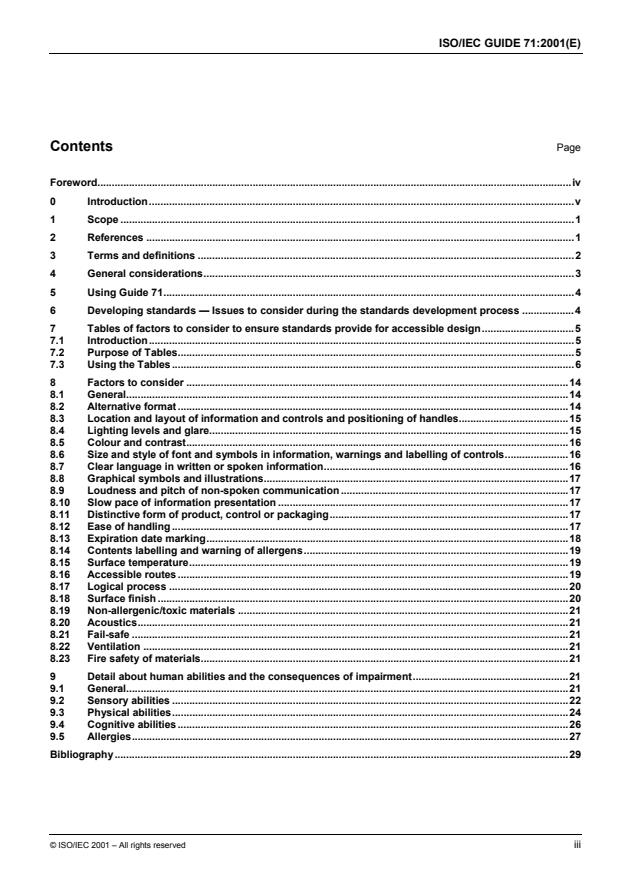
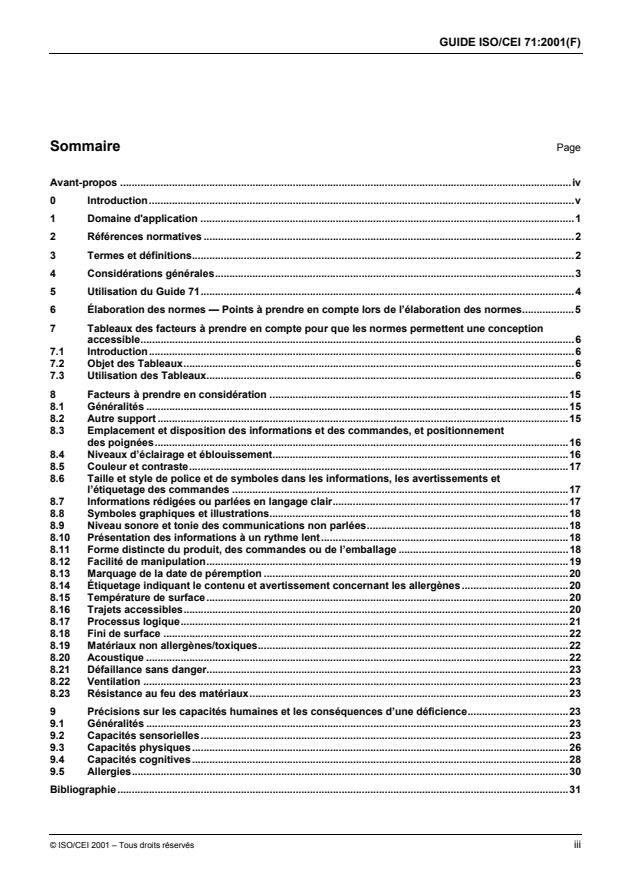
Contents Page
Foreword.iv
0 Introduction.v
1 Scope.1
2 References.1
3 Terms and definitions .2
4 General considerations.3
5 Using Guide 71.4
6 Developing standards — Issues to consider during the standards development process .4
7 Tables of factors to consider to ensure standards provide for accessible design.5
7.1 Introduction.5
7.2 Purpose of Tables.5
7.3 Using the Tables .6
8 Factors to consider .14
8.1 General.14
8.2 Alternative format.14
8.3 Location and layout of information and controls and positioning of handles.15
8.4 Lighting levels and glare.15
8.5 Colour and contrast.16
8.6 Size and style of font and symbols in information, warnings and labelling of controls.16
8.7 Clear language in written or spoken information.16
8.8 Graphical symbols and illustrations.17
8.9 Loudness and pitch of non-spoken communication .17
8.10 Slow pace of information presentation .17
8.11 Distinctive form of product, control or packaging.17
8.12 Ease of handling .17
8.13 Expiration date marking.18
8.14 Contents labelling and warning of allergens.19
8.15 Surface temperature.19
8.16 Accessible routes.19
8.17 Logical process.20
8.18 Surface finish.20
8.19 Non-allergenic/toxic materials.21
8.20 Acoustics.21
8.21 Fail-safe.21
8.22 Ventilation.21
8.23 Fire safety of materials.21
9 Detail about human abilities and the consequences of impairment.21
9.1 General.21
9.2 Sensory abilities.22
9.3 Physical abilities.24
9.4 Cognitive abilities.26
9.5 Allergies.27
Bibliography.29
© ISO/IEC 2001 – All rights reserved iii
Foreword
ISO (the International Organization for Standardization) and IEC (the International Electrotechnical Commission)
form the specialized system for worldwide standardization. National bodies that are members of ISO or IEC
participate in the development of International Standards through technical committees established by the
respective organization to deal with particular fields of technical activity. ISO and IEC technical committees
collaborate in fields of mutual interest. Other international organizations, governmental and non-governmental, in
liaison with ISO and IEC, also take part in the work.
International Standards are drafted in accordance with the rules given in the ISO/IEC Directives, Part 2.
Draft Guides adopted by the responsible Committee or Group are circulated to national bodies for voting.
Publication as a Guide requires approval by at least 75 % of the national bodies casting a vote.
Attention is drawn to the possibility that some of the elements of this Guide may be the subject of patent rights. ISO
and IEC shall not be held responsible for identifying any or all such patent rights.
ISO/IEC Guide 71 was prepared by an ad hoc TAG (Technical Advisory Group) based on the preliminary work
undertaken by a COPOLCO (Committee on Consumer Policy) Working Group, at the request of the ISO/TMB
Secretariat.
iv © ISO/IEC 2001 – All rights reserved
0 Introduction
0.1 It is an important goal for the whole of society that all people have access to products, services, workplaces
and environments. The issue of accessibility to and usability of products and services has become more critical
with the increasing percentage of older persons in the world’s population. While not all older persons have
disabilities, the prevalence of disability or limitations is highest among this demographic group.
0.2 The needs and abilities of people change as they advance from childhood to old age and the abilities of
individuals in any particular age group vary substantially. It is important to recognize that functional and cognitive
limitations vary from comparatively minor, such as mild hearing loss or use of spectacles only to read, to blindness,
deafness or the inability to move part or all of one’s body. It should be noted that although some limitations may be
minor in nature, in combination, as is the case in ageing, these can pose a significant problem.
0.3 For many years, standards bodies at the national and international level have addressed the needs of
persons with disabilities in the development of specific standards in the area of assistive technology and accessible
building design. However, the needs of older persons and persons with disabilities are not being adequately
addressed when other relevant standards for everyday products and services are written or revised. Standards
bodies are starting to address ageing and disability issues and will, increasingly, develop and implement policies
and programmes in their products and services to include the needs of older persons and persons with disabilities.
It is important to ensure the representation of interests of older persons and persons with disabilities in the
development of these solutions.
0.4 This Guide is intended to be part of the overall framework that standards bodies can use in their efforts to
support the need for more accessible products and services. The ISO/IEC Policy Statement 2000 — Addressing
the Needs of Older Persons and People with Disabilities in Standardization Work sets out the principles for
1)
ensuring that the needs of older persons and persons with disabilities are incorporated in the standards-making
process, providing justification on humanitarian and economic grounds. This Guide supplements the ISO/IEC
Policy Statement by identifying problem areas which need to be considered when drafting standards, recognizing
the constraint that standards should normally not be design-restrictive. It is intended for those involved in the
preparation and revision of International Standards but also contains information which may be useful for others
such as manufacturers, designers, service providers and educators.
0.5 Of necessity, guidance provided in this Guide is general. Usability issues for people with impairments are
identified without specific solutions. It is recognized that additional sector-related guides need to be developed for
specific product or service sectors.
1) Developments in the field of accessibility have resulted in the creation and use of a wide variety of terms and definitions,
related to older persons and disability, which differ throughout the world. For example, some people prefer to use the term
“people with disabilities” and others prefer “disabled people”. Overall, terms have evolved to become more precise and
descriptive, rather than negative or stigmatizing. As no universal practice exists, the terms used in this Guide reflect the
language generally used by international agencies such as the United Nations Organization and the World Health Organization.
© ISO/IEC 2001 – All rights reserved v
Guidelines for standards developers to address the needs of older
persons and persons with disabilities
1 Scope
1.1 This Guide provides guidance to writers of relevant International Standards on how to take into account the
needs of older persons and persons with disabilities. Whilst recognizing that some people with very extensive and
complex disabilities may have requirements beyond the level addressed in this Guide, a very large number of
people have minor impairments which can be easily addressed by relatively small changes of approach in
standards, thereby increasing the market for the product or service.
This Guide aims
a) to inform, increase understanding and raise awareness about how human abilities impact on the usability of
products, services and environments,
b) to outline the relationship between the requirements in standards and the accessibility and usability of products
and services, and
c) to raise awareness about the benefits of adopting accessible design principles in terms of a wider market.
1.2 This Guide applies to products, services and environments encountered in all aspects of daily life and
intended for the consumer market and the workplace. For the purposes of this document, the term ‘products and
services’ is used to reflect all these purposes.
1.3 This Guide
a) describes a process by which the needs of older persons and persons with disabilities may be considered in
the development of standards,
b) provides tables to enable standards developers to relate the relevant clauses of a standard to the factors
which should be considered to ensure that all abilities are addressed,
c) offers descriptions of body functions or human abilities and the practical implications of impairment,
d) offers a list of sources that standards developers can use to investigate more detailed and specific guidance
materials.
1.4 This Guide provides general guidance. Consideration should be given to the development of additional
guides for specific product or service sectors.
1.5 While it is recognized that accessibility and usability are important for both products amd services,
international work on services standards is at the preliminary stage. At present, this Guide contains considerably
more guidance on products than on services.
2 References
ISO/IEC Guide 37:1995, Instructions for use of products of consumer interest
© ISO/IEC 2001 – All rights reserved 1
2)
ISO/IEC Guide 50:— , Safety aspects — Guidelines for child safety
ISO/IEC Guide 51:1999, Safety aspects — Guidelines for their inclusion in standards
ISO/IEC Policy Statement, 2000, Addressing the needs of older persons and people with disabilities in
standardization work
World Health Organization, International Classification of Functioning and Disability, ICIDH-2 Beta-2
3 Terms and definitions
For the purposes of this Guide, the following terms and definitions apply.
NOTE This clause is designed to provide clarification of some of the terms used in the fields of ergonomics, accessibility
and standardization. It does not provide descriptions of body functions and impairments. This information is provided in
clause 9. (See also Introduction, footnote 1, page v.)
3.1
ergonomics
human factors
that branch of science and technology that includes what is known and theorized about human behavioural and
biological characteristics that can be validly applied to the specification, design, evaluation, operation and
maintenance of products and systems, to enhance safety, and effective and satisfying use by individuals, groups and
organizations
3.2
accessible design
design focussed on principles of extending standard design to people with some type of performance limitation to
maximize the number of potential customers who can readily use a product, building or service which may be
achieved by
designing products, services and environments that are readily usable by most users without any modification,
by making products or services adaptable to different users (adapting user interfaces), and
by having standardized interfaces to be compatible with special products for persons with disabilities.
NOTE 1 Terms such as design for all, barrier-free design, inclusive design and transgenerational design are used similarly
but in different contexts.
NOTE 2 Accessible design is a subset of universal design where products and environments are usable by all people, to the
greatest extent possible, without the need for adaptation or specialized design.
3.3
assistive technology
assistive device
piece of equipment, product system, hardware, software or service that is used to increase, maintain or improve
functional capabilities of individuals with disabilities
NOTE This can be acquired commercially off-the-shelf, modified or customized. The term includes technical aids for
persons with disabilities. Assistive devices do not eliminate an impairment but may lessen the difficulty an individual has in
carrying out a task or activity in specific environments.
2) To be published. (Revision of ISO/IEC Guide 50:1987.)
2 © ISO/IEC 2001 – All rights reserved
3.4
impairment
problem in body function or structure such as a significant deviation or loss which can be temporary due, for
example, to injury, or permanent, slight or severe and can fluctuate over time, in particular, deterioration due to
ageing
NOTE 1 Body function can be a physiological or psychological function of a body system; body structure refers to an
anatomic part of the body such as organs, limbs and their components (as defined in ICIDH-2 of July 1999). See also
footnote 1, page v.
NOTE 2 This definition differs from that in ISO 9999:2001 and, slightly, from ICIDH-2/ICF: May 2001, WHO.
3.5
activity limitation
difficulty an individual may have in executing taks or actions
3.6
user
person who interacts with the product, service or environment
NOTE Adapted from ISO 9241-11:1998.
3.7
usability
extent to which a product can be used by specified users to achieve specified goals with effectiveness, efficiency
and satisfaction in a specified context of use
[ISO 9241-11:1998]
3.8
alternative format
different presentation which may make products and services accessible by the use of another mobility or sensory
ability
3.9
working dog
guide dog, hearing and seizure, service (usually assisting with mobility needs) and social therapy dog, or any
combination of these
4 General considerations
4.1 Aside from the humanitarian reasons for making products, services and environments more usable by older
persons and persons with disabilities, there are a number of economic benefits. The most obvious is the increase in
potential customers. Features that make products and services usable for persons with disabilities can also make
them convenient and easy to use for everyone else. This is particularly helpful when people have temporary
difficulties, such as lost glasses, a broken leg or a journey with a pram/stroller or bulky luggage.
4.2 Addressing needs earlier rather than later in the design stage enables producers, at little or no extra cost, to
design and produce products, services and environments that more people can use. Standardization greatly
influences the design of products and services that are of interest to the consumer and therefore can play an
important role in this field.
4.3 Technical Committees are encouraged to address the needs of older persons and persons with disabilities in
the drafting of International Standards (see ISO/IEC Policy Statement, Addressing the Needs of Older Persons and
People with Disabilities in Standardization Work). This Guide aims to provide standards developers and related
others with a systematic approach to addressing ageing and disability issues in the writing and revision of
International Standards and to assisting Technical Committees in evaluating how they are addressing these needs
in their Work Programmes.
© ISO/IEC 2001 – All rights reserved 3
4.4 It is recognized that standards committees include risk assessments as part of their analysis (as specified in
Guides 50 and 51). The present Guide will assist committees in the risk assessment process by identifying
potential hazards which can present greater risks to those with impairments.
4.5 Assistive technology, in the form of equipment, software or services, is available to meet some of the needs
of older persons and persons with disabilities. It is important that this is compatible with mainstream products.
Consideration needs to be given to everyday products and their potential to allow the fitting of more technical
assistive devices specifically for older persons and persons with disabilities. Baths and bath seats should be
compatible; equally, hearing aids and telephones should be compatible.
4.6 The provision of personal assistance, including the assistance of working dogs, while sometimes
indispensable to a person with a disability, should never be relied upon to replace accessible design principles.
Where accessible design cannot fully respond to the needs of older persons and persons with disabilities, in
particular in the field of services, the need for personal assistance may still be required.
4.7 In product design there is potential for conflict between safety and usability. For example child-resistant
closures used on medicines to prevent access to children may also make closures more difficult to open for older
persons who no longer see as well, or have reduced strength or dexterity. While safety is the primary objective,
Technical Committees should try to develop solutions which also address ergonomic factors. Guidance on
addressing the needs of children is given in ISO/IEC Guide 50.
5 Using Guide 71
5.1 Clause 6 of this Guide suggests a process standards developers may use to address the needs of older
persons and persons with disabilities as part of their standards development process.
5.2 Clause 7 provides tables to help standards developers to identify factors that will affect the use of a product,
service or environment and to consider their significance for persons with different abilities.
5.3 Clause 8 provides more explanation of the factors to consider, using key words set out in the tables.
5.4 Clause 9 describes the different human abilities, sensory, physical and cognitive, referred to in the tables,
and provides some description of the causes and consequences of impairment. It also includes a section on
allergies which can impose limitations on an individual’s activities and which are in some cases potentially life-
threatening. It is desirable that all standards writers read all of clause 9, to increase awareness of the issues.
5.5 A Bibliography is also provided which offers a list of sources that standards developers can use to
investigate more detailed and specific guidance materials.
6 Developing standards — Issues to consider during the standards development
process
Committees may find the following process helpful in ensuring that the needs of older persons and persons with
disabilities are included, when drafting a new standard or at each revision of an existing one. The process reads
from left to right with guidance on achieving each objective in the columns below.
4 © ISO/IEC 2001 – All rights reserved
Define Ensure Develop Review Publish
standards committee content of process Standard
project well equipped Standard
Identify: Ensure: Use Guide 71 and Ensure: Ensure:
other guidance
material to help
determine:
• purpose of • committee • particular • usability • that standard
standard members needs and requirements can be
aware of safety in standard reproduced in
• end-users of
ageing and concerns of have been alternative
product or
disability older persons assessed, e.g. formats
service being
issues, e.g. and persons by consumer
standardized
experts and with disabilities test panels
• current
users
• ways of • language and
accessibility of
represented
minimizing terminology of
product or
and/or training
hazards standard is
service to
provided
through new or acceptable to
broad range of
• meeting rooms enhanced older persons
users
accessible to requirements and persons
sources:
older persons with disabilities
• ways of
and persons (should not
• suppliers
maximizing
with disabilities discriminate)
• groups accessibility of
• committee product or • draft is
representing
older persons papers service to circulated to
available in broad range of wide range of
and persons
with disabilities alternative users stakeholders,
formats including
• where
• user surveys
groups
• data available alternative
• consumer test
representing
on user solutions, such
panels
older persons
issues, e.g. as assistive
and persons
• guides and
injury data, technology,
with disabilities
policies
focus group are necessary
research
7 Tables of factors to consider to ensure standards provide for accessible design
7.1 Introduction
Tables 1 to 7 provide a tool intended to help standards developers to identify factors that will affect the use of a
product, service or environment by people with different levels of ability. It should be noted that individual users
may have impairment in more than one ability and all abilities should always be considered.
7.2 Purpose of Tables
Each Table identifies typical clauses or sections of International Standards as follows:
Table 1 Information, labelling, instructions and warnings
Table 2 Packaging: opening, closing, use and disposal
Table 3 Materials
Table 4 Installation
© ISO/IEC 2001 – All rights reserved 5
Table 5 User interface, handling, controls and feedback
Table 6 Maintenance, storage and disposal
Table 7 Built environments (buildings)
7.3 Using the Tables
7.3.1 To use the Tables, it is suggested that standards developers first consider which Tables are relevant to
their draft International Standard, that is, what sorts of clauses they expect to include in the standard. For example,
a standard related to an electrical product might have clauses covering information, packaging, materials,
installation, user interface and maintenance and thus Tables 1 to 6 would be relevant. A standard on food
packaging might have clauses covering information, packaging, materials, user interface and maintenance, and so
Tables 1 to 3, 5 and 6 should be consulted. A standard on building access might include clauses on information,
materials, installation, user interface and the built environment in general, suggesting Tables 1, 3, 4, 5 and 7 should
be looked at.
7.3.2 Within each Table, the first column identifies, through key words, the factors which should be considered.
The key words are numbered as they are described in clause 8 of this Guide.
EXAMPLE For an electrical product, when drafting clauses on information and warnings, consideration should be given to
alternative formats, the location and layout of information, the light conditions under which it should be viewed, etc. The key
words “Alternative format” are explained in more detail in 8.2, “Location and layout” are covered in 8.3, and so on.
7.3.3 The remaining columns of each Table show, by shading, where factors are significant for those with
impairment in the various human abilities. Even though the factors which tend to be especially significant are
shaded here, all the factors could be important and should be considered for each different case. So, again in
Table 1, the use of alternative formats for information and warnings can be seen to be important for people with
sensory impairment (in seeing, hearing, touch, taste or smell), and those who have impairment in dexterity or in
language and literacy. The relevant alternative format may be different for different abilities but clearly the more
alternative formats used, the greater the number of people who will be suited. Each of the human abilities is
numbered as it appears in clause 9 so more information about, for example, an ability to see and the potential risks
arising from impairment can be found in 9.2.1.
7.3.4 In conclusion, standards developers should use the Tables selectively — in terms of the Tables and factors
that are relevant to their International Standard. However, once the relevant Tables and factors have been
identified, all the consequent row of Human abilities should be considered. This is because all factors relevant to a
product, service or environment may be significant to people of any ability.
6 © ISO/IEC 2001 – All rights reserved
© ISO/IEC 2001 – All rights reserved 7
Table 1 — Factors to consider in clauses on information
The best designed products or services avoid the need for any explanatory information, signalling the way they should be used by form and appearance.
Additionally, some users may not pay attention to any information provided. Nevertheless where information is supplied, in particular safety warnings, it
needs to be available to all users of a product or service. ISO/IEC Guide 37:1995 provides general guidance; the following are ways of ensuring maximum
accessibility to older persons and persons with disabilities.
Factors to consider Human abilities
in standards clauses on
9.2 Sensory 9.3 Physical 9.4 Cognitive 9.5 Allergy
information (labelling,
instructions and
Seeing Hearing Touch Taste/ Balance Dexterity Manipu- Movement Strength Voice Intellect/ Language/ Contact/
warnings)
9.2.1 9.2.2 9.2.3 smell 9.2.5 9.3.1 lation 9.3.3 9.3.4 9.3.5 memory literacy food/
9.2.4 9.3.2 9.4.2/3 9.4.4 respiratory
8.2 Alternative format
8.3 Location/layout
8.4 Lighting/glare
8.5 Colour/contrast
8.6 Size/style of font
8.7 Clear language
8.8 Symbols/drawings
8.9 Loudness/pitch
8.10 Slow pace
8.11 Distinctive form
8.12 Ease of handling
8.13 Expiration date marking
8.14 Contents labelling
8.15 Surface temperature
8.16 Accessible routes
8 © ISO/IEC 2001 – All rights reserved
Table 2 — Factors to consider in clauses on packaging
Aspects to consider include the labelling of packaging which overlaps with information given in Tables 1 (instructions), 3 (materials) and the process of
opening and disposal of packaging.
Factors to consider Human abilities
in standards clauses on
9.2 Sensory 9.3 Physical 9.4 Cognitive 9.5 Allergy
packaging (opening,
closing, use and
Seeing Hearing Touch Taste/ Balance Dexterity Manipu- Movement Strength Voice Intellect/ Language/ Contact/
disposal)
9.2.1 9.2.2 9.2.3 smell 9.2.5 9.3.1 lation 9.3.3 9.3.4 9.3.5 memory literacy food/
9.2.4 9.3.2 9.4.2/3 9.4.4 respiratory
8.2 Alternative format
8.4 Lighting/glare
8.5 Colour/contrast
8.6 Size/style of font
8.8 Symbols/drawings
8.11 Distinctive form
8.12 Ease of handling
8.17 Logical process
8.18 Surface finish
8.19 Non-allergenic/toxic
© ISO/IEC 2001 – All rights reserved 9
Table 3 — Factors to consider in clauses on materials
The nature of materials has an impact on user interactions.
Factors to consider Human abilities
in standards clauses on
9.2 Sensory 9.3 Physical 9.4 Cognitive 9.5 Allergy
materials
Seeing Hearing Touch Taste/ Balance Dexterity Manipu- Movement Strength Voice Intellect/ Language/ Contact/
9.2.1 9.2.2 9.2.3 smell 9.2.5 9.3.1 lation 9.3.3 9.3.4 9.3.5 memory literacy food/
9.2.4 9.3.2 9.4.2/3 9.4.4 respiratory
8.4.4 Glare
8.5 Colour/contrast
8.11 Distinctive form
8.12 Ease of handling
8.14 Contents labelling
8.15 Surface temperature
8.18 Surface finish
8.19 Non-allergenic/toxic
8.20 Acoustics
10 © ISO/IEC 2001 – All rights reserved
Table 4 — Factors to consider in clauses on Installation
In many cases, installation will or should be carried out by qualified persons who may be less likely to have certain impairments, such as in strength.
However attention should still be given to catering for different abilities wherever possible.
Factors to consider Human abilities
in standards clauses on
9.2 Sensory 9.3 Physical 9.4 Cognitive 9.5 Allergy
installation
Seeing Hearing Touch Taste/ Balance Dexterity Manipu- Movement Strength Voice Intellect/ Language/ Contact/
9.2.1 9.2.2 9.2.3 smell 9.2.5 9.3.1 lation 9.3.3 9.3.4 9.3.5 memory literacy food/
9.2.4 9.3.2 9.4.2/3 9.4.4 respiratory
8.4 Lighting/glare
8.8 Symbols/drawings
8.11 Distinctive form
8.12 Ease of handling
8.17 Logical process
8.18 Surface finish
8.19 Non-allergenic/toxic
8.21 Fail-safe
© ISO/IEC 2001 – All rights reserved 11
Table 5 — Factors to consider in clauses on the user interface
This is the area in which attention to factors can have most impact on usability by a wide range of users.
Factors to consider Human abilities
in standards clauses on
9.2 Sensory 9.3 Physical 9.4 Cognitive 9.5 Allergy
user interface (handling,
controls and feedback)
Seeing Hearing Touch Taste/ Balance Dexterity Manipu- Movement Strength Voice Intellect/ Language/ Contact/
9.2.1 9.2.2 9.2.3 smell 9.2.5 9.3.1 lation 9.3.3 9.3.4 9.3.5 memory literacy food/
9.2.4 9.3.2 9.4.2/3 9.4.4 respiratory
8.2 Alternative format
8.3 Location/layout
8.4 Lighting/glare
8.5 Colour/contrast
8.6 Size/style of font
8.7 Clear language
8.8 Symbols/drawings
8.9 Loudness/pitch
8.10 Slow pace
8.11 Distinctive form
8.12 Ease of handling
8.15 Surface temperature
8.17 Logical process
8.18 Surface finish
8.19 Non-allergenic/toxic
8.20 Acoustics
8.21 Fail-safe
12 © ISO/IEC 2001 – All rights reserved
Table 6 — Factors to consider in clauses on maintenance, storage and disposal
This may be undertaken by someone other than the user; see also Table 4.
Factors to consider Human abilities
in standards clauses on
9.2 Sensory 9.3 Physical 9.4 Cognitive 9.5 Allergy
maintenance, storage
and disposal
Seeing Hearing Touch Taste/ Balance Dexterity Manipu- Movement Strength Voice Intellect/ Language/ Contact/
9.2.1 9.2.2 9.2.3 smell 9.2.5 9.3.1 lation 9.3.3 9.3.4 9.3.5 memory literacy food/
9.2.4 9.3.2 9.4.2/3 9.4.4 respiratory
8.2 Alternative format
8.4 Lighting/glare
8.8 Symbols/drawings
8.11 Distinctive form
8.12 Ease of handling
8.17 Logical process
8.19 Non allergenic/toxic
© ISO/IEC 2001 – All rights reserved 13
Table 7 — Factors to consider in clauses relating to the built environment (buildings)
Design of the built environment may need to take into account the additional requirements of assistive technology. For example wider corridors are needed
for wheelchairs to pass. Buildings otherwise closed to animals should nevertheless provide access for working dogs. Where design solutions are
constrained, providing personal assistance to, for example, visually impaired persons or wheelchair users may facilitate access.
Factors to consider Human abilities
in clauses relating to
9.2 Sensory 9.3 Physical 9.4 Cognitive 9.5 Allergy
the built environment
(buildings)
Seeing Hearing Touch Taste/ Balance Dexterity Manipu- Movement Strength Voice Intellect/ Language/ Contact/
9.2.1 9.2.2 9.2.3 smell 9.2.5 9.3.1 lation 9.3.3 9.3.4 9.3.5 memory literacy food/
9.2.4 9.3.2 9.4.2/3 9.4.4 respiratory
8.2 Alternative format
8.3 Location/layout
8.4 Lighting/glare
8.5 Colour/contrast
8.6 Size/style of font
8.7 Clear language
8.8 Symbols/drawings
8.9 Loudness/pitch
8.10 Slow pace
8.12 Ease of handling
8.15 Surface temperature
8.16 Accessible routes
8.18 Surface finish
8.19 Non-allergenic/toxic
8.20 Acoustics
8.22 Ventilation
8.23 Fire resistance
8 Factors to consider
8.1 General
8.1.1 This clause, to be used in conjunction with Tables 1 to 7 and the fuller descriptions of abilities in clause 9,
provides more detail on the features of products, services and environment that assist or hinder older persons and
persons with disabilities.
8.1.2 Clauses 8.2 onwards expand on the key words used in the Tables, describing the factors to consider to
make products and services accessible. Examples of possible solutions are given but these should be treated as
guidance and not specifications. The list of problems and solutions is not exhaustive.
8.1.3 Where they exist, International or national Standards on accessibility should be consulted before writing
new or revised standards that meet any of the table positions identified as a result of 7.3.3.
8.2 Alternative format
8.2.1 General considerations
An alternative format (defined in 3.8) describes a different presentation or representation intended to make
products and services accessible through a different modality or sensory ability. By providing all input and all
output, i.e. information and functions, in at least one alternative format, for instance visual and tactile, more people,
including some with language/literacy problems, may be helped. In terms of function for people with dexterity and
strength impairment, alternative packaging solutions may need to be envisaged.
8.2.2 Alternatives to visual information
The type and texture of surface finishes can be important in providing tactile feedback which can reinforce
instructions and warnings for those with visual impairment. Where the principal form of instruction on a product or in
a building is written, alternatives would be voice (instructions ‘spoken’ by a product or service), sound (feedback
from clicks, bells and buzzers) or touch (tactile marking or grip).
Wherever feasible, visual information which is presented on electronic products should be available from the
product in audio or other sensory stimuli for those with a visual impairment including those who cannot read braille,
as well as for those who have difficulty with reading or are unable to read. Printed visual information should be
available in alternative formats (electronic audio, large raised letters or braille, etc.) which are readable by
individuals without vision and in large print for those with low vision.
8.2.3 Alternatives to auditory information
Wherever feasible, sound signals should be supported by visual or other sensory stimuli for those with a hearing
impairment (e.g. communication in writing, graphical symbols, vibration or sign language). In particular, audible
warnings, such as fire alarms, should also activate, for example, visual stimuli, such as flashing lights which are
well sited and clearly indicated.
8.2.4 Alternatives to voice input
Where voice input is used to activate a process, for example building entry security systems, alternatives such as
keypads or the use of video monitoring should be considered.
8.2.5 Biological identification and operation
Where biometric forms of identification are intended, an alternative form of identification or activation should also be
provided. For example, if systems require a retinal scan and a person does not have a retina, or the system
requires a fingerprint amd the person does not have hands or uses a prosthesis, such people are unable to operate
the devices unless some alternative form of identification is substituted.
14 © ISO/IEC 2001 – All rights reserved
8.2.6 Prevention of seizures
Flicker rates, or flashing or blinking text, objects or video screens should avoid frequencies that are most likely to
trigger visually induced seizures.
8.3 Location and layout of information and controls and positioning of handles
8.3.1 Location
The position of information and controls on a product, or in a building, or even the point at which information is
available for a service (e.g. warnings about the terms on which dry-cleaners accept clothes for processing) are
important. They need to be prominent for someone with a visual impairment or language/literacy disability, visible
from the angle of view of someone standing and seated in a wheelchair, and easily accessed by seated or standing
users without bending and stretching. This may mean that the positioning needs to be flexible or adjustable or
duplicated. Information or controls should be located in a position where they will not be obstructed, for example
when a product is held by either or both hands, or held in a different way by someone with manipulation or strength
impairment.
8.3.2 Buildings
The design of buildings can incorporate simple measures that enable people to feel more confident in the physical
environment, such as well placed, sturdy handrails. Controls and door handles within easy reach facilitate use by
those with impairment in dexterity, manipulation, movement or strength.
8.3.3 Layout
The layout of information and controls will also determine how easy they are to read by someone with a visual or
cognitive impairment. Factors to c
...
GUIDE 71
Principes directeurs pour les
normalisateurs afin de répondre
aux besoins des personnes
âgées et de celles ayant
des incapacités
Première édition 2001
©
ISO/CEI 2001
GUIDE ISO/CEI 71:2001(F)
PDF – Exonération de responsabilité
Le présent fichier PDF peut contenir des polices de caractères intégrées. Conformément aux conditions de licence d'Adobe, ce fichier peut
être imprimé ou visualisé, mais ne doit pas être modifié à moins que l'ordinateur employé à cet effet ne bénéficie d'une licence autorisant
l'utilisation de ces polices et que celles-ci y soient installées. Lors du téléchargement de ce fichier, les parties concernées acceptent de fait la
responsabilité de ne pas enfreindre les conditions de licence d'Adobe. Le Secrétariat central de l'ISO décline toute responsabilité en la
matière.
Adobe est une marque déposée d'Adobe Systems Incorporated.
Les détails relatifs aux produits logiciels utilisés pour la création du présent fichier PDF sont disponibles dans la rubrique General Info du
fichier; les paramètres de création PDF ont été optimisés pour l'impression. Toutes les mesures ont été prises pour garantir l'exploitation de
ce fichier par les comités membres de l'ISO. Dans le cas peu probable où surviendrait un problème d'utilisation, veuillez en informer le
Secrétariat central à l'adresse donnée ci-dessous.
© ISO/CEI 2001
Droits de reproduction réservés. Sauf prescription différente, aucune partie de cette publication ne peut être reproduite ni utilisée sous quelque
forme que ce soit et par aucun procédé, électronique ou mécanique, y compris la photocopie et les microfilms, sans l'accord écrit de l’ISO à
l’adresse ci-après ou du comité membre de l’ISO dans le pays du demandeur.
ISO copyright office
Case postale 56 • CH-1211 Geneva 20
Tel. + 41 22 749 01 11
Fax. + 41 22 749 09 47
E-mail copyright@iso.ch
Web www.iso.ch
Version française parue en 2002
Imprimé en Suisse
ii © ISO/CEI 2001 – Tous droits réservés
GUIDE ISO/CEI 71:2001(F)
Sommaire Page
Avant-propos .iv
0 Introduction.v
1 Domaine d'application.1
2 Références normatives.2
3 Termes et définitions.2
4 Considérations générales.3
5 Utilisation du Guide 71.4
6 Élaboration des normes — Points à prendre en compte lors de l’élaboration des normes.5
7 Tableaux des facteurs à prendre en compte pour que les normes permettent une conception
accessible.6
7.1 Introduction.6
7.2 Objet des Tableaux.6
7.3 Utilisation des Tableaux.6
8 Facteurs à prendre en considération .15
8.1 Généralités.15
8.2 Autre support.15
8.3 Emplacement et disposition des informations et des commandes, et positionnement
des poignées.16
8.4 Niveaux d’éclairage et éblouissement.16
8.5 Couleur et contraste.17
8.6 Taille et style de police et de symboles dans les informations, les avertissements et
l’étiquetage des commandes .17
8.7 Informations rédigées ou parlées en langage clair.17
8.8 Symboles graphiques et illustrations.18
8.9 Niveau sonore et tonie des communications non parlées.18
8.10 Présentation des informations à un rythme lent.18
8.11 Forme distincte du produit, des commandes ou de l’emballage .18
8.12 Facilité de manipulation.19
8.13 Marquage de la date de péremption .20
8.14 Étiquetage indiquant le contenu et avertissement concernant les allergènes.20
8.15 Température de surface.20
8.16 Trajets accessibles.20
8.17 Processus logique.21
8.18 Fini de surface .22
8.19 Matériaux non allergènes/toxiques.22
8.20 Acoustique.22
8.21 Défaillance sans danger.23
8.22 Ventilation.23
8.23 Résistance au feu des matériaux.23
9 Précisions sur les capacités humaines et les conséquences d’une déficience.23
9.1 Généralités.23
9.2 Capacités sensorielles.23
9.3 Capacités physiques.26
9.4 Capacités cognitives.28
9.5 Allergies.30
Bibliographie.31
© ISO/CEI 2001 – Tous droits réservés iii
GUIDE ISO/CEI 71:2001(F)
Avant-propos
L'ISO (Organisation internationale de normalisation) est une fédération mondiale d'organismes nationaux de
normalisation (comités membres de l'ISO). L'élaboration des Normes internationales est en général confiée aux
comités techniques de l'ISO. Chaque comité membre intéressé par une étude a le droit de faire partie du comité
technique créé à cet effet. Les organisations internationales, gouvernementales et non gouvernementales, en
liaison avec l'ISO participent également aux travaux. L'ISO collabore étroitement avec la Commission
électrotechnique internationale (CEI) en ce qui concerne la normalisation électrotechnique.
Les Guides sont rédigés conformément aux règles données dans les Directives ISO/CEI, Partie 2.
Les projets de Guides adoptés par le comité ou le groupe responsable sont soumis aux comités membres pour
vote. Leur publication comme Guides requiert l'approbation de 75 % au moins des comités membres votants.
L'attention est appelée sur le fait que certains des éléments du présent Guide peuvent faire l'objet de droits de
propriété intellectuelle ou de droits analogues. L'ISO ne saurait être tenue pour responsable de ne pas avoir
identifié de tels droits de propriété et averti de leur existence.
Le Guide ISO/CEI 71 a été élaboré par un Groupe Technique consultatif (TAG) ad hoc sur la base du travail
préliminaire entrepris par un Groupe de travail du Comité pour la politique en matière de consommation
(COPOLCO), à la demande du Secrétariat de l’ISO/TMB.
iv © ISO/CEI 2001 – Tous droits réservés
GUIDE ISO/CEI 71:2001(F)
0 Introduction
0.1 Il est important, pour l’ensemble de la société, que tous les individus aient accès aux produits, services, lieux
de travail et environnements. La question de l’accessibilité et de l’utilisabilité des produits et services est devenue
plus critique, étant donné le pourcentage croissant de personnes âgées dans la population mondiale. Les
personnes âgées ne présentent pas toutes des incapacités, mais c’est au sein de ce groupe démographique que
les incapacités ou les limitations sont les plus importantes.
0.2 Les besoins et capacités des individus changent au fur et à mesure qu’ils avancent en âge, de l’enfance à la
vieillesse, et les capacités des individus dans un groupe d’âge donné sont très variables. Il est important de
reconnaître que les limitations fonctionnelles et cognitives varient, et vont d’une limitation comparativement
mineure telle qu’un déficit auditif léger ou le port de lunettes pour la lecture seulement, à la cécité, la surdité ou
l’incapacité à bouger une partie ou l’ensemble du corps. Il convient de noter que, bien que certaines limitations
puissent être mineures par nature, elles peuvent représenter un problème significatif en combinaison avec
d’autres, comme dans le cas du vieillissement.
0.3 Depuis de nombreuses années, les organismes de normalisation au niveau national et international
répondent aux besoins des personnes ayant des incapacités, en élaborant des normes spécifiques dans le
domaine des aides techniques et de la conception des bâtiments accessibles. Toutefois, les besoins des
personnes âgées et de celles présentant des incapacités ne sont pas pris en considération de façon adéquate lors
de l’élaboration ou de la révision d’autres normes, relatives à des produits et services courants. Les organismes de
normalisation commencent à prendre en compte les problèmes liés à la vieillesse et aux incapacités, et vont de
plus en plus développer et mettre en œuvre des politiques et des programmes prenant en compte les besoins des
personnes âgées et de celles ayant des incapacités. Il est important que les intérêts des personnes âgées et de
celles présentant des incapacités soient représentés dans le cadre de l’élaboration de ces solutions.
0.4 Le présent Guide est destiné à faire partie du cadre global que les organismes de normalisation peuvent
utiliser afin de prendre en charge le besoin de produits et services plus accessibles. La déclaration politique
ISO/CEI 2000 — Prise en compte dans la normalisation des besoins des personnes âgées et de celles ayant des
incapacités établit les principes garantissant que les besoins des personnes âgées et de celles présentant des
1)
incapacités sont intégrés dans les normes, dans une double optique humanitaire et économique. Le présent
Guide vient en complément de l’énoncé de principes ISO/CEI, en identifiant les problèmes à prendre en compte
lors de l’élaboration des normes compte tenu du fait que les normes ne doivent normalement pas représenter un
obstacle à la conception. Il est destiné aux personnes impliquées dans la préparation et la révision des Normes
internationales. Toutefois, il contient également des informations qui peuvent s’avérer utiles aux fabricants,
concepteurs, prestataires de services, éducateurs spécialisés, etc.
0.5 Un guide général ne peut fournir que des informations d’ordre général. Les problèmes d’utilisabilité pour les
personnes ayant des incapacités sont identifiés, mais aucune solution spécifique n’est proposée. Il est admis qu’il
est nécessaire d’élaborer des guides supplémentaires pour des secteurs spécifiques de produits et services.
1) Les développements dans le domaine de l’accessibilité ont abouti à la création et à l’utilisation de nombreux termes et
définitions relatifs aux personnes âgées et à l’incapacité, mais les termes utilisés diffèrent au niveau international. Par exemple,
certains préfèrent utiliser le terme «personne ayant des incapacités» et d’autres «personne handicapée». De façon générale,
les termes sont devenus plus précis et descriptifs, plutôt que négatifs ou dépréciatifs. Étant donné l’absence de pratique
universelle, les termes utilisés dans le présent Guide reflètent le langage généralement utilisé par les agences internationales
telles que l’Organisation des Nations unies et l’Organisation mondiale de la santé.
© ISO/CEI 2001 – Tous droits réservés v
GUIDE ISO/CEI 71:2001(F)
Principes directeurs pour les normalisateurs afin de répondre aux
besoins des personnes âgées et de celles ayant des incapacités
1 Domaine d'application
1.1 Le présent Guide fournit des principes directeurs aux rédacteurs de Normes internationales sur la façon de
prendre en considération les besoins des personnes âgées et de celles ayant des incapacités. Certaines
personnes ayant des incapacités très graves et complexes peuvent nécessiter une prise en considération de
niveau supérieur à celles du présent Guide, mais un très grand nombre de personnes ont des déficiences
mineures dont il est facile de tenir compte par des changements d’approche relativement mineurs dans les
normes; il en résulte une augmentation du marché pour le produit ou le service considéré.
L’objectif de ce Guide est
a) d’informer, de sensibiliser et d’expliquer comment les capacités humaines influent sur l’utilisation de produits,
services et environnements;
b) de mettre en évidence la relation qui existe entre d’une part les exigences des normes et d’autre part
l’accessibilité et l’utilisabilité des produits et services;
c) de mieux faire prendre conscience de l’intérêt d’adopter des principes de conception accessible, dans une
optique d’élargissement du marché.
1.2 Le présent Guide s’applique aux produits, services et environnements concernant tous les aspects de la vie
courante, destinés à être mis sur le marché et se trouvant sur le lieu de travail. Aux fins de ce document, le terme
«produits et services» est utilisé pour désigner tous ces aspects.
1.3 Le présent Guide
a) décrit un processus de prise en considération des besoins des personnes âgées et de celles ayant des
incapacités lors de l’élaboration des normes;
b) fournit des tableaux permettant aux rédacteurs de normes de relier les articles d’une norme aux facteurs qu’il
convient de prendre en considération pour que toutes les incapacités soient prises en compte;
c) fournit des descriptions de fonctions corporelles ou de capacités humaines, et indique les implications
pratiques d’une déficience;
d) donne une liste de sources utilisables par les rédacteurs de normes pour rechercher des informations plus
détaillées et plus spécifiques en matière de guide.
1.4 Le présent guide fournit des lignes directrices générales. Il est nécessaire de réfléchir à l’élaboration de
guides sectoriels spécifiques à des produits ou des services.
1.5 Même si l’on reconnaît que l’accessibilité et l’utilisabilité sont aussi importantes pour les produits que pour
les services, les travaux au niveau international dans le domaine des normes de services ne font que débuter.
Actuellement, ce guide s’applique beaucoup plus aux produits qu’aux services.
© ISO/CEI 2001 – Tous droits réservés 1
GUIDE ISO/CEI 71:2001(F)
2 Références normatives
Guide ISO/CEI 37:1995, Instructions d’emploi pour les produits présentant un intérêt pour les consommateurs
2)
Guide ISO/CEI 50:— , Aspects liés à la sécurité — Principes directeurs pour la sécurité des enfants
Guide ISO/CEI 51:1999, Aspects liés à la sécurité — Principes directeurs pour les inclure dans les normes
Déclaration politique de l’ISO/CEI, 2000, Prise en compte dans la normalisation des besoins des personnes âgées
et de celles ayant des incapacités
World Health Organization (Organisation mondiale de la santé), International Classification of Functioning and
Disability, ICIDH-2 Beta-2
3 Termes et définitions
Pour les besoins du présent Guide, les termes et définitions suivants s'appliquent.
NOTE L’article est destiné à clarifier certains termes utilisés dans les domaines de l’ergonomie, de l’accessibilité et de la
normalisation. Il ne fournit pas de descriptions des fonctions corporelles et des déficiences. Ces informations sont fournies à
l’article 9 (voir également la note 1 de bas de page de l’Introduction).
3.1
ergonomie
facteurs humains
branche de la science et de la technologie incluant les connaissances et théories sur le comportement humain et
les caractéristiques biologiques que l’on peut valablement appliquer à la spécification, à la conception, à
l’évaluation, au fonctionnement et à l’entretien des produits et systèmes afin d’en augmenter la sécurité et d’en
améliorer l’utilisation effective et satisfaisante par des individus, des groupes et des organismes
3.2
conception accessible
conception centrée sur les principes d’extension de la conception des normes aux personnes présentant un certain
type de limitation, afin d’augmenter le nombre de clients potentiels pouvant utiliser facilement un produit ou un
service, ou pouvant accéder facilement à un bâtiment, qui peut être obtenue par:
la conception de produits, services et environnements facilement utilisables par la plupart des utilisateurs sans
aucune modification,
l’adaptation des produits ou services à différents utilisateurs (adaptation d’interfaces utilisateur), et
la normalisation des interfaces afin de les rendre compatibles avec des produits spéciaux destinés aux
personnes ayant des incapacités
NOTE 1 Les termes tels que conception pour tous, aménagement à accès facile, conception inclusive, conception
transgénérationnelle sont utilisés de façon similaire mais dans différents contextes.
NOTE 2 La conception accessible est un sous-ensemble de la conception universelle dans laquelle les produits et
environnements sont utilisables par tous, dans la mesure du possible, sans adaptation ni conception particulière.
2) À publier. (Révision du Guide ISO/CEI 50:1987)
2 © ISO/CEI 2001 – Tous droits réservés
GUIDE ISO/CEI 71:2001(F)
3.3
technologie d’aide
aide technique
pièce d’équipement, système, matériel informatique, logiciel ou service utilisé pour augmenter, maintenir ou
améliorer les capacités fonctionnelles des individus ayant des incapacités
NOTE Cette technologie peut être disponible dans le commerce ou résulter d’une modification ou d’une personnalisation.
Ce terme inclut les aides techniques destinées aux personnes ayant des incapacités. Les aides techniques ne suppriment pas
une déficience, mais ils peuvent réduire la difficulté qu’a un individu à accomplir une tâche ou à mener une activité dans des
environnements spécifiques.
3.4
déficience
problème d’une fonction ou d’une structure corporelle, comme une déviation ou une perte significative, qui peut
être temporaire (dû à une blessure, par exemple) ou permanent, léger ou grave, et qui peut fluctuer dans le temps,
en particulier détérioration en raison du vieillissement
NOTE 1 La fonction corporelle peut être une fonction physiologique ou psychologique d’un système corporel; la structure
corporelle se rapporte à une partie anatomique du corps telle que les organes, les membres et leurs composants (tels que
définis dans la publication ICIDH-2, juillet 1999). Voir aussi la note de bas de page 1), page v.
NOTE 2 Cette définition diffère de celle de l’ISO 9999:2001, et légèrement de celle de la publication ICIDH-2/ICF:mai 2001,
de l’Organisation mondiale de la santé.
3.5
limitation d’activité
difficulté que peut avoir un individu à exécuter des tâches ou des actions
3.6
utilisateur
personne en interaction avec le produit, le service ou l’environnement
NOTE Adapté de l’ISO 9241-11:1998.
3.7
utilisabilité
degré selon lequel un produit peut être utilisé, par des utilisateurs identifiés, pour atteindre des buts définis avec
efficacité, efficience et satisfaction, dans un contexte d’utilisation spécifié
[ISO 9241-11:1998]
3.8
autre support
présentation différente permettant de rendre des produits et des services accessibles en faisant appel à une autre
mobilité ou à une autre capacité sensorielle
3.9
chien d’assistance
chien guide, chien d’aide, par exemple pour faciliter la mobilité de la personne, chien à vocation de thérapie
sociale, ou combinaison de plusieurs de ces fonctions
4 Considérations générales
4.1 Outre les raisons humanitaires, il existe un certain nombre d’avantages économiques à créer des produits,
services et environnements plus utilisables par les personnes âgées et celles ayant des incapacités. Le plus
évident est l’augmentation de clients potentiels. Les produits et services ayant des caractéristiques qui les rendent
utilisables par des personnes présentant des incapacités peuvent également se révéler pratiques et faciles à
utiliser par toute autre personne. Cela est particulièrement utile en cas de difficultés temporaires, comme une perte
de lunettes, une jambe cassée ou un trajet avec un landau/une poussette ou avec un bagage encombrant.
© ISO/CEI 2001 – Tous droits réservés 3
GUIDE ISO/CEI 71:2001(F)
4.2 S’ils se soucient de ces besoins plus en amont de la conception, les fabricants pourront, moyennant un coût
supplémentaire faible ou nul, concevoir et produire des produits, services et environnements utilisables par
davantage de personnes. La normalisation a une incidence importante sur la conception de produits et services
intéressant le consommateur, et peut donc jouer un rôle considérable dans ce domaine.
4.3 Les comités techniques sont encouragés à se pencher sur les besoins des personnes âgées et de celles
présentant des incapacités lors de l’élaboration de Normes internationales (voir la déclaration politique de l’ISO/CEI,
Prise en compte dans la normalisation des besoins des personnes âgées et de celles ayant des incapacités). Le
présent Guide a pour but de fournir aux rédacteurs de normes et autres personnes concernées une approche
systématique des problèmes liés au vieillissement et aux incapacités, pour l’élaboration et la révision de Normes
internationales et d’aider les comités techniques à évaluer dans quelle mesure ils tiennent compte de ces besoins
dans leurs programmes de travail.
4.4 On sait que les comissions de normalisation effectuent des évaluations des risques dans le cadre de leur
analyse (selon les spécifications du Guide 50 et du Guide 51). Le présent Guide leur facilite la tâche en identifiant
les dangers potentiels susceptibles de représenter des risques accrus pour les personnes ayant des déficiences.
4.5 Les aides techniques, sous la forme d’équipements, de logiciels ou de services, permettent de répondre à
certains besoins des personnes âgées et de celles ayant des incapacités. Il est important d’assurer la compatibilité
entre les aides techniques et les produits courants. Il est nécessaire de prendre en considération les produits
courants et leur potentiel pour permettre l’adaptation d’aides techniques plus spécifiquement destinées aux
personnes âgées et à celles ayant des incapacités. Il convient d’assurer la compatibilité entre les baignoires et les
sièges de bain, ainsi qu’entre les téléphones et les aides à l’audition.
4.6 Il convient qu’une assistance personnelle, y compris celle de chiens d’assistance, même si elle est parfois
indispensable pour une personne présentant une incapacité, ne se substitue jamais à des principes de conception
accessible. Si, malgré une conception accessible, les besoins des personnes âgées et de celles ayant des
incapacités ne peuvent pas être totalement satisfaits, en particulier dans le domaine des services, une assistance
personnelle peut s’avérer nécessaire.
4.7 Dans la conception de produits, il existe un risque de conflit entre sécurité et utilisabilité. Par exemple, les
fermetures à l’épreuve des enfants utilisées pour les médicaments peuvent s’avérer plus difficiles à ouvrir pour les
personnes âgées qui n’y voient plus très bien, ou ont moins de force ou de dextérité. Même si la sécurité est
l’objectif principal, il convient que les comités techniques s’efforcent de trouver des solutions prenant également en
compte des facteurs ergonomiques. Le Guide ISO/CEI 50 traite des besoins concernant les enfants.
5 Utilisation du Guide 71
5.1 L’article 6 du présent Guide propose aux rédacteurs de normes un procédé pour tenir compte, dans le travail
d’élaboration des normes, des besoins des personnes âgées et de celles ayant des incapacités.
5.2 L’article 7 fournit des tableaux destinés à aider les rédacteurs de normes à identifier les facteurs qui auront
une incidence sur l’utilisation d’un produit, d’un service ou d’un environnement, et à étudier leur importance pour
des personnes ayant des capacités différentes.
5.3 L’article 8 fournit des explications complémentaires sur les facteurs à prendre en compte, en utilisant des
mots clés présents dans les tableaux.
5.4 L’article 9 décrit les différentes capacités humaines, sensorielles, physiques et cognitives, mentionnées dans
les tableaux, et donne une description des causes et des conséquences d’une déficience. Il comprend également
une section sur les allergies, qui peuvent limiter les activités d’un individu et peuvent dans certains cas être
mortelles. Il est souhaitable que tous les rédacteurs de normes lisent tout l’article 9, pour mieux prendre
conscience des problèmes.
5.5 Une Bibliographie est également fournie; elle donne une liste de sources que les rédacteurs de normes
peuvent utiliser pour rechercher des informations plus spécifiques et plus détaillées.
4 © ISO/CEI 2001 – Tous droits réservés
GUIDE ISO/CEI 71:2001(F)
6 Élaboration des normes — Points à prendre en compte lors de l’élaboration
des normes
Les commissions peuvent s’aider du processus ci-après pour s’assurer que les besoins des personnes âgées et de
celles ayant des incapacités sont pris en compte, lors de la rédaction d’une nouvelle norme ou à chaque révision
d’une norme existante. Le processus se lit de gauche à droite, et les colonnes ci-dessous indiquent comment
réaliser chaque objectif.
Définir le projet S’assurer un Élaborer Revoir Publier
de la norme comité bien le contenu le processus la norme
équipé de la norme
Identifier: S’assurer que: Utiliser le Guide 71 S’assurer que: S’assurer que:
ou d’autres
informations pour
déterminer:
• l’objet de la • les membres • les besoins • les exigences • la norme peut
norme du comité sont particuliers et d’utilisabilité de être reproduite
conscients des les problèmes la norme ont sur d’autres
• les utilisateurs
problèmes liés de sécurité des été évaluées, supports
finals du
au personnes par exemple,
produit ou du
vieillissement âgées et des par un panel de
service à
et aux personnes consomma-
normaliser
incapacités, présentant des teurs
• l’accessibilité
par exemple incapacités
• la langue et la
actuelle du
que des
• les moyens de terminologie de
produit ou du
experts et
réduire les la norme sont
service à un
utilisateurs
risques par des acceptables
large éventail
soient
exigences pour des
d’utilisateurs
représentés,
nouvelles ou personnes
et/ou qu’une
Sources:
plus strictes âgées et des
formation soit
personnes
• fournisseurs
• les moyens de
prévue
présentant des
maximiser
• groupes
• les salles de incapacités
l’accessibilité
représentant
réunion sont (pas de
d’un produit ou
des personnes
accessibles discrimination)
d’un service à
âgées et des
aux personnes
un vaste • le projet est
personnes
âgées et à
éventail mis en
présentant des
celles
d’utilisateurs circulation
incapacités
présentant des
auprès d’un
• si d’autres
• études
incapacités
vaste éventail
solutions,
d’utilisateurs
• les documents de parties
comme une
• panels de
du comité sont prenantes, y
technologie
consomma-
disponibles sur compris des
d’assistance,
teurs
d’autres groupes
sont
supports représentant
• guides et
nécessaires
des personnes
modalités
• des données
âgées et des
sont
personnes
disponibles sur
présentant des
les problèmes
incapacités
des utilisateurs,
par exemple
concernant des
blessures
© ISO/CEI 2001 – Tous droits réservés 5
GUIDE ISO/CEI 71:2001(F)
7 Tableaux des facteurs à prendre en compte pour que les normes permettent
une conception accessible
7.1 Introduction
Les Tableaux 1 à 7 sont un outil destiné à aider les rédacteurs de normes à identifier les facteurs qui auront une
incidence sur l’utilisation d’un produit, d’un service ou d’un environnement par des personnes ayant différents
niveaux de capacité. Il convient de noter que les utilisateurs peuvent avoir une déficience dans plus d’une capacité
et qu’il y a lieu de toujours prendre toutes les capacités en considération.
7.2 Objet des Tableaux
Chaque Tableau identifie les articles ou sections types des Normes internationales, comme suit:
Tableau 1 Information, étiquetage, instructions et avertissements
Tableau 2 Emballage: ouverture, fermeture, utilisation et mise au rebut
Tableau 3 Matériaux
Tableau 4 Installation
Tableau 5 Interface utilisateur, manipulation, commandes et retour d’information
Tableau 6 Entretien, stockage et mise au rebut
Tableau 7 Milieux bâtis (bâtiments)
7.3 Utilisation des Tableaux
7.3.1 Pour utiliser les Tableaux, il est suggéré aux rédacteurs de normes de commencer par voir quels tableaux
concernent leurs projet de Norme internationale, c’est-à-dire quelles sortes d’articles ils ont l’intention d’intégrer
dans la norme. Par exemple, une norme relative à un produit électrique peut comporter des articles recouvrant
l’information, l’emballage, les matériaux, l’installation, l’interface utilisateur et l’entretien, et donc les Tableaux 1 à 6
seraient pertinents. Une norme sur l’emballage alimentaire pourrait comporter des articles recouvrant l’information,
l’emballage et les matériaux, l’interface utilisateur et l’entretien, et par conséquent il convient de consulter les
Tableaux 1 à 3, 5 et 6. Une norme sur l’accès aux bâtiments pourrait comporter des articles sur l’information, les
matériaux, l’interface utilisateur et les milieux bâtis en général, par conséquent il convient de consulter les
Tableaux 1, 3, 4, 5 et 7.
7.3.2 Dans chaque Tableau, la première colonne identifie, par des mots clés, les facteurs qu’il convient de
prendre en compte. Les mots clés sont numérotés selon l’article 8 du présent Guide.
EXEMPLE Pour un produit électrique, lors de l’élaboration des articles traitant de l’information et des avertissements, il
convient d’envisager d’autres supports, de veiller à l’emplacement et à la disposition des informations, aux conditions
d’éclairage sous lesquelles il pourrait être examiné, etc. Le mot clé «autre support» est explicité en 8.2, «emplacement et
disposition» est traité en 8.3, etc.
7.3.3 Les autres colonnes de chaque Tableau montrent, en grisé, les facteurs significatifs en fonction des
déficiences dans les différentes capacités humaines. Même si les facteurs qui peuvent être particulièrement
significatifs sont présentés en grisé, tous les facteurs pourraient avoir de l’importance et il convient de les prendre
en considération dans chaque cas. Ainsi, dans le Tableau 1, l’utilisation d’autres supports pour les informations et
les avertissements apparaît comme important pour les personnes présentant une déficience sensorielle (vue,
audition, toucher, goût ou odorat) et pour celles ayant une dextérité réduite ou des déficiences de langage ou
d’alphabétisation. Le support adéquat peut varier selon les différentes capacités, mais plus les supports sont
nombreux, plus ils seront adaptés à un grand nombre de personnes. Chacune des capacités humaines est
numérotée selon l’article 9, ainsi on trouvera en 9.2.1 un complément d’information concernant, par exemple, la
capacité à voir et les risques potentiels liés à une déficience visuelle.
6 © ISO/CEI 2001 – Tous droits réservés
GUIDE ISO/CEI 71:2001(F)
7.3.4 En conclusion, il convient que les rédacteurs de normes utilisent les Tableaux de manière sélective — en
choisissant les Tableaux et les facteurs pertinents pour leur Norme internationale. Cependant, une fois que les
tableaux et facteurs pertinents ont été identifiés, il convient de prendre en considération toute la ligne concernant
les capacités humaines. En effet, tous les facteurs pertinents pour un produit, un service ou un environnement
peuvent être significatifs pour une personne, quelles que soient ses capacités.
© ISO/CEI 2001 – Tous droits réservés 7
GUIDE ISO/CEI 71:2001(F)
8 © ISO/CEI 2001 – Tous droits réservés
Tableau 1 — Facteurs à prendre en considération dans les articles sur les informations
Les produits ou services les mieux conçus ne nécessitent pas d’explications, car leur usage est indiqué par leur forme et leur aspect. De plus, certains
utilisateurs ne font pas attention aux informations fournies. Néanmoins, lorsque des informations sont fournies, en particulier des avertissements en matière
de sécurité, elles doivent être accessibles à tous les utilisateurs d’un produit ou service. Le guide ISO/CEI 37:1995 donne des orientations générales; le
tableau ci-après indique des manières d’assurer une accessibilité maximale aux personnes âgées et à celles ayant des incapacités.
Facteurs à prendre en Capacités humaines
considération dans les
9.2 Sensorielles 9.3 Physiques 9.4 Cognitives 9.5 Allergie
articles de normes sur les
informations, (étiquetage,
Vue Ouïe Toucher Goût/ Équilibre Dextérité Manipu- Mouvement Force Voix Intellect/ Langage/ De contact/
instructions et
9.2.1 9.2.2 9.2.3 odorat 9.2.5 9.3.1 lation 9.3.3 9.3.4 9.3.5 mémoire alphabé- alimentaire/
avertissements)
9.2.4 9.3.2 9.4.2/3 tisation respiratoire
9.4.4
8.2 Autre support
8.3 Emplacement/disposition
8.4 Éclairage/éblouissement
8.5 Couleur/contraste
8.6 Taille/style de police
8.7 Langage clair
8.8 Symboles/dessins
8.9 Volume/fréquence
8.10 Rythme lent
8.11 Forme distincte
8.12 Facilité de manipulation
8.13 Marquage de la date
de péremption
8.14 Étiquetage concernant
le contenu
8.15 Température de
surface
8.16 Trajets accessibles
GUIDE ISO/CEI 71:2001(F)
© ISO/CEI 2001 – Tous droits réservés 9
Tableau 2 — Facteurs à prendre en considération dans les articles sur l’emballage
Les aspects à prendre en considération comprennent l’étiquetage de l’emballage, qui recouvre les informations fournies dans le Tableau 1 (instructions), le
Tableau 3 (matériaux), et le processus d’ouverture et la mise au rebut de l’emballage.
Facteurs à prendre en Capacités humaines
considération dans les
9.2 Sensorielles 9.3 Physiques 9.4 Cognitives 9.5 Allergie
articles de normes sur
l’emballage (ouverture,
Vue Ouïe Toucher Goût/ Équilibre Dextérité Manipu- Mouvement Force Voix Intellect/ Langage/ De contact/
fermeture, utilisation et
9.2.1 9.2.2 9.2.3 odorat 9.2.5 9.3.1 lation 9.3.3 9.3.4 9.3.5 mémoire alphabé- alimentaire/
mise au rebut)
9.2.4 9.3.2 9.4.2/3 tisation respiratoire
9.4.4
8.2 Autre support
8.4 Éclairage/éblouissement
8.5 Couleur/contraste
8.6 Taille/style de police
8.8 Symboles/dessins
8.11 Forme distincte
8.12 Facilité de manipulation
8.17 Processus logique
8.18 Fini de surface
8.19 Non allergène/toxique
GUIDE ISO/CEI 71:2001(F)
10 © ISO/CEI 2001 – Tous droits réservés
Tableau 3 — Facteurs à prendre en considération dans les articles sur les matériaux
La nature des matériaux a un impact sur les interactions avec les utilisateurs.
Facteurs à prendre en Capacités humaines
considération dans les
9.2 Sensorielles 9.3 Physiques 9.4 Cognitives 9.5 Allergie
articles de normes sur les
matériaux
Vue Ouïe Toucher Goût/ Équilibre Dextérité Manipu- Mouvement Force Voix Intellect/ Langage/ De contact/
9.2.1 9.2.2 9.2.3 odorat 9.2.5 9.3.1 lation 9.3.3 9.3.4 9.3.5 mémoire alphabé- alimentaire/
9.2.4 9.3.2 9.4.2/3 tisation respiratoire
9.4.4
8.4.4 Éblouissement
8.5 Couleur/contraste
8.11 Forme distincte
8.12 Facilité de manipulation
8.14 Étiquetage concernant le
contenu
8.15 Température de surface
8.18 Fini de surface
8.19 Non allergène/toxique
8.20 Acoustique
GUIDE ISO/CEI 71:2001(F)
© ISO/CEI 2001 – Tous droits réservés 11
Tableau 4 — Facteurs à prendre en considération dans les articles sur l’installation
Souvent, l’installation est ou doit être effectuée par des personnes qualifiées, qui peuvent être moins susceptibles d’avoir certaines déficiences, en matière
de force par exemple. Cependant, il convient dans la mesure du possible de prendre en compte des capacités différentes.
Facteurs à prendre en Capacités humaines
considération dans les
9.2 Sensorielles 9.3 Physiques 9.4 Cognitives 9.5 Allergie
articles de normes sur
l’installation
Vue Ouïe Toucher Goût/ Équilibre Dextérité Manipu- Mouvement Force Voix Intellect/ Langage/ De contact/
9.2.1 9.2.2 9.2.3 odorat 9.2.5 9.3.1 lation 9.3.3 9.3.4 9.3.5 mémoire alphabé- alimentaire/
9.2.4 9.3.2 9.4.2/3 tisation respiratoire
9.4.4
8.4 Éclairage/éblouissement
8.8 Symboles graphiques
8.11 Forme distincte
8.12 Facilité de manipulation
8.17 Processus logique
8.18 Fini de surface
8.19 Non allergène/toxique
8.21 Défaillance sécurité
intégrée
GUIDE ISO/CEI 71:2001(F)
12 © ISO/CEI 2001 – Tous droits réservés
Tableau 5 — Facteurs à prendre en considération dans les articles sur l’interface utilisateur
C’est le domaine dans lequel l’attention portée aux facteurs peut avoir le plus d’impact sur l’utilisabilité par un vaste éventail d’utilisateurs.
Facteurs à prendre en Capacités humaines
considération dans les
9.2 Sensorielles 9.3 Physiques 9.4 Cognitives 9.5 Allergies
articles de normes sur
l’interface utilisateur
Vue Ouïe Toucher Goût/ Équilibre Dextérité Manipu- Mouvement Force Voix Intellect/ Langage/ De contact/
(manipulation, commandes
9.2.1 9.2.2 9.2.3 odorat 9.2.5 9.3.1 lation 9.3.3 et 9.3.5 mémoire alphabé- alimentaires/
et retour d’information)
9.2.4 9.3.2 endurance 9.4.2/3 tisation respiratoires
9.3.4 9.4.4
8.2 Autre support
8.3 Emplacement/disposition
8.4 Éclairage/éblouissement
8.5 Couleur/contraste
8.6 Taille/style de police
8.7 Langage clair
8.8 Symboles/dessins
8.9 Volume/fréquence
8.10 Rythme lent
8.11 Forme distincte
8.12 Facilité de manipulation
8.15 Température de surface
8.17 Processus logique
8.18 Fini de surface
8.19 Non allergène/toxique
8.20 Acoustique
8.21 Défaillance sécurité
intégrée
GUIDE ISO/CEI 71:2001(F)
© ISO/CEI 2001 – Tous droits réservés 13
Tableau 6 — Facteurs à prendre en considération dans les articles sur l’entretien, le stockage et la mise au rebut
Ces opérations peuvent être effectuées par une personne autre que l’utilisateur; voir aussi Tableau 4.
Facteurs à prendre en Capacités humaines
considération dans les
9.2 Sensorielles 9.3 Physiques 9.4 Cognitives 9.5 Allergie
articles de normes sur
l’entretien, le stockage et
Vue Ouïe Toucher Goût/ Équilibre Dextérité Manipu- Mouvement Force Voix Intellect/ Langage/ De contact/
la mise au rebut
9.2.1 9.2.2 9.2.3 odorat 9.2.5 9.3.1 lation 9.3.3 9.3.4 9.3.5 mémoire alphabé- alimentaire/
9.2.4 9.3.2 9.4.2/3 tisation respiratoire
9.4.4
8.2 Autre support
8.4 Éclairage/éblouissement
8.8 Symboles/dessins
8.11 Forme distincte
8.12 Facilité de manipulation
8.17 Processus logique
8.19 Non allergène/toxique
GUIDE ISO/CEI 71:2001(F)
14 © ISO/CEI 2001 – Tous droits réservés
Tableau 7 — Facteurs à prendre en considération dans les articles sur les milieux bâtis (bâtiments)
La conception des milieux bâtis peut devoir tenir compte des exigences supplémentaires de la technologie d’aide. Par exemple, des couloirs plus larges
sont nécessaires pour le passage des fauteuils roulants. Il convient que les bâtiments interdits aux animaux soient néanmoins accessibles aux chiens
d’assistance. Lorsque des solutions ne sont pas possibles au niveau de la conception, l’accès peut être facilité par une assistance humaine, par exemple
pour les personnes malvoyantes ou les utilisateurs de fauteuils roulants.
Facteurs à prendre en Capacités humaines
considération dans les
9.2 Sensorielles 9.3 Physiques 9.4 Cognitives 9.5 Allergie
articles de normes sur les
milieux bâtis (bâtiments)
Vue Ouïe Toucher Go
...
Questions, Comments and Discussion
Ask us and Technical Secretary will try to provide an answer. You can facilitate discussion about the standard in here.
Loading comments...