


ISO 28219:2009
(Main)Packaging — Labelling and direct product marking with linear bar code and two-dimensional symbols
Packaging — Labelling and direct product marking with linear bar code and two-dimensional symbols
ISO 28219:2009 defines minimum requirements for identifying items; provides guidelines for item marking with machine-readable symbols; covers both labels and direct marking of items; includes testing procedures for label adhesive characteristics and mark durability; provides guidance for the formatting on the label of data presented in linear bar code, two-dimensional symbol or human readable form; is intended for applications which include, but are not limited to, support of systems that automate the control of items during the processes of: production; inventory; distribution; field service; point of sale; repair, and is intended to include, but it is not limited to, multiple industries including: automotive; aerospace; chemical; consumer items; electronics; health care; marine; rail; telecommunications. The location and application method of the marking are not defined (these will be reviewed and agreed upon by suppliers and manufacturers and their trading partners before implementing ISO 28219:2009 ). ISO 28219:2009 does not supersede or replace any applicable safety or regulatory marking or labeling requirements. ISO 28219:2009 is meant to satisfy the minimum item marking requirements of numerous applications and industry groups and as such its applicability is to a wide range of industries, each of which may have specific implementation guidelines for it. ISO 28219:2009 is to be applied in addition to any other mandated labeling direct-marking requirements. The labeling and direct marking requirement of ISO 28219:2009 and other standards can be combined labeling into one label or marking area or appear as separate labels or marking areas. ISO 28219:2009 uses the terms “part marking” and “item marking” interchangeably. Unless otherwise stated, this document will use the term “item marking” to describe both the labeling and direct part marking (DPM) of an item, where DPM includes, but is not limited to, altering (e.g. dot peen, laser etch, chemical etch) as well as additive type processes (e.g. ink jet, vacuum deposition). The purpose of ISO 28219:2009 is to establish the machine-readable (linear, two dimensional, and composite symbols) and human readable content for direct marking and labeling of items, parts, and components. ISO 28219:2009 provides a means for items, parts and components to be marked, and read in either fixtured or handheld scanning environments at any manufacturer's facility and then read by customers purchasing items for subsequent manufacturing operations or for final end use. Intended applications include, but are not limited to supply chain applications, e.g. inventory, distribution, manufacturing, quality control, acquisition, transportation, supply, repair, and disposal.
Emballage — Étiquetage et marquage direct sur le produit avec un code à barres et des symboles bidimensionnels
General Information
- Status
- Withdrawn
- Publication Date
- 04-Jan-2009
- Withdrawal Date
- 04-Jan-2009
- Technical Committee
- ISO/TC 122 - Packaging
- Drafting Committee
- ISO/TC 122/WG 12 - Supply chain applications of logistics technology
- Current Stage
- 9599 - Withdrawal of International Standard
- Start Date
- 26-Sep-2017
- Completion Date
- 14-Feb-2026
Relations
- Effective Date
- 09-Feb-2026
- Effective Date
- 05-Oct-2013
Get Certified
Connect with accredited certification bodies for this standard

BSI Group
BSI (British Standards Institution) is the business standards company that helps organizations make excellence a habit.

BRCGS (Brand Reputation Compliance Global Standards)
Global food safety and quality standards owner.

NYCE
Mexican standards and certification body.
Sponsored listings
Frequently Asked Questions
ISO 28219:2009 is a standard published by the International Organization for Standardization (ISO). Its full title is "Packaging — Labelling and direct product marking with linear bar code and two-dimensional symbols". This standard covers: ISO 28219:2009 defines minimum requirements for identifying items; provides guidelines for item marking with machine-readable symbols; covers both labels and direct marking of items; includes testing procedures for label adhesive characteristics and mark durability; provides guidance for the formatting on the label of data presented in linear bar code, two-dimensional symbol or human readable form; is intended for applications which include, but are not limited to, support of systems that automate the control of items during the processes of: production; inventory; distribution; field service; point of sale; repair, and is intended to include, but it is not limited to, multiple industries including: automotive; aerospace; chemical; consumer items; electronics; health care; marine; rail; telecommunications. The location and application method of the marking are not defined (these will be reviewed and agreed upon by suppliers and manufacturers and their trading partners before implementing ISO 28219:2009 ). ISO 28219:2009 does not supersede or replace any applicable safety or regulatory marking or labeling requirements. ISO 28219:2009 is meant to satisfy the minimum item marking requirements of numerous applications and industry groups and as such its applicability is to a wide range of industries, each of which may have specific implementation guidelines for it. ISO 28219:2009 is to be applied in addition to any other mandated labeling direct-marking requirements. The labeling and direct marking requirement of ISO 28219:2009 and other standards can be combined labeling into one label or marking area or appear as separate labels or marking areas. ISO 28219:2009 uses the terms “part marking” and “item marking” interchangeably. Unless otherwise stated, this document will use the term “item marking” to describe both the labeling and direct part marking (DPM) of an item, where DPM includes, but is not limited to, altering (e.g. dot peen, laser etch, chemical etch) as well as additive type processes (e.g. ink jet, vacuum deposition). The purpose of ISO 28219:2009 is to establish the machine-readable (linear, two dimensional, and composite symbols) and human readable content for direct marking and labeling of items, parts, and components. ISO 28219:2009 provides a means for items, parts and components to be marked, and read in either fixtured or handheld scanning environments at any manufacturer's facility and then read by customers purchasing items for subsequent manufacturing operations or for final end use. Intended applications include, but are not limited to supply chain applications, e.g. inventory, distribution, manufacturing, quality control, acquisition, transportation, supply, repair, and disposal.
ISO 28219:2009 defines minimum requirements for identifying items; provides guidelines for item marking with machine-readable symbols; covers both labels and direct marking of items; includes testing procedures for label adhesive characteristics and mark durability; provides guidance for the formatting on the label of data presented in linear bar code, two-dimensional symbol or human readable form; is intended for applications which include, but are not limited to, support of systems that automate the control of items during the processes of: production; inventory; distribution; field service; point of sale; repair, and is intended to include, but it is not limited to, multiple industries including: automotive; aerospace; chemical; consumer items; electronics; health care; marine; rail; telecommunications. The location and application method of the marking are not defined (these will be reviewed and agreed upon by suppliers and manufacturers and their trading partners before implementing ISO 28219:2009 ). ISO 28219:2009 does not supersede or replace any applicable safety or regulatory marking or labeling requirements. ISO 28219:2009 is meant to satisfy the minimum item marking requirements of numerous applications and industry groups and as such its applicability is to a wide range of industries, each of which may have specific implementation guidelines for it. ISO 28219:2009 is to be applied in addition to any other mandated labeling direct-marking requirements. The labeling and direct marking requirement of ISO 28219:2009 and other standards can be combined labeling into one label or marking area or appear as separate labels or marking areas. ISO 28219:2009 uses the terms “part marking” and “item marking” interchangeably. Unless otherwise stated, this document will use the term “item marking” to describe both the labeling and direct part marking (DPM) of an item, where DPM includes, but is not limited to, altering (e.g. dot peen, laser etch, chemical etch) as well as additive type processes (e.g. ink jet, vacuum deposition). The purpose of ISO 28219:2009 is to establish the machine-readable (linear, two dimensional, and composite symbols) and human readable content for direct marking and labeling of items, parts, and components. ISO 28219:2009 provides a means for items, parts and components to be marked, and read in either fixtured or handheld scanning environments at any manufacturer's facility and then read by customers purchasing items for subsequent manufacturing operations or for final end use. Intended applications include, but are not limited to supply chain applications, e.g. inventory, distribution, manufacturing, quality control, acquisition, transportation, supply, repair, and disposal.
ISO 28219:2009 is classified under the following ICS (International Classification for Standards) categories: 35.040 - Information coding; 35.040.50 - Automatic identification and data capture techniques; 55.020 - Packaging and distribution of goods in general. The ICS classification helps identify the subject area and facilitates finding related standards.
ISO 28219:2009 has the following relationships with other standards: It is inter standard links to CEN ISO/TS 16791:2015, ISO 28219:2017. Understanding these relationships helps ensure you are using the most current and applicable version of the standard.
ISO 28219:2009 is available in PDF format for immediate download after purchase. The document can be added to your cart and obtained through the secure checkout process. Digital delivery ensures instant access to the complete standard document.
Standards Content (Sample)
INTERNATIONAL ISO
STANDARD 28219
First edition
2009-01-15
Packaging — Labelling and direct
product marking with linear bar code and
two-dimensional symbols
Emballage — Étiquetage et marquage direct sur le produit avec un
code à barres et des symboles bidimensionnels
Reference number
©
ISO 2009
PDF disclaimer
This PDF file may contain embedded typefaces. In accordance with Adobe's licensing policy, this file may be printed or viewed but
shall not be edited unless the typefaces which are embedded are licensed to and installed on the computer performing the editing. In
downloading this file, parties accept therein the responsibility of not infringing Adobe's licensing policy. The ISO Central Secretariat
accepts no liability in this area.
Adobe is a trademark of Adobe Systems Incorporated.
Details of the software products used to create this PDF file can be found in the General Info relative to the file; the PDF-creation
parameters were optimized for printing. Every care has been taken to ensure that the file is suitable for use by ISO member bodies. In
the unlikely event that a problem relating to it is found, please inform the Central Secretariat at the address given below.
© ISO 2009
All rights reserved. Unless otherwise specified, no part of this publication may be reproduced or utilized in any form or by any means,
electronic or mechanical, including photocopying and microfilm, without permission in writing from either ISO at the address below or
ISO's member body in the country of the requester.
ISO copyright office
Case postale 56 • CH-1211 Geneva 20
Tel. + 41 22 749 01 11
Fax + 41 22 749 09 47
E-mail copyright@iso.org
Web www.iso.org
Published in Switzerland
ii © ISO 2009 – All rights reserved
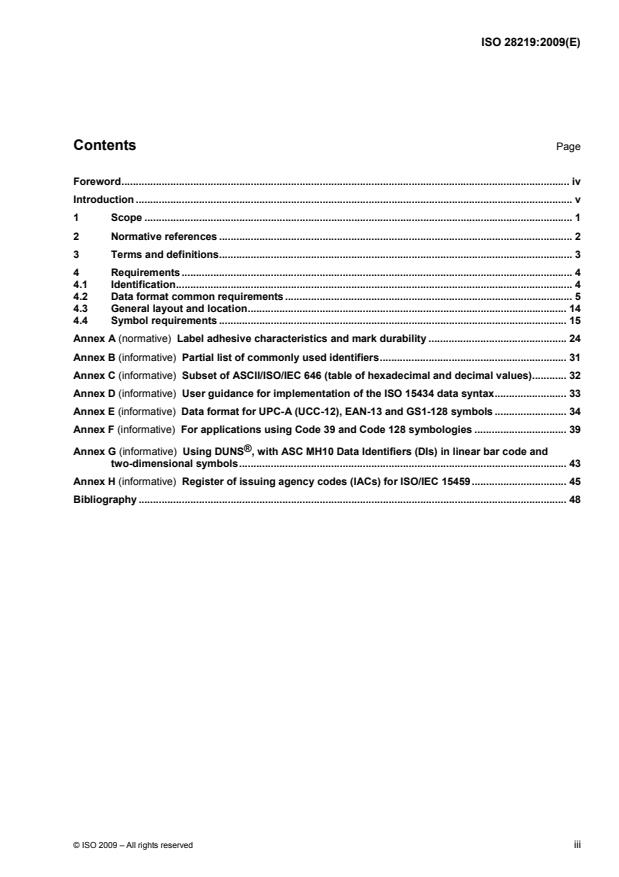
Contents Page
Foreword. iv
Introduction . v
1 Scope . 1
2 Normative references . 2
3 Terms and definitions. 3
4 Requirements . 4
4.1 Identification. 4
4.2 Data format common requirements . 5
4.3 General layout and location. 14
4.4 Symbol requirements . 15
Annex A (normative) Label adhesive characteristics and mark durability . 24
Annex B (informative) Partial list of commonly used identifiers. 31
Annex C (informative) Subset of ASCII/ISO/IEC 646 (table of hexadecimal and decimal values). 32
Annex D (informative) User guidance for implementation of the ISO 15434 data syntax. 33
Annex E (informative) Data format for UPC-A (UCC-12), EAN-13 and GS1-128 symbols . 34
Annex F (informative) For applications using Code 39 and Code 128 symbologies . 39 ®
Annex G (informative) Using DUNS , with ASC MH10 Data Identifiers (DIs) in linear bar code and
two-dimensional symbols. 43
Annex H (informative) Register of issuing agency codes (IACs) for ISO/IEC 15459. 45
Bibliography . 48
Foreword
ISO (the International Organization for Standardization) is a worldwide federation of national standards bodies
(ISO member bodies). The work of preparing International Standards is normally carried out through ISO
technical committees. Each member body interested in a subject for which a technical committee has been
established has the right to be represented on that committee. International organizations, governmental and
non-governmental, in liaison with ISO, also take part in the work. ISO collaborates closely with the
International Electrotechnical Commission (IEC) on all matters of electrotechnical standardization.
International Standards are drafted in accordance with the rules given in the ISO/IEC Directives, Part 2.
The main task of technical committees is to prepare International Standards. Draft International Standards
adopted by the technical committees are circulated to the member bodies for voting. Publication as an
International Standard requires approval by at least 75 % of the member bodies casting a vote.
Attention is drawn to the possibility that some of the elements of this document may be the subject of patent
rights. ISO shall not be held responsible for identifying any or all such patent rights.
ISO 28219 was prepared by Technical Committee ISO/TC 122, Packaging.
iv © ISO 2009 – All rights reserved
Introduction
Today, global industries widely use machine-readable markings on products for inventory control, quality
control, and product life cycle management. Common technologies, data structures, conformance, and
applications standards are necessary to enable all trading partners to use such markings internally and
throughout the supply chain.
A number of different product labelling and marking standards exist, each designed to meet the requirements
of the specific industry sector. For effective and economic use within and between industry sectors one
common multi-industry standard is a necessity.
A standard linear bar code or two-dimensional symbol marked on a product or part will facilitate the
automation of inventory control, quality control, and product life cycle management. The linear bar code or
two-dimensional symbol information on the product may be used as a key to access the appropriate database
that contains detailed information about the product, including information transmitted via EDI. In addition a
product mark may contain other information as agreed between the trading partners.
INTERNATIONAL STANDARD ISO 28219:2009(E)
Packaging — Labelling and direct product marking with linear
bar code and two-dimensional symbols
1 Scope
This International Standard
⎯ defines minimum requirements for identifying items;
⎯ provides guidelines for item marking with machine-readable symbols;
⎯ covers both labels and direct marking of items;
⎯ includes testing procedures for label adhesive characteristics and mark durability;
⎯ provides guidance for the formatting on the label of data presented in linear bar code, two-dimensional
symbol or human readable form;
⎯ is intended for applications which include, but are not limited to, support of systems that automate the
control of items during the processes of:
⎯ production;
⎯ inventory;
⎯ distribution;
⎯ field service;
⎯ point of sale;
⎯ repair, and
⎯ is intended to include, but it is not limited to, multiple industries including:
⎯ automotive;
⎯ aerospace;
⎯ chemical;
⎯ consumer items;
⎯ electronics;
⎯ health care;
⎯ marine;
⎯ rail;
⎯ telecommunications.
The location and application method of the marking are not defined (these will be reviewed and agreed upon
by suppliers and manufacturers and their trading partners before implementing this International Standard).
This International Standard does not supersede or replace any applicable safety or regulatory marking or
labeling requirements. This International Standard is meant to satisfy the minimum item marking requirements
of numerous applications and industry groups and as such its applicability is to a wide range of industries,
each of which may have specific implementation guidelines for it. This International Standard is to be applied
in addition to any other mandated labeling direct-marking requirements.
The labeling and direct marking requirement of this International Standard and other standards can be
combined labeling into one label or marking area or appear as separate labels or marking areas.
This International Standard uses the terms “part marking” and “item marking” interchangeably. Unless
otherwise stated, this document will use the term “item marking” to describe both the labeling and direct part
marking (DPM) of an item, where DPM includes, but is not limited to, altering (e.g. dot peen, laser etch,
chemical etch) as well as additive type processes (e.g. ink jet, vacuum deposition).
The purpose of this International Standard is to establish the machine-readable (linear, two dimensional, and
composite symbols) and human readable content for direct marking and labeling of items, parts, and
components.
This International Standard provides a means for items, parts and components to be marked, and read in
either fixtured or handheld scanning environments at any manufacturer’s facility and then read by customers
purchasing items for subsequent manufacturing operations or for final end use. Intended applications include,
but are not limited to supply chain applications, e.g. inventory, distribution, manufacturing, quality control,
acquisition, transportation, supply, repair, and disposal.
The figures are illustrative and not necessarily to scale or to the quality requirements specified in this
International Standard.
2 Normative references
The following referenced documents are indispensable for the application of this document. For dated
references, only the edition cited applies. For undated references, the latest edition of the referenced
document (including any amendments) applies.
ISO/IEC 646, Information Processing — ISO 7-Bit Coded Character Set for Information Interchange
ISO/IEC 3166-1, Codes for the representation of names of countries and their subdivisions — Part 1: Country
Code
ISO/IEC 15415, Information technology, identification and data capture techniques — Bar code symbol print
quality test specification — Two-dimensional symbols
ISO/IEC 15416, Information technology, identification and data capture techniques — Bar code print quality
test specification — Linear symbols
ISO/IEC 15417, Information technology, identification and data capture techniques — Bar code symbology
specification — Code 128
ISO/IEC 15418, Information technology, Automatic identification and data capture techniques — GS1
Application Identifiers and ASC MH10 Data Identifiers
ISO/IEC 15434, Information technology — Automatic identification and data capture techniques — Data
Syntax for high capacity ADC media
ISO/IEC 15438, Information technology — Automatic identification and data capture techniques — Bar code
symbology specification — PDF417
2 © ISO 2009 – All rights reserved
ISO/IEC 15459-2, Information technology — Unique identifiers — Part 2: Registration procedures
ISO/IEC 16022, Information technology — Automatic identification and data capture techniques — Bar code
symbology specification — Data Matrix
ISO/IEC 16388, Information technology — Automatic identification and data capture techniques — Bar code
symbology specification — Code 39
ISO/IEC 18004, Information technology — Automatic identification and data capture techniques — QR Code
2005 bar code symbology specification
ISO/IEC 19762, Information technology — Automatic identification and data capture techniques —
Harmonized vocabulary
ISO 21067, Packaging — Vocabulary
ISO/IEC 24723, Information technology — Automatic identification and data capture techniques — Bar code
symbology specification — Composite component
ISO/IEC 24728, Information technology — Automatic identification and data capture techniques — Bar code
symbology specification — MicroPDF417
ANS MH10.8.2, Data Application Identifier Standard
AIM DPM-1, Direct Part Mark (DPM) Quality Guideline
ASTM D1000-93, Pressure-Sensitive Adhesive-Coated Tapes Used for Electrical and Electronic Applications
Dun & Bradstreet, DUNS® Number
GS1 General Specifications
International Symbology Specification — GS1 Composite Symbology
NAMSA, ACodP-1(D), Chapter 2, Subsection 242-243, (NCAGE)
3 Terms and definitions
For the purposes of this document, the terms and definitions given in ISO/IEC 19762 and ISO 21067 and the
following apply.
3.1
cell
smallest element of a two-dimensional matrix symbol
3.2
TM
CLEI code
coding structure maintained by Telcordia that identifies communications equipment, in a concise, uniform
feature-oriented language, describing product type, features, source document and associated drawings and
vintages
3.3
components
parts (bare printed circuit board, integrated circuits, capacitor, diodes, switch, valve, spring, bearing, bracket,
bolt, etc.) of a first level/modular assembly
3.4
data element separator
specified character used to delimit discrete fields of data
3.5
first level
modular assembly
manufactured item (populated printed circuit board, hydraulic pump, starter, dashboard assembly, door
assembly, etc.) made up of components
3.6
intrusive marking
device designed to alter a material surface to form a human- or machine-readable symbol
NOTE Intrusive marking includes, but is not limited to, devices that abrade, burn, corrode, cut, deform, dissolve, etch,
melt, oxidize or vaporize a material surface. Intrusive marking methods include laser etch, chemical etch, dot peen and
micro-sandblast.
3.7
item
product
first level or higher assembly that is sold in a complete end-usable configuration
3.8
label
adhesive backed media capable of being marked with information in machine-readable and/or human-
readable form
NOTE Both labels and direct marking methods are referred to in this International Standard under the term “label”.
3.9
manufacturer
actual producer or fabricator of an item; not necessarily the supplier in a transaction
3.10
non-intrusive marking
method of forming markings by adding material to a surface
NOTE Non-intrusive marking methods include ink jet, laser bonding, liquid metal jet, silk screen, stencil and thin film
deposition.
3.11
supplier
party that produces, provides, or furnishes an item or service
3.12
syntax
manner in which data is put together to form messages
NOTE 1 Syntax also includes rules governing the use of appropriate identifiers, delimiters, separator character(s), and
other non-data characters within the message.
NOTE 2 Syntax is the equivalent to grammar in spoken language.
4 Requirements
4.1 Identification
4.1.1 General
Enterprises may choose to assign uniqueness to items at the individual, group, or product level. Individual
uniqueness requires serialization or one-of-a-kind production, see 4.1.2 and 4.2.2.2. A lot or batch number
4 © ISO 2009 – All rights reserved
captures group uniqueness, see 4.1.3 and 4.2.2.2. A product code is an example of item uniqueness,
see 4.2.2.3.
4.1.2 Unique item identification
Items may be assigned a unique item identification code to each instance of the item, i.e. serialization. Serial
numbers shall be unique either within an enterprise ID or within enterprise ID + part number. When using
unique identification, the encoded symbol shall contain only one enterprise identifier, serial number and/or
original part number to avoid confusion and ensure uniqueness.
4.1.3 Lot or batch identification
Items can have group uniqueness applied by an enterprise. Some items are assigned group identification, e.g.
lot or batch number.
4.2 Data format common requirements
Those implementing this International Standard should refer to the guidelines for their particular industries. For
a partial list of industry guidelines see the bibliography.
4.2.1 General format
Labels will accommodate both mandatory and optional data fields. The maximum length of each discrete data
field shall be 25 data characters unless otherwise specified. This character count is exclusive of overhead
characters.
All data elements encoded in a machine-readable medium shall be preceded by the appropriate data identifier
(DI) as defined in ISO/IEC 15418 and ANS MH10.8.2 Data Identifier, or the appropriate application identifier
(AI) defined in ISO/IEC 15418 and the GS1 General Specifications. The exceptions to this rule are the UPC-A,
UPC-E, EAN-8, and EAN-13 symbologies.
The choice between DIs and GS1 AIs, for any user, will normally be determined in the applicable industry
convention being followed.
Other industries developing item identification conventions should consider business practices, information
requirements and systems capabilities of the trading partners in choosing between DIs and GS1 AIs.
4.2.1.1 Data identifiers (DIs)
The descriptions in the DI list are general in nature and are used in industrial and international applications.
Specific application guidelines provide the detailed definition used amongst trading partners.
The full list of registered DIs and the full specification for their use are found in the American National
Standard MH10.8.2.
DIs may be used with any alphanumeric data carrier and are designed to ensure cross-industry commonality
of data identifiers used in automatic identification technologies.
DIs have a format of one alphabetic character alone, or one alphabetic character prefixed by one, two or three
numeric characters.
4.2.1.2 GS1 Application Identifiers (AIs)
The definitions of the GS1 AIs are supported by application guidelines. The GS1 AIs, and associated
guidelines, have been designed for international and multi-sector trading purposes.
The GS1 item identification system and related encoding standard are complemented by the GS1 maintained
AIs. This International Standard comprises two principal elements, which are the key to any encoding system:
the data content and the data carrier.
The use of GS1 AIs is subject to the rules established by GS1.
GS1 AIs identify generic and simple data fields for use in cross-sector and international supply chain
applications. The GS1 General Specifications provide rules for the definition, format and structure of the data
fields.
Each GS1 AI consists of two, three or four characters. The first two digits of the AI determine the length of the
AI. A list of two digit codes indicating the predefined length of existing and future AIs and their data fields is
contained within the GS1 General Specifications.
ISO/TC 122 has approved the use of ISO/IEC 15418, since through its normative references it encompasses
the GS1 General Specifications.
Subclause 3.6.58 of the GS1 General Specifications, Information Mutually Agreed Between Trading Partners
(Including FACT DIs): AI (90), states that the data field shows the information agreed between the two trading
partners, and may also be used to incorporate data preceded by FACT (ASC MH10) DIs. The ambiguity
existing as to whether the information that follows AI (90) is a DI or another type of trading partner information
makes the AI (90) solution to identify ASC MH10 DIs unworkable.
ISO/TC 122 values the formal GS1 approval process and has submitted a proposal to the GS1 GSMP seeking
approval of a new format for the DI addition. That approval process is lengthy, and, in the interim, a
collaborative solution is necessary to create a near-term interoperable environment.
ISO/TC 122 has requested a specific AI to signify that what follows is in fact an ASC MH10 DI. ISO/TC 122
has established the collaborative solution, the application identifier “DI”, to enable the use of DIs using AIs
until such time as an AI is assigned to specifically indicate the use of DIs in the GS1 Generation Specifications.
This solution uses the structure of GS1 Generation Specifications as an acceptable semantic standard and
the business rules in the GS1 Generation Specifications. When approved, the new AI shall be used and
replace the interim “DI” application identifier format.
Consideration and decisions on coding approaches should carefully weigh any impacts to changing from the
“DI” application identifier format to an approved future AI against any associated costs and strategic near term
coding requirements. The use of the collaborative solution AI as described below should strictly be considered
an interim approach.
4.2.1.3 Organization inclusion in coding
It is recommended that data structures used to identify items or the traceability of items include identification
of the organization providing the coding as well as the specific coding structure.
In the GS1 General Specifications this coding structure is the GS1 Company Prefix portion of the global trade
item number (GTIN).
When using DIs, this coding structure uses the issuing agency code (IAC) established in ISO/IEC 15459-2
and the company identification number (CIN) assigned by the issuing agency.
4.2.2 Mandatory data fields
Mandatory data fields are given in Table 1.
6 © ISO 2009 – All rights reserved
Table 1 — Item identification code type
Item identification type Mandatory fields
1. Commodity Item identification code (example nails)
2. Non-traceable Enterprise identification code
Item identification code
3. Group traceability Enterprise identification code
Item identification code
Unique lot or batch traceability code
4. Unique serialization within item identification code Enterprise identification code
Item identification code
Unique individual item identification code
5. Unique serialization within enterprise Enterprise identification code
Unique item traceability code within enterprise identification code
The enterprise identification code and item identification code may be combined in a single data field,
see 4.2.2.3.
4.2.2.1 Enterprise identification code
The enterprise identification code shall use formats contained in Table 2 and Table 3. The use of more than
one enterprise identification code is permitted on an item preceded by DI 20V. The choice of enterprise
identification code(s) should be mutually agreed upon between trading partners. The appropriate DI shall
precede the enterprise identification when separate data fields are used to identify the supplier and the item
identification.
Table 2 — Data identifiers used for enterprise identification
Data identifier Data field Data characteristics Description
Type followed by the number
of characters
a
e.g. a#, n#, an#)
18V Combined IAC/CIN an3+an1.3+an3.13 Combined IAC/CIN
12V DUNS® number an3+n9 Entity (manufacturer) identification assigned by
Identifying Dun and Bradstreet
Manufacturer
17V U.S. Department of an3+an5 Company identification assigned by the U.S.
Defense (DoD) Department of Defense
CAGE Code/NAMSA
NCAGE
20V Company an3+an1.3+ Combined IAC/CIN and Party Qualifier Code
identification (EDIFACT DE 3035)
an3.13+“+”+an3
21V Supplier identification an3 +an.25 Combined IAC/CIN followed by an internally
assigned entity identification
a
The characters before the first “+” symbol describe the format of the DI or AI. Note that the “+” symbols are not encoded in the data.
Table 3 — Application Identifiers used for enterprise identification
Application Data Field Data characteristics Description
Identifier
Type followed by the number
of characters
a
e.g. a#, n#, an#)
N/A Part number n12 (See Annex E) UPC-A Symbology (combination of supplier &
(supplier/item) item identification)
UPC-A (GTIN-12)
N/A Part number n13 (See Annex E) EAN-13 Symbology (combination of supplier &
(supplier/item) item identification)
EAN-13 (GTIN-13)
01 Part number n2+n14 GS1-128, GS1 Data Bar Expanded and GS1
(supplier/item & Data Matrix (combination of indicator digit,
quantity) supplier and item identification)
EAN/UCC (GTIN-14)
a
The characters before the first “+” symbol describe the format of the DI or AI. Note that the “+” symbols are not encoded in the data
except for “+” in 20V.
4.2.2.2 Group and item traceability codes
The traceability code is assigned by the supplier to identify a unique item or group of entities (e.g. lot, batch,
date code, revision level or serial number). The DIs or AIs given in Table 4 and Table 5 represent a partial list
of the ASC MH10 Data Identifiers and GS1 Application Identifiers that may be applicable to traceability codes.
The traceability data field is assigned by the manufacturer or supplier. The maximum length of a single
traceability data field shall be 20 characters, which excludes the associated DI or AI. Concatenated fields, e.g.
IAC/CIN plus serial number, shall not exceed 35 characters.
8 © ISO 2009 – All rights reserved
Table 4 — Data identifiers used for traceability
Data Identifier Data Field Data characteristics Description
Type followed by the number
of characters
a
e.g. a#, n#, an#)
S Serial number an1+an.20 Serial number or code assigned by the
supplier to an entity for its lifetime
18S Serial number within an3+an.20 Serial number or code assigned by the CAGE
CAGE Code Code that is unique within CAGE Code
20S Customer assigned an3+an.20 Serial number or code assigned by the
serial number customer to an entity for its lifetime
25S Serial number an3 +IAC/CIN+an.20 Combined IAC/CIN and the serial number
assigned by the supplier
1T Lot/batch number an2+an.20 Lot/Batch Number defined by the manufacturer
25T Lot/batch number an3 +IAC/CIN+an.20 Combined IAC/CIN and enterprise
identification and lot or batch number assigned
by the supplier
+$ Lot/batch number a2+an.15 Options of concatenated lot or batch
combinations with item data are specified with
ANSI/HIBC 2
20S may be used by industries that are serializing items that were not serialized by the manufacturer at time of
manufacturing.
Asset identifiers shall be used for any other purpose and shall remain unique for a period well beyond the lifetime of
relevant records. If a company assigns asset identifiers to trade items supplied to its customers, the company shall
ensure that the asset identifiers are never reused.
The length specified in the table may be shorter than the length specified in the reference standard, however, that is the
maximum length specified in this International Standard.
NOTE 1 The variable lengths for the IAC/CIN combined lengths are defined by ISO 15459.
NOTE 2 Traceability codes are not always mandatory for GS1 implementations.
a
The characters before the first “+” symbol describe the format of the DI or AI. Note that the “+” symbols are not encoded in the data.
Table 5 — Application identifiers used for traceability
Application Data Field Data characteristics Description
Identifier
Type followed by the number
of characters
a
e.g. a#, n#, an#)
10 Batch/lot number n2+an.20 Traceability code defined by the manufacturer
b
Production date
11 Production date n2+n6
21 Serial number n2+an.20 Serial number or code assigned by the
supplier to an trade item for its lifetime
414 n3+n13 Global location number (GLN) to be processed
Global location
according to the particular application
number
requirements
8003 Global returnable n4+n14+an.16 Global returnable asset identifier (GRAI)
asset identifier
8004 Global individual asset n4+an.30 Global individual asset identifier (GIAI)
identifier
20S may be used by industries that are serializing items that were not serialized by the manufacturer at time of
manufacturing.
Asset identifiers shall be used for any other purpose and shall remain unique for a period well beyond the lifetime of
relevant records. If a company assigns asset identifiers to trade items supplied to its customers, the company shall
ensure that the asset identifiers are never reused.
The length specified in the table may be shorter than the length specified in the reference standard, however, that is the
maximum length specified in this International Standard.
NOTE 1 The variable lengths for the IAC/CIN combined lengths are defined by ISO 15459.
NOTE 2 Traceability codes are not always mandatory for GS1 implementations.
a
The characters before the first “+” symbol describe the format of the DI or AI. Note that the “+” symbols are not encoded in the data.
b
Production Date code construction using GS1 Application Identifiers use a two-digit designation for year. Users wishing more
information on the GS1 implementation of Year 2000 issues should contact GS1.
4.2.2.3 Item identification
The maximum length of the Item Identification shall be 20 data characters unless otherwise specified in this
document or agreed to between trading partners. This maximum excludes the associated DI or AI. Item
identification codes may be concatenated with the enterprise identification to produce a unique item
identification. See Tables 2 to 5 for IAC/CIN.
The item identification code (e.g. supplier or customer part number) shall be designated as mutually agreed
upon between the supplier or manufacturer and customer. The supplier’s part number is the recommended
item identification code.
An item identification code may be concatenated with the company prefix to produce a unique item
identification code. GTIN-12 and GTIN-13 formats are fixed length numeric examples of company prefix codes
concatenated with item identification codes to provide worldwide item identification uniqueness. See Table 7.
Likewise, variable length examples of a fixed length enterprise identification codes concatenated with a
variable length alphanumeric item identification codes to provide worldwide item identification uniqueness may
be provided with DIs such as “9P” and “17P”. See Table 6.
10 © ISO 2009 – All rights reserved
Table 6 — Data identifiers used for item identifier
Data identifier Data field Data characteristics Description
Type followed by the number
of characters
a
e.g. a#, n#, an#)
P Part number an1+an.20 Customer assigned part number
1P Part number an2+an.20 Supplier assigned part number
8P Part number an2+n14 GS1 GTIN-14
9P Part number an2+n9+an.16 Combined DUNS®-9 supplier identification and
item code assigned by the supplier
TM
11P Part number an3+an10
CLEI code for telecommunications
equipment
17P Part number an3+an7+an.20 Combined GS1 company prefix and item code
assigned by the supplier
25P Product number an3+IAC/CIN+an.20 Combined IAC/CIN and item code assigned by
the supplier
+ Product number a1+an.19 HIBCC
NOTE Whilst GS1 permits AI “241” to be a maximum of 30 characters, the customer assigned part number should be limited to no
more than 25 characters.
a
The characters before the first “+” symbol describe the format of the DI or AI. Note that the “+” symbols are not encoded in the data.
Table 7 — Application identifiers used for item identifier
Application Data field Data characteristics Description
identifier
Type followed by the number
of characters
a
e.g. a#, n#, an#)
N/A Part number n12 (see Annex E) UPC-A/UPC-E Symbology (combination of
(supplier/item) UPC- supplier & item identification)
A/UPC-E (GTIN-12)
N/A Part number n13 (see Annex E) EAN-13 Symbology (combination of supplier &
(supplier/item) item identification)
EAN-13 (GTIN-13)
01 Part number n2+n14 GS1-128, GS1 Data Bar Expanded and GS1
(supplier/item & Data Matrix (combination of indicator digit,
quantity) supplier, and item identification)
EAN/UCC-14
(GTIN-14)
241 Part number n3+an.30 Customer assigned part number
8001 Roll products n4+n14 Roll products - width, length, core diameter,
direction and splices
8006 Identification of the n4+n14+n2+n2 GS1 Identification of a fixed measure trade
components of a trade item (GTIN) packed in separate parcels.
item
8018 Global service relation n4+n18 GS1 identification number of a service relation
number (GSRN) (GSRN) to be assigned by the service provider
NOTE Whilst GS1 permits AI “241” to be a maximum of 30 characters, the customer assigned part number should be limited to no
more than 25 characters.
a
The characters before the first “+” symbol describe the format of the DI or AI. Note that the “+” symbols are not encoded in the data.
4.2.3 Optional data fields
Specific applications and trading partner agreements may require additional data fields. See Table 8 and
Table 9 for examples.
When using DIs or AIs to encode country of origin, it shall be in one of the formats shown in Table 8 or
Table 9.
Table 8 — Data identifiers for optional data
Data identifier Data field Data characteristics Description
Type followed by the number
of characters
a
e.g. a#, n#, an#)
4L Country of origin an2+an2
The two-character country code as defined by
ISO 3166. The country of origin is defined as
the manufacturing country wherein the product
obtained its present identity as a part,
subassembly, or finished product.
6D Defined date an2+n8+an3 ISO format YYYYMMDD immediately followed
by an ANSI X12.3 Data Element Number 374
Qualifier providing a code specifying type of
date (e.g. ship date, manufacture date)
14D Expiration date an3+n8 Expiration date (YYYYMMDD)
16D Production date an3+n8 Production date (YYYYMMDD)
30P First level additional an3+an…20 First level (supplier assigned) item
item identification identification (item ID), which is different than
or in addition to Item ID provided by “1P”
a
The characters before the first “+” symbol describe the format of the DI or AI. Note that the “+” symbols are not encoded in the data.
Table 9 — Application identifiers for optional data
Application Data Field Data characteristics Description
Identifier
Type followed by the number
of characters
a
e.g. a#, n#, an#)
422 Country of origin n3+n3 The three-digit country code as defined by
ISO 3166. The country of origin is defined as
the manufacturing country wherein the product
obtained its present identity as a part,
subassembly, or finished product.
423 Country of initial n3+n.15 ISO country codes stating the countries of
processing (with ISO initial processing of a trade item. The n.15
country code) code may be 3,6,9,12,15 characters long
depending on number of processing countries.
424 Country of processing n3+n3 ISO country code stating the country of
(with ISO country code) processing of a trade item
425 Country of disassembly n3+n3 ISO country code stating the country of
(with ISO country code) disassembly of a trade item
426 Country covering full n3+n3 ISO country code stating the (single) country of
process chain (with ISO full processing of a trade item
country code)
17 Expiration date an3+n8
11 Production date an3+n8
a
The characters before the first “+” symbol describe the format of the DI or AI. Note that the “+” symbols are not encoded in the data.
12 © ISO 2009 – All rights reserved
4.2.4 Syntax
4.2.4.1 Linear bar code symbol data field syntax
Data encoded in the EAN/UPC symbology includes no identifiers. A Data Identifier, as per ANS MH10.8.2,
shall precede data encoded in the Code 39 symbology, as described in ISO/IEC 16388. Data encoded in
GS1-128 symbology shall be formatted as defined in GS1 General Specification preceded by an Application
Identifier. Data encoded in Code 128, as described in ISO/IEC 15417, not using GS1 Application Identifiers
shall be preceded by a Data Identifier per ANS MH10.8.2. Data encoded in UPC-A symbology shall be in
accordance with GS1 General Specification.
4.2.4.2 Concatenation of multiple data fields
When concatenating data in a linear bar code symbol the total length should be limited to 32 data characters,
including the associated DIs and AIs and concatenation characters but not including symbology overhead
characters. If the length exceeds the 32-character maximum message length, two-dimensional symbols
should be used.
a) When concatenating data in a linear bar code message, the appropriate data element separator shall be
used in accordance with the specific industry standard. The maximum length of the concatenated data
field is limited by the symbology, the reading technology, and the available space.
b) Specific data or AIs are assigned to accommodate concatenation of specific fixed length data fields.
c) When variable length data fields need to be concatenated using the Code 39 symbology, the plus “+”
character (ASCII Decimal 43) should be used to delineate between data fields, per ANS MH10.8.2.
d) When multiple variable length data fields need to be concatenated using the Code 128 symbology with
DIs, the plus “+” character (ASCII Decimal 43) should be used to delineate between data fields, as per
ANS MH10.8.2 (ISO/IEC 15418).
e) When multiple variable length data fields need to be concatenated using the GS1-128 symbology, the
G
function one “FNC1” character (transmitted as “ ” ASCII Decimal 29) is used to delineate between data
S
fields.
4.2.4.3 Two-Dimensional symbology data field syntax
Data encoded to be compliant with this International Standard shall use the syntax identified in ISO/IEC 15434.
R G R E
The header (first 7 characters “[)> 06 ”) and trailer (the last 2 characters “ O ”) are fixed for this
S S S T
application, in accordance with the ANS ISO/IEC 15434 standard, when Data Identifiers are used within the
R G R E
message. The header (first 7 characters “[)> 05 ”) and trailer (the last 2 characters “ O ”) are fixed for
S S S T
this application, in accordance with the ANS ISO/IEC 15434 standard, when Application Identifiers are used
R E
within the data encoding. The “ ” character is ASCII/ISO 646 Decimal 30. The “ O ” character is
S T
ASCII/ISO 646 Decimal 04. All characters supported by this International Standard are shown in Annex C.
Certain symbologies support the use of a single codeword to encode the header and trailer character strings.
Refer to applicable symbology standards. The use of structures combining different formats shall be as
defined in ISO/IEC 15434.
G
When combining data fields within a two dimensional symbol, the “ ” (ASCII/ISO 646 Decimal 29) character
S
shall be used with the appropriate DI or AI to identify each of the combined fields. The exception to this
requirement may be GS1 data carriers (e.g. composite symbology) that do not encode data in accordance
with ISO 15434. It is incumbent upon the reader to transmit the data to the application in an ISO/IEC 15434
syntax.
4.3 General layout and location
4.3.1 Layout
Layout refers to the positioning of the fields on the label. Layout of bar code symbols or two-dimensional
symbols will depend on the available space on the item and other factors such as industry sector business
rules, trading partner agreements or customer labeling requirements.
4.3.2 Location
Location refers to the positioning of the label on the item. Each label should be located in a position that
facilitates scanning without degrading the safety or performance of the item. Consideration should be given to
reading the symbol in the item’s installed position.
4.3.3 Linear bar code titles
Titles are recommended for all linear bar code fields. When DIs are used, the title shall include the appropriate
DI, enclosed in parentheses, e.g. (1P) PART # SPLR. When AIs are used, the AI is part of the human
readable interpretation, not as part of the title. Titles shall be in accordance with ISO/IEC 15418. Titles may be
positioned above or below the bar code symbol in accordance with industry guidelines and application
standards.
If the physical space available for marking is insufficient to support the marking of the title, and the user is
employing linear bar code symbols, the title may be abbreviated to only include the DI enclosed in
parentheses. Where physical space for marking is extremely limited the title may be eliminated.
4.3.4 Human-readable interpretation
For linear bar codes, the human-readable interpretation should be printed adjacent to the symbol. The human-
readable interpretation of the data encoded shall be printed legibly. The recommended height of the upper
case alpha characters is 2 mm. The minimum height of the upper case alpha characters shall be 1,25 mm.
For bar code symbols, when DIs are used, the human-readable interpretation shall include all of the data
within the bar code symbol, less the DI. See Figure 1.
Figure 1 — Bar code symbol example with data identifier
When an AI is used, the human-readable interpretation shall include the data as well as the AI in parentheses.
See Figure 2.
Figure 2 — Bar code symbol example with application identifier
14 © ISO 2009 – All rights reserved
For two-dimensional symbols, portions of the data should be shown in the human-readable interpretation
when necessary or required by application or industry standards. However, the interpretation of the GTIN
when using GS1 data structures shall use a human-readable interpretation of two-dimensional symbols.
4.4 Symbol requirements
4.4.1 Symbology recommendations
Any of the symbologies identified in this International Standard may be used for any direct part-marking
technique. Only matrix symbologies (e.g. data matrix) should be used for direct part-marking techniques.
4.4.2 Linear bar code symbol requirements
The linear symbologies specified in this International Standard are Code 39, UPC-A and E, EAN-13, EAN-8,
GS1-128, Code 128, and the GS1 Data Bar family. Users contemplating applications of Code 128 with DIs
should familiarize themselves with the issues identified in Annex F. See Figures 3 to 8.
Figure 3 — UPC-A symbol Figure 4 — EAN-13 symbol
Figure 5 — GS1-128 symbol Figure 6 — Code 39 symbol
Figure 7 — Code 128 symbol Figure 8 — GS1 Data Bar-14 symbol
4.4.2.1 “X” dimension
The narrow element dimension (X dimension) range should be from 0,19 mm to 0,51 mm as determined by
the printing capability of the supplier/printer of the label. EAN/UPC symbols are an exception to this; for
printing of EAN/UPC symbols the narrow element dimension range should be from 0,264 mm to 0,66 mm.
Note that at the smaller X dimensions, care must be given to match the X dimension to an integer multiple of
the resolution of the printer. Conformance to bar code print quality requirements shall be determined
according to 4.4.2.4.
...
МЕЖДУНАРОДНЫЙ ISO
СТАНДАРТ 28219
Первое издание
2009-01-15
Упаковка. Этикетирование и прямая
маркировка изделий линейным штрих–
кодом и двумерными символами
Packing – Labelling and direct product marking with linear bar code and
two-dimensional symbols
Ответственность за подготовку русской версии несёт GOST R
(Российская Федерация) в соответствии со статьёй 18.1 Устава ISO
Ссылочный номер
©
ISO 2009
Отказ от ответственности при работе в PDF
Настоящий файл PDF может содержать интегрированные шрифты. В соответствии с условиями лицензирования, принятыми
фирмой Adobe, этот файл можно распечатать или смотреть на экране, но его нельзя изменить, пока не будет получена
лицензия на установку интегрированных шрифтов в компьютере, на котором ведется редактирование. В случае загрузки
настоящего файла заинтересованные стороны принимают на себя ответственность за соблюдение лицензионных условий
фирмы Adobe. Центральный секретариат ISO не несет никакой ответственности в этом отношении.
Adobe - торговый знак Adobe Systems Incorporated.
Подробности, относящиеся к программным продуктам, использованным для создания настоящего файла PDF, можно найти в
рубрике General Info файла; параметры создания PDF оптимизированы для печати. Были приняты во внимание все меры
предосторожности с тем, чтобы обеспечить пригодность настоящего файла для использования комитетами – членами ISO. В
редких случаях возникновения проблемы, связанной со сказанным выше, просим информировать Центральный секретариат
по адресу, приведенному ниже.
ДОКУМЕНТ ЗАЩИЩЕН АВТОРСКИМ ПРАВОМ
© ISO 2009
Все права сохраняются. Если не указано иное, никакую часть настоящей публикации нельзя копировать или использовать в
какой-либо форме или каким-либо электронным или механическим способом, включая фотокопии и микрофильмы, без
предварительного письменного согласия ISO по адресу ниже или членов ISO в стране регистрации пребывания.
ISO copyright office
Case postale 56 • CH-1211 Geneva 20
Tel. + 41 22 749 01 11
Fax + 41 22 749 09 47
E-mail copyright@iso.org
Web www.iso.org
Опубликовано в Швейцарии
ii © ISO 2009 – Все права сохраняются
Содержание Страница
Предисловие .iv
Введение .v
1 Область применения .1
2 Нормативные ссылки .2
3 Термины и определения .3
4 Требования .5
4.1 Идентификация.5
4.2 Требования к общему формату данных .5
4.3 Общая компоновка и расположение.15
4.4 Требования к символам.16
Приложение A (нормативное) Клеевые характеристики этикеток и долговечность
маркировок .26
Приложение B (информативное) Неполный список употребительных идентификаторов.33
Приложение C (информативное) Поднабор ASCII/ISO/IEC 646 (таблица 16-ричных и
десятичных значений).34
Приложение D (информативное) Руководство пользователю для выполнения синтаксиса
данных ISO 15434.35
Приложение E (информативное) Формат данных для символов UPC-A (UCC-12), EAN-13 и
GS1-128 .36
Приложение F (информативное) Для применений, использующих символики кода 39 и кода
128.41 ®
Приложение G (информативное) Использование DUNS с идентификаторами данных ASC
MH10 (DIs) в линейном штриховом коде и двумерных символах .45
Приложение H (информативное) Реестр кодов агентств выдачи (IACs) для ISO/IEC 15459.47
Библиография.50
© ISO 2009 – Все права сохраняются iii
Предисловие
Международная организация по стандартизации (ISO) является всемирной федерацией национальных
организаций по стандартизации (комитетов-членов ISO). Разработка международных стандартов
обычно осуществляется техническими комитетами ISO. Каждый комитет-член, заинтересованный в
деятельности, для которой был создан технический комитет, имеет право быть представленным в этом
комитете. Международные правительственные и неправительственные организации, имеющие связи с
ISO, также принимают участие в работах. Что касается стандартизации в области электротехники, то
ISO работает в тесном сотрудничестве с Международной электротехнической комиссией (IEC).
Проекты международных стандартов разрабатываются в соответствии с правилами Директив ISO/IEC,
Часть 2.
Основной задачей технических комитетов является подготовка международных стандартов. Проекты
международных стандартов, принятые техническими комитетами, рассылаются комитетам-членам на
голосование. Их опубликование в качестве международных стандартов требует одобрения не менее
75 % комитетов-членов, принимающих участие в голосовании.
Следует иметь в виду, что некоторые элементы настоящего международного стандарта могут быть
объектом патентных прав. Международная организация по стандартизации не может нести
ответственность за идентификацию какого-либо одного или всех патентных прав.
ISO 28219 подготовил Технический комитет ISO/TC 122, Упаковка.
iv © ISO 2009 – Все права сохраняются
Введение
В настоящее время промышленность всего мира широко использует машиночитаемые маркировки
изделий для управления запасами, контроля качества и менеджмента цикла долговечности продукции.
Общепринятые технологии, структуры данных, согласование и стандарты применений необходимы для
всех торговых партнеров, чтобы использовать такие маркировки на внутреннем рынке и по всей
цепочке поставок.
Существует ряд стандартов по нанесению этикеток и маркировочных знаков, каждый из которых
предназначен для удовлетворения требований специфической отрасли промышленности. Для
эффективного и экономного применения внутри и между отраслями промышленности необходим один
общепринятый промышленный стандарт.
Стандартный линейный штрих-код или двумерный символ, отмеченный на изделии или детали,
облегчает автоматизацию управления запасом, контроль качества и менеджмент цикла долговечности
продукции. Информация на изделии в виде линейного штрих-кода или двумерного символа может
быть использована в качестве ключа доступа к соответствующей базе данных, которая содержит
подробные сведения о продукции, включая информацию, передаваемую через электронный обмен
данными (EDI – electronic data interchange). Кроме того, маркировка изделий (товара) может содержать
другую информацию, согласованную между торговыми партнерами.
.
© ISO 2009 – Все права сохраняются v
МЕЖДУНАРОДНЫЙ СТАНДАРТ ISO 28219:2009(R)
Упаковка. Этикетирование и прямая маркировка изделий
линейным штрих–кодом и двумерными символами
1 Область применения
Настоящий международный стандарт
⎯ определяет минимальные требования для идентификации изделий;
⎯ дает руководящие указания по маркировке изделий машиночитаемыми символами;
⎯ охватывает нанесение этикеток и прямое маркирование изделий;
⎯ включает методы проверки характеристик клееных этикеток и долговечности маркировок;
⎯ задает формат на этикетку с данными, представленными линейным штрих – кодом, двумерным
символом или в форме, читаемой человеком;
⎯ предназначается для применений, включая поддержку систем, которые автоматизируют
управление изделиями в ходе следующих процессов:
⎯ производство;
⎯ инвентаризация;
⎯ распределение;
⎯ обслуживание в условиях эксплуатации;
⎯ торговля;
⎯ ремонт и
⎯ предназначается для многих отраслей промышленности, в том числе:
⎯ автомобильная;
⎯ аэрокосмическая;
⎯ химическая;
⎯ производство товаров потребления
⎯ электроника;
⎯ обеспечение здравоохранения
⎯ для морского флота;
⎯ в железнодорожном транспорте;
⎯ электросвязь.
© ISO 2009 – Все права сохраняются 1
Местоположение маркировки и метод ее применения не определяется. (Эти вопросы подлежат
рассмотрению и согласованию между поставщиками и производителями, а также их торговыми
партнерами до практической реализации международного стандарта).
Настоящий международный стандарт не вытесняет или заменяет любые приемлемые маркировки по
технике безопасности или предусмотренные законом, а также требования к нанесению маркировочных
знаков. Он имеет в виду удовлетворение минимальных требований к маркировке изделий для
многочисленных применений и в интересах промышленных групп. В этом контексте предполагается
применимость настоящего международного стандарта к широкому диапазону отраслей
промышленности, каждая из которых может иметь специфические руководящие указания по его
реализации. Настоящий международный стандарт надо применять в дополнение к другим
обязательным требованиям прикрепления этикеток и непосредственного маркирования.
Требование настоящего международного стандарта и других стандартов в отношении нанесения
этикетки и прямой маркировки может быть объединенным для одного места или оно может касаться
отдельных участков для этикеток или маркировки.
Настоящий международный стандарт использует взаимозаменяемые термины “маркировка детали”
(“part marking”) и “маркировка изделия” (“item marking”). Если не заявлено иное, то в этом документе
используется термин “маркировка изделия”, чтобы описать нанесение этикетки и прямое маркирование
детали (direct part marking - DPM) изделия в случае, когда DPM включает видоизменение (например,
точечное выдавливание, лазерное гравирование, химическое травление), а также аддитивные типовые
процессы (например, струйная печать, вакуумное напыление).
Замысел настоящего международного стандарта заключается в том, чтобы учредить машиночитаемые
(линейные, двумерные и смешанные символы) и читаемое человеком содержание для прямого
маркирования и этикетирования изделий, частей (деталей) и компонентов.
Настоящий международный стандарт предоставляет способ маркировки изделий, деталей и
компонентов, а также считывание меток путем фиксированного или ручного сканирования на
предприятии производителя, а затем покупателями изделий, предназначенных для последующих
производственных операций или конечного использования. Настоящий стандарт может быть применен
в цепочке поставок изделий и товаров, например, при инвентаризации, распределении, производстве,
контроле качества, приобретении, транспортировке, снабжении, ремонте и удалении в отход.
Рисунки являются иллюстративными и не обязательно соответствуют масштабу или требованиям
качества, заданным в настоящем международном стандарте.
2 Нормативные ссылки
Следующие ссылочные документы являются обязательными для применения настоящего документа.
Для устаревших ссылок применяется только цитируемое издание. Для недатированных ссылок
применяется самое последнее издание ссылочного документа (включая поправки).
ISO/IEC 646, Обработка информации. 7- разрядный набор кодированных символов ISO для обмена
информацией
ISO/IEC 3166-1, Коды для представления названий стран и их административных делений. Часть 1.
Код страны
ISO/IEC 15415, Информационные технологии. Методы идентификации и выделения данных.
Спецификация по определению качества печати символов штрихового кода. Двумерные символы
ISO/IEC 15416, Информационные технологии. Методы идентификации и выделения данных.
Спецификация по определению качества печати символов штрихового кода. Линейные символы
ISO/IEC 15417, Информационные технологии. Методы идентификации и выделения данных.
Спецификация на символику штрихового кода. Код 128
2 © ISO 2009 – Все права сохраняются
ISO/IEC 15418, Информационные технологии. Методы автоматической идентификации и
выделения данных. Идентификаторы приложения GS1 и идентификаторы данных ASC MH10
ISO/IEC 15434, Информационные технологии. Методы автоматической идентификации и
выделения данных. Синтаксис данных для среды АЦП высокой пропускной способности
ISO/IEC 15438, Информационные технологии. Методы автоматической идентификации и
выделения данных. Спецификация на символику штрихового кода. PDF417
ISO/IEC 15459-2, Информационные технологии. Однозначные идентификаторы. Часть 2.
Процедуры регистрации
ISO/IEC 16022, Информационные технологии. Спецификация на символику штрихового кода.
Матрица данных
ISO/IEC 16388, Информационные технологии. Методы автоматической идентификации и
выделения данных. Спецификация на символику штрихового кода. Код 39
ISO/IEC 18004, Информационные технологии. Методы автоматической идентификации и
выделения данных. Спецификация на символику штрихового кода QR 2005
ISO/IEC 19762, Информационные технологии. Методы автоматической идентификации и
выделения данных. Гармонизированный словарь
ISO 21067, Упаковка. Словарь
ISO/IEC 24723, Информационные технологии. Методы автоматической идентификации и
выделения данных. Спецификация на символику штрихового кода. Составной компонент
ISO/IEC 24728, Информационные технологии. Методы автоматической идентификации и
выделения данных. Спецификация на символику штрихового кода. МикроPDF417
ANS MH10.8.2, Стандарт идентификатора применения данных
AIM DPM-1, Руководство по качеству прямой метки детали (DPM)
ASTM D1000-93, Самоприклеивающиеся ленты для электрических и электронных применений
Номер Dun & Bradstreet, DUNS® (присвоенный 9-значный идентификационный код компании)
Общие технические условия GS1
Спецификация международной символики. Составная символика GS1
NAMSA, ACodP-1(D), Глава 2, подраздел 242-243, (NCAGE)
3 Термины и определения
В настоящем документе применяются термины и определения, данные в ISO/IEC 19762 и ISO 21067, а
также следующие.
3.1
ячейка
cell
наименьший элемент символа двумерной матрицы
© ISO 2009 – Все права сохраняются 3
3.2
TM
код CLEI
TM
CLEI code
структура кодирования, поддерживаемая Telcordia, которая идентифицирует оборудование
электросвязи на лаконичном, единообразном, ориентированном на выделение особенностей языке,
описывая тип изделия, свойства, исходный документ и соответствующие чертежи и модели
3.3
компоненты
components
детали (пустая печатная плата, интегральные схемы, конденсатор, диоды, электронная лампа,
пружина, подшипник, скоба, болт и т.д.), относящиеся к первому уровню/модульной сборке
3.4
разделитель элементов данных
data element separator
заданный символ, используемый для определения границы дискретных полей данных
3.5
первый уровень
first level
модульная сборка
modular assembly
изготовленное из компонентов изделие (плата с интегральными схемами, гидравлический насос,
стартер, приборная щиток в сборе, дверной узел и т.д.)
3.6
маркировка вторжением
intrusive marking
устройство, предназначенное вносить изменения в поверхность материала, чтобы формировать
символ, считываемый человеком или машиной
ПРИМЕЧАНИЕ Маркировка вторжением включает устройства, которые истирают, выжигают, разъедают,
вырезают, деформируют, растворяют, вытравливают, расплавляют, окисляют или испаряют поверхность
материала. Методы маркировки вторжением включают лазерное гравирование, химическое вытравливание,
точечное выдавливание и микро обработку песчаной струей.
3.7
изделие
item
продукт
product
сборка первого или более высокого уровня, которая продается в конфигурации, полностью готовой для
конечного применения
3.8
этикетка
label
липкая с подложкой среда, способная принимать маркировку с информацией в форме, читаемой
машиной и/или человеком
ПРИМЕЧАНИЕ Как этикетки, так и методы прямой маркировки называются в настоящем международном
стандарте под общим термином “этикетка”.
3.9
производитель
manufacturer
действительный изготовитель изделия и не обязательно поставщик в сделке
4 © ISO 2009 – Все права сохраняются
3.10
маркировка без вторжения
non-intrusive marking
метод образования маркировок путем добавления материала на поверхность
ПРИМЕЧАНИЕ Методы маркировки без вторжения включают струйную метку типографской краской, сварку
лазерным лучом, струйную метку жидким металлом, сетчатый трафарет, узор/надпись по трафарету и осаждение
тонкой пленки
3.11
поставщик
supplier
сторона, которая производит, предоставляет или доставляет изделие или услугу
3.12
синтаксис
syntax
манера, в которой данные соединяются вместе, чтобы образовать сообщения
ПРИМЕЧАНИЕ 1 Синтаксис также включает правила, обуславливающие использование подходящих
идентификаторов, определителей границ, разделительные знаки и другие символы в пределах сообщения,
которые не относятся к данным.
ПРИМЕЧАНИЕ 2 Синтаксис является эквивалентом грамматики в разговорном языке.
4 Требования
4.1 Идентификация
4.1.1 Общие положения
Предприятия могут по выбору назначать уникальность отдельных и группы изделий или на уровне
выпускаемой продукции. Отдельная уникальность связана с серийным производством или выпуском
продукции одного вида, см. 4.1.2 и 4.2.2.2. Лот или партия выделяет групповую уникальность, см. 4.1.3
и 4.2.2.2. Код изделия является примером уникальности этого изделия, см.4.2.2.3.
4.1.2 Идентификация изделия, единственного в своем роде
Код идентификации может быть присвоен для единственного в своем роде изделия, для каждого
экземпляра этого изделия, т.е. присвоение серийных номеров. Серийные номера не должны
повторяться в пределах производственной идентификации (ID) или должны иметь единственный ID
предприятия + номер детали. При использовании уникального идентификатора кодированный символ
должен содержать только один производственный идентификатор, серийный номер и/или
первоначальный номер детали, чтобы избежать путаницы и обеспечить однозначность.
4.1.3 Идентификация лота или партии
Изделия могут иметь групповую уникальность, применяемую на предприятии. Некоторым изделиям
назначается групповая идентификация, например номер некой совокупности изделий (лот) или некого
объема продукции (партия).
4.2 Требования к общему формату данных
Что касается требований к общему формату данных, реализующих настоящий международный
стандарт, то следует обращаться к руководящим указаниям в соответствующих отраслях
промышленности. Частичный перечень руководящих указаний по отраслям промышленности можно
найти в библиографии.
© ISO 2009 – Все права сохраняются 5
4.2.1 Общий формат
Маркировки (этикетки и непосредственные метки) включают в себе обязательные и необязательные
поля данных. Максимальная длина каждого поля дискретных данных должна составлять 25 знаков
данных, если не задано иное. Этот подсчет исключает служебные знаки.
Всем элементам данных, кодированных в машиночитаемой среде, должен предшествовать
подходящий идентификатор данных (data identifier – DI), как определено в ISO/IEC 15418 и
ANS MH10.8.2 Идентификатор данных, или подходящий идентификатор применения (application
identifier – AI), определенный в ISO/IEC 15418 и общих технических условиях GS1. Исключениями этого
правила являются символики UPC-A, UPC-E, EAN-8 и EAN-13.
Выбор между DIs и GS1 AIs для любого пользователя нормально определяется условиями
соответствующей договоренности, которая поддерживается в определенных отраслях
промышленности.
Другие отрасли промышленности, разрабатывающие свои соглашения по идентификации изделий,
учитывают практику бизнеса, информационные требования и системные возможности торговых
партнеров в отборе идентификаторов между DIs и GS1 AIs.
4.2.1.1 Идентификаторы данных (DIs)
Описания в перечне идентификаторов данных (DI) являются общими по характеру для промышленных
и международных применений. Руководящие указания по специфическому применению
предоставляют подробное определение, используемое среди торговых партнеров.
Полный перечень зарегистрированных идентификаторов данных (DIs)_ и полная спецификация по их
использованию содержится в американском национальном стандарте MH10.8.2.
Идентификаторы DIs могут быть использованы с несущей буквенно-цифровых данных и
предназначаются для обеспечения в промышленности перекрестной общности идентификаторов
данных, используемых в технологиях автоматического распознавания.
Идентификаторы DIs имеют формат одного знака алфавита или один буквенный (алфавитный) знак,
перед которым стоит один, два или три цифровых знака.
4.2.1.2 Идентификаторы применения GS1
Определения GS1 AIs поддерживаются руководящими указаниями по применению. Идентификаторы
GS1 AIs и связанные с ними руководящие указания предназначены для международных и
многосекторных торговых целей.
Система идентификации изделий GS1 и связанные стандарты кодирования дополняются
идентификаторами применения AIs, которые поддерживаются общей спецификацией GS 1. Настоящий
международный стандарт содержит два принципиальных элемента, которые являются ключом в любой
системе кодирования – это содержание данных и носитель информации.
Использование GS1 AIs подчиняется правилам, установленным GS1 (ведущей международной
организацией, управляющей многоотраслевой системой товарной нумерации).
Идентификаторы GS1 AIs распознают групповые и простые поля данных для использования в
пересекающихся отраслевых применениях и международной цепочке поставок. Общие технические
условия GS1 дают правила для определения, формата и структуры полей данных.
Каждый идентификатор применения GS1 AI состоит из двух, трех или четырех отличительных
признаков (букв, знаков, символов). Первые два однозначных числа AI устанавливают длину
идентификатора применения AI. Список двух цифровых кодов, указывающих заранее определенную
длину существующих или перспективных идентификаторов AIs и их поля данных, содержится в рамках
общих технических условий GS1 General Specifications .
6 © ISO 2009 – Все права сохраняются
Технический комитет ISO/TC 122 одобрил использование ISO/IEC 15418, так как через его
нормативные ссылки он выполняет общие технические условия GS1.
В подпункте 3.6.58 общих технических условий GS1, Информация, взаимно согласованная между
торговыми партнерами [включая идентификаторы данных (DI) Федерации по технологиям
автоматического кодирования (FACT)]: AI (90), говорится, что поле данных показывает информацию,
согласованную между двумя торговыми партнерами. Это поле может быть также использовано, чтобы
включить данные, которым предшествуют идентификаторы данных FACT (комитета MH10).
Существует двусмысленность, является ли информация после AI (90) идентификатором данных (DI)
или другим типом информации о торговых партнерах. Эта двусмысленность делает нерабочим
решение AI (90) распознавать идентификаторы данных (DI), разработанные комитетом MH10 по
аккредитованным стандартами (Accredited Standards Committee – ASC; MH10)
Технический комитет ISO/TC 122 оценивает формальный процесс одобрения GS1 и представил
предложение на форум GS1 GSMP (Global Standards Management Process), желая получить одобрение
нового формата для дополнения идентификатора данных (DI). Этот процесс одобрения является
длительным и в промежутке необходимо совместное решение, чтобы создать временную среду для
возможности взаимодействия.
Технический комитет ISO/TC 122 запросил специфический идентификатор применения AI, чтобы
обозначить, что всё последующее на самом деле будет идентификатором данных (DI), который
разработал комитет ASC MH10. Технический комитет ISO/TC 122 принял временное решение, которое
делает возможным применение идентификаторов данных (DIs), используя идентификаторы
применения (AIs) до тех пор, когда AI будет назначаться, чтобы конкретно указывать использование
DIs в технических условиях одного поколения (GS1 Generation Specifications).
Это решение использует структуру GS1 Generation Specifications в качестве приемлемого
семантического стандарта и бизнес - правила в этих технических условиях одного поколения. После
утверждения должен быть использован новый AI, который заменит промежуточный формат
идентификатора применения “DI”.
В ходе рассмотрения и принятия решения к подходам кодирования следует осторожно взвесить любые
влияния на изменение от формата идентификатора применения “DI” к утвержденному будущему AI в
сравнении с любыми связанными расходами и стратегическими ближайшими требованиями
кодирования. Использование совместного решения по идентификатору применения AI, как изложено
ниже, следует строго рассматривать в качестве промежуточного подхода.
4.2.1.3 Включение организации в кодирование
Рекомендуется включать идентификацию организации, обеспечивающей кодирование, а также
структуру специального кодирования в структуры данных, которые используются для распознавания
или прослеживаемости изделий.
В общих технических условиях GS1 эта структура кодирования является частью глобального номера
предмета торговли (global trade item number-GTIN) в префиксе компании, поддерживаемого GS1.
При использовании идентификаторов данных (DIs) эта структура кодирования использует код
агентства выдачи (issuing agency code – IAC), учрежденный в ISO/IEC 15459-2, и номер идентификации
компании (company identification number – CIN), назначенный этим агентством выдачи.
4.2.2 Обязательные поля данных
Обязательные поля данных приведены в Таблице 1.
© ISO 2009 – Все права сохраняются 7
Таблица 1 — Тип кода идентификации изделия
Тип идентификации изделия Обязательные поля
1. Предмет потребления (или товар) Код идентификации изделия (например, гвозди)
2. Непрослеживаемый Код идентификации предприятия
Код идентификации изделия
3. Групповая прослеживаемость Код идентификации предприятия
Код идентификации изделия
Уникальный код прослеживаемости лота или партии
4. Уникальное серийное производство в Код идентификации предприятия
пределах кода идентификации изделия
Код идентификации изделия
Уникальный код идентификации отдельного изделия
5. Уникальное серийное производство на Код идентификации предприятия
предприятии
Уникальный код прослеживаемости изделия в пределах кода
идентификации предприятия
Код идентификации предприятия и код идентификации изделия можно объединить в одно поле данных,
см. 4.2.2.3.
4.2.2.1 Код идентификации предприятия
Код идентификации предприятия должен использовать форматы, содержащиеся в Таблицах 2 и 3.
Использование больше одного кода идентификации предприятия разрешается на изделие, которому
предшествует идентификатор данных DI 20V. Выбор кода(ов) идентификации предприятия следует
взаимно согласовывать между торговыми партнерами. Подходящий DI должен предшествовать
идентификации предприятия при использовании отдельных полей данных, чтобы распознавать
поставщика и идентификацию изделия.
Таблица 2 — Идентификаторы данных, используемые для идентификации предприятия
Идентификатор Поле данных Характеристики данных Описание
данных
Тип, за которым следует
число знаков
a
например, a#, n#, an#)
18V Объединенные an3+an1.3+an3.13 Объединенные IAC/CIN
IAC/CIN
12V Номер DUNS® , an3+n9 Идентификация фирмы
идентифицирующий (производителя), присвоенная Dun and
производителя Bradstreet
17V Министерство обороны an3+an5 Идентификация компании,
США (DoD) присвоенная Министерством обороны
США
Код CAGE /NAMSA
NCAGE
20V Идентификация an3+an1.3+ Объединенные IAC/CIN и код
компании описателя участника (EDIFACT DE
an3.13+“+”+an3
3035)
21V Supplier identification an3 +an.25 Объединенные IAC/CIN, за которыми
следует идентификация, назначенная
внутри фирмы
a
Знаки до первого “+”символа характеризуют формат DI или AI. Заметим, что “+” символы не кодируются в данных.
8 © ISO 2009 – Все права сохраняются
Таблица 3 — Идентификаторы приложения, используемые для идентификации предприятия
Идентификатор Поле данных Характеристики данных Описание
применения
Тип, за которым следует
число знаков
a
например, a#, n#, an#)
нет Номер детали n12 (см. Приложение E) Символика UPC-A (комбинация:
(поставщик/изделие) поставщик & идентификация изделия)
UPC-A (GTIN-12)
нет Номер детали n13 (см. Приложение E) Символика EAN-13(комбинация:
(поставщик/изделие) поставщик & идентификация изделия)
EAN-13 (GTIN-13)
01 Номер детали n2+n14 GS1-128, расширенная линейка данных
(поставщик/изделие & GS1 Data Bar Expanded и матрица
количествоy) данных GS1 Data Matrix (комбинация:
EAN/UCC (GTIN-14) число индикатора, поставщик и
идентификация изделия)
a
Знаки до первого “+” характеризуют формат DI или AI. Заметим, что знаки “+” не кодируются в данных, кроме“+” в 20V.
4.2.2.2 Коды прослеживаемости группы и изделия
Код прослеживаемости назначается поставщиком, чтобы распознавать уникальное изделие или группу
нечто реально существующего (например, лот, партия, код даты, уровень ревизии или серийный
номер). Идентификаторы DIs или AIs, данные в Таблицах 4 и 5, представляют частичный список
идентификаторов данных комитета MH10 для аккредитованных стандартов (ASC MH10 Data Identifiers)
и идентификаторов применения GS1 Application Identifiers, которые могут быть применимыми для
кодов прослеживаемости.
Поле прослеживаемости данных назначается производителем или поставщиком. Максимальная длина
одного поля данных прослеживаемости должна быть 20 знаков. В эту длину не входят
ассоциированные DI или AI. Сцепленные поля, например, IAC/CIN плюс серийный номер, не должны
превышать 35 знаков.
© ISO 2009 – Все права сохраняются 9
Таблица 4 — Идентификаторы данных, используемые для прослеживаемости
Идентификатор Поле данных Характеристики данных Описание
данных
Тип, за которым следует
число знаков
a
например, a#, n#, an#)
S Серийный номер an1+an.20 Серийный номер или код, назначенный
поставщиком объекту на весь срок его
существования
18S Серийный номер в an3+an.20 Серийный номер или код, назначенный
пределах кода l кодом CAGE, который является уникальным
CAGE в пределах кода CAGE (Commercial and
Government Entity)
20S Серийный номер, an3+an.20 Серийный номер или код, назначенный
назначенный заказчиком объекту на весь срок его
заказчиком существования
25S Серийный номер an3 +IAC/CIN+an.20 Объединенный IAC/CIN и серийный номер,
назначенный поставщиком
1T Номер лота/партии an2+an.20 Номер лота/партии, определенный
производителем
25T Номер лота/партии an3 +IAC/CIN+an.20 Комбинация IAC/CIN, идентификации
предприятия и лот или партия, назначенная
поставщиком
+$ Номер лота/партии a2+an.15 Варианты сцепленных комбинаций лота или
партии с данными изделия задаются с
ANSI/HIBC 2
Идентификатор данных 20S может быть использован в отраслях промышленности, выпускающих серийные
изделия, которые не выпускались сериями производителем во время изготовления.
Идентификаторы активов должны быть использованы для любой другой цели и должны оставаться
единственными в своем роде на период за пределом срока существования уместных записей. Если фирма
назначает идентификаторы активов предметам торговли, поставляемым ее заказчиками, то фирма должна
гарантировать, что эти идентификаторы активов никогда не используются повторно.
Длина, заданная в Таблице, может быть короче длины, заданной в ссылочном стандарте, однако, является
максимальной длиной, заданной в настоящем международном стандарте.
ПРИМЕЧАНИЕ 1 Переменные значения длины для комбинации длин IAC/CIN определяются стандартом ISO 15459.
ПРИМЕЧАНИЕ 2 Коды прослеживаемости не всегда являются обязательными для реализаций GS1.
a
Знаки до первого “+” характеризуют формат DI или AI. Заметим, что знаки “+” не кодируются в данных.
10 © ISO 2009 – Все права сохраняются
Таблица 5 – Идентификаторы применения, используемые для прослеживаемости
Идентификатор Поле данных Характеристики данных Описание
применения
Тип, за которым следует
число знаков
a
например, a#, n#, an#)
10 Номер партии/лота n2+an.20 Код прослеживаемости, определенный
производителем
b
11 Дата выпуска Дата выпуска
n2+n6
21 Серийный номер n2+an.20 Серийный номер или код, назначенный
поставщиком предмету торговли на
весь срок его существования
414 n3+n13 Глобальный номер места нахождения
Глобальный номер места (Global location number - GLN),
нахождения подлежащий обработке согласно
конкретным требованиям применения
8003 Глобальный n4+n14+an.16 Глобальный идентификатор
идентификатор возвратных активов (Global returnable
возвратных активов asset identifier – GRAI)
8004 Глобальный n4+an.30 Глобальный идентификатор
идентификатор индивидуальных активов (Global
индивидуальных активов individual asset identifier – GIAI)
Идентификатор данных 20S может быть использован в отраслях промышленности, выпускающих серийные
изделия, которые не выпускались сериями производителем во время изготовления.
Идентификаторы активов должны быть использованы для любой другой цели и должны оставаться
единственными в своем роде на период за пределом срока существования уместных записей. Если фирма
назначает идентификаторы активов предметам торговли, поставляемым ее заказчиками, то фирма должна
гарантировать, что эти идентификаторы активов никогда не используются повторно.
Длина, заданная в Таблице, может быть короче длины, заданной в ссылочном стандарте, однако, является
максимальной длиной, заданной в настоящем международном стандарте.
ПРИМЕЧАНИЕ 1 Переменные значения длины для комбинации длин IAC/CIN определяются стандартом ISO 15459.
ПРИМЕЧАНИЕ 2 Коды прослеживаемости не всегда являются обязательными для реализаций GS1.
a
Знаки до первого “+”символа характеризуют формат DI или AI. Заметим, что “+” символы не кодируются в данных.
b
Конструкция кода даты выпуска, использующая идентификаторы применения GS1, имеет двузначное обозначение на год.
Пользователям, желающим имеет больше информации о реализации GS1 выпусков 2000 года, следует обратиться в GS1
(ведущая международная организация, управляющая многоотраслевой системой товарной нумерации).
4.2.2.3 Идентификация изделия (товара)
Максимальная длина идентификации изделия (товара) должна составлять 20 знаков данных, если не
заявлено иное в настоящем документе или не согласовано другое между торговыми партнерами. Этот
максимум включает ассоциированный DI или AI. Коды идентификации изделий могут быть
сцепленными с идентификацией предприятия, чтобы получить уникальную идентификацию изделия.
См. Таблицы 2 – 5 для IAC/CIN.
Код идентификации изделия (например, номер детали поставщика или заказчика) должен быть
назначен по взаимному согласию между поставщиком или производителем и заказчиком. Номер
детали поставщика является рекомендованным кодом идентификации изделия
Код идентификации изделия может быть сцепленным с префиксом фирмы, чтобы получить
уникальный код идентификации изделия. Форматы GTIN-12 и GTIN-13 являются числовыми
примерами фиксированной длины кодов префикса фирмы, сцепленными с кодами идентификации
изделия, чтобы дать всемирную уникальность идентификации изделия. См. Таблицу 7.
Подобным образом, примеры переменной длины кодов идентификации фирмы фиксированной длины,
сцепленных с кодами буквенно-цифровой идентификации изделия переменной длины, чтобы дать
всемирную уникальность идентификации изделия, могут быть получены с идентификаторами данных,
например, “9P” и “17P”. См. Таблицу 6.
© ISO 2009 – Все права сохраняются 11
Таблица 6 — Идентификаторы данных, используемые для идентификаторов изделия
Характеристики данных
Идентификатор Поле данных Описание
данных
Тип, за которым следует
число знаков
a
например, a#, n#, an#)
P Номер детали an1+an.20 Номер детали, назначенный заказчиком
1P Номер детали an2+an.20 Номер детали, назначенный поставщиком
8P Номер детали an2+n14 GS1 GTIN-14
9P Номер детали an2+n9+an.16 Комбинированная DUNS®-9 идентификация
поставщика и код изделия, назначенный
поставщиком
TM
11P Номер детали an3+an10
Код CLEI для оборудования
электросвязи
17P Номер детали an3+an7+an.20 Комбинированный GS1 префикс фирмы и
код изделия, назначенный поставщиком
25P Номер детали an3+IAC/CIN+an.20 Комбинированный IAC/CIN и код изделия,
назначенный поставщиком
+ Номер детали a1+an.19 HIBCC (Health Industry Business
Communications Council) – Совет по бизнес
связи в индустрии здравоохранения
ПРИМЕЧАНИЕ Пока GS1 разрешает AI “241” длиной максимум 30 знаков, но номер детали, назначенный заказчиком,
следует ограничить до не более 25 знаков.
a
Знаки до первого “+” характеризуют формат DI или AI. Заметим, что знаки “+” не кодируются в данных.
Таблица 7 — Идентификаторы применения, используемые для идентификатора изделия
Идентификатор Поле данных Характеристики данных Описание
применения
Тип, за которым следует
число знаков
a
например, a#, n#, an#)
нет Номер детали n12 (см. Приложение E) Символика UPC-A/UPC-E (комбинация
(поставщик /изделие) идентификации поставщика & изделия)
UPC-A/UPC-E (GTIN-12)
нет Номер детали n13 (см. Приложение E) Символика EAN-13 (комбинация
(поставщик /изделие) идентификации поставщика & изделия)
EAN-13 (GTIN-13)
01 Номер детали n2+n14 Расширенная линейка данных GS1-128,
(поставщик /изделие GS1 Data Bar Expanded и матрица
и количество) данных GS1 Data Matrix (комбинация
EAN/UCC-14(GTIN-14) числа индикатора, поставщика и
идентификации изделия)
241 Номер детали n3+an.30 Назначенный заказчиком номер детали
8001 Прокат n4+n14 Прокат - ширина, длина, диаметр
сердцевины, направление и соединения
внахлестку
8006 Идентификация n4+n14+n2+n2 GS1 идентификация товара
компонентов товара фиксированной меры (GTIN),
упакованного в отдельные пакеты.
8018 Глобальный номер n4+n18 GS1 номер идентификации отношений в
отношений в сфере сфере услуг (GSRN- Global Service
услуг (GSRN) Relation Number), который назначается
провайдером услуг.
ПРИМЕЧАНИЕ Пока GS1 разрешает AI “241” длиной максимум 30 знаков, но номер детали, назначенный заказчиком,
следует ограничить до 25 знаков.
a
Знаки до первого “+” характеризуют формат DI или AI. Заметим, что знаки “+” не кодируются в данных.
12 © ISO 2009 – Все права сохраняются
4.2.3 Необязательные поля данных
Специальные применения и соглашения торговых партнеров могут требовать дополнительные поля
данных. См. для примеров Таблицы 8 и 9.
При использовании DIs или AIs, чтобы кодировать страну производства товара, необходимо
использовать один из форматов, показанных в Таблицах 8 или 9.
Таблица 8 — Идентификаторы для дополнительных данных
Идентификатор Поле данных Характеристики данных Описание
данных
Тип, за которым следует
число знаков
a
например, a#, n#, an#)
4L Страна an2+an2 Двузначный код страны по определению в
происхождения ISO 3166. Исходная страна определяется
товара как страна-изготовитель, в которой изделие
получило свою настоящую идентичность в
качестве детали, узла или готового изделия.
6D Определенная дата an2+n8+an3 Формат ISO YYYYMMDD, за которым сразу
следует квалификатор ANSI X12.3 Data
Element Number 374 Qualifier,
предоставляющий код, который
специфицирует дату (например, дату
отгрузки, дату изготовления)
14D Дата истечения срока an3+n8 Дата истечения срока (YYYYMMDD)
16D Дата производства an3+n8 Дата производства (YYYYMMDD)
30P Идентификация an3+an…20 Идентификация элемента первого уровня
дополнительного (назначенного поставщиком) (элемент ID),
элемента первого который отличается или дополняет элемент
уровня ID, предоставленный идентификатором “1P”
a
Знаки до первого “+” характеризуют формат DI или AI. Заметим, что знаки “+” не кодируются в данных.
Таблица 9 — Идентификаторы применения для дополнительных данных
Идентификатор Поле данных Характеристики данных Описание
применения
Тип, за которым следует
число знаков
a
например, a#, n#, an#)
422 Стран n3+n3 Трехзначный код страны по определению в
происхождения ISO 3166. Исходная страна определяется
товара как страна-изготовитель, в которой изделие
получило свою настоящую идентичность в
качестве детали, узла или готового изделия
423 Страна начальной n3+n.15 ISO коды, заявляющие страны первой
обработки (с ISO обработки товара. Затем код n.15 может
кодом страны) быть длиной из 3,6,9,12,15 символов в
зависимости от числа стран обработки
424 Страна обработки (с n3+n3 ISO код, заявляющий страну обработки
ISO кодом страны) предмета торговли
425 Страна разборки (с n3+n3 ISO код, заявляющий страну разборки
ISO кодом страны) предмета торговли
426 Стран охвата всей n3+n3 ISO код, заявляющий (одну) страну полной
цепи процесса (с обработки предмета торговли
ISO кодом страны)
17 Дата истечения срока an3+n8
11 Дата производства an3+n8
a
Знаки до первого “+” характеризуют формат DI или AI. Заметим, что знаки “+” не кодируются в данных.
© ISO 2009 – Все права сохраняются 13
4.2.4 Синтаксис
4.2.4.1 Синтаксис поля данных для знаков линейного штрихового кода
Данные, кодированные в символике EAN (European Product Code)/UPC (Universal Product Code), не
включают идентификаторы. Идентификатор данных (Data Identifier) согласно ANS MH10.8.2, должен
предшествовать данным, кодированным в символике кода 39, как изложено в ISO/IEC 16388. Данные,
кодированные в символике GS1-128, должны быть форматированы, как определено в общей
спецификации GS1 General Specification, упрежденные идентификатором применения (Application
Identifier). Данным в коде 128, как изложено в ISO/IEC 15417, не использующим идентификаторы
применения GS1, должен предшествовать идентификатор данных согласно ANS MH10.8.2. Данные,
кодированные в символике UPC-A, должны быть в соответствии с общей спецификацией GS1 General
Specification.
4.2.4.2 Сцепление многочисленных полей данных
При сцеплении данных в символе линейного штрихового кода общую длину следует ограничить до 32
знаков данных, включая ассоциированные DIs и AIs и знаки сцепления, но, не включая знаки
служебной символики. Если эта длина превышает 32-значную максимальную длину сообщения, то
следует использовать двумерные символы.
a) При сцеплении данных в сообщении линейного штрихового кода необходимо использовать
подходящий разделитель элементов данных в соответствии со специальным промышленным
стандартом. Максимальная длина поля сцепленных данных ограничивается символикой,
технологией считывания и пространством, имеющимся в наличии.
b) Специфические данные или идентификаторы применения (AIs) назначаются для того, чтобы
обеспечить сцепление полей данных специфической фиксированной длины.
c) Когда
...
Questions, Comments and Discussion
Ask us and Technical Secretary will try to provide an answer. You can facilitate discussion about the standard in here.
Loading comments...