

ISO/TS 10811-1:2000
(Main)Mechanical vibration and shock — Vibration and shock in buildings with sensitive equipment — Part 1: Measurement and evaluation
General Information
- Abstract
This part of ISO/TS 10811 defines methods of measurement, algorithms for analysis and the report of shock and vibration data for equipment in buildings which is sensitive to shock and vibration. The methods are applicable to the quantification of a future installation or the verification of an existing one. Accurate vibration data acquisition, analysis and uniform reporting methods are needed to evaluate vibration relative to manufacturers' and generic vibration criteria. Expected levels of vibration can be found in IEC 60721. Procedures for testing of equipment can be found in IEC 60068. NOTE A classification system of environmental vibration conditions established from measurements according to this part of ISO/TS 10811 should serve as guidelines for designers, manufacturers and users of shock-and-vibration-sensitive equipment and for building constructors (see ISO/TS 10811-2). The types of shock and vibration considered are those transmitted from floors, tables, walls, ceilings or isolation systems into an equipment unit. The vibration and shock response of individual mechanical or electronic parts inside the unit are not considered explicitly. The types of sensitive equipment envisaged include, but are not limited to, the following: a) stationary computer systems, including the peripherals; b) stationary telecommunication equipment; c) stationary laboratory equipment such as electron microscopes, equipment using scanning probe methods, biotechnical instrumentation, mass spectrometers, etc.; d) mechanical high-precision instruments (tools) such as equipment for microelectronics production; e) optical high-precision instruments, systems for photoreproduction; f) electromechanical systems in traffic control centres for trains; g) security equipment (fire intrusion) and equipment for access control. The types of shock and vibration considered herein can be generated by the following: _ external sources, for example traffic (by road, rail or air), or building and construction activities such as blasting, piling and vibratory compaction; the vibration response to sonic booms and acoustical excitations is also included as well as weather-induced vibration; _ equipment for indoor use, such as punch presses, forging hammers, rotary equipment (air compressors, air conditioner systems, etc.) and heavy equipment transported or operated inside a building; _ human activities in connection with the service or operation of the equipment, for example, people walking, especially on raised floors. The measurement and evaluation of shock and vibration effects on sensitive equipment in buildings covered in this part of ISO/TS 10811 does not directly consider the human operators' capability to observe, operate or maintain the equipment. For vibration effects on human beings, see ISO 2631. The frequency range of interest is normally 2 Hz to 200 Hz. Normally the dominant frequencies are less than 100 Hz because they represent the response of the elements in the building. For special purposes, another frequency range may be used and the numbers referring to frequency range should be changed accordingly. The vibration amplitude and duration depend mainly upon the source, its distance from sensitive equipment, and the response of the elements of the building containing the sensitive equipment. Expressed in terms of vibration velocity, the values to consider are in the range 0,001 mm/s to 10 mm/s. This part of ISO/TS 10811 deals only with vibration from a maximum amplitude point of view. The concept of vibration dose (e.g. estimation of fatigue life) is not treated.
- Status
- Published
- Publication Date
- 07-Jun-2000
- Current Stage
- 9093 - International Standard confirmed
- Start Date
- 19-Feb-2024
- Completion Date
- 29-Aug-2026
Buy Documents
ISO/TS 10811-1:2000 - Mechanical vibration and shock — Vibration and shock in buildings with sensitive equipment — Part 1: Measurement and evaluation Released:6/8/2000
ISO/TS 10811-1:2000 - Vibrations et chocs mécaniques — Vibrations et chocs dans les bâtiments abritant des équipements sensibles — Partie 1: Mesurage et évaluation Released:6/8/2000
Overview
ISO/TS 10811-1:2000 - Mechanical vibration and shock - Part 1: Measurement and evaluation - specifies methods for measuring, analysing and reporting vibration and shock in buildings that house shock‑ and vibration‑sensitive equipment. The Technical Specification defines practical field procedures to quantify future installations or verify existing ones, focusing on transmitted vibration from floors, walls, ceilings or isolation systems into equipment units. The standard addresses measurement accuracy, filter‑based analysis and uniform reporting to allow comparison with manufacturers’ and generic vibration criteria.
Key topics and requirements
- Scope and exclusions
- Covers transmitted vibration/shock affecting equipment; does not model internal component response or human vibration effects (see ISO 2631).
- Deals with maximum amplitude evaluation; vibration dose/fatigue is not treated.
- Frequency and amplitude
- Normal frequency range: 2 Hz to 200 Hz (dominant <100 Hz); instrumentation system recommended range 1 Hz to 315 Hz (–3 dB).
- Typical velocity amplitudes of interest: 0.001 mm/s to 10 mm/s.
- Measurement practice
- Measure at points as close as possible to equipment supports; record time history on three orthogonal axes (vertical + two horizontals).
- When practical, test with the equipment in place or with a dummy of equivalent mass/dynamics.
- Instrumentation
- Use high‑sensitivity accelerometers or velocity transducers; mount per ISO 5348.
- Instrumentation noise (r.m.s., 2–200 Hz) should be < 5% of the maximum measured vibration; battery power recommended to minimize mains interference.
- Recommended digital sampling frequency ≥ 2000 Hz and appropriate anti‑alias filtering.
- Analysis
- Use response‑equivalent peak velocity filters (Annex A) - single‑degree‑of‑freedom pseudo‑velocity filters, 40 filters per decade (logarithmic).
- Recommended Q values: 5, 10, 20 (single Q = 10 if one value used). Algorithms in Annex B.
- Calibration
- End‑to‑end, traceable calibration at purchase and at least annually; pre‑test reference checks recommended.
Applications and users
ISO/TS 10811-1 is intended for engineers, facility designers, building constructors, lab managers and equipment manufacturers involved with:
- Stationary computer / telecommunication systems
- Electron microscopes, scanning probe instruments, mass spectrometers
- Microelectronics production tools and optical high‑precision equipment
- Traffic control, security and access control systems It is used to specify installation vibration limits, verify site suitability, support equipment procurement and to document vibration levels for diagnostics and mitigation.
Related standards
- ISO/TS 10811-2 (Classification)
- ISO 5348 (accelerometer mounting)
- IEC 60721 (expected environmental vibration levels)
- IEC 60068 (equipment testing procedures)
- ISO 2631 (human exposure to vibration)
Keywords: ISO/TS 10811-1:2000, vibration measurement, shock measurement, buildings with sensitive equipment, response‑equivalent peak velocity, accelerometer mounting, vibration analysis.
Buy Documents
ISO/TS 10811-1:2000 - Mechanical vibration and shock — Vibration and shock in buildings with sensitive equipment — Part 1: Measurement and evaluation Released:6/8/2000
ISO/TS 10811-1:2000 - Vibrations et chocs mécaniques — Vibrations et chocs dans les bâtiments abritant des équipements sensibles — Partie 1: Mesurage et évaluation Released:6/8/2000
Get Certified
Connect with accredited certification bodies for this standard

DIBt (Deutsches Institut für Bautechnik)
German Institute for Building Technology.
DIN CERTCO
DIN Group product certification.

Aboma Certification B.V.
Specialized in construction, metal, and transport sectors.
Sponsored listings
Frequently Asked Questions
ISO/TS 10811-1:2000 is a technical specification published by the International Organization for Standardization (ISO). Its full title is "Mechanical vibration and shock — Vibration and shock in buildings with sensitive equipment — Part 1: Measurement and evaluation". This standard covers: This part of ISO/TS 10811 defines methods of measurement, algorithms for analysis and the report of shock and vibration data for equipment in buildings which is sensitive to shock and vibration. The methods are applicable to the quantification of a future installation or the verification of an existing one. Accurate vibration data acquisition, analysis and uniform reporting methods are needed to evaluate vibration relative to manufacturers' and generic vibration criteria. Expected levels of vibration can be found in IEC 60721. Procedures for testing of equipment can be found in IEC 60068. NOTE A classification system of environmental vibration conditions established from measurements according to this part of ISO/TS 10811 should serve as guidelines for designers, manufacturers and users of shock-and-vibration-sensitive equipment and for building constructors (see ISO/TS 10811-2). The types of shock and vibration considered are those transmitted from floors, tables, walls, ceilings or isolation systems into an equipment unit. The vibration and shock response of individual mechanical or electronic parts inside the unit are not considered explicitly. The types of sensitive equipment envisaged include, but are not limited to, the following: a) stationary computer systems, including the peripherals; b) stationary telecommunication equipment; c) stationary laboratory equipment such as electron microscopes, equipment using scanning probe methods, biotechnical instrumentation, mass spectrometers, etc.; d) mechanical high-precision instruments (tools) such as equipment for microelectronics production; e) optical high-precision instruments, systems for photoreproduction; f) electromechanical systems in traffic control centres for trains; g) security equipment (fire intrusion) and equipment for access control. The types of shock and vibration considered herein can be generated by the following: _ external sources, for example traffic (by road, rail or air), or building and construction activities such as blasting, piling and vibratory compaction; the vibration response to sonic booms and acoustical excitations is also included as well as weather-induced vibration; _ equipment for indoor use, such as punch presses, forging hammers, rotary equipment (air compressors, air conditioner systems, etc.) and heavy equipment transported or operated inside a building; _ human activities in connection with the service or operation of the equipment, for example, people walking, especially on raised floors. The measurement and evaluation of shock and vibration effects on sensitive equipment in buildings covered in this part of ISO/TS 10811 does not directly consider the human operators' capability to observe, operate or maintain the equipment. For vibration effects on human beings, see ISO 2631. The frequency range of interest is normally 2 Hz to 200 Hz. Normally the dominant frequencies are less than 100 Hz because they represent the response of the elements in the building. For special purposes, another frequency range may be used and the numbers referring to frequency range should be changed accordingly. The vibration amplitude and duration depend mainly upon the source, its distance from sensitive equipment, and the response of the elements of the building containing the sensitive equipment. Expressed in terms of vibration velocity, the values to consider are in the range 0,001 mm/s to 10 mm/s. This part of ISO/TS 10811 deals only with vibration from a maximum amplitude point of view. The concept of vibration dose (e.g. estimation of fatigue life) is not treated.
This part of ISO/TS 10811 defines methods of measurement, algorithms for analysis and the report of shock and vibration data for equipment in buildings which is sensitive to shock and vibration. The methods are applicable to the quantification of a future installation or the verification of an existing one. Accurate vibration data acquisition, analysis and uniform reporting methods are needed to evaluate vibration relative to manufacturers' and generic vibration criteria. Expected levels of vibration can be found in IEC 60721. Procedures for testing of equipment can be found in IEC 60068. NOTE A classification system of environmental vibration conditions established from measurements according to this part of ISO/TS 10811 should serve as guidelines for designers, manufacturers and users of shock-and-vibration-sensitive equipment and for building constructors (see ISO/TS 10811-2). The types of shock and vibration considered are those transmitted from floors, tables, walls, ceilings or isolation systems into an equipment unit. The vibration and shock response of individual mechanical or electronic parts inside the unit are not considered explicitly. The types of sensitive equipment envisaged include, but are not limited to, the following: a) stationary computer systems, including the peripherals; b) stationary telecommunication equipment; c) stationary laboratory equipment such as electron microscopes, equipment using scanning probe methods, biotechnical instrumentation, mass spectrometers, etc.; d) mechanical high-precision instruments (tools) such as equipment for microelectronics production; e) optical high-precision instruments, systems for photoreproduction; f) electromechanical systems in traffic control centres for trains; g) security equipment (fire intrusion) and equipment for access control. The types of shock and vibration considered herein can be generated by the following: _ external sources, for example traffic (by road, rail or air), or building and construction activities such as blasting, piling and vibratory compaction; the vibration response to sonic booms and acoustical excitations is also included as well as weather-induced vibration; _ equipment for indoor use, such as punch presses, forging hammers, rotary equipment (air compressors, air conditioner systems, etc.) and heavy equipment transported or operated inside a building; _ human activities in connection with the service or operation of the equipment, for example, people walking, especially on raised floors. The measurement and evaluation of shock and vibration effects on sensitive equipment in buildings covered in this part of ISO/TS 10811 does not directly consider the human operators' capability to observe, operate or maintain the equipment. For vibration effects on human beings, see ISO 2631. The frequency range of interest is normally 2 Hz to 200 Hz. Normally the dominant frequencies are less than 100 Hz because they represent the response of the elements in the building. For special purposes, another frequency range may be used and the numbers referring to frequency range should be changed accordingly. The vibration amplitude and duration depend mainly upon the source, its distance from sensitive equipment, and the response of the elements of the building containing the sensitive equipment. Expressed in terms of vibration velocity, the values to consider are in the range 0,001 mm/s to 10 mm/s. This part of ISO/TS 10811 deals only with vibration from a maximum amplitude point of view. The concept of vibration dose (e.g. estimation of fatigue life) is not treated.
ISO/TS 10811-1:2000 is classified under the following ICS (International Classification for Standards) categories: 17.160 - Vibrations, shock and vibration measurements; 91.120.25 - Seismic and vibration protection. The ICS classification helps identify the subject area and facilitates finding related standards.
ISO/TS 10811-1:2000 is available in PDF format for immediate download after purchase. The document can be added to your cart and obtained through the secure checkout process. Digital delivery ensures instant access to the complete standard document.
Standards Content (Sample)
TECHNICAL ISO/TS
SPECIFICATION 10811-1
First edition
2000-06-01
Mechanical vibration and shock —
Vibration and shock in buildings
with sensitive equipment —
Part 1:
Measurement and evaluation
Vibrations et chocs mécaniques — Vibrations et chocs dans les bâtiments
abritant des équipements sensibles —
Partie 1: Mesurage et évaluation
Reference number
©
ISO 2000
PDF disclaimer
This PDF file may contain embedded typefaces. In accordance with Adobe's licensing policy, this file may be printed or viewed but shall not
be edited unless the typefaces which are embedded are licensed to and installed on the computer performing the editing. In downloading this
file, parties accept therein the responsibility of not infringing Adobe's licensing policy. The ISO Central Secretariat accepts no liability in this
area.
Adobe is a trademark of Adobe Systems Incorporated.
Details of the software products used to create this PDF file can be found in the General Info relative to the file; the PDF-creation parameters
were optimized for printing. Every care has been taken to ensure that the file is suitable for use by ISO member bodies. In the unlikely event
that a problem relating to it is found, please inform the Central Secretariat at the address given below.
All rights reserved. Unless otherwise specified, no part of this publication may be reproduced or utilized in any form or by any means, electronic
or mechanical, including photocopying and microfilm, without permission in writing from either ISO at the address below or ISO's member body
in the country of the requester.
ISO copyright office
Case postale 56 � CH-1211 Geneva 20
Tel. + 41 22 749 01 11
Fax + 41 22 734 10 79
E-mail copyright@iso.ch
Web www.iso.ch
Printed in Switzerland
ii © ISO 2000 – All rights reserved
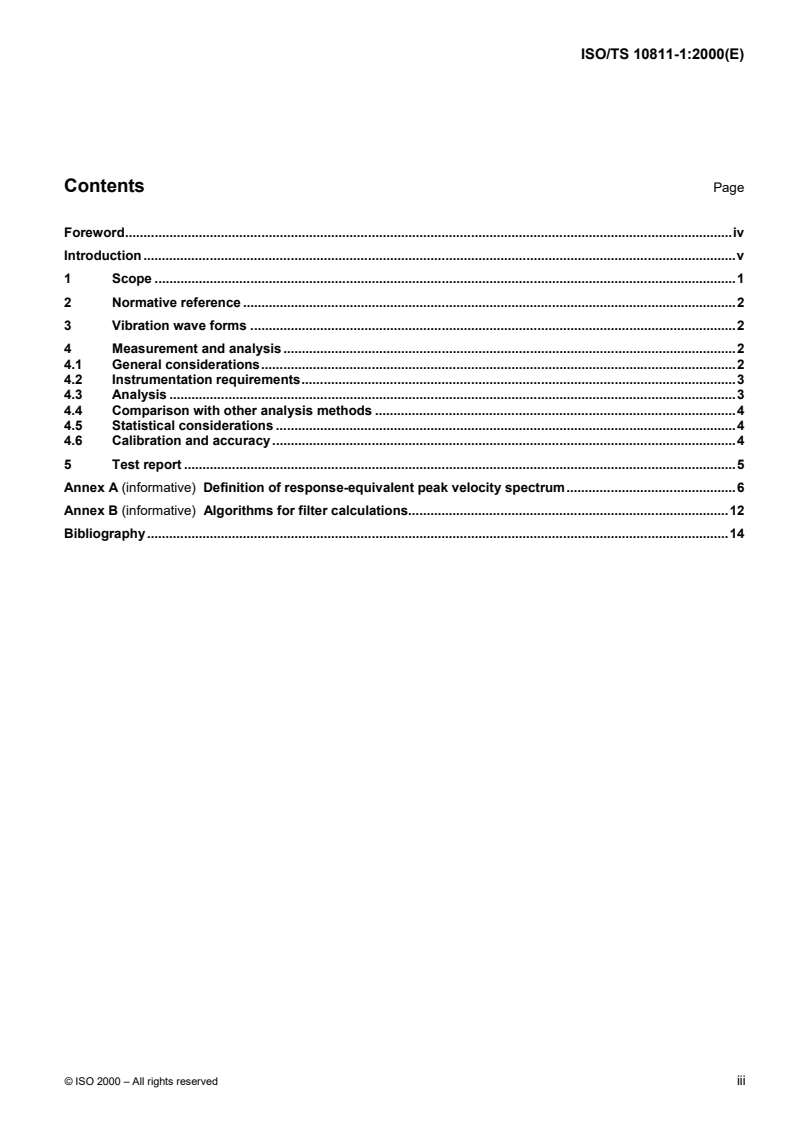
Contents Page
Foreword.iv
Introduction.v
1 Scope .1
2 Normative reference .2
3 Vibration wave forms .2
4 Measurement and analysis .2
4.1 General considerations.2
4.2 Instrumentation requirements.3
4.3 Analysis .3
4.4 Comparison with other analysis methods .4
4.5 Statistical considerations .4
4.6 Calibration and accuracy.4
5 Test report .5
Annex A (informative) Definition of response-equivalent peak velocity spectrum.6
Annex B (informative) Algorithms for filter calculations.12
Bibliography.14
Foreword
ISO (the International Organization for Standardization) is a worldwide federation of national standards bodies (ISO
member bodies). The work of preparing International Standards is normally carried out through ISO technical
committees. Each member body interested in a subject for which a technical committee has been established has
the right to be represented on that committee. International organizations, governmental and non-governmental, in
liaison with ISO, also take part in the work. ISO collaborates closely with the International Electrotechnical
Commission (IEC) on all matters of electrotechnical standardization.
International Standards are drafted in accordance with the rules given in the ISO/IEC Directives, Part 3.
The main task of technical committees is to prepare International Standards. Draft International Standards adopted
by the technical committees are circulated to the member bodies for voting. Publication as an International
Standard requires approval by at least 75 % of the member bodies casting a vote.
In other circumstances, particularly when there is an urgent market requirement for such documents, a technical
committee may decide to publish other types of normative document:
� an ISO Publicly Available Specification (ISO/PAS) represents an agreement between technical experts in an
ISO working group and is accepted for publication if it is approved by more than 50 % of the members of the
parent committee casting a vote;
� an ISO Technical Specification (ISO/TS) represents an agreement between the members of a technical
committee and is accepted for publication if it is approved by 2/3 of the members of the committee casting a
vote.
An ISO/PAS or ISO/TS is reviewed every three years with a view to deciding whether it can be transformed into an
International Standard.
Attention is drawn to the possibility that some of the elements of this part of ISO/TS 10811 may be the subject of
patent rights. ISO shall not be held responsible for identifying any or all such patent rights.
ISO/TS 10811-1 was prepared by Technical Committee ISO/TC 108, Mechanical vibration and shock,
Subcommittee SC 2, Measurement and evaluation of mechanical vibration and shock as applied to machines,
vehicles and structures.
ISO/TS 10811 consists of the following parts, under the general title Mechanical vibration and shock — Vibration
and shock in buildings with sensitive equipment:
� Part 1: Measurement and evaluation
� Part 2: Classification
Annexes A and B of this part of ISO/TS 10811 are for information only.
iv © ISO 2000 – All rights reserved
Introduction
This part of ISO/TS 10811 proposes a new method for specifying and evaluating the performance of buildings
housing equipment which is sensitive to shock and vibration. The purpose is to encourage users and
manufacturers of sensitive equipment to collect data using this method to facilitate exchange of information and
assessment of the usefulness of the methodology.
TECHNICAL SPECIFICATION ISO/TS 10811-1:2000(E)
Mechanical vibration and shock — Vibration and shock
in buildings with sensitive equipment —
Part 1:
Measurement and evaluation
1 Scope
This part of ISO/TS 10811 defines methods of measurement, algorithms for analysis and the report of shock and
vibration data for equipment in buildings which is sensitive to shock and vibration. The methods are applicable to
the quantification of a future installation or the verification of an existing one.
Accurate vibration data acquisition, analysis and uniform reporting methods are needed to evaluate vibration
relative to manufacturers' and generic vibration criteria. Expected levels of vibration can be found in IEC 60721.
Procedures for testing of equipment can be found in IEC 60068.
NOTE A classification system of environmental vibration conditions established from measurements according to this part
of ISO/TS 10811 should serve as guidelines for designers, manufacturers and users of shock-and-vibration-sensitive equipment
and for building constructors (see ISO/TS 10811-2).
The types of shock and vibration considered are those transmitted from floors, tables, walls, ceilings or isolation
systems into an equipment unit. The vibration and shock response of individual mechanical or electronic parts
inside the unit are not considered explicitly.
The types of sensitive equipment envisaged include, but are not limited to, the following:
a) stationary computer systems, including the peripherals;
b) stationary telecommunication equipment;
c) stationary laboratory equipment such as electron microscopes, equipment using scanning probe methods,
biotechnical instrumentation, mass spectrometers, etc.;
d) mechanical high-precision instruments (tools) such as equipment for microelectronics production;
e) optical high-precision instruments, systems for photoreproduction;
f) electromechanical systems in traffic control centres for trains;
g) security equipment (fire intrusion) and equipment for access control.
The types of shock and vibration considered herein can be generated by the following:
� external sources, for example traffic (by road, rail or air), or building and construction activities such as
blasting, piling and vibratory compaction; the vibration response to sonic booms and acoustical excitations is
also included as well as weather-induced vibration;
� equipment for indoor use, such as punch presses, forging hammers, rotary equipment (air compressors, air
conditioner systems, etc.) and heavy equipment transported or operated inside a building;
� human activities in connection with the service or operation of the equipment, for example, people walking,
especially on raised floors.
The measurement and evaluation of shock and vibration effects on sensitive equipment in buildings covered in this
part of ISO/TS 10811 does not directly consider the human operators’ capability to observe, operate or maintain
the equipment. For vibration effects on human beings, see ISO 2631.
The frequency range of interest is normally 2 Hz to 200 Hz. Normally the dominant frequencies are less than
100 Hz because they represent the response of the elements in the building. For special purposes, another
frequency range may be used and the numbers referring to frequency range should be changed accordingly.
The vibration amplitude and duration depend mainly upon the source, its distance from sensitive equipment, and
the response of the elements of the building containing the sensitive equipment. Expressed in terms of vibration
velocity, the values to consider are in the range 0,001 mm/s to 10 mm/s.
This part of ISO/TS 10811 deals only with vibration from a maximum amplitude point of view. The concept of
vibration dose (e.g. estimation of fatigue life) is not treated.
2 Normative reference
The following normative document contains provisions which, through reference in this text, constitute provisions of
this part of ISO/TS 10811. For dated references, subsequent amendments to, or revisions of, this publication do
not apply. However, parties to agreements based on this part of ISO/TS 10811 are encouraged to investigate the
possibility of applying the most recent editions of the normative documents indicated below. For undated
references, the latest edition of the normative document referred to applies. Members of ISO and IEC maintain
registers of currently valid International Standards.
ISO 5348, Mechanical vibration and shock — Mechanical mounting of accelerometers.
3 Vibration wave forms
The vibration wave forms in a building that could affect sensitive equipment may be of any kind: sinusoidal
(periodic), random or transient. Therefore, to be effective, measurement and analysis of the vibration shall address
all three types of motion. Typical examples of sources for different wave forms are the following:
a) rotating machinery for sinusoidal vibration;
b) road traffic (many vehicles) for random vibration;
c) single road vehicles, piling, impacting and blasting for transient vibration.
The frequency content of the vibration is determined by the source but is also influenced by the dynamics of the
building.
The main purpose of this part of ISO/TS 10811 is to define methods for measurement and analysis of vibration that
can be used for any types of vibration wave form.
4 Measurement and analysis
4.1 General considerations
In order to determine the vibration and shock conditions to which equipment may be exposed, accurate and
comprehensive measurements in the field shall be made.
2 © ISO 2000 – All rights reserved
Measurement of the vibration shall be performed at points as close as possible to the points of contact of the
equipment or its support with a floor or wall. For large equipment, multiple points may be necessary.
The time history of the vibration should be recorded and analysed along three orthogonal axes (preferably in the
vertical direction and in two orthogonal horizontal directions).
The measurements shall, where practical, be made with the shock-and-vibration-sensitive equipment in place, or
with a dummy having the same mass and similar dynamic behaviour as that of the equipment under consideration.
(The effective mass of the equipment on raised floors or tables may significantly change the response levels and
frequencies. At the equipment's resonance frequencies, it will act as a "dynamic absorber" and reduce the
vibration.)
It is recommended that the measurement be performed, whenever possible, with the sensitive equipment (including
auxiliary syste
...
SPÉCIFICATION ISO/TS
TECHNIQUE 10811-1
Première édition
2000-06-01
Vibrations et chocs mécaniques —
Vibrations et chocs dans les bâtiments
abritant des équipements sensibles —
Partie 1:
Mesurage et évaluation
Mechanical vibration and shock — Vibration and shock in buildings with
sensitive equipment —
Part 1: Measurement and evaluation
Numéro de référence
©
ISO 2000
PDF – Exonération de responsabilité
Le présent fichier PDF peut contenir des polices de caractères intégrées. Conformément aux conditions de licence d'Adobe, ce fichier peut
être imprimé ou visualisé, mais ne doit pas être modifié à moins que l'ordinateur employé à cet effet ne bénéficie d'une licence autorisant
l'utilisation de ces polices et que celles-ci y soient installées. Lors du téléchargement de ce fichier, les parties concernées acceptent de fait la
responsabilité de ne pas enfreindre les conditions de licence d'Adobe. Le Secrétariat central de l'ISO décline toute responsabilité en la
matière.
Adobe est une marque déposée d'Adobe Systems Incorporated.
Les détails relatifs aux produits logiciels utilisés pour la création du présent fichier PDF sont disponibles dans la rubrique General Info du
fichier; les paramètres de création PDF ont été optimisés pour l'impression. Toutes les mesures ont été prises pour garantir l'exploitation de
ce fichier par les comités membres de l'ISO. Dans le cas peu probable où surviendrait un problème d'utilisation, veuillez en informer le
Secrétariat central à l'adresse donnée ci-dessous.
Droits de reproduction réservés. Sauf prescription différente, aucune partie de cette publication ne peut être reproduite ni utilisée sous quelque
forme que ce soit et par aucun procédé, électronique ou mécanique, y compris la photocopie et les microfilms, sans l'accord écrit de l’ISO à
l’adresse ci-après ou du comité membre de l’ISO dans le pays du demandeur.
ISO copyright office
Case postale 56 � CH-1211 Geneva 20
Tel. + 41 22 749 01 11
Fax. + 41 22 734 10 79
E-mail copyright@iso.ch
Web www.iso.ch
ImpriméenSuisse
ii © ISO 2000 – Tous droits réservés
Sommaire Page
Avant-propos.iv
Introduction.v
1 Domaine d'application.1
2 Référence normative .2
3 Formes d’ondes de vibrations.2
4 Mesurage et analyse.3
4.1 Considérations d’ordre général .3
4.2 Exigences concernant l’instrumentation .3
4.3 Analyse .3
4.4 Comparaison avec d’autres méthodes d’analyse .4
4.5 Considérations d’ordre statistique .5
4.6 Étalonnage et précision .5
5 Rapport d'essai .5
Annexe A (informative) Définition du spectre équivalent de réponse en vitesse de crête.6
Annexe B (informative) Algorithmes pour les calculs des filtres.12
Bibliographie .14
Avant-propos
L'ISO (Organisation internationale de normalisation) est une fédération mondiale d'organismes nationaux de
normalisation (comités membres de l'ISO). L'élaboration des Normes internationales est en général confiée aux
comités techniques de l'ISO. Chaque comité membre intéressé par une étude a le droit de faire partie du comité
technique créé à cet effet. Les organisations internationales, gouvernementales et non gouvernementales, en
liaison avec l'ISO participent également aux travaux. L'ISO collabore étroitement avec la Commission
électrotechnique internationale (CEI) en ce qui concerne la normalisation électrotechnique.
Les Normes internationales sont rédigées conformément aux règles données dans les Directives ISO/CEI, Partie 3.
La tâche principale des comités techniques est d'élaborer les Normes internationales. Les projets de Normes
internationales adoptés par les comités techniques sont soumis aux comités membres pour vote. Leur publication
comme Normes internationales requiert l’approbation de 75 % au moins des comités membres votants.
Dans d’autres circonstances, en particulier lorsqu’il existe une demande urgente du marché, un comité technique
peut décider de publier d’autres types de documents normatifs:
� une Spécification publiquement disponible ISO (ISO/PAS) représente un accord entre les experts dans un
groupe de travail ISO et est acceptée pour publication si elle est approuvée par plus de 50 % des membres
votants du comité dont relève le groupe de travail;
� une Spécification technique ISO (ISO/TS) représente un accord entre les membres d’un comité technique et
est acceptée pour publication si elle est approuvée par 2/3 des membres votants du comité.
Les ISO/PAS et ISO/TS font l’objet d’un nouvel examen tous les trois ans afin de décider éventuellement de leur
transformation en Normes internationales.
L’attention est appelée sur le fait que certains des éléments de la présente partie de l’ISO/TS 10811 peuvent faire
l’objet de droits de propriété intellectuelle ou de droits analogues. L’ISO ne saurait être tenue pour responsable de
ne pas avoir identifié de tels droits de propriété et averti de leur existence.
L’ISO/TS 10811-1 a été élaborée par le Comité technique ISO/TC 108, Vibrations et chocs mécaniques,
sous-comité SC 2, Mesure et évaluation des vibrations et chocs mécaniques intéressant les machines, les
véhicules et les structures.
L'ISO/TS 10811 comprend les parties suivantes, présentées sous le titre général Vibrations et chocs mécaniques
— Vibrations et chocs dans les bâtiments abritant des équipements sensibles:
� Partie 1: Mesurage et évaluation
� Partie 2: Classification
Les annexes A et B de la présente partie de l’ISO/TS 10811 sont données uniquement à titre d’information.
iv © ISO 2000 – Tous droits réservés
Introduction
La présente partie de l’ISO/TS 10811 propose une nouvelle méthode de spécification et d’évaluation du
comportement des bâtiments abritant des équipements sensibles aux vibrations et aux chocs. L’objet de cette
spécification est d’encourager les utilisateurs et les constructeurs d’équipements sensibles à recueillir des données
à l’aide de cette méthode, et ce, afin de faciliter l’échange d’informations et l’évaluation du caractère utile de la
méthodologie.
SPÉCIFICATION TECHNIQUE ISO/TS 10811-1:2000(F)
Vibrations et chocs mécaniques — Vibrations et chocs
dans les bâtiments abritant des équipements sensibles —
Partie 1:
Mesurage et évaluation
1 Domaine d'application
La présente partie de l’ISO/TS 10811 définit les méthodes de mesurage, les algorithmes d’analyse et le rapport
des données relatives aux vibrations et aux chocs pour ce qui concerne les équipements sensibles aux vibrations
et aux chocs dans les bâtiments. Les méthodes sont applicables à la quantification d’une installation future ou à la
vérification d’une installation existante.
Des méthodes précises d’acquisition des mesures de vibration, d’analyse et de rédaction de rapports homogènes
sont nécessaires afin d’évaluer les vibrations selon des critères généraux et ceux des constructeurs. La norme
CEI 60721 donne les niveaux de vibrations prévus. Les modes opératoires d’essais des équipements sont décrits
dans la norme CEI 60068.
NOTE Il convient que le système de classification des régimes vibratoires ambiants établi à partir des mesures effectuées
conformément à la présente partie de l’ISO/TS 10811 soit utilisé comme ligne directrice par les concepteurs, les constructeurs
et les utilisateurs d’équipements sensibles aux chocs et aux vibrations, ainsi que par les constructeurs immobiliers (voir
l'ISO/TS 10811-2).
Les types de chocs et de vibrations pris en considération sont ceux transmis à un équipement par les planchers,
les panneaux de revêtement, les murs, les plafonds ou les systèmes d’isolation. La tenue aux vibrations et aux
chocs des pièces mécaniques ou électroniques individuelles d’un équipement n’est pas prise en considération de
manière explicite.
Les types d’équipement sensible concernés incluent, sans toutefois s’y limiter:
a) les systèmes informatiques fixes, y compris les périphériques;
b) le matériel de télécommunication fixe;
c) le matériel de laboratoire fixe tel que les microscopes électroniques, le matériel utilisant des méthodes par
sonde de balayage, l’instrumentation biotechnique, les spectromètres de masse, etc.;
d) les instruments (outils) mécaniques de haute précision tels que le matériel de production microélectronique;
e) les instruments optiques de haute précision, les systèmes de photoreproduction;
f) les systèmes électromécaniques des centres de régulation du trafic ferroviaire;
g) le matériel de sécurité (déclaration d’incendie) et de contrôle d’accès.
Les types de chocs et de vibrations pris en considération dans le présent document peuvent être générés par:
� des sources extérieures, par exemple trafic (routier, ferroviaire ou aérien) ou activités liées au bâtiment et à la
construction telles que les explosions, le battage de pieux et le vibrofonçage; la tenue aux vibrations dues aux
bruits d’explosion et aux excitations acoustiques est également prise en compte, de même que les vibrations
attribuables aux intempéries;
� le matériel destiné à être utilisé à l’intérieur, tel que les presses mécaniques, les marteaux-pilons, le matériel à
fonctionnement rotatif (compresseurs d’air, systèmes de conditionnement d’air, etc.) ainsi que le matériel lourd
transporté ou utilisé à l’intérieur d’un bâtiment;
� les activités humaines en rapport avec l’entretien ou le fonctionnement du matériel, par exemple le fait que des
personnes se déplacent, en particulier sur des faux planchers.
Le mesurage et l’évaluation des effets des chocs et des vibrations sur les équipements sensibles à l’intérieur des
bâtiments, traitées dans la présente partie de l’ISO/TS 10811, ne prennent pas directement en considération la
capacité des opérateurs humains à observer, utiliser ou entretenir le matériel concerné. Pour les effets des
vibrations sur les individus, se reporter à l’ISO 2631.
Le domaine de fréquences représentatif est normalement compris entre 2 Hz et 200 Hz. Les fréquences
dominantes sont généralement inférieures à 100 Hz dans la mesure où elles représentent la réponse des éléments
dans le bâtiment. Une autre gamme de fréquences peut être utilisée à des fins particulières et il convient de
modifier les nombres faisant référence à la gamme de fréquences en conséquence.
L’amplitude et la durée des vibrations dépendent principalement de la source, de sa distance par rapport aux
équipements sensibles et de la réponse des éléments du bâtiment contenant les équipements sensibles. Les
valeurs à prendre en considération, exprimées en termes de vitesse vibratoire, sont comprises entre 0,001 mm/s et
10 mm/s.
La présente partie de l’ISO/TS 10811 traite uniquement des vibrations du point de vue de l’amplitude maximale. Le
concept de la quantité de vibrations (par exemple en ce qui concerne l’estimation de la résistance à la fatigue)
n’est pas traité.
2 Référence normative
Le document normatif suivant contient des dispositions qui, par suite de la référence qui y est faite, constituent des
dispositions valables pour la présente partie de l’ISO/TS 10811. Pour les références datées, les amendements
ultérieurs ou les révisions de ces publications ne s’appliquent pas. Toutefois, les parties prenantes aux accords
fondés sur la présente partie de l’ISO/TS 10811sont invitées à rechercher la possibilité d'appliquer l’édition la plus
récente du document normatif indiqué ci-après. Pour les références non datées, la dernière édition du document
normatif en référence s’applique. Les membres de l'ISO et de la CEI possèdent le registre des Normes
internationales en vigueur.
ISO 5348, Vibrations et chocs mécaniques — Fixation mécanique des accéléromètres.
3 Formes d’ondes de vibrations
Les formes d’ondes de vibrations à l’intérieur d’un bâtiment susceptibles d’affecter les équipements sensibles
peuvent être de toute nature: sinusoïdale (périodique), aléatoire ou transitoire. Par conséquent, et pour être
efficaces, le mesurage et l’analyse des vibrations doivent concerner l’ensemble de ces trois types de mouvement.
Les exemples types des sources des différentes formes d’ondes sont les suivants:
a) pour les vibrations sinusoïdales: les machines tournantes;
b) pour les vibrations aléatoires: le trafic routier (nombreux véhicules);
c) pour les vibrations transitoires: les véhicules routiers isolés, le battage de pieux, les chocs et les explosions.
La composante fréquentielle des vibrations est déterminée par la source mais est également influencée par la
dynamique du bâtiment.
L’objet principal de la présente partie de l’ISO/TS 10811 est de définir des méthodes de mesure et d’analyse des
vibrations pouvant être utilisées pour tous les types de forme d’onde de vibrations.
2 © ISO 2000 – Tous droits réservés
4 Mesurage et analyse
4.1 Considérations d’ordre général
Afin de déterminer les régimes de vibrations et de chocs auxquels les équipements peuvent être exposés, des
mesures précises et complètes sur le terrain doivent être effectuées.
Le mesurage des vibrations doit être effectué aux points les plus proches possible des points de contact des
équipements ou de leur support avec le sol ou un mur. Pour des équipements de grande dimension, plusieurs
points peuvent se révéler nécessaires.
Il convient de consigner le diagramme temporel des vibrations et de l’analyser le long de trois axes orthogonaux,
de préférence dans une direction verticale et dans deux directions horizontales orthogonales.
Le mesurage doit, lorsque la pratique le permet, être effectué avec l’équipement sensible aux chocs et aux
vibrations installé, ou avec une maquette ayant la même masse et un comportement dynamique similaire à celui
de l’équipement pris en considération. (La masse effective de l’équipement disposé sur des faux planchers ou des
panneaux de revêtement peut modifier de manière significative les niveaux et fréquences de réponse. Aux
fréquences de résonance de l’équipement, la masse agit comme un «amortisseur dynamique» et réduit les
vibrations.)
Il est recommandé, dans toute la mesure du possible, d’effectuer la mesure avec l’équipement sensible, y compris
les systèmes auxiliaires, à la fois dans les modes de fonc
...