

ISO 780:2015
(Main)Packaging — Distribution packaging — Graphical symbols for handling and storage of packages
General Information
- Abstract
ISO 780:2015 specifies a set of graphical symbols conventionally used for marking of distribution packages in their physical distribution chain to convey handling instructions. The graphical symbols should be used only when necessary. ISO 780:2015 is applicable to packages containing any kind of goods, but does not include instructions specific to handling of dangerous goods.
- Status
- Published
- Publication Date
- 17-Nov-2015
- Technical Committee
- ISO/TC 122 - Packaging
- Drafting Committee
- ISO/TC 122 - Packaging
- Current Stage
- 9093 - International Standard confirmed
- Start Date
- 10-Jun-2026
- Completion Date
- 29-Aug-2026
Buy Documents
ISO 780:2015 - Packaging -- Distribution packaging -- Graphical symbols for handling and storage of packages
ISO 780:2015 - Packaging — Distribution packaging — Graphical symbols for handling and storage of packages/18/2015
ISO 780:2015 - Emballages -- Emballages de distribution -- Symboles graphiques pour la manutention et le stockage des emballages
ISO 780:2015 - Emballages — Emballages de distribution — Symboles graphiques pour la manutention et le stockage des emballages/18/2015
Overview
ISO 780:2015 - Packaging - Distribution packaging - Graphical symbols for handling and storage of packages defines a standardized set of graphical symbols used to mark distribution packages so that handling and storage instructions can be understood across languages and literacy levels. It applies to packages containing any kind of goods (except instructions specific to dangerous goods) and aims to reduce damage and improve safety during transport and storage by conveying clear, visual handling instructions.
Key topics and technical requirements
- Scope and intent
- Applies to distribution packages in the physical distribution chain; symbols used only when necessary.
- Not intended for handling instructions specific to dangerous goods.
- Symbol set and meanings
- Includes commonly used symbols such as Centre of gravity (No. 1), Sling here (No. 2), Fragile - handle with care (No. 3), No hand hooks (No. 4), Do not use hand truck here (No. 5), Use no forks (No. 6), Do not clamp as indicated (No. 7), Clamp as indicated (No. 8), Do not roll (No. 9), Keep away from rain (No. 10), etc.
- Display and reproduction
- For large packages, symbols should preferably be stencilled or reproduced on a label; symbols are designed for easy stencilling.
- Colour and contrast
- Symbols shall be black; if the package background prevents legibility, provide a contrasting panel (preferably white).
- Avoid red, orange or yellow to prevent confusion with dangerous goods labeling.
- Size and legibility
- Typical symbol heights: 100 mm, 150 mm or 200 mm, adaptable to package size provided visibility is retained.
- Number and position
- The standard specifies minimum numbers, faces and typical positions for particular symbols (e.g., centre of gravity and sling markings should be visible on specified faces).
- Compatibility
- Symbols follow principles harmonized with ISO 7000 (registered symbols) and IEC guidance for graphical symbol design.
Practical applications and users
Who benefits from implementing ISO 780:2015:
- Logistics and supply chain professionals (packaging engineers, warehouse managers, freight forwarders)
- Shippers and manufacturers designing distribution packaging
- Safety and compliance officers aiming to reduce handling damage and workplace accidents
- Labeling and printing suppliers producing package markings Practical uses include palletization and lift planning, crane and forklift operations, export packaging, warehouse racking and storage instructions, and international shipments where multilingual text is impractical.
Related standards
- ISO 7000 - Graphical symbols for use on equipment (registered symbols)
- IEC 80416-1 - Basic principles for graphical symbols
- ISO 21067 - Packaging - Vocabulary
- ISO 2331, ISO 4306-1, ISO 5053 - terminology for handling equipment
Implementing ISO 780:2015 helps organizations standardize package marking for safer, clearer handling instructions that reduce damage, improve worker safety, and simplify international logistics.
Relations
- Effective Date
- 25-Aug-2026
- Effective Date
- 12-Feb-2026
- Effective Date
- 06-Jun-2022
- Effective Date
- 25-Jun-2011
Buy Documents
ISO 780:2015 - Packaging -- Distribution packaging -- Graphical symbols for handling and storage of packages
ISO 780:2015 - Packaging — Distribution packaging — Graphical symbols for handling and storage of packages/18/2015
ISO 780:2015 - Emballages -- Emballages de distribution -- Symboles graphiques pour la manutention et le stockage des emballages
ISO 780:2015 - Emballages — Emballages de distribution — Symboles graphiques pour la manutention et le stockage des emballages/18/2015
Get Certified
Connect with accredited certification bodies for this standard

BRCGS (Brand Reputation Compliance Global Standards)
Global food safety and quality standards owner.
Sponsored listings
Frequently Asked Questions
ISO 780:2015 is a standard published by the International Organization for Standardization (ISO). Its full title is "Packaging — Distribution packaging — Graphical symbols for handling and storage of packages". This standard covers: ISO 780:2015 specifies a set of graphical symbols conventionally used for marking of distribution packages in their physical distribution chain to convey handling instructions. The graphical symbols should be used only when necessary. ISO 780:2015 is applicable to packages containing any kind of goods, but does not include instructions specific to handling of dangerous goods.
ISO 780:2015 specifies a set of graphical symbols conventionally used for marking of distribution packages in their physical distribution chain to convey handling instructions. The graphical symbols should be used only when necessary. ISO 780:2015 is applicable to packages containing any kind of goods, but does not include instructions specific to handling of dangerous goods.
ISO 780:2015 is classified under the following ICS (International Classification for Standards) categories: 01.080.99 - Other graphical symbols; 55.020 - Packaging and distribution of goods in general. The ICS classification helps identify the subject area and facilitates finding related standards.
ISO 780:2015 has the following relationships with other standards: It is inter standard links to EN ISO 28721-1:2019, EN ISO 780:2015, ISO 6877:2006, ISO 780:1997. Understanding these relationships helps ensure you are using the most current and applicable version of the standard.
ISO 780:2015 is available in PDF format for immediate download after purchase. The document can be added to your cart and obtained through the secure checkout process. Digital delivery ensures instant access to the complete standard document.
Standards Content (Sample)
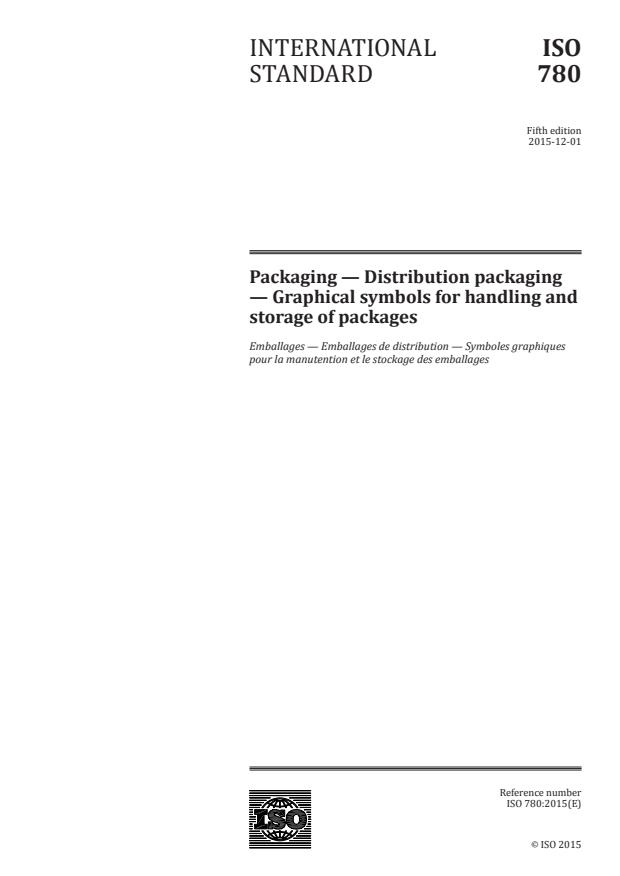
INTERNATIONAL ISO
STANDARD 780
Fifth edition
2015-12-01
Packaging — Distribution packaging
— Graphical symbols for handling and
storage of packages
Emballages — Emballages de distribution — Symboles graphiques
pour la manutention et le stockage des emballages
Reference number
©
ISO 2015
© ISO 2015, Published in Switzerland
All rights reserved. Unless otherwise specified, no part of this publication may be reproduced or utilized otherwise in any form
or by any means, electronic or mechanical, including photocopying, or posting on the internet or an intranet, without prior
written permission. Permission can be requested from either ISO at the address below or ISO’s member body in the country of
the requester.
ISO copyright office
Ch. de Blandonnet 8 • CP 401
CH-1214 Vernier, Geneva, Switzerland
Tel. +41 22 749 01 11
Fax +41 22 749 09 47
copyright@iso.org
www.iso.org
ii © ISO 2015 – All rights reserved
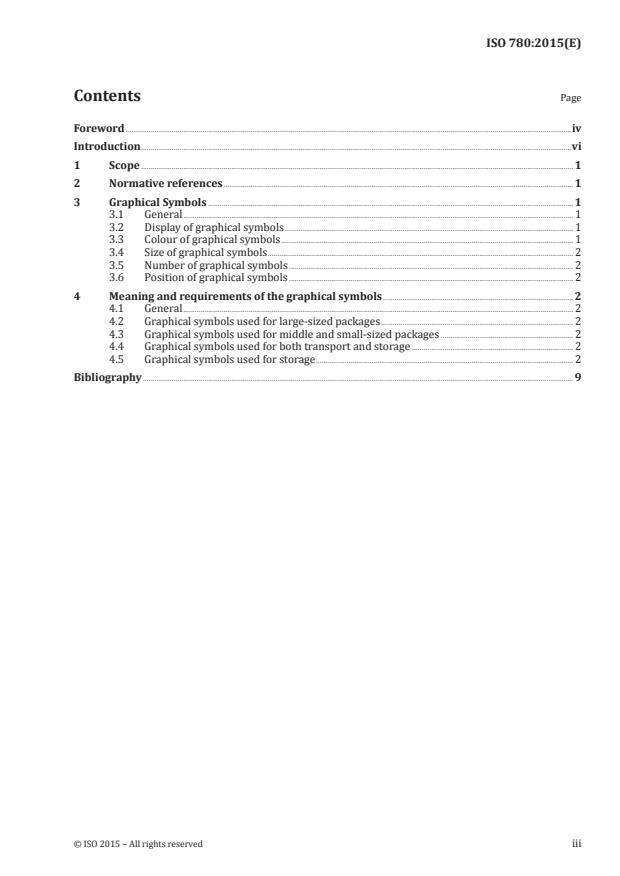
Contents Page
Foreword .iv
Introduction .vi
1 Scope . 1
2 Normative references . 1
3 Graphical Symbols . 1
3.1 General . 1
3.2 Display of graphical symbols . 1
3.3 Colour of graphical symbols . 1
3.4 Size of graphical symbols . 2
3.5 Number of graphical symbols . 2
3.6 Position of graphical symbols . 2
4 Meaning and requirements of the graphical symbols . 2
4.1 General . 2
4.2 Graphical symbols used for large-sized packages . 2
4.3 Graphical symbols used for middle and small-sized packages . 2
4.4 Graphical symbols used for both transport and storage . 2
4.5 Graphical symbols used for storage . 2
Bibliography . 9
Foreword
ISO (the International Organization for Standardization) is a worldwide federation of national standards
bodies (ISO member bodies). The work of preparing International Standards is normally carried out
through ISO technical committees. Each member body interested in a subject for which a technical
committee has been established has the right to be represented on that committee. International
organizations, governmental and non-governmental, in liaison with ISO, also take part in the work.
ISO collaborates closely with the International Electrotechnical Commission (IEC) on all matters of
electrotechnical standardization.
The procedures used to develop this document and those intended for its further maintenance are
described in the ISO/IEC Directives, Part 1. In particular the different approval criteria needed for the
different types of ISO documents should be noted. This document was drafted in accordance with the
editorial rules of the ISO/IEC Directives, Part 2. www.iso.org/directives
Attention is drawn to the possibility that some of the elements of this document may be the subject of
patent rights. ISO shall not be held responsible for identifying any or all such patent rights. Details of
any patent rights identified during the development of the document will be in the Introduction and/or
on the ISO list of patent declarations received. www.iso.org/patents
Any trade name used in this document is information given for the convenience of users and does not
constitute an endorsement.
For an explanation on the meaning of ISO specific terms and expressions related to conformity
assessment, as well as information about ISO’s adherence to the WTO principles in the Technical
Barriers to Trade (TBT), see the following URL: Foreword - Supplementary information
The committee responsible for this document is ISO/TC 122, Packaging.
This fifth edition cancels and replaces the fourth edition (ISO 780:1997), which has been technically
revised.
All the 17 graphical symbols in this International Standard have already been modified to accord with
IEC 80416-1:2008, Basic principles for graphical symbols for use on equipment — Part 1: Creation of
graphical symbols for registration and submitted to TC 145/SC 3 for registration on ISO 7000, Graphical
symbols for use on equipment — Registered symbols.
Some of the major modification points are indicated as follows:
a) Title:
New: Packaging – Distribution packaging – Graphical symbols for handling and storage of packages
Old: Packaging – Pictorial marking for handling of goods
“Distribution packaging” is preferred to “transport packaging” in this standard. The reason is that
“transport packaging” does not include “stored” packages, for example, in the practice of “transport
packaging for dangerous goods”. ISO 780 concerns with packages during storage as well as those
during transport.
“Pictorial marking” is replaced by “graphical symbols” to coincide with TC 145’s way of addressing
pictorial marking.
b) Introduction:
Statements on safety issue and hand-written symbols have been added.
c) Handling instructions:
The order of the graphical symbols has been re-arranged in the following order.
1) Graphical symbols used for large-sized packages.
iv © ISO 2015 – All rights reserved
2) Graphical symbols used for middle and small-sized packages:
— For all types of handling;
— For manual handling;
— For handling using machines.
3) Graphical symbols used for both transport and storage.
4) Graphical symbols used for storage.
To make this standard easier to use, the layout of the table has been changed and each graphical symbol
has its Reference No. to ISO 7000, Meaning, Requirement, Note and example of application.
Introduction
Packages are often marked with handling instructions in the language of the country of origin. While
this may safeguard the consignment in the areas using the same language, it is of little value for goods
consigned to, or through, countries using different languages, and of no value at all if people handling
the packages are illiterate.
Graphical symbols offer the best possibility of conveying the consignor’s intention and their adoption
will; therefore, undoubtedly reduce loss and damage through incorrect handling. Moreover, graphical
symbols help ensure safety of workers, who cannot grasp such important information as structure,
gravity centre, property, and strength of a package while handling distribution packages.
The graphical symbols specified are in accordance with the rules of ISO/TC 145/SC 3, Graphical symbols
for use on equipment.
The use of graphical symbols does not provide any guarantee of satisfactory handling; safely and
properly protective packaging is therefore of primary importance.
Distribution packages could deteriorate as time passes and sometimes cannot withstand normal
handling before they reach the final destination. In such case, according to the provisions of the
distribution contract, we need to decide whether to stop shipping and storing them or to continue to
use them by putting proper graphical symbols on them. In any case, handwritten symbols are partially
accepted in this standard so that the proper symbols can be added to do the needful on the spot.
vi © ISO 2015 – All rights reserved
INTERNATIONAL STANDARD ISO 780:2015(E)
Packaging — Distribution packaging — Graphical symbols
for handling and storage of packages
1 Scope
This International Standard specifies a set of graphical symbols conventionally used for marking of
distribution packages in their physical distribution chain to convey handling instructions. The graphical
symbols should be used only when necessary.
This International Standard is applicable to packages containing any kind of goods, but does not include
instructions specific to handling of dangerous goods.
2 Normative references
The following documents, in whole or in part, are normatively referenced in this document and are
indispensable for its application. For dated references, only the edition cited applies. For undated
references, the latest edition of the referenced document (including any amendments) applies.
ISO 2331, Fork lift trucks — Hook-on type fork arms — Vocabulary
ISO 4306-1, Cranes — Vocabulary — Part 1: General
ISO 5053, Powered industrial trucks — Terminology
ISO 7000, Graphical symbols for use on equipment — Registered symbols
ISO 21067, Packaging — Vocabulary
3 Graphical Symbols
3.1 General
In order to ensure safe, proper and efficient handling of distribution packages, display, colour, size,
number and position of graphical symbols shall be considered.
3.2 Display of graphical symbols
For large packages, graphical symbols should preferably be stencilled directly on the package or may
appear on a label. It is recommended that the graphical symbols should be printed, painted or otherwise
reproduced as specified in this International Standard. They need not be framed by border lines.
The graphical design of each symbol shall have only one meaning; symbols are purposely designed so
that they can also be stencilled without changing the graphics. The change of the graphics, however, is
accepted to facilitate the forming of stencil.
3.3 Colour of graphical symbols
The colour used for graphical symbols shall be black.
If the colour of the package is such that the black symbol would not show clearly, a panel of a suitable
contrasting colour, preferably white, shall be provided as a background.
Care shall be taken to avoid the use of colours such as red, orange or yellow, which could result in
confusion with the labelling of dangerous goods.
3.4 Size of graphical symbols
For normal purposes the overall height of the graphical symbols shall be 100mm, 150mm or 200mm.
Depending on the size or shape of the package; however, the size of the graphical symbols may be larger
or smaller provided that the visibility of the graphical symbols is retained.
Different horizontal/vertical ratio may be applied to enhance the visi
...
INTERNATIONAL ISO
STANDARD 780
Fifth edition
2015-12-01
Packaging — Distribution packaging
— Graphical symbols for handling and
storage of packages
Emballages — Emballages de distribution — Symboles graphiques
pour la manutention et le stockage des emballages
Reference number
©
ISO 2015
© ISO 2015, Published in Switzerland
All rights reserved. Unless otherwise specified, no part of this publication may be reproduced or utilized otherwise in any form
or by any means, electronic or mechanical, including photocopying, or posting on the internet or an intranet, without prior
written permission. Permission can be requested from either ISO at the address below or ISO’s member body in the country of
the requester.
ISO copyright office
Ch. de Blandonnet 8 • CP 401
CH-1214 Vernier, Geneva, Switzerland
Tel. +41 22 749 01 11
Fax +41 22 749 09 47
copyright@iso.org
www.iso.org
ii © ISO 2015 – All rights reserved
Contents Page
Foreword .iv
Introduction .vi
1 Scope . 1
2 Normative references . 1
3 Graphical Symbols . 1
3.1 General . 1
3.2 Display of graphical symbols . 1
3.3 Colour of graphical symbols . 1
3.4 Size of graphical symbols . 2
3.5 Number of graphical symbols . 2
3.6 Position of graphical symbols . 2
4 Meaning and requirements of the graphical symbols . 2
4.1 General . 2
4.2 Graphical symbols used for large-sized packages . 2
4.3 Graphical symbols used for middle and small-sized packages . 2
4.4 Graphical symbols used for both transport and storage . 2
4.5 Graphical symbols used for storage . 2
Bibliography . 9
Foreword
ISO (the International Organization for Standardization) is a worldwide federation of national standards
bodies (ISO member bodies). The work of preparing International Standards is normally carried out
through ISO technical committees. Each member body interested in a subject for which a technical
committee has been established has the right to be represented on that committee. International
organizations, governmental and non-governmental, in liaison with ISO, also take part in the work.
ISO collaborates closely with the International Electrotechnical Commission (IEC) on all matters of
electrotechnical standardization.
The procedures used to develop this document and those intended for its further maintenance are
described in the ISO/IEC Directives, Part 1. In particular the different approval criteria needed for the
different types of ISO documents should be noted. This document was drafted in accordance with the
editorial rules of the ISO/IEC Directives, Part 2. www.iso.org/directives
Attention is drawn to the possibility that some of the elements of this document may be the subject of
patent rights. ISO shall not be held responsible for identifying any or all such patent rights. Details of
any patent rights identified during the development of the document will be in the Introduction and/or
on the ISO list of patent declarations received. www.iso.org/patents
Any trade name used in this document is information given for the convenience of users and does not
constitute an endorsement.
For an explanation on the meaning of ISO specific terms and expressions related to conformity
assessment, as well as information about ISO’s adherence to the WTO principles in the Technical
Barriers to Trade (TBT), see the following URL: Foreword - Supplementary information
The committee responsible for this document is ISO/TC 122, Packaging.
This fifth edition cancels and replaces the fourth edition (ISO 780:1997), which has been technically
revised.
All the 17 graphical symbols in this International Standard have already been modified to accord with
IEC 80416-1:2008, Basic principles for graphical symbols for use on equipment — Part 1: Creation of
graphical symbols for registration and submitted to TC 145/SC 3 for registration on ISO 7000, Graphical
symbols for use on equipment — Registered symbols.
Some of the major modification points are indicated as follows:
a) Title:
New: Packaging – Distribution packaging – Graphical symbols for handling and storage of packages
Old: Packaging – Pictorial marking for handling of goods
“Distribution packaging” is preferred to “transport packaging” in this standard. The reason is that
“transport packaging” does not include “stored” packages, for example, in the practice of “transport
packaging for dangerous goods”. ISO 780 concerns with packages during storage as well as those
during transport.
“Pictorial marking” is replaced by “graphical symbols” to coincide with TC 145’s way of addressing
pictorial marking.
b) Introduction:
Statements on safety issue and hand-written symbols have been added.
c) Handling instructions:
The order of the graphical symbols has been re-arranged in the following order.
1) Graphical symbols used for large-sized packages.
iv © ISO 2015 – All rights reserved
2) Graphical symbols used for middle and small-sized packages:
— For all types of handling;
— For manual handling;
— For handling using machines.
3) Graphical symbols used for both transport and storage.
4) Graphical symbols used for storage.
To make this standard easier to use, the layout of the table has been changed and each graphical symbol
has its Reference No. to ISO 7000, Meaning, Requirement, Note and example of application.
Introduction
Packages are often marked with handling instructions in the language of the country of origin. While
this may safeguard the consignment in the areas using the same language, it is of little value for goods
consigned to, or through, countries using different languages, and of no value at all if people handling
the packages are illiterate.
Graphical symbols offer the best possibility of conveying the consignor’s intention and their adoption
will; therefore, undoubtedly reduce loss and damage through incorrect handling. Moreover, graphical
symbols help ensure safety of workers, who cannot grasp such important information as structure,
gravity centre, property, and strength of a package while handling distribution packages.
The graphical symbols specified are in accordance with the rules of ISO/TC 145/SC 3, Graphical symbols
for use on equipment.
The use of graphical symbols does not provide any guarantee of satisfactory handling; safely and
properly protective packaging is therefore of primary importance.
Distribution packages could deteriorate as time passes and sometimes cannot withstand normal
handling before they reach the final destination. In such case, according to the provisions of the
distribution contract, we need to decide whether to stop shipping and storing them or to continue to
use them by putting proper graphical symbols on them. In any case, handwritten symbols are partially
accepted in this standard so that the proper symbols can be added to do the needful on the spot.
vi © ISO 2015 – All rights reserved
INTERNATIONAL STANDARD ISO 780:2015(E)
Packaging — Distribution packaging — Graphical symbols
for handling and storage of packages
1 Scope
This International Standard specifies a set of graphical symbols conventionally used for marking of
distribution packages in their physical distribution chain to convey handling instructions. The graphical
symbols should be used only when necessary.
This International Standard is applicable to packages containing any kind of goods, but does not include
instructions specific to handling of dangerous goods.
2 Normative references
The following documents, in whole or in part, are normatively referenced in this document and are
indispensable for its application. For dated references, only the edition cited applies. For undated
references, the latest edition of the referenced document (including any amendments) applies.
ISO 2331, Fork lift trucks — Hook-on type fork arms — Vocabulary
ISO 4306-1, Cranes — Vocabulary — Part 1: General
ISO 5053, Powered industrial trucks — Terminology
ISO 7000, Graphical symbols for use on equipment — Registered symbols
ISO 21067, Packaging — Vocabulary
3 Graphical Symbols
3.1 General
In order to ensure safe, proper and efficient handling of distribution packages, display, colour, size,
number and position of graphical symbols shall be considered.
3.2 Display of graphical symbols
For large packages, graphical symbols should preferably be stencilled directly on the package or may
appear on a label. It is recommended that the graphical symbols should be printed, painted or otherwise
reproduced as specified in this International Standard. They need not be framed by border lines.
The graphical design of each symbol shall have only one meaning; symbols are purposely designed so
that they can also be stencilled without changing the graphics. The change of the graphics, however, is
accepted to facilitate the forming of stencil.
3.3 Colour of graphical symbols
The colour used for graphical symbols shall be black.
If the colour of the package is such that the black symbol would not show clearly, a panel of a suitable
contrasting colour, preferably white, shall be provided as a background.
Care shall be taken to avoid the use of colours such as red, orange or yellow, which could result in
confusion with the labelling of dangerous goods.
3.4 Size of graphical symbols
For normal purposes the overall height of the graphical symbols shall be 100mm, 150mm or 200mm.
Depending on the size or shape of the package; however, the size of the graphical symbols may be larger
or smaller provided that the visibility of the graphical symbols is retained.
Different horizontal/vertical ratio may be applied to enhance the visi
...
NORME ISO
INTERNATIONALE 780
Cinquième édition
2015-12-01
Emballages — Emballages de
distribution — Symboles graphiques
pour la manutention et le stockage
des emballages
Packaging — Distribution packaging — Graphical symbols for
handling and storage of packages
Numéro de référence
©
ISO 2015
DOCUMENT PROTÉGÉ PAR COPYRIGHT
© ISO 2015, Publié en Suisse
Droits de reproduction réservés. Sauf indication contraire, aucune partie de cette publication ne peut être reproduite ni utilisée
sous quelque forme que ce soit et par aucun procédé, électronique ou mécanique, y compris la photocopie, l’affichage sur
l’internet ou sur un Intranet, sans autorisation écrite préalable. Les demandes d’autorisation peuvent être adressées à l’ISO à
l’adresse ci-après ou au comité membre de l’ISO dans le pays du demandeur.
ISO copyright office
Ch. de Blandonnet 8 • CP 401
CH-1214 Vernier, Geneva, Switzerland
Tel. +41 22 749 01 11
Fax +41 22 749 09 47
copyright@iso.org
www.iso.org
ii © ISO 2015 – Tous droits réservés
Sommaire Page
Avant-propos .iv
Introduction .vi
1 Domaine d’application . 1
2 Références normatives . 1
3 Symboles graphiques . 1
3.1 Généralités . 1
3.2 Présentation des symboles graphiques . 1
3.3 Couleur des symboles graphiques . 1
3.4 Dimensions des symboles graphiques . 2
3.5 Nombre de symboles graphiques . 2
3.6 Position des symboles graphiques . 2
4 Signification et exigences relatives aux symboles graphiques . 2
4.1 Généralités . 2
4.2 Symboles graphiques utilisés pour les emballages de grande taille. 2
4.3 Symboles graphiques utilisés pour les emballages de petite et moyenne taille . . 2
4.4 Symboles graphiques utilisés à la fois pour le transport et le stockage . 3
4.5 Symboles graphiques utilisés pour le stockage . 3
Bibliographie . 9
Avant-propos
L’ISO (Organisation internationale de normalisation) est une fédération mondiale d’organismes
nationaux de normalisation (comités membres de l’ISO). L’élaboration des Normes internationales est
en général confiée aux comités techniques de l’ISO. Chaque comité membre intéressé par une étude
a le droit de faire partie du comité technique créé à cet effet. Les organisations internationales,
gouvernementales et non gouvernementales, en liaison avec l’ISO participent également aux travaux.
L’ISO collabore étroitement avec la Commission électrotechnique internationale (IEC) en ce qui
concerne la normalisation électrotechnique.
Les procédures utilisées pour élaborer le présent document et celles destinées à sa mise à jour sont
décrites dans les Directives ISO/IEC, Partie 1. Il convient, en particulier de prendre note des différents
critères d’approbation requis pour les différents types de documents ISO. Le présent document a été
rédigé conformément aux règles de rédaction données dans les Directives ISO/IEC, Partie 2 (voir www.
iso.org/directives).
L’attention est appelée sur le fait que certains des éléments du présent document peuvent faire l’objet de
droits de propriété intellectuelle ou de droits analogues. L’ISO ne saurait être tenue pour responsable
de ne pas avoir identifié de tels droits de propriété et averti de leur existence. Les détails concernant
les références aux droits de propriété intellectuelle ou autres droits analogues identifiés lors de
l’élaboration du document sont indiqués dans l’Introduction et/ou dans la liste des déclarations de
brevets reçues par l’ISO (voir www.iso.org/brevets).
Les appellations commerciales éventuellement mentionnées dans le présent document sont données
pour information, par souci de commodité, à l’intention des utilisateurs et ne sauraient constituer
un engagement.
Pour une explication de la signification des termes et expressions spécifiques de l’ISO liés à
l’évaluation de la conformité, ou pour toute information au sujet de l’adhésion de l’ISO aux principes
de l’OMC concernant les obstacles techniques au commerce (OTC), voir le lien suivant: Avant-propos —
Informations supplémentaires.
Le comité chargé de l’élaboration du présent document est l’ISO/TC 122, Emballages.
Cette cinquième édition annule et remplace la quatrième édition (ISO 780:1997), qui a fait l’objet d’une
révision technique.
Les 17 symboles graphiques figurant dans la présente Norme internationale ont déjà été modifiés en
accord avec l’IEC 80416-1:2008, Principes de base pour les symboles graphiques utilisables sur le matériel
— Partie 1: Création des symboles graphiques pour enregistrement, et ont été soumis au TC 145/SC 3 pour
enregistrement selon l’ISO 7000, Symboles graphiques utilisables sur le matériel — Symboles enregistrés.
Les principales modifications apportées sont indiquées ci-après:
a) Titre:
Nouveau: Emballages — Emballages de distribution — Symboles graphiques pour la manutention et le
stockage des emballages
Ancien: Emballages — Marquages graphiques relatifs à la manutention des marchandises
Dans la présente norme, le terme « emballages de distribution » est préféré à « emballage de transport ».
En effet, les « emballages de transport » n’incluent pas les emballages « stockés », par exemple dans la
pratique des « emballages de transport des marchandises dangereuses ». L’ISO 780 se rapporte à la fois
aux emballages pendant le stockage et pendant le transport.
Le terme « marquages graphiques » est remplacé par « symboles graphiques » pour se conformer à la
manière dont le marquage graphique est traité dans le TC 145.
b) Introduction:
iv © ISO 2015 – Tous droits réservés
Des mentions concernant les problèmes de sécurité et les symboles marqués à la main ont été ajoutées.
c) Instructions de manutention:
Les symboles graphiques ont été reclassés dans l’ordre suivant:
1) Symboles graphiques utilisés pour les emballages de grande taille.
2) Symboles graphiques utilisés pour les emballages de petite et moyenne taille:
— pour tous les types de manutention;
— pour la manutention manuelle;
— pour la manutention à l’aide de machines.
3) Symboles graphiques utilisés à la fois pour le transport et le stockage.
4) Symboles graphiques utilisés pour le stockage.
Pour faciliter l’utilisation de la présente norme, la présentation du tableau a été modifiée et chaque
symbole graphique est associé à son numéro dans l’ISO 7000, avec sa signification, les exigences
correspondantes, une note et un exemple d’application.
Introduction
Les emballages sont souvent marqués avec des instructions de manutention dans la langue du pays
d’origine. Bien que ces instructions puissent assurer la protection des envois dans les zones où l’on
parle la même langue, elles sont néanmoins de peu de valeur pour les marchandises expédiées vers ou
par des pays où l’on parle des langues différentes, et sans aucune valeur lorsque le personnel chargé de
la manutention des emballages est illettré.
Les symboles graphiques offrent la meilleure possibilité de transmettre les intentions de l’expéditeur et
leur adoption réduira donc, sans aucun doute, les pertes et les dommages causés par une manutention
incorrecte. En outre, les symboles graphiques aident à garantir la sécurité des travailleurs qui n’ont pas
connaissance d’informations importantes telles que la structure, le centre de gravité, la propriété et la
résistance de l’emballage lors de la manutention des emballages de distribution.
Les symboles graphiques spécifiés sont conformes aux règles de l’ISO/TC 145/SC 3, Symboles graphiques
utilisables sur le matériel.
L’utilisation des symboles graphiques ne confère aucune garantie de manutention satisfaisante et, par
conséquent, un emballage protecteur convenable et sûr est de première importance.
Les emballages de distribution peuvent se détériorer au fil du temps et ne peuvent parfois plus résister
à une manutention normale avant d’atteindre leur destination finale. Dans un tel cas, selon les termes
du contrat de distribution, il est nécessaire de décider s’il faut mettre fin à l’expédition et les stocker ou
continuer à les utiliser en apposant dessus des symboles graphiques appropriés. Dans tous les cas, les
symboles marqués à la main sont partiellement acceptés dans la présente norme afin de pouvoir ajouter
sur site les symboles appropriés en cas de nécessité.
vi © ISO 2015 – Tous droits réservés
NORME INTERNATIONALE ISO 780:2015(F)
Emballages — Emballages de distribution — Symboles
graphiques pour la manutention et le stockage des
emballages
1 Domaine d’application
La présente Norme internationale spécifie un ensemble de symboles graphiques utilisés d’une
manière conventionnelle pour le marquage des emballages de distribution au cours de leur chaîne de
distribution physique afin de transmettre les instructions de manutention. Il convient d’utiliser les
symboles graphiques seulement lorsqu’ils s’avèrent nécessaires.
La présente Norme internationale est applicable à des emballages contenant des marchandises de tout
genre, mais ne couvre pas les instructions de manutention spécifiques aux marchandises dangereuses.
2 Références normatives
Les documents ci-après, dans leur intégralité ou non, sont des références normatives indispensables à
l’application du présent document. Pour les références datées, seule l’édition citée s’applique. Pour les
références non datées, la dernière édition du document de référence s’applique (y compris les éventuels
amendements).
ISO 2331, Chariots élévateurs à fourche — Bras de fourche à tenons — Vocabulaire
ISO 4306-1, Appareils de levage à charge suspendue — Vocabulaire — Partie 1: Généralités
ISO 5053, Chariots de manutention automoteurs — Terminologie
ISO 7000, Symboles graphiques utilisables sur le matériel — Symboles enregistrés
ISO 21067, Emballages — Vocabulaire
3 Symboles graphiques
3.1 Généralités
Afin de garantir une manutention sûre, convenable et efficace des emballages de distribution, la
présentation, la couleur, les dimensions, le nombre et la position des symboles graphiques doivent être
pris en considération.
3.2 Présentation des symboles graphiques
Pour les grands emballages, il convient que les symboles graphiques soient de préférence marqués au
pochoir directement sur l’emballage ou figurent sur une étiquette. Il est recommandé d’imprimer, de
peindre ou de reproduire les symboles graphiques tels qu’ils sont spécifiés dans la présente Norme
internationale. Il n’est pas obligatoire d’encadrer les symboles.
Le dessin graphique de chaque symbole doit correspondre à une seule signification; les symboles
sont donc conçus de façon qu’ils puissent également être marqués au pochoir sans avoir à modifier le
graphisme. La modification du graphisme est toutefois acceptée pour faciliter la réalisation du pochoir.
3.3 Couleur des symboles graphiques
La couleur utilisée pour les symboles graphiques doit être le noir.
Si la couleur de l’emballage est telle que le symbole noir ne ressort pas clairement, un panneau d’une
couleur de contraste appropriée, de préférence le blanc, doit être prévu comme fond.
L’utilisation de couleurs qui pourraient porter à confusion avec le marquage des marchandises
dangereuses, par exemple le rouge, l’orange ou le jaune, doit être soigneusement évitée.
3.4 Dimensions des symboles graphiques
Normalement, la hauteur totale des symboles graphiques doit être de 100 mm, 150 mm ou 200 mm.
En fonction de la dimension ou de la forme de l’emballage, les dimensions des symboles graphiques
peuvent être augmentées ou réduites à condition que ces derniers restent visibles.
Un rapport horizontal/vertical différent peut être appliqué pour améliorer la visibilité des symboles
graphiques à condition que la signification d’origine soit maintenue.
3.5 Nombre de symboles graphiques
Pour les symboles graphiques N° 1, 2, 3, 8 et 13, le nombre de symboles graphiques devant figurer sur
l’emballage est spécifié à l’Article 4.
Un emballage doit comporter le minimum de types de symboles graphiques nécessaire.
3.6 Position des symboles graphiques
Pour les symboles graphiques N° 1, 2, 3, 5, 7, 8, 10 et 13, la position des
...
NORME ISO
INTERNATIONALE 780
Cinquième édition
2015-12-01
Emballages — Emballages de
distribution — Symboles graphiques
pour la manutention et le stockage
des emballages
Packaging — Distribution packaging — Graphical symbols for
handling and storage of packages
Numéro de référence
©
ISO 2015
DOCUMENT PROTÉGÉ PAR COPYRIGHT
© ISO 2015, Publié en Suisse
Droits de reproduction réservés. Sauf indication contraire, aucune partie de cette publication ne peut être reproduite ni utilisée
sous quelque forme que ce soit et par aucun procédé, électronique ou mécanique, y compris la photocopie, l’affichage sur
l’internet ou sur un Intranet, sans autorisation écrite préalable. Les demandes d’autorisation peuvent être adressées à l’ISO à
l’adresse ci-après ou au comité membre de l’ISO dans le pays du demandeur.
ISO copyright office
Ch. de Blandonnet 8 • CP 401
CH-1214 Vernier, Geneva, Switzerland
Tel. +41 22 749 01 11
Fax +41 22 749 09 47
copyright@iso.org
www.iso.org
ii © ISO 2015 – Tous droits réservés
Sommaire Page
Avant-propos .iv
Introduction .vi
1 Domaine d’application . 1
2 Références normatives . 1
3 Symboles graphiques . 1
3.1 Généralités . 1
3.2 Présentation des symboles graphiques . 1
3.3 Couleur des symboles graphiques . 1
3.4 Dimensions des symboles graphiques . 2
3.5 Nombre de symboles graphiques . 2
3.6 Position des symboles graphiques . 2
4 Signification et exigences relatives aux symboles graphiques . 2
4.1 Généralités . 2
4.2 Symboles graphiques utilisés pour les emballages de grande taille. 2
4.3 Symboles graphiques utilisés pour les emballages de petite et moyenne taille . . 2
4.4 Symboles graphiques utilisés à la fois pour le transport et le stockage . 3
4.5 Symboles graphiques utilisés pour le stockage . 3
Bibliographie . 9
Avant-propos
L’ISO (Organisation internationale de normalisation) est une fédération mondiale d’organismes
nationaux de normalisation (comités membres de l’ISO). L’élaboration des Normes internationales est
en général confiée aux comités techniques de l’ISO. Chaque comité membre intéressé par une étude
a le droit de faire partie du comité technique créé à cet effet. Les organisations internationales,
gouvernementales et non gouvernementales, en liaison avec l’ISO participent également aux travaux.
L’ISO collabore étroitement avec la Commission électrotechnique internationale (IEC) en ce qui
concerne la normalisation électrotechnique.
Les procédures utilisées pour élaborer le présent document et celles destinées à sa mise à jour sont
décrites dans les Directives ISO/IEC, Partie 1. Il convient, en particulier de prendre note des différents
critères d’approbation requis pour les différents types de documents ISO. Le présent document a été
rédigé conformément aux règles de rédaction données dans les Directives ISO/IEC, Partie 2 (voir www.
iso.org/directives).
L’attention est appelée sur le fait que certains des éléments du présent document peuvent faire l’objet de
droits de propriété intellectuelle ou de droits analogues. L’ISO ne saurait être tenue pour responsable
de ne pas avoir identifié de tels droits de propriété et averti de leur existence. Les détails concernant
les références aux droits de propriété intellectuelle ou autres droits analogues identifiés lors de
l’élaboration du document sont indiqués dans l’Introduction et/ou dans la liste des déclarations de
brevets reçues par l’ISO (voir www.iso.org/brevets).
Les appellations commerciales éventuellement mentionnées dans le présent document sont données
pour information, par souci de commodité, à l’intention des utilisateurs et ne sauraient constituer
un engagement.
Pour une explication de la signification des termes et expressions spécifiques de l’ISO liés à
l’évaluation de la conformité, ou pour toute information au sujet de l’adhésion de l’ISO aux principes
de l’OMC concernant les obstacles techniques au commerce (OTC), voir le lien suivant: Avant-propos —
Informations supplémentaires.
Le comité chargé de l’élaboration du présent document est l’ISO/TC 122, Emballages.
Cette cinquième édition annule et remplace la quatrième édition (ISO 780:1997), qui a fait l’objet d’une
révision technique.
Les 17 symboles graphiques figurant dans la présente Norme internationale ont déjà été modifiés en
accord avec l’IEC 80416-1:2008, Principes de base pour les symboles graphiques utilisables sur le matériel
— Partie 1: Création des symboles graphiques pour enregistrement, et ont été soumis au TC 145/SC 3 pour
enregistrement selon l’ISO 7000, Symboles graphiques utilisables sur le matériel — Symboles enregistrés.
Les principales modifications apportées sont indiquées ci-après:
a) Titre:
Nouveau: Emballages — Emballages de distribution — Symboles graphiques pour la manutention et le
stockage des emballages
Ancien: Emballages — Marquages graphiques relatifs à la manutention des marchandises
Dans la présente norme, le terme « emballages de distribution » est préféré à « emballage de transport ».
En effet, les « emballages de transport » n’incluent pas les emballages « stockés », par exemple dans la
pratique des « emballages de transport des marchandises dangereuses ». L’ISO 780 se rapporte à la fois
aux emballages pendant le stockage et pendant le transport.
Le terme « marquages graphiques » est remplacé par « symboles graphiques » pour se conformer à la
manière dont le marquage graphique est traité dans le TC 145.
b) Introduction:
iv © ISO 2015 – Tous droits réservés
Des mentions concernant les problèmes de sécurité et les symboles marqués à la main ont été ajoutées.
c) Instructions de manutention:
Les symboles graphiques ont été reclassés dans l’ordre suivant:
1) Symboles graphiques utilisés pour les emballages de grande taille.
2) Symboles graphiques utilisés pour les emballages de petite et moyenne taille:
— pour tous les types de manutention;
— pour la manutention manuelle;
— pour la manutention à l’aide de machines.
3) Symboles graphiques utilisés à la fois pour le transport et le stockage.
4) Symboles graphiques utilisés pour le stockage.
Pour faciliter l’utilisation de la présente norme, la présentation du tableau a été modifiée et chaque
symbole graphique est associé à son numéro dans l’ISO 7000, avec sa signification, les exigences
correspondantes, une note et un exemple d’application.
Introduction
Les emballages sont souvent marqués avec des instructions de manutention dans la langue du pays
d’origine. Bien que ces instructions puissent assurer la protection des envois dans les zones où l’on
parle la même langue, elles sont néanmoins de peu de valeur pour les marchandises expédiées vers ou
par des pays où l’on parle des langues différentes, et sans aucune valeur lorsque le personnel chargé de
la manutention des emballages est illettré.
Les symboles graphiques offrent la meilleure possibilité de transmettre les intentions de l’expéditeur et
leur adoption réduira donc, sans aucun doute, les pertes et les dommages causés par une manutention
incorrecte. En outre, les symboles graphiques aident à garantir la sécurité des travailleurs qui n’ont pas
connaissance d’informations importantes telles que la structure, le centre de gravité, la propriété et la
résistance de l’emballage lors de la manutention des emballages de distribution.
Les symboles graphiques spécifiés sont conformes aux règles de l’ISO/TC 145/SC 3, Symboles graphiques
utilisables sur le matériel.
L’utilisation des symboles graphiques ne confère aucune garantie de manutention satisfaisante et, par
conséquent, un emballage protecteur convenable et sûr est de première importance.
Les emballages de distribution peuvent se détériorer au fil du temps et ne peuvent parfois plus résister
à une manutention normale avant d’atteindre leur destination finale. Dans un tel cas, selon les termes
du contrat de distribution, il est nécessaire de décider s’il faut mettre fin à l’expédition et les stocker ou
continuer à les utiliser en apposant dessus des symboles graphiques appropriés. Dans tous les cas, les
symboles marqués à la main sont partiellement acceptés dans la présente norme afin de pouvoir ajouter
sur site les symboles appropriés en cas de nécessité.
vi © ISO 2015 – Tous droits réservés
NORME INTERNATIONALE ISO 780:2015(F)
Emballages — Emballages de distribution — Symboles
graphiques pour la manutention et le stockage des
emballages
1 Domaine d’application
La présente Norme internationale spécifie un ensemble de symboles graphiques utilisés d’une
manière conventionnelle pour le marquage des emballages de distribution au cours de leur chaîne de
distribution physique afin de transmettre les instructions de manutention. Il convient d’utiliser les
symboles graphiques seulement lorsqu’ils s’avèrent nécessaires.
La présente Norme internationale est applicable à des emballages contenant des marchandises de tout
genre, mais ne couvre pas les instructions de manutention spécifiques aux marchandises dangereuses.
2 Références normatives
Les documents ci-après, dans leur intégralité ou non, sont des références normatives indispensables à
l’application du présent document. Pour les références datées, seule l’édition citée s’applique. Pour les
références non datées, la dernière édition du document de référence s’applique (y compris les éventuels
amendements).
ISO 2331, Chariots élévateurs à fourche — Bras de fourche à tenons — Vocabulaire
ISO 4306-1, Appareils de levage à charge suspendue — Vocabulaire — Partie 1: Généralités
ISO 5053, Chariots de manutention automoteurs — Terminologie
ISO 7000, Symboles graphiques utilisables sur le matériel — Symboles enregistrés
ISO 21067, Emballages — Vocabulaire
3 Symboles graphiques
3.1 Généralités
Afin de garantir une manutention sûre, convenable et efficace des emballages de distribution, la
présentation, la couleur, les dimensions, le nombre et la position des symboles graphiques doivent être
pris en considération.
3.2 Présentation des symboles graphiques
Pour les grands emballages, il convient que les symboles graphiques soient de préférence marqués au
pochoir directement sur l’emballage ou figurent sur une étiquette. Il est recommandé d’imprimer, de
peindre ou de reproduire les symboles graphiques tels qu’ils sont spécifiés dans la présente Norme
internationale. Il n’est pas obligatoire d’encadrer les symboles.
Le dessin graphique de chaque symbole doit correspondre à une seule signification; les symboles
sont donc conçus de façon qu’ils puissent également être marqués au pochoir sans avoir à modifier le
graphisme. La modification du graphisme est toutefois acceptée pour faciliter la réalisation du pochoir.
3.3 Couleur des symboles graphiques
La couleur utilisée pour les symboles graphiques doit être le noir.
Si la couleur de l’emballage est telle que le symbole noir ne ressort pas clairement, un panneau d’une
couleur de contraste appropriée, de préférence le blanc, doit être prévu comme fond.
L’utilisation de couleurs qui pourraient porter à confusion avec le marquage des marchandises
dangereuses, par exemple le rouge, l’orange ou le jaune, doit être soigneusement évitée.
3.4 Dimensions des symboles graphiques
Normalement, la hauteur totale des symboles graphiques doit être de 100 mm, 150 mm ou 200 mm.
En fonction de la dimension ou de la forme de l’emballage, les dimensions des symboles graphiques
peuvent être augmentées ou réduites à condition que ces derniers restent visibles.
Un rapport horizontal/vertical différent peut être appliqué pour améliorer la visibilité des symboles
graphiques à condition que la signification d’origine soit maintenue.
3.5 Nombre de symboles graphiques
Pour les symboles graphiques N° 1, 2, 3, 8 et 13, le nombre de symboles graphiques devant figurer sur
l’emballage est spécifié à l’Article 4.
Un emballage doit comporter le minimum de types de symboles graphiques nécessaire.
3.6 Position des symboles graphiques
Pour les symboles graphiques N° 1, 2, 3, 5, 7, 8, 10 et 13, la position des
...