

ISO/TR 19083-1:2016
(Main)Intelligent transport systems — Emergency evacuation and disaster response and recovery — Part 1: Framework and concept of operation
General Information
- Abstract
ISO/TR 19083-1:2016 - defines the framework for the ISO/TR 19083 series of standards related to emergency evacuation and disaster response and recovery, - establishes the criteria under which public transport should support evacuations and disaster response and recovery based on the magnitude of the disaster and the location as these factors drive the policies, directives and plans for each countries disaster prevention/evacuation systems, - identifies the types of agencies and organizations involved in a regionally supported evacuation and disaster, - defines the roles and responsibilities public transport entities should provide in planning, preparing for, and conducting evacuations and disaster response and recovery efforts in support of regional authorities, - recommends the type of information required and necessary actions to be followed by public transport to ensure efficient and effective transportation in response to recovery from a disaster, - provides a concept of operation describing the characteristics of the EEDRR Decision Support System from the viewpoint of an individual who will use the system for public transport disaster support, it is the guiding document for public transport services operators who voluntarily wish to develop EEDRR Decision Support Systems, and - identifies guidelines to improve coordination among regional authorities when public transport disaster support is required.
- Status
- Published
- Publication Date
- 18-Oct-2016
- Technical Committee
- ISO/TC 204 - Intelligent transport systems
- Drafting Committee
- ISO/TC 204/WG 8 - Public transport/emergency
- Current Stage
- 6060 - International Standard published
- Start Date
- 19-Oct-2016
- Due Date
- 25-May-2019
- Completion Date
- 25-May-2019
Buy Documents

ISO/TR 19083-1:2016 - Intelligent transport systems — Emergency evacuation and disaster response and recovery — Part 1: Framework and concept of operation Released:10/19/2016

ISO/TR 19083-1:2016 - Intelligent transport systems — Emergency evacuation and disaster response and recovery — Part 1: Framework and concept of operation/19/2016
Overview
ISO/TR 19083-1:2016 - Intelligent transport systems - Emergency evacuation and disaster response and recovery - Part 1: Framework and concept of operation - defines the framework and operational concept for using public transport and ITS technologies in emergency evacuation, disaster response and recovery. It establishes decision criteria, agency roles, and information requirements for a public-transport‑led Emergency Evacuation and Disaster Response and Recovery (EEDRR) Decision Support System (DSS). The document is focused on ground transportation and the role of public transport as a primary mobility agent during disasters.
Key topics and technical requirements
The technical report provides high‑level, practical guidance rather than prescriptive engineering specifications. Major topics include:
- Framework and planning assumptions for when and how public transport should be used during evacuations, driven by disaster magnitude and location.
- Criteria for deploying public transport for evacuation, response and recovery (timing, scale and governance considerations).
- Agencies and organizational roles at local, regional and national levels, and the types of organizations typically involved in regionally coordinated evacuations.
- Roles and responsibilities for public transport operators in planning, preparedness, response and recovery phases.
- Concept of Operations (ConOps) template for a PT‑EEDRR Decision Support System (DSS) - describing user viewpoints, operational needs, scenarios, timelines, operational and support environments, and expected operational impacts.
- Information and data needs: recommended information types and actions public transport should provide to ensure effective transportation support.
- Guidance on coordination among regional authorities and integration with existing ITS components (e.g., CAD/AVL, traffic management, passenger information).
- Cloud‑based DSS recommendation to maintain accessibility and resilience when physical access is constrained.
Practical applications
ISO/TR 19083-1 is intended to help organizations design, plan and operate transportation support during disasters by:
- Guiding the development of an EEDRR Decision Support System to coordinate public transport, traffic management and emergency services.
- Informing contingency planning and playbooks for mass evacuation, resource allocation, routing and fleet management.
- Improving interoperability and data sharing across agencies through a common operational concept.
- Supporting training exercises and tabletop scenario planning using the ConOps templates.
Who should use this standard
- Public transport authorities and operators (urban transit, bus networks, paratransit).
- Emergency management and disaster response agencies seeking transport coordination best practices.
- Traffic managers and ITS system integrators designing DSS, CAD/AVL and data platforms.
- Regional planners and policymakers creating evacuation policies and inter‑agency agreements.
Related standards
- ISO 22300 (societal security terminology)
- ISO/TC 292 outputs on societal security
- ISO/TC 20 SC 17 and ISO/TC 269 (air and rail disaster considerations) - referenced for cross‑modal topics
Keywords: ISO TR 19083-1, Intelligent transport systems, EEDRR Decision Support System, emergency evacuation, disaster response and recovery, public transport, ITS, concept of operations.
Buy Documents
ISO/TR 19083-1:2016 - Intelligent transport systems — Emergency evacuation and disaster response and recovery — Part 1: Framework and concept of operation Released:10/19/2016
ISO/TR 19083-1:2016 - Intelligent transport systems — Emergency evacuation and disaster response and recovery — Part 1: Framework and concept of operation/19/2016
Get Certified
Connect with accredited certification bodies for this standard

BSI Group
BSI (British Standards Institution) is the business standards company that helps organizations make excellence a habit.

CIS Institut d.o.o.
Personal Protective Equipment (PPE) certification body. Notified Body NB-2890 for EU Regulation 2016/425 PPE.
Great Wall Tianjin Quality Assurance Center
Established 1993, first batch to receive national accreditation with IAF recognition.
Sponsored listings
Frequently Asked Questions
ISO/TR 19083-1:2016 is a technical report published by the International Organization for Standardization (ISO). Its full title is "Intelligent transport systems — Emergency evacuation and disaster response and recovery — Part 1: Framework and concept of operation". This standard covers: ISO/TR 19083-1:2016 - defines the framework for the ISO/TR 19083 series of standards related to emergency evacuation and disaster response and recovery, - establishes the criteria under which public transport should support evacuations and disaster response and recovery based on the magnitude of the disaster and the location as these factors drive the policies, directives and plans for each countries disaster prevention/evacuation systems, - identifies the types of agencies and organizations involved in a regionally supported evacuation and disaster, - defines the roles and responsibilities public transport entities should provide in planning, preparing for, and conducting evacuations and disaster response and recovery efforts in support of regional authorities, - recommends the type of information required and necessary actions to be followed by public transport to ensure efficient and effective transportation in response to recovery from a disaster, - provides a concept of operation describing the characteristics of the EEDRR Decision Support System from the viewpoint of an individual who will use the system for public transport disaster support, it is the guiding document for public transport services operators who voluntarily wish to develop EEDRR Decision Support Systems, and - identifies guidelines to improve coordination among regional authorities when public transport disaster support is required.
ISO/TR 19083-1:2016 - defines the framework for the ISO/TR 19083 series of standards related to emergency evacuation and disaster response and recovery, - establishes the criteria under which public transport should support evacuations and disaster response and recovery based on the magnitude of the disaster and the location as these factors drive the policies, directives and plans for each countries disaster prevention/evacuation systems, - identifies the types of agencies and organizations involved in a regionally supported evacuation and disaster, - defines the roles and responsibilities public transport entities should provide in planning, preparing for, and conducting evacuations and disaster response and recovery efforts in support of regional authorities, - recommends the type of information required and necessary actions to be followed by public transport to ensure efficient and effective transportation in response to recovery from a disaster, - provides a concept of operation describing the characteristics of the EEDRR Decision Support System from the viewpoint of an individual who will use the system for public transport disaster support, it is the guiding document for public transport services operators who voluntarily wish to develop EEDRR Decision Support Systems, and - identifies guidelines to improve coordination among regional authorities when public transport disaster support is required.
ISO/TR 19083-1:2016 is classified under the following ICS (International Classification for Standards) categories: 03.220.20 - Road transport; 13.200 - Accident and disaster control; 35.240.60 - IT applications in transport. The ICS classification helps identify the subject area and facilitates finding related standards.
ISO/TR 19083-1:2016 is available in PDF format for immediate download after purchase. The document can be added to your cart and obtained through the secure checkout process. Digital delivery ensures instant access to the complete standard document.
Standards Content (Sample)
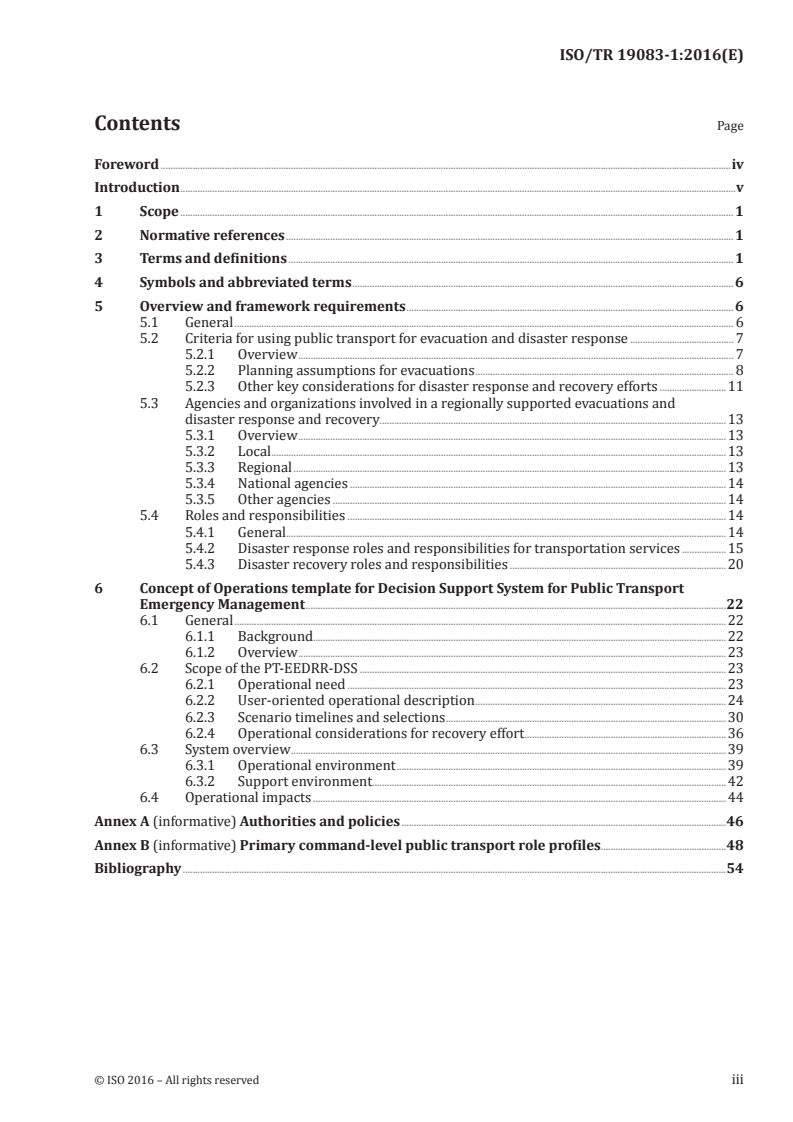
TECHNICAL ISO/TR
REPORT 19083-1
First edition
2016-10-15
Intelligent transport systems —
Emergency evacuation and disaster
response and recovery —
Part 1:
Framework and concept of operation
Systèmes intelligents de transport — Évacuation d’urgence et
intervention en cas de catastrophe et rétablissement —
Partie 1: Cadre et concept opérationnel
Reference number
©
ISO 2016
© ISO 2016, Published in Switzerland
All rights reserved. Unless otherwise specified, no part of this publication may be reproduced or utilized otherwise in any form
or by any means, electronic or mechanical, including photocopying, or posting on the internet or an intranet, without prior
written permission. Permission can be requested from either ISO at the address below or ISO’s member body in the country of
the requester.
ISO copyright office
Ch. de Blandonnet 8 • CP 401
CH-1214 Vernier, Geneva, Switzerland
Tel. +41 22 749 01 11
Fax +41 22 749 09 47
copyright@iso.org
www.iso.org
ii © ISO 2016 – All rights reserved
Contents Page
Foreword .iv
Introduction .v
1 Scope . 1
2 Normative references . 1
3 Terms and definitions . 1
4 Symbols and abbreviated terms . 6
5 Overview and framework requirements . 6
5.1 General . 6
5.2 Criteria for using public transport for evacuation and disaster response . 7
5.2.1 Overview . 7
5.2.2 Planning assumptions for evacuations . 8
5.2.3 Other key considerations for disaster response and recovery efforts .11
5.3 Agencies and organizations involved in a regionally supported evacuations and
disaster response and recovery.13
5.3.1 Overview .13
5.3.2 Local .13
5.3.3 Regional .13
5.3.4 National agencies .14
5.3.5 Other agencies .14
5.4 Roles and responsibilities .14
5.4.1 General.14
5.4.2 Disaster response roles and responsibilities for transportation services .15
5.4.3 Disaster recovery roles and responsibilities .20
6 Concept of Operations template for Decision Support System for Public Transport
Emergency Management .22
6.1 General .22
6.1.1 Background.22
6.1.2 Overview .23
6.2 Scope of the PT-EEDRR-DSS .23
6.2.1 Operational need .23
6.2.2 User-oriented operational description .24
6.2.3 Scenario timelines and selections .30
6.2.4 Operational considerations for recovery effort .36
6.3 System overview .39
6.3.1 Operational environment .39
6.3.2 Support environment.42
6.4 Operational impacts .44
Annex A (informative) Authorities and policies .46
Annex B (informative) Primary command-level public transport role profiles.48
Bibliography .54
Foreword
ISO (the International Organization for Standardization) is a worldwide federation of national standards
bodies (ISO member bodies). The work of preparing International Standards is normally carried out
through ISO technical committees. Each member body interested in a subject for which a technical
committee has been established has the right to be represented on that committee. International
organizations, governmental and non-governmental, in liaison with ISO, also take part in the work.
ISO collaborates closely with the International Electrotechnical Commission (IEC) on all matters of
electrotechnical standardization.
The procedures used to develop this document and those intended for its further maintenance are
described in the ISO/IEC Directives, Part 1. In particular, the different approval criteria needed for the
different types of ISO documents should be noted. This document was drafted in accordance with the
editorial rules of the ISO/IEC Directives, Part 2 (see www.iso.org/directives).
Attention is drawn to the possibility that some of the elements of this document may be the subject of
patent rights. ISO shall not be held responsible for identifying any or all such patent rights. Details of
any patent rights identified during the development of the document will be in the Introduction and/or
on the ISO list of patent declarations received (see www.iso.org/patents).
Any trade name used in this document is information given for the convenience of users and does not
constitute an endorsement.
For an explanation on the meaning of ISO specific terms and expressions related to conformity assessment,
as well as information about ISO’s adherence to the World Trade Organization (WTO) principles in the
Technical Barriers to Trade (TBT) see the following URL: www.iso.org/iso/foreword.html.
The committee responsible for this document is ISO/TC 204, Intelligent transport systems.
A list of all parts in the ISO series can be found on the ISO website.
iv © ISO 2016 – All rights reserved
Introduction
This document defines the framework and concept of operation for developing a public transport
decision support system for evacuations and disaster response and recovery. This includes establishing
the criteria under which public transport prepares for, responds to, and recovers from a disaster. The
criteria, as established by national, regional and local governance based on the type and severity of the
emergency, are used to identify the roles and responsibilities of public transport within the boundaries
of the Intelligent Transport System architecture. For example, the criteria for a localized disaster
such as a chemical plant fire will be governed by local or regional response plans and requires fast
response times. Whereas, a hurricane having a wider impact may be governed by national response
plans, as well as local and regional, and allow pre-planning to take place because they are typically
slower moving. It is important to emphasize that this document focuses only on those activities related
to ground transportation and does not address societal issues (i.e. sheltering, aid, security, etc.) nor
does it address air or rail transportation associated with disaster management. The reader is directed
to ISO/TC 292 for societal issues and to ISO/TC 20 SC 17 and ISO/TC 269 for air and rail transportation
issues associated with disasters. This document adheres to ISO 22300, which contains terms and
definitions applicable to societal security to establish a common understanding so that consistent
terms are used.
It is also important to note that this document relies on national, regional, and local policies and
authorities to create a concept of operation. The concept of operations defines the set of requirements
needed for designing, developing, and deploying a Decision Support System for evacuation and disaster
response and recovery. The Decision Support System is an interactive software-based system intended
to help public transport emergency services personnel compile useful information from a combination
of raw data, documents, and personal knowledge, or traffic models. This knowledge is then used to
identify and solve evacuation and disaster response and recovery problems and disseminate those
decisions to emergency managers, traffic managers, public transport, and the public itself. The Decision
Support System is a natural progression from Computer Aided Dispatch and Automatic Vehicle Location
systems which has been the core Intelligent Transportation Systems (ITS) used by public transport. The
Decision Support System combines the use of traffic models and analytic techniques with traditional
ITS data access and retrieval functions to solve less well structured, underspecified evacuation and
disaster response and recovery problems that upper level managers may face in a disaster.
The goal of this document is to save lives and aid recovery by using ITS technologies to coordinate a
comprehensive transportation response to disaster. This includes using the Decision Support System
to identify routes and manage equipment and personnel to ensure public transport is used to evacuate
people out of harm’s way and provide transportation support for all response and recovery efforts from
major disasters such as hurricanes, tsunamis, or catastrophic accidents. This document recommends
public transport to serve as the primary mobility agent for all transportation-related actions before,
during and after a disaster. This represents a paradigm shift from past response and recovery
efforts such as the Great Japan Earthquake 2011 or Hurricane Katrina in the US, which typically see
transportation-related activities coordinated by emergency managers who rely on traffic managers
and public transport service operators to provide the services. While the emergency manager is the
responsible individual for any disaster and will continue to do so, the role of coordinating transportation
between traffic management, emergency services and public transport should be assigned to a public
transport professional. The reasoning for this shift of responsibility is that public transport has the
most experience and the resources to move large numbers of people efficiently and in a timely manner,
which is paramount before, during and after a disaster. This may present problems in rural areas as
ITS technologies, equipment and personnel may not be available to carry out these assignments.
Additionally, problems may exist due to differences in country-based operational methodology between
Asia, North America, and Europe. In Asia, public transport is predominantly run by privately owned
and publicly traded mass transit and real estate conglomerates. In North America, public transport
is predominantly run by municipal transit authorities. In Europe, public transport is predominantly
run by both public-owned and private companies. The ideal solution is to ensure that a public entity is
responsible for the public transport emergency management and that personnel operating the Decision
Support System are professionals from the public transport sector.
The ISO/TR 19803- series recommends the creation of a cloud-based Emergency Evacuation and
Disaster Response and Recovery (EEDRR) Decision Support System to assist, coordinate, and direct
all transportation services, including those used by emergency management, traffic management
and public transport. The cloud-based solution allows different services (i.e. servers, storage and
applications) to be delivered to emergency management/public transport computers and devices
through the Internet; thus, providing access to the EEDRR even when access to the physical area is
not possible because of the disaster. The major actors involved in coordinating transportation services
related to a disaster and the systems required for communicating the associated information are shown
in Figure 1.
Figure 1 — Coordinated transportation services for disasters
As shown, there are eight major actors associated with transportation service during a disaster. Details
of the roles and responsibilities are included in 5.4. The actors are at a group level and may vary from
country to country. For instance, first responders include various people such as firefighter, emergency
medical personnel, and police. In addition to these, those people who are managing infrastructures like
electricity, water, sewage and gas play may also be part of the first responders. Moreover, individuals
such as teachers may also act as first responders and be responsible for taking care of their students. The
primary role and responsibility addressed by this family of standards is the coordination of emergency
transportation services through existing communication channels by professional transportation
planners and operators in public transport. The existing communication channels include emergency
communications systems (ECS) used by first responders, advanced traveller information systems
(ATIS) used by traffic managers, and passenger information systems (PIS) used by public transport.
The cornerstone of this document is the EEDRR Decision Support System which will maintain the data
and information sets used by public transport to make knowledgeable transportation-related decisions
during the chaotic times leading up to, during and after a disaster. Figure 1 depicts the EEDRR Decision
Support System being operated by public transport as part of emergency management. Transportation-
vi © ISO 2016 – All rights reserved
related information and data are collected from and transportation-related decisions and actions are
communicated to the other entities involved in the disaster.
The EEDRR Decision Support System is a computer-based transportation information system that
supports critical transportation-related decision making activities during a disaster. The EEDRR
Decision Support System is part of the Emergency Operations Centre and serves the emergency
management, operations, and planning levels of the emergency management organization where
planning levels mean those individuals who are responsible for planning the response as opposed
to those individuals that are performing the actions required in a response. This system is operated
by public transport emergency services personnel and helps to make transportation routing and
equipment and personnel resource decisions, which may be rapidly changing and not easily specified
in advance. It is an interactive software-based system that aids decision makers by compiling useful
information from a combination of raw traffic and public transport data, policy documents, personal
knowledge, and traffic models to identify and solve problems and assist transportation professionals
in decision making. To ensure the information is useful and the sources are reliable, requires that data
suppliers be vetted, data distribution networks are resilient, data management is expandable and
modular, and data processing is organized into thematic applications such as floods, hurricanes, fires,
earthquakes, etc.
Typical information that the EEDRR Decision Support System gathers and presents includes:
— local, regional, and national criteria for disaster evacuation, response, and recovery based on
policies, plans and directives;
— benchmark evacuation times established by evacuation plans through best practices, regulations,
or simulations;
— transportation resources available for evacuation, response, and recovery effort including traffic
management and public transport;
— digital maps, images, political boundaries, sensor data, integrated transportation network models
and other GIS related information;
— weather forecast, alerts, demand forecast, incident notification, and other real time information for
mitigating traffic delays;
— damage assessments, risk factors, situational analysis, desired outcomes, and other real time
information from field reporting;
— demographics for the regional population, passenger counts, special needs persons, and other
information needed to estimate/determine the number of car-less persons in an area of interest;
— social media reporting of situation awareness as reported from various social media outlets
(i.e. Facebook, Twitter, Line, Cyworld, Sina Weibo, etc.)
— and in the future, heuristic classifications that may be used to create an expert system as the use of
artificial intelligence matures.
The EEDRR Decision Support System is an information processing system that runs on the public
transport emergency services personnel PCs. The framework takes into account that each local
jurisdiction has its own requirements, and thus in order to be useful this set of international standard
should provide generic text that local jurisdictions can make distinctive to their own needs and
communities by adding to and/or replacing the generic text with specific details. ISO/TR 19083 includes
three parts:
— Part 1 — Framework and concept of operation for the use of public transport during an emergency
evacuation or large scale disaster
— Part 2 — Information flow between Public Transport Passenger Information Systems, Public
Transport Command and Control Systems, and Regional Emergency Operation Centres during a
disaster
— Part 3 — Use cases needed to support public transport actions in disaster drills/exercises.
The framework for the ISO/TR 19083 series and an associated concept of operation is provided in
Clauses 5 and 6, respectively.
viii © ISO 2016 – All rights reserved
TECHNICAL REPORT ISO/TR 19083-1:2016(E)
Intelligent transport systems — Emergency evacuation and
disaster response and recovery —
Part 1:
Framework and concept of operation
1 Scope
This document
— defines the framework for the ISO/TR 19083 series of standards related to emergency evacuation
and disaster response and recovery,
— establishes the criteria under which public transport should support evacuations and disaster
response and recovery based on the magnitude of the disaster and the location as these factors
drive the policies, directives and plans for each countries disaster prevention/evacuation systems,
— identifies the types of agencies and organizations involved in a regionally supported evacuation and
disaster,
— defines the roles and responsibilities public transport entities should provide in planning, preparing
for, and conducting evacuations and disaster response and recovery efforts in support of regional
authorities,
— recommends the type of information required and necessary actions to be followed by public
transport to ensure efficient and effective transportation in response to recovery from a disaster,
— provides a concept of operation describing the characteristics of the EEDRR Decision Support
System from the viewpoint of an individual who will use the system for public transport disaster
support, it is the guiding document for public transport services operators who voluntarily wish to
develop EEDRR Decision Support Systems, and
— identifies guidelines to improve coordination among regional authorities when public transport
disaster support is required.
2 Normative references
There are no normative references in this document.
3 Terms and definitions
For the purpose of this document, the following terms and definitions apply.
ISO and IEC maintain terminological databases for use in standardization at the following addresses:
— IEC Electropedia: available at http://www.electropedia.org/
— ISO Online browsing platform: available at http://www.iso.org/obp
3.1
actor
entity that fulfils a role
Note 1 to entry: The same definition can also be found in EN 302 665.
3.2
command-level decision making
decisions made by managers to manage and mitigate critical incidents
3.3
command-level decision makers
managers within public transport tasked with making decisions during critical incidents
3.4
command-level roles
management positions within public transport tasked with making decisions during critical incidents
3.5
commercial vehicle
any type of motor vehicle used for transporting goods or paid passengers
3.6
computer-aided dispatch/automatic vehicle location systems
central software used by dispatchers for operations management that periodically receives real-time
updates on fleet vehicle locations
Note 1 to entry: Computer-aided dispatch systems use one or more servers located in a central dispatch office,
which communicate with computer terminals in a communications centre or with mobile data terminals installed
in vehicles.
Note 2 to entry: Utilize the capabilities of geographic information systems (GIS) and GPS-based automatic vehicle
location (AVL) to show real time vehicle location on a map display.
3.7
data
reinterpretable representation of information in a formalized manner suitable for communication,
interpretation or processing
Note 1 to entry: Data can be processed by humans or by automatic means.
[SOURCE: ISO/IEC 15944-5:2008, 3.35 modified]
3.8
disaster
situation where widespread human, material, economic or environmental losses have occurred which
exceeded the ability of the affected organization, community or society to respond and recover using
its own resources
[SOURCE: ISO 22300:2012, 2.1.11]
3.9
disaster planning
first phase of disaster management cycle consisting of prevention and preparedness
3.10
disaster recovery
recovery phase that starts after the immediate threat to human life has subsided with the immediate
goal to bring the affected area back to normalcy as quickly as possible
3.11
disaster response
second phase of the disaster management cycle consisting of warning/evacuation, search and rescue,
providing immediate assistance, assessing damage caused by the disaster, continuing assistance and
the immediate restoration of infrastructure
2 © ISO 2016 – All rights reserved
3.12
emergency management organization
group of people that has its own functions with responsibilities, authorities and relationships to the
overall approach preventing and managing emergencies that might occur
Note 1 to entry: In general, emergency management utilizes a risk management approach to prevention,
preparedness, response and recovery before, during and after potentially destabilizing or disruptive events.
[SOURCE: ISO 22320:2011, 3.35 modified]
3.13
emergency operations centre
EOC
central location from which local, regional or national governments can provide interagency
coordination and executive decision making in support of disaster response and recovery operations
Note 1 to entry: to entry. The purpose is to provide a centralized location where public safety, emergency
response, and support agencies coordinate planning, preparedness, and response activities.
Note 2 to entry: to entry. The EOC does not command or control on-scene response efforts, but does carry out the
coordination functions through
a) collecting, evaluating and disseminating disaster related information,
b) analysing jurisdictional impacts and setting priority actions, and
c) managing requests, procurement and utilization of resources.
3.14
exercise
process to train for, assess, practice, and improve performance in an organization
Note 1 to entry: Exercises can be used for validating policies, plans, procedures, training, equipment, and
inter-organizational agreements; clarifying and training personnel in roles and responsibilities; improving
inter-organizational coordination and communications; identifying gaps in resources; improving individual
performance; and identifying opportunities for improvement, and controlled opportunity to practice
improvisation.
Note 2 to entry: A test is a unique and particular type of exercise, which incorporates an expectation of a pass or
fail element within the goal or objectives of the exercise being planned.
[SOURCE: ISO 22300:2012, 2.4.9]
3.15
hazardous material
any item or agent (biological, chemical, radiological, and/or physical), which has the potential to cause
harm to humans, animals, or the environment, either by itself or through interaction with other factors
3.16
incident
situation that might be, or could lead to, a disruption, loss, emergency or crisis
[SOURCE: ISO 22300:2012, 2.1.15]
3.17
man-made disaster
disastrous event caused directly and principally by one or more identifiable deliberate or negligent
human actions
3.18
private vehicle
two- or four-wheel vehicle that are not used to carry passengers for a fee
3.19
public safety agency
includes emergency management agencies, law enforcement agencies, fire departments, rescue squads,
emergency medical services and other such entities whose purpose is to enhance the public welfare
3.20
public transport
shared transport service which is available for use by the general public and includes city buses,
trolleybuses, trams (or light rail) and passenger trains, rapid transit (metro/subways/undergrounds,
etc.) and ferries
3.21
public transport emergency management
managerial function charged with creating the framework within which public transport reduce
vulnerability to hazards and cope with disasters
3.22
public transport emergency services personnel
persons within public transport responsible for transportation-related mitigation activities in an
evacuation or disaster including pre-disaster planning, response, and recovery
3.23
public transport emergency response team
persons within public transport responsible for transportation-related mitigation activities in an
evacuation or disaster including pre-disaster response planning and disaster response
3.24
public transport recovery team
persons within public transport responsible for transportation-related mitigation activities in an
evacuation or disaster including pre-disaster recovery planning disaster recovery
3.25
public transport emergency manager
person responsible for the overall strategic command of the emergency response effort such as risk
identification and mitigation
3.26
public transport emergency operations coordinator
person responsible for managing the tactical functions such as coordination with field supervisors,
assigning vehicles and drivers/operators to routes, monitoring traffic flow, etc.
3.27
public transport emergency planning coordinator
person responsible for the collection, evaluation, forecasting, dissemination, and use of the information
about the emergency incident and status of resources
3.28
public transport recovery manager
person responsible for the overall strategic plan of the recovery effort to include damage assessment
and recovery planning for short-term, intermediate, and long-term mitigation
3.29
public transport recovery communication coordinator
person responsible for informing outside organizations and the public of recovery plans and services
3.30
public transport recovery project coordinator
person responsible for managing mutual aid request and work associated with infrastructure repair
4 © ISO 2016 – All rights reserved
3.31
public transport emergency logistics coordinator
person responsible for managing logistical support such as personnel, vehicles, equipment, and supplies
3.32
public transport operator
private, profit-driven entity that provides shared transport service which are available for use by the
general public and includes city buses, trolleybuses, trams (or light rail), passenger trains, rapid transit
(metro/subways/undergrounds, etc.) and ferries
3.33
public transport service manager
public entity that manages and may provide shared transport service which are available for use by the
general public and includes city buses, trolleybuses, trams (or light rail), passenger trains, rapid transit
(metro/subways/undergrounds, etc.) and ferries
3.34
regional
layer within the emergency management hierarchy that exists between national and local
Note 1 to entry: Local is this instances means a government entity covering a small geographic area such as a
town or city.
3.35
shared-use vehicle
vehicle used by several different individuals throughout the day
Note 1 to entry: There are three basic shared-use vehicle system models: neighbourhood car sharing, station
cars, and multimodal shared-use vehicles.
3.36
strategic command
organization responsible for formulating the strategy for dealing with the incident
3.37
tactical functions
formulated from strategic plans the sets of actions dealing with the incident that are completed in the field
3.38
traffic flow models
use of computer modelling to simulate the of interactions between vehicles, drivers, pedestrians,
cyclists, other travellers and infrastructure (including highways, signage, and traffic control devices),
with the aim of understanding and developing an optimal road network with efficient movement of
traffic and minimal traffic congestion problems
3.39
use case
sequence of actions that an actor (usually a person, but perhaps an external entity, such as another
system) performs within a system to achieve a particular goal
[SOURCE: ISO 25102:2008, 2.12 modified]
4 Symbols and abbreviated terms
ATIS advanced traveller information system
CAD/AVL computer aided dispatch/automatic vehicle location
DSS decision support system
ECS emergency communications system
EEDRR emergency evacuation and disaster response and recovery
EOC emergency operations centre
HAZMAT hazardous materials
ISDM interagency shared data message
ISO International Organization for Standardization
ISR interagency service request
ITS intelligent transport systems
I2V infrastructure to vehicle communications.
MOU memorandum of understanding
NRC United States Nuclear Regulatory Commission
PIS Passenger Information System
PT public transport
PT-EEDRR-DSS public transport decision support system for emergency evacuation and disaster
response and recovery
PTMS-IAM public transport management system interagency message
TERA transit emergency response application
TMC traffic management centre
V2I vehicle to infrastructure communications
5 Overview and framework requirements
5.1 General
The ISO/TR 19083 series is designed to assist public transport in creating a Decision Support System
that is scalable to and integrates with a regional Emergency Operations Centre (EOC). The primary goal
is to use this document to develop a formal set of requirements that would be used to acquire an EEDRR
Decision Support System. The content and design of the ISO/TR 19083 series provides a foundation
from which public transport agencies can develop a customized EEDRR Decision Support System using
national, regional, and local guidance, and the wealth of information and expertise available in the
emergency management community.
6 © ISO 2016 – All rights reserved
The ISO/TR 19083 series includes three parts:
— Part 1 — Framework and concept of operation for the use of public transport during an emergency
evacuation or large scale disaster
This provides the framework and concept of operation for the ISO/TR 19083 series. The framework
describes the criteria required for involving public transport in an evacuation, the actors involved
in the event, and the roles and responsibilities of public transport. The concept of operation
contains the operational concepts developed by the United States Department of Transportation
Federal Highway Administration for evacuation transportation management and includes specific
operational scenarios for public transport. It is impossible to list all possible disaster scenarios.
But, it is important to note that a scenario should reflect the most catastrophic imaginable
disaster. Before the Great East Japan Earthquake occurred on 11 March 2011, the target disaster
of a disaster prevention plan had been the maximum one in scale that occurred in the past.
However, the Great East Japan Earthquake and the tsunami were beyond expectation and caused
unprecedented damages to Japan. Disasters of this kind occur very rarely, once in several thousand
years, and hence there is usually no record left in many cases. However, if it does occur, the damage
is enormous. Therefore, it is recommended that the most catastrophic imaginable disaster be
included in emergency management planning.
— Part 2 — Information flow between Public Transport Passenger Information Systems, Public
Transport Command and Control Systems, and Regional Emergency Operation Centres during a
disaster
This identifies the information exchanged between public transport service operators and
Emergency Operations Centres during an evacuation or as part of a disaster response and recovery
effort. This includes a common message structured in a uniform and open format, to enable the
exchange of information among multiple agencies with unique requirements, policies, and operating
environments. Two interagency shared data messages (ISDM) are planned, the interagency service
requests (ISR) and the Public Transport Management System interagency message (PTMS-IAM).
The ISR specifically requests services rendered by public safety agencies and secondary responder
services. ISRs may be between Public Transport Decision Support Systems for Emergency
Evacuation and Disaster Response and Recovery (PT-EEDRR-DSS) and Emergency Operation
Centres (EOC) to specifically request public transport safety and secondary responder services.
The IAM relates to public transport control requests between PT-EEDRR-DSS and the EOC.
— Part 3 — Use cases needed to support public transport actions in disaster drills/exercises
This provides the use cases that are relevant to public transports participation in disaster drills
and exercises. The objective is to develop a mechanism that improves the effectiveness of Public
Transport Evacuation Decision Support System by employing use case diagrams that can easily
be added or changed as the system evolves and be used as a feedback instrument to enhance
requirements for future systems.
5.2 Criteria for using public transport for evacuation and disaster response
5.2.1 Overview
Establishing the criteria by which public transport is used to evacuate populated areas and respond
to disasters is highly dependent on local, regional and national authorities and policies. Additionally,
these authorities and policies often change in response to a large scale disaster. A prime example is
the Department of Homeland Security (DHS), formed as a result of the 9/11 terrorist attack, and is the
ultimate authority for disaster response and recovery in the United States. Similarly, the Post-Katrina
Emergency Management Reform Act of 2006 and the Pets Evacuation and Transportation Standards
Act of 2006 were laws enacted by the United States to provide policies and funding for emergency
planning as a result of Hurricane Katrina. These authorities and policies define the criteria for using
public transport to evacuate residents. Annex A provides a list of those policies and directives for each
participating country.
5.2.2 Planning assumptions for evacuations
With regard to authorities and policies around the world, a common logic exists as to when evacuation,
response and recovery measures should be taken. The logic is based on need, evacuation times, and
resources. However, evacuation is not always required or possible. Whether to evacuate is dependent
on the type and magnitude of the disaster. For example, if a strong earthquake occurs in the western
part of Japan, a big tsunami will hit the coastal area in five minutes. In this case, evacuation by car or
PT is useless. The only way is to go upstairs and shelter in place. In this case, the transportation needs
shift from emergency evacuation to disaster response and recovery. Additionally, the machinery and
equipment for monitoring and controlling routes will be damaged by the disaster, so these functions
will not be available for some time after a big disaster. In these cases, the primary effort will focus
on assessing the damage and requesting resources from areas outside the disaster area to aid in the
response and recovery efforts.
5.2.2.1 Identifying the need
The information described in this subclause is focused on pre-disaster evacuations such as would occur
when a hurricane or cyclone is approaching an area. Transportation need in this case is driven by the
demographics of the population to be evacuated and need to develop evacuation models which typically
use four population segments:
— permanent residents (employed, unemployed, retired) and transient population (visitors and
tourist) using private automobiles;
— public transport-dependent permanent residents and transient population using public transport;
— special facility residents (e.g. hospitals, prisons, nursing homes, etc.);
— school populations.
Additionally, special needs exist for public safety personnel who are involved in the response and
recovery efforts as they will require transport into and out of the impacted areas. Each of these
populations requires unique transportation services during an evacuation or disaster.
The use of private transportation which includes automobiles, trucks, motorcycles, bicycles, etc. by
residents and transient population during a disaster will vary depending on whether the impact area
is urban, suburban, or rural. The numbers of private transportation users can overwhelm the available
roadways, potentially causing gridlock and posing a significant challenge to traffic management.
Traffic managers are the key actor in planning evacuation routes and managing traffic flow for private
transportation. Numerous ITS technologies exist to assist with traffic flow models as well as monitoring
and controlling routes. The Concept of Operation references the role and responsibility of traffic
managers but does not provide detailed operational procedures but rather references to where these
procedures can be found and more importantly what information is required from traffic management.
Public transport dependent permanent residents and transient populations include those who do not
have access to a vehicle or are dependent upon help from outside the home to evacuate. This population
group may include:
— households
— with no vehicle,
— with unsupervised latchkey children,
— with one vehicle that is at work and would not return,
— where residents have limitations on driving (e.g. elderly who do not drive at night or do not
drive distances of more than a few miles), and
8 © ISO 2016 – All rights reserved
— dependent on specialized transportation such as wheelchair vans or ambulances;
— commercial venues and businesses, such as hotels and motels, malls, restaurants, etc. that may
house populations without automobiles due to accessibility by public transport;
— airports, train stations, port terminals, etc. where transient populations may be entering the area.
Identification of this population is a key consideration for any successful evacuation and as such a key
function for the Concept of Operation. Surveys are helpful in identifying the site specific demographics
of this population group; however, they have proven to be of limited value in the response ph
...
TECHNICAL ISO/TR
REPORT 19083-1
First edition
2016-10-15
Intelligent transport systems —
Emergency evacuation and disaster
response and recovery —
Part 1:
Framework and concept of operation
Systèmes intelligents de transport — Évacuation d’urgence et
intervention en cas de catastrophe et rétablissement —
Partie 1: Cadre et concept opérationnel
Reference number
©
ISO 2016
© ISO 2016, Published in Switzerland
All rights reserved. Unless otherwise specified, no part of this publication may be reproduced or utilized otherwise in any form
or by any means, electronic or mechanical, including photocopying, or posting on the internet or an intranet, without prior
written permission. Permission can be requested from either ISO at the address below or ISO’s member body in the country of
the requester.
ISO copyright office
Ch. de Blandonnet 8 • CP 401
CH-1214 Vernier, Geneva, Switzerland
Tel. +41 22 749 01 11
Fax +41 22 749 09 47
copyright@iso.org
www.iso.org
ii © ISO 2016 – All rights reserved
Contents Page
Foreword .iv
Introduction .v
1 Scope . 1
2 Normative references . 1
3 Terms and definitions . 1
4 Symbols and abbreviated terms . 6
5 Overview and framework requirements . 6
5.1 General . 6
5.2 Criteria for using public transport for evacuation and disaster response . 7
5.2.1 Overview . 7
5.2.2 Planning assumptions for evacuations . 8
5.2.3 Other key considerations for disaster response and recovery efforts .11
5.3 Agencies and organizations involved in a regionally supported evacuations and
disaster response and recovery.13
5.3.1 Overview .13
5.3.2 Local .13
5.3.3 Regional .13
5.3.4 National agencies .14
5.3.5 Other agencies .14
5.4 Roles and responsibilities .14
5.4.1 General.14
5.4.2 Disaster response roles and responsibilities for transportation services .15
5.4.3 Disaster recovery roles and responsibilities .20
6 Concept of Operations template for Decision Support System for Public Transport
Emergency Management .22
6.1 General .22
6.1.1 Background.22
6.1.2 Overview .23
6.2 Scope of the PT-EEDRR-DSS .23
6.2.1 Operational need .23
6.2.2 User-oriented operational description .24
6.2.3 Scenario timelines and selections .30
6.2.4 Operational considerations for recovery effort .36
6.3 System overview .39
6.3.1 Operational environment .39
6.3.2 Support environment.42
6.4 Operational impacts .44
Annex A (informative) Authorities and policies .46
Annex B (informative) Primary command-level public transport role profiles.48
Bibliography .54
Foreword
ISO (the International Organization for Standardization) is a worldwide federation of national standards
bodies (ISO member bodies). The work of preparing International Standards is normally carried out
through ISO technical committees. Each member body interested in a subject for which a technical
committee has been established has the right to be represented on that committee. International
organizations, governmental and non-governmental, in liaison with ISO, also take part in the work.
ISO collaborates closely with the International Electrotechnical Commission (IEC) on all matters of
electrotechnical standardization.
The procedures used to develop this document and those intended for its further maintenance are
described in the ISO/IEC Directives, Part 1. In particular, the different approval criteria needed for the
different types of ISO documents should be noted. This document was drafted in accordance with the
editorial rules of the ISO/IEC Directives, Part 2 (see www.iso.org/directives).
Attention is drawn to the possibility that some of the elements of this document may be the subject of
patent rights. ISO shall not be held responsible for identifying any or all such patent rights. Details of
any patent rights identified during the development of the document will be in the Introduction and/or
on the ISO list of patent declarations received (see www.iso.org/patents).
Any trade name used in this document is information given for the convenience of users and does not
constitute an endorsement.
For an explanation on the meaning of ISO specific terms and expressions related to conformity assessment,
as well as information about ISO’s adherence to the World Trade Organization (WTO) principles in the
Technical Barriers to Trade (TBT) see the following URL: www.iso.org/iso/foreword.html.
The committee responsible for this document is ISO/TC 204, Intelligent transport systems.
A list of all parts in the ISO series can be found on the ISO website.
iv © ISO 2016 – All rights reserved
Introduction
This document defines the framework and concept of operation for developing a public transport
decision support system for evacuations and disaster response and recovery. This includes establishing
the criteria under which public transport prepares for, responds to, and recovers from a disaster. The
criteria, as established by national, regional and local governance based on the type and severity of the
emergency, are used to identify the roles and responsibilities of public transport within the boundaries
of the Intelligent Transport System architecture. For example, the criteria for a localized disaster
such as a chemical plant fire will be governed by local or regional response plans and requires fast
response times. Whereas, a hurricane having a wider impact may be governed by national response
plans, as well as local and regional, and allow pre-planning to take place because they are typically
slower moving. It is important to emphasize that this document focuses only on those activities related
to ground transportation and does not address societal issues (i.e. sheltering, aid, security, etc.) nor
does it address air or rail transportation associated with disaster management. The reader is directed
to ISO/TC 292 for societal issues and to ISO/TC 20 SC 17 and ISO/TC 269 for air and rail transportation
issues associated with disasters. This document adheres to ISO 22300, which contains terms and
definitions applicable to societal security to establish a common understanding so that consistent
terms are used.
It is also important to note that this document relies on national, regional, and local policies and
authorities to create a concept of operation. The concept of operations defines the set of requirements
needed for designing, developing, and deploying a Decision Support System for evacuation and disaster
response and recovery. The Decision Support System is an interactive software-based system intended
to help public transport emergency services personnel compile useful information from a combination
of raw data, documents, and personal knowledge, or traffic models. This knowledge is then used to
identify and solve evacuation and disaster response and recovery problems and disseminate those
decisions to emergency managers, traffic managers, public transport, and the public itself. The Decision
Support System is a natural progression from Computer Aided Dispatch and Automatic Vehicle Location
systems which has been the core Intelligent Transportation Systems (ITS) used by public transport. The
Decision Support System combines the use of traffic models and analytic techniques with traditional
ITS data access and retrieval functions to solve less well structured, underspecified evacuation and
disaster response and recovery problems that upper level managers may face in a disaster.
The goal of this document is to save lives and aid recovery by using ITS technologies to coordinate a
comprehensive transportation response to disaster. This includes using the Decision Support System
to identify routes and manage equipment and personnel to ensure public transport is used to evacuate
people out of harm’s way and provide transportation support for all response and recovery efforts from
major disasters such as hurricanes, tsunamis, or catastrophic accidents. This document recommends
public transport to serve as the primary mobility agent for all transportation-related actions before,
during and after a disaster. This represents a paradigm shift from past response and recovery
efforts such as the Great Japan Earthquake 2011 or Hurricane Katrina in the US, which typically see
transportation-related activities coordinated by emergency managers who rely on traffic managers
and public transport service operators to provide the services. While the emergency manager is the
responsible individual for any disaster and will continue to do so, the role of coordinating transportation
between traffic management, emergency services and public transport should be assigned to a public
transport professional. The reasoning for this shift of responsibility is that public transport has the
most experience and the resources to move large numbers of people efficiently and in a timely manner,
which is paramount before, during and after a disaster. This may present problems in rural areas as
ITS technologies, equipment and personnel may not be available to carry out these assignments.
Additionally, problems may exist due to differences in country-based operational methodology between
Asia, North America, and Europe. In Asia, public transport is predominantly run by privately owned
and publicly traded mass transit and real estate conglomerates. In North America, public transport
is predominantly run by municipal transit authorities. In Europe, public transport is predominantly
run by both public-owned and private companies. The ideal solution is to ensure that a public entity is
responsible for the public transport emergency management and that personnel operating the Decision
Support System are professionals from the public transport sector.
The ISO/TR 19803- series recommends the creation of a cloud-based Emergency Evacuation and
Disaster Response and Recovery (EEDRR) Decision Support System to assist, coordinate, and direct
all transportation services, including those used by emergency management, traffic management
and public transport. The cloud-based solution allows different services (i.e. servers, storage and
applications) to be delivered to emergency management/public transport computers and devices
through the Internet; thus, providing access to the EEDRR even when access to the physical area is
not possible because of the disaster. The major actors involved in coordinating transportation services
related to a disaster and the systems required for communicating the associated information are shown
in Figure 1.
Figure 1 — Coordinated transportation services for disasters
As shown, there are eight major actors associated with transportation service during a disaster. Details
of the roles and responsibilities are included in 5.4. The actors are at a group level and may vary from
country to country. For instance, first responders include various people such as firefighter, emergency
medical personnel, and police. In addition to these, those people who are managing infrastructures like
electricity, water, sewage and gas play may also be part of the first responders. Moreover, individuals
such as teachers may also act as first responders and be responsible for taking care of their students. The
primary role and responsibility addressed by this family of standards is the coordination of emergency
transportation services through existing communication channels by professional transportation
planners and operators in public transport. The existing communication channels include emergency
communications systems (ECS) used by first responders, advanced traveller information systems
(ATIS) used by traffic managers, and passenger information systems (PIS) used by public transport.
The cornerstone of this document is the EEDRR Decision Support System which will maintain the data
and information sets used by public transport to make knowledgeable transportation-related decisions
during the chaotic times leading up to, during and after a disaster. Figure 1 depicts the EEDRR Decision
Support System being operated by public transport as part of emergency management. Transportation-
vi © ISO 2016 – All rights reserved
related information and data are collected from and transportation-related decisions and actions are
communicated to the other entities involved in the disaster.
The EEDRR Decision Support System is a computer-based transportation information system that
supports critical transportation-related decision making activities during a disaster. The EEDRR
Decision Support System is part of the Emergency Operations Centre and serves the emergency
management, operations, and planning levels of the emergency management organization where
planning levels mean those individuals who are responsible for planning the response as opposed
to those individuals that are performing the actions required in a response. This system is operated
by public transport emergency services personnel and helps to make transportation routing and
equipment and personnel resource decisions, which may be rapidly changing and not easily specified
in advance. It is an interactive software-based system that aids decision makers by compiling useful
information from a combination of raw traffic and public transport data, policy documents, personal
knowledge, and traffic models to identify and solve problems and assist transportation professionals
in decision making. To ensure the information is useful and the sources are reliable, requires that data
suppliers be vetted, data distribution networks are resilient, data management is expandable and
modular, and data processing is organized into thematic applications such as floods, hurricanes, fires,
earthquakes, etc.
Typical information that the EEDRR Decision Support System gathers and presents includes:
— local, regional, and national criteria for disaster evacuation, response, and recovery based on
policies, plans and directives;
— benchmark evacuation times established by evacuation plans through best practices, regulations,
or simulations;
— transportation resources available for evacuation, response, and recovery effort including traffic
management and public transport;
— digital maps, images, political boundaries, sensor data, integrated transportation network models
and other GIS related information;
— weather forecast, alerts, demand forecast, incident notification, and other real time information for
mitigating traffic delays;
— damage assessments, risk factors, situational analysis, desired outcomes, and other real time
information from field reporting;
— demographics for the regional population, passenger counts, special needs persons, and other
information needed to estimate/determine the number of car-less persons in an area of interest;
— social media reporting of situation awareness as reported from various social media outlets
(i.e. Facebook, Twitter, Line, Cyworld, Sina Weibo, etc.)
— and in the future, heuristic classifications that may be used to create an expert system as the use of
artificial intelligence matures.
The EEDRR Decision Support System is an information processing system that runs on the public
transport emergency services personnel PCs. The framework takes into account that each local
jurisdiction has its own requirements, and thus in order to be useful this set of international standard
should provide generic text that local jurisdictions can make distinctive to their own needs and
communities by adding to and/or replacing the generic text with specific details. ISO/TR 19083 includes
three parts:
— Part 1 — Framework and concept of operation for the use of public transport during an emergency
evacuation or large scale disaster
— Part 2 — Information flow between Public Transport Passenger Information Systems, Public
Transport Command and Control Systems, and Regional Emergency Operation Centres during a
disaster
— Part 3 — Use cases needed to support public transport actions in disaster drills/exercises.
The framework for the ISO/TR 19083 series and an associated concept of operation is provided in
Clauses 5 and 6, respectively.
viii © ISO 2016 – All rights reserved
TECHNICAL REPORT ISO/TR 19083-1:2016(E)
Intelligent transport systems — Emergency evacuation and
disaster response and recovery —
Part 1:
Framework and concept of operation
1 Scope
This document
— defines the framework for the ISO/TR 19083 series of standards related to emergency evacuation
and disaster response and recovery,
— establishes the criteria under which public transport should support evacuations and disaster
response and recovery based on the magnitude of the disaster and the location as these factors
drive the policies, directives and plans for each countries disaster prevention/evacuation systems,
— identifies the types of agencies and organizations involved in a regionally supported evacuation and
disaster,
— defines the roles and responsibilities public transport entities should provide in planning, preparing
for, and conducting evacuations and disaster response and recovery efforts in support of regional
authorities,
— recommends the type of information required and necessary actions to be followed by public
transport to ensure efficient and effective transportation in response to recovery from a disaster,
— provides a concept of operation describing the characteristics of the EEDRR Decision Support
System from the viewpoint of an individual who will use the system for public transport disaster
support, it is the guiding document for public transport services operators who voluntarily wish to
develop EEDRR Decision Support Systems, and
— identifies guidelines to improve coordination among regional authorities when public transport
disaster support is required.
2 Normative references
There are no normative references in this document.
3 Terms and definitions
For the purpose of this document, the following terms and definitions apply.
ISO and IEC maintain terminological databases for use in standardization at the following addresses:
— IEC Electropedia: available at http://www.electropedia.org/
— ISO Online browsing platform: available at http://www.iso.org/obp
3.1
actor
entity that fulfils a role
Note 1 to entry: The same definition can also be found in EN 302 665.
3.2
command-level decision making
decisions made by managers to manage and mitigate critical incidents
3.3
command-level decision makers
managers within public transport tasked with making decisions during critical incidents
3.4
command-level roles
management positions within public transport tasked with making decisions during critical incidents
3.5
commercial vehicle
any type of motor vehicle used for transporting goods or paid passengers
3.6
computer-aided dispatch/automatic vehicle location systems
central software used by dispatchers for operations management that periodically receives real-time
updates on fleet vehicle locations
Note 1 to entry: Computer-aided dispatch systems use one or more servers located in a central dispatch office,
which communicate with computer terminals in a communications centre or with mobile data terminals installed
in vehicles.
Note 2 to entry: Utilize the capabilities of geographic information systems (GIS) and GPS-based automatic vehicle
location (AVL) to show real time vehicle location on a map display.
3.7
data
reinterpretable representation of information in a formalized manner suitable for communication,
interpretation or processing
Note 1 to entry: Data can be processed by humans or by automatic means.
[SOURCE: ISO/IEC 15944-5:2008, 3.35 modified]
3.8
disaster
situation where widespread human, material, economic or environmental losses have occurred which
exceeded the ability of the affected organization, community or society to respond and recover using
its own resources
[SOURCE: ISO 22300:2012, 2.1.11]
3.9
disaster planning
first phase of disaster management cycle consisting of prevention and preparedness
3.10
disaster recovery
recovery phase that starts after the immediate threat to human life has subsided with the immediate
goal to bring the affected area back to normalcy as quickly as possible
3.11
disaster response
second phase of the disaster management cycle consisting of warning/evacuation, search and rescue,
providing immediate assistance, assessing damage caused by the disaster, continuing assistance and
the immediate restoration of infrastructure
2 © ISO 2016 – All rights reserved
3.12
emergency management organization
group of people that has its own functions with responsibilities, authorities and relationships to the
overall approach preventing and managing emergencies that might occur
Note 1 to entry: In general, emergency management utilizes a risk management approach to prevention,
preparedness, response and recovery before, during and after potentially destabilizing or disruptive events.
[SOURCE: ISO 22320:2011, 3.35 modified]
3.13
emergency operations centre
EOC
central location from which local, regional or national governments can provide interagency
coordination and executive decision making in support of disaster response and recovery operations
Note 1 to entry: to entry. The purpose is to provide a centralized location where public safety, emergency
response, and support agencies coordinate planning, preparedness, and response activities.
Note 2 to entry: to entry. The EOC does not command or control on-scene response efforts, but does carry out the
coordination functions through
a) collecting, evaluating and disseminating disaster related information,
b) analysing jurisdictional impacts and setting priority actions, and
c) managing requests, procurement and utilization of resources.
3.14
exercise
process to train for, assess, practice, and improve performance in an organization
Note 1 to entry: Exercises can be used for validating policies, plans, procedures, training, equipment, and
inter-organizational agreements; clarifying and training personnel in roles and responsibilities; improving
inter-organizational coordination and communications; identifying gaps in resources; improving individual
performance; and identifying opportunities for improvement, and controlled opportunity to practice
improvisation.
Note 2 to entry: A test is a unique and particular type of exercise, which incorporates an expectation of a pass or
fail element within the goal or objectives of the exercise being planned.
[SOURCE: ISO 22300:2012, 2.4.9]
3.15
hazardous material
any item or agent (biological, chemical, radiological, and/or physical), which has the potential to cause
harm to humans, animals, or the environment, either by itself or through interaction with other factors
3.16
incident
situation that might be, or could lead to, a disruption, loss, emergency or crisis
[SOURCE: ISO 22300:2012, 2.1.15]
3.17
man-made disaster
disastrous event caused directly and principally by one or more identifiable deliberate or negligent
human actions
3.18
private vehicle
two- or four-wheel vehicle that are not used to carry passengers for a fee
3.19
public safety agency
includes emergency management agencies, law enforcement agencies, fire departments, rescue squads,
emergency medical services and other such entities whose purpose is to enhance the public welfare
3.20
public transport
shared transport service which is available for use by the general public and includes city buses,
trolleybuses, trams (or light rail) and passenger trains, rapid transit (metro/subways/undergrounds,
etc.) and ferries
3.21
public transport emergency management
managerial function charged with creating the framework within which public transport reduce
vulnerability to hazards and cope with disasters
3.22
public transport emergency services personnel
persons within public transport responsible for transportation-related mitigation activities in an
evacuation or disaster including pre-disaster planning, response, and recovery
3.23
public transport emergency response team
persons within public transport responsible for transportation-related mitigation activities in an
evacuation or disaster including pre-disaster response planning and disaster response
3.24
public transport recovery team
persons within public transport responsible for transportation-related mitigation activities in an
evacuation or disaster including pre-disaster recovery planning disaster recovery
3.25
public transport emergency manager
person responsible for the overall strategic command of the emergency response effort such as risk
identification and mitigation
3.26
public transport emergency operations coordinator
person responsible for managing the tactical functions such as coordination with field supervisors,
assigning vehicles and drivers/operators to routes, monitoring traffic flow, etc.
3.27
public transport emergency planning coordinator
person responsible for the collection, evaluation, forecasting, dissemination, and use of the information
about the emergency incident and status of resources
3.28
public transport recovery manager
person responsible for the overall strategic plan of the recovery effort to include damage assessment
and recovery planning for short-term, intermediate, and long-term mitigation
3.29
public transport recovery communication coordinator
person responsible for informing outside organizations and the public of recovery plans and services
3.30
public transport recovery project coordinator
person responsible for managing mutual aid request and work associated with infrastructure repair
4 © ISO 2016 – All rights reserved
3.31
public transport emergency logistics coordinator
person responsible for managing logistical support such as personnel, vehicles, equipment, and supplies
3.32
public transport operator
private, profit-driven entity that provides shared transport service which are available for use by the
general public and includes city buses, trolleybuses, trams (or light rail), passenger trains, rapid transit
(metro/subways/undergrounds, etc.) and ferries
3.33
public transport service manager
public entity that manages and may provide shared transport service which are available for use by the
general public and includes city buses, trolleybuses, trams (or light rail), passenger trains, rapid transit
(metro/subways/undergrounds, etc.) and ferries
3.34
regional
layer within the emergency management hierarchy that exists between national and local
Note 1 to entry: Local is this instances means a government entity covering a small geographic area such as a
town or city.
3.35
shared-use vehicle
vehicle used by several different individuals throughout the day
Note 1 to entry: There are three basic shared-use vehicle system models: neighbourhood car sharing, station
cars, and multimodal shared-use vehicles.
3.36
strategic command
organization responsible for formulating the strategy for dealing with the incident
3.37
tactical functions
formulated from strategic plans the sets of actions dealing with the incident that are completed in the field
3.38
traffic flow models
use of computer modelling to simulate the of interactions between vehicles, drivers, pedestrians,
cyclists, other travellers and infrastructure (including highways, signage, and traffic control devices),
with the aim of understanding and developing an optimal road network with efficient movement of
traffic and minimal traffic congestion problems
3.39
use case
sequence of actions that an actor (usually a person, but perhaps an external entity, such as another
system) performs within a system to achieve a particular goal
[SOURCE: ISO 25102:2008, 2.12 modified]
4 Symbols and abbreviated terms
ATIS advanced traveller information system
CAD/AVL computer aided dispatch/automatic vehicle location
DSS decision support system
ECS emergency communications system
EEDRR emergency evacuation and disaster response and recovery
EOC emergency operations centre
HAZMAT hazardous materials
ISDM interagency shared data message
ISO International Organization for Standardization
ISR interagency service request
ITS intelligent transport systems
I2V infrastructure to vehicle communications.
MOU memorandum of understanding
NRC United States Nuclear Regulatory Commission
PIS Passenger Information System
PT public transport
PT-EEDRR-DSS public transport decision support system for emergency evacuation and disaster
response and recovery
PTMS-IAM public transport management system interagency message
TERA transit emergency response application
TMC traffic management centre
V2I vehicle to infrastructure communications
5 Overview and framework requirements
5.1 General
The ISO/TR 19083 series is designed to assist public transport in creating a Decision Support System
that is scalable to and integrates with a regional Emergency Operations Centre (EOC). The primary goal
is to use this document to develop a formal set of requirements that would be used to acquire an EEDRR
Decision Support System. The content and design of the ISO/TR 19083 series provides a foundation
from which public transport agencies can develop a customized EEDRR Decision Support System using
national, regional, and local guidance, and the wealth of information and expertise available in the
emergency management community.
6 © ISO 2016 – All rights reserved
The ISO/TR 19083 series includes three parts:
— Part 1 — Framework and concept of operation for the use of public transport during an emergency
evacuation or large scale disaster
This provides the framework and concept of operation for the ISO/TR 19083 series. The framework
describes the criteria required for involving public transport in an evacuation, the actors involved
in the event, and the roles and responsibilities of public transport. The concept of operation
contains the operational concepts developed by the United States Department of Transportation
Federal Highway Administration for evacuation transportation management and includes specific
operational scenarios for public transport. It is impossible to list all possible disaster scenarios.
But, it is important to note that a scenario should reflect the most catastrophic imaginable
disaster. Before the Great East Japan Earthquake occurred on 11 March 2011, the target disaster
of a disaster prevention plan had been the maximum one in scale that occurred in the past.
However, the Great East Japan Earthquake and the tsunami were beyond expectation and caused
unprecedented damages to Japan. Disasters of this kind occur very rarely, once in several thousand
years, and hence there is usually no record left in many cases. However, if it does occur, the damage
is enormous. Therefore, it is recommended that the most catastrophic imaginable disaster be
included in emergency management planning.
— Part 2 — Information flow between Public Transport Passenger Information Systems, Public
Transport Command and Control Systems, and Regional Emergency Operation Centres during a
disaster
This identifies the information exchanged between public transport service operators and
Emergency Operations Centres during an evacuation or as part of a disaster response and recovery
effort. This includes a common message structured in a uniform and open format, to enable the
exchange of information among multiple agencies with unique requirements, policies, and operating
environments. Two interagency shared data messages (ISDM) are planned, the interagency service
requests (ISR) and the Public Transport Management System interagency message (PTMS-IAM).
The ISR specifically requests services rendered by public safety agencies and secondary responder
services. ISRs may be between Public Transport Decision Support Systems for Emergency
Evacuation and Disaster Response and Recovery (PT-EEDRR-DSS) and Emergency Operation
Centres (EOC) to specifically request public transport safety and secondary responder services.
The IAM relates to public transport control requests between PT-EEDRR-DSS and the EOC.
— Part 3 — Use cases needed to support public transport actions in disaster drills/exercises
This provides the use cases that are relevant to public transports participation in disaster drills
and exercises. The objective is to develop a mechanism that improves the effectiveness of Public
Transport Evacuation Decision Support System by employing use case diagrams that can easily
be added or changed as the system evolves and be used as a feedback instrument to enhance
requirements for future systems.
5.2 Criteria for using public transport for evacuation and disaster response
5.2.1 Overview
Establishing the criteria by which public transport is used to evacuate populated areas and respond
to disasters is highly dependent on local, regional and national authorities and policies. Additionally,
these authorities and policies often change in response to a large scale disaster. A prime example is
the Department of Homeland Security (DHS), formed as a result of the 9/11 terrorist attack, and is the
ultimate authority for disaster response and recovery in the United States. Similarly, the Post-Katrina
Emergency Management Reform Act of 2006 and the Pets Evacuation and Transportation Standards
Act of 2006 were laws enacted by the United States to provide policies and funding for emergency
planning as a result of Hurricane Katrina. These authorities and policies define the criteria for using
public transport to evacuate residents. Annex A provides a list of those policies and directives for each
participating country.
5.2.2 Planning assumptions for evacuations
With regard to authorities and policies around the world, a common logic exists as to when evacuation,
response and recovery measures should be taken. The logic is based on need, evacuation times, and
resources. However, evacuation is not always required or possible. Whether to evacuate is dependent
on the type and magnitude of the disaster. For example, if a strong earthquake occurs in the western
part of Japan, a big tsunami will hit the coastal area in five minutes. In this case, evacuation by car or
PT is useless. The only way is to go upstairs and shelter in place. In this case, the transportation needs
shift from emergency evacuation to disaster response and recovery. Additionally, the machinery and
equipment for monitoring and controlling routes will be damaged by the disaster, so these functions
will not be available for some time after a big disaster. In these cases, the primary effort will focus
on assessing the damage and requesting resources from areas outside the disaster area to aid in the
response and recovery efforts.
5.2.2.1 Identifying the need
The information described in this subclause is focused on pre-disaster evacuations such as would occur
when a hurricane or cyclone is approaching an area. Transportation need in this case is driven by the
demographics of the population to be evacuated and need to develop evacuation models which typically
use four population segments:
— permanent residents (employed, unemployed, retired) and transient population (visitors and
tourist) using private automobiles;
— public transport-dependent permanent residents and transient population using public transport;
— special facility residents (e.g. hospitals, prisons, nursing homes, etc.);
— school populations.
Additionally, special needs exist for public safety personnel who are involved in the response and
recovery efforts as they will require transport into and out of the impacted areas. Each of these
populations requires unique transportation services during an evacuation or disaster.
The use of private transportation which includes automobiles, trucks, motorcycles, bicycles, etc. by
residents and transient population during a disaster will vary depending on whether the impact area
is urban, suburban, or rural. The numbers of private transportation users can overwhelm the available
roadways, potentially causing gridlock and posing a significant challenge to traffic management.
Traffic managers are the key actor in planning evacuation routes and managing traffic flow for private
transportation. Numerous ITS technologies exist to assist with traffic flow models as well as monitoring
and controlling routes. The Concept of Operation references the role and responsibility of traffic
managers but does not provide detailed operational procedures but rather references to where these
procedures can be found and more importantly what information is required from traffic management.
Public transport dependent permanent residents and transient populations include those who do not
have access to a vehicle or are dependent upon help from outside the home to evacuate. This population
group may include:
— households
— with no vehicle,
— with unsupervised latchkey children,
— with one vehicle that is at work and would not return,
— where residents have limitations on driving (e.g. elderly who do not drive at night or do not
drive distances of more than a few miles), and
8 © ISO 2016 – All rights reserved
— dependent on specialized transportation such as wheelchair vans or ambulances;
— commercial venues and businesses, such as hotels and motels, malls, restaurants, etc. that may
house populations without automobiles due to accessibility by public transport;
— airports, train stations, port terminals, etc. where transient populations may be entering the area.
Identification of this population is a key consideration for any successful evacuation and as such a key
function for the Concept of Operation. Surveys are helpful in identifying the site specific demographics
of this population group; however, they have proven to be of limited value in the response ph
...