

ISO/IEC 20648:2024
(Main)Information technology — TLS specification for storage systems
General Information
- Abstract
This document details the requirements for use of the Transport Layer Security (TLS) protocol in conjunction with data storage technologies. The requirements set out in this document are intended to facilitate secure interoperability of storage clients and servers as well as non-storage technologies that may have similar interoperability needs. This document is relevant to anyone involved in owning, operating or using data storage devices. This includes senior managers, acquirers of storage products and service, and other non-technical managers or users, in addition to managers and administrators who have specific responsibilities for information security and/or storage security, storage operation, or who are responsible for an organization’s overall security program and security policy development. It is also relevant to anyone involved in the planning, design and implementation of the architectural aspects of storage security.
- Status
- Published
- Publication Date
- 16-Jul-2024
- Technical Committee
- ISO/IEC JTC 1 - Information technology
- Drafting Committee
- ISO/IEC JTC 1 - Information technology
- Current Stage
- 6060 - International Standard published
- Start Date
- 17-Jul-2024
- Due Date
- 24-Jan-2025
- Completion Date
- 17-Jul-2024
Overview
ISO/IEC 20648:2024 - Information technology - TLS specification for storage systems - defines requirements and guidance for using the Transport Layer Security (TLS) protocol with data storage technologies. The standard aims to ensure secure interoperability between storage clients and servers (and non-storage technologies with similar needs) by specifying TLS protocol usage, cipher suite guidance, certificate profiles, and implementation recommendations tailored to storage environments.
Key topics and technical requirements
- TLS protocol support and encouragement of TLS 1.3: the document promotes use of TLS 1.3 while retaining interoperability guidance for TLS 1.2. It calls out extensions such as the TLS 1.3 pre-shared key (PSK) extension and recommends guarding against replay attacks on 0‑RTT.
- Cipher suites and forward secrecy: recommended and required cipher-suite guidance is provided, aligned with forward‑secrecy best practices (e.g., ECDHE/ECDSA and AEAD modes such as GCM). Security strength requirements have been increased to 128 bits.
- Digital certificates and PKI: detailed requirements for X.509 certificate profiles, encoding (e.g., DER/PEM expectations), validity periods (maximum validity updated to 398 days), path validation, and lifecycle management (issuance, renewal, revocation, OCSP/CRL considerations).
- Compression and other transport considerations: treatment of compression methods and interoperability notes relevant to storage protocols.
- Quantum computing awareness: a statement on quantum computing implications and a call to consider future-proofing cryptography.
- DTLS relevance: while primarily focused on TLS, the standard notes relevance to Datagram TLS (DTLS) implementations without prescribing DTLS conformance.
Practical applications
- Securing management, control and data access channels for storage systems (e.g., protocols layered over TCP/IP).
- Defining interoperability requirements for storage product vendors, cloud storage services, and enterprise storage clients.
- Providing procurement and policy guidance for acquirers and senior managers to specify TLS requirements in contracts and security policies.
- Guiding administrators and architects on certificate lifecycle, cipher-suite selection, and operational controls (revocation, 0‑RTT protections).
Who should use this standard
- Storage product vendors and implementers
- Storage system architects and security architects
- IT security managers, administrators, and operations teams
- Procurement officers and non-technical managers assessing storage security requirements
Related standards and references
- IETF RFC 8446 (TLS 1.3) and RFC 5246 (TLS 1.2)
- IETF RFC 5280 (X.509 PKI)
- ISO/IEC 17826 (CDMI) and SNIA SMI‑S (origin of storage TLS requirements)
- ISO/IEC 27000 (information security vocabulary)
Keywords: ISO/IEC 20648, TLS for storage systems, TLS 1.3, cipher suites, digital certificates, storage security, interoperability, PKI, 0-RTT, PSK.
Relations
- Effective Date
- 28-Jan-2023
Get Certified
Connect with accredited certification bodies for this standard

BSI Group
BSI (British Standards Institution) is the business standards company that helps organizations make excellence a habit.

Bureau Veritas
Bureau Veritas is a world leader in laboratory testing, inspection and certification services.

DNV
DNV is an independent assurance and risk management provider.
Sponsored listings
Frequently Asked Questions
ISO/IEC 20648:2024 is a standard published by the International Organization for Standardization (ISO). Its full title is "Information technology — TLS specification for storage systems". This standard covers: This document details the requirements for use of the Transport Layer Security (TLS) protocol in conjunction with data storage technologies. The requirements set out in this document are intended to facilitate secure interoperability of storage clients and servers as well as non-storage technologies that may have similar interoperability needs. This document is relevant to anyone involved in owning, operating or using data storage devices. This includes senior managers, acquirers of storage products and service, and other non-technical managers or users, in addition to managers and administrators who have specific responsibilities for information security and/or storage security, storage operation, or who are responsible for an organization’s overall security program and security policy development. It is also relevant to anyone involved in the planning, design and implementation of the architectural aspects of storage security.
This document details the requirements for use of the Transport Layer Security (TLS) protocol in conjunction with data storage technologies. The requirements set out in this document are intended to facilitate secure interoperability of storage clients and servers as well as non-storage technologies that may have similar interoperability needs. This document is relevant to anyone involved in owning, operating or using data storage devices. This includes senior managers, acquirers of storage products and service, and other non-technical managers or users, in addition to managers and administrators who have specific responsibilities for information security and/or storage security, storage operation, or who are responsible for an organization’s overall security program and security policy development. It is also relevant to anyone involved in the planning, design and implementation of the architectural aspects of storage security.
ISO/IEC 20648:2024 is classified under the following ICS (International Classification for Standards) categories: 35.030 - IT Security; 35.220.01 - Data storage devices in general. The ICS classification helps identify the subject area and facilitates finding related standards.
ISO/IEC 20648:2024 has the following relationships with other standards: It is inter standard links to ISO/IEC 20648:2016. Understanding these relationships helps ensure you are using the most current and applicable version of the standard.
ISO/IEC 20648:2024 is available in PDF format for immediate download after purchase. The document can be added to your cart and obtained through the secure checkout process. Digital delivery ensures instant access to the complete standard document.
Standards Content (Sample)
International
Standard
ISO/IEC 20648
Second edition
Information technology — TLS
2024-07
specification for storage systems
Technologies de l'information — Spécification TLS pour systèmes
de stockage
Reference number
© ISO/IEC 2024
All rights reserved. Unless otherwise specified, or required in the context of its implementation, no part of this publication may
be reproduced or utilized otherwise in any form or by any means, electronic or mechanical, including photocopying, or posting on
the internet or an intranet, without prior written permission. Permission can be requested from either ISO at the address below
or ISO’s member body in the country of the requester.
ISO copyright office
CP 401 • Ch. de Blandonnet 8
CH-1214 Vernier, Geneva
Phone: +41 22 749 01 11
Email: copyright@iso.org
Website: www.iso.org
Published in Switzerland
© ISO/IEC 2024 – All rights reserved
ii
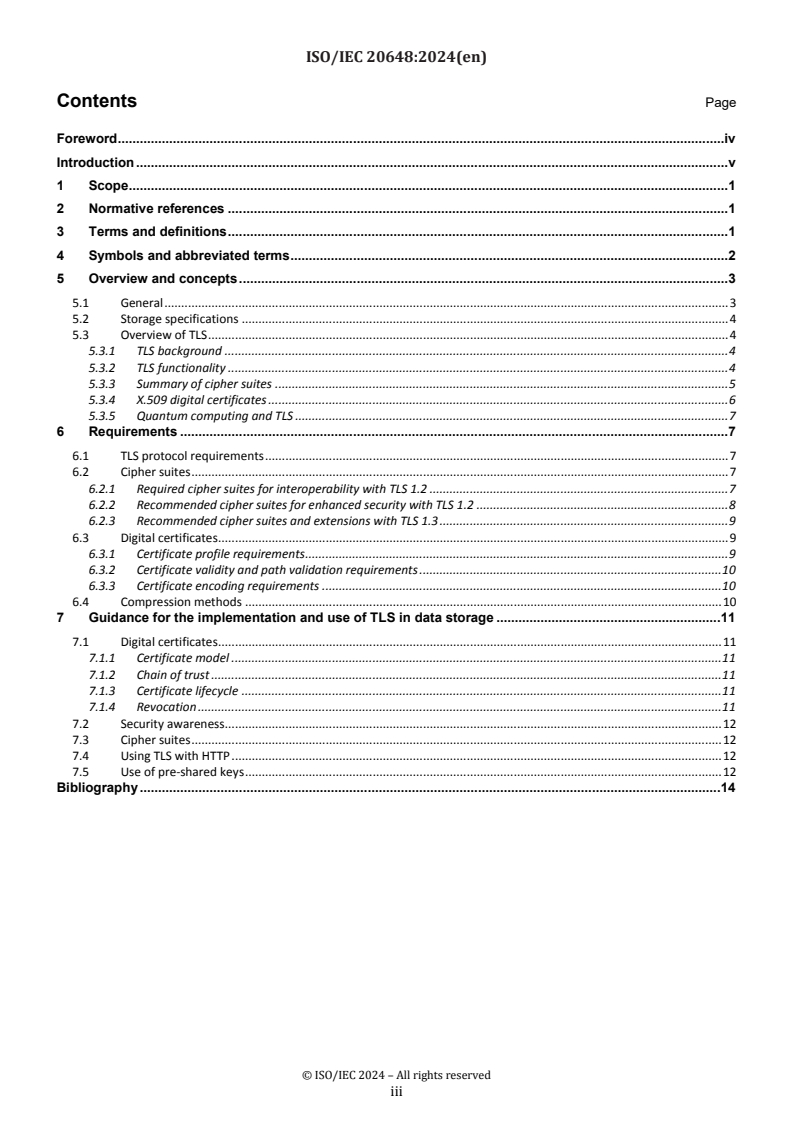
Contents Page
Foreword . iv
Introduction . v
1 Scope. 1
2 Normative references . 1
3 Terms and definitions . 1
4 Symbols and abbreviated terms . 2
5 Overview and concepts . 3
5.1 General . 3
5.2 Storage specifications . 4
5.3 Overview of TLS . 4
5.3.1 TLS background . 4
5.3.2 TLS functionality . 4
5.3.3 Summary of cipher suites . 5
5.3.4 X.509 digital certificates . 6
5.3.5 Quantum computing and TLS . 7
6 Requirements . 7
6.1 TLS protocol requirements . 7
6.2 Cipher suites . 7
6.2.1 Required cipher suites for interoperability with TLS 1.2 . 7
6.2.2 Recommended cipher suites for enhanced security with TLS 1.2 . 8
6.2.3 Recommended cipher suites and extensions with TLS 1.3 . 9
6.3 Digital certificates . 9
6.3.1 Certificate profile requirements . 9
6.3.2 Certificate validity and path validation requirements . 10
6.3.3 Certificate encoding requirements . 10
6.4 Compression methods . 10
7 Guidance for the implementation and use of TLS in data storage . 11
7.1 Digital certificates . 11
7.1.1 Certificate model . 11
7.1.2 Chain of trust . 11
7.1.3 Certificate lifecycle . 11
7.1.4 Revocation . 11
7.2 Security awareness. 12
7.3 Cipher suites . 12
7.4 Using TLS with HTTP . 12
7.5 Use of pre-shared keys . 12
Bibliography . 14
© ISO/IEC 2024 – All rights reserved
iii
Foreword
ISO (the International Organization for Standardization) and IEC (the International Electrotechnical Commission)
form the specialized system for worldwide standardization. National bodies that are members of ISO or IEC
participate in the development of International Standards through technical committees established by the
respective organization to deal with particular fields of technical activity. ISO and IEC technical committees
collaborate in fields of mutual interest. Other international organizations, governmental and non-governmental, in
liaison with ISO and IEC, also take part in the work.
The procedures used to develop this document and those intended for its further maintenance are described in the
ISO/IEC Directives, Part 1. In particular, the different approval criteria needed for the different types of document
should be noted (see www.iso.org/directives or www.iec.ch/members_experts/refdocs).
ISO and IEC draw attention to the possibility that the implementation of this document may involve the use of (a)
patent(s). ISO and IEC take no position concerning the evidence, validity or applicability of any claimed patent
rights in respect thereof. As of the date of publication of this document, ISO and IEC had not received notice of (a)
patent(s) which may be required to implement this document. However, implementers are cautioned that this may
not represent the latest information, which may be obtained from the patent database available at
www.iso.org/patents and https://patents.iec.ch. ISO and IEC shall not be held responsible for identifying any or all
such patent rights.
Any trade name used in this document is information given for the convenience of users and does not constitute an
endorsement.
For an explanation of the voluntary nature of standards, the meaning of ISO specific terms and expressions related
to conformity assessment, as well as information about ISO's adherence to the World Trade Organization (WTO)
principles in the Technical Barriers to Trade (TBT), see www.iso.org/iso/foreword.html. In the IEC, see
www.iec.ch/understanding-standards.
This document was prepared by SNIA (as TLS Specification for Storage Systems, Version 2.1) and drafted in
accordance with its editorial rules. It was adopted, under the JTC 1 PAS procedure, by Joint Technical Committee
ISO/IEC JTC 1, Information technology.
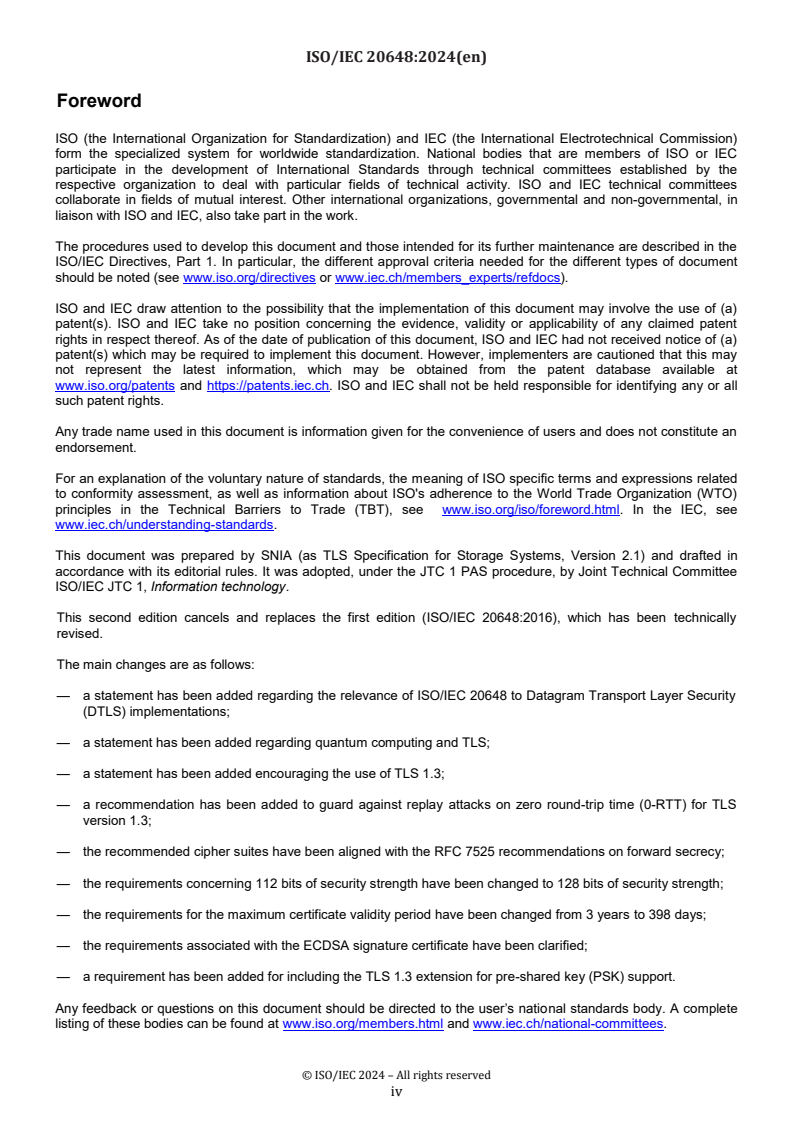
This second edition cancels and replaces the first edition (ISO/IEC 20648:2016), which has been technically
revised.
The main changes are as follows:
— a statement has been added regarding the relevance of ISO/IEC 20648 to Datagram Transport Layer Security
(DTLS) implementations;
— a statement has been added regarding quantum computing and TLS;
— a statement has been added encouraging the use of TLS 1.3;
— a recommendation has been added to guard against replay attacks on zero round-trip time (0-RTT) for TLS
version 1.3;
— the recommended cipher suites have been aligned with the RFC 7525 recommendations on forward secrecy;
— the requirements concerning 112 bits of security strength have been changed to 128 bits of security strength;
— the requirements for the maximum certificate validity period have been changed from 3 years to 398 days;
— the requirements associated with the ECDSA signature certificate have been clarified;
— a requirement has been added for including the TLS 1.3 extension for pre-shared key (PSK) support.
Any feedback or questions on this document should be directed to the user’s national standards body. A complete
listing of these bodies can be found at www.iso.org/members.html and www.iec.ch/national-committees.
© ISO/IEC 2024 – All rights reserved
iv
Introduction
Within information and communications technology, one of the best defences against telecommunications attacks
is to deploy security services implemented with mechanisms specified in standards that are thoroughly vetted in the
public domain and rigorously tested by third party laboratories, by vendors, and by users of commercial off-the-
shelf products. Three services that most often address network user security requirements are confidentiality,
message integrity and authentication.
The Internet Engineering Task Force (IETF) with its Transport Layer Security (TLS) has a standard that supports
preventing tampering, message forgery, and eavesdropping by encrypting data units, or segments, from one end of
the transport layer to the other. In addition, TLS is application protocol independent, which means higher-level
protocols like the Hypertext Transfer Protocol (HTTP) can layer on top of the TLS protocol transparently.
Additional details beyond the basic TLS protocol specification are necessary to ensure both security and
interoperability. This document provides detail in the form of specific requirements and guidance for using TLS in
conjunction with storage systems.
© ISO/IEC 2024 – All rights reserved
v
International Standard ISO/IEC 20648:2024(en)
Information technology —TLS specification for storage systems
1 Scope
This document details the requirements for use of the Transport Layer Security (TLS) protocol in conjunction with
data storage technologies. The requirements set out in this document are intended to facilitate secure
interoperability of storage clients and servers as well as non-storage technologies that may have similar
interoperability needs.
This document is relevant to anyone involved in owning, operating or using data storage devices. This includes
senior managers, acquirers of storage products and service, and other non-technical managers or users, in
addition to managers and administrators who have specific responsibilities for information security and/or storage
security, storage operation, or who are responsible for an organization’s overall security program and security
policy development. It is also relevant to anyone involved in the planning, design and implementation of the
architectural aspects of storage security.
2 Normative references
The following documents are referred to in the text in such a way that some or all of their content constitutes
requirements of this document. For dated references, only the edition cited applies. For undated references, the
latest edition of the referenced document (including any amendments) applies.
ISO/IEC 27000, Information technology — Security techniques — Information security management systems —
Overview and vocabulary
IETF RFC 5280, Internet X.509 Public Key Infrastructure Certificate and Certificate Revocation List (CRL) Profile,
IETF, May 2008
IETF RFC 5246, The Transport Layer Security (TLS) Protocol Version 1.2, IETF, August 2008
IETF RFC 5746, Transport Layer Security (TLS) Renegotiation Indication Extension, IETF, February 2010
IETF RFC 8446, The Transport Layer Security (TLS) Protocol Version 1.3, IETF, August 2018
3 Terms and definitions
For the purposes of this document, the terms and definitions given in ISO/IEC 27000 and the following apply.
3.1
cipher suite
named combination of authentication, encryption, and message authentication code algorithms used to negotiate
the security settings for a network connection
Note 1 to entry: Cipher suites are typically used with the Transport Layer Security (TLS) and the Secure Sockets Layer (SSL)
network protocols.
© ISO/IEC 2024 – All rights reserved
3.2
digital certificate
data structure signed with a digital signature that is based on a public key and which asserts that the key belongs
to a subject identified in the structure
3.3
perfect forward secrecy
security condition in which a leaving entity cannot obtain any subsequent shared secret keys
[SOURCE: ISO/IEC 11770-5:2011, 3.24]
3.4
proxy
intermediary that acts as both a server and a client for the purpose of making requests on behalf of other clients
3.5
self-signed certificate
digital certificate (3.2) that is signed by the same entity whose identity it certifies
Note 1 to entry: A self-signed certificate is one signed with its own private key.
3.6
security strength
number associated with the amount of work that is required to break a cryptographic algorithm or system and
s
specified in bits such that security strength s bits implies the required number of operations is 2
Note 1 to entry: Common values of security strength are 80, 112, 128, 192, and 256.
[SOURCE: ISO/IEC 9797-2:2021, 3.13, modified — Note to entry 1 has been replaced.]
4 Symbols and abbreviated terms
AEAD Authenticated Encryption with Additional Data
AES Advanced Encryption Standard
ASCII American Standard Code for Information Interchange
CA certificate authority
CBC cipher block chaining
CDMI Cloud Data Management Interface
CRL certificate revocation list
DER distinguished encoding rules
DHE Ephemeral Diffie-Hellman
DSA Digital Signature Algorithm
DTLS Datagram Transport Layer Security
ECDHE Elliptic Curve Ephemeral Diffie–Hellman
ECDSA Elliptic Curve Digital Signature Algorithm
© ISO/IEC 2024 – All rights reserved
GCM Galois/Counter Mode
HKDF HMAC key derivation function
HMAC Hash Message Authentication Code
HTTP Hypertext Transfer Protocol
HTTPS Hypertext Transfer Protocol Secure
IANA Internet Assigned Numbers Authority
IETF Internet Engineering Task Force
IP Internet Protocol
MAC message authentication code
MD5 Message Digest 5
OCSP Online Certificate Status Protocol
PEM Privacy Enhanced Mail
PKCS Public-Key Cryptography Standards
PKI public key infrastructure
PRF pseudorandom function
PSK pre-shared key
RFC Request For Comment
RSA Rivest, Shamir, and Adelman algorithm
SHA Secure Hash Algorithm
SMI-S Storage Management Initiative – Specification
SSL Secure Socket Layer
TCP Transmission Control Protocol
TLS Transport Layer Security
5 Overview and concepts
5.1 General
Data storage systems and infrastructure increasingly use technologies such as protocols over TCP/IP to manage
the systems and data as well as to access the data. In many situations, the historical reliance on isolated
connectivity, specialized technologies, and the physical security of data centers are not sufficient to protect data,
especially when the data is considered sensitive and/or high value. Thus, there is a need to include security at the
transport layer and at the same time, ensure interoperability.
© ISO/IEC 2024 – All rights reserved
The objectives for this document are to:
⎯ Specify the TLS elements necessary to secure storage management and data access
⎯ Facilitate timely updates and enhancements to the security for the storage specifications
⎯ Ensure storage clients and systems can interoperate securely
⎯ Support non-storage technologies that may have similar TLS interoperability needs
While many elements of this document can be relevant to Datagram Transport Layer Security (DTLS), no
provisions have been added to address DTLS conformance.
5.2 Storage specifications
As a starting point, the original TLS requirements described herein were extracted from the following specifications:
⎯ ISO/IEC 17826:2012, Information technology — Cloud Data Management Interface (CDMI)
⎯ SNIA Storage Management Initiative – Specification (SMI-S), Version 1.6.1
These original requirements were then harmonized, eliminating minor differences.
5.3 Overview of TLS
5.3.1 TLS background
TLS is a protocol that provides communications security over networks. It allows client/server applications to
communicate in a way that is designed to prevent eavesdropping, tampering, or message forgery. TLS is layered
on top of a reliable transport protocol (e.g., TCP), and it is used for encapsulation of various higher-level protocols
(e.g., HTTP).
Version 1.2 of TLS is specified in IETF RFC 5246. The more recent version 1.3 of TLS is specified in IETF RFC
8446. Earlier, and less secure, versions of TLS are also specified and in use; TLS versions 1.0 is specified in IETF
RFC 2246, and TLS versions 1.1 is specified in IETF RFC 4346. The predecessor to TLS, The Secure Sockets
Layer (SSL), and in particular, version 3.0 is also in use, but also considered less secure; SSL 3.0 is documented
in the historical IETF RFC 6101, The Secure Sockets Layer (SSL) Protocol Version 3.0.
5.3.2 TLS functionality
TLS provides endpoint authentication and communications privacy over the network using cryptography. Typically,
only the server is authenticated (i.e., its identity is ensured) while the client remains unauthenticated; this means
that the end user (whether an individual or an application) has a measure of assurance with whom they are
communicating. Mutual authentication (the identities of both endpoints are verified) requires, with few exceptions,
the deployment of digital certificates on the client.
TLS involves three basic phases:
⎯ Peer negotiation for algorithm support
⎯ Key exchange and authentication
⎯ Symmetric cipher encryption and message authentication
During the first phase, the client and server negotiate cipher suites (see 5.3.3), which determine the ciphers to be
used, the key exchange, authentication algorithms, and the Message Authentication Codes (MACs). The key
exchange and authentication algorithms are typically public key algorithms. The MACs are made up from a keyed-
Hash Message Authentication Code (HMAC).
© ISO/IEC 2024 – All rights reserved
5.3.3 Summary of cipher suites
TLS cipher suite names consist of a set of mnemonics separated by underscores (i.e., “_”). A registered 16-bit
(4 hexadecimal digit) number, called the cipher suite index, is assigned for each defined cipher suite. The naming
convention in TLS 1.3 differs from the convention shared in TLS 1.0, 1.1, and 1.2. In all TLS cipher suites, the first
mnemonic is the protocol name (i.e., “TLS”). Cipher suite names in TLS 1.0. 1.1, and 1.2 have the following form:
TLS_KeyExchangeAlg_WITH_EncryptionAlg_MessageAuthenticationAlg
where:
KeyExchangeAlg consists of one (e.g., RSA, PSK, etc.) or two (e.g., ECDHE_ECDSA) mnemonics.
EncryptionAlg indicates the symmetric encryption algorithm and associated mode of operations.
MessageAuthenticationAlg is generally the hashing algorithm to be used for HMAC, if applicable.
The following examples illustrate how to interpret the cipher suite names:
⎯ TLS_DHE_RSA_WITH_AES_256_CBC_SHA256: Ephemeral DH is used for the key exchange. The server’s
ephemeral public key is authenticated using the server’s RSA public key. Once the handshake is completed,
the messages are encrypted using AES-256 in CBC mode. SHA-256 is used for both the PRF and HMAC
computations.
⎯ TLS_ECDHE_ECDSA_WITH_AES_256_GCM_SHA384: Ephemeral ECDH is used for the key exchange. The
server’s ephemeral public key is authenticated using the server’s ECDSA public key. Once the handshake is
completed, the messages are encrypted and authenticated using AES-256 in GCM mode, and SHA-384 is
used for the PRF. Since an authenticated encryption mode is used, messages neither have nor require an
HMAC message authentication code.
TLS 1.3 cipher suites have the following form:
TLS_AEAD_HASH
where:
AEAD indicates the AEAD algorithm that is used for confidentiality, integrity, and message authentication.
HASH indicates the hashing algorithm that is used with the HKDF during key derivation.
The following examples illustrate how to interpret TLS 1.3 cipher suite names:
⎯ TLS_AES_256_GCM_SHA384: Messages are encrypted and authenticated with AES-256 in GCM mode, and
SHA-384 is used with the HKDF.
⎯ TLS_AES_128_CCM_SHA256: Messages are encrypted and authenticated with AES-128 in CCM mode, and
SHA-256 is used with the HKDF.
The negotiation of the key exchange method is handled elsewhere in the TLS 1.3 handshake.
The Internet Assigned Numbers Authority (IANA) documents registries and important TLS parameters, which can be found
at: https://www.iana.org/assignments/tls-parameters/tls-parameters.xml.
© ISO/IEC 2024 – All rights reserved
To ensure a measure of interoperability between clients and servers, each version of TLS specifies a mandatory
cipher suite that all compliant applications are required to implement. The following is the mandatory cipher suite
associated with TLS 1.2:
⎯ TLS_RSA_WITH_AES_128_CBC_SHA {0x00, 0x2F}
The client always initiates the TLS session and starts cipher suite negotiation by transmitting a handshake
message that lists the cipher suites (by index value) that it will accept. The server responds with a handshake
message indicating which cipher suite it selected from the list or an "abort." Although the client orders its list of
cipher suite by preference, starting with the most preferred, the server may choose any of the cipher suites
proposed by the client. Therefore, there is no guarantee that the negotiation will select the strongest suite. If no
cipher suites are mutually supported, the connection is aborted.
NOTE When the negotiated options, including optional public key certificates and random data for developing keying
material to be used by the cryptographic algorithms, are complete, messages are exchanged to place the communications
channel in a secure mode.
5.3.4 X.509 digital certificates
TLS uses X.509 version 3 public key certificates that are conformant with the Certificate and Certificate Extension
Profile defined in Section 4 of IETF RFC 5280. This certificate and certificate revocation list (CRL) profile specifies
the mandatory fields included in the certificate as well as optional fields and extensions that may be included in the
certificate. These X.509 certificates use a digital signature to bind together a public key with an identity. These
signatures will often be issued by a certificate authority (CA) associated with an internal or external public key
infrastructure (PKI); however, an alternate approach uses self-signed certificates (the certificate is digitally signed
by the very same key-pair whose public part appears in the certificate data). The trust models associated with
these two approaches are very different.
NOTE Self-signed certificates can be used to form a web of trust (trust decisions are in the hands of individual
users/administrators) that is considered less secure as there is no central authority for trust (e.g., no identity assurance or
revocation). This reduction in overall security, which may still offer adequate protections for some environments, is accompanied
by an easing of the overall complexity of implementation.
Section 6 of IETF RFC 5280 identifies the need for clients and servers to perform basic path validation, extension
path validation, and CRL validation. These validations include, but are not limited to, the following:
⎯ The certificate is a validly constructed certificate
⎯ The signature is correct for the certificate
⎯ The date of its use is within the validity period (i.e., it has not expired)
⎯ The certificate has not been revoked (applies only to PKI certificates)
⎯ The certificate chain is validly constructed considering the peer certificate plus valid issuer certificates up to the
maximum allowed chain depth (applies only to PKI certificates)
X.509 digital certificates come in various formats that involve either binary or textual (ASCII) encoding. These
encoded certificates can be stored in file types
...